
“Indeed, Allah was pleased with the believers when they pledged allegiance to you ˹O Prophet˺ under the tree. He knew what was in their hearts, so He sent down serenity upon them and rewarded them with a victory at hand..” (Qur’an 48:18)
﷽
“The noble verse was not phrased as: “Allah was pleased with those who pledged allegience to you under the tree”-which might imply that the pledge itself necessitated *walayah al-haqiqah* (affilation and guardianship based on inner spritual reality)-but rather qualified that pleasure with faith: “Allah was pleased with the believers when they pledged allegiance to you.” Thus, Allah’s pleasure applies to those believers whom He knew would remain steadfast in piety. The verse does not specify any particular individual. Neither Ali, nor Abu Bakr (ra), nor anyone else; it is general in nature, and its application to specific individuals is a matter of probability rather than certainty.” -Shaykh Abu Hamed Al Sawafi
“Consequently, while is is certain that there were believers among those who pledeged allegiance, the question remains: Who exactly were they? For this reason, the rulings applicable to them are those of *walayah al-zahir* (affiliation and guardianship based on outward status) rather than *walayah al-haqiqa*. And Allah knows best.”-Shaykh Abu Hamed Al Sawafi
One of our teachers had informed us the following in regard to the above verse.
“There are accounts that indicate that Imam Ali-May Allah honour his face, in light of this verse (Qur’an 48:18) repented to Allah of his sins. For this reason, some of our scholars do not subscribe to the view of disavowing Imam Ali -May Allah honour his face.” -Shaykh Rashid Al Miskiri
What is also interesting is the exact same verse is used to show the outrage at the killing of the companions at Nahrawan.
And a large majority of those killed from Ahl Nahrawan were companions and thousands of Muslims and the majority of those killed from Ahl Nahrawan that day were from the best of people on the earth that day and the most ascetic. Amongst them were those who fought the battle of Badr; those who gave allegiance under that tree and reciters and the best of the tabi’un.
“Indeed, Allah was pleased with the believers when they pledged allegiance to you ˹O Prophet˺ under the tree. He knew what was in their hearts, so He sent down serenity upon them and rewarded them with a victory at hand..” (Qur’an 48:18)
And it is a known position that whomever Allah purifies becomes among the people of walayah (divine allegiance/guardianship). So how is it that, in the end, they label the Ibadiyya as Kharijites, as if they are challenging Allah by passing a judgment upon them that is contrary to Allah’s judgment?!
Prima Qur’an comments: For us Shaykh Abu Hamed Al Sawafi’s point is very strong. For even if we knew for certain that Abu Bakr (ra), Ali, or the companions of Ahl Nahrawan were present by name the verse is clear that Allah (swt) is pleased with the believers. He does not indicate who present at the pledge were believers.
Evidence used by the Ibadi school to show that Ali Ibn Abu Talib had repented for his sins.
That is repentance for the sin of arbitration and for the slaughter of the people of Nahrawan. That he felt remorse in his heart and realized that killing the people of Nahrawan was a greave mistake. Thus, by extension is reasoned that he would not feel that way if he did not see them as being in the right. ipso facto-the arbitration was a colossal mistake.
In other words there came a point in which he felt the walls closing in around him and saw the great loss the chain of events that befell him. These Ibadis are those who hold Ali Ibn Abu Talib in walayah. They do not hold him in bara’ah. Nor do they practice wuquoof. They will often say Karram Allahu Wajhahū (Allah honoured his face). Though it is unlikely they will say Radeyallāhu ′Anhu (May Allah pleased with him). As this is exclusively reserved for those companions who were not known to do any open sins against Allah (swt). However, the act of repentance is certainly the most pleasing forms of worship.
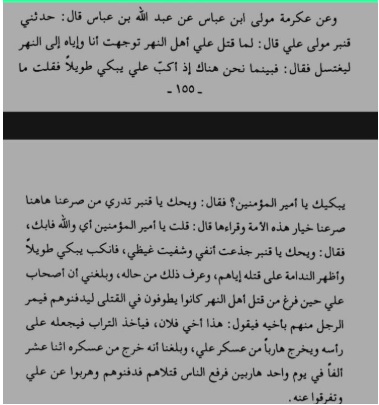
Narrated from Ikrimah, The client of Ibn Abbas, from Abdullah ibn Abbas, who narrated to him from Qunbur – the client of Ali – that when Ali had killed the people of Al-Nahr, he and I turned our faces toward the river to wash off. While we were doing so, Ali began to cry, and he cried for a long time. Then I asked him: “Why these tears, O Amir al-Mu’minin?” He said: “Woe to you, O Qunbur! Do you know whom we have just fought and killed here? We fought and killed the best of this Ummah and its reciters!” I then said: “Indeed! By Allah, it is as you say, O Amir al-Mu’minin.” I too then began to cry. Ali then said again: “Woe to you, O Qunbur,” scrunching his nose and frowning. He then cried for a long time again, and his regret for his action of killing them. The people of Al-Nahr became apparent, and we could see this from the state he had entered.
And it was told to me that after killing the people of Al-Nahr, Ali’s companions walked around surveying the dead so they could bury them. Then one of them passed by his brother’s corpse and said: “This is my brother so-and-so.” He then threw dust over his head and fled the army in anger. And those who fled the army on that very day alone numbered 12,000. They would search among the dead, see their own relatives, bury them, then flee from Ali’s army and desert him.
Source: (Al-Jawahir Al-Muntaqah – The Selected Gems – by Abul-Qasem Ibn Ibrahim Al-Barradi, may Allah have mercy on him, pp. 155–156)
Because of this, some Ibadi scholars do not advocate disavowing (bara’ah) Ali. This shows that the Ibadi position on Ali is not uniform. There is room for walayah (loyalty) and recognition of his repentance.
“Imām ‘Alī ibn Abī Tālib (may Allah honor his face) said in describing the Prophet (peace and blessings be upon him): “Whoever saw him suddenly stood in awe of him, and whoever mixed with him came to know him and loved him.” -Ustadh Zahir Al Abdissalam
“Yes. Whoever saw the Prophet (peace and blessings be upon him) at first glance, without any prior acquaintance, was filled with awe. An awe of reverence, honor, respect, and veneration. But when one mixed with him, he would come to know him. Whether in the mosque, or in the market, or on the battlefield, or on the road. He would mix with him in war and in peace; he would see his interaction with events; he would see how he mixed with people; he would see how he spoke; he would see how he scattered his pearls of wisdom—how, how, and how. He could not help but love him.” -Ustadh Zahir Al Abdissalam
“And ‘Alī (may Allah be pleased with him) spoke the truth. That presence which those noble Companions attained, those who were around the Prophet (peace and blessings be upon him). No human being can match their station; no one can reach that exalted honor, that lofty glory, that sublime rank. No one.” -Ustadh Zahir Al Abdissalam
“But that presence was not confined to the lifetime of the Prophet (peace and blessings be upon him). Whoever comes to know the Prophet (peace and blessings be upon him) through the verses of the Book of Allah—for Allah described him with those magnificent, splendid, and sublime attributes and whoever looks at what has been transmitted to us by those noble men who recorded the biography (sīrah) of the Prophet (peace and blessings be upon him), and they reached the highest level in transmitting and documenting it. He knows and realizes that that presence remains. Whether the Prophet (peace and blessings be upon him) was alive upon the earth or beneath the soil. May my father and mother be sacrificed for him, peace and blessings be upon him.” -Ustadh Zahir Al Abdissalam
“O beloved ones! In consecutive and successive sessions of a program that was previously held in the Great Mosque of Banī ‘Ubaydah in the south of Wilāyat al-Sīb.. This program is called “Malādh” and will be hosted next Thursday, starting from Thursday afternoon until the sunrise of Friday, if Allah wills. And in this edition, if Allah wills, which will be after a break. All of this by the grace of Allah. Our discussion will be about the Chosen Prophet, the Venerated, the Honored (peace and blessings be upon him). We will speak about his character, his conduct, his contemplation, some scenes from his life, and his daily routine. May the best of prayers and peace be upon him.” -Ustadh Zahir Al Abdissalam
“So whoever would like to join us, by the permission of Allah, I will attach some details to this clip for those who wish to participate. And may Allah grant us success, facilitate for us, make things easy for us, and enable us to broadcast the episodes in a live stream, if Allah wills, on the mosque’s platforms or any platform that will be announced at that time, if Allah wills. About the Prophet (peace and blessings be upon him). So that we may achieve or reach that station—the station of one who tasted and knew, and one who knew and drew, and one who drew and attained honor.” -Ustadh Zahir Al Abdissalam
Summary and Conclusion.
Qur’an 48:18 is indeterminate (open to interpretation) and can be used to support different positions.
The verse speaks generally about “the believers” who pledged allegiance. It does not name any individual. Therefore, we cannot say with certainty that it applies to any particular person. Whether Ali, Abu Bakr (ra), or the people of Nahrawan. However, it has been used to sanctify Ali, Abu Bakr (ra) and the people of Nahrawan.
This highlights the interpretive indeterminacy: the verse can be cited both to defend Ali and to condemn his actions against the Nahrawanites.
We hope this information is helpful for those seeking the truth.
You may also wish to read:
May Allah Guide the Ummah.
May Allah Forgive the Ummah.


