
“So woe to those who pray yet are unmindful of their prayers.” (Qur’an 107: 104-105)

﷽
Malik ibn Al-Huwayrith reported:
We came to the Prophet (saw) while we were young men, and we stayed with him twenty nights. Then the Prophet considered that we were anxious to see our families, so he asked us who we had left behind to take care of them, and we told him. The Prophet was kindhearted and merciful, and he said, “Return to your families, teach them, and enjoin good upon them.” Pray as you have seen me praying. When the time of prayer arrives, then one of you should announce the call to prayer and the eldest of you should lead the prayer.
Source: (https://sunnah.com/bukhari:6008)
This is a commentary on the following video:
Shaykh Uthman REFUTES Shi’i lies on Folding Hands in Prayer [MUST WATCH]
It is refreshing to see that those who claim to be following the early generations are starting to relax their position on this matter. Al hamdulillah.
For example, Salafi preacher, Assim Al Hakeem mentions that one can pray with their arms to the side with no problem.
If you pray with your hands down, your salah is still acceptable -Shaykh Uthman Ibn Farooq.
Shaykh Uthman says @0:46 “If you feel that you want to pray with your hands to your side ,and you feel that’s the correct opinion based on the evidence that you have seen, it’s up to you. No problem. That’s between you and Allah. I believe with the evidences from the Qur’an itself and from the authentic hadith of the Prophet (saw) and the sahabam, ahl bayt and others that the sunnah is to fold the hands.”
Shaykh Uthman says @1:09 “But I’m not pushing that opinion. I don’t believe in dividing the ummah based on this. I believe even if you pray with your hands down, your salah is still acceptable.”
Shaykh Uthman says @3:24 “Now when, whether you fold your hands or don’t fold your hands, personally I’m not going to argue with you on this issue. If you feel this is the way of the Prophet (saw), then that’s between you and Allah.”
Shaykh Uthman Ibn Farooq: Misquotes the Shi’i man.
@7:14 “This man is saying there’s not a single narration that shows among the Ahl Sunnah to fold the hands. That’s hwat he’s saying. Listen to him again.”
Actually, that is not what the man said.
The Shi’i man: “Within Ahl Sunnah there is no single proven tradition from the holy prophet (peace be upon him and his family in regard to folding of the hands in prayer.”
Proven (adjective) = established beyond doubt.
Something to be mindful of. The idea that something is more established than it truly is. In fact, throughout the video, Shaykh Uthman makes this claim about the Sh’ia man several times.
If one person narrates something to 50 students and those 50 students copy this narration into their books and a person quotes those 50 students, the one listening may get the false impression that the evidence is overwhelming. They may reason to themselves. “Look how many people narrate this.” However, in reality they all quote the one channel.
This is not necessarily dishonest, however, it can give the false impression that something is stronger than what it actually is.
@12:06 “But he mentioned that Ibn Mundhir has mentioned from Ibn Zubayr, from Hassan Al Basri from Nakha’i, about leaving the hands on the side. That not folding the right on the left and this was reported by an-Nawawi, upon the authority of Layth ibn Sa’ad.” (Shaykh Uthman stops reading..)
@12:26 “Now, the honesty that we believe in we quote this. We’re not going to hide anything from you.” (NOTICE THE VIDEO EDIT).
Notice, dear reader, and in this case, dear viewer, that at the point where Shaykh Uthman says, ‘We’re not going to hide anything from you.” The video skips. Which shows that part
was cut. Does this mean that nothing was hidden or revealed? Allah knows best. However, it is worth taking note of.
@12:31 “Now what does he say? He says Ibn Al Qassim has mentioned this from Imam Malik one of the great a’immah of Medina that is also reported from him Ibn Al Qassim, but he says he was opposed (@12:47 the video is cut) by Ibn Al Hikim who said that Imam Malik believed in folding the hands as well.
Prima Qur’an: Why can’t Shaykh Uthman simply quote the narration that Imam Malik regarded praying with the hands at side? The way the video is sliced and spliced is done in such a way that it skips over it.
Where did these knowledgeable salaaf get their view from about placing the hands at the side in prayer?
Abdullah ibn al-Zubayr
Al Hassan al-Basri
Ibrahim al-Nakha’i
Imam Malik
Shaykh Uthman says: @13:49 “20 authentic narrations leading back to 18 different sahaba from the Prophet (saw).”
You have to wonder if that is what Shaykh Uthman believes himself? Are all those narrations authentic? Because it is important to note what Shaykh Uthman is doing is talking about narrations concerning folding the hands in prayer.
Shayky Uthman Ibn Farooq is caught lying.
Shaykh Uthman, while reading from a text, says: @15:04 “We were ordered in the time of the Prophet (saw), as Abu Hazim has clarified, to fold the hands, right on left in the prayer.”
Which Arabic in the text below is he rendering as: ‘In the time of the Prophet’ ?
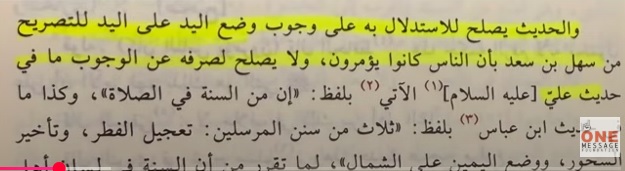
Often Shaykh Uthman makes mistakes in his Arabic.
@16:03 “Ali radianhu” ???
Insh’Allah we will come back to this hadith. This hadith they feel is their ultimate trump card. Suffice it to say that the text does not say: “were ordered in the time of the Prophet.”
They wish it said that!
We remind Shaykh Uthman the seriousness about lying on the Blessed Prophet (saw).
Narrated `Ali:
The Prophet (saw) said, “Do not tell a lie against me for whoever tells a lie against me (intentionally) then he will surely enter the Hell-fire.”
Source: (https://sunnah.com/bukhari:106)
The word intentionally is not in the Arabic text.
Does the Qur’an mention anywhere about the placement of the hands?
“Therefore pray to your Lord and make a sacrifice.” (Qur’an 108:2)
https://www.islamawakened.com/quran/108/2/
Does this really need any comment? Does one really see anything in this text about the placement of hands in the prayer?
Shaykhk Uthman says: @17:12 “Imam Malik himself and I’m going to put a link to the Muwatta Imam Malik in the description. He has an entire chapter in his Muwatta about folding the hands in prayer; from the people of Medina. Not a single hadith in the Muwatta, not a single chapter that says, ‘dangle the hands in prayer’. And Imam Malik style of writing if he saw the people of Madina doing something opposite to that which was narrated, then in the Muwatta he would write, ‘This is what is narrated, but the people of Madina
did opposite. But he did not say that about folding the hands.”
There are a few points to take note of.
- The Muwatta is not the only work attributed to Imam Malik. The following are also attributed to him.
- al-Mudawwanah al-Kubrā
- Risālat Mālik ilā al-Layth ibn Saʿd
- al-ʿUtibiyyah
2. @12:31 Shaykh Uthman didn’t actually give us the quote that is from Malik on his stance.
3. As we mentioned in our other article. Just because someone narrated something doesn’t mean they acted upon what was narrated. Narrating a hadith shows awareness of its existence.
Abu Dawud transmitted the following hadith:
- Hands below the navel
- On the chest
- And even hands to the sides
You can read more about that here:
4. Fiqh is stronger than hadith. Hadith is a narration and fiqh is understanding of the narration.
We mentioned that we would come back to this: “were ordered in the time of the Prophet.”
Narrated Sahl bin Sa`d:
The people were ordered to place the right hand on the left forearm in the prayer. Abu Hazim said, “I knew that the order was from the Prophet (saw) .”
Source: (https://sunnah.com/bukhari:740)
So for them this hadith serves as a neutralizer to any idea of the Blessed Prophet (saw) praying with arms to the side.
Go look at how the render the English over here: (https://sunnah.com/bukhari:740)
What a juciy dishonest lie! In plain sight!
The whole of the Arabic text actually says:
Abdullah ibn Maslamah narrated to us, from Malik, from Abu Hazim, from Sahl ibn Sa’d, who said: “People were commanded that a man should place his right hand on his left forearm during prayer.” Abu Hazim said: “I know of it only as being attributed to the Prophet (peace be upon him).” Isma’il (a narrator in the chain) said: “It is attributed” — and he did not say “he attributes it.”
Effectively, the hadith they think is a trump card actually is an athar. It doesn’t describe something that the Blessed Prophet (saw) did. It describes actions that people did that were attributed to the Prophet (saw).
A note about Sahl ibn Sa’d: He lived to see the Umayyad imperium.
Al-Bukhari’s hadith comes through two chains: one from ‘Abdullah ibn Maslama and the other from Isma‘il ibn Abi Uways, both narrating from Imam Malik ibn Anas, from Abu Hazim, from Sahl ibn Sa‘d, who said: “The people used to be commanded…”
• In the narration of ‘Abdullah ibn Maslama, Abu Hazim said: “I do not know it except that he attributes it (yanmī dhālika) to the Blessed Prophet (saw).”
• In the narration of Isma‘il ibn Abi Uways, it says: “I do not know it except that it is attributed (yunmā dhālika) to him.”
Based on this, the hadith is defective (ma‘lūl), weak, and cannot be used as evidence, because it is merely Abu Hazim’s supposition, and it is also inconsistent (muḍṭarib).
20 different chains from 18 different sahabah?
A Sunni, Maliki scholar Shaykh Abdullah bin Hamid Ali translated a work that showed the problems in these chains.
So when the Shi’i man says: “Within Ahl Sunnah there is no single proven tradition from the holy prophet (peace be upon him and his family in regard to folding of the hands in prayer.”
Proven (adjective) = established beyond doubt.
This is correct.
As the article by Shaykh Abdullah states:
“True or not, there exists sufficient doubt about every single report that exists to this effect that weakens the “popular” claim and understanding that it is well established that the Prophet prayed while placing one hand over the other.”
You may also be interested in reading the following:
Final thoughts.
Shaykh Uthman Ibn Farooq, his first point, lands hard. That was quite embarrassing for the Shi’i to quote that as a reference. Also, something Shi’i has to contend with is the idea of women praying with their hands folded.
However, Shaykh Uthman Ibn Farooq himself blatantly lied and misled his audience concerning what the Arabic text said.
May Allah Guide the Ummah.
May Allah Forgive the Ummah.


 Prima Quran