“Indeed, We created humans in the best form.” (Qur’an 95:4)
﷽
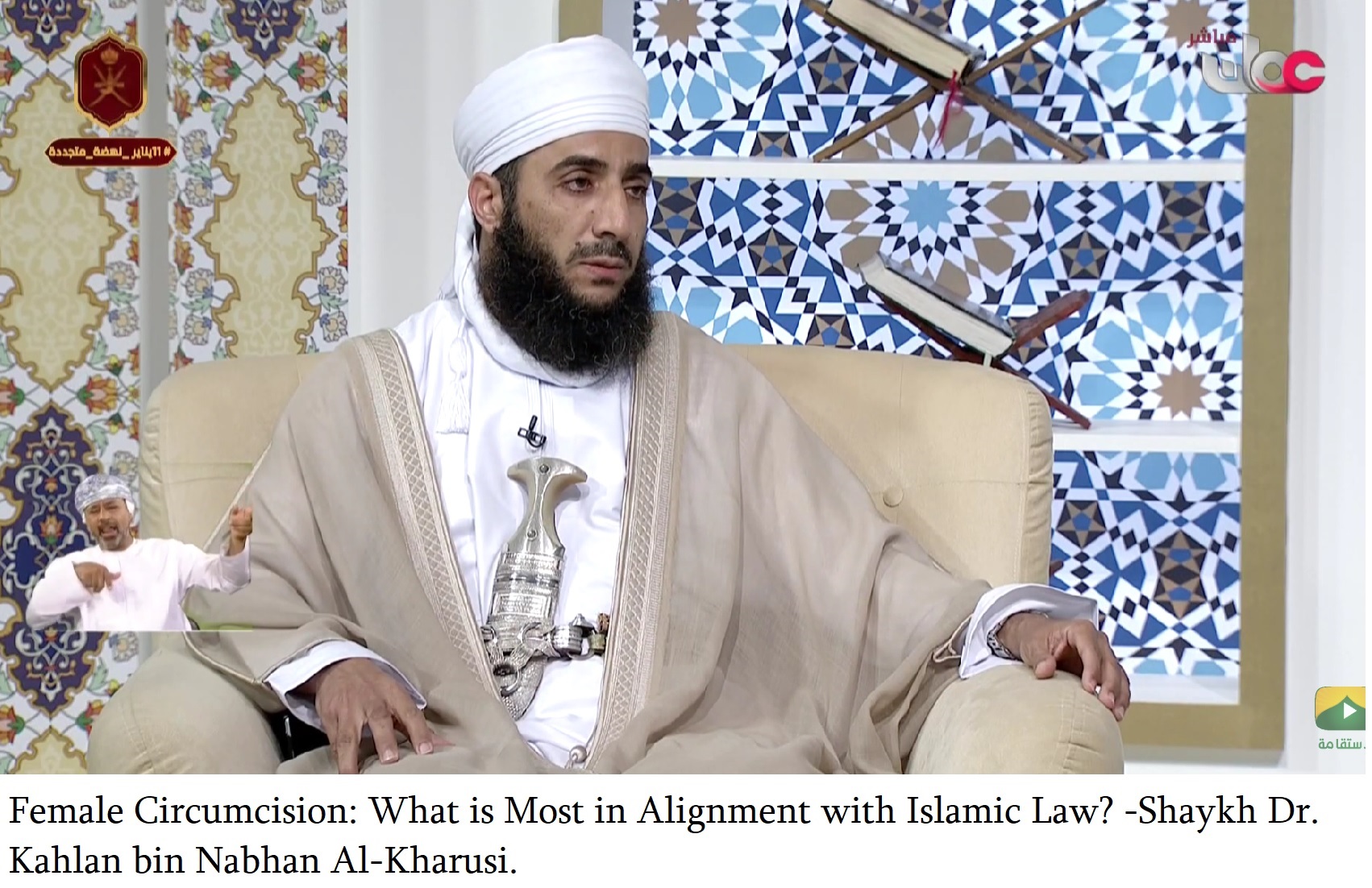
An interview with the honourable Shaykh Dr. Kahlan bin Nabhan Al-Kharusi on a very important topic.
Translation is as follows:
We come to another topic, and this time it relates to the circumcision of girls. Yes. Perhaps among the customs and traditions that people have inherited is that a girl must be circumcised just as a boy is circumcised. You mentioned in a previous fatwa that this means something permissible perhaps an advisory Sunnah was reported regarding it. However, people have greatly expanded in taking this concession that you spoke about, this permissibility, and they have begun committing acts that may not be good, that are harmful to the girl. So now, has your fatwa changed on this topic?
“No, the fatwa has not changed, and the fatwa, considering what exists in our jurisprudential heritage, was contrary to much of what the scholars of religion said on this matter.” -Shaykh Dr. Kahlan bin Nabhan Al-Kharusi
Yes.
“Rather, I said in it that my wish was that Muslim doctors would speak about this matter.” -Shaykh Dr. Kahlan bin Nabhan Al-Kharusi
Yes.
“What I mentioned in that answer was shocking to many jurists and students of Islamic legal knowledge because it was contrary to what they are accustomed to.” -Shaykh Dr. Kahlan bin Nabhan Al-Kharusi
Aha.
“Let us clarify the matter once again. The narrations that have come regarding the practice of khafd (female circumcision), which is known as circumcision for females. They are not free of criticism. None of these narrations can be relied upon with confidence. All the narrations that have come are not free of weakness, not free of defect.” -Shaykh Dr. Kahlan bin Nabhan Al-Kharusi
Yes.
“And what can be accepted with great leniency from these narrations does not, in reality, indicate what many jurists have concluded. Some narrations, for example, such as the narration that circumcision is an honor for the woman. It contains no legal ruling, so it cannot be used even to establish recommendation (istihbab), because this description “an honor for the woman” does not indicate a legal ruling.” Shaykh Dr. Kahlan bin Nabhan Al-Kharusi
Yes.
“And the Messenger of Allah’s instruction (peace and blessings be upon him and his family) in another narration which is one of the most relied-upon narrations by those who hold the view of recommendation and those who hold the view of obligation regarding circumcision for females is that he said to Umm Atiyya: “Trim but do not exhaust” or “reduce but do not exhaust”. This indicates the opposite of what was intended, it indicates the opposite of what many jurists have said, even assuming acceptance of this narration with great leniency.” -Shaykh Dr. Kahlan bin Nabhan Al-Kharusi
Yes.
“Moreover, I am more convinced by the view of those jurists and scholars, both early and late, who held that all these narrations are not free of criticism. Nevertheless The Messenger of Allah (peace and blessings be upon him) it is not established that he instructed anyone to do it, or commanded it for his daughters or his wives (peace be upon him) or the believing women. It is only according to the narration that when he migrated to Medina, a woman who performed circumcision said to be Umm Atiyya al-Ansariyya asked him, and he said to her: “Trim but do not exhaust.” Now this indicates that the intent was to lighten a practice that already existed.” -Shaykh Dr. Kahlan bin Nabhan Al-Kharusi
Yes.
“And therefore the guidance was for “ishmam” (light touching), for minimal taking without exaggeration. It is also apparent from this report, assuming its acceptance once again that the woman was qualified and capable of doing it properly, otherwise the Messenger of Allah (peace be upon him) would never have permitted her!” -Shaykh Dr. Kahlan bin Nabhan Al-Kharusi
Yes.
“So now let us summarize what we have said so far.” -Shaykh Dr. Kahlan bin Nabhan Al-Kharusi
Aha.
“None of the narrations that have come regarding female circumcision, regarding the circumcision of girls, is free of criticism that weakens it. Right?” -Shaykh Dr. Kahlan bin Nabhan Al-Kharusi
“And accordingly, the utmost that can be said is that it is among the permissible matters. Among the permissible matters in Islamic law. Now we say it is permissible, that it is within legal permissibility, if it is done by someone who is qualified and knowledgeable, aware of the correct method, taking the necessary precautions, and not exaggerating in it.” -Shaykh Dr. Kahlan bin Nabhan Al-Kharusi
Yes.
“So if we say it is permissible, and it is established that it is in fact practiced by people; meaning when we say it is permissible, the first conclusion we arrive at is that leaving it involves no sin in Islamic law and no wrongdoing.” -Shaykh Dr. Kahlan bin Nabhan Al-Kharusi
Yes.
“And this is an important conclusion. We respect the views of our imams and scholars from the various Islamic schools of thought. Perhaps some early Shafi’i scholars are among those who held it obligatory, and some Hanbali scholars, but others among the scholars of the Islamic schools for example, the Ibadi, Hanafi, and Maliki did not go that far. Some of them spoke of permissibility, and some said it is recommended, and they did not mention the derived legal evidence. These jurisprudential views are respected and are part of our Islamic heritage, but they should be understood, in terms of legal ruling, in light of the evidence that reached them.” -Shaykh Dr. Kahlan bin Nabhan Al-Kharusi
Yes.
“And in terms of actual practice, they never intended that it be done by women who lack qualification, knowledge, sufficiency, and capability, and who do not take the necessary precautions to avoid harming the girls.” -Shaykh Dr. Kahlan bin Nabhan Al-Kharusi
Beautiful.
“So since the matter is such that it is no more than permissible, and there is no sin in leaving it and no wrongdoing upon one who leaves it, then we can take the matter further than this.” -Shaykh Dr. Kahlan bin Nabhan Al-Kharusi
Yes.
“Because what has happened in people’s actual practice is poor application, even in this act. On one hand, as you noted, they imagine legal rulings that have been shown to have no validity or to be exaggerated. But in practice, there are many incidents in which young girls have suffered great harm from bleeding or tearing, yes? Or exaggeration in exhausting to the point of affecting the urinary tract and the genital area.” -Shaykh Dr. Kahlan bin Nabhan Al-Kharusi
Yes.
“Not to mention the injury and impact on the ability to conceive and bear children and on legitimate enjoyment in marriage And these are cases I have personally seen, seen from reality. Therefore, since the matter reaches this level of harm and damage, and lack of knowledge of correct application and correct execution even in the permissible amount; especially since it is not studied in medicine at all. There are no women practicing surgery for women who know how to do it, because contemporary medical sciences do not teach it. There are no specifications, no method, no standards, no procedure for doing it which is unlike the obligatory circumcision for males.” -Shaykh Dr. Kahlan bin Nabhan Al-Kharusi
Yes.
“This is not studied at all; it is not in the curricula. And what some Muslim doctors have mentioned of benefits and advantages of it unfortunately, in following up, I did not find that they rely on scientific evidence. They were advocating for jurisprudential views, and they should have stopped at the limit of permissibility.” -Shaykh Dr. Kahlan bin Nabhan Al-Kharusi
Yes.
“Because establishing health benefits should be based on sound medical evidence.But we do not find this. We find descriptions and praise and mentions, but without relying on sound scientific evidence that could be relied upon. And even if that were established, it would be conditional on correct execution but if it cannot be executed in a correct manner, because there is no one who can do it at all, since it is not studied and does not exist in medical curricula, then leaving it in this case is preferable either it is viewed as restricting the permissible due to the harms resulting from doing it, or it is viewed through the principle of blocking the means that lead to harm, damage, and corruption for the girls for whom it is done. And Allah Almighty knows best. And forgive me for the length.” -Shaykh Dr. Kahlan bin Nabhan Al-Kharusi
Okay, but the question relates to this topic. Since you mentioned that you have seen cases through perhaps your contact with doctors and your participation in biology conferences
Yes.
Is it permissible because no text prohibiting it has come, for example, or forbidding it? Or because the evidence found leads to the conclusion that it is permissible? Why is it not forbidden if it leads to such harms? The matter is very open.
“The view of prohibiting it is based only on what was mentioned previously.” -Shaykh Dr. Kahlan bin Nabhan Al-Kharusi
Yes.
There is no text from which prohibition can be taken from a prohibition by the Messenger of Allah (peace and blessings be upon him and his family). Rather, it is based on what was mentioned previously. And therefore a group and this can increase people’s confidence; a group of fatwa bodies and fatwa institutions in our Islamic countries today are also saying to prohibit this act.” -Shaykh Dr. Kahlan bin Nabhan Al-Kharusi
Yes.
“And they say so also because of what they have learned and reached regarding the weakness of the evidence that has come on this matter, and because of what has been established for them of poor practice leading to great harm and extreme harm.” -Shaykh Dr. Kahlan bin Nabhan Al-Kharusi
“It has reached the point with some circumcisers that they perform it behind hospitals and health centers because they know the result so that it may be closer to rescue and first aid, they do it near hospitals. And there is no limit to what could be said about the instruments used they are far removed from the health requirements required in this matter, let alone complete ignorance of it. The cases that the Omani female doctors told us about are not minor cases that can be overlooked.” -Shaykh Dr. Kahlan bin Nabhan Al-Kharusi
Yes.
“But what remains is that the foundation we rely on is: is this matter obligatory in the religion of Allah, Blessed and Exalted? Is it recommended and called for? The matter is not so.”-Shaykh Dr. Kahlan bin Nabhan Al-Kharusi
Yes.
“Is it permissible? Yes, we cannot say it is not permissible. But permissibility is restricted by what was mentioned previously of light touching, minimal taking and that it be done by someone with complete knowledge and understanding. But even so, can this permissibility be restricted due to the magnitude of harms that result from its application and practice? Yes, it can be restricted, as is the case with a number of permissible matters. Therefore, the view that is most convincing and most suited to people’s conditions today is to leave this act. And Allah Almighty knows best.” -Shaykh Dr. Kahlan bin Nabhan Al-Kharusi
Let us now move the ruling from the act to the actor. By this we are meaning the one who performs this task but does not possess this expertise. Is she committing something forbidden?
“Yes, she is committing a forbidden act, since she is ignorant. And whoever practices medicine without medical knowledge is liable. Yes.” -Shaykh Dr. Kahlan bin Nabhan Al-Kharusi
This is narrated as a report, but it has become a legal maxim. There is no doubt that such an act originally requires knowledge, understanding, and science, and that one should adhere to that. That is why, as mentioned, these reports. Yes, there are narrations about naming the place “al-khatanun” (the two circumcisers). These are sound hadiths, but we know that in such dual-form names, the description may often be used by predominance.” -Shaykh Dr. Kahlan bin Nabhan Al-Kharusi
Yes.
“For example It is said “the two black ones” for dates and water by predominance. It is said, for example, “the two moons” for the sun and the moon, by predominance. So this does not mean that the description applies to both described things together?” -Shaykh Dr. Kahlan bin Nabhan Al-Kharusi
Yes.
“Therefore we said that the view in principle is permissibility restricted by its conditions. But this permissible act should now be left because of the transgression that has occurred in it, the severe harms that have afflicted girls, the lack of a sound scientific method, and the lack of qualified people to perform it. And Allah Almighty is the one whose help is sought.” -Shaykh Dr. Kahlan bin Nabhan Al-Kharusi
Yes, may Allah reward you with good. Thank you. Yeah.
Prima Qur’an comments:
People come in different shapes, colours and sizes. Some people have features distinct from others. This is part of our diversity. It is plausible that some women have larger labia than other women. So perhaps in the view of some cultures they felt having a larger labia would not be appealing to a prospective partner. It could also be due to what they perceive as hygene related. Perhaps in places where water was scarce and sand is plentiful this practice came about.
After all, in the event of no availability of water or the preference to preserve the water for drinking we as Muslims perform tayammum.
Also, as the Shaykh mentinoned we also know of couples whose intimacy has been ruined through this practice. Some layman whom we spoke with from the Shafi’i school had insisted that the practice is to keep the excitability of women in check! Very unfortunate!
However, we do not know any reason that has any merit for the excising of a woman’s clitoris!
There is a principle in Shari’a law
لا ضرر ولا ضرار
“Lā ḍarar wa lā ḍirār” = No harm and no reciprocating harm.
Abu Sa‘īd al-Khudri reported: The Messenger of Allah (saw) said: “There should be no harm or reciprocal harm. Whoever causes harm, Allah harms him, and whoever makes things difficult, Allah makes things difficult for him.
We also have in Islamic law we also have what is known as: ‘Preventing harm takes precedence over attaining benefit.’ This is also known as: darʾ al-mafāsid muqaddam ʿalā jalb al-maṣāliḥ.
Thus, as the Shaykh said we have no proof text that explicitly forbids the practice. We also have no proof text that estabilshes that this was done by the Blessed Prophet (saw). It is not established that he instructed anyone to do it, or commanded it for his daughters or his wives (peace be upon him) or the believing women.
Examination of the ‘go to’ hadith itself.
As the Shaykh mentioned the hadith is weak. In fact, Imam Abu Dawud (the one who transmits this hadith) himself said it was weak!
Narrated Umm Atiyyah al-Ansariyyah:
A woman used to perform circumcision in Medina. The Prophet (ﷺ) said to her: Do not cut severely as that is better for a woman and more desirable for a husband.
Abu Dawud said: It has been transmitted by ‘Ubaid Allah b. ‘Amr from ‘Abd al-Malik to the same effect through a different chain.
Abu Dawud said: It is not a strong tradition. It has been transmitted in mursal form (missing the link of the Companions)
Abu Dawud said: Muhammed b. Hasan is obscure, and this tradition is weak.
However, when you click on the link above you will find that al-Albānī (Shu’ayb al-Arna’ut) gave the hadith a grade of Sahih (meaning sound)!
So from our perspective (speaking of the Prima Qur’an team) if an adult woman of sound mine wants to have this procedure than proceed. However, as it is very clear that infants, tolddlers and small children are not capable of giving thier consent it is best to abandon this practic altogether. Allah knows best and his help is sought. May Allah (swt) assist Shaykh Dr. Kahlan bin Nabhan Al-Kharusi in bringing light to the people!
For the interested Omani law states as follows:
Child Law (Article 20): Explicitly prohibits any person (especially doctors, nurses, and guardians) from engaging in, promoting, or assisting in “harmful traditional practices to the child’s health”.
Executive Regulations of the Child Law (Ministerial Decision No. 125/2019, Article 4): This is the crucial defining clause, which explicitly lists “female genital mutilation of any kind” as a “harmful traditional practice to the child’s health”.
Penalties (Child Law, Article 67): Violators face imprisonment of no less than 6 months and no more than 3 years
If you have found this entry informative you may enjoy the following articles:
“He said: “Allah only accepts from the righteous.” (Qur’an 5:27)
﷽
To be clear what we are saying is that one who commits a major sin nullifies their fast for the day that they commit the sin on. We are not saying that it invalides the entire fast of Ramadan.
Based upon the Qur’an and Sunnah: acts of worship are not merely valid or invalid based on external conditions (shurūṭ). They are real (accepted) or unreal (rejected) based on whether they achieve their intended effect.
Ṣalāh without khushū‘ and without abandoning ḥarām is not ṣalāh. It is mere movement.
Ṣawm without abandoning ḥarām is not ṣawm. It is mere hunger.
Zakāh given from ḥarām wealth is not zakāh. It is mere transfer of property.
Ḥajj without taqwā is not ḥajj. It is mere travel.
“He said: “Allah only accepts from the righteous.” (Qur’an 5:27)
This serves as a sufficient proof that Allah Almighty does not accept any act of worship from a disobedient person; this is the essential point, and there are numerous hadith that support this as well.
Similarily, if you turn to the Qur’an, there are many verses indicating that the deeds of a disobedient person are cast back upon him; the hadith also attest to this.
The Mixture of Righteous and Evil Deeds
Obedience and disobedience cannot occupy the same place in the heart of the diligent worshipper.
“And (there are) others who have acknowledged their sins, they have mixed a deed that was righteous with another that was evil. Perhaps Allâh will turn unto them in forgiveness. Surely, Allâh is Oft-Forgiving, Most Merciful.” (Qur’an 9:102)
Understanding the above evidence.
Allah (swt) says that the mixing of a righteous deed with another deed that was evil is acknowledged as a sin. It is like mixing pure water with toxin. The combination of the two is still toxic. The mixture is defined by the toxin, not the water. Allah (swt) doesn’t accept this mixture.
The Meaning of “La‘allakum Tattaqūna”
“O you who believe, fasting is prescribed upon you as it was prescribed upon those who were before you, so that you may become righteous.” (Qur’an 2:183)
la’allakum tattaqūna From the perspective of Arabic grammar la’alla is to achieve the reason for something. It is not to achieve the hope. For example: In English we might say, ‘Maybe I come to you’. The Arabic here is not about aiming for a ‘maybe’.
The grammatical analysis of Qur’an 2:183 is correct from the Ibadi perspective. The particle لَعَلَّ (la‘alla) here expresses purpose and intended outcome, not mere possibility or hope. The verse establishes taqwa as the raison d’être of fasting—the goal to be achieved. Fasting that does not produce taqwa has failed its purpose.
The Arabic here is talking about the reason and what is to be achieved! So the reason for fasting is to achieve taqwa!
In reality this is for all our ibadat. All our worship is to achieve this aim.
This is indicated by the verse:
“O mankind! worship your Lord, the One Who created you and those from before you, so that you may become righteous.” (Qur’an 2:21)
Two Possible Understandings of the Failure of Fasting
Understanding 1: The fast is valid but fruitless. The person fasted correctly. They abstained from food, drink, and marital relations during the prescribed hours. However, the fast did not produce taqwa because they did not couple it with obedience in other matters. The fast “failed its purpose” but was still technically performed.
Understanding 2: The fast was never truly performed. The Ibadi position is stronger and more consistent. If the person did not achieve taqwa, it is not that they fasted and the fast was deficient—rather, they did not truly fast at all. What they did was merely imsāk (abstention), not siyām (fasting). The outward form was present, but the reality was absent.
Why Understanding 2 is More Consistent
If لَعَلَّكُمْ تَتَّقُونَ expresses the purpose and intended outcome of fasting, that it is not merely a hoped-for side effect; then the relationship between fasting and taqwa is not accidental but essential. A thing that does not achieve its essential purpose is not truly that thing at all!
This aligns with the following hadith:
It was narrated from Abu Hurairah that the Messenger of Allah (saw) said:
“There are people who fast and get nothing from their fast except hunger, and there are those who pray and get nothing from their prayer but a sleepless night.”
The Blessed Prophet (saw) does not say they did not fast. He says they get nothing from their fast—meaning what they did was not fasting in the true sense. It was hunger without siyām.
And the following hadith:
Narrated Abu Huraira:
The Prophet (saw) said, “Whoever does not give up false statements (i.e. telling lies), and evil deeds, and speaking bad words to others, Allah is not in need of his (fasting) leaving his food and drink.”
Here the blessed Prophet (saw) is telling us by way of inspiration that Allah (swt) is saying:
I do not accept this as fasting at all. The person left food and drink, but that leaving was not siyām; because siyām by definition includes the abandonment of prohibitions.
The narration from Ibn Abbas (ra) makes this explicit:
Abu Ubaydah narrated from Jabir ibn Zayd, from Ibn Abbas, from the Prophet (saw), who said: “There is no faith for the one who does not pray, and there is no prayer for the one who does not perform ablution; and there is no fasting except by refraining from what Allah has forbidden.”
لَا صِيَامَ—”there is no fast”—not “there is no reward for the fast.” The fast itself does not exist for the one who has not abandoned prohibitions.
The grammatical point reinforces this.
If لَعَلَّ in the Qur’an expresses purpose (the ‘illah for which fasting was prescribed), then taqwa is not something added to fasting. It is the very thing fasting is meant to produce. A fast that does not produce taqwa is like a medicine that does not cure: it was not taken properly, the individual did not follow the instructions.
But the Qur’an makes it very clear : the fasting itself was not real fasting. The person may have gone through the motions, but siyām as Allah defined it never occurred.
The Qur’anic Pattern: Deeds that are “Ḥabiṭa” (Nullified)
This is why the Qur’an speaks of deeds being حَبِطَتْ (nullified, come to nothing):
“Those who disbelieve and avert from the way of Allah. He will waste their deeds.” (Qur’an 47:8)
“O you who have believed, obey Allah and obey the Messenger and do not invalidate your deeds.” (Qur’an 47:33)
The Qur’an and Sunnah repeatedly inform us that disobedience nullifies worship, not merely diminishes its reward. The deed is not stored up and then deducted from. No! It is erased. It never reached the stage of acceptance because it was never truly performed as an act of worship.
“Be quick in the race for forgiveness from your Lord, and for a Garden whose width is that (of the whole) of the heavens and of the earth, prepared for the righteous.” (Qur’an 3:133)
“Those who, upon committing an evil deed or wronging themselves, remember Allah and seek forgiveness for their sins and who forgives sins except Allah? And they do not knowingly persist in wrongdoing.” (Qur’an 3:135)
Examples that would nullify our fasting without doubt:
Watching porn even with no fap.
Deliberately sleeping through an entire prayer time. People literally skip dhur and imagine their fasting is still accepted.
Lying, doing all sorts of evil deeds, fighting with others.
Wasting time in Ramadan.
Wasting time in the month of Ramadan. The month of Ramadan is a barakah. If we do not seize on it by utilizing the time for baraka we literally wasting time.
Allah does not love those who waste.
“O Children of Adam! Dress properly whenever you are at worship. Eat and drink, but do not waste. Surely He does not like the wasteful.” (Qur’an 7:31)
If you are not engaged in something fruitful especially in the month of Ramadan, like reading the Qur’an or reading beneficial books in general. Excercising, doing volunteer work. Assisting those in need rather they be your family, friends or the local community or doing superagatory acts of worship. Then what are you engaged in? Vain and idle talk? Playing video games hours on end? Window shopping with no clear goal or objective.
The phrase: “Passing the time” should be a disliked phrase for us in the blessed month of Ramadan. We should replace ‘passing the time’ with ‘investing with time’ We should be engaging with the time Allah blessed us with. ‘Passing the time’ sounds like one who is in a state of boredom or doing some repetitive taslk in which they find no joy in. ‘Passing the time’ treats time as an obstacle to be endured rather than a blessing to reap. In Ramadan, this is a spiritual failure.
Fasting has not failed to become the spiritual engine of the Muslim Ummah. It is that the Ummah has followed interpretations and misunderstandings that have not allowed the Muslim Ummah to ignite this spiritual engine!
Thus, we particpate in collective movement in Ramadan. We partcipate in collective obstaining from food and drink. But somehow collectively the ummah’s engine is not jump started. The engine is not ignited because the fuel (taqwa) is not being produced.
The Ummah’s engine does not start because we have not connected the fast to its purpose. We have the form. We lack the reality.
If you have enjoyed this article you may like our series on Ramadan here:
“Satan made their evil deeds appealing to them, hindering them from the right way, although they were capable of reasoning.” (Qur’an 29:38)
﷽
First and foremost, please stop reading this if you are someone who has had a past of sexual abuse and/or has been traumatized by sexual abuse. This post is likely to trigger unwanted emotions or memories that we would rather not stir.
Kindly be advised.
Indeed as Allah (swt) informs us that Satan often may make our deeds appealling or fair seeming to us even though we are capable of reasoning.
In Islamic jurisprudence, extreme need or a state of dire necessity is called ‘ḍarūrah’
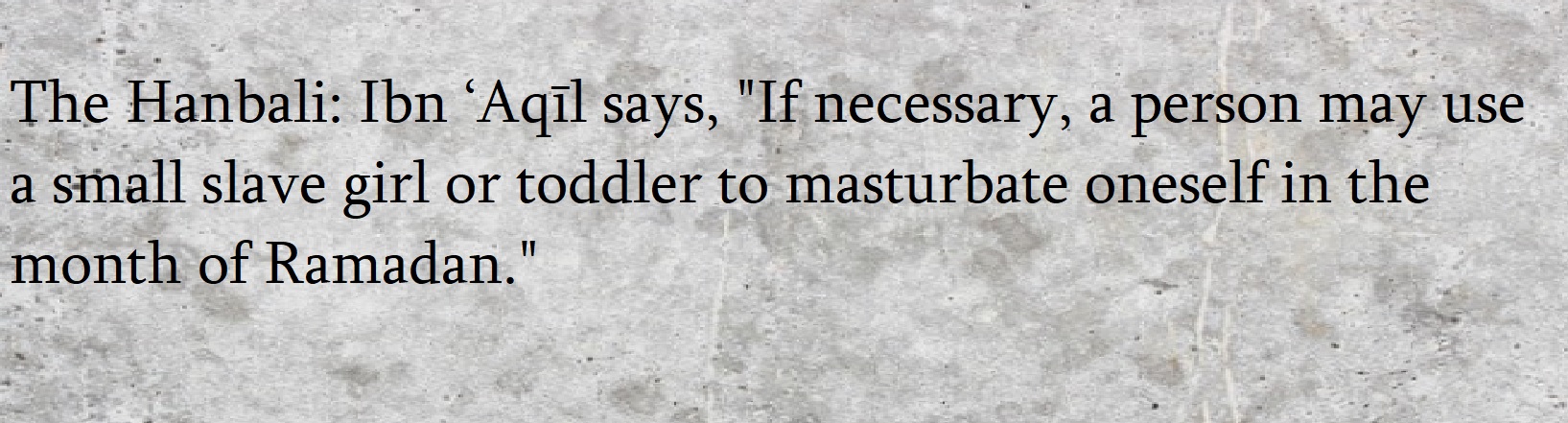
Our opponents inform us that what is being addressed is a case of ‘ḍarūrah‘. Such that if a man is fasting in the month of Ramadan and he feels that is very testicles are going to explode that he may alleviate himself via masterbating using the hand of a small slave girl or a toddler.
The logic is medical and legal: if the desire is so severe that it threatens physical injury, the lesser harm (masturbation) is permitted to avoid the greater harm (rupture).
While this is a real conditon known as: Epididymal hypertension, or commonly known as “blue balls,” is a temporary, harmless aching or heavy feeling in the testicles caused by prolonged sexual arousal without ejaculation.
Epididymal hypertension is not fatal. There have been no recorded cases (that we are aware of) where a person has died from such a condition.
Unfortunately, such lack of understanding has led to legal verdicts that undermine the rights of children, violate the sacred law and perpertuate an environment of exploitation of children.
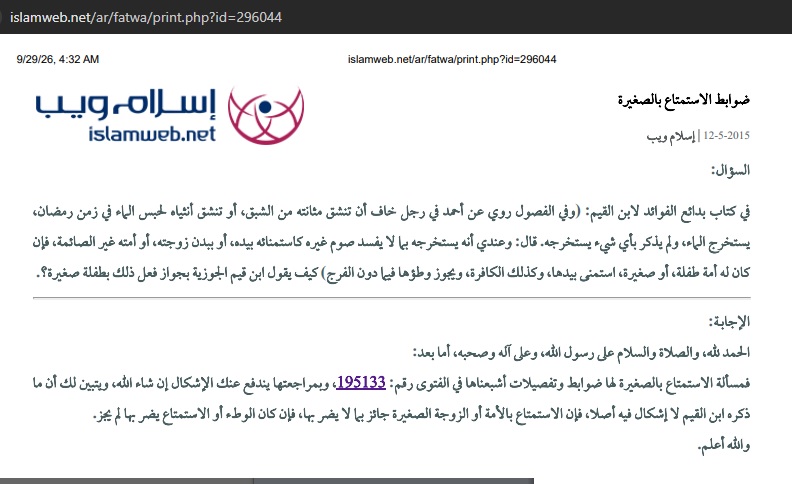
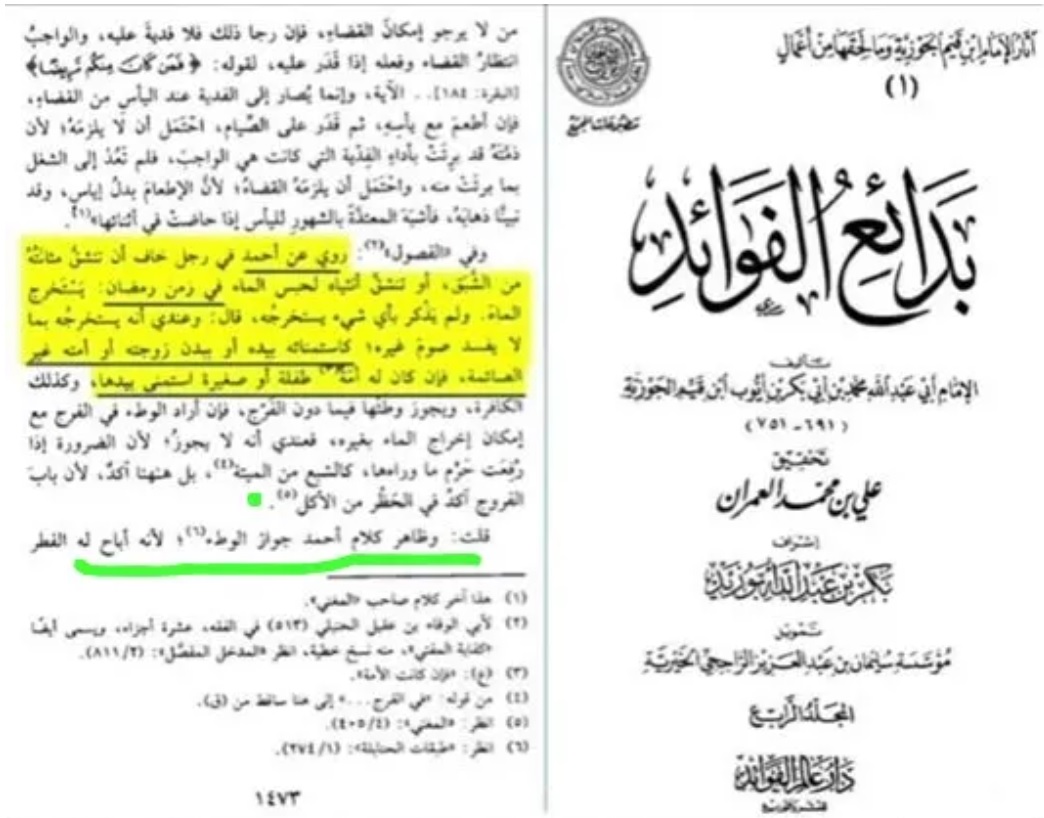
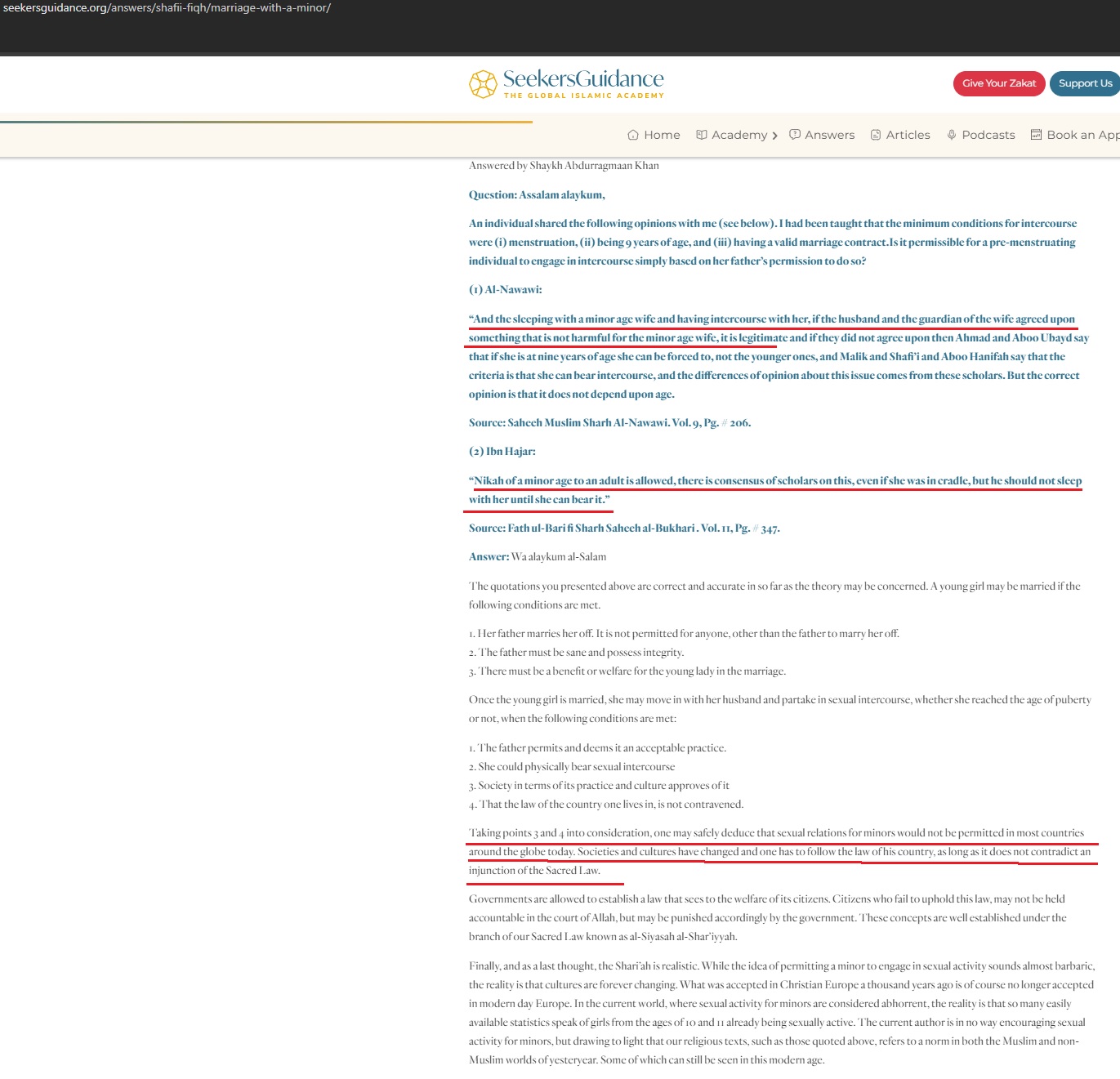
You can see from the following that someone has doubts about this and so he asked an explanation from this Salafi/Athari/Hanbali affiliated website:
Question: In Ibn al-Qayyim’s book Bada’i’ al-Fawa’id: And in al-Fusul it was narrated on the authority of Ahmad concerning a man who feared that his bladder would burst from lust, or that his testicles would burst from retaining water during Ramadan, that he should extract the water, and he did not mention with what he should extract it. He (Ibn ‘Aqīl) said: And in my opinion, he should extract it with something that does not invalidate the fast of others, such as masturbating with his hand, or with the body of his wife, or his slave girl who is not fasting. If he has a slave girl who is a child, or a young girl, he should masturbate with her hand, and the same applies to a non-Muslim girl, and it is permissible to have intercourse with her in a way that does not invalidate the fast of others) How can Ibn Qayyim al-Jawziyya say that it is permissible to do that with a young girl?
Answer: Praise be to Allah, and peace and blessings be upon the Messenger of Allah, and upon his family and companions. Now then: The issue of enjoying a young girl has rules and details that we have thoroughly discussed in Fatwa No. 195133. By reviewing it, the problem will be resolved for you, Allah willing, and it will become clear to you that what Ibn al-Qayyim mentioned is not problematic at all. Enjoying a young slave girl or wife is permissible as long as it does not harm her. If intercourse or enjoyment harms her, then it is not permissible.
Translation: “It is narrated on the authority of Ahmad concerning a man who feared that his bladder would rupture from lust or that his testicles would rupture from retaining semen during Ramadan. He was instructed to release the semen, but it was not specified how. He (Ibn ‘Aqīl) said:
“In my opinion, he should release it in a way that does not invalidate the fast of others, such as masturbating with his hand or with the body of his wife or his non-fasting slave girl. If he has a young slave girl or toddler, he may masturbate with her hand, and the same applies to a non-Muslim slave girl. It is permissible to have intercourse with her in a manner other than penetration. If he desires vaginal intercourse when it is possible to release the semen in another way, then in my opinion, it is not permissible, because when necessity is removed, what lies beyond it is also forbidden.”
Now pay close attention:
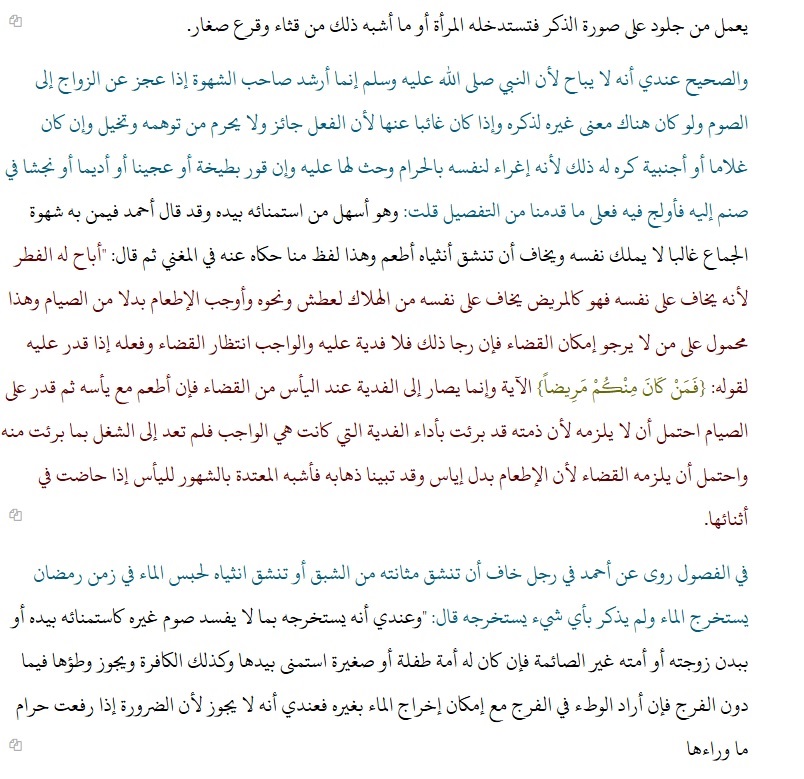
From the green dot we can see Ibn al-Qayyim give the least problematic view of the three (between himself, Imam Ahmad and Ibn ‘Aqīl) he states: “And it is more appropriate that he masturbate with his own hand, and not with the hand of another.”
The underlined green text is Ibn al-Qayyim saying: “And the apparent meaning of Ahmad’s words is the permissibility of intercourse in the vagina with dislike.”
So how would Ibn al-Qayyim know this?
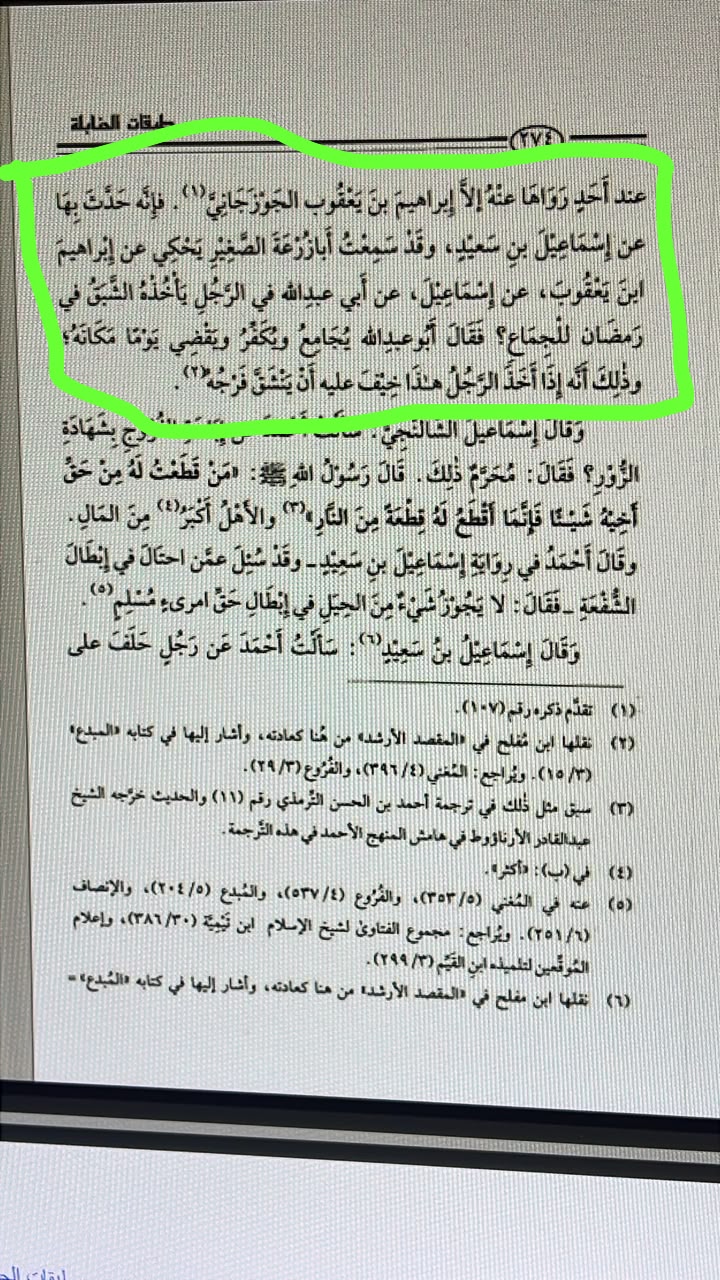
Ibn al-Qayyim would have access to the: Ṭabaqāt al-Ḥanābilah
The text with green highlight: “According to Ahmad, apart from Ibrahim ibn Yaʿqūb al-Jawzajānī, for he narrated it from Ismāʿīl ibn Saʿīd, and I have heard Abū Zurʿah al-Ṣaghīr narrating from Ibrahim ibn Yaʿqūb, from Ismāʿīl, from Abū ʿAbdillāh, regarding a man who is seized by desire in Ramadan for intercourse. He said: Abū ʿAbdillāh said: He has intercourse and expiates, and he fulfills his wife’s need. And that is because if the man takes [her], then it is obligatory upon him to fulfill her desire.”
So it is very likely that Ibn ‘Aqīl was commenting on what he saw as a deficiency on Imam Ahmad’s answer. The assumption that one has a wife. The assumption that the wife is not menstrating.
Ibn Al-Qayyim and Ibn ‘Aqīl: Who are they?
Ibn al-Qayyim (d. 751 AH) is a central figure in the Hanbali school. He was the foremost student of Ibn Taymiyyah and authored numerous influential works in fiqh, theology, and spirituality. His recording of this opinion in Badāʾiʿ al-Fawāʾid means it is preserved within the Hanbali scholarly tradition.
Ibn al-Qayyim recorded this opinion in his book, Badāʾiʿ al-Fawāʾid, and he is indeed a major authority of the Hanbali school.
Ibn ‘Aqīl (Abu al-Wafa’ Ali ibn Aqil, d. 513 AH) is a major Hanbali authority. He was one of the most prominent Hanbali jurists and theologians of Baghdad, a prolific author, and a central figure in the school’s intellectual history. He is not a nobody, and no one can dismiss him as such. When Ibn Aqil reports a position from Imam Ahmad, that is a serious, substantive attribution that carries weight within the Hanbali tradition.
So who reports what and who is attributed with what?
Ibn ‘Aqīl is reporting from Imam Ahmad the following: It is narrated on the authority of Ahmad concerning a man who feared that his bladder would rupture from lust or that his testicles would rupture from retaining semen during Ramadan. He was instructed to release the semen, but it was not specified how. Full stop.
Then Ibn ‘Aqīl gives his commentary and understanding:
“In my opinion, he should release it in a way that does not invalidate the fast of others, such as masturbating with his hand or with the body of his wife or his non-fasting slave girl. If he has a young slave girl or baby girl, he may masturbate with her hand, and the same applies to a non-Muslim slave girl. It is permissible to have intercourse with her in a manner other than penetration. If he desires vaginal intercourse when it is possible to release the semen in another way, then in my opinion, it is not permissible, because when necessity is removed, what lies beyond it is also forbidden.”
This is confirmed by the reply to the questioner in the website above:
“It will become clear to you that what Ibn al-Qayyim mentioned is not problematic at all.“
The phrase in Ibn al-Qayyim’s Badāʾiʿ al-Fawāʾid is:
أَمَة طِفْلَة أَوْ صَغِيرَة Amah ṭiflah aw ṣaghīrah
A break down of the words:
(Amah) her legal status is milk al-yamīn. This text is not addressing a free child. Amah is not an age descriptor it is a status descriptor. It tells you the female in question is not a free person.
(Ṭiflah). The age range is from birth until puberty, but strongly connotes a very young child such as infant or a toddler.
Prima Qur’an comments: We will rule out an infant here because of the obvious reasons. Although the training of a toddler to perform such in this situation is problematic.
One may be shocked. How can someone so young be described as milk al-yamīn.
Through the process of war. These young ones were not left to fend for themsleves but taken in by the tribe.
Through the ijtihad of the legal schools. Many Sunni legal schools rule that a child born to someone who is described as milk al-yamīn is themselves milk al-yamīn.
(Ṣaghīrah) is the standard legal term for a minor female who has not reached puberty. It is broader than ṭiflah. It can include older children. However, paired with ṭiflah, it clearly means a very young child i.e a toddler.
Ṣaghīrah being used as a descriptor reinfornces that the Amah Ṭiflah is younger still, as in an infant or a toddler.
Marriage and sex with toddlers according to Sunni Islamic Jurisrprudence.
From the perspective of the Ibadi school this view by Ibn ‘Aqīl is shocking and totally unacceptable on many levels and from many angles.
Keep in mind that this view is said in the context of the holy month of Ramadan.
The first issue would be: Can retaining/withholding semen reach the point of causing physical harm?
Does Epididymal hypertension lead to death?
The second issue would be: Is masturbation permissible?
The third issue would be: Is masturbation during fasting in the month of Ramadan even permissible?
The fourth issue would be: Is masturbation a sin?
The fifth issue would be: If masturbation is a sin (especially in this month) do sins (in general) validate the fast?
The sixth issue What is meant by “al-amah al-saghirah” ?
The seventh issue: Is non-penetrative sexual intimacy permissible during fasting in Ramadan?
The eighth issue: How can semen be extracted without invalidating the fast?
The ninth issue: Is it permissible to marry or have relations with a young girl?
The tenth issue: Is it permissible to show people’s private parts specifically the most intimate areas and is it permissible to display them during fasting in Ramadan?
The eleventh issue: The non Muslim slave girl. If this is a marriage from a disbelieving woman how is this permissible?
If this article was insightful you may wish to read the following:
“And whoever kills a believer intentionally, their reward will be Hell—where they will stay indefinitely.Allah will be displeased with them, condemn them, and will prepare for them a tremendous punishment.” (Qur’an 4:93)
﷽
The following article is a translation of the wonderful presentation by the respected Shaykh
In the name of Allah, the Most Merciful, the Most Compassionate.
Praise be to Allah, Lord of the worlds, and prayers and peace be upon the Seal of the Prophets and Messengers, our master Muhammed, and upon his family and his righteous, guided companions. To proceed:
Peace, mercy, and blessings of Allah be upon you.
Introduction: The Allegations Answered Once and For All.
My brothers, in this article we continue responding to a persistent allegation that the Ibadis declare the Companions to be disbelievers, that we excommunicate them from Islam. This accusation is repeated endlessly by those who either misunderstand our creed or deliberately misrepresent it.
As we have said before, this attack against the Ibadis is the result of these people’s ignorance regarding the principle of loyalty and disavowal (al-walāyah wa’l-barā’ah) among the Ibadis. Likewise, these people are trying to conceal what they themselves call the faults of some of the Companions. Namely, the events that occurred during the civil strife (fitnah). These events are what led those scholars to declare disavowal from some of the Companions.
These people are not only ignorant of the principle of loyalty and disavowal, but they are also trying to conceal and avoid discussing these events.
When these people throw this accusation at the Ibadis, they simply say directly: “The Ibadis declare the Companions disbelievers,” without discussing the reasons. There are reasons that led those scholars to declare disavowal regarding those Companions.
What Our Opponents Say: Documenting the Accusation
Let us document exactly what our opponents claim. Listen carefully to their own words:
“Look, regardless of my disagreement with them, they declare ʿUthmān ibn ʿAffān to be a disbeliever, and they declare ʿAlī ibn Abī Ṭālib, and Ḥasan ibn ʿAlī, and Ḥusayn ibn ʿAlī, and a group of the Prophet’s Companions to be disbelievers. Yet despite that, they do not openly state it. Rather, you find this in their major books. You find it in their books. They also have an element of taqiyyah (dissimulation). Even so, I do not know whether this expression will be understood properly or not, but I respect in them the absence of sectarianism. This is their creed: they declare the Prophet’s Companions disbelievers. This is their creed: they declare the Prophet’s Companions disbelievers. Yes, we declare Muʿāwiyah a disbeliever, but we still narrate from him. We declare Marwān a disbeliever, but we still narrate from him. We declare ʿUthmān a disbeliever, but we still narrate from him. We declare ʿAlī and al-Ḥasan and al-Ḥusayn disbelievers, but we still narrate from al-Ḥasan and al-Ḥusayn. This is the Ibadi belief.”
Another says:
“Therefore we are not surprised by this stance, for the position of the early Ibadis regarding the Companions—especially the two caliphs—is contrary to the methodology of Ahl al-Sunnah wa’l-Jamāʿah. It included criticism, takfīr, and false disavowal from the best of this nation. As for the other two Rightly Guided Caliphs, ʿUthmān ibn ʿAffān and ʿAlī ibn Abī Ṭālib, may Allah be pleased with them, the Khawārij, including the Ibadis, remained deeply astray concerning them, attributing to them things from which Allah declared them innocent, and speaking grievously against them.”
And another:
“They called themselves the people of truth and uprightness, but they are the people of falsehood and misguidance. Hatred toward Ahl al-Sunnah. Let me add even more: they declare ʿAlī ibn Abī Ṭālib and ʿUthmān disbelievers and also al-Ḥasan and al-Ḥusayn, of course. As for Muʿāwiyah ibn Abī Sufyān, he exited Islam through its widest gates.”
As you have heard, these people claim that the Ibadis declare ʿUthmān, ʿAlī ibn Abī Ṭālib, al-Ḥasan, al-Ḥusayn, and a group of the Prophet’s Companions to be disbelievers. Then they say that the Ibadis do not openly state this and that they practice a kind of taqiyyah. They say this is our creed.
The Reality: No Taqiyyah, No Doctrine of Takfīr
The reality is that this is not our creed, nor is there any taqiyyah. Rather, it is their ignorance. They are ignorant of the doctrine of loyalty, disavowal, and suspension (wuqūf) among the Ibadis.
One of these opponents commented on an interview with one of our shaykhs. The interviewer asked the shaykh about Sayyidunā Abū Bakr and Sayyidunā ʿUmar, then afterwards about Sayyidunā ʿUthmān. They claim that he stuttered. The reality is that the shaykh did not stutter. Rather, he was avoiding reopening the fitnah and the events that occurred among the Companions. He did not want to stir up these matters, so he avoided them. Yet they claim he hesitated and faltered.
The shaykh did not hesitate or stutter. He answered. The problem is not with the shaykh the problem is with them. They are ignorant of the doctrine of loyalty, disavowal, and suspension. Anyone who understands this doctrine would know that the shaykh did answer the question.
The shaykh did not want to bring out what is found in their own books regarding the events that occurred among the Companions. He was avoiding this issue.
The shaykh said according to the meaning of his words that there were those who had one opinion and others who had another opinion. This is the reality. The issue returns to the doctrine of loyalty, disavowal, and suspension. There are people with one opinion and others with another. That is the answer. The shaykh cannot specify which of those opinions is correct because the matter returns to our doctrine of loyalty, disavowal, and suspension.
They want the shaykh simply to say: “Disbeliever” or “not a disbeliever.” But the matter is not that simple. This black-and-white approach belongs to them. The shaykh is not obligated to adopt their methodology, nor are the Ibadis obligated to adopt their methodology in these issues. We Ibadis have our own methodology and doctrine: the doctrine of loyalty, disavowal, and suspension.
Now, these people claim that we declare ʿUthmān, ʿAlī ibn Abī Ṭālib, al-Ḥasan, al-Ḥusayn, and a group of the Prophet’s Companions to be disbelievers. Then they say we do not openly state it and that we practice taqiyyah. Then they say this is the creed of the Ibadis.
The reality is that there is neither taqiyyah nor a doctrine of declaring the Companions disbelievers. Declaring the Companions disbelievers is not a doctrine among the Ibadis. We do not have a chapter in our creed titled: “The Ibadi doctrine of declaring the Companions disbelievers.” This is their ignorance.
If we focus on their words and these responses and clips they produced, we find them constantly repeating the term takfīr, the term kufr. They say: “They declared disbelief,”“acts of disbelief,”“so-and-so is a disbeliever.”
One of them even distorted the shaykh’s words in that interview, lied, and played with expressions. Anyone who watches the interview and his commentary will find that he distorted the shaykh’s words and attributed to him statements he never made. The shaykh never uttered the term takfīr. Yet this man attributes to the Ibadis things they never said.
Did Ibadis invent using the term Kufr to apply to some of the companions actions??
Let us establish this. Let us speak and cite from the books that our opponents use themselves. We will not use Ibadi sources.
The Messenger is addressing whom in the above hadith? He is addressing the Companions.
If it is inconceivable that the companions would engage in acts that could be deemed kufr the Blessed Prophet (saw) would not have given them advise that would be redundant.
The Blessed Prophet (saw) also said:
al-Nabiyya ṣallallāhu ʿalayhi wa sallam qāla: “Sibābu al-muslimi fusūq, wa qitāluhu kufr.”
“Insulting a Muslim is wickedness, and fighting him is disbelief.” < Sunni translation.
“Insulting a Muslim is wickedness, and fighting him is ingratitude.” < Ibadi translation.
This is another ḥadīth proving the usage of the term kufr for actions committed by Muslims against other Muslims.
What Sunni Scholars Say About this Kufr
Now let us see what these people’s own scholars say regarding these ḥadīths and the term kufr.
Muhammed ibn Ṣāliḥ al-ʿUthaymīn
Muhammed ibn Ṣāliḥ al-ʿUthaymīn, one of the most revered contemporary Sunni scholars, says in his commentary on Riyāḍ al-Ṣāliḥīn, volume 4, page 70:
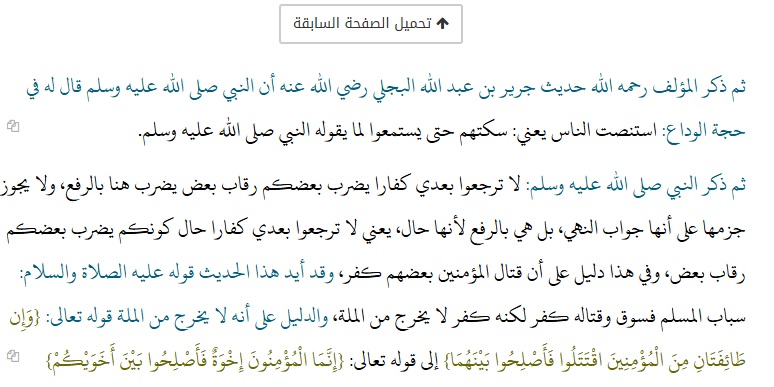
“Then the author may Allah have mercy on him mentioned the hadith of Jarīr ibn ʿAbdillāh al-Bajalī (may Allah be pleased with him), that the Prophet (peace and blessings be upon him) said to him during the Farewell Pilgrimage: “Make the people listen” meaning: silence them so that they may hear what the Prophet (peace and blessings be upon him) is saying.” -Muhammed ibn Ṣāliḥ al-ʿUthaymīn
“Then the Prophet (peace and blessings be upon him) mentioned: “Do not revert to disbelief after me, striking the necks of one another.” The word “striking” (yaḍribu) here is in the nominative case (marfūʿ), and it is not permissible to place it in the jussive case (majzūm) as though it were the answer to the prohibition; rather, it is in the nominative because it is a circumstantial clause (ḥāl). Meaning: do not revert to disbelief after me in the state of some of you striking the necks of others. And in this there is evidence that the fighting of believers against one another is disbelief (kufr).” -Muhammed ibn Ṣāliḥ al-ʿUthaymīn
“And this hadith is supported by his statement (peace and blessings be upon him): “Insulting a Muslim is wickedness (fusūq), and fighting him is disbelief (kufr).” However, it is a disbelief that does not expel one from the religion (millah). And the evidence that it does not expel one from the religion is the statement of Allah the Most High: “And if two parties of the believers fight one another, then make peace between them” up to His statement: “The believers are but brothers, so make peace between your brothers.” -Muhammed ibn Ṣāliḥ al-ʿUthaymīn
“And in this there is evidence that the fighting of believers against one another is disbelief (kufr)” -Muhammed ibn Ṣāliḥ al-ʿUthaymīn.
And notice he says:
“However, it is a disbelief that does not expel one from the religion (millah).” -Muhammed ibn Ṣāliḥ al-ʿUthaymīn.
So what exactly is your problem with some statements in some Ibadi sources? That such and such copmanions did actions that amount to kufr. This is for certain you will never find in any Ibadi sources where we have said that Ali, Uthman or Muaviya are mushrik or polytheist. Then this would be a problem.
However, you know what has happened to soften these Sunni positions in some English translations? They translate it as: “This indicates that believers fighting one constitutes some disbelief.”
Muhammed Nāṣir al-Dīn al-Albānī
In Al-Thamar al-Mustatāb fī Fiqh al-Sunnah wa al-Kitāb, page 53, al-Albānī says:
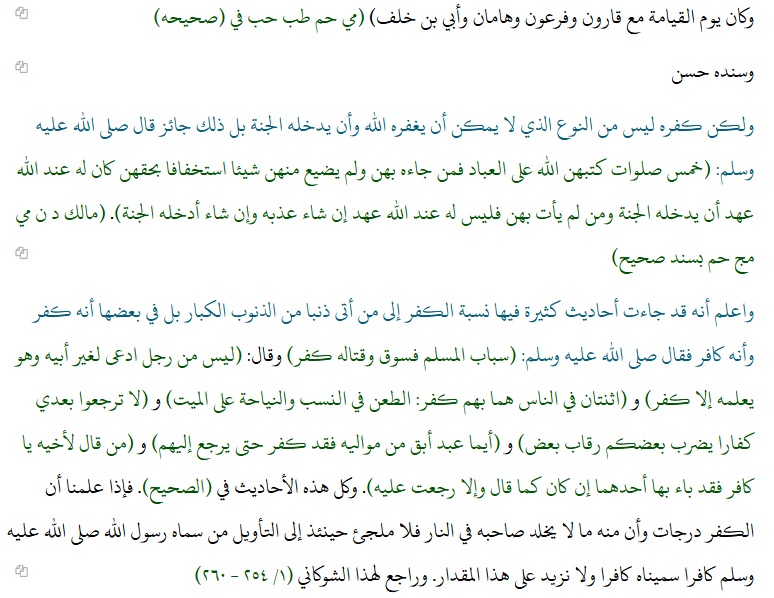
“And on the Day of Resurrection he will be with Qārūn, Firʿawn, Hāmān, and Ubayy ibn Khalaf) (Muslim, Aḥmad, al-Ṭabarānī, al-Ḥākim in his Ṣaḥīḥ) And its chain of narration is good (ḥasan)”- Muhammed Nāṣir al-Dīn al-Albānī
“But his disbelief is not of the type that Allah cannot forgive and admit him to Paradise; rather, that is possible. He (peace and blessings be upon him) said: “Five prayers Allah has prescribed upon the servants. Whoever comes with them, not wasting any of them out of disdain for their right, then he has a covenant with Allah that He will admit him to Paradise. And whoever does not come with them, then he has no covenant with Allah — if He wills He punishes him, and if He wills He admits him to Paradise.” (Mālik, Abū Dāwūd, al-Nasāʾī, Muslim, al-Majmūʿ, Aḥmad, with an authentic chain).” -Muhammed Nāṣir al-Dīn al-Albānī
“And know that many hadiths have come in which disbelief (kufr) is attributed to one who commits one of the major sins; indeed in some of them it is [called] disbelief and that he is a disbeliever. He (peace and blessings be upon him) said: “Insulting a Muslim is wickedness, and fighting him is disbelief.” And he said: “No man claims a father other than his own while knowing it, except that he has committed disbelief.” And: “Two things in people are disbelief in them: attacking lineage and wailing over the dead.” And: “Do not revert to disbelief after me, striking the necks of one another.” And: “Whichever slave flees from his masters has committed disbelief until he returns to them.” And: “Whoever says to his brother, ‘O disbeliever,’ it returns upon one of them. If it is as he said, then so; otherwise it returns upon him.” And all of these hadiths are in the Ṣaḥīḥ. So when we know that disbelief has degrees, and that some of it does not cause its doer to remain forever in the Fire, then there is no need at that point for reinterpretation from one whom the Messenger of Allah (peace and blessings be upon him) named.” -Muhammed Nāṣir al-Dīn al-Albānī
“Know that many ḥadīths have come attributing kufr to those who commit major sins … among them: ‘Insulting a Muslim is wickedness and fighting him is kufr’… and ‘Do not return after me as disbelievers, striking the necks of one another.’ All these ḥadīths are authentic. So if we know that kufr has levels (darajāt), and that some forms do not eternally condemn a person to Hell, then there is no need for reinterpretation.” –Muhammed Nāṣir al-Dīn al-Albānī
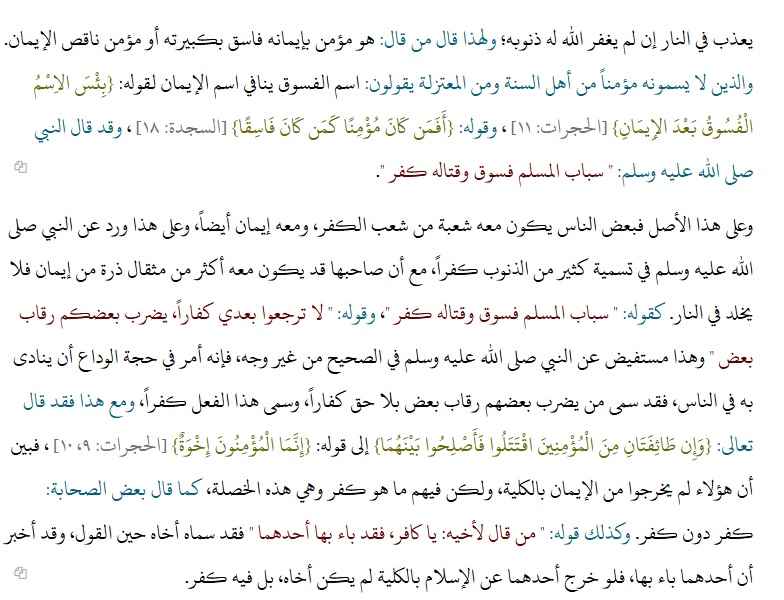
“He will be punished in the Fire if Allah does not forgive him his sins; and for this reason some said: he is a believer through his faith, a sinner through his grave sin, or a believer deficient in faith. And those among Ahl al-Sunnah and the Muʿtazilah who do not call him a believer say: the name of wickedness (fusūq) negates the name of faith, because of His saying: “How evil is the name of wickedness after faith” [al-Ḥujurāt: 11], and His saying: “Is one who is a believer like one who is a sinner?” [al-Sajdah: 18]. And the Prophet (peace and blessings be upon him) said: “Insulting a Muslim is wickedness, and fighting him is disbelief.” –Ibn Taymiyyah
“And upon this principle, some people have with them a branch of disbelief, and they also have faith. And upon this came reports from the Prophet (saw) in naming many sins as disbelief, even though the one doing them may have with him more than a speck of faith, so he will not remain forever in the Fire. Such as his saying: “Insulting a Muslim is wickedness, and fighting him is disbelief,” and his saying: “Do not revert to disbelief after me, striking the necks of one another.” And this is widely transmitted from the Prophet (saw) in the Ṣaḥīḥ through numerous chains. For he commanded during the Farewell Pilgrimage that it be proclaimed among the people. So he named those who strike the necks of one another without right as disbelievers, and he named this act disbelief. And despite this, Allah the Most High said: “And if two parties of the believers fight one another, then make peace between them” up to His saying: “The believers are but brothers” [al-Ḥujurāt: 9-10]. So He clarified that these did not exit from faith entirely, but there is in them what is disbelief namely this trait as some of the Companions said: disbelief below disbelief. Likewise his saying: “Whoever says to his brother, ‘O disbeliever,’ then it returns upon one of them.” For he called him his brother at the time of the saying, and he informed that one of them has incurred it. So if one of them had exited from Islam entirely, he would not be his brother; rather, there is in him disbelief.” –Ibn Taymiyyah
“If hatred is for worldly reasons only, then this is lesser disbelief and does not reach major disbelief. Hence the Prophet ﷺ said: ‘Do not return after me as disbelievers, striking the necks of one another.’”
Then on page 852 he says:
“The fact that some Companions fought other companions involves entering into traits of disbelief. Therefore he (saw) said: ‘Do not return after me as disbelievers.’” – Ṣāliḥ Āl al-Shaykh
ولهذا قال النبي عليه الصلاة والسلام: لا ترجعوا بعدي كفاراً يضرب بعضكم أعناق بعض. وكون بعض الصحابة قاتل بعضاً آخر هذا فيه دخول في خصال الكفار، لهذا قال: لا ترجعوا بعدي…
He then says this disbelief may be lesser or greater disbelief depending on the nature of the hatred.
«ولا شك أنه قد يكون الباعث على ذلك البغض والكره، لأن القتال يكون معه ما في النفس، لكن مع تقاتل الصحابة فإن بعضهم لم يسب بعضاً يعني بلسانه، والنفس قد يوجد فيها ما لا يسلم من البشر. فإذا الكفر هنا قد يكون كفراً أصغر وقد يكون كفراً أكبر بحسب نوع البغض…»
“And there is no doubt that the motive for that may be hatred and aversion, because fighting is accompanied by what is in the soul. However, despite the fighting among the Companions, some of them did not insult others. Meaning with their tongues. Though the soul may contain what no human being is free from. Thus, the disbelief here may be a lesser disbelief or may be a greater disbelief, according to the nature of their hatred.” -Ṣāliḥ Āl al-Shaykh
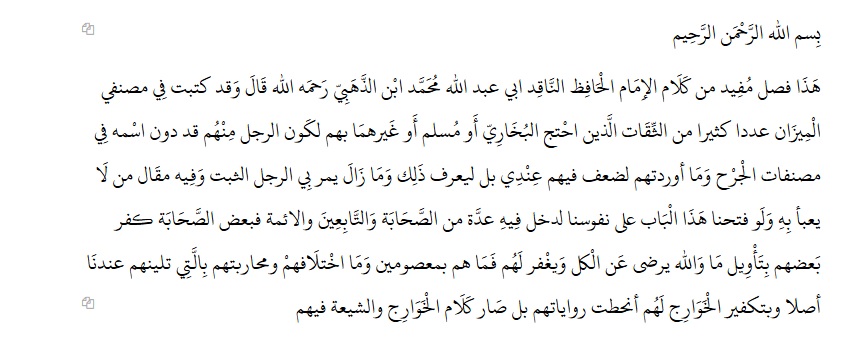
In his book: Al-Ruwāt al-Thiqāt al-Mutakallam Fīhim bimā Lā Yūjib Raddahum on page 23 he says:
“In the name of Allah, the Most Merciful, the Most Compassionate”
“This is a beneficial chapter from the words of the Imām, the Ḥāfiẓ, the critic Abū ʿAbdillāh Muḥammed Ibn al-Dhahabī may Allah have mercy on him. He said: I have written in my work al-Mīzān a large number of reliable narrators whom al-Bukhārī, Muslim, or others used as evidence, because the name of one of them had been recorded in the works of criticism (al-jarḥ). I did not include them due to any weakness in them according to me, but rather so that this may be known. And a reliable narrator concerning whom there is a statement from one who is not to be given any weight would still pass by me. And if we were to open this door upon ourselves, a number of the Companions, the Successors, and the Imāms would enter into it. For some of the Companions declared others disbelievers based on interpretation and Allah is pleased with all of them and forgives them for they are not infallible. And their disagreement and fighting did not diminish them in our eyes at all. And it was because of the Khawārij’s declaring them disbelievers that their narrations declined; indeed the speech of the Khawārij and the Shīʿah concerning them became [a mark against them].” –Al-Dhahabī
“If we opened this door for ourselves, many Companions, Followers, and imams would enter into it. Some Companions declared others disbelievers based on interpretation.”
Al-Dhahabī affirms takfīr occurring among the Companions themselves based on interpretive ijtihād, not because the target of takfīr had actually left Islam.
Prima Qur’an comments: In fact in a recent back and forth on Twitter (X) the Sunni (traditional) beat a hasty retreat when it was asked point blank of them:
What did Dhahabi mean by the companions called each other kafir? فَبَعْضُ الصَّحَابَةِ كَفَّرَ بَعْضُهُمْ بِتَأْوِيلٍ مَا
So if Dhahabi means when the companions called each other kafir that it did not entail expulsion from the millat of Islam you have to wonder what your real problem is with us? This is what is meant when you find this in Ibadi books. No one believes Ali or Uthman left Islam.
Imam al-Nawawī
Imam al-Nawawī said in his commentary on Sahih Muslim:
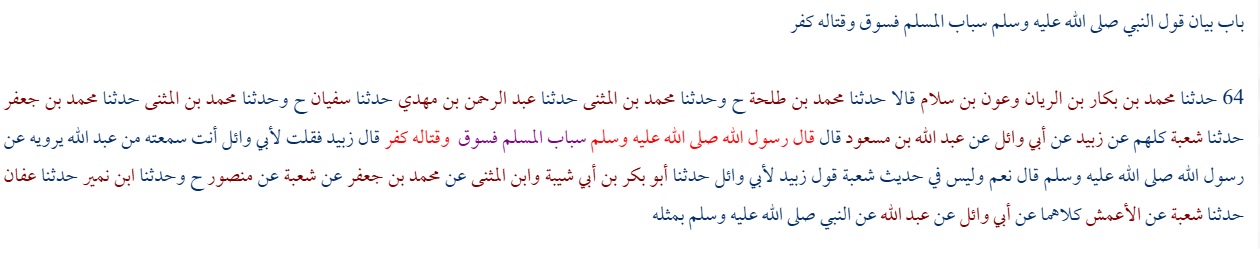
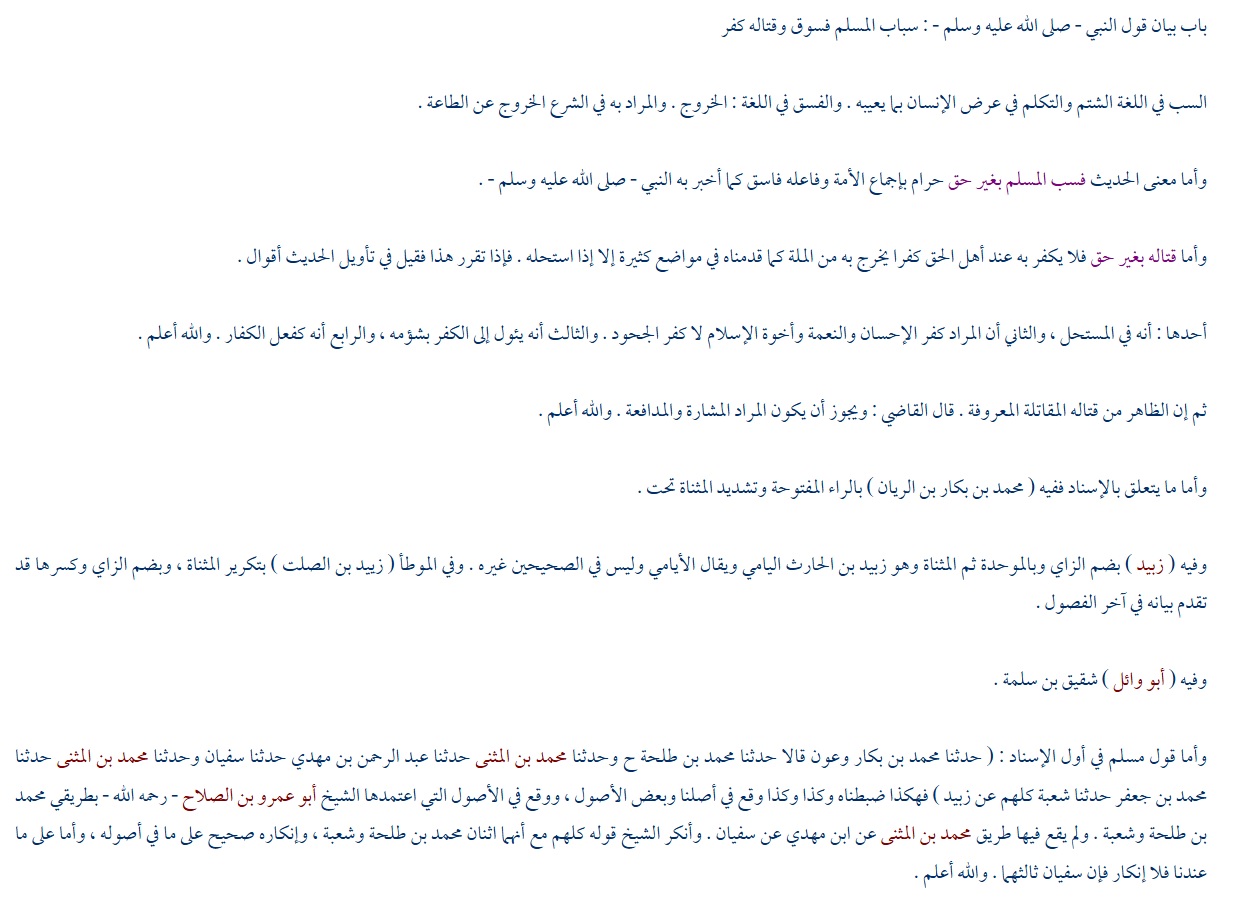
Chapter: Clarification of the statement of the Prophet (saw): “Insulting a Muslim is wickedness, and fighting him is disbelief”
64 Muḥammed ibn Bakkār ibn al-Rayyān and ʿAwn ibn Sallām narrated to us, both saying: Muḥammed ibn Ṭalḥah narrated to us. And Muḥammed ibn al-Muthannā narrated to us: ʿAbd al-Raḥmān ibn Mahdī narrated to us: Sufyān narrated to us. And Muḥammed ibn al-Muthannā narrated to us: Muḥammed ibn Jaʿfar narrated to us: Shuʿbah narrated to us. All of them from Zubayd, from Abū Wāʾil, from ʿAbdullāh ibn Masʿūd, who said: The Messenger of Allah (saw) said: “Insulting a Muslim is wickedness, and fighting him is disbelief.” Zubayd said: So I said to Abū Wāʾil: Did you hear it from ʿAbdullāh narrating it from the Messenger of Allah, (saw)? He said: Yes. And in the hadith of Shuʿbah there is not the statement of Zubayd to Abū Wāʾil. Abū Bakr ibn Abī Shaybah and Ibn al-Muthannā narrated to us, from Muḥammed ibn Jaʿfar, from Shuʿbah, from Manṣūr. And Ibn Numayr narrated to us: ʿAffān narrated to us: Shuʿbah narrated to us, from al-Aʿmash, both of them from Abū Wāʾil, from ʿAbdullāh, from the Prophet, (saw) the like of it.
Imam al-Nawawī puts his Ash’ari (Murji’ah) spin. However, some important points come through.
Chapter: Clarification of the statement of the Prophet (saw) : “Insulting a Muslim is wickedness, and fighting him is disbelief.”
“Insult (sabb) in the language means reviling and speaking about a person’s honor in a way that faults him. And wickedness (fisq) in the language means going out. And what is meant by it in the religious law is going out from obedience. As for the meaning of the hadith, insulting a Muslim without right is forbidden by the consensus of the Ummah, and the one who does it is a sinner (fāsiq), as the Prophet (saw) himinformed.”-Imam al-Nawawī
“As for fighting him without right, it does not make one a disbeliever with a disbelief that takes him out of the religion according to the people of truth, as we have presented in many places, unless he considers it lawful. So when this is established, several statements have been said regarding the interpretation of the hadith.” -Imam al-Nawawī
“The first: that it is concerning the one who considers it lawful. The second: that what is meant is the disbelief of ingratitude and the denial of the blessing and the brotherhood of Islam, not the disbelief of outright rejection. The third: that it leads to disbelief through its ill omen. The fourth: that it is like the deed of the disbelievers. And Allah knows best. Then, the apparent meaning of “fighting him” is the well-known combat. The Qāḍī said: It is possible that what is meant is disputing and defending. And Allah knows best.” –Imam al-Nawawī
Prima Qur’an: We will comment on Imam al-Nawawī puts his Ash’ari (Murji’ah) spin.
The interpretation of the Murji’ah/Ash’ari is:
If you kill a fellow a Muslim but you don’t believe that it is lawful to do so then it is not kufr.
We wonder if the companions who killed each other thought that what they were doing was lawful or unlawful?
If it was unlawful then they participated in the unlawful in masse.
Second. It is meant as ingratitude for blessings and brotherhood in Islam, not as disbelief in Allah. Hence, kufr ni’ama. Welcome to the Ibadi view! Though we do not subscribe to the Murji’ah/Ash’ari misunderstanding and misguidance.
Third. It leads to disbelief due to its evil consequences.
Fourth. It resembles the actions of disbelievers.
Summary of Sunni Scholarly Consensus on the above matter.
Scholar
Affirmation
Ibn Taymiyyah
Kufr has levels; “kufr less than kufr” exists; a person can have a branch of kufr while still having faith.
Al-Dhahabī
Some Companions declared other Companions disbelievers based on interpretation (ta’wīl).
Al-ʿUthaymīn
Believers fighting one another is kufr—but they remain believers.
Al-Albānī
Kufr has levels (darajāt); some forms do not eternally condemn to Hell.
Ṣāliḥ Āl al-Shaykh
Lesser disbelief exists and does not reach major disbelief.
al-Nawawī
Meant as ingratitude for blessings and brotherhood in Islam, not as disbelief in Allah
The Sunni Understanding of Qur’anic Reconciliation vindicates the Ibadis
Now we do not share thier misunderstanding of the verse. We are simplly based upon their understanding it vindicates our perspective.
Now we return to the Qur’anic verse that seals this matter.
The Sunnis translate the verse as:
“And if two groups of the believers fight each other…” (Qur’an 49:9)
Allah did not say: “If two groups, one of which has left Islam…” He said: “of the believers.”
Therefore:
Statement
Implication
Allah calls fighting groups believers
They have not left the millah of Islam.
The Prophet calls fighting a Muslim kufr
The act is kufr in the lesser sense.
Conclusion
Kufr in the ḥadīth and in Ibadi usage does not mean expulsion from Islam.
This understanding of kufr that we Ibadis have did not come out of thin air. Rather, this term is established and has a basis in the explicit words of the Blessed Prophet (saw) and the explicit text of the Qur’an.
The Prophet said: “Insulting a Muslim is wickedness and fighting him is kufr.” And he also said: “Do not return after me as disbelievers, striking the necks of one another.”
The question is: did the Companions strike one another’s necks? No rational person can deny that this happened during the fitnah.
The Ibadi Doctrinal Framework: Walāyah, Barā’ah, and Wuqūf
Now that we have established the legitimacy of the term kufr in its lesser sense, let us explain the actual Ibadi doctrine. The framework our opponents either do not understand or deliberately misrepresent.
The issues related to the stance on historical events (the Great Fitnah) are among the most intricate topics in Ibadi theology, and they have witnessed significant methodological development while preserving their theoretical foundations.
First: The Three Doctrinal Concepts
These concepts represent a “system of analogy” that defines a Muslim’s relationship with others based on behavior and actions:
Walāyah (Loyalty): This is love for the sake of Allah, and it is obligatory for every Muslim whose outward conduct is in accordance with Allah’s commands. It is of two types: general walāyah (for all believers) and specific walāyah (for those known for their righteousness).
Barā’ah (Disavowal): This is hatred for the sake of Allah, and it is obligatory for anyone who openly commits a major sin, persists in a wrong, or introduces something into the religion that contradicts its fundamental principles (from the perspective of the school of thought). It is not a “curse” or “insult,” but rather a severing of religious allegiance from the action or innovation.
Wuqūf (Suspension): This refers to refraining from judging someone’s loyalty or innocence due to unclear evidence, conflicting reports, or because the person was unaware of the events and not legally obligated to pass judgment on them.
A Detailed Overview of Positions Throughout the Ages
Stage 1: The Prophetic Period.
Prevailing Position: Innocence of the events and those responsible for them. Early Ibadis did not hold the Companions (as a whole) responsible for the fitnah in a way that condemned them.
Estimated Percentage: Let us guestimate and say 95% innocence. The overwhelming majority of early Ibadi scholars maintained that the Companions (as a whole) were not to be held blameworthy for the civil strife.
Even if we granted a theoretical 5% Allowance for disavowal
The remaining 5% allows for the possibility that some Companions, as human beings, may have committed acts prior to the fitnah that deserved punishment under the Qur’an and Sunnah. This is not a blanket condemnation of any Companion, nor is it specific to the events of the fitnah. Rather, it is an acknowledgment that Companions like all humans were not infallible (ma’sūm) and could commit individual sins for which the Qur’an and Sunnah prescribe accountability. This is not unique to Ibadis; Sunni scholars also acknowledge that Companions were not infallible and could commit sins, though they are generally considered righteous overall.
Examples: What is mentioned in the letters of Imam Jābir ibn Zayd (although his letters are characterized by piety) and what biographers have reported about the position of the people of Nahrawān towards ʿUthmān (due to the issue of protected areas and positions) and towards ʿAlī (due to the arbitration).
Logic: The position was directly political and doctrinal. Early Ibadis considered certain actions during the fitnah to be innovations, but they did not translate that into condemning the Companions as individuals. Rather, their barā’ah (disavowal) was directed at the actions and innovations, not at the persons as polytheist or as having left the millah of Islam.
Stage 2: Establishing and Remaining Silent (5th–13th centuries AH)
Prevailing Stance: Expressions of “remaining silent” began to appear explicitly.
Estimated Ratio: Let us guestimate a 50% disavowal (in educational texts) and 50% wuqūf (in practical application).
A well-known saying: Imam Abū Saʿīd al-Kadāmī (one of the leading scholars of the 4th century AH) said: “We do not disavow ʿAlī ibn Abī Ṭālib or ʿUthmān ibn ʿAffān unless we have definitive proof that necessitates it, and silence is safer.”
Logic: The principle of “scholarly integrity” began to emerge, whereby statements of disavowal were transmitted as part of the heritage, but remaining silent was practiced out of respect for the status of these Companions.
Contemporary Phase (14th century AH – Present Day)
Prevailing Stance: Remaining silent and accepting (the principle of good faith).
Estimated Percentage: Let us guestimate 90% wuqūf and acceptance, 10% disavowal (historical transmission only).
Statements of Scholars:
Shaykh Nūr al-Dīn al-Sālimī: Despite his adherence to the fundamentals, he opened the door to wuqūf for those who were unaware of the fitnah, saying: “You may abstain from judgment regarding the people of the qiblah, for Allah will not question you about what they did.”
His Eminence Shaykh Aḥmad bin Ḥamad al-Khalīlī (Grand Mufti of Oman): He always emphasizes the unity of the Ummah and purity of heart. In his lessons and writings, he prays for mercy upon all the Companions and affirms that historical differences should not divide Muslims today.
The Principle of Purity of Heart: This is the principle adopted by the Ibadi school today, meaning that the contemporary Muslim is not obligated to investigate the bloodshed of the Companions, and it is safer for him to meet Allah with a pure heart towards everyone.
Why Do Classical Texts Continue to Contain Statements of Disavowal?
The continued presence of these statements in books does not necessarily mean they are being implemented today. Rather, it stems from methodological reasons:
Scholarly Integrity: Ibadi scholars consider the books of the early scholars an inheritance that should not be censored or deleted. Instead, it should be transmitted as is, with explanations within its historical context.
Preserving Historical Memory: Transmitting these statements aims to explain why the Ibadis differed from others initially (the political and legal reasons for the revival), not to incite hatred.
Distinguishing Between “Statement” and “Religious Practice”: The statement of disavowal exists “intellectually” in the books as an interpretation by earlier scholars, but wuqūf and acceptance are what are practiced “religiously” and as acts of worship today.
Should One Take a Doctrinal Stance Regarding the People of Nahrawān?
This is a fundamental question within the school of thought, and the answer can be summarized as follows:
The Ibadi position on their predecessors: The Ibadis believe that the people of Nahrawān were “people of righteousness” and that their disavowal of ʿUthmān and ʿAlī was based on a legitimate interpretation of Islamic law, which they considered justified in their time, to protect the core of the faith (as they perceived it).
Are you obligated to disavow them as they did? No. The principle among the Ibadis is: “There is no blame on one who remains neutral.” A contemporary Muslim who refrains from judging ʿUthmān and ʿAlī, while simultaneously respecting the people of Nahrawān as scholars and predecessors, is not considered an “innovator” or “outside the school.”
Conclusion of the Doctrinal Section
There is no religious obligation within the Ibadi school that compels you to disavow any of the Companions today. The required doctrinal stance is loyalty to the believers and hatred of oppressors in general. However, regarding specific historical events, the best and safest course is to remain neutral. (Wuqūf)
Accordingly, the Ibadi approach today is one of unity, not division, whereby the Companions (including ʿUthmān and ʿAlī) are treated with respect as a general virtue, while the interpretations of the early scholars who took strong stances are also respected, and this is considered part of the history of scholarly interpretation that does not preclude present-day harmony.
The early Muhakkima who fought at Nahrawān were responding to their historical moment with their ijtihād. There is no obligation for a Muslim 1,300 years later to inherit the same specific judgments, especially when the evidentiary record is disputed among Muslims.
Kufr in the Ibadi School Does Not Expel from the Millah
Let us state this as clearly as possible:
Kufr in the Ibadi school is not something that takes one out of the millah of Islam.
This is the fundamental distinction that our opponents either cannot grasp or deliberately conceal.
When early Ibadi scholars used the term kufr regarding certain actions during the fitnah, they did not mean:
That the person had left the millah of Islam.
That their shahādah was invalidated.
That they were forever condemned to Hell.
Rather, they meant precisely what Ibn Taymiyyah meant when he wrote “a person may possess a branch of disbelief while also possessing faith” and “kufr less than kufr.” They meant what al-Albānī meant when he wrote “kufr has levels.”
They meant that the action—fighting a fellow Muslim unjustly, or introducing innovation into the religion—is an act of kufr in the lesser sense: a grave violation that necessitates barā’ah (disavowal) but not the complete negation of faith.
Even in how we understand the word كفر or kufr in Arabic. This ensures us that we have a creed that is based upon the Qur’an, the primary source of Islam, the revelation Allah sent to his Blessed Prophet (saw). Allah (swt) never defined كفر as exit from the religion of Islam. This is concept is theologically superimposed upon the word. The proof of this is evident. In light of the clear text from the Prophetic Sunnah, Sunni scholars have provided an array of understandings and levels concering the word.
Why the Accusation of Taqiyyah for the Ibadi Is False
Our opponents also claim that we, the Ibadis practice taqiyyah—that we conceal our “true” belief that the Companions are disbelievers.
This is false for several reasons:
There is no concealment. We are explaining our doctrine openly in this very article, citing our sources and demonstrating our distinctions.
Wuqūf is not taqiyyah.Taqiyyah is concealing one’s true belief out of fear of harm. Wuqūf is a principled theological position: suspending judgment when evidence is unclear or when the matter does not affect one’s own religious obligation.
The accusation is ironic. Our opponents accuse us of taqiyyah while ignoring that we openly state: “We do not declare the Companions disbelievers in the sense of expulsion from Islam.” What are we supposedly concealing?
The burden of proof is on them. They claim we secretly believe something. But they provide no evidence—only misinterpretation of early texts that they refuse to read in light of their own understanding of Qur’an (49:9) and the distinction between lesser and major kufr.
The Rhetorical Question Our Opponents Cannot Answer
Let us conclude with a question for those who accuse the Ibadis of excommunicating the Companions:
According to their own undersatnding of Qur’an 49:9, when two groups of believers fight each other, are they still believers or not?
They cannot say “no” without contradicting the Qur’an.
And according to your own ḥadīth in Bukhārī and Muslim, fighting a Muslim is kufr. So how do you reconcile the Qur’an calling fighting believers ‘believers’ and the ḥadīth calling fighting ‘kufr’?
The only possible reconciliation is that kufr here does not mean apostasy. It means a lesser kufr, a grave sin, an act of major transgression but not expulsion from the millah of Islam.
That is exactly what we Ibadis have been saying all along.
This is not meant as a ‘gotcha’ for the Sunnis, but a call for sincere reflection, bridge-building, and moving forward as an Ummah
Final Summary
Accusation
Reality
“Ibadis declare Companions to be disbelievers (apostates).”
Ibadis use kufr in the lesser sense (kufr ni’ma), as affirmed by Ibn Taymiyyah, al-Albānī, al-ʿUthaymīn, and others.
“Ibadis declare companions to be mushrik (polytheist).”
Ibadis have not declared a single companion to be a mushrik.
“Ibadis practice taqiyyah to hide their true beliefs.”
There is no concealment. Wuqūf (suspension) is a principled theological position, not taqiyyah.
“Ibadis invented the term kufr for Muslims.”
The term comes from how Allah defined it in the Qur’an.
“Ibadis are Khawārij who excommunicate Muslims.”
Ibadis distinguish themselves from extremist Khawārij precisely by affirming that kufr does not always entail expulsion from the millah.
“Contemporary Ibadis still declare the Companions disbelievers.”
The contemporary Ibadi position is overwhelmingly wuqūf and acceptance, with scholars praying for mercy upon all Companions.
Conclusion and Call for Fairness
We Ibadis do not ask anyone to agree with our historical interpretations. We do not ask anyone to adopt our doctrine of barā’ah. What we ask for is fairness. That we be judged by what we actually believe, not by the distorted caricature our opponents present.
We ask that our accusers to read their own understasnding of Qur’an (49:9) and the authentic ḥadīth.
The inconsistency applied to the Ibadi school is real.
Sunni, Imami, and Zaydi traditions all maintain elaborate taxonomies of kufr.
Kufr al-ʿamal — disbelief of deed (action contradicting faith without denying it)
Kufr al-inkār — disbelief of denial
Kufr al-juhūd — disbelief of stubborn rejection after knowing
Kufr al-nifāq — disbelief of hypocrisy
Kufr bi’l-iʿrāḍ / al-irād — disbelief of turning away
Kufr al-niʿmah — disbelief of ingratitude for blessing
Kufr al-ʿinād — disbelief of obstinacy
Kufr al-takdhīb — disbelief of denial/contradiction
These categories are not fringe. They are taught in Sunni ʿaqīdah manuals, Imami kalām texts, and Zaydi uṣūl works. Even Ibn Taymiyyah’s Kitāb al-Īmān which we cited above is built on exactly this distinction. Al-Albānī’s “kufr has levels” is the same principle. Ṣāliḥ Āl al-Shaykh’s “lesser and greater kufr” is the same.
So the inconsistency is this:
When these same scholars encounter the term kufr applied to ʿAlī, ʿUthmān, or Muʿāwiyah in an Ibadi text, they immediately read it as kufr al-juhūd or kufr al-inkār and then declare the Ibadis to be Khawārij who excommunicate the Companions. But when their own scholars apply kufr to Muslims who fight each other, or to one who insults a Muslim, or to one who abandons prayer out of laziness, they read it as kufr al-niʿmah or kufr dūna kufr the lesser kufr. That which does not expel one form the millah kind.
The word is identical. The subject is different. The interpretive charity is applied inconsistently.
This is not a minor rhetorical point. It exposes that the accusation “Ibadis declare the Companions disbelievers” rests on a selective reading. The accusers are not applying their own taxonomy to Ibadi texts. If they did, they would have to ask: which kufr do the Ibadis mean? And the answer, as the article documents and as we have confirmed, is kufr al-niʿmah — ingratitude for blessing — not expulsion from the millah.
We ask that they stop accusing us of taqiyyah when we are explaining our doctrine openly.
If they insist that our definition of kufr means apostasy, they bear the burden of proof is upon the accuser—not us.
“And give full measure when you measure, and weigh with an even balance. That is the best [way] and best in result.” (Qur’an 17:35)
“Successful indeed are the believers, those who offer their prayers with all solemnity and full submissiveness khāshiʿūna.” (Qur’an 23:1-2)
“Nay, seek (Allah’s) help with patient perseverance and prayer: It is indeed hard, except to those who (l-khāshiʿīna)bring a lowly spirit.” (Qur’an 2:45)
“Be guardians of your prayers, and of the midmost prayer, and stand up with (qānitīna)devotion to Allah.” (Qur’an 2:238)
﷽
The status of the word ‘amin’.
Know dear readers and seekers of truth that Amin is by consensus (ijmā’) not part of the Qur’an, due to its absence from the Imām Codex (the official Uthmanic manuscript) between the two covers of which the Companions (may Allah be pleased with them) unanimously agreed to record everything that was Qur’an and to exclude everything that was not.
Copies of this codex were distributed across major cities and shared throughout the Muslim nation without anyone raising an objection to any part of it. These copies have served as the authoritative basis for transmitting the Qur’an generation after generation down to our present day.
Jurists, exegetes, and other scholars have explicitly stated its non-Qur’anic status. Here is what the renowned exegete Abū Ḥayyān stated in his grand commentary, Al-Baḥr al-Muḥīṭ:
“Likewise, they meaning the exegetes discussed Amin, its linguistic variants, the differences regarding its meaning, and its ruling in prayer; however, it is not part of the Qur’an, which is why we have disregarded discussing it altogether.”
Al-Ālūsī also stated in his commentary, Rūḥ al-Maʿānī:
“And it is not part of the Qur’an by consensus… [up to his statement:] to the extent that several scholars mentioned that whoever claims *Āmīn* is part of the Qur’an has committed disbelief.”
Since the word Amin is non-Qur’anic, it falls under human speech, and human speech has been established as prohibited during prayer after having been initially permissible. We will give our evidence with the permission of Allah.
Our first and strongest evidence.
The consensus (ijmā’) of our scholars across the centuries, and the fact that prayer is a practical, mass-transmitted act of worship. This is the mass transmitted sunnah with us.
As for us, the consensus (ijmā’) of our companions may Allah the Exalted have mercy on them across the centuries is sufficient for us. Prayer is a practical, outwardly manifest act of worship that has been transmitted from the Messenger of Allah (ﷺ) generation after generation, down to our present day. We know of no disagreement among our scholars, whether of the earlier or later generations, regarding the issues of prayer among them, the impermissibility of saying “Amin” after al-Fatiha.
Supporting evidence.
The occasion of the revelation of the Qur’an.
“Be guardians of your prayers, and of the midmost prayer, and stand up with devotion to Allah.” (Qur’an 2:238)
Mu’awiya b. al-Hakam said:
Zaid b. Arqam reported:
We used to talk while engaged in prayer and a person talked with a companion on his side in prayer till (this verse) was revealed: “And stand before Allah in devout obedience” (ii, 238) and we were commanded to observe silence (in prayer) and were forbidden to speak.
“We used to talk behind Allah’s Messenger (Saw) during the Salat, a man among us would talk to his companions next to him until (the following) was revealed: “And stand before Allah with obedience”. (2:238) So we were ordered to be silent and prohibited from talking.”
The word they understood as a command to stop speaking is:
قَانِتِينَ (qānitīn)
It appears at the end of the verse:
وَقُومُوا لِلَّهِ قَانِتِينَ
(“…and stand before Allah as qānitīn.”)
قَانِتِينَ is the plural of قَانِت (qānit), which carries meanings including:
Obedient / devoutly obedient
Silent / keeping quiet
Standing in humility and submission.
This means the companions used to talk during the prayer and even to each other. However, they understood from the occasion of this verse that they should no longer do so. Such practice was abrogated.
The explicit command of the Blessed Prophet (saw).
Mu’awiyah b. al-Hakam al-Sulami said ; when I came to the Messenger of Allah (ﷺ) I learnt many things about islam. One of the things that I was taught was that it was that it was pointed out me. When you sneeze, praise Allah (I,e, say “praise be to Allah”); and when someone sneezes and praises Allah, say “ May Allah have mercy on you. Meanwhile I was standing along with the Messenger of Allah (may peace be upon him) during prayer, all of a sudden a man sneezed, and he praised Allah. So I said, “may Allah have mercy on you”, in a loud voice. The people gave me disapproving looks so much so that I took ill of it. So I said :
what do you mean by looking at me with furtive glances. Then they glorified Allah. When the prophet (ﷺ) finished his prayer, he asked; who was the speaker? The Prophet told him; this Bedouin. The Messenger of Allah (ﷺ) called me and said to me: Prayer is meant for the recitation of the Quran, and making mention of Allah. When you are in it (prayer), this should be your work therein. I never saw an instructor more lenient than the Messenger of Allah (ﷺ)
“He said: I prayed behind the Messenger of Allah, May Allah bless him and grant him peace, one day and a man from the people sneezed, so I said: May Allah have mercy on you, so the people looked at me with their eyes, so I said: May my mother be bereaved of me, what is the matter with you that you are looking at me? He said: So they struck their thighs with their hands. When I saw them silencing me, I kept quite until the Messenger of Allah (peace and blessings be upon him) finished praying. Then he called me. He said: By my father and mother, I have never seen a teacher before or after him who taught better than him. He neither struck me, nor rebuked me, nor insulted me. He said: “This prayer is not a place for such human speech. Rather, It is for glorification, magnification, and reading the Qur’an.”
How do we undertand this? We understand that the Blessed Prophet (saw) is telling us:
“Indeed, in this prayer of ours, nothing of people’s speech is valid; it is only tasbih (glorification), takbir (saying Allahu Akbar), tahmid (praising Allah), and the recitation of the Qur’an.”
There is no doubt that the word “Amin” is not among these. For it is neither part of the Qur’an nor any of the things mentioned. Nothing of people’s speech is valid in prayer. Only tasbih, takbir, tahmid, and the Qur’an recitation and “Amin” falls outside these categories.
Abdullah (b. Masu’d) reported:
We used to greet the Messenger of Allah (ﷺ) while he was engaged in prayer and he would respond to our greeting. But when we returned from the Negus we greeted him and he did not respond to us; so we said: Messenger of Allah. we used to greet you when you were engaged in prayer and you would respond to us. He replied: Prayer demands whole attention.
We used to salute during prayer and talk about our needs. I came to the Messenger of Allah (ﷺ) and found him praying. I saluted him, but he did not respond to me. I recalled what happened to me in the past and in the present.
When the Messenger of Allah (ﷺ) finished his prayer, he said to me: Allah, the Almighty, creates new command as He wishes, and Allah, the Exalted, has sent a fresh command that you must not talk during prayer. He then returned my salutation.
Therefore, if it were [permitted], meaning reciting ‘amin’ it would fall under the abrogated matters that are prohibited; and it is not permissible to act upon the abrogated.
That is to say that the hadith on the matter that have reached us are ‘sahih’ or sound. However with us the living sunnah takes priority over documented sunnah that may or may not still be acted upon.
Let us give you an example. Think carefully about the evidence that you have read above.
Examples of abrogation of practice during the prayer.
Narrated Abu Hurairah:
That the Messenger of Allah (ﷺ) came out to Ubayy bin Ka’b, and the Messenger of Allah (ﷺ) said: “O Ubayy!” And he was performing Salat, so Ubayy turned around but he did not respond to him, so Ubayy finished his Salat quickly. Then he turned to the Messenger of Allah (ﷺ) and said: ‘As-Salamu ‘Alaikum, O Messenger of Allah!’ The Messenger of Allah (ﷺ) said: ‘Wa ‘Alaikum As-Salam – what prevented you from responding to me when I called you Ubayy?’ He said: ‘O Messenger of Allah! I was performing Salat.‘ So he said: ‘Do you not find among what Allah revealed to me: Respond to Allah and to the Messenger when they call you to what gives you life?’ He said: ‘Of course, I shall not repeat that, if Allah wills.’ He said: ‘Would you like for me to teach you a Surah the likes of which has neither been revealed in the Tawrah, nor the Injil, nor the Zabur, nor in the entire Qur’an?’ He said: “Yes, O Messenger of Allah!’ The Messenger of Allah (ﷺ) said: ‘What do you recite in your Salat?’ He said: ‘I recite Umm Al-Qur’an.’ So the Messenger of Allah (ﷺ) said: ‘By the One in Whose Hand is my soul! The like of it has neither been revealed in the Tawrah, nor the Injil nor the Zabur, nor in the Furqan. It is the seven oft-repeated, and the Magnificent Qur’an which I was given.'”
So is more than one way to understand the implications of the above hadith.
Notice that the reason Ubayy bin K’ab (ra) gave for not responding to the Messenger of Allah (saw):
He said: ‘O Messenger of Allah! I was performing Salat.‘
This means that Ubayy bin K’ab (ra) could have been aware of the ruling that prohibits talking during the prayer.
However, the Messenger of Allah (swt) introduces an exception by quoting the verse of the Qur’an:
“O believers! Respond to Allah and His Messenger when he calls you to that which gives you life.” (Qur’an 8:24)
Or this hadith can be understood by another way.
That is that this verse: “O believers! Respond to Allah and His Messenger when he calls you to that which gives you life.” (Qur’an 8:24) was later restricted. In otherwords it was not abrogated but it was restricted to answer the Blessed Messenger (saw) after the prayer.
This is why Hadith < Fiqh. You can have a hadith but the understanding is what is important.
Likewise: Docummented Sunnah < Living Sunnah.
There is grounds to believe that ‘Amin’ is not actually Arabic in its origin. However, this article is not the time or place to wade into the weeds-so to speak.
The Qur’an indicates the phrase “Our Lord, accept this from us” (رَبَّنَا تَقَبَّلْ مِنَّا) after prayer. This phrase appears in (Qur’an 2:127), where Prophet Ibrahim and Prophet Ismail (peace be upon them) supplicate while raising the foundations of the Kaaba:
رَبَّنَا تَقَبَّلْ مِنَّا ۖ إِنَّكَ أَنتَ السَّمِيعُ الْعَلِيمُ “Our Lord, accept [this] from us. Indeed, You are the Hearing, the Knowing.”
This verse demonstrates that the Qur’an itself provides a specific supplication for acceptance after an act of worship, distinct from the Hebrew-origin “Amen.”
What about the Tashahhud?
Don’t worry dear readers we are one step ahead insh’Allah.
One cannot object against us by citing the continued legitimacy of *Taḥmīd* (praising Allah) and *Tashahhud* in prayer; for *Taḥmīd* falls under the category of *Tasbīḥ* (glorification), while *Tashahhud*though not Qurʾān consists entirely of glorifying Allah Almighty and Majestic, and holds a special status. The Prophet (peace and blessings of God be upon him) gave it meticulous care, as evidenced by Ibn Masʿūd’s statement:
Narrated Ibn Mas`ud:
Allah’s Messenger (ﷺ) taught me the Tashah-hud as he taught me a Sura from the Qur’an, while my hand was between his hands. (Tashah-hud was) all the best compliments and the prayers and the good things are for Allah. Peace and Allah’s Mercy and Blessings be on you, O Prophet! Peace be on us and on the pious slaves of Allah, I testify that none has the right to be worshipped but Allah, and I also testify that Muhammad is Allah’s slave and His Apostle. (We used to recite this in the prayer) during the lifetime of the Prophet (ﷺ) , but when he had died, we used to say, “Peace be on the Prophet.”
This clearly indicates that it carries the ruling of Qurʾānic recitation during prayer. Moreover, the consensus of the Muslim community (*ijmāʿ*) regarding the non-abrogation of *Taḥmīd* and *Tashahhud* in prayer serves as sufficient proof that they are excluded from abrogated speech and that which is agreed upon is not comparable to that which is disputed.
Furthermore, know that the methodology of our scholars concerning prayer is that of legal precaution (*Iḥtiyāṭ*). That is adopting only those narrations surrounding which there is no shadow of doubt in disputed matters. This is because prayer is the second pillar of Islam, coming directly after creed (*ʿAqīdah*). Verifying scholars across various schools of thought do not accept solitary reports (*Aḥād* traditions) as binding proof in creedal matters because they do not yield absolute certainty (*qaṭʿ*); thus, prayer being adjacent to creed in rank is all the more worthy of such caution.
Furthermore, some scholars have stated that the prayer practiced by our companions is established by consensus, because the actions they omit are themselves subject to disagreement among others, and those who advocate those actions do not view their omission as invalidating the prayer. This alone suffices as proof for the validity of the prayer of one who does not pronounce *Āmīn*.
Do recall this was our first and strongest evidence.
If anyone should denounce us for omitting the *aʾmīn*, the response to him is that it would be more fitting for him to denounce those who omit the *Basmalah* which IS a verse from the Book of Allah, recorded in all codices by consensus than to denounce those who omit *aʾmīn*, which is consensus-proven to be non-Qurʾānic. And Allah knows best.
Insh’Allah this article in the near future will be found here:
“O humanity, indeed We have created you from male and female and made you peoples and tribes that you may know one another. Indeed, the most noble of you in the sight of Allah is the most righteous of you. Indeed, Allah is Knowing, Well Acquainted.” (Qur’an 49:13)
“And do not approach unlawful sexual intercourse. Indeed, it is ever an immorality and is evil as a way.” (Qur’an 17:32)
“Allah (swt) reminded us of the promise of Satan where he said: And I will command them so they will change the creation of Allah.” (Qur’an 4:119)
﷽
All of human existence that is observable and known has come through the pairing of a male with a female. Every single person in existence today who claims to be a part of LGBT+ is the result of heterosexual reproduction.
So set thy face to the way of life that is upright and in harmony with nature, the pattern which He originated mankind. There is no changing Allah’s creation. That is the upright way of life; but most men know it not. (Qur’an 30:30)
The exceptions to this have come through supernatural means. Adam being the first of the creation was created without a mother and a father. Eve being created without a female. Christ Jesus being created without a father.
This entry is to address whether or not the Qur’an (the foundation of Islam) allows for or makes room for same sex marriage. We will also likewise be addressing the issue of LGBT in particular transsexuals and people who inject hormones and have physical operations to change their gender.
First We would like to share a personal story of a friend of one of our colleagues (who will remain anonymous). This friend of theirs would see attend the Friday prayer on a regular basis. At that time they actually were not friends; however as Muslims they were brothers in faith.
He approached our colleague and asked them about the work (giving guided tours to tourists) at the Masjid. They became good friends and went out for lunch. Our colleague believes that they understood from his mannerisms that our colleague knew he was homosexual or “gay”. So he confided in our colleague and our colleague told him that they knew that he had those inclinations.
So he asked our colleague, “So what do you think? Where am I going when I die?” Our colleague told him, “My brother and my friend, if you were to reach your hand into my pocket you will not find a ticket with my name on it that says seat number 7 aisle 10 guaranteed paradise. If that is the case for myself, who am I to say about you or anyone else? You should know that to act upon your desire is sinful in the same way that if an unmarried man or woman acted upon their desire it is a sin.”
Al hamdulillah, this brother goes to the masjid. Accordingly, our colleague has never known him to intentionally miss prayers. They known that he does his best to support his mother and sister in Malaysia. He has compassion and love for others in his heart. Allah (swt), the All-Wise, the Just, and the Compassionate is his judge, not me.
Sowe feel the first thing to do is look at the following verse of the Qur’an again.
“So set thy face to the religion that is upright and in harmony with nature, the pattern which He originated mankind. There is no changing Allah’s creation. That is the upright religion; but most men know it not.” (Qur’an 30:29)
As Islam is a worldview and a way of life that is in harmony and balance with nature, the first question should be: Does Allah (swt) disallow or absolutely abhor the idea of any species changing its sex?
The answer to that would be an emphatic No! The proof of that is that the majority of snails are hermaphrodites — that is, they carry both sexual organs and need only one other snail to procreate their species.
The purpose of this in nature is to allow proliferation of their species.
*Note* Snails do not undergo any physical operating procedures; this is their fitra.
There are also species of fish that will change from male into female and female into male. Our colleague used to keep a reef tank and learned quite a bit about corals, inverts, and the various fish species that they desired to keep and learn about.
One such gorgeous species is the Anthias.
“Harem groups usually consist of several females, their young (both male and female), and a single dominant male. Parrotfishes, wrasses, anemonefishes, and anthias form harem groups, but harems are not unique to reef fishes. Elephant seals, common pheasants, and several species of baboons also use this reproductive strategy. The single dominant male defends his group of females, and he may reproduce with one or several of his choosing. The advantages are for the females to reproduce with the strongest male and for the male to produce many offspring. The single largest disadvantage is that reproductive success for the females may be seriously jeopardized in the absence of the male. It is such a disadvantage that most families of reef fishes that practice this form of social behavior have evolved an interesting solution to the lack of a reproductive partner; the largest female will turn into a male and assume harem control and reproductive responsibilities. This reproductive strategy, whereby an individual begins life as one sex and switches to the opposite sex at some point in their life, is called sequential hermaphroditism. In the case of females turning into males, it is called protandrous hermaphroditism, or protandry.” see link: https://coraltriangleadventures.com/sex-changing-anthias/
The purpose of this in nature is to allow proliferation of their species.
*Note* Anthias do not undergo any physical operating procedures; this is their fitra.
Another example is the Ocellaris ‘Clown Fish’. Our colleague witnessed this first hand. Our colleague had two small male clownfish and over time one of them became larger than the other and this one actually became a female.
“Clownfish are all born males and the dominant male of a group will turn female when the female of that group dies.”
“Clownfish, also known as anemonefish, are sequential hermaphrodites that first develop into males. In fact, they live in regimented schools made up of all males and just one female — the lone female being the dominant and generally the largest fish in a given group. The second in command of the school is usually the largest, and most aggressive, male of the group. Due to his dominance of the other males, he’ll tend to ensure they stay small via taking the best food opportunities for himself and the like. Besides the perks of more food, he’s also the only one that gets to breed with the female.” see link: http://www.todayifoundout.com/index.php/2011/08/clownfish-are-all-born-male-a-dominant-male-will-turn-female-when-the-current-female-of-the-group-dies/
The purpose of this in nature is to allow proliferation of their species.
*Note* Clownfish do not undergo any physical operating procedures; this is their fitra.
These three examples will suffice. It should be noted in all these examples there are no physical operations or physical procedures being done to these species. These are all built-in mechanisms. These are all done with the purpose and drive to proliferate their species. All of this is permitted and allowed by Allah (swt). Allah (swt) deemed it an appropriate mechanism for their proliferation and survival of their species.
However, Allah (swt) has not allowed this for humans. This is not the strategy that Allah (swt) has devised for human proliferation.
There has never been a recorded case in human history of a situation where a male or female human being has undergone or experienced sequential hermaphroditism. Even in all-male prisons or all-female prisons or in other cases where males/females have been more numerous than the other.
We should also be aware that just as there are genetic disorders in animals (a subject that is still vastly under-researched), there are also genetic disorders among humans. There is also a whole field of science called abnormal psychology, among them is gender dysphoria. This is a branch of science that studies unusual patterns of behavior, emotion and thought, which may or may not be understood as precipitating a mental disorder.
In conclusion, transgender marriage, or even changing one’s sexuality through outside physical operations, is something that goes against the natural order and is against the fitra as prescribed by Allah (swt).
What about same sex marriage between gays and lesbians?
Before we get into the Qur’an on this issue we would also like to take the time to post a video that we highly recommend from Professor Richard Dawkins. Professor Richard Dawkins is a well-known evolutionary biologist who is no friend to religion.
Watch in the first video how Professor Richard Dawkins struggles to make the case for the ‘gay gene’.
“The gay gene was passed on in the bodies of the children that were being protected by the gay uncles.” — Professor Richard Dawkins
It is highly astonishing that someone of Oxford education could even make a statement like this. It begs the question: where did the ‘gay uncle’ come from? How was the ‘gay gene’ passed on in the bodies of the children? That could only come from ‘bisexual’ uncles, not from purely homosexual men.
He then proceeds to his “Sneaky Fucker Theory”.
Listen carefully to what he says:
“Which is the idea that the males who possess the gay gene — many of them may not have been wholly homosexual, they may be bisexual. In that case, go back to our scenario of the dominant males going off hunting and leaving behind the women and children in the charge of other males — and if there were other males who were known to be homosexual, then the dominant males would have trusted them not to mate with the females.” — Professor Richard Dawkins
“Being gay would have been a pretty good certificate that you can safely leave your women with me.” “If they were bisexual, that would have been the first assumption. We now have a way in which the gay gene would have been passed on.” — Professor Richard Dawkins
Once again this is not addressing the ‘gay gene’ at all. He’s still on the topic of men who have a sexual predilection towards females and males. There is no ‘gay gene’ being passed on. What we do have here are opportunistic men sleeping with women and children when their fathers/husbands were away hunting.
Notice that the homosexual man (whom Professor Dawkins was actually throwing a life vest) actually discarded Professor Dawkins’ theory altogether! He said from experience:
He says:
“I don’t know that, but it seems to be that a lot more women are bisexual. I can’t think of too many guys who start out as bisexual and then usually come out as gay later. Now there are men who are bisexual. I just think it’s a smaller percentage than people might think, just from my experience having met and been in the gay community, running organizations or meeting thousands of people over the years. I can’t think of too many people that hop back and forth.” — From the interview
Also notice the facial expression as the man begins to realize that Professor Dawkins hasn’t made a case for the ‘gay gene’ at all. At best he made a case for the ‘bisexual gene’.
We feel that Professor Richard Dawkins, with all his intelligence, also like many of us, doesn’t like being rebuffed. You can see this in his third response, in which he actually says “there really is no such thing as the gay gene.”
In the third attempt, Professor Richard Dawkins gives his weakest example yet, suggesting that this ‘gay gene’ manifests differently in different environments. He almost seemed to suggest that the homosexual in his scenario manifests in a world where we move away from breast feeding to bottle feeding.
The suggestion here is that at a very young age we moved away from the natural breast feeding to sucking on bottles — this carries heavy innuendo for those able to read between the lines. Finally, Professor Richard Dawkins submits: “There really is no such thing as the gay gene.” This may not go over very well with many in the LGBT+ community because what Professor Dawkins is saying is that environmental conditions, triggers, or learned behavior cause this to be expressed.
We think at this point the wise thing for Muslims who are trained in biology, Darwinian and Lamarckian evolution and so forth, is to be courageous enough to put forth the question:
“What is the Darwinian reason for possessing non-beneficial traits for reproduction and survival?”
For example, why are people born with achondroplasia or ‘dwarfism’? What about people who are born with poor eyesight? What about people who are born with genes that cause Down Syndrome, Hemophilia, Muscular Dystrophy, or Sickle Cell Anemia?
In what way does evolution favor such things?
“And we will surely test you with something of fear and hunger and a loss of wealth and lives and fruits, but give good tidings to the patient, Who, when under any condition say, “Indeed we belong to Allah, and indeed to Him we will return.” (Qur’an 2:155-156)
In other words, why can’t it be possible that being ‘gay’ or being ‘lesbian’ is either a genetic or psychological disorder? My understanding is that science is to be neutral and free of our societal pressures, as well as our own presuppositions.
Now what does the Qur’an say about same sex marriage?
“And do not approach unlawful sexual intercourse. Indeed, it is ever an immorality and is evil as a way.“ (Qur’an 17:32)
So two things to note here:
We are obviously not to do unlawful sexual intercourse.
We are not to even approach unlawful sexual intercourse.
The first one is very obvious. The second, however, has been governed by a whole set of ethos guided by the respective culture that one lives in. So not only is the act of unlawful sexual intercourse forbidden but any and all acts that lead up to it as well.
This is something that doesn’t have to be spelled out in minutiae. Human beings are intelligent, and that is why in Islam we are judged by the intentions behind every single action.
However, you can see guidance given by the Qur’an on this matter again:
“Tell the believing men to reduce some of their vision and guard their private parts. That is purer for them. Indeed, Allah is Acquainted with what they do. And tell the believing women to reduce some of their vision and guard their private parts.” (Qur’an 24:30-31)
This is a clear command not to look upon with lust those to whom we are not married, cannot marry, or have no intention of marrying. What is interesting is that men are told to reduce some of their vision but it is not said exclusively in reference to women, and women are told to reduce some of their vision and it is not said exclusively as a reference to men.
It is said as a general injunction and gives a strong indicator when the Almighty tells us ‘do not approach unlawful sexual intercourse’.
We feel it is worth mentioning here the following statement attributed to Christ Jesus in the Gospel according to Matthew.
“You have heard that it was said to those of old, ‘You shall not commit adultery.’ But I say to you that whoever looks at a woman to lust for her has already committed adultery with her in his heart.” (Matthew 5:27-28)
So what is unlawful sexual intercourse as defined by the Qur’an?
“And do not marry those women whom your fathers married, except what has already occurred. Indeed, it was an immorality and vile, indeed it was evil as a way. Prohibited to you for marriage are your mothers, your daughters, your sisters, your father’s sisters, your mother’s sisters, your brother’s daughters, your sister’s daughters, your milk mothers who nursed you, your sisters through nursing, your wives’ mothers and your step-daughters under your guardianship from your wives, unto whom you have gone in. But if you have not gone in unto them, there is no sin upon you. And also prohibited are the wives of your sons who are from your own loins, and that you take in marriage two sisters simultaneously, except for what has already occurred. Indeed, Allah is ever Forgiving and Merciful.” (Qur’an 4:22-23)
You cannot marry women your fathers married.
You cannot marry your mothers.
You cannot marry your daughters.
You cannot marry your sisters.
You cannot marry your aunts from either your mother or father’s side.
You cannot marry your nieces.
You cannot marry milk nurses who nursed you.
You cannot marry your maternal grandmother.
You cannot marry step-daughters that come under your ward from women who were previously married, widowed, etc.
You cannot marry the wives of your sons.
You cannot marry sisters. You have to marry one or the other.
Prima Qur’an Comments: One cannot fail to notice that the address is to men as to what type of women they cannot marry. Although no mention in the Qur’an at all about who the women can marry, in this text by inference or istidlal one can deduce that the reverse applies to women as well.
Examples:
You cannot marry brothers (because women have only one husband).
You cannot marry the husband of your daughter.
You cannot marry step-sons that come under your ward from men who were previously married or widowed.
You cannot marry your nephews.
You cannot marry uncles from either your mother or father’s side.
You cannot marry your maternal grandfather.
You cannot marry your brothers.
You cannot marry your sons.
You cannot marry your fathers.
You cannot marry men your mothers married.
Prima Qur’an comments: Likewise, the text did not explicitly mention not marrying one’s paternal grandmother or one’s paternal grandfather. However, through istidlal or inference we can deduce that it is similarly forbidden.
The above text is also not explicitly forbidding the following types of marriage.
The text above is not forbidding same sex marriage.We are not saying same sex marriage is not forbidden; We are simply saying the above text does not address it.
The above text does not address the issue of bestiality or humans who have a desire or inclination towards performing sexual acts towards animals.
The above text does not address necrophilia — the desire or inclination to perform sexual acts with the dead or dead bodies.
“And We had sent Lot when he said to his people, ‘Do you approach such sexual immorality as no one has preceded you with from among the worlds? Indeed, you approach men with desire, along with and other than women. Rather, you are a transgressing people.'” (Qur’an 7:80-81)
The Arabic word ‘duni’ means that they had desire for both men and women as well as simply just men. This means both bisexual and homosexual desire.
Also note ‘latatuna’ — approach.
Now notice what this text is and is not saying. This text is addressing people who were ‘caught in the act’. There is no mention of anyone penetrating anyone. In fact it is much stronger than this. The text is giving strong condemnation of both bisexual and homosexual men who even approach men with the desire and passion to be with them.
Even in classical Shafi’i books of jurisprudence, it is disliked for a man to return or initiate a greeting of ‘as salamu ‘alikum’ to a boy youth who was considered to have effeminate characteristics or voice. This was done to avoid any passions being stirred.
“And mention Lot, when he said to his people, ‘Do you approach sexual immorality while you are seeing? Do you indeed approach men with desire other than/along with that of women? Rather, you are a people behaving ignorantly.'” (Qur’an 27:54-55)
Prima Qur’an Comments: Again notice the Arabic words: Do you approach (atatuna) and latatuna (approach). duni (instead of/along with) addressing bisexual men and homosexual men. It is very important to keep this in mind because if you are not allowed to approach men with sexual passion, then it stands to reason you are not allowed to engage in sexual acts with other men, and by that would mean to marry them.
Marriage in Islam serves three very basic objectives:
To have sex legally in a way that is blessed by the Creator.
To procreate the species.
To have a family unit that supports one another and shapes the next generation of human beings.
This does not mean that marriage cannot encompass companionship and objectives other than sex, procreation, or having a family.
As two men cannot have sex that is recognized as sacred in Islamic law, nor have any two men in the history of humanity ever produced another human being, they do not meet the basic objectives for a marriage.
What is also important as mentioned before is atatuna and latatuna — to approach.
The reason this is important is that often critics will focus on the act of ‘penetration‘ for men, and the reason for that is because where there is no penetration where women are concerned, there is no harm done. Yet, we can see that the two texts above mention simply approaching men with the intention and desire of lust for them.
As mentioned above when giving the categories of women that men cannot marry, it was also understood that similar categories applied to men that women cannot marry.
Likewise, as men are not to approach sexual immorality with men, it is understood that women are not to approach sexual immorality with women. This is through the principle of istidlal. Likewise, in any case, same sex marriage among women would not be able to meet the basic objectives of marriage:
To have sex legally
To procreate the species
To have a family unit that supports one another and shapes the next generation of human beings
Punishment for Homosexuality in The Qur’an?
As can be seen in the cases of the Prophet Lut (upon him be peace), in both cases Allah (swt) is fully capable of meting out punishment.
The punishment for any type of sexual immorality is mentioned here:
“The woman and the man guilty of adultery or fornication — flog each of them with a hundred stripes. Let not compassion move you in their case, in a matter prescribed by Allah, if ye believe in Allah and the Last Day; and let a party of the Believers witness their punishment.” (Qur’an 24:2)
There is no death penalty for homosexual acts in the Qur’an meted out by human beings. If four witnesses are produced and a man was found with a man or a woman with a woman or a man and woman who are unmarried, then the above prescribed punishment would be meted out.
Note The Qur’an does not condemn men living together with men, or women living together with women. What it does condemn is sexual immorality. What people do in the privacy of their own homes is between them and their Rabb.
Holding hands of the same sex.
It should be noted here that men who desire men and women who desire women are allowed to hold hands. This is because the punitive measures of Islam are only meted out based on the apparent and the obvious, whereas men and women who desire — or do not desire — each other of the opposite sex are to avoid unnecessary physical contact altogether, unless they are mahram.
This is a cultural practice that you commonly find throughout India, the Arab lands, and European nations influenced by Latin culture. Men holding hands with men is not something the Germanic and Nordic cultures in general embrace.
Other thoughts on the subject.
Possible wisdom/hikma in all of this?
Again keep in mind this is (the author of Prima-Quran) personal thoughts. They are based upon reason — which often can be flawed. It is possible that as a countermeasure to overpopulation, Allah (swt) in His wisdom allowed people to be born with such inclinations as a countermeasure to overpopulation. This is so the homosexual will not reproduce and thus prevent the species from being overpopulated.
It could be reasoned that without this trait, heterosexuals alone could put an enormous strain on the ecosystem, leading to species-wide extinction. Thus, species that are able to curb their reproduction to manageable levels are better able to survive.
What about the alleged injustice of this?
A person with gay/lesbian inclinations may argue, “It is not fair. Heterosexuals are allowed an outlet to express their sexuality and we are not.”
First of all, as mentioned above, there are people who are born into this world with all kinds of physical and psychological challenges. There are mothers who die in childbirth and children who are born with leukemia.
There are heterosexual people who cannot get married because of their financial challenges, or other restrictions imposed on them by parents, culture, and society.
There are heterosexual people who are divorcees or advanced in years — often society is not kind to them.
There are heterosexuals who get married and do not feel sexual gratification from their respective partners.
Likewise, being homosexual doesn’t guarantee one a partner or sexual gratification either. There are very many people in the homosexual LGBT+ community who are lonely and depressed. Like heterosexuals, they face the same stigma of being divorced, aged, and so forth.
As regards to what is just and what is not just, Allah (swt) reminds us in the revelation:
“He is not questioned about what He does, but they will be questioned.” (Qur’an 21:23)
So ultimately it is about filling our lives with those things which are meaningful, fruitful, and give us joy and bring joy to others within the parameters of Allah’s guidance.
It should also be remembered that the following promise is also true of all believers (even those believers who have inclinations towards the same sex).
So whoever you are, wherever you are right now, We would advise you to take solace in knowing that beings of light, the holy angels, are praying for your protection and your salvation by Allah’s permission.
“Those who bear the power and those around Him celebrate the praise of their Lord and believe in Him and ask protection for those who believe: Our Lord! You embrace all things in mercy and knowledge, therefore grant protection to those who turn (to You) and follow Your way, and save them from the punishment of hell.” (Qur’an 40:7)
What should be the attitude of Heterosexual Muslims towards Homosexuals (both Muslim and Non Muslim)?
First, keep in mind the following verses:
“If Allah were to punish men according to what they deserve, He would not leave on the back of the (earth) a single living creature: but He gives them respite for a stated Term: when their Term expires, verily Allah has in His sight all His Servants.” (Qur’an 35:45)
So this verse includes both heterosexual and homosexual. When it rains outside, it rains on all of us. We should always have mercy and compassion towards all human beings. We should call each other towards piety and patience. We should ourselves strive to be patient and upright.
As one shaykh said, “Do not look down upon people because their sins are different than yours.” In other words, we are all struggling. The highest struggle of them all is jihad an nafs (struggling with the inner self and one’s desires).
Perhaps we as Muslims also push people to sin because of our attitude towards them. Perhaps if more people in our community were not stigmatized for having various psychological disorders like bipolar, depression, or even certain sexual inclinations (homosexuality), these people would likely be more fruitful, productive members of the Muslim community, as well as living more wholesome lives in general if there wasn’t always condemnation waiting at the door.
People, human beings, have a desire to belong and be a part of something bigger than themselves.
So we feel as Muslims and as a community we need to make it abundantly clear. We do not embrace same sex marriages. We do not embrace the LGBT+ agenda.Marriage in Islam was, is, and always will be between a man and a woman. Those in our communities who force this upon us should be debated and repudiated with the utmost of intellectual vigor.
What about men and women with same sex inclination — should they be forced or pressured to marry the opposite sex?
The answer to that is absolutely not! This is part of the problem as mentioned above. You have people in the Indo-Pak, Arab, Malay, Turkish, and other Muslim communities who think the solution is to get their homosexual son or daughter married off! That is the worst possible thing they can do.
They are now forcing that person towards an inclination that they do not feel. Not only this, but it is totally unfair to the man or woman they are being married off to. Because believe us when we tell you, you are dooming such marriages to failure. You will have a partner who spiritually will be crushed and depressed and the other who will never feel sexual gratification because their partner is simply ‘not into it’.
First off, as a parent you should actually say, ‘Al hamdulillah.’ Why? Al hamdulillah that you have done such an amazing job as a parent that your son/daughter has felt comforted and confident enough to confide in you their inclination and their immense struggle with opposite sex partnership. Then you should encourage your son/daughter to be the best Muslim that they can be, enjoining the good and forbidding the wrong. To be healthy, happy, productive members of both the Muslim community and the larger communities to which they may belong.
Allah (swt) knows best, and the help of Allah (swt) is always sought.
Our Noble Shaykh and Teacher, Ahmed bin Hamad al-Khalili (hafidhahullah) has given a live telecast as well as publishing a book on the dangers of LGBT. This among other insidious trends of liberalism aims to destroy the family and go against the fitra.
May Allah (swt) safe guard the family. May Allah (swt) grant us strong families. May Allah (swt) help us to have strong family bonds and to impart good character and conduct to our children! Amin!
“And we will surely test you with something of fear and hunger and a loss of wealth and lives and fruits, but give good tidings to the patient, Who, when under any condition say, “Indeed we belong to Allah, and indeed to Him we will return.” (Qur’an 2:155-156)
“Complete the pilgrimage and minor pilgrimage for Allah.” (Qur’an 2:196)
﷽
May Allah (swt) bless and accept the noble Shaykh for teaching us how to perform the Hajj in accordance with the Qur’an and Sunnah. May all who follow this guide remember the blessed Shaykh in their du’a and may this teaching be a witness for the Shaykh on the day of reckoning. Amin.
Hajj Step by Step | Hajj Rituals from the Day of Tarwiyah to the Days of Tashreeq | Shaykh Abdul-Munim bin Rashid Al-Saidi
Allah is the Greatest, Allah is the Greatest, Allah is the Greatest. There is no god but Allah
In the name of Allah, the Most Gracious, the Most Merciful. All praise is due to Allah, the Lord of all worlds, and may peace and blessings be upon our Prophet Muhammed, his family, and all his companions. My dear brothers and sisters, respected viewers, we greet you with the greeting of Islam: Peace be upon you all, and the mercy of Allah and His blessings. We continue, by the will of Allah, this blessed course concerning the rulings of the rituals of Hajj and Umrah.
In our previous meeting, we had stopped after completing the rituals of Umrah.
The pilgrim remains in the sacred city of Makkah, increasing their remembrance of Allah (dhikr) and attending the circles of knowledge that are held within the campaign accommodations. They should be extremely keen not to miss these lessons, because the ultimate goal of these lessons and lectures held for the pilgrims in their accommodations is to prepare the pilgrims’ hearts spiritually, as well as to prepare them jurisprudentially and knowledgeably, so they are fully prepared to perform this blessed ritual and to complete the rites of Hajj with clear insight and guidance.
The actions of Hajj begin on the eighth day of Dhul-Hijjah.
This Hajj has three pillars (arkan). When we say ‘pillar’, it means a foundation upon which Hajj is built. If any one of these pillars is compromised, the Hajj becomes invalid. The first pillar is Ihram (the state of consecration), because Ihram is the key through which the pilgrim enters this rite. Without Ihram, they have not entered the rite at all. The second pillar is standing at Arafah, because the Prophet (peace be upon him) said: “Hajj is Arafah.” Whoever does not stand at Arafah with the pilgrims, their Hajj is invalid. The third pillar is Tawaf (circumambulation) and Sa’i (walking between Safa and Marwah) – specifically Tawaf al-Ifadah along with Sa’i al-Ifadah. This Tawaf with Sa’i is a pillar of Hajj.
These three pillars cannot be compensated for by anything.
If a person leaves other rites out of forgetfulness, ignorance, heedlessness, or due to an inability for health reasons that prevents them from performing them, those might be compensated for by something, such as offering a sacrifice (dam) or a fidya (ransom). However, these three pillars cannot be compensated for by anything. Whoever does not perform one of them, their Hajj is invalid. Therefore, pay attention to these three pillars, may Allah bless you.
When do the actions of Hajj begin?
On the eighth day of Dhul-Hijjah, which is the Day of Tarwiyah. On the eighth of Dhul-Hijjah, the rites of Hajj begin. The pilgrim enters Ihram from their own home in which they are residing, i.e., from the accommodation they are staying in within Makkah. They do not need to go to a Miqat (designated station for Ihram), nor to the Sacred Mosque, nor to the mosque of their neighborhood. Rather, they enter Ihram from the very place they are staying in Makkah.
What does the pilgrim do on the eighth day, from the moment they enter Ihram until the morning of the ninth day? Let us all watch this following clip.
Actions of the Eighth Day: The Mutamatti’ (performing Umrah first then Hajj), Mufrid (performing Hajj only), and Qiran (performing Umrah and Hajj together) enter Ihram on the eighth day if they have not entered Ihram before that. This is done by wearing the garments of Ihram and avoiding prohibited acts, such as stitched clothing, covering the head (for men), using perfume, engaging in sexual intercourse and its preliminaries, and arguing.
Among the actions of the eighth day is forming the intention (niyyah) after beginning the Talbiyah (chanting “Labbayk Allahumma Labbayk…”) while heading to Mina. This day is the first day of Hajj. The pilgrim should recite the Talbiyah and dhikr abundantly while being careful to spend the night of the ninth day in Mina. If the pilgrim remains in Mina and prays the five daily prayers there – Dhuhr, Asr, Maghrib, Isha, and Fajr – how does the pilgrim pray these five prayers in Mina? For Dhuhr, they pray two rak’ahs shortened (qasr) at its proper time. For Asr, they pray two rak’ahs shortened at its proper time. For Maghrib, they pray three rak’ahs at its proper time. For Isha, they pray two rak’ahs shortened at its proper time. As for Fajr, there is no shortening, so they pray it at its proper time. Thus, they perform these five prayers in Mina until the morning of the ninth day of Dhul-Hijjah. From the moment they enter Ihram on the eighth day until this time on the morning of the ninth day, the pilgrim should abundantly recite the Talbiyah to Allah, repeating it over and over.
The ninth day of Dhul-Hijjah is the greatest day of Hajj by far. It is called the Day of Arafah. What is the Day of Arafah? What does the pilgrim do on this day? What is the status of this day with Allah? Let us all watch the following clip.
Actions of the Ninth Day
The Day of Arafah: This is the ninth day of Dhul-Hijjah and it is the second pillar of Hajj after Ihram. “Hajj is Arafah,” and the Hajj of one who does not stand at Arafah is incomplete. After sunrise on the ninth day, the pilgrim begins moving from Mina to Arafah for this greatest pillar. What is meant by ‘standing’ (wuquf) is remaining in the place, not the physical posture of standing. The time for the standing begins after the sun passes its zenith (zawal) until complete sunset. The pilgrim listens to the sermon delivered by the khatib after zawal, then they pray Dhuhr and Asr combined and shortened. The pilgrim humbly supplicates (du’a), seeks forgiveness (istighfar), and remembers Allah generally. This day is the greatest and most honorable day of the entire year, and they should not waste it on idle talk, gossip, or meaningless conversation.
The pilgrim remains in Arafah until they are certain of sunset. It is not permissible for them to depart (Ifadah) before that. Whoever intentionally departs before sunset has invalidated their Hajj. Likewise, it is not correct for them to move from their standing spot towards the boundaries of Arafah with the intention of preparing to leave, as the intention of leaving and moving is equivalent to departing (Ifadah). Purification (taharah) is not a condition for standing at Arafah. Therefore, the standing of a menstruating woman, a woman experiencing post-natal bleeding, or a person in a state of major ritual impurity (junub) is valid. However, the person in major impurity is commanded to perform ghusl (bath) for prayer, and performing ghusl, bathing, and changing clothes does not prevent this; rather, it is recommended for the purpose of cleanliness and purity.
The pilgrim departs (yufeed) from Arafah after sunset, heading to Muzdalifah to spend the night. Thus, the standing at Arafah is completed. The pilgrim remains in Arafah, abundantly remembering Allah. The greatest remembrance that the pilgrim can offer on the Day of Arafah is what is authentically reported from the Messenger of Allah (peace be upon him): the pilgrim’s saying, “La ilaha illa Allah, wahdahu la sharika lahu, lahul mulku wa lahul hamdu, wa huwa ‘ala kulli shay’in Qadeer” (There is no deity worthy of worship except Allah alone, He has no partner, to Him belongs sovereignty and all praise, and He is over all things competent). So the pilgrim should recite this dhikr and others abundantly, filling their time on this blessed day and making good use of and dividing their time.
Indeed, Hajj is Arafah, and the best day upon which the sun has risen and set is the Day of Arafah.
The best supplication is the supplication of the Day of Arafah. The devil has never been seen more humiliated, more despised, more angry, or more grieved than on this day, due to what he sees of the abundant descending of Allah’s mercies on these blessed plains. The standing on the Day of Arafah begins after the sun’s zenith. Therefore, what I advise the pilgrims to the Sacred House of Allah, when they arrive at Arafah before zawal (i.e., before Dhuhr prayer, before the time for Dhuhr enters), is to rest a little so that their bodies become active for performing the actions that will begin after zawal. The actual standing (wuquf) begins after the sun passes its zenith. So, when zawal occurs, the khatib stands and delivers the sermon of Arafah to the people. Then the call to prayer (Adhan) is given, and they pray Dhuhr and Asr combined and shortened. This combination and shortening is obligatory at Arafah. After finishing the prayer, each person devotes themselves to the remembrance of Allah.
What I advise my brothers and sisters is to create a schedule for dhikr on this day, dividing their time so they can make the best possible use of this blessed day. The pilgrim remains in Arafah, reciting the Quran and remembering Allah in whatever position they are in: “Those who remember Allah standing, sitting, and on their sides.” If a person needs to rest a little to rejuvenate their body, there is no religious prohibition against sleeping. The pilgrim remains in Arafah, not leaving until they are certain of sunset. Once they are certain of sunset, i.e., the entry of Maghrib prayer time, it becomes legislated for them to depart (Ifadah) from Arafah. The pilgrims leave Arafah heading towards Muzdalifah. This is where the actions of the tenth day begin.
There are actions the pilgrim performs on the night of the tenth day – i.e., the night spent in Muzdalifah – and there are actions they perform on the morning of the tenth day. What are these actions performed by the pilgrim in Muzdalifah, and what are the actions performed on the morning of the tenth day? Let us all watch this clip, which explains the actions of the tenth day, starting from the night until the morning of that day.
We watch the actions of the tenth day: He prays Maghrib and Isha in Muzdalifah, combined with delay (jam’ ta’khir). He abundantly recites the Talbiyah, Takbir (“Allahu Akbar”), Tasbih (“Subhan Allah”), Tahmid (“Alhamdulillah”), and Tahlil (“La ilaha illa Allah”) at Al-Mash’ar Al-Haram (the Sacred Monument). Spending the night (mabit) in Muzdalifah is an obligatory sunnah (wajib), and it is not permissible to intentionally leave it except for an excuse. Spending the night is achieved by remaining for most of the night of sacrifice (Yawm an-Nahr) there.
It is legislated for the one standing at Muzdalifah, after praying Fajr and remembering Allah, to cross the valley of Muhassir quickly and pass beyond it before the sun rises on the tenth day, if possible. After passing the valley of Muhassir, the pilgrim heads to stone (ramy) the Great Jamrah (Jamrat al-Aqabah), which is the last Jamrah from the direction of Makkah. Here, they stop reciting the Talbiyah and throw seven pebbles at the Jamrah, saying “Allahu Akbar” with each pebble. They should have Makkah on their left and Mina on their right, if possible. Then they leave immediately after the seventh pebble, without making supplication (du’a) or dhikr. They do not throw any other Jamrah on this day according to the Sunnah.
After finishing the stoning, the pilgrim should hasten to slaughter their sacrificial animal (hady). After ensuring the slaughter is done, they are permitted to perform Tahallul (exit from Ihram) by shaving or shortening their hair. By doing so, they have exited from Ihram to the minor tahallul (at-tahallul al-asghar). They are then permitted everything that was prohibited during Ihram, except for sexual intercourse, which is only permitted after completing Tawaf al-Ifadah.
The actions of the tenth day are performed in order: stoning (ramy), then slaughter (dhabh), then shaving (halq). It is not valid to intentionally present one before the other, unless done out of forgetfulness or heedlessness. The pilgrim still has to perform, on the tenth day, Tawaf al-Ifadah around the Ancient House (the Kaaba) and Sa’i, which is obligatory for the Mutamatti’. As for the Mufrid and Qiran, if they had already performed Sa’i after Tawaf al-Qudum (Arrival Tawaf), that suffices them for the Sa’i of Hajj. After completing Tawaf and Sa’i, the pilgrim has achieved the major tahallul (at-tahallul al-akbar). It is also permissible for the pilgrim to delay Tawaf al-Ifadah and Sa’i until after the days of Tashreeq, especially for menstruating women or those experiencing post-natal bleeding. Consequently, the major tahallul is delayed for them as well.
Once the pilgrim has completed the actions of the tenth day, there remain actions of Hajj to be performed during the days of Tashreeq.
The days of Tashreeq are the 11th, 12th, and 13th of Dhul-Hijjah. It is permissible for the pilgrim, after performing the stoning on the 12th day, to leave Mina without performing the stoning on the 13th day and without spending the night of the 13th in Mina. Allah Almighty says in the Noble Book: “But whoever hastens (to leave) in two days – there is no sin upon him, and whoever delays – there is no sin upon him for whoever fears Allah.” What are the actions the pilgrim performs during the days of Tashreeq (the 11th, 12th, and if they remain for the 13th)? Let us watch these actions together according to their legislated order.
Watch the following clip: The days of Tashreeq – the 11th, 12th, and 13th of Dhul-Hijjah – begin with the sunset of the tenth day and end with the sunset of the thirteenth day.
They are days of eating, drinking, and remembrance of Allah. Among the Sunnahs of these days is remaining in Mina and spending most of the night there. It is not advisable to be lenient in leaving spending the night there except for an excuse such as illness or a necessity requiring departure.
It is legislated during these days to stone the three Jamarat: the small (as-sughra), the middle (al-wusta), and the great (al-kubra). The time for stoning on the days of Tashreeq begins from the verified passing of the sun’s zenith (zawal). There is no narrow restriction on the ending time for stoning. Order (tarteeb) is required in stoning; it is not valid to present the middle or great Jamrah before the small Jamrah. The pilgrim stones the small Jamrah, one pebble at a time, saying “Allahu Akbar” with each pebble. Then they face the Qibla and supplicate to Allah and remember Him. Then they proceed to the middle Jamrah and stone it likewise with seven pebbles, saying “Allahu Akbar” with each pebble. Then they face the Qibla again, raising their hands in supplication and dhikr. Then they proceed to the great Jamrah and do the same as before, except they do not stop here for dhikr and supplication. Thus, they have finished stoning the three Jamarat on the 11th day. They repeat the stoning on the 12th day, and on the 13th day for those who delay. It is not valid to perform the stoning before zawal for those who wish to hasten, under the pretext of wanting to return home. Rather, the time for stoning begins after verified zawal on each of the days of Tashreeq.
Allah has permitted those in a hurry to depart (an-Nafr) from Mina to Makkah for Tawaf al-Wada’ (Farewell Tawaf) and then return home, after stoning the three Jamarat on the 12th day. However, the virtue and reward are greater for those who delay until the 13th. As you have seen, the actions of stoning on the 11th and 12th occur after zawal, meaning after the entry time of Dhuhr prayer. Here, I will explain to you in a visual clip where and how the stoning of the three Jamarat is performed. Let us watch this clip together, and then I will comment on it. Stoning should be done inside this basin, meaning the pilgrim throws the pebble so that it falls inside the basin. If they can hit the wall – i.e., the wall of the stoning area – that is better. The minimum requirement is that it falls inside the basin of the Jamarat. If the pebble falls outside the basin or on top of the wall, they must replace it with another pebble and throw it inside the basin. This is the method of stoning during these days.
Undoubtedly, you are aware that the pilgrim stones the three Jamarat – the small, then the middle, then the great – stoning each one with seven pebbles. However, they should not throw all seven at once. Rather, they throw them one pebble at a time until they are certain each pebble has fallen into the stoning basin. We ask Allah Almighty to grant you success in performing this.
After finishing Hajj, after stoning the Jamarat on the 12th day and leaving Mina, the pilgrim heads to Makkah. They remain there until the time of their travel and return to their country. At this point, they must perform Tawaf al-Wada’ (Farewell Tawaf). Tawaf al-Wada’ is a Tawaf of seven circuits around the Kaaba, followed by praying two rak’ahs. The pilgrim should not abandon this Tawaf, as it is an obligatory duty (wajib) of the duties of Hajj, whether the person is a man or a woman. Tawaf al-Wada’ is only waived for two categories of people: the first is a woman who experiences her menstrual period (hayd) before she can perform the Farewell Tawaf; she may leave without performing Tawaf. The second is a person afflicted by Allah with an illness that prevents them from performing Tawaf al-Wada’, whether walking or being carried. Thus, it is waived from them due to inability. As for the rest of the pilgrims, they must perform Tawaf al-Wada’ and make the last action they do in Makkah the Tawaf of the House. Therefore, after Tawaf al-Wada’, it is not correct for the pilgrim to buy anything without necessity, nor to sleep in Makkah before leaving it. Rather, after Tawaf al-Wada’, the pilgrim should immediately proceed to leave Makkah. However, if someone is forced to buy something, such as losing their sandals (may Allah bless you), and they cannot walk barefoot, it is legally permitted for them to go and buy sandals and then leave Makkah.
What are the rulings pertaining to Tawaf al-Wada’? What is the manner of performing Tawaf al-Wada’? Let us watch the following clip:
Tawaf al-Wada’: Scholars agree on the legislated nature of the Farewell Tawaf for the pilgrim, based on the hadith of the Messenger of Allah (peace be upon him): “None of you should depart until his last interaction with the House is the Tawaf.” The pilgrim performs Tawaf of seven circuits around the House, without Ihram and without Sa’i. Then they try to hasten to leave the known boundaries of the sanctuary, so that the Tawaf is the last action they perform.
With this, my dear respected brothers and sisters, viewers, we have completed this jurisprudential course on how to perform the rites of Hajj and Umrah. We ask Allah Almighty to grant us and you success in saying and doing what He loves and is pleased with, to grant us and you sincerity and acceptance, to accept from us and you the righteous deeds, to grant the pilgrims to the Sacred House of Allah success in performing this blessed rite according to what pleases Allah Almighty, and we ask Him to ordain good for us and for you, and to ordain good for His believing servants. We entrust you to Allah, Whose trusts are never lost. May Allah bless you. Peace be upon you, and the mercy of Allah and His blessings.
“Complete the pilgrimage and minor pilgrimage for Allah.” (Qur’an 2:196)
﷽
May Allah (swt) bless and accept the noble Shaykh for teaching us how to perform the Hajj in accordance with the Qur’an and Sunnah. May all who follow this guide remember the blessed Shaykh in their du’a and may this teaching be a witness for the Shaykh on the day of reckoning. Amin.
Hajj Step by Step | From the Prohibitions of Ihram to the Exit of Umrah | Shaykh Abdul-Munim bin Rashid Al-Saidi
Allah is the Greatest, Allah is the Greatest, Allah is the Greatest. There is no god but Allah.
In the name of Allah, the Most Gracious, the Most Merciful. All praise is due to Allah, Lord of all worlds, and may peace and blessings be upon our Master Muhammad, his family, and all his companions.
To proceed: I greet you, my brothers and sisters watching, with the beautiful, blessed greeting of Islam: Assalamu Alaikum Wa Rahmatullahi Wa Barakatuh (May peace, mercy, and blessings of Allah be upon you all).
We are pleased to meet again for the second part of the jurisprudence course on the rulings of the rituals of Hajj and Umrah. We ask Allah, Glorified and Exalted, to make it full of goodness, benefit, and utility, and to grant us and you reward and blessing.
In our last meeting, we stopped after the person in a state of ritual consecration (Ihram) had entered Ihram and assumed the state of a Muhrim (one in Ihram). As long as he is a Muhrim, there are a number of things he is prohibited from doing, called the prohibitions of Ihram. These are matters he is forbidden from, and he cannot do any of them. If he does any of them, specific legal rulings apply.
What are these prohibitions, and what are these things that the pilgrim must avoid?
First, I note that abstinence is required only during the period of Ihram. Before his Ihram, he is not forbidden from these things, and after exiting his Ihram (Tahalul), they become permissible for him. So this prohibition is during the state of Ihram, from the start of the Talbiyah (chanting) until the Tahalul from the ritual he has entered.
Some of these prohibitions are specific to men, some specific to women, and some common to both. What are these prohibitions?
Let us all watch the following clip on the rulings of Hajj.
Question: What are the prohibitions of Ihram for Hajj and Umrah for men and women in general?
Answer: The prohibitions of Ihram for men and women are three categories:
What is prohibited for both males and females.
What is prohibited only for males.
What is prohibited only for females.
As for what is prohibited for both males and females:
Removing head hair by shaving or other means, due to the saying of Allah: “And do not shave your heads until the sacrificial animal has reached its place of slaughter.” The majority of scholars include the hair of the rest of the body by analogy with head hair.
Trimming or cutting fingernails or toenails, by analogy with shaving hair, according to the well-known view of scholars.
Using perfume after entering Ihram, on one’s clothes, body, or anything else, due to the Prophet’s (saw) statement about the Muhrim: “He should not wear a garment touched by saffron or wars (a yellow dye).”
Concluding a marriage contract, due to the Prophet’s (saw) saying: “The Muhrim should not marry, nor arrange a marriage for himself or others, nor propose marriage.”
Sexual touching with desire, such as kissing, caressing, hugging, etc.
Sexual intercourse, due to Allah’s saying: “The Hajj is during well-known months. So whoever has made Hajj obligatory upon themselves therein [by entering Ihram], there should be no sexual relations, no wicked conduct, and no arguing during Hajj.”
Killing game animals, due to Allah’s saying: “…and hunting of the land is forbidden to you as long as you are in Ihram.” So the Muhrim is not permitted to hunt or kill game, whether directly, indirectly, or by assisting in its killing through guiding, pointing, handing over a weapon, etc.
As for what is prohibited only for men (and permissible for women):
Covering the head with something that adheres to it, like a turban, cap, or head cover, due to the Prophet’s (saw) statement about the Muhrim who was thrown by his mount at Arafat: “Do not cover his head.”
Wearing sewn garments – meaning wearing what is tailored to fit the body parts, whether covering the whole body like a hooded cloak (Burnus) or shirt, or part of it like pants, leather socks, socks, or gloves. This is based on the hadith of the Prophet (saw) when asked what the Muhrim should wear; he said: “He should not wear a shirt, nor a turban, nor a Burnus, nor pants, nor leather socks.”
As for women: She may cover her head and wear whatever clothes she wishes while in Ihram, provided she does not display her adornment (Tabarruj), she should not wear gloves (for hands), nor a face-veil (Niqab), and she should not cover her face unless non-mahram men are passing close by, in which case she may cover her face. And Allah knows best.
So, when the pilgrim enters Ihram and performs the Talbiyah, he becomes a Muhrim and is prohibited from these forbidden things.
What does he do from the moment of Ihram until he reaches Makkah to perform this ritual (Umrah)?
He must recite the Talbiyah frequently throughout the journey, from the moment of Ihram at the Miqat (designated point) until he sees the Sacred House of Allah. He should say it often. It is narrated from the Prophet (saw) that on the Day of Resurrection, those who recited the Talbiyah will have witnessed for them everything to their right and left. The man should raise his voice with the Talbiyah – this was the practice of the companions of the Messenger of Allah (saw). As for the woman, she should not raise her voice but recite it in a low voice audible only to those next to her.
So the Muhrim, whether man or woman, continues reciting the Talbiyah frequently until he reaches Makkah and sees the Sacred House. There, he stops the Talbiyah and begins performing the rituals of Umrah.
The rituals of Umrah include: Tawaf (circumambulation), praying two Rak’ahs behind Maqam Ibrahim (Station of Abraham), Sa’yi (walking) between Safa and Marwah, and then Tahalul (exiting Ihram).
The first is Tawaf. Tawaf has conditions that the pilgrim performing Umrah must adhere to. The Umrah is not valid, nor is the Tawaf, unless these three conditions are met:
Purity (Taharah) from ablution (Wudu): The Messenger of Allah (saw) said: “Tawaf is a prayer, except that Allah has permitted speaking during it. So whoever speaks, should speak only good.” Therefore, the one performing Tawaf must maintain his Wudu throughout the entire Tawaf and until he completes the two Rak’ahs behind Maqam Ibrahim.
The Tawaf must encompass the entire Kaaba: Meaning that no part of his body enters inside the Kaaba; rather, he must go around the entire Kaaba. (Some may ask if the pilgrim can enter any part of his body into the Kaaba – we will clarify this shortly).
He must complete seven circuits (Ashwat) around the Kaaba – no less, and no more than seven. Acts of worship are Tawqifiyyah (based on divine prescription, not personal opinion). It is not valid for the pilgrim to add or subtract anything from the practice of the Messenger of Allah (saw), who said: “Take your rituals from me.”
Just as Tawaf has conditions, it also has recommended practices (Sunnan). The pilgrim should strive to adhere to them:
First Sunnah: Al-Idtiba’ – Exposing the right shoulder. Before starting Tawaf, he takes his upper garment (Rida’) from his right shoulder, passes it under his armpit, and places it over his left shoulder. This is a Sunnah. When does he do it? For all seven circuits. After completing the seventh circuit, he returns his garment to its normal state.
Second Sunnah: Ar-Raml – Walking with quick, short steps (not running). This is specific to men. He does this during the first three circuits only, from the Black Stone to the Yemeni Corner. When he reaches the Yemeni Corner, he walks normally. If he cannot due to severe crowding, there is no sin if he leaves Ar-Raml.
Third Sunnah: Kissing the Black Stone if he can reach it without causing crowding or harm to others. If he cannot (the usual case during Hajj due to crowding), the sensible person should not approach that place to avoid harming or being harmed. He then has another option: to face it, raise his hands, and say “Allahu Akbar” without kissing.
Fourth Sunnah: Touching (Istilam) the Yemeni Corner – touching it with his hand without kissing it or kissing his hand. If he cannot, he does not gesture or say Takbir.
Fifth Sunnah: Supplication (Dhikr) – The one performing Tawaf should frequently remember Allah with all types of Dhikr. The minimum is to say Al-Baqiyat As-Salihat (the enduring good deeds). Each of us has needs when going to this pure place; he should ask Allah in any language, as Allah understands all languages. Is there a specific Dhikr? No specific Dhikr is required during Tawaf except in one place: between the Yemeni Corner and the Black Stone. The Prophet (saw) would say there: “Rabbana atina fid-dunya hasanah, wa fil-akhirati hasanah, wa qina ‘adhab an-nar” (Our Lord, give us in this world good, and in the Hereafter good, and protect us from the punishment of the Fire). For the rest of Tawaf, there is no required specific Dhikr.
My advice to my brothers and sisters is to occupy themselves with venerating the ritual, not paying attention to the actions of others, and seeking Allah’s pleasure. You will find people busy with useless talk, taking pictures with phones, or even having audio/video calls with others in other countries. All of this contradicts the veneration of this blessed ritual. Venerating the rituals of Allah stems from the piety of hearts.
Earlier, we mentioned that the pilgrim must avoid letting any part of his body enter inside the Kaaba during Tawaf. (Visual description of the Kaaba, the Black Stone, the Yemeni Corner, the door, Maqam Ibrahim, and the curved wall called Al-Hijr or Hateem). The common mistake is entering the area between Al-Hijr and the Kaaba. This space is actually part of the Kaaba, as is that wall, based on the foundations laid by Ibrahim and Isma’il (peace be upon them). Whoever performs Tawaf must avoid entering this space or placing his hand on top of the wall. A hand placed on that wall has not circumambulated the Kaaba as Allah commanded: “Let them circumambulate the Ancient House” (22:29).
(Clip showing how to perform Tawaf, from entering the Sacred Mosque until after praying the two Rak’ahs).
After finishing Tawaf at the Sacred House, the pilgrim moves to the second ritual: Sa’yi between Safa and Marwah.
Upon entering the path leading to the Mas’a (place of Sa’yi), he enters through Bab as-Safa. It is Sunnah, when approaching Safa, to recite the verse: “Indeed, As-Safa and Al-Marwah are among the symbols of Allah. So whoever makes Hajj to the House or performs ‘Umrah, there is no blame upon him for walking between them. And whoever volunteers good – indeed, Allah is Appreciating and Knowing.” (2:158).
He recites this, then when he reaches Safa, he faces the Qibla, raises his hands, and makes the supplication narrated from the Prophet (saw), repeating it three times and supplicating between them. Then he descends towards Marwah, remembering Allah, and it is Sunnah for the man only to walk quickly (Ramal) between the two green markers. When he reaches Marwah, he supplicates as he did at Safa (without reciting the verse), completing one circuit. He returns to Safa the same way. Each time he goes from Safa to Marwah or Marwah to Safa counts as one circuit. He continues until he ascends Marwah on the seventh circuit.
The two green markers are the lights found in the Mas’a. The man runs quickly in this area. The woman does not run. A common question: What should a man do if he is with women he might lose during Sa’yi? The solution is to take a specific path – either the far right edge or the far left edge of the Mas’a, not the middle. When he reaches the start of the green markers, he runs. At the end of the running area, he stops at the corresponding pillar and waits for the women, who walk normally, to catch up.
After completing Sa’yi, nothing remains of the Umrah rituals except Tahallul (exiting Ihram). For the man, this is done by taking some hair from all over the head, not just one part. Some take only from one side – this contradicts the Sunnah. The legal principle is to cover the entire head. Since the Mutamatti’ pilgrim will need to shave on the 10th of Dhul-Hijjah, he should shorten (Taqseer) his hair after finishing Umrah, using scissors or a machine, covering the whole head.
As for the woman, she shortens or cuts from the end of her hair by about a fingertip’s length. She gathers all her hair at the back and cuts the end by the length of a fingertip. I remind believing sisters heading to the Sacred House that shortening hair to exit Umrah (or Hajj on the 10th) must be done in a covered place away from men’s eyes, as a woman’s hair is ‘Awrah (must be covered). Secondly, she should do this immediately upon returning to her lodging, before getting busy with something else, so she doesn’t forget and then do something prohibited in Ihram. Can she cut her own hair? Yes, there is no sin in that, Allah willing.
After this Tahallul – either by shortening for the man or cutting a fingertip’s length for the woman – the person performing Umrah has exited his Ihram. For the Mutamatti’ pilgrim, he puts on his normal clothes, and everything prohibited during Ihram becomes permissible. As for the Qarin (performing Hajj and Umrah together) and Mufrid (performing Hajj alone), they remain in their Ihram until the 10th day of Dhul-Hijjah, after completing the actions of that day.
With this, we conclude this blessed episode at the end of the actions of the Umrah rituals. We ask Allah, Glorified and Exalted, to accept righteous deeds from us and you. In the next episode, we will talk about the rituals of Hajj, by the permission of Allah.
We will meet you in the next meeting.
Assalamu Alaikum Wa Rahmatullahi Wa Barakatuh.
Allah is the Greatest, Allah is the Greatest, Allah is the Greatest. There is no god but Allah.
“Complete the pilgrimage and minor pilgrimage for Allah.” (Qur’an 2:196)
﷽
May Allah (swt) bless and accept the noble Shaykh for teaching us how to perform the Hajj in accordance with the Qur’an and Sunnah. May all who follow this guide remember the blessed Shaykh in their du’a and may this teaching be a witness for the Shaykh on the day of reckoning. Amin.
Hajj Step by Step | From the Moment of Preparation to Arriving at the Miqat | Shaykh Abdul Munim bin Rashid Al-Saidi(h)
Allah is the greatest, Allah is the greatest, Allah is the greatest. There is no god but Allah.
In the name of Allah, the Most Gracious, the Most Merciful. Praise be to Allah, Lord of all worlds. Praise be to Allah, by whose grace righteous deeds are completed. Through obedience to Him, life becomes pleasant and blessings descend. I send prayers and peace upon the bringer of glad tidings and warner, the illuminated lamp—the best of those who prayed, fasted, and circumambulated the Sacred House. May Allah’s peace and blessings be upon him, his family, his honorable companions, and upon all who follow his path and tread his way until the Day of Judgment. May He grant them abundant peace.
To proceed: My brothers and sisters, dear viewers, I greet you with the pleasant and blessed greeting of Islam: Peace be upon you all, and the mercy of Allah and His blessings.
We meet in this good and blessed gathering to discuss an important topic that concerns every Muslim, especially those who are about to present themselves to Allah, heading to the Sacred House of Allah to perform one of the rituals of Islam—the ritual of Hajj to the Sacred House of Allah.
At the beginning of this blessed gathering, we open with that which is best. I say: “My Lord, expand my chest for me, ease my affair for me, and untie the knot from my tongue so that they may understand my speech.” O Allah, teach us what benefits us, and benefit us by what You have taught us. Indeed, You are the All-Hearing, the All-Knowing.
We will discuss this topic through several axes, taking them one by one, and we will pause to consider some rulings related to each axis.
When a person resolves to perform Hajj to the Sacred House of Allah, what must he do before setting out to perform this ritual? There are several matters the pilgrim must attend to before heading to Allah to perform this great ritual. We will pause to consider some of these matters that the pilgrim does before going to perform this ritual.
First: He must purify his intention for Allah, because sincerity is the basis for acceptance of deeds. Allah says in the Noble Book: “And they were not commanded except to worship Allah, being sincere to Him in religion, inclining to truth, and to establish prayer and to give zakah. And that is the correct religion.” The correct religion that Allah desires from His servants is the religion based on sincerity to Allah in deeds. He also says: “Say, ‘Indeed, I have been commanded to worship Allah, being sincere to Him in religion.'” In the hadith that the Prophet (peace be upon him) relates from his Lord—a sacred hadith—Allah says: “I am the most self-sufficient of all partners. Whoever does a deed in which he associates others with Me, I leave him and his association.” Therefore, everyone, when performing any act of worship, must be sincere to Allah, seeking only Allah’s Face, not hoping for praise, mention, commendation, or anything from people. Rather, he seeks Allah’s pleasure by that deed, so that the deed may be purely for Allah and thus more worthy of acceptance.
Second: He must make sincere, genuine repentance (tawbah nasūḥ) from every sin and transgression. Repentance is something Allah has encouraged and urged His servants to do: “O you who have believed, repent to Allah with sincere repentance.” Allah has promised the believing servants that He will accept their repentance, forgive their misdeeds, and that He is the One who accepts repentance from His servants and pardons evil deeds. He gives glad tidings to His believing servants that He will accept them if they come to Him: “O My servants who have transgressed against themselves, indeed I am the Forgiving, the Merciful.” Therefore, it is fitting for the one heading to the Sacred House of Allah to purify his inner self through repentance from every sin and transgression before purifying his body by bathing for Ihrām.
Third: As a requirement of sincere repentance, he must settle all obligations, whether these obligations are between him and Allah or between him and other people. Someone might ask: “For example, what obligations between him and Allah?” These could be expiations (kaffārāt) that he must discharge before coming to Allah for this ritual. Or there might be days he owes to make up from Ramadan, which he should fast before setting out. Or there might be vows (nudhūr) he needs to fulfill before coming to Allah. These are obligations between him and Allah.
There might also be obligations between him and other people—rights or wrongs he must restore to their owners. Sincere repentance is not complete until rights are returned to their owners. Sins are of two types: sins between the servant and his Lord, and sins between the servant and his fellow. As for sins between him and his Lord, if he repents, Allah accepts his repentance.
But as for sins between him and his fellow, he must restore the right to its owner for Allah to accept his repentance. The Prophet (peace be upon him) severely warned against taking people’s rights unjustly and commanded believers to return even the smallest items—imagine, O servants of Allah, how much is a thread or a needle worth? A very small, almost negligible thing. Yet he (peace be upon him) said: “Return the thread and the needle.” He warned against anyone seizing a right from another without justification. “Whoever seizes a right from his brother by his oath has obligated the Fire for himself and forbidden Paradise for himself.” One of the Companions asked: “Even if it is something small, O Messenger of Allah?” He said: “Even if it is a twig from an arāk tree.” How much is an arāk twig worth? A small, insignificant thing. Yet it may lead its owner to become among the people of the Fire, may Allah protect us. Therefore, before coming to Allah to perform this great ritual, a person must settle all obligations between himself and others. Likewise, he must reconcile with people. If there are disputes or enmity between him and someone, he must seek absolution and resolve these matters before going for this ritual.
Suppose this person tries to reconcile with the other party, but the other party refuses. Does he bear any sin? No, because he initiated goodness and took the first step. The Prophet (peace be upon him) said: “It is not permissible for a Muslim to abandon his brother for more than three nights. They meet, and this one turns away and that one turns away. The better of them is the one who gives the greeting of peace first.” So if you are the one who initiates and takes the first step, you gain that virtue, even if the other party is not pleased, even if the other party refuses. You have earned the reward and gained the blessing.
There are other matters the pilgrim must attend to before setting out, including:
Learning the rituals: He must learn how to perform this ritual for one purpose: to perform the worship according to what Allah desires. The best way to worship Allah is with knowledge. If a servant performs worship without knowledge—i.e., ignorantly—he is rarely safe from mistakes. These mistakes may cause the worship to be invalid without his realizing it. Many people have fallen into issues due to ignorance that led to their Hajj being invalidated. Imagine a person spends his wealth, exhausts his body, leaves his family, is away from his homeland, and then returns only to find his Hajj invalid. What caused it? Failure to learn how to perform these rituals. Praise be to Allah, the means of learning are now available. Comprehensive books exist, as do concise ones, and clips from scholars and virtuous people are widespread on internet sites and networks. Your watching of this blessed course is part of this—a means of learning how to perform this blessed ritual. Therefore, be keen, may Allah bless you, to learn and to ask the people of knowledge and virtue about every matter that arises.
I draw attention here to a mistake many people make, especially in the rituals of Hajj. What is this mistake? A pilgrim encounters an issue and acts without asking. Then, after doing it, he comes to the scholars and says: “I did such and such, what is the ruling?” This is a mistake, my brothers and sisters. Rather, the principle is that a person should not act until he asks. Allah says: “And do not pursue that of which you have no knowledge. Indeed, the hearing, the sight, and the heart—about all those will be questioned.” A person should not fall into an issue without asking about it first. He should not act until he asks, so that he performs it correctly, avoiding mistakes that might lead to rulings that are difficult to fulfill.
Writing a will: Before setting out to perform this ritual, he should write his will. The principle for a believer is that his will should always be ready and written down. The Prophet (peace be upon him) mentioned concerning the believer that if he has something to bequeath, he should not spend a night without having his will written at his head. This means it should always be present, because a person does not know when the vicissitudes of fate will surprise him. Therefore, he should not set out for this ritual without having written his will. Someone might ask: “What should I write in my will?” First, he writes what he bequeaths to his family and relatives regarding kindness, goodness, and good conduct—advising them to fear Allah. Second, he writes what he owes to Allah in terms of rights. As we mentioned earlier, if there are obligations to Allah—such as vows, making up missed fasts, or expiations—and the person could not fulfill them before his travel time, he records them in his will so that if Allah decrees his death and he does not return from this journey, his heirs execute what he bequeathed. Likewise, he writes the rights that others owe him—debts if he lent money to people, or deposits left with others that belong to him. He also writes in his will if he holds deposits or trusts belonging to others, especially if it is money, because the heirs do not know whether this money is his or someone else’s; they might think it is his and distribute it as inheritance, when in fact it belongs to others or was entrusted to him for a period of time. So he must record those deposits in his will so that people’s rights are not lost. He also writes bequests for relatives—allocating a sum of money to be distributed to close relatives who are not heirs after his death. Allah commanded this in the Noble Book. He also writes in his will what he wishes to bequeath for various charitable purposes—setting aside part of his wealth for ongoing charity (ṣadaqah jāriyah), to be used for works or good causes whose benefit and reward return to him even while in his grave. He records all of this in his will, then has it witnessed by two witnesses. If he registers it officially with a notary, that is better. He leaves this will with a trustworthy person and instructs him to execute it if Allah decrees that he does not return from this blessed journey.
Lastly: He must always remember Allah throughout this blessed journey, remembering Him in his home and on his travels, at all times and in all situations, frequently remembering Allah and keeping his tongue moist with His remembrance throughout the journey. Allah commanded believers to remember Him often: “O you who have believed, remember Allah with much remembrance, and exalt Him morning and evening.” Allah commanded His believing servants to remember Him frequently because remembrance brings tranquility to the heart and peace of mind. Allah says: “Unquestionably, by the remembrance of Allah hearts are assured.” Therefore, the one heading to the Sacred House of Allah should keep his tongue occupied with Allah’s remembrance constantly, from the time he sets out—even before—and continue this throughout his journey, occupying himself with obedience. This is a season of good deeds, and the wise person is he who seizes opportunities—the opportunities of time are only for those who seize them.
The next axis in our discussion of the rulings of Hajj rituals in this jurisprudential course concerns the mīqāt (designated places and times). We will discuss the time-based mīqāt and the place-based mīqāt.
Time-based mīqāt: This is the time period that Allah prescribed for performing the Hajj ritual. Hajj is in “well-known months” (ashhur ma‘lūmāt) as Allah said. The months of Hajj are Shawwāl, Dhul-Qa‘dah, and the first ten days of Dhul-Hijjah. These are the months of Hajj. What this means is that whoever intends to perform Hajj Tamattu‘ must perform his ‘Umrah during this period. If he performs it before that, it does not count as ‘Umrah for Tamattu‘. If someone goes in Ramadan, performs ‘Umrah in Ramadan, then remains in Makkah until the time of the Hajj rituals, does this ‘Umrah suffice him for ‘Umrah al-Tamattu‘? The answer is no, because ‘Umrah al-Tamattu‘ must be performed during the months of Hajj we just mentioned. This is called the time-based mīqāt.
Place-based mīqāt: These are locations specified by the Prophet (peace be upon him) as mīqāt. It is not permissible for anyone heading to the Sacred House of Allah for Hajj or ‘Umrah to pass beyond these places without having entered Ihrām. He absolutely cannot pass them without Ihrām. What are these five locations? We will show them in the following segment:
The journey of glorification begins from the mīqāt. On the way to Makkah, every pilgrim passes by his designated mīqāt. The place-based mīqāt are:
Dhul-Hulayfah (Abyār ‘Ali) for the people of Madinah.
Al-Juhfah (Rābigh) for the people of the Levant (Shām).
Qarn al-Manāzil (Al-Sayl al-Kabīr) for the people of Najd.
Yalamlam (Al-Sa‘diyyah) for the people of Yemen.
Dhāt ‘Irq for the people of Iraq. These mīqāt are for their people and for anyone who passes by them from other regions. The people of Makkah enter Ihrām from “Adnā al-Ḥill,” which is outside the boundaries of the sanctuary. It is from the Sunnah for a traveler passing by land to go to the mīqāt and form the intention for ‘Umrah, saying: “Labbayka Allāhumma labbayk, labbayka ‘Umrah.” If he fears being unable to reach the sanctuary, he may make a condition by saying: “Fa in ḥabasani ḥābisun fa maḥilli ḥaythu ḥabastani” (If something prevents me, my place of removal is where I am prevented). As for one passing parallel to the mīqāt—such as a traveler by air or sea—he must intend Ihrām when parallel to it, and it is not permissible for him to pass the mīqāt without Ihrām.
These are the place-based mīqāt from which the pilgrim enters Ihrām. What does the pilgrim do at Ihrām? Ihrām has several steps that the pilgrim must do upon reaching the mīqāt:
Step one: Bathing (ghusl). The pilgrim bathes as he would for major ritual impurity, i.e., covering his entire body with water. Someone might ask: “Can he use scented soap?” The answer is yes, because he will use the soap and then wash it off with water afterward—there is no religious prohibition.
Step two: Wearing Ihrām garments. As you can see, a man wears two pieces of cloth: one as a lower wrap (izār) and the other over his shoulders, covering them. As for the woman, she enters Ihrām in her ordinary clothes and wears a wide, covering, ample cloak over them, with no outward adornment.
Step three: If an obligatory prayer is due, he prays it. If he reaches the mīqāt at the time of Ẓuhr, he prays it, then enters Ihrām afterward. If he reaches at Maghrib time, he prays Maghrib, then enters Ihrām afterward. If he reaches the mīqāt at a time when no obligatory prayer is due, he may pray two rak‘ahs as a voluntary prayer (tahiyyat al-masjid), then enter Ihrām afterward.
Step four: He then specifies the type of ritual he will enter. You will soon learn about the three types of rituals for which a pilgrim enters Ihrām. He specifies the type and also specifies for whom the Hajj is—if performing Hajj for himself, he intends it for himself; if performing Hajj on behalf of someone else, he intends it for that person.
If he has bathed, put on Ihrām garments, prepared himself, and prayed if an obligatory prayer was due, and has formed the intention in his heart—is he now in a state of Ihrām? Not yet. When does he become in a state of Ihrām? When he begins the Talbiyah. The Talbiyah is the entry into the ritual, exactly like the opening takbīr (takbīrat al-iḥrām) in prayer. Just as the opening takbīr in prayer prohibits certain permissible things for the person (like eating, drinking, speaking, turning away, moving), similarly, the Talbiyah prohibits certain things for the one who recites it. It is not valid for him to do certain prohibited acts once he recites the Talbiyah. We will see what these prohibitions are shortly.
A note for those traveling by air: Someone going by plane may take one of three routes. He may go to Madinah, directly to Jeddah, or to Ta’if. Whoever goes to Madinah enters Ihrām after leaving Madinah from the mīqāt of Dhul-Hulayfah. Whoever goes to Ta’if will land at Ta’if airport, and upon leaving Ta’if, he will pass by the mīqāt of Al-Sayl al-Kabīr and enter Ihrām there. The third case is the one who flies directly to Jeddah. This person will pass by the mīqāt of Al-Sayl al-Kabīr while in the air. What must he do? Airlines announce the mīqāt half an hour before reaching it. At that point, the person should be ready and prepared to enter Ihrām before reaching the mīqāt. As soon as the announcement is made in the plane that the mīqāt is half an hour away, he prepares to enter Ihrām. My advice to my brothers is to wear the lower Ihrām garment (izār) before boarding the plane—either from home or from the last airport they depart from—and keep the other piece in their hand luggage. Then, when the announcement is made in the plane that the mīqāt is half an hour away, while still in his seat, he can remove his clothes and place the second piece of Ihrām cloth over his shoulders, then begin the Talbiyah. The most important thing I emphasize is that the one heading to the Sacred House of Allah should not wait for the second announcement in the plane. The second announcement indicates that the plane is passing over the mīqāt. Rather, he must enter Ihrām before reaching the mīqāt. Therefore, a few minutes after the first announcement, he should immediately put on the second piece of Ihrām cloth (if he hasn’t already) and then begin the Talbiyah. Once he recites the Talbiyah, he becomes in a state of Ihrām.
The wording of the Talbiyah: Someone might ask: “What is the wording of the Talbiyah that the pilgrim recites?” The Talbiyah is: “Labbayka Allāhumma labbayk, labbayka lā sharīka laka labbayk, inna al-ḥamda wa an-ni‘mata laka wa al-mulk, lā sharīka lak.” This same wording is used for all three types of ritual. What are the three types? Tamattu‘, Ifrād, and Qirān. Each of these three has a slightly different Talbiyah wording. Let us take them one by one.
First: Tamattu‘. This means the one who enters Ihrām for ‘Umrah, performs it completely, then exits the state of Ihrām. The wording of his Talbiyah: “Labbayka Allāhumma labbayk, labbayka lā sharīka laka labbayk, inna al-ḥamda wa an-ni‘mata laka wa al-mulk, lā sharīka lak. Labbayka ‘Umrah.” So he says: “Labbayka ‘Umrah.”
Second: Ifrād. This is the one who enters Ihrām for Hajj only, without performing ‘Umrah. When he recites the Talbiyah, he says: “Labbayka Allāhumma labbayk, labbayka lā sharīka laka labbayk, inna al-ḥamda wa an-ni‘mata laka wa al-mulk, lā sharīka lak. Labbayka Ḥajjah.” He says: “Labbayka Ḥajjah.” This is the same wording that the Mutamatti‘ says on the eighth day of Dhul-Hijjah when he enters Ihrām for Hajj, also saying: “Labbayka Ḥajjah.”
Third: Qirān. This means performing ‘Umrah completely but not exiting the Ihrām; he remains in the same Ihrām state and continues until the eighth day of Dhul-Hijjah, then enters the Hajj with the same Ihrām, combining ‘Umrah and Hajj in a single Ihrām. The wording he says is: “Labbayka Allāhumma labbayk, labbayka lā sharīka laka labbayk, inna al-ḥamda wa an-ni‘mata laka wa al-mulk, lā sharīka lak. Labbayka ‘Umratan wa Ḥajjah.” He says: “Labbayka ‘Umratan wa Ḥajjah,” combining the two rituals in one Ihrām.
These are the three wordings for the three types of rituals. I point out here: whoever goes to perform Hajj on behalf of someone else, after reciting the wording we mentioned, adds the name of the person on whose behalf he is performing Hajj. For example, if he is a Mutamatti‘, when entering Ihrām for ‘Umrah he says: “Labbayka ‘Umrah ‘an fulān” (or ‘an fulānah for a female). Then when entering Ihrām for Hajj on the eighth day, he says: “Labbayka Ḥajjah ‘an fulān” (or ‘an fulānah). When the pilgrim completes this wording, he becomes in a state of Ihrām, meaning he has entered the ritual of Ihrām, and consequently a set of prohibitions (muḥarramāt) apply to him.
But before we learn what these prohibitions are, let us watch this short segment that discusses the three types of rituals and what each entails.
Types of Hajj:
Ifrād: The pilgrim enters Ihrām for Hajj only, intending to perform Hajj without ‘Umrah. In his Talbiyah he says: “Labbayka Ḥajjah.” He then performs all the rites of Hajj and remains in Ihrām until exiting it on the Day of Nahr.
Tamattu‘: The pilgrim enters Ihrām intending ‘Umrah during the months of Hajj, saying in his Talbiyah for ‘Umrah: “Labbayka ‘Umrah.” He then exits Ihrām from ‘Umrah and remains in Makkah until he enters Ihrām for Hajj on the Day of Tarwiyah, saying in his Talbiyah for Hajj: “Labbayka Ḥajjah.”
Qirān: The pilgrim combines ‘Umrah and Hajj in a single ritual with one Ihrām, saying in his Talbiyah: “Labbayka ‘Umratan wa Ḥajjah.” He performs ‘Umrah and remains in Ihrām until he exits from both his ‘Umrah and Hajj on the Day of Nahr.
Pillars of Hajj (Arkān): It is not permissible to omit them, and Hajj is invalid without them:
Ihrām
Standing at ‘Arafah
Tawāf around the House
Sa‘y between Safa and Marwah
Obligations of Hajj (Wājibāt): It is not permissible to omit them, but if omitted, a sacrifice (dam) compensates:
Entering Ihrām from the mīqāt
Spending the night in Muzdalifah on the 10th night
Stoning Jamrat al-‘Aqabah on the 10th day
Slaughtering the sacrifice (for those obligated)
Shaving or shortening the hair
Spending the nights of Tashrīq in Minā
Once the pilgrim enters Ihrām by reciting the Talbiyah as described, he becomes in a state of Ihrām, and certain things become forbidden to him. These are the prohibitions (muḥarramāt) of Ihrām, which we will discuss at the beginning of the next episode of this jurisprudential course on the rituals of Hajj and ‘Umrah.
We will meet you again with goodness, may Allah bless you. Peace be upon you and the mercy and blessings of Allah.
Allah is the greatest, Allah is the greatest, Allah is the greatest. There is no god but Allah.
For that cause We decreed for the Children of Israel that whosoever kills a human being for other than manslaughter or corruption in the earth, it shall be as if he had killed all mankind, and whoever saves the life of one, it shall be as if he had saved the life of all mankind.” (Qur’an 5:32)
﷽
Our colleague recalls this when they were at Zaytuna, California. So, one of the views of the Sunni school of Islam is that as long as someone hides their kufr/nifaq among the believers, they are safe.
However, in the Shafi’i school of jurisprudence, if a Muslim is knowingly negligent in prayer, he is killed and buried with the Muslims. It is recommended he repent, but not a must.
f1.3 Someone raised among Muslims who denies the obligatoriness of the prayer, zakat, fasting Ramadan, the pilgrimage, or the unlawfulness of wine and adultery, or denies something else upon which there is scholarly consensus (ijma`, def:b7) and which is necessarily known as being of the religion (N: necessarily known meaning things that any Muslim would know about if asked) thereby becomes an unbeliever (kafir and is executed for his unbelief (O: if he does not admit he is mistaken and acknowledge the Obligatoriness or unlawfulness of that which there is scholarly consensus upon. As for if he denies the obligatoriness of something there is not consensus upon, then he is not adjudged an unbeliever).
f1.4 A Muslim who holds the prayer to be obligatory but through lack of concern neglects to perform it until its proper time is over has not committed unbelief (dis: w18.2). Rather, he is executed, washed, prayed over, and buried in the Muslim’s cemetery as he is one of them. It is recommended, but not obligatory, that he be asked to repent (and if he does, he is not executed)).
Source: (‘Umdat al-Salik (Reliance of the Traveller) by Ahmad Ibn Naqib Al-Misri Translated by Shaykh Nuh Ha Mim Keller)
Prima Qur’an comment: “It is recommended, but not obligatory, that he be asked to repent (and if he does, he is not executed)).”
This is a position that would never be accepted in the Ibadi school. This is because it is the right of every Muslim who falters to be called to repentance. What to do with a Muslim who is willfully negligent in his prayers will be decided by the ruling Imam, Hakam etc.
Taking a life is a huge matter in Islam and one of the things that reached us on taking a life of the believer from the sunnah are:
1. Adultery
2. Apostasy coupled with fighting the Muslims.
3. A person who killed somebody unjustly, was killed (in Qisas)
So someone who is negligent in the prayer (as in just doesn’t even care) is executed?
Would this fall under the category of:
Adultery?
Apostasy?
Manslaughter?
Spreading corruption in the earth?
If the Shafi’i are honest with themselves and with you, it must be reasoned that, according to their principles of interpretation of all that which is based on their understanding of the Qur’an and Sunnah, the clearest category would be that of apostasy.
f1.4 A Muslim who holds the prayer to be obligatory but through lack of concern neglects to perform it until its proper time is over has not committed unbelief (dis: w18.2). Rather, he is executed, washed, prayed over, and buried in the Muslim’s cemetery as he is one of them. It is recommended, but not obligatory, that he be asked to repent (and if he does, he is not executed)).
This view would have many Muslims today executed. As there are a great many Muslims who are negligent in performing the prayer.
‘Abdullah bin Buraidah narrated that his father said:
“The Messenger of Allah (saw) said: ‘The covenant that distinguishes between us and them is prayer; so whoever leaves it, he has committed Kufr.’”
It is narrated on the authority of Abu Zubair that he heard Jabir b. ‘Abdullah saying. I heard the Messenger of Allah (may peace and blessings be upon him) observing this:
“Between man and polytheism and unbelief is the abandonment of salat.”
Buraidah (May Allah be pleased with him) reported:
Messenger of Allah (saw) said, “That which differentiates us from the disbelievers and hypocrites is our performance of Salat. He who abandons it, becomes a disbeliever.”
We have seen from the text above that their belief is as follows:
A person can neglect every aspect of Islam — prayer, fasting, zakat, enjoining good and forbidding evil, as long as they acknowledge through some lip service that what they are doing is wrong.
Only if a person states that the above aspects are not obligatory do they become a kafir (apostate, as Sunnis define it).
“Do you enjoin right conduct on the people, and forget to practice it yourselves, and yet you study the book? Will you not understand?” (Qur’an 2:44)
Dear Muslim brothers and sisters, this Murji’ah doctrine of Sunni Islam is plain error.
May Allah suffice us!
Do you not want certainty in your life? Do you not want certainty in your heart?
Do you not want to know if you are truly a believer or not?
“Say: “If you do love Allah, Follow me: Allah will love you and forgive you your sins: For Allah is Oft-Forgiving, Most Merciful.” (Qur’an 3:31)
Do you love Allah?
Than follow the Prophet Muhammed (saw) by doing such.
Allah will love you AND forgive your sins!
One of the signs that Allah loves us is that we actually obey Allah by following his commands and prohibitions. One of the signs that we are under the wrath of Allah is that we do not follow his commands and prohibitions.
Qur’an (23:1-9) The self-measurement test.
Read for yourself and see that prayer is an essential ingredient to being a believer!
“And they who carefully maintain their prayers.”
Ask yourself: “Am I in a state of ingratitude towards Allah? After everything our creator has given us, that which is beyond counting will I not be a Muslim? Will I not submit? Will I not surrender?”
There is no verse anywhere in the Qur’an where Islam means 51% submission. There is no verse where Islam means even 90% submission.
Read the following and may Allah flood your heart with light!