
” Indeed, it is We who sent down the Qur’an and indeed, We will be its guardian.” (Qur’an 15:9)
﷽
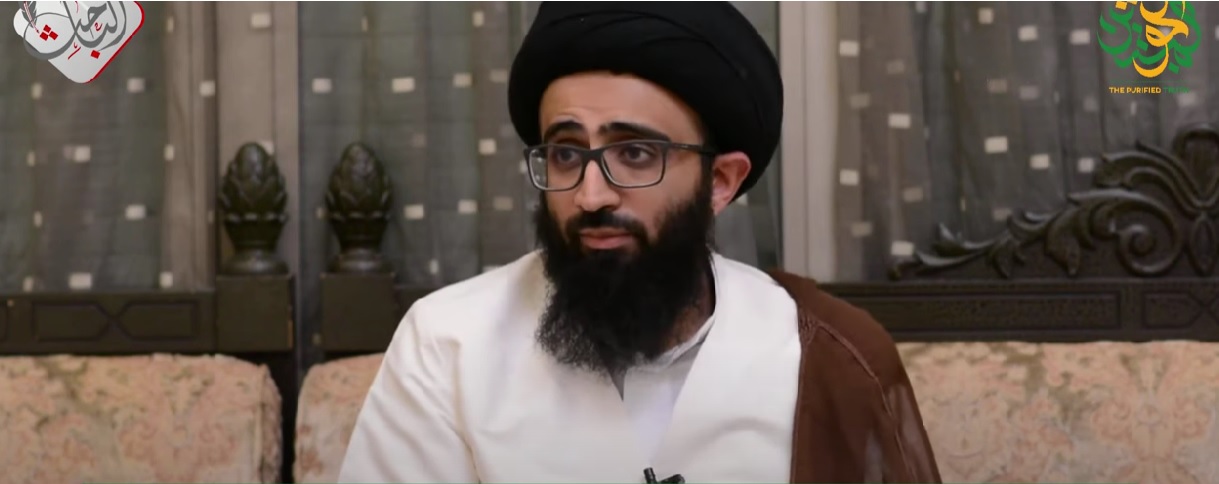
First let us post what the original video clip has to say about Sayyid Ali’s presentation:
“In this video, the Sayyid responds to a questioner who asks whether the Qurʾān that is present between us today has been subject to distortion or not. Instead of going through the traditions related to whether this has indeed been the case, the Sayyid outlines some epistemological points to bear in mind when trying to evaluate this claim. He delineates general historical principles and facts that cause us to deem such an occurrence, as historians, to be extremely far-fetched. He then outlines the possible goals of a distorter and contrasts these objectives to what is found within the Qurʾānic text, whence we find that had these been the objectives of the distorters, then we would not possess certain verses and contents of the Qurʾān that we do today.” –Source: https://www.youtube.com/watch?v=l7y9bstcnXM&t=1453s
We would also like to say that this explanation by Sayyid Ali is one of the best, if not the best we have seen. It answers a lot of questions that are put forward in regard to this.
There are those who claim that the Shi’i themselves make this claim. The claim of tahrif of the Qur’an. Sayyid Ali beautifully responds to these claims.
This is a short and succinct lecture, equal to about 29 minutes of your time. It is absolutely worth it.
Those Orientalists and advocates of the historical critical method are most welcome to put this in their pipes and smoke it. The Imam laid out a very cohesive and cogent argument.
We would highly recommend you listen to the whole of the presentation.
@20:04 “Pay attention with me, in the Glorious Qur’an, now if someone wants to distort, what would they want to distort? What are his objectives hind distortion? I mean, what are the possible objectives of distortion? We will mention objectives, and let’s see if they have any basis.”
@20:18 “It may be said, for example, that among the objectives of distortion: Is the removal of certain criticisms directed towards some of the Companions who ruled. I mean, those who had authority. They are all present in the Qur’an. They are found in Surat al-Tahrim, Surat al-Hujurat, which contains: {Do not raise your voices above the voice of the Prophet} [Qur’an 49:2]“
@20:40 “And it’s mentioned about whom it was revealed. The issue of fleeing on the day of Uhud, and Hunayn, all these details are mentioned. The details of the events are mentioned. If someone wanted to distort, why would they distort? I mean, if one of the objectives of authorities was distortion, it would have been something related to them.”
@:20:58 “Those who ruled, the criticisms directed at them in the Book of Allah are present.
This is a possible objective [for distortion]. Of coruse, I mention these as supporting points,
not as evidence. The [main] evidence has concluded. The evidence has concluded, now we’re
mentioning supporting [points].
@21:10 “The second objective is, for example, that these individuals want to remove some matters regarding the Prophet (peace be upon him and his family) [being portrayed in a negative light].
@21:19 “They love the Prophet, so they try. The Glorious Qur’an, the criticisms made by the polytheist against the Prophet (peace be upon him and his family) are present in the harshest articulation. In fact, some addresses in the Qur’anic chapters to the Prophet (peace be upon him and his family) that contain-where principally one may perceive some sort of harshness and severity within, for example, {And had We not strengthened you, you would have almost inclined to them a little} [Qur’an 17:74], it’s all there.”
@21:49 “Alright? Of course, we say it’s in the sense of “I mean you, and listen O neighbor.” But the address is there.”
@22:17 “Very well. Among the objectives that are mentioned, is removing the names of
Ahl al-Bayt (upon them be peace), from the Qur’an. I say—I say, firstly, what’s the meaning of this verse? We’re talking now as Shi’a. {O Messenger, announce that which has been revealed to you from your Lord, and if you do not not, then you have not conveyed His message} [Qur’an 5:67]
@22:38 “How do we interpret this? Isn’t it about Wilaya? Isn’t it about Wilaya in the last days of the Prophet (peace be upon him and his family). And Surat al-Ma’ida is amongst the last [chapters] to be revealed, if not the very last.”
@22:53 “If Wilaya was detailed in previous chapters, then what would be the meaning of: {announce that which has been revealed to you from your Lord} [Qur’an 5:67]? We fundamentally believe that it’s natural for the mention of the Commander of the Faithful (peace be upon him) to not be frequent in the Qur’an.“
“This is natural. And this is what we believe. I mean, his mentioned as an Imam.
I speak of his mention as an Imam. Clear? Not as a man of virtues. Otherwise if we’re speaking of virtues, then a “a quarter [of the Qur’an] is about us”. Clear?”
@23:23 “We are not speaking for that perspective. We’re speaking from the perspective of those in power. Alright? Concerning those in power, {Announce that which has been revealed to you from your Lord, and if you do not, then you have not conveyed His message} [Qur’an 5:67] Now, this verse, what’s the reason for its revelation? It’s natural that the mention of Imam ‘Ali (upon him be peace) will not be frequent in the Qur’an. As for mentioning the rest of the Imams (upon them be peace), in the Qur’an.”
@23:50 “Fundamentally, we Shi’a do not believe in the necessity of believing in [all] the Imams (upon them be peace) except after the death of the previous Imam.
However the Imam later admits:
@27:25 “The thing that may be brought up is the issue of Wilaya. So it would be
problematic only on the Shi’a side. But we explained that the Shi’a, when it comes to revealing all of the Imams’ [names], that is something they have deemed far-fetched. Fundamentally. It’s not something to be expected, that there would be something in the Qur’an about Imamate. And on the other hand, concerning the Commander of the Faithful (upon him be peace), we believe that the Prophet (peace be upon him and his family) proclaimed this towards the end of his life. {O Messenger, announce that which has been revealed to you from your Lord, and if you do not, then you have not conveyed His message} [Qur’an 5:67]. So in reality, naturally, if the name of the Commander of the Faithful (upon him be peace) was in the Qur’an, it would have been rare and minimal. For example, had it been the case. Up to this extent, I mean, this degree of speculation.”
@28:14 “This does not outright negate the existence of the name of Imam ‘Ali (upon him be peace). This is a speculative argument. However, I just want to say, that upon reflection on the matter, the degree of distortion will not, some people, I mean, naturally, the name of Imam Ali, had it been in the Qur’an, it would be rare, Had it been there, it would be rare. Had it been there. Clear? According to the Shi’i view. Nothing else. I’m saying this according to the Shi’i Twelver view. Alright?”
Prima Qur’an comments: First and foremost again, the overall explanation by the respected Imam was/is brilliant! It is unfortunate that some people will allow themselves to be clouded by sectarianism and not benefit by what he said.
The only part where he dropped the ball was giving his minor points (because, as he mentioned, the main case has already been established), but in regard to the minor points is concerning the mention of the ahl bayt and/or the mention of the name of Imam Ali (at the very least).
By quoting a vague reference:”Announce that which has been revealed to you from your Lord, and if you do not, then you have not conveyed His message} [Qur’an 5:67] This does little to dissuade anyone from the idea that a redactor or editor wanted to remove explicit mention of the Ahl Bayt or Imam Ali as the leader of Imam of the Muslims.
The Imam was also honest and transparent enough to say:
“@22:38 “How do we interpret this? Isn’t it about Wilaya? Isn’t it about Wilaya in the last days of the Prophet (peace be upon him and his family)
“How do we interpret this.”
“I mean, naturally, the name of Imam Ali, had it been in the Qur’an, it would be rare, Had it been there, it would be rare. Had it been there.”
He was also very objective and fair-minded when he stated:
“The thing that may be brought up is the issue of Wilaya. So it would be problematic only on the Shi’a side. But we explained that the Shi’a, when it comes to revealing all of the Imams’ [names], that is something they have deemed far-fetched
That is correct. It would only be a problem for the Shi’a side, as they are the ones who have as a theological foundation the concept of being ruled by the family of the Prophet (saw), a concept we absolutely do not find in the Qur’an at all.
So, for the Sunni or the Ibadi, this is not something we would expect to find in the Qur’an.
We have already mentioned this in our article:
Other than that one should watch and take note of this excellent presentation by Sayyid Ali Abu al-Hasan.
May Allah (swt) guide the Ummah.
May Allah (swt) forgive the Ummah.


 Prima Quran