
“Whenever a newly (muḥ’dathin) spoken reminder comes to them from their Lord, they listen to it while they are playing.” (Qur’an 21:2)
﷽
Today we will be addressing the four core arguments given by Imam Al-Ash’ari’ in his ‘Al-Ibana ‘an Usul al-Diyanah’ on the createdness of the Qur’an.
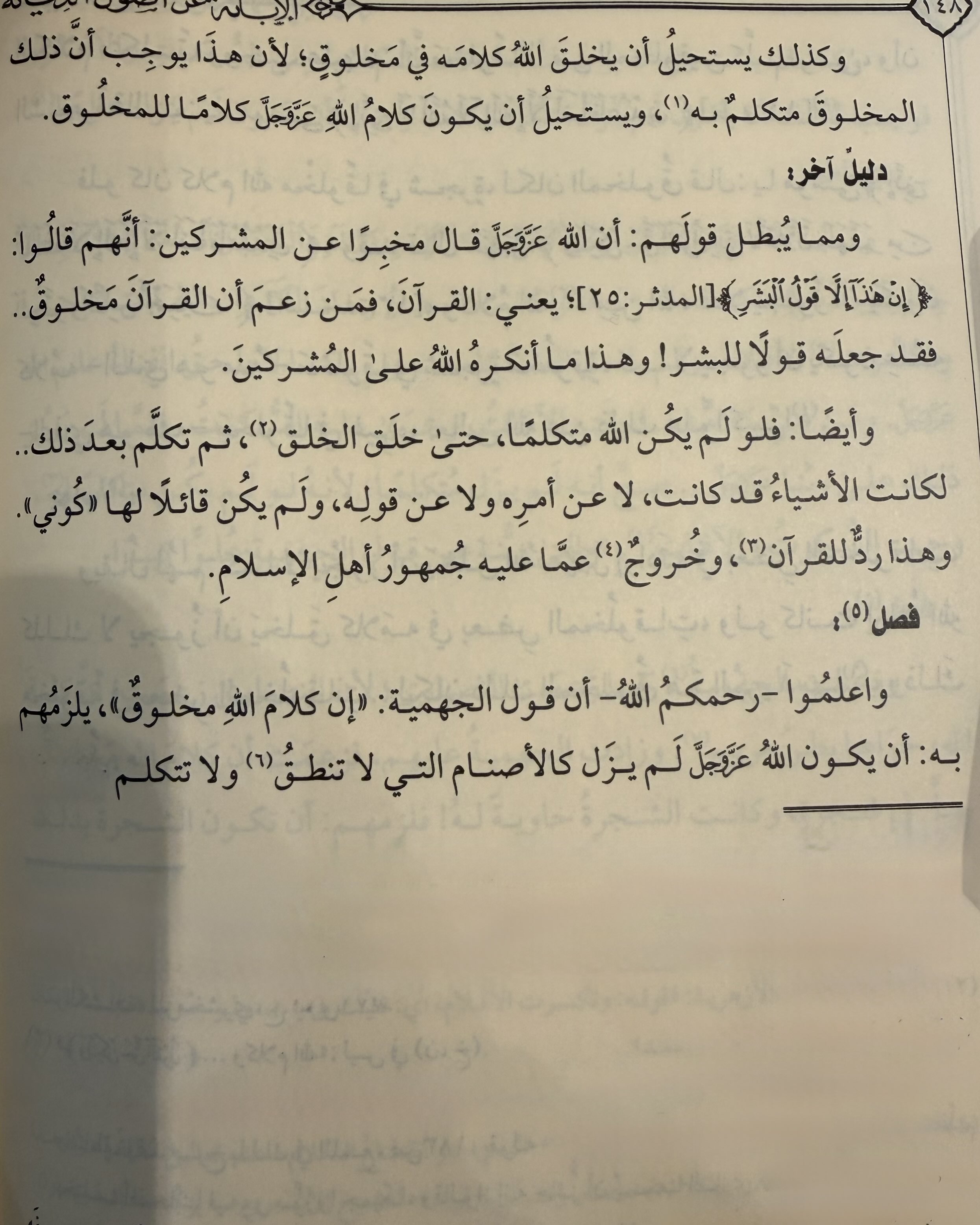
The text on the page is from Imam al-Ash’ari’s Al-Ibana ‘an Usul al-Diyanah (The Elucidation of the Foundations of Religion page 148) . This work is a foundational text in Islamic theology where Imam al-Ash’ari explains his creed, particularly concerning the nature of Allah’s speech and the uncreatedness of the Qur’an.
The translation of the above is as follows:
And likewise, it is impossible that Allah should create His speech in a created being; because that would necessitate that the created being is the one speaking with it, and it is impossible that the speech of Allah (Mighty and Majestic) be a attribute of the created being.
Another Evidence:
And among that which invalidates their statement is His (Mighty and Majestic) saying, informing about the polytheists that they said: {This is nothing but the word of a human being} [Al-Muddaththir: 25]; meaning: the Qur’an. So whoever claims that the Qur’an is created has made it the word of a human being! And this is what Allah denied upon the polytheists.
And also: If Allah had not been speaking (with speech), until He created the creation, then spoke after that, the things would have already existed, without His command and without His saying, and He would not have said to it “Be”.
And this is a refutation of the Qur’an, and a departure from what the majority of the people of Islam are upon.
Chapter:
And know – may Allah have mercy on you – that the statement of the Jahmiyyah: “The speech of Allah is created,” necessitates that Allah (Mighty and Majestic) was not speaking and not speaking, like the idols that do not speak.
Here are four necessary conclusions (implications) from Imam al-Ash’ari.
1. If the speech of Allah, the Qur’an that is in our hands were created in a human being, then that speech would be specific to the created being, and it would be impossible for the speech of Allah to be attributed to created beings.
2. If the Qur’an is not the speech of Allah, then it is the speech of humans, and this is precisely the statement of the polytheists.
3. If Allah were not described with speech, that would lead to the denial of the Qur’an, which clarifies that His speech preceded the existence of created things when He said to them, “Be.”
4. If the Qur’an were created and Allah had no speech, then Allah would be described with what the idols are described with namely, the absence of the ability to articulate and speak.
Prima Qur’an response:
These are old and tired arguments by those of us who have been engaged in this for some time now.
Here is the refutation of al-Ash’ari’s feeble inferences.
However, before we come to that It is known through inductive observation that one who moves from one school of thought to another is at the very least acquainted with the general statements of both schools. However, when looking at the arguments of “Abu al-Hasan al-Ash’ari,” it invites a deeper question.
How did al-Ash’ari move from Mu’tazilism to Sunnism, when his inferences betray his ignorance of the doctrine of his former companions?
To clarify what we mean, we praise be to Allah intend to expose the flaws in what he inferred, due to his ignorance of the doctrine of his opponents, so that no ignorant person may be deceived by him. And with Allah is success.
His first implication: That the creation of the Qur’an in a human being necessitates attributing it to that human, so that it becomes that human’s speech rather than Allah’s speech.
The response: We do not concede that speech (in the sense of letters and sound) is established in the essence of the human being at all; rather, it is established in the air that he articulates. Once this is established, we say: speech is attributed to its originator (i.e., its first producer), not to the one who uttered it. For if one of us recites verses by al-Buhturi, that does not mean they are his; likewise, the Qur’an is attributed to its originator and first creator, glorified be He.
The gist of the second implication: That if the Qur’an is not Allah’s speech, then it is human speech, which is precisely the statement of the polytheists.
The response: If by his statement “the Qur’an is not Allah’s speech” he means that the Qur’an is not identical to the attribute of speech, then that is conceded but that does not entail that it is human speech. And if he means that his opponents say the Qur’an is not from Allah’s origination and creation, then that is a lie against them and does not apply to their statement.
His third implication: That if Allah were not speaking before the creation of creation, that would lead to the denial of His saying, exalted be He: {When He decrees a matter, He only says to it, “Be,” and it is} (Qur’an 2:117)
Its answer: That would only lead to denial if His saying “Be” were not created and spoken, and infinite regress is not entailed, because of the rational specification [of the created thing].
Or it may be said: the verse does not indicate a literal statement; rather, it is of the category of expressing the form of speech to mean action, and that is frequent in the Arabic language like the poet’s saying, “When the saddle-straps said to the belly, ‘Stretch,'” and his saying, “The east wind said to it, ‘Qarqar.'” Some exegetes interpreted His saying, exalted be He: {They said, “We have come willingly”} (Qur’an 41:11)in this sense, and it is more fitting to the context and more indicative of the intended meaning.
His fourth implication: That if the Qur’an were created, Allah would resemble the idols in their not being speaking and articulate.
Its response: We say that Allah is described as speaking in the sense that He is the producer of letters and sound, and that is what is immediately understood from the meaning of speech; for letters and sound are not established in the speaker from the outset; rather, His power to produce those letters and sound by His choice is established in Him. Once you understand that, this objection has no meaning, since the idols are not able to produce letters and sound by their choice.
These arguments are dragged out here and there like a an old and tired horse in it’s 20s no longer suitable to be ridden. Have some shame and pity on the horse!
And praise be to Allah, Lord of the worlds.
If you want to see the third argument of Abu al-Hasan al-Ash’ari dealt with in more detail you can read our article here:
If you want to see the fourth argument of Abu al-Hasan al-Ash’ari dealt with in more detail you can read our article here:
By the way this is also a favourite argument of the Salafi-Athari.
May Allah (swt) guide the Ummah to firm foundations in their aqida.
Foundations that are found in the Qur’an itself.
May Allah Guide the Ummah.
May Allah Forgive the Ummah.


