
“And DO NOT OBEY the order of the transgressors, Who cause corruption in the land and do not amend their ways” (Qur’an 26:151-152)
﷽
“They will kill the Muslims but will not disturb the idolaters. If I should live up to their time’ I will kill them as the people of ‘Ad were killed (i.e. I will kill all of them)”
Source: https://sunnah.com/bukhari:3344
Two points I want to dive into from the get go.
As mentioned before in a previous article. Having a stable government and a country or nation that you live in where your basic needs and necessities are being met is a huge provision and blessing of Allah (swt). Political stability is a huge blessing and provision from Allah (swt).
Yet, political stability cannot come as an enjoyment to one group of people and one class of people and a hardship for others.
Allah (swt) has commanded that we stand firm for justice and that this justice cannot be selective justice or a justice that is subservient to our whims and desires.
“O you who have believed, be persistently standing firm in justice, witnesses for Allah, even if it be against yourselves or parents and relatives. Whether one is rich or poor, Allah is more worthy of both.” (Qur’an 4:135)
From Palestine to Yemen from Libya to Sudan. We have Muslim brothers who do not speak out against the leaders not because they are afraid of Abdel Fattah El-Sisi or Mohammed bin Salman Al Saud. They do not speak up because they fear that if they do they are going against Allah (swt) and his Blessed Messenger (saw). This has been implanted in their minds so that powerful rulers can stay in place and justify what ever decision or policy they wish and the masses have nothing to do but to keep quite on the matter.
Hudhayfah ibn al-Yaman reported: I asked, “O Messenger of Allah, we were living in an evil time and Allah brought us good in which we live now. Will there be evil after this good?” The Messenger of Allah, peace and blessings be upon him, said, “Yes.” I said, “And any good after this evil?” The Prophet said, “Yes.” I said, “And any evil after this good?” The Prophet said, “Yes.” I said, “How will it be?” The Prophet said, “Leaders after me will come who do not follow my guidance and my Sunnah. Some of their men will have the hearts of devils in a human body.” I said, “O Messenger of Allah, what should I do if I live to see that time?” The Prophet said, “You should listen and obey the ruler, even if he strikes your back and takes your wealth, even still listen and obey.”
Source: https://sunnah.com/muslim:1847b
This is the hadith that is used by the Madhkali Salafiyyah as a proof text to justify their position.
We say that this hadith if taken the way the Madhkali want you to take it will cause confusion and clashes with other equally authentic reports that report contrary statements from the Blessed Messenger (saw).
The first point is to acknowledge that the in this hadith the Blessed Messenger (saw) is clearly stating they these leaders are not upon the guidance that the Prophet (saw) is upon. It is also clearly stating that they do not follow his way.
The second point where it is attributed to the Prophet (saw) the following:
“The Prophet said, “You should listen and obey the ruler, even if he strikes your back and takes your wealth, even still listen and obey.”
This means with right. That taw’il or interpretation of this is if the leader strikes your back or takes your wealth (with right).
Examples could be: The punishment for flogging. For fornication for drinking etc. There are examples of sahabah being whipped for drinking etc.
Taking your money could mean zakaat that is not paid. Abu Bakr (ra) fought what was known as the rida wars for those who did not pay the zakaat.
However….
It cannot mean that obey the leader even if he takes your wealth or strikes your back (without right).
So now let us look at what is the truth on this matter and openings are only with Allah (swt). May Allah (swt) guide is to the truth of these matters.
Three inconvenient points that Madhkali Salafi leave out when talking about obeying the ruler.
1. That ruler is singular.
2. That when the Blessed messenger (saw) says rulers (plural) it is always in succession and never concurrent. Meaning Muslims are not divided in their leadership.
3. The audience that is being addressed is a united Muslim body under united leadership.
Notice a very relatable argument that Prophet Joseph (as) uses:
Prophet Joseph (as) uses a relatable argument to his fellow prisoners. Something to think about.
“Oh my fellow companions of this prison, are masters with separate agendas better or Allah, The One, The Subjugator?” (Qur’an 12:39)
O you who have believed, obey Allah and obey the Messenger and those in authority among you. And if you disagree over anything, refer it to Allah and the Messenger, if you should believe in Allah and the Last Day. That is the best [way] and best in the result. (Qur’an 4:59).
Understanding the proof.
In this clear verse, we find that in matters of disagreement between those in authority and those under authority, we need to refer back to Allah and the Messenger. Had it been that, those in authority were infallible or divinely appointed, or to be given absolute obedience then, Allah (swt) wouldn’t have given any scope to disagree with them.
The fact that there is disagreement proves that “those in authority aka the Uli-l-amri”, are neither an absolute nor an infallible authority, nor are Muslims to submit to their seat of power in all things.
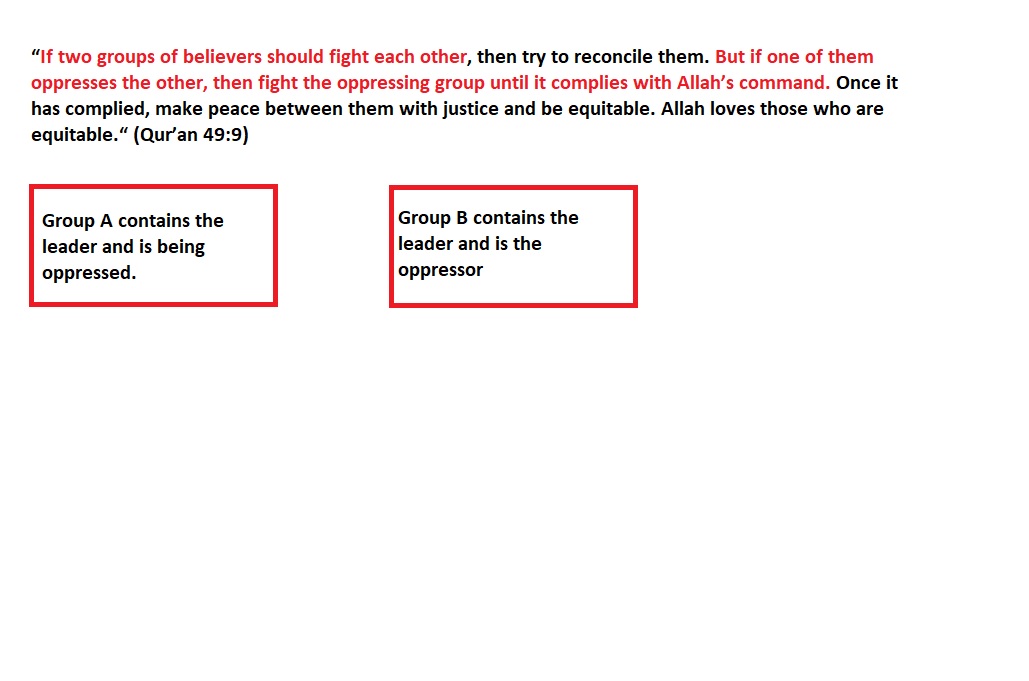
These two verses together (Qur’an 4:59 & Qur’an 49:9) absolutely debunk the idea that Muslims cannot rebel against a leader. It is not reasonable to think that if two groups of believers were fighting each other (with intent to kill) that the leader would not be among one of the two warring factions himself! Thus, he would be opposed.
The leader would either be in group A or in group B.
Notice that it uses the word ‘believers’ when discussing those who would be fighting (with intent to kill). Also says until it complies with Allah’s command (amri-l-lahi). Notice it does not say until it complies with the uli-l-amri (those that are given authority over you).
Let it be known that the Qur’an is qati (it is decisive in proof and evidences).
Looking at hadith from the sunnah of the Blessed Messenger (saw).
“Verily, tyrannical rulers will come after me and whoever affirms their lies and supports their oppression has nothing to do with me and I have nothing to do with him, and he will not drink with me at the fountain in Paradise. Whoever does not affirm their lies and does not support their oppression is part of me and I am part of him, and he will drink with me at the fountain in Paradise.”
Source: https://sunnah.com/nasai:4207
“If an Ethiopian slave with a cut off nose and ear were appointed as your ruler, you would have to listen to and obey his orders as long as he rules in accordance with the Book of Allah.
Source: https://sunnah.com/ibnmajah:2861
Narrated ‘Abdullah:
The Prophet said, “A Muslim has to listen to and obey (the order of his ruler) whether he likes it or not, as long as his orders involve not one in disobedience (to Allah), but if an act of disobedience (to Allah) is imposed one should not listen to it or obey it.
Source: https://sunnah.com/bukhari:7144
Explanation of the apparent contradiction.
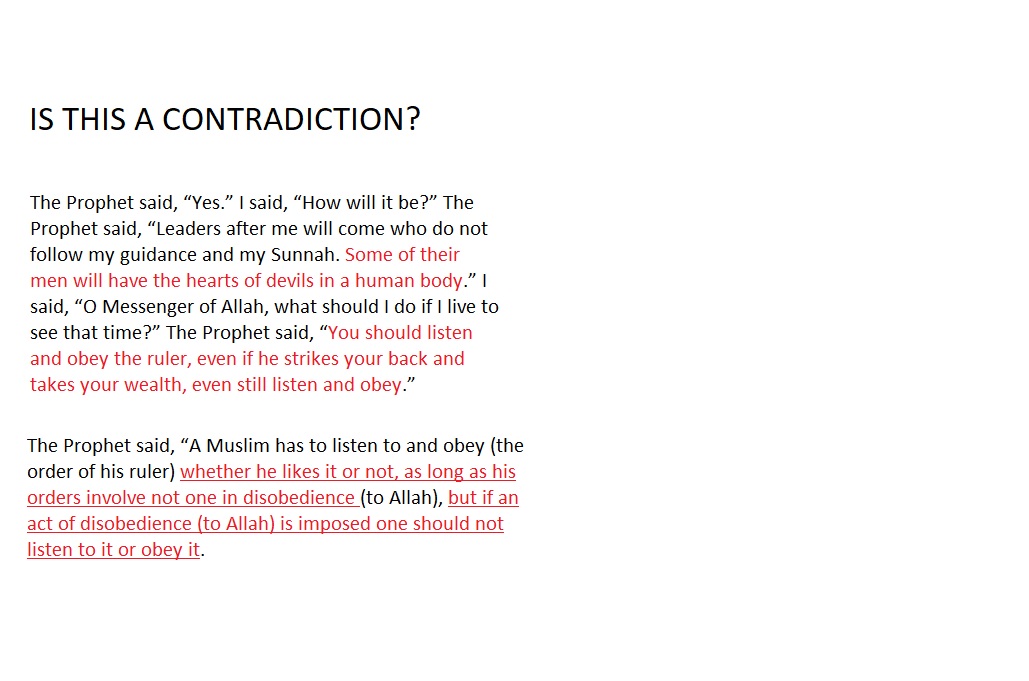
Look carefully at the two hadith. The Blessed Messenger (saw) is acknowledging that we as Muslims may outright have hypocrites as leaders. “Will have the hearts of devils in a human body.” This is the batin (the hidden). In Islam we do not judge by the batin (hidden). The man could be rotten to the core. This could be true of any of us for that matter. Allah (swt) sees and knows all.
If we were to put the two hadith together we have the following hadith of the Blessed Messenger (saw):
“A Muslim has to listen to and obey the ruler, even if he strikes your back and takes your wealth, even still listen and obey. As long as his orders do not involve one in disobedience, but if an act of disobedience is imposed one should not listen to it or obey it.“
Now it makes total sense. Now the apparent contradiction is resolved.
Now we know what was meant by the righteous Amir of the Muslims. Umar Ibn Al Khattab (ra).
Abdullah ibn ‘Utbah reported: Umar ibn al-Khattab (ra) said,
“Verily, people were judged by revelation in the time of the Messenger of Allah, peace and blessings be upon him, and the revelation has ceased. We only judge now what is manifested outwardly of your deeds. Whoever shows us good, we will trust him and bring him close. It is not for us to judge anything of his inner secrets. Allah will hold him accountable for his inner secrets. Whoever shows us evil, we will never trust him or believe him even if it is said his intentions are good.
Source: https://sunnah.com/bukhari:2641
The highest Jihad in Islam.
It was narrated from Tariq bin Shihab that:
‘”A man asked the Prophet, when he had put his leg in the stirrup: “Which kind of Jihad is best?'” He said: ” A word of truth spoken before an unjust rulers.”
Source: https://sunnah.com/nasai:4209
Now some people may also want to interpret this hadith to mean something pacifist. It is the right of every Muslim to receive good counsel, even the corrupt rulers. Yet, why is this the highest form of Jihad? Because more often than not it leads to martyrdom.
“[Pharaoh] said, “You believed him before I gave you permission. Indeed, he is your leader who has taught you magic. So I will surely cut off your hands and your feet on opposite sides, and I will impale you on/in the trunks of palm trees, and you will surely know which of us is more severe in [giving] punishment and more enduring.” (Qur’an 20:71)
Did these magicians incite rebellion? Well, that depends. They are not recorded to have incited rebellion against Pharaoh. They did not take up weapons against him. However, some times simply by speaking the truth and uncovering that which is false can undermine a ruler, a false idea or a false ideology. Hence censorship and telling the people to keep quite.
Thus,
“Which kind of Jihad is best?” The Blessed Messenger (saw) replies:
“A word of truth spoken before an unjust rulers.”
Shaykh Abdur Rahman Sudays is basically saying that the killings are “fitna”. That we should not get involved and that we refer the matter back to the ruler and the scholars.
Meanwhile the military police stand close watch. Some how does not seem very convincing.
We should not be so quick as to condemn Shaykh Abdur Rahman Sudays or any of the other scholars. However, when geopolitical allegiances and alliances are involved we should be careful of who is saying what and what is the affiliation of their government.
On the authority of Abu Sa`eed al-Khudree (ra) who said:
I heard the Messenger of Allah (swt) say, “Whosoever of you sees an evil, let him change it with his hand; and if he is not able to do so, then [let him change it] with his tongue; and if he is not able to do so, then with his heart — and that is the weakest of faith.”
Source: https://sunnah.com/nawawi40:34
So be very careful dear brothers and sisters on racing to condemn each other. The Blessed Messenger (saw) has left some scope based upon the abilities of each individual.
- He (saw) started by saying we should change the munkar (evil) with our hands.
- However, if you cannot do so with your hands than through your speech.
- If you are unable to do so via speech than at the very least hate it in your heart.
Not everyone is ready or prepared for martyrdom and even those of us who are may not be prepared to have our families threatened, or killed or horrific ways.
So condemning these nation state “rulers” you will end up with labels, “Khawarij” you may end u imprisoned and/or face horrific torture.
Make du’a for every single scholar of Islam from all the various Islamic schools of thought that Allah (swt) protect them guide them and give them strength.
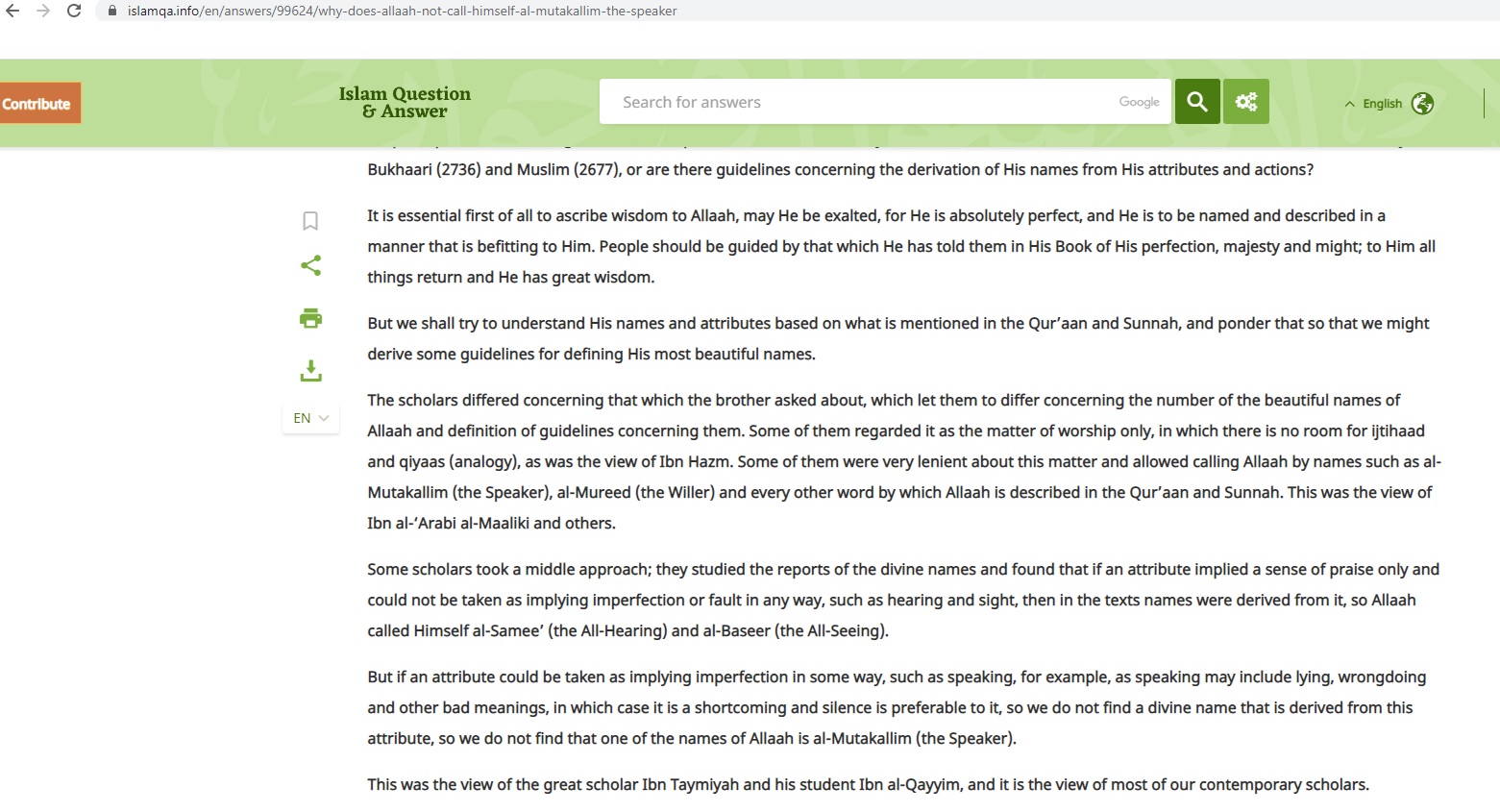
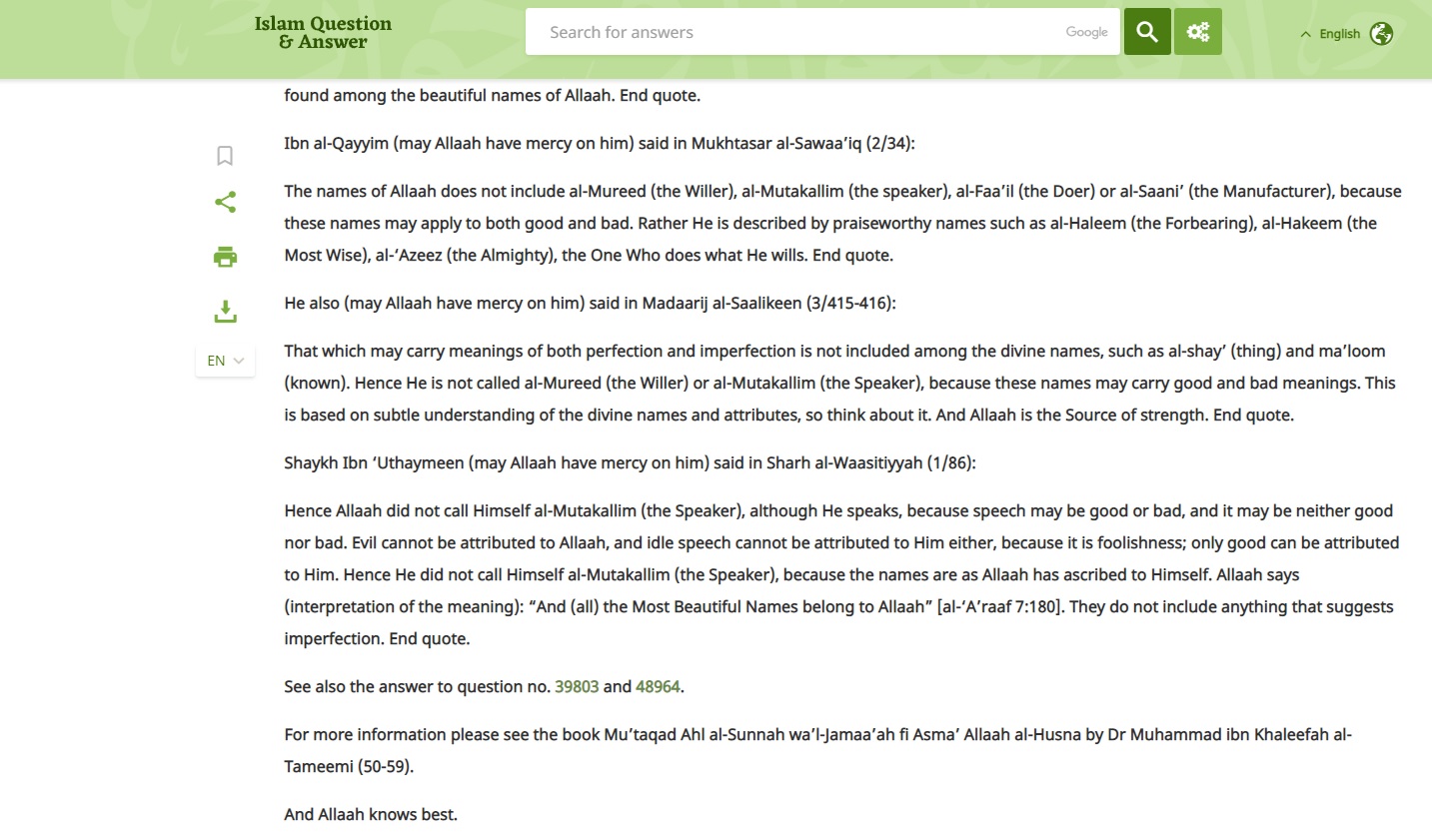
“One does not deviate from obedience to the ruler, even if he commits adultery and drinks alcohol on live television!” ?
The improper understanding of the Qur’an and the Sunnah is what leads people like Dr. Abdulaziz Al-Rays to say the following:
This actually depends.
“If an Ethiopian slave with a cut off nose and ear were appointed as your ruler, you would have to listen to and obey his orders as long as he rules in accordance with the Book of Allah.”
Source: https://sunnah.com/ibnmajah:2861
So in the case of adultery on live television he would have enough witnesses to bring the punishment of adultery upon him and thus would be the leader no more as he would be executed.
In the case of drinking alcohol he would be whipped.
If he submits to the book of Allah (swt) one has scope to argue that he is to be obeyed. If he does not submit to the book of Allah (swt) than he is a hypocrite and what has Allah (swt) told us about the hypocrites?
“O Prophet! Fear Allah and do not obey the unbelievers and the hypocrites: certainly Allah is aware and wise.” (Qur’an 33:1)
There are a few scenarios when it comes to the rulers.
Example 1 Outwardly pious but inwardly evil. This was already discussed.
Example 2 Outwardly impious and ask us to go against the Qur’an and the Sunnah. Than he is definitely not to be obeyed.
Example 3 Outwardly impious does not ask us to go against the Qur’an and the Sunnah. However, he himself goes against the Qur’an and the Sunnah. This will depend upon the nature of his rebellion against the the Qur’an and the Sunnah.
Be very careful with point number 3. That is where things can get slippery. For example look at the following hadith:
Narrated ‘Ali:
“The Prophet sent an army unit (for some campaign) and appointed a man from the Ansar as its commander and ordered them (the soldiers) to obey him. (During the campaign) he became angry with them and said, “Didn’t the Prophet order you to obey me?” They said, “Yes.” He said, “I order you to collect wood and make a fire and then throw yourselves into it.” So they collected wood and made a fire, but when they were about to throw themselves into it, they started looking at each other, and some of them said, “We followed the Prophet to escape from the fire. How should we enter it now?” So while they were in that state, the fire extinguished and their commander’s anger abated. The event was mentioned to the Prophet and he said, “If they had entered it (the fire) they would never have come out of it, for obedience is required only in what is good.”
Source: https://sunnah.com/bukhari:7145
Similar to this:
Ali said, “The Messenger of Allah(saw) sent an army and appointed a man as a commander for them and he commanded them to listen to him and obey. He kindled fire and ordered them to jump into it. A group refused to enter into it and said “We escaped from the fire; a group intended to enter into it. When the Prophet (saw) was informed about it, he said “Had they entered into it, they would have remained into it. There is no obedience in matters involving disobedience to Allah. Obedience is in matters which are good and universally recognized.
Source: https://sunnah.com/abudawud:2625
It was narrated from ‘Ali that the Prophet (saw) said:
`There is no obedience to any human being if it involves disobedience to Allah.`
Source: https://sunnah.com/ahmad:1065
It was narrated from Ali that the Prophet (saw) said:
`There is no obedience to any created being if it involves disobedience to Allah, may He be glorified and exalted.”
Source: https://sunnah.com/ahmad:1095
So all of those three hadith are not saying that you do not obey the leader if he slips up or makes mistakes or sins. Those hadith are saying that we, the people do not have to obey the leaders if they order us to do something against the Qur’an and the Sunnah.
This is a very important point to keep in mind.
It has been narrated on the authority of Abu Huraira (ra) that the Messenger of Allah (saw) said:
“It is obligatory for you to listen to the ruler and obey him in adversity and prosperity, in pleasure and displeasure, and even when another person is given (rather undue) preference over you.”
Source: (https://sunnah.com/muslim:1836)
More contradictory hadith?
Narrated Abu Huraira:
Allah’s Messenger (saw) said, “Whoever obeys me, obeys Allah, and whoever disobeys me, disobeys Allah, and whoever obeys the ruler I appoint, obeys me, and whoever disobeys him, disobeys me.”
Source: https://sunnah.com/bukhari:7137
Narrated Ibn Umar (ra)
The Prophet (saw) said:
“It is obligatory for one to listen to and obey (the ruler’s orders) unless these orders involve one disobedience (to Allah); but if an act of disobedience (to Allah) is imposed, he should not listen to or obey it.”
Source: https://sunnah.com/bukhari:2955

Now when the two hadith are combined the apparent contradiction is removed. We are to obey the ruler as long as the ruler does not ask one to disobey Allah (swt) or his Messenger (saw).
The hadith on not over throwing the ruler as long as he does his prayer among you.
More contradictory hadith?
It has been narrated on the authority of ‘Auf b. Malik that the Messenger of Allah (saw) said:
“The best of your rulers are those whom you love and who love you, who invoke Allah’s blessings upon you and you invoke His blessings upon them. And the worst of your rulers are those whom you hate and who hate you and whom you curse and who curse you. It was asked (by those present): Shouldn’t we overthrow them with the help of the sword? He said: No, as long as they establish prayer among you. If you then find anything detestable in them. You should hate their administration, but do not withdraw yourselves from their obedience.”
Source: (https://sunnah.com/muslim:1855b)
How to reconcile the apparent contradiction?

In other words if they do not establish prayer among us and if they stop ruling according to the book of Allah than obedience is forfeit.
How do we know that our understanding of the Qur’an and Sunnah is the correct one?
Because this is how the companions of the Blessed Messenger (saw) understood it.
“O people, whoever among you sees any crookedness in me in my character, my deals, my action, then let him straighten out that crookedness.” A man from the audience called out, “By Allah, were we to see any crookedness in you, we would have straightened it out with our swords.’ Umar then said, “All praise is for Allah, who has placed in this nation someone who will straighten the crookedness of Umar with his sword.’”
Source: (Akhbar Umar (pg. 231,232) and Ar-Riyadh an Nadirah)
Subhan’Allah is there a Muslim leader alive today who claims to be greater than Umar (ra)?
Secondly after Caliph Uthman was admonished again and again by the Muslims he was overthrown. By the Khawarij they will tell you. Well….about that.
So now you are in a pickle.
If Amr b. al-Hamiq al-Khuza’i is to be damned (there goes the doctrine of the companions being all adala). Amr b. al-Hamiq al-Khuza’i is a khariji who dies the death of jahiliyah (according to them)
or sacrifice this concept that there comes a point in which the believers may find it necessary to forcibly remove the Amir.
What has happened is that some of them so bewildered by these undeniable facts of history than go on to say that the sahabah did not know the books of aqidah (written with a sectarian milieu in mind long after the fact. Or even better yet, that these sahabah did familiar with the Qur’an and hadith on these matters!
All that has been written has shown this is not the case at all.
“If only Muslims were upon the proper manhaj, had proper aqidah and proper knowledge of tawheed none of this would be happening!“
Where have we heard this before?
Likewise some Muslims will say well, we just need to focus on obedience to Allah (swt) and Tawheed and the proper aqidah.
Look! The very essence of Islam is submission to the will of Allah (swt). Yet, the very fact that the companions who had proper aqidah and proper tawheed and yet had massive fitna is a prove that one can have can be hyper fixated on these things and still not save one from strife. Just like the idea of the Muslims having a Caliph did not stop the expulsion of Muslims from Andalusia.
This does not mean we do not strive to establish rule by the Qur’an and the Sunnah. It does not mean that we do not strive to worship Allah (swt) properly and be upon the proper aqidah. It simply means that human ego and the frailty of men will last until the day of judgement.
The hypocrisy of the Madhkali Salafiyah.
This whole mantra of obey the leader seems very specific to a particular group of leaders they feel approximate their idea of the correct aqidah and or manhaj. It doesn’t seem to apply to Ergodan or Mubarak, or the Muslim brotherhood, or Qatar, or Assad (who certainly deserved rebellion) and a litany of others.
One big elephant in the room. What is actually meant by ‘The Leader’ or ‘The Ruler’
Last I checked the agreed upon leaders of the Muslim Ummah (according to the Sunni and the Ibadi) were Abu Bakr, Umar, Uthman and Ali. Than after Ali, the Ibadi and Sunni have different narratives. The Shi’a have a totally different narrative altogether, The Blessed Messenger (saw) and his family.
I mean I don’t remember the Muslim ummah holding shura for pretty much any of these guys. Who said they get the wealth of the land? Who said they get to buy football teams and sports cars with the money from the land? Is this from the Qur’an and the Sunnah?
Realistic expectations of Muslim rulers and governments and signs of the hypocrites.
Now I want to say I have seen allot of disdain for Arabs online over the issue of Palestine. First of all, I think love of the Arabs is a good thing because the Blessed Messenger (saw) was from among them. Secondly, you cannot blame Arabs as a whole. Blame their leaders! Lastly, many of you simply know better. Many of you know Arabs as your brothers and sisters who are generous and kind. They have shown you some of the best hospitality and certainly Saudi Arabia is to be commended for the logistics feat of hosting 3 million people for Hajj annually.
However, when it comes to the majority Muslim countries, it has to be said. If it quacks like a duck and moves like a duck it’s a duck! The geopolitical rivalries and alliances do not necessarily benefit the Ummah of Muhammed (saw).
“And Allah will surely make evident those who believe, and He will surely make evident the hypocrites.” (Qur’an 29:11)
“O Prophet, strive against the disbelievers and the hypocrites and be harsh upon them. And their refuge is Hell, and wretched is the destination.” (Qur’an 66:9)
“They will kill the Muslims but will not disturb the idolaters. If I should live up to their time’ I will kill them as the people of ‘Ad were killed (i.e. I will kill all of them)”
Source: https://sunnah.com/bukhari:3344
Let me list countries with a Muslim majority (if I have missed any or you feel there are those who should be included and are left out please do let me know).
When we look at this list we need to ask ourselves some questions: What are their capabilities (militarily speaking) (economically speaking) and/or other. What are the current challenges that they are facing?
Malaysia
Brunei
Indonesia
Bangladesh
Comoros Islands
Maldives Islands
Kazakhstan
Kyrgyzstan
Uzbekistan
Turkmenistan
Tajikistan
Azerbaijan- currently in conflict with Armenia/ backed by Iran
Afghanistan-Taliban trying to rebuild the country after nearly 4 decades of war with foreign powers.
Pakistan-currently in political turmoil
Iran-currently backing Armenia against Turkey/Azerbaijan/Israel
Iraq-still reeling from the U.S Invasions.
Turkey-currently a part of NATO, backing Azerbaijan against Armenia/Iran.
Albania
Bosnia Herzegovina
Syria-still reeling after a civil war.
Lebanon-dealing with 1. 5 million refugees from Syria.
Jordan
Kuwait
U.A.E
Saudi Arabia
Oman
Yemen -still reeling after civil war.
Egypt
Somalia-civil war.
Djibouti
Sudan-currently in a civil war.
Libya-currently in a civil war.
Tunisia
Chad -dealing with close to 500,000 refugees that came in from Sudan.
Niger-forming new government after kicking out French colonialist.
Mali -civil unrest.
Burkina Faso-forming new government after kicking out French colonialist.
Algeria-tensions with Morocco over Western Sahara.
Morocco-tensions with Algeria over Western Sahara.
Senegal
Mauritania
Guinea
Sierra Leone
Nigeria
Dagestan, Ingushetia/Chechnya (as part of the Russian Federation) are bogged down in conflict in Ukraine
So we need to be realistic about who can help and how they can help. This is why these protest, and boycotts are very very effective and something that I hope leads to greater things among the wider Muslim community namely economic cooperation and buying Muslim owned products. Insh’Allah. In my next article I will cover this.
I will leave the readers with this. I feel that this doctrine that Madhkali Salafiyyah is problematic and it is a manipulation of the text of the Qur’an and the Sunnah and a re-reading into the history of the early Muslims. It makes a great ideology for despots and tyrants. If anyone has an issue with it. We have our scholars who can debate your scholars on this matter. Insh’Allah it will be of benefit and we will certainly be waiting.
Think about how you as a Muslim. As a Sunni/Shi’i/Ibadi as Salafi/Sufi would feel if you woke up one day and saw the Kab’a absolutely destroyed? Mecca was in ruins? How would you feel knowing it was not from a flood or natural disaster but the enemies of the Muslims destroyed it. Now hold that feeling and read the following:
It was narrated that ‘Abdullah bin ‘Amr said:
“I saw the Messenger of Allah (saw) circumambulating the Ka’bah and saying: ‘How good you are and how good your fragrance; how great you are and how great your sanctity. By the One in Whose Hand is the soul of Muhammed, the sanctity of the believer is greater before Allah than your sanctity, his blood and his wealth, and to think anything but good of him.’”
Source: (https://sunnah.com/ibnmajah:3932)
It is said that this hadith is Sahih li ghayrihi (authentic due to external evidence) according to Al-Albani
May Allah (swt) grant victory to our brothers and sisters in Palestine! May Allah (swt) grant this ummah good leaders, bridge builders, those who fear Allah (swt), and love his Messenger (saw) and love the ummah of Islam. Those who are wise and have bold vision. Those who stand firm upon the truth. Amin!
If you would like to learn more about the Madhkali I would suggest the following articles:




 Prima Quran