Tag Archives: worshippers-of-forms-and-shapes

Salafiyyah using mantiq (logic) and aql (reasoning) to deny attributes of Allah?

“Creator of the heavens and the earth. He has made for you from yourselves, mates, and among the cattle, mates; He multiplies you thereby. There is nothing like unto Him, and He is the Hearing, the Seeing.” (Qur’an 42:11)

﷽ 

Why does Allah not call Himself al-Mutakallim (the Speaker)?

This was a question that was sent to a Salafi Q & A and the response was quite shocking. Not only do the Salafi use logic and reasoning to reject attributes of Allah (swt) they use flawed logic and reasoning to do so.

You may find this article very eye opening: https://islamqa.info/en/answers/99624/why-does-allaah-not-call-himself-al-mutakallim-the-speaker
Praise be to Allah.

In order to make it clearer, we could word the question differently and say: 

Is it permissible to derive from the attributes and actions of Allaah that He has confirmed for Himself names for Him by which He may be called and by which His slaves may call upon Him, and which may be added to the list of His names so as to attain the reward mentioned in the hadeeth of the Prophet (peace and blessings of Allaah be upon him) “Allaah has ninety-nine names. Whoever memorizes them will enter Paradise” Narrated by al-Bukhaari (2736) and Muslim (2677), or are there guidelines concerning the derivation of His names from His attributes and actions? 
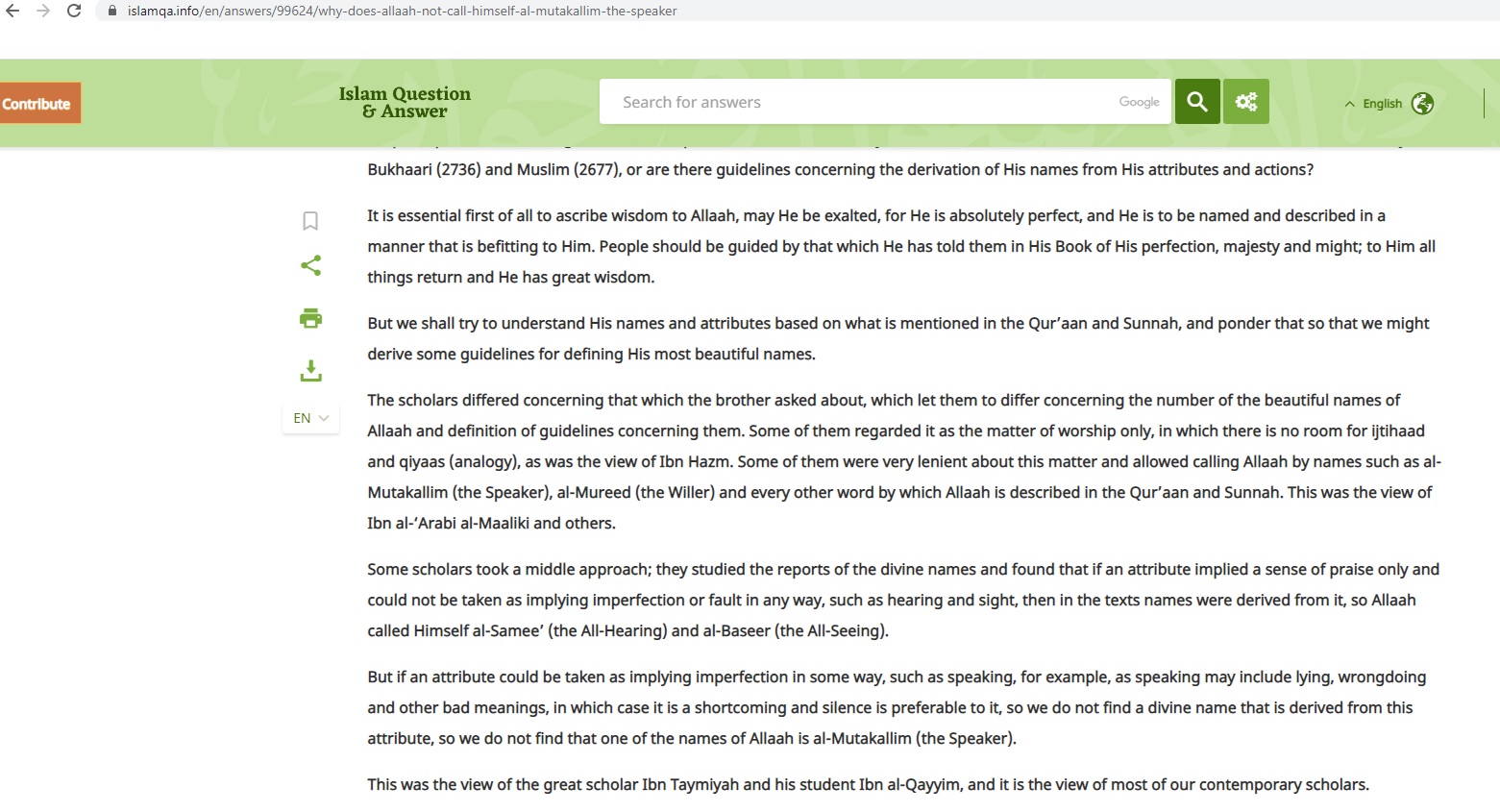
It is essential first of all to ascribe wisdom to Allaah, may He be exalted, for He is absolutely perfect, and He is to be named and described in a manner that is befitting to Him. People should be guided by that which He has told them in His Book of His perfection, majesty and might; to Him all things return and He has great wisdom. 

But we shall try to understand His names and attributes based on what is mentioned in the Qur’aan and Sunnah, and ponder that so that we might derive some guidelines for defining His most beautiful names. 

The scholars differed concerning that which the brother asked about, which let them to differ concerning the number of the beautiful names of Allaah and definition of guidelines concerning them. Some of them regarded it as the matter of worship only, in which there is no room for ijtihaad and qiyaas (analogy), as was the view of Ibn Hazm. Some of them were very lenient about this matter and allowed calling Allaah by names such as al-Mutakallim (the Speaker), al-Mureed (the Willer) and every other word by which Allaah is described in the Qur’aan and Sunnah. This was the view of Ibn al-‘Arabi al-Maaliki and others. 

Some scholars took a middle approach; they studied the reports of the divine names and found that if an attribute implied a sense of praise only and could not be taken as implying imperfection or fault in any way, such as hearing and sight, then in the texts names were derived from it, so Allaah called Himself al-Samee’ (the All-Hearing) and al-Baseer (the All-Seeing). 

But if an attribute could be taken as implying imperfection in some way, such as speaking, for example, as speaking may include lying, wrongdoing and other bad meanings, in which case it is a shortcoming and silence is preferable to it, so we do not find a divine name that is derived from this attribute, so we do not find that one of the names of Allaah is al-Mutakallim (the Speaker). 

This was the view of the great scholar Ibn Taymiyah and his student Ibn al-Qayyim, and it is the view of most of our contemporary scholars. 

Ibn Taymiyah (may Allaah have mercy on him) said in Sharh al-‘Aqeedah al-Isfahaaniyyah (1/19-20): 

As for calling Allaah, may He be exalted, Mureed (Willer) and Mutakallim (Speaker),  

These two names are not mentioned in the Qur’aan, or among the well known divine names. Their meanings are true, but the well known divine names are those by which Allaah may be called upon, and are mentioned in the Qur’aan and Sunnah, and which imply perfection and praise in and of themselves. 

Knowledge, power, mercy and so on are in and of themselves praiseworthy attributes, and the names which point to them are praiseworthy names.  

As for speech and will, they may be divided into praiseworthy types such as truthfulness and justice, and blameworthy types such as wrongdoing and lying. Allaah can only be described in praiseworthy terms, not blameworthy ones, hence His names do not include al-Mutakallim (the Speaker) or al-Mureed (the Willer). End quote. 

He also (may Allaah have mercy on him) said in Bayaan Talbees al-Jahamiyyah (2/10-11): 

Allaah has the most beautiful names, by which He has called Himself, and has revealed them in His Book and taught to whomever He willed among His creation, such as al-Haqq (the Truth), al-‘Aleem (the All-Knowing), al-Raheem (the Most Merciful), al-Hakeem (the Most Wise), al-Awwaal (the First), al-Aakhir (the last), al-‘Aliy (the Most High), al-‘Azeem (the Almighty), al-Kabeer (the Most Great) and so on. 

All of these names are names of praise which indicate praiseworthy meaning, and have no blameworthy meaning. To Allaah belong the most beautiful names, and He is perfect in all ways. Names which are more general in meaning and may be applied to both good and bad things are not found among the beautiful names of Allaah. End quote. 
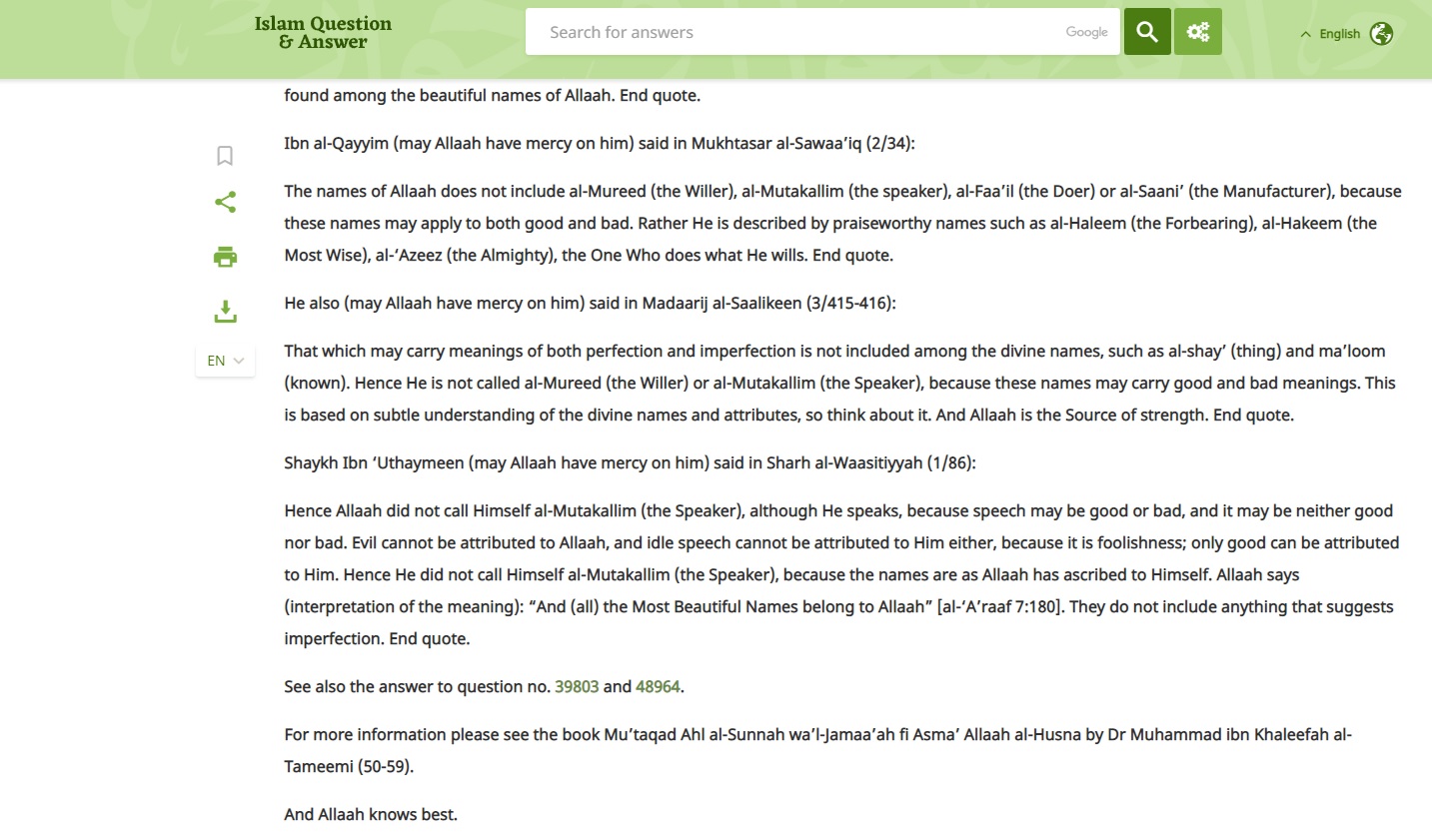
 

Ibn al-Qayyim (may Allaah have mercy on him) said in Mukhtasar al-Sawaa’iq (2/34):

The names of Allaah does not include al-Mureed (the Willer), al-Mutakallim (the speaker), al-Faa’il (the Doer) or al-Saani’ (the Manufacturer), because these names may apply to both good and bad. Rather He is described by praiseworthy names such as al-Haleem (the Forbearing), al-Hakeem (the Most Wise), al-‘Azeez (the Almighty), the One Who does what He wills. End quote. 

He also (may Allaah have mercy on him) said in Madaarij al-Saalikeen (3/415-416): 

That which may carry meanings of both perfection and imperfection is not included among the divine names, such as al-shay’ (thing) and ma’loom (known). Hence He is not called al-Mureed (the Willer) or al-Mutakallim (the Speaker), because these names may carry good and bad meanings. This is based on subtle understanding of the divine names and attributes, so think about it. And Allaah is the Source of strength. End quote. 

Shaykh Ibn ‘Uthaymeen (may Allaah have mercy on him) said in Sharh al-Waasitiyyah (1/86): 

Hence Allaah did not call Himself al-Mutakallim (the Speaker), although He speaks, because speech may be good or bad, and it may be neither good nor bad. Evil cannot be attributed to Allaah, and idle speech cannot be attributed to Him either, because it is foolishness; only good can be attributed to Him. Hence He did not call Himself al-Mutakallim (the Speaker), because the names are as Allaah has ascribed to Himself. Allaah says (interpretation of the meaning): “And (all) the Most Beautiful Names belong to Allaah” [al-‘A’raaf 7:180]. They do not include anything that suggests imperfection. End quote.  

See also the answer to question no. 39803 and 48964. 

For more information please see the book Mu’taqad Ahl al-Sunnah wa’l-Jamaa’ah fi Asma’ Allaah al-Husna by Dr Muhammad ibn Khaleefah al-Tameemi (50-59). 

And Allaah knows best.

PRIMA QUR’AN COMMENTS:

Well, can you imagine the Athari/ Salafiyyah making a big fuss about the Qur’an being the speech of Allah (swt) and than claiming that speech is an attribute of Allah (swt) and than turning around and admitting that Allah (swt) never called Himself “Al-Mutakallim”.

Then, saying that this is not appropriate to call Allah (swt) as Al-Mutakallim because speech may be good or bad! Yet they claim evil cannot be attributed to Allah (swt).

Pardon me for being more Athari than the Athari, but if your basic principle is that Allah (swt) cannot lie and that Allah (swt) does no evil than attributing the name of Al Mutakallim to Allah (swt) based upon that alone is not problematic.

Likewise simple logic. If the basic principle is that Allah (swt) cannot lie and that Allah (swt) does no evil and wills no evil than there is no harm in attributing the name of Al-Mureed. How can it be imagined that Allah (swt) wills evil?

In fact by the logic and the reasoning that the Athari/Salafi use in the above article you could reject the names of All Seeing and All Hearing.

Why? Because it is possible to hear gossip, and vile things. It is possible to witness and see vile and evil things.

Certainly Allah (swt) hears (perceives) and sees (knows) that which we as believers are forbidden to listen to and see. Allah (swt) has full grasp of all knowledge.

So the reasoning and logic given by the Athari/Salafi for rejecting the names of Al-Mureed or Al Mutakallim are not sound nor consistent.

That which may carry meanings of both perfection and imperfection is not included among the divine names, such as al-shay’ (thing) and ma’loom (known)

Notice that they do not believe it is appropriate to call Allah (swt) al-shay (The Thing). Not a thing (one among many) but The Thing.

Things brings them directly in conformity with Mu’tazilite/Ashari/Māturīdī theology.

Why?

Qur’an 42:11 the verse quoted in the beginning of the article the Arabic text states:

“laysa kamith’lihi shayon” (There is not like Him anything).

So, there is even a textual evidence that someone could come along and say, “We say Allah (swt) is a thing unlike other things.” Yet, this is not a good descriptor of The Divine.

There are no two things alike. Even things we deem identical have different properties and/or attributes.

Look what they quote from Ibn Al Qayyim above:

“That which may carry meanings of both perfection and imperfection is not included among the divine names, such as al-shay’ (thing) and ma’loom (known). Hence He is not called al-Mureed (the Willer) or al-Mutakallim (the Speaker), because these names may carry good and bad meanings. This is based on subtle understanding of the divine names and attributes, so think about it.”

This is based on subtle understanding of the divine names and attributes, so think about it“-Ibn Al Qayyim

Mash’Allah now only if our Athari/Salafi friends would think about it!

May Allah (swt) guide the to the haqq!

May Allah (swt) Forgive the Ummah! May Allah (swt) Guide the Ummah!
Leave a comment

Filed under Uncategorized

Salafi Shaykh Nasiruddin al-Albani admits: Bukhari has weak hadith and mistakes!

“Do not mix truth with falsehood and do not deliberately hide the truth” (Qur’an 2:42)

﷽ 

*Note This entry is being updated as of 15, July 2020. Those of the Salafi denomination of Ahl Sunnah can be unfortunately quite slippery and many links have already been taken down!

So those links that I do put up you owe it to yourself and truth seekers to save those links! I even anticipated in my very first paragraph of this entry that they would do this. Whatever they are after it certainly doesn’t’ look like its truth.

I would encourage you to click on the link to verify before the link is mysteriously taken down. Unfortunately, many of those who follow the Salafi denomination of Ahl Sunnah, are quite ignorant in terms of actual historical criticism of hadith

Also many among the Salafi denomination imitate the Shi’i denomination’s belief in “infallible imams” in that they grant the status of infallibility when it comes to the hadith canons of Bukhari and Muslim.

However, Salafi Shaykh Al Abani distanced himself from adopting a Shi’i like attitude towards Bukhari and Muslim that the majority of those from the Salafi denomination of Ahl Sunnah Islam adopted.

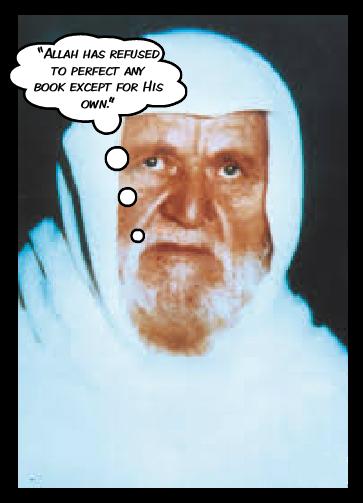
It is also possible that Shaykh Al Abani took Imam As Shafi’i (raheemullah) seriously when Shafi’i said, “Only Allah’s Book is perfect and free from error.” *

  • source: (Narrated by al-Khatib in Mudih Awham al Jam’wal-Tafriq 1:6)

Keep in mind that Nasir Al Abani had already died before he could begin to take a part in Bukhari’s canon in a more exquisite fashion.What follows is a small taste of this Shaykh’s thoughts and attitude towards Bukhari’s hadith collection.

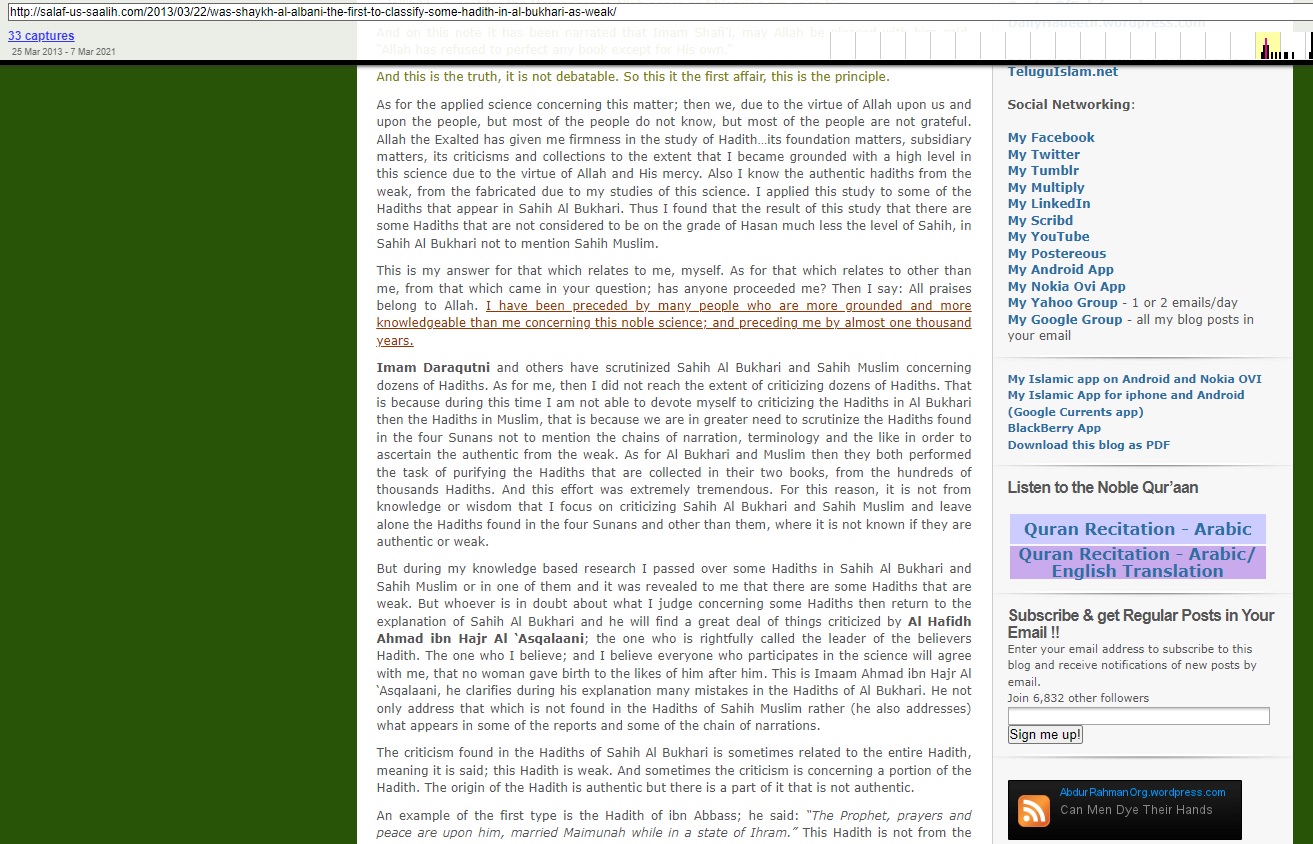
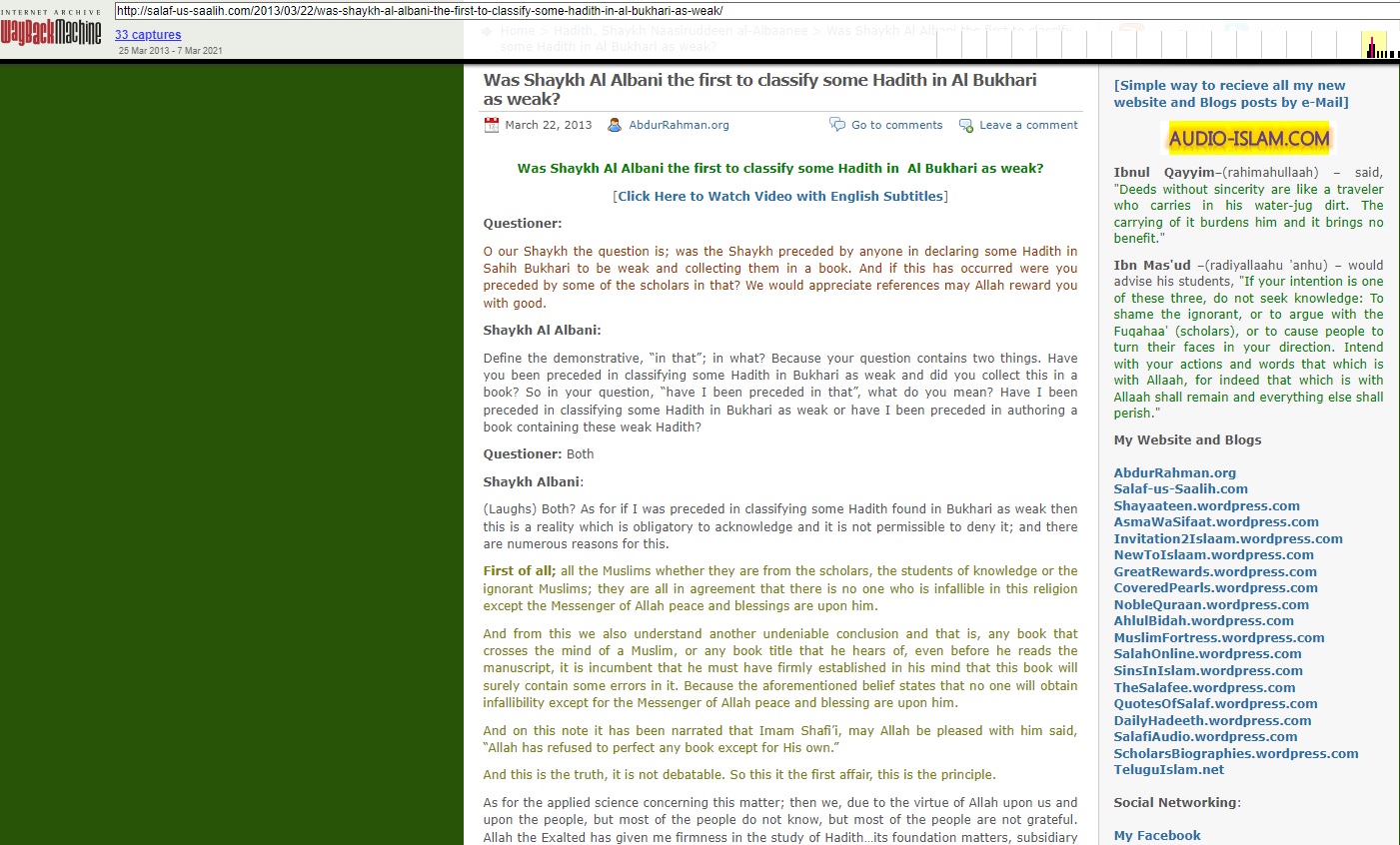
http://salaf-us-saalih.com/2013/03/22/was-shaykh-al-albani-the-first-to-classify-some-hadith-in-al-bukhari-as-weak/ (this link has been deleted by the Salafis!)

However, this is a new link (and one that I have captured pictures of & saved the text of).

You may watch the video here: https://www.youtube.com/watch?v=7v1moESgRb0

However, if they take it down I can send you the video and/or mp3 upon request. insh’Allah

http://mtws.posthaven.com/was-shaykh-al-albani-the-first-to-classify-so

Here is the link to the interview with the late Shaykh Al Abani. NOTE IMPORTANT! The video below had been deleted in the past by the Salafis below is the full captured text from the links that have been deleted. However, I will put up a new video link at the end of the discussion with Shaykh Al Abani. Please do make sure that you save this video before it goes missing as well!

Was Shaykh Al Albani the first to classify some Hadith in Al Bukhari as weak?

[Click Here to Watch Video with English Subtitles]

Questioner:

“O our Shaykh the question is; was the Shaykh preceded by anyone in declaring some Hadith in Sahih Bukhari to be weak and collecting them in a book. And if this has occurred were you preceded by some of the scholars in that? We would appreciate references. May Allah reward you with good.” -Questioner

Shaykh Al Albani:

“Define the demonstrative, “in that”; in what? Because your question contains two things. Have you been preceded in classifying some Hadith in Bukhari as weak and did you collect this in a book? So in your question, “have I been preceded in that”, what do you mean? Have I been preceded in classifying some Hadith in Bukhari as weak or have I been preceded in authoring a book containing these weak Hadith?”-Shaykh Al Albani

Questioner: Both

Shaykh Albani:

(Laughs) “Both? As for if I was preceded in classifying some Hadith found in Bukhari as weak then this is a reality which is obligatory to acknowledge and it is not permissible to deny it; and there are numerous reasons for this.”-Shaykh Al Albani

“First of all; all the Muslims whether they are from the scholars, the students of knowledge, or the ignorant Muslims; they are all in agreement that there is no one who is infallible in this religion except the Messenger of Allah peace and blessings are upon him.”-Shaykh Al Albani

“Moreover, from this, we also understand another undeniable conclusion and that is any book that crosses the mind of a Muslim or any book title that he hears of, even before he reads the manuscript, it is incumbent that he must have firmly established in his mind that this book will surely contain some errors in it. Because the aforementioned belief states that no one will obtain infallibility except for the Messenger of Allah peace and blessing are upon him.”-Shaykh Al Albani”And on this note, it has been narrated that Imam Shafi’i, may Allah be pleased with him said, “Allah has refused to perfect any book except for His own.” –Shaykh Al Albani

“So this is the truth, it is not debatable. So this it the first affair, this is the principle.:-Shaykh Al Albani

“As for the applied science concerning this matter; then we, due to the virtue of Allah upon us and upon the people, but most of the people do not know, but most of the people are not grateful. Allah the Exalted has given me firmness in the study of Hadith…its foundation matters, subsidiary matters, its criticisms, and collections to the extent that I became grounded with a high level in this science due to the virtue of Allah and His mercy. Also, I know the authentic hadiths from the weak, from the fabricated due to my studies of this science. I applied this study to some of the Hadiths that appear in Sahih Al Bukhari. Thus I found that the result of this study that there are some Hadiths that are not considered to be on the grade of Hasan much less the level of Sahih, in Sahih Al Bukhari not to mention Sahih Muslim.”-Shaykh Al Albani

“This is my answer to that which relates to me, myself. As for that which relates to other than me, from that which came in your question; has anyone proceeded me? Then I say: All praises belong to Allah. I have been preceded by many people who are more grounded and more knowledgeable than me concerning this noble science and preceding me by almost one thousand years.”-Shaykh Al Albani

“Imam Daraqutni and others have scrutinized Sahih Al Bukhari and Sahih Muslim concerning dozens of Hadiths. As for me, then I did not reach the extent of criticizing dozens of Hadiths. That is because during this time I am not able to devote myself to criticizing the Hadiths in Al Bukhari then the Hadiths in Muslim, that is because we are in greater need to scrutinize the Hadiths found in the four Sunan not to mention the chains of narration, terminology and the like in order to ascertain the authentic from the weak. As for Al Bukhari and Muslim then they both performed the task of purifying the Hadiths that are collected in their two books, from the hundreds of thousands of Hadiths. And this effort was extremely tremendous. For this reason, it is not from knowledge or wisdom that I focus on criticizing Sahih Al Bukhari and Sahih Muslim and leaves alone the Hadiths found in the four Sunan and other than them, where it is not known if they are authentic or weak.”-Shaykh Al Albani

“But during my knowledge-based research, I passed over some Hadiths in Sahih Al Bukhari and Sahih Muslim or in one of them and it was revealed to me that there are some Hadiths that are weak. But whoever is in doubt about what I judge concerning some Hadiths then return to the explanation of Sahih Al Bukhari and he will find plenty of things criticized by Al Hafidh Ahmad ibn Hajr Al ‘Asqalaani; the one who is rightfully called the leader of the believer’s of Hadith. The one who I believe; and I believe everyone who participates in the science will agree with me, that no woman gave birth to the likes of him after him. This is Imaam Ahmad ibn Hajr Al ‘Asqalaani, he clarifies during his explanation many mistakes in the Hadiths of Al Bukhari. He not only address that which is not found in the Hadiths of Sahih Muslim rather (he also addresses) what appears in some of the reports and some of the chain of narrations.”-Shaykh Al Albani

“The criticism found in the Hadiths of Sahih Al Bukhari is sometimes related to the entire Hadith, meaning it is said; this Hadith is weak. And sometimes the criticism is concerning a portion of the Hadith. The origin of the Hadith is authentic but there is a part of it that is not authentic.”-Shaykh Al Albani

“An example of the first type is the Hadith of ibn Abbass; he said: “The Prophet, prayers and peace are upon him, married Maimunah while in a state of Ihram.” This Hadith is not from the Hadiths which is only found in Sahih Al Bukhari and not Sahih Muslim, rather they both agreed upon the narration of the Hadith in their books. And the reason for this is the report of this Hadith comes from the narrator and he is Abdullah ibn Abbas, and he is morally impeccable. Thus the chain of narration is authentic; no one can criticize its narrator. Whereas there are other Hadith where there is room to criticize the Hadith just from the standpoint of the narrator.”-Shaykh Al Albani

“An example from the men of Al Bukhari, there is a man named: Fulaih bin Sulaiman. Ibn Hajr described him, in his book Al Taqreeeb, as Sadooq (one who is a level below reliable) with a bad memory. Therefore if this person narrates a Hadith in Sahih Al Bukari, as a lone narrator and it is not supported by a Mutabi’ah (Two or more Hadith which are the same, narrated by the same Companion, while the rest of the men in the chain are different) nor it is supported by a Shaahid (Two or more Hadith which are the same narrated by different Companions) then his Hadith remains at the level of weak, that which can be strengthened with a Mutabi’ah or a Shaahid.”-Shaykh Al Albani

“As for the Hadith of Maimunah, that the Messenger of Allah prayers and peace are upon him, married her while he was in a state of Ihram, there is no room to criticize the chain of narration due to the lone narration as in the case of Fulaih bin Sulaiman for example. No, all of the people in the chain of narration are reliable and trustworthy. For that reason you do not find those who criticize this Hadith from the scholars, who preceded us by generations, that they found an angle to criticize this Hadith except concerning the first narrator in the Hadith, ibn Abbass and he is a noble Companion.”-Shaykh Al Albani

“They said this was a surmise from ibn Abbass and that is because he was young; from one standpoint. And from another standpoint, in his narration his contradicted the person in the Hadith, meaning the wife of the Prophet prayers and peace are upon him, who was Maimunah. As it has been authentically narrated from her the Prophet prayers and peace are upon him, married her while neither of them was in a state of Ihram. Therefore this Hadith was the surmise of the first narrator, him being ibn Abbass. Thus this Hadith is weak. And it is as you see; a limited number of words. “He married Maimunah while is a state of Ihram.” Four words (in the original Arabic) “He married Maimunah while is a state of Ihram.” -Shaykh Al Albani

“Similar to this Hadith and perhaps it is longer, there is another example in Sahih Al Bukhari”-Shaykh Al Albani

“The second category: The Hadith could be in its origin authentic, but one of the narrators erred by inserting in the text a sentence that was not from the Hadith of the Prophet, prayers, and peace be upon him.”-Shaykh Al Albani

“An example of that is the well-known Hadith in Sahih Al Bukhari that the Prophet, prayers and peace are upon him said: “Verily my nation will come on the Day of Judgment with bright streaks of light from the traces of wudu.” -Shaykh Al Albani

“Up until this point, the Hadith is authentic, and it has many supporting Hadiths. One of the narrators in Sahih Al Bukhari added: “Thus whoever is able to extend his streaks then let him do so”. Al Hafidh bin Hajr Al Asqalaani, and Ibn Al Qayyim Al Jawziyah, and his Shaykh ibn Al Taymiyyah, and Al Hafidh Al Muntharee, and other scholars have said this addition was inserted and it is not from the speech of the Messenger of Allah, prayers, and peace are upon him; rather it is from the speech of Abu Huraira.”-Shaykh Al Albani

“Thus the answer is complete in reference to the first condition, meaning I criticized some Hadiths and I have been proceeded by many Imaams. As for did I or someone other than me author a book (surrounding this topic) then I did not author a book. As for other than me, then they have authored books, but we are not able to mention a book today in this regard. This is the answer to what you asked.” -Shaykh Al Albani

Translated by Rasheed ibn Estes Barbee
http://mtws.posthaven.com/was-shaykh-al-albani-the-first-to-classify-so

NOTE IMPORTANT. This is a link to the video that was deleted above. Please do your self a favour and save this video before it becomes missing to or they take it down!

You may also listen to the mp3 here:

Conclusion:

Salafi Shaykh Nasir Al Abani has said that Bukhari has weak hadith and errors in its text. In many ways the Shakyh made it sound like it was a matter of Iman (of faith) to recognize that before even picking up Bukhari, acquiring Arabic, hadith sciences, and so forth that as a matter of Iman (faith) one can know that Bukhari has mistakes!

Look what he says above: “Another undeniable conclusion and that is, any book that crosses the mind of a Muslim, or any book title that he hears of, even before he reads the manuscript, it is INCUMBENT that he MUST have FIRMLY ESTABLISHED in his mind that this book WILL SURELY contain some errors in it.”

Also, note that the Shaykh made the following statement:

As for me, then I did not reach the extent of criticizing dozens of Hadiths. That is because during this time I am not able to devote myself to criticizing the Hadiths in Al Bukhari then the Hadiths in Muslim…”

But just in the small amount of time, he did allot to it it was enough for him to find weak hadith and mistakes in Bukhari.

So other scholars have said this addition was inserted and it is not from the speech of the Messenger of Allah, prayers, and peace are upon him; rather it is from the speech of Abu Huraira.”

Please also keep in mind that Shaykh Nasiruddin al-Albani is the Imam of Hadith for the Salafiyya. Nothing proves that more than the following interaction between Bin Baaz, Al al-Albani, and Uthaymeen.

May Allah guide the Ummah! May Allah forgive the Ummah! May Allah bless the Ummah!

9 Comments

Filed under Uncategorized

Allah has two hands and both his hands are right hands? (and he has a left hand)

“There is nothing like Him: He is the All Hearing, the All Seeing.” (Qur’an 42:11)

“Do you say things regarding Allah that you do not know?” (Qur’an 7:28)

﷽ 

There are those who make it a point of aqidah/imam a creedal position to assert that Allah (swt) has two hands, and both of these hands are right hands and one of these right hands is a left hand.

We must accept this “without asking how“. Then they also turn around and say, “but the meaning is known.

Interestingly this issue is not about denying/affirming any attribute of Allah (swt). Nor is about the way of the Salaaf. It is a simply a matter of does the Arabic language have idioms and expressions?

Apparently some people in the Muslim community simply do not get this! Kindly read the four articles linked at the end.

Thus, they will go on an inquisition and label as deviants anyone who does not hold to the idea that Allah (swt) has two hands, both of those hands are right hands and one of those right hands is a left hand.

The Salafi Aqidah Check List:

1. Two hands

2. Both his hands are right hands.

3. One of those right hands is a left hand.

4. He has two additional hands (we do not talk about). Which makes four but we affirm two.

That is correct you heard them. Allah (swt) has “two right hands

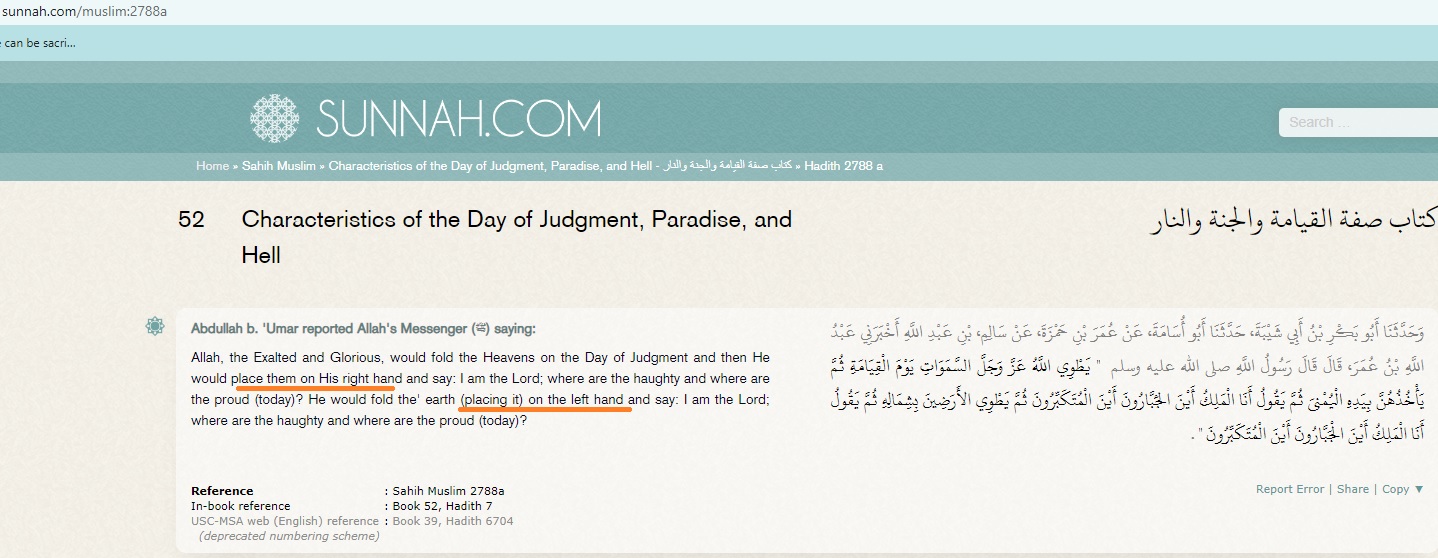
I came across a Hadith of Sahih Muslim which states:


“Abdullah b. ‘Umar reported Allah’s Messenger (may peace be upon him) saying: Allah, the Exalted and Glorious, would fold the Heavens on the Day of Judgment and then He would place them on His right hand and say: I am the Lord; where are the haughty and where are the proud (today)? He would fold the’ earth (placing it) on the left hand and say: I am the Lord; where are the haughty and where are the proud (today)?

The God of the Bible has hands (plural).

“The sea is his, for he made it, and his hands formed the dry land.” (Psalm 95:5)

“So I reflected on all this and concluded that the righteous and the wise and what they do are in God’s hands, but no one knows whether love or hate awaits them.” (Ecclesiastes 9:1 )

The God of the Bible has a right hand and Jesus is sitting next to it.

“He sat down at the right hand of the Majesty in heaven.” (Hebrews 1:3)

The God of the Bible has a right hand and Jesus is standing next to it.

“But Stephen, full of the Holy Spirit, looked up to heaven and saw the glory of God, and Jesus standing at the right hand of God “Look,” he said, “I see heaven open and the Son of Man standing at the right hand of God.” (Acts 7:55-56)

*NOTE* NO WHERE DOES THE BIBLE SAY GOD HAS A LEFT HAND!

Thus it can be deduced that the God of the Bible has two right hands (if not more right hands).

We explore this more in our article here:

https://primaquran.com/2024/08/20/the-anthropomorphic-god-of-the-bible/

BOTH OF ALLAH’S “HANDS” ARE RIGHT HANDS?

Now you can clearly see from the above text that many Salafi preachers have asserted that Allah (swt) has two hands and that “both his hands are right hands.” They get that from the above hadith!

Source: https://sunnah.com/nasai:5379

Yet, this hadith is Mudraj:

Mudraj – interpolated: an addition by a reporter to the text of the hadith being narrated. It even tells you in the hadith itself! Muhammad (one of the narrators said in his Hadith: “And both of His hands are right hands.”

How does one not see that?!

This cannot be said to be attributed to the Blessed Messenger (saw). This is the statement of the sub-narrator.

These people in their guilty conscious did not want people to think Allah (swt) has a left hand. Which also shows they are involved in dhan (speculation) about Allah (swt). They did not just let the words pass they had to make bold assertions without proof!

Some of the claimants to the Salaaf who hold these positions will expose themselves by blatantly comparing Allah (swt) to the creation by saying something along the following:

“You see akhi All of Allah’s attributes (hands, shin, face ect) can be described as right. Right here means blessed  (تَيَمُّن). As Muslims we know the right is preferred and more virtuous than the left. For example the verse in the Qur’an that says:

“So those on the Right Hand (i.e. those who will be given their Records in their right hands) – how (fortunate) will be those on the Right Hand! (As a respect for them, because they will enter Paradise).” (Qur’an 56:8)

Or for example:

“And those on the Left Hand (i.e. those who will be given their Record in their left hands) – how (unfortunate) will be those on the Left Hand! (As a disgrace for them, because they will enter Hell).”(Qur’an 56:9)

This is Tamthil clear as day. Let us say for the sake of discussion that Allah (swt) does indeed have a left hand as the hadith Sahih Muslim clearly says he does above. Why would any attribute of Allah (swt) not be blessed? That is a bizarre thought.

Then, the person commits a clear act of Tamthil (likening Allah (swt) to the creation) by negating a left hand for Allah (swt)!! They do this by comparing/contrasting the unfortunate news of people receiving their records in their left hands and right hands on the day of judgement. But these are actual hands of people!

This claimant to Salafiyah has committed a clear act of Tamthil.

  1. Is negating what clearly says he has: “a left hand” according to the sahih hadith.
  2. Making claims that an attribute of Allah (swt) would not be blessed?!

ALLAH (SWT) ACTUALLY HAS FOUR HANDS, TWO HANDS, BOTH OF WHICH ARE RIGHT HANDS EXCEPT ONE OF THOSE RIGHT HANDS IS A LEFT HAND!

“And He (is) the One Who sends the winds (of glad news between the two hands of his Mercy, until, when they have carried clouds ”(Qur’an 7:57)

Allah sends winds like herald of glad news, between the two hands of his Mercy.

Now his Mercy has two hands?

So those who believe in literal translations tell us that Allah (swt) has two right hands, and he has an attribute of Mercy and this attribute has two hands. Are they also right hands? Does Allah (swt) now have a total of four hands?

Please see for yourself at Islam Awakened the literal translation that the Salafi do not use.

https://www.islamawakened.com/quran/7/57/

Thank you gentleman for some honest translations. So now not only does Allah (swt) have two hands, and both of his hands are right hands and one of those right hands is a left hand, but his attribute of mercy also has two hands.

One of their scholars likened Allah (swt) to the moon!

Let us get something out of the way from the very beginning. There is not a single narration from the Blessed Messenger (saw) where when he speaks of Allah’s “hands” where the Blessed Messenger (saw), says, “In a way that befits his majesty” or “unlike his creation.”

That is an open challenge. For the person who can bring that I will shutdown this website!

I challenge any of those people who make such a disclaimer statement after mentioning “hands”, “foot”, “eyes”, “shin” “leg” “foot” or “side” to show this!

The fact that such people have to put a disclaimer after such a statement is an innovation!

“They have not appraised Allah with true appraisal, while the earth entirely will be within His grip on the Day of Resurrection, and the heavens will be folded in His right hand. Exalted is He and high above what they associate with Him.”(Qur’an 39:67)

“Allah said, “O Iblis, what prevented you from prostrating to that which I created with My hands? Were you arrogant then, or were you already among the haughty?” (Qur’an 38:75)

Some of these people have tried to argue that this word translated as “hands” must be understood as “hands” as something special concerning the creation of Adam. However, this is refuted by the following text of the Qur’an:

“Do they not see that We have created for them from what Our hands have made, grazing livestock, and then they are their owners?”(Qur’an 36:71)

Are we to say that cattle have an advantage or distinction over other animals because they were created by the “hands” of Allah (swt)?

“And the sky we built it with hands.” (Qur’an 51:47)

Look at the following three Saudi English translations of the Qur’an translate the above text!!

“And the heaven We constructed with strength, and indeed, We are its expander.”(Qur’an 51:47 Sahih International)

“With power did we Construct heaven. Truly, We can extend the vastness of space thereof.” (Qur’an 51:47 Muhsin Khan & Muhammed Al Hilali)

“With power and skill did We construct the Firmament: for it is We Who create the vastness of pace.” (Qur’an 51:47 Yusuf Ali Saudi 1985)

The hands of Allah (swt) tied up?

“And the Jews say, ‘The hand of Allah is tied up.’ Chained are their hands, and cursed are they for what they say. Rather, both His Hands are extended, HE spends however He Wills.” (Qur’an 5:64)

It is obvious, to begin with, that this very verse is allegorical. The Jews are not literally saying that Allah’s hand is “tied up”. Rather they are claiming that Allah (swt) is not bestowing upon them what they feel he should bestow. What this verse means is that both the power and generosity of Allah (swt) is on full display.

“He wrote the Tawrāt for you with His Own Hand.”

Source: (Bukhāri, no. 6614, Muslim, no. 80)

Other uses of the word hand in the Qur’an.

“Indeed, those who pledge allegiance to you, they are actually pledging allegiance to Allah. The hand (yadu) of Allah is over their hands (aydihim). So he who breaks his word only breaks it to the detriment of himself. And he who fulfills that which he has promised Allah – He will give him a great reward.” (Qur’an 48:10)

This is a metaphorical usage of the word hand that is allowed within the context of the Qur’an itself. Will it be said that people who have no hands or people who are amputees could never make such a pledge?

The word that is used for hand (yadu) the singular noun is also used for the plural noun (aydihim) above. The apparent understanding of the text, is that Allah (swt) has a hand and people have hands. Yet the following verse should make the matter more clear.

“Oh Prophet, say to whoever is in your hands (aydikum) of the captives, “If Allah knows any good in your hearts, He will give you something better than what was taken from you, and He will forgive you, and Allah is Forgiving and Merciful.” (Qur’an 8:70)

Are we supposed to imagine that the Blessed Prophet (saw) was a giant with little tiny people in his hands!?!

“Moreover, whatever strikes you of disaster – it is for what your hands have earned, but He pardons much.” (Qur’an 42:30)

Are we to understand from the above verse that as long as we do evil with our tongues, eyes, feet that disaster will not befall us? As far as those who do not have physical hands does this verse still apply to them?

“And remember Our servants Ibrahim and Ishaq and Yaqoub, men who possessed hands (l-aydi) and vision.” (Qur’an 38:45)

l-aydi is a plural noun literally it would be hands.

Here the word hands literally does mean power. Look how virtually everyone under the sun translates this!

https://www.islamawakened.com/quran/38/45/default.htm

“Or he in whose hand(biyadihi) is the knot of marriage remits.” (Qur’an 2:237)

If you have enjoyed this entry you may also find the following articles/entries of value:

We explore the Anthropomorphic God of the Bible which also is claimed to have all right hands!

https://primaquran.com/2022/10/04/ahmed-deedat-roasting-athari-aqeedah/

May Allah Guide the Ummah!

May Allah Forgive the Ummah!

3 Comments

Filed under Uncategorized

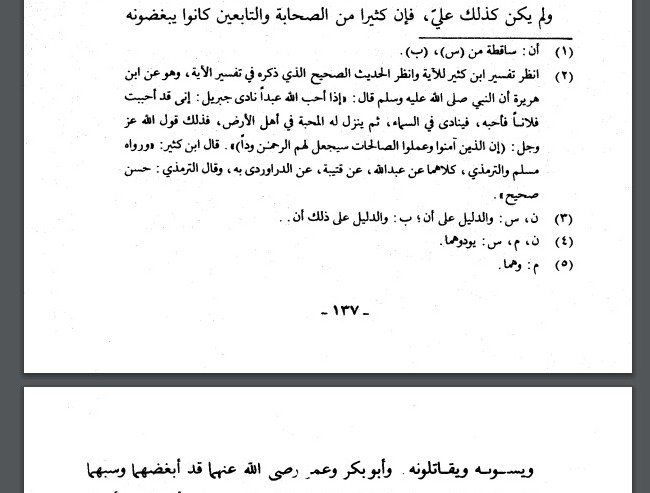
Ibn Taymiyya claims the majority of Sahabah (Companions) and Tabi’in (Followers) hated Ali Ibn Abi Talib

“Verily, those who believe and work deeds of righteousness, the Most Beneficent (Allah) will bestow love for them (in the hearts of the believers).” (Qur’an 19:96)

﷽ 

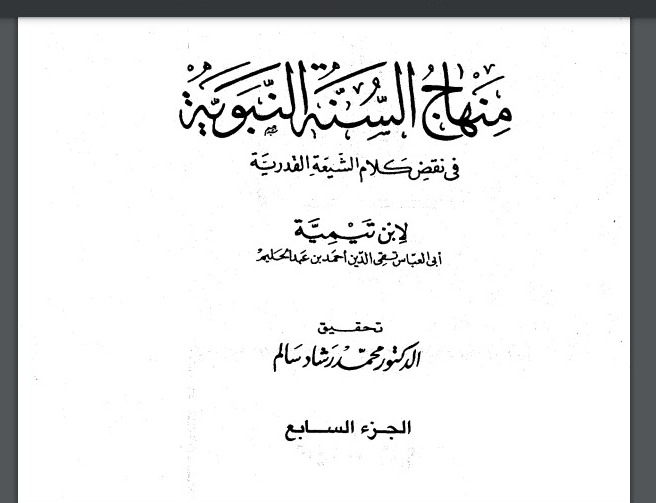
Ibn Taymiyya al Harrani in his asSunnah an-Nabawiyyah when he comments about the above ayat in relation to Ali ibn Abi Talib that:

“Allah (swt) has told that He will place on the believers and those that preform good, love. And this is a true promise from him. Especially for the Caliphs Abu Bakr (ra) and Umar Ibn Al Khattab (ra) for the general amount of companions loved them and they were the best periods of Islam. Ali was not like that, as a large number of companions (sahabah) and followers (tab’ieen) hated him, cursed him and fought him.”

Source: (منهاج السنة النبوية في نقض كلام الشيعة والقدرية Minhaj al-Sunnah al-Nabawiyyah fi Naqd Kalam al-Shi’a wa al-Qadariyyah)

The implication (though not explicitly stated by Ibn Taymiyya) was that Ali was not of those who worked deeds of righteousness.

Ibn Taymiyya continues:

“They love and venerate him, while Abu Bakr and Umar – may God be pleased with them – have been hated and cursed by the Rafidah (Rejectors), the Nusayriyyah, the Ghulat (Extremists), and the Ismailis. However, it is known that those who loved those two (1) are better and more numerous, and that those who hated them are further from Islam and fewer.”

This contradicts the case of Ali, for those who hated and fought him are better than those who hated Abu Bakr and Umar. In fact, the faction of Uthman, who love him and hate Ali, even if they are innovators and wrongdoers, are more knowledgeable and religious than the faction of Ali who love him and hate Uthman, and they are greater in jihad and justice. Thus, it is clear that the affection mandated for the three [first Caliphs] is greater.”

“And if it is said: ‘Claims of divinity and prophethood have been made about Ali (2),’ it is replied: ‘All the Khawarij considered him a disbeliever and the Marwaniyyah hated him. And these are better than the Rafidah who curse Abu Bakr and Umar – may God be pleased with them – let alone the Extremists (3).'”

Source: [Chapter: The Thirteenth Proof “You are only a warner, and for every people there is a guide.”]

You may be interested in reading the following:

May Allah Forgive the Ummah.

May Allah Guide the Ummah.

2 Comments

Filed under Uncategorized