
“Oh you who believe! if a deviator brings you a report, scrutinize it carefully in case you attack people in ignorance and so come to greatly regret what you have done.” (Quran 49:6).
﷽
This is an examination of the hadith that Shīa uses as a justification for Ali either being infallible or without error in judgement.
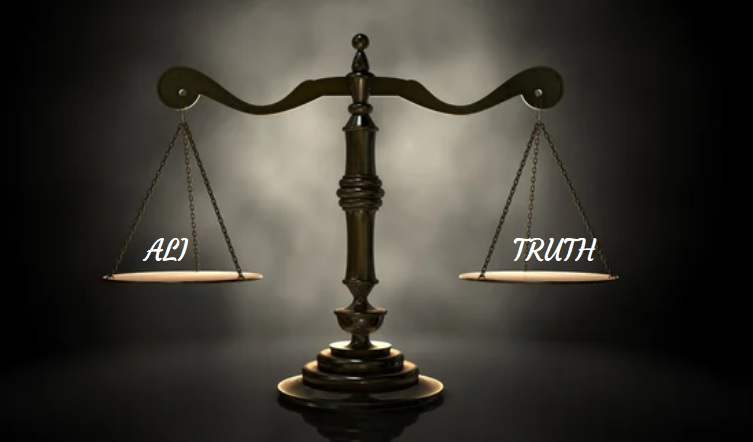
Namely, the hadith that comes to us with conflicting statements: One being that Ali is with the truth and the truth is with Ali. There other is that Ali is with the Qur’an and the Qur’an is with Ali.
The idea that the Shīa have in quoting this is that Ali could possibly never err. For the Shi’i, either version of this hadith is proof that Ali is infallible in his ijtihad.
In Islam, as is commonly known, no one is above the law; no one has an absolute authority by being free from the limitations of the law: anyone whose idea goes contrary to what Allah (swt) or what the Blessed Prophet (saw) says, has his idea disregarded and discarded irrespective of the class or caste to which one belongs.
The hadith contradict the Qur’an.
If the idea is that these hadith prove that Ali is infallible and beyond reproach that itself is contradicted by Allah (swt) in the Qur’an.
It would also mean that Ali or anyone who is guaranteed to be infallible or beyond reproach, would mean that he is secure from the Plan of Allah (swt) and that he would be under the power and the threat of the following verse:
“Were they secure from the Plan of Allah? None deems himself secure from the Plan of Allah except a people that are doomed to perish.” (Qur’an 7:99)
These hadiths are used in a polemical sense.
For example, they are intended to be used in the following polemical way:
Whoever opposed Ali on any matter was simply on the wrong side of history. Not only did they oppose Ali, but they opposed the haqq, the truth. Not only did they oppose Ali and the haqq, but they opposed the Qur’an. So this would include, but not limited to: Muaviyah and those companions (muhakima) who broke camp with Ali over the issue of tahkim-arbitration. It would include Aisha (ra), Talha and Zubayr etc.
Muslims are not born yesterday. Naturally, the thinking Muslim will ask the following questions.
Questions like:
Why not quote the hadith of the 10 promised paradise during all these skirmishes?
Why not quote ghadir khum hadith?
Why not quote the hadith of thaqalayn?
Why not quote all these things to avoid unnecessary bloodshed?
We will approach these narrations in three ways.
1. Does it contradict what we know from history or how other companions understood the data? Information that is accessible to you the reader.
2. We will look at the ‘matn’, which is the text itself. We are looking for anomalous statements or inconsistencies. This information is also accessible to you the reader.
3. We will be looking at the chain of narrators. This is a specialized field in which the majority of the readers do not have access to.
Does it contradict what we know from history or how other companions understood the data?
One thing which can be taken to absolutely prove the fact that many of these traditions are fabricated is that when Ali himself went to Nahrawan to debate with the people there, after Ibn ‘Abbas (ra) was defeated, Ali did not use any of those traditions as his arguments against them.
In fact, we challenge anyone to bring forth the claims that he did. And if he didn’t, and assuredly he did not, you have to ask yourself: Why is that?
Indeed, no man took those traditions as his proofs and arguments during the whole period of the Ali-Mu’awiya crisis: all of them had the Qur’an as the basis for their source of evidence for the ideas they held.
In other words, no one argued that: “Ali is with the truth and the truth is with ‘Ali: it goes with him wherever he goes.”
Take for example:
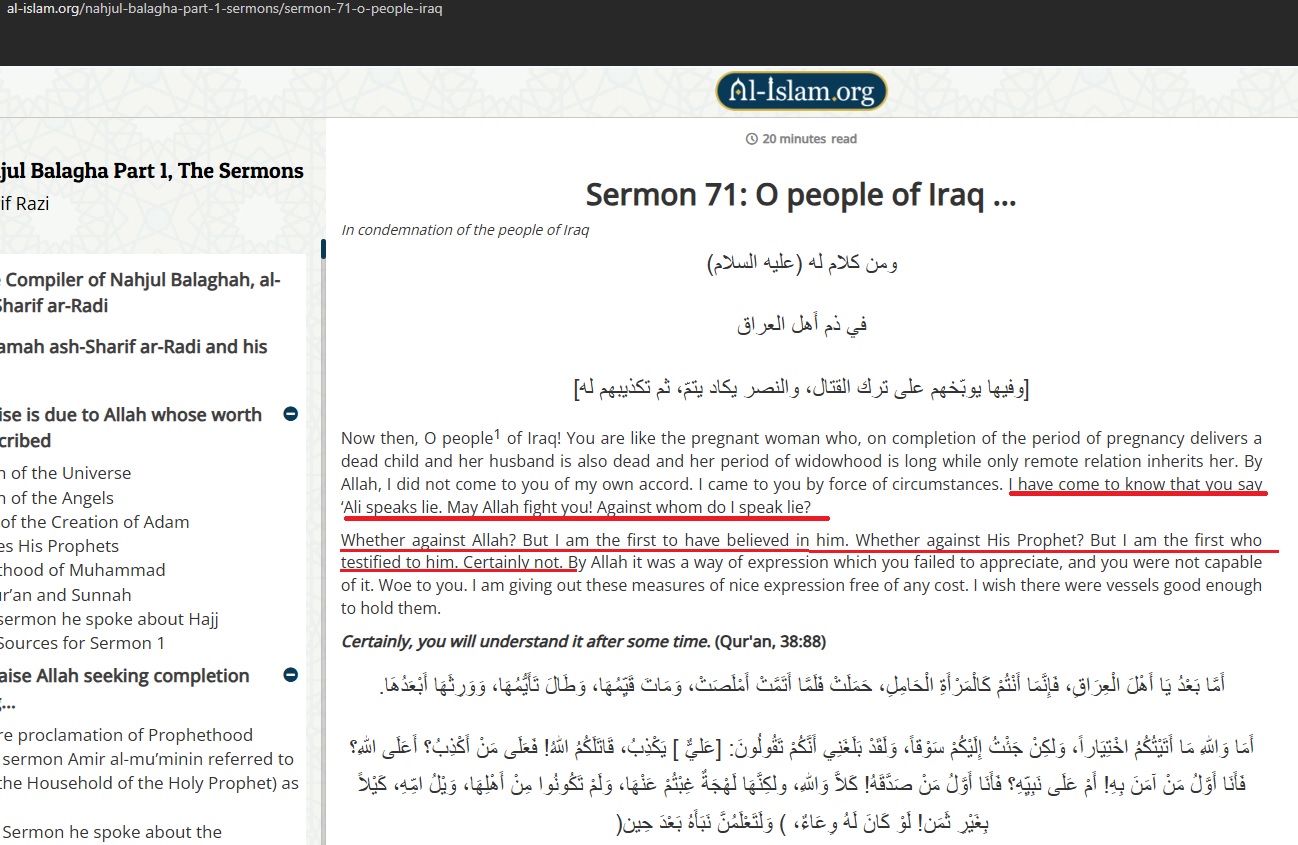
Where are all these quotes from the Blessed Prophet (saw) about Ali?
Why are all these hadith that the (Shi’i) feel are effective for the Muslims of the 14th century but not seemingly not helpful at all to Ali and his contemporaries?
This in and of itself should give the sincere researcher a cause for pause.
If Ali is with the haqq and the haqq is with Ali, why would a good portion of the companions of the Blessed Prophet (saw) oppose Ali to begin with?!
We could simply end all this discussion at that. Case closed.
Then let us approach this from the angle of logic and real life scenarios.
Al Abbas (ra) said the following about Ali.
فَقَالَ عَبَّاسٌ: يَا أَمِيرَ الْمُؤْمِنِينَ اقْضِ بَيْنِي وَبَيْنَ هَذَا – الْكَاذِبِ الآثِمِ الْغَادِرِ الْخَائِنِ.
So Al Abbas said: “O Commander of the Faithful, judge between me and this one – the liar, the sinful, the treacherous, the deceitful.”
Source: (https://sunnah.com/muslim:1757c)
The hadith above makes it seem as if Ali is always in the right no matter what. So in the scenario above where Al Abbas (ra) says to Umar (ra) about Ali, “judge between me and this one, liar, sinful, treacherous and deceitful.” How could it ever be fair? How could Umar (ra) judge at all? He could look and say, “Oh it’s Ali and the truth is with him, and he is with the truth out of my sight, Abbas!” In fact, Ali could win any court case by default with such a hadith!
This has all the trappings of abuse and manipulation. Especially when these types of weak hadith come to be used later in sufi tariqas and syed culture. When real abuse and mischief happens, people are shamed and silenced. Made to think evil will befall them if they report such people. A real type of psychological terrorism.
This is a far cry from the Blessed Prophet (saw) whom even Allah (swt) overturned a decision of his on the account of the woman who pleaded!
The hadith above makes it seem as if Ali is always in the right no matter what. So in the scenario above where Al Abbas (ra) says to Umar (ra) says about Ali, “judge between me and this one, liar, sinful, treacherous and deceitful.” How could it ever be fair? How could Umar (ra) judge at all? He could look and say, “Oh it’s Ali and the truth is with him and he is with the truth out of my sight Abbas!” In fact, Ali could win any court case by default with such a hadith!
Another crystal clear example of a person who did not accept that understanding is none other than Ibn Abbas (ra).
Narrated Ibn `Abbas:
Once the Prophet (saw) embraced me and said, “O Allah! Bestow on him the knowledge of the Book (Qur’an).”
Source: (https://sunnah.com/bukhari:75)
Ikrima (ra) informs us that Ali had errors in his ijtihad that would go against the Qur’an & Sunnah. That he would get corrected by a senior member of the Ahl Bayt.
Narrated `Ikrima:
“Some Zanadiqa (atheists) were brought to `Ali, and he burnt them. The news of this event reached Ibn Abbas, who said, “If I had been in his place, I would not have burnt them, as Allah’s Apostle forbade it, saying, ‘Do not punish anybody with Allah’s punishment (fire).’ I would have killed them according to the statement of Allah’s Apostle, ‘Whoever changed his Islamic religion, then kill him.’”
Source: (https://sunnah.com/bukhari:6922)
It was narrated by Anas that :
‘Ali came to some people of Az-Zutt, who worshiped idols and burned them. Ibn ‘Abbas said: “But the Messenger of Allah [SAW] said: ‘Whoever changes his religion, kill him.‘”
Source: (https://sunnah.com/nasai:4065)
Clearly Ibn Abbas (ra) did not see that the haqq nor the Qur’an was with Ali on that matter.
Narrated from Abū ʿAbdillāh (Imām Jaʿfar al-Ṣādiq), who said: Amīr al-Muʾminīn (ʿAlī), said:
“If it were possible for me, and if I found someone to help me, I would kill all the adherents of these sects (aṣnāf), and I would burn them with fire. And this is [in accordance with] the saying of Allah, Mighty and Exalted:
‘Say, I am only a man like you to whom it has been revealed that your God is but one God. So, whoever would hope for the meeting with his Lord – let him do righteous work and not associate anyone in the worship of his Lord’ (Qur’an 18:110).”
Source: (Bihār al-Anwār al-Jāmiʿah li-Durar Akhbār al-Aʾimmat al-Aṭhār Volume and Page: Vol. 25, p. 265, Hadith #30)
Prima Qur’an comments: If that is Ali’s understanding of that verse of the Qur’an, it is certainly not from any apparent reading of the text. It is a very strange take. How anyone reads the Qur’an 18:110 and takes away from it that we should burn people is shocking.
Another point to consider is that even if those traditions are really authentic, they still do not mean that Ali does not make mistakes, especially in matters like these, which depend almost entirely on human intellectual efforts.
For if “Ali is with the truth and the truth is with ‘Ali: it goes with him wherever he goes,” then the inevitable, logical implication is: “The Prophet is with the truth and the truth is with the Prophet (saw): it goes with him wherever he goes.”
This is only logical. Yet, Allah (swt) has blamed the Blessed Prophet (saw) him for leaving a better way in some of his military and civil actions.
For example, the verse states: “May Allah forgive you (O Muhammed). Why did you grant permission to them (to stay behind), until those who told the truth become clear to you, and you had known the liars? (Qur’an 9:43)” , was revealed in order to blame the Blessed Prophet (saw) for his act to allow some people who brought him false excuses so that they might be exempted from taking part in the war of Jihad.
Typically, the verse: “O Prophet! Why do you prohibit ˹yourself˺ from what Allah has made lawful to you, seeking to please your wives? And Allah is All-Forgiving, Most Merciful.”(Qur’an 66:1) was sent down to blame the Prophet (saw) for outlawing a certain thing which Islam makes lawful to him.
How can a person of understanding mind, therefore, claim that ‘Ali was infallible simply because the Prophet (saw) is alleged to say: “Ali is with the truth and the truth is with ‘Ali: it goes with him wherever he goes?!”
“The Prophet (saw) is with the truth and the truth is with the Prophet (saw): it goes with him wherever he goes.”
The logical question we ought to ask ourselves is: Was the Prophet (saw) not with the truth and the truth not with him? Of course!
Every Muslim’s answer will be “The Prophet (saw) was with the truth every time.” Thus, if the Prophet (saw) was the most truthful, and so was with the truth ,and the truth was with him, let us ask ourselves again: was he not blamed by Allah for leaving a better way in some of his actions?
Take for example:
Musa b. Talha reported:
“I and Allah’s Messenger (saw) happened to pass by people near the date-palm trees. He (the Holy Prophet) said: What are these people doing? They said: They are grafting, i. e. they combine the male with the female (tree) and thus they yield more fruit. Thereupon Allah’s Messenger (saw) said: I do not find it to be of any use. The people were informed about it and they abandoned this practice. Allah’s Messenger (saw) (was later) on informed (that the yield had dwindled), whereupon he said: If there is any use of it, then they should do it, for it was just a personal opinion of mine, and do not go after my personal opinion; but when I say to you anything on behalf of Allah, then do accept it, for I do not attribute lie to Allah, the Exalted and Glorious.”
Source: (https://sunnah.com/muslim:2361)
Look at what is said here:
Worldly Affairs versus the Sacred Law
“Imam Nawawi comments: “Scholars mention that his opinion (peace and blessings be upon him) in worldly/livelihood affairs is like the opinion of others, so the like of this [incident] is not impossible, and there is no deficiency entailed in this. The reason is the fact that their [the Companions’] central concern was the afterlife and its affairs.” [Nawawi, Sharh Sahih Muslim]”
“Mufti Taqi Usmani mentions that the Prophet’s statement, “I don’t think that will provide any benefit,” was only based on his personal opinion and estimation, as before that, he had never himself engaged in farming and agriculture (peace and blessings be upon him). Mufti Taqi also mentions that matters such as this incident can only occur with respect to worldly affairs that are permissible (mubah), yet not with anything entailing a legal ruling of the Sacred Law, like commands, prohibitions, adjudication or legal verdicts. [Usmani, Takmila Fath al-Mulhim]”
“Allah has indeed heard (and accepted) the statement of the woman who argues with you concerning her husband and carries her complaint (in prayer) to Allah and Allah (always) hears the arguments between both sides among you: for Allah hears and sees (all things). If any men among you divorce their wives by Zihar (calling them mothers), they cannot be their mothers: None can be their mothers except those who gave them birth. And in fact, they use words (both) iniquitous and false: but truly Allah is one that blots out (sins), and forgives (again and again). But those who divorce their wives by Zihar, then wish to go back on the words they uttered,- (It is ordained that such a one) should free a slave before they touch each other: You are admonished to perform: and Allah is well-acquainted with (all) that you do. And if any has not (the wherewithal), he should fast for two months consecutively before they touch each other. But if any is unable to do so, he should feed sixty indigent ones, this, that you may show your faith in Allah and His Messenger. Those are limits (set by) Allah. For those who reject (Him), there is a grievous Penalty.” (Qur’an 58: 1-4)
As many of you may know regarding what is considered the historical context of these verses, Khawlah bint Tha‘labah (ra) went to the Blessed Messenger (saw) to complain about her husband. Many times it is reported that the Blessed Messenger (saw) gave his verdict on the matter.
Now, this should give us pause.
Here we have the case of this woman who, even after hearing the decision of the Blessed Messenger (saw), continued to argue with him! In other words, the Sunnah of the Prophet (saw) wasn’t good enough for her! That’s right. She didn’t simply say, “Yes, Oh Messenger of Allah, thank you!” No! This woman went to the highest authority of justice and wisdom that there is. She took her pain directly to Allah (swt)!
So Allah (swt) took the side of the woman over the side of the Blessed Messenger (saw)!
Ali is nowhere near the Prophet (saw) when it comes to knowledge. So if the Blessed Prophet (saw) can make errors in worldy ijtihad, then so can Ali.
It is clear, therefore, that the idea of “Ali being infallible on the grounds that Ali is with the truth”…is the result of the politics of lies aimed at indoctrinating people with the creed of Alism during the time when the waves of the politics of division swept the Islamic nation.
Another example: it has also been narrated concerning Ammar bin Yasir (ra)
“Ammar (bin Yasir) is with the truth and the truth is with Ammar (bin Yasir): it goes with him wherever he goes.”
Source: (Ibn A’atham Al-Futuh Vol. 3, p. 269.)
Indeed, Ali himself has been quoted as saying: “Ammar (bin Yasir) is with the truth and the truth is with ‘Ammar: it goes with him wherever he goes.”
Source: (Ibn A’atham Al-Futuh Vol. 3, p. 129, p. 269. Similar to it has been narrated by Al-Hakim – from Hudhaifa – in his Al-Mustadrak Vol. 2, p. 162, hadith no. 2652. )
Yet no one has ever claimed that ‘Ammar bin Yasir has been infallible, for in case the account is authentic, the meaning intended thereby is that ‘Amaar is truthful: he does not intend to do wrong – no sense of infallibility at all is produced by the account.
Likewise with Ali. That he intends the truth, not that he is in any sense infallible.
The hadith in question: Ali is with the Qur’an and the Qur’an is with Ali.
Al Hakim and al Tabarani narrate — from ‘Ali ibn Hashim ibn al Barid — from his father who said — Abu Sa’id al Taymi narrated to me — from Abu Thabit, the mawla (client) of Abu Dharr
“I was with Ali on the Day of the Battle of the Camel. When I saw ‘Aisha standing. Some of that (doubt) which entered other people (also) entered me. Allah disclosed that for me (i.e. removed from me the reservations I had to fight) at the time of Salat al Zuhr and so I fought alongside Amir al Muʾminin. When he finished, I proceeded to Madinah. I came to Umm Salamah and said, ‘I have come, by Allah, not asking for food or drink; rather, I am the mawla (client) of Abu Dharr.’ She said, ‘Welcome.’ I told her my story and so she said, ‘Where were you when the hearts flew their course (i.e. when the fighting broke out)?’ I said, ‘I was such that Allah disclosed it for me (i.e. removed the reservations I had) at noon (and then I went to fight alongside Amir al Muʾminin).’ She said, ‘Excellent! I heard the Messenger of Allah(saw) say: ‘‘Ali is with the Qur’an and the Qur’an is with Ali. They will never separate UNTIL they meet me at the Hawd (Cistern).’”
Sources: (Mustadrak al Hakim 4628 / al Tabarani: al Mujam al Awsat, Volume 5/4880 / & al Mujam al Saghir, volume 2 /720.)
Interestingly, these statements are not found in either Bukhari or Muslim. Neither in the Muwatta of Imam Malik nor the Musnad Al-Imam Ar-Rabi’ (Al-Jami’ Al-Sahih).
Chain analysis: a look at the sanad (chain of narrators)
Al Hakim says, “This hadith has a sahih (authentic) chain of transmission. Abu Sa’id al Taymi is (Abu Sa’id al Taymi) al ‘Aqisaʾ. He is a thiqah (reliable) and maʾmun (trustworthy). Imam al Bukhari and Imam Muslim did not include it in their respective collections.”
Dinar Abu Sa’id ‘Aqisa al Tamimi (or al Taymi) is not as al Hakim supposed.
Imam al Nasaʾi says he is not a thiqah (reliable).
Al Daraqutni says he is matruk al Hadith (suspected of forgery).
Al Sa’di says he is not a thiqah (reliable).
Additionally, Abu Thabit could not be traced. The identity of Abu Thabit is a bit of a mystery, he is not mentioned in the books of Hadith narrators. So, Thabit is Majhul (unknown)
Therefore, this hadith is etiolated, totally weak.
Some time on Al Hakim Al Naysaburi
Al-Hakim, Muhammed ibn Abd Allah ibn Muhammed ibn Hamduyah, Abu Abd Allah al-Dabbi al-Tamhani al-Naysaburi al-Shafi’i, also known as Ibn al-Bayyi.
Al-Hakim is known among the people of Hadith to be mutasahil (lenient hadith critic).
Al-Hakim’s Mustadrak was criticized by Hadith scholars due to the number of mistakes and inaccuracies found in it. Al-Sakhawiin alilan wal-Tawbikh and others mention that he declares many forged reports to be rigorously authentic; up to 100, according to some authorities. This is not to mention extremely weak ones. Instead of clinging to his own expressed precondition, he only reports with the chains of the rank of the status of Bukhari and Muslim. For example, he narrates in the Musadrak from Ibn Abbas that Allah revealed to the Blessed Messenger (saw), the following:
“I have killed seventy thousand [in punishment] for [the murder of] Yahya ibn Zakariyya and I will kill seventy thousand times seventy thousand [in punishment] for [the murder of] your daughter’s son al-Husayn.”
Al-Hakim said this report has a sound chain, while Al-Dhahabi added: “By the criterion of Muslim” but Ibn Hibban said this hadith is untraceable (la asla lahu), Al-Dhahabi himself rejected its matn as munkar in the Siyar while Ibn Kathir similarly declared it “highly anomalous” (gharib jiddan) in al-Bidaya. [1]
Sources: Ibn Hibban, al-Majruhin (2:215), al-Khatib, Tarikh Baghdad (1:142), al-Hakim(1990 ed 2:319, 2:648, and 3:195), Fayd al-Qaiîr (1:205), Tadhkirat al-Huffaz (1:77 gharib), Mizan (sv. Qâsim ibn Ibrahim al-Hashimi), and Siyar (Risala ed 4:342-343).
Some say Al-Dhahabi went to excess in regretting that al-Hakim had compiled the Mustadrak in the first place.
“It would have been better if al-Hakim had never compiled it!” as mentioned by Dr. Bashshar Awward Maruf in his doctoral thesis.”
Source: (al-Dhahabi wa Manhajuhu fi Kitabihi Tarikh al-Islam.)
His classing al-Hakim “among those who are lenient, like al-Tirmidhi” does not apply to al-Hakim in absolute terms but only to his grading of narrations in the Mustadrak, which the Scholars pointed out he compiled in his old age, intending to revise it, a task left unfinished beyond the first volume.
Sources: Dhikr Man Yutamadu Qawluhu fil-Jarh wal-Tadil (p.172) & (Cf. Al-Sakhawi, Fath al-Mughith (1:36) and Mamduh, Raf` al-Minara (p. 153 n. 1).
This is proven by the fact that al-Hâkim’s mistakes are fewer in the first volume of the Mustadrak, as shown by al-Dhahab’s own minimal corrections there. “Outside the Mustadrak,” Shaykh Mahmud Mamduh said, “his positions are as strict as those of the meticulous Imams of hadith”
Source: (al-Sakhawi, Fath al-Mughith (1:36) and Mamduh, Raf` al-Minara p. 153 n.)
Prima Qur’an comments:
A look at the matn.
Abu Thabit had to identify himself to Umm Salamah.
He twice claims that Allah (swt) had removed his reservations to fight alongside Ali. He actually says this twice. It was at the time of the afternoon prayer. He doesn’t disclose how.
The hadith contradicts another hadith (below) where he is also the transmitter in which the text (matn) is changed.
Ali is with the qur’an and the qur’an is with Ali. They will never separate until they meet me at the Hawd (Cistern)
Ali is with the truth and the truth is with ‘Ali. They will never separate UNTIL they both arrive at the Hawd (Cistern) on the Day of Judgment
This stand-out line would not be difficult for someone to recall. The fact that the narrator redacts words in the mouth of Umm Salamah and cannot get the facts straight shows that they are confused.
The Qur’an is all truth but not all truth is the Qur’an.
In the second version of the hadith of Abu Thabit, there is no mention of his own doubts with regard to standing with Ali or his change of heart at the afternoon prayer.
Also, in the second version, it is simply that he came upon Umm Salamah. In the second version he does not need to identify himself to her.
The Hadith of Umm Salamah
This hadith comes to us via two ways:
The first is as follows:
Al Khatib narrates from ‘Abdul Salam ibn Salih — ‘Ali ibn Hashim ibn al Barid — narrated to us — from his father — from Abu Sa’id al Tamimi — from Abu Thabit, the mawla (freed slave) of Abu Dharr who said, “I entered the presence of Umm Salamah and saw her crying. She was mentioning the name of ‘Ali and said, ‘I heard the Messenger of Allah (saw),’” saying Ali is with the truth and the truth is with ‘Ali. They will never separate until they both arrive at the Hawd (Cistern) on the Day of Judgment.
Source: (Al Khatib: Tarikh Baghdad, 14/321.)
Chain analysis: a look at the sanad (chain of narrators)
‘Abdul Salam Ibn Salih is al Harawi. It has been mentioned previously that he is suspected of lying.
Al Haythimi said he is weak. Source: (Majma’ al Zawa’id vol. 9 pg. 114)
Dhahabi said he is censured: Source: (Siyar vol. 11 pg. 447)
He is accused of being a forger of hadith and one who steals chains to invent things.
Sources: (Al Kamil fi al Du’afa’ vol. 5 pg. 177) & (Lisan al Mizan vol. 4 pg. 144)
He is accused of lying and hadith forgery. Source: Mizan al I’tidal vol. 5 pg. 220.
Abu Sa’id Dinar is not a thiqah (reliable). He is matruk al hadith (suspected of forgery).
Abu Thabit could not be traced. He is mahjul (unknown)
Ibn Taymiyyah did not find a chain of transmission for this hadith; consequently, he denied it.
Source: (Ibn Taymiyyah: Minhaj al Sunnah al Nabawiyyah, 4/238)
However, there is a chain via Abu Ya’la here:
The Hadith of Abu Sa’id
Abu Ya’la narrates — Muhammed ibn ‘Abbad al Makki narrated to us — Abu Sa’id narrated to us — from Sadaqah ibn al Rabi’ — from ‘Umarah ibn Ghaziyyah — from ‘Abdul Rahman ibn Abi Sa’id — from his father that ‘I heard the Messenger of Allah (saw) ,’” saying Ali is with the truth and the truth is with ‘Ali. They will never separate UNTIL they both arrive at the Hawd (Cistern) on the Day of Judgment.
Source: (Abu Ya’la: Musnad Abi Ya’la, hadith no. 1052.)
Chain analysis: a look at the sanad (chain of narrators)
Sadaqah ibn al Rabi’ is regarded as a thiqah (reliable) by Ibn Hibban.
Source: (Ibn Hibban: Kitab al Thiqat, 8/319)
Ibn Hibban is known for deeming majhul (unknown) narrators as reliable.
Ibn Abi Hatim mentions a biography about Sadaqah ibn al Rabi’. However, he did not make mention of any jarh (impugning statement) or ta’dil (statement of approval). Thus, his status is unknown. Neither favourable nor unfavourable.
Source: (Ibn Abi Hatim: Kitab al Jarh wa al Ta’dil, 4/433.)
Abu Sa’id is the mawla (freed slave) of Banu Hashim. There is a difference of opinion regarding his status. The better opinion is that he is Hassan al hadith (fair in hadith). However, this type of hadith from him is unacceptable.
In short, the hadith is da’if (weak); the first chain of transmission is saqit (wholly unreliable) and the second chain of transmission is da’if (weak).
Lastly, Allah (swt) has made it clear that we are a broken humanity. Yet, he showers abundant grace and mercy upon us all.
“If Allah were to punish people ˹immediately˺ for their wrongdoing, He would not have left a single living being on earth. But He delays them for an appointed term. And when their time arrives, they cannot delay it for a moment, nor could they advance it.” (Qur’an 16:61)
In other words if Allah (swt) wanted to exact due measure and justice for the failings of humanity this whole planet would be turned to ash. Everyone. No one is exempted.
I leave you with this final verse to reflect upon.
“These are the verses of Allah which We recite to you in truth. Then in what statement after Allah and His verses will they believe?” (Qur’an 45:6)
You maybe interested in reading the following:
May Allah (swt) guide the Ummah!
May Allah forgive the Ummah!


 Prima Quran
this is a great example of how Shias authenticate hadiths that clearly go against the Quran