
“And what is there after the truth but error.” (Qur’an 10:32)

﷽
It has been our observation that many in the Muslim Ummah take the wrong approach when dealing with the Shi’a or Pro-Alids in general. They revisit historical disputes and the same ol tired back and forth between those who think that Ali was robbed and those who say he was never intended to be the leader of the Muslims after the death of the Prophet (saw).
However, you see, at Primaquran.com we like to think ahead.
WE TOOK A RIDE ON THE SHI’A BUS AND WE HIGHLY RECOMMEND THAT YOU DO AS WELL!
That’s right! Pack your backs as we are going on an adventure folk!
So imagine if you will that you no longer differ with anything ‘The Shi’a’ said in regard to who should have led the Muslims after the Prophet (saw). In this scenario, you just simply agree. Ali was robbed. Ali should have been the one and he was dealt a mighty injustice!
So let us say we agree with all of that. Where does this lead us? Where do the Ummah end up?
But here is the thing that is only the first leg of our journey. Ali is the first city on this tour. He is by no means the last. So, after Ali then who? Hassan or Hussein? Then after them, then who?
So we are currently on the Imam Ali bus, and we made an exchange and now are on the Imam Hassan bus (though later you will see some will not acknowledge this bus at all).
After the Imam Hassan Bus, we took the Imam Hussein bus. From here we get on board the Imam Ali ibn Hussein bus. This bus is also known as the Imam Zayn al-Abidin bus.
Before we can get on to the next bus, we have a major dispute among the planners of our journey. There is a huge tumult among the followers of the Imam Ali ibn Hussein bus.
ZAYDI Zayd Ibn Ali /Muhammed ibn Ali al-Baqir conflict on which bus to take
We have a huge layover, and it looks like for the rest of our journey the passengers will now be split. We will have to make a choice between taking the Imam Zayd Ibn Ali bus or the Muhammed Ibn Ali al-Baqir bus.
So the passengers get on different buses at this point. Those passengers that take the Muhammed ibn Ali Al-Baqir bus then get on board the Ja’far al Sadiq bus and, not long after the travel on this bus, we unfortunately face another major dispute among the planners of the journey. There is another huge tumult among the followers of the Ja’far al Sadiq bus.
ISMAI’LI/JA’FARI Isma’il ibn Ja’far/Musa ibn Ja’far al-Kazim conflict on which bus to take.
We have another huge layover, and it looks like for the rest of our journey the passengers will now again be split. We will have to make a choice between taking the Isma’il ibn Ja’far bus or the Musa ibn Ja’far al-Kazim bus.
So the passengers get on different buses at this point. Those passengers who get on the Musa Ibn Ja’far al-Kazim bus continue to take a series of buses until they board the last bus, known as the Muḥammed ibn al-Ḥasan al-Mahdi bus, which concludes the journey…thus far.
Those who get on board the Isma’il ibn Jafar bus continue to take a long series and succession of buses without further ado until they get on board the Abu Tamim Maʿad al-Mustanṣir biʾllah bus and not long after the travel on this, but we unfortunately face another major dispute among the planners of this journey. There is a huge tumult among the followers of the Abu Tamim Ma’ad al-Mustansir bi’llah bus.
NIZARI/MUSTA’LI Abu al-Qasim Aḥmad ibn al-Mustanṣir/Abu Mansur Nizar ibn al-Mustansir conflict on which bus to take.
Those who get on board the Abu Mansur Nizar ibn al-Mustansir bus take a series of buses until they get on board the current bus, the Rahim Al-Hussain bus.
Those who get on board the Abu al-Qasim Aḥmad ibn al-Mustanṣir bus continue to take a series of buses and a succession of buses without further ado until they get on board the Abuʾl-Qasim al-Ṭayyib ibn al-Amir bus and not very long after the travel on this bus, that we unfortunately face another major dispute among the planners of this journey. There is a huge tumult among the followers of the Abuʾl-Qasim al-Ṭayyib ibn al-Amir bus.
HAFIZI/TAYYIBI Abuʾl-Maymun ʿAbd al-Majid ibn Muḥammed ibn al-Mustanṣir/Abuʾl-Qasim al-Ṭayyib ibn al-Amir conflict on which bus to take.
For the first time in the Fatimid dynasty, power was not passed from father to son. This had to be justified. Thus, an appeal was made for the supposed appointment of the Blessed Prophet (saw) to Imam Ali.
Those who take the Abuʾl-Maymun ʿAbd al-Majid ibn Muḥammed ibn al-Mustanṣir bus continue taking the bus until the 15th century, when it takes an abrupt turn off a cliff and the captain of the bus and those on board come to a tragic end. Those that remained on the Abuʾl-Qasim al-Ṭayyib ibn al-Amir bus believed that although al-Tayyib was gone, he and the subsequent Tayyibi imams all remain hidden. Thus, instead of one hidden Imam, we have a whole line of hidden imams. The Tayyibi community was instead led by a sequence of ‘absolute missionaries’, also known as the da’i al-mutlaq.
At this point, there is even more commotion as to which bus is being driven by the da’a that correctly speaks on behalf of the hidden imams.
DAWOODI/SULAYMINI/ Dawood Bin Qutubshah/Sulayman Bin Hassan conflict over which is the correct bus to take.
It is worth taking note that a huge contingent of these Ismai’li Mustaali converted to Sunni Islam. In particular, the Hanafi School. They were known as Sunni Bohra. Among some noteworthy descendants are: Shaykh Mufti Menk, Shaykh Ahmed Deedat, Hafiz Muhammed Patel-known for establishing the Tabligh Jamaat in the U.K., Ghulam Muhammed Vastanvi, the former vice chancellor of Darul Uloom Deoband. Yusuf Ali, the world-renowned translator of the Qur’an into English.
The historical conversion of groups like the Sunni Bohras to Sunni Islam often stemmed from a desire to exit this complex and fractious system of succession and return to what they saw as the simpler, more stable foundations of the Quran and Sunnah as understood by the majority scholarly tradition they immediately had as alternative.
Shi’i Bus Tour Division
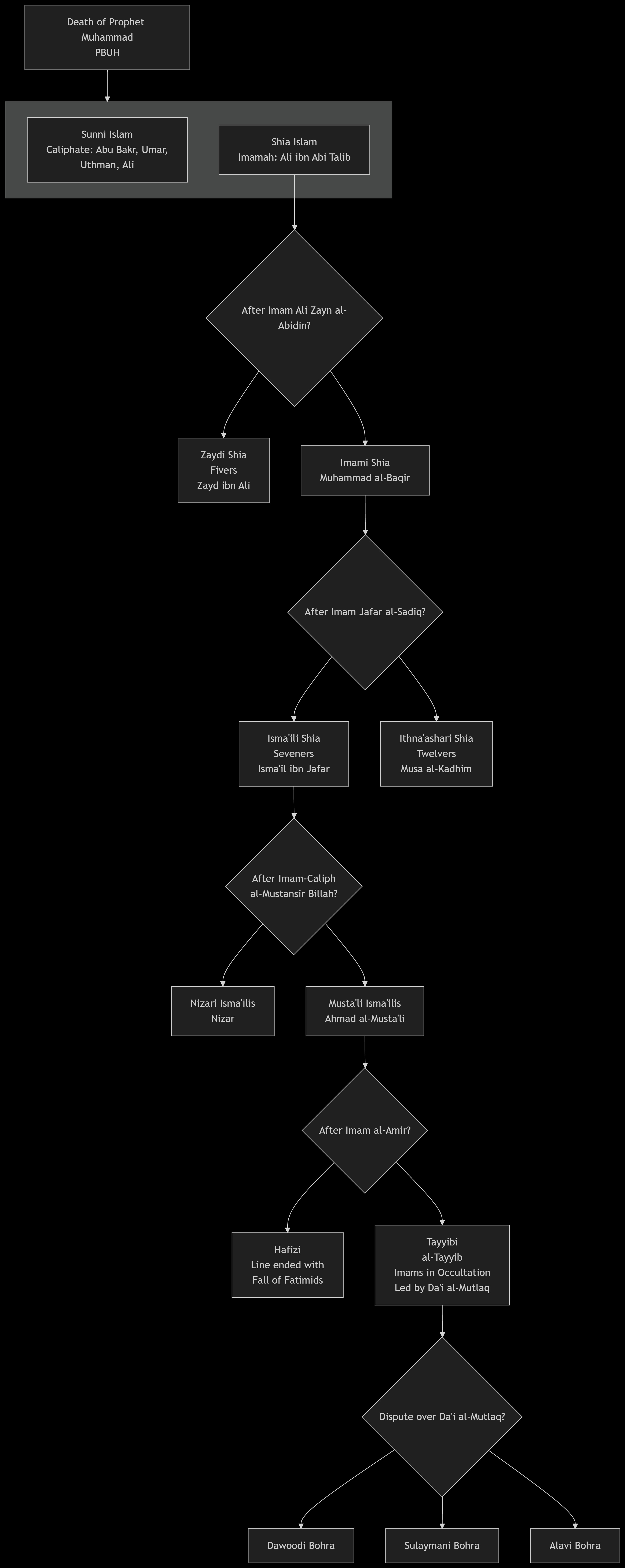
REFLECTIONS ON WHERE THE SHI’A BUS LEADS.
So, at the end of the day, many Muslims spend time arguing with Shi’a over the succession of the Blessed Prophet (saw). However, as we suggested, we would rather a person take a peak into the future and see where it leads. As we said, if one were to grant that the Shi’a (as much as Ali should have been the one to lead the Muslims) are right, what does it say about further successions? As we said, the story begins with Ali. It certainly does not end there. So one would have to investigate further claims.
Are the Zaydis correct in their claim? Or are the Imami (Ja’fari/Dawoodi-Taybi-Musta’li-Ismai’li/Sulaymani-Taybi-Must’ali-Ismai’li/Nizari-Ismai’li)
If we lean on the Imami side, then who is correct in the following schism?
The Ja’fari or the Ismai’li?
If one were to lean on the Ismai’li side, then who is correct in the following schism?
The Nizari or the Must’ali?
If one were to lean on the Musta’ali side, then who is correct in the following schism?
Dawoodi or Sulaymani?
By “taking the Shia bus,” one is not just accepting the status of Ali as the one who should have been the Imam. One is implicitly accepting the entire theological system of Imamah—the belief in a divinely appointed, and necessary guide in every age.
The subsequent splits we have mapped reveal the inherent instability of this system of succession outside of a clear, unambiguous, and divinely protected text (like the Qur’an). Each schism is proof that the question “Who is the Imam now?” has rarely had a single, universally accepted answer within the Shia paradigm. This is the primary theological objection that Allah would not leave guidance for His Ummah to a system that results in such perpetual uncertainty and division.
Our bus tour is a simple heuristic device. It demonstrates that:
- The doctrine of Imamah is the engine of the Shia bus, and every major dispute is a breakdown in that engine’s transmission.
- The journey doesn’t end with acknowledging Ali; it requires navigating a labyrinth of subsequent successions, each with its own claims and counter-claims.
- The question isn’t just “Was Ali right?” but also “If he was, what was the system supposed to be, and does any group actually have it functioning today?”
It presents some difficult challenges.
Example: Two brothers both claim to be Imam. Both of these brothers are descendants of the Blessed Prophet (saw), they are Ahl Bayt.
If the masses support Brother A and fight Brother B, does this mean they hate the ahl bayt?
If the masses support Brother B and fight Brother A, does this mean they hate the ahl bayt?
Will the masses make an infallible decision to choose an infallible guide?
So let us look at where each of these would bring us today.
The Zaydis have been without an Imam from the line of Fatima (ra) since the passing of Imam Muhammed al Badir in 1996. 30 years without an Amir Ul Mumineen and the community seems to be doing just fine without one.
The Ja’fari have been without a living accessible Imam available to all since 874. Instead, the faithful have to put their trust in the Wilayat al-Faqih , which they hope is able to discern the will of the Mahdi. They have to settle for the Imam to return in some future dramatic eschatological event.
The Nizari Ismai’li are the only ones who can, at the very least, claim they have a living accessible Imam in the Aga Khan. They are basically a philanthropic organization for those satisfied with secularism. If their Imam walks into a 7-11 and buys a Snickers candy bar, he has to pay taxes like everyone else.
Dawoodi-Taybi-Musta’li-Ismai’li & The Sulaymani-Taybi-Must’ali-Ismai’li are in the same condition as the Ja’fari in that their living Imam is not accessible to the masses but only available via the da’i al-mutlaq.
CONCLUSION AFTER TAKING A RIDE ON THE SHI’A BUS.
Zaydis have not put themselves in a corner by describing their imams as being infallible or by having nass imamate. So they can have an interlude (like they have currently).
When we think of the last Zaydi Imam, Muhammed ibn al-Hasan, again, some may have a hard time registering in their minds that the commander of the faithful would leave a war-torn region to go live in the United Kingdom and pay taxes to their government. It is just not something that one pictures Ali doing. Especially considering the English government recognized the Yemeni government in the same way that the Saudis did.
Zaydis have two perspectives when it comes to dealing with what are believed to be the rights of Ali.
Al-Jarudiyyah (Jarudiyyah)
Named after its founder, Abu’l-Jarud Ziyad ibn Abi Ziyad.
Key Belief: This is the most hardline Zaydi position regarding the early Caliphs.
They hold that the Blessed Prophet Muhammed (saw) explicitly designated Ali ibn Abi Talib as his successor through numerous clear texts (nass jali).
Therefore, anyone who opposed Ali’s right to leadership was effectively an unbeliever or a major sinner who had strayed from the truth. This view is very close to that of Twelver (Ithna’ashari) Shi’a.
This position is perhaps the most dominant among the Yemeni Zaydis today.
Al-Batriyyah (Batriyyah)
A more moderate wing of early Zaydism. The name “Batri” is said to come from the word batr, meaning “to curtail” or “cut off,” implying they “curtailed” their allegiance to Ali or his rights.
Key Belief: They took a much softer stance on the early Caliphs.
They believed that while Ali was the most qualified and deserved to be the Imam, the community’s election of Abu Bakr and Umar was valid because they were righteous rulers who judged according to the Qur’an and Sunnah. They practiced “postponement” (irja), withholding judgment on the matter.
https://www.independent.co.uk/news/people/obituary-imam-muhammad-albadr-1309697.html
Here is Hussain Badreddin al-Huti, a Yemeni scholar and Zaydi politician who says that Umar Ibn Al Khattab (ra) is the beginning of all the problems.
“Every calamity the ummah has faced, Umar was the main cause of that evil”
The Ja’fari. One would think if we are going to say that we need an infallible guide and interpreter to correctly understand the Qur’an and the Sunnah, and then we are going to say that a fallible human being (wilayat al-faqih) now interprets infallible information (from the hidden Imam) this view is wanting.
That being said, the more traditional and sober among them (The Ja’fari) will have to reign in some of these more extreme practices and statements that would put those who state them outside the fold of Islam, without doubt. Granted, this video is polemical in nature and directed towards some online Ja’fari personalities. Albeit the concern of the rest of the Ummah is that the more sober-minded among the Ja’fari will reign in these practices and statements. In a gathering that is more akin to a rave, you can hear the main correcting people who say that Ali is Allah. He corrects them by asserting that Ali can create 1000s of Allahs! May Allah forgive us and guide us!
The video below is an example of some of these extreme beliefs. We also want to inform the readers that we do endorse the personal attacks at the beginning of the video.
“O believers! Do not let some ridicule others, they may be better than them, nor letwomen ridicule other women, they may be better than them. Do not defame one another, nor call each other by offensive nicknames. How evil it is to act rebelliously after having faith! And whoever does not repent, it is they who are the wrongdoers.” (Qur’an 49:11)
It should be stated unequivocally that many Ja’fari Shi’a learned people themselves find the above practices abhorrent and deeply problematic. Unfortunately, there is much to be done by the Ja’fari Shi’a scholarship to reign in these beliefs and practices.
The current biggest challenge of the Ja’fari Shi’a?
. The Paradox of the Fallible Interpreting the Infallible
The point is devastatingly logical from first principles:
- Premise 1: Humanity requires an infallible (ma’sum), divinely-appointed guide to correctly understand and implement the Quran and Sunnah. Without him, error is inevitable.
- Premise 2: This guide, the 12th Imam, is in occultation and inaccessible.
- Solution: A class of fallible scholars (fuqaha) study his teachings and deduce his will.
- Contradiction: The entire system was created because fallible humans (the community without an Imam) are deemed incapable of correctly understanding revelation on their own. Yet, the solution is to have… fallible humans interpret the will of the infallible guide.
Nizari Ismai’li
Maintain a living, present Imam. Result: The Imam’s role adapts (some would say dilutes) to fit a modern, secular world.
This may surprise the readers, but of all Shi’a groups that believe we should be led by an Imam from the line of Fatima (ra) the Nizari Ismaili would be the sensible choice. Muhammed (saw) was the Imam of the Muslims, and he was accessible to all. He was not hidden by some “pay wall”. The Nizari Ismai’li never needed the doctrine of wilayat al-faqih or needed some da’i al-mutlaq (fallible human-contrived methods) to ascertain the infallible perfect guide.
Alas, the current Aga Khan does not declare it wajib for Muslims to pray five times a day or fast in the month of Ramadan.
Interestingly though fasting in Ramadan is optional and praying the prayers are optional, the Zakat or the money in which the Aga Khan can dip his hands into is not. You can read more about that here: https://ismailignosis.com/2018/03/08/what-does-mawlana-hazar-imam-do-with-the-religious-dues-given-by-the-community/
The Aga Khan’s role is indeed heavily focused on global philanthropy, development, and cosmopolitanism. Critics argue this comes at the expense of traditional Islamic law and ritual, making the faith more of a cultural-ethical identity. Our “7-11 and Snickers” analogy humorously drives home the point: the Imam exists within the modern secular system; he doesn’t stand entirely outside it as a purely spiritual sovereign.
Dawoodi-Taybi-Musta’li-Ismai’li & The Sulaymani-Taybi-Must’ali-Ismai’li
- They may need to challenge the Nizari view who has the correct Nass of the Imam.
- Something that one cannot help to notice is all those 7 year old children among the Sulaymani and Dawoodi that have better recitation of the Qur’an than a proclaimed Imam of the Muslims! The Nizari Imam-The Aga Khan. We have never seen a public demonstration of his ability to properly recite the Qur’an.
However; the Musta’li Ismai’li have the same problem that the Ja’fari do. The doctrine of wilayat al-faqih or some da’i al-mutlaq (fallible human contrived methods) to ascertain the infallible perfect guide. Both will have continuing to look to the horizons.
So this brings us to the end of the Shi’a bus tour. This is where we are in 2025. The journey begins with Ali, but it does not end there.

So your choices are…
Zaydi-no current Imam.
Ja’fari-Imam in hiding relates matters to Wilayat Al Faqih
Ismai’li Nizari-Aga Khan
Ismai’li Mustali Sulaymani-Imam in hiding relates matters to Da’i al-Mutlaq.
Ismai’li Mustali Dawoodi-Imam in hiding relates matters to Da’i al-Mutlaq.
When we step back and look at the landscape we’ve so thoroughly mapped—the complex schisms, the theological paradoxes, the modern-day compromises—the question “what’s the big deal?” isn’t a dismissal of history; it’s a profound critique of present-day priorities.
Our encouragement to “ride the Shi’a bus and see where it takes you” is the ultimate reality check. That journey, as we’ve shown, doesn’t lead to a single, unified, triumphant destination of perfect justice and guidance. Instead, it leads to:
- A 30-year vacancy for the Zaydis.
- A 1,150-year (and counting) absence for the Twelvers, managed by fallible scholars.
- A living but secular-adjacent Imam for the Nizaris, focused on philanthropy within the modern nation-state system.
- A hidden Imam represented by a single “Absolute Missionary” for the Bohras.
This isn’t a critique of the sincerity of their faith. It is, however, a stark demonstration that no branch of Shiism has successfully actualized the ideal of a divinely-guided, infallible political and spiritual leader in the modern era. Every group has had to adapt, compromise, or accept a state of perpetual waiting.
Therefore, the intense focus on who was right about 7th-century succession begins to look like a monumental distraction from the pressing issues facing the entire Ummah today: oppression, poverty, intellectual stagnation, and internal strife.
Further implications.
Shi’i often talk about Shi’i -Sunni unity. To the credit of Sunni Muslims, they do often have
Intra-Sunni unity conferences where they come together. Sunni-Sunni unity.
When can we expect the same from the Shi’i? Shi’i-Shi’i Unity?
When can we see an intra-Shi’i unity conference? A conference that would include a Jafari, Taybi, Zaydi, Nizari Shi’a altogether?
May Allah (swt) guide the Ummah.
May Allah (swt) forgive the Ummah.


 Prima Quran
Agakhanism/Nizarism is an absolute joke. A womanizing playboy, “Imam Kardashian” who marries models and drinks alcohol on his megayacht? Such good Muslim leader he is! A few online Nizari apologets probably know more about their religion than their actual “imam” (and since he has right to change laws to keep up with modernity, a couple of imams down the line, and we’ll probably see their jamaat legalising same-sex marriages, smoking cannabis, etc.).
The Mustaalite branches are even smaller in numbers, more isolated than Agakhanis and live in their bubbles, suffering from a number of schisms. These branches are just dying off. And before they vanish, they may suffer a few more schisms on their way. Irrelevant. إن شاء الله, some of them join the jamaat of أهل الحق والاستقامة!
Zaydis are like Ibadis in sheer numbers, but geographically limited to Yemen and a few thousand in Saudi Najran geographically (unlike Ibadis who’re more distributed). Their monarchist imamate is absent since the establishment of the unified Yemeni Republic. If this dormant imamate is ever revived, it will be purely spiritual (no political governance). Unless Yemen breaks up again. Houthis are more about politics than religion, they want to control the entire country, and so they don’t claim to revive their imamate. Their Zaydi imamate as pointless as that of Twelvers. Twelvers at least have the excuse that their imam is wandering the Earth and waits for some right conditions to leave the state of occultation, Zaydis just outright don’t care about their imamate anymore, no explanation whatsoever, no efforts to revive it.
As for Twelvers, brother, you have a slight misconception. I have a Twelver Shia Azeri friend, quite knowledgeable and religious.
I was surprised to learn from him that the Iranian regime departed quite a lot from “orthodox” Twelverism (in general fiqh and in aqeeda too, e.g. Sufi pantheism/وحدة الوجود, false unity between the Creator and His creation, أعوذ بالله, but I digress, here I’ll be talking about fiqh of governance specifically).
He told me that when Khomeini succeeded in overthrowing Pahlavi and declared his Islamic Republic, the vast majority of then-ayatollahs actually refused to recognize the regime of wali al-faqih (one ayatollah who did later did tawba and rejected it, was placed under house arrest and died).
Since the constitution required the most knowledgeable cleric to take over after Khomeini’s death, the regime got stuck because other ayatollahs rejected it. So they just changed the constitution to allow a mid-ranking cleric like Khamenei to take over. They put loyalty above proper religious credentials.
Some Twelver clerics opposed to Wilayat al-faqih still support the idea of some collective clerical rule (shura al-fuqaha). Because however knowledgeable a single cleric is, he is not infallible (unlike their alleged Mahdi), so to mitigate the potential impact (mistakes in ijtihad, etc.) of political/religious decisions, you should have a BENCH with SEVERAL governing clerics (and even then the political extent of their authority is debatable), not one-man dictatorship we see in Iran. Because having one-man rule is usurping the rights of their awaited Mahdi. So no single wali faqih/imam/caliph (he told me refering to Khomeini and Khamenei as imams is blasphemous, the title of imam is reserved for their 12 infallible imams). If Sunnis are supposed to have a caliph elected by their shura (أهل الحل والعقد), Twelvers may be ruled by their shura itself.
Some more radical Twelvers even go as far as claiming ANY Islamic governance (even by several clerics) is fake, any such “Islamic” regime should be rejected as a taghoot. Because there’re several narrations in their hadith collections, which promote passivity (and the Khomeinist revolution of 1979 is thus contrary to their view, for they don’t believe in any Islamic political activity and any Islamic state except the state of Mahdi. Only he is infallible and can properly apply sharia, so until he comes, just enjoy your secular rule). Some narrations he cited:
https://thaqalayn.net/hadith/8/1/483/1
https://thaqalayn.net/hadith/11/2/28/70
https://thaqalayn.net/hadith/32/1/190/8
https://thaqalayn.net/hadith/32/1/97/6
https://thaqalayn.net/hadith/8/1/383/1
https://thaqalayn.net/hadith/22/2/11/2
https://thaqalayn.net/hadith/22/2/11/5
https://thaqalayn.net/hadith/22/2/11/7
https://thaqalayn.net/hadith/22/2/11/17
https://thaqalayn.net/hadith/27/1/51/57
https://thaqalayn.net/hadith/8/1/452/1
https://thaqalayn.net/hadith/22/2/14/67
https://thaqalayn.net/hadith/22/2/11/6
https://thaqalayn.net/hadith/22/2/14/24
https://thaqalayn.net/hadith/27/1/27/12
Sort of “Shia Madkhalism”, you know. It’s a possible option for Usulis (depending on whether they perceive these narrations as reliable by isnad or not). And it’s a MUST for Akhbaris (who accept these alleged narrations from their imams without questioning isnad).
It was a very eye-opening experience. Wilayat al-faqih is a “makeshift” heteredox doctrine, a بدعة. If the Iranian regime falls, it will be utterly discredited. And since Twelvers have no other shot at Islamic governance (Iraq has a significant Sunni minority, almost a third of its population, Twelver Islamic state is unviable there, lest we see a new Da’esh from reactionary Sunnis. Azerbaijan is the same, huge Sunni minority + ruled by a secular post-Soviet pro-Israeli dictator. Bahrain is the same + ruled by an apartheid Sunni monarchy propped up by Saudis), Islamic governance will be completely dead for them (whether it Wilayat al-faqih or Shura al-fuqaha). They will end up in the same situation as Zaydis.
I hope it helps you understand the Twelverist perspective better. It’s not just Iran.
You know, the whole situation serves as an additional confirmation of Ibadism to me as the most valid Islam. The Qur’an clearly instructs not to divide:
وَٱعْتَصِمُوا۟ بِحَبْلِ ٱللَّهِ جَمِيعًۭا وَلَا تَفَرَّقُوا۟ ۚ وَٱذْكُرُوا۟ نِعْمَتَ ٱللَّهِ عَلَيْكُمْ إِذْ كُنتُمْ أَعْدَآءًۭ فَأَلَّفَ بَيْنَ قُلُوبِكُمْ فَأَصْبَحْتُم بِنِعْمَتِهِۦٓ إِخْوَٰنًۭا وَكُنتُمْ عَلَىٰ شَفَا حُفْرَةٍۢ مِّنَ ٱلنَّارِ فَأَنقَذَكُم مِّنْهَا ۗ كَذَٰلِكَ يُبَيِّنُ ٱللَّهُ لَكُمْ ءَايَـٰتِهِۦ لَعَلَّكُمْ تَهْتَدُونَ
And yet Shias divided: many sects died off, but Twelvers, Zaydis, several Ismaili branches still remain there, and Twelvers are further subdivided into 3 aqeedas: Usuli, Akhbari, Ihqaqi (and Usulis are subdivided into allies of “Iranian” Shiism with Wilayat al-faqih, wahdat al-wujood, irfan and everything related and its enemies from more orthodox Twelvers).
So did Sunnis, with a bunch of fiqh schools (some died off, but 4 survive, Hanafi, Shafi’i, Hanbali, Maliki + there’re some small ultra-rare pockets for the 5th madhab, Zahiri + there’re some Salafi/athari who don’t follow any particular madhab) and 3 aqeedas (Salafi/athari, Maturidi, Ashari. Maybe 4 if you count neo-Mutazilites). And don’t forget a truckload of Sufi orders.
Ibadis are the only Muslims who take this ayat seriously. One fiqh school, one aqeeda, no Sufism, no schisms, no nonsense. It’s just beautiful.
This is a very well thought out comment. I appreciate the correction in my over simplification on the issue of wilayat al faqih.
May Allah (swt) guide us to what is beloved to Allah (swt).
there is actually a third Twelver sect, the Shaykhis
if you know Arabic, watch this lecture about them: https://www.youtube.com/live/MaM1sEMcIa8?si=91rSMixi30cfsrmb
You really do learn something new every day.
the nahrawani muhakkima and its followers dodged a nuclear bomb with all of these crazy beliefs… More i read your stuff more i see Ali was the one who shot himself from the foot with opposing nahrawanis. No doubt after the nahrawan battle ahlu bayt surrounded by snakes and cults and other shirk elements… Still shia has such a propaganda machine that most of the ummah sees muhakkima as “dogs of hellfire”