
“That is because Allah He is the Truth (Al Haqq) -the Only True God of all that exists, Who has no partners or rival, the ultimate reality, and what they (those who associate) invoke besides Him, it is Batil (falsehood) And verily, Allah He is the Highest, The Most Great.” (Qur’an 22:62)
“No! We hurl the Truth against Falsehood, and it crushes it. Behold, falsehood does perish! Woe to you for the false things you ascribe.” (Qur’an 21:18)
﷽
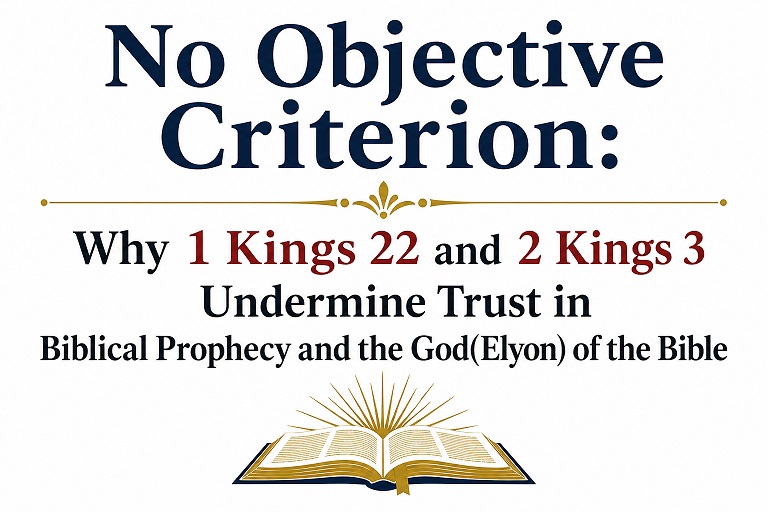
The Bible claims to be a repository of divine revelation delivered through prophets. Yet within its own pages lie passages that raise a devastating question: How can anyone know, with objective certainty, whether a prophet speaks for God or for a deceiving spirit?
Two passages—1 Kings 22 (the lying spirit sent to deceive Ahab’s prophets) and 2 Kings 3 (the Moabite king’s child sacrifice to Chemosh that apparently succeeded)—demonstrate that the Bible provides no reliable, objective criterion for distinguishing true prophecy from false. Consequently, confidence in the God of the Bible and the reliability of the prophetic tradition is not rationally justified.
The Lying Spirit of 1 Kings 22
In 1 Kings 22, King Ahab of Israel seeks prophetic guidance before attacking Ramoth-gilead. Four hundred prophets unanimously predict victory. King Jehoshaphat of Judah asks for another prophet. Micaiah son of Imlah is summoned. After initial sarcasm, Micaiah delivers a startling revelation:
“I saw the Lord seated on his throne, with the whole host of heaven standing to his right and to his left. The Lord asked: Who will deceive Ahab, so that he will go up and fall on Ramoth-gilead? And one said this, another that, until this spirit came forth and stood before the Lord, saying, ‘I will deceive him.’ The Lord asked: How? He answered, ‘I will go forth and become a lying spirit in the mouths of all his prophets.’ The Lord replied: You shall succeed in deceiving him. Go forth and do this. So now, the Lord has put a lying spirit in the mouths of all these prophets of yours; the Lord himself has decreed evil against you.” (1 Kings 22:19–23)
This Is A Huge Problem.
This passage establishes several disturbing facts:
- The Lord initiates deception. He does not merely permit a lying spirit to act; he asks for volunteers to deceive Ahab.
- The lying spirit acts with divine authorization. The Lord commands, “Go forth and do this.”
- The 400 prophets are sincere but deceived. Nothing in the text suggests they are frauds. They experience genuine prophetic ecstasy. They believe they speak for God. They are wrong.
- The deception works. Ahab hears the prophesied victory, believes it, goes to battle, and dies.
The Objective Criterion Problem
If a prophet can be sincerely inspired by a lying spirit sent by the Lord, then the prophet’s subjective experience of inspiration is worthless as a test of truth. The 400 prophets felt exactly as true prophets feel. They spoke with confidence. They may even have performed signs (Zedekiah’s iron horns in verse 11). Yet they were deceived.
This means that any prophet at any time could be in the same position. There is no internal marker—no distinctive feeling, no special certainty, no accompanying miracle—that guarantees the message comes from the Lord rather than from a divinely commissioned lying spirit.
Possible Counter-Arguments and Responses
These objections are usually the response of those Christians who believe in Glossolalia, or speaking in tongues. Often other Christians will ask them how do they (Pentacostal, Evangelical) know that they do not have a lying spirit? These interesting internal Christian debates have helped in what follows.
Counter-argument 1: The lying spirit was sent as judgment against Ahab because he had already rejected the truth. The 400 prophets were not typical prophets; they were court prophets who told Ahab what he wanted to hear.
Prima Qur’an Response: This does not solve the objective criterion problem. Even if the 400 prophets were corrupt, the text says the lying spirit entered their mouths. The deception was real. More importantly, how would an observer know, in advance, which prophets are corrupt and which are true? Ahab had no objective way to know that Micaiah was the true prophet and the 400 were deceived until after the battle—when Ahab was dead. The test of fulfillment (Deuteronomy 18:21–22) works only in hindsight.
Counter-argument 2: Deuteronomy 13 provides a test: even if a prophet’s sign comes true, if he leads people to other gods, he is false. The 400 prophets did not do that.
Prima Qur’an Response: Deuteronomy 13 is a necessary test, but not a sufficient one. It catches only prophets who explicitly advocate idolatry. What about prophets who speak in the name of the Lord but are deceived? What about prophets who give military or political advice that leads to disaster? The lying spirit speaks in the name of the Lord. The 400 prophets say, “The Lord will give it into the power of the king” (verse 6). They do not advocate other gods. Yet they are false. Deuteronomy 13 does not identify them.
Counter-argument 3: The test of fulfillment eventually caught the false prophets. Ahab died. Their prophecy failed. That is the objective criterion.
Prima Qur’an Response: This is true but useless for anyone who must make a decision before the event. Ahab needed to know before the battle whether to attack. The 400 prophets gave him confident assurance. Micaiah gave him a warning. Ahab chose the majority. He had no objective way to decide which group was telling the truth. The test of fulfillment only works after the fact—after lives have been lost. A decision-making criterion that only works retroactively is not a criterion for decision-making at all.
The God of Chemosh in 2 Kings 3
In 2 Kings 3, the Moabite king rebels against Israel. Jehoram of Israel, Jehoshaphat of Judah, and the king of Edom form a coalition to attack Moab from the south. They run out of water. The prophet Elisha is consulted. He prophesies:
“Thus says the Lord: Dig ditches in this wadi. For thus says the Lord: You will see neither wind nor rain, yet the wadi will fill with water, and you will drink—you, your cattle, and your pack animals. And this is easy in the Lord’s sight; he will also deliver Moab into your power. You will destroy every fortified city and every choice city, cut down every good tree, stop up all the springs, and ruin every fertile field with stones.” (2 Kings 3:16–19)
The next morning, water comes. The Moabites see the water red in the sunlight, mistake it for blood, assume the allied kings have turned on each other, and rush out to plunder. The Israelites rise up and defeat them, pursuing them into Moab.
Then the text continues:
“When the king of Moab saw that the battle was going against him, he took with him seven hundred swordsmen to break through to the king of Edom, but they failed. Then he took his firstborn son, who was to succeed him, and offered him as a burnt offering on the wall. And great wrath came upon Israel, so they withdrew from him and returned to their own land.” (2 Kings 3:26–27)
Another Massive Problem.
The plain reading of the text is devastating for any claim that the Lord alone is God or that other gods have no real power:
- Elisha, a true prophet of the Lord, prophesied total victory. He said Moab would be delivered into Israel’s power. He described complete destruction: every city destroyed, every tree cut down, every spring stopped.
- The Moabite king offers his son to Chemosh. This is not a private ritual; it is a public act of desperate propitiation, performed on the wall for both armies to see.
- Something happens. The text does not explain the mechanism, but the causal sequence is unmistakable: sacrifice —> great wrath —> Israel withdraws.
- Israel does not achieve the prophesied victory. They do not destroy Moab’s cities. They do not cut down its trees. They withdraw. They go home.
The most natural reading is that Chemosh, the Moabite god, was propitiated by the child sacrifice and responded by protecting Moab and driving Israel away.
Score card: Chemosh 1 Yahweh 0.
People May Ask: Does This Mean Chemosh Exists and Has Power?
If the biblical text reports that a sacrifice to Chemosh produced a military victory against an army that had the blessing of the Lord (through Elisha), then one of three conclusions follows:
- Chemosh is a real god with real power. The Lord is not the only God, or at least not the only effective God. The Bible contains henotheism (many gods, but Israel must worship only one) rather than monotheism (only one God exists).
- The Lord caused the wrath to punish Israel for some unstated sin. But the text does not say this. Elisha’s prophecy was unconditional: “The Lord will deliver Moab into your power.” If the Lord then caused Israel’s defeat, Elisha was a false prophet by Deuteronomy 18’s test. That creates an even larger problem.
- The “wrath” was psychological—Israelite morale collapsed at the horror of child sacrifice. But the text does not say that either. It says wrath came upon Israel (qetseph gadol ‘al Yisra’el). The same language is used elsewhere for divine wrath. And psychological collapse is still an effect caused by the sacrifice—an effect that a non-existent god could not produce.
Possible Counter-Arguments and Responses
We have not seen good objectives or responses to the above. However, Christian apologetic is often predictable. Here are some of their possible counters as well as our response.
Counter-argument 1: The withdrawal was temporary. The text does not say Moab won the war. It only says Israel withdrew from that particular siege. Moab remained a vassal or was later subdued.
Priama Qur’an response: This is special pleading. The text presents the withdrawal as a direct consequence of the wrath. Elisha’s prophecy promised total destruction of Moab’s cities. That did not happen. The text does not record any later Moabite subjugation in this campaign. The plain reading is that the sacrifice worked and Israel failed to achieve its objective.
Counter-argument 2: The “great wrath” was from the Lord against Moab, not against Israel. So the wrath came upon Moab, causing the Israelites to withdraw because Moab was now protected by divine wrath.
Prima Qur’an response: The wrath comes after the sacrifice. If the wrath is against Moab, why does Israel withdraw? Israel would press the attack if Moab were under divine wrath. The withdrawal makes sense only if the wrath is against Israel—or if the wrath is Chemosh’s wrath against Israel. The simplest reading remains the most natural: the sacrifice propitiated Chemosh, and Chemosh acted.
Counter-argument 3: Chemosh may have real power, but that power is demonic and subordinate to the Lord.
Prima Qur’an Response: This does not solve the problem; it relocates it. If Chemosh is a demon acting under the Lord’s permission, then the Lord permitted a demon to defeat his own prophet’s prophecy. That means the Lord allows his own true prophets to be publicly humiliated and his people to be defeated by demonic powers. On what basis could anyone then trust a prophetic word? The Lord might have authorized a lying spirit to deceive the prophet (as in 1 Kings 22) or authorized a demon to defeat the army (as in 2 Kings 3). There is no objective way to know.
Counter-argument 4: The story is not about Chemosh’s power but about the horror of child sacrifice. The Israelites withdrew because they were morally repulsed, not because Chemosh did anything.
Prima Qur’an Response: The text does not say this. It says “great wrath came upon Israel.” That is theological language. The author could have written “they were horrified” but did not. Moreover, if the withdrawal was purely psychological, then the Moabite king’s strategy worked—not because Chemosh necesarilyh exists, but because human psychology responded to the horror. That still means the sacrifice was effective. And it means the Lord’s prophet (Elisha) did not foresee this psychological effect, despite having just predicted total victory. That makes Elisha a false prophet by the standard of Deuteronomy 18.
The Real Problem: The Collapse of Objective Criteria
The Bible provides several tests for prophets. Each fails when subjected to the evidence of these passages.
Test One: Fulfillment (Deuteronomy 18:21–22)
“If a prophet speaks in the name of the Lord and the word does not come true, that word was not spoken by the Lord.”
The Problem: This test only works after the fact. Ahab needed to decide before the battle. Moreover, 2 Kings 3 shows that even a true prophet (Elisha) can prophesy victory that does not come to pass. Either Elisha was not a true prophet (contradicting the text’s presentation of him) or the test fails. And if a lying spirit can make false prophets succeed (1 Kings 22), then even fulfilled prophecy is not proof of divine origin. A demon could produce a fulfilled prediction to deceive.
Test Two: Theological Orthodoxy (Deuteronomy 13:1–5)
“If a prophet arises and gives you a sign or wonder, and the sign or wonder comes true, but he says, ‘Let us follow other gods,’ you must not listen.”
The Problem: This test catches only prophets who explicitly advocate idolatry. The 400 prophets in 1 Kings 22 spoke in the name of the Lord. They did not advocate other gods. Yet they were deceived. A lying spirit can speak perfectly orthodox theology while leading people to destruction. Theological orthodoxy is no guarantee of truth.
Think about it. The above text says that a there can be a false prophet who can give signs and wonders.
In fact, they have Jesus say as much here:
“For there shall arise false christs and false prophets and shall show great signs and wonders, insomuch that, if it were possible, they shall deceive the very elect.” (Matthew 24:24)
The only thing that makes that prophet false is that he is doing these things either by the power or in the name of another god. This is no objective criteria at all. It puts both on an even playing field.
Test Three: Track Record and Character
The Problem: Ahab knew that Micaiah had a track record of negative prophecies. He still chose to believe the 400. Track record is probabilistic, not certain. And 2 Kings 3 shows that a prophet with an impeccable track record (Elisha) can prophesy a victory that does not occur. If Elisha can be wrong (or overridden by Chemosh), then no prophet’s track record guarantees future accuracy.
Test Four: The Prophet’s Willingness to Suffer
The Problem: Micaiah was willing to die for his message. So were many false prophets in other religions. Martyrdom proves sincerity, not accuracy. A sincerely deceived prophet (like the 400) might also be willing to suffer if he believed his message was from God.
The Theological Consequences
The arguments above are sound, then the following conclusions follow:
1. There is no objective, reliable criterion for distinguishing true prophecy from false in real time.
A person standing at the gate of Samaria with Ahab has no rational basis to choose between Micaiah and the 400 prophets. Both groups speak in the name of the Lord. Both may be sincere. One group is deceived. There is no external test available before the event that resolves the question.
2. The Lord can and does authorize deception.
The text of 1 Kings 22 is unambiguous: the Lord commissions a lying spirit to deceive prophets. This means that any prophet at any time could be the vehicle of divine deception. The reader of the Bible has no guarantee that any given prophetic book was not produced under the influence of a divinely sent lying spirit.
3. Other gods (or the spiritual entities behind them) have real power.
The plain reading of 2 Kings 3 is that Chemosh responded to child sacrifice with military effect against an army blessed by the Lord’s prophet. Whether Chemosh is a god, a demon, or a literary device, the narrative presents a rival deity successfully opposing the Lord’s plan. This undercuts any strong monotheism that claims the Lord alone acts in history. It also supports henotheism which is presented throughout the Bible.
4. Biblical prophecy is not a reliable basis for knowledge about God.
If prophecy can be deceived by divine design, and if rival deities can thwart prophetic predictions, then the prophetic corpus of the Bible cannot be trusted as a secure foundation for theology. The claims of Isaiah, Jeremiah, Ezekiel, and the minor prophets rest on the same prophetic mechanism that produced the 400 deceived prophets of 1 Kings 22. There is no external verification available to the modern reader that distinguishes true biblical prophets from false ones.
Possible Responses from Believing Scholarship.
Response 1: The Canonical Context
Believing scholars argue that the Bible as a whole provides its own hermeneutic. The lying spirit episode is a judgment on Ahab’s hardness of heart. The Chemosh episode shows the horror of child sacrifice, not Chemosh’s power. When read in the full canon—from Genesis to Revelation—these episodes do not undermine trust but reinforce the sovereignty of the Lord who uses even deception and foreign gods for his purposes.
Prima Qur’an response: This response assumes what it needs to prove—that the canon as a whole is trustworthy. The question at issue is whether the prophetic mechanism itself is reliable. Citing other biblical passages does not solve the problem because those passages come through the same unreliable prophetic mechanism. This is circular reasoning.
Response 2: Divine Accommodation
Some theologians argue that the Bible accommodates itself to ancient Near Eastern ways of thinking. The authors of 1 Kings and 2 Kings believed that other gods existed and that the Lord could use lying spirits.
Prima Qur’an Response: If the Bible accommodates false beliefs (that other gods exist, that the Lord sends lying spirits), then on what basis can any part of the Bible be trusted as accurate? Accommodationism is a slippery slope. If the Bible is wrong about the existence of Chemosh and the mechanism of divine deception, it could be wrong about anything. The reader is left with no objective criterion for deciding which parts are accommodation and which are truth.
Response 3: Existential Trust
Some theologians argue that faith does not rest on objective criteria. Faith is a leap. The absence of certainty is the condition for authentic trust. The objective uncertainty of prophecy is not a bug but a feature.
Prima Qur’an Response: This is an honest attempt at a response but it concedes the argument. If faith requires a leap without objective evidence, then the claim that “the Bible is reliable” is not a rational conclusion but a personal commitment. The skeptic who demands objective grounds for belief is not refuted; they are simply told that faith does not provide what they seek. That is a defensible position on the basis of faith alone, but it abandons any claim to rational demonstration.
Conclusion
The Bible itself provides no objective, reliable criterion for distinguishing true prophecy from false. The lying spirit of 1 Kings 22 demonstrates that sincere prophets speaking in the name of the Lord can be deceived by divine commission. The God of Chemosh in 2 Kings 3 demonstrates that rival deities (or the spiritual powers behind them) can successfully oppose armies blessed by the Lord’s true prophets.
These passages strike at the heart of biblical authority. If the prophetic mechanism is unreliable, then the prophetic books of the Bible are unreliable. If the Bible cannot provide a rational basis for trusting its own prophets, then the God of the Bible cannot be known with certainty through the Bible.
This does not prove that God does not exist. It proves something narrower but still devastating: the Bible does not give its readers a reliable, objective method for knowing that its prophets speak truth rather than a lying spirit. For anyone who demands rational grounds for belief, this is sufficient reason to withhold trust.
May Allah guide the sincere among the Jews and the Christians so that they do not enter the hellfire.
May Allah Guide the Ummah.
May Allah Forgive the Ummah.


