“Indeed, We created humans in the best form.” (Qur’an 95:4)
﷽
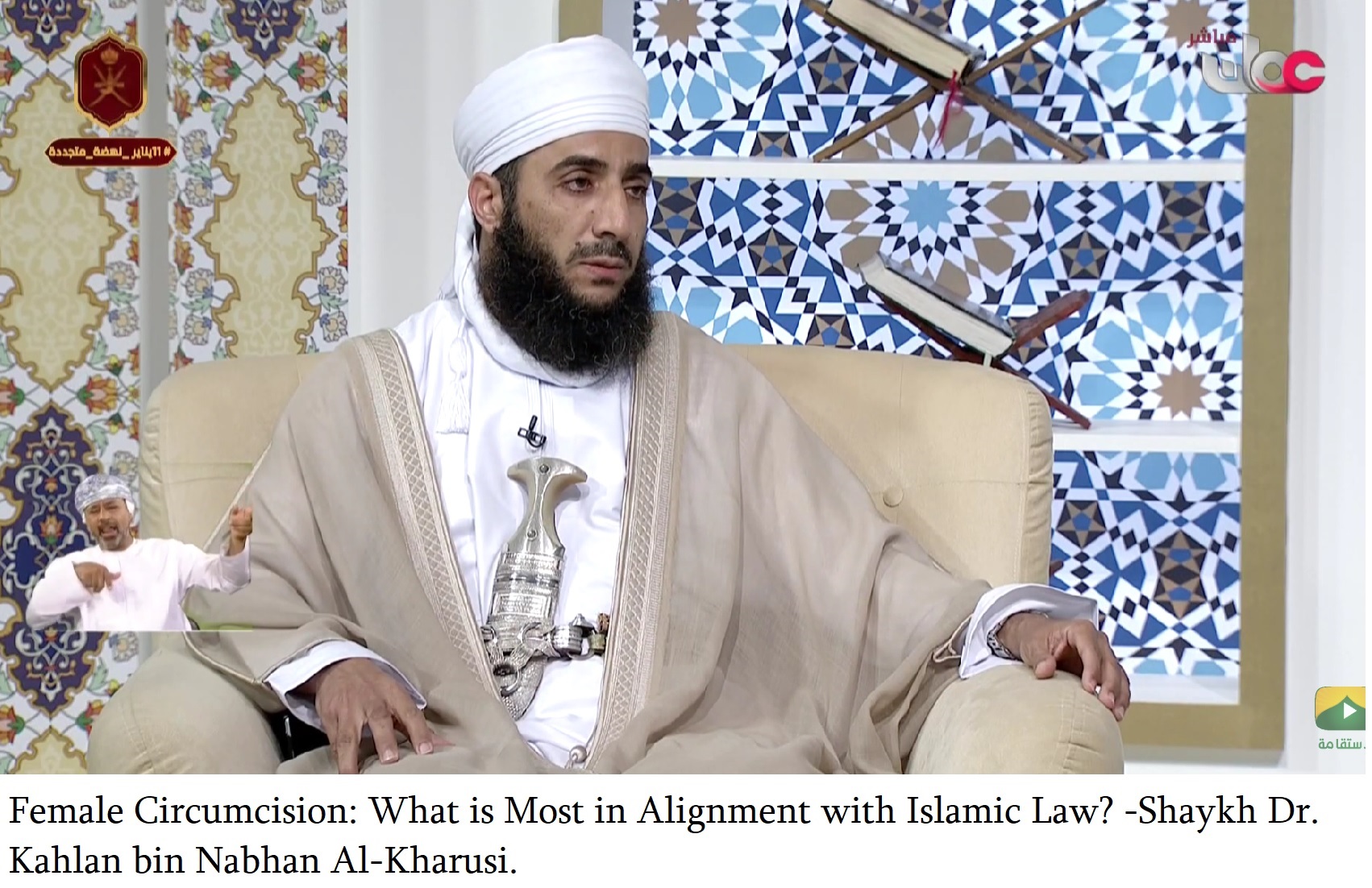
An interview with the honourable Shaykh Dr. Kahlan bin Nabhan Al-Kharusi on a very important topic.
Translation is as follows:
We come to another topic, and this time it relates to the circumcision of girls. Yes. Perhaps among the customs and traditions that people have inherited is that a girl must be circumcised just as a boy is circumcised. You mentioned in a previous fatwa that this means something permissible perhaps an advisory Sunnah was reported regarding it. However, people have greatly expanded in taking this concession that you spoke about, this permissibility, and they have begun committing acts that may not be good, that are harmful to the girl. So now, has your fatwa changed on this topic?
“No, the fatwa has not changed, and the fatwa, considering what exists in our jurisprudential heritage, was contrary to much of what the scholars of religion said on this matter.” -Shaykh Dr. Kahlan bin Nabhan Al-Kharusi
Yes.
“Rather, I said in it that my wish was that Muslim doctors would speak about this matter.” -Shaykh Dr. Kahlan bin Nabhan Al-Kharusi
Yes.
“What I mentioned in that answer was shocking to many jurists and students of Islamic legal knowledge because it was contrary to what they are accustomed to.” -Shaykh Dr. Kahlan bin Nabhan Al-Kharusi
Aha.
“Let us clarify the matter once again. The narrations that have come regarding the practice of khafd (female circumcision), which is known as circumcision for females. They are not free of criticism. None of these narrations can be relied upon with confidence. All the narrations that have come are not free of weakness, not free of defect.” -Shaykh Dr. Kahlan bin Nabhan Al-Kharusi
Yes.
“And what can be accepted with great leniency from these narrations does not, in reality, indicate what many jurists have concluded. Some narrations, for example, such as the narration that circumcision is an honor for the woman. It contains no legal ruling, so it cannot be used even to establish recommendation (istihbab), because this description “an honor for the woman” does not indicate a legal ruling.” Shaykh Dr. Kahlan bin Nabhan Al-Kharusi
Yes.
“And the Messenger of Allah’s instruction (peace and blessings be upon him and his family) in another narration which is one of the most relied-upon narrations by those who hold the view of recommendation and those who hold the view of obligation regarding circumcision for females is that he said to Umm Atiyya: “Trim but do not exhaust” or “reduce but do not exhaust”. This indicates the opposite of what was intended, it indicates the opposite of what many jurists have said, even assuming acceptance of this narration with great leniency.” -Shaykh Dr. Kahlan bin Nabhan Al-Kharusi
Yes.
“Moreover, I am more convinced by the view of those jurists and scholars, both early and late, who held that all these narrations are not free of criticism. Nevertheless The Messenger of Allah (peace and blessings be upon him) it is not established that he instructed anyone to do it, or commanded it for his daughters or his wives (peace be upon him) or the believing women. It is only according to the narration that when he migrated to Medina, a woman who performed circumcision said to be Umm Atiyya al-Ansariyya asked him, and he said to her: “Trim but do not exhaust.” Now this indicates that the intent was to lighten a practice that already existed.” -Shaykh Dr. Kahlan bin Nabhan Al-Kharusi
Yes.
“And therefore the guidance was for “ishmam” (light touching), for minimal taking without exaggeration. It is also apparent from this report, assuming its acceptance once again that the woman was qualified and capable of doing it properly, otherwise the Messenger of Allah (peace be upon him) would never have permitted her!” -Shaykh Dr. Kahlan bin Nabhan Al-Kharusi
Yes.
“So now let us summarize what we have said so far.” -Shaykh Dr. Kahlan bin Nabhan Al-Kharusi
Aha.
“None of the narrations that have come regarding female circumcision, regarding the circumcision of girls, is free of criticism that weakens it. Right?” -Shaykh Dr. Kahlan bin Nabhan Al-Kharusi
“And accordingly, the utmost that can be said is that it is among the permissible matters. Among the permissible matters in Islamic law. Now we say it is permissible, that it is within legal permissibility, if it is done by someone who is qualified and knowledgeable, aware of the correct method, taking the necessary precautions, and not exaggerating in it.” -Shaykh Dr. Kahlan bin Nabhan Al-Kharusi
Yes.
“So if we say it is permissible, and it is established that it is in fact practiced by people; meaning when we say it is permissible, the first conclusion we arrive at is that leaving it involves no sin in Islamic law and no wrongdoing.” -Shaykh Dr. Kahlan bin Nabhan Al-Kharusi
Yes.
“And this is an important conclusion. We respect the views of our imams and scholars from the various Islamic schools of thought. Perhaps some early Shafi’i scholars are among those who held it obligatory, and some Hanbali scholars, but others among the scholars of the Islamic schools for example, the Ibadi, Hanafi, and Maliki did not go that far. Some of them spoke of permissibility, and some said it is recommended, and they did not mention the derived legal evidence. These jurisprudential views are respected and are part of our Islamic heritage, but they should be understood, in terms of legal ruling, in light of the evidence that reached them.” -Shaykh Dr. Kahlan bin Nabhan Al-Kharusi
Yes.
“And in terms of actual practice, they never intended that it be done by women who lack qualification, knowledge, sufficiency, and capability, and who do not take the necessary precautions to avoid harming the girls.” -Shaykh Dr. Kahlan bin Nabhan Al-Kharusi
Beautiful.
“So since the matter is such that it is no more than permissible, and there is no sin in leaving it and no wrongdoing upon one who leaves it, then we can take the matter further than this.” -Shaykh Dr. Kahlan bin Nabhan Al-Kharusi
Yes.
“Because what has happened in people’s actual practice is poor application, even in this act. On one hand, as you noted, they imagine legal rulings that have been shown to have no validity or to be exaggerated. But in practice, there are many incidents in which young girls have suffered great harm from bleeding or tearing, yes? Or exaggeration in exhausting to the point of affecting the urinary tract and the genital area.” -Shaykh Dr. Kahlan bin Nabhan Al-Kharusi
Yes.
“Not to mention the injury and impact on the ability to conceive and bear children and on legitimate enjoyment in marriage And these are cases I have personally seen, seen from reality. Therefore, since the matter reaches this level of harm and damage, and lack of knowledge of correct application and correct execution even in the permissible amount; especially since it is not studied in medicine at all. There are no women practicing surgery for women who know how to do it, because contemporary medical sciences do not teach it. There are no specifications, no method, no standards, no procedure for doing it which is unlike the obligatory circumcision for males.” -Shaykh Dr. Kahlan bin Nabhan Al-Kharusi
Yes.
“This is not studied at all; it is not in the curricula. And what some Muslim doctors have mentioned of benefits and advantages of it unfortunately, in following up, I did not find that they rely on scientific evidence. They were advocating for jurisprudential views, and they should have stopped at the limit of permissibility.” -Shaykh Dr. Kahlan bin Nabhan Al-Kharusi
Yes.
“Because establishing health benefits should be based on sound medical evidence.But we do not find this. We find descriptions and praise and mentions, but without relying on sound scientific evidence that could be relied upon. And even if that were established, it would be conditional on correct execution but if it cannot be executed in a correct manner, because there is no one who can do it at all, since it is not studied and does not exist in medical curricula, then leaving it in this case is preferable either it is viewed as restricting the permissible due to the harms resulting from doing it, or it is viewed through the principle of blocking the means that lead to harm, damage, and corruption for the girls for whom it is done. And Allah Almighty knows best. And forgive me for the length.” -Shaykh Dr. Kahlan bin Nabhan Al-Kharusi
Okay, but the question relates to this topic. Since you mentioned that you have seen cases through perhaps your contact with doctors and your participation in biology conferences
Yes.
Is it permissible because no text prohibiting it has come, for example, or forbidding it? Or because the evidence found leads to the conclusion that it is permissible? Why is it not forbidden if it leads to such harms? The matter is very open.
“The view of prohibiting it is based only on what was mentioned previously.” -Shaykh Dr. Kahlan bin Nabhan Al-Kharusi
Yes.
There is no text from which prohibition can be taken from a prohibition by the Messenger of Allah (peace and blessings be upon him and his family). Rather, it is based on what was mentioned previously. And therefore a group and this can increase people’s confidence; a group of fatwa bodies and fatwa institutions in our Islamic countries today are also saying to prohibit this act.” -Shaykh Dr. Kahlan bin Nabhan Al-Kharusi
Yes.
“And they say so also because of what they have learned and reached regarding the weakness of the evidence that has come on this matter, and because of what has been established for them of poor practice leading to great harm and extreme harm.” -Shaykh Dr. Kahlan bin Nabhan Al-Kharusi
“It has reached the point with some circumcisers that they perform it behind hospitals and health centers because they know the result so that it may be closer to rescue and first aid, they do it near hospitals. And there is no limit to what could be said about the instruments used they are far removed from the health requirements required in this matter, let alone complete ignorance of it. The cases that the Omani female doctors told us about are not minor cases that can be overlooked.” -Shaykh Dr. Kahlan bin Nabhan Al-Kharusi
Yes.
“But what remains is that the foundation we rely on is: is this matter obligatory in the religion of Allah, Blessed and Exalted? Is it recommended and called for? The matter is not so.”-Shaykh Dr. Kahlan bin Nabhan Al-Kharusi
Yes.
“Is it permissible? Yes, we cannot say it is not permissible. But permissibility is restricted by what was mentioned previously of light touching, minimal taking and that it be done by someone with complete knowledge and understanding. But even so, can this permissibility be restricted due to the magnitude of harms that result from its application and practice? Yes, it can be restricted, as is the case with a number of permissible matters. Therefore, the view that is most convincing and most suited to people’s conditions today is to leave this act. And Allah Almighty knows best.” -Shaykh Dr. Kahlan bin Nabhan Al-Kharusi
Let us now move the ruling from the act to the actor. By this we are meaning the one who performs this task but does not possess this expertise. Is she committing something forbidden?
“Yes, she is committing a forbidden act, since she is ignorant. And whoever practices medicine without medical knowledge is liable. Yes.” -Shaykh Dr. Kahlan bin Nabhan Al-Kharusi
This is narrated as a report, but it has become a legal maxim. There is no doubt that such an act originally requires knowledge, understanding, and science, and that one should adhere to that. That is why, as mentioned, these reports. Yes, there are narrations about naming the place “al-khatanun” (the two circumcisers). These are sound hadiths, but we know that in such dual-form names, the description may often be used by predominance.” -Shaykh Dr. Kahlan bin Nabhan Al-Kharusi
Yes.
“For example It is said “the two black ones” for dates and water by predominance. It is said, for example, “the two moons” for the sun and the moon, by predominance. So this does not mean that the description applies to both described things together?” -Shaykh Dr. Kahlan bin Nabhan Al-Kharusi
Yes.
“Therefore we said that the view in principle is permissibility restricted by its conditions. But this permissible act should now be left because of the transgression that has occurred in it, the severe harms that have afflicted girls, the lack of a sound scientific method, and the lack of qualified people to perform it. And Allah Almighty is the one whose help is sought.” -Shaykh Dr. Kahlan bin Nabhan Al-Kharusi
Yes, may Allah reward you with good. Thank you. Yeah.
Prima Qur’an comments:
People come in different shapes, colours and sizes. Some people have features distinct from others. This is part of our diversity. It is plausible that some women have larger labia than other women. So perhaps in the view of some cultures they felt having a larger labia would not be appealing to a prospective partner. It could also be due to what they perceive as hygene related. Perhaps in places where water was scarce and sand is plentiful this practice came about.
After all, in the event of no availability of water or the preference to preserve the water for drinking we as Muslims perform tayammum.
Also, as the Shaykh mentinoned we also know of couples whose intimacy has been ruined through this practice. Some layman whom we spoke with from the Shafi’i school had insisted that the practice is to keep the excitability of women in check! Very unfortunate!
However, we do not know any reason that has any merit for the excising of a woman’s clitoris!
There is a principle in Shari’a law
لا ضرر ولا ضرار
“Lā ḍarar wa lā ḍirār” = No harm and no reciprocating harm.
Abu Sa‘īd al-Khudri reported: The Messenger of Allah (saw) said: “There should be no harm or reciprocal harm. Whoever causes harm, Allah harms him, and whoever makes things difficult, Allah makes things difficult for him.
We also have in Islamic law we also have what is known as: ‘Preventing harm takes precedence over attaining benefit.’ This is also known as: darʾ al-mafāsid muqaddam ʿalā jalb al-maṣāliḥ.
Thus, as the Shaykh said we have no proof text that explicitly forbids the practice. We also have no proof text that estabilshes that this was done by the Blessed Prophet (saw). It is not established that he instructed anyone to do it, or commanded it for his daughters or his wives (peace be upon him) or the believing women.
Examination of the ‘go to’ hadith itself.
As the Shaykh mentioned the hadith is weak. In fact, Imam Abu Dawud (the one who transmits this hadith) himself said it was weak!
Narrated Umm Atiyyah al-Ansariyyah:
A woman used to perform circumcision in Medina. The Prophet (ﷺ) said to her: Do not cut severely as that is better for a woman and more desirable for a husband.
Abu Dawud said: It has been transmitted by ‘Ubaid Allah b. ‘Amr from ‘Abd al-Malik to the same effect through a different chain.
Abu Dawud said: It is not a strong tradition. It has been transmitted in mursal form (missing the link of the Companions)
Abu Dawud said: Muhammed b. Hasan is obscure, and this tradition is weak.
However, when you click on the link above you will find that al-Albānī (Shu’ayb al-Arna’ut) gave the hadith a grade of Sahih (meaning sound)!
So from our perspective (speaking of the Prima Qur’an team) if an adult woman of sound mine wants to have this procedure than proceed. However, as it is very clear that infants, tolddlers and small children are not capable of giving thier consent it is best to abandon this practic altogether. Allah knows best and his help is sought. May Allah (swt) assist Shaykh Dr. Kahlan bin Nabhan Al-Kharusi in bringing light to the people!
For the interested Omani law states as follows:
Child Law (Article 20): Explicitly prohibits any person (especially doctors, nurses, and guardians) from engaging in, promoting, or assisting in “harmful traditional practices to the child’s health”.
Executive Regulations of the Child Law (Ministerial Decision No. 125/2019, Article 4): This is the crucial defining clause, which explicitly lists “female genital mutilation of any kind” as a “harmful traditional practice to the child’s health”.
Penalties (Child Law, Article 67): Violators face imprisonment of no less than 6 months and no more than 3 years
If you have found this entry informative you may enjoy the following articles:
“And if two parties from the believers should fight, then you [O men] should reconcile between them. Then if one of them transgresses against the other, then fight against the one that transgresses until it returns to the command of Allah. And if it returns, then reconcile between them in justice and act justly. Indeed, Allah loves those who act justly.” (Qur’an 49:9)
“And whoever kills a believer intentionally, their reward will be Hell. Therein they will stay indefinitely. Allah will be displeased with them, condemn them, and will prepare for them a tremendous punishment.” (Qur’an 4:93)
﷽
Introduction
Qur’an 49:9 stands as one of the most consequential verses in Islamic jurisprudence, politics, and theology concerning intra-community conflict.
The Ibadi tradition offers a uniquely rigorous and internally consistent reading of Qur’an 49:9, the verse commanding reconciliation. This article demonstrates how the Ibadi tafsir resolves tensions between the verse’s apparent designation of combatants as “believers” and its command to fight the transgressing party. The Ibadi position hinges on the distinction between kufr al-milla (disbelief of the religion) and kufr al-ni’ma (ingratitude of blessing), maintaining that the transgressor remains within the milla of Islam but enters a state of ingratitude subject to divine punishment. This framework is supported by the unique linguistic status of Qur’an 49:9, the Prophetic prohibition warning, and the strict rules of engagement established by the earliest Muslim community.
“And if two parties from the believers should fight, then make peace between them. But if one of them transgresses against the other, then fight against the one that transgresses until it returns to the command of Allah. Then if it returns, make peace between them with justice and be equitable. Indeed, Allah loves those who act equitably.” (Qur’an 49:9)
“min al-mu’minīn”–(مِنَ الْمُؤْمِنِينَ) The literal translation of “min al-mu’minīn” is “From the believers” or “Among the believers.”
This is very important to see how this verse of the Qur’an has been translated into English.
“Hence, if two groups of believers fall to fighting, make peace between them; but then, if one of the two [groups] goes on acting wrongfully towards the other, fight against the one that acts wrongfully until it reverts to God’s commandment; and if they revert, make peace between them with justice, and deal equitably [with them]: for verily, God loves those who act equitably.”-Muhammed Asad
“And if two parties of believers fall to fighting, then make peace between them. And if one party of them doeth wrong to the other, fight ye that which doeth wrong till it return unto the ordinance of Allah; then, if it return, make peace between them justly, and act equitably. Lo! Allah loveth the equitable.” -Marmaduke Pickthall.
This verse has generated extensive commentary across all Islamic schools of thought. However, the Ibadi tradition offers a uniquely rigorous and internally consistent reading that deserves careful attention. Drawing on the Ibadi tafsir Al-Abriz, the Taysir al-Tafsir of Atfayyish, the tafsir of al-Hawwari, the Prophetic tradition, and the broader Qur’anic framework, this article will demonstrate how the Ibadi position resolves apparent tensions in the text while maintaining a coherent theology of faith, sin, and community.
Asbāb al-Nuzūl: Reason or occasion for the revelation.
Ibn Abbas (or his report transmitted in Tanwīr al-Miqbās) (7th century / died 68 AH / 687 CE)
“(And if two parties of believers fall to fighting) this was revealed about the hypocrite ‘Abdullah Ibn Ubayy Ibn Salul and his host and ‘Abdullah Ibn Rawahah, a true believer, and his companions; these two parties fell to fighting after an exchange of words, and so Allah forbade them from fighting each other and commanded them to make up, saying, (And if two parties of believers fall to fighting then make peace between them) by referring to the Book of Allah. (And if one party of them) the party of ‘Abdullah Ibn Ubayy Ibn Salul (doeth wrong to) persists and transgresses against (the other) the party of ‘Abdullah Ibn Rawahah al-Ansari, and refuses to make peace by referring the matter to the Qur’an, (fight you that which does wrong till it return unto the ordinance of Allah) until it accepts to make peace by referring to the ordinances of the Qur’an; (then, if it return) if it accepts to make peace by referring the matter to the Book of Allah, (make peace between them justly, and act equitably) towards both parties. (Lo! Allah loveth the equitable) Allah loves those who judge justly by the Book of Allah, and act upon it.”
Tafsir al-Wahidi (by Abu al-Hasan al-Wahidi) 11th century / died 468 AH / 1075 CE) 400 years after Ibn Abbas.
“(And if two parties of believers fall to fighting, then make peace between them…) [49:9]. Muhammed ibn Ahmad ibn Ja‘far al-Nahwi informed us> Muhammed ibn Ahmad ibn Sinan al-Muqri’> Ahmad ibn ‘Ali al-Mawsili> Ishaq ibn Abi Isra’il> Mu‘tamir ibn Sulayman> his father> Anas who related: “I said: ‘O Prophet of Allah, why do you not visit ‘Abd Allah ibn Ubayy?’ The Prophet, Allah bless him and give him peace, decided to go and visit him. He mounted an ass and the Muslims walked with him. It happened that the ground was full of manure. So when the Prophet, Allah bless him and give him peace, reached ‘Abd Allah ibn Ubayy, the latter said: ‘Keep away from me, the staunch of your ass is offending me’. A man from the Helpers said to him: ‘By Allah, the ass of the Messenger of Allah, Allah bless him and give him peace, smells better than you’. One of the men of ‘Abd Allah ibn Ubayy got angry; then the men of both parties became angry because of what was said. They exchanged blows and hurled leafless palm leaves and sandals at each others. We heard that it is about them that (And if two parties of believers fall to fighting…) was revealed”. This was narrated by Bukhari from Musaddid and by Muslim from Muhammed ibn ‘Abd al-A‘la; both Musaddid and Muhammed ibn ‘Abd al-A‘la related it from al-Mu‘tamir.”
Tafsir Ibn Kathir (by Imad al-Din Ibn Kathir) (14th century / died 774 AH / 1373 CE) 300 years after al-Wahidi and 650 years after Ibn Abbas.
“(And if two parties among the believers fall to fighting, then make peace between them both.) Therefore, Allah calls both opposing groups among Muslims, believers, although they are fighting each other. Al-Bukhari and other scholars relied on this Hadith as evidence that committing a sin does not nullify faith, no matter how major the sin is. This creed contradicts the creed of the Khawarij sect and those who accepted their idea, such as the Mu`tazilah sect.“
” Said bin Jubayr said that the tribes of Aws and Khazraj once got into a scuffle using date tree branches and slippers. Allah revealed this honourable Ayah comanding them to make peace between them. As-Suddi said, A man from Al-Ansar, whose name was Imran, had a wife called Umm Zayd. She wanted to visit her family, but her husband prevented her from visiting them by locking her in an upper room. So, none of her family could visit or see her. She sent someone to her family. They came, took her down from the room and wanted to take her away. Her husband was absent at the time, so his family called on their people. Their cousins came to help prevent the wife from going with her family. A push and shove situation occurred that led to them fighting using slippers. This Ayah was then revealed in their case, and the Messenger of Allah sent someone to bring peace between them, and they both agreed to resort to the decision of Allah the Exalted.'”
Prima Qur’an comments. Ibn Kathir immediately evokes the so called ‘Khawarij’ and Mu’tazilah’ in which he puports to represent their position.
He then pivots to the Aws and Khazraj getting into a scuffle. He also narrates a conflict between among the Ansar themselves.
The prominent Maliki jurist Qadi Abu Bakr ibn al-Arabi (d. 1148 CE) from his landmark legal exegesis, Ahkam al-Qur’an remarked the following:
“The first: It was narrated by Saʿīd ibn Jubayr from Ibn ʿAbbās that it concerned Aws and Khazraj. A man from them insulted another, so each group supported its clansman until fighting erupted between them. Then the Messenger of Allah (saw) came and reconciled them, and Allah revealed the verse commanding justice and fairness.”
“The second: It was narrated that the verse was revealed concerning a dispute between two groups of the Anṣār. They took the case to the Prophet (saw), who judged between them. But one side refused the judgment and became angry, which led to fighting. Then Allah revealed the verse: “And if two groups of the believers fight each other, then reconcile between them.”
“The third: Al-Suddī narrated that a man from the Anṣār was married to a woman, and they had a disagreement. The woman wanted to go to her family, but her husband refused. She gathered her people, and he gathered his people, and they fought one another. Then the Prophet (saw) reconciled them, and the verse was revealed concerning them.”
“The fourth:It was said that the verse was revealed about ʿAbdullāh ibn Ubayy ibn Salūl (the hypocrite leader) who quarreled with a Muslim. Each of them brought his group to support him until fighting almost broke out. Then the Prophet (saw) reconciled them, and the verse was revealed.”
“Al-ʿArabī said: The most authentic of the narrations is the last one. “The correct opinion is that the verse is general, and it is not restricted to a particular cause of revelation. The Qur’anic verse remains general in meaning, even if it was revealed about a specific event. What is narrated about Aws, Khazraj, Ibn Ubayy, or the story of the husband and wife all of it fits the meaning, but the ruling of the verse applies universally to every case.”
The fourth case involves the hypocrite ʿAbdullāh ibn Ubayy ibn Salūl.
The second case involves one who refuses the very judgement of the Prophet (saw). Which makes you wonder how will you reconcile between those who won’t even accept the authority of the Prophet (saw). It is likely that ibn al-Arabi so the futility of that case from a matn perspective.
Ibn al-Arabi likely saw that the first case and the third case cancel each other out.
Why? Because if the verse was revealed for the first case it would be redundant to be revealed concerning the third case and if it was revealed concerning the third case it would be redunant concerning the first case.
The Ibadi scholars weigh in.
The eminent scholar Al-Qutb al-A’imma (r) said:
(“And if two groups from the believers fight”) – They are called believers based on their apparent state known to us before the fighting. Or it means: ‘And if two groups from the believers’ – like calling a prepubescent child a ‘disobedient sinner’ (‘āṣin) based on his state before reaching puberty, even though their fathers have died.”
The eminent scholar Shaykh Al-Khalīlī (h) said:
“As for His saying, the Exalted, (“And if two groups from the believers fight”), it is possible to understand it based on considering the faith (īmān) of the two groups before the fighting. Just as one says: ‘The disbeliever believed,’ ‘The people repented,’ ‘The misguided one was guided,’ ‘The Muslim apostatized,’ and ‘The pious person sinned’ – this is said with regard to what they were upon, even though after his belief he is no longer a disbeliever. Similarly, after his repentance he is no longer a sinner, after his guidance he is no longer misguided, and whoever apostatizes from his Islam is no longer a Muslim. Likewise, the trader, after he has sinned, is not pious.”
“Similarly, the faith of the two groups: it is correct to consider it with regard to what they were upon before the fighting. However, the faith that prevents its ascription [being removed] from a person and a sinner is the faith upon which success and salvation in the Hereafter are contingent. This is just as Islam is used in contrast to disbelief (kufr), for conventionally, every monotheist is called a Muslim, even if he falls short in fulfilling the obligations of Islam, even though…”
Question: Does this observation by the respected scholars find evidence in the Qur’an?
Answer: Yes! by using Tafsīr al-Qur’ān bi’l-Qur’ān which is the method of explaining or interpreting the meanings of one verse of the Quran by using another verse from within the Quran itself.
(49:9)fa-in baghat iḥdāhumā ‘alā al-ukhrā — “if one of them oppresses the other”
Is there any verse outside of Qur’an 49:9 that suggest that this is the conduct of the righteous and those who fear Allah? Is there anywhere in the Qur’an where Allah uses this descriptor to describe the righteous and those who fear Allah?
The root b-gh-y is not used for ordinary sinning. It is used for transgression, oppression, rebellion — a specific and severe category. This specific category is never applied to believers or to the righteous anywhere in the Qur’an.
Form I verb baghā (بَغَىٰ) — 25 times
Every single Qur’anic usage of Form I in the active sense is negative. It means to transgress, oppress, rebel, or wrong someone.
Examples:
(2:213)baghyan baynahum — “out of jealousy among themselves”
(3:19)baghyan baynahum — “out of envy among themselves”
(7:33)wal-baghya bighayri al-haqq — “and oppression without right” (forbidden)
(10:23)yabghūna fi’l-ard bighayri al-haqq — “they rebel in the earth without right”
(28:76)fa-baghā ‘alayhim — “but he oppressed them” (Qarun)
(38:22)baghā ba’ḍunā ‘alā ba’ḍ — “one of us has wronged the other”
(42:27)la-baghaw fi’l-ard — “they would surely rebel in the earth”
(49:9)fa-in baghat iḥdāhumā ‘alā al-ukhrā — “if one of them oppresses the other”
(55:20)lā yabghiyāni — “they do not transgress” (the two seas)
Conclusion: Form I verb baghā is never used in the Qur’an to describe the righteous positively. It is always transgression, oppression, or rebellion. The only “neutral” usage is in the sense of “seeking” in a few places, but even then the context is not describing the righteous as such. Example: (3:83) afaghayra dīn Allāh yabghūna — “Do they seek other than the religion of Allah?” — which is a rebuke.
Noun baghy (بَغْي) — 11 times
Every single usage is negative. It means transgression, oppression, envy, or rebellion.
(2:90)baghyan — “grudging”
(2:213)baghyan baynahum — “out of jealousy among themselves”
(3:19)baghyan baynahum — “out of envy among themselves”
(6:146)bibaghyihim — “for their rebellion”
(7:33)wal-baghya — “and oppression” (forbidden)
(10:23)baghyukum — “your rebellion”
(10:90)baghyan wa ‘adwan — “in tyranny and enmity” (Pharaoh)
(16:90)wal-baghyi — “and oppression” (forbidden)
(42:14)baghyan baynahum — “out of rivalry”
(42:39)al-baghyu — “tyranny”
(45:17)baghyan baynahum — “out of envy”
Conclusion: The noun baghy is never used positively. It is always a blameworthy quality.
Noun baghiyy (بَغِيّ) — 2 times
Both usages refer to an unchaste woman — a negative term:
(19:20)wa mā kuntu baghiyyan — “I have not been unchaste” (Maryam’s defense)
(19:28)wa mā kānat ummuki baghiyyan — “nor was your mother unchaste”
Conclusion: Always negative.
Verbal noun bighā’ (بِغَاء) — 1 time
(24:33)wa lā tukrihū fatayātikum ‘alā al-bighā’ — “do not compel your slave girls to prostitution”
Conclusion: Always negative.
Active participle bāgh (بَاغ) — 3 times
All three occur in the same phrase:
(2:173)ghayra bāghin wa lā ‘ādin — “neither desiring [it] nor transgressing”
(6:145) same
(16:115) same
Conclusion: The participle bāgh here means “one who desires” or “one who transgresses” — in the context of eating forbidden food under necessity. It is not describing the righteous; it is describing the limits of a concession for the one in need. The righteous person is the one who does not desire the forbidden thing.
Perhaps the most striking feature of the Sunni understanding of Qur’an 49:9 is that this is the only verse in the entire Qur’an where they can claim the apparent believers are described as bāghī (transgressors)!
The Sunni reading must work harder to explain why the Qur’an uses a term for believers in 49:9 that it never uses for believers anywhere else.
If the question is which reading is on firmer textual footing, the Ibadi reading has the stronger case. This is not because it is the majority position, but because it is the reading that accounts for the most textual data with the no unresolved tensions.
Where as we have seen using Tafsīr al-Qur’ān bi’l-Qur’ān the Sunni understanding doesn’t hold under scrutiny.
This misunderstanding not only clashes with the Qur’an but clashes with sound tranmission from the Blessed Prophet (saw).
As we have seen it clashes with the Qur’an. Such a descrption is never applied to believers or to the righteous anywhere in the Qur’an.
It also clashes with the following:
“And whoever kills a believer intentionally, their reward will be Hell. Therein they will stay indefinitely. Allah will be displeased with them, condemn them, and will prepare for them a tremendous punishment.” (Qur’an 4:93)
The (eternal punishment for intentional killing of a believer) creates a tension that the Sunni framework struggles to resolve without collapsing into Murji’ism.
This verse presents a serious problem for the Sunni reading:
If the bāghī remains a believer, and they intentionally kill another believer, then Qur’an 4:93 applies to them: eternal Hell.
But Sunni theology generally holds that a Muslim who commits a major sin does not face eternal Hell they face punishment, then eventually enter Paradise.
So either Qur’an 4:93 applies to the bāghī (and they face eternal punishment), or Qur’an 4:93 does not apply to the bāghī (which shouldn’t require an strenuous explanation).
Narrated Ibn `Umar:
I heard the Prophet (saw) saying, “Do not revert to disbelief (kuffaran) after me by striking (cutting) the necks of one another.”
The Ibadi reading is that this confirms that intra-Muslim fighting is a form of kufr. In particular kufr al-ni’ma, the kufr that does not expel one from the milla.
The Ibadi reading has the advantage of taking the word kufr seriously while still maintaining that the fighters remain within the community. The Sunni reading must explain why the Prophet (saw) used the word kufr if he did not mean kufr in some sense. Look at the verse:
“Then if one of them transgresses against the other, then fight against the one that transgresses until it returns to the command of Allah.”
The verse does not describe the two parties who did ijtihād and erred. Or had a “difference of opinion” — it uses the language of transgression.
It cannot be imagined that Allah (swt) is asking believers to fight against those who are in conformity with Allah and his Messenger.
This is proven by the fact that one faction has to return to the command of Allah. If they were upon the command of Allah they would not be fought.
The Verse of the Qur’an Does Not Call Both Parties Believers While They Fight.
Let us look at the actual Arabic:
وَإِن طَائِفَتَانِ مِنَ الْمُؤْمِنِينَ اقْتَتَلُوا Wa-in ṭā’ifatāni min al-mu’minīna iqtatalū
The structure is:
طَائِفَتَانِ (ṭā’ifatāni) — two factions
مِنَ الْمُؤْمِنِينَ (min al-mu’minīna) — from among the believers
اقْتَتَلُوا (iqtatalū) — they fought
The description “from among the believers” qualifies the subject before the action. The verse does not say “two factions of believers fought.” It says “if two factions from among the believers fight.”
Grammatically and logically, the min al-mu’minīn is identifying who these factions are drawn from — the believing community. It is describing their origin, their prior status, their membership in the community.
It is not saying they are believers in the state of fighting.
So when the Qur’an says “two factions from among the believers fought,” it is saying:
They were believers before the fighting.
The one who commits (baghy) transgression is to be fought.
The description “believer” applies to what they were, not to what they are doing.
The verse continues:
فَإِن بَغَتْ إِحْدَاهُمَا عَلَى الْأُخْرَىٰ فَقَاتِلُوا الَّتِي تَبْغِي Fa-in baghat iḥdāhumā ‘alā al-ukhrā fa-qātilū allatī tabghī “But if one of them transgresses against the other, then fight against the one that transgresses.”
So the Qur’an:
Identifies them as from among the believers (prior state).
Describes one of them as transgressing (baghat).
Commands fighting the transgressing one — not both.
If both parties remained believers in the state of fighting, the verse would not single out one as the transgressor. The verse makes a moral distinction: one party is in the wrong. The other is the wronged party. The wronged party is not fought. The transgressing party is fought until it returns to Allah’s command.
This is why the Sunni framing of “two groups of believers who had a misunderstanding” is problematic. The verse does not describe a mutual misunderstanding. It describes one party transgressing against the other.
What they were: believers.
What one of them did: transgressed.
What the community must do: fight the transgressor until it returns.
The one who fights unjustly is the bāghī. The one who is fought against is the wronged believer.
So the question becomes: what is the status of the believer who transgresses?
This is where the Ibadi framework comes in:
They remain within the milla(the religion). They are not kuffār in the sense of kufr al-milla.
But they have entered kufr al-ni’ma. That is the ingratitude of blessing by transgressing against their fellow believers.
They are subject to fighting until they return, and to divine punishment if they do not.
This is a coherent, textually grounded framework. And it does not require reading the verse as describing a “big misunderstanding” between two parties who remain believers while fighting.
The Argument from A Fortiori Reasoning (Qiyās al-Awlawī)
“O you who have believed, let not a people ridicule other people; perhaps they may be better than them; nor let women ridicule other women; perhaps they may be better than them. And do not insult one another and do not call each other by offensive nicknames. Wretched (bi’sa) is the name of disobedience (l-fusūqu) after [one’s] faith. And whoever does not repent – then it is those who are the (l-ẓālimūna) wrongdoers.” (Qu’ran 49:11)
If ridicule — a word, a gesture, a nickname — is enough to earn the label fāsiq and ẓālim, then what about killing?
The Qur’anic reasoning is:
Premise 1: Ridicule and insult are prohibited, and those who persist in them are called fāsiq and ẓālim (Qur’an 49:11).
Premise 2: Killing a believer intentionally is a far graver offense . It is the destruction of a life, the breaking of the community, the ultimate transgression against a fellow Muslim.
Conclusion: Therefore, the one who kills a believer is at least a fāsiq and a ẓālim and in fact, far worse.
Notice the sequence. The verse does not say:
“Ridiculing is a minor sin.”
“Insulting is a peccadillo.”
“Nicknames are a trivial matter.”
It says:
The one who does these things has been labeled with disobedience (fusūq).
The one who does not repent is among the wrongdoers (ẓālimūn).
These are Qur’anic categories of serious moral failure. They are not casual descriptors. They are the same categories used elsewhere in the Qur’an for grave offenses.
Now place this next to Qur’an 4:93:
“And whoever kills a believer intentionally, their reward will be Hell. Therein they will stay indefinitely. Allah will be displeased with them, condemn them, and will prepare for them a tremendous punishment.” (Qur’an 4:93)
If ridicule earns fusūq and ẓulm, then intentional killing which earns eternal Hell and divine curse cannot possibly leave the perpetrator in the same moral category as before.
Dear readers! What planet or universe does this make sense? Taking the life of a believer is a lesser offense than ridicule?!
This is precisely the point. The Sunni framework that says:
Ridicule → fāsiq, ẓālim
Intentional killing of other Muslims → are the actions of a Mu’min?
This creates a moral inversion. The lesser offense (ridicule) earns the label fāsiq and ẓālim. The greater offense (killing) supposedly leaves one a Mu’min in good standing. It is a matter of ijtihad?!
This is incoherent. And it is precisely why the Ibadi framework of kufr al-ni’ma is more consistent:
Ridicule → kufr al-ni’ma (ingratitude)
Intentional killing → kufr al-ni’ma (ingratitude), and far more severe
Both are within the milla outwardly, but both have entered kufr al-ni’ma. The difference is in the degree of the offense and the severity of the punishment.
The Qur’an does not say that the one who ridicules is a Mu’min in good standing. It says he is a fāsiq and a ẓālim unless he repents. How much more, then, the one who kills?
The Two Types of Kufr: Kufr al-Milla and Kufr al-Ni’ma
The Ibadi position hinges on a critical distinction between two categories of kufr (disbelief/ingratitude):
1. Kufr al-Milla (Disbelief of the Religion): This is outright rejection of Islam, placing one outside the community of believers entirely. This is the kufr of the polytheists and those who deny God’s existence or reject the Prophethood of Muhammed(saw).
2. Kufr al-Ni’ma (Disbelief/Ingratitude of Blessing): This applies to a Muslim who commits a major sin (kabīra) but still affirms the oneness of Allah (tawḥīd) and belongs to the milla of Islam. Such a person is a kāfir in the sense of being ungrateful for Allah’s blessings, but not a kāfir in the sense of being outside the faith.
This distinction is rooted in the Qur’an itself. In Surah Ibrahim (14:7), Allah declares:
“And [remember] when your Lord proclaimed, ‘If you are grateful (shakartum), I will surely increase you [in favor]; but if you are ungrateful (kafartum), indeed, My punishment is severe.'” (Qur’an 14:7)
The verse establishes a direct correlation between gratitude (shukr) and increase in favor, and between ingratitude (kufr) and severe punishment. The one who fights and kills fellow believers is acting in kufr al-ni’ma. They are ungrateful for the blessings of faith, brotherhood, and life itself.
Crucially, the Qur’an does not promise paradise to the ungrateful (kafartum) as a standalone category. Paradise is promised to the believers, the righteous, the Allah-conscious, the patient, and the repentant. In no place is it ever promised to the ungrateful (kafir) as a category. Therefore, the bāghī cannot claim the promise of paradise while persisting in their transgression.
The Qur’an explicitly warns:
“And whoever kills a believer intentionally, their reward will be Hell. Therein they will stay indefinitely. Allah will be displeased with them, condemn them, and will prepare for them a tremendous punishment.” (Qur’an 4:93)
This verse presents a serious theological problem: How can a believer who commits such a sin face eternal punishment? The Ibadi answer is that the intentional killer has entered a state of kufr al-ni’ma—a state of ingratitude so profound that they are subject to the severe punishment promised in Qur’an 14:7.
Qur’an 2:112 and The Two Conditions
“Yes [on the contrary], whoever submits his face (wholeself/being) in Islam to Allah while being a doer of good will have his reward with his Lord. And no fear will there be concerning them, nor will they grieve.”
The verse establishes two conditions:
أَسْلَمَ وَجْهَهُ لِلَّهِ (aslama wajhahu li’llāh) — submission of the face to Allah. This is the inward orientation: sincerity, devotion, turning toward Allah.
وَهُوَ مُحْسِنٌ (wa-huwa muḥsin) — being a doer of good. This is the outward manifestation: actions of obedience, iḥsān in practice.
The reward is contingent on both. Neither alone is sufficient. This is a key Qur’anic principle: faith and works are inseparable in the Qur’anic vision of salvation.
How This Fits the Ibadi Understanding
The Ibadi framework of kufr al-ni’ma (ingratitude of blessing) and kufr al-milla (disbelief of religion) maps directly onto this verse:
The person who claims belief but has no outward actions of obedience has entered kufr al-ni’ma. They have not left the milla — they are still outwardly Muslim, still part of the community — but they are not fulfilling the condition of iḥsān that Qur’an 2:112 requires for reward and security.
This is precisely why the Ibadi tradition takes outward conformity seriously. It is not enough to say “I believe”. The Qur’an demands that belief be accompanied by iḥsān (doing good).
By not, at the very least, calling out the lack of outward conformity, it becomes very easy for hypocrites to move about undetected, although the inward hypocrisy can only be dealt with by Allah.
The Ibadi framework does not pretend to judge the inward. It judges the outward, because that is what the community has access to, and it leaves the inward to Allah. But precisely because it takes the outward seriously, it does not allow outward conformity to be ignored.
Every Mumin is a Muslim but not every Muslim is a Mumin.
“The bedouins say, ‘We have believed.’ Say, ‘You have not believed; but say [instead], “We have submitted,” for faith has not yet entered your hearts.'” (Qur’an 49:14)
This verse is directly adjacent to Qur’an 49:9–12. It is part of the same surah, the same discourse, and the same thematic unit. And it establishes the exact distinction this article is builds on:
Term
Meaning
What it describes
Islam (أَسْلَمْنَا)
Submission, outward entry into the community
The dhāhir — what is visible, legal, social
Īmān (آمَنَّا)
Faith, inward conviction
The inward (bāṭin) —what is in the heart or the ḥaqīqa (reality) — is only accessible to Allah
The bedouins claimed īmān (inward faith). Allah corrected them: You have not believed; say instead that you have submitted. The outward profession of Islam is real, but the inward faith has not yet entered their hearts.
The bedouins in 49:14 are Muslims (aslamnā). That is they have entered the milla. But they are not yet believers (mā āmannā). Meaning īmān has not entered their hearts. Their status is:
Outwardly: Muslim part of the community, subject to its laws and protections.
Inwardly: Not yet a mu’min faith has not entered the heart.
Their reality: Their reality is known to Allah alone.
The Prophetic Warning
The Ibadi reading of Qur’an 49:9 is strongly supported by the Prophetic tradition.
“Do not revert after me as disbelievers, striking the necks of one another.”
The Arabic word used is kuffāran (كُفَّارًا). While some translations render this as “disbelievers,” the Ibadi understanding as reflected in our translation as “ungrateful ones” actually captures the essence of the warning. The Blessed Prophet (saw) was not saying that those who fight each other become actual disbelievers outside the fold of Islam. Rather, he was warning that fighting fellow Muslims is an act of extreme ingratitude (kufr al-ni’ma) that mimics the behavior of disbelievers.
Narrated Ibn `Abbas:
The Prophet (saw) said, “When (a person) an adulterer commits illegal sexual intercourse, then he is not a believer at the time he is doing it; and when somebody steals, then he is not a believer at the time he is stealing .”
The Prophet (saw) said, “An adulterer, at the time he is committing illegal sexual intercourse is not a believer; and a person, at the time of drinking an alcoholic drink is not a believer; and a thief, at the time of stealing, is not a believer.” Ibn Shihab said: `Abdul Malik bin Abi Bakr bin `Abdur-Rahman bin Al- Harith bin Hisham told me that Abu Bakr used to narrate that narration to him on the authority of Abu Huraira. He used to add that Abu Bakr used to mention, besides the above cases, “And he who robs (takes illegally something by force) while the people are looking at him, is not a believer at the time he is robbing (taking).
So when a person who is part of the milla of Islam is not described a believer at the moment they commit illegal sexual intercourse, steals, drinks, or robs then what is his status when he oppresses a fellow Muslim? Especially when this oppression leads to intentional killing?
The Ibadi commentary in Al-Abriz reinforces this point:
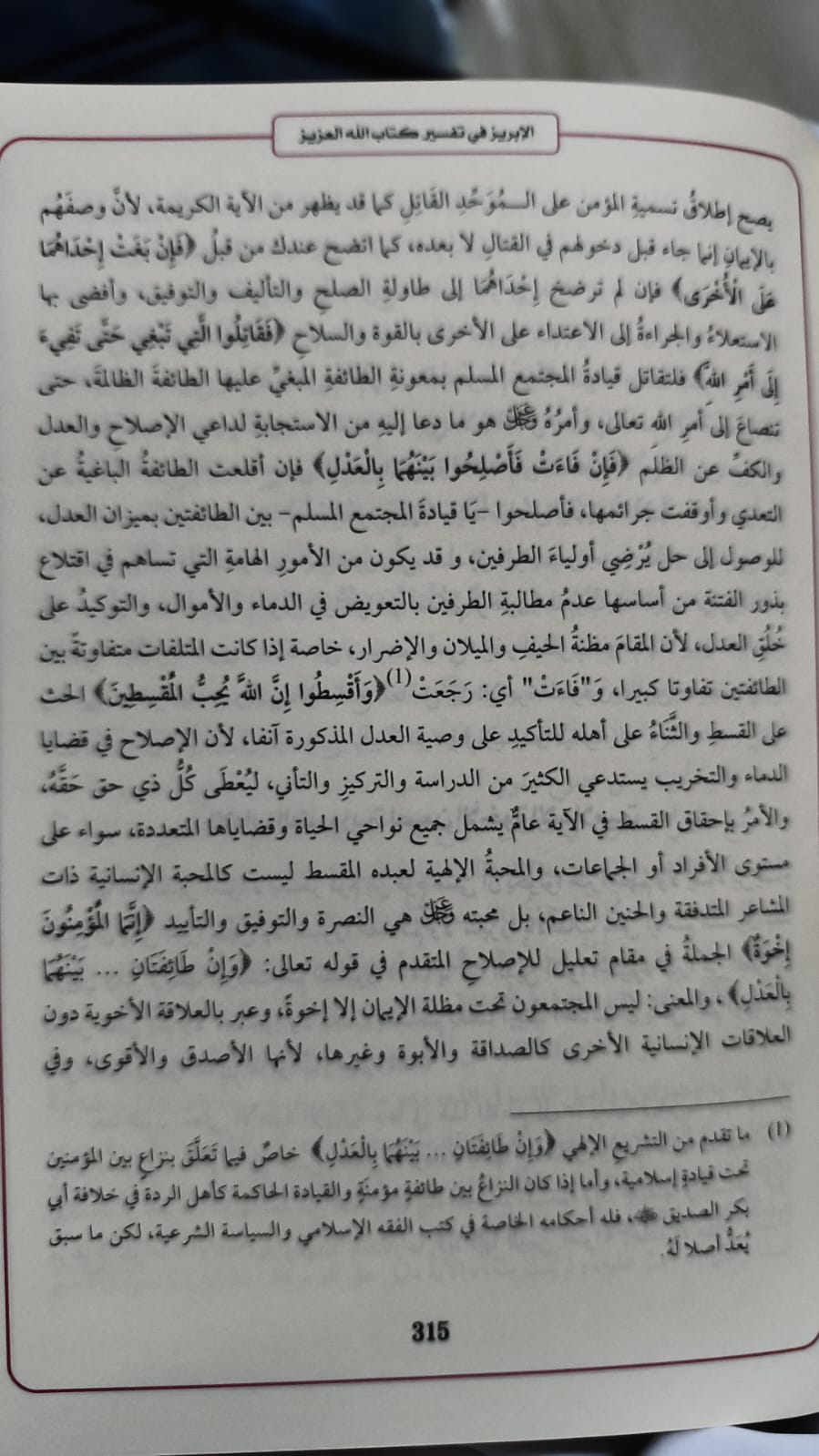
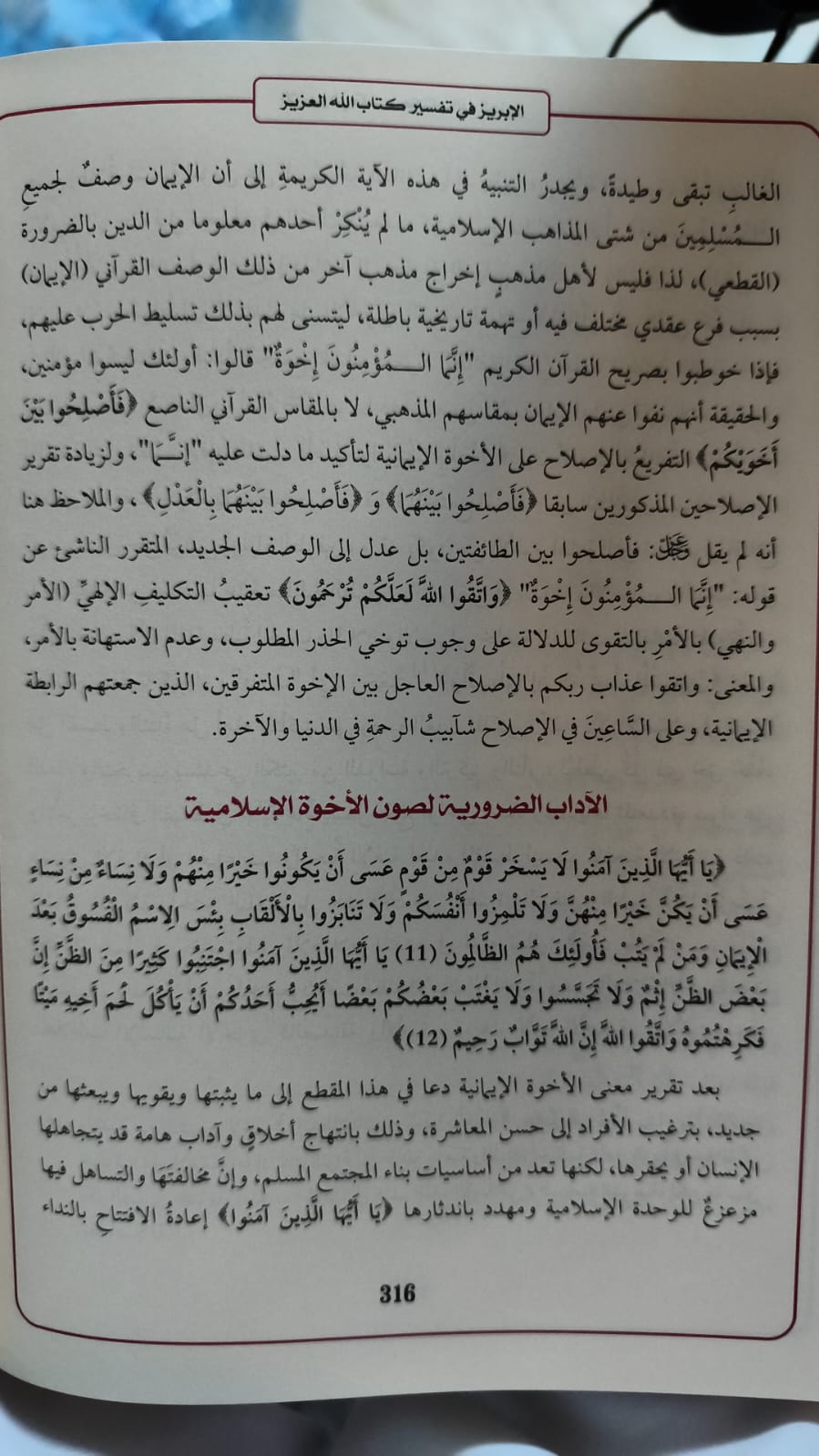
It is not valid to apply the name of ‘Believer’ to the one who commits major sins, as is apparent from the noble verse, because He described them with faith at the time of the fighting, before it.” (Al-Abriz, p. 315)
The Divine Method in Extinguishing the Fitnah of Fighting Between the Believers
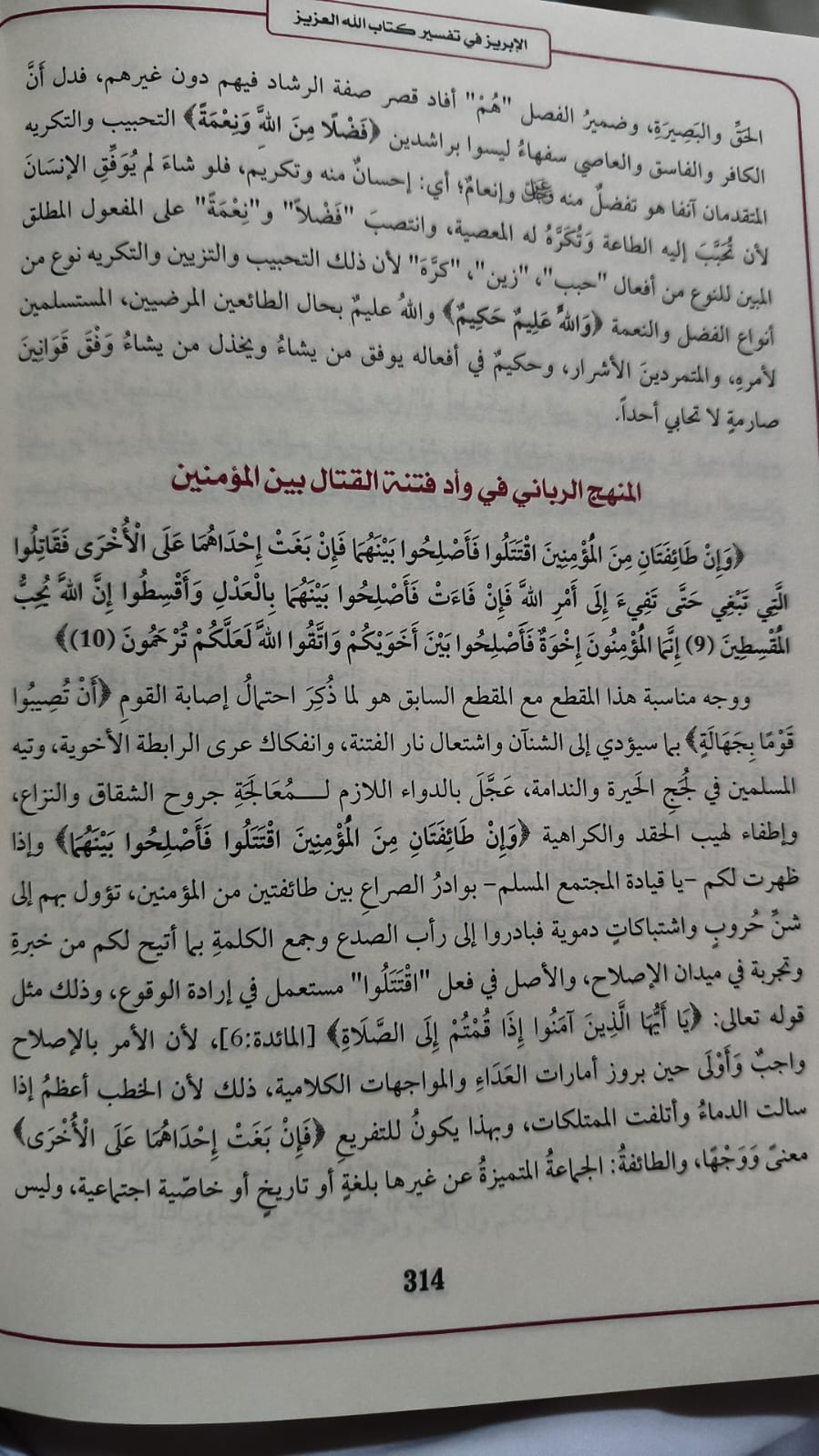
“And if two factions among the believers should fight, then make settlement between the two. But if one of them oppresses the other, then fight against the one that oppresses until it returns to the ordinance of Allah. And if it returns, then make settlement between them in justice and act justly. Indeed, Allah loves those who act justly. The believers are but brothers, so make settlement between your brothers. And fear Allah that you may receive mercy.” (Qur’an 49:9-10) -pg 314 Al-Ibriz fi Tafsir al-Qur’an al-‘Aziz
“And the point of connection between this passage and the previous passage is what was mentioned regarding the possibility of the people being afflicted with ignorance. This leads to the fire of discord and the disintegration of the bonds of brotherhood. And the Muslims, in the throes of confusion and regret, hasten with the necessary remedy to heal the wounds of division and conflict, and to extinguish the flames of hatred and aversion. And if “And if two factions among the believers should fight, then make settlement between the two” — O leaders of the Muslim community — the sparks of conflict between two factions of the believers appear, leading to outbreaks of wars and bloody clashes, then hasten to mend the breach and gather the word.” -pg 314 Al-Ibriz fi Tafsir al-Qur’an al-‘Aziz
” [This is] in light of what has been permitted to you of experience in the field of reform. The root [of the word] in the verb “should fight” (iqtatalū) is used in the sense of intending the occurrence. This is like His saying, the Most High: “O you who have believed, when you rise to [perform] prayer…” (5:6). [This is] because the command to reform is obligatory, and the nearest [course of action] when signs of enmity and verbal confrontations appear is that, because the matter is greater, blood has flowed and properties have been destroyed. And with this, there is a transition to the branch: “But if one of them oppresses the other.” And the meaning and the face [of it]: Al-Ta’ifah (the faction): the group distinguished from others by language, or history, or social specificity. And it is not valid to apply the name of “believer” to the one who commits major sins, as is apparent from the noble verse, because He described them with iman (faith) before their fighting, as became clear to you previously from His saying: “And if two factions among the believers should fight…” (49:9). If one of them does not submit to the other, [and] does not yield to the path of reconciliation, harmony, and agreement, it leads to arrogance and audacity in aggression against the other with force and weapons. [This is indicated by] His saying: “then fight against the one that oppresses until it returns to the ordinance of Allah” (49:9). So the leadership of the Muslim community aids the oppressed faction against the oppressive, transgressing faction until it submits to the command of Allah, and His command is what calls to it of responding to the call of reconciliation and justice, and refraining from injustice. “And if it returns, then make settlement between them in justice” (49:9).” -pg 314-315 Al-Ibriz fi Tafsir al-Qur’an al-‘Aziz
“If the transgressing faction desists from its aggression and stops its crimes, then make peace — O leadership of the Muslim community — between the two factions with the balance of justice, to reach a solution that satisfies the guardians of both parties. And it may be among the crucial matters that contribute to extinguishing the flames of discord: the absence of demanding compensation from the two parties for blood and wealth, and emphasis upon the removal of justice, for the position is one of caution regarding bias and harm, especially if the damages of the two factions are vastly different, and their losses are greatly disparate. “And act justly. Indeed, Allah loves those who act justly” (49:9) — meaning: return. And His saying “and act justly” is an emphasis upon the guardians of the matter to reaffirm the aforementioned testament of justice, because reform in matters of blood and destruction requires much study, focus, and deliberation, so that every possessor of a right is given their right. And the command to establish justice in the verse is general, encompassing all aspects of life and its multiple issues, whether at the level of individuals or groups. And the divine love for His servant who is just is not a sentimental emotion or a tender longing; rather, His love is His aid, support, and divine confirmation. Then the sentence “The believers are but brothers” (49:10) is in the position of explaining the previous [command] to make peace in His saying: “And if two factions among the believers should fight… then make settlement between them in justice” (49:9).” -pg 315 Al-Ibriz fi Tafsir al-Qur’an al-‘Aziz
“The meaning: those gathered under the shade of faith are nothing but brothers, and He expressed the relationship of brotherhood without [mentioning] other human relationships like friendship, fatherhood, and sonship, because it is the most truthful and strongest, and in it The majority remain firm, and it is appropriate to draw attention in this noble verse to the fact that iman (faith) is a description of all Muslims from the various Islamic schools of thought, as long as one of them does not deny something known of the religion by necessity (which is categorical).” -pg 315-316 Al-Ibriz fi Tafsir al-Qur’an al-‘Aziz
“Therefore, the people of a school of thought do not have the right to exclude another school of thought from that Qur’anic description (iman) due to a doctrinal branch in which it differs, or due to a baseless historical accusation, so that it becomes easy for them to impose war upon them. For they have been addressed by the explicit text of the Noble Qur’an: “The believers are but brothers” (49:10). They said: “Those are not believers.” But the truth is that they negated iman from them due to their school of thought, not according to the Qur’anic standard of the advisor: “So make settlement between your brothers”(49:10). The transition to reconciliation is based on the bond of faith, to emphasize what the word “only” (innamā) indicated, and to increase the affirmation of the two reconciliations mentioned previously: “So make settlement between them” (49:9) and “then make settlement between them in justice” (49:9). And the observation here is that He did not say: “So make settlement between the two factions,” but rather He shifted to the new description, which is established by His saying: “The believers are but brothers” (49:10). “And fear Allah that you may receive mercy” (49:10) is a follow-up to the divine obligation (the command and the prohibition) with the command of piety, to indicate the necessity of observing the required caution and not taking the matter lightly. And the meaning: And fear the punishment of your Lord by making immediate reconciliation between the believing brothers who have been separated, and [fear] the one who strives for reconciliation [regarding] the consequences of mercy in this world and the Hereafter.” -pg 316 Al-Ibriz fi Tafsir al-Qur’an al-‘Aziz
The Necessary Etiquettes for Preserving Islamic Brotherhood
“O you who have believed, let not a people ridicule [another] people; perhaps they may be better than them; nor let women ridicule [other] women; perhaps they may be better than them. And do not insult one another and do not call each other by [offensive] nicknames. Wretched is the name of disobedience after [one’s] faith. And whoever does not repent — then it is those who are the wrongdoers. O you who have believed, avoid much [negative] assumption. Indeed, some assumption is sin. And do not spy or backbite each other. Would one of you like to eat the flesh of his brother when dead? You would detest it. And fear Allah; indeed, Allah is Accepting of repentance and Merciful.” (Qur’an 49:11-12)” -pg 316 Al-Ibriz fi Tafsir al-Qur’an al-‘Aziz
“After affirming the meaning of the bond of faith in this passage, it calls for what strengthens it, establishes it, and raises it to a new level, by encouraging individuals to good companionship. This is done by adopting a set of ethics and etiquettes that a person may be ignorant of or belittle, but which are among the foundations of building a Muslim society. Indeed, laxity in them undermines the unity of the Islamic brotherhood and threatens its pillars with collapse. The opening of the call with “O you who believe” (49:11) -pg 316 Al-Ibriz fi Tafsir al-Qur’an al-‘Aziz
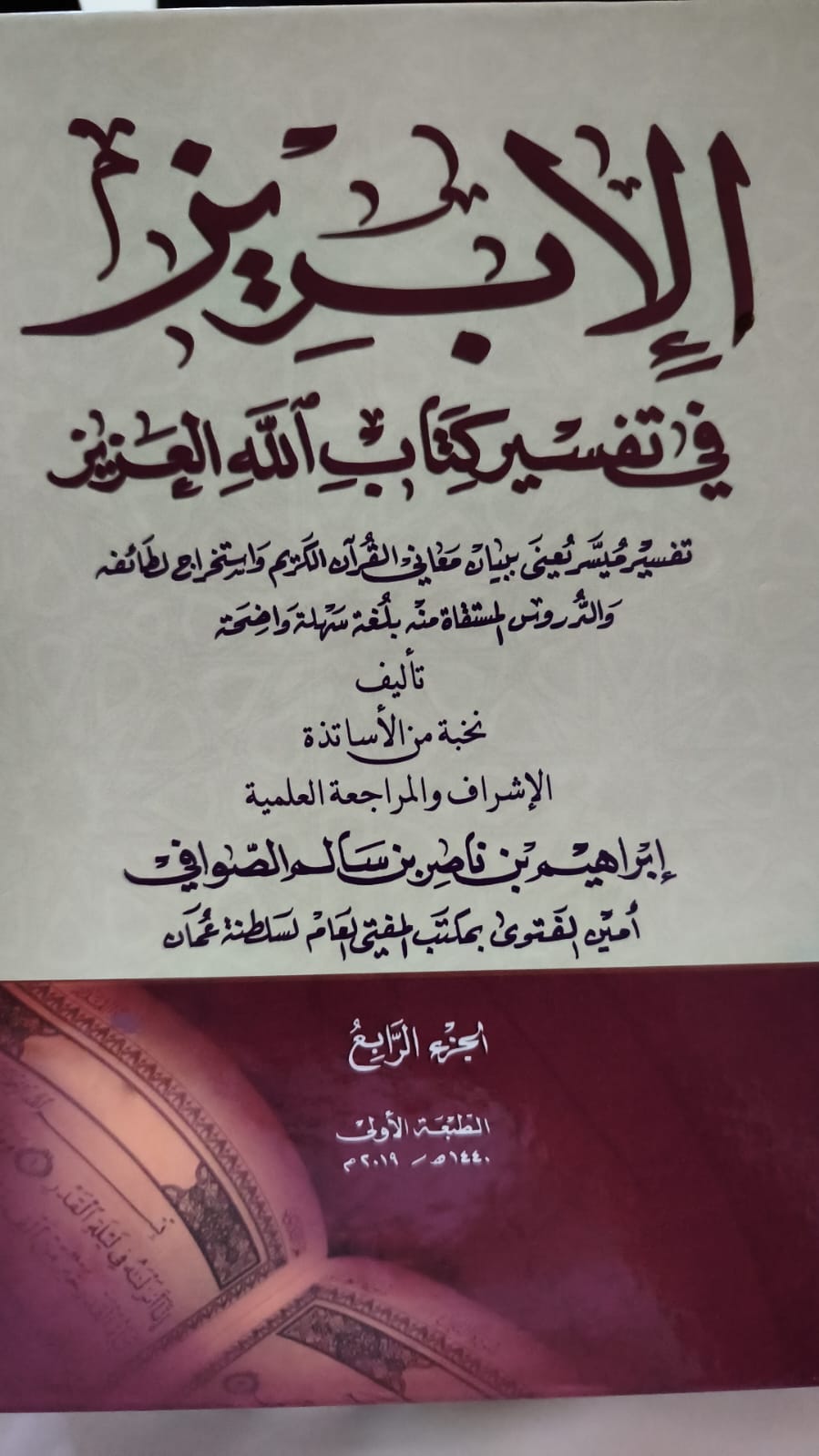
Source: (pgs. 314-316 Al-Ibriz fi Tafsir al-Qur’an al-‘Aziz – Pure Gold in the Interpretation of the Noble Qur’an – First Edition 2019 CE 1440 AH -The fourth Volume/Part 4 )
This is an Ibadi tafsir published under the supervision of the Office of Fatwa in the Sultanate of Oman. It is a contemporary, simplified commentary on the Qur’an produced by a committee of scholars.
Authored by a select group of professors/scholars. This was done under the supervison and scholarly review of Ibrahim Muhammed Fadil bin Salman al-Sawafi.
Rules of Engagement
The passage from Atfayyish’s Taysir al-Tafsir provides the historical context for the revelation of Qur’an 49:9. It recounts a specific incident involving ‘Abdullah ibn Ubayy ibn Salul, the leader of the hypocrites (munafiqun) in Medina:
“It is mentioned in the story of Badr: Usama ibn Zayd was riding behind him [the Prophet], and on the donkey was Qutba ibn Abi Salul before he embraced Islam. Al-Khazraj passed by a gathering of the Jews, and they had idols and a Muslim with them. When the gathering was covered by the braying of the donkey, ‘Abdullah ibn Ubayy said: ‘Do not frighten us with your donkey.’ The Messenger of Allah (saw) stopped, descended, recited the Qur’an, and called them to Allah. ‘Abdullah said: ‘O man, there is nothing better than what you say, if it were true. So do not harm us in our gatherings.’ So the Messenger of Allah (saw) returned to his mount. Then ‘Abdullah ibn Rawaha said: ‘O Messenger of Allah, he is harming us in our gathering, so we are the polytheists…’ And the Jews and the Muslims almost fought. The Prophet (saw) continued to reconcile them until they were quiet, then he rode his mount. Then the verse was revealed.” Source: (Taysir al-Tafsir, Atfayyish, p. 436)
This historical context confirms that the verse 49:9 was revealed to address civil strife (fitnah) within the Muslim community. The Prophet’s own action—reconciling rather than fighting—demonstrates the priority of peace.
The passage also cites a narration from Al-Hasan:
“One of them was a hypocrite (munafiq) supported by his people, and the other was a believer (mu’min) supported by the Muslims, so they fought. Then it was revealed.”
Source: (Taysir al-Tafsir, Atfayyish, p. 436)
The Rules of Engagement (Fiqh al-Baghy)
The early Muslim community established strict rules of engagement for fighting the transgressing believers. Ibn Mas’ud ruled:
“The wounded among them is not to be finished off, the captive among them is not to be killed, the fugitive among them is not to be pursued, and no spoils are to be divided regarding them.”
Source: (Taysir al-Tafsir, Atfayyish, p. 436)
These rules prove beyond a doubt that the bāghī remains a Muslim. You do not take spoils from Muslims, nor do you execute Muslim captives. The goal is to restore order, not to exterminate the transgressors.
And a caller announced on the Day of the Camel:
“Do not pursue a fugitive, do not finish off a wounded person, and do not kill a captive.”
Source: (Taysir al-Tafsir, Atfayyish, p. 436)
When a captive was brought to Ali on the Day of Siffin, he said:
“I will not kill you, for I fear Allah, the Lord of the Worlds.”Source: (Taysir al-Tafsir, Atfayyish, p. 436)
This demonstrates the extreme caution the early Muslims exercised in shedding the blood of fellow believers.
The Sequence of Commands: Reconciliation, Fighting, and Justice
The Taysir al-Tafsir of Atfayyish provides a detailed legal analysis of the sequence of commands in Qur’an 49:9:
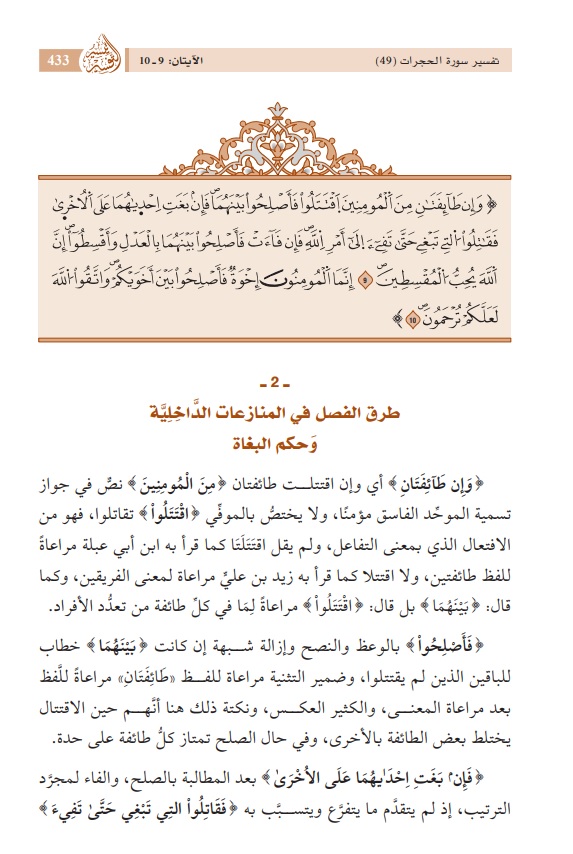
{“But if one of them transgresses against the other”} — after the request for reconciliation, and the refusal is merely [an act of] defiance. It has not yet been dealt with, so it necessitates {“then fight against the one that transgresses until it returns to the command of Allah”}.
Source: (Taysir al-Tafsir, Atfayyish, p. 433)
Atfayyish highlights a critical detail in the verse’s structure. The command to “make peace” (fa-aṣliḥū) appears twice:
First:“If two parties fight, make peace between them.” (General reconciliation)
Second:“Then if it returns, make peace between them with justice.” (Post-fighting reconciliation)
He explains that the first reconciliation is directed at both parties. But if one party transgresses (baghat), the second command to reconcile is directed specifically at the transgressor—they are the ones who must be brought back to obedience first, before peace can be established.
The Al-Abriz commentary adds:
“If one of them transgresses against the other, then fight against the one that transgresses until it returns to the command of Allah.” The purpose of fighting is not to exterminate the transgressors but to bring them back to obedience. The commentary notes that the verb qātilū (fight) is used in the sense of willing the occurrence, similar to the command to establish prayer. The goal is correction, not destruction. (Al-Abriz, p. 315)
The Taysir al-Tafsir also confirms the linguistic point we discussed earlier:
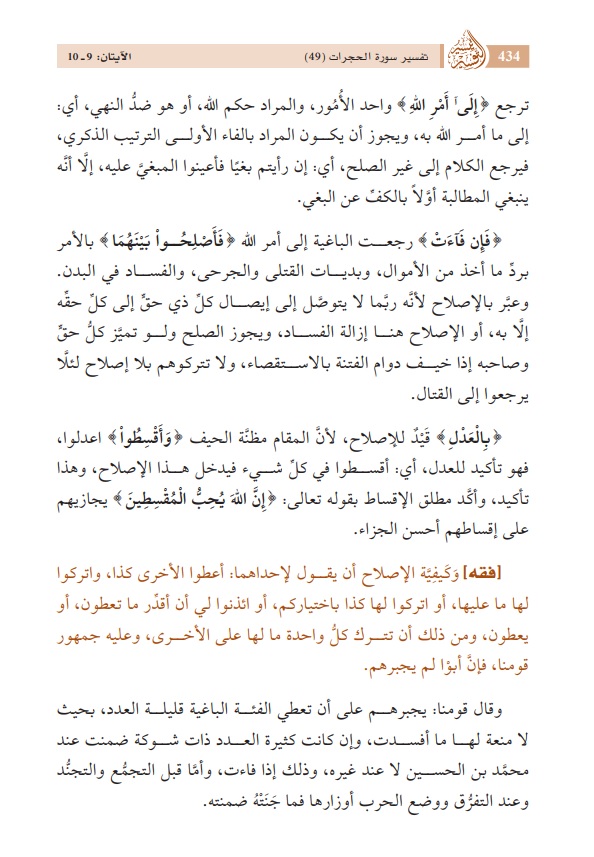
{“Until it returns” (tafi’a)} — it is said that the meaning is: until it returns to the command of Allah, which is His ruling. [The word] tafi’a (returns) is used exclusively for returning to obedience after disobedience.
Source: (Taysir al-Tafsir, Atfayyish, p. 434)
This is a crucial theological point. The bāghī is not being called to “convert” to Islam (as a disbeliever would be). They are being called to return to obedience (ṭā’ah) after a state of disobedience (ma’ṣiyah). This confirms that they are already Muslims; they have simply fallen into kufr al-ni’ma.
“Until it returns” (tafi’a)}
Justice and Equity: The Goal of Reconciliation
The Taysir al-Tafsir emphasizes that reconciliation must be done “with justice” (bil-ʿadl). Why? Because the position is one of “suspicion of bias” (maẓinnat al-ḥayf). After blood has been shed, there is a natural tendency for one party to seek revenge or for the mediator to favor one side. The Qur’an commands absolute equity to prevent further injustice:
{“Then make peace between them with justice”} — the command [here] includes the prevention of wealth, and the blood-money for the killed and the wounded, and the corruption in the body. And the expression “with reconciliation” is because it may not lead to the restoration of every right to its owner, even if the reconciliation is [meant to be] clear. It is permissible for reconciliation to remove the corruption, even if it does not perfectly distinguish every right to its owner, if there is a fear of the continuation of the dissension.
Source: (Taysir al-Tafsir, Atfayyish, p. 434)
Atfayyish outlines the practical steps of reconciliation:
Prevention of wealth (badal min al-amwāl): The transgressor must compensate for destroyed property.
Blood-money (diyāt): Compensation for the killed and wounded.
Corruption in the body (al-fasād fī al-badan): Physical injuries must be accounted for.
This confirms that the bāghī is legally liable for their actions — proof that they are still a Muslim. You do not pay blood-money to a disbeliever’s family in the same way; you take their wealth as spoils.
The Al-Abriz commentary adds:
“This is a confirmation of the aforementioned instruction of justice, because reform in matters of blood and destruction requires much study, focus, and deliberation, so that every person with a right is given his right.” Sources: (Al-Abriz, p. 315) & (Taysir al-Tafsir, Atfayyish, p. 438)
The verse concludes with the statement that “Allah loves those who act equitably” (al-muqsiṭīn). This divine love is not a sentimental emotion but a promise of victory, success, and support for those who establish justice.
Source: (Taysir al-Tafsir, Atfayyish, p. 434)
The Brotherhood of Faith
Qur’an 49:10 immediately follows the verse on fighting:
“The believers are but brothers, so make peace between your brothers and fear Allah that you may receive mercy.” (Qur’an 49:10)
“Those gathered under the shade of faith are nothing but brothers, and the brotherhood relationship is without [the need for] other human relationships like friendship, fatherhood, and others, because it is the most truthful, strongest, and most powerful.” (Al-Abriz, p. 316)
This brotherhood is the basis for the command to reconcile. If the fighters were outside the milla of Islam, there would be no brotherhood to preserve. But because they are outwardly Muslims— guilty of kufr al-ni’ma — the doors to repentance and reconciliation must remain open so as to restore peace and unity.
The Taysir al-Tafsir notes that the sentence “The believers are but brothers” is in the position of explaining the previous instruction for reconciliation:
“And the meaning: Those gathered under the shade of faith are nothing but brothers, and the brotherhood relationship is without [the need for] other human relationships like friendship, fatherhood, and others, because it is the most truthful, strongest, and most powerful.”
Source: (Taysir al-Tafsir, Atfayyish, p. 438)
Source material: (Taysir al-Tafsir li’l-Qur’an al-Karim, Qutb al-A’imma Muhammed ibn Yusuf Atfayyish)
The Strength of the Ibadi Position
The Ibadi tafsir of Qur’an 49:9 offers a theologically rigorous and textually grounded reading that resolves several apparent tensions:
Principle
Ibadi Position
Evidence
Status of the Bāghī
Believer in milla, kāfir in ni’ma (ungrateful).
Qur’an 49:9 (nowhere in the Qur’an is bāghī for believers); Qur’an 14:7 (kafartum = severe punishment); Hadith Bukhari 7077 (“Do not revert as kuffāran“).
Goal of Fighting
To restore obedience and justice, not to exterminate.
Qur’an 49:9 (“until it returns to the command of Allah”); Taysir al-Tafsir (tafi’a = return to obedience after disobedience).
Rules of Engagement
No killing captives, no spoils, no pursuit of fugitives.
Ibn Mas’ud’s ruling in Taysir al-Tafsir, p. 436; the caller on the Day of the Camel; Ali’s statement “I will not kill you, for I fear Allah.”
Responsibility
The community leaders (ahl al-amr) must reconcile.
Qur’an 49:9 (“make peace between them”); Al-Abriz (leaders of the Muslim community).
Purpose
Eliminate rancor and hatred, establish justice.
Taysir al-Tafsir (purpose of the verse is the elimination of rancor and hatred); Qur’an 49:10 (brotherhood).
Nature of the Duty
Supporting the oppressed against the transgressor is a jihad.
Taysir al-Tafsir (a group of our people said: assistance of the oppressed is a jihad).
Conclusion
The Ibadi tafsir of Qur’an 49:9 offers a balanced theology that upholds the sanctity of faith while recognizing the gravity of sin.
The Ibadi position, is not one of extremism or excessive leniency. It is a rigorous, textually grounded, and spiritually profound reading of the Qur’anic text. It demonstrates that the Muslim community is called to be a community of justice, reconciliation, and mercy even in the midst of its most painful internal conflicts. It provides a framework for addressing intra-community conflict that neither demonizes the transgressor nor ignores their wrongdoing. It serves as a powerful reminder that faith and sin are not mutually exclusive—but the consequences of sin are severe, and the path to reconciliation requires justice, equity, and a steadfast commitment to the bonds of brotherhood.
The root b-gh-y is never used for believers elsewhere in the Qur’an.
The min al-mu’minīn describes prior state, not the state of fighting.
The hadith uses kufr language for intra-Muslim fighting.
Qur’an 4:93 creates a tension that the Ibadi framework resolves.
“He said: “Allah only accepts from the righteous.” (Qur’an 5:27)
﷽
To be clear what we are saying is that one who commits a major sin nullifies their fast for the day that they commit the sin on. We are not saying that it invalides the entire fast of Ramadan.
Based upon the Qur’an and Sunnah: acts of worship are not merely valid or invalid based on external conditions (shurūṭ). They are real (accepted) or unreal (rejected) based on whether they achieve their intended effect.
Ṣalāh without khushū‘ and without abandoning ḥarām is not ṣalāh. It is mere movement.
Ṣawm without abandoning ḥarām is not ṣawm. It is mere hunger.
Zakāh given from ḥarām wealth is not zakāh. It is mere transfer of property.
Ḥajj without taqwā is not ḥajj. It is mere travel.
“He said: “Allah only accepts from the righteous.” (Qur’an 5:27)
This serves as a sufficient proof that Allah Almighty does not accept any act of worship from a disobedient person; this is the essential point, and there are numerous hadith that support this as well.
Similarily, if you turn to the Qur’an, there are many verses indicating that the deeds of a disobedient person are cast back upon him; the hadith also attest to this.
The Mixture of Righteous and Evil Deeds
Obedience and disobedience cannot occupy the same place in the heart of the diligent worshipper.
“And (there are) others who have acknowledged their sins, they have mixed a deed that was righteous with another that was evil. Perhaps Allâh will turn unto them in forgiveness. Surely, Allâh is Oft-Forgiving, Most Merciful.” (Qur’an 9:102)
Understanding the above evidence.
Allah (swt) says that the mixing of a righteous deed with another deed that was evil is acknowledged as a sin. It is like mixing pure water with toxin. The combination of the two is still toxic. The mixture is defined by the toxin, not the water. Allah (swt) doesn’t accept this mixture.
The Meaning of “La‘allakum Tattaqūna”
“O you who believe, fasting is prescribed upon you as it was prescribed upon those who were before you, so that you may become righteous.” (Qur’an 2:183)
la’allakum tattaqūna From the perspective of Arabic grammar la’alla is to achieve the reason for something. It is not to achieve the hope. For example: In English we might say, ‘Maybe I come to you’. The Arabic here is not about aiming for a ‘maybe’.
The grammatical analysis of Qur’an 2:183 is correct from the Ibadi perspective. The particle لَعَلَّ (la‘alla) here expresses purpose and intended outcome, not mere possibility or hope. The verse establishes taqwa as the raison d’être of fasting—the goal to be achieved. Fasting that does not produce taqwa has failed its purpose.
The Arabic here is talking about the reason and what is to be achieved! So the reason for fasting is to achieve taqwa!
In reality this is for all our ibadat. All our worship is to achieve this aim.
This is indicated by the verse:
“O mankind! worship your Lord, the One Who created you and those from before you, so that you may become righteous.” (Qur’an 2:21)
Two Possible Understandings of the Failure of Fasting
Understanding 1: The fast is valid but fruitless. The person fasted correctly. They abstained from food, drink, and marital relations during the prescribed hours. However, the fast did not produce taqwa because they did not couple it with obedience in other matters. The fast “failed its purpose” but was still technically performed.
Understanding 2: The fast was never truly performed. The Ibadi position is stronger and more consistent. If the person did not achieve taqwa, it is not that they fasted and the fast was deficient—rather, they did not truly fast at all. What they did was merely imsāk (abstention), not siyām (fasting). The outward form was present, but the reality was absent.
Why Understanding 2 is More Consistent
If لَعَلَّكُمْ تَتَّقُونَ expresses the purpose and intended outcome of fasting, that it is not merely a hoped-for side effect; then the relationship between fasting and taqwa is not accidental but essential. A thing that does not achieve its essential purpose is not truly that thing at all!
This aligns with the following hadith:
It was narrated from Abu Hurairah that the Messenger of Allah (saw) said:
“There are people who fast and get nothing from their fast except hunger, and there are those who pray and get nothing from their prayer but a sleepless night.”
The Blessed Prophet (saw) does not say they did not fast. He says they get nothing from their fast—meaning what they did was not fasting in the true sense. It was hunger without siyām.
And the following hadith:
Narrated Abu Huraira:
The Prophet (saw) said, “Whoever does not give up false statements (i.e. telling lies), and evil deeds, and speaking bad words to others, Allah is not in need of his (fasting) leaving his food and drink.”
Here the blessed Prophet (saw) is telling us by way of inspiration that Allah (swt) is saying:
I do not accept this as fasting at all. The person left food and drink, but that leaving was not siyām; because siyām by definition includes the abandonment of prohibitions.
The narration from Ibn Abbas (ra) makes this explicit:
Abu Ubaydah narrated from Jabir ibn Zayd, from Ibn Abbas, from the Prophet (saw), who said: “There is no faith for the one who does not pray, and there is no prayer for the one who does not perform ablution; and there is no fasting except by refraining from what Allah has forbidden.”
لَا صِيَامَ—”there is no fast”—not “there is no reward for the fast.” The fast itself does not exist for the one who has not abandoned prohibitions.
The grammatical point reinforces this.
If لَعَلَّ in the Qur’an expresses purpose (the ‘illah for which fasting was prescribed), then taqwa is not something added to fasting. It is the very thing fasting is meant to produce. A fast that does not produce taqwa is like a medicine that does not cure: it was not taken properly, the individual did not follow the instructions.
But the Qur’an makes it very clear : the fasting itself was not real fasting. The person may have gone through the motions, but siyām as Allah defined it never occurred.
The Qur’anic Pattern: Deeds that are “Ḥabiṭa” (Nullified)
This is why the Qur’an speaks of deeds being حَبِطَتْ (nullified, come to nothing):
“Those who disbelieve and avert from the way of Allah. He will waste their deeds.” (Qur’an 47:8)
“O you who have believed, obey Allah and obey the Messenger and do not invalidate your deeds.” (Qur’an 47:33)
The Qur’an and Sunnah repeatedly inform us that disobedience nullifies worship, not merely diminishes its reward. The deed is not stored up and then deducted from. No! It is erased. It never reached the stage of acceptance because it was never truly performed as an act of worship.
“Be quick in the race for forgiveness from your Lord, and for a Garden whose width is that (of the whole) of the heavens and of the earth, prepared for the righteous.” (Qur’an 3:133)
“Those who, upon committing an evil deed or wronging themselves, remember Allah and seek forgiveness for their sins and who forgives sins except Allah? And they do not knowingly persist in wrongdoing.” (Qur’an 3:135)
Examples that would nullify our fasting without doubt:
Watching porn even with no fap.
Deliberately sleeping through an entire prayer time. People literally skip dhur and imagine their fasting is still accepted.
Lying, doing all sorts of evil deeds, fighting with others.
Wasting time in Ramadan.
Wasting time in the month of Ramadan. The month of Ramadan is a barakah. If we do not seize on it by utilizing the time for baraka we literally wasting time.
Allah does not love those who waste.
“O Children of Adam! Dress properly whenever you are at worship. Eat and drink, but do not waste. Surely He does not like the wasteful.” (Qur’an 7:31)
If you are not engaged in something fruitful especially in the month of Ramadan, like reading the Qur’an or reading beneficial books in general. Excercising, doing volunteer work. Assisting those in need rather they be your family, friends or the local community or doing superagatory acts of worship. Then what are you engaged in? Vain and idle talk? Playing video games hours on end? Window shopping with no clear goal or objective.
The phrase: “Passing the time” should be a disliked phrase for us in the blessed month of Ramadan. We should replace ‘passing the time’ with ‘investing with time’ We should be engaging with the time Allah blessed us with. ‘Passing the time’ sounds like one who is in a state of boredom or doing some repetitive taslk in which they find no joy in. ‘Passing the time’ treats time as an obstacle to be endured rather than a blessing to reap. In Ramadan, this is a spiritual failure.
Fasting has not failed to become the spiritual engine of the Muslim Ummah. It is that the Ummah has followed interpretations and misunderstandings that have not allowed the Muslim Ummah to ignite this spiritual engine!
Thus, we particpate in collective movement in Ramadan. We partcipate in collective obstaining from food and drink. But somehow collectively the ummah’s engine is not jump started. The engine is not ignited because the fuel (taqwa) is not being produced.
The Ummah’s engine does not start because we have not connected the fast to its purpose. We have the form. We lack the reality.
If you have enjoyed this article you may like our series on Ramadan here:
“O believers, if an evildoer brings you any news, verify so you do not harm people unknowingly, becoming regretful for what you have done.” (Qur’an 49:6)
﷽
In Islamic jurisprudence, khabar al-āhād (solitary report) is a narration that does not reach the level of mutawatir (mass transmission). In terms of its epistemic value, it is generally considered dhannī (probabilistic/speculative) rather than qat’i (absolutely certain).
What has happened is that we as Muslims have not done a great job in explaining why do we accept the lone narrator reports in jurisprudence?
It is very clear on why we do not accept the lone narrator reports in matters of theology.
Shaykh Massoud bin Mohammed al Miqbali (h) he made this very clear in his lecture here:
This has lead many Muslims to have an inconsistent epistemology. Where one will take the word of people as given for practically all facets of life. However, the same one will be skeptical or outright reject the words of the Blessed Prophet (saw).
The khabar al-āhād (solitary report) yields epistemic probability, and they do not yeild absolute certainty (qat’i).
This khabar al-āhād (solitary report)is further broken down into three categories:
Gharib (strange/scarce): Narrated by only a single reporter at every point in the chain.
Aziz (rare/strong): Narrated by exactly two people at every point in the chain.
Mashur (well-known): Narrated by at least three to nine people at every point in the chain.
Now coming back to the worddhannī. This means that there is a probability of it being true and a probability of it not being true.
This is why honesty and integrity are very important in Islam. It is why lying is a major sin in Islam.
In fact, every society at every level values honesty and integrity within individuals.
The Qur’an gives us qat’i (decisive text) that informs the Muslims that we are to rely upon dhannīin testimonies and as witness.
“The month of Ramadan is the month in which the Quran was revealed; a guide for the people, the most authoritative of all guidance and a criteria to discern right from wrong. Anyone from among you knows that the month of Ramadan has begun, he must start to fast. Those who are sick or on a journey have to fast the same number of days at another time. Allah does not impose any hardship upon you. He wants you to have comfort so that you may complete the fast, glorify Allah for His having given you guidance, and that, perhaps, you would give Him thanks.” (Qur’an 2:185)
The basis for begining out fasting in the month of Ramadan is on the report of a single witness.
“O believers! When you contract a loan for a fixed period of time, commit it to writing. Let the scribe maintain justice between the parties. The scribe should not refuse to write as Allah has taught them to write. They will write what the debtor dictates, bearing Allah in mind and not defrauding the debt. If the debtor is incompetent, weak, or unable to dictate, let their guardian dictate for them with justice. Call upon two of your men to witness. If two men cannot be found, then one man and two women of your choice will witness—so if one of the women forgets the other may remind her. The witnesses must not refuse when they are summoned. You must not be against writing for a fixed period—whether the sum is small or great. This is more just in the sight of Allah, and more convenient to establish evidence and remove doubts. However, if you conduct an immediate transaction among yourselves, then there is no need for you to record it, but call upon witnesses when a deal is finalized. Let no harm come to the scribe or witnesses. If you do, then you have gravely exceeded the bounds. Be mindful of Allah, for Allah teaches you. And Allah has knowledge of all things.” (Qur’an 2:282)
“O believers! When death approaches any of you, call upon two just Muslim men to witness as you make a bequest; otherwise, two non-Muslims if you are afflicted with death while on a journey. If you doubt, keep them after prayer and let them testify under oath, “By Allah! We would never sell our testimony for any price, even in favour of a close relative, nor withhold the testimony of Allah. Otherwise, we would surely be sinful.” (Qur’an 5:106)
“And those who accuse chaste women and then do not produce four witnesses – lash them with eighty lashes and do not accept from them testimony ever after. And those are the defiantly disobedient.” (Qur’an 24:4)
“And those who accuse their wives [of adultery] and have no witnesses except themselves – then the witness of one of them [shall be] four testimonies [swearing] by Allah that indeed, he is of the truthful. And the fifth [oath will be] that the curse of Allah be upon him if he should be among the liars. But it will prevent punishment from her if she gives four testimonies [swearing] by Allah that indeed, he is of the liars. And the fifth [oath will be] that the wrath of Allah be upon her if he was of the truthful.” (Qur’an 24:6-9)
“Then when they have reached the end of their waiting period, either retain them honourably or separate from them honourably. And call two of your reliable men to witness and bear true testimony for Allah. This is enjoined on whoever has faith in Allah and the Last Day. And whoever is mindful of Allah, He will make a way out for them.” (Qur’an 65:2)
“O believers! Do not kill game while on pilgrimage. Whoever kills game intentionally must compensate by offering its equivalenceas judged by two just men among you to be offered at the Sacred House, or by feeding the needy, or by fasting so that they may taste the consequences of their violations. Allah has forgiven what has been done. But those who persist will be punished by Allah. And Allah is Almighty, capable of punishment.” (Qur’an 5:95)
“And if you fear dissension between the two, send an arbitrator from his people and an arbitrator from her people. If they both desire reconciliation, Allah will cause it between them. Indeed, Allah is ever Knowing and Acquainted with all things.” (Qur’an 4:35)
We will translate one section that is relevant for our discussion here. We will also translate the full discussion on the other matters as well.
“One of the rationalists comes and says: “Here you are, differing regarding such hadiths. The meaning of these hadiths is not correct; they indicate probability(dhann), as some have said, and probabilty is not acted upon.” Fine, probability is not acted upon. Meaning that it could be correct in one possibility, or it could be incorrect. So this also means he would not act upon the Qur’an in many matters, regarding the commands and prohibitions of the Qur’an. Allah, blessed and exalted, has commanded us in explicit text to accept the testimony of two just witnesses in judgment: “And bring to witness two just men from among you”. This is a definitive Qur’anic text. He says: Yes, this is definitive in the Qur’an. Fine, but if we come to application: suppose someone claims let’s say, the phone is broken, or in my estimation, this pen is yours. Okay, if this person stands up and takes this pen in his hand and says, “Ustadh Khalid said this is my pen,” then fine — bring two witnesses. He brings two witnesses, and the judge rules based on these two witnesses because they are just, according to what he sees either through his personal knowledge of them or through their being vouched for. Is this ruling definitive? Is it definitive or not? As for the fact that he rules by the testimony of two just witnesses, that is definitive from the Qur’an. That he is commanded to judge by the testimony of two just witnesses. But is the justice of these two men definitively established? It can never be definitively established. A judge can never be certain about any person. I said to him: We do not have definitive certainty regarding anyone’s testimony of course, except for the prophets and messengers. And he says what does he say? That no one’s testimony can be definitively affirmed. Allah, blessed and exalted, has poured the meaning into its molds, and it is not my fault if the cows do not understand. So we told him: In application, we cannot be certain that so-and-so is such-and-such. We do not say that the ummah has no just people. The ummah has just people. But when you want to rule based on the testimony of two just witnesses, fine. In terms of application, this is probablity(dhann). So if you rule by probabilty, fine. What about prayers? If a person does not know the direction of the qiblah, and one, two, or three people come and tell him the qiblah is this way, for example — is he certain of their statement?” -Shaykh Saeed bin Mabrouk Al-Qanubi (h).
“Fine, they say it is established. For example, two people even regarding the differences of opinion among scholars if two just witnesses testify to the sighting of the crescent for the beginning or end of Ramadan, it is established. Fine, two just witnesses testify to seeing the crescent on the day of doubt. Fasting is prohibited on that day, and on the day of Eid, fasting is prohibited. Does he accept their testimony and fast or break his fast? Yes. Fine, the fast of Ramadan is established by definitive evidence. Yes, “The month of Ramadan in which the Qur’an was revealed.” Fine, is he certain of the truthfulness of the two just witnesses? He is not certain of their truthfulness. Likewise, in matters of rights, and in many matters of purification. If, for example, someone knows that his garment was affected by impurity, and a just person tells him, “I have washed it,” is he certain that it has been washed? He is not certain, but he is not required to be certain in such matters. Testimonies cut off hands, and even cut off heads. Fine. And one follows according to the known rulings you have. Fine, by the testimony of two just witnesses, a person does not have certainty. A man marries a woman, saying “I married you,” and so-and-so and so-and-so testify that she is his wife. Fine, he then permits himself to look at her, touch her, have marital relations, and the children are his children, and he inherits from her and she from him, and all the other known rulings. And if he divorces, likewise the known rulings, and rulings on dhihar, manumission, and other matters the testimony of just witnesses all of these are probabilistic (dhanniyyah). The underlying principles are definitive, but in terms of establishment and application, they are probable. So how can they apply such matters if they wanted to?”-Shaykh Saeed bin Mabrouk Al-Qanubi (h).
Based on the information provided in the text, the Shaykh is making the following implications for Islamic jurisprudence regarding the use of khabar al-āhād (solitary/lone-narrator reports) and dhannī (speculative) evidence:
The Qur’anic Foundation: Certainty of Source vs. Certainty of Application
The Shaykh establishes a crucial distinction:
Definitive textual sources (e.g., the Qur’anic command to accept the testimony of two just witnesses – “And bring to witness two just men from among you”), which are qaṭ’ī (definitive and certain) in their textual authenticity.
The practical application of that text, which is dhannī (speculative/probabilistic) because it depends on human factors. Such as verifying the actual justice (‘adālah) of the two witnesses in a given case.
The key insights: Even when the source is certain (the Qur’an), the application in any particular case is always probable(dhannī). A judge can never be 100% certain that the two witnesses before him are truly just. He acts on outward indications.
Therefore, certainty in the source does not translate into certainty in the ruling derived from that particular application.
His point: Even when the source is certain, the implementation is always probable. A judge can never be 100% certain that the two witnesses before him are truly just; he only acts on outward indications (personal knowledge or external vouching). Therefore, certainty in the source does not translate into certainty in the ruling derived from that particular application.
The Practical Necessity Argument
Many everyday legal rulings cannot be established through mass-transmitted reports alone:
Details of prayer
Transaction rules
Family law
Purification rules
Without accepting khabar al-āhād, the legal system would lack guidance on most practical matters.
Despite being dhannī (speculative and fallible), the shaykh argues that such evidence is fully actionable in Islamic law. He gives multiple examples where even definitive rulings (like the obligation of Ramadan fasting, the prohibition of fasting on Eid, marriage, divorce, inheritance, purification of clothes, and even capital punishments) are implemented based on the testimony of two witnesses. Yet no one claims absolute certainty about the witnesses’ truthfulness.
Speculative Evidence is Sufficient for Action in Practice
The implication: Islamic jurisprudence does not require qaṭ’ (absolute certainty) for every ruling in practice. Probabilty(dhann), when based on valid legal mechanisms (like witness testimony), is legally sufficient and binding, even though it carries the possibility of error.
The Argument from Consistency (Reductio ad Absurdum)
Rejecting Speculative Hadith Would Lead to the Collapse of the Legal System
The shaykh uses this analogy to answer the rationalist who dismisses āhād hadiths because they are dhannī and “probability is not acted upon.” The shaykh turns this argument on its head:
“If you refuse to act on dhann in the case of hadith, then you must also refuse to act on dhann in all these other areas of Islamic law (testimony, prayer direction, purification, marriage, etc.).”
Since that is impossible and would render the entire legal system unworkable, the implication is clear:
Speculative evidence (dhann) is not only acceptable in Islamic jurisprudence, it is unavoidable and integral to the functioning of the law.
The Distinction Between Theology and Jurisprudence
Why take the dhanni in jurisprudence but not take the dhanni in theology?
Theology (ʿAqidah)
Jurisprudence (Fiqh)
Requires absolute certainty (yaqīn)
Probability (ẓann) is sufficient
Concerns eternal salvation
Concerns worldly actions
Doctrines about Allah, prophethood, afterlife
Practical legal rulings
Cannot risk error
Error is possible and accommodated
Qur’an + Mutawātir only
Qur’an + Ahad + Consensus + Analogy +Various legal parameters defined by respective schools.
Rationale: Matters of belief require certainty because they concern eternal salvation; legal rulings concern worldly actions where probability is acceptable for practical and pragmatic purposes.
The Real Issue is Not Epistemological Certainty but Legal Reliability
The shaykh implies that the proper criterion for accepting khabar al-āhād is not whether it yields qaṭ’ (certainty), but whether it meets the juridical standards of reliability (ṭhrāq al-dhann – giving a strong/overwhelming presumption of correctness).
Just as a judge accepts testimony based on outward justice without penetrating the inner conscience of the witnesses, scholars accept āhād reports based on established criteria of narrators’ reliability, without requiring absolute knowledge of their inner truthfulness.
Summary of the Implication:
The shaykh is arguing that the dhannī (speculative) nature of khabar al-āhād does not disqualify it from being a valid source of evidence in Islamic jurisprudence. On the contrary, most legal rulings in practice operate on dhann. Including those derived from the Qur’an when applied through human testimony.
To reject āhād reports on the grounds that they are merely probable would be inconsistent, because it would require rejecting the vast majority of Islamic legal rulings that are themselves implemented on the basis of probability, not certainty. Thus, speculative evidence is legally authoritative (ḥujjah) in action, even if it falls short of absolute epistemological certainty.
The Role of Human Fallibility
The Shaykh emphasizes that narrators are fallible:
They may forget.
They may err in retention.
They may have misunderstood.
They may have narrated before abrogation.
Their opinions may contradict their narrations.
Examples given:
‘Umar ibn al-Khattab(ra) forgot the tayammum incident.
Ibn ‘Abbas (ra and others differed on narrations.
Scholars may reject a narration due to hidden defects (‘ilal).
The Methodology of Evaluating Ahad Reports
The Shaykh outlines how ahad reports are evaluated for jurisprudence:
Examine the chain – Is it continuous? Are narrators trustworthy?
Examine the text – Does it contradict established principles?
Consider abrogation – Was it early or late in revelation?
Consider interpretation – Is the apparent meaning intended?
Check for consensus – Has the ummah agreed on the contrary?
Look for hidden defects (‘ilal) – Subtle issues undermining authenticity.
Summary: The Ibadi Position
Aspect
Theology
Jurisprudence
Standard
Certainty (yaqīn)
Probability (ẓann)
Source
Qur’an + Mutawātir
Qur’an + Ahad + Consensus + Analogy +Various legal parameters defined by respective schools
Result
Definitive doctrines
Practical rulings (may be revised)
Error
Not permitted
Permitted; law accommodates human fallibility
The Ibadi position is epistemologically consistent:
Certainty is required for theology because it concerns eternal truths.
Probability is sufficient for law because law operates in the realm of human affairs.
The Qur’an itself demonstrates this principle through its acceptance of witness testimony.
Rejecting probability would collapse the legal system entirely.
The Ibadi school thus maintains a dual-track epistemology:
High epistemic standard for matters of faith.
Practical epistemic standard for matters of action.
This allows us to preserve certainty in theology while having a functional, comprehensive legal system based on the full range of prophetic traditions.
The following is the respected Shaykh speaking on other matters not related to the above topic. However, we have decided to translate and share what he has said for the benefit of the general readers. The Shaykh is given legal verdicts and answering questions given by students and those who seek knowledge. May Allah (swt) continue to bless the Shaykh and bless others by him.
Shaykh Saeed bin Mabrouk Al-Qanubi (h) fatwa session.
“But I say: the one who does not examine many of these issues may reject some hadiths because he sees them as contradicting what has been settled upon, and he may rule that hadiths are contradictory, and he may blunder about blindly, and take from such [superficial views]. There come those wicked people and say: ‘No problem they all used to perform ablution together. No problem a woman can come with a non-mahram man and do this, uncover her head, do this and that. You are extreme and obstinate! This is the Sunnah of the Prophet (saw), and you claim to follow it, yet you reject those who oppose it, etc., etc.’
It is necessary to know the time in which the Messenger (saw)spoke or did something. Was it before the ruling that is now settled, or not? If we say the first excuse [abrogation], the scholar would not reject that hadith. The second issue is abrogation itself. Yes. He was speaking about the narration of Rabī’ah regarding the issue of [the prohibition of] predatory animals. So how does one respond to this narration? Yes . By reconciling it [with other texts], as we said. If it cannot be reconciled with the Qur’an, then [it may be rejected], but here it can be reconciled. No problem. He says: ‘I do not find in what has been revealed to me anything forbidden…’ yes, at that time there was nothing forbidden except these things, as we know. Even prayer had not yet been prescribed in the form we see today, and fasting had not yet been prescribed in the form it is now, and zakāh had not yet been fully detailed . It was general at the beginning, and jihād was not originally obligatory at all, but rather recommended. Likewise, some things like wine was lawful. Can someone come, for example, and find that Hamzah (may Allah be pleased with him) drank wine, as mentioned in some narrations, and then say that wine is lawful because Hamzah drank it, and that he (Hamzah) could not have done such a thing, and even if we assume he did, why did the Prophet (saw)not rebuke him?
The answer: He drank it at a time when wine had not yet been forbidden. So it is true that it can be said at that time: ‘I do not find it [forbidden]’. Then the prohibition of wine came later. Likewise, in many matters, no one can [ignore this principle]. And this is an issue where some may err regarding certain hadiths. They do not distinguish between what came early and what came later. For example, one finds a report that men and women used to perform ablution together. Someone may come and say: ‘This hadith is not authentic, because it is not possible for a woman to perform ablution with a non-mahram man. She would have to wash her hands, wipe her head, etc.’ But this hadith is not necessarily invalid, because it could be that firstly the report says ‘men and women’ in an absolute or general wording, and this absolute wording is intended to be restricted, or this general wording is intended to be specified. Who were the ones performing ablution together? They were mahrams with their mahrams there is no problem with a wife and her husband, nor with a woman and her brother, son, father, grandfather, grandson, nephew, etc. That is how some scholars interpret it. And some scholars said: Yes, but this was before the hijab was prescribed. But I am not in need of preponderance here.
What I am saying is: the one who does not examine many of these issues may reject some hadiths because he sees them as contradicting what has been settled upon, and he may judge that hadiths contradict each other, and he may blunder about blindly, and take such approaches. Those wicked people come and say: ‘No problem, they all used to perform ablution together. No problem, a woman can come with a non-mahram man and do this, uncover her head, do this and that. You are extreme and obstinate! This is the Sunnah of the Prophet (saw), and you claim to follow it, yet you reject those who oppose it, etc., etc.’ It is necessary to know the time in which the Messenger (saw) spoke or did something. Was it before the ruling that is now settled, or not?
For example, someone comes to the issue of visiting graves: it was permissible, then prohibited, then permitted again. Can someone take a hadith containing the prohibition and go to a man visiting graves and forbid him from doing so, claiming that the Prophet (saw) forbade it? When the Prophet (saw) later permitted it? Likewise, regarding predatory animals with fangs: they were permissible in the past, then later prohibited. Though some scholars say there is no problem with the hadith because the Arabs were not accustomed to eating such animals, so the prohibition came, and Allah said: ‘I do not find in what has been revealed to me anything forbidden to eat except these things…’ And the Arabs originally did not eat these. I am not in need of preponderance between these two views, but I say: the hadith is authentic and established. No problem. And do we say this is from the category of abrogating and abrogated, or not? There is no problem in this, and it requires discussion: what is meant by permissibility here? Is it legal permissibility, or is it permissibility based on the original principle? This then branches into whether it is abrogating/abrogated or not.
Someone may also come to the issue of ‘water is from water’ . This was at a time when a man who came to his wife and did not ejaculate was not required to perform ghusl; ghusl was only required upon ejaculation. Later, ghusl was prescribed generally . Whether the man ejaculated or not. Can someone use the first hadith as evidence and say: ‘Ghusl is required because water is from water,’ and then say: ‘These two hadiths contradict. One says water is from water, and the other says when he sits between her four limbs… look at these contradictory hadiths!’? There is no problem with these hadiths. That was at one time, and this at another. Contradiction only occurs between two matters if they are at the same time. If one informant tells you I was in Muscat yesterday, and another tells you I am in Sinaw today is there contradiction? No, that was at one time, and this at another. But if both informants told you that at the exact same hour, not even the same day, because it could be morning or afternoon; they said I was in Muscat at that exact hour, then we would say this is a contradiction; one of them is mistaken. Either lying or erring. He may have seen my car there (and I have another car) and assumed I was there. This happens.
I remember once someone called wanting to speak to Shaykh Ahmad, and the call was transferred — there were voice recordings of Shaykh Ahmad. When they transferred him, someone in the other location said: ‘Peace be upon you, I wanted Shaykh Ahmad to listen to a lesson with him.’ When he heard that, he assumed Shaykh Ahmad was giving a lesson at that moment. But Shaykh Ahmad may have been traveling to another region of Oman, or even outside Oman. So one person says: ‘I heard Shaykh Ahmad just now in Sinaw giving a lecture,’ and another says: ‘No, Shaykh Ahmad is currently in such-and-such country.’ We say: No, that is wrong. He merely assumed. When he heard that recording, he thought Shaykh Ahmad was currently giving a lesson, but in reality it could have been from 10 or 20 years ago. It was recorded. Or someone saw Shaykh Ahmad’s car driven by someone else coming to the ministry, so he assumed Shaykh Ahmad was there. Such contradictions occur due to error. But if the matter occurred at two different times, there is no contradiction. And this is what abrogation is about: if a ruling was established before, then changed; if it was not previously established, then the first was based on the original principle of permissibility, and the second is a new ruling.
The same applies to domestic donkeys. Initially they were not forbidden, then later forbidden. And the same applies to temporary marriage (mut’ah). It was lawful, then forbidden, and scholars differed on whether it was permitted again then forbidden again. The outcome is that it is now forbidden. Some scholars say it was lawful, then forbidden, then lawful, then forbidden; others say it was lawful, then forbidden. As for the other reconciliation regarding the hadith of Khaybar that mentions that wording there is scrutiny over its authenticity. We do not need to establish that it was lawful at one time and then forbidden. Likewise, predatory animals were lawful at one time according to one view. Though we mentioned there is a view that they were never lawful, but rather were not part of Arab diet, so they were not even mentioned.
The excuse of that scholar or those scholars is that some of them had not come across the hadith at all; some criticized it; some came across it in a wording open to interpretation. Even if one says that prohibition in principle indicates forbiddance. As Shaykh al-Imām al-Sālimī (may Allah have mercy on him) said, and its ruling is forbiddance and permanence. But here there is a contextual indicator that shifts it. However, if someone comes, what should he do? Should he say: ‘I follow such-and-such’? How can you say ‘I follow al-Sālimī’ when you were criticizing this hadith, and you were capable of criticism, or you were not? If he was not capable, why would he criticize it? In reality, he is not capable, or you have something in its text that needs discussion. But if you say: ‘I just follow,’ then we find people like this. They do not distinguish between these matters. Among them are ignorant people, and among them are those with ulterior motives. Authentic, established hadiths from the Prophet (saw)are brought to them, but if they desire a particular matter, they pay no attention except to those hadiths that suit them, claiming: ‘We are followers, and we follow so-and-so scholar, and we are safe — and no scholar has said you are safe by following in such matters.’
Yes, a person may be considered ‘safe’. Consider if a person prays facing the wrong direction, then the matter becomes clear to him. People whose testimony he cannot reject come and say: ‘O so-and-so, you are facing east, and the qiblah is west.’ Is he told ‘you are safe’? Fine . So-and-so, my companion, prayed and finished. How can you say ‘safe’? We say ‘safe’ because the proof had not been established against him. I think this is clear. The proof had not been established that the qiblah was in that direction; he knew the qiblah differently and thought it was that way. So he prayed, no problem. Or if a person performed tayammum and prayed outside. Fine. He prayed and finished, and they said: ‘So-and-so, you prayed. No problem; you don’t have to repeat it.’ This is the well-known correct view. He prayed, but he did tayammum. He must perform wudū’ or ghusl if he was in a state of major impurity, or if a woman was in menstruation or postnatal bleeding, then she must perform ghusl. But that does not mean he is commanded to repeat that prayer. However, tayammum does not suffice when water becomes available it does not suffice. He says: ‘How can you say he is safe? I also did tayammum like he did, he performed the prayer, and may have even died. But you did not perform the prayer because the proof had been established against you. For example, you were informed of the presence of water that you could reach before the prayer time ended, or even if water was available but at an excessive price. Scholars have detailed this issue regarding excessive price or otherwise. The point is: if a person does not intend to oppose [the truth], then here there is a difference.
So if he has come across the hadith but in what form? In a wording that allows interpretation, while it is authentically established in a wording that leaves no room for interpretation. A scholar may come across the hadith but forget it, and this is common, clear, and well-known. For example, ‘Umar ibn al-Khaṭṭāb (may Allah be pleased with him) was with ‘Ammār and the Prophet(saw), and they performed tayammum, the Prophet(saw) instructed tayammum for ‘Ammār due to major impurity. But later, when the issue arose again, ‘Umar (may Allah be pleased with him) forbade tayammum. ‘Ammār said: ‘O Commander of the Faithful, do you not remember when we were in such-and-such situation?’ and he reminded him of that incident, and the period between the death of the Prophet (saw) and the death of ‘Umar (may Allah be pleased with him) was only about a year. Even if we say it happened at the end of that period, there is no doubt it happened before. Yet he forgot.
Here, some people may come with ulterior motives and say: ‘Look at ‘Umar! How can he be a Commander of the Faithful and not even understand this matter?’ This is for the wisdom of Allah . A scholar may attain much knowledge, yet subḥān Allāh, some matters are hidden from him. Matters are hidden from those greater than him. One scholar is reported to have delved deeply into the chapter of sales and become very knowledgeable. Then one day a layman came and asked him a question, and he could not answer it. However, someone much less knowledgeable than him in that field answered it. He realized and said: ‘There is a share for the self here’. He had thought he had attained everything, but this is for those who hold themselves accountable in such matters. So no problem. ‘Umar (may Allah be pleased with him) may have forgotten. But how many did he forget? If he forgot one, two, or three hadiths what can be said? He forgot (may Allah be pleased with him), even though ‘Ammār reminded him he reminded him, but ‘Umar did not recall. So what if there is a chain of narration: ‘So-and-so narrated to me from so-and-so from so-and-so…’?
I saw some people criticizing Musnad al-Rabī’ on the grounds that al-Rabī’ did not narrate from Abū ‘Ubaydah, citing that it is narrated from Abū ‘Ubaydah that he denied the prohibition of predatory animals. So how could he deny that while narrating the hadith? This does not impugn Abū ‘Ubaydah — neither his knowledge, nor his narration of the Sunnah, nor the fact that this hadith is narrated through him. It is possible he said that before he came across the hadith; or he came across it and forgot; or other known possibilities. Similar things occurred to other imams of the schools of jurisprudence. It is possible he narrated this hadith after holding that view and then retracted to what he narrated from the hadith. Moreover, that narration from Abū ‘Ubaydah may not be established. Even if found in some fiqh books — because the chain to Abū ‘Ubaydah is not continuous; the one who attributed that statement to Abū ‘Ubaydah may have erred.
As for their claim that they criticized the narrator saying ‘if the narration is authentic’ does that mean they criticized Abū ‘Ubaydah, or Jābir, or Ibn ‘Abbās? No, it does not necessarily mean they criticized any of them. But if the narration is established, it may be said they criticized the narration of that narrator because he erred — even if he was trustworthy. When someone rejects the narration of Ibn ‘Umar (may Allah be pleased with him) when he said ‘the Messenger of Allah (saw) performed ‘umrah in Rajab,’ and ‘Ā’ishah (may Allah be pleased with her) rejected it does that mean she impugned Ibn ‘Umar? No, it impugns his narration, though one might loosely say it impugns the narrator. By this we mean his retention of that particular narration. This is something one should be aware of: when it is said they impugned his memory, it does not mean they impugned his memory absolutely; it means they impugned his retention of that specific narration. This is well-known.
Sometimes, in books of jarḥ wa ta’dīl especially abridgments like al-Mīzān, al-Mughnī, al-Ḍu’afā’, al-Tahdhīb and its branches they abbreviate and do not mention the incident or the reason for the criticism. They simply say ‘they impugned his memory’ meaning his memory for that narration, not absolutely. They may even use expressions that seem to disparage the narrator, though that is not their intent. Similarly, scholars impugned the statement of Ibn ‘Abbās (may Allah be pleased with them both) that the Prophet (saw) married Maymūnah while in iḥrām. They said Ibn ‘Abbās erred. The news reached him about the timing of the marriage, and he assumed the Prophet (saw) married her at that time, while in fact he had married her earlier. When the news reached him, he assumed otherwise and reported accordingly.
From here comes the statement: ‘A solitary hadith does not establish creedal matters.’ They think that when we say this, we are impugning something we are certain came from the Prophet (saw). As some people say: ‘You are rejecting the Messenger of Allah (saw)!’ They say: ‘Whoever rejects the Prophet (saw) is lost and ruined.’ But he (the scholar) is saying: ‘The Prophet (saw)did not say this’ or at least ‘I doubt whether he said it or not.’ He is not saying: ‘The Prophet said it, and I reject his words.’ No Muslim would ever say: ‘O Messenger of Allah, you say such-and-such, but your words carry no weight.’ They should have paid attention to this. But calamity! Whoever is not granted success is in calamity; and its opposite is success. The successful one is guided to good, but the forsaken one is struck with calamity.
So one person, when confronted with the hadith ‘Where is Allah?’ said: ‘You are rejecting the Messenger of Allah (saw)!’ Fine. If we wanted to treat him likewise, we would say: ‘You too, when you narrated this hadith, then Allah willed [otherwise], you said this is a Jewish creed.’ On your own logic, someone can come and say: ‘You are rejecting the Messenger of Allah (saw) and describing his words as a Jewish creed. Meaning he held Jewish beliefs’. Even though the hadith is in Ṣaḥīḥ al-Bukhārī. What is your answer to this?
There is no doubt we do not accuse him of saying ‘the Prophet did not say this’ and this is an error whether from al-Bukhārī, or his shaykh, or his shaykh’s shaykh, or one of the narrators. The Prophet cannot have said it. And we say to you: if so, we also say: ‘Where is Allah?’ This wording was not said by the Prophet (saw) It may be from Muslim, or from Muslim’s shaykh, or from his shaykh’s shaykh. There is no doubt that al-Bukhārī is higher in rank than Muslim, and Ṣaḥīḥ al-Bukhārī is higher than Ṣaḥīḥ Muslim. If it is permissible for you to impugn a narration in Ṣaḥīḥ al-Bukhārī, why is it not permissible for us to impugn a narration in Ṣaḥīḥ Muslim? What is his answer? Even if he died many years ago, what is the answer of his followers? They make things seem huge, so that some poor student or layperson thinks: ‘This school of thought rejects the Messenger of Allah (saw) and does not accept his words!’ This is flimsy, incoherent talk. No one has ever said this. We do not accuse any Muslim of rejecting a hadith of the Prophet (saw). Rather, we say: a scholar may reject a hadith because it is weak in his view.
They differ on some hadiths. They differ on their indications or even their authenticity. Abrogation in the Qur’an for example. Some scholars differed on whether certain matters are abrogated or not; this indicates prohibition, that indicates recommendation or permissibility, this indicates obligation, that indicates something else. In specifying generalities of the Qur’an, they differed; in restricting, in interpretation, in the meanings of many Qur’anic verses. Anyone who looks at books of tafsīr of rulings knows this. These things may raise some doubts. Not long ago, some people came to me with this doubt They did not know how to respond: ‘How can hadiths be probable and we act on probability?’ Fine. These rulings are agreed upon by the ummah, and the evidence indicates the authority of the Sunnah. This is a matter definitively established among the ummah. Leave aside those who have no value. But application of some hadiths remains we do not exaggerate the matter. Application in some hadiths this also exists in the case of the Qur’an. Yes, the establishment of the Qur’anic text is definitive, but hadiths differ.
What time is it now? 38 minutes [past]. Usually, how long do they stop? 11:30. So we have about an hour less. The point is: many matters arise. The issue of forgetfulness exists. A scholar may remember a hadith and forget it later. As I mentioned before, even some hadiths in Musnad al-Rabī’ , When Shaykh al-Sālimī (may Allah have mercy on him), Shaykh Abū Nabhān, and Ibn Madād too, regarding some hadiths these are later books. They say: Musnad of Abū Ya’qūb is not sufficient, and scholars for example, if we bring an example from Ibn Barakah, or Abū Sa’īd, or some early scholars they would reject them because they had not seen Musnad al-Rabī’, as it was not available. Fine. SShaykh al-Sālimī saw Musnad al-Rabī’, and Abū Nabhān saw it. When Shaykh al-Sālimī (may Allah have mercy on him) came to the hadith of combining prayers, initially he seemed to want to discuss it, but then he realized the hadith is in the Musnad. You can look at Shaykh al-Imām’s words in al-Ma’ārik this is present. So besides al-Rabī’, a scholar may forget.
Shaykh al-Sālimī (may Allah have mercy on him), despite the closeness of time and his great memory but subḥān Allāh, for a wisdom Allah wills, something like this may occur to a scholar. In al-Ma’ārij, when he came to the issue of facing the qiblah he said it is not a condition for the supererogatory prayer if one is on a mount. And I say: ‘on a mount’ does not necessarily imply restriction, because if he is not on a mount but walking, offering supererogatory prayer facing other than the qiblah there is discussion about this. I do not intend restriction. The question is: when he intends to say the takbīr of iḥrām, should he face the qiblah? If we assume a man is on a camel or a mount and wants to offer supererogatory prayer, is he required to stop the mount or turn it toward the qiblah as it moves, to say the takbīr of iḥrām, and then proceed as he wishes? Or, for example, stop his car facing the qiblah? But in reality, it is not easy for a driver to offer supererogatory prayer. He should occupy himself with listening to the Qur’an, reciting, dhikr, supplication, reflection, and similar acts of worship; and there are many, praise be to Allah.
As for performing prayer with prostration and bowing, this could cause an accident and bring great harm to himself and others . It is not appropriate for a driver. But if we assume two men are traveling, and the one riding beside the driver wants to offer supererogatory prayer is he required to say: ‘Brother, stop the car so I can face the qiblah,’ then say the takbīr of iḥrām and continue on the path he wants? Or is this not required? Four authentic hadiths report that the Prophet (saw) used to offer supererogatory prayer facing other than the qiblah, indicating his bowing and prostration. A narration from Anas ibn Mālik (may Allah be pleased with him) states that the Prophet (saw) used to face the qiblah when intending the takbīr of iḥrām. Some scholars considered this narration sound, others weakened it and the view that it is weak is probably closer to correctness. But this is not the point of evidence. The point is that Shaykh al-Imām al-Sālimī (may Allah have mercy on him) mentioned in al-Ma’ārij the narration indicating this, but in Sharḥ al-Jāmi’ which is later than al-Ma’ārik and close in time he mentioned that there is no narration indicating that. So subḥān Allāh despite the Shaykh’s great memory, for a wisdom Allah wills, something like this may occur.
And also, a scholar may reject a narration because others among the narrators forgot it. A narrator narrates a hadith, ‘So-and-so told us from so-and-so from the Prophet (saw) and then the narrator relates the hadith from that , and later says: ‘I do not remember narrating that hadith to you.’ This is present, like the hadith of the takbīr narrated from Ibn ‘Abbās in Ṣaḥīḥ al-Bukhārī. But this does not harm [the hadith], though some scholars say it does, and they criticize the hadith on that basis. A scholar may also criticize a hadith because it contradicts why? the madhhab of its narrator, or because the narrator contradicted that narration. Here, some scholars say: the criterion is the narrator’s narration, not his opinion that contradicts it. Others say: the criterion is the narrator’s opinion regarding his narration, because a just narrator cannot contradict a hadith he narrated unless that hadith is interpreted or carried upon other than its apparent meaning. In reality, we say: the matter requires some examination and scrutiny when judging each narration.
First, we need to examine the chain of the opinion attributed to that narrator, and also examine the chain of the narration he narrated. In many narrations, we find a narrator narrating a hadith, yet an opinion contrary to it is attributed to him; but that opinion attributed to him is not established from him. So here, there is no contradiction between his narration and his opinion; because that opinion is not authentically established from that Companion or that narrator (if non-Companion) for us to say: ‘We take the narrator’s opinion or his narration,’ because in reality it is only a narration, and the madhhab attributed to him is not authentic from him.
The opposite may also occur: the narration is not established, and the opinion attributed to him is what is authentically established from him. An example is the issue narrated from Ibn ‘Abbās (may Allah be pleased with him) that divorce during the time of the Prophet (saw) three divorces counted as one. The narration is not authentic; rather it is weak. And the authentic view of Ibn ‘Abbās is that it counts as three. Someone might say: ‘How can Ibn ‘Abbās contradict his own narration?’ If both the opinion and the narration were authentic, we could examine and say: perhaps Ibn ‘Abbās knew this was initially the case, then abrogated. But we say: there is no abrogation here. The narration is not authentic, and the opinion is the correct one. So we must look: if the opinion is correct and the narration is correct, then we need to study the matter because it is possible the narrator abandoned it out of forgetfulness and absent-mindedness, narrated it long ago, then forgot and said otherwise. It is also possible he held that opinion first, then later narrated the hadith as we mentioned regarding Abū ‘Ubaydah (may Allah have mercy on him). It is also possible he understood it first, and then we look at his interpretation is it correct or not? Or he may have said it was abrogated, or specified, or restricted and then we examine. It may be said: his excuse is the context of this narration, which led him to his view. Or it may be said: he is a mujtahid like other mujtahids we look at his narration; if his opinion aligns with the correct meaning of the narration, we take it; otherwise, no.
This of course requires examples, but for now, you have the issue of wiping over leather socks (khuffayn) Abū Hurayrah is reported to have narrated that the Prophet (saw) wiped over them, but scholars said this narration is not established because it is authentically reported from Abū Hurayrah that he denied wiping over them, and that narration is not authentic from him. So we do not take his opinion nor his narration because his narration is not authentic. Similarly, Ibn ‘Umar narrated wiping over khuffayn from the Prophet (saw), but it is authentically established from him that he said otherwise. The narration he narrated is not authentic. This may actually yield a useful point: these Companions did not narrate wiping over khuffayn from the Prophet (saw). As for Ibn ‘Umar, it is possible likewise; and Abū Hurayrah embraced Islam late, so this may indicate as some of our scholars said that wiping over khuffayn was early, before Sūrat al-Mā’idah. There remains the issue of Jarīr, did he embrace Islam after Sūrat al-Mā’idah? This needs examination; it is possible Jarīr heard part of al-Mā’idah and the whole sūrah does not necessarily have to have been revealed at one time; al-Baqarah, for example, was not revealed at one time. He may have assumed it was revealed later among other possibilities. In any case, a narrator is fallible. He may be correct or err. I am not here to settle this issue, though you may say wiping over khuffayn is not established at this time because the verse explicitly commands washing the feet.
So in such cases, we must ascertain whether the narrator’s narration is established and whether the narrator’s opinion is established and then judge each case individually. A narrator may reject a narration because he thinks it contradicts consensus. How can a narration be rejected for contradicting consensus? Can the Prophet’s (saw) saying be rejected by consensus of people? Here we say, as we said regarding the issue of rejecting a hadith that contradicts the Qur’an: we understand from this that the hadith is not authentic because if it were authentic, it would not contradict the Qur’an and the Prophet (saw) cannot say something contrary to the Qur’an; that can never happen. Here too, a hadith may appear authentic in its chain, but when the ummah has agreed upon the contrary, that indicates to us that this hadith is either abrogated, interpreted, restricted, specified, or weak, even if its chain appears sound; because trustworthiness of men and their precision are conditions for authenticity, and continuity of chain is also a condition. The presence of these conditions does not mean all conditions have been met; we must examine the remaining conditions to judge the hadith authentic.
It may be said: the default is that if the chain is continuous, the conditions of trustworthiness and precision are met, and there are no hidden defects (‘ilal) that undermine its establishment then yes, it is established in principle. But when the ummah has agreed on the contrary, this indicates a hidden defect that must be sought; if we can identify it, fine; if not, we are certain of it without pinpointing the exact defect. This is well-known in the statements of scholars no one denies it.
However, there remains an obstacle: we must be sure of the authenticity of this consensus. How many narrations have been claimed to contradict consensus, yet that consensus turned out to be an illusion. The consensus was not established? This is an important point that a student of knowledge should pay attention to: not everything attributed to scholars is authentically from them. How many narrations in creed, worship, transactions, and other areas have been attributed to some scholars yet they never heard of them in their lives? For example, you find attributed to Abū Bakr al-Ṣiddīq that he said such-and-such regarding the vision [of Allah]; it is attributed indeed, it is said all the Companions agreed on it, and even the prophets and messengers agreed but in reality these narrations are not authentic. So if someone comes with such an attribution that many people claim, we must be cautious.
Therefore, when we encounter a purported consensus, we must reflect: how many claimed consensuses are not authentic? And how many opinions attributed to a scholar or to scholars are not authentic from them at all? Here, especially when we find some narrations contradict some claimed consensuses or rather, those consensuses contradict these narrations we must examine and scrutinize. Some of these narrations, as I said, may not be authentic from them. At the same time, we find some consensuses to be authentic, but we find some people attributing to certain scholars the contrary opinion to those consensuses. Consequently, some people follow those who differed, saying: ‘This issue is not agreed upon, and I take the view of so-and-so’ as we said earlier, those who take the view of al-Sālimī. And we said this statement is not absolutely correct they make the disagreement the arbiter over the legal evidence, whereas Allah commanded us when differing to refer the disagreement to the legal evidence meainng: to the Book and the Sunnah of the Prophet (saw). He commanded us to refer it to Allah and His Messenger. Referring to Allah is referring to His Book, and referring to His Messenger is referring to his Sunnah(saw). We do not make disagreement the arbiter even when the disagreement is valid; so what if the disagreement is not valid, and the ummah is actually agreed?
When we find, for example, the issue of musical instruments of which more than 30 scholars have reported consensus on its prohibition. Yet some people come and say: ‘I follow so-and-so and so-and-so.’ This is not established from them at all. We must also note that some of those to whom such opinions are attributed are not qualified mujtahids. Even if authentically attributed to them. Some of them may have been hasty in their early days, or they may have thought there was no consensus when the matter is actually agreed upon. So we must be cautious in such matters. Not every consensus is authentic, and not every disagreement is valid. One must pay attention to these issues.
There are scholars known for reporting consensuses; many matters are subject to disagreement for many reasons. I have pointed to some, and there are reasons I cannot point to now. But students must be aware of these. I am not saying this now, but when you study, whether in university studies or later, even if only to a limited degree, a person should know why scholars differed and how to stand when there is disagreement among scholars, how to stand regarding the mujtahids, and regarding the followers (muqallids) who follow those scholars.
Followers themselves are of different types. Some are laymen who cannot read or write . When you try to ask about the simplest matter, they do not understand. If such a person says: ‘I follow so-and-so,’ and you say to him: ‘This hadith is narrated by al-Rabī’ and by Abū ‘Ubaydah,’ and he says: ‘I don’t know what al-Rabī’ narrated or what Abū ‘Ubaydah narrated’ fine. If such a person follows a scholar in a matter, one should try to explain to him, but sometimes it does not become clear.
I recall a story: someone heard a sermon or lesson in which the speaker said: ‘When a person wants to slaughter, he must say bismillāh it is obligatory and Allāhu akbar is recommended.’ So when that person went to slaughter, he said: ‘Bismillāh obligatory, Allāhu akbar recommended.’ The speaker had intended to explain that basmalah is obligatory meaning one cannot slaughter without saying bismillāh, and the meat is forbidden to eat if the basmalah was omitted, whether intentionally or forgetfully while takbīr is not obligatory but recommended; if omitted, there is no harm. But this person did not understand; he thought he had to say the words ‘bismillāh obligatory and Allāhu akbar recommended.’ So what can you do with such laymen? If a layman hears something from Shaykh so-and-so, and when told otherwise, he may say: ‘Shaykh so-and-so said this; he would not abandon a hadith, he is the one who can [evaluate].’ But sometimes, when he understands, he may. A student of knowledge is different from such a layman. As for laymen, one must see why he differed and if the understanding can be corrected, one tries. And inshallah, laymen are more accommodating than some people with ulterior motives.
The point is: there are matters that may relate to the chain of transmission or to the text that may lead one to reject a hadith and they are many. But I will suffice with this for now.”
If you enjoyed this article you may enjoy the following:
“Invite to the Way of your Lord with wisdom and kind advice, and only debate with them in the best manner. Surely your Lord knows best who has strayed from His Way and who is guided.” (Qur’an 16:125)
“And it is not for the believers to go forth [to battle] all at once. For there should separate from every division of them a group [remaining] to obtain understanding in the religion and warn their people when they return to them that they might be cautious.” (Qur’an 9:122)
“And who is better in speech than one who invites to Allah and does righteousness and says, “Indeed, I am of the Muslims.” (Qur’an 41:33)
﷽
Let us tell you what Da’wah is not. Da’wah is not posting pictures of the wives of Christian apologist in bikini and other inappropriate clothing. This is an act of kufr. Those who are pleased with it are pleased with acts of kufr. If The person who post this dies without repenting from it they upon something other than Islam. Yes! It is that serious.
Da’wah is not saying that you will start telling people that a self proclaimed ex-Muslim girl took ‘backshots’ in the desert simply becuase she spreads lies about the Blessed Prophet (saw). Her lies do not justify your lies. This too is an act of kufr. Those who are pleased with it are pleased with acts of kufr. If the person dies without repenting from this they die upon something other than Islam.
Da’wah is not ‘dunking’ on others. No one’s goal should be to ‘destroy’ someone. We don’t ‘own’ others. Allah is the one who owns us all! We are all of us broken and needy before Allah.
Can you imagine the atheist, the agnostic, the undecided seeker? They see this very nasty discourse between Muslims and Christians. Why would they choose to become either? They may reason to themselves, that if religion causes me to be an angry hateful and vicious individual what is the point of religion?!
Da’wah is not argument or claims of superiority. It’s an authentic, genuine and sincere invitation to Allah with dignity. What da’wah really is, what’s it’s obligation, who should speak (and within what knowledge), and the Qur’anic method of wisdom, gentle counsel and best manner. It closes with the core truth: you invite, but Allah ultimately is the guide.
We strongly encourage everyone to listen to this wonderful and beneficial talk on the Call to Islam (Da’wah) by Shaykh Hatim Al Abdisalam and Shaykh Muhanna Al Harthy. It offers valuable insights, practical guidance, and inspiration for anyone interested in conveying the message of Islam with wisdom and compassion.
So by mercy from Allah, [O Muhammed], you were lenient with them. And if you had been rude and harsh in heart, they would have fled from about you. So pardon them and ask forgiveness for them and consult them in the matter. And when you have decided, then rely upon Allah. Indeed, Allah loves those who rely upon Him. (Qur’an 3:159)
The example of da’wah to Pharaoh.
“O eminent ones, I have not known you to have a god other than me.” (Qur’an 28:38)
“Go to Pharaoh. Indeed, he has transgressed.” (Qur’an 20:24)
So we can see that Pharaoh has committed the highest form of sin against Allah (swt) namely the claim of divinity! Allah (swt) also says that he was a transgressor!
Nonetheless look at the way in which Allah (swt) ask Moses and Aaron (peace be upon them both) to conduct themselves while speaking with him.
“And speak to him with gentle speech that perhaps he may be reminded or fear Allah.” (Qur’an 20:44)
Christians and Atheist can say some very dispicable and vile things about our faith. This does not mean that we respond to them in kind. It can be frustraing. Especially for us as Muslims. When engaging with Christians, especially the low hanging fruiti among them, they insult the Blessed Prophet Muhammed (saw) but we cannot turn around and insult Jesus (as).
“Do not insult what they invoke besides Allah or they will insult Allah spitefully out of ignorance. This is how We have made each people’s deeds appealing to them. Then to their Lord is their return, and He will inform them of what they used to do.” (Qur’an 6:108)
The majority of the companions and indeed the majority of people you will meet in your life who become Muslims did so because of the good conduct and charachter of Muslims.
“Virtue and evil are not equal. If you replace evil habits with virtuous ones, you will certainly find that your enemies will become your intimate friends.” (Qur’an 41:34)
We are human and at times we may slip. Allah (swt) reminds us in such occasions.
“But if you forget, then remember your Lord, and say, “I trust my Lord will guide me to what is more right than this.” (Qur’an 18:24)
We should ask ourselves if we embody the following verse:
“And who is better in speech than one who invites to Allah and does righteousness and says, “Indeed, I am of the Muslims.” (Qur’an 41:33)
1. What is Da’wah?
Da’wah literally means “invitation” or “calling.” It is inviting people to know Allah and understand Islam. It is not about winning debates or pressuring people to accept Islam.
2. The Purpose of Da’wah
The goal is to:
Help people know the truth about Islam.
Remove misconceptions.
Guide people to worship Allah alone.
Earn Allah’s pleasure by conveying His message.
A Muslim is responsible for conveying the message, not for making someone accept it.
3. Qualities of a Good Da’ee (Caller to Islam)
The discussion emphasizes that a da’ee should have:
Knowledge: Speaking based on authentic Islamic teachings.
Wisdom: Choosing the right words and the right time.
Patience: Accepting rejection without anger.
Good manners: Being humble, truthful, gentle, and respectful.
4. The Best Method of Da’wah
The most effective invitation is often through:
Good character.
Helping others.
Being honest in business and daily life.
Showing kindness and mercy.
Listening before speaking.
People are often attracted to Islam by the behavior of Muslims before they are convinced by arguments.
5. Common Mistakes in Da’wah
The discussion warns against:
Arguing aggressively.
Speaking without knowledge.
Insulting other religions.
Trying to force people to accept Islam.
Becoming impatient when someone does not accept the message.
6. The Prophet Muhammed’s Example
The Prophet ﷺ is presented as the greatest example of da’wah because he:
Treated everyone with mercy.
Forgave those who harmed him.
Answered questions calmly.
Never forced anyone to become Muslim.
Continued inviting people despite years of hardship.
7. Responsibility of Every Muslim
Da’wah is not limited to scholars. Every Muslim can participate by:
Being a good example.
Sharing authentic Islamic knowledge.
Helping neighbors and colleagues.
Answering questions honestly.
Referring difficult questions to knowledgeable scholars.
8. Guidance Belongs to Allah
One of the main lessons is that success in da’wah is not measured by the number of converts. Success is delivering the message sincerely and correctly. Guidance is in Allah’s hands.
Key Takeaway
The discussion presents da’wah as a lifelong act of worship built on sincerity, knowledge, wisdom, patience, and excellent character. It reminds Muslims that their conduct is often the strongest invitation to Islam, and that their duty is simply to convey the message faithfully while leaving the outcome to Allah.
A remeinder to us at PrimaQur’an and our team.
We, the Ibāḍīs, are distinguished from other sects and schools by our noble character and refined conduct. We rise above those who slander us and we are not people of insults, and this has been the way of our forefathers, whose footsteps we follow. That is why everyone who visits Ibadi communities in Oman, Zanzibar, Algeria, Libya etc does not hear foul or offensive words.
Anas ibn Mālik (may Allah be pleased with him) said: “The Prophet ﷺ was never insulting, nor obscene, nor one who cursed.”
Therefore, regardless of what has been said about us or what will be said, we remain committed to the manners of the Prophet, the manners of true believers.
The second group are the Sunni Muslims (in general). There have always been dissenting voices. In fact, in our article above. Ibn Hazm mentions that there has been no consensus among the Muslims in regard to this issue.
First and foremost try and understand something if you can. When we have established from the Qur’an that there is no text that mentions the coming of Jesus (as). That the consistent exegesis and interpretation of the term Tawaffā which appears in twenty-five passages in the Qur’an, and twice in relation to Christ Jesus (Q 5:117 and Q 3.55) means to die.
Secondly any reading of the Qur’an that even remotely suggest that Jesus (as) went up into heaven body and soul would flatly contradict the following verse.
“or until you have a house of gold, or you ascend into heaven and even then we will not believe in your ascension until you bring down to us a book that we can read.” Say, “Glory be to my Lord! Am I not only a human messenger?” (Qur’an 17:93)
When this is established the obligation is not upon us to deal with the hadith. The obligation is upon those who assert these hadith and how they make sense of them in light of the above information.
Qur’an 5:116–117 decisively closes the case
“And when Allah will say: O Jesus, son of Mary! did you say to men, Take me and my mother for two gods besides Allah, he will say: Glory be to You, it did not befit me that I should say what I had no right to (say); if I had said it, You would indeed have known it; You know what is in my mind, and I do not know what is in your mind, surely you are the great Knower of the unseen things. I did not say anything to them except what you commanded me with: That worship Allah, my Lord and your Lord, and I was a witness over them as long as I was among them, but when you caused me to die (Arabic: Tawafaytani), you were the watcher to them, and you are witness of all things.”(Qur’an 5:116-117)
There are several things to take from the above passage:
1) This dialogue takes place on the Day of Judgment, where Prophet Jesus (as) suggests that he has no knowledge of what has happened since his demise on Earth and after his ministry ended. “I was a witness to them as long as I was among them.”
2) From the discussion, it is clear that Prophet Jesus only came to Earth once, acting as a witness to his people. If indeed there was a ‘second coming’ before the Day of Judgment, he would have full knowledge of what had happened since his first departure. After all, he abolished the Jizya and forced the Christians and Jews to convert to Islam. This conversation with Allah (swt) would make little to no sense.
3) For the sake of the argument, let us imagine that those hadith that are claimed to have been spoken by the Blessed Prophet (saw) were true for a moment. So now Jesus (as) comes back and everyone becomes a Muslim. The Dajjal is defeated. Jesus (as) gets married. Then Allah (swt) causes Jesus (as) to die.
Then we have Jesus (as) saying after he dies to Allah (swt) “I was a witness to them as long as I was among them, but when you caused me to die, you were the watcher over them, and you are witness of all things.”
A rather bizarre understanding, it seems.
Especially, if we take the following text into consideration: “And there is none from the People of the Scripture but that he will surely believe in Jesus before his death.” (Qur’an 4:159)
A rather bizarre situation the ‘traditional‘ and ‘dominant‘ position leaves us in.”
Jesus says on the Day of Judgment:
“I was a witness to them as long as I was among them, but when You caused me to die (tawaffaytanī), You were the Watcher over them.”
This statement is incompatible with:
A second earthly mission
A global enforcement of Islam
A forty-year reign
If such events occurred, Jesus could not truthfully say this.
The verse only works if:
Jesus lived once
Died once
And never returned
Here are the facts.
The idea of the Messiah coming a second time has produced for the Jews and the fundamentalist Christians the state of Israel for them, while our belief in the return of the Messiah has produced backwardness, injustice, and poverty for us.
This leads to the nullification of action. It means that we cannot change evil, rebel against injustice, or advance unless Messiah or the awaited Mahdi (according to the Sunni & Shi’i) comes to save us from that.
Imagine the rhetoric in the United Kingdom and the United States they fear that Islam will be implemented in those lands! What?! Even when Islam has not been implemented in the lands where Muslims are an overwhelming majority? How will we implement Islam in lands where we are 2 or 3% of the population?!
Now we come to the hadiths, upon which they rely heavily. All these hadiths are ahad (solitary) reports, and we know that ahad hadiths are not used in matters of creed.
Volumes have been written on the hadiths about the return of the Messiah and the awaited Mahdi. By Allah, can a hadith like this occupy Muslims so much that volumes are written about it, while not a single verse, explicitly or implicitly, mentions it? Unfortunately, Muslims busied themselves with this and became passive, abandoning action and every attempt at reform and advancement, waiting for the Messiah to come.
As mentioned these hadith about the return of Jesus (as) are ahad. For us they do not come under the category of mutawatir.
Abu Huraira reported
Allah’s Messenger (saw) as saying, “In the last days there will be lying dajjals who will bring you traditions of which neither you nor your fathers have heard, so beware of them. They will neither lead you astray nor seduce you.” Muslim transmitted it.
This above is an interesting hadith from Abu Huraira.
Many of these hadith have as their source Abu Huraira (ra). The hadith from him in regard to the Israʼiliyyat are problematic. Those who transmitted from him would mix up his reports from the Blessed Messenger (saw) with those of his reports from the Israʼiliyyat.
عن بسر بن سعيد ، قال : اتقوا الله ، وتحفظوا من الحديث ; فوالله لقد رأيتنا نجالس أبا هريرة ; فيحدث عن رسول الله – صلى الله عليه وسلم- ويحدثنا عن كعب ثم يقوم ، فأسمع بعض من كان معنا يجعل حديث رسول الله عن كعب ، ويجعل حديث كعب عن رسول الله ،
صلى الله عليه وسلم .
“On the authority of Busr ibn Sa’id , said: Fear God, and be careful with hadith; for by God, I saw us sitting with Abu Hurayrah ; and he would narrate on the authority of the Messenger of God (peace and blessings be upon him) and he would narrate to us on the authority of Ka’b , then he would get up, and I would hear some of those who were with us attributing the hadith of the Messenger of God to Ka’b , and attributing the hadith of Ka’b to the Messenger of God (peace and blessings be upon him).”
In other words people were mixing up what was being narrated from Ka’b (ra) and what was being narrated from the Blessed Messenger (saw)!
This is from Imam al-Dhahabi in his ‘Siyar A’lam al-Nubala’ under the section talking about Abu Huraira.
This is one of many reasons why we in the Ibadi school are very careful when it comes to narrations from Abu Huraira concerning the Israʼiliyyat.
However we take from him in matters of jurisprudence.
What you the reader need to know and understand from the very beginning is that these lone narrator reports are distributed throughout hadith collections. When you often hear from your Shaykh and/or teacher is a narrative about Jesus (as) coming back and the rise of this figure known as the Mahdi. They will than give you a narrative that seems like a sequence of events. They will inform you that this happens and than this will happen followed by this.
The truth is for much of what they say they are piecing together a narrative because the information is scattered and often contradictory.
The other issue that is problematic and causes people to stop thinking about what is being reported is that once the label ‘sahih’ is given to a report people are mistaken to think that the Blessed Messenger (saw) definitely said this. The word ‘sahih’ has been translated into English as ‘authentic’. However, a better translation would be ‘sound’. This means that it has met the rigorous scrutiny of hadith masters; however, there is still the possibility of an error.
Think for a moment about assembly line production in a factory. Have you ever received a product or an item and found that it was faulty or had a defect in it? This is even after rigorous criteria are applied to ensure that the item reach you without defects.
Often times elaborate interpretations are offered to save what apparently looks like conflicting data. So this is up to you the truth seeker to weigh the information and see if the explanations given to you are sensible and rather or not the data adds up.
“When would the Last Hour come? Thereupon Allah’s Messenger (saw) kept quiet for a while. Then looked at a young boy in his presence belonging to the tribe of Azd Shanu’a and he said: If this boy lives he would not grow very old till the Last Hour would come to you. Anas said that this young boy was of our age during those days.”
Interpretations of this hadith say that “the Hour” here means the hour of these people, but the hadith is clear. The question is about the Hour, and the Prophet (saw) does not know it, while Allah Almighty says the Hour will come suddenly and says to the Prophet: “You have no knowledge of it.” This hadith contradicts these verses, telling them that the age of this young boy will not reach senility before the Hour comes. This boy lived and Allah knows best when he died but the Hour did not come.
“People ask you about the Hour. Say, “That knowledge is only with Allah. You never know, perhaps the Hour is near.” (Qur’an 33:64)
“They ask you regarding the Hour, “When will it be?” But it is not for you to tell its time. That knowledge rest with your Lord.” (Qur’an 79:42-44)
Narrated Abu Huraira:
Allah’s Messenger (saw) said, “By Him in Whose Hands my soul is, surely (Jesus,) the son of Mary will soon descend amongst you and will judge mankind justly (as a Just Ruler); he will break the Cross and kill the pigs and there will be no Jizya (i.e. taxation taken from non Muslims). Money will be in abundance so that nobody will accept it, and a single prostration to Allah (in prayer) will be better than the whole world and whatever is in it.” Abu Huraira added “If you wish, you can recite (this verse of the Holy Book): — ‘And there is none Of the people of the Scriptures (Jews and Christians) But must believe in him (i.e Jesus as an Apostle of Allah and a human being) Before his death. And on the Day of Judgment He will be a witness Against them.” (4.159)
The most famous hadith about breaking the cross killing the swine and abolishing the jizya.
“I swear by Allah that the son of Mary will certainly descend as a just judge and he would definitely break the cross, and kill swine and abolish Jizya and would leave the young she-camel and no one would endeavor to (collect Zakat on it). Spite, mutual hatred and jealousy against one another will certainly disappear and when he summons people to accept wealth, not even one would do so.”
Even though this hadith has been given a grading of ‘sahih’ it is problematic for many reasons.
A) The first type of issue is that this hadith has is that the riwayat-the narration comes down to us through different wordings and some of it has additional or missing information that others do not have.
B) The second issue and more serious issue is that this particular hadith has information that contradicts what Allah (swt) revealed in the Qur’an.
“Spite, mutual hatred and jealousy against one another will certainly disappear.”
“And the Jews say, “The hand of Allah is chained.” Chained are their hands, and cursed are they for what they say. Rather, both His hands are extended; He spends however He wills. And that which has been revealed to you from your Lord will surely increase many of them in transgression and disbelief. And We have cast among them animosity and hatred until the Day of Resurrection. ” (Qur’an 5:64)
“And from those who say, “We are Christians” We took their covenant; but they forgot a portion of that of which they were reminded. So We caused among them animosity and hatred until the Day of Resurrection. And Allah is going to inform them about what they used to do.” (Qur’an 5:14)
C) The phrase: “Break the Cross” is problematic as it is indefinite. It is not specific. Christians do not have ‘A’ Cross, rather they have crosses. And some Christians -like the Jehovah’s Witness do even hold it to be sacred at all.
D) The phrase: “Kill swine” is problematic as it too is indefinite. It is not specific. Most of the Muslims we speak to on this matter understand that Jesus (as) will kill all the species of Sus scrofa, family Suidae (pigs, swine, hogs, wild boars).
These animals are creations of Allah (swt) and Allah (swt) has simply ordered us not to eat them (unless dire need). What is the reason to kill them?
They cover a wide geographical range and they play a beneficial role in the spreading of seeds in nature. Jesus (as) if it is to be believed that he will literally kill the pigs such adventures would take him to Guam, Samoa Islands, the Caribbean, Papua New Guinea, Sri Lanka, and various diverse geographical regions.
Malik related to me from Yahya ibn Said that Isa ibn Maryam encountered a pig on the road. He said to it, “Go in peace.” Somebody asked, “Do you say this to a pig?” Isa said, “I fear lest I accustom my tongue to evil speech.”
*note* that this chain above does not go beyond Malik and thus it is not sure how he obtained this information.
E) The phrase: “abolish Jizya” is problematic as discussed in other articles. This is not a problematic issue for most Sunni Muslims as they do believe in concepts of abrogation.
Narrated Abu Hurayrah:
The Prophet (saw) said: There is no prophet between me and him, that is, Jesus (as). He will descent (to the earth). When you see him, recognise him: a man of medium height, reddish fair, wearing two light yellow garments, looking as if drops were falling down from his head though it will not be wet. He will fight the people for the cause of Islam. He will break the cross, kill swine, and abolish jizyah. Allah will perish all religions except Islam. He will destroy the Antichrist and will live on the earth for forty years and then he will die. The Muslims will pray over him.
Look at this part of the hadith: Here is the specific clause from the hadith that addresses this:
“وَيُهْلِكُ اللَّهُ فِي زَمَانِهِ الْمِلَلَ كُلَّهَا إِلاَّ الإِسْلاَمَ” “And Allah will cause all other religions to perish during his time except Islam.”
The Arabic word used here is “الْمِلَلَ” (al-milal), which means “all creeds, faiths, or religious communities.” This is a sweeping, all-encompassing term that explicitly includes Christianity and Judaism alongside every other religion.
Yet what did Allah (swt) says?
“And the Jews say, “The hand of Allah is chained.” Chained are their hands, and cursed are they for what they say. Rather, both His hands are extended; He spends however He wills. And that which has been revealed to you from your Lord will surely increase many of them in transgression and disbelief. And We have cast among them animosity and hatred until the Day of Resurrection. ” (Qur’an 5:64)
“And from those who say, “We are Christians” We took their covenant; but they forgot a portion of that of which they were reminded. So We caused among them animosity and hatred until the Day of Resurrection. And Allah is going to inform them about what they used to do.” (Qur’an 5:14)
The above hadith says: and abolish jizyah
This goes against the Qur’an.
“There shall be no compulsion in [acceptance of] the religion. The right course has become clear from the wrong. So whoever disbelieves in exceeding the limits and believes in Allah has grasped the most trustworthy handhold with no break in it. And Allah is Hearing and Knowing.” (Qur’an 2:256)
There are three interpretations of ”abolish Jizya”
The first is more believable and less of an interpretation. It is the view that outright people will be asked to become a Muslim and if they refuse they will be killed.
The second one is that it actually means he will enforce the Jizya. Yet that interpretation seems strange considering the very same hadith claims that Judaism and Christianity will cease to exist as faiths.
The last interpretation is that their is such an abundance of wealth that the Jizya need to be enforced. Yet, the amount of wealth has nothing to do with rather or not a Jizya is enforced as per the Qur’an.
In fact, many Muslims have tried a half and half approach to this hadith. What do we mean by this? They offer interpretations of parts of it but others are to be taken literal. You can see that in the video we are posting here:
Listen to the brief exegesis of the hadith about Jesus returning breaking the cross, killing pigs and abolishing the Jizya with Dr. Abdullah bin Hamid Ali in his discussion with Paul Williams of Blogging Theology.
Now you listen to this and come up with your own conclusions.
Prima-Qur’an comments: *Note* the above hadith states: ”He summons people to accept wealth, not even one would do so.”
Please compare this with another hadith:
Narrated Abu Huraira:
Allah’s Messenger (saw) said, “The Hour will not be established until the son of Mary (i.e. Jesus) descends amongst you as a just ruler, he will break the cross, kill the pigs, and abolish the Jizya tax. Money will be in abundance so that nobody will accept it (as charitable gifts).
There is another religion that broke away from Sunni Muslims they too believe in a Prophet after Muhammed (saw). Also, like the Sunni they use often bizarre and fanciful interpretations of the hadith to get themselves out of embarrassing situations. So because this particular religion claims that Jesus (as) has already came back how on earth do we understand “Money will be in abundance so that nobody will accept it.”
So, sincere apologies for the hundreds of millions of people living in abject poverty in India, Pakistan, Bangladesh, Indonesia, Ghana, the United States, and other places you will have to settle for: “and he will spread insightful pearls through his teachings and writings, so much so that no one will accept them.”
What slippery evasion! What an absolute abandonment of the text!
Well, one of the things the so called “Khilafa” of this religion does is that he himself pays property taxes to the British government for a house he has there! Can any Muslim imagine Abu Bakr, Umar, Uthman or Ali paying property taxes to a Non Muslim polity?
So back to the point. They interpret or abandon the text in the same way that many Sunni Muslims do as well.
“abolish Jizya” itself goes against the idea of Jesus (as) coming back. The very idea of Jesus (as) abolishing the Jizya and giving people the choice of the sword or Islam in and of itself refutes the idea of him coming back and uniting the Jews and Christians upon haqq (truth).
Why? The very presence of Jesus (as) should be enough to convince the Jews and Christians that Jesus (as) is who the Muslims say he is. The fact he abolishes the jizya and gives them the choice of Islam or the sword belies that point.
Think about it like this. Your mother is put in a room with four other women and you are told you need to recognize your mother from a group of women as they come out of a room. Your mother is the 4th woman out of the room and you immediately recognize her. However, would it not be strange that your mother comes to you with a sword and presses the issue? “Accept that I am your mother or die.”
If this is some attempt to fulfil some misguided understanding of the verse: “Every one of the People of the Book will definitely believe in him before his death.” (Qur’an 4:159) it is not necessary for Jesus (as) to come back.
In fact, imposing such an ultimatum (Islam or death) could be done by the so called “Mahdi” or even the Amir of the Muslims. That is if they wanted to go against the Qur’an 2:256 as quoted above.
Everyone will all believe in Islam?
Another Sahih hadith about the end of times that contradict flatly contradict the Qur’an.
Narrated Abu Huraira:
“Allah’s Messenger (saw) said, “The Hour will not be established (1) till two big groups fight each other whereupon there will be a great number of casualties on both sides and they will be following one and the same religious doctrine, (2) till about thirty Dajjals (liars) appear, and each one of them will claim that he is Allah’s Messenger (saw), (3) till the religious knowledge is taken away (by the death of Religious scholars) (4) earthquakes will increase in number (5) time will pass quickly, (6) afflictions will appear, (7) Al-Harj, (i.e., killing) will increase, (8) till wealth will be in abundance —- so abundant that a wealthy person will worry lest nobody should accept his Zakat, and whenever he will present it to someone, that person (to whom it will be offered) will say, ‘I am not in need of it, (9) till the people compete with one another in constructing high buildings, (10) till a man when passing by a grave of someone will say, ‘Would that I were in his place (11) and till the sun rises from the West. So when the sun will rise and the people will see it (rising from the West) they will all believe (embrace Islam)but that will be the time when: (As Allah said,) ‘No good will it do to a soul to believe then, if it believed not before, nor earned good (by deeds of righteousness) through its Faith.’ (Qur’an 6.158) And the Hour will be established while two men spreading a garment in front of them but they will not be able to sell it, nor fold it up; and the Hour will be established when a man has milked his she-camel and has taken away the milk but he will not be able to drink it; and the Hour will be established before a man repairing a tank (for his livestock) is able to water (his animals) in it; and the Hour will be established when a person has raised a morsel (of food) to his mouth but will not be able to eat it.”
There will never come a time in the future when the Jews as a whole will enter Islam in mass.
“We have stirred among them hostility and hatred until the Day of Judgment.” (Qur’an 5:64)
” So We caused among them (Christians) animosity and hatred until the Day of Resurrection. And Allah is going to inform them about what they used to do.” (Qur’an 5:14)
The Jews and Christians remain divided until the day of judgement/resurrection.
What is the point of Jews and Christians embracing Islam if it doesn’t benefit them?
Read the above hadith again.
“but that will be the time when: (As Allah said,) ‘No good will it do to a soul to believe then, if it believed not before, nor earned good (by deeds of righteousness) through its Faith.” (Qur’an 6.158)
“On the Day your Lord’s signs arrive, belief will not benefit those who did not believe earlier or those who did no good through their faith.1 Say, “Keep waiting! We too are waiting.” (Qur’an 6:158)
If everyone embraces Islam where do all the evil wicked people come from after realizing the haqq (truth)?
Also, even if all the people from the Earth did embrace Islam after very obvious signs and a continuation of very obvious signs the return of Jesus narrative leaves us with something very anticlimactic; namely, that huge swaths of Muslims totally apostate from Islam and become the worst of people and the last on the face of the Earth!
“and at that time Allah would send a pleasant wind which would soothe (people) even under their armpits, and would take the life of every Muslim and only the wicked would survive who would commit adultery like donkeys and the Last Hour would come to them.”
The return of Jesus (as) doesn’t even benefit the Ahl Kitab!
As we have already mentioned.
Narrated Abu Hurairah:
That the Prophet (saw) said: “There are three, for which when they appear, a soul will not benefit by its faith, if it did not believe before the Signs: Ad-Dajjal, the Beast, and the rising of the sun from its setting place” – or “from the west.”
So those converts (forced or not) get nada, zip, zilch, nothing. They get absolutely jack!
Imagine, if someone had access to a tome that they possessed that said rather or not you accept what they propose you still perish.
Couldn’t that person who had access to that information reject your proposal on the grounds that they didn’t want to be disingenuous?
Remember that according to the hadith that Jesus (as) comes after the Dajjal has appeared.
Al-nawwas b. Sim’an al-Kilabi said:
The Messenger of Allah (saw) mentioned the Dajjal (Antichrist) saying: If he comes forth while I am among you I shall be the one who will dispute with him on your behalf, but if he comes forth when I am not among you, a man must dispute on his own behalf, and Allah will take my place in looking after every Muslim. Those of you who live up to his time should recite over him the opening verses of Surat al – Kahf, for they are your protection from his trial. We asked: How long will he remain on the earth ? He replied : Forty days, one like a year, one like a month, one like a week, and rest of his days like yours. We asked : Messenger of Allah, will one day’s prayer suffice us in this day which will be like a year ? He replied : No, you must make an estimate of its extent. Then Jesus son of Marry will descend at the white minaret to the east of Damascus. He will then catch him up at the date of Ludd and kill him.
“Allah’s Messenger (saw) said, “The Hour will not be established (1) till two big groups fight each other whereupon there will be a great number of casualties on both sides and they will be following one and the same religious doctrine, (2) till about thirty Dajjals (liars) appear, and each one of them will claim that he is Allah’s Messenger (saw), (3) till the religious knowledge is taken away (by the death of Religious scholars) (4) earthquakes will increase in number (5) time will pass quickly, (6) afflictions will appear, (7) Al-Harj, (i.e., killing) will increase, (8) till wealth will be in abundance —- so abundant that a wealthy person will worry lest nobody should accept his Zakat, and whenever he will present it to someone, that person (to whom it will be offered) will say, ‘I am not in need of it, (9) till the people compete with one another in constructing high buildings, (10) till a man when passing by a grave of someone will say, ‘Would that I were in his place (11) and till the sun rises from the West. So when the sun will rise and the people will see it (rising from the West) they will all believe (embrace Islam) but that will be the time when: (As Allah said,) ‘No good will it do to a soul to believe then, if it believed not before, nor earned good (by deeds of righteousness) through its Faith.’ (Qur’an 6.158) And the Hour will be established while two men spreading a garment in front of them but they will not be able to sell it, nor fold it up; and the Hour will be established when a man has milked his she-camel and has taken away the milk but he will not be able to drink it; and the Hour will be established before a man repairing a tank (for his livestock) is able to water (his animals) in it; and the Hour will be established when a person has raised a morsel (of food) to his mouth but will not be able to eat it.”
Who actually leads the people in prayer when Jesus (as) descends? Is it Jesus (as) or someone else?
Jabir b. ‘Abdullah reported:
I heard the Messenger of Allah (saw) say: A section of my people will not cease fighting for the Truth and will prevail till the Day of Resurrection. He said: Jesus son of Mary would then descend and their (Muslims’) commander would invite him to come and lead them in prayer, but he would say: No, some amongst you are commanders over some (amongst you). This is the honour from Allah for this Ummah.
Abu Huraira reported Allah’s Messenger (saw) as saying:
The Last Hour would not come until the Romans would land at al-A’maq or in Dabiq. An army consisting of the best (soldiers) of the people of the earth at that time will come from Medina (to counteract them). When they will arrange themselves in ranks, the Romans would say: Do not stand between us and those (Muslims) who took prisoners from amongst us. Let us fight with them; and the Muslims would say: Nay, by Allah, we would never get aside from you and from our brethren that you may fight them. They will then fight and a third (part) of the army would run away, whom Allah will never forgive. A third (part of the army) which would be constituted of excellent martyrs in Allah’s eye, would be killed and the third who would never be put to trial would win and they would be conquerors of Constantinople. And as they would be busy in distributing the spoils of war (amongst themselves) after hanging their swords by the olive trees, the Satan would cry: The Dajjal has taken your place among your family. They would then come out, but it would be of no avail. And when they would come to Syria, he would come out while they would be still preparing themselves for battle drawing up the ranks. Certainly, the time of prayer shall come and then Jesus (peace be upon him) son of Mary would descend and would lead them. When the enemy of Allah would see him, it would (disappear) just as the salt dissolves itself in water and if he (Jesus) were not to confront them at all, even then it would dissolve completely, but Allah would kill them by his hand and he would show them their blood on his lance (the lance of Jesus Christ).
Jesus (as) from the children of Israel totally eclipses the Mahdi -the descendant of the Prophet (saw).
Narrated Umm Salamah, Ummul Mu’minin:
The Prophet (saw) said: The Mahdi will be of my family, of the descendants of Fatimah. Abdullah ibn Ja’far said: I heard AbulMalih praising Ali ibn Nufayl and describing his good qualities.
When one compares what Jesus (as) is going to accomplish as compared/contrasted to what a Syed, a descendant of the Prophet (saw) is supposed to accomplish the Mahdi’s resume is a bit thin. Jesus (as) a descendant of Isaac (as) absolutely outshines, outclasses, and outperforms the Mahdi a descendant of Ishmael (as).
Seriously do yourself a favour. Go and read those two handfuls of hadith that mention the Mahdi. Look at those that specifically mention “Mahdi” not allusions, or interpretations but the very word “Mahdi”. Go and look at them. That is right go and take a look. Don’t go and read some lengthy commentaries about things he is suppose to do that are not explicitly stated in the hadith but read the hadith themselves. It is certainly underwhelming.
According Jesus (as). Whom has been alive for 2000+ years descends upon the Earth and kills the Dajjal, he informs people of their ranks in paradise, he rules as a just ruler, he fights the Gog and Magog and performs supplication that sends plagues upon them (gog and magog) and vanquishes them. He converts all the Jews and Christians to Islam, He lives among the Muslims for 40 years and gets married. Mahdi is basically background noise at this point.
Are Jesus (Isa) and this “Mahdi” one and the same or are they two different individuals?
It was narrated from Anas bin Malik that the Messenger of Allah (saw) said:
“Adhering to religion will only become harder and worldly affairs will only become more difficult, and people will only become more stingy, and the Hour will only come upon the worst of people, and the only Mahdi (after Muhammed (saw)) is Isa bin Maryam.”
“Even if this hadeeth were saheeh – but it is not saheeh – the meaning would be that there is no one who is perfectly guided (mahdi) or protected from sin and error except Isa ibn Maryam (peace be upon him). This was stated by al-Qurtubi, Ibn al-Qayyim and Ibn Katheer. ”
Now earlier we mentioned this other religion that broke away from Islam and believes that Jesus (as) has already come and he was born in India. They want their cake and eat it to. Thus, they take a rather straight forward hadith speaking highly of the faith among future Muslims, from among the Persians ,they blatantly ignore the text of the Qur’an, as well as the hadith itself.
Narrated Abu Hurairah:
“We were with the Messenger of Allah (saw) when Surat Al-Jumu’ah was revealed, so he recited it until he reached: ‘And others among them who have not yet joined them (62:3).’ A man said to him: ‘O Messenger of Allah! Who are these people who have not yet joined us?’ But he did not say anything to him.” He said: “Salman Al-Farisi was among us.” He said: “So the Messenger of Allah (saw) placed his hand upon Salman and said: ‘By the One Whose Hand is my soul! If faith were on Pleiades then men among these people would reach it.'”
Even though in that particular text of the Qur’an 62:3 nor in the above hadith do we have the word “Mahdi” or “Messiah” or “Jesus” at all. Yet some people will be desperate to try to prove the unprovable.
Even if the idea of a coming Mahdi was true (which it is not) the hadith declare that the Mahdi will be a descendant of the Blessed Messenger (saw). This is proven through well kept and documented lineages and not through private dreams. Some are absolutely desperate.
Dajjal the biggest fitna? Hardly!
‘Imran bin Hussain reported:
“I heard the Messenger of Allah (saw) saying, “Between time of the creation of Adam and the Resurrection Day, there is nothing greater than the mischief of Dajjal (the Antichrist).”
“No one asked the Messenger of Allah (saw) more about Dajjal than I asked him. He said to me, “He will not harm you.” I said: “O Messenger of Allah, it is reported that he will have with him a mountain of bread and a river full of water.” Thereupon he said, “He (Dajjal) is far too worthless and insignificant near Allah (to let him deceive the believers).“
“The Messenger of Allah (saw) came out to us when we were discussing Dajjal (False Christ) and said: ‘Shall I not tell you of that which I fear more for you than Dajjal?’ We said: ‘Yes.’ He said: ‘Hidden polytheism, when a man stands to pray and makes it look good because he sees a man looking at him.’”
“The Messenger of Allah (saw) mentioned Dajjal, one morning, as something despised but also alarming, until we thought that he was in the stand of date-palm trees. When we came to the Messenger of Allah (saw) in the evening, he saw that (fear) in us, and said: ‘What is the matter with you?’ We said: ‘O Messenger of Allah, you mentioned Dajjal this morning, and you spoke of him as something despised but also alarming, until we thought that he was in the stand of date-palm trees.’ He said: ‘There are things that I fear more for you than the Dajjal. If he appears while I am among you, I will contend with him on your behalf, and if he appears when I am not among you, then each man must fend for himself, and Allah will take care of every Muslim on my behalf.”
“The Messenger of Allah (saw) mentioned the Dajjal (Antichrist) saying: If he comes forth while I am among you I shall be the one who will dispute with him on your behalf, but if he comes forth when I am not among you, a man must dispute on his own behalf, and Allah will take my place in looking after every Muslim. Those of you who live up to his time should recite over him the opening verses of Surat al – Kahf, for they are your protection from his trial. We asked: How long will he remain on the earth ? He replied : Forty days, one like a year, one like a month, one like a week, and rest of his days like yours. We asked : Messenger of Allah, will one day’s prayer suffice us in this day which will be like a year ? He replied : No, you must make an estimate of its extent. Then Jesus son of Marry will descend at the white minaret to the east of Damascus. He will then catch him up at the date of Ludd and kill him.”
Abu Huraira reported Allah’s Messenger (saw) as saying:
“And as they would be busy in distributing the spoils of war (amongst themselves) after hanging their swords by the olive trees, the Satan would cry: The Messiah has taken your place among your family. They would then come out, but it would be of no avail. And when they would come to Syria, he would come out while they would be still preparing themselves for battle drawing up the ranks. Certainly, the time of prayer shall come and then Jesus (peace be upon him) son of Mary would descend and would lead them. When the enemy of Allah would see him, it would (disappear) just as the salt dissolves itself in water and if he (Jesus) were not to confront them at all, even then it would dissolve completely, but Allah would kill them by his hand and he would show them their blood on his lance (the lance of Jesus Christ).”
Prima-Qur’an comments: This hadith is both interesting and strange. It mentions that even if Jesus (as) did not kill the false Messiah even then he would dissolve like salt in water. That Allah (swt) would kill this Dajjal by his lance. Though in brackets above it says (the lance of Jesus Christ)
Jesus (as) confronts the Dajjal and how is Gog and Magog dispatched?
It was narrated that ‘Abdullah bin Mas’ud said:
“On the night on which the Messenger of Allah (saw) was taken on the Night Journey (Isra’), he met Ibrahim, Musa and ‘Eisa, and they discussed the Hour. They started with Ibrahim, and asked him about it, but he did not have any knowledge of it. Then they asked Musa, and he did not have any knowledge of it. Then they asked ‘Eisa bin Maryam, and he said: ‘I have been assigned to some tasks before it happens.’ As for as when it will take place, no one knows that except Allah. Then he mentioned Dajjal and said: ‘I will descend and kill him, then the people will return to their own lands and will be confronted with Gog and Magog people, who will: “swoop down from every mound.”[21:96] They will not pass by any water but they will drink it, (and they will not pass) by anything but they will spoil it. They (the people) will beseech Allah, and I will pray to Allah to kill them. The earth will be filled with their stench and (the people) will beseech Allah and I will pray to Allah, then the sky will send down rain that will carry them and throw them in the sea. Then the mountains will turn to dust and the earth will be stretched out like a hide. I have been promised that when that happens, the Hour will come upon the people, like a pregnant woman whose family does not know when she will suddenly give birth.'” (One of the narrators) ‘Awwam said: “Confirmation of that is found in the Book of Allah, where Allah says: “Until, when Gog and Magog people are let loose (from their barrier), and they swoop down from every mound (21:96).”
So while he is doing that, ‘Eisa bin Mariam, peace be upon him, will descend in eastern Damascus at the white minaret, between two Mahrud, with his hands on the wings of two angels. When he lowers his head, drops fall, and when raises it, gems like pearls drop from him.’ He said: ‘His (the Dajjal’s) breath does not reach anyone but he dies, and his breath reaches as far as his sight.‘ He said: ‘So he pursues him(the Dajjal) and he catches up with him at the gate of Ludd where he kills him.’ He said: ‘So he remains there as long as Allah wills.’ He said: ‘Then Allah reveals to him: “Take my slaves to At-Tur, for I have sent down some creatures of Mine which no one shall be able to kill.'” He said: ‘Allah dispatches Ya’juj and Ma’juj, and they are as Allah said: They swoop down from every mount.’ “He said: ‘The first of them pass by the lake of Tiberias, drinking what is in it. Then the last of them pass by it saying: “There was water here at one time.” They travel until they reach a mountain at Bait Al-Maqdis. They will say: “We have killed whoever was in the earth. Come! Let us kill whoever is in the skies.” They will shoot their arrows into the Heavens, so Allah will return their arrows to them red with blood. Eisa bin Mariam and his Companions be surrounded, until the head of a bull on that day would be better to them than a hundred Dinar to one of you today.’ “He (s.a.w) said: “Eisa will beseech Allah, as will his companions.’ He said: ‘So Allah will send An-Naghaf down upon their necks. In the morning they will find that they have all died like the death of a single soul.’ He said: ” ‘Eisa and his companions will come down, and no spot nor hand-span can be found, except that it is filled with their stench, decay and blood. So ‘Eisa will beseech Allah, as will his companions.’ So Allah will send upon them birds like the necks of Bukht(milch)camels.’ They will carry them off and cast them into an abyss.
While they are like that, Allah will send ‘Eisa bin Maryam, who will come down at the white minaret in the east of Damascus, wearing two Mahrud[garment dyed with Wars and then Saffron], resting his hands on the wings of two angels. When he lowers his head, beads of perspiration will fall from it. Every disbeliever who smells the fragrance of his breath will die, and his breath will reach as far as his eye can see. Then he will set out and catch up with him (the Dajjal) at the gate of Ludd, and will kill him. Then the Prophet of Allah ‘Eisa will come to some people whom Allah has protected, and he will wipe their faces and tell them of their status in Paradise. While they are like that, Allah will reveal to him: “O ‘Eisa, I have brought forth some of My slaves whom no one will be able to kill, so take My slaves to Tur in safety.” Then Gog and Magog will emerge and they will, as Allah describes, “swoop down from every mound.”[21:96] The first of them will pass by lake Tiberias and drink from it, then the last of them will pass by it and will say: “There was water here once.” The Prophet of Allah, ‘Eisa and his companions will be besieged there until the head of an ox would be dearer to any one of them than one hundred Dinar are to any one of you today. Then, the Prophet of Allah, ‘Eisa and his companions will supplicate Allah. Then Allah will send a worm in their necks and the next morning they will all die as one. The Prophet of Allah ‘Eisa and his companions will come down and they will not find even the space of a hand span that is free of their stink, stench and blood. They will pray to Allah, and He will send birds with necks like the necks of Bactrian camels, which will pick them up and throw them wherever Allah wills.
Prima-Qur’an comments: It is very clear that this great fitna or trial of this so called “Dajjal” is treated by Jesus (as) as nothing more than an after thought. Sure there are other hadith that have vague mention of him having fire and water and doing this or that. Yet, when all is said and done Jesus (as) just kills him, the end.
The hadith transmitters are confused as to who has the ability to kill people with their breath
“Every disbeliever who smells the fragrance of his breath will die, and his breath will reach as far as his eye can see.” -The Breath of Jesus (as)
“ He said: ‘His (the Dajjal’s) breath does not reach anyone but he dies, and his breath reaches as far as his sight.“-The Breath of the Dajjal
Who/What dispatches Juj (Gog) and Majuj(Magog) and where are they dispatched to?
(Where does the Juj (Gog) and Majuj (Magog) end up?)
“They will pray to Allah, and He will send birds with necks like the necks of Bactrian camels, which will pick them up and throw them wherever Allah wills.”
“So Allah will send upon them birds like the necks of Bukht(milch)camels.’ They will carry them off and cast them into an abyss.”
“The earth will be filled with their stench and (the people) will beseech Allah and I will pray to Allah, then the sky will send down rain that will carry them and throw them in the sea.”
The very strange thing about these reports is that Jesus (as) sets out to kill the Dajjal seemingly of his own strength. Yet, when it comes to Gog (Juj) and Magog (Majuj) Jesus (as) needs to supplicate to Allah (swt) for divine intervention. It is odd given that the Dajjal is a foe we are told slays a man/child and brings him back to life.
Was the Prophet (saw) given a false dream in regards to Jesus (as) and the Dajjal in Mecca?
Narrated `Abdullah:
The Prophet (saw) mentioned the Masih Ad-Dajjal in front of the people saying, Allah is not one-eyed while Masih Ad-Dajjal is blind in the right eye and his eye looks like a bulging out grape. While sleeping near the Ka`ba last night, I saw in my dream a man of brown color the best one can see amongst brown color and his hair was long that it fell between his shoulders. His hair was lank and water was dribbling from his head and he was placing his hands on the shoulders of two men while circumambulating the Ka`ba. I asked, ‘Who is this?’ They replied, ‘This is Jesus, son of Mary.’ Behind him I saw a man who had very curly hair and was blind in the right eye, resembling Ibn Qatan (i.e. an infidel) in appearance. He was placing his hands on the shoulders of a person while performing Tawaf around the Ka`ba. I asked, ‘Who is this? ‘They replied, ‘The Masih, Ad-Dajjal.‘ “
Allah’s Messenger (saw) said. “While I was sleeping, I saw myself (in a dream) performing Tawaf around the Ka`ba. Behold, I saw a reddish-white man with lank hair, and water was dropping from his head. I asked, “Who is this?’ They replied, ‘The son of Mary.’Then I turned my face to see another man with a huge body, red complexion and curly hair and blind in one eye. His eye looked like a protruding out grape. They said (to me), He is Ad-Dajjal.” The Prophet (saw) added, “The man he resembled most is Ibn Qatan, a man from the tribe of Khuza`a. “
The Prophet (saw) said, “Ad-Dajjal will come to Medina and find the angels guarding it. So Allah willing, neither Ad-Dajjal, nor plague will be able to come near it.”
An-Nawwas b. Sam`an reported that Allah’s Messenger (saw) made a mention of the Dajjal one day in the morning.
He (Dajjal) would be a young man with twisted, contracted hair, and a blind eye. I compare him to `Abd-ul-`Uzza b. Qatan. He who amongst you would survive to see him should recite over him the opening verses of Sura Kahf (18). He would appear on the way between Syria and Iraq and would spread mischief right and left.
Does he come from the same place as Mahdi and his armies -aka-Khorasan?
It was narrated that Abu Bakr Siddiq said:
“The Messenger of Allah (saw) told us: ‘Dajjal will emerge in a land in the east called Khorasan, and will be followed by people with faces like hammered shields.'”
Other issues surrounding Gog & Magog (Juj & Majuj)
It was narrated from Abu Hurairah that the Messenger of Allah (saw) said:
“Gog and Magog people dig every day until, when they can almost see the rays of the sun, the one in charge of them says: “Go back and we will dig it tomorrow.” Then Allah puts it back, stronger than it was before. (This will continue) until, when their time has come, and Allah wants to send them against the people, they will dig until they can almost see the rays of the sun, then the one who is in charge of them will say: “Go back, and we will dig it tomorrow if Allah wills.’ So they will say: “If Allah wills.” Then they will come back to it and it will be as they left it. So they will dig and will come out to the people, and they will drink all the water. The people will fortify themselves against them in their fortresses. They will shoot their arrows towards the sky and they will come back with blood on them, and they will say: “We have defeated the people of earth and dominated the people of heaven.” Then Allah will send a worm in the napes of their necks and will kill them thereby.'” The Messenger of Allah (saw) said: “By the One in Whose Hand is my soul, the beasts of the earth will grow fat on their flesh.”
“Until he reached ˹a pass˺ between two mountains. He found in front of them a people (qawman) who could hardly understand ˹his˺ language.” (Qur’an 18:93)
“They pleaded, “O Ⱬul-Qarnain! Surely Gog and Magog are spreading corruption throughout the land. Should we pay you tribute, provided that you build a wall between us and them?”(Qur’an 18:94)
“He said: “(The power) in which my Lord has established me is better (than tribute): Help me therefore with strength (and labour): I will erect a strong barrier between you and them.” (Qur’an 18:95)
The Qur’an is referencing the Gog and Magog a qawm (people) that could be stopped by a well fortified barrier (at least for a time). There is nothing extra-ordinary or mythical assigned to these Gog and Magog people. Now the hadith comes along and assigns to the Gog and Magog people such ferocious power that the dajjal is little more of an afterthought. Now the majority of Muslims believe that these Gog and Magog people are some where IN the earth. Yet, we do not have any records of people coming out from the Earth and laying seize to anyone in history. Nor, do we have any records of a people being sealed up. Unless it can be proven beyond a shadow of a doubt that the saddan (barrier) was erected over a passage that led dwellings IN the earth rather than a saddan (barrier) that stopped/halted passage from one area to the other OVER the earth; than this hadith remains problematic.
One well known Sunni Muslim scholar in the United States went so far as to interpret Gog (Juj) and Magog (Majuj) as zombies. However, after further reflection this is what his position seems to be now.
The Dajjal comes after Muslims conquer constantinople.
“Narrated Mu’adh ibn Jabal:
“The Prophet (saw) said: The flourishing state of Jerusalem will be when Yathrib is in ruins, the ruined state of Yathrib will be when the great war comes, the outbreak of the great war will be at the conquest of Constantinople and the conquest of Constantinople when the Dajjal (Antichrist) comes forth. He (the Prophet) struck his thigh or his shoulder with his hand and said: This is as true as you are here or as you are sitting (meaning Mu’adh ibn Jabal).”
Abu Huraira reported Allah’s Messenger (saw) as saying:
The Last Hour would not come until the Romans would land at al-A’maq or in Dabiq. An army consisting of the best (soldiers) of the people of the earth at that time will come from Medina (to counteract them). When they will arrange themselves in ranks, the Romans would say: Do not stand between us and those (Muslims) who took prisoners from amongst us. Let us fight with them; and the Muslims would say: Nay, by Allah, we would never get aside from you and from our brethren that you may fight them. They will then fight and a third (part) of the army would run away, whom Allah will never forgive. A third (part of the army) which would be constituted of excellent martyrs in Allah’s eye, would be killed and the third who would never be put to trial would win and they would be conquerors of Constantinople. And as they would be busy in distributing the spoils of war (amongst themselves) after hanging their swords by the olive trees, the Satan would cry: The Dajjal has taken your place among your family. They would then come out, but it would be of no avail. And when they would come to Syria, he would come out while they would be still preparing themselves for battle drawing up the ranks. Certainly, the time of prayer shall come and then Jesus (peace be upon him) son of Mary would descend and would lead them. When the enemy of Allah would see him, it would (disappear) just as the salt dissolves itself in water and if he (Jesus) were not to confront them at all, even then it would dissolve completely, but Allah would kill them by his hand and he would show them their blood on his lance (the lance of Jesus Christ).
Constantinople was conquered in 1453 CE, and we are now in 2026, which is about six centuries later. Why has Jesus (as) not descended, and why has the Dajjal not appeared, six centuries after the conquest of Constantinople?
Those who cling to this hadith after the conquest of Constantinople say: “No, because Constantinople will return to the Christians (Crusaders) and then be conquered again, and then Jesus will come.”
CONCLUSION: “Do not cloak Truth with falsehood nor hide the Truth while you realize it.” (Qur’an 2:42)
Many of you may walk away with the conclusion that those of us in the Ibadi school do not believe any signs of the day of judgement or end of times and nothing can be further from the truth. The Qur’an makes mention of signs. Just because we find problematic the idea of the coming of a Mahdi, or Jesus (as), it does not mean we discount all the information that has been transmitted. Such as people competing to build high buildings, more death and dishonesty. Parents becoming the slaves of their children. Earthquakes and more. Or that we do not make du’a seeking protection any and all types of Dajjals-which in reality means deceivers and liars. The biggest Dajjal for us is one who lies about religious truth.
The idea of Jesus (as) coming back is highly problematic even from the hadith that are given in this article. We can see from hadith that:
“And if he (Jesus) were not to confront them at all, even then it would dissolve completely.” Thus, Jesus(as) is not a necessity to fight some entity known as “Dajjal” We find that Jesus (as) is not even necessary to convert the Jews and Christians to Islam via abolishment of the Jizya. It is something anyone could do (provided they wanted to violate the teachings of the Qur’an.) We find out that it doesn’t even matter if Jesus (as) manages to convert the Jews and Christians as their faith will be for nothing. So you have to ask yourself what really is the reason/purpose for Jesus (as) to come again?
If people say it is to give the Jews and Christians yaqin (certainty) again it is soo problematic from so many angles.
1. As mentioned their faith amounts to nothing anyway as it is already too late.
2. Many Jews and Christians have been convinced of the veracity of Islam and what Allah (swt) informed us about the truth concerning Jesus (as) without Jesus (as) being present. What is deficient about the Qur’an and the Sunnah that Jesus (as) provides?
3. What is so special about that group of Christians/Jews that they get to recognize Jesus (as) -which benefits them nothing in the end as opposed to the Christians/Jews who have lived for the last 2000 plus years?!
So, dear truth seekers all these hadiths, as you have seen, are highly contradictory, and they are ahad narrations that cannot be used in matters of creed. Of course, we should not be discussing this, but when Muslims rely on and become passive, waiting for the return of the Messiah, not moving a finger, not changing evil, not rebelling against injustice, waiting for the Messiah then this is the greatest tragedy.
The return of the Messiah among the Jews and among the fundamentalist Christians produced Israel for them, while our belief in the return of Messiah produced backwardness, injustice, poverty, and ignorance for us. All nations exploit us and our resources, while we remain waiting for the savior the Messiah who will come and save us — and he will never come. And peace be upon you.
In the end Allah (swt) knows the truth about such matters and he will judge between us where in we differ. We ask Allah (swt) to guide us to that which is beloved to Allah (swt). May Allah (swt) empower us to stand with our brothers in Palestine and all suffering Muslims world wide in Somalia, Chad, Sudan, Libya, Rohingya in Myanmar, the Uigurs in China, the increasing hostility towards the believers in India.
We have scholars telling us to just wait for the Messiah. They tell us that Imamate did not stop the conquest of Andalusia. They tell us that Imamate did not stop the Mongol destruction of Baghdad. While all this is true it does not mean that Muslims do not have an obligation to restore the Imamate.
May Allah (swt) grant us all strong eman and resolute determination.
“The Jews and Christians each claim that none will enter Paradise except those of their own faith. These are their desires. Reply, “Produce your proof if what you say is true.” (Qur’an 2:111)
﷽
This above verse encapsulates the Qur’anic approach to interfaith debate, which is not limited to textual proofs, but reasoned proof. This is sensible considering huge swathes of the population were illiterate. Illiteracy does not mean one could not reason or one could not think.
What is striking and deeply ironic is that the ‘Islamic Dilemma’ is not merely a Protestant argument against Islam. It is a veiled attack on traditional Christianity itself. Roman Catholics, Eastern Orthodox, Oriental Orthodox, and Assyrian Christians who adopt this argument are unwittingly fighting on Protestant ground, using Protestant weapons, against their own ecclesial principles.
The “Islamic Dilemma” is a very specific form of argument. It is a logical, text-based trap: if it is assumed that the Qur’an says the Bible is true, and the Bible contraditcts Islam, then Islam is false. However, If the Bible is unreliable and corrupted, then it is assumed that Islam is still false because of the claim that the Qur’an repeatedly affirms the divine authority, inspiration, and preservation of the very same scriptures.
The trap is clever, but it rests on a fatal assumption: that the Qur’an is referring to the Protestant canon, and that it commands the laity to consult it directly. Neither assumption is true.
For the Protestant this is a debate about the accuracy and authority of written texts.
For a Catholic, Orthodox, or Assyrian Christian, this framing is a false start as well as a betrayal of their own tradition. The ‘dilemma’ demands that the Bible be treated the way Protestants imagine Muslims treat the Qur’an: as a direct, self-interpreting, accessible text for the laity. Yet this is a caricature of both traditions.
Muslims have always had direct access to the Qur’an through recitation and prayer. It is memorized, recited, and heard. Yet like Christians before the Reformation, they have never approached it as a text for private interpretation. The Shi’i have their Imams; the Sunni and Ibadi have their scholars and jurists. The Church, not the text, is the pillar of truth for traditional Christians. And the community of scholars, not the individual, is the pillar of interpretation for Muslims. Both traditions are built on communal, mediated authority. Only Protestantism is built on the chaos of the individual.
The Protestant ‘Islamic Dilemma’ is demonstrablyhistorically fallacious.
It posits that Christians in the 7th century engaged with their scriptures rather than defer to Church authority.
It posits that Muslims in the 7th century accept books that Protestants themselves today do not accept.
It posits that Muslims and Christians engaged in cross referencing Bible canons with the Qur’an.
It posits that people in the 7th century have a high degree of literacy.
It posits that Bible canons were widely availabe to every Christian household.
The Qur’an engages communities and their learned.
“We did not send before you except as men to whom We revealed. Ask the People of the Reminder if you do not know.” (Qur’an 16:43)
(And We sent not (as Our messengers) before thee other than men whom We inspired…) [16:43]. This verse was revealed about the idolaters of Mecca who denied the prophethood of Muhammed, Allah bless him and give him peace. They said: “Allah is too great to have a human being as His messenger; could He not have sent an angel?”
Notice that the people are being told to ask the people. They are not being told to consult the gospel or the torah.
“So “if you are in doubt concerning that which We have revealed unto you, then ask those who are reciting the Book before you. Verily, the truth has come to you from your Lord. So be not of those who doubt (it).” (Qur’an 10:94)
Notice it says ask those who are reciting the book. The one(s) being addressed are not being told to consult the gospel or the torah.
As regard the ‘if’ Arabic grammar has conditionals that are similar to what we find in English.
The zero conditional is used for universal truths or general facts. Example: If water reaches 100°C, it boils.
The second conditional is used for unlikely or hypothetical scenarios. Example: If I won a million dollars, I would travel the world.
So the example used above is the conditional used for universal truths and general facts.
The zero conditional in Arabic (as in English) is not a genuine hypothetical. When the Qur’an says ‘If you are in doubt…’ it is not suggesting that doubt is possible. Rather, it is establishing a universal principle: when in doubt (and the Prophet -peace be upon him, was not), the remedy is to ask the learned. The ‘if’ is rhetorical. To make a point, not to suggest a real possibility.
Examples in the Qur’an:
“Say, “If The Most Merciful had a son, I would certainly have been the first one to worship him.” Exalted is the Lord of the heavens and the earth, Lord of the Throne, above what they describe.”(Qur’an 43:81-82)
The if here is not one of a hypothetical but rather a universal truth. Allah does not have a son.
“Say, “If there had been with Him gods, as they say, then they would have sought to the Owner of the Throne a way.” (Qur’an 17:42)
The if here is not one of a hypothetical but rather a universal truth. There are no other gods.
Also, let us take a look at a key part of the text. “Ask those who are reciting the book.” It doesn’t say ask the Jews or Samaritans. It doesn’t say ask the Oriental Orthodox, the Assyrian Christian, or the Eastern Orthodox. It says, ‘those who are reciting the book‘. So, if Muhammed (saw) asked ‘those who are reciting the book, he would receive some common themes but also a cacophony of discordant voices.
This confirms the following:
“Do not be like those who became divided and differed after the clear proofs had come to them.” (Qur’an 3:105)
“The Jews and Christians each claim that none will enter Paradise except those of their own faith. These are their desires. Reply, “Produce your proof if what you say is true.” (Qur’an 2:1111)
Notice the text says ‘produce your proof’ it does not say ‘let us consult the torah and the gospel’.
Another example.
“Or have they taken gods besides Him? Say, “Produce your proof. This is the message for those with me and the message of those before me.” But most of them do not know the truth, so they are turning away.” (Qur’an 21:24)
In both examples with the idolaters of mecca, the jews and the christians all are being told to ‘produce their proofs’ what are your arguments.
Why do the rabbis (l-rabaniyuna) and religious scholars (ahbaru) not forbid them from saying what is sinful and devouring what is unlawful? How wretched is what they have been practicing.” (Qur’an 5:63)
This is a clear appeal to authority. The rabbis and scholars could only be faulted if it was known that they had authority over thier people. The verse presupposes that the religious leaders have authority and that they are failing in their duty. This is a direct parallel to the traditional Christian model, where bishops and councils, not laypeople, are the authority.
This is not accidental. The Protestant project has always sought to undermine ecclesiastical authority. By recruiting traditional Christians to fight the ‘Islamic Dilemma,’ Protestants are achieving what centuries of polemics could not: getting Catholics and Orthodox to abandon their own ecclesial principles and adopt the Protestant method of direct textual engagement.
It is bad enough that Protestant Evangelicals are ignorant of the context of 7th century Arabia, as well as the reality of the Pagan Arabs, as well as the Jewish and Christian communities.
What is extremely shocking is that representatives of traditional churches are willingy to drink from the same cup of ignorance.
Sola Scriptura (scripture alone) has never been the position of any traditional church.
Jesus claims that neither he nor the Bible guide you into all truth.
“I have many things to say unto you, but you cannot bear them now. Howbeit when HE, the Spirit (Pneuma)Πνεῦμα of truth comes HE will guide you into all truth: (HOW?) For HE shall not speak of HIMSELF; But whatsoever HE shall hear (from God) that shall HE speak: and HE will show you things to come.” (John 16:12-13)
The problem for the Protestant: If the Spirit guides into all truth, then the Scripture can’t be the only infallible authority. This means The Bible alone does not contain all truth. It is only a partial revelation at bests and awaiting the Spirit of Truth and his guidance.
The problem for Catholics/Orthodox: If the Church (tradition) is the vehicle of the Spirit’s guidance, then the Church’s authority is self-referential and circular.
This is circular because:
The Church’s authority depends on the Bible The Bible’s authority depends on the Church Neither can independently validate the other.
So here we are. The real issue is we were promised someone who would SPEAK but in reality all we have are church councils (EO/Catholic) or private interpretations (1001 Protestant denominations). Stalemate.
The problem for the Catholics/Orthodox is that Protestants have unwittingly recruited them into an argument that undermines them and their authority.
The layman did not go directly to the text in the 7th century Arabia.
There are number of reasons historically why this is not the case.
1) Literacy, one cannot assume that the average person could read and write, Arabic, Amharic, Ge’ez, Aramaic, Greek. For example the reference in Qur’an 10:94. This has to obviously be a reference to those who can read. This brings us to the next point.
2) Not only does Qur’an 10:94 have to be a reference to those who can read but those who would have access to a text. So this brings us to the lack of accessibility to the text. Today a Bible can be found in your average hotel. In that time people were not walking around with full canons.
3) It is a Protestant approach to go direct to the scripture and not a Traditional Church perspective. If one was Oriental Orthodox, Eastern Orthodox or Assyrian Church of the East, it was not the habit of laypeople to go directly to the text.
Thus, the Qur’anic command to ‘judge by what Allah has revealed’ cannot mean ‘read the Bible for yourself.’ It would have been historically impossible for the vast majority of Christians to comply. The command must mean something else entirely something consistent with both the traditional model of authority and the lived reality on the ground.
The Protestant use of the Islamic Dilemma is actually a full frontal attack on traditional Christianity (be it Eastern Orthodox, Oriental Orthodox, Roman Catholic, Assyrian Church of the East). Imagine Protestants telling Muslims to go direct to the Torah or the Injeel without the medium of the Holy Spirit or the guidance of the Church!! This is very mischievous and very cunning proposition propagated by the Protestants (esp evangelicals).
There were no Protestant churches nor a Protestant canon in the 7th century.
*Note*
The Roman Catholic and Eastern Orthodox Church did not split until 1054. Therefore the above graph should have them united as: Orthodox Catholic Church.
The following verse is often used by Protestant Christians.
“Do you believe in some of the book and reject the rest? Is there any reward for those who do so among you other than disgrace in this worldly life and being subjected to the harshest punishment on the Day of Judgment? For Allah is never unaware of what you do.” (Qur’an 2:285)
For the sake of argument let us say that Muslims understand this verse in the way that Protestants do.
What objective basis do the Protestants have for determing what is part of the book and what is not?
What objective basis do the Protestants have for determing what is scripture and what is not?
If a Muslim in the 7th or 8th century were to listen to the children of Israel, in particular the tribes of the tribes of Ephraim and Manasseh what would the Samaritans advise in regard to following which scriptures?
The Muslim would find that the Samaritans reject all parts of the Bible except what they consider the Torah. That is to say they only accept Genesis, Exodus, Leviticus, Numbers and Deuteronomy. They reject the rest.
If a Muslim in the 7th or 8th century were to listen to the children of Israel, in particular those who are called Jews, what would be the advise in terms of scripture?
The Muslims would find that the bulk of Jews follow more than the five books that the Samaritans follow. They also follow an oral torah.
If a Muslim in the 7th or 8th century were to embrace Christianity they would join any number of traditional churches that accepted the following books: Tobit, Judith, Wisdom, Sirach, Baruch, 1 & 2 Maccabees.
The Protestant canon of 66 books did not exist in the 7th century. It was a 16th-century invention. The Qur’an could not possibly be endorsing a canon that did not yet exist. This alone destroys the ‘Islamic Dilemma’.
If a Muslim in the 7th or 8th century were to embrace Christianity they would join any number of traditional churches that differ on the canon of the New Testament as well.
“By the beginning of the 5th century, or slightly earlier, the Syrian Church’s version of the Bible, the Peshitta (‘simple’ translation) was formed. For the New Testament it represented an accommodation of the Syrian canon with that of the Greeks. It contains 22 books – all of the present New Testament except:
II Peter, II John, III John, Jude, Revelation of John.”
“For the eastern part of the Syrian Church this constituted the closing of the canon, for after the Council of Ephesus (431 CE) the East Syrians separated themselves as the Nestorians. There are many surviving manuscripts of the Peshitta, the oldest of which bears the date 442. For much more on Peshitta history, see the article at The Encyclopedia of New Testament Textual Criticism. It is noteworthy that exactly these 22 books are cited by John Chrystosom (~347-407) and Theodoret(393-466) from the School of Antioch. For a visual summary of these 22 books see the Cross Reference Table.”
Thus, even if we assume the Qur’an is endorsing the Peshitta canon, it would be endorsing a Bible that lacks five books the Protestant considers canonical. Which canon did the Qur’an endorse? The answer: none. The Qur’an does not endorse any canon. It endorses the original revelation, which is now lost or corrupted.
The Protestants imagine that the Qur’an is somehow endorsing a tangible canon.
What tangible canon would that be? Especially seeing that the Christians themselves were/are in dispute over it?
This is the same question that Christians who follow a traditional Church pose to those who espouse ‘anti-Islamianity’. That is why their whole preaching is against Islam, but they don’t have anywhere for Muslims to go after they apostate from Islam. It’s just anti-Islam teaching, but they (those preachers) do not reveal which church they are affiliated with. That is if they are affiliated with one at all.
This is also known as ‘churchless apologetic’.
This is why the ‘Islamic Dilemma’ is promoted primarily by ‘churchless apologists’. Grifters and independent evangelicals with no affiliation to any traditional Church. They have no stake in defending a particular ecclesiastical tradition. They simply want to tear down Islam, with no thought to where the Muslim convert would go. They are a law unto themselves, accountable to no one but their own whims and private interpretations. And this, ironically, is precisely what the traditional Churches have always warned against i.e The chaos of sola scriptura without the anchor of ecclesiastical authority.
Let us reflect on what Pope Benedict XVI said in his ‘What Is Christianity?’
“All of this means that the Christian faith is not a religion of the Book (see Catechism of the Catholic Church n. 108 and the Post Synodal Apostolic Exhortation Verbum Domini of 2008). Holy Scripture speaks only in the living community of the Church. There is a double exchange here, a relationship of subordination and superordination. On the one hand, the Church clearly submits to the Word of God, always having to let itself be guided and judged by it, on the other hand, however, Scripture, starting from its whole, can only be adequately interpreted in the living Church. This position, adopted by the whole Church until the 16th century, was rejected in the Reformation with the principle of sola scriptura . Christianity now appears as a religion of the Book.
Source: (Benedetto XVI Che Cos’e il Cristianesimo quasi un testamento spirituale).
Here we have the Pope himself affirming that the Catholic Church does not treat the Bible as a self-interpreting text. The Qur’an says the same thing: ‘Ask the People of the Reminder.’ The Protestant ‘Islamic Dilemma’ is not just unhistorical it is anti-Catholic, anti-Orthodox, and anti-Assyrian.
Holy Scripture speaks only in the living community of the Church. -Pope Benedict.
Example.
The doctrine of Invincible Ignorance.
The Roman Catholic Church teaches that not everyone necessarily needs to confess Jesus Christ as their lord and saviour simply becuase not everyone is able to do so.
“Salvation is found in no one else, for there is no other name under heaven given to mankind by which we must be saved.” (Acts 4:12)
“But what does it say? “The word is near you, in your mouth and in your heart” (that is, the word of faith which we preach): That if you confess with your mouth the Lord Jesus and believe in your heart that God has raised Him from the dead, you will be saved.” (Romans 10:8-9)
“Whoever believes in him is not condemned, but whoever does not believe stands condemned already.” (John 3:18)
These text seem very clear that one needs to confess their faith in Jesus to be saved. However, the Roman Catholic Church via it’s doctrine of ‘Invincible Ignorance’ says not so fast.
The concept of invincible ignorance allows for the salvation of young children, the mentally disabled, and others who never heard the gospel.
St Augustine has a whole chapter title called: Chapter 2 [II.]— Faith in Christ Not Necessary to Salvation, If a Man Without It Can Lead a Righteous Life.
He states:
“Therefore the nature of the human race, generated from the flesh of the one transgressor, if it is self-sufficient for fulfilling the law and for perfecting righteousness, ought to be sure of its reward, that is, of everlasting life, even if in any nation or at any former time faith in the blood of Christ was unknown to it. For God is not so unjust as to defraud righteous persons of the reward of righteousness, because there has not been announced to them the mystery of Christ’s divinity and humanity, which was manifested in the flesh. 1 Timonty 3:16 For how could they believe what they had not heard of; or how could they hear without a preacher? Romans 10:14 For faith comes by hearing, and hearing by the word of Christ. But I say (adds he): Have they not heard? Yea, verily; their sound went out into all the earth, and their words unto the ends of the world. Romans 10:17-18. Before, however, all this had been accomplished, before the actual preaching of the gospel reaches the ends of all the earth — because there are some remote nations still (although it is said they are very few)”
The doctrine of invincible ignorance even allows for pagans who persecuted and killed Christians to enter heaven if the Pope prays for their deliverance. There is no need for the person to confess Christ even if they are able.
John of Damascus said that God freed Trajan from Hell after the prayers of Saint Gregory the Great.
“Further, the Damascene in the same sermon relates that Gregory, while praying for Trajan, heard a voice from heaven saying to him: “I have heard thy voice, and I pardon Trajan; : and of this fact the Damascene adds in the same sermon, “the whole East and West are witnesses. ” Yet it is clear that Trajan was in hell, since “he put many martyrs to a cruel death” [De his qui fide dormierunt]. Therefore the suffrages of the Church avail even for those who are in hell.”
The Roman Catholic Church can appeal to scripture but it is not necessay.
“And Jesus said, “Father, forgive them, for they know not what they do.” (Luke 23:34)
“In the past God overlooked such ignorance, but now he commands all people everywhere to repent.” (Acts 17:30)
So Catholics argue that God cannot issue commands that people can’t obey.
If the Catholic Church can interpret away the seemingly clear words of Acts 4:12 and Romans 10:9, then on what basis do Protestants claim that the Bible is self-iexplanatory? The very existence of the doctrine of invincible ignorance proves that the Church and not the text is the final authority.
Catholics like Sam Shamoun and Cameron Bertuzzi stand ready to debate Protestants like Anthony Rogers and Samuel Green on Invincible Ignorance.
The Protestant project has always sought to undermine church authority.
In Mainz, Germany, in the mid-1450s, Johann Gutenberg and his partner Johann Fust published more than 150 large-format copies of the Bible in Latin. This is the book known today as the Gutenberg Bible. That was in the 1450s, and there were 150 copies.
Up until that point, imagine all the Christian souls scattered throughout the Earth; they lived and died without once having or holding an individual Bible in their possession. Hopefully, some Christians will be more appreciative of this fact.
For over a millennium, Christians had no personal Bibles. They relied on the Church. They relied upon its liturgy, its priests, its bishops, its councils. The Protestant idea that the Bible is for the laity is a 16th-century invention. The Qur’an, revealed in the 7th century, could not have been commanding Christians to do what was historically impossible.
Books in those times were luxury items reserved exclusively for the ultra-wealthy, ruling elites, and church communities.
Ordinary Christians experienced the scriptures orally. They would gather together at church services to hear a literate priest or bishop read the letters and gospels aloud.
That Christian laity did not rely upon the Bible to receive their guidance. They relied upon their respective church, whether it was the Latin Roman Catholic, Assyrian Church, Oriental or Eastern Orthodox Church. The Church, and not scripture, was the source of guidance and inspiration for the average Christian.
We can clearly see that the Qur’an has never endorsed the entirety of any Biblical canon or text.
The Protestant ‘Islamic Dilemma’ has two horns both of which rest on an assumption. The assumption is that the Qur’an claims the Bible is true.
Does the Qur’an claim the Bible is true?
The word Bible has its etymological root in the Greek ta biblia, which means “small books”.
Possibly the closest equivalent would be the following:
“The Messenger believes in what has been revealed to him from his Lord, and so do the believers. They believe in Allah, His angels, His Books (kutubihi), and His messengers.” (Qur’an 2:285)
This particular verse does not clarify which books are to be believed. Only that Muslims are to believe in ‘His Books’.
As we have demonstrated that historically speaking, Protestants cannot prove that the Qur’an 2:285 is identical to a 66 book canon.
One thing is certain. The Gospel is not included in the text of Qur’an 2:285. Hoever, Jesus is included in Qur’an 2:285.
The Qur’an never describes the Gospel as a book given to Jesus.
“And He will teach him the Scripture and wisdom, and the Torah and the Gospel.” (Qur’an 3:48)
An interesting note on the above. If the Torah was intact there would be no need for Allah to teach the Torah to Jesus.
“And We sent, following in their footsteps, Jesus , the son of Mary, (ma bayna yadayhi) having authority over the Torah; and We gave him the Gospel, in which was guidance and light and having authority over that which preceded it of the Torah as guidance and instruction for the righteous.” (Qur’an 5:46)
“So let the people of the Gospel judgeby what Allah has revealed in it. And those who do not judge by what Allah has revealed are the rebellious.” (Qur’an 5:47)
If the Gospel was in pristine condition the verse would have simply stated:
“And let the Christians judge by the Gospel.”
Yet, it is drawing attention to the ‘People of the Gospel’ (ahlul l’injili) to judge by what Allah has revealed therein.
The people who have the nomenclature ‘People of the Gospel’ are to judge.
Again keep in mind this is not a call for Christian laity to engage directly with their text.
Recall that we have already established two unassailable points. 1. Literacy was not widespread among all people. 2. Even it were not everyone had access to a text.
“Those who follow the Messenger, the unlettered prophet, whom they find written in the Torah and the Gospel (which are) with them(ʿindahum).” (Qur’an 7:157)
If a person possesses a heavily edited or condensed version of a historical document, it is still legally and conversationally “with them” (ʿindahum).
Example.
“And those who disbelieve say, ‘Why was the Qur’an not revealed to him all at once?” (Qur’an 25:32)
This is a reference to the Qur’an but the entirety of the Qur’an was not revealed at this time. Yet the text is still calling it the Qur’an.
The Qur’an debunks the Protestant claim of preservation.
“There are some among them who distort what is in the Book(bil-kitabi) with their tongues to make you think this is from (l-kitabi) the Book but it is not what the (l-kitabi) Book says. They say, “It is from Allah”—but it is not from Allah. And they attribute lies to Allah knowingly.” (Qur’an 3:78)
The Protestants sweep this accusation aside by affirming that the text doesn’t say anything about textual corruption. It is about people who twist the words and meanings of their sacred text. However, as pointed out in a society where illiteracy was common place, the laity did not go directly to the text and many of them did not have the requisite language skills to acces it. This was already quite poisonous.
However, the next text are not so easily swept aside.
“Have you any hope that they will be true to you when a party of them used to listen(yasma’una) to the word of Allah, then used to (yuharrifunahu)change it, after they had understood(‘aqaluhu) it, knowingly.” (Qur’an 2:75)
This verse is quite explicit in the damnation of these people. That they actually would listen to the words of Allah (auditory hearing), they understood it, confirmed it and knowingly changed it during the oral transmission process!
Received the revelation from Allah.
Understood it.
Knowingly distorted it during the oral transmission process.
One would have to be extremely vile to do such a thing.
‘Then woe to those who write the Book (l-kitaba) with their own hands, and then say: “This is from Allah,” to traffic with it for miserable price!- Woe to them for what their hands do write, and for the gain they make thereby.’ (Qur’an 2:79)
This is what we find “with them” (ʿindahum).
“How can you say, ‘We are wise, and the (תּוֹרַת יְהֹוָהTorat YHWH) law of the LORD is with us’? But behold, the lying pen of the scribes has made it into a lie. (Jeremiah 8:8)
Notice the text of Qur’an 2:79 says they make gain by what they wrote.
The following says that Jews can give interest to non-Jews but not to one another.
“Unto a foreigner you may lend interest; but not unto your brother you shall not lend interest, that Jehovah your God may bless you in all that you put your hand on, in the land wherever you go into possess it. When you shall vow a vow unto Jehovah your God, you shall not be slack to pay it: For Jehovah your God will surely require it of you; and it would be sin in you.” (Deuteronomy 23:20-21)
The Protestant ‘Islamic Dilemma’ uno verse card.
The Qur’an claims that the Gospel, Zabur and Torah are revelation from Allah. If one claims they have the Gospel, Zabur or Torah and those contents do not claim it is from Allah then it should be rejected.
For example, let us imagine that the Gospel is equivalent to any number of competing New Tesatament canons (35 books, 22 books or 27 books) this in and of itself raises questions how one objectively comes to the correct number of books.
However, is there anywhere where the New Testament claims that it is from God?
Many Christians will point to 2 Timothy 3:16.
Let us examine the text.
“Every writing inspired by God is profitable for teaching, for reproof, for correction, and for instruction which is in righteousness.”
Well, this doesn’t say much. Every writing (graphé)inspired by God is profitable. This begs the question. On what objective basis does the Protestant determine which writings are inspired by God?
Predicative: All scripture (as a category) is inspired
ASV / RSV / NEB
“Every writing inspired by God is also profitable…”
Restrictive: Only inspired scripture is profitable
The Grammatical Issue
The Greek construction πᾶσα γραφὴ θεόπνευστος (pasa graphē theopneustos) is ambiguous:
Predicative Reading: “All writing is God-breathed” (the adjective describes the entire category)
Restrictive Reading: “Every writing that is God-breathed” (the adjective limits the category)
The Critical Point:
The absence of the verb “is” (ἐστιν – estin) in the Greek makes the translation a matter of interpretation. There is no explicit “is” in the text. The translator must decide whether to supply it as a predicative or a restrictive statement.
By the way, most of your translations will translate graphé as ‘scripture’ to give you the indication that it is somehow sacred.
Look how the various translations render the Greek into English.
The restrictive reading makes the most sense. That is because there is no Christian on Earth that believes that every writing is God -breathed. That would also make the Qur’an God-breathed and we would not be having this conversation.
The problem for the Protestant. (Every Christian must ask this in reality).
If only some writings are God-breathed, then:
Who determines which writings are inspired?
What is the criterion for inspiration?
How do we know which graphē are God-breathed?
This leads to the question of canon.
The Circular Problem:
Protestant Claim: 2 Timothy 3:16 proves that all Scripture is inspired.
Problem: The verse does not tell us which writings are Scripture.
Result: We must have a canon to know which writings are inspired.
But: The canon is determined different competing apostolic Churches, not by the text itself.
This is circular because:
The Church’s authority depends on the Bible. The Bible’s authority depends on the Church. Neither can independently validate the other.
So here we are. In reality all we have are church councils (EO/Catholic) or private interpretations (1001 Protestant denominations). Stalemate.
The Protestant ‘Islamic Dilemma’ undermines Jesus teachings and becomes a Satanic Dilemma for themselves.
“If Satan drives out Satan, he is divided against himself. “How then will his kingdom stand?” (Matthew 12:26)
The context of Matthew 12:26 is Jesus’ response to the Pharisees, who accused him of driving out demons by the power of Beelzebul (Satan). Jesus used logical reasoning to expose the flaw in their claim, explaining that a divided kingdom or household cannot survive. Therefore, it would make no sense for Satan to cast out his own demons, as that would mean working against himself and destroying his own kingdom
The Protestant claim is that the spiritual force behind the Qur’an is none other than Satan.
If Satan inspired the Qur’an, why would he command people to follow the Torah and Gospel?
The Bible says Satan is the father of lies.
“You belong to your father, the devil, and you want to carry out your father’s desires. He was a murderer from the beginning, not holding to the truth, for there is no truth in him. When he lies, he speaks his native language, for he is a liar and the father of lies.” (John 8:44).
If he is the father of lies, he would not inspire a book that tells people to follow the truth (the Bible).
Therefore, the Qur’an cannot be from Satan. It must be from God.
The Christian cannot escape this without admitting that the Qur’an is either:
A) From God (which they deny), or
B) A bizarre, self-defeating satanic book that commands people to follow the very scripture that would lead them to Jesus and save them from Satan. This ultimately debunks Jesus logic given in Matthew 12:26.
C) The Christian must admit that the Qur’an does not confirm the totality of what Christians call the Gospel and what Jews call the Torah. This would mean the Qur’an’s confirmation is selective, conditional, and discriminatory. But this undermines the entire foundation of the ‘Islamic Dilemma’.
The Christian cannot say the Qur’an is entirely false (because it commands people to follow the Bible) and cannot say it’s entirely true (because that would mean accepting Islam). The only logical exits are:
Admit the Qur’an is from God (conversion).
Admit that Satan sometimes commands people to follow God (which is theologically absurd)
Admit the Muslim position is true (the Qur’an does not confirm the totality of what Christians call the Gospel and what the Jews call the Torah -which undermines both faiths.) < This would be what Satan would do. Satan would obfuscate a matter not lead people to God.
This is why traditional Christian Churches such as the Eastern Orthodox, Oriental Orthodox, Roman Catholic, Assyrian Church of the East did not use these type of arguments against Islam.
They recognized the logical fallacy of such arguments. However, many catechumens of both the Roman Catholic and Eastern Orthodox tradition have fallen for the Protestant approach. They have brought shame and disrepute towards their respective churches.
The ‘Islamic Dilemma’ is a Protestant invention. It is historically ignorant, theologically shallow, and logically self-defeating. It betrays the very traditions it purports to defend. Traditional Christians who embrace it are unwittingly abandoning their own principles and fighting a battle on Protestant ground. The Qur’an invites a different approach: reasoned argument, consultation with the learned, and a return to the original revelation that it confirms and clarifies. The question is not ‘Which text is true?’ but ‘Where is the truth?’ And the Qur’an answers: it is in the Reminder that Allah has sent down. It is clear, preserved, and accessible to all who seek it.
To fully appreciate the Qur’anic message, we must imagine the religious landscape of the 7th century. it was a world of competing factions, warring sects, and conflicting claims to truth.
Consider the scene. The Jews and Samaritans were at odds with one another. The Samaritans accepted only the Pentateuch, rejected the Prophets and Writings, and worshipped on Mount Gerizim. The Jews accepted the entire Tanakh and worshipped in Jerusalem. Both claimed to be the true heirs of Abraham. Both anathematized the other neither accepting Jesus as the Messiah, each claiming to possess the true Torah. The Samaritans had their own version of the Torah, their own Mount Gerizim, their own priesthood. The Jews had their own Torah, their own Temple Mount, their own rabbinic traditions.
Then you had the Christians. But which Christians? The Oriental Orthodox, the Assyrian Christians, the Eastern Orthodox all arguing with one another over the nature of Christ, the number of his natures, the proper way to calculate Easter, the veneration of icons. Each claimed to be the true Church. Each claimed to have the true faith. Each anathematized the others.
These Christians practiced baptism as a death and resurrection ritual.
Then you had the Sabeans, also known as the Mandeans. They accepted John the Baptist but not Jesus. They practiced ritual baptism, but it carried a different meaning than what the Christians claimed. They had their own scriptures, their own prophets, their own traditions. They were a living witness to the fact that baptism was not the exclusive property of Christianity.
And among all these groups, there was no unified voice. The Pope in Rome claimed authority over the West. The Patriarch of Constantinople claimed authority over the East. The Patriarch of Alexandria claimed authority over Egypt and Ethiopia. The Patriarch of Antioch claimed authority over Syria and beyond. Each claimed to be the successor of Peter, the guardian of the true faith.
There was no single Bible. There were multiple canons: the 27-book canon of the West, the 22-book canon of the Syrian Church, the longer canons of the Ethiopian and Coptic Churches. There were multiple languages: Greek, Syriac, Coptic, Ge’ez, Armenian. There were multiple traditions: the Latin Rite, the Byzantine Rite, the Syriac Rite, the Alexandrian Rite.
Into this chaos came Muhammed, peace be upon him, with a single, powerful, unifying voice. He did not claim to bring a new religion. He came to restore the ancient faith of Abraham. The faith that all the prophets had taught. He did not speak from his own authority. He recited what was revealed to him by Allah, through the Angel Gabriel. He did not claim to be a new pope or patriarch. He claimed to be the final Messenger, confirming what was true in the previous revelations and correcting what had been corrupted.
The message was simple, clear, and cohesive:
There is no god but Allah, and Muhammed (saw) is His Messenger.
Allah is One. Not three, not incarnate.
All the prophets from Adam to Jesus (upon them be peace) taught the same message: submission to the One God.
The Qur’an is the final, preserved, and clarifying revelation.
Judgment is coming. Believe and do good. Or reject it and face the consequences.
For a truth-seeker in the 7th century, the choice was clear. On one side, a cacophony of competing sects, conflicting canons, and anathematizing councils. On the other side, a single, powerful, unifying voice calling all people to submit to the One God. Which message was more cohesive? Which message was more compelling? Which message would you follow?
Allah/God addresses this very scene:
‘So He has made the religion straight and simple. And do not be divided over it.’ (Qur’an 42:13)
‘And hold firmly to the rope of Allah all together and do not become divided.’ (Qur’an 3:103)
‘And those who have been given the Book did not differ except after knowledge had come to them—out of jealousy among themselves.’ (Qur’an 42:14)
The Qur’anic message of unity was not just theological it was a lived reality. It offered clarity in a world of confusion. It offered authority in a world of division. It offered access to revelation in a world where the layperson was excluded from the text. And it offered a single, unified community in a world of warring sects.
“O humanity! What has emboldened you against your Lord, the Most Generous?” (Qur’an 82:6)
May Allah guide the sincere Christians who are longing for the truth. Those who have a hunger in their heart for guidance.
“That was a community that had already gone before. For them is what they earned and for you is what you have earned. And you will not be accountable for what they have done.” (Qur’an 2:141)
“Do not mix truth with falsehood or hide the truth knowingly.” (Qu’ran 2:42)
﷽
This is a summary given by one of our Sunni brothers concerning this debate.
“I am not an Ibadi, but I say that Brother Omar was unable to provide Ibn Salam’s interpretation regarding seeking Allah’s pleasure with Imam Ali. Thus, the debate concluded that it was Al-Hawari, the Ibadi, who sought Allah’s pleasure with Imam Ali, who proved the Ibadi’s claim to be true.”
“That al-Tabari is satisfied in his book with Ali ibn Abi Talib, whereas the other two shaykhs from the Hanbali school’s perspective did not express satisfaction with him in their books even a single time!”
Before we break down this debate these are some of our thoughts. Of course we are a site in which the participants follow the Ibadi school. Some may accuse us of bias. That is why you yourself (if you have access to the Arabic language) can watch and see for yourself. Likewise, you can judge if this is a faithful translation of the debate. With Allah is success.
Shaykh Muhammed al-Rashidi stated with complete clarity, without any dissimulation, that among our companions, there are some who disavow certain companions, while others are pleased with them. Thus, we, the Ibadi do not hold to a single position on this matter, and there is also the stance of suspension regarding them.
The Wahhabis focus on the issue of certain prominent Ibadi scholars’ disavowal of certain companions related to the arbitration incident and what accompanies it, because they firmly believe this is the killing blow against us. If they examined it, they would find it is deliberate denial of the Messenger (saw) not disagreement with the companions, for infallibility belongs to the Prophet (saw) alone that expels one from the millat. Accordingly everyone is an opponent among the Wahhabis.
They forget that justice does not mean infallibility, and they forget that the companions cursed and fought one another, and that the phrase “and we do not delve into what transpired among them” is ijtihad, not consensus, even if it is called consensus. Here, the saying “Whoever claims consensus is a liar” proves true to a great extent, for partial consensus of some of the ummah is not consensus of the entire ummah, despite the permissibility of accepting and relying upon it as taking a credible view among views. But not at the expense of expelling some from the community of consensus of the Muslims, and one is not declared kafir with certainty for not seeing some opinion as valid ijtihad or interpretation.
And there is kufr short of kufr, as Ibn ‘Abbas (ra) said, which does not expel its holder from the religion. Some say that hating ‘Ali may be a is a sign of hypocrisy, but hating actions differs from hating persons.
Although Ibn Taymiyyah was of the view that hatred of Ali does not harm faith.
Source: (Volume 5 of Minhaj as-Sunnah an-Nabawiyyah (The Path of Prophetic Sunnah) by Ibn Taymiyyah)
Those among the Ibadi school who show disavowal of Ali cannot be said that they hate the person of ‘Ali but they hated his agreeing to the Arbitration, which led to the fighting. This is a strong excuse with no denial of the Messenger in it, and the Ibadi disavowal cannot be interpreted except according to our principles and rules, for we are an independent Islamic school with our own principles and branches. It is forbidden to expel any Muslim from the fold of Islam except with certainty, just as one enters it with certainty. Shaykh Muhammed ibn ‘Abdullah al-Rashidi excelled in his debate with al-Zahrani, who took it as an opportunity to savage our Ibadi school.
The reason for this debate. Once again the Zionist and the proxies have attacked a Muslim country, Iran. There are certain segments in the Muslim Ummah who shield these Zionist and shield the Muslim rulers that aid the Zionist. Therefore there can be no empathy shown towards Iran and no solidarity shown with the Iranian people. They do not accept this from Sunni Muslims nor from the Ibadi.
Examples:
Shaykh Uthman Ibn Farooq made the following video:
What he said is absolutely true. However, he did not use that opportunity to attack and assail the Shi’i. Therefore most likely he got a call from those Zionist handlers. Guess what immediately followed? Attacks upon Iran of course.
Or, when Zakir Naik mentioned his support for Iran. Zakir Naik clearly mentioned Iran did things that are not appropriate. However, people came out and attacked Zakir Naik for it.
So the reason for this debate is that it well known that Oman and the Omani people stand with and support Muslims against the Zionist. So in this case this means standing with Iran and with the people of Iran against the Zionist aggressors.
Thus, this man Omar Al-Zahrani came with a mission. That mission is to create division and animosity between the Shi’i and Ibadi. You will see in the debate he brings up fatwa from 12er Shi’i about the Ibadi. He brings up some poem by an Ibadi scholar in praise of Ibn Muljam. All the red herrings that he can. Yet mash’Allah, he was no match for the calm, poise and overwhelming knowledge that Shaykh Muhammed Al Rashidi has.
The status of Ali: Muhammed Al Rashidi of the Ibadi school debates Omar Al-Zahrani of the Salafi school.
Opening statement from the moderator:
My greetings to all of you, all the lovers and followers of the “Facts of Religions” channel. The meeting renews with you, respected gentlemen, and with the esteemed guests who are proficient in the language of dialogue, research, thought, and reflection on religion. Diversity is also required. The goal is for you, respected gentlemen, to receive accurate information from this one and that one. Today’s episode and today’s debate are very important because they have a dimension for us to get to know the Ibadi doctrine. Of course, our brother Omar will be with us; he will represent the Salafi belief or concept.
My greetings to all of you, all the lovers and followers of the “Facts of Religions” channel. I hope for mutual respect between you on the chat: respect for symbols, respect for sanctities, respect for guests. The channel’s goal is an intellectual meeting point, setting corrective and clarifying controls for what has been documented in our books.We welcome Brother Muhammed, who will represent the Ibadi thought through the “Dictionary of Sharia.”
He will also clarify, first as an introductory title. Brother Muhammed, you have five minutes, then we will move on to Brother Omar afterwards. It’s better, Brother Muhammed, if you could give an introductory title in the first minute, then start presenting the initial givens that Brother Omar will document and interact with you on. Go ahead, Brother Muhammed.
Muhammed Al Rashidi of the Ibadi school self introduction and opening statements:
In the name of Allah, the Most Gracious, the Most Merciful. O Allah support our brothers in Palestine, Iran, Yemen, Sudan, and in all corners of the earth, O Lord of the worlds. O Allah, protect our homelands, strengthen our ruler, support him with truth, and support truth with him, O Lord of the worlds. O Allah, make this debate beneficial for the seeker of truth and the listener, and keep it away from division and sectarianism.
Regarding this debate: It was raised a while ago that the Ibadis pray for the mercy of Imam Ali (Yataradaw ‘an). I presented evidence from this book, which is the “Tafsir Kitab Allah al-Aziz” by Imam al-Hawari, who is from the scholars of the third century AH, one of the Ibadi scholars. I extracted a text from it and said that the Ibadis pray for the mercy of Imam Ali, and I proved that. Brother Omar (may Allah bless him) came and took a part from the introduction of this book, where the investigator says that Imam al-Hawari relied on another Tafsir, which is the Tafsir of Imam Yahya ibn Salam al-Qayrawani. This is a wonderful thing. Imam al-Hawari indeed relied on this book; no problem, no issue. But the talk here is… Brother Omar, at the beginning, said that since there is “Taraddi” (praying for mercy) in this book, then this “Taraddi” belongs to Yahya ibn Salam, not to Hud ibn Muhakkam al-Hawari, who is one of the Ibadi scholars. He said that the Ibadis took this Tafsir (of Yahya ibn Salam), changed only the title, attributed it to Hud ibn Muhakkam al-Hawari, and made it Ibadi.
Of course, he raised other matters that we will discuss all of them, Allah willing, with Brother Omar, and we will discuss them fully, Allah willing. But I will start with a simple matter, Alah willing. I will prove with three pieces of evidence that these “Taraddiyat” (expressions of seeking mercy) found in this book are “Taraddiyat” of Imam Hud ibn Muhakkam al-Hawari, not of Yahya ibn Salam.
The first matter: Since we are talking about the “Taraddiyat,” and I presented evidence containing “Taraddi” for Imam Ali in this book, it was expected of Brother Omar to show us the same text from the book of Yahya ibn Salam al-Qayrawani and say that this same “Taraddi” exists there, regardless of the fact that the Tafsir of Yahya ibn Salam is incomplete (22 surahs). No problem.
But I tell you now, Brother Omar, what if I challenged you or asked you to produce just one “Taraddi” for Imam Ali in the book of Yahya ibn Salam? Just one “Taraddi” in the Tafsir of Yahya ibn Salam, from the remaining surahs. Ali is mentioned several times; we want just one “Taraddi.”
Now, the “Taraddiyat” are proven in this book. I have prepared dozens of texts, and I have other texts, but ten suffice. I also have a comparison between several texts from the two books. Excellent. So first, I have three pieces of evidence, as I said. I will present two here in this debate or dialogue (better to call it a dialogue). I will keep the third and final evidence for a separate discussion, Allah willing, you will see it. As for now, as we said, I think for every statement there is a challenge, a question, or a request. So we ask Brother Omar, may Allah bless him, to produce for us just one “Taraddi” on Imam Ali from the book of Yahya ibn Salam al-Qayrawani. If he does not produce a “Taraddi” for us, then the “Taraddiyat” were added by Imam Hud ibn Muhakkam al-Hawari, and they are Ibadi “Taraddiyat.” May Allah bless you. The remaining time is for you, Brother Omar.
Moderator speaking:
Okay, I don’t know if Dr. Muhammed is present… Okay, let me thank you, Brother Muhammed. I thank you for your punctuality, and I also thank you for the introduction. I hope from all the lovers and followers of the “Facts of Religions” channel and everyone to focus very well on the data being presented now, especially since it will introduce you to the reality of the Ibadi belief or concept. Brother Omar, you have five minutes with us for initial data. Could you make my picture bigger, Dr. Muhammed, please? On the camera. Okay.
Omar Al-Zahrani of the Salafi school self introduction and opening statements:
Peace be upon you and Allah’s mercy and blessings. In the name of Allah, the Most Gracious, the Most Merciful. O Allah, bless Muhammed and the family of Muhammed and all his companions and wives. Of course, may Allah protect our shyookh, kings, princes in the Gulf countries and in the rest of the Muslim lands.
Of course, as I told you, I will not leave a single word that the guest says without clarifying it. Iran, which you are sitting there… I don’t know why you pray for them, I don’t know if it’s to provoke us or what is your goal? Look at what they say about you in the book “Madinat al-Ma’ajiz” when they talk about the Khawarij. This is the “Mu’assasat al-Ma’arif al-Islamiyyah” in Iran, the ones you pray for. It says: “They are outcasts from Islam by the judgment of all Islamic scholars, ancient and modern. The most important of their sects are the Ibadis, may Allah’s curse be upon them all until the Day of Judgment.” This is not my words; this is the words of Iran. So, may Allah bless you, we try to adhere to the text.
Brother Omar, this phrase you just said, this phrase is attributed to…
Omar Al-Zahrani speaks again.
“…to an Iranian institution for printing. Of course, this investigator says they are outcasts from Islam by the judgment of all Islamic scholars, ancient and modern. The most important of their sects are the Ibadis. I am not saying “May Allah curse you, Muhammed al-Rashidi,” but Iran, the ones you pray for, who bombed our countries and your country, said “May Allah’s curse be upon you until the Day of Judgment.” Got it? Allah forbid, I don’t say such things to you. This is your books that conveyed this to you. Sorry, not your books, their books that you are happy with.”
Okay, the second issue, my dear brothers, may Allah bless you. When he asked me, he said, “I challenge you to prove that this ‘Taraddi’ exists in books…” I will give you from the words of the scholars… What does the investigator, Al-Hajj bin Sa’id Sharif (from Algeria), say? Look, my dear brothers, when he mentioned… even what did he say? “The Messenger of Allah, may Allah bless him and grant him peace.” He says: “This is from al-Hawari?” I tell you, no. He says: “An addition that is necessary, because what follows is a text of an authentic hadith.” Meaning even the prayer upon the Prophet (saw) was added by the investigator, not al-Hawari. So you tell me this “Taraddi” is from… from al-Hawari? No, my dear brother, this is the words of the investigator. So this issue is very natural.
Okay, my dear brothers, of course, now I will show you the many proofs. Our topic was about al-Hawari’s Tafsir and so on, but I will give you this issue: Basically, this entire book, all of it, is taken from… as I explained, from the Tafsir of Yahya ibn Salam. But the strange thing, my dear brothers, the strange thing is that after researching and investigating this book, I discovered that… What’s the idea? That al-Hawari took the complete book of Yahya ibn Salam al-Basri. And when he came to matters that benefit the Ibadi school of thought, or sorry, that harm the Ibadi school of thought (like divine vision, like intercession, etc.), he deleted them. My brothers, this is not my words, this is their books. There is a Master’s thesis… Basically, Hud ibn Muhakkam al-Hawari, hardly anyone talked about him, meaning few researches on “The Methodology of Hud al-Hawari in Tafsir.” It says: “And it concluded with the following results: Complete omission of the personality of Hud ibn Muhakkam al-Hawari – no one, by Allah, knows who Hud al-Hawari is, nor when he was born, nor when he lived, nor his shyookh. No one knows anything about him.”
Second: “Hud’s Tafsir is an abridgment of the Tafsir of Ibn Salam al-Basri the Sunni.” Okay. “The bias of Hud al-Hawari towards his Ibadi school of thought is evident in doctrinal rulings, practical rulings, and in his omission of narrations that contradict his school of thought.” Meaning, as long as you are taking an issue from our books, you must adhere to it. If you are taking an issue from our books, you must be committed to it, Dr. Muhammed. If possible, just enlarge my picture because the quality for some doesn’t show clearly during my intervention. Just enlarge it, may Allah reward you. Okay, my dear brothers, these are the evidences that confirm that the origin of the book is taken from us, from the Tafsir of Yahya ibn Salam al-Basri. For you to prove otherwise, you must bring… For example, this “Taraddi” (رضي الله عنه) is found in your book, while in the original, this “Taraddi” is not found at all. Even the prayer upon the Prophet (saw) – Hud thought it was too much to pray upon the Prophet (saw). So you tell me this action was… My dear brothers, unfortunately, this man (Hud al-Hawari) did not even know the basics of his religion. It says: “Among the criticisms against Hud is his mixing between the hypocrite and the polytheist in some rulings.” Hud says: “Whoever associates partners (with Allah) and is a hypocrite, We will punish him,” meaning killing. And we know that the hypocrite is not killed. Meaning, even the fundamentals of the Ibadi school of thought are deficient according to Hud al-Hawari.
You tell me that this, by the way, is not only taken from the Tafsir of Yahya ibn Salam al-Basri, but also taken from the Tafsir of Ibn Zaminayn, who is also one of our scholars. It is taken from both books. You tell me there is no “Taraddi” in the Tafsir of Yahya ibn Salam? It is found in the Tafsir of Ibn Zaminayn, by the way, found in the same narration about Ali (RA). I will give it to you in the next intervention. I have absolutely no problem with this. Okay. Now, my dear brothers, the next intervention will be…
Moderator: Okay, let’s thank you, Brother Omar. We’ll quickly move to Brother Muhammed. I hope all the esteemed viewers focus well on what is being presented now. Go ahead.
Muhammed Al Rashidi speaks:
Praise be to Allah, and after: “And say, ‘The truth has come, and falsehood has vanished. Indeed, falsehood is [ever] bound to vanish.'” Brother Omar, what do I care if the Tafsir of Hud ibn Muhakkam al-Hawari is correct or incorrect? Now our discussion is about the “Taraddi,” proving the “Taraddi.” Whether it is correct or incorrect, that’s another topic.
The issue of “Taraddi”… You told me about the prayer upon the Prophet. I demanded from you just one “Taraddi”! One “Taraddi”! I have dozens of texts, dozens of texts containing “Taraddi” on Imam Ali. Don’t tell me they added “Salla Allahu alayhi wa sallam” (saw). If they added it, that’s a weak argument. Bring me a text… For example, the investigator himself… I have statements from the investigator himself. He made mistakes in several things. One of the things he said is that this book is an abridgment or called an abridgment. This book cannot be called an abridgment at all; this book is a refinement of the book of Yahya ibn Salam, not an abridgment.
Second, he said that what is criticized in this book is the omission of chains of narration (asanid). Omitting chains of narration is the methodology of the Ibadis, the methodology of the school. You have “Al-Jami'” behind me, the explanation of “Musnad al-Imam al-Rabi'”, without chains of narration. “Musnad al-Imam al-Rabi'” which is the most authentic chain we have, explained without chains of narration. No problem.
I challenged you with one “Taraddi.” You know that the book of Yahya ibn Salam does not contain a single “Taraddi” on Imam Ali, not one! As for this book, it has several “Taraddiyat,” dozens, we can say. No problem. I will show Brother Omar… I will mention something before continuing. He said that Imam al-Hawari added things that benefit his school of thought. Previously, he said the Ibadis only changed the title and kept the Tafsir of Yahya ibn Salam. Why change the statement now?
Second, you said that Imam al-Hawari abbreviated some things, not that he added anything. Your statement is with me. Do you deny any word? Let’s show the clip. No problem, everything is there. These are three contradictions, three statements you made about the book of Imam al-Hawari. I demand from you only one text, one text where Imam Yahya ibn Salam al-Qayrawani prays for mercy on Imam Ali.
This is excellent. We will show pages if possible. There’s still time. Excellent. Let’s show some pages. Brother Omar said… or open a page from the pages. I’ll share it. Open a page from the pages where he compares the Tafsir of al-Hawari and the Tafsir of Yahya ibn Salam. Actually, if I complete that page… Let’s open a page. Does the page appear? Does it appear? It appears, it appears. Yes, go ahead. Excellent, excellent, excellent. This page: Right side is the Tafsir of Imam Yahya ibn Salam, left side is the Tafsir of Hud ibn Muhakkam al-Hawari. He said: “And some said, ‘It does not afflict her in the east nor in the west.'” This is in both books, in the Tafsir of Surat An-Nur. If we go down a little in the book of Imam al-Hawari, he prays for mercy on Imam Ali. As for Yahya ibn Salam, the book of Yahya ibn Salam did not pray for mercy on Imam Ali. I have dozens of texts like this, comparing the same texts from the two Tafsirs. Imam Hud ibn Muhakkam al-Hawari prays for mercy on Imam Ali, while Yahya ibn Salam does not pray for mercy on Imam Ali.
This is the first evidence that the Tafsir… that Hud ibn Muhakkam al-Hawari is the one who added these “Taraddiyat.” Of course, there are other errors in your statement besides this huge contradiction: Imam al-Hawari added jurisprudential things, added doctrinal things from “Musnad al-Imam al-Rabi'”. I have surprises for you as well. He added doctrinal things. I have texts I will show later. There are 30 seconds left. The remaining time is for you. Give me only one text where Imam al-Hawari or Imam Yahya ibn Salam prays for mercy on Imam Ali, just one text. You have now shown the viewer that Yahya ibn Salam does not pray for mercy on Imam Ali. This is clear. Go ahead, Brother Omar.
Omar Al-Zahrani speaks
Okay, could you enlarge me, Dr. Muhammed, so I can show the sources? Yes. In the name of Allah, the Most Gracious, the Most Merciful. Enlarge me, Doctor, may Allah bless you. Okay, my dear brothers, I think my statement is clear. Did I say that al-Hawari only took the Tafsir from Yahya ibn Salam? In the previous intervention, I told you he also took it from Ibn Zaminayn, the Sunni. The evidence for my statement is from “The Methodology of Hud ibn Muhakkam al-Hawari in Tafsir.” It says: “Hud al-Hawari followed, to some extent, the process of abridgment.”
The problem is your scholars say “abridgment,” and you tell me “refinement”! No, it’s not refinement, it’s abridgment. “However, he is criticized for not distinguishing between his opinions and the opinions of Ibn Salam, as Ibn Abi Zaminayn did.”
So, where did he take it from? He took it from two: from Ibn Salam and from Ibn Abi Zaminayn. You demand a “Taraddi” from me. This, my dear brothers, in “Uṣūl al-Sunnah” by Ibn Abi Zaminayn, it says about Ali ibn Abi Talib (RA). There! I have brought you your request. This request is fulfilled. Thank you. Okay, my dear brothers, now we come to the second issue. You are really bringing scandals, may Allah bless you. When you say, “We take our religion without a chain of transmission (sanad), we explain it without a chain.” May Allah bless you, this is a good thing, honestly. I don’t know why there’s a comment in the stream… The problem is, to say “We take our religion without a chain and explain without a chain” – this is not something, my dear brother, you should be proud of. On the contrary, it goes against you. Okay.
Moderator:
“The network weakness is from you, Brother Omar. The network weakness is from you. Just for your information.”
Omar Al-Zahrani speaks:
Okay, no problem. Let’s go back to show the source, my dear brothers. Okay, sorry, so this is in “The Methodology of Hud al-Hawari.” It says: “Hud al-Hawari followed, to some extent, the process of abridgment. However, he is criticiz
ed for not distinguishing between his opinions and the opinions of Ibn Salam, as Ibn Abi Zaminayn did.” Let’s go back to the books of Ibn Abi Zaminayn. He says about Ali ibn Abi Talib (RA). So this is the “Taraddi” now. May Allah bless you. Okay, my dear brothers, now we come, Allah willing, to the second issue with which he challenged me. He said, “You see, we take it without Tafsir, etc.” Brother, this is against you, not for you. Allah is sufficient. Your request I answered. It didn’t come with anything else. Okay, he says, “No, you must retract because Hud ibn Muhakkam al-Hawari added some words.” I know he added two or three words, a line or two. This does not count as an addition to the book. It is indeed an abridgment.
Evidence, my dear brothers, come, let’s make a simple comparison. Okay, this is, my dear brothers, the Tafsir of Yahya ibn Salam al-Basri the Sunni. He says regarding Surat An-Nahl: “In the name of Allah, the Most Gracious, the Most Merciful. ‘The command of Allah is coming, so do not impatiently seek to hasten it.’ Al-Hasan said: ‘This is a response from Allah.'” Let’s go back to the Tafsir of Yahya ibn Salam. He said: “Al-Hasan said: ‘This is a response from Allah to the saying of the polytheists to the Prophet: Bring us the punishment of Allah.'” The exact same thing! Where is the addition? You tell me, “By Allah, he added two words, added two letters”! This does not change the meaning. It’s very natural.
My dear brothers, if I go and take Al-Bukhari and at the end add two words, “Peace be upon you,” does that mean I have added to the interpretation? Absolutely not! Impossible. This is considered an addition by me, two or three words I wrote. It’s a normal matter. Okay, my dear brothers, now we come to the important issue which we will also clarify, because our topic today is about two things: al-Hawari’s Tafsir and the “Dictionary of Sharia.”
The “Dictionary of Sharia,” my dear brothers, Brother Muhammed al-Rashidi presented this source on his account. He said, “We have in the book ‘Dictionary of Sharia’ there is ‘Taraddi’ on Imam Ali. He interpreted it as ‘Ali, may Allah be pleased with him.'” I went back to the introduction of the investigation and discovered a catastrophe, by Almighty Allah! It says: “The words of Taraddi, Tarahhum, Tasliyah, and Taslim were proven in the text as they appeared in the manuscripts, and no intervention was made in them, neither modification nor alteration. Likewise, the author of the dictionary used to prove these words as he found them in their sources. This does not necessarily mean the author’s belief in that Taraddi or Tarahhum, because he was transmitting the text as it appeared in the source.” Meaning, just by him transmitting “Radhiya Allahu ‘anhu,” it does not necessitate that he believes in this Taraddi.
What is the evidence for your statement, Omar? What is the evidence that this man does not believe in this Taraddi? Get ready for the shock, by Almighty Allah! Don’t be shocked! This, my dear brothers, is the same book, “Dictionary of Sharia,” but a few pages later. It says: “We declare allegiance to Abu Bakr al-Siddiq and Umar ibn al-Khattab.” (It was supposed to say Uthman and Ali) – No Uthman, no Ali! And Abu Ubaydah ibn al-Jarrah, Abu Dharr al-Ghifari, Abd al-Rahman ibn Awf, Mu’adh ibn Jabal, Abdullah ibn Mas’ud, Salman al-Farisi, Ubayy ibn Ka’b, and Abdullah ibn Wahb al-Rasibi (who abandoned Ali ibn Abi Talib) – they are present. But Ali ibn Abi Talib is not present!
They declare allegiance to him? Take the great calamity: “And we declare disavowal (al-bara’ah) from those from whom our prominent Imams declared disavowal in the biographies, without needing to disclose or specify.” Who are these you disavow? Let’s go down below and see who you disavow. It says: “And we declare the correctness (taswib) of the people of Nahrawan” (those who fought Ali). “And disavowal (al-bara’ah) from those who killed them.” Who killed them? Ali ibn Abi Talib killed them! So you disavow Ali ibn Abi Talib! From the same book you brought! Not me, you brought this book!
Do you want a clearer declaration that he indeed disavows Ali? Take the catastrophe, brothers. The same book, “Dictionary of Sharia,” Volume 8, by al-Sa’di. It says: “And after the Prophet, we disavow the people of the Qibla (Muslims) who are… Uthman ibn Affan, they disavow him, and Ali ibn Abi Talib, they disavow him, and Talhah, al-Zubayr, Mu’awiyah, Amr ibn al-As, Abu Musa al-Ash’ari, and all who were satisfied with the arbitration of the two arbitrators and abandoned the judgment of Allah.”
Abu Abdullah Muhammed ibn Mahbub (may Allah have mercy on him) said: “We agree with them on this disavowal of those named.” We disavow Ali, we disavow Uthman.And Abu Sa’id al-Kudami prays for mercy on this man… He says: “We agree with them on the disavowal… we disavow Uthman ibn Affan, Ali ibn Abi Talib, Talhah, al-Zubayr, Mu’awiyah, Amr, and Abu Musa al-Ash’ari, and all who were satisfied…”
The sources, Brother Omar! The sources! The same book, brothers, that Brother Muhammed al-Rashidi brought. Not a new book. The same book he brought, “Dictionary of Sharia”! It says: “And after the Prophet, we disavow the people of the Qibla who are Uthman ibn Affan, Ali ibn Abi Talib, Talhah, al-Zubayr, Mu’awiyah ibn Abi Sufyan, Amr ibn al-As, Abu Musa al-Ash’ari, and all who were satisfied with the arbitration of the two arbitrators…” …Disavowal. Okay.
So, my dear brothers, those who agreed to this… Abu Sa’id… Then you come and hold onto an issue saying, “By Allah, he prayed for mercy on him, he said ‘Ali, may Allah be pleased with him.'” Where is the love here? Where is this love?
Moderator:
Okay, thank you, Brother Omar. Thank you for this data, really. Brother Muhammed is indeed worthy of interacting with it for clarification and correction. Go ahead.
Muhammed Al Rashidi speaks:
First, I hope we adhere to the time, first of all. Secondly, we haven’t finished with the Tafsir of Yahya ibn Salam and the Tafsir of Hud ibn Muhakkam al-Hawari. You haven’t denied your contradiction in the statements you made about the book of Yahya ibn… Hud ibn Muhakkam al-Hawari. First.
Second… You did not bring a single “Taraddi” from the book of Yahya ibn Salam! Excellent! Second or third… You talked about Ibn Abi Zaminayn. Excellent! I now challenge you as well to bring one “Taraddi” from the abridgment of Ibn Abi Zaminayn of the Tafsir of Yahya ibn Salam. Don’t give me from the book “Al-Sunnah”! Bring it to me from the Tafsir. Didn’t he abridge the Tafsir? Come on, here’s the shock! Look at the shock!
I will say it while I open the pages… Ibn Abi Zaminayn, in his introduction, says that he abridged much of what was in Yahya ibn Salam’s book and omitted many chains of narration and many reports. In the first preface. Excellent! So, you are dependent on the Ibadis for this as well. Now, if you want the Tafsir of Yahya ibn Salam, it’s incomplete (22 surahs). If you want to refer back, you cannot refer to Ibn Abi Zaminayn’s book because it is very incomplete, and that’s a criticism against it.
As for the Tafsir of Hud ibn Muhakkam al-Hawari, I repeat to you: You say “my scholars say it’s an abridgment.” He is not my scholar! That’s the investigator of the book! Don’t say “your scholars,” he is the investigator of the book, and he made a mistake in this. I say it once more: This book is a refinement. I think you understand – I trust your academic ability – the difference between refinement and abridgment. Excellent! You yourself said he added things! So how can it be an abridgment if he added? Wonderful!
Likewise, will you say that your scholars who abridged, refined, or relied on other books… will you say they stole? Will you say they removed a title and took a book? Can you say this, or only because he is Ibadi? Excellent!
Now, I challenged you with two or three Tafsirs. The first Tafsir contains “Taraddiyat.” The second evidence that Yahya ibn Salam did not pray for mercy on Imam Ali is the Tafsir of Ibn Abi Zaminayn. The Tafsir of Ibn Abi Zaminayn did not pray for mercy on Imam Ali, and he transmitted from reliable books in his abridgment. So, the two books did not pray for mercy: neither the book of Yahya ibn Salam nor Ibn Abi Zaminayn. The one who prayed for mercy is the Ibadi, Hud ibn Muhakkam al-Hawari.
This is evidence that Hud is the one who added the “Taraddiyat” in his Tafsir. Among the things he added are statements in jurisprudence: statements of Abu Ubaydah Muslim ibn Abi Karimah, statements of Jabir ibn Zayd, statements of “our companions,” “our school of thought.” These are additions! They do not exist in the Tafsir of Yahya ibn Salam. Doctrinal statements: I have prepared seven doctrinal issues, on Al-Istiwa’ (The Rising on the Throne), etc. All are Ibadi interpretations. So, how can you say they only took the title? “They only took the title or changed the title and took it” – how is this, Ibadis?
Your Tafsir is incomplete. I challenge us to compare. I tell you, open Surat Al-Fatihah and compare now! Between this Tafsir… The audio is present, your voice is there. You say, “I am ready to compare.” We open the book from the beginning and compare word for word. How? And the things that Yahya… that Hud ibn Muhakkam al-Hawari added…
Alright, I tell you, open Surat Al-Fatihah so we can compare. It’s not present in Surat Al-Fatihah. You rely on the Ibadi Tafsir to refer back to the book of Yahya ibn Salam. Even the Tafsir of Ibn Abi Zaminayn is not sufficient for you! Not sufficient for you to complete! I have brought many texts. Okay, let’s open this text… another text… containing a comparison. Open this text for me…
Moderator:
You have about two minutes…
Muhammed Al Rashidi speaks:
Yes, may Allah bless you. We have this text, the two Tafsirs. This Tafsir (right) is Yahya ibn Salam’s. He mentioned Hamzah and Ali, but did not pray for mercy on them. Look at the Ibadi Tafsir: “Hamzah ibn Abdul-Muttalib and Ali ibn Abi Talib, may Allah be pleased with them all.” This is the Ibadi Tafsir! Okay. Open the other text…. This is another text.
We haven’t even finished with the Tafsir of Hud ibn Muhakkam al-Hawari, and you move to another topic, the “Dictionary of Sharia.” Look at this text: “From Al-Harith, from Ali, that he asked the Messenger of Allah…” This is in Yahya ibn Salam’s Tafsir. Look at the book of Hud ibn Muhakkam al-Hawari: He said about “Ali ibn Abi Talib, may Allah be pleased with him, that he asked the Messenger of Allah…” Okay, now you say the investigator added this. Where is the evidence? Don’t just tell me so.
This is a refinement by… to Hud al-Hawari. Go ahead, but I emphasize an issue now. I challenged you regarding two of his Tafsirs: to produce just one “Taraddi” from two Tafsirs, not one! One “Taraddi” on Imam Ali! I brought dozens!
Moderator:
Okay, thank you, Brother Muhammed. We’ll move on.
Omar Al-Zahrani speaks:
Okay, if possible, could you share with me, Dr. Muhammed? I don’t know what the problem is with the sources I presented. Share this text with me, may Allah bless you, and enlarge my picture, please. Dr. Muhammed, share, may Allah bless you. Yes.
My dear brothers, as I explained to you, this text and these additions… Are they from al-Hawari? I tell you, no! Rather, this is from the scribes (nussakh). In the “Tafsir Kitab Allah al-Aziz,” it says: “The Messenger of Allah, may Allah bless him and grant him peace,” – the prayer upon the Prophet… he says: “An addition that was necessary.” He added it!
So you tell me it’s “Taraddi”? Which “Taraddi”? Naturally, the scribes added it, and you have that he prayed for mercy on Ali. I know. But did al-Hawari say it? The answer is no. Evidence: the text I gave you just now.
If possible, Dr. Muhammed, also share with me in the book “Dictionary of Sharia.” My dear brothers, “Dictionary of Sharia” which we proved… Dr. Muhammed, share with me, may Allah bless you. Yes, this is the “Dictionary of Sharia” we showed earlier. This is “Dictionary of Sharia.” What does it say? “Ali, may Allah be pleased with him.” Then what does the investigator say? “The words of Taraddi, Tarahhum… were proven in the text as they appeared in the manuscripts, and no intervention was made in them, neither modification nor alteration. Likewise, the author of the dictionary used to prove these words… and this does not necessarily mean the author’s belief.” Meaning, this does not necessarily mean the author believes in this Taraddi and Tarahhum. I know that “Radhiya Allahu ‘anhu” is written, correct.
But remember the name of the book. What is the name of the book? “Dictionary of Sharia.” Correct. My dear brothers, the same book “Dictionary of Sharia”… Look, my dear brothers, the same “Dictionary of Sharia”… What does it say? Dr. Muhammed, share, please… the text, may Allah bless you. Yes, this is “Dictionary of Sharia.” It says: “We declare allegiance (nuwalli) to Abu Bakr al-Siddiq, may Allah be pleased with him, and Umar ibn al-Khattab, may Allah be pleased with him.” Where is the name of Uthman? Deleted. The name of Ali? Not there! “And Abu Ubaydah, Abu Dharr, Abd al-Rahman ibn Awf, Mu’adh ibn Jabal, Abdullah ibn Mas’ud, Salman al-Farisi, Ubayy ibn Ka’b, and Abdullah ibn Wahb al-Rasibi, the Khariji who removed Ali ibn Abi Talib from governance at Nahrawan, who said: ‘We don’t want you as a ruler.'” He said: “We declare allegiance to these.” “And we declare disavowal (al-bara’ah) from those from whom our Imams declared disavowal among the famous…”
Who are those you disavow? He tells you: “And we declare the correctness (taswib) of the people of Nahrawan and disavowal (al-bara’ah) from those who fought them.” Question: Who fought the people of Nahrawan? Ali ibn Abi Talib!
So the first “Taraddi” is something… it has no value, no benefit whatsoever, because basically he concealed “Radhiya Allahu ‘anhu.” Does he believe in this? Does he believe in this “Taraddi”? I tell you, no! He does not believe in this “Taraddi”!
Dr. Muhammed, share with me. I assure you, he does not believe in this “Taraddi.” Why, my dear brothers? Because the same book, “Dictionary of Sharia”… first thing, it had “Radhiya Allahu ‘anhu” written. But it says: “And after the Prophet, we disavow the people of the Qibla who are… Uthman ibn Affan – we disavow him. Ali ibn Abi Talib – Ali ibn Abi Talib, the one you go to the Shia for and we love Imam Ali! We love Imam Ali! But Ali ibn Abi Talib – we disavow him! And Talhah, al-Zubayr, Mu’awiyah, Amr ibn al-As, Abu Musa al-Ash’ari, and all who were satisfied with the arbitration of the two arbitrators, abandoned Allah’s judgment, and their followers and supporters, and those who ally with them – upon their disbelief.”
Disbelievers! O disbelievers! And their injustice! From the people of innovation and followers of whims. Who agreed to this statement? Abu Abdullah Muhammed ibn Mahbub (may Allah have mercy on you). “We agree with them on this, and the disavowal of those named.” Abu Sa’id al-Kudami, your friend, the one you love very much, says: “We agree with them on the disavowal of those named, calling them disbelievers.” Who? Uthman ibn Affan, Ali ibn Abi Talib – our brothers, our own selves! Ali ibn Abi Talib! My dear brothers, what… They disavowed him! We disavow you, Ali ibn Abi Talib!
And I explained to you the Tafsir of Ibn Abi Zaminayn, this is present. In “Uṣūl al-Sunnah” by Ibn Abi Zaminayn, this “Taraddi” is present. So I tell you, if you have a million “Taraddiyat” now, a thousand “Taraddiyat”… let’s say you have 10 million “Taraddiyat” in the book, does this mean you believe in them? I tell you, no! You deleted the name of Ali! You prayed for mercy on Ali in “Dictionary of Sharia,” and in the same “Dictionary of Sharia” you said: “We disavow Ali!” And Abu Sa’id al-Kudami says: “Whoever allies with them, upon their disbelief – disbelievers!”
My dear brother, by Allah, “disbelievers”! This is the problem. I don’t know, the sources earlier apparently didn’t appear, sorry, because I’m presenting them again, just to confirm the information which is “Madinat al-Ma’ajiz.” When you prayed for Iran, sorry, by Allah, I don’t know what this situation is, but it must be resolved. “Madinat al-Ma’ajiz” by the “Mu’assasat al-Ma’arif al-Islamiyyah.” When it mentioned the Khawarij, it said: “They are outcasts from Islam.” They declare you disbelievers! And the “Qadhafat al-Kham” (Iranian officials) that you are happy with! It says: “By the judgment of all Islamic scholars, you are outcasts from Islam, and the most important of their sects are the Ibadis.” They declare you disbelievers! Who is this? Iran! Iran declared you disbelievers! “May Allah’s curse be upon them all until the Day of Judgment!” Not my words, by Allah, not my words. On the contrary, I absolve you of such words. I went to Oman and saw respectable Ibadis, by Allah, they are good people. But Iran itself says: “May Allah’s curse be upon you until the Day of Judgment!”
Yes. This is their statement, their own statement! Go ahead, Brother…
Moderator:
Brother Omar Khalil, I thank you, and I don’t know why you are focused on the Iran part. I don’t know. The man mentioned it briefly at the beginning. But certainly, you have dimensions to it. Brother Muhammed is very capable of interacting with this aspect. Brother Muhammed, because I think Brother Omar is somewhat focused on it. Go ahead, Brother Muhammed.
Muhammed Al Rashidi speaks:
No problem, my teacher. But this is not the topic of the debate now. The topic of the debate now is… three rounds?…I agree.
Moderator:
Wait, wait, Brother Muhammed. I agree with you. But it is on the periphery. Since you started it, and he insisted on stopping at this point, you could clarify and correct for the viewers on the periphery, not for him, and then we finish this aspect and move to the title of the episode.
Muhammed Al Rashidi speaks:
No problem, we will clarify. But first, let’s finish what we started, and we will clarify quickly: The Ibadis do not declare their opponent as disbelievers, nor do they pass judgment on their opponent based on what their opponent has within them. Let’s finish this. There are evidences and other matters by which they judge their opponents… Shia, Sunnis… we consider all of them our brothers and do not enter into these matters.
But now, this Tafsir… I told you, or if you zoom in on this… I challenged you with two Tafsirs: the first is the original, and the second is taken from the original (Yahya ibn Salam) and abridged by Ibn Abi Zaminayn. The absence of “Taraddi” in the book of Ibn Abi Zaminayn is evidence that Yahya ibn Salam did not pray for mercy on Imam Ali, or that this “Taraddi” was not present in his book.
Your statement that the Ibadis lack chains of narration and so on is a methodological issue. Ibn Taymiyyah, your shaykh, says the Khawarij do not lie. Even if we differ with him about the name Khawarij, he says the Khawarij do not lie. So what need do we have for chains of narration if the Khawarij do not lie? If you want to verify the hadiths of the Khawarij, the hadiths of the Ibadis, you have something called “mutaba’at” and “shawahid” (follow-ups and supporting evidence). Refer to the book “Musnad al-Imam al-Rabi'”. We have an explanation called “Sharh Sahih al-Rabi'”. Imam al-Salimi explained it. In every hadith, he mentions the “mutaba’at”, “shawahid”, and other such matters. Our methodology is that we do not mention these chains of narration. Omitting chains of narration is not a flaw; rather, it is the methodology of the Ibadis. This is a feature.
But what are we talking about? The “Taraddiyat.”
Regarding the “Dictionary of Sharia,” the text you showed in the introduction says that these “Taraddiyat” exist in the original book and were not added by scribes or investigators. Excellent. It says the author may not believe in them, but he takes them from their sources.
Okay, let me ask you a question, Brother Omar. What are the sources used by the author of the “Dictionary of Sharia”? Did you go to the introduction of the first volume and research which books he relies on? Most of the books he relies on are Ibadi books. All or most of the books he relies on are Ibadi books: “Bayan al-Shar'” and others. So the “Taraddiyat” are inevitably Ibadi “Taraddiyat,” whether he said them or not, whether he believed in them or not.
The other issue: “Al-Wala’ wal-Bara'” (Loyalty and Disavowal) with us Ibadis applies to a specific person. Therefore, they used to mention “so-and-so scholar” is the one who disavows. It applies to that specific person, not to all of us. The disavowal is excellent. Even if the group that was with him agrees, no problem. But the evidence that reached them about disavowing Imam Ali applies to them. We may consider them mistaken.
Excellent. We may consider them mistaken.
But now… I challenged you with two Tafsirs… Excellent. And I proved to you that the “Taraddi” in the “Dictionary of Sharia” is an Ibadi “Taraddi,” whether al-Sa’di believed in it or not. It is an Ibadi “Taraddi.” Now, I want you to produce just one text, one text of “Taraddi” either in the Tafsir of Yahya ibn Salam or in the Tafsir of Ibn Abi Zaminayn. It is difficult for you to produce one text. I produce dozens of texts from this book that you criticize. This book that you say the Ibadis took its title… I bring you dozens of texts. But prove to me just one text, one text from the book of Yahya ibn Salam or from the book of Ibn Abi Zaminayn, no more. Excellent.
I will show some texts… Excellent… Alright… You can’t see these texts?
For example, here is a text on aqeedah. Go to “Al-Istiwa’.” Look at this text… Take this. Pay attention. Yes. Did Yahya ibn Salam interpret it? Or did Hud ibn Muhakkam al-Hawari interpret it? Alright. He said: “The Most Merciful rose over the Throne (istawa).” Is the text clear? He said: “Istawaa… His command and power prevailed over His creation.” Excellent. If you search for this text in the book of Yahya ibn Salam… Although, look in which surah? Look in which surah? In Surat Ta-Ha. If you search for it in Yahya ibn Salam’s book, you will not find it. This is an addition by Hud ibn Muhakkam al-Hawari. Where did Hud ibn Muhakkam al-Hawari bring it from? Go ahead…
Where did al-Muhakkam al-Hawari bring it from? He brought it from “Al-Jami’ al-Sahih” of Imam al-Rabi’ ibn Habib, from the third century AH. Look at this from al-Rabi’: “His command and power prevailed over His creation.” This exact text does not exist with Yahya ibn Salam. But it exists here with al-Muhakkam al-Hawari.
Okay, so the issue of the “Taraddiyat,” Brother Omar, once again, I tell you that the “Taraddiyat” were added by Hud ibn Muhakkam al-Hawari. Even “Salla Allahu alayhi wa sallam” and “Alayhi wa alihi salam” which were added by the investigator or scribes. “Radhiya Allahu ‘anhu” is from the original book! There’s a mark, I don’t know if you noticed it or not.
Can you bring me… I’ll go with you… Can you bring me one “Taraddi” in Yahya ibn Salam’s book and say the scribes added it? Can you? One “Taraddi”! I demanded “Taraddiyat” from two Tafsirs. We Ibadis, when we enter debates… I have read three Tafsirs. I don’t say this unless I know that the only Tafsir that prays for mercy on Imam Ali among these three is this Tafsir.Yes? Excellent! Yes?
So, I demand… mostly in this battle, you bring one “Taraddi” from a Tafsir. If it’s not there, say it’s not there, and we’re done with this. Meaning, you are demanding one “Taraddi”? I demand one “Taraddi.” Why? Because he says the “Taraddiyat” in this book were taken from Yahya ibn Salam. Of course, before, he said “they took them from Yahya ibn Salam”…
Now he says… …because no one knows, professor. Go ahead. Okay, thank you.
Moderator:
Thank you. Brother Omar is also capable of interacting with these issues. Go ahead, Brother Omar.
Omar Al-Zahrani speaks:
Okay, if possible, could you share with me, may Allah bless you, this text that I requested? Share, Dr. Muhammed. Share.
Yes, my dear brothers, “Uṣūl al-Sunnah” by Ibn Abi Zaminayn. He says about Ali ibn Abi Talib, “Radhiya Allahu ‘anhu.” He took it from… Ibn Abi Zaminayn took it, as he says… from the people of the methodology… they studied the methodology of Hud… “Ali ibn Abi Talib, Radhiya Allahu ‘anhu.” By the way, I brought you your request. I don’t know why you repeat it. Maybe you’ve run out of answers, by Allah, I don’t know. My dear brothers, the problem is in the next clip, he will respond to Dr. Asim. Listen…
“Shaykh al-Hadrami, author of ‘Al-Kawkab al-Duri,’ is not Ibadi because he prays for mercy on Imam Ali. Therefore, the author of the ‘Qamus’ (Dictionary) is also not Ibadi. Do not forget…
Yes, meaning he now used the author of the “Dictionary of Sharia” as evidence. Now, when we shocked him that the author of the “Dictionary of Sharia” actually disavows Ali, disavows Uthman, and disavows the companions, and says “disbelievers” and whatnot… By Allah, he definitely took it from an Ibadi book. By Allah, I don’t know from which Ibadi book he took it. But he took it from you. This is the response, my dear brother! This is not a response! This is not a response! He did not take it from you; rather, he found it in some Sunni source and took it and placed it there. Evidence is that he says “We disavow them”! Of course, my dear brothers, he continues to throw words. I am paying attention, by Allah, to every word. He said: “Ha, by Allah, we don’t declare them disbelievers as they declare us disbelievers.” Look at the screen, my dear brothers. Dr. Muhammed, share with me, may Allah bless you.
Okay, my dear brothers, the book “Lubab al-Athar” by Sayyid Muhanna ibn Khalfan. It says: “Issue: About Shaykh Ahmad ibn Madad, may Allah have mercy on him. What do you say about all the other schools of thought besides the Ibadi? What do you say about them? Is it permissible to declare them mistaken and misguided? Is it permissible to curse them (Yal’anuhum)? Does the ablution of the one who does that break or not?” He said: “Yes, that is permissible. Curse them (Tal’anuhum)! And the ablution of the one who does that does not break, because he has spoken the truth.” The truth is that they are cursed! Accursed! You, O Sunnis, according to this man’s tongue! The correct and the truth is that all our opponents from other schools are, with us, perishing, innovators in religion, heretics, ungrateful disbelievers, hypocrites, oppressors. The Book of Allah and the Sunnah of His Messenger testify to that.
Whoever dies on other than the Ibadi religion is in the Fire, in Hell. With this we testify and declare our religion. Whoever doubts the Ibadi religion and claims the truth is in other than the Ibadi religion is, with us, an ungrateful disbeliever, a sinner, a hypocrite, a misguided innovator, an innovator in religion. You don’t declare us disbelievers? By Allah, I wish you would declare us disbelievers rather than saying all this to us!
Also, in the book “Qawa’id al-Islam,” it says about disavowal (al-bara’ah) from whoever leaves the school of the people of truth. Not just takfir now… Take this calamity: Whoever leaves the school of the people of truth for the school of those in opposition, and allies with their Imams and disavows the Imams of the Muslims, it is obligatory upon the Muslims to hate him, be hostile to him, and remove his allegiance until he repents and returns to the Muslims. If he leaves the school of the Muslims, opposes them, criticizes their school, and finds fault with it, then his killing is permissible, his assassination by any means to cause his destruction and death.
Got it, dear teacher? Beware once again! Someone tells me, “You Salafis are takfiris, you Wahhabis are takfiris, you are blood-shedders”! No, I tell you this statement. It shouldn’t appear these days. I know this statement shouldn’t appear. But don’t accuse us of a disease that you yourselves suffer from. If you see this as a disease, then it is a life-ending matter.
It’s a camera, just a question, if you please. Why shouldn’t it appear now? What is the reason? My dear brother, I tell you, now we are in a time of tolerance. What are they doing?
Moderator:
Sorry, transparency and clarity, Brother Omar.
Omar Al-Zahrani speaks:
No, no, I will tell you. Listen to me. Listen to me. What do they do? They go to old books from a certain period, a certain time when some boundaries (hudud) were not suspended, and they apply its rulings. They say, “Look, you have a book from 1000 years ago that says ‘kill’ so-and-so.” It’s not that we kill. Rather, this matter is referred to the ruler (Wali al-Amr), who considers it. There are conditions and prerequisites for seeking repentance (istitabah). They don’t read that. They just see the word “kill” – “Attack the Sunni! Kill the Sunni! Beat the Sunni!” The Sunni commands all this, and we are innocent and good, we don’t do anything. Meanwhile, the opposite is these books of theirs that are hidden in the bellies, no one sees them. And I tell you, we don’t show them. By Almighty Allah, I know the Ibadis are good people, there is goodness and blessing in them. I personally went to Oman, by Allah, I found the immigrant treated better than the citizen, with all manners and respect. But these books… I tell you, hide these books, it’s better.
Moderator:
Thank you, Brother Omar. Faithful transmission is required from you and Brother Muhammed. Faithful transmission. Brother Muhammed, go ahead. May Allah bless you, Brother Omar and Brother Muhammed.
Muhammed Al Rashidi speaks:
Brother Omar has left the topic of the debate several times now, several times, and goes far away from the challenge. You tell me the book “Al-Sunnah” by Ibn Abi Zaminayn. He abridged the Tafsir of Yahya ibn Salam in the book “Al-Sunnah” or in the Tafsir? Why can’t you bring one text from the Tafsir? One text of “Taraddi” from the Tafsir? You say, “Where did he take it from Yahya?” From the book “Al-Sunnah”? How? From the book “Al-Sunnah”? He abridged the Tafsir of Yahya ibn Salam in another Tafsir. Why don’t you bring one text? We are done with this topic.
Let’s repeat it. You have this book, “Dictionary of Sharia,” “Al-Hawi” its wide ways. The introductions that Brother Omar went to… he went to the introduction of the volume, but he did not go to this book, which is the introduction to all the volumes. Here on page 376, you have the sources of the “Dictionary of Sharia.” He took these “Taraddiyat” and others from Ibadi books. You find that Ibadi books constitute more than 90%.
So how can you say that “Taraddi” was taken from a Sunni book? You have said this several times without evidence. You said this “Taraddi” they took from a Sunni book. To this moment, Brother Omar has no evidence that these “Taraddiyat” in the two books are taken from Sunni books.
Now, the topic of the debate is this. I can now say, for example, Ibn Taymiyyah says the companions are disbelievers! Ibn Taymiyyah says the companions are disbelievers based on the Prophet’s hadith: “Do not return after me as disbelievers, striking the necks of one another.” Yes, he said it is a restricted designation, no problem. But he labeled them with the name “disbelievers,” did he not? He said they are disbelievers!
If I want to go away from these texts, I can bring you your takfir of the companions. The people of Nahrawan are not companions? I can bring you this. I can bring you those who besieged Uthman ibn Affan – they are not companions? I can bring you those who fought Imam Ali at the Battle of the Camel and others – they are not companions? I can bring you these texts, and we can discuss this. But what is our topic now? Our topic is this Tafsir and this book. I hope we don’t leave them, we don’t go out from them.
Brother Omar has not been able to prove that the “Taraddiyat” in the two books are Sunni “Taraddiyat” or that they took them from such. Alright, I have other texts once again. I do not leave the topic of research. Every time you leave, I bring you back to the same topic.
Look at these texts that Imam al-Hawari added to his Tafsir. For example, this text… So you don’t say he abridged. You said “abridged.” Pay attention, you said “abridged.” If he abridged and didn’t add anything, why are these texts here? For example, “The general statement of our jurists, Abu Ubaydah, etc.” This text… Search for it in the Tafsir of Yahya ibn Salam. Will you find it?
This other text… “And Abu Ubaydah said” – Abu Ubaydah here means Abu Ubaydah Muslim ibn Abi Karimah. Can you bring these texts from the Tafsir of Yahya ibn Salam? You cannot. Why? An addition by Hud ibn Muhakkam al-Hawari, whom you say the Ibadis only took the title of his book? If they only took the title and the Tafsir itself, then the Tafsir would be identical to the Tafsir of Yahya ibn Salam, wouldn’t it? The two Tafsirs would be presumed to be identical if they only changed the title, as you said. You said they changed the title. You said the “Taraddiyat” are not of Hud al-Muhakkam al-Hawari. Okay, the viewers are waiting for one text… The book “Al-Sunnah”… Did Ibn Abi Zaminayn abridge in the book “Al-Sunnah”? He didn’t abridge it in the Tafsir, or he didn’t abridge it in the book “Al-Sunnah”? He abridged it in another Tafsir. Produce for us from that Tafsir, and produce for us from the Tafsir of Yahya ibn Salam one “Taraddi”! Difficult, very difficult. I now say to you, and I demand the same thing, I say to you, I have not left this topic. You haven’t been able to produce a single text of “Taraddi” from a complete Tafsir! There is no single text of “Taraddi”!
Alright, let’s say the investigator added it. Didn’t the investigator add it? Or didn’t the scribes add it? How is it that this Tafsir has dozens of texts of “Taraddi”? And they are from the original book? Yes. Alright. Yes, okay.
Moderator:
Thank you, thank you, Brother Muhammed. In the next intervention for Brother Omar, then Brother Muhammed, the time will be three minutes. There will be obligations: each guest will ask one question. We are responsible for obligating the guest to answer the question. Thank you, Brother Muhammed. We move to Brother Omar. We have shared your screen. We see what you are also presenting. Brother Omar, go ahead.
Omar Al-Zahrani speaks:
Okay, my dear brothers, by Almighty Allah, I don’t know why the guest attacks me and says, “Why did you say it is an abridgment?” My dear brothers, a question: Did my mother, Um Omar al-Zahrani, say this Tafsir is an abridgment? No! Your scholars say that the Tafsir of Hud ibn Muhakkam al-Hawari is an abridgment! They said! He is biased! I challenge you! Challenge your scholars! Challenge your investigators, dear teacher, who said it is an abridgment!
“Mukhtasar” (abridged) – Meem, Kha, Ta, Sad, Ra – “Mukhtasar”! When I say it, by Allah, you have the right to tell me, “Omar, give me a page!” The cover page! The cover page!
Okay, and the cover page… It’s a complete Master’s thesis. Dr. Muhammed, share with me, please. This, my dear brothers, is “The Methodology of Hud ibn Muhakkam al-Hawari in Tafsir.” The People’s Democratic Republic of Algeria – because al-Hawari is there in Algeria, he’s not Omani.
It’s a complete Master’s thesis. Subhanallah, I read it in one day, finished all of it. This says it is an abridgment, and the investigator himself, the author of the book, says it’s an abridgment. So you… I don’t know why you attack me and get upset at me.
As for Ibn Taymiyyah declaring the companions disbelievers, etc… Where did Ibn Taymiyyah declare the companions disbelievers? Dr. Muhammed, share with me, may Allah bless you. My dear brothers, in the book “Majmu’ al-Fatawa” by Ibn Taymiyyah (may Allah have mercy on him), Ibn Taymiyyah was asked about what happened between the companions: Ali, Mu’awiyah, Talhah, and Aisha. Are they accountable for it or not? He answered: “It is proven by authentic texts that Uthman, Ali, Talhah, al-Zubayr, and ‘Aisha are among the people of Paradise.” May Allah bless you. That’s enough for me. “People of Paradise” means Muslims, their Islam is proven. Thank you.
On the other hand, what do we have, my dear brothers? What is the catastrophe we have on the other hand? Dr. Muhammed, sorry, share with me… Sorry to bother you… In the book “Dictionary of Sharia” which he used as evidence… What is the problem? I am not bringing another book. He brought it in his clip. He was shocked that the author of the book says: “We disavow after the Prophet the people of the Qibla who are the people of the Qibla. Uthman ibn Affan – we disavow them, we don’t want them. Ali ibn Abi Talib – we disavow him.” It’s not “Imam Ali” or anything. On the contrary, basically, I am sorry for the sermon you gave that day, the sermon of Imam Ali… You disavow him in your books! “And after the Prophet, we disavow the people of the Qibla: Uthman ibn Affan, Ali ibn Abi Talib, Talhah, al-Zubayr, Mu’awiyah, Amr ibn al-As, Abu Musa al-Ash’ari, and all who were satisfied with the arbitration of the two arbitrators, their followers, their supporters, and those who ally with them – upon their disbelief and their injustice.”
Oppressors! He tells you Ali ibn Abi Talib is an oppressor, from the people of innovation and followers of whims. And al-Kudami… By Allah, I challenge you to even say that al-Kudami is described as you described the Imam, or as they described the Imam. I challenge you, of course, I don’t say this, but by necessity, you say that al-Kudami is the disbeliever, the one who disavowed… you cannot say that. But what did al-Kudami say about the companions? He said: “Calling them disbelievers.” He said it clearly: “Calling them disbelievers.”
As for the issue… By Allah, since you brought it up, here you are. I obligate you by your own tongue. You said, “By Allah, we have… the one who explained ‘Musnad al-Rabi” is al-Salimi.” Look at what al-Salimi says in “Jawabat al-Imam al-Salimi.” The issue is well-known. You brought it to say he explains the ‘Musnad al-Rabi”. And about Ali ibn Abi Talib, look at what he says: “The issue is well-known among those who agree and those who disagree. However, those who disagree often make excuses for Ali while acknowledging the reality.”
We say, as we say, “We disavow Ali,” even though the reality is that Ali was wrong. Because his Imam, Abdullah ibn Wahb (who removed Ali), said to Ali: “Go away, we don’t want you.” This was after they removed Ali from the Imamate themselves. So the people of Nahrawan who fought Ali, who waged war against Ali, are the ones in the right (muhaqqun). And those who fought them are the ones in the wrong (mubtilun). Whoever understands this, it is obligatory upon them… and those who fought them means Ali, who fought the people of Nahrawan, is in the wrong. And he is not accused of otherwise. Likewise, disavowal of those who fought them is obligatory.
Who is al-Salimi? The al-Salimi you brought? Not me, by Allah, I didn’t bring him. The al-Salimi you brought! Moreover, al-Salimi says later… he tries to soften the expression a little. He says: “It is not from our religion to insult, nor from our school of thought to criticize. We have seen among the specific group (the Ibadis) and the general public (the Sunnis) that we have not seen anyone criticize those who passed, or insult, or curse. People are safe from that.”
Fine. Even if you don’t curse him… If he believes in the allegiance (walayah) of the people of Nahrawan and the disavowal (bara’ah) of those who fought them, fulfilling an obligation from Allah’s religion, without insult, obscenity, or condemnation… except for what occurred with Ibn al-Nadhar in his ‘Lamyyah’ poem. His intention (may Allah forgive him) was to show the truth, but anger for the sake of Allah led him to utter a curse. He started cursing and insulting Ali in his poem. May Allah forgive him. He cursed Ali ibn Abi Talib. May Allah forgive him. He said “May Allah curse him” in the poem. What was appropriate for the school of thought was to clarify who is right and who is wrong. You just say Ali was wrong, but don’t go and curse him. He went to extremes in his statement. What did he say in the poem? “That Ali is in the lowest depth (of Hell).” Ali ibn Abi Talib is in the lowest depth, Ali ibn Abi Talib is in Hell. This is from Ibn al-Nadhar.
I challenge you yourself to denounce Ibn al-Nadhar. But what does al-Salimi say? “May Allah forgive him.” “Allah forgive him, he cursed Ali…” “May Allah curse him”? “He insulted Ali ibn Abi Talib, may Allah forgive him.” He said Ali is in the Hellfire, in the lowest depth. “May Allah forgive him.” This is your al-Salimi that you brought!
Not me, “May Allah forgive him”…
Moderator:
Yes, yes. Okay, Brother Omar, I thank you. Brother Muhammed, we will start from now. You will take five minutes. In the last five minutes, you will ask Brother Omar a question, and he is obligated to answer it, and vice versa. Brother Muhammed, go ahead.
Muhammed Al Rashidi speaks:
Excellent. But, my teacher, we are Muslims according to their conditions. We stipulated not to leave the topic. Brother Omar, every statement he makes leaves the topic. Every round, he leaves the topic of the Tafsir of Imam al-Hawari and the “Dictionary of Sharia.” Almost every statement he makes leaves them. Excellent. So I hope Brother Omar adheres to the hadith of the Prophet (saw). And you, Brother Muhammed, also remind him. Excellent.
Let’s come back to the Tafsir again, Brother Omar. You say the scholars, our scholars, say it’s an abridgment. You yourself read the introduction. Let’s open the clip if… Go ahead. This…Open this.Aha…Is the clip appearing? The reader assumes, like yourself… Yes. That his statement is just audio. Yes, go ahead.
Moderator:
No, we can’t play a video. I can share a screenshot, a picture. Brother Muhammed, you can play the audio. You can let me hear the audio. You can play the audio without showing anything. No problem, we hear the audio if you want.
Muhammed Al Rashidi speaks:
No problem, no problem. I will state what Brother Omar says and he denies it. We will open this. He says that Brother Omar, after reading the introduction, says he discovered the texts are similar between the two Tafsirs after comparison. I tell you now: By comparison, I say the investigator is wrong.
By comparison, can you prove to me that the Tafsir of Hud ibn Muhakkam al-Hawari is an abridgment? This is one of the things you were mistaken about. You said it’s an abridgment once, and that he didn’t add anything. Then in the debate, you said he added what benefits him, what benefits the Ibadi school of thought. You said this in front of people. Third, you said the “Taraddiyat” are not his.
In this statement of yours, Brother Omar, you said the “Taraddiyat” are not his. How do you prove they are not his? You have two methods, one method: to bring these “Taraddiyat” from the Tafsir of Yahya ibn Salam. Can you bring these “Taraddiyat” from the texts that contain prayers for mercy on Imam Ali from the book of Yahya ibn Salam?
You will move to another topic. I know this. And you will not be able to bring texts that pray for mercy on Imam Ali from the Tafsir of Ibn Abi Zaminayn either. Excellent.
How much time is left? Excellent.
What I want to raise, as I told you, Brother Omar… Even the Tafsir of Ibn Abi Zaminayn is an incomplete Tafsir. You have two incomplete Tafsirs. If you want to go back to the original texts of Yahya ibn Salam’s book, you are dependent on the Ibadis. You need the Ibadis. The person who transmitted the most texts of Yahya ibn Salam are the Ibadis. This Tafsir is not less than others… The Tafsir of Ibn Abi Zaminayn is much more incomplete. This is what he said in the preface.
I will show the preface..I think…They don’t lie…
No, Take it out, take it out from my display, or the viewer will go back to it later. No problem. If it doesn’t appear on my screen… He said this in the preface, on page 117. He says in the preface: “I found a lot of repetition in it” – meaning what? The book of Yahya ibn Salam – “and hadiths that the science of Tafsir can do without. So the book became lengthy.” Then in the next line: “So I abridged its repetitions and some of its hadiths.” If you look at the Tafsir of Ibn Abi Zaminayn, it’s a very severe abridgment. There’s no… I mean, there’s no… Even the “Taraddiyat” are not present. Excellent.
Now, what we obligate you with, Brother Omar… We obligate you to either bring a text… We want to finish this issue so we can move to other things you raised. Either you bring a text with “Taraddi” from the two Tafsirs. I gave you two, not one. I made it very easy for you. One text from two Tafsirs! Okay, or admit and say it does not exist. Yahya ibn Salam did not pray for mercy. This is what we want. Go ahead…
Moderator:
Doctor…Okay, Brother Muhammed. Sorry, Brother Omar, this is one. The formulation of your question again, in a sentence, Brother Muhammed.
Muhammed Al Rashidi speaks:
I say to Brother Omar: Are there “Taraddiyat” in the Tafsir of Yahya ibn Salam and in the book of Ibn Abi Zaminayn? The two Tafsirs, don’t bring the book “Al-Sunnah”. The two Tafsirs. Are there “Taraddiyat” in them? If there are, then show us one “Taraddi” from the two Tafsirs. Just one from the two Tafsirs. I show you dozens of texts. I want one from the two Tafsirs. Just one. Go ahead.
Moderator:
Thank you, Brother Muhammed. Brother Omar, you have five minutes to answer the question, and you continue. At the end of your intervention, you will ask your question. Go ahead.
Omar Al-Zahrani speaks:
I’m ready, Dr. Muhammed. But could you share with me and be there? If you don’t mind, just share this text for me… Yes, Dr. Muhammed. Sorry, I apologize. Could you just read this word for me? “Ali ibn Abi Talib”… what? It’s very far away. Enlarge the picture on your end. The words…”Ali ibn Abi Talib”… what? It’s not clear.
Muhammed Al Rashidi speaks:
This is not the Tafsir. It’s a book.
Omar Al-Zahrani speaks:
La ilaha illa Allah. “Radhiya Allahu ‘anhu” also. O Ali, “Radhiya Allahu ‘anhu” for Ibn Abi Zaminayn. In “Al-Sunnah”? In Shia? In Tafsir? This is not my question. You asked for the “Taraddi.” I brought you the “Taraddi” from the same scholar. I didn’t change my word. From Ibn Abi Zaminayn. You tell me “in another book”. Since when am I committed to one book just so you can obligate me with something I am not committed to?
My teacher, now, Professor Muhammed, this is my time. Did you see? The first one who started changing the conditions is you! Then he accuses me of not adhering to the condition. We agreed not to interrupt during the time. He started interrupting me. Then, by Almighty Allah, it’s a catastrophe. He says, “We have Imam al-Salimi, he explained such and such.” Yes, Imam al-Salimi is good. Why, when I respond to him from Imam al-Salimi, he says “this is leaving the topic”? By Allah, this is not leaving the topic. I obligate you with the scholar you brought yourself. Do you understand, good people? So it’s not reasonable that I respond 1000 times, then he comes back and asks me the same question: “Ali, Radhiya Allahu ‘anhu” in the book “Uṣūl al-Sunnah” by Ibn Abi Zaminayn. You tell me, “I want from the Tafsir.” Sorry, respect… It’s not up to you. It exists in this book. Why do you obligate me? Because we don’t commit to it? It exists in this book.
The second issue: You will say we have additions. I know there are additions. I tell you there are additions. 9%? 95% of al-Hawari’s Tafsir is taken from the book of Yahya ibn Salam. You tell me there are additions. I know there are additions. I myself read earlier for you. I told you there are changes, omissions of some verses, some interpretations that do not benefit his school of thought, as I said from the beginning. So it’s not reasonable that I say something and he repeats it. Catastrophe, by Almighty Allah, catastrophe. Okay, and every time I give him something, he doesn’t respond to it.
Dr. Muhammed, you are present, Allah willing, or not? Look at the agreement, Dr. Muhammed, before we started the stream. Didn’t the guest himself say we will talk about the “Taraddi” on Imam Ali? Didn’t he say this, Dr. Muhammed? Sorry… Dr. Muhammed… Dr. Muhammed is the channel owner.
Moderator:
Yes, he pointed out, yes, he pointed this out, may Allah
Omar Al-Zahrani speaks:
Excellent! Did you see, my dear brothers? The one he accuses of fleeing and leaving the topic… we agreed on this. So now, when I talk and give him from other books, I have the right, by the way, to use any book as evidence. Nevertheless, I commit to bringing from the books you bring. The topic of “Taraddi” you requested… I swear by Allah that in the introduction, and with the clear admission just now… he said “we talk about ‘Taraddi’ on Imam Ali.” When we talk about “Taraddi”, he says “this is not our topic, you left the topic”. I did not leave the topic. I am speaking directly about the topic, which is “Taraddi”! Got it? When is it considered leaving the topic? Okay, my dear brothers, may Allah bless you. Look at the screen. I will talk about the topic which is “Taraddi on Imam Ali”.
Moderator:
Yes, but Brother Omar, I will add time for you, don’t worry. But the topic of “Taraddi” was an integral part of the main title, not the primary title. Correct? Go ahead.
Omar Al-Zahrani speaks:
Excellent, and that’s what I brought. I brought the “Taraddi” and explained the words of the scholars. The problem is the words of the investigators… he doesn’t accept them. I bring him from… where should I bring from? Should my mother speak? Should my father speak? He starts explaining. Not reasonable, my dear brother. I bring him from his own investigators, he doesn’t accept. Master’s theses, he doesn’t accept. Who should I bring to explain to him? He says “this is refinement, this is not refinement”. No one from your side said it’s refinement. You said it’s refinement. Your investigators, what do they say? The investigators say it’s an abridgment. The researchers, Masters, a Master’s thesis on his biography, they say abridgment. So what should I do for you? Is there a problem? I give him from books, he doesn’t accept. He says the investigator made a mistake. I challenge you to show me one mistake the investigator made. You are the first one mistaken about him. If it wasn’t for this, by the way, I read the biography of this investigator from the beginning. The poor man died, his back was bent from how much he sat to compile for you. I saw the manuscripts myself. His eyes were exhausted. This poor man came to verify your books for you. At the end of it, you coldly say “the investigator made mistakes”. No, the investigator did not make a mistake. If it wasn’t for this investigator, al-Sharifi, you wouldn’t have al-Hawari’s Tafsir! He said, “By Allah, I found it after 1100 years, I don’t know where it was thrown away, in the ‘Kabt’? We found scattered manuscripts, brought them together, compiled the book.” This is what he says, by Allah, in the introduction. All this is present.
Okay, now, my dear brothers, on the topic of “Taraddi on Imam Ali”… Dr. Muhammed, share with me, may Allah bless you. Dr. Muhammed, share, please.
Okay, my dear brothers, may Allah reward you. Look at the screen. He says in “Al-Siyar wal-Jawabat” for the scholars and Imams of Oman, Volume 2: “We said to them: Likewise, Allah commanded Ali to fight them, so it is not permissible for him to abandon that nor to consider it forbidden to kill them until they fulfill the command of Allah.” This is evidence of the disbelief and misguidance of Ali, and the correctness and justice of the people of Nahrawan. “Then Ali (Allah scattered his command) was killed by Abd al-Rahman ibn Muljam out of anger for Allah, and that was permissible for him because he killed him.” Allah! “Those who command justice from the people. May Allah have mercy on Abd al-Rahman” – not Abd al-Rahman, son of my uncle, no – “May Allah have mercy on Abd al-Rahman ibn Muljam. Yes, may Allah have mercy on Abd al-Rahman ibn Muljam, the killer of Ali!” Did you see? Did you see this? This is what you have! “May Allah have mercy on Abd al-Rahman ibn Muljam who killed Ali.” So, clarify for us…
Moderator:
Thank you, Brother Omar. Where is your question? Your question?
Omar Al-Zahrani speaks:
This is my question. The author of the “Dictionary of Sharia”: does he disavow Ali ibn Abi Talib or not? A clear question. I want a clear answer.
Moderator:
Thank you, Brother Muhammed. Go ahead.
Muhammed Al Rashidi speaks:
My dear teacher, first, I think you remember that what I requested from him was a “Taraddi” from the two Tafsirs. You, Professor Muhammed, did not obligate him for this. Sorry. I requested a “Taraddi” from the two Tafsirs. I did not request from the book “Al-Sunnah”. Why did I request from the two Tafsirs? To prove that this book, Hud ibn Muhakkam al-Hawari, is the one who prayed for mercy. You bring me from the book “Al-Sunnah”? He abridged it in the Tafsir, not in “Al-Sunnah”!
I say to you, this “Taraddi” here… this “Taraddi” here is the original, not the Tafsir of Yahya ibn Salam. This is the first thing.
Secondly, you contradict yourself. You say al-Muhakkam added additions, then you say it is an abridgment. How can it be an abridgment if he adds things? Addition is called refinement! Addition, arrangement, and comments are called refinement. You are contradicting yourself now.
Leave this. You have not been able to bring a single “Taraddi” from the two Tafsirs. I hope you obligate this. You say I am the first person who opposed the conditions. Brother Omar, you leave the topic every time. How am I the first person to oppose the conditions? Likewise, you go to other books to lead us to other topics. I will answer the issue of the “Dictionary of Sharia.” I already answered you originally that “Al-Wala’ wal-Bara'” among the Ibadis applies to a specific person. It applies to a specific person. This is known to every Ibadi. If I disavow Imam Ali, this binds me alone. It does not bind the others. It does not bind you. It binds me alone. But if so-and-so, likewise Imam Ali, that binds him alone. This is all about “Al-Wala’ wal-Bara'” with us. Except, its allegiance and disavowal are realities with us… it has categories. That’s a completely different topic.
Therefore, our topic is this Tafsir. These are things you must study the books of the Ibadis and study “Al-Wala’ wal-Bara'” and other things before entering these topics, so you are aware of this. Don’t bring me texts, understand?
Now, this Tafsir… I tell you, this Tafsir and this book relied in its “Taraddi” on Ibadi books. You say it relied on Sunni books. We want… No problem. It relied on Sunni books. We want evidence that it relied on Sunni books. This you say… or that the “Taraddi” in it is a “Taraddi” of Yahya ibn Salam. No problem. Let’s say it’s a “Taraddi” of Yahya ibn Salam. But where is the evidence that it is a “Taraddi” of Yahya ibn Salam?
You say 95% of the Tafsir is taken from the Tafsir of Yahya ibn Salam. I tell you that only 22 surahs of Yahya ibn Salam’s Tafsir exist today! How are you going to prove this? You say things like this without being able to prove them, Brother Omar. I tell you: open Surat Al-Fatihah today in Yahya ibn Salam’s book so we can compare. You cannot. Why? Because it’s not there. That’s one.
The other issue: the texts he added – how can 95% be from Yahya ibn Salam’s book? The aqeedah, fiqh, and other additions, and the Tafsirs from al-Rabi’, etc. – where are these from? They are not from Yahya ibn Salam. So I hope you stay on topic with these two books.
Likewise, I mentioned Imam al-Salimi in response to you on the point about chains of transmission and the point that the investigator says this is a flaw in the Tafsir, but in reality, it is a feature for the Ibadis. Beyond this, now… I remain on the same challenge because you haven’t answered it. Truthfully. We want one “Taraddi” from the two Tafsirs. I have other questions, other matters. But we want this. We want clarification. We want a statement that the “Taraddiyat” are original in this book. You bring me the book “Al-Sunnah” by Ibn Abi Zaminayn. What does the book “Al-Sunnah” have to do with it? Sorry, he abridged the Tafsir in another book called “Al-Tafsir”. Let’s open the Tafsir of Ibn Zaminayn. No problem. Or bring it out here, it would be clearer.
This is “Tafsir al-Quran al-Aziz”. I don’t know if it’s clear or not. “Tafsir al-Quran al-Aziz” by Ibn Abi Zaminayn. This book. Excellent. Bring out a “Taraddi” from it now. Two Tafsirs! I tell you two Tafsirs. You cannot bring me a single “Taraddi”. What does this mean? It means that the “Taraddi” was original in the book of Yahya ibn Salam. This is the challenge, my teacher.
Moderator:
Is this your question? And you built the challenge upon it. Brother Omar (he misspoke and meant brother Muhammed) wants a “Taraddi” from the two books he relies on.
Omar Al-Zahrani speaks:
My teacher, okay, if possible, enlarge me, may Allah bless you. My dear brothers, I tell you now: For example, this product exists in this supermarket. You go to another supermarket… Why? I tell you, the “Taraddi” exists in the book “Uṣūl al-Sunnah” by Ibn Abi Zaminayn – the same scholar, but in a different book! By Almighty Allah, it’s a catastrophe, my dear brother. It exists in that book! It’s a disaster, by Almighty Allah. How many times do we return and explain this? It exists in this book. No problem. It exists in any book. It exists in the book “Uṣūl al-Sunnah” by Ibn Abi Zaminayn. You tell me, “It doesn’t exist in the Tafsir.” That’s my least concern. Okay, let it exist in “Uṣūl al-Sunnah”. Your problem is you obligate us with an issue we don’t want. It doesn’t matter to me if it exists in “Uṣūl al-Sunnah” or in the Tafsir of Ibn Abi Zaminayn. In the end, it’s the same scholar himself, the same man, Ibn Abi Zaminayn. So this is exactly my point.
Okay, my dear brothers, let’s go back once again. My dear brothers, when he says the Tafsir of al-Hawari is an abridgment… Omar, do you get this statement from your pocket or from a book? You are reading, I tell you, by Allah, from a book! He says: “Today, and after more than years of investigation, comparison, and induction, I can say without hesitation that Shaykh Hud al-Hawari relied heavily, if not completely, on the Tafsir of Ibn Salam al-Basri.” He relied completely, fully, totally!
My dear brothers, I’ll spoil it from the beginning, by Almighty Allah. I came to give you this research: a person named Hud al-Hawari – you want it in Arabic – there is no person named Hud al-Hawari! Evidence for my statement… Enlarge me, please. In this source I presented, the book “The Methodology of Hud al-Hawari”, it says: “The second branch: His birth and death. The Ibadi sources, nor others, have not determined the century in which the Shaykh was born, nor the year of his death. It is not known when he was born, when he died, who he is. No one knows him.” Additionally, his travels and sheikhs: “His travels – where did he travel? And who are his shyookh? Did he leave his country in travels seeking knowledge? Who are his sheikhs whom he sat with and took from? The Ibadi sources have completely omitted talking about the travels of Hud al-Hawari and his sheikhs, except for his father. So his only sheikh was his father! They don’t have a dirham! Even the commentator Hud himself did not tell us about his academic life.”
Because no one knows! How did they get this book of Tafsir? Al-Sharifi from Algeria came. He said: “I found with us a manuscript from 1100 years ago. I took it, compiled it, wrote it.” A person named Hud al-Hawari – who is he? We don’t know. Then we find the investigator asserting that there is no trace of any mention of his shyookh in the Tafsir. He says: “I tried hard to find a reference to some of his shyookh within his Tafsir, but I did not come across any of them.” Talking about the travels of Hud and his shyookh is mere guesswork. This is the reality, brothers. No one knows him. He even says: “The Tafsir of Hud remained for more than 11 centuries, 1100 years, forgotten, obscure. It did not exist until scattered manuscripts appeared in some private libraries.” He found a manuscript in a library. “Come on, this is Tafsir.” Meanwhile, the Tafsir of Ahl al-Sunnah wal-Jama’ah… look where it exists! Look how they took it, researched it, and revised it! This is the issue.
Okay, my dear brothers, let’s go back to the topic of “Taraddi” which we agreed on from the beginning: “Taraddi” on Imam Ali. Basically, the whole issue revolves around “Taraddi” on Ali ibn Abi Talib. Okay, “Al-Jawahir al-Muntaqa” by the scholar Abu al-Qasim ibn Ibrahim al-Baraddi. It says: “But Ali insisted on arbitration, so they left him and he left them. They disavowed him (bari’u minhu) and he disavowed them (tabarra’a minhum). Ali fought them – Ali fought the people of Nahrawan, meaning he fought them while they were ‘Hujjatullah’ (Allah’s proof).” Meaning the truth was with them, the truth was with those whom Ali fought. Oh, peace!
And in the book of Abu Sufyan Mahbub (may Allah be pleased with you): “I asked Abu Sufyan about the statement of the Muslims regarding Abd al-Rahman ibn Muljam. He said: ‘I have not heard anyone praise him nor criticize him, and nothing has reached me about him.’ I said: ‘Perhaps that is due to treachery…’ He said: ‘No, I have come across a biography attributed to Shaykh Abi al-Hasan al-Bisyawi.'” Not “al-Basyawi” – some say “al-Bisyawi” is a mistake, it’s “al-Bisyawi” with kasra. Do you know any of his students? Students of Ibn Barakah. Who is Ibn Barakah? Abdullah ibn Muhammed ibn Barakah, a scholar from the major scholars of the Ibadis, al-Zahrani. Yes. “In it, he mentions the Imams of the Muslims and their shyookh, and those who were people of ‘Al-Wala’ wal-Bara’. He explicitly states in it the disavowal (al-bara’ah) of Ali, disavows Ali, and the allegiance (walayah) to Abd al-Rahman ibn Muljam, and being pleased with him, and praying for mercy on him (tarahhum).” Meaning “May Allah have mercy on Ibn Muljam, and may Allah be pleased with him”, and disavows Ali ibn Abi Talib. So, when we shocked him with the book “Dictionary of Sharia” (which I didn’t bring, he brought it), he said “this applies to him, not to us.” You used it as evidence, and now you say it applies to him? Oh, peace…
Moderator:
Yes, where is your question, Brother Omar?
Omar Al-Zahrani speaks:
This is the question, the second time. I want a clear answer, yes or no. Does Imam al-Salimi and the author of the “Dictionary of Sharia”, al-Sa’di – answer yes or no – do they pray for mercy on Imam Ali or do they disavow him, as individuals? I want this answer: yes, they pray for mercy, or no, they disavow? Clear.
Moderator:
Thank you, Brother Omar. Brother Muhammed, go ahead.
Muhammed Al Rashidi speaks:
Professor Muhammed, remind me of the title of the debate, if you please. Remind me of the title of the debate, Professor Muhammed. I think the “Taraddiyat” we are requesting in this debate are related to…
Moderator:
I said, kind sir, I said and pointed out, I said that “Taraddi” was an integral part of the main title, not the primary title.
Muhammed Al Rashidi speaks:
Thank you, may Allah reward you. This is a clear, good admission that Brother Omar leaves the topics and goes to other books, and this is not the topic of the debate. My topic is to prove that the “Taraddiyat” in these two books are original “Taraddiyat” for the authors of the two books. This is my topic today. I came for this.
You go and talk about “bara’ah” (disavowal) and such. What do I care? Prove to me that the authors of these two books do not pray for mercy. That’s it. Excellent. You go and talk about the book “Al-Sunnah”. I ask you: what is the origin of this book? Is it not the Tafsir of Yahya ibn Salam? Yahya ibn Salam. If you want to say that this “Taraddi” text is originally from Yahya ibn Salam, how do you say that? You go and bring this text from the Tafsir of Yahya ibn Salam. Very simple. Very simple. I bring texts from the Tafsir of Yahya ibn Salam and from the Tafsir of Hud ibn Muhakkam al-Hawari. He prays for mercy. Let’s open the text again, please.
Let’s open the text again. This text you opened and used as evidence. This… Go ahead… Excellent. This text in the two Tafsirs. Yahya ibn Salam… Look at the scientific matter. Look at the scientific comparison like this. You compare. You have two books. The same text. The text exists in the book of Yahya ibn Salam. It exists in the “Tafsir Kitab Allah al-Aziz” of al-Muhakkam al-Hawari, Hud ibn Muhakkam al-Hawari. He prays for mercy. Yahya ibn Salam did not pray for mercy. This is the comparison. We came for these two books, for these two books. This text is clear in Surat An-Nur. Search for them. I have many other texts.
You mention the book “Al-Sunnah”. Is the origin of the book “Al-Sunnah” the book of Yahya ibn Salam? No. The Tafsir! May Allah bless you. The Tafsir book! Bring me a text from the two Tafsirs. You mention Ibn Barakah and Imam al-Salimi, and this is not the debate. Stay on the topic of the debate. You have run out of arguments. You have nothing to say about these two books that we came to debate about, these two books.
I can, by the way, answer all the questions, everything you raised with texts. I can answer you starting from the topic of “Al-Wala’ wal-Bara'”. No problem. Do you want us to stay on the topic of “Al-Wala’ wal-Bara'” today, open the books of the Ibadis on “Al-Wala’ wal-Bara'”, and explain the conditions of “Al-Wala’ wal-Bara'” to understand these texts? No problem. Even if it leads to another discussion, I have no problem. But what is the title of the debate, Professor Muhammed? Please remind us.
Professor Muhammed?
These two Tafsirs, the topic of the debate, and the “Taraddi” within them. You say the topic of the debate is “Taraddi”. Yes, in “Taraddi”. But in these two books! Prove to us that the “Taraddi” is not from the original books! It’s a difficult topic. It seems very difficult. I think Professor Muhammed disconnected…
Moderator:
Okay. Now, Brother Muhammed, from my point of view, if the books you have confirm this “Taraddi”, you have confirmed this matter, sir.
Muhammed Al Rashidi speaks:
I indeed confirmed it. I presented texts of “Taraddi” from this book and from this book. Brother Omar says the “Taraddiyat” in these two books – his argument is that they are not from the original book or the author does not believe in them. That’s what he said. Excellent. That’s what he said. I came to this debate for this topic.
Yes. Can he prove that the “Taraddiyat” are not Ibadi “Taraddiyat”? Starting with the Tafsir. I was generous and gave him two Tafsirs. Yes. Tafsir, Tafsir.
Moderator:
Yes, your message is taken. Okay, I always say something, and the “Facts of Religions” channel says… Brother Muhammed, Brother Omar knows this: the data being presented now… the respected viewers who have a right on the program and a right on you… let them choose. The debate is clear, and the presentation is clear. But between this and that, there must be a dialectic component. I won’t start it now. Sorry, Brother Omar will take an intervention, and Brother Muhammad will take an intervention. Then there will be a dialectic segment. This segment is vital for the viewer. Afterwards, we will leave the judgment to the Lord of the Worlds. Go ahead, Brother Omar.
Omar Al-Zahrani speaks:
Dr. Muhammed, before I take my turn, a question. The thing that Brother Muhammad al-Rashidi wants from me: to give him one “Taraddi” from the Tafsir of Yahya ibn Salam. If I bring it, have I answered the question? Correct?
Moderator:
Professor, I will allow you to interact with… I will stop the timer now. A procedural point. Because what he must answer, he must answer. Go ahead, interact with him.
Muhammed Al Rashidi speaks:
My teacher, to be clear, to be clear: What does Brother Omar say? He says the “Taraddiyat” in this book are “Taraddiyat” of Yahya ibn Salam, not “Taraddiyat” of Hud al-Muhakkam al-Hawari. Excellent? Excellent! Now, bring us a text from here and from here so we can compare. Or to say this, for your statement to be complete, the book must be complete. But I obligate you to only what exists in Yahya ibn Salam’s book, 22 surahs.
Omar Al-Zahrani speaks:
The question is clear. If I bring a “Taraddi” on Ali ibn Abi Talib from the Tafsir of Yahya ibn Salam, then I have answered your question.
Muhammed Al Rashidi speaks:
Yahya ibn Salam’s Tafsir or Ibn Abi Zamin’s.
Omar Al-Zahrani speaks:
Excellent. If I bring it, I have answered your question. You won’t repeat the question. Okay, Dr. Muhammed… Another thing… Just before this, another thing. But I answered you now. My dear brothers… Tafsir…Yahya ibn Salam. From the very first debate, I challenged. Yahya ibn Salam. Part 1, page 241. “And Abu Al-Ash’ath narrated to me from Abu Ishaq al-Hamdani, he said: I heard Ali ibn Abi Talib, may Allah be pleased with him…” Spare me! From where? From the Tafsir of Yahya ibn Salam! I wanted to drag you, drag you, drag you, so I could know that I will answer you in the end. Did you see, my dear brothers? I fled the topic? No, I returned to the topic. I brought your request precisely. “Ali ibn Abi Talib, Radhiya Allahu ‘anhu” – from the same book! By Allah, are we being fair or not? By Allah, fair.
Okay, my dear brothers, now that I have answered his question, I have the right to use my rocket launcher now. My dear brothers, Dr. Muhammed, share with me, may Allah bless you, so we can read these texts. Okay.
My dear brothers, in the book “Sharh Kitab al-Nil wa Shifa’ al-Alil” by Muhammed ibn Yusuf al-Tayyish (an Algerian scholar, but Ibadi). “According to the effect, no one is appointed to the Imamate except one for whom the Muslim scholars have concluded and whose Imamate was valid. Umar ibn Abd al-Aziz (his Imamate was valid) due to the correctness of his conduct, but the Muslims did not appoint him because they did not put him forward, it is said. What is well-known is that they did not appoint him because he did not disavow Uthman.” Disavowal of Uthman! Beautiful!
“Al-Siyar wal-Jawabat” – we read it earlier. “Al-‘Uqud al-Fiddiyyah fi Usul al-Ibadi” by al-Harithi. It says: “The answer: In the name of Allah, the Most Gracious, the Most Merciful. From Abdullah ibn Wahb al-Rasibi, who removed Ali, and Zayd ibn Hisn (or Husayn), and those with them from the Muslims, to Ali ibn Abi Talib: Peace be upon whoever follows the guidance. We praise Allah besides whom there is no deity. To proceed: Your letter has reached us, mentioning that the two arbitrators discarded the Book of Allah and judged by other than what Allah revealed. We have known, praise be to Allah, that their matter was contrary to the truth from the beginning. By appointing them as arbitrators, you committed a greater crime than both of them, O Ali! You, when you appointed them, your crime is greater. If you are truthful, then enter into what the Muslims have entered in obedience to Allah and His Messenger… And who? …Not your Imamate. The Imam of the Muslims is Abdullah ibn Wahb al-Rasibi.” He became the Imam of the Muslims. He removed Ali and put himself in place. “We have pledged allegiance to him after we removed you, O you who are removed (ya makhlu’), because you deserved to be removed by us. It is not possible for us to do otherwise. You must be removed. And peace be upon you.”
Al-Qutb Muhammed ibn Yusuf al-Jaza’iri, the Ibadi, one of the verifying scholars, said: “If you say, ‘Why do they not accept his repentance and return him as an Imam?’ I say: He insisted on arbitration, appeased Mu’awiyah, commanded what is false, refused to repent, repented but broke his promise as mentioned, continued breaking the promise, deserved removal, rather he removed himself, so it was permissible to appoint someone else.”
As for the claim of repentance… They say Ali repented. He claimed repentance after the appointment of Abdullah ibn Wahb. Meaning he claimed repentance after they appointed Abdullah ibn Wahb. So it’s too late.
These books… Okay. Also, we read the “Dictionary of Sharia”: “And after the Prophet, we disavow the people of the Qibla: Uthman ibn Affan and Ali ibn Abi Talib – we disavow him, Ali ibn Abi Talib…” Why? Because they are upon disbelief and injustice, from the people of innovation and followers of whims. And al-Kudami, what does he say? “We agree with them on the disavowal of those named, calling them disbelievers.” Disbelievers! Who is the disbeliever? Uthman ibn Affan, Ali ibn Abi Talib, Talhah, al-Zubayr, Mu’awiyah, Amr ibn al-As, Abu Musa al-Ash’ari, and all who were satisfied with the arbitration of the two arbitrators and abandoned the judgment of Allah.
The issue is over. So, your takfir of us – we brought it. Your call to kill us – naturally, from your Ibadi books. I’m not saying this represents every Ibadi, no. It exists in your books. I criticize it.
Moderator:
What do you mean “your call to kill us,” Brother Omar?
Omar Al-Zahrani speaks:
It’s a problem. He threw the word. I didn’t start it with him. He threw it. He said, “We don’t label you as you label us, declaring us disbelievers, etc.” Declare us disbelievers or not, O good people? The answer is they declared us disbelievers. Okay. Evidence for this statement is that they declared us disbelievers. Let’s look at the screen. Okay, if possible, share, Dr. Muhammed. Okay. The book “Lubab al-Athar”: “Issue: About Shaykh Ahmad ibn Madad. What do you say about all the other schools of thought, everyone other than the Ibadi school? What do you say about them? Is it permissible to declare them mistaken and misguided? Is it permissible to curse them (Yal’anuhum)? And ablution does not break for the one who does that…”
Moderator:
Sorry, sorry, the phrase says… “Yal’anuhum”? It says… Go back, the phrase again. It doesn’t say “Yal’anuhum”, my teacher. Where did you get “Yal’anuhum” from?Wait, wait. Amanat al-naql (Faithful transmission). “Yal’anuhum” – what does it mean? The correct is “Yal’anuhum” (they curse them).
Omar Al-Zahrani speaks:
I don’t know, what is the phrase?
Moderator:
A moment. Ask me “curse”. Tell me, where is the curse? Mistake and misguidance… and now see the catastrophe. Okay, I say there is no curse.
Omar Al-Zahrani speaks:
Yes, “It is permissible. For he has spoken the truth, the correct, and the honest. Because all our opponents from other schools are, with us, perishing.” Come on, not cursed? Perishing! “Innovators in religion, heretics, ungrateful disbelievers, hypocrites, oppressors. The Book of Allah and the Sunnah of His Messenger, and the consensus of the Muslims testify to that.” Okay. “Whoever dies on other than the Ibadi religion…” Where is he? Disneyland? No, he is in the Fire, certainly. With this we testify, not just statements… with this we testify and declare our religion. “Whoever doubts the Ibadi religion, if you doubt the Ibadis are wrong, and claims the truth is in other than the Ibadi religion, is, with us, an ungrateful disbeliever, a sinner, a hypocrite, a misguided innovator, an innovator in religion – doomed.”
Moderator:
We will stop here. Stop here. Thank you, Brother Omar. We will move quickly to Brother Muhammed, who is worthy of interacting with this data.
Muhammed Al Rashidi speaks:
May Allah reward you and thank you very much for this beautiful debate. But Brother Omar, where did you get that “Taraddi” from, may Allah bless you? Could you open the PDF of the book on the same page for us? I have read both books, read the Tafsirs, Brother Omar. I did not find a single “Taraddi”. Where did you bring this “Taraddi” from? This book… on the same page that Brother Omar opened, he mentioned “Ali ibn Abi Talib”. The PDF, I don’t know if it’s clear or not… Excellent. It exists. He did not pray for mercy on him. Here, on the same page, in the same hadith that Brother Omar showed… Where did you get that “Taraddi” from the Tafsir of Yahya ibn Salam? It’s okay. If you want to show now, in my time, the PDF and hack the book, no problem, I have no problem. Hack the PDF and show us this “Taraddi”. I know the two books. I know the Tafsir of Yahya ibn Salam and the Tafsir of Ibn Abi Zaminayn. There are no “Taraddiyat” in them. This “Taraddi” is new to me. I have not seen it before. Excellent.
The issues raised by Brother Omar, once again, I tell you, the debate is about these two books. Don’t drag me to another topic. The debate is about these two books. Any escape from these two books is considered weakness, considered an admission by you that they prayed for mercy on Imam Ali. We’re done. We’re done.
You talk about takfir… First, I did not say “you declare us disbelievers and we do not declare you disbelievers”. I did not say that. I said the Ibadis do not pass judgment on their opponent based on what their opponent has within them. Excellent. When you mentioned the statements of the Shia, I told you that the Ibadis… and that they declared us disbelievers… we do not declare them disbelievers except if those reasons occur. If those reasons occur, we declare them disbelievers. No problem. Excellent. But if those reasons do not occur… not just because they declared us disbelievers, we declare them disbelievers.
Likewise, unlike you, because you declare us disbelievers, we declare you disbelievers if those reasons occur. No problem. We declare you disbelievers. What is takfir? Is not takfir from Allah’s religion, Glorified and Exalted be He, if disbelief occurs? Is it not in Allah’s religion? No problem. So, we agree on this. We do not declare our opponent a disbeliever simply because our opponent declares us a disbeliever. Once again, Brother Omar, where did you bring that “Taraddi” from? Honestly, I see this “Taraddi” for the first time. If you could, Brother Muhammed, stress this, so we can see this “Taraddi” in a PDF book, for example. Because this PDF I have does not have it, this website also does not have it, and Al-Shamilah does not have it.
Moderator:
Since the viewers have a right on you, and the channel has a right, there will be a dialectic segment now between you and the professor. Please, go ahead.
Muhammed Al Rashidi speaks:
Excellent.
Omar Al-Zahrani speaks:
Okay, my dear brothers, as I showed you in the editions… I tell you with all honesty, there are editions that pray for mercy on Ali, and there are editions that do not pray for mercy on Ali. So, I came now… No, please, I now obligate you in the same way… What did he do? No, no… The dialectic, go ahead. Yes.
Look, my dear brothers… So as in the Tafsir of al-Hawari… Look, brothers, look how… There are words in the editions where it says “The Messenger of Allah” and stops. In other editions, it says “Salla Allahu alayhi wa sallam”. So now, how do you prove to us that this is the words of the investigator or the words of the author of the book? The prayer upon the Prophet – is it the words of the investigator or the words of al-Hawari?
Muhammed Al Rashidi speaks:
Excellent. I talked about the prayer upon the Prophet, not the “Taraddi” on Imam Ali.
Omar Al-Zahrani speaks:
The prayer upon the Prophet is greater! The prayer upon the Prophet is greater!
PRIMA QUR’AN COMMMENTS:
Dear readers at this point in the debate there is lots of interruptions and the exchange is free flowing. We will try and break this down differently here.
Omar Al Zahrani: The debate about what? Just answer me this: “Salla Allahu alayhi wa sallam” – this addition is from whom?
Omar Al Zahrani: This addition is from whom? I will show you what you presented. I will show you what you presented on the debate account. I know what you presented. This prayer, this prayer is an addition by whom? You presented… The prayer is an addition by whom? We talked…
Omar Al Zahrani: Just answer. Explain to me. Why am I telling you? What do I have to do with the prayer? Because editions differ. You have editions that do not include the prayer, and you have editions that do include the prayer.
Omar Al Zahrani: So why, when you came to me… why, when you came to the “Taraddi”, are there editions that pray for mercy? Are there editions that pray for mercy? We showed, we showed. Go ahead. I gave you this text earlier.
Omar Al Zahrani: Go ahead, go ahead. Show it to us. Let’s see it.
Omar Al Zahrani: I gave you this text. Go ahead.
Omar Al Zahrani: This is the Tafsir of Yahya ibn Salam: “Ali ibn Abi Talib, Radhiya Allahu ‘anhu”?
Muhammed Al Rashidi: No, no, no. It’s the Tafsir of Hud ibn Muhakkam al-Hawari, not the Tafsir of Yahya ibn Salam.
Omar Al Zahrani: Now we’re back. Now we’re back. Yes, see how he couldn’t…
Omar Al Zahrani: Now it became… Now it became the Tafsir of…
Muhammed Al Rashidi: No, no. The prayer upon the Prophet – where did you bring it from? The prayer upon the Prophet – where did you bring it from? It’s not from the Tafsir…
Omar Al Zahrani: This is my question to you. I asked you. You brought it. Go ahead with it.
Omar Al Zahrani: May Allah bless you.
Omar Al Zahrani: This is my question. You turned the question back on me?
Muhammed Al Rashidi: No, no, I didn’t turn the question back on you. You… the prayer upon the Prophet…
Omar Al Zahrani: My teacher, may Allah bless you. The prayer upon the Prophet: the investigator says he added it.
Muhammed Al Rashidi: Wonderful. But from which book?
Omar Al Zahrani: How should I know? You have to ask the investigator. Not me.
Muhammed Al Rashidi: The investigator’s addition.
Muhammed Al Rashidi: From which book? Which book did you present where there is an investigator’s addition?
Muhammed Al Rashidi: Al-Hawari. Excellent. Then give us a text in the book of al-Hawari indicating that there are texts or editions that did not mention… You don’t bring me Yahya ibn Salam. This is the statement, Professor. He said “The Messenger of Allah”. He, the one who added it, he says to you in the margin: “An addition that is necessary,” he added it.
Omar Al Zahrani: Wonderful, excellent. I am with you on this. Now you say there are editions that include it and editions that don’t. I say to you: show me an edition of the “Tafsir Kitab Allah al-Aziz” that says “An addition that is necessary” – who added it? Understand? Not the author of the book. He says to you: “An addition that is necessary.”
Muhammed Al Rashidi: No problem, I’m with you. I talked about the “Taraddi”.
Omar Al Zahrani: Excellent. This statement – is it from the investigator or from the author of the book?
Muhammed Al Rashidi: What do I care, Brother Omar? What do I care?
Omar Al Zahrani: And what do I care? Okay, and what do I care? No, the debate is about what? The debate is about what? I use this to tell you that the existing “Taraddi” – you don’t know who prayed for mercy? This is the idea. The prayer upon the Prophet, I don’t know. The “Taraddi” – for whom?
Muhammed Al Rashidi: No, by Allah, I know. You can’t use an analogy. The “Taraddi” belongs to al-Muhakkam al-Hawari. Your evidence? My evidence is that Imam al-Muhakkam al-Hawari added the “Taraddi”. No, it exists. Subhanallah. I tell him: prove that Hud added it. He says evidence that Hud added it… He transfers evidence, the least evidence… The “Taraddi” does not exist in the book of Yahya ibn Salam, nor does it exist in the book of Ibn Abi Zaminayn. These two Tafsirs do not contain it. So, he added it.
Omar Al Zahrani: Does not exist? How did he add it? Do you have evidence?
Muhammed Al Rashidi: Evidence is that the investigator tells you… why did I use this phrase? The prayer on the Prophet…
Omar Al Zahrani: Excellent. The investigator said they added the prayer. Did the investigator say they added the “Taraddi”? I tell you: if they added the prayer, what makes you think they didn’t add the “Taraddi”?
Muhammed Al Rashidi: No, now you are relying on the statement of the investigator, aren’t you?
Omar Al Zahrani: Correct.
Muhammed Al Rashidi: You accepted the investigator’s statement originally?
Omar Al Zahrani: No, you rely on it, not me. You rely on it. Correct?
Muhammed Al Rashidi: From your books. Very natural, I mean. No, I ask you, Brother Omar. You rely on it, don’t you?
Omar Al Zahrani: Yes.
Muhammed Al Rashidi: Excellent. Give me a statement from the investigator where he says the scribes added the “Taraddi”. Go ahead. What’s this? You have to answer that, not me. How do you know this addition is from the scribes or not?
Omar Al Zahrani: You are returning the question to me? This is my question! The prayer… you don’t know who added it.
Muhammed Al Rashidi: Brother Omar, organizing the speech is better for the listener.
Omar Al Zahrani: Organization happens with time. Subhanallah. Ask… I say my statement and stay silent. My first questions I asked: Did al-Salimi disavow Ali?
Muhammed Al Rashidi: No, the debate is about what?
Omar Al Zahrani: You said “Taraddi” on Ali in the Kuwalis, and Dr. Muhammed admitted that this is a sub-title. From these two Tafsirs. Excellent. Sub-title, may Allah bless you. Among the branches: Did al-Salimi disavow Ali? “Taraddi” in these two books? Agreed. The second book, “Dictionary of Sharia”. Did the author of the book disavow Ali? These two? No. These two? No. Dr. Muhammed, share how… Dr. Muhammed, share, may Allah bless you, in the book “Dictionary of Sharia”. Or he meant “Taraddi”… “Taraddi”… both of them. “Dictionary of Sharia” when he said: “And after the Prophet, we disavow the people of the Qibla: Uthman and Ali…” Does he disavow or not?
Muhammed Al Rashidi: My teacher, the “Taraddi”… he says “disavowed” or not?
Omar Al Zahrani: Excellent. I will answer you, but you be quiet for a little while.
Muhammed Al Rashidi: I will be quiet for a little while.
Omar Al Zahrani: This book transmitted from other books. Excellent. This book, “Dictionary of Sharia”, transmitted from other books. These books it transmitted from are listed in the introduction. Excellent. All of them are Ibadi books. I say to you that the “Taraddiyat” in the two books are “Taraddiyat” of our companions.
Muhammed Al Rashidi: Agreed.
Omar Al Zahrani: When he said “And after the Prophet, we disavow Ali”… our companions…
Muhammed Al Rashidi: Agreed, by Allah, agreed. I am conceding to you. I am talking to you about the “Dictionary of Sharia”.
Omar Al Zahrani: This is the topic of the debate. Dr. Muhammed, don’t remove the share. Dr. Muhammed, understand his question: Did al-Sa’di, the author of the “Dictionary of Sharia”, say “we disavow Ali”? Yes, he transmitted that.
Muhammed Al Rashidi: He said “we disavow Ali”.
Omar Al Zahrani: He transmitted that. Yes.
Muhammed Al Rashidi: Transmitted from whom?
Omar Al Zahrani: Transmitted from our companions. Yes.
Muhammed Al Rashidi: Our companions disavowed Ali?
Omar Al Zahrani: Some of our companions, yes, disavowed Ali.
Muhammed Al Rashidi: Wait, wait. When I say “I disavow Ali”, how can I have transmitted from someone else?
Omar Al Zahrani: How does he say… man, the introduction, please. The introduction! You read the introduction, didn’t you? The introduction says… This is transmission, not a confession. Correct?
Muhammed Al Rashidi: You say yes.
Omar Al Zahrani: This is transmission, not an explicit confession from him. I tell you he transmitted. I tell you he transmitted, I don’t tell you he confessed.
Muhammed Al Rashidi: The disavowal… Does the author of the “Dictionary of Sharia” disavow Ali or not?
Omar Al Zahrani: I tell you: does he pray for mercy or does he not pray for mercy? I tell you, the “Taraddi” is useless! It’s the reason! He prays for mercy, okay? That’s it. He does not believe in it. How, man? “And we disavow Ali”!
Muhammed Al Rashidi: You first said… Let’s understand. Dr. Muhammed, share. My dear brothers, “Dictionary of Sharia” by al-Sa’di: “We declare allegiance to Abu Bakr al-Siddiq and Umar…”
Omar Al Zahrani: Where is Ali? Do they declare allegiance to Ali?
Muhammed Al Rashidi: No, but…
Omar Al Zahrani: A clear question: “We declare allegiance” – why did he not mention Ali ibn Abi Talib?
Muhammed Al Rashidi: What did I tell you? I told you, my brother, my answer is clear, explicit, very clear, very comfortable. I told you: transmitted from our companions. He transmitted. “We declare allegiance” – he sat and said “We declare allegiance to the Messenger of Allah, we declare allegiance to Abu Bakr…”
Omar Al Zahrani: Go to the introduction of this volume you have. Go to its introduction and see…
Muhammed Al Rashidi: Yes.
Omar Al Zahrani: Man, he says “We declare allegiance” (Nadinu), he doesn’t say “We declare allegiance” (Nadinu).
Muhammed Al Rashidi: By Almighty Allah, it’s correct. By Allah, your guardian, you, the first day, look at this text. You don’t know, by Almighty Allah, that this is his belief? Evidence…
Omar Al Zahrani: He said…
Muhammed Al Rashidi: By Allah, I swear by Almighty Allah that this is the belief of al-Sa’di! He is not transmitting from anyone. This is his belief with which he worships Allah.
Omar Al Zahrani: No, no, you said “I saw it for the first time.” Don’t change the subject. You said “I saw it for the first time.” I tell you that the “Taraddiyat”…
Omar Al Zahrani: The existing “Taraddiyat”… Professor, let’s finish this topic. Let’s stay on this topic. I will bring you, I promise I will bring you… Does he say “We declare allegiance” to Ali? He prays for mercy on him? Yes.
Muhammed Al Rashidi: No, he does not pray for mercy on him. This is not his belief at all. This is his belief! Man, if you open… Professor, my brother…
Omar Al Zahrani: Muhammed, I want to open a text.
Muhammed Al Rashidi: Man, professor, respected, when he said “and disavowal from those who killed him”…
Omar Al Zahrani: Who?
Muhammed Al Rashidi: Please, a minute, open this. You said he does not believe in it. He does not believe in the “Taraddi”? You are trying to confuse people, meaning.
Omar Al Zahrani: You are entering his intention! You say “he does not pray for mercy.” I say the investigator. The investigator is the one who says…
Muhammed Al Rashidi: That he does not believe in it. Yes, he said he does not believe in that “Taraddi”. Yes, he does not believe in the “Taraddi”. Come on, I’ll make you a Shaykh who says… the investigator, come on.
Muhammed Al Rashidi: Let’s open the text. A minute.
Omar Al Zahrani: This text is in front of me. A minute.
Muhammed Al Rashidi: Open it. Let’s read together. Please.
Omar Al Zahrani: In the name of Allah.
Muhammed Al Rashidi: Come on.
Omar Al Zahrani: From “Dictionary of Sharia”. Look at what it says.
Muhammed Al Rashidi: No, a minute.
Omar Al Zahrani: “He does not believe in these ‘Taraddiyat’.” The text.
Muhammed Al Rashidi: Please, if you would, open the text for us and see. They complete it to the end. I am with you. And of course, Brother Omar, I did not leave the topic of addition…
Omar Al Zahrani: The “Taraddi” addition.
Muhammed Al Rashidi: The problem is that this question I answered…
Omar Al Zahrani: A moment, just…
Muhammed Al Rashidi: If you would, open the text in the introduction.
Omar Al Zahrani: I will bring you the introduction. This is Dr. Muhammed. Share with me, please.
Omar Al Zahrani: Okay, this is “Dictionary of Sharia”.
Muhammed Al Rashidi: No, just read.
Omar Al Zahrani: The “Taraddi” on Ali: “He interpreted it as ‘Ali, Radhiya Allahu ‘anhu’.” Wait, wait, wait. I brought this from the very first intervention. I brought it from the first intervention.
Muhammed Al Rashidi: Complete, complete.
Omar Al Zahrani: What does it say in the introduction?
Omar Al Zahrani: “The words of Taraddi and Tarahhum were proven in the text as they appeared in the manuscripts.” Beautiful.
Omar Al Zahrani: “And no intervention was made in them, neither modification nor alteration.” Amen.
Muhammed Al Rashidi: Excellent.
Omar Al Zahrani: “Likewise, the author of the dictionary used to prove these words as he found them in their sources.” Agreed. “And this does not necessarily mean the author’s belief…”
Muhammed Al Rashidi: Complete.
Omar Al Zahrani: “…in that Taraddi or Tarahhum, because he was transmitting it as it appeared in its source.” Excellent. This is exactly what I said!
Muhammed Al Rashidi: Excellent. Now, how do we know the belief of al-Sa’di personally?
Omar Al Zahrani: By going back to his official statements.
Muhammed Al Rashidi: Dr. Muhammed, share with me when he said: “We declare the correctness (taswib) of the people of Nahrawan and disavowal (al-bara’ah) from those who killed them” – who killed them? Who is meant by the one who killed them?
Omar Al Zahrani: The statement is mine.
Muhammed Al Rashidi: Okay, so for me, who killed them?
Omar Al Zahrani: Okay, let’s talk about “Taraddi” first, since you raised the topic…
Muhammed Al Rashidi: La ilaha illa Allah. No, man, answer me: “and disavowal from those who killed them” – what is it? What is it? The debate is about “Taraddi”, isn’t it?
Muhammed Al Rashidi: By Allah, Muhammed al-Rashidi, by Almighty Allah, I tell you it. You mean, honestly, your clips, you just want to reach “Explorer” with them. This is your belief! This is your correct belief, the one that contains the disavowal of Ali.
Muhammed Al Rashidi: Who is the person who killed the people of Nahrawan? What is his name?
Omar Al Zahrani: I, Brother Omar… First, first, from “Dictionary of Sharia”. Before I go, you read in this introduction that “as it appeared in their sources” – what appeared in their sources? The books of the Ibadis are the source of this book, “Dictionary of Sharia”. Above 91 volumes! Excellent.
Omar Al Zahrani: 91 volumes are these Ibadi books. So, whatever the case, this “Taraddi” is an Ibadi “Taraddi”.
Omar Al Zahrani: First, second: The “Taraddi” in the book of Yahya ibn Salam and the book of Hud al-Muhakkam al-Hawari – we haven’t finished this, Brother Omar!
Omar Al Zahrani: Wonderful, wonderful! You just brought a “Taraddi” that doesn’t even exist in the manuscripts!
Omar Al Zahrani: Don’t try to go. Don’t try to go. Don’t try to go. We are still talking about “We declare the correctness of the people of Nahrawan”. Dr. Muhammed, share with me. “And disavowal from those who killed them” – who killed the people of Nahrawan?
Omar Al Zahrani: Go ahead.
Omar Al Zahrani: Who killed the people of Nahrawan?
Muhammed Al Rashidi: This text is in a book! Professor, man, man! “And disavowal from those who killed them” – who killed the people of Nahrawan?
Omar Al Zahrani: Brother Omar, Brother Omar…
Muhammed Al Rashidi: Have mercy on my mother, answer me! Who killed the people of Nahrawan?
Omar Al Zahrani: The “Taraddi” you brought from this book… Where is it?
Muhammed Al Rashidi: See, professor…
Omar Al Zahrani: Bring the mobile closer. Bring the mobile a little closer. Bring the mobile a little closer to the camera, Brother Muhammad. What is this display you are showing?
Muhammed Al Rashidi: Go ahead. A minute. This might be unclear. I will send it to the laptop. No problem. The text that Brother Omar brought in…
Omar Al Zahrani: Man, don’t try to go right or left. By Allah, I won’t leave you until you tell me: “disavowal from those who killed them” – who killed them?
Omar Al Zahrani: Who killed the people of Nahrawan?
Muhammed Al Rashidi: Professor Muhammed, he asked me now.
Omar Al Zahrani: Who killed the people of Nahrawan?
Muhammed Al Rashidi: Let me, Brother Muhammed, asked me, didn’t he? Let him ask.
[Moderator]: Yes. Let’s, Brother Omar. I apologize. Let me just… Let the brother present what he has so the viewer can see what he is using as evidence.
Omar Al Zahrani: Dr. Muhammed, you said there is an obligation to answer the question. Where is my question? This is my question: Ali ibn Abi Talib, when he said “We declare disavowal from those who killed them” – who killed them, Professor?
Muhammed Al Rashidi: And I also said the dialectic segment…
Omar Al Zahrani: He doesn’t want to answer! You didn’t obligate him!
Muhammed Al Rashidi: I obligated you. I brought you the answer. He is now turning it around. He is now saying “Where is the answer?”
Muhammed Al Rashidi: Where is the answer to “We declare disavowal from those who killed them”? Man, I told you there are editions that exist and editions that don’t, just like with al-Hawari you have editions that exist and editions that don’t.
Muhammed Al Rashidi: This statement of yours is not correct. Show me. Show me. Your statement is not correct.
Muhammed Al Rashidi: Dr. Muhammed, share with me. Share the PDF page.
Muhammed Al Rashidi: Dr. Muhammed, share, please. “From those who disavowed…” “From those who killed them” – who killed them? Who is the subject? Who?
Muhammed Al Rashidi: By Allah, you will not leave this topic yourself. The same book, “Dictionary of Sharia”, which you brought: “disavowal from those who killed them” – who killed them?
Muhammed Al Rashidi: Now, Brother Omar, who killed the people of Nahrawan?
Muhammed Al Rashidi: By Allah, if you try…
(Interruption)
Moderator: I apologize with your permission. Each guest will take two minutes because the dialectic segment is not disciplined. Theoretically, between question and answer, we wait about 10-15 seconds. Brother Muhammed, start your two minutes.
Muhammed Al Rashidi: Professor, now… my killer?…
Muhammed Al Rashidi: You said… you said to him… you didn’t answer my questions or my challenges, Brother Omar.
Moderator: Excellent, meaning he hasn’t answered.
Muhammed Al Rashidi: You brought a Taraddi from a website. I don’t know which website you brought it from. Open a PDF for us. I want to prove my theory or the truth that I believe: that the Taraddiyat exist only in this book. Open a PDF in front of the people. Let the people see it. Bring out that text containing the Taraddi. You said there are editions that contain the Taraddi and editions that don’t. Isn’t that right? Bring out the edition that contains the Taraddi. Here is a PDF. Go ahead. This is simple, very simple. I am clear, simple, and very lenient with you. Go ahead.
Omar Al Zahrani: Thank you for your leniency. I, my dear brothers, am very clear. When I ask…
Moderator: Okay, my dear brothers. Dr. Muhammed, share, please. Two minutes, my dear brothers.
Omar Al Zahrani: When he said “We declare the correctness of the people of Nahrawan and disavowal from those who killed them” – who, my dear brothers, killed the people of Nahrawan? Who is this who crushed the people of Nahrawan? Who is this who destroyed the people of Nahrawan? He is the Commander of the Faithful, Ali ibn Abi Talib!
Omar Al Zahrani: What are they doing? They declare him correct (yusawwibunahu)! Who fought Ali? In which book? In the same book he brought, the one he wants to debate about! It says: “We declare the correctness of the people of Nahrawan.” Moreover, the author of the book himself says: “We disavow after the Prophet the people of the Qibla: Uthman ibn Affan and Ali.” He says “disavowal is our belief.” And Ali ibn Abi Talib… And al-Kudami says: “We agree with them on the disavowal, calling them disbelievers.” Why? Because they are disbelievers! “And their followers, supporters, and those who ally with them, upon their disbelief and their injustice, from the people of innovation and followers of whims, according to the saying of Allah Almighty: ‘And who is more unjust than one who follows his own desire?’” What is this? Disbelief! Disbelievers! From the same book you brought!
Omar Al Zahrani: I give him from other books – problem. I give him from the same books he brought, he doesn’t respond! I give him from other books, he says “this is not our topic”! By Allah, this is not the state. This is not the state, brothers.
Omar Al Zahrani: Is my time now?
Moderator: Your time now. Go ahead.
Muhammed Al Rashidi: May Allah reward you, Brother Omar. I demanded one text from you, and I repeat: one text. Open a PDF – simple. Open a PDF in front of the people so they see that the book of Yahya ibn Salam contains a Taraddi. Okay. The only copy that contains the Taraddi that you opened… an electronic copy. Give him a PDF copy. Give him a PDF copy. They add a lot to those electronic copies. You know this. Excellent. Give us an authenticated PDF copy that says Yahya ibn Salam prayed for mercy on Imam Ali. I brought a book with dozens of texts that pray for mercy on Imam Ali, from a scholar of the third century, Imam al-Hawari.
Muhammed Al Rashidi: Because I also demanded from the people, and the texts… Open the text that Brother Omar opened exactly. Give me a little time… Excellent…
Muhammed Al Rashidi: You open it.
Muhammed Al Rashidi: A minute, just a few minutes…
Muhammed Al Rashidi: A few minutes…
Muhammed Al Rashidi: This is the blue one…
Muhammed Al Rashidi: Yes, yes.
Muhammead Al Rashidi: The same text that Brother Omar brought from a PDF copy. Excellent. Yes.
Muhammed Al Rashidi: This…
Muhammed Al Rashidi: The same text…
Moderator: Two minutes…
Muhammed Al Rashidi: Go ahead. The same text. I presented it to you. A gift from me. Go ahead.
Omar Al Zahrani: Thank you. Thank you for the gift. May Allah bless you.
Omar Al Zahrani: Okay, Dr. Muhammed, enlarge me, may Allah bless you.
Omar Al Zahrani: My dear brothers, let’s go back to the same text, Allah willing. Look, brothers. By Allah, I will treat it the same way. Isn’t it an electronic copy, my dear brothers? The PDF he has, doesn’t he have a book? This book was a PDF, an electronic print. Okay. I tell you that the Taraddi was added by those who wrote it, those who placed it in this book. They added the Taraddi. You tell me, “What is the evidence?” I say, like his evidence – he has no evidence. He just throws words: “Perhaps it is like this and that.” Okay. Let’s go back once again, my dear brothers.
Omar Al Zahrani: My dear brothers, I requested from him a very simple request. As he says, “simple, simple, easy, very easy.” He doesn’t need anything. He just answers us.
Omar Al Zahrani: When he said “We declare the correctness of the people of Nahrawan and disavowal from those who killed them” – who killed the people of Nahrawan? Just a simple word…
Omar Al Zahrani: Just “disavowal from those who killed them”… who is the one who killed them? “We declare disavowal from those whom our famous Imams disavowed in the biographies without disclosure or specification… We declare the correctness of the people of Nahrawan and disavowal from those who killed them.” The problem is, I ask him “who killed them?” because I want him to say the name. He can say the name. But here, in the declaration, it says “We disavow Ali ibn Abi Talib.” We disavow Ali ibn Abi Talib. So why all this trouble?
Omar Al Zahrani: By Almighty Allah, it’s a disaster!
Omar Al Zahrani: Then he tells me, “This is an electronic copy.” I agree. It’s an electronic copy. Suppose there is no other. Okay. The book you have basically – what is the evidence that the one who wrote this Taraddi is al-Hawari? Perhaps the scribes wrote it. Perhaps the printer of the book wrote it. Perhaps the investigator wrote it. You haven’t proven anything. It’s all “perhaps, perhaps, perhaps.” Meanwhile, when I came to the most important issue and told you, “Here is a Taraddi on Ali, and the author of the book does not believe in it.” What is the evidence? The evidence is that he said “We disavow Ali.” He said “We disavow Ali, we disavow Ali, and we declare the correctness of the people of Nahrawan, and we disavow those who killed them.” So the issue is easy.
Omar Al Zahrani: I will repeat. Just tell me: who are the ones you declared correct? Who are those who killed the people of Nahrawan?
Omar Al Zahrani: Brother Omar, Brother Muhammed…
Moderator: Professor, Professor Muhammed, may Allah bless you. Is it possible in debates to present such unreal evidence? Because this is the first time I know…
Muhammed Al Rashidi: Are you accusing me of something? What are you saying, sir?
Moderator: I’m saying, is it possible in debates to present unreal evidence?
Moderator: Let me just comment on this point. Is it permissible to present unreal evidence? Why? So that the respected viewer, who has a right on you and us, after reviewing, is certain that the person is a liar or the person is deceptive. We always leave the judgment to the viewer and leave the first and final judgment to the Lord of the Worlds. Not to me, not to you. Go ahead, Brother Muhammed.
Muhammed Al Rashidi: Brother, you are a man. I love you for the sake of Allah. May Allah bless you. Now…
Muhammed Al Rashidi: We leave the judgment to the viewer, as Professor Muhammed said, may Allah bless you.
Muhammed Al Rashidi: Open any book, any electronic copy, I mean any PDF copy of the Tafsir of Yahya ibn Salam, and see if it contains Taraddi. Any copy, even printed. Does it contain Taraddi or not? If it does not exist, then the origin of the Taraddi is from this book that I came today to prove. You come to me with “disavowal”! I came to prove the Taraddi in this book. Moreover, I answered you, Brother Omar. I answered you. I told you that this book transmits from our companions, and indeed, some of our companions disavow. I don’t hide anything from you. There are indeed some of our companions who disavow Imam Ali. But that judgment is for them, not for all Ibadis. They themselves… I am with you, very clear. He mentioned the names of scholars. But I tell you, the Taraddi in it – for whom? Is the Taraddi for the Ibadis or not? And the Taraddi here – is it from Hud ibn Muhakkam al-Hawari or not? This is the topic of the debate. The judgment is for the viewer.
Muhammed Al Rashidi: These two books… Allah bears witness that I did not leave these two books. I did not leave these two books.
Muhammed Al Rashidi: Dr. Muhammed, two minutes have passed. Okay.
Muhammed Al Rashidi: Look, my dear brothers, the issue is that I specified certain scholars. He says, “Yes, we have others, and we have others.” No. I specified specific ones. I said al-Salimi, al-Sa’di. Do they disavow or not?
(Interruption)
Muhammed Al Rashidi: The beloved al-Salimi and al-Sa’di – do they disavow or not disavow?
Omar Al Zahrani: Al-Salimi and al-Sa’di…
Moderator: Aha…
Muhammed Al Rashidi: I think the debate is about these two books, Brother Omar.
Omar Al Zahrani: La ilaha illa… Who is al-Sa’di? The author of which book? Not “Dictionary of Sharia”?
Muhammed Al Rashidi: No, I…
Omar Al Zahrani: Surely from the two books, better.
Omar Al Zahrani: Answer me clearly: Does he believe in disavowal or not?
Muhammed Al Rashidi: He transmitted.
Omar Al Zahrani: No, he said “Nadinu” (we declare as religion). What does “Nadinu” mean?
Muhammed Al Rashidi: “Nadinu” is that which Imam al-Sa’di transmitted. Where did he transmit it from? He doesn’t say… Belief, belief… No, no, no. Evidence is that he said at the end of the book… I read the book, by the way…
Muhammed Al Rashidi: At the very end, he said “Nadinu” with… meaning he is mentioning what he worships Allah with. He said this statement in the introduction…
Omar Al Zahrani: Ma sha’ Allah.
Omar Al Zahrani: Sorry, sorry, on the last page… Dr. Muhammed, share with me, may Allah bless you. Look, brothers… Okay, this said: “We declare as religion (Nadinu) upholding family ties, honoring parents, what the right hand possesses, the rights of the neighbor, we declare as religion all of Allah’s rights, we declare as religion all avoidance of major sins…” This is “Nadinu” – belief of whom? This is al-Sa’di!
Omar Al Zahrani: You tell me it’s someone else. I tell you, the evidence you don’t have. “By allegiance”… I answered you, I told you that this book relies on other books. Here, al-Sa’di is not speaking in his own tongue.
Muhammed Al Rashidi: Not correct. He says “Nadinu” – he believes. No, he believes with his own tongue, by his own self. He said this statement. At the very end of it…
Omar Al Zahrani: Not correct. By Allah, not correct. I challenge you to show me one… Wait, wait. I challenge you to show me from whom he transmitted this statement…
Omar Al Zahrani: Go ahead. No, no, just a moment. Just a moment, I’ll tell you… “The one in which he said ‘Nadinu‘”…
Muhammed Al Rashidi: No, just a moment. He says to you…
Omar Al Zahrani: From the book “Dictionary of Sharia”… You read the book, and in it “Nadinu” – from Ali? “Nadinu” – from the disavowal of Ali ibn…
Omar Al Zahrani: The fifth, the fifth, the fifth…
Muhammed Al Rashidi: Excellent, excellent.
Omar Al Zahrani: Excellent. I will bring you from where he transmitted it…
Moderator: Okay, until he brings the source, let me just remind the respected viewer… My greetings to you all, all lovers and followers of the “Facts of Religions” channel. The channel transmits the written to visual and audio. The guests who are part of the program’s family participate in this work. It is counted for them, which is transmitting the written to visual and audio, whether you disagree with them or agree with them.
Moderator: Okay, Dr. Muhammed, why doesn’t the guest… Could you share with me, please, this text?
Omar Al Zahrani: Look, my dear brothers, he says now, “By Allah, we love Imam Ali and pray for mercy on Imam Ali, etc.” But do you know, my dear brothers, who called them liars? I don’t call them liars. Look who calls them liars…
Omar Al Zahrani: In the book “Ali wal-Khawarij”… Yes, go ahead.
Omar Al Zahrani: Go ahead.
Omar Al Zahrani: Open.
Omar Al Zahrani: Yes.
Omar Al Zahrani: Page 376.
Muhammed Al Rashidi: Which book?
Omar Al Zahrani: “Dictionary of Sharia”… What does it say? What does it say?
Omar Al Zahrani: Go ahead, the books it relied on.
Muhammed Al Rashidi: I know it relied on books. I tell you, “Nadinu” – this statement, “Nadinu” – whose statement is it? Whose statement?
Omar Al Zahrani: It says here that he used to write them…
Muhammed Al Rashidi: He wrote them from whom?
Omar Al Zahrani: He wrote them from our scholars who did…
Muhammed Al Rashidi: From whom? Name for me. Name for me who said “Nadinu” with disavowal from Ali. Name him.
Muhammed Al Rashidi: Name him.
Muhammed Al Rashidi: Name the Ibadi scholar who prays for mercy… who disavows Imam Ali.
Omar Al Zahrani: No, the one from whom he transmitted that text.
Omar Al Zahrani: He transmitted that… Yes, he disavows Ali. What is the fifth…
Muhammed Al Rashidi: I know he transmitted from him the disavowal of Ali. Who is this scholar? What is his name?
Omar Al Zahrani: Okay, Dr. Muhammed, share with me… Yes, this is the book “Ali wal-Khawarij” by Sayyid Ja’far Murtada al-‘Amili. Remember his name, ‘Adil. He says: “It has become apparent that the Ibadis and others, when they showed some flexibility towards Ali (AS), they were not truthful in what they showed.” This is a Shi’i. He says: “As it has become apparent from some of their writings published in this era.” He says you use Taqiyya! From Ja’far Murtada al-‘Amili! Imagine! Of course, Ja’far Murtada al-‘Amili died recently, around 2019. Imagine who praised and commended this man? Imagine! Who is Ja’far Murtada? Who praised him when he died? It was Khamenei! Imam Khamenei offered condolences on the death of Sayyid Ja’far Murtada al-‘Amili and said: “This venerable scholar provided great service to the Islamic world and filled an important cultural gap with his solid writings.” What are his solid writings? That he goes and lies about the Ibadis! What is the devil… I quote lines from Professor Muhammed al-Rashidi: “The devil hopes for a meteor’s flame, but these are the Qadhafat al-Kham!” You see what the Qadhafat al-Kham are? Indeed, he lied about the Ibadis!
Muhammed Al Rashidi: Allah…
Muhammed Al Rashidi: I repeat to you, Brother Omar… I repeat to you, Brother Omar: The judgment of the Ibadis on their opponent is not like the judgment of their opponent upon them. We are done with this. Even if you repeat it dozens of times.
Muhammed Al Rashidi: Here, Imam al-Sa’di is mentioned… that he transmitted in the first volumes of this book from several books… The first is “Bayan al-Shar’”, the second is “Jami’ ibn Barakah”, “Jami’ ibn Ja’far”… It is known that he transmitted “Nadinu” with disavowal – this statement “Nadinu” with disavowal – from whom did he disavow Ali? Wonderful. He transmitted in these volumes from these scholars. We’re done.
Omar Al Zahrani: No, who specifically disavowed Ali? Name him.
Muhammed Al Rashidi: How can I name him? He transmitted from these four…
Omar Al Zahrani: Meaning, Ibn Barakah disavows Ali?
Muhammed Al Rashidi: I tell you he transmitted from these four. He does not explicitly say…
Omar Al Zahrani: You couldn’t. You couldn’t say. I tell you, basically, this is the statement of al-Sa’di. You can’t say it because you know what will happen to you. Since you, masha’Allah, have a good relationship with the Shia, if you say the scholar’s name, you will harm yourself. You know what? You can’t say it. So, I prove to you very much, dear one, that the Taraddi exists in this book… And I prove to you that the Taraddiyat exist in this book. What do I have to do with the Shia? I have already declared to you that there are scholars among us who disavow Ali. What is their name? What is their name? Al-Kudami disavows Ali! How? Now I… Now I’m not… I mean, close…
Muhammed Al Rashidi: No, what are you saying? You say “we have”, you don’t want to name them. Al-Kudami disavows Ali.
Muhammed Al Rashidi: Isn’t it my time?
Omar Al Zahrani: Brother Omar…
Muhammed Al Rashidi: Al-Kudami disavows Ali… He is taking your time and spoke now…
Moderator: Leave him. Let him take his time, Brother Omar.
Omar Al Zahrani: Brother Omar, I have declared to you with my tongue. You say he will ruin his relationship with the Shia. I declared it to you with my tongue.
Omar Al Zahrani: I said there are scholars who disavow. That binds them.
Muhammed Al Rashidi: What business is it of yours? What business is it of yours?
Omar Al Zahrani: My question, my question, my question! What business is it of yours? What business is it of yours with the Tafsir of Yahya ibn Salam? What business is it of yours? It’s a debate, now it’s a debate about “What business is it of yours?”
Muhammed Al Rashidi: You said the Taraddi is not from the original book.
Omar Al Zahrani: What business is it of yours? What business is it of yours? Done…
Muhammed Al Rashidi: You can’t name them…
Muhammed Al Rashidi: You can’t name them. So once again, don’t come and attack the Sunni shyookh when they say the Ibadis declared disbelief. I know…
Muhammed Al Rashidi: Disbelief… The Ibadis do not declare disbelief… The Ibadis do not declare Ali a disbeliever. Not all of them disbelieve Ali, or some of them disbelieve Ali. Not all of them. This is not the statement. I informed you that whoever disbelieves Ali, it applies to him alone. You cannot say “the Ibadis disbelieve Ali.”
Omar Al Zahrani: Excellent. Al-Kudami – did he say it or not?
Muhammed Al Rashidi: So your statement is wrong. The Ibadis do not disbelieve…
Omar Al Zahrani: I ask you, does al-Kudami say it or not? Answer me.
Muhammed Al Rashidi: By Allah, you can’t say. By Allah, you can’t say. I ask you a clear question: Al-Kudami – he is like Imam Ahmad to them. Do you know Imam Ahmad ibn Hanbal? This al-Kudami of theirs, you can’t say anything about him? Not correct. Not correct. This statement…
Moderator: So, for the sake of us understanding and the viewer understanding, is your actual belief, Dr….? You answer the opposite, Brother Omar. Just like that, without interruption. Just two minutes. Two minutes. Is your belief effective, Brother Muhammed?
Muhammed Al Rashidi: I have explained several times, in the same debate and in several rounds, I said that “Al-Wala’ wal-Bara’” applies to a specific person. I said this and repeated it several times. We cannot say that the belief of the Ibadis is the disavowal of Imam Ali, or the belief of the Ibadis is the allegiance to Imam Ali, or the belief of the Ibadis is to stop (tawaqqquf) regarding Imam Ali. Each person is bound by his own self. This is our school of thought. This is our school of thought. We know our school of thought. The books on “Al-Wala’ wal-Bara‘” exist. Do you want to open a book explaining “Al-Wala’ wal-Bara‘” now in front of you? “Qawa’id al-Wala’ wal-Bara‘”. Even books used by our children on “Al-Wala’ wal-Bara‘”. I will explain to you the topic of “Al-Wala’ wal-Bara‘” among the Ibadis. No problem. You are now talking about the takfir of Imam Ali. This topic is related to “Al-Wala’ wal-Bara‘”. But now, I am surprised by this matter, honestly. Our topic is proving the Taraddiyat of this book and proving the Taraddiyat of this book. You have moved to many topics. I am still with these two books and have not…
Moderator: But you concealed concepts. You denied this claim so that the viewer who will review the episode has a document. You deny it, and that’s it.
Muhammed Al Rashidi: May Allah bless you. I said, “Yes, I said that the ‘Taraddiyat‘ – prayers for mercy on Imam Ali – firstly, exist in our books in abundance. I can open several books from this library for you that contain many prayers for mercy on Imam Ali.” Imam Abu Muslim al-Bahlani al-Rawahi praises him in his verses. Our Imams, many of them praise him, and others, especially our Maghrebi scholars. Many, I think even most, if not all… So what I say is that the topic of today’s debate, may Allah bless you, is about these two books. We agreed on these two books. I say, so as not to prolong… I say, so as not to prolong it for you, that the Taraddiyat in the Tafsir of Hud ibn Muhakkam al-Hawari, “Tafsir Kitab Allah al-Aziz”, are originally from Hud ibn Muhakkam al-Hawari. The evidence is that they are not present in the book of Yahya ibn Salam (first), and not present in the abridgment of Yahya ibn Salam, which is the abridgment of Ibn Abi Zaminayn (second). These two books, the original and the branch, do not contain them. But they are present in this Ibadi book, which is Hud al-Muhakkam al-Hawari. Likewise, in this book, “Dictionary of Sharia”. Brother Omar says the investigator says that this Taraddi in this book may not be the belief of the author, but he may transmit from other books. Okay, what are the other books, Brother Omar? The other books, in the introduction, he tells you they are Ibadi books. So, this Taraddi is, in any case, an Ibadi Taraddi. So, the Ibadis pray for mercy on Imam Ali. That’s it. These two books… I…
Muhammed Al Rashidi: Dr. Muhammed, I just want the last intervention… I need…
Moderator: Yes, yes, yes.
Moderator: Yes, just a second. Just a second. A point of view. Thank you for the confirmation. Brother Omar, now you have the opportunity to refute what Brother Muhammed has just said and say the opposite, through the books. And we leave the judgment to the viewer. Go ahead.
Omar Al Zahrani: Meaning it will be the last intervention. Okay, because he started, I will conclude. Enlarge me, please. May Allah bless you.
Moderator: No, just…
Omar Al Zahrani: Last intervention. Okay, so I know if I should go or not. Okay.
Moderator: Yes, go ahead. Enlarge me, enlarge me, please.
Omar Al Zahrani: Okay, my dear brothers, may Allah bless you. Enlarge my picture, Doctor. The picture itself. Yes.
Omar Al Zahrani: Okay, brothers, may Allah bless you. To summarize the issue. We talked about al-Hawari’s Tafsir. This Tafsir is an abridgment – not by my statement, but by the statement of his scholars and his investigators: that it is an abridged book. You will tell me, “There are additions, some matters.” Yes, I tell you, yes, there are some additions, but you cannot find a single page except that it is taken from the Tafsir of Yahya ibn Salam. This is a proven issue.
Omar Al Zahrani: Okay, the Tafsir… Sorry, the book “Dictionary of Sharia” by al-Sa’di. Does this book contain Taraddi? I tell you, yes, it contains Taraddi. Okay, does the author of the book believe in this Taraddi? The answer is no. Evidence: The author of the book himself said “We declare as religion (Nadinu) the disavowal of Ali”, “We declare as religion the correctness of the people of Nahrawan”, “We declare as religion the disavowal of those who killed the people of Nahrawan.” So this is the belief of al-Sa’di, the one you brought.
Omar Al Zahrani: That’s regarding the two books. We’re done with this.
Omar Al Zahrani: Regarding your beliefs… Why can’t you declare? You say “What business is it of mine with their names?” or “What business is it of mine with their names?” No, declare their names! He can’t. Al-Kudami said this. The scholars of the Ibadis said this, that they disavow. Evidence, my dear brothers, look at the screen. Dr. Muhammed, share with me now…
Omar Al Zahrani: We’ll give it all. Okay, brothers, okay. In the book “Manhaj al-Talibin”: “So whoever did not change nor alter, and denounced the evil when it appeared from them…” Look who did not change: Abu Bakr and Umar. It was supposed to be Uthman and Ali. Not there. “And Abdullah ibn Mas’ud, Abu Dharr al-Ghifari, Ammar ibn Yasir – those who denounced evil when it appeared. And Abdullah ibn Wahb al-Rasibi (the one who removed him) and his companions, the people of Nahrawan and his companions, the people of Nahrawan, and those martyred with them. These are the ones who did not change nor alter the religion.” Meaning their opposite is Ali ibn Abi Talib, he changed and altered.
Omar Al Zahrani: “Dictionary of Sharia”, we read it 1000 times: “We declare allegiance to Abu Bakr al-Siddiq and Umar ibn al-Khattab.” No Ali, no Uthman. Rather, we find the opposite. “We declare the correctness of the people of Nahrawan. We declare correct the people of Nahrawan. We disavow those who killed them” – who is Ali ibn Abi Talib – “we disavow him.” And here, in bold letters, it says: “And after the Prophet, we disavow the people of the Qibla: Uthman ibn Affan and Ali ibn Abi Talib – we disavow him, Talhah, al-Zubayr, Mu’awiyah…”
Omar Al Zahrani: “Jawabat al-Imam al-Salimi”: “The issue is well-known among those who agree and those who disagree. However, those who disagree often make excuses for Ali while acknowledging the reality. So his Imam, Abdullah ibn Wahb (who removed Ali), was only after Ali himself removed himself from the Imamate. So the people of Nahrawan are the ones in the right (muhaqqun), and those who fought them are the ones in the wrong (mubtilun). Whoever understands this, it is obligatory upon him… and he is not accused, with no disagreement among the Muslims. Likewise, disavowal of those who fought them is obligatory upon him” – meaning you must disavow Ali. He also says: “It is not from our religion to insult, nor from our school of thought to criticize. We have seen among the specific and the general that we have not seen anyone criticize those who passed, or insult, or curse. People are safe from that. Except for what occurred with Ibn al-Nadhar in his ‘Lamyyah’. His intention (may Allah forgive him) was to show the truth, but anger for the sake of Allah led him to utter a curse. He started cursing and insulting Ali in his poem. What was appropriate for the school of thought was only to clarify who is right and who is wrong. He went to extremes in his statement: ‘That Ali is in the lowest depth (of Hell).’ That Ali is in the lowest depth – meaning Ali ibn Abi Talib is in Hell. Allah forbid!”
Omar Al Zahrani: “Al-‘Uqud al-Fiddiyyah”: The answer, of course, when he said: “By appointing them as arbitrators, you committed a greater crime than both of them, O Ali. If you are truthful, then enter into what the Muslims have entered. Come and pledge allegiance to Abdullah ibn Wahb. We have pledged allegiance to him after we removed you, because you deserved to be removed by us. You are removed (makhlu’), O Ali, you do not deserve to be the Caliph.” Al-Qutb Muhammed ibn Yusuf al-Jaza’iri, the Ibadi, one of the verifying scholars, said: “If you say, ‘Why do they not accept his repentance and return him as an Imam?’ I say: He insisted on arbitration, appeased Mu’awiyah, commanded what is false, refused to repent, repented but broke his promise as mentioned, continued breaking the promise, deserved removal, rather he removed himself, so it was permissible to appoint someone else.” As for the claim of repentance – Ali claimed repentance – meaning Ali did not repent. He claimed repentance only after the appointment of Abdullah ibn Wahb al-Rasibi.
Omar Al Zahrani: “Al-Siyar wal-Jawabat” for the scholars and Imams of Oman: “We said to them: Likewise, Allah commanded Ali to fight them, so it is not permissible for him to abandon that nor to consider it forbidden to kill them until they fulfill the command of Allah. This is evidence of the disbelief and misguidance of Ali, and the correctness and justice of the people of Nahrawan.” Then Ali removed the two arbitrators, he was not satisfied with their judgment. Allah scattered his command. Ali was killed by Abd al-Rahman ibn Muljam out of anger for Allah, and that was permissible – the blood was permissible originally because he killed him. So, “May Allah have mercy on Abd al-Rahman ibn Muljam,” the one who killed Ali.
Omar Al Zahrani: And in “Al-Jawahir al-Muntaqa”: “But Ali insisted on arbitration, so they left him and he left them. They disavowed him and he disavowed them. He fought them…” Meaning the truth was with them, the truth was with those whom Ali fought, not with Ali.
Omar Al Zahrani: Abu Sufyan Mahbub (may Allah be pleased with you)… “I asked Abu Sufyan about the statement of the Muslims…” until he says: “I have come across a biography attributed to Shaykh Abi al-Hasan al-Bisyawi. In it, he mentions the Imams of the Muslims and their sheikhs, and those who were people of ‘Al-Wala’ wal-Bara‘. He explicitly states in it the disavowal (al-bara’ah) of Ali… and the allegiance (walayah) to Abd al-Rahman ibn Muljam, and being pleased with him, and praying for mercy on him (tarahhum) – on Ibn Muljam, the one who killed Ali ibn Abi Talib.”
Omar Al Zahrani: So, Ahl al-Sunnah wal-Jama’ah are the people of truth and righteousness. And peace be upon you and the mercy and blessings of Allah.
Moderator: Wait, wait, Brother Omar. Wait, Brother Omar, please. So that the conclusion is musk, and you are striving and capable of it. Brother Muhammed, there is a phrase: the test (ikhtibar) through the certificate (shahada). If we ask a question, we leave its results to the respected viewer, who has a right on you. This is the channel’s goal: the viewer.
Moderator: Who bears witness for you that the Ibadi creed is the correct creed, the true creed? Who is the witness for this, sir?
Muhammed Al Rashidi: The Messenger of Allah , may Allah bless him and his family and grant them peace, bears witness, and Allah Almighty bears witness to that. Okay. And the sources of deriving the Sharia are known: the Quran and Sunnah. The researcher can research the Quran and Sunnah. I always say the phrase: “Whoever reads the entire Holy Quran and ponders over it will not end up except as an Ibadi.” Excellent. But I draw attention to a point: I say that the people of piety (Ahl al-Taqwa) may be from any school of thought. Excellent. They may be from any school of thought: pious, pure, knowledgeable, a worshipper. No problem. I see this. So, who bears witness? Allah and His Messenger bear witness to that. May Allah bless you.
Moderator: Thank you very much, Brother Muhammed. You said the testimony for the Ibadi, the Ibadi belief, is Allah, the Messenger, the Book, or the Sunnah. Brother Omar, who bears witness for you that the Salafi belief is the true and correct belief?
Omar Al Zahrani: Bears witness to this: Firstly, Allah and His Messenger. And the Shia and the Ibadis. Why? Because, by Almighty Allah, you will hardly find a single book in the world, neither from the Shia nor from the Ibadis, except that it takes from the Sunnah. Some take from the Sunnah. I even went to some of their books of biography. All of it: “So-and-so narrated, and Al-Tabarani narrated, and Al-Haythami narrated, and Ibn Hajar narrated, and he cited such and such.” Meanwhile, do you find in the books of the Sunnah – with rare exception – they say “and Al-Tabarsi narrated”? Impossible! We don’t need Al-Tabarsi, nor al-Kudami. Not to belittle them, but I say we don’t need them. Praise be to Allah, our scholars are present. My dear brothers, have you ever found in our books of creed we say, “By Allah, So-and-so said…” meaning we adhere to his statement? The answer is no. You find the Shia using the statement of Umar as evidence. The Ibadis take, for example, the statement of Sunni scholars…
Moderator: So, Omar, the witness that the Salafi creed is the truth is Allah and His Messenger…
Omar Al Zahrani: …And the Shia and the Ibadis.
Moderator (Closing): Thank you. My greetings to all of you, all the lovers and followers of the “Facts of Religions” channel. A very important debate with good data. I hope you review it well. Brother Muhammed, thank you, you honored and enlightened us on the “Facts of Religions” channel. Brother Omar, thank you, you honored and enlightened us on the “Facts of Religions” channel. All the respected viewers, lovers and followers of the channel, we hope from Allah Almighty that we have contributed to presenting visual and audible material that you can benefit from later. My greetings to all of you. Peace be upon you.
Prima Qur’an scores the debate.
Muhammed Al Rashidi (Ibadi)
Strengths:
Stayed on topic: Throughout the debate, Muhammed repeatedly tried to return the discussion to the two agreed-upon books: al-Hawari’s Tafsir and Yahya ibn Salam’s Tafsir. He consistently refused to be dragged into other issues.
Clear, repeated challenge: He asked Omar a simple, direct, and verifiable question dozens of times: “Bring me just one text of ‘Taraddi’ (prayer for mercy) for Imam Ali from the Tafsir of Yahya ibn Salam or from the Tafsir of Ibn Abi Zaminayn.”
Procedural victory: Omar never produced this text. The one time Omar claimed to have found it (page 241 of Yahya ibn Salam’s Tafsir), Muhammed immediately pointed out that the text Omar showed was actually from al-Hawari’s Tafsir, not Yahya ibn Salam’s. Omar conceded this (“Now we’re back. Yes, see how he couldn’t…”).
Cautious on takfir: Muhammed explained the Ibadi doctrine of Al-Wala’ wal-Bara’ (loyalty and disavowal) as applying to specific individuals, not entire groups.
Weaknesses:
Defensive on al-Sa’di: When Omar quoted the “Dictionary of Sharia” showing al-Sa’di disavowing Ali and declaring the people of Nahrawan correct, Muhammed’s response (“he transmitted from our companions”) was technically correct but appeared evasive to a neutral viewer.
Admitted some Ibadis disavow Ali: This was an honest admission but weakened his position that the Ibadis as a whole pray for mercy on Ali.
Verdict:Won the debate on technical grounds. He successfully defended his original claim (that the Taraddiyat in al-Hawari’s Tafsir are Ibadi additions) by forcing Omar to fail the simple challenge. He remained focused and disciplined.
Omar Al Zahrani (Salafi)
Strengths:
Strong command of sources: Omar demonstrated extensive knowledge of Ibadi texts (al-Salimi, al-Kudami, al-Sa’di, Ibn al-Nadhar, al-Tayyish, al-Harithi) and effectively quoted them to show that some classical Ibadi scholars held hostile views toward Ali.
Effective use of the “Dictionary of Sharia”: He successfully showed that the same book Muhammed relied upon for Taraddi also contains explicit disavowal (bara’ah) of Ali and support for the people of Nahrawan. This was a powerful rhetorical point.
Exposed potential contradictions: He highlighted that Muhammed could not definitively prove whether the phrase “Salla Allahu alayhi wa sallam” (PBUH) was added by the author or by later scribes, using this as an analogy for the Taraddi.
Weaknesses (Significant):
Repeatedly left the core topic: Instead of answering Muhammed’s simple challenge (produce one Taraddi from Yahya ibn Salam’s Tafsir), Omar continually shifted to new topics: Iran, the “Dictionary of Sharia,” the people of Nahrawan, Ibn Muljam, al-Salimi’s poems, Shia sources, and takfir.
Failed the core challenge: Despite dozens of opportunities, Omar never produced the requested text from Yahya ibn Salam’s Tafsir. When he thought he had, he was immediately corrected by Muhammed.
Emotional and accusatory tone: Omar frequently accused Muhammed of lying, hiding beliefs, and using taqiyya. He also made several personal comments and invoked Iran repeatedly, which was outside the agreed scope.
Cinematic turn: His closing segment quoting multiple Ibadi books (al-Siyar wal-Jawabat, al-‘Uqud al-Fiddiyyah, al-Jawahir al-Muntaqa) was rhetorically powerful but largely irrelevant to the original question about the two Tafsirs.
Verdict:Lost the debate on focus and procedural grounds. While he demonstrated broader knowledge and landed some strong rhetorical blows, he failed the central challenge and spent most of the debate introducing new topics rather than answering the specific question.
Who tried to derail the debate and bring in issues outside the context?
Omar Al Zahrani overwhelmingly. He introduced:
Iran and its statements about Ibadis.
The “Dictionary of Sharia” (not one of the two agreed Tafsirs).
The people of Nahrawan and Ali’s battle against them.
Abd al-Rahman ibn Muljam (killer of Ali).
Imam al-Salimi’s poems and Ibn al-Nadhar’s “Lamyyah.”
Muhammed Al Rashidi occasionally responded to these topics but consistently tried to return to the core topic.
Who stayed focused on the debate?
Muhammad Al Rashidi stayed significantly more focused. His repeated refrain was: “The debate is about these two books. Don’t drag me to another topic. We haven’t finished with al-Hawari’s Tafsir.”
Omar even admitted this when he said: “You said ‘Taraddi’ on Ali in the Kuwalis, and Dr. Muhammed admitted that this is a sub-title. From these two Tafsirs. Excellent. Sub-title, may Allah bless you.” This was an inadvertent acknowledgment that Muhammed had consistently tried to stay on the topic.
Final Observation
The moderator, Dr. Muhammed (channel host), recognized the dynamic and eventually decided to leave the judgment to the viewer. He stopped trying to enforce the original scope and allowed the debate to become a broader theological exchange. You decide if this was a wise decision.
The two participants were effectively debating different questions:
Muhammed wanted to debate: “Did the Ibadis add the ‘Taraddi’ to al-Hawari’s Tafsir?”
Omar wanted to debate: “Do the Ibadis secretly disbelieve in Ali and support his killer?”
Because they were never debating the same question, a decisive knockout was impossible. However, on the agreed-upon original topic, Muhammed clearly prevailed, and Omar avoided the core challenge.
With Allah is the final argument. (Qur’an 6:149)
You might be interested in the following articles:
“We have sent you only as a mercy for the whole world.” (Qur’an 21:107)
“I did not create jinn and humans except to worship Me.” (Qur’an 51:56)
“And when your Lord brought forth from the loins of the children of Adam their descendants and had them testify regarding themselves. “Am I not your Lord?” They replied, “Yes, You are! We testify.” “Now you have no right to say on Judgment Day, ‘We were not aware of this.’ (Qur’an 7:172)
“Messengers of good cheer and of warning, in order that mankind might have no argument against Allah after the messengers. Allah was ever Mighty, Wise.” (Qur’an 4:165)
“And We will extract from every nation a witness and say, “Produce your proof,” and they will know that the truth belongs to Allah , and lost from them is that which they used to invent.” (Qur’an 2:75)
﷽
There are several key differences between the Ibadi school of creed and the Ash’ari when it comes to the status of the Ahl Al Fatrah or those people who did not hear about the message of Islam.
We as Muslims take the Qur’an in total. We look at verses within their immediate context as well as look at verses in light of other verses. This helps give us an overall picture of what Allah (swt) is conveying to us.
The Ash’ari stance makes Islam into a curse and a burden.
The Ash’ari stance makes it more of a mercy to never hear about the Prophet (saw) than to hear about him. This is a damnable position.
The Ash’ari stance makes the objective of Da’wah redundant and illogical.
The Ash’ari admit that in many cases the kufar go to paradise!
Worse the Ash’ari have to admit that those who commit shirk go to paradise!
Before we proceed let us say that the following will look like this is a critique of Dr. Shadee El Masry, it is not.
You can replace him with any other Ash’ari and it would be the same message. This is a critique of that view. As regard Dr. Shadee El Masry (if you live in or around New Jersey) we would recommend you to be part of his community. The man talks the talk and walks the walk. In their community it is known they try and reach out to people who are struggling (both Muslim and not-yet-Muslim). They have soup kitchens and they are activist. We sincerely believe you are in safe hands with him and his community. May Allah bless him and that community.
Shadee El Masry an Ash’ari explains what happens to those Non Muslims who did hear about Islam.
“As a result of that nobody is Mukhalif. What is the aqidah of Muslims when someone can’t find the truth or there is no truth or no prophet? They go to janna right away. What’s the proof for that? wama kunna mu’adhibinia hatta nab’atha rasulan. (Qur’an 17:15) That’s the qati’i proof. What do you have to say? They get tested in the afterlife that’s an ahad hadith. That’s ahad hadith. Why is it rejected by most of the Ulemah? Because the Qur’an affirms ….huh? The people who will be tested on the day of judgement that is an opinion but I’ll tell you why it’s weak. The hadith basically says that people will be tested on the day of judgement if they never received a prophet. Or they were mentally incapacitated or something like that. Yeah, Senile when the Messenger came, things like that. The proof for that, the reason they hold that against that is that is that the Qur’an itself states that the akhira is not the abode of testing. This world is the abode of testing. And they don’t take an ahad hadith over a Qur’anic verse, in aqidah. That’s Ash’ari aqidah; if there’s a clear cut Quranic verse and there’s a solitary chain hadith, they’ll go with the Quranic verse as the proof. Not the solitary chain hadith. Yup.”
Prima Qur’an comments: Can you imagine that this is the belief of the Ash’ari? They don’t even believe that the person goes to hellfire to be purified of shirk!
Shadee El Masry discusses: Are the Prophet’s Parents in Hellfire?
“He said abi wabuka fi nar. O.k let me answer both of them. So the first one the mother of the Prophet (saw) to say that she’s in the hellfire because he asked to make du’a for her and that he was told no. The answer is this. There’s a category of people who never received the message they are by fiqh by sharia mulhaqq bil kufar hukam an sharan-in our law they are treated as kufar; but the message never reached them and hence they are people of paradise. Because we say:wa kinabata wa rasula( )this is the aqidah right? Of the Ashariya and Matrudiya and many of the Hanabila. We don’t punish until you get the message. So she didn’t get the message obviously. Right? There’s no message at that time. Right? So she didn’t get the message, so we must-they must be treated kufar mulhaqq bil kufar meaning what? Meaning when I go to Native American they never heard about Islam right? Can I go now and and make du’a at his grave? I can’t. Okay? If a person comes to me and brings me a person and tells me they never heard about Islam. I said to her on her deathbed have you ever heard anything called Islam? Allah? Muhammed? She said no I never heard of that and before I could speak another word she died. So we say is Min Ahl Fatrah, she never heard the message she goes to jannah. But we bury her in the Non-Muslim grave yard. By law she’s not a Muslim but with Allah she’s forgiven; goes to paradise. That’s number one.“
The rest of the discussion he addresses the issue of the parents of the Blessed Prophet (saw).
Our position in regard to this is outlined by Dr. Shaykh Abdullah al-Mu’ammari here:
The Ash’ari stance makes Islam into a curse and a burden.
Let us think about this. If you had to choose between one of two options which would you choose.
Hear about Islam, embrace Islam, eventually choose the wrong sect and go to hellfire, and/or commit major sins and go to hell-fire for a while (maybe a few billion years who knows) and than enter paradise.
Never hear about Islam and enter into paradise no questions asked.
The choose is rather obvious. The position of the Ash’ari turns Islam into some type of curse. Allah-forbid anyone hear about Islam!
The Ash’ari stance makes it more of a mercy to never hear about the Blessed Prophet (saw) than to hear about him.
“We have sent you only as a mercy for the whole world.” (Qur’an 21:107)
Let us think about this. How does it make sense that not hear about the mercy for the whole world is more of a mercy than hearing about the mercy sent to mankind? In the Ash’ari aqidah not hearing about rahmatan lil’alamin becomes more a mercy for the person than hearing about him! Assuredly this is a damnable position!
The Ash’ari stance makes the objective of Da’wah redundant and illogical.
What is the point of da’wah? Is it not to invite people to ‘the’ truth. So that they may be rightly guided and obtain salvation?
“Invite to the Way of your Lord with wisdom and kind advice, and only debate with them in the best manner. Surely your Lord knows best who has strayed from His Way and who is guided.” (Qur’an 16:125)
This verse is rendered moot in the Ash’ari position. Allah already knows who is rightly guided and since Allah (swt) already knows he will forgive those who do not encounter the guidance than we are in a situation with circular reasoning.
The Ash’ari admit that in many cases the kufar go to paradise!
You heard the Shaykh above state the following:
“in our law they are treated as kufar; but the message never reached them and hence they are people of paradise.“
“But we bury her in the Non-Muslim grave yard. By law she’s not a Muslim but with Allah she’s forgiven; goes to paradise.”
Allah (swt) has stated:
“Indeed, they who are kafaru-ungrateful among the People of the Scripture and the polytheists will be in the fire of Hell, abiding eternally therein. Those are the worst of creatures.” (Qur’an 98:6)
“Indeed, those who are ungrateful-kafaruand die while they are ungrateful-kuffarun– upon them will be the curse of Allah and of the angels and the people, all together.” (Qur’an 2:161)
“Indeed, Allah does not forgive association with Him, but He forgives what is less than that for whom He wills.” (Qur’an 4:48)
What is the Ibadi Aqidah position on Ahl Al Fatrah?
It is important to understand that for our school there are two types of information one may utilize to come to knowledge about the existence of Allah.
Where we differ with the Mu’tazilah is that human reason and intellect is insufficient in and of itself to determine if an action is inherently good or evil a part from divine guidance.
1) Sama’ -Hearing arguments from the Qur’an, Sunnah, Prophets. 2) Al Aql-The Mind, reasoning.
It is also important to note that we take the following hadith as authentically transmitted:
It was narrated from ‘Aishah that the Prophet (saw) said:
“The pen has been lifted from three: From the sleeper until he wakes up, from the minor until he grows up, and from the insane until he comes back to his senses or recovers.”
That the Messenger of Allah (saw) said: “The pen has been lifted from three; for the sleeping person until he awakens, for the boy until he becomes a young man and for the mentally insane until he regains sanity.”
What we do in our sleep we are not held accountable for it.
The young of all people who have ever lived on the face of the earth, rather they are from tribes that are polytheist, animist etc. If they die before they become mukhalif -the are not held accountable.
The person mentally insane -until they regain sanity (if ever).
So imagine the worse possible oppressor ever. This person is drunk with the blood of the Muslim believers. This person kills the Muslim man, women and children. If this person (the evil doer) has children that die before they become mukhalif -those children go to paradise.
The people of Fatrah. Do we say they are excused?
Are they are excused in their kufr and worship of idols or are they not excused? The popular opinion with us is that they are not excused. They are not excused for their disbelief of shirk or worship of idols because the proof of Allah’s existence is established by the mind. So for as long as they have gone through puberty and have their minds, then the proof has been established by their minds. Every human knows this by his natural disposition even if no messenger has reached him. The evidence for this is the fact that Allah (swt) directed his speech to the mind to establish the proof of his existence by the observation of the signs of Allah:
“Indeed, in the creation of the heavens and the earth and the alternation of the day and night there are signs for people of reason.” (Qur’an 3:190)
Indeed, in the creation of the heavens and the earth; the alternation of the day and the night; the ships that sail the sea for the benefit of humanity; the rain sent down by Allah from the skies, reviving the earth after its death; the scattering of all kinds of creatures throughout; the shifting of the winds; and the clouds drifting between the heavens and the earth—are surely signs for people of understanding. (Qur’an 2:164)
“In the earth, there are diverse regions side by side and gardens of grapes and cultivated fields, and palm-trees sharing one root and others with individual roots, all watered with the same water. And We make some things better to eat than others. There are Signs in that for people who use their intellect.” (Qur’an 13:4)
“Those who remember Allah while standing, sitting, and lying on their sides, and reflect on the creation of the heavens and the earth, “Our Lord! You have not created this without purpose. Glory be to You! Protect us from the torment of the Fire.” (Qur’an 3:191)
“There is also evidence of the Truth within your own selves. Will you then not see?” (Qur’an 51:21)
Every person of sound intellect reaches this conclusion, it is not necessary to know that this particular creator is called Allah, for the mind doesn’t give such information.
“Say, “Call upon Allah or call upon the Most Compassionate—whichever you call, He has the Most Beautiful Names.” (Qur’an 17:110)
In fact Allah (swt) tells about those who do not use their faculty of reason and intellect:
“Notwithstanding that no human being can ever attain to faith otherwise than by Allah’s leave, and it is He who cast uncleanliness upon those who will not use -their reason!” (Qur’an 10:100)
Allah has condemned the polytheist for worshipping idols, for the mind knows that such things cannot be gods. This is a proof that Ibrahim was able to establish to his people.
“He said, “Then do you worship instead of Allah that which does not benefit you at all or harm you? Uff to you and to what you worship instead of Allah. Then will you not use reason?” (Qur’an 21:66-67)
Them worshipping something that neither benefits nor harms them proves they are not using reason. Thus not using their brains and making them upon misguidance. And it is not said that this only applies to polytheist living in the time of the Prophet (saw) and remained on their misguidance.
Even in the case of those polytheist they were not people without any clue. There were vestiges of the truth among them. In fact, the most important point was already established among them.
“And if you asked them, “Who created the heavens and earth?” they would surely say, ” Allah.” Say, “[All] praise is [due] to Allah “; but most of them do not know.” (Qur’an 31:25)
“And if you asked them, “Who created the heavens and the earth?” they would surely say, ” Allah.” Say, “Then have you considered what you invoke besides Allah ? If Allah intended me harm, are they removers of His harm; or if He intended me mercy, are they withholders of His mercy?” Say, “Sufficient for me is Allah ; upon Him rely the wise.” (Qur’an 39:38)
“If you ask them who created the heavens and the earth and subjected the sun and the moon , they will certainly say, “Allah!” How can they then be deluded ˹from the truth˺?” (Qur’an 29:61)
Allah (swt) also reprended them for following the footsteps of their predecessors
“But when they are told, Follow what Allah has sent down, they answer, We will follow the ways of our fathers, even though their fathers did not use their reason, and were devoid of all guidance.” (Qur’an 2:170)
What did Allah say? He says, “Even though their fathers did not use their reason, and were devoid of all guidance?”
He (swt) described them as not having reason, and described them as being misguided. If they were not guided, if they were excused how could he describe them as possessing no minds? If they had minds then they will be guided by their intellects to the monotheism of Allah (swt). And if they were upon guidance it would be impossible for Him to denounce their right to it, if they were excused believers.
More thoughts on what Dr. Shadee El Masry said.
Notice that the Shaykh said: “We don’t punish until you get the message.” That is a huge twist. The actual text says: “And never would We punish until We sent a messenger.”
There is a huge difference between saying:
“We don’t punish until you get the message.”
“And never would We punish until We sent a messenger.”
What Dr. Shadee El Masry said in the red implicitly states passivity. As if one can sit at home and a messenger has to knock on their door (like the Jehovah’s Witness) and ask for their time and attention.
Where as the verse in the Qur’an does not imply in any shape or form passivity at all.
In fact, the very verse that Dr. Shadee El Masry quoted is a proof against him. Has not Allah (swt) sent a Messenger? Many in fact, so what onus is upon an individual to actually actively seek out that message?
Allah has sent prophets and messengers to every people -the whole of humanity.
The Message of the Fitra and why reason is a proof against us for denying the Creator.
“And when your Lord brought forth from the loins of the children of Adam their descendants and had them testify regarding themselves. “Am I not your Lord?” They replied, “Yes, You are! We testify.” “Now YOU HAVE NO RIGHT TO SAY on Judgment Day, ‘WE WERE NOT AWARE OF THIS.’ (Qur’an 7:172)
“They will further say: “Had we but listened or used our intelligence, we should not (now) be among the Companions of the Blazing Fire!” (Qur’an 67:10)
Notice the above listened OR used intelligence.
1) Sama’ -Hearing arguments from the Qur’an, Sunnah, Prophets. 2) Al Aql-The Mind, reasoning.
The progenitor of the human race-Adam (as) was a monotheist that believed in Allah. So that is the basis of the tribes of humanity. Default position are people who are aware of Allah (swt).
“We said, “Descend all of you! Then when guidance comes to you from Me, whoever follows it, there will be no fear for them, nor will they grieve.” (Qur’an 2:38)
“Allah said, “Descend, both of you, from here together as enemies to each other. Then when guidance comes to you from Me, whoever follows My guidance will neither go astray nor suffer.” (Qur’an 20:123)
In both of the above verses Allah (swt) is using a rhetorical device to foreshadow the coming of guidance to you(humanity).
“For every community We appointed a code of life to follow. So do not let them dispute with you in this matter. And invite to your Lord, for you are truly on the Right Guidance.” (Qur’an 22:67)
“And [mention] the Day when We will resurrect among every nation a witness over them from themselves. And We will bring you, [O Muhammed], as a witness over your nation. And We have sent down to you the Book as clarification for all things and as guidance and mercy and good tidings for the Muslims.” (Qur’an 16:89)
“Have they not traveled through the earth and observed how was the end of those before them? They were greater than them in power, and they plowed the earth and built it up more than they have built it up, and their messengers came to them with clear evidence. And Allah would not have wronged them, but they were wronging themselves.” (Qur’an 30:9)
Examining the Ash’ari positin in light of the Qur’an.
The Ash’ari love to quote the following verse:
“Whoever is guided is only guided for the benefit of his own soul. And whoever errs only errs against it. And no bearer of burdens will bear the burden of another.And never would We punish until We sent a messenger.” (Qur’an 17:15)
So the question has to be asked. Is there anyone on this Earth that has not received a messenger?
“For We assuredly sent among every People a Messenger, (with the Command), “Serve Allah, and eschew Evil”: of the People were some whom Allah guided, and some on whom error became inevitably (established). So travel through the earth, and see what was the end of those who denied (the Truth).” (Qur’an 16:36)
So the Ash’ari claim is moot. It is bunk.
Their misunderstanding also clashes with the following:
“If Allah were to punish people for their wrongdoing, He would not have left a single living being on earth. But He delays them for an appointed term. And when their time arrives, they cannot delay it for a moment, nor could they advance it.” (Qur’an 16:61)
At the very least the Ash’ari see the force of the verse. At the very least the wrongdoing that can be ascribed to such people is shirk.
It is very clear that Allah (swt) has already sent a messenger. So he most assuredly can punish.
It is also very clear that Allah (swt) has sent a messenger to every people.
So that this has been established we have to look at the follow scenarios.
In Diagram A a Messenger has come. What obligation do the people around this messenger have to ascertain the truth of his message? Note there will be people who will call to haqq and people who will call to batil. There were detractors. So the fact that there are people who try and distort the message does that lift the obligation upon the people to discern the truth?
“And [there are] those [hypocrites] who took for themselves a mosque for causing harm and disbelief and division among the believers and as a station for whoever had warred against Allah and His Messenger before. And they will surely swear, “We intended only the best.” And Allah testifies that indeed they are liars.” (Qur’an 9:107)
In Diagram B the messenger has passed away. There is no current messenger. The message of the messenger has been distorted. Does this now lift the obligation of the people to ascertain the truth? To discern between distortion and authenticity?
Up until what generation are said people under obligation to learn the truth or lifted from that obligation?
In Diagram C Islam (in its current manifestation) came and there were detractors. There were people who called to the haqq and those who called to batil. So the fact that there are people who try and distort the message does that lift the obligation upon the people to discern the truth?
In Diagram D Islam (in its current manifestation) being debated over by 73 (or more) different sects and groups. There are those who call to the haqq and those who call to batil. So the fact that there are people who try and distort the message does that lift the obligation upon people to discern the truth? What about the adherents of the religion themselves. Is there any obligation upon them to discern the facts about their religion?
On what consistent basis do the Ash’ari claim that a Muslim who could be following one of the 72 misguided sects will be in hell while the rest of the world who did not hear about Islam will be granted paradise?
“Then will We treat the Muslims like the criminals?What is [the matter] with you? How do you judge?” (Qur’an 68: 35-36)
People are only accountable for the legal codes that were revealed to them.
“Allah does not burden a soul beyond that it can bear.” (Qur’an 2:286)
All that can be deduced from this is that if a legal code and/or moral law is not revealed to a particular people they cannot be held accountable for that. However, they are held accountable to that which was revealed to them.
The Example of the Prophet Ibrahim (as)
“He has made night and day subservient to you, and the sun and moon and stars, all subject to His command. There are certainly Signs in that for people who use their intellect.” (Qur’an 16:12)
This is exactly what Ibrahim (as) did.
“We also showed Ibrahim the wonders of the heavens and the earth, so he would be certain (l-muqinina) in faith. When the night grew dark upon him, he saw a star and said, “This is my Lord!” But when it set, he said, “I do not love things that set.” Then when he saw the moon rising, he said, “This one is my Lord!” But when it disappeared, he said, “If my Lord does not guide me, I will certainly be one of the misguided people.” Then when he saw the sun shining, he said, “This must be my Lord—it is the greatest!” But again when it set, he declared, “O my people! I totally reject whatever you associate. I have turned my face towards the One Who has originated the heavens and the earth—being upright—and I am not one of the polytheists.” (Qur’an 6:75-79)
Ibrahim (as) was observing that the stars, moon and sun are all following an order. Or they were all subject to some phenomena. Thus, Ibrahim (as) reasoned that which follows laws and patterns can not be the law giver or the pattern maker.
Thus the verse above:
“He has made night and day subservient to you, and the sun and moon and stars, all subject to His command. There are certainly Signs in that for people who use their intellect.” (Qur’an 16:12)
Notice that at that point Ibrahim (as) had not received any formal revelation (wahyu) from Allah (swt). Ibrahim (as) is even known as the friend of Allah. So this millat (creed) of Ibrahim that was so basic and fundamental which was not to associate anything as equal to Allah (swt). It was to worship the ultimate source of all.
If that is sufficient for Ibrahim (as) that is sufficient enough for all the Ahl Al Fatara. Allah (swt) knows best.
“Then We revealed to you, [O Muhammed], to follow the creed (millata) Ibrahim, inclining toward truth; and he was not of (l-mush’rikina) those who associate with Allah.” (Qur’an 16:123)
“And who is better in their way of life (dinan) than those who (aslama) submit themselves fully to Allah, do good, and follow the millata (creed) Ibrahim, the upright? Allah chose Ibrahim as a close friend.” (Qur’an 4:125)
Among societies that became predominantly polytheist or animist one can still come to the conclusion that Allah is one. Human beings have been given intellect and with this intellect, a person would realize that they were created. As this Creator has created me it is a right of the Creator that I believe in him.
“We will soon show them Our signs in the Universe and in their own souls until it will become quite clear to them that it is the truth. Is it not sufficient as regards your Lord that He is a witness over all things?” (Qur’an 41:53)
For the Ash’ari simply to claim that all these people will go to heaven belies the fact that they were sent Messengers, and if it is unnecessary for these people to reflect and research due to the distortion of the message than the same can be said of the Muslims today, even though ironically we have our sources.
Second, it believes the justice of Allah (swt) concerning any evil these people may/may not have done. At the very least to not suggest that among them will be judged based upon how they lived their lives in the same way Muslims will be judged based upon how we lived our lives would is folly.
“And when it is said to them, “Follow what Allah has revealed,” they say, “Rather, we will follow that upon which we found our fathers.” Even if Satan was inviting them to the punishment of the Blaze?” (Qur’an 31:21)
This verse is crystal clear that during the period of distortion and corruption or when no messenger was sent it was still likely for Satan to suggest things to their base selves that would lead them to hellfire.
“On a Day when their tongues, their hands, and their feet will bear witness against them as to what they used to do.” (Qur’an 24:24)
This is a very powerful verse.
Everywhere one travels on this Earth there is certainly an understanding of selfishness, injustice, cruelty, and malice towards others. One’s own consciousness is a witness against his/her self.
“And the earth shines bright with the light of her Lord, and the Book is set up, and the prophets and the witnesses are brought, and it is judged between them with truth, and they are not wronged. And every soul shall be paid back fully what it has done, and He knows best what they do.” (Qur’an 39:70)
“And We will set up a just balance on the day of resurrection, so no soul shall be dealt with unjustly in the least; and though there be the weight of a grain of mustard seed, (yet) will We bring it, and sufficient are We to take account.” (Qur’an 21:47)
The most that can be said is that those among them who committed shirk they will be in the hellfire. The least that can be said is that we suspend judgement (wuqoof) and leave their matter to Allah (swt).
“Notwithstanding that no human being can ever attain to faith otherwise than by Allah’s leave, and it is He who cast uncleanliness upon those who will not use -their reason!” (Qur’an 10:100)
Yet to grant paradise to every person that they claim has not heard the undistorted message of Islam is fallacious for the many reasons that have been given.
Even if messengers reach people it does not guarantee guidance.
As one of the sages have said:
“The person who is seeking the truth, one evidence will be enough for him. A person who is upon their desires, a thousand clues will still not be clear for him.”
“And if you invite them to guidance, they do not hear; and you see them looking at you while they do not see.” (Qur’an 7:198)
“[Even] if you should strive for their guidance, [O Muhammed], indeed, Allah does not guide those He sends astray, and they will have no helpers.” (Qur’an 16:37)
“And who does more wrong than those who, when reminded of their Lord’s revelations, turn away from them and forget what their own hands have done? We have certainly cast veils over their hearts—leaving them unable to comprehend this and deafness in their ears. And if you invite them to guidance, they will never be guided.” (Qur’an 18:57)
So just as Messengers, and Revelations and Miracles can be sent to people it does not mean that they will be guided just as the inverse is true. By this we mean just because a messenger, or revelation or miracle was not sent to a people it does not mean they will not be guided. [Even though Allah has stated he sent to every people a Prophet].
Lastly, guidance is the purview of Allah (swt).
“It is certainly upon Us to show guidance.” (Qur’an 92:12)
Conclusion: Guidance is a blessing and not a curse. Guidance is both for serenity, safety, stability and peace in this life as well as increases the certainty of those who obey Allah of entering into ever lasting paradise in the next.
The Ash’ari say the believers go to hell (possibly for billions or trillions of years) and non believers go to paradise just on not hearing about Islam.
The Ibadi school based upon the Qur’an and Sunnah say that the believers do not enter hell and that the disbelievers do not enter into paradise.
“Tell them, “I do not claim to have all the treasures of Allah in my hands, nor to know the unseen, nor do I claim to be an angel. I follow only what is revealed to me.” Say to them, “Are the blind and the seeing equal?” Will, you not reflect? (Qur’an 6:50)
“Those blind and those who can see are not equal, nor are those who believe and do good to those who do evil. Yet you are hardly mindful.” (Qu’ran 40:58)
Rather, in the Ash’ari aqidah the blind are those who are the inheritors of paradise.
If you are interested to read more we would suggest the following:
Thanks are due to Allah, Al Aziz Al Hakim (the Might & the Wise) and prayers and peace be upon the Prophet Muhammed who has followed the righteous path and had the purist mind, and upon all his companions and followers till the Day of Judgment.
The Ibadis as a school have contributed greatly to the Islamic ‘Aqidah studies as they share schools with Sunnah, Shi’ah and Mu’tazilah. Even though many consider Ibadism as a Fiqh or a political movement, what make Ibadis so special are their “Aqidahh foundations and principles. All their political and Fiqh opinions are only reflections of their ‘Aqidah and convictions that have been established long ago on a solid ground. The disagreements between classic and modern scholars and between the Mashariqa and Maghariba (Ibadies of the east and west) are minor; most of these disagreements fall under the second or third degree ‘Aqidah issues such as the torment of the grave or Createdness of the Quran. Moreover, in many cases these disagreements stem from linguistic choices and do not touch core principles.
In the 18th and 19th centuries AD, a number of Omani scholars emerged with a qualitative shift in ‘Aqidah writing be it in presentation or content. Most notably of these scholars are four: Shaykh Abu Nabhan Ja’ed bin Khamis Al Kharousi, Al Mohaqiq Said bin Khalfan Al Khalili,Shaykh Nasser bin Abi Nabhan Al Kharousi and Shaykh Nasser Abu Muslim Nasser bin Salim bin Adai’em Al Rawahi. The writings of those scholars were relatively contemporary in terms of the ‘Aqidah issues they tackle and the interrelated sciences they use. Their predecessors would not have touched on such issues or if they did, they would do that superficially. The efforts of those four led to an intellectual movement that remained strong till today, even if with less momentum.
In this brief paper, the researcher will try to highlight the role of those scholars in renovating the intellectual movement of the late centuries. The researcher will try to highlight the impact of their movement and how they were influenced by and did in turn influence the ‘Aqidah and intellectual principles of the Ibadi School in general.
Preface: Introduction of the scholars:
1.Shaykh Abu Nabhan Jai’ed bin Khamis bin Mubarak Al Kharousi (1147-1237 AH/ 1734-1822 AD)1, also known as Al Rais (the president). He was born in Al Aliya town in Wadi Bani Kharus, and was responsible for an intellectual revolution by writing more than twenty books in different disciplines:Tafseer, Fiqh, ‘Aqidah, Nahw & Saraf (interpretation, jurisprudence, faith, syntax and morphology). He mentored a number of famous scholars such as his son Nasser bin Ja’ed and Shaykh Said bin Khalfan Al Khalili. Most notable of his books are: Maqaleed AlTanzeel, Al Diqqaq li’Ahl AnNifaq, Sharh Hayat Al Muhaj & Kitab Al Haj. He passed away mid-day Thursday 3rd of Thi Al Hija 1237, aged more than 90 years, and was buried in his hometown Al Aliya.
2.Shaykh Nasser bin Abi Nabhan Ja’ed bin Khamis bin Mubarak Al Kharusi (1192-1262 AH/ 1778-1847 AD)2. He was born in Al Aliya town, Al Awabi, to an educated family; his father is a well-known figure in Islamic studies. He wrote many well-known books such as: Kitab Al Ikhlas, Mubtada Al Asfar an AtTahtheeb and has a good question-answer collection in different issues mentioned by the author of Oamoos Al Sharia. He also wrote Tarf Al Altaf and Diwan Al Mustafa, a poetic piece organized in the chronology of the dictionary alphabet, and touches on philosophy and the wisdom of the Almighty Allah.
3. Shaikh Said bin Khalfan bin Ahmed bin Saleh Al Khalili (1231-1287 AH/ 1816-1870 AD)3, whose lineage goes back to Imam Al Khalil bin Shathan bin Al Imam Al Salt bin Malik Al Kharusi. He is considered one of the most well-known figures in the 13th century AH in religion and politics. He lived in Izki then moved to Baushar and finally settled in Samail. He was best known as Al Muhaqiq, for his dedication to Tahqeeq and assigning evidence and principle to different issues. He was a key member of the cabinet of Imam Azzan bin Qais in his revolution (1869-1871 AD), along with Saleh bin Ali Al Harthi and Muhammed bin Saleem Al Gharbi. He wrote many books and combined poetry with science and thus was known as the most knowledgeable of poets and the most poetic of scholars. Some of his key books are: Orjoozat Ilm AsSarf and he wrote a commentary for it called Al Maqaleed. He wrote another poem in Aroodh called Al Madhar Al khafi fil Arood wal Qawafi, another orjooza in Zakat, Al Nawamees Al Rahmaniya fi Tasheel Al Turuq Ela Al Olum Al Rabbaniyya, Al Saif Al Muthaker fil Amer bil Maroof wan Nahi anl Munkar, and a collection of Fatwa. He was killed together with his son in 1287 AH.
4. Scholar and poet Abu Muslim Nasser bin Salim bin Adai’em Al Rawahi (1273-1339 AH/ 1867-1920 AD). He grew up initially in Mahram town, where he studied at the hands of Shaykh Ahmed bin Said bin Khalfan Al Khalili. He later moved to Zanzibar with his father who was appointed judge at that time. He returned to Oman for five years and went back again to Zanzibar to take up his father’s role. In Zanzibar he dedicated his time to teaching and authoring. He combined mastery of Sharia sciences, literature and poetry. He was considered a genius of his time and deserved the title “The poet of scholars and the scholar of poets”. He died in Zanzibar in 1339 AH/ 1920 AD. He wrote many books most notably of which are: Nithar Al Jawhar fi Ilm Al Shara Al Zahar, Al Nashat Al Mohamadiya, Al Noor Al Mohammadi and Al Nafs Al Rahmani. He has a big collection of poetic works4.
The Development in the Ibadi Theology during the 18th and 19th Centuries can be summed up in the following:
First: Development in Authoring:
The eighteenth and nineteenth centuries AD witnessed a considerable development in Ibadi ‘Aqidah authoring and writing in Oman. This development can be summed up in the following:
Writing style: A considerable development has been witnessed in the style of scientific writing in general and more notably in ‘Aqidah issues. ‘Aqidah writing featured more expressive force and attention to rhetoric, especially when refuting opposing opinions. A closer look at the Ajwiybah (Questions-Answers) of AlMohaqia Al Khalili will notice a great deal of rhetoric styles, especially Saj’a (rhymed phrase endings).
Use of poetry in authoring: The time of those scholars saw a new trend of authoring in different ‘Aqidah issues using poetry as a vehicle. A good example of this trend is the poem written by Abu Muslim Al Bahlani in the issue of seeing Allah, in which he starts with:
Realize Allah’s Transcendence from being seen to know Him. Would you be able to know Him and prove so?
Know your capacity in what you are attempting. What you are attempting is what will hurt you.
In fact, Abu Muslim used poetry a lot in expressing his ‘Aqidah and political opinions, whether for contemporary or classic issues. One famous example of classic political issues is the Nahrawania poem in which he expressed his opinion in the battles of Sifeen and Al Nahrawan.
Another common way of using poetry in authoring is the question-answer books, a trend which expanded on later stages5. The aim was to use a rhetoric appealing way of expressing Fiqh opinions. Full fiqh books were written in this style such as Kitab Bahjat Al Majalis by Shaykh Khlfan bin Jumayel Al Siyabi and Al Fiqh fi Itar Al Adab by Abi Surour Abdullah bin Humaid Al Jami’e.
Commentary expansion in ‘Aqidah issues: It is found that those four scholars (Shaykh Ja’ed bin Khamis, his son Nasser, Al Mohaqiq Al Khalili and Abu Muslim Al Bahlani) expanded commentary in some ‘Aqidah issues as a response to the Wahabi invasion of Oman and the conversion of many Omanis to Wahabism as a result of fear and desire. A lot of debates took place and much skepticism was casted on the foundation of Ibadi ‘Aqidah principles. Those four scholars took it on them to explain and counter the sceptics of Ibadi ‘Aqidah principles.
ShaykhSaid bin Khalfan Al Khalili for example expanded commentary on the issue of seeing Allah and his commentary runs to about thirty pages. He stated the evidences used by the opposition from the Quran and Sunnah and refuted every single claim of them6. Shaykh Abu Muslim Al Bahlani on the other hand expanded commentary on the issue of Quran createdness in his Nithar Al Jawhar using many Quranic and Hadith evidence to support his opinion that the Quran is created.7
Second: Tendency toward Rationalism:
There is no doubt that Islamic Sharia, especially in ‘Aqidah issues, is based on conclusive evidence from Quran and Sunnah. Rational is used only on what is perceivable such as knowing the existence of Allah and His attributes. Sheikh Al Khalili emphasized this opinion and said: “One thing that must be believed in once it occurs to the mind is knowing the existence of Allah and knowing His attributes after knowing His existence . . .”.8
During the 18th and 19th centuries AD, those scholars expanded on the use of rational evidence ‘Aqidah issues driven and supported by extensive reading in philosophical sciences, besides their strong mental capabilities. They critically read and scrutinized what other Muslim philosophers wrote such as Abu Hamid Al Gazali. Al Khalili for example after reading Al Gazali’s book rejected al-Gazali’s attempt to prove the possibility of seeing Allah by using a claimed incident of angel Jibril being seen in the picture of Dihyat Al Khalbi, and said: “This man compared Allah with angels which is wrong, as Allah is not a comparable entity”9.
This rational trend helped those scholars to reject some stories that were attributed to the Prophet (MPBUH) whenever they felt they contradict logic reasoning. Shaykh Nasser bin Abi Nabhan for example denied the idea of the torment of the grave and blessings10 despite many evidences from the Sunnah. In fact, the abundance of evidence on the torment of the grave led some scholars to categorize the idea as Mutawatir Manawi (successive reporting of the same concept over time), and one of those was Al Imam Noor Al Deen Al Salmi in his Anwar Al ‘Uqul, where he said:
“and then the torment of the grave, you shall understand that stories have been successfully reported . . . and you shall believe in it as a truth and do not look at other possibilities”1 1
Shaykh Nasser’s denial of the torment of the grave, besides being difficult to imagine, was the absence of evidence from the Quran or absolute evidence from the Sunnah. Furthermore he thinks that Quranic evidence actually says the opposite; a dead person is resurrected only on the Day of Judgment as per the verse: “They will say, “Our Lord, You made us lifeless twice and gave us life twice, and we have confessed our sins. So, is there to an exit anyway?” Ghafer:11. The common opinion of Ibadi scholars though is that the torment of the grave is true, but they don’t shun opposing opinions12.
Another example of rational justification is Shaykh Nasser bin Abi Nabhan’s rejection of the Hadith that says some Prophets are alive in the heavens and that Adam is alive in the heaven of this life and is presented with the deeds of his descendants. Shaykh Nasser said: “This is not possible. They are dead in this earth and they are not different than the prophet Mohammed MPBUH”.
Shaykh Nasser also rejected the story of prophet Issa’s (Jesus) second coming at the end of time, and the Mahdi’s prophecy, despite the narrated hadiths such as the one narrated by Al Bukhari and others from Abu Huraira that the Prophet Muhammed (saw)said:
“The Hour will not be established until the son of Mary (i.e. Jesus) descends amongst you as a just ruler, he will break the cross, kill the pigs, and abolish the Jizya tax. Money will be in abundance so that nobody will accept it (as charitable gifts).”13
There is also another Hadith narrated by Abi Said Al Khudari that the Prophet Muhammed (saw) said: “The Hour shall not be established until the earth is filled with injustice and tyranny, and then a man from my house will rise up and fill the earth with as much justice as there was injustice”14.
However, ShaykhNassr rejected these Hadiths casting doubt on their credibility and said: “I believe that the second coming of Jesus and the rise of the Mahdi are not true and there is no explicit or implicit evidence on that from the Quran, Sunnah or logic. After all, why would they be resurrected? Why would they be resurrected together?
The teachings of the prophet are clear like the sun. If the resurrection is meant to distinguish between the right and the wrong and if the right is not possible to be identified without their guidance, how would Allah leave the followers of Prophet Mohammed (saw) in their divide and chaos since the day the companions disagreed till the day of Jesus and Mahdi resurrection?
Many of Allah’s servants want to worship Him with the right religion and Allah leaves them in their aberrance. The benefit of resurrecting the prophet Mohammed (saw) becomes pointless except for himself and his companions who died before the divide of the companions. And if the right truth is clear and known why would Jesus and the Mahdi be resurrected?
From whatever angle you look at it, you find it wrong. And Allah knows better.15
Third: Tendency toward Sufism:
Sufism emerged in the second century after Hijra as an independent and established movement with its own principles and terminology, focusing on cleansing one’s self, drawing closer to Allah and dedicating worship for Him. Like most widespread movements, Sufism branched out to other sub-schools and despite sharing common objectives; some practices were overtaken by extremism.
There is no doubt that Sufism’s ultimate goal is the cleansing of the soul and dedication of self to Allah, which is the essence of Islam that has been narrated in both Quran and Sunnah. For example, in the Hadith Qudsi: “…And the most beloved thing with which My slave comes nearer to Me, is what I have enjoined upon him; and My slave keeps on coming closer to Me through performing Nawafil (voluntary prayers or doing extra deeds besides what is obligatory) until I love him, (so much so that) I become his hearing with which he hears, and his sight with which he sees, and his hand with which he strikes, and his leg with which he walks; and if he asks Me something, I will surely give him, and if he seeks My Protection (refuge), I will surely protect him …”l6, and this Hadith is at the core foundation of Sufism.
If we also go back to what the prophet’s (saw) companions were described with, we find that they were described as “monks of the night”, apart from being knights of the day, and this became the essence of Sufism. Ibadis however define Sufism in a different original way such as what Abu Hamza AI Shari described his companions: “… young but followed the path of the wise elders, their eyes blinded from evil, their feet are heavy to walk the path of wrong doings, dedicated to worship and in love with late hours of the night. They gave away their souls that may die tomorrow in exchange for eternal souls. Allah looks upon them in the hollowness of the night and sees their bodies leaning over their copies of the Quran, and if they happen to read any verse about heaven, they would cry longing for it, and if they read a verse bout hell they would gasp as if the hellish fires are breathing in their ears. Earth has eaten their knees, hands, noses and foreheads, and they know no rest whether at day or night, their bodies have turned yellow and withered from long standing and fasting. They do all this for the sake of their promise to Allah. However, if they see the arrows, spears and swords of the enemy approaching and the thunder of war calls out, they take the fear of legions lightly for the sake of their reward from Allah; they never take the promise of Allah lightly in fear of legions of the enemy. They take spears and arrows heads on with their chests and faces. A young man (such as them) moves ahead with his head high and when he falls down and the earth dirties his handsome face and the birds and predators prey on his body …”17
However, the relation between Ibadis and Sufism was barely notable with the early Ibadi scholars; there are no books on Sufism and they didn’t use Sufi terminology in their books. This relationship thrived though in the 18thcentury with many scholars such as Shaykh Ja’ed and his son Nasser, Al Mohaqiq Al Khalili and Abu Muslim Al Bahlani embracing Sufism and producing some of the most influential and hard-core writings on Sufism. The contributions of those scholars can be summed up in the following:
Books: Those four scholars added a number of rich books in Sufism and behavioral science (‘ilm al-suluk), most famous of which are:
1. Commentary on Hayat Al Mohaj poem and the poem itself by Shaykh Ja’ed bin Khamis Al Kharusi: Hayat Al Mohaj poem is a lengthy poem in Sufism and behaviors, and starts with:
My brothers in Allah listen to me,
as I am always advising for the Sake of Allah till He is pleased.
2. Other poems of Shaykh Ja’ed: He wrote other poems in Sufism, and one of them starts with:
The sun of the enlightened is above all,
and they are abstinent from the love of anything but Allah
3.Al Nawamees Al Rahmaniya fi Tasheel Turuq Ela oloum ArRabaniya, a book by Shaykh Said bin Khalfan Al Khalili. This book was described by Shaykh Khalfan Al Harthi as: “This book tackles issues of knowledge acquisition tools. He started by talking about the brain and the beneficial food and drugs. After that the book talks about the secrets of verses, prayers and divine names of Allah. In doing so, Shaykh Said quotes Al Antaki, Al Ghazali Al Bani and others18.
4.Lydah Nudum AsSoluk Ela Hadarat Malik AlMolok by Shaykh Nasser bin Ja’ed Al Kharusi in which he gives extensive commentary on Ibn Al Faridh’s “T rhyming” poem in Sufism, a lengthy poem that runs to about 759 lines, and starts with:
Yes, my heart has longed for my beloved…
This book was printed in 2011 in 786 pages with an introduction by Dr. Waleed Mahmood Khalis. This is a valuable and unique book that reflects deep understanding and knowledge of ShaykhNasser.
5.Poems of Shaykh Said bin Khalfan Al Khalili in Sufism and behavior: Shaykh Said Al Harthi says: “He wrote many poems in the divine love, supplication, prayer, motivation and guidance to the path of the enlightened”19. Some of the poems are very lengthy; one of them runs to 220 lines. Shaykh Abu Muslim Al Bahlani did Takhmis (extension of a poem line by adding one and a half line to an existing line) of one of those poems.
6. Poems of Abu Muslim Al Bahlani in Sufism: Lengthy poems that can reach to 1000 lines. The total number of lines in prayer poems of Abu Muslim reached about 5500 lines20, which can be considered a full book on their own. Dr. Mohamed Nasser says about these poems: “All these poems can be categorized under the supplication, because they were simply written for this purpose as can be seen in the introductions. The author puts forward a certain behavior before and during the poems which means he used to practice a certain ritual. He would prepare himself by Ablution, supplication and prayer at midnight. The poem lines would flow in his tongue and he uses them to call upon his creator in moments of spiritual highness and emotional fulfillment”21
Uniqueness of Ibadis Sufism: Despite embracing, practicing and writing in Sufism, those scholars did not follow that path blindly without critique. In fact, they created their own Sufism as Dr. Waleed Khalis says: “It is important to note that, in embracing Sufism, those Omani scholars and poets chose only what aligns with their ‘Aqidah and their sects principles. We did hint to this earlier. That is why they used the concept of Soluk not Holol or Wihdat AlWojood (unity of existence) or other concepts embraced by some Sufis. Ibn Al Faridh in fact himself falls under a conservative group that keeps the Quran and Sunnah always as a super guide. Omani scholars and poets expressed interest in Al Faridh’s works because they share common foundations objectives”22
This uniqueness can be summed up in the following:
Their definition of Ibadi Sufism: Those scholars defined Sufism in a unique way that moves away from extremism, trying to repel the stereotype that had become a norm. They stressed that Sufism in its essence calls for good and virtue, and all impurities have to be ruled out. Shaykh Nasser bin Ja’ed said: “A person shall not overlook Sufism; even if he couldn’t reach its peak he should pray and supplicate with whatever is possible to him. Sufism cannot be achieved by roaming the lands, but by the dedication to Allah in everything and following the straight path. Then a person needs to ask Allah and supplicate by abandoning bad habits and traits and embracing the steps of Iman after completing the mandatory prayers and worships…”23
Sufism doesn’t mean solitude and escape from other religious duties, and it doesn’t mean monasticism; it is rather a state of the heart that a Muslim tries to deepen by drawing closer to Allah through prayers and supplications. This is clearly noted by Shaykh Nasser bin Abi Nabhan when he said: “You should know that supplications to Allah is the tool of Sufism and it works even if a person sleeps with four women at night, righteously fight the infidels during the day, helps people and works in Sharia; all of this can’t spoil Sufism. No one knows that a person is Sufi without a revelation from Allah or by direct hearing from the mouth of a Prophet as Sufism is a hidden state in the heart. Naming someone ‘Sufi’ on the basis of outlooks is allowed …”24
This precise understanding of the essence of religion and Sufism is what is clearly referred to by many verses of the Holy Quran and many Hadiths. In the days of the Prophet Mohammed (saw) some people misunderstood religion for monasticism but the prophet explained to them that religion is not about solitude and worship only. Anas bin Malik said: “Thus, it has been narrated that a group of three men came to the houses of the wives of The Prophet (saw) asking how the Prophet (MPBUH) worshipped (Allah), and when they were informed about that, they considered their worship insufficient and said: “Where are we in comprise to The Prophet as his past and future sins have been forgiven.” Then one of them said: “I will offer the prayer throughout the night forever.” The other said: “I will fast throughout the year and will not break my fast.” The third said: “I will keep away from the women and will not marry forever.” Allah’s Messenger (saw) came to them and said: “Are you the same people who said so-and-so? By Allah, I am more submissive to Allah and more afraid of Him than you; yet I fast and break my fast, I do sleep and I also many women. So, he who does not follow my tradition in religion, is not from me (not one of my followers).”25
This definition and conception of Sufism by these scholars is not theoretical but had been their way of living, despite having been very active in political, social and intellectual life. Sufism didn’t restrain them from engaging in life activities. Shaykh Said bin Khalfan AI Khalili was the strongest pillar of the Imamate of Azzan bin Qais AI Busaidi; he was the one backing the Imam, the one who appointed him and the one who fought his wars and battles until he got killed for the sake of his principles.
Shaykh Ja’ed bin Khamis and his son were very active in political, social and intellectual life in their days. This is evident in their multidisciplinary books; Shaykh Ja’ed himself left behind more than 20 books.
On the other hand, Abu Muslim Al Bahlani played a critical role in the intellectual renaissance in Zanzibar and his newspaper (Al Falaq) was one of the first Arabic newspapers at that time. He printed a number of books and his deep devotion to Sufism didn’t withhold him from writing poetry in other fields such as praise, ghazal, humor and obituary.
Sufism terminology: Those four scholars used in their books and poems many Sufi terms. Dr. Sharifa Al Yahyai said: “The pioneering of Al Khalili in Sufi poetry made his poems a reservoir of Sufi terminology, a rich pool for research on Sufi language. Moreover, his poems acquired some linguistic alienness as a result of the deep connection with Sufi literature and this influence is demonstrated in complex structures, a common feature of Sufi poetry. He was also influenced by Ibn Al Faridh, one of the most prominent Sufi poets”26. However, they also tried to avoid misleading terms, such as the word ‘Sufi’ itself and replaced it with ‘Soluk’ which denotes the objective of this movement, to reach to the ultimate understanding of Allah and His attributes and get His blessings.
Holding on to the Ibadi ‘Aqidah: The Sufi movement emerged and grew in non-Ibadi cultures and no Ibadi scholar wrote on this field before those four who remained rooted and firmly holding their Ibadi ‘Aqidah principles. Whenever they felt something contradicting the Ibadi ‘Aqidah, they would promptly reject it and rectify it. Two examples of this are:
The meaning of (unity) with Allah in Sufism: One of the extreme thoughts of Sufism is the actual unity between the creator and the created, which is claimed to happen when a person rises high in love and closeness to Allah. However, Shaykh Nasser bin Ja’ed explains that Sufism (or the correct Sufism) doesn’t actually mean so27. What it actually means is not a unity of entities but rather of attributes, as a believer takes on the attributes of Allah when he draws closer to Him. With this explanation, ShaykhNasser may be referring to the hadith: “And the most beloved thing with which My slave comes nearer to Me, is what I have enjoined upon him; and My slave keeps on coming closer to Me through performing Nawafil (voluntary prayers or doing extra deeds besides what is obligatory) until I love him, (so much so that) I become his hearing with which he hears, and his sight with which he sees, and his hand with which he strikes, and his leg with which he walks; and if he asks Me something, I will surely give him, and if he seeks My Protection (refuge), I will surely protect him”28
Seeing Allah: Ibadis believe that Allah cannot be seen by the eye sight in this world or in the afterlife. The common Sunni opinion is that Allah can be seen, and most of them agree that this seeing happen only in the afterlife as a reward for believers. When Ibadis faced the paradox of seeing Allah with the eye sight, they were firm about their opinion and emphasized that whatever revelation happens is only a revelation of His attributes. Shaykh Nasser bin Ja’ed said in the context of explaining the concept of seeing Allah in this life and the life after: “It is not Allah’s entity that will be seen, it is only His attributes. In the afterlife, paradise dwellers will have Allah always with them, and they will feel His mighty presence and His attributes, but they won’t be seeing His entity. In the same context, Shaykh Abu Nabhan said: “they feel His attributes in their hearts. In the afterlife the sighting of Allah’s attributes is conceived by the mind just like the Prophet (saw) sees Allah in his mind by His attributes not His entity… and some people believe in seeing Allah’s entity which is not possible and not right to believe. Allah’s entity is and will not be conceived or seen by anyone but Allah only, and not even prophets or angels can do that. It is just impossible and believing otherwise is a delusion”29.
·And he also said: “I swear that ultimate joy in paradise is to comprehend the attributes of Allah not seeing Him by the eye. Seeing Allah is something that we reject anyway. When we say ‘seeing’ we mean the presence of the mind with Allah and seeing his attributes”30.
Conclusion
This paper concludes with the following findings:
1.A considerable development has been witnessed in theology (‘Ilm Al Kalam) with the Ibadis in the 18th and 19th centuries AD, in terms of the style or writing and expansion in the issues that have not been touched by other Ibadi scholars in Oman before.
2. The authoring style in Ilm Al Kalam saw some development with the use of more expressive and rhetoric force.
3. Poetry was used to refute the opinions of the opposition in ‘Aqidah issues.
4. Some scholars expanded their commentary in some ‘Aqidah issues and in response to opposing opinions.
5. Many scholars wrote on Ilm Al Suluk (Sufism) whether in poetry or in prose.
6. The writing on Suluk (Sufism) was done with due consideration of Ibadi ‘Aqidah principles, and without deviating from the founding principles of the Ibadi school.
_________________________
1 See his biography: Mujam Alaam Al Ibadiyah (Mashriq Scholars) p. 43-44, Daleel Alam Oman 45, Al Khusaibi, Shaqaiq Al Numan 1/139-154.
See his biography: Al Salmi, Abdullah, Tuhfat Al Aayan 2/172-175, Daleel Aalam Oman p.159, Al Sadi, Fahad, Muajam Al Fuqaha wal Mutaklmeen Al Ibadia 3/240-247.
3 See his biography: Daleel Alaam Al Ibadiay (Mashriq Scholars) p. 132-133, Al Harthi, Khalfan, Fiqh of Shaykh Said bin Khalfan Al Khalili p.35-60, Al Yahyaiya, Sharifa, Shaykh Said bin khalfan Al Khalili, Pioneer of Sufi Poetry in Oman p1.
Shariaf bin Khalfan AI Yahyai Al Saadi, Fahad, Mujam AI Fuqaha wal Mutaklmeen Al Ibadiay 3/240-247.
4 See his biography in Daleel Alam Oman 159-160, Al Khusaibi, Shaqaiq Al Numan 2/347, Al Bahlani, Nithar Al Jawhar 1/15-20, Al Sadi, Fahad, Mujam AI Fuqaha AI Mutaklmeen AI Ibadiay 3/252-259.
5 See for example: Al Khalili, Said, Ajwibat AI Mohaqiq AI Khalili 1/165, 1/187.
6 Al Khalili, Said, Ajwibat Al Mohaqiq Al Khalili 1/165, 1/187. See also: Al Khalili, Said, Tamheed Qawa’ed Al lyman, 1/262-286.
7 Al Bahlani, Abu Muslim, Nithar Al jawhar, 1/92-98.
8 Al Kkalili, Said, Ajwibat Al Mohaqiq Al Khalili, 1/79.
9 Al Khalili, Said, Ajwibat Al Mohaqiq Al Khalili, 1/163.
10 Al Khalili, Said, Ajwibat Al Mohaqiq Al Khalili, 1/216.
11 Al Salmi, Noor Al Deen, Mashariq Anwar AI Oqool, p.355.
12 See: Al Salmi, Noor Al Deen, Mashariq Anwar Al Oqool, p.358, Al Khalili, Said, Ajwibat Al Mohaqiq Al Khalili 1/220.
13 Al Bukari, Mohammed, Sahih Al Bukhari, Hadith No. 2476.
14 Ibn Habban, Abu Hatim, Sahih Ibn Habban, Hadith No. 6823.
15 Al Khalili, Said, Ajwibat Al Mohaqiq Al Khalili, 1/202.
16 Al Bukhari, Mohammed, Sahih Al Bukhari, Hadith No. 6502.
17 Safwat, Ahmed Zaki, Jamharat Khutab Al Arab, 2/469-476.
18 AI Harthi, Khalfan, Fiqh Said bin Khalfan AI Khalili p.56.
19 Al Harthi Khalfan, Fiqh Said bin Khalfan Al Khalili p.69.
20 Nasser Dr Mohammed, Abu Muslim AI Rawahi Hassan Oman p.39.
21 Nasser, Dr. Mohammed, Abu Muslim Al Rawahi Hassan Oman p.39-40.
22 Khalis, Dr. Waleed, Iydah Nudum Al Soluk, p.32.
23 Al Kharusi, Nasser, Iydah Nudum Al Soluk, p.482.
24 Al Kharusi, Nasser, Iydah Nudum AI Soluk, p.485.
25 Al Bukhari, Mohammed, Sahih Al Bukhari, Hadith No. 5063.
26 Al Yahyaiya, Sharifa, Al ShaykhSaid bin Khalfan AI Khalili, Doyen of Sufi Poetry in Oman,p.3
Sharifa bint Khalfan Al yahiyai for Saidi, Fahad, Mujam AI Fuqaha wal Mutaklmeen AI Ibadia 3/240-247.
27 Al Kharusi, Nasser, Iydah Nudum AI Soluk, p.315.
28 Al Bukhari, Mohammed, Sahih Al Bukhari, Hadith No. 6502.
29 Al Kharusi, Nasser, Iydah Nudum Al Soluk, p.328-329.
30 Al Kharusi, Nasser, Iydah Nudum AI Soluk, p.136.