
“It is He who has sent His Messenger with guidance and the world view that is based on the truth to manifest it over all other world views, although the mushrik make dislike it.” (Qur’an 9:33)
﷽
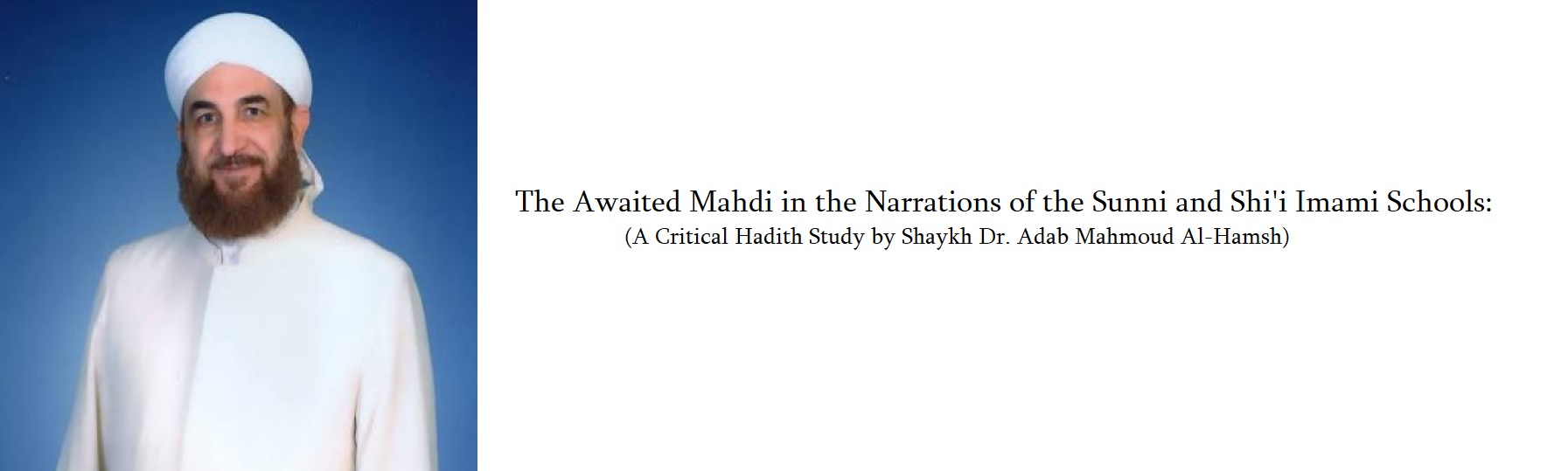
Mostly known in the West for the Sunni-on-Sunni confrontations between himself and Shaykh Saeed Fodeh, this claimed descendant of the Blessed Prophet (saw), Shaykh Dr. Adab Mahmoud Al-Hamsh himself is not a believer in the coming of any Mahdi figure.
In his critical hadith study: “Al-Mahdi al-Muntazar fi Riwayat Ahl al-Sunna wa al-Shi’a al-Imamiyya” (The Awaited Mahdi in the Narrations of Sunni and Imami Shi’i Islam), Shaykh Dr. Adab Mahmud al-Hamsh concludes that all the specific hadiths concerning the advent of a literal, awaited Mahdi whether marfu’ (attributed directly to the Prophet) or mawquf (attributed to companions) are weak (da’if) upon close critical examination.
Key Aspects of Al-Hamsh’s View
Flawed Transmission: He argues that what has been narrated about the Mahdi either lacks explicit authenticity in its wording or lacks clear attribution where the wording is authentic (ma swa sahha lam yakun sarihan, wa ma swa sarihan lam yakun sahihan).
Rejection of Consensus/Mutawatir Claims: Contrary to the mainstream traditional Sunni position which holds that Mahdi narrations reach the level of Tawatur Ma’nawi (mass-transmitted in meaning) Shaykh al-Hamsh contends that the proofs do not support a binding doctrinal belief (aqeedah) regarding a future awaited savior.
Critique of Shia Reports: He similarly devalues the Imami Shi’i reports concerning the specific birth, lineage, and occultation of Muhammed bin Hasan al-Askari, treating them as unproven through rigorous hadith-criticism standards
Published by Dar Al-Razi (Amman, 1422 AH – first edition). It comprises 553 pages in a large format and consists of six chapters. These chapters provide a general overview of most writings on the subject of the Mahdi. Both individually and within other contexts from Sunni and Shi’i perspectives. They also present the various conceptions of the Mahdi held by Sunnis and Shi’i, discuss the narrations related to him from both sides (those affirming and those rejecting them), and address other related topics, including the author’s own perspective on the issue. The hadith-based study of these narrations occupies 145 pages of the book.
His objective is to deny the negative effects of this doctrine on the development and behavior of Muslims (p. 532), both Sunni and Shi’i, with the latter being particularly egregious among Shi’i Muslims. This is because the failure to rely solely on authentic texts has led to an exaggeration of this doctrine among Sunnis, who believe the Mahdi is the savior and deliverer, thus negating the need for work and jihad.
They believe the Mahdi’s appearance will bring only a few years of happiness and prosperity followed by hardship. Meanwhile, Sufis portray the Mahdi as a pious, devout leader for whom Allah provides everything, and he has no say in the matter. Others see the Mahdi as an invincible warrior who fights infidels and hypocrites.
The Mahdi, according to the Shi’i, is part of the pillars of the religion because he is connected to the Imamate. However, he is different from the Mahdi of the Sunnis, as the Mahdi of the Sunnis is from the lineage of Al-Hasan ibn Ali. While according to the Shi’i he is from the lineage of Al-Husayn ibn Ali. Furthermore, the Mahdi of the Sunnis will come at the end of time, but the Mahdi of the Shi’i appeared between the years 252-260 AH, but he disappeared from that time in a minor occultation and then a major occultation, and he will appear at the end of time. Throughout this period, he is alive on earth but hidden from sight.
Based on the negative effects of the aforementioned Mahdi doctrine, the author studied the chains of transmission of the hadiths related to the Mahdi. He concluded that these hadiths are not authentic, and those that are authentic are not explicit on the subject of the Mahdi. Therefore, there is no need to link them to the Mahdi because the Mahdi is not authentic in the first place!
Therefore, Shaykh Dr. Adab Mahmud al-Hamsh believes that the Mahdi and the savior is the Messenger of Allah (saw). This is clear on pages (p. 212, p. 525), and that understanding the approach of the Messenger of Allah (saw) in calling for adherence to the religion of Allah Almighty is the only way to achieve happiness for Muslims throughout time, and not for a limited period as is the case with the Mahdi.
Because we have many articles that deal with Sunni scholars (from across the spectrum) that have rejected the hadiths concerning the Mahdi we will give special focus to Shaykh Dr. Adab Mahmud al-Hamsh repudiation of the Imami Shi’i concept.
That chapter is one of the most important chapters in the book for several reasons: The author is claims to descend from the family of the Prophet (saw) as He explained in (pp. 408, 539). The author narrates Shi’i books with chains of transmission. The author addressed the topic according to the Shi’i methodology in hadith, and did not cite any other books.The author is an advocate of rapprochement and cooperation between Sunnis and Shi’i, while disavowing what he disagrees with. A commendable approach as compared to others. As for the importance of the topic of the Mahdi to the Imami Shi’a, it is because it is one of the fundamentals of the religion, and whoever denies it is considered an infidel by them, and this includes the Shi’i declaring all Muslims other than themselves as infidels as he cites in his book in (pp. 411, 531)
Therefore, the author discussed with the Shi’i what they claim to be the fundamentals of religion; he found that they cite (5303) hadiths (p. 412), and these narrations relate to everything about the Mahdi. Because it is impossible to discuss this number of narrations, the author limited himself to discussing the narrations of his birth, so that if the narrations of his birth and existence are proven to be weak and invalid, then what is the value of the narrations of those who saw him, or spoke to him. He mentions this on (p. 412). This is a sound strategy. The author discussed the Shi’a approach to verifying historical accounts, revealing that they place no value on objectivity or scientific rigor; rather, emotion dictates their interpretation of events and history. He quoted the author of the ten-volume encyclopedia “History of the Minor Occultation,” Sayyid Muhammed Muhammed Sadiq al-Sadr (The father of Muqtada al-Sadr), who described his methodology as follows: “The historian is a mixture of emotions, instincts, mental predispositions, and habits. Reason and intellect represent only a part of this mixture. He does not write his history with his intellect and intellect, but rather with the sum of his emotions and all his other predispositions” (p. 414).
The author explains the Shi’i position on narrations; that they are divided into two groups: the Akhbari, who accept all transmitted narrations even if they are fictional, and the Usuli, who examine the narrations. He also explains that they did not exist before Ibn Tawus (d. 673 AH) or his student al-Hilli (d. 726 AH).But when the narrations that the fundamentalists corrected regarding the birth of the Mahdi were presented and criticized, it became clear that the fundamentalists also have no business in the science of Hadith at all!
The author’s method of critiquing the narratives of the Mahdi’s birth consisted of five steps.
The first step: Criticizing the narrations of the Imamate of Al-Hasan Al-Askari; because the previous Imam must specify be the Imam after him, so if the Imamate of Al-Hasan Al-Askari is not valid, then the Imamate of Al-Mahdi is not valid. Here he discussed what Al-Kulayni mentioned in his book “Al-Kafi”, the most important book of the Shi’i, in which he mentioned thirteen narrations (853-865), and it became clear that not one of them was authentic, neither according to the scale of Al-Khu’i, the late Shi’i reference and author of the encyclopedia “Men of Hadith”, nor according to the scale of Shaykh Al-Muzaffar Al-Shi’i, the investigator of Al-Kafi. If the original principle, which is the Imamate of Al-Hasan Al-Askari, is not valid, then how can the Imamate of Al-Mahdi be valid?
Step two: Discussing the story of the mother of the Mahdi: This is a funny issue; because the Mahdi must have a mother, so who is she? This is what the author researched in the second section of the fifth chapter, and he showed the falsehood of the story of Nargis, the mother of the Mahdi, which is contrary to reason and reality, and which contains many gaps. The problem is that this strange and long story has no fixed historical basis. Is it conceivable that the mother of the Mahdi, one of the foundations of faith, is not proven by a clear and correct basis?! Unless it is nonexistent, then it is conceivable. The author comments on this at the end of the discussion, saying: “It is unfortunate that a scholar like you Mr. Sadiq al-Sadr would build an encyclopedia in ten volumes about Imam al-Mahdi without having a single authentic historical account that proves his birth or that one of the trustworthy people saw him” (p. 470).
Step three : Did Al-Hasan Al-Askari explicitly designate Al-Mahdi as his successor as Imam? The author stated that the chapter narrations that Al-Kulayni included in “Al-Kafi” do not contain an explicit statement or reference to the Imamate of Al-Mahdi.Al-Kulayni included six hadiths in it, one of which was deemed weak by the Shi’i scholar of “Al-Kafi”, and he pointed out that two of them contained unknown narrators. The author discussed the remaining three narrations, and the result was that none of them are valid according to the standards of Shi’i biographical books.
Step four: Did the Mahdi see a human being? The author explained that Al-Kulayni included fifteen hadiths (872-886), one of which was deemed weak by the Shi’i investigator of Al-Kafi, another was judged to be disputed, eleven hadiths to be unknown, and only two hadiths were deemed authentic. The author reviewed the two authenticated hadiths and the disputed hadith, and the result was that none of them were authentic.
Step five: Has the Mahdi been born?It was mentioned that Al-Kulayni included 31 hadiths under this chapter (1362-1392). The Shi’i scholar Al-Muzaffar judged twenty of them to be unknown, two hadiths to be weak, one to be silent, and another to be good like the authentic, and he authenticated seven hadiths. When reviewing these remaining eight, none of them were safe. All of this was based on Al-Khu’i’s Encyclopedia of Hadith Men, even though he criticized what was less wrong than it in the books of hadith and terminology. It is clear that the Shi’i, while acknowledging that their books of fundamentals contain weak and fabricated hadiths, also authenticate these false narrations without a scientific basis.The author commented on these narrations about the Mahdi among the Shi’i, saying: “How I wished that one or several narrations from this huge collection of weak and unknown ones would be correct, so that I could excuse the Imami scholars for building an Islamic doctrine on the report of a single person” (p. 496).
After the invalidation of this Shi’i belief, which is the birth of the Mahdi, and that whoever does not believe in him is an infidel, it is incumbent upon the Shi’i to review their principles and books, and not to try to invite the Sunnis to enter their sect and spread propaganda books among the Sunnis such as the books of Al-Tijani and Al-Mawsawi. (pp. 535-537).
Conclusion: After these reflections on the book “The Awaited Mahdi” by Shaykh Dr. Adab Al-Hamsh, it should be emphasized that:The belief in the appearance of the Mahdi is a belief stated by a group of great scholars, and many scholars have stated that the hadiths concerning the Mahdi are transmitted through multiple chains of narration.- Some people exaggerating aspects of this doctrine without a legitimate basis and this is not permissible, but it does not invalidate belief in it.Belief is belief and people will go on believing irregardless of what is presented to them. That if one is to believe in the Mahdi then it should not become a reason for complacency and inaction.The Shi’i belief in the Mahdi is false and invalid, and they must retract it and stop declaring all Muslims as infidels. In the Shaykh’s assesment the Shi’i have no knowledge of the science of Hadith, and their books are full of fabrications, lies, and myths, and this is in the fundamentals of religion, not just in the branches.
We have uploaded Shaykh Dr. Adab Al-Hamsh book here:
This website will be one of the few places you may find this. May Allah (swt) aid the student of knowledge and the truth seekers among the Muslim and Non Muslim alike.
May Allah (swt) aid the student of knowledge among the Ibadi, the Shi’i and the Sunni and bless them and guide them in their sincere efforts.
The above article will be moved here where other prominent individiuals claim the hadiths of the Mahdi are not authetic.
As the Ibadization of the Ummah continues.
May Allah Guide the Ummah.
May Allah Forgive the Ummah.


