“Whatever the Messenger gives you, take it. And whatever he forbids you from, leave it. And fear Allah. Surely Allah is severe in punishment.” (Qur’an 59:7)
“The Messenger believes in what has been revealed to him from his Lord, and so do the believers. They believe in Allah, His angels, His Books, and His messengers. “We make no distinction between any of His messengers.” And they say, “We hear and obey. Your forgiveness, our Lord! And to You is the final return.” (Qur’an 2:285)
﷽
Narrated ‘Ubaidullah bin `Abdullah:
Ibn `Abbas said, “When the ailment of the Prophet (saw) became worse, he said, ‘Bring for me (writing) paper and I will write for you a statement after which you will not go astray.’ But `Umar said, ‘The Prophet is seriously ill, and we have got Allah’s Book with us and that is sufficient for us.’ But the companions of the Prophet (saw) differed about this and there was a hue and cry. On that the Prophet (saw) said to them, ‘Go away (and leave me alone). It is not right that you should quarrel in front of me.” Ibn `Abbas came out saying, “It was most unfortunate (a great disaster) that Allah’s Messenger (saw) was prevented from writing that statement for them because of their disagreement and noise. (Note: It is apparent from this Hadith that Ibn `Abbas had witnessed the event and came out saying this statement. The truth is not so, for Ibn `Abbas used to say this statement on narrating the Hadith and he had not witnessed the event personally. See Fath Al-Bari Vol. 1, p.220 footnote.) (See Hadith No. 228, Vol. 4).
The first problem is that the hadith portrays the Prophet (saw) as someone literate enough to write something lengthy. This goes against the ‘ijma that it is well known that the Blessed Prophet (saw) was unlettered.
The second problem is that if it was something short, why couldn’t he have simply said it?
The third problem is as follows. Everyone would agree that by writing down he meant for others to transcribe his words. The Blessed Prophet (saw) had many more days ahead of him. Why not simply ask the people to reconvene and write down what he willed?
The fourth problem is that the Prophet (saw) said to them, :Go away (and leave me alone). It is not right that you should quarrel in front of me.” So, if he had the strength to make this statement surely he could have said what he needed to say, presuming it was short and to the point.
The fifth problem is that the hadith speaks ill of Allah (swt).
Today I have perfected your faith for you, completed My favour upon you, and chosen Islam as your way. But whoever is compelled by extreme hunger—not intending to sin—then surely Allah is All-Forgiving, Most Merciful.” (Qur’an 5:3)
Allah speaks the truth and in this case the hadith is batil (falsehood). The hadith is batil (falsehood) as indicates the faith has not been perfected.
The sixth problem is the statement attributed to the Prophet (saw) ‘Bring for me (writing) paper and I will write for you a statement after which you will not go astray.’ and the statement attributed to Ibn Abbas (ra): “It was most unfortunate (a great disaster) that Allah’s Messenger (saw) was prevented from writing that statement for them because of their disagreement and noise” have problems.
Why is it a problem? It does not preclude the possibility that everyone present there and not present there would all go astray. That would include Umar, Ali, Ibn Abbas, and whoever else was present. Without that alleged document, they were all (without exception) liable to go astray.
The seventh problem. What good is a written letter to an unlettered people?!
“It is He who sent among the unlettered [Arabs] a Messenger from themselves reciting to them His verses and purifying them and teaching them the Book and wisdom – although they were before in clear error.” (Qur’an 62:2)
We know that the Qur’an was transmitted orally. So what good does some document on a piece of paper with few witnesses do for a population that is mostly illiterate?
The eighth problem is that this is a strong argument for Christian missionaries or anyone else under the sun that Muslims do not have complete guidance.
The ninth problem is that it makes the Prophet (saw) as someone who did not submit to Allah (swt).
“O Messenger! Deliver what has been revealed to you from your Lord, for if you fail to do that, you have not fulfilled the task of His messengership. Allah will certainly protect you from the evil of men. Surely Allah will not guide the unbelievers.” (Qur’an 5:67)
So this is an admission that the Blessed Prophet (saw) did not submit to Allah (swt) fully.
Aisha (ra), a member of the household of the Blessed Prophet (saw) should know if there was anything pressing. She crushes such satanic innuendo with the following:
“She said: He who presumes that the Messenger of Allah saw) concealed anything from the Book of Allah fabricates the greatest lie against Allah. Allah says: “O Messenger, announce that which has been revealed to you from your Lord, and if you do not, then you have not conveyed His message. And Allah will protect you from the people. Indeed, Allah does not guide the disbelieving people.” (Al-Qur’an, Surat al-Ma’idah, 5:67).
The tenth problem is makes the Blessed Prophet (saw) as someone who wasn’t responsible or thinking carefully about his duties and role as a Messenger to mankind. If you have something so important to say, you do not wait until you are feeble and meek.
The eleventh problem is that if what is given was to be a matter of creed, we cannot take our creed upon the ahad. The lone narrator reports.
There are more that a well-trained eye can spot.
The issue with the sanad.
Narrated Yahya ibn Sulaiman: Ibn Wahb told me: Yunus informed me, from Ibn Shihab, from ‘Ubaidullah ibn ‘Abdullah, from Ibn ‘Abbas, who said:
The wording used by Ibn Shihab al-Zuhrī is: “عَنِ ابْنِ شِهَابٍ، عَنْ عُبَيْدِ اللَّهِ” — meaning “‘an” (from/on the authority of) , not “haddathanā” (he narrated to us) or “sami’tu” (I heard).
Why This Matters
Form
Meaning
Implication for Authenticity
haddathanā / akhbaranā
Explicit confirmation that the narrator heard directly from his teacher.
The transmission is muttaṣil (connected) and can be accepted if the narrators are trustworthy.
‘an (عن)
Ambiguous; could mean direct hearing, but could also mean through an intermediary or even from a written source without direct audition.
If the narrator is known to be a mudallis (one who conceals), ‘an is problematic unless it is proven he heard it directly.
However, there are additional problems for Shi’i when it comes to this.
It presents the Prophet (saw) as someone who was unaware that people would prevent him from writing these things down and, it is not acceptable for a Prophet to be unaware of it.
It is a tacit admission that it was not made clear that Ali should be the leader of anyone at Ghadir Khum.
It makes our faith one of esoteric secrecy in which the truth cannot be openly proclaimed but rather revealed via secret channels to a select few. More akin to a gnostic cult than an abrahamic faith.This ultimately explains the various disputes among the shi’i in their lines of succession which we discussed here: https://primaquran.com/2026/02/28/how-the-muslim-ummah-approach-the-shia-in-the-wrong-way/
It shows that if Ali was present he was disobedient as well. Since he obviously did not obey the Prophet (saw) at that moment either.
No one in that room felt that the order of the Prophet (saw) was worth fighting and dying for.
Ultimately, for the Shi’i to rely upon such things it does not make their case look strong.
“It is He who has sent down to you, [O Muhammed], the Book; in it are verses [that are] precise – they are the foundation of the Book – and others unspecific. As for those in whose hearts is deviation [from truth], they will follow that of it which is unspecific, seeking discord and seeking an interpretation [suitable to them]” (Qur’an 3:7)
Our faith has to be built upon that which is certain and foundational. It cannot be built upon ambiguity, uncertainty or matters that are not clear.
From Shaykh Ahmed Al Khalili (h) the Mufti of Oman.
” Indeed, it is We who sent down the Qur’an and indeed, We will be its guardian.” (Qur’an 15:9)
﷽
First let us post what the original video clip has to say about Sayyid Ali’s presentation:
“In this video, the Sayyid responds to a questioner who asks whether the Qurʾān that is present between us today has been subject to distortion or not. Instead of going through the traditions related to whether this has indeed been the case, the Sayyid outlines some epistemological points to bear in mind when trying to evaluate this claim. He delineates general historical principles and facts that cause us to deem such an occurrence, as historians, to be extremely far-fetched. He then outlines the possible goals of a distorter and contrasts these objectives to what is found within the Qurʾānic text, whence we find that had these been the objectives of the distorters, then we would not possess certain verses and contents of the Qurʾān that we do today.” –Source:https://www.youtube.com/watch?v=l7y9bstcnXM&t=1453s
We would also like to say that this explanation by Sayyid Ali is one of the best, if not the best we have seen. It answers a lot of questions that are put forward in regard to this.
There are those who claim that the Shi’i themselves make this claim. The claim of tahrif of the Qur’an. Sayyid Ali beautifully responds to these claims.
This is a short and succinct lecture, equal to about 29 minutes of your time. It is absolutely worth it.
Those Orientalists and advocates of the historical critical method are most welcome to put this in their pipes and smoke it. The Imam laid out a very cohesive and cogent argument.
We would highly recommend you listen to the whole of the presentation.
@20:04 “Pay attention with me, in the Glorious Qur’an, now if someone wants to distort, what would they want to distort? What are his objectives hind distortion? I mean, what are the possible objectives of distortion? We will mention objectives, and let’s see if they have any basis.”
@20:18 “It may be said, for example, that among the objectives of distortion: Is the removal of certain criticisms directed towards some of the Companions who ruled. I mean, those who had authority. They are all present in the Qur’an. They are found in Surat al-Tahrim, Surat al-Hujurat, which contains: {Do not raise your voices above the voice of the Prophet} [Qur’an 49:2]“
@20:40 “And it’s mentioned about whom it was revealed. The issue of fleeing on the day of Uhud, and Hunayn, all these details are mentioned. The details of the events are mentioned. If someone wanted to distort, why would they distort? I mean, if one of the objectives of authorities was distortion, it would have been something related to them.”
@:20:58 “Those who ruled, the criticisms directed at them in the Book of Allah are present. This is a possible objective [for distortion]. Of coruse, I mention these as supporting points, not as evidence. The [main] evidence has concluded. The evidence has concluded, now we’re mentioning supporting [points].
@21:10 “The second objective is, for example, that these individuals want to remove some matters regarding the Prophet (peace be upon him and his family) [being portrayed in a negative light].
@21:19 “They love the Prophet, so they try. The Glorious Qur’an, the criticisms made by the polytheist against the Prophet (peace be upon him and his family) are present in the harshest articulation. In fact, some addresses in the Qur’anic chapters to the Prophet (peace be upon him and his family) that contain-where principally one may perceive some sort of harshness and severity within, for example, {And had We not strengthened you, you would have almost inclined to them a little} [Qur’an 17:74], it’s all there.”
@21:49 “Alright? Of course, we say it’s in the sense of “I mean you, and listen O neighbor.” But the address is there.”
@22:17 “Very well. Among the objectives that are mentioned, is removing the names of Ahl al-Bayt (upon them be peace), from the Qur’an. I say—I say, firstly, what’s the meaning of this verse? We’re talking now as Shi’a. {O Messenger, announce that which has been revealed to you from your Lord, and if you do not not, then you have not conveyed His message}[Qur’an 5:67]
@22:38 “How do we interpret this? Isn’t it about Wilaya? Isn’t it about Wilaya in the last days of the Prophet (peace be upon him and his family). And Surat al-Ma’ida is amongst the last [chapters] to be revealed, if not the very last.”
@22:53 “If Wilaya was detailed in previous chapters, then what would be the meaning of: {announce that which has been revealed to you from your Lord} [Qur’an 5:67]? We fundamentally believe that it’s natural for the mention of the Commander of the Faithful (peace be upon him) to not be frequent in the Qur’an.“
“This is natural. And this is what we believe. I mean, his mentioned as an Imam. I speak of his mention as an Imam. Clear? Not as a man of virtues. Otherwise if we’re speaking of virtues, then a “a quarter [of the Qur’an] is about us”. Clear?”
@23:23 “We are not speaking for that perspective. We’re speaking from the perspective of those in power. Alright? Concerning those in power, {Announce that which has been revealed to you from your Lord, and if you do not, then you have not conveyed His message} [Qur’an 5:67] Now, this verse, what’s the reason for its revelation? It’s natural that the mention of Imam ‘Ali (upon him be peace) will not be frequent in the Qur’an. As for mentioning the rest of the Imams (upon them be peace), in the Qur’an.”
@23:50 “Fundamentally, we Shi’a do not believe in the necessity of believing in [all] the Imams (upon them be peace) except after the death of the previous Imam.
However the Imam later admits:
@27:25 “The thing that may be brought up is the issue of Wilaya. So it would be problematic only on the Shi’a side. But we explained that the Shi’a, when it comes to revealing all of the Imams’ [names], that is something they have deemed far-fetched. Fundamentally. It’s not something to be expected, that there would be something in the Qur’an about Imamate. And on the other hand, concerning the Commander of the Faithful (upon him be peace), we believe that the Prophet (peace be upon him and his family) proclaimed this towards the end of his life. {O Messenger, announce that which has been revealed to you from your Lord, and if you do not, then you have not conveyed His message} [Qur’an 5:67]. So in reality, naturally, if the name of the Commander of the Faithful (upon him be peace) was in the Qur’an, it would have been rare and minimal. For example, had it been the case. Up to this extent, I mean, this degree of speculation.”
@28:14 “This does not outright negate the existence of the name of Imam ‘Ali (upon him be peace). This is a speculative argument. However, I just want to say, that upon reflection on the matter, the degree of distortion will not, some people, I mean, naturally, the name of Imam Ali, had it been in the Qur’an, it would be rare, Had it been there, it would be rare. Had it been there. Clear? According to the Shi’i view. Nothing else. I’m saying this according to the Shi’i Twelver view. Alright?”
Prima Qur’an comments: First and foremost again, the overall explanation by the respected Imam was/is brilliant! It is unfortunate that some people will allow themselves to be clouded by sectarianism and not benefit by what he said.
The only part where he dropped the ball was giving his minor points (because, as he mentioned, the main case has already been established), but in regard to the minor points is concerning the mention of the ahl bayt and/or the mention of the name of Imam Ali (at the very least).
By quoting a vague reference:”Announce that which has been revealed to you from your Lord, and if you do not, then you have not conveyed His message} [Qur’an 5:67] This does little to dissuade anyone from the idea that a redactor or editor wanted to remove explicit mention of the Ahl Bayt or Imam Ali as the leader of Imam of the Muslims.
The Imam was also honest and transparent enough to say:
“@22:38 “How do we interpret this? Isn’t it about Wilaya? Isn’t it about Wilaya in the last days of the Prophet (peace be upon him and his family)
“How do we interpret this.”
“I mean, naturally, the name of Imam Ali, had it been in the Qur’an, it would be rare, Had it been there, it would be rare. Had it been there.”
He was also very objective and fair-minded when he stated:
“The thing that may be brought up is the issue of Wilaya. So it would be problematic only on the Shi’a side. But we explained that the Shi’a, when it comes to revealing all of the Imams’ [names], that is something they have deemed far-fetched
That is correct. It would only be a problem for the Shi’a side, as they are the ones who have as a theological foundation the concept of being ruled by the family of the Prophet (saw), a concept we absolutely do not find in the Qur’an at all.
So, for the Sunni or the Ibadi, this is not something we would expect to find in the Qur’an.
(After rebuking his people) Moses turned to Aaron and said: “Aaron! What prevented you, when you saw them going astray, from following my way? Have you disobeyed my command? Aaron answered: “Son of my mother! Do not seize me with my beard, nor by (the hair of) my head. I feared that on returning you might say: ‘You sowed discord among the Children of Israel, and did not pay heed to my words.” (Qur’an 20:91-93)
﷽
This is in response to other hadith that the Shi’i often use. They try to justify their claims of Ali being the correct or rightful Imam of the Muslims after the Blessed Messenger (saw).
It is another example (of many) of them making a mountain out of a molehill.
The following hadith comes to mind:
Narrated Sa`d:
Allah’s Messenger (saw) set out for Tabuk, appointing Ali as his deputy (in Medina). Ali said, “Do you want to leave me with the children and women?” The Prophet (saw) said, “Will you not be pleased that you will be to me like Aaron to Moses? But there will be no prophet after me.”
The hadith about Umar (ra) neutralizes any attempt to single out Ali for a uniquely elevated status.
This hadith (https://sunnah.com/bukhari:4416) shows clear as daylight that Ali was not pleased being left to take charge of the affairs of the people of Medina. So how much more the whole Ummah?!
Rather than seeing this as an honor bestowed upon him as one being the most trustworthy to take care of the most vulnerable, Ali saw it as a slight.
So not being content with trusting his station to his Imam, which is none other than the Blessed Messenger (see), Ali quipped, “Do you want to leave me with the children and women?”
Was Ali not aware of this verse of the Qur’an?
“Whoever obeys the Messenger has truly obeyed Allah. But whoever turns away, then ˹know that˺ We have not sent you ˹O Prophet˺ as a keeper over them.” (Qur’an 4:80)
Because the Shi’i cannot prove their case for the concept of the Imamate of Ahl Bayt from the Qur’an, they must quickly pivot the conversation to Hadith, which they feel justifies their position.
The Blessed Prophet (saw) is said to have replied to the recalcitrant Ali,
“Will you not be pleased that you will be unto me like Aaron to Moses? But there will be no prophet after me.”
Somehow, the Shi’i seemed to close their eyes over the fact that the Blessed Messenger (saw) was trying to console his otherwise temperamental cousin.
Perhaps Ali sought glory or standing on the battlefield? Allah (swt) knows best. Yet, the Blessed Messenger (saw) gave Ali a more noble task than what Ali could have longed for.
The Shi’i run wild.
So, the Shi’i became laser focused on the part: “You will be unto me like Aaron to Moses? But there will be no prophet after me.”
They start to surmise that this must be a strong indication that Ali, without a doubt, is the one who will lead the Muslims after the Blessed Messenger (saw) is gone.
So they start to imagine that the Blessed Messenger (saw) said things that he did not say. For example, the Hadith says, ‘no prophet after me’ but it does not say ‘no messenger after me’.
So perhaps Ali could be a Messenger after the Prophet Muhammed (saw) ?
The Shi’i who are known to be lovers of Qiyas (analogy) so well …maybe just this once.. 😉 🤫
So, with the above hadith in tow, we can quickly turn to the Qur’an and find:
“We made an appointment of thirty nights with Moses (On Mount Sinai), to which We added ten more; so the term set by the Lord was completed in forty nights. Moses said to Aaron, his brother: “Deputize for me ((ukh’luf’nī) among my people. Dispose rightly, and do not follow the way of the authors of evil.” (Qur’an 7:142)-Ahmed Ali
“And We treated with Musa thirty nights, and We completed them with ten; so the appointment of his Lord was completed by forty nights. And Musa said unto his brother Harun: act thou (ukh’luf’nī) in my place among my people, and rectify, and follow not the way of the corrupters.” (Qur’an 7:142)=Abdul Majid Daryabadi
As archaic and jumbled as Abdul Majid Daryabadi’s translation sounds to us, it best represents both the Arabic and the context. Although Ahmed Ali’s translation is good as well.
As always, because we are not here to tell you how to think or what to think, but for you to research and come to your own conclusions, please proceed to:
Even some of the more modern translations do a very horrible job of translating the verse:
For example, Sahih International has:
“And We made an appointment with Moses for thirty nights and perfected them by [the addition of] ten; so the term of his Lord was completed as forty nights. And Moses said to his brother Aaron, “Take my place among my people, do right [by them], and do not follow the way of the corrupters.” (Qur’an 7:142)
“Take my place.” No. Moses was not going anywhere permanently. Moses went somewhere briefly.
The following translators translate (ukh’luf’nī) in a Shi’i friendly manner.
Dr. Laleh Bakhtiar-Iranian Christian translator Muhammed Mahmoud Ghali -Al Ahzar Ali Quli Qara’i -Shi’i translator Ali Bakhtiari Nejad -Shi’ia translator The Monotheist Group [2013 Edition]-Quranist
The following translates the verse that we feel best expresses the meaning of ukh’luf’nī given the context.
Abdul Majid Daryabadi Ahmed Ali Hamid S Aziz A.L Bilal Muhammed et al Mushraff Hussain Mohammed Shafi
So we know that it cannot mean to “take my place” permanently because Moses came back. We also know that it cannot mean taking my place in succession. How do we know this?
The historical data does not support this.
“Now Joshua son of Nun was filled with the spirit of wisdom because Moses had laid his hands on him. So the Israelites listened to him and did what the Lord had commanded Moses.” (Deuteronomy 34:9)
The following, which is quite literally, is titled: Joshua to Succeed Moses.
Then Moses went out and spoke these words to all of Israel: “I am now a hundred and twenty years old, and I am no longer able to lead you. The Lord has said to me, ‘You shall not cross the Jordan.’ The Lord your God himself will cross over ahead of you. He will destroy these nations before you, and you will take possession of their land. Joshua also will cross over ahead of you, as the Lord said. And the Lord will do to them what he did to Sihon and Og, the kings of the Amorites, whom he destroyed along with their land. The Lord will deliver them to you, and you must do to them all that I have commanded you. Be strong and courageous. Do not be afraid or terrified because of them, for the Lord your God goes with you; he will never leave you nor forsake you.”
Then Moses summoned Joshua and said to him in the presence of all Israel, “Be strong and courageous, for you must go with this people into the land that the Lord swore to their ancestors to give them, and you must divide it among them as their inheritance. The Lord himself goes before you and will be with you; he will never leave you nor forsake you. Do not be afraid; do not be discouraged.”
Next time your overly excited Shi’a friend starts to tell you about the above Hadith and quotes the above verse of the (Qur’an 7:142), inform them what it says just 8 verses later.
“And when Moses returned to his people, angry and grieved, he said, “How wretched is that by which you have replaced me after [my departure]. Were you impatient over the matter of your Lord?” And he threw down the tablets and seized his brother by his head, pulling him toward him. [Aaron] said, “O son of my mother, indeed the people oppressed me and were about to kill me, so let not the enemies rejoice over me and do not place me among the wrongdoing people.” (Qur’an 7:150)
“And recall when We summoned Moses for a term of forty nights, and then you set up the calf as your god in his absence. You indeed committed a grave wrong.” (Qur’an 2:51)
Moses scolded, “O Aaron! What prevented you, when you saw them going astray, from following after me? How could you disobey my orders? Aaron pleaded, “O son of my mother! Do not seize me by my beard or my head. I really feared that you would say, ‘You have caused division among the Children of Israel, and did not observe my word.’” (Qur’an 20:92-94)
So, if the Shi’i want to make Ali analogous to Harun (as) in a very literal way, we have some real problems.
Let us replace the words Moses (as) with the Prophet Muhammed (saw) and wewill replace Aaron (as) with Ali and let us see how this works.
“And when Muhammed returned to his people, angry and grieved, he said, “How wretched is that by which you have replaced me after [my departure]. Were you impatient over the matter of your Lord?” And he threw down the tablets and seized Ali by his head, pulling him toward him. [Ali] said, “O son of my mother, indeed the people oppressed me and were about to kill me, so let not the enemies rejoice over me and do not place me among the wrongdoing people.” (Qur’an 7:150)
Muhammed scolded, “O Ali! What prevented you, when you saw them going astray, from following after me? How could you disobey my orders? Ali pleaded, “O son of my mother! Do not seize me by my beard or my head. I really feared that you would say, ‘You have caused division among the Children of Israel, and did not observe my word.’” (Qur’an 20:92-94)
Are we to believe that it only takes the Prophet Muhammed (saw) to be gone for 40 days as Ali, fearing for his life, allows the people to fall into blatant shirk?
Are we to believe there could be a scenario where the Blessed Prophet Muhammed (saw) is so furious with Ali that he snatches him up by his beard?!
Are we to believe there is a scenario where the Blessed Prophet (saw) scolded Ali for disobeying his orders? Even to the point where Ali feared that the Blessed Prophet (saw) would say that he (Ali) caused division among the Muslims?
Keep in mind that Moses (as), like the Blessed Prophet Muhammed (saw) would have been given knowledge by Allah (swt) that Aaron (as) was not, in any way shape or form, in dereliction of his duties. Yet Musa (as) snatched Aaron (as) up!
We do not believe these are things the Shi’i are willing to entertain regarding Ali.
The Moses Aaron comparison is also devastating to Shi’i claims.
Why? Because they do not have equal authority.
“When there comes to them some matter touching (public) safety or fear, they divulge it. If they had only referred it to the Messenger, or to those charged with (ulī l-amri) authority among them, the proper investigators would have tested it for them (direct). Were it not for the Grace and Mercy of Allah unto you, all but a few of you would have fallen into the clutches of Satan.” (Qur’an 4:83)
Aaron did not have the knowledge of the divine will that Moses had.
“I really feared that you would say, ‘You have caused division among the Children of Israel, and did not observe my word.’
“And [recall] when Moses said to his people, “O my people, indeed you have wronged yourselves by your taking of the calf [for worship]. So repent to your Creator and kill yourselves [i.e., the guilty among you]. That is best for [all of] you in the sight of your Creator.” Then He accepted your repentance; indeed, He is the Accepting of Repentance, the Merciful.” (Qur’an 2:54)
This line: “I really feared that you would say, ‘You have caused division among the Children of Israel, and did not observe my word.” This absolutely does not refer to Ali ibn Abi Talib at all! This was a man who, instead of pursuing the killers of Uthman, wasted no time in collecting his army to go fight the people of Sham!
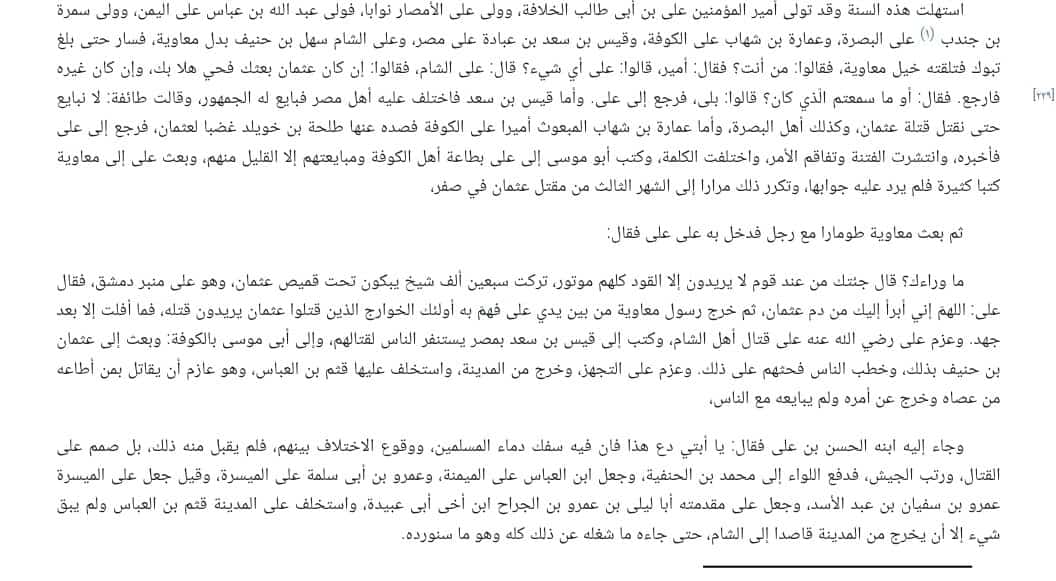
Translation of the above:
“This year of his caliphate, the Commander of the Faithful, Ali ibn Abi Talib, assumed leadership and appointed governors over the regions. He appointed Abdullah ibn Abbas over Yemen, Samurah ibn Jundab over Basra, Imarah ibn Shihab over Kufa, Qays ibn Sa’d ibn Ubadah over Egypt, and over Syria, Sahl ibn Hunayf in place of Muawiyah. Sahl marched until he reached Tabuk, when the close associates of Muawiyah met him and said, “We want to say…” It was said, “He knows.” They said, “We want to say…” It was said, “He knows.” They then said, “If Uthman sent you in his capacity [as the rightful caliph, then proceed], but if it was someone else, then go back.” They said, “Have you not heard what happened?” They replied, “Yes.” So he returned to Ali.”
“As for Qays ibn Sa’d, the people of Egypt differed concerning him. The majority pledged allegiance to him, but a group said, “We will not pledge allegiance until the killers of Uthman are brought to us.” The situation was similar in Basra. As for Imarah ibn Shihab, who was sent as governor to Kufa, Talhah ibn Khuwaylid prevented him from entering out of anger for Uthman. He returned to Ali and informed him. The strife intensified, the matter became grave, and opinions differed. Abu Musa wrote to Ali informing him of the obedience and pledge of allegiance of the people of Kufa, except for a few. Ali sent many letters to Muawiyah, but he did not receive any reply. This continued repeatedly until the third month after the murder of Uthman, in Safar.”
“Then Muawiyah sent a scroll with a man who came to Ali. Ali asked, “What news do you bring?” The man replied, “I come to you from people who desire nothing but revenge, deeply aggrieved. I left seventy thousand elderly men gathered under the shirt of Uthman, which is displayed on the pulpit of Damascus.” Ali said, “O Allah, I declare myself innocent before You of the blood of Uthman.” Then the messenger of Muawiyah left Ali’s presence, and those Kharijites who had killed Uthman intended to kill him, but he barely escaped after much effort.”
“Ali, may Allah be pleased with him, resolved to fight the people of Syria. He wrote to Qays ibn Sa’d in Egypt, urging the people to mobilize for fighting them, and to Abu Musa in Kufa. He also sent word to Uthman ibn Hunayf about this. He addressed the people, inciting them for that purpose. He was determined to prepare and depart from Medina, appointing Qutham ibn Abbas as his deputy over it. He was resolved to fight, with those who obeyed him, against those who disobeyed him, rebelled against his command, and did not pledge allegiance to him along with the people.”
“His son, Al-Hasan ibn Ali, came to him and said, “O my father, abandon this, for it involves the shedding of Muslim blood and the occurrence of division among them.” But he did not accept that from him; rather, he insisted on fighting and organized the army. He gave the standard to Muhammed ibn al-Hanafiyyah, appointed Ibn Abbas to be in charge of important matters, and Umar ibn Abi Salama over the vanguard. It is also said he appointed Umar ibn Sufyan ibn Abd al-Assad over the vanguard. He appointed as the commander of his advance guard Abu Layla ibn Amr ibn al-Jarrah, the nephew of Abu Ubaydah. He appointed Qutham ibn Abbas as his deputy over Medina. Nothing remained except for him to depart from Medina heading towards Syria, until there came to him what diverted him from all of that, which we will mention.”
Source: Al-Bidāyah wa al-Nihāyah (البداية والنهاية) by Ibn Kathir Volume: around Vol. 7 or 8 (depending on the edition)
Prima Qur’an comments:
Ali claimed that he is in Bara’ah with those who killed Uthman.
He did not spend his time looking for these killers. Ali did not seem concerned at all about finding the killers of Uthman.
Trying to find the killers of Uthman could have easily disuaded the tension or at the very least exposed Muawiyah as a hypocrite.
Rather, Ali wasted no time in raising an army for the continued fighting, and killing and slaughter among the Muslims.
Al Hasan ibn Ali was much wiser than his father (Ali), who was spoiling for a fight.
Look at the words of Al Hasan ibn Ali.
“O my father, abandon this, for it involves the shedding of Muslim blood and the occurrence of division among them.” But he (Ali) did not accept that from him.”
So try to apply the following statement of Aaron (as) to Ali : “I really feared that you would say, ‘You have caused division among the Children of Israel, and did not observe my word.” This absolutely does not apply to Ali.
In addition to that, we have the following:
Narrated by ‘Abdullah bin Abbas
“Ali bin Abu Talib came out of the house of Allah’s Apostle during his fatal illness. The people asked, “O Abu Hasan (i.e. Ali)! How is the health of Allah’s Apostle this morning?” ‘Ali replied, “He has recovered with the Grace of Allah.” ‘Abbas bin ‘Abdul Muttalib held him by the hand and said to him, “In three days you, by Allah, will be ruled (by somebody else), And by Allah, I feel that Allah’s Apostle will die from this ailment of his, for I know how the faces of the offspring of ‘Abdul Muttalib look at the time of their death. So let us go to Allah’s Apostle and ask him who will take over the Caliphate. If it is given to us we will know as to it, and if it is given to somebody else, we will inform him so that he may tell the new ruler to take care of us.” ‘Ali said, “By Allah, if we asked Allah’s Apostle for it (i.e. the Caliphate) and he denied it us, the people will never give it to us after that. And by Allah, I will not ask Allah’s Apostle for it.”
It is quite clear that Ibn Abbas was not aware of any Shi’i interpretations that Ali should be the one to lead the Muslims after the death of the Blessed Prophet (saw).
Ali himself was not of the understanding that it was something that was his to take simply by being related to the Blessed Prophet (saw).
This is another reason why it is best to make the Qur’an the pillar of our theology and faith, as the hadith themselves have narrations that the Shi’i themselves wince at.
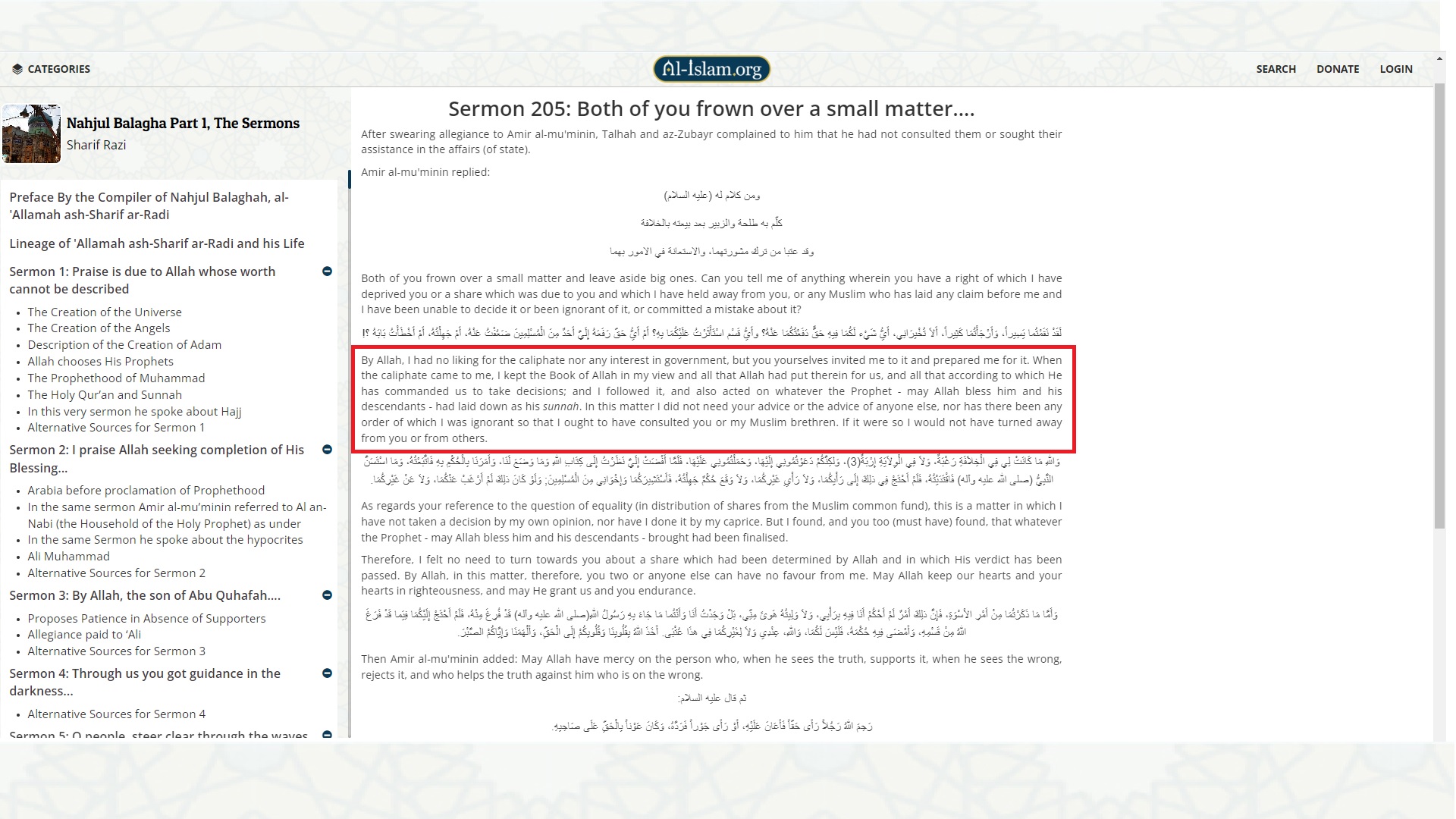
Then there is this straight from Nahjul balagha itself. Straight from a Shi’i website:
“By Allah, I had no liking for the caliphate nor any interest in government, but you yourselves invited me to it and prepared me for it. When the caliphate came to me, I kept the Book of Allah in my view and all that Allah had put therein for us, and all that according to which He has commanded us to take decisions; and I followed it, and also acted on whatever the Prophet – may Allah bless him and his descendants – had laid down as his sunnah. In this matter I did not need your advice or the advice of anyone else, nor has there been any order of which I was ignorant so that I ought to have consulted you or my Muslim brethren. If it were so I would not have turned away from you or from others.”
This sermon is said to have happened long after the Blessed Prophet Muhammed (saw) died. This sermon itself proves that Ali never considered that he was already the appointed Khilafa of the Muslims.
He said, “When the Caliphate came to me.” This means he was not the Caliph at the time, he recognized it as such and nor did he want it. Someone who is divinely appointed by Allah (swt) to the Khilafa of the Muslims takes pride in it, claims it and upholds that as a great trust.
It shows Ali himself viewed the caliphate as something that came to him by people’s invitation after Uthman’s death, not as a pre-appointed right he was claiming.
Someone who recognizes they are not divinely appointed but that people have chosen who will lead them and then gets pushed into a position of leadership makes the kind of statements that Ali made above.
May Allah (swt) guide us to what is beloved to Allah (swt).





 Prima Quran