Tag Archives: athari

Ibn Taymiyya: The Sufi Shaykh Part 2

“Do not mix truth with falsehood and do not deliberately hide the truth.” (Qur’an 2:42) 
﷽ 

Those who have not read part 1 may be interested to read that here:

Before I begin this part 2 I would like to begin with the conclusion from part 1.

There are a number of reasons why many different groups (especially those who want division and discord) among Muslims would keep this information hidden.

#1) Sunni Muslims who belong to Sufi groups and associated with the Ashari theological school don’t want people to know Ibn Taymiyya who was Athari in his school was a Sufi.  This gives the impression that Sufism is a monopoly of those who follow the Maturdidi or Ashari theological positions.

#2) Those Sunni Muslims who belong to the theological schools of the Maturdidi and Ashari and also follow Sufi tariqat have high esteem for Shaykh Abdul Qadir Al Jilani (who was Athari in creed) don’t want people to connect the dots.  The reason being is it takes the wind out of the sails of those who make takfir upon the Atharis. They dare not do this with Sheikh Abdul Qadir Al Jilani!

#3) Those who say they follow the ‘Salafi Manhaj‘ -they rely heavily upon Ibn Taimiyya and they are harsh in their critique of Sufism and Tassawuf in general. They would not want any of their followers to even get the slightest whiff that Ibn Taimiyya belonged to a Sufi order.

#4) It is a useful tool in the heads of those who have machinations upon Muslim lands and have a vested interest in keeping the divide going among Muslims; especially Sunni Muslims (the largest group).

IBN TAYMIYYA’S DISCUSSION OF TASAWWUF IN HIS MAJMU’A FATAWA

What Ibn Taymiyya Says About the Term ‘Tasawwuf’? 

Here we will mention what Imam Ibn Taymiya, mentioned about the definition of Tasawwuf, from Volume 11, “At-Taswassuf” of “Majmu’a Fatawa Ibn Taymiyya al-Kubra, ” Dar Ar-Rahmah, Cairo:

“Alhamdulillah, the pronunciation of the word Tasawwuf has been thoroughly discussed. From those who spoke about Tasawwuf were not just the Imams and Shaikhs, but also included were Ahmad bin Hanbal, Abi Sulayman ad-Daarani, As-Sirr as-Saqati, al-Junayd al-Bahgdadi, Hasan al-Basri, Ma’auruf al-Karkhi, Abdul Qadir Jilani, Bayazid al-Bistami [one of the grand Shaykhs of the Naqshbandi Tariqat] and many others. This is a term that was given to those who were dealing with that kind of science [tazkiyyat an-nafs and Ihsan].”

Imam Ibn Taymiyya says:

“Tassawuf has realities and states of experience which they talk about in their science. Some of it is that the Sufi is that one who purifies himself from anything which distracts him from the remembrance of Allah and who will be so filled up with the knowledge of the heart and knowledge of the mind to the point that the value of gold and stones will be the same to him. And Tasawwuf is safeguarding the precious meanings and leaving behind the call to fame and vanity in order to reach the state of Truthfulness, because the best of humans after the prophets are the Siddiqeen, as Allah mentioned them in the verse:

“(And all who obey Allah and the Apostle) are in the company of those whom is the grace of Allah: of the prophets, the sincere lovers of truth, the martyrs and the righteous; Ah! What a beautiful fellowship.” (an-Nisa’, 69,70)

Ibn Taymiyya continues: “as-Sufi hua fil-haqiqa naw’un min as-siddiqeen. Fahua as-siddiq alladhee iktassa bil-zuhadiwal-‘ibadada.” which translates:

“And the Sufi is, in reality, a kind of Siddiq (Truthful One), that  Siddiq who specialized in zuhd and worship.”

He continues about the Sufis,

“Some people criticized the Sufiyya and Tasawwuf and they said they were innovators, out of the Sunnah, but the truth is they are striving in Allah’s obedience [mujtahidin fi ta’at-illahi], as others of Allah’s People strove in Allah’s obedience. So from them, you will find the Foremost in Nearness in virtue of his striving [as-saabiq ul-muqarrab bi hasab ijtihadhi]. And some of them are from the People of the Right hand [ Ahl al-Yameen mentioned in Qur’an in Surah Waqiah], but slower in their progress. For both kinds, they might make ijtihad and in that case, they might be correct and they might be wrong. And from both types, some of them might make sin and repent. And this is the origin of Tasawwuf. And after that origin, it ha been spread and (tasha’aabat wa tanawa’at) has its mainline and its branches. And it has become three kinds:

1.) Sufiyyat il-Haqa’iq-the True Sufis

2.) Sufiyyat il-Arzaaq -the Professional Sufis (Those who use Sufism for personal gain)

3.) Sufiyyat il-Rasm -The Caricature Sufis. (Sufi by appearance only).”

IMAM IBN TAYMIYYA ABOUT SAINTS AND SAINTHOOD

Imam Ibn Taymiyya mentions in volume 11, page 190 of Majmu’a Fatawi Shaikh ul-Islam Ibn Taymiyya , edition published in Egypt by Dar ar-Rahma:

“A servant of Allah ‘azza wa-Jal’, cannot be considered a saint unless he is a true believer. Allah mentions in the Qur’an:

“Now surely the friends of Allah-they shall have no fear nor shall they grieve. Those who believe and guarded (against evil):” (Yunus, 61,62)

He then quotes from the famous hadith from Bukhari:

“My servant draws not near to Me with anything more loved by Me than the religious duties I have enjoined upon him, and My servant continues to draw near to Me with supererogatory works so that I shall love him. When I love him I am his hearing with which he hears, his seeing with which he sees, his hand with which he strikes and his foot with which he walks. Were he to ask [something] of Me, I would surely give it to him and were he to ask Me for refuge, I would surely grant him it. I do not hesitate about anything as much as I hesitate about [seizing] the soul of My faithful servant: he hates death and I hate hurting him.”

Imam Ibn Taymiyya About Miracles Of Saints

In his book al-Mukhtasar al-Fatawa al-Masriyya, published by al-Madani Publishing House,1980, page 603:

“The miracles of saints are absolutely true and correct, by the acceptance of all Muslim scholars. And the Qur’an has pointed to it in different places, and the Hadith of the Prophet (s) have mentioned it, and whoever denies the miraculous power of saints are only people who are innovators and their followers.”

He continues in Majmu’a Fatawai Ibn Taymiyya:

“What is considered as a miracle for a saint is that sometimes the saint might hear something that others do not hear and they see something that others do not see, while not in a sleeping state, but in a woken state of vision. And he can know something others cannot know, through revelation or inspiration.”

All that Imam Ibn Taymiyya says about the subject of Tasawwuf is found in a large book (volume 11) consisting of 704 pages only about Tasawwuf. And we would like to mention briefly what he said on page 314, about the hadith Qudsi [i.e. related form Allah Himself]:

Verily Allah ta’ala has said: ‘Whosoever shows enmity to a wali (friend) of Mine, then I have declared war against him.”

Source: (https://sunnah.com/nawawi40:38)

Imam Ibn Taymiyya says:

“Which means that Allah is expressing: I will seek revenge against anyone who comes against My saints like an aggressive lion.'”

He continues on p. 314 quoting Prophet’s saying about the saints: “You are the martyrs of Allah on Earth.”

Imam Ibn Taymiyya About The Unveiling Of Appearances

He said: “Allah Almighty will unveil to his saint’s states that have never been given before and give them support without measure…If that saint will begin to speak form the things of the unseen, past, or present or future it is considered from “Bab al’ilm al-khaariq” the miraculous unseen knowledge…..Anything that a saint does which is form unveiling to people or to listeners or curing or healing or teaching knowledge, it is accepted….and we have to thank Allah for it.”

Imam Ibn Taymiyya Mentions Some Great Shaikhs of Sufism

And we wish to mention some of the shaikhs, who Imam Ibn Taymiyya accepted from the well-known Sufi shaikhs. This is found in his volume entitled ‘Ilm as-Sulook [The Science of Travelling the Way to Allah], which consist of the whole volume 10 of Majmu’a Fatawa Ibn Taymiyya which is 775 pages in length, all of which is about the knowledge of the ways of true Sufism, the Science of Traveling to Allah, [‘ilm us-sulook].

On page 516, the third paragraph he says:

“The great Sufi shaikhs are the best shaykhs to be known and accepted, such as Bayazid al-Bistami [a grand shaikh of the Golden Chain of the Naqshabandi Tariqat], Shaikh Abdul Qadir Jilani, Junayd bin Muhammad [the most well-known Sufi]. Hasan-al-Basri, al-Fudayl ibn al-Ayyad, Ibrahim bin al-Adham [very famous Sufi, known as Sultan of the Ascetics], Abi Sulayman ad-Daarani,

Ma’ruf’al-Karkhi[a well-known Sufi], Siri-as-Saqati, Shaikh Hammad, Shaikh Abdul Bayyan.”

And Ibn Taymiyya continues:

“Those great Sufi people were the leaders of humanity and they were calling to what is right and forbidding what is wrong.”

In Majmu’a Fatawa Ibn Taymiyya , published by Dar ar-Rahmat, Cairo, Vol, 11, page 497. Book of Tassuwuf), Ibn Taymiyya says:

“You have to know that the rightly -guided shaikhs must be taken as guides and examples in the Din, as they are following in the footsteps of the Prophets and Messengers. And the Way (tariqat) of those shaikhs is to call people to Allah’s Divine Presence and obedience to the Prophet.”

Here we find Ibn Taymiyya calling for people to take a guide and mentioning that each guide has his own method (tariqat) in calling people to the Prophet’s ways.

Ibn Taymiyya says on page 499 of the same volume:

“And the shaikhs whom we need to take as guides are our examples that we have to follow, as when on the Hajj, (the pilgrimage) one needs a guide [daleel] to reach the Ka’aba, these shaikhs our guide [daleel] to Allah and our Prophet (s).”

Ibn Taymiyya quotes from Bayazid al-Bistami, who said, on page 510, Volume 10:

“….the great Sufi shaikh Bayazid al-Bistami and the famous story about him when he saw Allah in a vision (kashf) and said to Him: ‘ O Allah what is the way to You?’ and Allah responded ‘Leave yourself and come to Me.'”

Ibn Taymiyya continues quoting Bayazid al-Bistami, “I shed my self as a snake sheds its skin.”  This quotation is an indication of the need for zuhd (self-denial or abstention from the worldly life), as that was the path followed by Bayazid al-Bistami.

So we see from the above quotes, that Ibn Taymiyya was accepting many shaikhs by quoting them and urging people to follow guides to show the way to obey Allah and to obey the Prophet (s).

Imam Ibn Taymiyya Explains Those Who Are Speaking About Fana’ 

In Book 2, volume 2, pages 396-397 of Majumu’a Fatawi Ibn Taymiyya, published by Dar ar-Rahmat, Cairo, Ibn Taymiyya speaks about the subject of fana’ also known is Sufism as annihilation, He said,

“This state of love is the state of many people that are from the people of Love of Allah ‘azza wa jall, they are the people of the love of Allah and the People of the Will (al-Irada) of Allah (it is typical of many of the people who love Allah and seek Him.) Because that person has vanished in his lover, in Allah ‘azza wa jall-through the intensity of the love, because He vanished in Allah’s love, not his own ego’s love. And he will recall Allah, not recalling himself, he would remember Allah not remembering himself, visualizing Allah [yastashhid], not visualization himself, existing in Allah, not in the existence of himself. When he reaches that stage, he no longer feels his own existence. And that is why he says in this state, ‘Ana al-Haqq” ( I am the Truth), or “Subhanee. (Glory to Me!)” And he will say “maa fil jubba ill-Allah” (there is nothing in this cloak except Allah) because he is drunk in the love of Allah and this is a pleasure and happiness that he cannot control.”

Further on Ibn Taymiyya says:

“This [matter] has in it Haqq and there is in it Batil. But when someone will enter a state with his fervor intense love (‘ishq) to Allah, he will enter a state of absentmindedness, and when he enters the state of absentmindedness, he will find himself as if he is accepting the [concept] ittihad. I do not consider this a sin. Because that person is excused and no one may punish him as he is not aware of what he is doing. Because the pen doe snot condemns the crazy except when he is restored to sanity. And when that person is in that state and he was wrong in what he did, he will be under Allah’s address:

“Rabbana laa tuakhidhna iin-nasseena aw ak-htaana” “O  Our Lord, do not take us to task if we forget or make mistakes.” (Baqara, 286)

“And Allah says in other verse, “wa laa junaaha ‘alwaykum fimma akhtaatum bihi” “there is no blame on you if you unintentionally do a mistake.”

On page 339, in Volume 10, he says:

“There is a story of two men who were so respectful and loved each other very much. One of them fell in the water [of the sea] and immediately the other threw himself behind him. Then the first, one who was sinking asked, “what made you throw yourself here?” He said, “I vanished in you. And when I vanished in you I thought you were me and I was you.”

And further on he continues:

“As long as he is not drunk through something that is prohibited, it is accepted, but if it were prohibited, (the intention was bad) then he is not excused.”

And he continues (vol 2,, page 397):

“And because of that  [situation] many of the saints, like ‘Abdul Qadir Jilani, have an excuse, because they are in a state of love (‘ishq).”

That subject is also mentioned in a whole chapter in detail from page 337 page 343, entitled:   al-Fana’ alladhee yujad fi kalam as-sufiyya yuffassar bi-thalathat umur.

This title means: “the Word of Annihilation found in Sufism explained in Three Ways.” This chapter describes in detail the concept of fana’.

This is the conclusion of the 2 part series. It is now up to you the reader to do your own research and reflection on this matter.

All praise be to Allah! 

May Allah Guide the Ummah.

May Allah Forgive the Ummah.

4 Comments

Filed under Uncategorized

Where is Allah? Allah is in London England!

Say, “My Lord has only forbidden immoralities – what is apparent of them and what is concealed – and sin, and oppression without right, and that you associate with Allah that for which He has not sent down authority, and that you say about Allah that which you do not know.” (Qur’an 7:33)

﷽ 

Once I was approached by a Salafi Muslim in a Masjid who asked me,
“
Brother where is Allah?” I thought this was an extraordinary question to ask but I asked him “What time it was“. He seemed puzzled but told me the current time. I thereby responded, “Allah is in London, England!”

He rapidly started to stroke his beard rapidly repeating “istaghfirullah!'” “‘istaghfirullah!” “Allah forgive you!” “Allah forgive you!”

This seemed like very neurotic behavior so I offered the following mutawatir hadith.

Abu Huraira reported Allah’s Messenger (saw) as saying:

“Allah descends every night to the lowest heaven when one-third of the first part of the night is over and says: I am the Lord; I am the Lord: who is there to supplicate Me so that I answer him? Who is there to beg of Me so that I grant him? Who is there to beg forgiveness from Me so that I forgive him? He continues like this till the day breaks.”

Source: (https://sunnah.com/muslim:758b)

I don’t see what was so wrong with saying that Allah was in London, England considering that it was around 4:45 a.m London time (which would be the last third of the night).

I guess that was not the answer he was expecting. He was visibly upset as he said, “But brother Allah is in the highest heaven.” “What?!” I responded. I thought this was very strange for how could Allah be in London England and in heaven at the same time! Surely this man does not believe that Allah is multi-present? Could it be that he believed that Allah (swt) was in many places simultaneously?

“Who said Allah is in heaven?” I asked.

“Firaun (Pharoah) said Allah is in heaven.” the brother offered.

“Where does he say this?” I demanded!

The brother quoted the following,

“And Fir’aun (Pharaoh) said: “O Hâmân! Build me a tower that I may arrive at the ways, The ways of the heavens, and I may look upon the Ilâh (God) of Mûsa (Moses) but verily, I think him to be a liar.”(Qur’an 40:37)

I was simply shocked by this! “Brother,” I said, “I do not think we need to be taking our Aqidah (belief) from Fir’aun (Pharaoh)! We do not need to build a tower of babel to reach heaven.“

This was a real conversation that happened between me and a Malay Salafi brother in a Masjid in Singapore. Needless to say, I feigned ignorance of the subject and admittedly baited the brother because I am all too familiar with these topics.

However, keep in mind he did approach me first.

However, I did advise him that in the future he may wish to use the hadith of the blind woman pointing upwards into heaven or when asked, ‘Who said Allah is in heaven‘ perhaps he could say, ‘Allah himself says this.’ It is also advisable to simply use the verse of the Qur’an “The Beneficent One, Who is established on the Throne.” (Qur’an 20:5)

I am quite sure that our Salafi brothers continue to improve their techniques.

Yet the problem remains. The issue of Allah (swt) presumably being over the throne and descending down into the lowest part of the earth every night of course (in a way that befits his majesty) …..of course.

Now the Ashari and Maturidi among our Sunni brothers are quite sensible on this issue. However, those Sunni Muslims from the Salafi, Hanbali, Athari can get quite agitated over this very sensitive issue.

So sensitive that they tell you to just shut up and accept it! Blind faith!

You can’t make taqlid to a legal school but you damn well better make taqlid to their belief system!

Observe: https://islamqa.info/en/answers/12290/there-is-no-contradiction-between-the-fact-that-allaah-descends-to-the-lowest-heaven-and-his-having-risen-above-the-throne-istiwaa

Don’t worry yours truly has screenshots of the entire Q & A as many people make web sites, articles, and entries that disappear in a flash!

So here we go… I’ll highlight the text of interest.

Question

When asked, “Where is Allah ?”
I reply “Above the seven Heavens and the Arsh” But taking the Hadith regarding that Allah descends to the lowest heaven in the latter part of the night. If someone asks where is Allah (swt) and they state He is the latter 3rd of the night now. What reply should you give?

Another point is that some people say it is the latter part of the night all the time (somewhere on the earth at a particular point in time) From this they conclude that Allah is not above His Arsh.

Answer

Praise be to Allah.

Firstly, we have to know the ‘aqeedah (belief) of Ahl al-Sunnah wa’l-Jamaa’ah concerning the names and attributes of Allah. The belief of Ahl al-Sunnah wa’l-Jamaa’ah is to affirm the names and attributes which Allah has affirmed for Himself, without distorting or denying them, discussing how they are or likening them to anything else. They believe that which Allah has commanded them to believe, for Allah says (interpretation of the meaning):

“There is nothing like Him, and He is the All-Hearer, the All-Seer”

[Qur’an 42:11]

Allah has told us about Himself. He says (interpretation of the meaning):

“Indeed, your Lord is Allah, Who created the heavens and the earth in Six Days, and then He rose over (Istawaa) the Throne (really in a manner that suits His Majesty).

Prima Qur’an comments: “The Throne (really in a manner that suits His Majesty)…” So now they are going to say no one knows how but then use the word ‘really’. Interesting.

[Qur’an 7:54]

“The Most Gracious (Allah) rose over (Istawaa) the (Mighty) Throne (in a manner that suits His Majesty).

[Qur’an 20:5]

and there are other ayats which mention that Allah rose over His Throne.

The rising of Allah over His Throne, which means that He Himself is High and above the Throne, is of a special nature which befits His Majesty and Might. No one knows how it is except Him.

This was proven in the saheeh Sunnah, where it is narrated from the Prophet (peace and blessings of Allaah be upon him) that Allaah descends during the last third of the night. It was narrated from Abu Hurayrah that the Messenger (peace and blessings of Allaah be upon him) said: “Our Lord descends every night to the lowest heaven when the last third of the night remains, and He says, ‘Who will call Me that I might answer him, who will ask of Me that I might give him, who will ask My forgiveness, that I might forgive him?’” (narrated by al-Bukhaari, Kitaab al-Tawheed, 6940; Muslim, Salaat al-Musaafireen, 1262)


According to Ahl al-Sunnah, the meaning of this descent is that Allaah Himself comes down to the lowest heaven in a real sense, as befits His Majesty, and no one knows how that is except Him.

Prima-Qur’ancomments: I thought that the doctrine of Ahl al-Sunnah according to the Hanbali, Salafi, and Athari is that no one knows how? So how are they saying tongue in cheek, “comes down to the lowest heaven in a real sense, as befits His Majesty.”

They continue:

“But does the fact that Allaah comes down means that He vacates the Throne or not? Shaykh Ibn ‘Uthaymeen said concerning a similar question: we say that this question is based on unnecessary and excessive questioning and that the one who asked this is not to be thanked for his question. We ask, are you keener than the Sahaabah to understand the attributes of Allah? If he says yes, we tell him, you are lying. And if he says no, we tell him, then be content with what they were content with. They did not ask the Messenger of Allah (peace and blessings of Allah be upon him), ‘O Messenger of Allah, when He comes down, does He vacate the Throne?’ Why do you need to ask this question? Just say, He comes down. Whether or not the Throne is vacated is not your business. You are commanded to believe the reports, especially concerning the essence of Allah and His attributes, for this matter is above rational thought.”

Prima-Qur’an comments: I have read many of Shaykh ‘Uthaymeen’s legal verdicts and this is as close to ‘Shut the hell up‘ as I have ever seen the Shaykh get. The whole of his response is about intimidation and shutting down the inquiry of the questioner.

They continue:

Majmoo’ Fataawa Shaykh Muhammad al-‘Uthaymeen, 1/204-205

Shaykh al-Islam Ibn Taymiyah (may Allaah have mercy on him) said concerning this matter:

“The correct view is that He descends and that He does not vacate the Throne. A person’s soul remains attached to his body night and day until he dies, but when he is asleep it ascends… It was said, night varies, and the last third of the night comes sooner in the east than in the west, so the descent of Allaah to the lowest heaven, of which His Messenger spoke, happens in the east first and then in the west…”

Prima-Qur’an comments: Whoa there Shaykh Ibn Taymiyah! Hold your horses! Are you now likening the descent/ascent of Allah (swt) to a human soul leaving the body? Furthermore are you saying that Allah (swt) has division with him self? A part of him that travels and a part of him that remains? By saying that Allah (swt) does not ‘vacate‘ the throne you are in fact establishing a ‘how’ for Allah swt! Authubillah min dhalik! Or if the Shaykh is suggesting that by his comparison to human beings that Allah (swt) can be in two places at the same time than my initial response to the brother that questioned me is not wrong at all!

They continue:

See Majmoo’ Fataawa Ibn Taymiyah, 5/132

Rising over (istiwaa’) and descending are two of the practical attributes which have to do with the will of Allaah. Ahl al-Sunnah wa’l-Jamaa’ah believe in that, but in this belief they avoid likening Allaah to any of His creation or discussing how He is. It cannot occur to them that Allaah’s descending is like the descending of any of His creatures or that His rising over the Throne is like the rising over of any of His creatures, because they believe that there is nothing like unto Allaah and He is the All-Hearer, All-Seer. They know on rational grounds that there is a great difference between the Creator and His creatures, in their essence, attributes and actions. It cannot occur to them to ask how He descends, or how He rose over His Throne. The point is that they do not ask how His attributes are; they believe that there is a ‘how’, but it is unknown, so we can never imagine how it is.

Prima Qur’an comments: Respected Shaykh Taymiyah you said, ‘we can never imagine how it is’ and yet you also say in the paragraph above, A person’s soul remains attached to his body night and day until he dies, but when he is asleep it ascends.

“We know for certain that what is narrated in the Book of Allaah or the Sunnah of His Prophet (peace and blessings of Allaah be upon him) is true and is not self-contradictory, because Allaah says (interpretation of the meaning):

“Do they not then consider the Qur’aan carefully? Had it been from other than Allaah, they would surely, have found therein many a contradiction”

[Qur’an 4:82]

Prima Qur’an comments: Well, you see 4:82 actually is a reference to the Qur’an. It is not a reference to hadith, sunnah, fiqh, ijtihad of imams, or anything else. How you lump the sunnah in with the Qur’an is anyone’s guess.

He continues:

“Because contradictions in the reports would mean that some of them were showing others to be false, and this is impossible in the case of that which Allaah and His Messenger tell us.

Whoever imagines that there are any contradictions in the Book of Allaah or the Sunnah of His Messenger (peace and blessings of Allaah be upon him), or between the two, it is either because of his lack of knowledge or because he has failed to understand properly or to ponder the matter correctly, so let him seek further knowledge and strive to think harder until the truth becomes clear to him. Then if the matter is still not clear to him, let him leave it to the One Who is All-Knowing and let him put a stop to his illusions and say, as those who are firmly grounded in knowledge say, “We believe in it; the whole of it (clear and unclear Verses) are from our Lord” [Aal ‘Imraan 3:7 – interpretation of the meaning]. Let him know that there is no contradiction in the Qur’aan and Sunnah and no conflict between them. And Allaah knows best.”

Prima Qur’an comments: Well, you see 3:7 actually is a reference to the Qur’an. It is not a reference to hadith, sunnah, fiqh, ijtihad of imams, or anything else. How you lump the sunnah in with the Qur’an is anyone’s guess.

He continues:

“See Fataawa Ibn ‘Uthaymeen, 3/237-238

Imagining that there is a conflict between Allaah’s descending to the lowest heaven and His having risen over the Throne and His being high above the heavens stems from making a comparison between the Creator and the created being. For man cannot imagine the unseen things of His creation, such as the delights of Paradise, so how can he imagine the Creator, may He be glorified and exalted, the Knower of the Unseen. So we believe in what has been narrated of His rising over (the Throne), His descending and His being High and Exalted. We affirm that (and state that it is) in a manner that befits His Majesty and Might.”

Prima-Qur’an comments: So there you have it. ‘Uthaymeen telling a person to shut up. Ibn Taymiyah basically resorted to blatant Tashbih and Tamthil. (Making resemblance and drawling parallels to) the creation.

Being accurate and circumspect in our beliefs. So the next time someone asks you, “Where is Allah?”’ in order to answer the question accurately one would need to ask the person back. “Do you believe Allah is the creator of all things?” “Do you believe Allah is the creator of space and time?”

Because apparently Allah (swt) is separate and distinct from his creation. Who said that? This website affirms that Imam Ahmad (r) said that.

“So Yoosuf bin Moosaa al-Qattaan, the Shaykh of Abu Bakr al-Khallaal, said: It was said to Abu Abdullah (Ahmad bin Hanbal): “Allaah is above the seventh heaven, over His Throne, separate and distinct (baa’in) from His creation, and His power and knowledge are in every place?” He said:

Yes, He is over His Throne, and nothing escapes His knowledge.”

http://www.abovethethrone.com/arsh/articles/wafmn-imaam-ahmad-bin-hanbal-d-241h-allaah-is-above-the-seventh-heaven-upon-his-throne.cfm

If the answer is yes, you have to wonder if the throne is a creation or not. If the throne, space, and time are all creations you have to wonder at the question: “Where is Allah?” before the creation of the throne.

We also have this interesting verse. This has to be taken into consideration since some of our brothers from Ahl Sunnah say that Allah (swt) will “come in ranks with the angels.”

“So your Lord comes and also the angels in ranks..” (Qur’an 89:22)

“Lo! those who swear allegiance unto you (Muhammed), swear allegiance only unto Allah. The Hand of Allah is above their hands. So whoever breaks his oath, breaks it only to his soul’s hurt; while whoever keeps his covenant with Allah, on him will He bestow immense reward.” (Qur’an 48:10)

We also have to take into account this hadith:

Narrated Anas:

The Prophet (saw) said, “The people will be thrown into the (Hell) Fire and it will say: “Are there any more (to come)?’ (50.30) till Allah puts His Foot over it and it will say, ‘Qati! Qati! (Enough Enough!)'”

Source: (https://sunnah.com/bukhari:4848)

THE DIFFERENCE BETWEEN WHERE IS ALLAH AND WHEN IS ALLAH?

So what does all this mean? Especially if it is admitted that Allah (swt) is separate and distinct from his creation?

It means that the true answer of an Athari, someone who takes the apparent meaning of a text, that the true answer to the question “Where is Allah?” is to respond by saying:

Allah is as he is before space/time. While also being over the throne, while also coming down in the third part of the night (depending upon the time) and coming with rows of his angels. Allah’s foot is on the hellfire. His hand is over their hands. All of that in a way that befits his majesty.

Because here is the point. I challenge anyone to show me where the Blessed Messenger (saw) or any of the companions disputed any of those points above?

Why is Allah (swt) being over the throne: The Default Answer to the Question-Where is Allah?

Why is ‘Allah being over the throne’ THE DEFAULT POSITION?

Again I challenge anyone to show me where the Blessed Messenger (saw) or the companions made ‘above the throne’ as the default position to the exclusion of the other text/positions? Thus, making everything else like ‘coming down’ or ‘existing as he was before creation’ or ‘coming in rows’ relational to that?

Because keep in mind the person is asking you, “Where is Allah?”  They are not asking you, “When is Allah?” They are not asking you ‘Where is Allah now?” Because ‘now‘ does not apply to Allah (swt).

Who gave them the authority to make ‘the throne’ the default position? So yes, when someone asks, “Where is Allah?” You could reply, “London England” depending upon what time of day/night it is where you are.

Those who say that Allah (swt) is over the throne bi dhati (in essence) have made a reprehensible innovation because we have nothing reliably transmitted to us on this account.

This is the state of these people who want to police the beliefs of the Muslims and do actually approach people in the Masjid and ask random people, “Where is Allah?” With beliefs like this no wonder, they go around asking such a question, because it certainly seems they have lost their Lord. If only Allah (swt) was always in the dhirk of their minds and and in their hearts they would not need to ask this. They are searching for Allah (swt).

May they find him.

For those who are interested to read more:

May Allah Guide the Ummah.

May Allah Forgive the Ummah.
3 Comments

Filed under Uncategorized

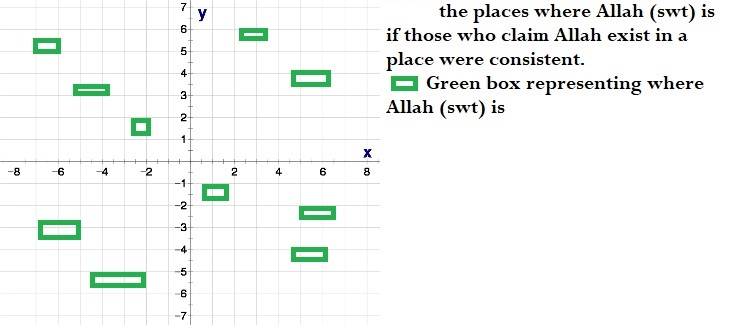
The consistent view would be that Allah is in a set of locations.

“Do they not consider the Qur’an (with care)? Had it been from other Than Allah, they would surely have found therein Much discrepancy.” (Qur’an 4:82)

﷽ 

Now if I was to follow that particular aqidah view I would have to be at least be consistent with myself and consistent with the text of the Qur’an. So again we have nothing stating that x/y is the default place for Allah (swt).

The correct view if we are to take the verses as they and apply a consistent methodology would be to say that Allah (swt) exist in a set [4,0 & 0,4 & 3,4 & 4,3 & 3,5 & 5,3 etc.…]

We describe Him (swt) by what has been authenticated that he described himself with. And we affirm for Him (swt) what the Prophet (saw) has affirmed for Him in his authentic Sunnah. As for those that say that we affirm for Allah what He has affirmed for Himself. They wanted from that to believe in the literal text and pass it as it came. For example, when He (Allah)-Great and Glorious God says:

“The Most Merciful [who is] above the Throne established.” (Qur’an 20:5) For this ayat (verse) when taken literally implies that Allah has a position, and he is above the throne, he says like this. This is the literal meaning.

And when I discussed with one of them regarding this,. I asked him, “Do you always stick to the literal meaning?”

He said, “Yes I do stick to the literal always, I don’t differ nor do I alter.” I said, “Let’s agree to stick to the literal meaning and I will agree on this ruling till a certain time, but I hope that you’ll stick to it and don’t change your words. Now me and you have both agreed on the same madhab and the same opinion.

Which is to say: The affirmation and passing of the ayats (verses) like they came, and taking the literal meanings, and building the belief upon it. (the opinion).

“Good”, he said, “Good”. I said, “Then this ayat (verse), Allah affirms a position for himself which is above the throne {The Most Merciful [who is] above the Throne established.} But in another ayat(verse) Allah says, “Indeed, my Lord is on a path [that is] straight.” (Qur’an 11:56)

Is the straight path the same as the throne or a different thing? Without doubt it’s another place, then this is a 2nd position. And you must affirm the literal meaning.

In a third ayat, Our Lord, Great and Glorious God says: “There are not three in a private conversation but that He is the fourth of them, nor are there five but that He is the sixth of them-and no less than that and no more except that He is with them.” (Qur’an 58:7)

This is a third place, different from the throne and different from the straight path.

And in a fourth ayat (verse), He (Allah) Great and Glorious God says about his Prophet Musa (as) ”No! Indeed, with me is my Lord; He will guide me.” Qur’an 26:62 and Musa (as) was on the beach of the Red Sea when he said this.

And in a fifth ayat, Allah tells us about our Prophet (saw) that he said when he was in Ghar Thawr (a cave that Muhammed-saw hid in)

“Have no fear, for Allah is with us.” (Qur’an 9:40)

And Allah tells us about his Khalil (Friend), Ibrahim (as) that he said: “I will go to my Lord! He will surely guide me!” (Qur’an 37:99)

And he (Allah) Great and Glorious God says in another ayat (verse) “But there he finds Allah, Who settles his account in full.” (Qur’an 24:39)

And he says in another ayat (verse) He says: “There is no creature but that He holds it by its forelock.” (Qur’an 11:56)

And the Prophet (saw) says in his Sunnah “A slave becomes nearest to his Lord when he is in prostration.” Source: (https://sunnah.com/riyadussalihin:1428)

And he says as well mentioning about Allah “Did you not know that my servant so and so was ill and yet you did not visit him? Did you not know that if you had visited him you would have found me with him?” Source: (https://sunnah.com/muslim:2569)

“When any one of you prays, he must not spit in front of him, for Allah is in front of him when he is engaged in prayer.” Source: (https://sunnah.com/bukhari:416)

Which of these literal meanings will you take? Now I am following your madhab.

On the throne? Or on the straight path, or is he the fourth of the three or the sixth of the fifth or in Ghar Thour, or on the beach of the Red Sea or in or where? Or in the prostration position?

He said: “All of these are not taken literally except {The Most Merciful [who is] above the Throne established.}”

I said: “Then you broke your ruling.” “You broke your ruling.”

Anyhow, taking the literal meaning falsifies the fact that the source of the Qur’an is from Allah. It falsifies that, why?

Because Allah says, “Had it been from anyone other than Allah, they would have certainly fund in it many inconsistencies.”(Qur’an 4:82) -and taking the literal meanings leads to that.

Sticking to the literal meaning leads to this inconsistency, because Allah Great and Glorious God affirms a hand for himself, and two hands, and affirms more than that..

{Allah’s hand is over theirs.}-Qur’an 48:10 {Rather, both his hands are extended}-Qur’an 5:64 {Do they not see that We have created for them from what Our hands have made, grazing livestock} –Qur’an 36:71

Which of these literal meanings will you take?

{sailing under Our ‘watchful’ Eyes} –Qur’an 54:14 { so that you would be brought up under My ‘watchful’ Eye.} –Qur’an 20:39 This is singular and that is plural, and lowest plural is 3 some say. 

So, which of these literal meaning will you take? {they would have certainly found in it many inconsistencies.}

Taking the literal meaning is a ruling that is broken and false but actually rotten and sluggish. It’s not looked upon and not depended upon. And it’s throwed to the side of the walls. The same is in the sunnah as well.

Those that take the path of affirming the attributes by affirming and passing them like they came and took the literal meaning have contradicted this ruling of theirs and have heavily crushed it and they have left it crumbled and fragmented and have not left a peaceful (part) of it ever!

And there’s nothing which implies that as much as the act of some when he came to the hadith “Do not curse Time, for it is Allah Who is Time.” Is it not like this?

Source: (https://sunnah.com/muslim:2247a)

He said: “No this hadith is not taken by the literal meaning.” (For it is Allah Who is Time) Else its literal meaning implies the divinity of time! Does it not?

Also, “I become the hearing with which he hears, his seeing with which he sees, his hand with which he strikes, and his leg with which he walks.” -taking the literal meaning leads to the belief of divine indwelling, is that not the case?

Source: (https://sunnah.com/qudsi40:25)

And they fight that very fiercely!!! Taking the literal meaning is a false method.

So when we say that we affirm what Allah has affirmed for himself we take out taking the literal meaning.

And when we say we affirm for Him (Allah) what the Prophet (saw) has affirmed for him in his Sunnah, then we mean the Mutawatir not any other.

What’s authentic about our Prophet (saw) in tawatur with clear mention of the attribute, in approval or rejection.

These people who ascribe to Allah (swt) a place are in error in their aqidah. May Allah (swt) guide them and us! May Allah (swt) forgive the Ummah!

You may be interested in reading the following:

May Allah Guide the Ummah.

May Allah Forgive the Ummah.

Leave a comment

Filed under Uncategorized

Ibn Taymiyya claims a large number of Sahabah (Companions) and Tabi’in (Followers) hated Ali Ibn Abi Talib

“Verily, those who believe and work deeds of righteousness, the Most Beneficent (Allah) will bestow love for them (in the hearts of the believers).” (Qur’an 19:96)

﷽ 

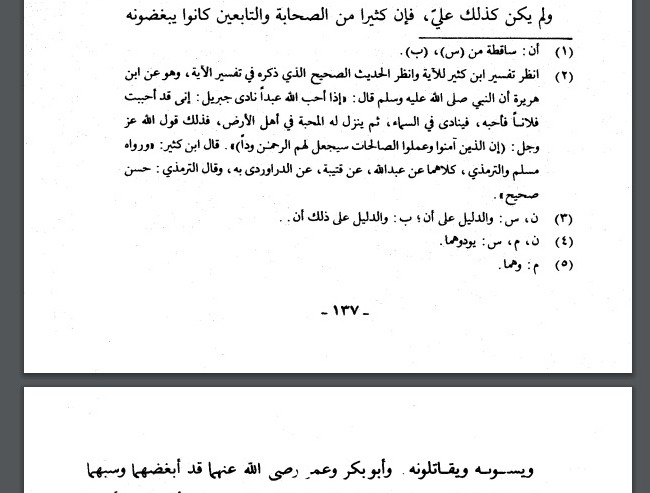
Ibn Taymiyya al Harrani in his as–Sunnah an-Nabawiyyah when he comments about the above ayat in relation to Ali ibn Abi Talib that:

“Allah (swt) has told that He will place on the believers and those that preform good, love. And this is a true promise from him. Especially for the Caliphs Abu Bakr (ra) and Umar Ibn Al Khattab (ra) for the general amount of companions loved them and they were the best periods of Islam. Ali was not like that, as a large number of companions (sahabah) and followers (tab’ieen) hated him, cursed him and fought him.”

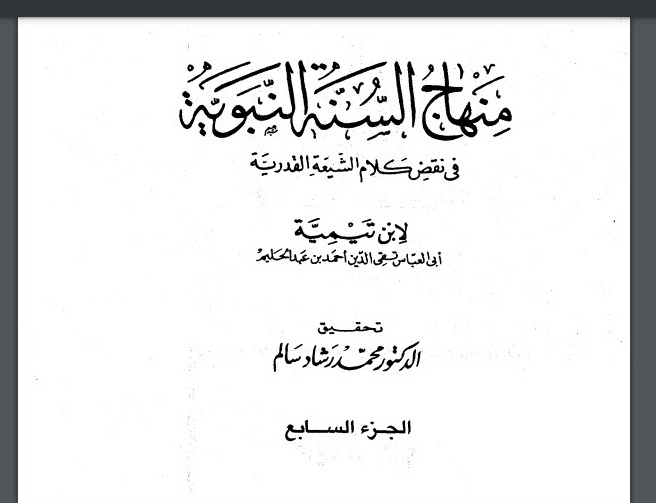
Source: (منهاج السنة النبوية في نقض كلام الشيعة والقدرية Minhaj al-Sunnah al-Nabawiyyah fi Naqd Kalam al-Shi’a wa al-Qadariyyah)

The implication (though not explicitly stated by Ibn Taymiyya) was that Ali was not of those who worked deeds of righteousness.

Ibn Taymiyya continues:

“They love and venerate him, while Abu Bakr and Umar – may God be pleased with them – have been hated and cursed by the Rafidah (Rejectors), the Nusayriyyah, the Ghulat (Extremists), and the Ismailis. However, it is known that those who loved those two (1) are better and more numerous, and that those who hated them are further from Islam and fewer.”

“This contradicts the case of Ali, for those who hated and fought him are better than those who hated Abu Bakr and Umar. In fact, the faction of Uthman, who love him and hate Ali, even if they are innovators and wrongdoers, are more knowledgeable and religious than the faction of Ali who love him and hate Uthman, and they are greater in jihad and justice. Thus, it is clear that the affection mandated for the three [first Caliphs] is greater.”

“And if it is said: ‘Claims of divinity and prophethood have been made about Ali (2),’ it is replied: ‘All the Khawarij considered him a disbeliever and the Marwaniyyah hated him. And these are better than the Rafidah who curse Abu Bakr and Umar – may God be pleased with them – let alone the Extremists (3).'”

Source: [Chapter: The Thirteenth Proof “You are only a warner, and for every people there is a guide.”]

You may be interested in reading the following:

May Allah Forgive the Ummah.

May Allah Guide the Ummah.

2 Comments

Filed under Uncategorized