
“Allah! There is no god except Him, the Ever-Living, All-Sustaining. Neither drowsiness nor sleep overtakes Him.” (Qur’an 2:55)

﷽
This article is written to explode one of the huge myths that is propagated by the Wahhabi sect. This Wahhabi sect also goes by the name of Salafiyah, or the Athari creed.
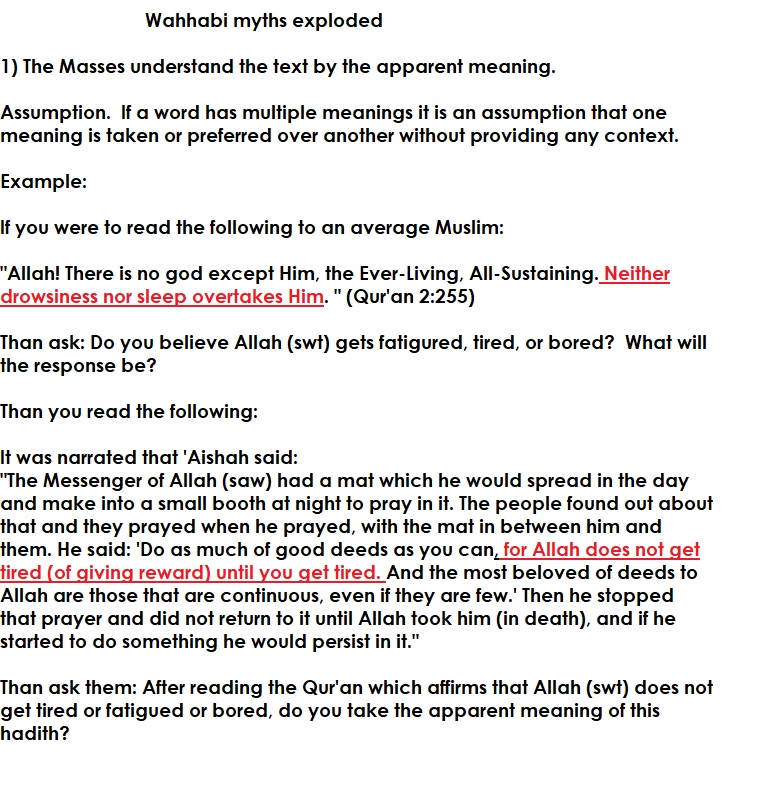
One of the most absurd theological positions to hold is the idea that Allah (swt) chose to communicate with mankind via a revelation that he himself said would need to be explained and he himself says it contains verses which are apparent in meaning and subject to layers of understanding, containing words that could have multiple meanings that one would walk a way with only one particular meaning on any given verse!
In our school, the Ibadi school we take the Qur’an as the primary source of evidence. We interpret the Qur’an by the Qur’an as the primary tafsir. Anything that conflicts with the Qur’an is heavily scrutinized. If on the apparent it looks as if it conflicts with the Qur’an a forensics analysis is done of the hadith on a few accounts.
- The sanad-the chain of narrators.
- The matn (the text itself).
- The eloquence of the language of the Prophet (saw).
In other words does this match the linguistic style of the Blessed Messenger (saw).
“DO not stir your tongue hastily (to commit the Revelation to memory). Surely it is for Us to have you commit it to memory and to recite it. And so when We recite it ,follow its recitation attentively; then it will be for Us to explain it.” (Qur’an 75:16-19)
“Allah! There is no god except Him, the Ever-Living, All-Sustaining. Neither drowsiness nor sleep overtakes Him.” (Qur’an 2:55)
The apparent meaning of the above verses is that Allah (swt) does not get tired, bored or fatigued.
However, this does not stop the Wahhabi/Athari from asserting that Allah (swt) gets bored-in a way that befits his majesty! May Allah (swt) protect us from the perverts!
Basing their information on the apparent meaning of the text of the following hadith:
“It was narrated that ‘Aishah said:
“The Messenger of Allah (saw) had a mat which he would spread in the day and make into a small booth at night to pray in it. The people found out about that and they prayed when he prayed, with the mat in between him and them. He said: ‘Do as much of good deeds as you can, for Allah does not get tired (of giving reward) until you get tired. And the most beloved of deeds to Allah are those that are continuous, even if they are few.’ Then he stopped that prayer and did not return to it until Allah took him (in death), and if he started to do something he would persist in it.”
Source: (https://sunnah.com/nasai:762)
You may seem them expound upon this here:
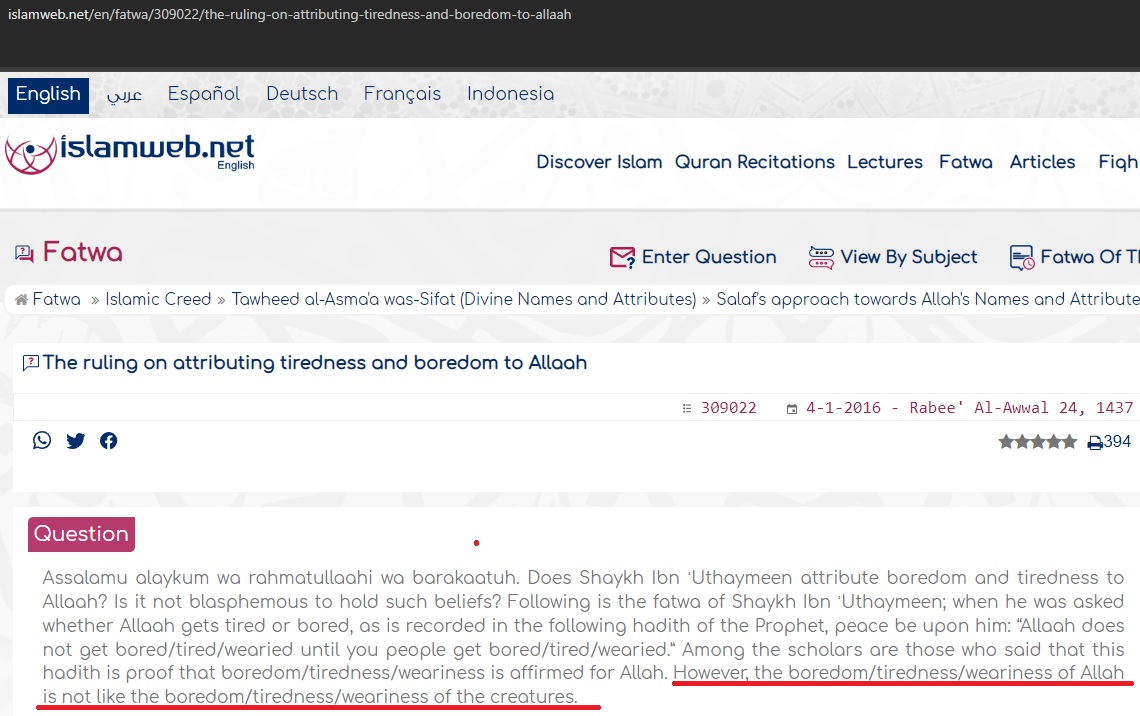
https://www.islamweb.net/en/fatwa/309022/the-ruling-on-attributing-tiredness-and-boredom-to-allaah
“However, the boredom/tiredness/weariness of Allah is not like the boredom/tiredness/weariness of the creatures.
Welcome to Salafiyah disarming Muslims of arguments against the deity of Jesus since….forever.
“Jesus was inside the boat, sleeping with his head on a pillow.” (Mark 4:38)
Salafi: “God doesn’t sleep!”
Christian: “Sure he does in a way that befits his majesty!”
So here the explanation goes some common sense, taw’il (interpretation) and some inconsistency. The link given above we read:
“As for the hadeeth that reads, ‘Allaah never gets tired until you get tired,’ some scholars held that this hadeeth serves as proof that the attribute of tiredness (or boredom) is affirmed for Allaah. However, the tiredness (or boredom) of Allaah is not like that of the creature. The tiredness of the creature is an imperfection, while that of Allaah is free of any imperfection. This is similar to all other attributes that we affirm for Allaah as an aspect of perfection although, when attributed to creatures, they are aspects of imperfection. Some scholars held that the statement, ‘Allaah never gets tired until you get tired,’ is meant to indicate that no matter how many good deeds you do, Allaah rewards you for them; so do whatever you wish for Allaah never gets tired of giving you rewards until you get tired of doing good deeds. Thus, what is meant by tiredness here is what such tiredness entails, which is stopping (to give rewards).Other scholars held that the hadeeth does not imply attributing tiredness to Allaah at all because when one says, ‘I shall not get up until you get up,’ this does not necessitate that the latter will get up. Similarly, ‘Allaah never gets tired until you get tired,’ does not necessitate affirming the attribute of tiredness for Allaah.In any case, it is incumbent on the Muslim to believe that Allaah is Exalted above any aspect of imperfection, be it tiredness, boredom, weariness or anything else. If it is established that this hadeeth is evidence to affirm the attribute of tiredness for Allaah, then we must believe that the tiredness of Allaah is nothing like that of the creatures.
” [Majmoo’ Al-Fataawa]
Prima Qur’an response: So we can see the answer is already given.
This absolutely has to be the case since the Qur’an categorically rejects, tiredness, sleepiness, boredom to Allah (swt)!
“Allah! There is no god except Him, the Ever-Living, All-Sustaining. Neither drowsiness nor sleep overtakes Him.” (Qur’an 2:55)
So for those of their scholars who affirm boredom of Allah (swt) maybe they could …I dunno…..perhaps pick up the Qur’an and read it?
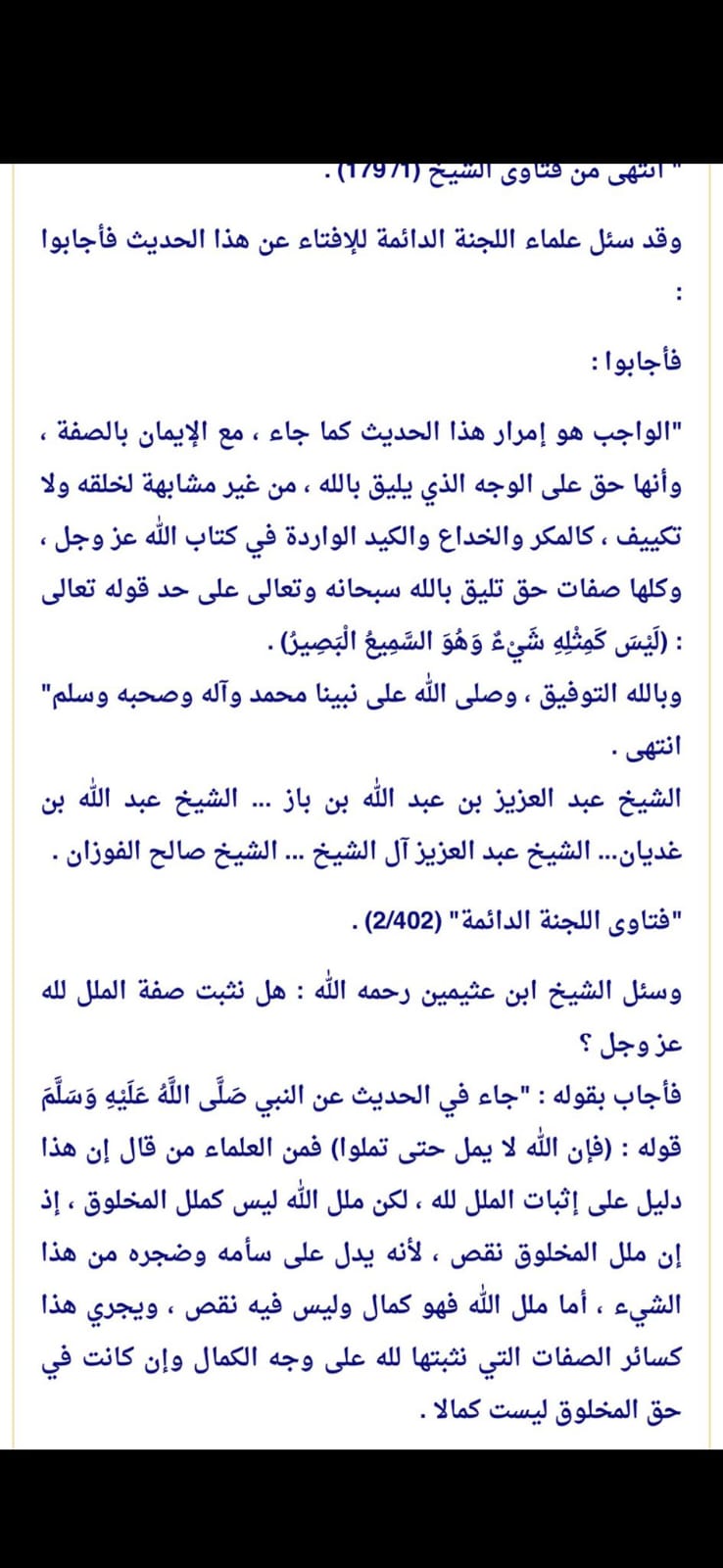
Ibn Taymiyya throws the idea of holding to the apparent meaning out the window.
He states in the link above:
““It is known that the principle held by Ahlus-Sunnah Wal-Jamaaʻah (mainstream Muslims) is that we describe Allaah only with what He describes Himself (in the Quran or the authentic Sunnah), without tamtheel (likening Allaah to His creation) or takyeef (trying to describe ‘how’ an attribute is by attempting to determine the manner in which attributes of Allaah take form). If this hadeeth indicates that Allaah is described with tiredness, then it should be noted that the tiredness of Allaah is not like our tiredness; rather, it is tiredness that is free from any aspect of imperfection or deficiency. As for the tiredness of human beings, it involves imperfection because it implies psychological and physical weariness because of a burden beyond one’s ability to endure. As for the tiredness of Allaah, if this hadeeth indicates it, then it is tiredness that befits Him. It is totally devoid of any aspect of imperfection. ” [Majmoo’ Al-Fataawa]”
But the very apparent meaning of one who gets tired or bored itself indicates need! The very apparent meaning of one who gets bored or tired is one who is deficient!
But for the Salafi/Athari the apparent meaning here will not suffice because of it’s obvious implication is that Allah (swt) -authubillah, gets tired and bored.
So the theology of the Salafi/Athari is superimposed upon the text. Than added to it is the Bid’ah addition which the Blessed Prophet (saw) nor any of his companions ever used….ever!
That bid’ah addition is “I a way that befits him” or “In a way that suits his majesty” etc…
Ibn Taymiyya flatly contradicts his own advise in the same discussion with a questioner!
“You know that the Prophet, sallallaahu ʻalayhi wa sallam, addressed his companions with this hadeeth and that they were keener than all of us on knowing the attributes of Allaah; did they ask the Messenger whether Allaah gets tired or not? Or did they rather say, ‘We hear and we believe that Allaah never gets tired (of giving rewards) until we get tired (of doing good deeds)?! The imperfection that tiredness implies is for us human beings, for Allaah is perfect in His Attributes. Hence, we must stop discussing and investigating this matter any further.”
Prima Qur’an: Very good Ibn Taymiyya well done!
Oops!
On second thought let us continue to discuss and investigate it as he does….
“As long as we do good deeds, then Allaah, The Exalted, rewards us, and He never gets tired of giving rewards until we get tired of doing good deeds.’ If you believe that getting tired in this sense is an imperfection in you, then do not attribute an imperfection to Allaah. Verily, it is tiredness befitting of Him. We know that if the attribute of tiredness is affirmed for Allaah, then this entails that it is free of all aspects of imperfection. I warn you, and I warn all listeners of going to extremes and delving deeper into such a serious issue. Instead, you should preoccupy yourselves with carrying out the religious obligations and duties instead of indulging in investigating the matters that you are not obliged to investigate.”
BEWARE THE SALAFI (WAHHABI) SMOKE AND MIRRORS!!!
“Oh the common people just take it at only one meaning, which happens to be what we affirm.”
Notice that the article in the link above continue to say:
At-Tahaawi  wrote:
“Someone may ask, ‘How could you accept to attribute this hadeeth to the Messenger of Allaah, sallallaahu ʻalayhi wa sallam, although it indicates describing Allaah with getting tired in a certain case, and this can never be an attribute of Allaah?’ Our answer is: Tiredness can never be an attribute of Allaah as mentioned, and it is not as he understood. Arabic linguists advised that the hadeeth that reads, ‘Allaah never gets tired until you get tired,’ means that tiredness is expected from you but not expected from Allaah. This is similar to what people commonly say when they describe someone as being a good speaker endowed with eloquence and great debate skills, that ‘he does not stop and give up his argument until his opponent does,’ referring to a merit of his in this regard because if they had intended that he does stop, then they would not be affirming a merit for him since he stops when his opponent stops just like his opponent. Rather, what they really mean is that he does not stop after his opponent stops and that he remains as powerful and capable as he was before his opponent stopped. Similar to that – and Allaah knows best – is the hadeeth that reads, ‘Allaah never gets tired until you get tired.’ It means that you may get tired (of performing good deeds), and stop; while Allaah, after you have gotten tired and stopped, is as He was before, never tiring and never stopping.” Source: [Sharh Mushkil Al-Aathaar]
Ah I see! So now we are appealing to Arabic linguist. It’s as if the Arabic language has depth and nuance, idiom and poetic expressions? Who would have thought?
Ibn ʻAbd Al-Barr wrote:
“With regard to the hadeeth that reads, ‘Allaah never gets tired until you get tired,’ the adjective ‘tired’ in this context is used to oppose the weariness on their part. It is well-known that Allaah, The Exalted, does not get tired regardless of whether people got tired or not, and nothing or nobody causes Him to get tired; Exalted is He above such imperfection. The hadeeth used a common style in the Arabic language, called mujaanasah, which means that if they (the Arabs) use a word as an answer and reward for another, it is the same as the original word though different in meaning. Examples on this style are clear in the verses that read (what means):
– {And the retribution for an evil act is an evil one like it…} [Quran 42:40]
– {So, whoever has assaulted you, then assault him in the same way that he has assaulted you.} [Quran 2:194]
In the first example, the second word ‘evil’ is merely for mujaanasah i.e. it does not convey its original meaning; it is only the same as the first. Of course, the reward of evil is not a similar evil, and retribution is not an assault because it is a due right.
The same applies to the following verses:
– {And the disbelievers plotted, but Allaah plotted. And Allaah is the best of plotters.} [Quran 3:54]
– {…they say, “Indeed, we are with you; we were only mockers.” (But) Allaah mocks them and prolongs them in their transgression (while) they wander blindly.} [Quran 2:14-15]
– {…Indeed, they are planning an evil plan, but I am planning an evil plan.} [Quran 86:15-16]
“The Arabic words for plotting, mocking, and evil planning used in the verses as the actions of Allaah are merely used for the sake of mujaanasah. Verily, Allaah, The Exalted, is above mocking, plotting, and planning evil; rather, the terms are used to indicate that Allaah shall punish them for their mockery, plotting, and evil planning. The same applies to the hadeeth that reads, ‘Allaah never gets tired until you get tired;’ the adjective ‘tired’ used for Allaah is merely used for the sake of mujaanasah…” Source: [At-Tamheed]
Imagine that! The Arabic language uses a grammatical device known as mujaanasah!
So be careful of those who pose simplistic scenarios that are dishonest to begin with.
The manner and context of the question is just as important as the question itself.
For example are we to believe that the majority of Muslims believe the literal Arabic of the following verse (easily missed in the English translation) but in the Arabic you have the wall “wanting” to collapse. So are we going to attribute a will to this wall?!
“So they moved on until they came to the people of a town. They asked them for food, but the people refused to give them hospitality. There they found a wall ready to collapse, so the man set it right. Moses protested, “If you wanted, you could have demanded a fee for this.”(Qur’an 18:77)
To read more on this topic I would encourage you to read the following:
May Allah (swt) guide us to what is beloved to him!
May Allah (swt) forgive the Ummah!


 Prima Quran