
“(We take our) colour from Allah, and who is better than Allah at colouring. We are His worshippers.” (Qur’an 2:138) -Pickthall
“(Our religion is) the Baptism of Allah: And who can baptize better than Allah? And it is He Whom we worship.” (Qur’an 2:138)-Yusuf Ali.
﷽
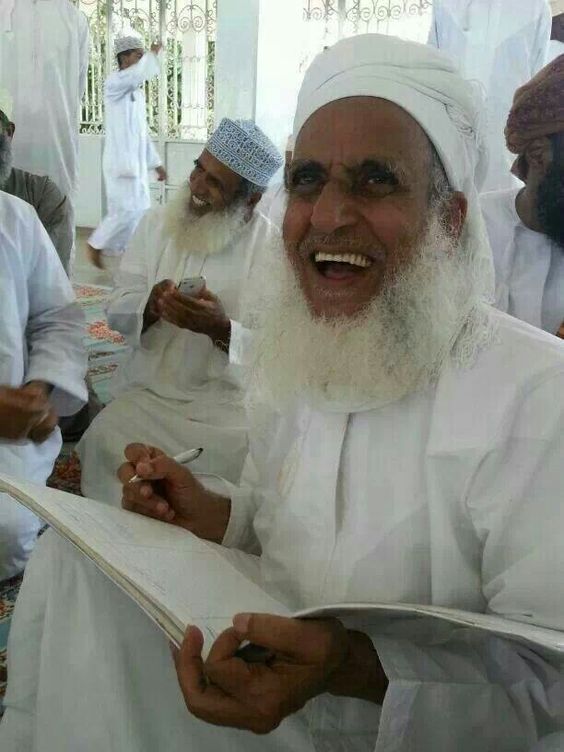
(Pictured above is Shaykh Ahmed Al Khalili (h) in a light moment.)
The following is a transcript of the respected Shaykh, Ahmed Al Khalili (h).
“The baptism of Allah” and who is better than Allah in baptism? And we are His worshippers. There is much disagreement concerning the meaning of “ṣibghah ” here; however, we find this disagreement expressed in two main views.
The first view is held by those who say that what is meant by “ṣibghah ” here is whatAllah may He be exalted and glorified has instilled in the hearts of His believing servants of loyalty to Him, obedience to Him, faith in Him and in the prophets, faith in what was revealed to them, and action in accordance with that faith. This view indicates that Allah may He be exalted has planted the meanings of faith in the believers, and its effects have appeared in their conduct. These effects are like an outward, visible dye, by which they are distinguished from all other people.
The terms ṣibghah and ṣibgh are also used to refer to character, dispositions, and the upbringing that a father gives his children. An example is the poet’s saying: “Every people have their own dye/character, and the dye/character of Hamdan is the best of dyes; we raise our children upon that, so how excellent is our dye among dyers!” For what is meant by ṣibghah here is the psychological upbringing whose psychological effects manifest in behavior.
To this view reverts the interpretation of those who explain ṣibghah as religion, those who explain it as innate nature (fiṭrah), those who explain it as sacred law (sharī’ah), and those who explain it as the seal/stamp for those who interpret ṣibghah as the seal have understood the concept of ṣibghah in this sense.
The second view is that ṣibghah is mentioned by way of literary parallelism (mushākalah) specifically, confirmatory parallelism because some of the Jews, in ages past, used to perform a bath of repentance. This practice continued until it resulted in what came to be called baptism (ta’mīd) and the sacrament of baptism (ma’mūdiyyah) among some of the Christians. The origin of this was that when one of their priests offered a sacrifice of repentance for a sin he had committed, or for a sin committed by his household, as well as during festivals the festivals of repentance for the general sins of the Children of Israel they would bathe. They continued this practice.
It was said that when John son of Zechariah (peace be upon him) would call people to repentance and remorse, just as they used to repent, and he would command them to bathe in the Jordan River. This was called in Aramaic ma’mūdhā or ma’mūthā, meaning purification. When Jesus (peace be upon him) received the revelation, he had first bathed and washed. The Arabs rendered the word ma’mūdh as ma’mūl and derived from it the terms al-ta’mīd and al-ta’mud (baptism). Thus, one who converted to Christianity was said to have been “baptized” (ta’mada) if he performed that washing which is followed by entering Christianity. And they said of those priests of the Christians who administer this rite in bringing someone into Christianity that he “baptizes” (‘ammada) or is “a baptizer” (mu’ammid).
It was said that when severe disagreement arose between John son of Zechariah and Jesus (peace be upon them both) on one side, and the Jews on the other, the Jews abandoned this washing, so it remained among the Christians and they continued it. Some of them began baptizing their children on the seventh day, saying to the one they baptized on that day: “Today you have truly become an Israelite” that is, on the seventh day after his birth, they wash him in water. This water is kept in basins in the churches, and they claim that in this water there are remnants of the water with which Jesus (peace be upon him) bathed and which dripped from his body. Whenever the water is about to run out, they add new water to it, so that those drops which they claim remain would continue to exist in that water. This water is what is called “the water of baptism” (mā’ al-ma’mūliyyah).
Based on this based on this view the noble verse contains a parallelism, meaning: If you are immersing yourselves in this water by which you enter into your religion, or by which you bring people into your religion, or by which you bring your children into your religion, then we have been dyed with Allah’s baptism.
It is also said that this water the Jews used to call ghimās in the bath from ṣaba’a yaṣba’u meaning “to immerse” in the Hebrew language. When the Arabs Arabized that, they disliked using the root ṣ-b-‘_ because it does not convey this meaning in Arabic. So they rendered this word using the root ṣ-b-gh instead. That is why it was called ṣibgh, ṣibghah, and ṣibghah.
As for ṣibghah it is either a verbal noun indicating a state or manner, like jilsah (a sitting posture), or it is a passive participle, because the passive participle can come on the pattern fi’l and fi’lah as in ṭiḥn meaning “ground flour,” wid meaning “found,” ḥib meaning “beloved” and likewise it comes on the pattern fi’lah when one intends femininity, like ṣibghah and wishqah for something split/cracked.
There is much disagreement regarding the grammatical declension of ṣibghah here. Some say that ṣibghah is a substitute (badal) for “the religion of Abraham” (millat Ibrāhīm) so whoever reads millata Ibrāhīma in the accusative, reads ṣibghata in the accusative; and whoever reads it in the nominative, reads ṣibghatu in the nominative. Others say it is an emphatic verbal noun (maṣdar mu’akkid) that emphasizes the meaning in Allah’s saying: “Say: We believe in Allah and what was revealed to us…” i.e., faith as Allah’s baptism; this faith is the baptism. Some say it is an emphasis for the entire preceding sentence, as in Allah’s saying may He be exalted “And on that day the believers will rejoice in Allah’s help; He helps whom He wills, and He is the Mighty, the Merciful. [This is] Allah’s promise” so the verbal noun “Allah’s promise” emphasizes the entire preceding sentence, not a previously implied verbal noun. Similarly, “The baptism of Allah” “And who is better than Allah in baptism?” i.e., we are baptized/immersed in Allah’s baptism, or the religion of Abraham is Allah’s baptism, or faith is Allah’s baptism, or adherence to Allah’s baptism. “And who is better than Allah in baptism?” — i.e., who is there whose baptism is better than Allah’s baptism? The interrogative here is rhetorical, meaning negation, indicating denial.
“And we are His worshippers” i.e., we are submissive to Him, or we are obedient to Him, or we are humbly devoted to Him, or we are submissive to Him. All of this has been mentioned in the interpretation of worship (‘ibādah) and servitude (u’būdah), as previously explained in Sūrat al-Fātiḥah that it is absolute humility that emanates from the soul with a consciousness inspired by correct belief in the Creator, may He be exalted and glorified. This is the correct worship required of man.
“And we are His” i.e., for Allah alone, not for any other i.e., we do not associate any partner with Him “worshippers.” Therefore, the related element (the prepositional phrase) is placed before the predicate (‘ābidūn) to indicate exclusivity. In this there is a subtle allusion to the Jews and Christians who worshipped other than Allah, may He be exalted and glorified.
We will now conclude at this point, asking Allah may He be exalted for success and right guidance. He is the One who grants success. And may the blessings and peace of Allah be upon our master Muḥammed, and upon his family and all his companions. Exalted is your Lord, the Lord of might, above what they describe. And peace be upon the messengers. And praise be to Allah, Lord of all worlds.
The following is from Dr. Ahmed bin Jabir Al Miskiri (h). May Allah (swt) reward him for this. It is a more precise and technical understanding of the above discussion.
baptism/colouring] of Allah. And who is better than Allah in baptism? And we are worshippers of Him.” There has been much disagreement regarding the sibghah, yet we restrict this disagreement to two opinions: The first is the view of those who said that what is meant by the sibghah here is what Allah, the Glorified and Exalted, has infused into the hearts of His believing servants of their loyalty and obedience to Allah, the Glorified and Exalted, their belief in Him, in the prophets, and in what was sent down to them, and their acting in accordance with this faith. For this opinion indicates that Allah, the Glorified and Exalted, implanted in the believers the matters of faith, so their effects appeared upon their conduct, making these effects akin to a clear, manifest dye, by which they were distinguished from all other people.
The Arabs apply the term sibghah to morals, natural dispositions, and the upbringing with which a father raises his sons. From that is the poet’s saying: “And every people have a sibghah, and the sibghah of Hamdan is the best of sibgh; we have dyed our sons upon that, so how noble is our sibghah in the sibgh!” Indeed, what is meant by sibghah here is the upbringing whose psychological effects appear in conduct. And to this opinion returns the view of whoever interpreted sibghah as religion, whoever interpreted sibghah as the natural disposition (fitrah), whoever interpreted sibghah as the divine law (sharia), and whoever interpreted sibghah as circumcision. By my life, indeed whoever interpreted sibghah as circumcision has certainly narrowed the concept of sibghah!
The second opinion is that sibghah was mentioned by way of estimated matching (mushākalah); becauses some of the Jews, in bygone ages, used to perform the ritual bath of repentance, and this ritual bath continued until it resulted in what came to be called baptism and baptismal practices among some of the Christians. And the origin of that: that the priests one of them, when presenting a sacrifice of repentance for a sin he committed or a sin committed by the people of his household, and likewise during the feasts of repentance for the general sins of the Children of Israel used to bathe, and they continued to do so.
It was said that when John the son of Zechariah, peace be upon him, was calling the people to repentance, and whenever they repented, he would command them to bathe from the stream of the Jordan. And this was called in the Aramaic language (ma’mūdhut or ma’mūdhutā) meaning purification. And Jesus, peace be upon him, when he received the revelation, had first taken a bath and washed. The Arabs arabized the word (ma’mūdhut) into the word (ma’mūd), and they derived from it baptism (ta’mīd) and being baptized (ta’amud). So it was said of one who Christianized: “He was baptized” when he performed that bath which is followed by his embracing of Christianity. And they said of whoever performs that from among the Christian priests in admitting someone into Christianity: “He baptizes” or “he is a baptizer.”
It was said that when the severe disagreement arose between John the son of Zechariah and Jesus, peace be upon them, on the one hand, and the Jews on the other hand, the Jews abandoned this ritual bath, so it remained among some of the Christians and they persisted in it. And some of them when they began to baptize their children on the seventh day, and they say to the one for whom they baptized: “Today you have truly become a Christian.” The child on the seventh day of his birth is washed by them in water. This water is prepared in basins in the churches, and they claim that in this water are remnants of the water with which Jesus, peace be upon him, washed and which dripped from his body.
Whenever the water was on the verge of running out, they added new water to it so that those droplets which they claim remain present in that water might persist; this water is what is called the water of baptism. Based on this opinion, there is in the noble verse a matching (mushākalah); meaning: If you dye yourselves with this water with which you enter your religion, or with which you bring people into your religion, or with which you bring your children into your religion, then we have indeed dyed ourselves with the sibghah of Allah, the Exalted.
It is said that this water the Jews used to call the act of dipping into it (al-sab’-) from (saba’a, yasba’u) meaning to plunge in the Hebrew language. When the Arabs arabized that, they found it distasteful to use the root (saba’a) because it is a root that does not indicate this meaning in the Arabic language, so they arabized this word by dotting the ghayn (changing it to sabagha). Therefore, that was called sabghan, sibghan, and sibghah.
And sibghah is either an infinitive noun indicating state/manner like al-jilsah, or it is a passive participle, because the passive participle is brought in the measure of fi’l and fi’lah, like tihlun meaning ground, jaddun meaning existing, and hibbun meaning beloved. Likewise, the measure of fi’lah is brought when feminine intent is intended, like sibghah and shiqfah for a broken piece.
There has been much disagreement regarding the parsing (i’rāb) of al-sibghah here: some of them said that al-sibghah is in apposition (badal) to millata Ibrahima. Therefore, whoever recited millata Ibrahima in the accusative in recitation recited sibghata in the accusative, and whoever raised it raised it. And it was said: It is an emphatic verbal noun (maṣdar mu’akkid); it emphasizes the meaning in His saying, the Most High: {Say, “We have believed in Allah and what has been revealed to us”} meaning: as faith, the sibghah of Allah. This faith is the sibghah of Allah.
Some of them said that it is an affirmation for the entire sentence, as in his saying: It is an emphatic verbal noun for the entire preceding sentence, not an emphasis for a prior estimated verbal noun. Similar to this is the saying of Allah, the Glorified and Exalted: {And that Day the believers will rejoice * in the victory of Allah. He gives victory to whom He wills, and He is the Exalted in Might, the Merciful * The promise of Allah}. The verbal noun is wa’da Allah meaning: Allah promised you that, His promise. This verbal noun emphasizes the entire preceding sentence: Sibghata Allah wa man ahsana min Allahi sibghah meaning: We are dyed with the sibghah of Allah, or the religion of Abraham is the sibghah of Allah, or as faith, the sibghah of Allah, or adhere to the sibghah of Allah.
And wa man ahsana min Allahi sibghah? Meaning: Which person is better in sibghah than Allah? And the intent is: Which sibghah from any person is better than the sibghah of Allah? The interrogation here is in the meaning of negation, indicating negation.
And wa nahnu lahu ‘ābidaūn; meaning: and we are submissive to Him, or and we are humbly submissive to Him, or and we are obedient to Him all of that has been said in the exegesis of worship (‘ibādah). Worship, as previously explained in Surah Al-Fatihah, is: absolute submission that stems from the soul with a feeling inspired by the correct belief in the Creator, the Glorified and Exalted; this is the correct worship required from man.
And nahnu lahu meaning to Allah alone, not to anyone else. Meaning: we do not associate anyone else with Him as worshippers (‘ābidūn). Therefore, the dependent element which is the preposition and its genitive was advanced over the dependent element which is ‘ābidūn for the sake of conferring restriction (ḥasr). And in this is an insinuation against the Jews and the Christians who worshipped other than Allah, the Glorified and Exalted.”
What are the key points from all of this?
The Two Main Interpretations
First Opinion: Metaphorical / Spiritual
- Ṣibghah refers to the inward imprint of faith that Allah places in the hearts of believers.
- It manifests in loyalty, obedience, belief in Allah and His prophets, and righteous action.
- This faith becomes like a visible dye that distinguishes believers from others in their character and conduct.
- The term is also linked to morals, natural disposition (fiṭrah), religion (dīn), divine law (sharī’ah), and even upbringing as in the poet’s example where a father “dyes” his children with his tribe’s noble values.
- One interpreter even said it means circumcision, though Dr. Ahmed bin Jabir Al Miskiri (h) alternative translation adds a critical note that this narrows the concept too much.
Second Opinion: Historical / Ritual (Parallelism with some strands of Judaism and/or some strrands of Christian Baptism)
- The word ṣibghah is used here as literary parallelism (mushākalah)—a rhetorical device where the Quran uses a term familiar to its audience to make a point, without adopting their literal meaning.
- Background: Some Jews practiced ritual washing for repentance a practice that continued and evolved into Christian baptism (ma’mūdiyyah).
- It was said that John the Baptist called people to repent and wash in the Jordan; Jesus also washed before receiving revelation.
- The Aramaic term for this was ma’mūdhā (purification), which the Arabs Arabized into ma’mūd and derived ta’mīd (baptism).
- It was noted that some Christian groups later baptized infants on the seventh day, using “holy water” kept in church basins. Water they believed contained remnants of the water Jesus used.
- The Quranic twist: The verse is saying: “If you (Jews/Christians) dye/immerse yourselves in your ritual water, we (Muslims) have been dyed with Allah’s own baptism far superior.” It’s a rhetorical rebuttal, not an endorsement of the ritual.
3. Grammatical and Linguistic Analysis
- Ṣibghah can be:
- A verbal noun indicating manner/state (like jilsah = posture).
- A passive participle (like ṭiḥn = ground flour, ḥib = beloved).
- Its grammatical role in the verse is debated:
- Some say it’s in apposition (badal) to “the religion of Abraham” (millat Ibrāhīm).
- Others say it’s an emphatic verbal noun reinforcing the preceding statement of faith.
- Others say it emphasizes the entire preceding sentence, similar to wa’da Allāh (Allah’s promise) in another verse.
- The phrase “wa man aḥsanu mina Allāhi ṣibghah” is a rhetorical question meaning: “No one has a better baptism/colouring than Allah.”
May the researcher and seeker of truth find this beneficial insh’Allah.
May Allah Guide the Ummah.
May Allah Forgivfe the Ummah.


