“(We take our) colour from Allah, and who is better than Allah at colouring. We are His worshippers.” (Qur’an 2:138) -Pickthall
“(Our religion is) the Baptism of Allah: And who can baptize better than Allah? And it is He Whom we worship.” (Qur’an 2:138)-Yusuf Ali.
﷽
(Pictured above is Shaykh Ahmed Al Khalili (h) in a light moment.)
The following is a transcript of the respected Shaykh, Ahmed Al Khalili (h).
“The baptism of Allah” and who is better than Allah in baptism? And we are His worshippers. There is much disagreement concerning the meaning of “ṣibghah ” here; however, we find this disagreement expressed in two main views.
The first view is held by those who say that what is meant by “ṣibghah ” here is whatAllah may He be exalted and glorified has instilled in the hearts of His believing servants of loyalty to Him, obedience to Him, faith in Him and in the prophets, faith in what was revealed to them, and action in accordance with that faith. This view indicates that Allah may He be exalted has planted the meanings of faith in the believers, and its effects have appeared in their conduct. These effects are like an outward, visible dye, by which they are distinguished from all other people.
The terms ṣibghah and ṣibgh are also used to refer to character, dispositions, and the upbringing that a father gives his children. An example is the poet’s saying: “Every people have their own dye/character, and the dye/character of Hamdan is the best of dyes; we raise our children upon that, so how excellent is our dye among dyers!” For what is meant by ṣibghah here is the psychological upbringing whose psychological effects manifest in behavior.
To this view reverts the interpretation of those who explain ṣibghah as religion, those who explain it as innate nature (fiṭrah), those who explain it as sacred law (sharī’ah), and those who explain it as the seal/stamp for those who interpret ṣibghah as the seal have understood the concept of ṣibghah in this sense.
The second view is that ṣibghah is mentioned by way of literary parallelism (mushākalah) specifically, confirmatory parallelism because some of the Jews, in ages past, used to perform a bath of repentance. This practice continued until it resulted in what came to be called baptism (ta’mīd) and the sacrament of baptism (ma’mūdiyyah) among some of the Christians. The origin of this was that when one of their priests offered a sacrifice of repentance for a sin he had committed, or for a sin committed by his household, as well as during festivals the festivals of repentance for the general sins of the Children of Israel they would bathe. They continued this practice.
It was said that when John son of Zechariah (peace be upon him) would call people to repentance and remorse, just as they used to repent, and he would command them to bathe in the Jordan River. This was called in Aramaic ma’mūdhā or ma’mūthā, meaning purification. When Jesus (peace be upon him) received the revelation, he had first bathed and washed. The Arabs rendered the word ma’mūdh as ma’mūl and derived from it the terms al-ta’mīd and al-ta’mud (baptism). Thus, one who converted to Christianity was said to have been “baptized” (ta’mada) if he performed that washing which is followed by entering Christianity. And they said of those priests of the Christians who administer this rite in bringing someone into Christianity that he “baptizes” (‘ammada) or is “a baptizer” (mu’ammid).
It was said that when severe disagreement arose between John son of Zechariah and Jesus (peace be upon them both) on one side, and the Jews on the other, the Jews abandoned this washing, so it remained among the Christians and they continued it. Some of them began baptizing their children on the seventh day, saying to the one they baptized on that day: “Today you have truly become an Israelite” that is, on the seventh day after his birth, they wash him in water. This water is kept in basins in the churches, and they claim that in this water there are remnants of the water with which Jesus (peace be upon him) bathed and which dripped from his body. Whenever the water is about to run out, they add new water to it, so that those drops which they claim remain would continue to exist in that water. This water is what is called “the water of baptism” (mā’ al-ma’mūliyyah).
Based on this based on this view the noble verse contains a parallelism, meaning: If you are immersing yourselves in this water by which you enter into your religion, or by which you bring people into your religion, or by which you bring your children into your religion, then we have been dyed with Allah’s baptism.
It is also said that this water the Jews used to call ghimās in the bath from ṣaba’a yaṣba’u meaning “to immerse” in the Hebrew language. When the Arabs Arabized that, they disliked using the root ṣ-b-‘_ because it does not convey this meaning in Arabic. So they rendered this word using the root ṣ-b-gh instead. That is why it was called ṣibgh, ṣibghah, and ṣibghah.
As for ṣibghah it is either a verbal noun indicating a state or manner, like jilsah (a sitting posture), or it is a passive participle, because the passive participle can come on the pattern fi’l and fi’lah as in ṭiḥn meaning “ground flour,” wid meaning “found,” ḥib meaning “beloved” and likewise it comes on the pattern fi’lah when one intends femininity, like ṣibghah and wishqah for something split/cracked.
There is much disagreement regarding the grammatical declension of ṣibghah here. Some say that ṣibghah is a substitute (badal) for “the religion of Abraham” (millat Ibrāhīm) so whoever reads millata Ibrāhīma in the accusative, reads ṣibghata in the accusative; and whoever reads it in the nominative, reads ṣibghatu in the nominative. Others say it is an emphatic verbal noun (maṣdar mu’akkid) that emphasizes the meaning in Allah’s saying: “Say: We believe in Allah and what was revealed to us…” i.e., faith as Allah’s baptism; this faith is the baptism. Some say it is an emphasis for the entire preceding sentence, as in Allah’s saying may He be exalted “And on that day the believers will rejoice in Allah’s help; He helps whom He wills, and He is the Mighty, the Merciful. [This is] Allah’s promise” so the verbal noun “Allah’s promise” emphasizes the entire preceding sentence, not a previously implied verbal noun. Similarly, “The baptism of Allah” “And who is better than Allah in baptism?” i.e., we are baptized/immersed in Allah’s baptism, or the religion of Abraham is Allah’s baptism, or faith is Allah’s baptism, or adherence to Allah’s baptism. “And who is better than Allah in baptism?” — i.e., who is there whose baptism is better than Allah’s baptism? The interrogative here is rhetorical, meaning negation, indicating denial.
“And we are His worshippers” i.e., we are submissive to Him, or we are obedient to Him, or we are humbly devoted to Him, or we are submissive to Him. All of this has been mentioned in the interpretation of worship (‘ibādah) and servitude (u’būdah), as previously explained in Sūrat al-Fātiḥah that it is absolute humility that emanates from the soul with a consciousness inspired by correct belief in the Creator, may He be exalted and glorified. This is the correct worship required of man.
“And we are His” i.e., for Allah alone, not for any other i.e., we do not associate any partner with Him “worshippers.” Therefore, the related element (the prepositional phrase) is placed before the predicate (‘ābidūn) to indicate exclusivity. In this there is a subtle allusion to the Jews and Christians who worshipped other than Allah, may He be exalted and glorified.
We will now conclude at this point, asking Allah may He be exalted for success and right guidance. He is the One who grants success. And may the blessings and peace of Allah be upon our master Muḥammed, and upon his family and all his companions. Exalted is your Lord, the Lord of might, above what they describe. And peace be upon the messengers. And praise be to Allah, Lord of all worlds.
The following is from Dr. Ahmed bin Jabir Al Miskiri (h). May Allah (swt) reward him for this. It is a more precise and technical understanding of the above discussion.
baptism/colouring] of Allah. And who is better than Allah in baptism? And we are worshippers of Him.” There has been much disagreement regarding the sibghah, yet we restrict this disagreement to two opinions: The first is the view of those who said that what is meant by the sibghah here is what Allah, the Glorified and Exalted, has infused into the hearts of His believing servants of their loyalty and obedience to Allah, the Glorified and Exalted, their belief in Him, in the prophets, and in what was sent down to them, and their acting in accordance with this faith. For this opinion indicates that Allah, the Glorified and Exalted, implanted in the believers the matters of faith, so their effects appeared upon their conduct, making these effects akin to a clear, manifest dye, by which they were distinguished from all other people.
The Arabs apply the term sibghah to morals, natural dispositions, and the upbringing with which a father raises his sons. From that is the poet’s saying: “And every people have a sibghah, and the sibghah of Hamdan is the best of sibgh; we have dyed our sons upon that, so how noble is our sibghah in the sibgh!” Indeed, what is meant by sibghah here is the upbringing whose psychological effects appear in conduct. And to this opinion returns the view of whoever interpreted sibghah as religion, whoever interpreted sibghah as the natural disposition (fitrah), whoever interpreted sibghah as the divine law (sharia), and whoever interpreted sibghah as circumcision. By my life, indeed whoever interpreted sibghah as circumcision has certainly narrowed the concept of sibghah!
The second opinion is that sibghah was mentioned by way of estimated matching (mushākalah); becauses some of the Jews, in bygone ages, used to perform the ritual bath of repentance, and this ritual bath continued until it resulted in what came to be called baptism and baptismal practices among some of the Christians. And the origin of that: that the priests one of them, when presenting a sacrifice of repentance for a sin he committed or a sin committed by the people of his household, and likewise during the feasts of repentance for the general sins of the Children of Israel used to bathe, and they continued to do so.
It was said that when John the son of Zechariah, peace be upon him, was calling the people to repentance, and whenever they repented, he would command them to bathe from the stream of the Jordan. And this was called in the Aramaic language (ma’mūdhut or ma’mūdhutā) meaning purification. And Jesus, peace be upon him, when he received the revelation, had first taken a bath and washed. The Arabs arabized the word (ma’mūdhut) into the word (ma’mūd), and they derived from it baptism (ta’mīd) and being baptized (ta’amud). So it was said of one who Christianized: “He was baptized” when he performed that bath which is followed by his embracing of Christianity. And they said of whoever performs that from among the Christian priests in admitting someone into Christianity: “He baptizes” or “he is a baptizer.”
It was said that when the severe disagreement arose between John the son of Zechariah and Jesus, peace be upon them, on the one hand, and the Jews on the other hand, the Jews abandoned this ritual bath, so it remained among some of the Christians and they persisted in it. And some of them when they began to baptize their children on the seventh day, and they say to the one for whom they baptized: “Today you have truly become a Christian.” The child on the seventh day of his birth is washed by them in water. This water is prepared in basins in the churches, and they claim that in this water are remnants of the water with which Jesus, peace be upon him, washed and which dripped from his body.
Whenever the water was on the verge of running out, they added new water to it so that those droplets which they claim remain present in that water might persist; this water is what is called the water of baptism. Based on this opinion, there is in the noble verse a matching (mushākalah); meaning: If you dye yourselves with this water with which you enter your religion, or with which you bring people into your religion, or with which you bring your children into your religion, then we have indeed dyed ourselves with the sibghah of Allah, the Exalted.
It is said that this water the Jews used to call the act of dipping into it (al-sab’-) from (saba’a, yasba’u) meaning to plunge in the Hebrew language. When the Arabs arabized that, they found it distasteful to use the root (saba’a) because it is a root that does not indicate this meaning in the Arabic language, so they arabized this word by dotting the ghayn (changing it to sabagha). Therefore, that was called sabghan, sibghan, and sibghah.
And sibghah is either an infinitive noun indicating state/manner like al-jilsah, or it is a passive participle, because the passive participle is brought in the measure of fi’l and fi’lah, like tihlun meaning ground, jaddun meaning existing, and hibbun meaning beloved. Likewise, the measure of fi’lah is brought when feminine intent is intended, like sibghah and shiqfah for a broken piece.
There has been much disagreement regarding the parsing (i’rāb) of al-sibghah here: some of them said that al-sibghah is in apposition (badal) to millata Ibrahima. Therefore, whoever recited millata Ibrahima in the accusative in recitation recited sibghata in the accusative, and whoever raised it raised it. And it was said: It is an emphatic verbal noun (maṣdar mu’akkid); it emphasizes the meaning in His saying, the Most High: {Say, “We have believed in Allah and what has been revealed to us”} meaning: as faith, the sibghah of Allah. This faith is the sibghah of Allah.
Some of them said that it is an affirmation for the entire sentence, as in his saying: It is an emphatic verbal noun for the entire preceding sentence, not an emphasis for a prior estimated verbal noun. Similar to this is the saying of Allah, the Glorified and Exalted: {And that Day the believers will rejoice * in the victory of Allah. He gives victory to whom He wills, and He is the Exalted in Might, the Merciful * The promise of Allah}. The verbal noun is wa’da Allah meaning: Allah promised you that, His promise. This verbal noun emphasizes the entire preceding sentence: Sibghata Allah wa man ahsana min Allahi sibghah meaning: We are dyed with the sibghah of Allah, or the religion of Abraham is the sibghah of Allah, or as faith, the sibghah of Allah, or adhere to the sibghah of Allah.
And wa man ahsana min Allahi sibghah? Meaning: Which person is better in sibghah than Allah? And the intent is: Which sibghah from any person is better than the sibghah of Allah? The interrogation here is in the meaning of negation, indicating negation.
And wa nahnu lahu ‘ābidaūn; meaning: and we are submissive to Him, or and we are humbly submissive to Him, or and we are obedient to Him all of that has been said in the exegesis of worship (‘ibādah). Worship, as previously explained in Surah Al-Fatihah, is: absolute submission that stems from the soul with a feeling inspired by the correct belief in the Creator, the Glorified and Exalted; this is the correct worship required from man.
And nahnu lahu meaning to Allah alone, not to anyone else. Meaning: we do not associate anyone else with Him as worshippers (‘ābidūn). Therefore, the dependent element which is the preposition and its genitive was advanced over the dependent element which is ‘ābidūn for the sake of conferring restriction (ḥasr). And in this is an insinuation against the Jews and the Christians who worshipped other than Allah, the Glorified and Exalted.”
What are the key points from all of this?
The Two Main Interpretations
First Opinion: Metaphorical / Spiritual
Ṣibghah refers to the inward imprint of faith that Allah places in the hearts of believers.
It manifests in loyalty, obedience, belief in Allah and His prophets, and righteous action.
This faith becomes like a visible dye that distinguishes believers from others in their character and conduct.
The term is also linked to morals, natural disposition (fiṭrah), religion (dīn), divine law (sharī’ah), and even upbringing as in the poet’s example where a father “dyes” his children with his tribe’s noble values.
One interpreter even said it means circumcision, though Dr. Ahmed bin Jabir Al Miskiri (h) alternative translation adds a critical note that this narrows the concept too much.
Second Opinion: Historical / Ritual (Parallelism with some strands of Judaism and/or some strrands of Christian Baptism)
The word ṣibghah is used here as literary parallelism (mushākalah)—a rhetorical device where the Quran uses a term familiar to its audience to make a point, without adopting their literal meaning.
Background: Some Jews practiced ritual washing for repentance a practice that continued and evolved into Christian baptism (ma’mūdiyyah).
It was said that John the Baptist called people to repent and wash in the Jordan; Jesus also washed before receiving revelation.
The Aramaic term for this was ma’mūdhā (purification), which the Arabs Arabized into ma’mūd and derived ta’mīd (baptism).
It was noted that some Christian groups later baptized infants on the seventh day, using “holy water” kept in church basins. Water they believed contained remnants of the water Jesus used.
The Quranic twist: The verse is saying: “If you (Jews/Christians) dye/immerse yourselves in your ritual water, we (Muslims) have been dyed with Allah’s own baptism far superior.” It’s a rhetorical rebuttal, not an endorsement of the ritual.
3. Grammatical and Linguistic Analysis
Ṣibghah can be:
A verbal noun indicating manner/state (like jilsah = posture).
“(We take our) colour from Allah, and who is better than Allah at colouring. We are His worshippers.” (Qur’an 2:138) -Pickthall
“(Our religion is) the Baptism of Allah: And who can baptize better than Allah? And it is He Whom we worship.” (Qur’an 2:138)-Yusuf Ali
“Indeed, those who have believed (amanu) and those who were Jews and the Sabeans and the Christians and the Magians and all those who associated (ashraku) with Allah – Allah will judge between them on the Day of Resurrection. Indeed Allah is, over all things, Witness.” (Qur’an 22:17)
﷽
INTRODUCTION AND FRAMEWORK
I. Introduction: The Silence of the Apologists
If you were to tune into the Christian apologetic scene, they really seem to be on a tare about how Islam somehow is not in continuity with the Bible. At least that is their claim. Yet, they are awfully quiet about the biggest ritual in all of Christianity, namely the rite of baptism.
This fundamental ritual has been a matter of dispute among Christians until today. Does one get baptized in the name of Jesus only or in the name of the Father, the Son and the Holy Spirit?
At what age does one get baptized? Can babies get baptized or not? Does a Church less Christian have authority to baptize? Can any self-professed Christian baptize any other self-professed Christian?
Is baptism required for salvation? What happens when there is no water available? Is it enough to be baptized in water? What is baptism by the Holy Spirit?
In our view this is not discussed enough in apologetic spaces.
Baptism. That quirky ritual found neither in Judaism or Islam.
The Qur’an addresses this matter directly:
“(We take our) colour from Allah, and who is better than Allah at colouring. We are His worshippers.” (Qur’an 2:138) -Pickthall
“(Our religion is) the Baptism of Allah: And who can baptize better than Allah? And it is He Whom we worship.” (Qur’an 2:138)-Yusuf Ali
“Indeed, those who have believed (amanu) and those who were Jews and the Sabeans and the Christians and the Magians and all those who associated (ashraku) with Allah – Allah will judge between them on the Day of Resurrection. Indeed Allah is, over all things, Witness.” (Qur’an 22:17)
This article argues that Christian baptism, the central rite of Christianity, has no foundation in the Hebrew Bible, no clear authorization from Jesus, and no consistent theological meaning across Christian traditions. In contrast, the Qur’anic concept of “the dye of Allah” (ṣib’ghat Allāh) offers a superior framework for spiritual purification rooted in the primordial constitution (fiṭra) upon which Allah created humanity.
II. The Qur’anic Framework: Understanding “The Dye of Allah”
We have two English translations of Qur’an 2:138 as seen above. They are both sound in their meaning.
The Word sib’ghata: Literally translates to “dye” or “color”
The great scholar of tafsir Shaykh Muḥammed b. Yūsuf Aṭfayyish (r) has the following to say:
“{The dye of Allah (ṣibghat Allāh)} is the fiṭra of Allah, the primordial constitution upon which He created mankind. It is Islam, or divine enabling (tawfīq), or the conclusive proof (ḥujja); or it is the purification of the heart from unbelief and disobedience. It is likened to a dye in that it is outwardly manifest. As a dye is manifest. And an ornament; and in that it permeates the very depths of what is dyed, being firmly rooted therein; and in that by it man is set apart from all other animate creatures, and from the unbelievers, as a dyed garment is set apart. This is an explicit metaphor (istiʿāra taṣrīḥiyya), original (aṣliyya) and realized (taḥqīqiyya).”
“Alternatively, it was termed a “dye” by way of mushākala (assimilative phrasing) since it occurs adjacent to an elided expression, namely the Christians’ dyeing of their children in the water of baptism so that their Christianity might be confirmed. This is a yellow water, originally the water with which Jesus (peace be upon him) was washed on the third day after his birth; whenever it is depleted they add water to it, and they hold it to be a purification. It is said to be an Arabized rendering of maʿmūdhīnā. With a dotted dhāl. Meaning purity: water sanctified by what is recited over it from the Gospel, in which pregnant women then bathe.”
“Allah commanded the believers to say to the Christians: Say, we have believed in Allah, and Allah has dyed us with faith. A dye unlike the dye of baptism. {And who is better than Allah in dyeing?}. None is better than the dye of Allah, nor is any its equal, for it is Islam, which delivers from disgrace in this world and the next and bequeaths the good of both. {And we are His}. His alone, and no other’s, unlike your associating others with Him in worship, O company of Jews and Christian.”
Key Understanding: The “dye of Allah” is not an external ritual but the primordial constitution (fiṭra) upon which Allah created humanity. This stands in direct contrast to human-invented rituals like baptism. Shaykh Aṭfayyish’s commentary illuminates that the “dye of Allah” is not an external ritual but an internal purification of the heart from unbelief and disobedience. This presents a profound critique. While Christians debate the mechanics of baptism, the Qur’an directs attention to the spiritual transformation itself.
THE ETYMOLOGY AND ORIGINS OF BAPTISM
III. What is the Etymology of Baptism?
[B-1,Verb,G907, baptizo] “to baptize,” primarily a frequentative form of bapto, “to dip,” was used among the Greeks to signify the dyeing of a garment, or the drawing of water by dipping a vessel into another, etc. Plutarchus uses it of the drawing of wine by dipping the cup into the bowl (Alexis, 67) and Plato, metaphorically, of being overwhelmed with questions (Euthydemus, 277 D).
βάπτω to dip in water Dodson: βάπτω I dip, dye (a) I dip, (b) I dye. Strong’s: βάπτω to whelm, i.e. cover wholly with a fluid; in the New Testament only in a qualified or special sense, i.e. (literally) to moisten (a part of one’s person), or (by implication) to stain (as with dye)
This linguistic connection is significant. The Greek word from which “baptism” derives is fundamentally about dyeing, or immersing something in a liquid to change its color. This connects directly to the Qur’anic concept of ṣib’ghat Allāh (the dye/color of Allah). What the Qur’an presents as a spiritual metaphor, the New Testament makes into a physical ritual, and even its linguistic roots betray this connection to the very concept the Qur’an uses.
IV. The Historical Problem: Baptism’s Absence from the Hebrew Bible
The first place baptism is ever mentioned in the New Testament is as follows:
“In those days John the Baptist came preaching in the wilderness of Judea, and saying, “Repent, for the kingdom of heaven is at hand!” For this is he who was spoken of by the prophet Isaiah, saying: “The voice of one crying in the wilderness: ‘Prepare the way of the Lord; Make His paths straight.’ ” Now John himself was clothed in camel’s hair, with a leather belt around his waist; and his food was locusts and wild honey. Then Jerusalem, all Judea, and all the region around the Jordan went out to him and were baptized by him in the Jordan, confessing their sins.” (Matthew 3:1-6).
There are a number of issues with this text.
It quotes from Isaiah 40:3. It is a quote mine. There is nothing anywhere in Isaiah that talks about the ritual of baptism. This brings us to our most devastating observation.
There is no mention of a baptism ritual anywhere in the Hebrew Bible. None of the Prophets ever preached it or practiced it or participated in it. None.
With this information in mind the following text is highly unlikely:
“Then Jerusalem, all Judea, and all the region around the Jordan went out to him and were baptized by him in the Jordan, confessing their sins”
In fact, this whole issue is unresolved in the New Testament. It leads to a showdown between Jesus and the Jewish scholars with the matter apparently being unresolved.
“They arrived again in Jerusalem, and while Jesus was walking in the temple courts, the chief priests, the teachers of the law and the elders came to him. “By what authority are you doing these things?” they asked. “And who gave you authority to do this?” Jesus replied, “I will ask you one question. Answer me, and I will tell you by what authority I am doing these things. John’s baptism was it from heaven, or of human origin? Tell me!” They discussed it among themselves and said, “If we say, ‘From heaven,’ he will ask, ‘Then why didn’t you believe him?’ But if we say, ‘Of human origin’…” (They feared the people, for everyone held that John really was a prophet.) So they answered Jesus, “We don’t know.” Jesus said, “Neither will I tell you by what authority I am doing these things.” (Mark 11:27-33).
You can find the same in Matthew 21:23-32 and Luke 20:1-8.
John’s baptism: Was it from heaven, or of human origin? <<< This is the smoking gun.
If the ritual of baptism was practiced, preached or participated in by any of the Prophets of the Hebrew Bible we would not have this type of confrontation. Now, we are reading what is claimed to be the thoughts of the Jewish leadership.
“They discussed it among themselves and said, “If we say, ‘From heaven,’ he will ask, ‘Then why didn’t you believe him?’ But if we say, ‘Of human origin’…” (They feared the people, for everyone held that John really was a prophet.)
This begs the question. If the people really thought that John was a prophet then how can they flock to a person who is introducing a practice that is clearly not in continuity with Judaism?
How do we square these confrontations with the Jewish learned people when Jesus himself says the following:
“Then Jesus said to the crowds and to his disciples: “The teachers of the law and the Pharisees sit in Moses’ seat. So you must be careful to do everything they tell you. But do not do what they do, for they do not practice what they preach.” (Matthew 23:1-3)
So then what happens when they go to the teachers of the law and the Pharisees and ask them about baptism?
Matthew 21:23-32 has some additional information that Luke 20:1-8 and Mark 11:27-33 do not have.
Apparently not happy with the stalemate the writer of Matthew has Jesus try to one up the Jewish leadership.
“Then he said, “Neither will I tell you by what authority I am doing these things. “What do you think? There was a man who had two sons. He went to the first and said, ‘Son, go and work today in the vineyard.’ ‘I will not,’ he answered, but later he changed his mind and went. Then the father went to the other son and said the same thing. He answered, ‘I will, sir,’ but he did not go. Which of the two did what his father wanted?” “The first,” they answered. Jesus said to them, “Truly I tell you, the tax collectors and the prostitutes are entering the kingdom of God ahead of you. For John came to you to show you the way of righteousness, and you did not believe him, but the tax collectors and the prostitutes did. And even after you saw this, you did not repent and believe him.” (Matthew 21:28–32)
However, this is nothing remarkable about what Jesus says here at all. It is not a rejoinder to the issue of where John got the authority to baptize.
Summary: No prophet in the Hebrew Bible ever preached, practiced, or participated in baptism. This is devastating to claims of continuity. This is not a minor detail. If baptism were essential for salvation, why would none of the prophets mention it or participate in it?
The Torah contains extensive legislation about purification rituals, sacrifices, and cleansing. Yet nothing resembling Christian baptism. The prophets called for repentance and turning to God, not ritual immersion in water for the forgiveness of sins.
V. Facts About John’s Baptism
Jesus replied:
“I will ask you one question. Answer me, and I will tell you by what authority I am doing these things. John’s baptism was it from heaven, or of human origin? Tell me!”
Facts about John’s baptism:
Jesus claims what John is doing has heavenly approval.
John wasn’t baptizing anyone in the name of Jesus.
John wasn’t baptizing anyone in the name of the Father, the Son, and the Holy Spirit.
John was baptizing people for the forgiveness of sins.
John’s baptizing involved no sacrifice or blood ritual.
Point 4 is explicitly stated in the following:
“And so John the Baptist appeared in the wilderness, preaching a baptism of repentance for the forgiveness of sins.” (Mark 1:4)
“He went into all the country around the Jordan, preaching a baptism of repentance for the forgiveness of sins.” (Luke 3:3)
VI. The Disconnect Between John’s Baptism and Christian Baptism
The question that has to be asked in regard to John’s baptism.
For Christians today the ritual of baptism carries the following significance:
Death and Resurrection.
Going under water: Represents dying with Christ and being buried.
Coming up from water: Signifies rising to a new life, mirroring Jesus’ resurrection.
The baptism of John could not possibly have meant those things to him or his followers as John was not even aware of Jesus (in fact he-John had to inquire about him-Jesus) and Jesus at that point hasn’t even died on a cross. So it is not possible that baptism has that theologically loaded understanding.
THE PROBLEM OF JOHN THE BAPTIST.
VII. The Tension Between Jesus and John the Baptist
What the New Testament text reveal is that there is a tension between Jesus and John the Baptist. In many places the New Testament writers go out of their way to belittle John the Baptist. As if he was a rival to Jesus.
The New Testament has Jesus have a dig at John the Baptist.
“Truly I tell you, among those born of women there has not risen anyone greater than John the Baptist; yet whoever is least in the kingdom of heaven is greater than he.” (Matthew 11:11)
“I tell you, among those born of women there is no one greater than John; yet the one who is least in the kingdom of God is greater than he.” (Luke 7:28)
In fact, this is a dig at all the Old Testament Prophets. That among all born among women there is none greater than John the Baptist. However, even the one who has the status of the ‘least’ in the kingdom of God/heaven is greater than John!
“Therefore anyone who sets aside one of the least of these commands and teaches others accordingly will be called least in the kingdom of heaven, but whoever practices and teaches these commands will be called great in the kingdom of heaven.” (Matthew 5:19)
“John answered them all, “I baptize you with water. But one who is more powerful than I will come, the straps of whose sandals I am not worthy to untie. He will baptize you with the Holy Spirit and fire.” (Luke 3:16)
What do you mean untie his sandals? You are not even worthy to carry them much less untie them!
“I baptize you with water for repentance. But after me comes one who is more powerful than I, whose sandals I am not worthy to carry. He will baptize you with the Holy Spirit and fire.” (Matthew 3:11)
So whether John said he was unworthy to carry Jesus’ sandals or untie the straps of his sandals is beside the point. The point is that Jesus is greater than John the Baptist.
VIII. John’s Uncertainty: The Decisive Problem
The New Testament records a very difficult and strange interaction between prophet Jesus and prophet John.
“For he will be great in the sight of the Lord. He is never to take wine or other fermented drink, and he will be filled with the Holy Spirit even before he is born.” (Luke 1:15)
“After Jesus had finished instructing his twelve disciples, he went on from there to teach and preach in the towns of Galilee. When John, who was in prison, heard about the deeds of the Messiah, he sent his disciples to ask him, “Are you the one who is to come, or should we expect someone else?” Jesus replied, “Go back and report to John what you hear and see: The blind receive sight, the lame walk, those who have leprosy are cleansed, the deaf hear, the dead are raised, and the good news is proclaimed to the poor.” (Matthew 11:1-5)
There are lots of issues with this:
John is a Prophet. He is filled with the Holy Spirit (even before he is born). Why does the Holy Spirit not know who Jesus is? How can a Prophet from God not recognize another Prophet from God?
Why does Jesus inform John about things he (John) already heard?
It is like this: John was informed Jesus performed a light show. So John wants to know if Jesus is a Prophet of God. So Jesus says, ‘Tell him I performed a light show’. Isn’t John already aware of this?
“When John, who was in prison, heard about the deeds of the Messiah.”
“Jesus replied, “Go back and report to John what you hear and see: The blind receive sight, the lame walk, those who have leprosy are cleansed, the deaf hear, the dead are raised, and the good news is proclaimed to the poor.”
Basically go back and inform John about things John is already informed about! What?
Why does Jesus give information to John that could also be true of a false messiah?
“For false messiahs and false prophets will appear and perform great signs and wonders to deceive, if possible, even the elect.” (Matthew 24:24)
How does Jesus feel that this information would be convincing to John?
Jesus is essentially saying to John: “I am the Messiah because I perform miracles.” But Jesus also warns that false messiahs will perform miracles. Therefore, miracles are not a reliable test of prophetic authenticity. John, being a prophet, should have known this. Why would Jesus offer a test that even Jesus himself says is unreliable?
It is very obvious that much to keen eyes that much of the information in the New Testament is convoluted.
John dies without ever knowing or declaring that Jesus is the Messiah.
There is not a single text anywhere in the New Testament that records John the Baptist explicitly uttering a statement of final, settled belief in Jesus before he (John) dies.
His final recorded words or actions regarding Jesus are a question of intense uncertainty from a prison cell, followed shortly by his sudden execution. Source: (Matthew 11:2-3) & (Matthew 14:10)
Since the Holy Spirit never guided John concerning Jesus how will he guide in the future?
“Then an angel of the Lord appeared to him, standing at the right side of the altar of incense. When Zechariah saw him, he was startled and was gripped with fear. But the angel said to him: “Do not be afraid, Zechariah; your prayer has been heard. Your wife Elizabeth will bear you a son, and you are to call him John. He will be a joy and delight to you, and many will rejoice because of his birth, for he will be great in the sight of the Lord. He is never to take wine or other fermented drink, and he will be filled with the Holy Spirit even before he is born.” (Luke 1:11-15)
Question: How can the Holy Spirit be expected to guide into ‘all truth’ in the future if we have demonstrable evidence he hasn’t done so in the past?
Question: How can Muslims fault Christians for not seeing the Blessed Prophet Muhammed (saw) in their scriptures when John the Baptist (a Prophet filled with the Holy Spirit) who saw Jesus, touched Jesus (he baptized him) and witnessed a voice from heaven STILL didn’t know that Jesus was the Messiah?
Are we Muslims being harsh with the Christians in light of this evidence?
According to the New Testament and the witness of John the Baptist, the title ‘Son of God’ had no special meaning that marked out Jesus from others.
Think about this. John the Baptist himself baptized Jesus. John the Baptist hears the voice from heaven saying:
“This is my Son, whom I love; with him I am well pleased.” – Matthew’s version the voice addresses other than Jesus.
“You are my Son, whom I love; with you I am well pleased.” – Mark’s version the voice addresses Jesus.
John the Baptist, a Prophet, filled with the Holy Spirit was sitting in prison and asked about Jesus:
“Are you the one who is to come, or should we expect someone else?”
This is devastating. This shows us clear as day that this title ‘Son of God’ addressed from heaven itself was not enough to deter John from further inquiry!
This proves that the appellation, ‘Son of God‘ was nothing remarkable to John.
We discussed the idea that the Bible never presents God has having ‘only one son’ here:
IX. John the Baptist Does Not Quote a Single Reference in the Hebrew Bible to Validate Jesus
John the Baptist does not quote a single reference in the Hebrew Bible to validate Jesus. He is uncertain about who Jesus is.
The only reference that Christian apologist can think of is the following:
Then they said to him, “Who are you, that we may give an answer to those who sent us? What do you say about yourself?” He said: “I am ‘The voice of one crying in the wilderness: Make straight the way of the Lord,’ as the prophet Isaiah said.” (John 1:22-23)
If someone reads the above text, the name “Jesus” is nowhere to be found.
John is quoting Isaiah 40:3, which talks about preparing the way for “the Lord” (Yahweh in the original Hebrew). The connection to Jesus is an inference made by the author of the Gospel and later Christian theology, not a literal statement by John in that verse.
X. Jesus Validates John by Misquoting the Hebrew Bible
Jesus validates John by quoting references in the Hebrew Bible that he (Jesus) says is about John.
What is interesting about the gospels having Jesus testify to John is that this is actually a self-serving agenda. It is well known at this point that John precedes Jesus. So the Gospel writers have Jesus mention John being in the Hebrew scriptures because all the text that Jesus does quote end up quickly brushing John aside to point to Jesus.
“This is the one about whom it is written: “I will send my messenger ahead of you, who will prepare your way before you.” (Matthew 11:10)
“This is the one about whom it is written: “I will send my messenger ahead of you, who will prepare your way before you.” (Luke 7:27)
These are actually misquotes of Malachi 3:1
“Behold, I am sending My messenger to clear the way before Me, and the Sovereign you seek shall come to the temple suddenly. As for the angel of the covenant that you desire, he is already coming.” (Malachi 3:1) – Source: (https://www.sefaria.org/Malachi.3.1)
“Behold I send My angel, and he will clear a way before Me. And suddenly, the Lord Whom you seek will come to His Temple. And behold! The angel of the covenant, whom you desire, is coming, says the Lord of Hosts.” Source: (https://www.chabad.org/ Translation of Malachi 3:1)
The New Testament misquotations are a shift in pronouns.
When Matthew and Luke quote this verse (Matthew 11:10 and Luke 7:27), they make a significant change: they render the pronouns in the second-person.
“Behold, I send My messenger before your face, who will prepare your way before you.”
The “your” here refers to Jesus. The New Testament authors are not citing the LXX or MT directly but are adapting the text to apply it to Jesus as the Messiah.
The infamous misattribution of Mark 1:2-3:
Mark’s use of this passage has a unique, and more famous, textual issue. Mark 1:2-3 is a composite quotation, weaving together Malachi 3:1 and Isaiah 40:3.
“as it is written in Isaiah the prophet: ‘Behold, I send my messenger before your face, who will prepare your way,’ ‘the voice of one crying in the wilderness: Prepare the way of the Lord, make his paths straight,'” (Mark 1:2-3).
The problem is that the first quotation is from Malachi, while only the second is from Isaiah. This raises a question: why is the entire quotation attributed to Isaiah?
A Well-Attested Reading: The phrase “in Isaiah the prophet” has the support of the earliest and most important manuscripts (Codex Sinaiticus, Codex Vaticanus, and others). This is almost certainly Mark’s original wording.
A Later “Correction”: Some later manuscripts change the wording to “in the prophets” (as seen in the King James Version). This is widely considered a scribal correction to resolve the apparent conflict of attributing a Malachi quote to Isaiah.
“And if you are willing to receive it, he is Elijah who is to come.” (Matthew 11:14)
So here Jesus validates John by claiming he is the return of Elijah and is thought to be a reference to the following text:
“See, I will send the prophet Elijah to you before that great and dreadful day of the Lord comes.” (Malachi 4:5).
THE TIMING PROBLEM
XI. John in Prison Before Jesus’s Baptism
Look at the following text.
“John answered them all, “I baptize you with water. But one who is more powerful than I will come, the straps of whose sandals I am not worthy to untie. He will baptize you with the Holy Spirit and fire. His winnowing fork is in his hand to clear his threshing floor and to gather the wheat into his barn, but he will burn up the chaff with unquenchable fire.” And with many other words John exhorted the people and proclaimed the good news to them. But when John rebuked Herod the tetrarch because of his marriage to Herodias, his brother’s wife, and all the other evil things he had done, Herod added this to them all: He locked John up in prison. When all the people were being baptized, Jesus was baptized too. And as he was praying, heaven was opened and the Holy Spirit descended on him in bodily form like a dove. And a voice came from heaven: “You are my Son, whom I love; with you I am well pleased.”” (Luke 3:16–22)
“At that time Herod the tetrarch heard the reports about Jesus, and he said to his attendants, “This is John the Baptist; he has risen from the dead! That is why miraculous powers are at work in him.” Now Herod had arrested John and bound him and put him in prison because of Herodias, his brother Philip’s wife, for John had been saying to him: “It is not lawful for you to have her.” Herod wanted to kill John, but he was afraid of the people, because they considered John a prophet. On Herod’s birthday the daughter of Herodias danced for the guests and pleased Herod so much that he promised with an oath to give her whatever she asked. Prompted by her mother, she said, “Give me here on a platter the head of John the Baptist.” The king was distressed, but because of his oaths and his dinner guests, he ordered that her request be granted and had John beheaded in the prison. His head was brought in on a platter and given to the girl, who carried it to her mother. John’s disciples came and took his body and buried it. Then they went and told Jesus.” (Matthew 14:12)
“But when John rebuked Herod the tetrarch because of his marriage to Herodias, his brother’s wife, and all the other evil things he had done, Herod added this to them all: He locked John up in prison.”
This happens before Jesus is baptized.
This is a problem because it never says that John was released from prison. According to Matthew, John is beheaded in prison. However, Matthew has it that John has already baptized Jesus.
“I baptize you with water for repentance. But after me comes one who is more powerful than I, whose sandals I am not worthy to carry. He will baptize you with the Holy Spirit and fire. His winnowing fork is in his hand, and he will clear his threshing floor, gathering his wheat into the barn and burning up the chaff with unquenchable fire.” Then Jesus came from Galilee to the Jordan to be baptized by John. But John tried to deter him, saying, “I need to be baptized by you, and do you come to me?” Jesus replied, “Let it be so now; it is proper for us to do this to fulfill all righteousness.” Then John consented. As soon as Jesus was baptized, he went up out of the water. At that moment heaven was opened, and he saw the Spirit of God descending like a dove and alighting on him. And a voice from heaven said, “This is my Son, whom I love; with him I am well pleased.“” (Matthew 3:11-17)
Now, Christian apologists will point to the following text in Luke:
“When all the people were being baptized, Jesus was baptized.”
It uses a passive participle. This specific grammatical structure can describe an action that happened prior.
To which we reply: “Yes, correct this is what the text indicates. However, it can still read that way and appear before Luke 3:19-20.”
Especially if this is written under the inspiration of the Holy Spirit and it is preserved and passed down to us unadulterated.
Notice that Mark mentions John being in prison immediately after the baptism.
“John wore clothing made of camel’s hair, with a leather belt around his waist, and he ate locusts and wild honey. And this was his message: “After me comes the one more powerful than I, the straps of whose sandals I am not worthy to stoop down and untie. I baptize you with water, but he will baptize you with the Holy Spirit.” At that time Jesus came from Nazareth in Galilee and was baptized by John in the Jordan. Just as Jesus was coming up out of the water, he saw heaven being torn open and the Spirit descending on him like a dove. And a voice came from heaven: “You are my Son, whom I love; with you I am well pleased.” At once the Spirit sent him out into the wilderness, and he was in the wilderness forty days, being tempted by Satan. He was with the wild animals, and angels attended him. After John was put in prison, Jesus went into Galilee, proclaiming the good news of God. “The time has come,” he said. “The kingdom of God has come near. Repent and believe the good news!”” (Mark 1:6-15)
All of the previous texts lead the sincere Christian truth seeker into some very uncomfortable conclusions.
JESUS AND BAPTISM
XII. Jesus Never Baptized Anyone (Or Did He?)
“After this, Jesus and his disciples went out into the Judean countryside, where he spent some time with them, and baptized.” (John 3:22)
ἐβάπτιζεν the verb ebaptizen (was baptizing) is imperfect active, meaning it was a continuous, ongoing action physically attributed to Jesus.
“Now Jesus learned that the Pharisees had heard that he was gaining and baptizing more disciples than John. (although in fact it was not Jesus who baptized, but his disciples.) So he left Judea and went back once more to Galilee.” (John 4:1-3)
Notice the parenthetical clarification: “although in fact it was not Jesus who baptized, but his disciples.” This is unique to John’s Gospel.
The text says that it was not Jesus who baptized but his disciples. This raises the curious question: Who baptized Jesus’ disciples? The New Testament does not record a single instance of any of Jesus’ disciples getting baptized. It is simply assumed.
If Jesus gave this command to his disciples we wouldn’t have the following controversy:
“While Peter was still speaking these words, the Holy Spirit came on all who heard the message. The circumcised believers who had come with Peter were astonished that the gift of the Holy Spirit had been poured out even on Gentiles. For they heard them speaking in tongues and praising God. Then Peter said, “Surely no one can stand in the way of their being baptized with water. They have received the Holy Spirit just as we have.” So he ordered that they be baptized in the name of Jesus Christ. Then they asked Peter to stay with them for a few days.” (Acts 10:44-48)
Why would people object to gentiles being baptized if Jesus instructed his 12 disciples to do exactly that?
If Jesus instructed elders and hierarchy for his church how could people question Peter and what he was doing?
Also note that these people received the Holy Spirit before being baptized.
XIII. The Baptism of the Holy Spirit
“I baptize you with water for repentance. But after me comes one who is more powerful than I, whose sandals I am not worthy to carry. He will baptize you with the Holy Spirit and fire.” (Matthew 3:11)
“John answered them all, “I baptize you with water. But one who is more powerful than I will come, the straps of whose sandals I am not worthy to untie. He will baptize you with the Holy Spirit and fire.”” (Luke 3:16)
Jesus never did any such thing. That is why the Christians say this ‘baptism’ is symbolic or spiritual. It refers to the outpouring of the Holy Spirit. The “baptism of the Holy Spirit” becomes a spiritualized concept that cannot be empirically verified. Insh’Allah we will revisit this later in the article.
XIV. The So-Called Great Commission is a Forgery and a Contradiction
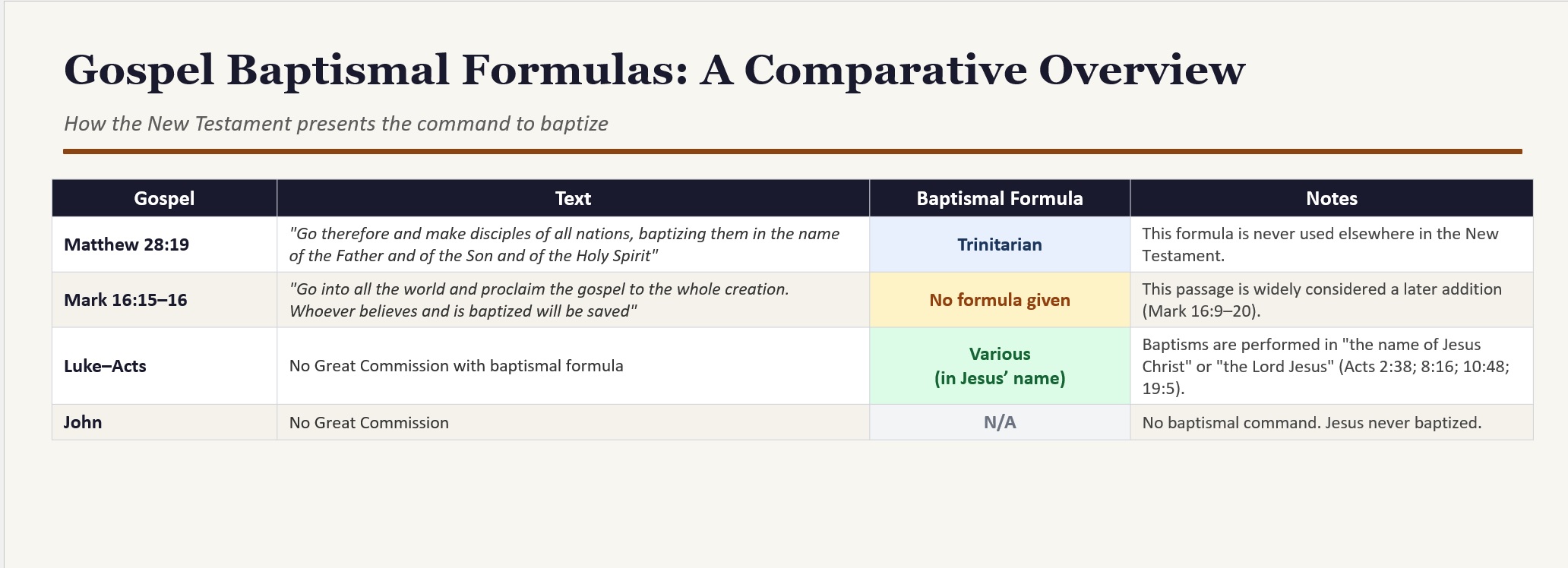
Note that in Mark 16:15-16 there is no baptismal formula given.
“And he said unto them, Go you into all the world, and preach the gospel to every creature. He that believes and is baptized shall be saved, but he that believes not shall be damned.” (Mark 16:15-16)
Notice the baptism formula given.
“Therefore go and make disciples of all nations, baptizing them in the name of the Father and of the Son and of the Holy Spirit.” (Matthew 28:19)
How are the unbaptized going to go and baptize others?
A missed opportunity: What the New Testament should have done is had Jesus rise from the dead and then in his glorified body baptize all his disciples and baptize them with fire.
Most critical scholars acknowledge that Mark 16:9-20 is not original to the Gospel of Mark. It is absent from the earliest and most important manuscripts (Codex Sinaiticus and Codex Vaticanus). The fourth-century church fathers Eusebius and Jerome noted that it was absent from most Greek manuscripts. This is widely considered a later addition to resolve the abrupt ending at Mark 16:8 with ‘for they were afraid.'”
“Other ancient authorities omit verses 9–20. Some ancient authorities conclude Mark instead with the following: But they reported briefly to Peter and those with him all that they had been told. And after this, Jesus himself sent out by means of them, from east to west, the sacred and imperishable proclamation of eternal salvation.”
“This passage is regarded as inspired and canonical scripture even if not written by Mark. As it is missing from some important manuscripts, it is possible that Mark did not write it. On the other hand, he would hardly have left his Gospel unfinished at verse 8. Many think that the original ending was lost at a very early date and that this ending was composed at the end of the apostolic period to take its place.”
1. The ancient authorities had no problem with Jesus sending out his disciples with no mention of baptism.
2. The Church is the authority. Even if Mark did not write it. The Church has already read it as authoritative.
3. The Church admits that the original ending may have been lost, and this ending was composed. It does not say by whom.
BAPTISM IN EARLY CHRISTIAN PRACTICE
XV. The Evidence from Acts: Contradictions and Developments
“Meanwhile a Jew named Apollos, a native of Alexandria, came to Ephesus. He was a learned man, with a thorough knowledge of the Scriptures. He had been instructed in the way of the Lord, and he spoke with great fervor and taught about Jesus accurately, though he knew only the baptism of John. He began to speak boldly in the synagogue. When Priscilla and Aquila heard him, they invited him to their home and explained to him the way of God more adequately.” (Acts 18:24-26)
Look at what Paul does when Apollos is away.
“While Apollos was at Corinth, Paul took the road through the interior and arrived at Ephesus. There he found some disciples and asked them, “Did you receive the Holy Spirit when you believed?” They answered, “No, we have not even heard that there is a Holy Spirit.” So Paul asked, “Then what baptism did you receive?” “John’s baptism,” they replied. Paul said, “John’s baptism was a baptism of repentance. He told the people to believe in the one coming after him, that is, in Jesus.” On hearing this, they were baptized in the name of the Lord Jesus. When Paul placed his hands on them, the Holy Spirit came on them, and they spoke in tongues and prophesied. There were about twelve men in all.” (Acts 19:1-7)
The above text is striking.
These people who were baptized by John apparently never heard that there is a Holy Spirit. You have to wonder what type of teaching they actually received.
Also note that the above text says they received the Holy Spirit after being baptized. This is contrasted with (Acts 10:44-48) where they received the Holy Spirit before being baptized.
Here this text blatantly shows that John’s baptism is inadequate. Paul had them all baptized in the name of the Lord Jesus!
THE MANDAEAN CONNECTION
XVII. Enter the Mandeans: The Other Religion That Practices Baptism
“Indeed, those who have believed (amanu) and those who were Jews and the Sabeans and the Christians and the Magians and all those who associated (ashraku) with Allah. Allah will judge between them on the Day of Resurrection. Indeed Allah is, over all things, Witness.” (Qur’an 22:17)
In Arabic, the Mandaeans are commonly known as aṣ-Ṣābiʾūn (الصابئون) or colloquially as al-Ṣubba (صُبَّة)
The Mandaean book of John also hints at historical tensions with other religions of the region. Specifically Christianity and Judaism. Parts of the book try to discredit both of these traditions. Mandaeans believe the mother of Jesus was Mandaean and became pregnant by witchcraft or some other source other than her husband. The book portrays her son Jesus as a deceiver who abandons his Mandaean heritage.
Ruha, the mother of darkness is sometimes called the holy spirit, a possible dig against the Christian holy spirit. The book of John (Draša d-Yaḥyā) also refers to the Jewish god as Adonai, called ‘Adunay’ in Mandaean. It characterizes him as an evil figure as well as his book, the Torah as a book of falsehoods.
In the Mandaean book of John when Jesus is baptized the voice/letter from heaven informs John: “You baptize the deceiver” and then the ruha, or the spirit makes an appearance. This spirit is a malevolent figure according to the Mandaeans.
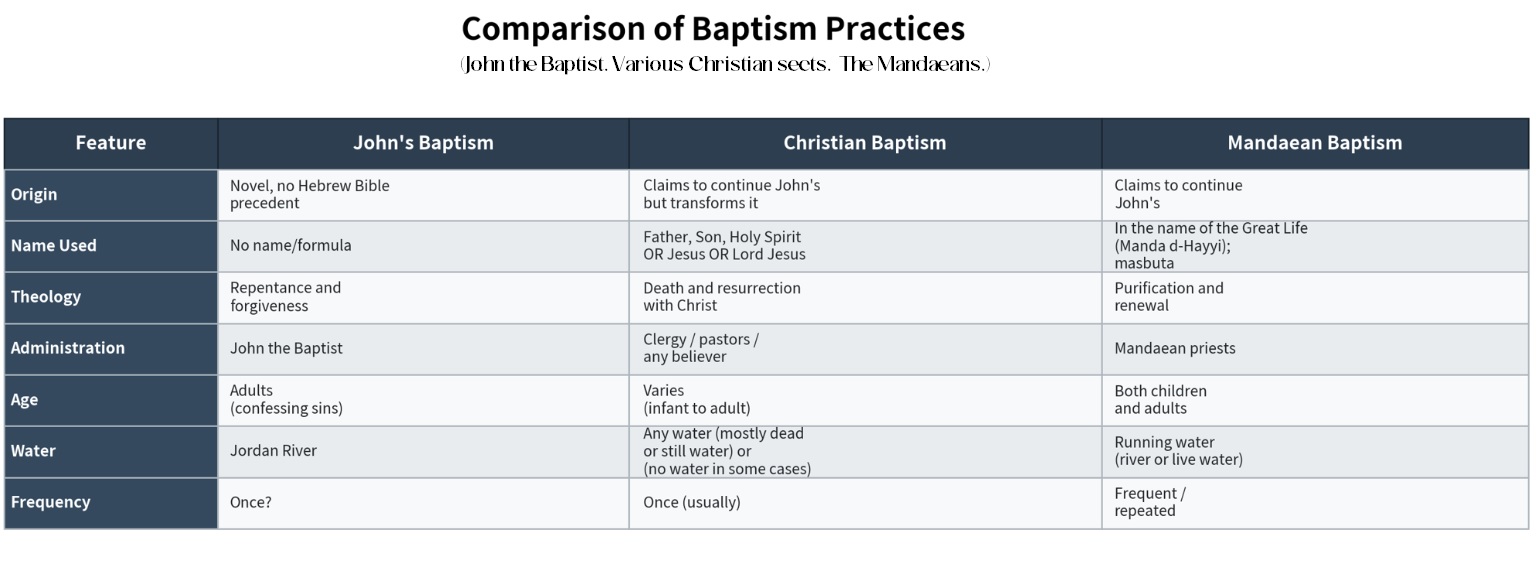
For John the Baptist and for the Mandaeans baptism is not a death and resurrection ritual!
The Mandaean Parallel is Illuminating:
The Mandaeans also practice baptism as a central ritual.
They view Jesus as a deceiver and John the Baptist as their true prophet.
Their rituals and understanding of baptism differ radically from Christian theology.
This demonstrates that baptism was a contested practice in the ancient Near East, not a clear, divinely-mandated ritual unique to Christianity.
XVI. The “Evil Jesus” Problem
There could be some truth to what the Mandaeans say.
The New Testament itself mentions an evil Jesus.
“And when they had gone through the isle unto Paphos, they found a certain sorcerer, a false prophet, a Jew, whose name was Barjesus:” (Acts 13:6)
There is no power in the name Jesus. Jesus was a common name at that time. It could refer to an evil doer. This is why it is quite possible that the New Testament is talking about a Jesus entirely different from what we as Muslims believe.
“For if a person comes and preaches another Jesus, whom we did not preach, or you receive a different spirit, which you had not received, or a different gospel, which you had not accepted, you put up with it splendidly!” (2 Corinthians 11:4)
Just so Christians could be clear that they were not being baptized in the name of evil Jesus there was always a modifier.
Observe!
“Then Peter said unto them, Repent, and be baptized every one of you in the name of Jesus Christ for the remission of sins, and ye shall receive the gift of the Holy Ghost.” (Acts 2:38)
“(For as yet he was fallen upon none of them: only they were baptized in the name of the Lord Jesus.)” (Acts 8:16)
“And he commanded them to be baptized in the name of the Lord. Then prayed they him to tarry certain days.” (Acts 10:48)
“When they heard this, they were baptized in the name of the Lord Jesus.” (Acts 19:5)
In Acts 19:5, a number of “Western” textual witnesses add Χριστοῦ εἰς ἄφεσιν ἁμαρτιῶν. translated as: ‘Christ for the forgiveness of sins’.
All of this to prevent Christians from being baptized into generic Jesus or evil Jesus.
Jesus Christ or Lord Jesus.
‘Lord’ and ‘Christ’ are identifiers and modifiers so the people are not confused about which Jesus they are being baptized in. (Good Jesus or Evil Jesus).
THE THEOLOGY OF BAPTISM
XVIII. For the Christians the Meaning Behind Baptism
For the Christians the meaning behind baptism is spelled out for them.
“Or don’t you know that all of us who were baptized into Christ Jesus were baptized into his death? We were therefore buried with him through baptism into death in order that, just as Christ was raised from the dead through the glory of the Father, we too may live a new life.” (Romans 6:3–4)
As we mentioned earlier in this article the baptism of John could not possibly have meant those things to him or his followers as John was not even aware of Jesus (in fact he-John had to inquire about him-Jesus) and Jesus at that point hasn’t even died on a cross. So it is not possible that baptism has that theologically loaded understanding.
With the Mandaeans recognizing Jesus as a deceiver and a disciple who betrayed John the Baptist, then their frequent baptisms also cannot have the theologically loaded understanding that Christians have.
XIX. Baptism by the Holy Spirit and Other Christian Disputes Over Baptism
Recall that in our article earlier we mentioned: The “baptism of the Holy Spirit” becomes a spiritualized concept that cannot be empirically verified.
“Peter replied, ‘Repent and be baptized, every one of you, in the name of Jesus Christ for the forgiveness of your sins. And you will receive the gift of the Holy Spirit.'” (Acts 2:38)
This is a promise, not a suggestion. It is addressed to everyone. Not just apostles, not just first-century believers. It is unconditional: repent → be baptized → receive the Spirit.
The question is: do we take this promise seriously? If so, then:
Every believer should expect to receive the Holy Spirit in a real, experiential way
The Spirit’s presence should be discernible. Whether through tongues, prophecy, healing, or other manifestations
The historic churches’ lack of these manifestations is not a sign of faithfulness, but a sign of loss or quenching of the Spirit
A Hard Question For the Historic Churches:
If the Holy Spirit is given to every believer at baptism (or confirmation/chrismation), then:
Why do believers in those traditions not consistently experience the Spirit’s power?
Why are the gifts of 1 Corinthians 12 (tongues, prophecy, healing, miracles) not active in their congregations?
Why did the Pentecostal movement have to emerge in the 20th century to recover what the New Testament presents as normal?
The honest answer, from many within those traditions, is:
Cessationism – the belief that the miraculous gifts ceased with the apostles.
Sacramentalism – the belief that the Spirit is given through the ritual itself, regardless of experience.
Loss of expectation – generations of Christians have not been taught to expect the Spirit’s manifest presence.
But the New Testament does not teach cessationism. It does not separate the Spirit from experience. And it does not promise a Spirit whose presence is invisible and undetectable.
XX. Charismatic-Pentecostal-Holy Roller Churches Don’t Get the Full Hot Dog
Even those who argue that the baptism of the Holy Spirit is alive and well are very selective on what aspects of the Holy Spirit are seen and heard.
Examples.
“When the day of Pentecost came, they were all together in one place. Suddenly a sound like the blowing of a violent wind came from heaven and filled the whole house where they were sitting. They saw what seemed to be tongues of fire that separated and came to rest on each of them. All of them were filled with the Holy Spirit and began to speak in other tongues as the Spirit enabled them.” (Acts 2:1-4)
Who hears this rushing violent wind from heaven these days? Who witnesses tongues of fire upon the heads of Christians?
XXI. Baptism – Full Water Immersion and Christians Being Overly Ritualistic
How do these Christians deal with people who suffer from ablutophobia?
One Christian mentions that his seminary professor instructed him that if the one being baptized came up out of the water with their head dry, then they would need to be immersed again!
One Christian retells a story about a member in their church who was disabled and could not go under water. So after discussion the elders arranged for this person to be lifted into a hot tub where the baptism was given by pouring water over their head.
What about situations in the desert when you have no water? The person is dying and they want to convert and be baptized?
These practical problems expose the human origin of the ritual.
SUMMARY AND CONCLUSION
XXII. Summary of Findings
1. Baptism Has No Hebrew Bible Foundation
No prophet preached, practiced, or participated in baptism.
The Torah is silent on this ritual.
The Isaiah 40:3 quotation is a “quote mine” about preparation, not baptism.
2. John’s Baptism Was Novel and Unresolved
The Mark 11:27-33 confrontation proves this.
Jewish religious leaders could not determine its source.
Jesus refused to answer the question.
If it had scriptural basis, the leaders would have known.
3. The Timing and Chronology Problems
John was apparently in prison before Jesus’s baptism.
A beheaded John cannot baptize Jesus.
The passive participle in Luke doesn’t resolve the problem.
4. John’s Baptism Could Not Mean What Christians Claim
John baptized before Jesus’s death/resurrection.
No death/resurrection symbolism was possible.
John’s baptism was merely for repentance and forgiveness.
This contradicts Paul’s theology of baptism.
5. Jesus Never Baptized Anyone
John 4:1-3 explicitly says Jesus didn’t baptize.
His disciples baptized, but we never learn who baptized them.
This raises serious questions about the ritual’s importance.
6. Jesus Failed to Baptize with the Holy Spirit
John prophesied this (Matthew 3:11).
It never happened as described.
It becomes a spiritualized, unverifiable concept.
7. The Great Commission Has Textual Problems
Two different versions (Mark and Matthew).
Mark’s version has no baptismal formula.
The Trinitarian formula appears only in Matthew 28:19.
The longer ending of Mark is a later addition.
8. The “Evil Jesus” Problem
Acts mentions Bar-Jesus (a sorcerer).
Paul warns about “another Jesus” (2 Corinthians 11:4).
Christians use modifiers to distinguish (“Lord Jesus,” “Jesus Christ”).
This suggests confusion about which Jesus was being preached.
9. Mandaeans Provide Historical Parallels
They practice baptism but view Jesus as a deceiver.
Their Book of John calls Jesus a “deceiver” at baptism.
This shows baptism was a contested practice.
10. John’s Uncertainty Is the Decisive Argument
John was filled with the Holy Spirit from birth.
He witnessed the heavens open and heard the divine voice.
Yet he still asked: “Are you the one who is to come?”
If John could be uncertain, why trust Christian interpretations?
Muslims are not being harsh with Christians; John’s failure proves the point.
XXIII. The Qur’anic Alternative
The opening verse (Qur’an 22:17) highlights that Allah alone will judge between the various religious communities. This is a reminder that ultimate authority rests with Allah, not human traditions.
“The dye of Allah (ṣib’ghata Allāh)” is a powerful metaphor for the natural constitution (fiṭra) upon which Allah created humanity. This stands in direct contrast to human-invented rituals like baptism.
Shaykh Aṭfayyish’s commentary illuminates: the “dye of Allah” is not an external ritual but an internal purification of the heart from unbelief and disobedience. This presents a profound critique. While Christians debate the mechanics of baptism, the Qur’an directs attention to the spiritual transformation itself.
XXIV. Conclusion: The Crux of the Matter
Our analysis demonstrates that baptism is a ritual without clear biblical foundation, differently understood across Christian and Mandaean traditions, and historically disconnected from the practice of the Hebrew prophets.
The most powerful observation is this: If the Jewish religious leaders, who sat in Moses’ seat and were experts in the Torah, could not determine the source of John’s baptism, how can Christians today be certain of its divine origin?
The most profound observation concerns John the Baptist’s lack of certainty about Jesus:
“Are you the one who is to come, or should we expect someone else?” (Matthew 11:2-3)
John who is filled with the Holy Spirit even before birth (Luke 1:15) could be uncertain despite:
Being Jesus’s cousin
Baptizing Jesus
Witnessing the heavens open
Hearing the divine voice declaring Jesus as the Son
Are we Muslims too harsh on Christians?
How can we Muslims be overly critical with Christians for not finding Muhammed (saw) in their scriptures when John himself, who had direct experience of Jesus, remained uncertain as to who Jesus was?
If John the Baptist who was the greatest man born of a woman according to Jesus himself (Matthew 11:11), could have direct contact with Jesus and still not be certain of his identity, then how can we as Muslims think that Christians will recognize Muhammed (saw) in their scriptures?
If the Holy Spirit who was supposed to guide into all truth left John in a state of confusion about Jesus, then:
Why should Christians believe the Holy Spirit will guide them into all truth regarding their own scriptures?
Why should Muslims accept Christian interpretations of ambiguous Old Testament prophecies when the very prophet who baptized Jesus couldn’t figure out who Jesus was?
XXV. Final Appeal
The Qur’an offers a superior alternative. The “dye of Allah” is not an external ritual but the primordial constitution (fiṭra) upon which Allah created humanity. True purification comes from turning to Allah, not from immersion in water, regardless of who performs it or with what formula.
As the Qur’an states:
“Indeed Allah is, over all things, Witness.” (Qur’an 22:17)
Allah alone knows the hearts. It is He who will judge between the communities, not just on the basis of their rituals, but on the basis of their sincerity, intentions, faith and actions.