
“Indeed, We created humans in the best form.” (Qur’an 95:4)
﷽
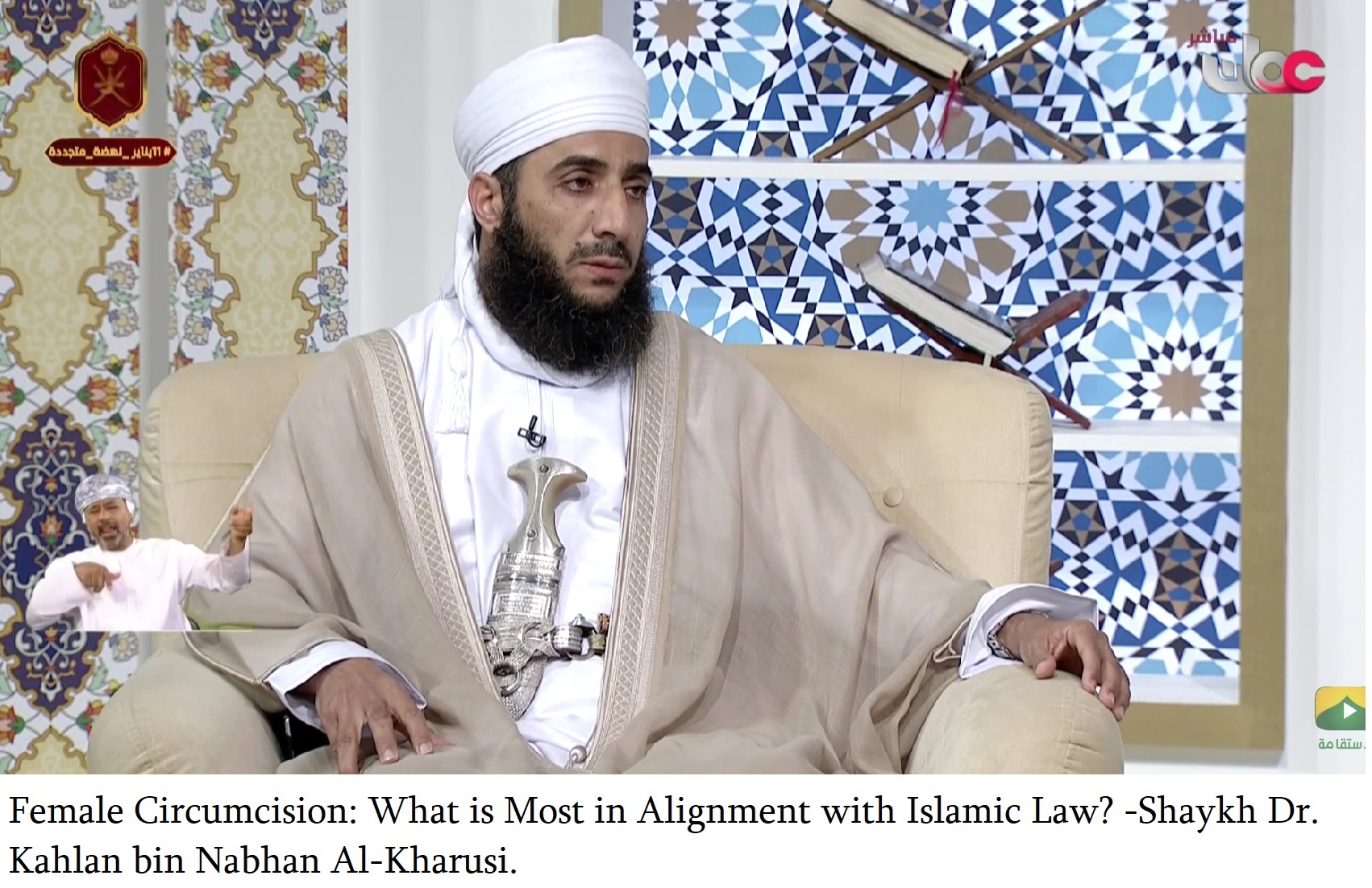
An interview with the honourable Shaykh Dr. Kahlan bin Nabhan Al-Kharusi on a very important topic.
Translation is as follows:
We come to another topic, and this time it relates to the circumcision of girls. Yes. Perhaps among the customs and traditions that people have inherited is that a girl must be circumcised just as a boy is circumcised. You mentioned in a previous fatwa that this means something permissible perhaps an advisory Sunnah was reported regarding it. However, people have greatly expanded in taking this concession that you spoke about, this permissibility, and they have begun committing acts that may not be good, that are harmful to the girl. So now, has your fatwa changed on this topic?
“No, the fatwa has not changed, and the fatwa, considering what exists in our jurisprudential heritage, was contrary to much of what the scholars of religion said on this matter.” -Shaykh Dr. Kahlan bin Nabhan Al-Kharusi
Yes.
“Rather, I said in it that my wish was that Muslim doctors would speak about this matter.” -Shaykh Dr. Kahlan bin Nabhan Al-Kharusi
Yes.
“What I mentioned in that answer was shocking to many jurists and students of Islamic legal knowledge because it was contrary to what they are accustomed to.” -Shaykh Dr. Kahlan bin Nabhan Al-Kharusi
Aha.
“Let us clarify the matter once again. The narrations that have come regarding the practice of khafd (female circumcision), which is known as circumcision for females. They are not free of criticism. None of these narrations can be relied upon with confidence. All the narrations that have come are not free of weakness, not free of defect.” -Shaykh Dr. Kahlan bin Nabhan Al-Kharusi
Yes.
“And what can be accepted with great leniency from these narrations does not, in reality, indicate what many jurists have concluded. Some narrations, for example, such as the narration that circumcision is an honor for the woman. It contains no legal ruling, so it cannot be used even to establish recommendation (istihbab), because this description “an honor for the woman” does not indicate a legal ruling.” Shaykh Dr. Kahlan bin Nabhan Al-Kharusi
Yes.
“And the Messenger of Allah’s instruction (peace and blessings be upon him and his family) in another narration which is one of the most relied-upon narrations by those who hold the view of recommendation and those who hold the view of obligation regarding circumcision for females is that he said to Umm Atiyya: “Trim but do not exhaust” or “reduce but do not exhaust”. This indicates the opposite of what was intended, it indicates the opposite of what many jurists have said, even assuming acceptance of this narration with great leniency.” -Shaykh Dr. Kahlan bin Nabhan Al-Kharusi
Yes.
“Moreover, I am more convinced by the view of those jurists and scholars, both early and late, who held that all these narrations are not free of criticism. Nevertheless The Messenger of Allah (peace and blessings be upon him) it is not established that he instructed anyone to do it, or commanded it for his daughters or his wives (peace be upon him) or the believing women. It is only according to the narration that when he migrated to Medina, a woman who performed circumcision said to be Umm Atiyya al-Ansariyya asked him, and he said to her: “Trim but do not exhaust.” Now this indicates that the intent was to lighten a practice that already existed.” -Shaykh Dr. Kahlan bin Nabhan Al-Kharusi
Yes.
“And therefore the guidance was for “ishmam” (light touching), for minimal taking without exaggeration. It is also apparent from this report, assuming its acceptance once again that the woman was qualified and capable of doing it properly, otherwise the Messenger of Allah (peace be upon him) would never have permitted her!” -Shaykh Dr. Kahlan bin Nabhan Al-Kharusi
Yes.
“So now let us summarize what we have said so far.” -Shaykh Dr. Kahlan bin Nabhan Al-Kharusi
Aha.
“None of the narrations that have come regarding female circumcision, regarding the circumcision of girls, is free of criticism that weakens it. Right?” -Shaykh Dr. Kahlan bin Nabhan Al-Kharusi
“And accordingly, the utmost that can be said is that it is among the permissible matters. Among the permissible matters in Islamic law. Now we say it is permissible, that it is within legal permissibility, if it is done by someone who is qualified and knowledgeable, aware of the correct method, taking the necessary precautions, and not exaggerating in it.” -Shaykh Dr. Kahlan bin Nabhan Al-Kharusi
Yes.
“So if we say it is permissible, and it is established that it is in fact practiced by people; meaning when we say it is permissible, the first conclusion we arrive at is that leaving it involves no sin in Islamic law and no wrongdoing.” -Shaykh Dr. Kahlan bin Nabhan Al-Kharusi
Yes.
“And this is an important conclusion. We respect the views of our imams and scholars from the various Islamic schools of thought. Perhaps some early Shafi’i scholars are among those who held it obligatory, and some Hanbali scholars, but others among the scholars of the Islamic schools for example, the Ibadi, Hanafi, and Maliki did not go that far. Some of them spoke of permissibility, and some said it is recommended, and they did not mention the derived legal evidence. These jurisprudential views are respected and are part of our Islamic heritage, but they should be understood, in terms of legal ruling, in light of the evidence that reached them.” -Shaykh Dr. Kahlan bin Nabhan Al-Kharusi
Yes.
“And in terms of actual practice, they never intended that it be done by women who lack qualification, knowledge, sufficiency, and capability, and who do not take the necessary precautions to avoid harming the girls.” -Shaykh Dr. Kahlan bin Nabhan Al-Kharusi
Beautiful.
“So since the matter is such that it is no more than permissible, and there is no sin in leaving it and no wrongdoing upon one who leaves it, then we can take the matter further than this.” -Shaykh Dr. Kahlan bin Nabhan Al-Kharusi
Yes.
“Because what has happened in people’s actual practice is poor application, even in this act. On one hand, as you noted, they imagine legal rulings that have been shown to have no validity or to be exaggerated. But in practice, there are many incidents in which young girls have suffered great harm from bleeding or tearing, yes? Or exaggeration in exhausting to the point of affecting the urinary tract and the genital area.” -Shaykh Dr. Kahlan bin Nabhan Al-Kharusi
Yes.
“Not to mention the injury and impact on the ability to conceive and bear children and on legitimate enjoyment in marriage And these are cases I have personally seen, seen from reality. Therefore, since the matter reaches this level of harm and damage, and lack of knowledge of correct application and correct execution even in the permissible amount; especially since it is not studied in medicine at all. There are no women practicing surgery for women who know how to do it, because contemporary medical sciences do not teach it. There are no specifications, no method, no standards, no procedure for doing it which is unlike the obligatory circumcision for males.” -Shaykh Dr. Kahlan bin Nabhan Al-Kharusi
Yes.
“This is not studied at all; it is not in the curricula. And what some Muslim doctors have mentioned of benefits and advantages of it unfortunately, in following up, I did not find that they rely on scientific evidence. They were advocating for jurisprudential views, and they should have stopped at the limit of permissibility.” -Shaykh Dr. Kahlan bin Nabhan Al-Kharusi
Yes.
“Because establishing health benefits should be based on sound medical evidence.But we do not find this. We find descriptions and praise and mentions, but without relying on sound scientific evidence that could be relied upon. And even if that were established, it would be conditional on correct execution but if it cannot be executed in a correct manner, because there is no one who can do it at all, since it is not studied and does not exist in medical curricula, then leaving it in this case is preferable either it is viewed as restricting the permissible due to the harms resulting from doing it, or it is viewed through the principle of blocking the means that lead to harm, damage, and corruption for the girls for whom it is done. And Allah Almighty knows best. And forgive me for the length.” -Shaykh Dr. Kahlan bin Nabhan Al-Kharusi
Okay, but the question relates to this topic. Since you mentioned that you have seen cases through perhaps your contact with doctors and your participation in biology conferences
Yes.
Is it permissible because no text prohibiting it has come, for example, or forbidding it? Or because the evidence found leads to the conclusion that it is permissible? Why is it not forbidden if it leads to such harms? The matter is very open.
“The view of prohibiting it is based only on what was mentioned previously.” -Shaykh Dr. Kahlan bin Nabhan Al-Kharusi
Yes.
There is no text from which prohibition can be taken from a prohibition by the Messenger of Allah (peace and blessings be upon him and his family). Rather, it is based on what was mentioned previously. And therefore a group and this can increase people’s confidence; a group of fatwa bodies and fatwa institutions in our Islamic countries today are also saying to prohibit this act.” -Shaykh Dr. Kahlan bin Nabhan Al-Kharusi
Yes.
“And they say so also because of what they have learned and reached regarding the weakness of the evidence that has come on this matter, and because of what has been established for them of poor practice leading to great harm and extreme harm.” -Shaykh Dr. Kahlan bin Nabhan Al-Kharusi
“It has reached the point with some circumcisers that they perform it behind hospitals and health centers because they know the result so that it may be closer to rescue and first aid, they do it near hospitals. And there is no limit to what could be said about the instruments used they are far removed from the health requirements required in this matter, let alone complete ignorance of it. The cases that the Omani female doctors told us about are not minor cases that can be overlooked.” -Shaykh Dr. Kahlan bin Nabhan Al-Kharusi
Yes.
“But what remains is that the foundation we rely on is: is this matter obligatory in the religion of Allah, Blessed and Exalted? Is it recommended and called for? The matter is not so.”-Shaykh Dr. Kahlan bin Nabhan Al-Kharusi
Yes.
“Is it permissible? Yes, we cannot say it is not permissible. But permissibility is restricted by what was mentioned previously of light touching, minimal taking and that it be done by someone with complete knowledge and understanding. But even so, can this permissibility be restricted due to the magnitude of harms that result from its application and practice? Yes, it can be restricted, as is the case with a number of permissible matters. Therefore, the view that is most convincing and most suited to people’s conditions today is to leave this act. And Allah Almighty knows best.” -Shaykh Dr. Kahlan bin Nabhan Al-Kharusi
Let us now move the ruling from the act to the actor. By this we are meaning the one who performs this task but does not possess this expertise. Is she committing something forbidden?
“Yes, she is committing a forbidden act, since she is ignorant. And whoever practices medicine without medical knowledge is liable. Yes.” -Shaykh Dr. Kahlan bin Nabhan Al-Kharusi
This is narrated as a report, but it has become a legal maxim. There is no doubt that such an act originally requires knowledge, understanding, and science, and that one should adhere to that. That is why, as mentioned, these reports. Yes, there are narrations about naming the place “al-khatanun” (the two circumcisers). These are sound hadiths, but we know that in such dual-form names, the description may often be used by predominance.” -Shaykh Dr. Kahlan bin Nabhan Al-Kharusi
Yes.
“For example It is said “the two black ones” for dates and water by predominance. It is said, for example, “the two moons” for the sun and the moon, by predominance. So this does not mean that the description applies to both described things together?” -Shaykh Dr. Kahlan bin Nabhan Al-Kharusi
Yes.
“Therefore we said that the view in principle is permissibility restricted by its conditions. But this permissible act should now be left because of the transgression that has occurred in it, the severe harms that have afflicted girls, the lack of a sound scientific method, and the lack of qualified people to perform it. And Allah Almighty is the one whose help is sought.” -Shaykh Dr. Kahlan bin Nabhan Al-Kharusi
Yes, may Allah reward you with good. Thank you. Yeah.
Prima Qur’an comments:
People come in different shapes, colours and sizes. Some people have features distinct from others. This is part of our diversity. It is plausible that some women have larger labia than other women. So perhaps in the view of some cultures they felt having a larger labia would not be appealing to a prospective partner. It could also be due to what they perceive as hygene related. Perhaps in places where water was scarce and sand is plentiful this practice came about.
After all, in the event of no availability of water or the preference to preserve the water for drinking we as Muslims perform tayammum.
Also, as the Shaykh mentinoned we also know of couples whose intimacy has been ruined through this practice. Some layman whom we spoke with from the Shafi’i school had insisted that the practice is to keep the excitability of women in check! Very unfortunate!
However, we do not know any reason that has any merit for the excising of a woman’s clitoris!
There is a principle in Shari’a law
لا ضرر ولا ضرار
“Lā ḍarar wa lā ḍirār”
= No harm and no reciprocating harm.
Abu Sa‘īd al-Khudri reported: The Messenger of Allah (saw) said:
“There should be no harm or reciprocal harm. Whoever causes harm, Allah harms him, and whoever makes things difficult, Allah makes things difficult for him.
Source: (https://hadeethenc.com/en/browse/hadith/4711)
We also have in Islamic law we also have what is known as: Preventing harm takes precedence over attaining benefit. This is also known as: darʾ al-mafāsid muqaddam ʿalā jalb al-maṣāliḥ.
Thus, as the Shaykh said we have no proof text that explicitly forbids the practice. We also have no proof text that estabilshes that this was done by the Blessed Prophet (saw). It is not established that he instructed anyone to do it, or commanded it for his daughters or his wives (peace be upon him) or the believing women.
So from our perspective (speaking of the Prima Qur’an team) if an adult woman of sound mine wants to have this procedure than proceed. However, as it is very clear that infants, tolddlers and small children are not capable of giving thier consent it is best to abandon this practic altogether. Allah knows best and his help is sought. May Allah (swt) assist Shaykh Dr. Kahlan bin Nabhan Al-Kharusi in bringing light to the people!
For the interested Omani law states as follows:
Child Law (Article 20): Explicitly prohibits any person (especially doctors, nurses, and guardians) from engaging in, promoting, or assisting in “harmful traditional practices to the child’s health”.
Executive Regulations of the Child Law (Ministerial Decision No. 125/2019, Article 4): This is the crucial defining clause, which explicitly lists “female genital mutilation of any kind” as a “harmful traditional practice to the child’s health”.
Penalties (Child Law, Article 67): Violators face imprisonment of no less than 6 months and no more than 3 years
If you have found this entry informative you may enjoy the following articles:
May Allah Guide the Ummah.
May Allah Forgive the Ummah.


