
Do they not then reflect on the Qur’an? Had it been from anyone other than Allah, they would have certainly found in it many inconsistencies.” (Qur’an 4:82)
﷽
The Qur’an calls Jesus the “son of Mary” (Ibn Maryam) 23 times. For a person who had no physical human father this is the most sensible and straightfoward appellation. No one else in the Qur’an has a title the ‘son of their mother’.
Jesus received his humanity and his flesh and blood via Mary (May Allah’s abundant blessings and peace be upon her).
The New Testament in some desperate attempt to try and frame Jesus as the Davidic Messiah forge two contradictory genalogies to a man (Jesus) who had no genetic imput from his father.
“ This is how the birth of Jesus the Messiah came about. His mother Mary was pledged to be married to Joseph, but before they came together, she was found to be pregnant through the Holy Spirit. Because Joseph her husband was faithful to the law, and yet did not want to expose her to public disgrace, he had in mind to divorce her quietly. But after he had considered this, an angel of the Lord appeared to him in a dream and said, “Joseph son of David, do not be afraid to take Mary home as your wife, because what is conceived in her is from the Holy Spirit. She will give birth to a son, and you are to give him the name Jesus, because he will save his people from sins.” (Matthew 1:18-21)
“How will this be,” Mary asked the angel, “since I am a virgin?” The angel answered, “The Holy Spirit will come on you, and the power of the Most High will overshadow you. So the holy one to be born will be called the Son of God. Even Elizabeth your relative is going to have a child in her old age, and she who was said to be unable to conceive is in her sixth month. For no word from God will ever fail.” (Luke 1:34-36)
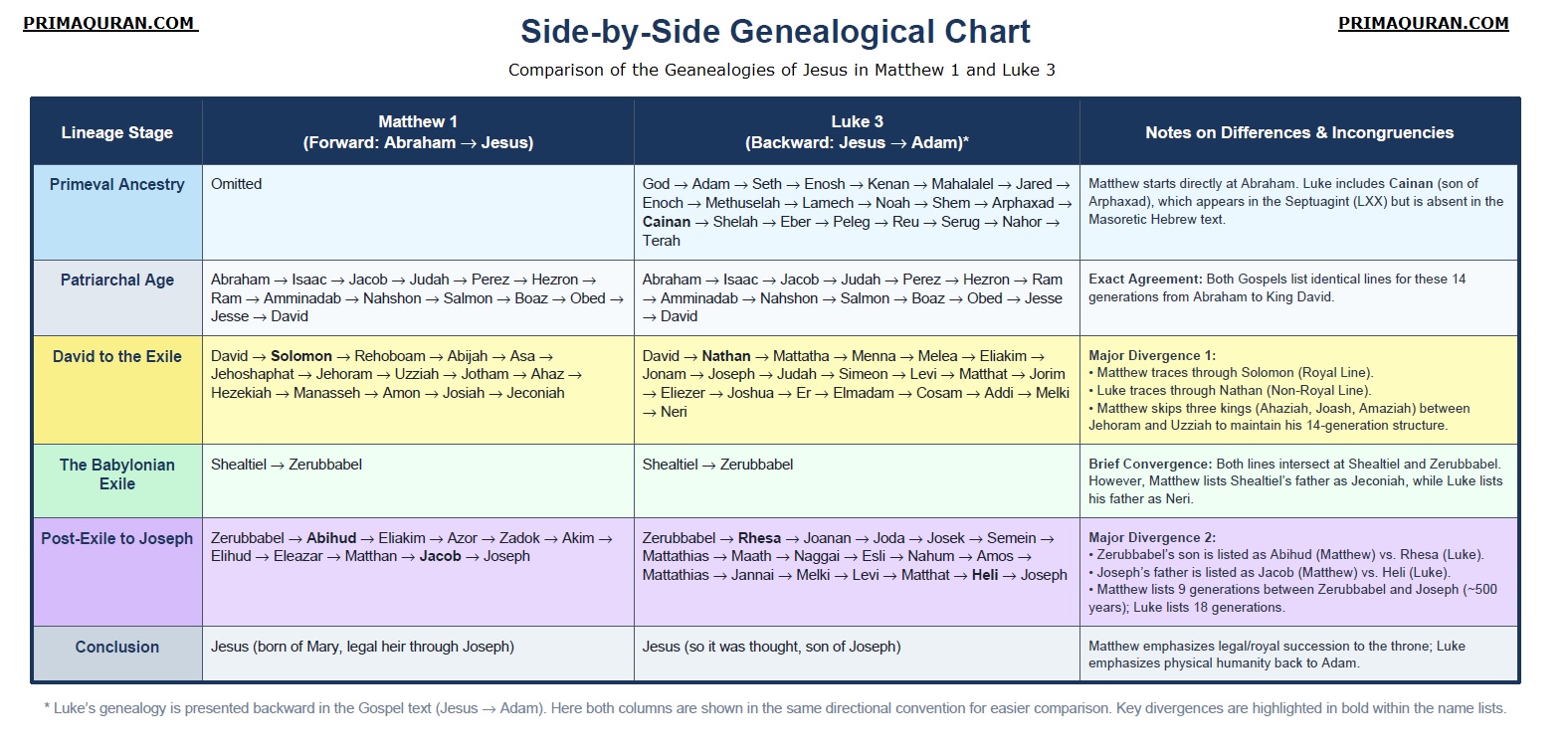
[Click on the image above. Then right click that image and select open image in new tab. Ctrl and mouse wheel or Ctrl and +,- to zoom in/out.] Voila!
Christians try and deal with this conflict by saying that one is a genealogy through Joseph and the other is a genealogy via Mary. However, neither of the text say that it represents a genealogy through Mary.
Even then you cannot get a consistent answer from Christians. Some will claim that Matthew is giving Mary’s lineage. Some will claim that Luke is giving Mary’s lineage.
Those who try and advocate a lineage via Mary do so by claiming that Matthew ends with Mary and not Joseph.
So let us look at what the text says:
and Jacob the father of Joseph, the husband of Mary, and Mary was the mother of Jesus who is called the Messiah. (Matthew 1:16)
What does this text say about Mary?
- She is the mother of Jesus.
- She is the wife of Joseph.
It says nothing of her lineage.
Christians are seeing things that simply aren’t there. Who can be a Christian with this level of cope and dishonesty. Matthew 1:16 clearly ends with Joseph.
- Who is the husband of Mary. Since Mary is introduced we get info about her.
- Mary is Jesus mother.
What we do not get is Mary’s genealogy.
Who is Mary’s Mother in Matthew 1:16?
Who is Mary’s Father in Matthew 1:16?
If we truly love and honout God we need to love and honour truth.
The Grammatical Shift in the Greek Text
There is a vital detail in the original Greek text of Matthew 1:16 that gets lost in English translation, which reinforces our earlier point that Mary is the only physical parent.
Throughout Matthew 1, the English translation uses “was the father of” or “begat.” In the original Greek, this is the active verb egennēsen ἐγέννησεν (masculine: “he fathered”).
But in verse 16, the grammar completely changes:
“…and Jacob fathered Joseph, the husband of Mary, of whom was born Jesus…”
The phrase “of whom” in Greek is hēs, which is strictly feminine singular.
The verb “was born” is (ἐγεννήθη) egennēthē, which is passive.
Grammatically, Matthew is explicitly stating that Jesus was physically born out of Mary alone, deliberately breaking the “he fathered” pattern used for every other man in the list. This confirms exactly what we stated: Jesus’ physical humanity and flesh come solely from Mary, while Joseph’s biological seed is entirely absent.
Luke also does not give us a genealogy via Mary.
“Now Jesus himself was about thirty years old when he began his ministry. He was the son, so it was thought, of Joseph, the son of Heli.” (Luke 3:23)
“So it was thought” or “as was supposed” in some translations. Luke 3:23 is simply acknowledging the public perception of the time. That to the average observer in Nazareth, Jesus was just a normal child born to Joseph and Mary.
Another observation. ‘was about thirty years old’. hōsei (ὡσεὶ)
Meaning: hósei: As if, like, about, approximately
Source: (https://biblehub.com/greek/5616.htm)
So you know this person is not writing under inspiration of any Holy Spirit. The Holy Spirit cannot even supply us with the information when Jesus began preaching. It’s as if the Holy Spirit is guessing. The Holy Spirit is giving us a ‘ball park figure’ a ‘guesstimation’.
Does the Gospel of Luke dismiss Matthew’s Genealogy?
It is important to note that the sequence of the Gospel order was not always uniform in Christian history.
Clement of Alexandria.Matthew and Luke are grouped together as being written before Mark, but Matthew is still traditionally listed first in that pair. The pair of Luke and Matthew.
The Western Order. The sequence is Matthew, John, Luke, Mark. Meaning Matthew remains the very first Gospel, while Luke is third.
So according to the most dominant and surviving Church tradition by all accounts Matthew is before Luke.
Luke exsposes all!
“Many have undertaken to draw up an account of the things that have been fulfilled[a] among us, just as they were handed down to us by those who from the first were eyewitnesses and servants of the word. With this in mind, since I myself have carefully investigated everything from the beginning, I too decided to write an orderly account for you, most excellent Theophilus, so that you may know the certainty of the things you have been taught.” (Luke 1:1–4)
There are four powerful points provided to us by Luke. These four points shatter the popular, clean narrative of flawless textual transmission and reveal the messy reality of early Christian record-keeping.
1. No Claim to Inspiration
The author of Luke never says, “The Holy Spirit moved me to write these words,” nor does he claim to have received this information via a divine vision or revelation. Instead, he treats his work as a human, academic endeavor. He explicitly frames his authority around human methodology: he “carefully investigated everything” like a standard ancient historian or investigative journalist.
2. Not an Eyewitness / Anonymous Sources
The text explicitly states: “just as they were handed down to us by those who from the first were eyewitnesses.”
- By using the word “us,” the author explicitly excludes himself from being an eyewitness.
- He admits he is a second- or possibly even a third- transmitter. Relying on a chain of custody (“handed down”).
- Crucially, when it comes to the complex, divergent genealogy in Luke 3, he never names his source. He doesn’t say he got it from Mary, or from an official temple archive; it is pulled from an entirely anonymous stream of tradition.
3. Rejecting Matthew’s Order
If we grant the traditional Church view that Matthew was written first and was widely circulated, Luke’s opening sentence becomes a direct, polite critique of Matthew.
- Luke acknowledges that “many have undertaken to draw up an account.” Matthew would be chief among them.
- Luke then says, “I too decided to write an orderly account.“
- The undeniable logical implication is that Luke found the existing accounts which would presumably include Matthew’s to be disorderly, incomplete, or structurally flawed. If Matthew’s genealogy and narrative were already perfect and “orderly,” Luke’s self-appointed mission to fix the record would be completely redundant.
4. Conflicting Information in the Early Strata
The very fact that Luke felt compelled to launch a major investigation and draft a brand-new timeline proves that the “data” about Jesus in currency between 60–90 AD was already heavily conflicting.
Even in the earliest layers of the Christian movement, there was no single, unified, locked-in story. You had:
- One community (Matthew’s) circulating a list that went through Solomon, Jeconiah, and Jacob.
- Another community (Luke’s source) circulating a list that went through Nathan, Neri, and Heli.
The author of Luke stepped into this chaotic environment of competing oral traditions and picked the data he deemed most reliable or “orderly,” and wrote his version. The result is the flat, un-harmonised contradictions we see on the page today.
The blood curse dilemma for Chrisitians.
“and Josiah the father of Jeconiah or spelled as Jehoiachin and his brothers at the time of the exile to Babylon.” (Matthew 1:11)
The inclusion of King Jeconiah (also known as Jehoiachin) in Matthew 1:11 introduces what theologians call the “Blood Curse” dilemma, which stems from a severe prophecy in the Book of Jeremiah.
The Prophetic Dilemma (Jeremiah’s Curse).
During the Babylonian exile, King Jeconiah rebelled against God. In response, God pronounced a permanent curse on his biological bloodline.
““As surely as I live,” declares the Lord, “even if you, Jehoiachin son of Jehoiakim king of Judah, were a signet ring on my right hand, I would still pull you off. I will deliver you into the hands of those who want to kill you, those you fear such as the Nebuchadnezzar king of Babylon and the Babylonians. I will hurl you and the mother who gave you birth into another country, where neither of you was born, and there you both will die. You will never come back to the land you long to return to.” Is this man Jehoiachin a despised, broken pot, an object no one wants? Why will he and his children be hurled out, cast into a land they do not know? O land, land, land, hear the word of the Lord! This is what the Lord says: “Record this man as if childless, a man who will not prosper in his lifetime, for none of his offspring will prosper, none will sit on the throne of David or rule anymore in Judah.” (Jeremiah 22:24-30)
This created a massive legal and prophetic paradox for the Jewish expectation of the Messiah:
- The Requirement: The Messiah had to be a descendant of King David and King Solomon to claim the legal rights to the royal throne.
- The Problem: Jeconiah was part of that royal line. Because of the curse, any biological child born from Jeconiah’s bloodline was strictly disqualified from ever sitting on the throne of David.
If Jesus was the biological son of Joseph (who carried Jeconiah’s bloodline in Matthew), Jesus would be legally disqualified from being the Messiah King!
If Jesus has absolutely no biological connection to Joseph. So then tracking Joseph’s genealogy whether cursed or not does not give Jesus a drop of Davidic blood.
Neither Matthew or Luke state that they are giving Mary’s genealogy. In fact, they are not even giving us Jesus genealogy. What we are getting are genealogies of Joseph.
The Unresolved Reality
By sticking strictly to the text, we are left with the exact dilemma that was raised earlier:
- Matthew traces Joseph’s ancestry to David.
- Luke traces Joseph’s ancestry to David.
- Jesus has no biological connection to Joseph.
- The texts do not explicitly provide Mary’s ancestry.
Further contradictions and errors in Matthew Genealogy.
“After the exile to Babylon: Jeconiah was the father of Shealtiel, Shealtiel the father of Zerubbabel,“(Matthew 1:12)
“The descendants of Jehoiachin the captive: Shealtiel his son, Malkiram, Pedaiah, Shenazzar, Jekamiah, Hoshama and Nedabiah. The sons of Pedaiah: Zerubbabel and Shimei. The sons of Zerubbabel: Meshullam and Hananiah. Shelomith was their sister.” (1 Chronicles 3:17-19)
To get around this error it is often propsed that a Leveriate marriage was involved. The claim is Shealtiel died childless. This information is completely absent from the text. It is a fabricated premise required to make the Levirate marriage theory function.
Why theis silence destroys any attempt at harmonization.
Once again, stacking this theory against the rest of scripture reveals a new contradiction:
- If Shealtiel died childless and Pedaiah raised up an heir for him: By Torah law (Deuteronomy 25:6), Pedaiah’s firstborn son would legally belong to Shealtiel to carry on his name.
- The Chronological Contradiction: If the Levirate law was successfully fulfilled, the official temple archives in 1 Chronicles should have recorded Zerubbabel as the son of Shealtiel. Instead, the Chronicler flatly records Zerubbabel as the son of Pedaiah.
By recording Zerubbabel under Pedaiah’s name, the text indicates that Zerubbabel carried Pedaiah’s legal identity and inheritance, not Shealtiel’s.
The flat textual discrepancy remains.
Rather than the text supporting a Levirate framework, we are left with a direct clash between different books of the Bible:
- 1 Chronicles 3:19 says Zerubbabel is the son of Pedaiah.
- (Ezra 3:2), (Nehemiah 12:1), (Haggai 1:1), (Mathew 1:12), (Luke 3:27) all flatly call him the son of Shealtiel.
The narrative of a childless death is a defensive theory constructed after the fact to patch over an explicit contradictions.
The Ultimate Historical Trap for Matthew.
- If it was a Levirate marriage: The child legally belongs to the dead brother (Shealtiel). Therefore, the official genealogical records of Israel should have listed Zerubbabel under Shealtiel.
- The Chronicler’s Rejection: But the author of 1 Chronicles explicitly rejects that. He prints Zerubbabel as the biological and legal son of Pedaiah.
- Matthew’s Error: By writing that Shealtiel fathered Zerubbabel, Matthew is directly contradicting the primary historical source material of the Hebrew Bible.
Why This Destroys Matthew’s Objective.
Matthew’s entire purpose in Chapter 1 is to present a neat, unquestionable, legally airtight royal lineage to prove Jesus is the Messiah to a Jewish audience.
However, by printing a line that flatly contradicts the official priestly and royal archives of 1 Chronicles 3, Matthew’s genealogy fails the very audience he is writing for. Any first-century scribe or scholar reading Matthew 1:12 alongside the scroll of Chronicles would immediately see the discrepancy and flag it as a disqualifying error!
Yes! Even more contradictions and errors in Matthew Genealogy.
“ Zerubbabel the father of Abihud, Abihud the father of Eliakim, Eliakim the father of Azor,” (Matthew 1:13)
“The sons of Zerubbabel: Meshullam and Hananiah, and Shelomith was their sister. There were also five others: Hashubah, Ohel, Berekiah, Hasadiah and Jushab-Hesed.” (1 Chronicles 3:19–20)
1 Chronicles explicitly lists seven sons and one daughter for Zerubbabel. Abiud is completely absent from the list.
Furthermore, Luke 3:27 also lists a son for Zerubbabel, but he calls him ‘Rhesa‘
Neither Matthew’s “Abiud” nor Luke’s “Rhesa” appear anywhere in the official Old Testament list of Zerubbabel’s children.
Matthew’s list here cannot be verified by any Hebrew scripture. Historians note that after the Babylonian exile, official, centralized royal records in Israel largely disintegrated or became heavily fragmented.
Matthew wanting to connect the historic post-exilic hero Zerubbabel to Joseph’s family either used a flawed, unverified local family oral tradition or simply inserted names (like Abiud) to bridge a multi-century historical gap and maintain his rigid structure of exactly 14 generations.
Matthew 1:13 directly invents or inserts a son for Zerubbabel that the chronicler of Israel’s royal line explicitly omitted.
The massive gap of generations between Zerubbabel and Joseph!
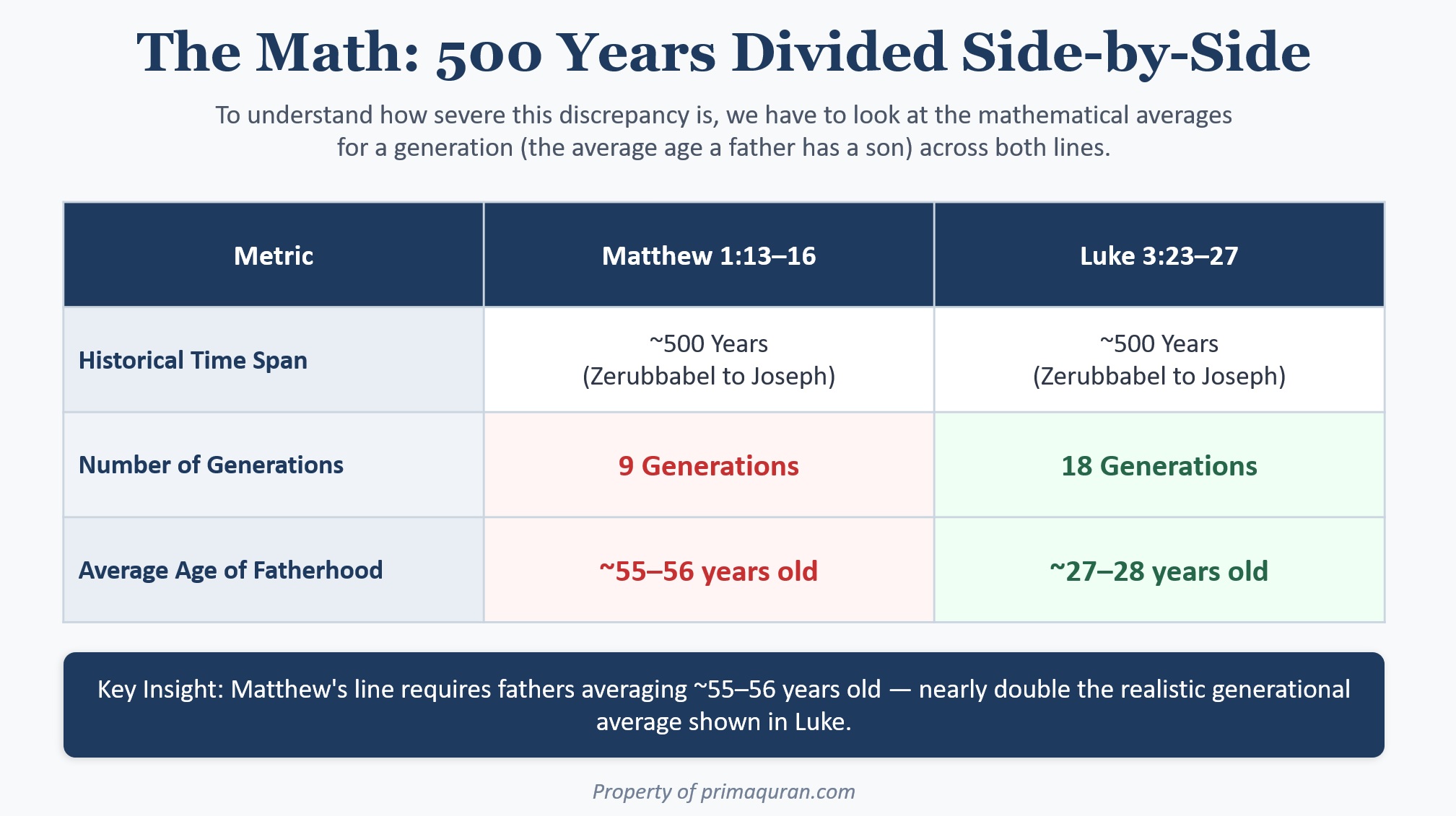
(Where Matthew covers over 500 years of history using only 9 names, while Luke uses 18.)
When we look at the final stretch of history from the Babylonian exile (around 586 BC) to the birth of Jesus, we encounter a massive, chronological black hole in Matthew’s genealogy.
By comparing the number of generations Matthew and Luke use to cover this 500-year historical gap, the numbers reveal a stark biological impossibility in Matthew’s list.
Why Matthew’s Line is Biologically Impossible
In the ancient world, the average age of fatherhood was typically between 20 and 30 years old.
- Luke’s timeline is completely realistic. An average of 27–28 years per generation fits perfectly with historical realities, standard human biology, and ancient demographics. Over 500 years, you should have around 17 to 20 generations.
- Matthew’s timeline requires a miracle per generation. For 9 men to stretch across 500 years, every single father in Matthew’s line would have to be roughly 55 to 60 years old when their listed son was born. While biologically possible for an isolated individual, it is mathematically and historically impossible for an entire ancestral line to maintain this average consecutively for half a millennium.
Why Did Matthew Do This?
Matthew explicitly tells us why.
“Thus there were fourteen generations in all from Abraham to David, fourteen from David to the exile to Babylon, and fourteen from the exile to the Messiah.” (Matthew 1:17)
Matthew was completely bound to the number 14. For whatever reason. Was it due to numerology, gematria or demonology is anyone’s guess.
What is clear is that Matthew intentionally deleted at least 8 to 10 historical generations from the post-exilic era. He compressed 500 years of history into a completely artificial framework.
By sticking strictly to the text, we see that Luke records a realistic human lineage, while Matthew prints a heavily redacted, structurally forced list.
Because Matthew chopped out massive chunks of history to make his “14 generations” pattern work, his list ceases to be an accurate historical record of Joseph’s actual ancestors. It is a literary device, not a historical document.
This is perhaps why we have Luke who claims:
“With this in mind, since I myself have carefully investigated everything from the beginning, I too decided to write an orderly account for you.”
Further Christian and so called “Hebrew Israelite’ defenses.
In this section we will look at further Christian and/or “Hebrew Isrealite” defenses of these contradictions.
Joseph: The son of Jacob or the son of Heli?
“and Jacob the father of Joseph, the husband of Mary, and Mary was the mother of Jesus who is called the Messiah.” (Matthew 1:16)
“Now Jesus himself was about thirty years old when he began his ministry. He was the son, so it was thought, of Joseph, the son of Heli.” (Luke 3:23)
Here the ‘Levirate marriage theory’ is introduced.
“If brothers are living together and one of them dies without a son, his widow must not marry outside the family. Her husband’s brother shall take her and marry her and fulfill the duty of a brother-in-law to her. The first son she bears shall carry on the name of the dead brother so that his name will not be blotted out from Israel.” (Deuteronomy 25:5-6)
Levirate marriage is a traditional practice where a man is required or encouraged to marry his deceased brother’s widow. The main goal is to produce an heir to carry on the dead brother’s name and protect family property.
Since both Gospels explicitly record that Jesus was miraculously conceived through the Holy Spirit, trying to engineer complex biological or legal loopholes for Joseph’s lineage becomes an unnecessary distraction from the text’s primary claim.
When you break down the actual rules of Levirate marriage, the traditional apologetic explanation completely falls apart under its own weight.
The Self-Contradiction of the Theory
The traditional harmonization (popularized by the early church historian Africanus) claims the following scenario:
- Heli and Jacob are maternal half-brothers.
- Heli dies childless.
- Jacob steps in and performs the Levirate marriage with Heli’s widow to raise up an heir for his dead brother.
- Jacob biologically fathers Joseph.
By the absolute law of Levirate marriage, the child belongs legally to the dead brother, not the living one.
- The Law’s Explicit Goal: Deuteronomy states that the firstborn child of a Levirate marriage “shall carry on the name of the dead brother so that his name will not be blotted out from Israel.”
- The Contradiction: If this was a true Levirate marriage, Heli is the legal father, and Jacob’s name is legally erased from the lineage.
- The Textual Reality: If Jacob’s name is erased from the legal line, Matthew would never have written “Jacob fathered Joseph.” Matthew’s genealogy would have had to list Heli. Conversely, if Jacob is listed because he is the physical father, it violates the entire point of a Levirate marriage, which was to attribute the child to the dead man.
- A Levirate marriage only happens after a man is dead.
- Therefore, Heli is completely out of the picture physically. He did not provide seed, he did not raise the child, and he did not father Joseph.
- For Luke to flatly write that “Joseph was the son of Heli” while Matthew flatly writes “Jacob fathered Joseph,” they are describing two completely mutually exclusive realities.
To make the Levirate theory work, apologists have to invent a completely fabricated hybrid system where Joseph somehow holds a “dual sonship” that the text of the Gospels never hints at, and that ancient Jewish legal records would not support in the way it is presented.
By applying strict logical consistency to the definitions of the law, the Levirate explanation doesn’t solve the problem. It just creates a new contradiction.
Since the legal and biological loopholes fail to bridge the gap, it leaves us right back at our earlier point: these are two completely separate, conflicting traditions circulating in the early Church strata.
Why the Levirate Explanation Fails Logically
The theory (originally proposed by the 3rd-century historian Julius Africanus) claims that Heli died childless, so his brother Jacob married the widow. Jacob physically fathered Joseph, but legally, Joseph belonged to the deceased Heli.
This fails for three fatal reasons:
1. It Completely Erases Matthew’s Genealogy
According to the Torah (Deuteronomy 25:6), the absolute legal purpose of a Levirate marriage is that the child “shall carry on the name of the dead brother so that his name will not be blotted out.”
- Legally, Jacob’s name is completely out of the picture. Joseph is legally the son of Heli alone.
- Therefore, Matthew’s legal genealogy tracking the line of kings could not say “Jacob fathered Joseph.” If Matthew was tracking the legal line, he would have been required to write “Heli.”
2. It Makes Matthew Track an Irrelevant Bloodline
If apologists argue that Matthew is tracking the physical bloodline (“according to the flesh”) via Jacob, the genealogy becomes messianically useless. If Joseph is legally Heli’s son, then Jacob’s physical lineage through Solomon and the kings means absolutely nothing to Joseph.
3. It Invents a Speculative “Dual Lineage”
The text of the Gospels gives no hint of this complexity. Matthew says “Jacob fathered Joseph.” Luke says Joseph was “the son of Heli.” To force a Levirate marriage onto the text requires inventing a massive legal loophole that violates how ancient Jewish records actually handled names.
How This Complicates and Ruins Messianic Claims in Judaism
In the Tanakh and rabbinic Judaism, the Levirate explanation does not save the narrative. It completely breaks the requirements for the Messiah.
1. The Legal vs. Physical Contradiction in Jewish Law
To inherit the throne of King David, the Messiah must fulfill two distinct criteria simultaneously under the Tanakh:
- Tribal/Royal Lineage is Paternal Only: Tribal affiliation (Judah) and royal succession (Davidic) are passed exclusively through the biological father’s seed (Numbers 1:18). Adoption or step-parenting does not transfer tribal identity or royal blood rights in Jewish law.
“and they called the whole community together on the first day of the second month. The people registered their ancestry by their clans and families, and the men twenty years old or more were listed by name, one by one,” (Numbers 1:18)
- The Biological Dilemma: If Joseph’s physical father is Jacob (Matthew) but his legal father is Heli (Luke), Jesus’ lineage is fractured. If you claim Jesus gets his right through Joseph’s legal line (Heli), Judaism rejects it because Heli’s line goes through Nathan, not Solomon. The Tanakh explicitly states the royal throne belongs exclusively to the physical seed of Solomon (1 Chronicles 22:9-10).
“Behold, a son shall be born to you, who shall be a man of rest; and I will give him rest from all his enemies all around. His name shall be Solomon, for I will give peace and quietness to Israel in his days. He shall build a house for My name, and he shall be My son, and I will be his Father; and I will establish the throne of his kingdom over Israel forever.’ (1 Chronicles 22:9-10)
2. The Levirate Law Disqualifies the Royal Line
If Joseph is the product of a Levirate marriage to raise up seed for Heli, Joseph’s legal identity belongs to Heli’s line (the line of Nathan).
- Because Nathan was never a king, Heli’s line has no royal claim to the throne.
- By asserting that Joseph is legally Heli’s son, apologists accidentally strip Joseph (and by extension, Jesus) of the legal right to the throne of Solomon.
3. The Ultimate Jewish Objection: The Virgin Birth
From the perspective of Judaism and the Tanakh, the entire genealogical debate is rendered moot by the claim of the Virgin Birth.
- If Joseph is not the biological father of Jesus (no sperm/seed involved), then Jesus has 0% tribal connection to Judah and 0% royal connection to David through Joseph, regardless of whether Joseph’s father was Jacob or Heli.
The Jeconiah Blood Curse solution and the Levirate Marriage solutution. When resolutions clash.
When you stack the Jeconiah Blood Curse solution right next to the Levirate Marriage solution, the two arguments completely collide and destroy each other. You cannot hold both views simultaneously without creating a massive logical paradox.
Here is the exact step-by-step breakdown of the trap that traditional harmonizations fall into:
The Contradiction Stack: How They Destroy Each Other
| The “Solution” Offered | The Mechanics of the Solution | The Hidden Conflict Created |
|---|---|---|
| 1. The Levirate Solution (To fix the Jacob vs. Heli contradiction) | Apologists claim Jacob (Matthew’s line) is the physical/biological father of Joseph, while Heli (Luke’s line) is the legal father. | This means Joseph’s true, binding legal identity belongs entirely to Heli (the non-royal line of Nathan). |
| 2. The Adoption Solution (To fix the Jeconiah Blood Curse) | Apologists claim Jesus inherits the royal, kingly right to the throne from Joseph via legal adoption. | In ancient law, you can only adopt a child into your own legal lineage. You cannot pass down a legal inheritance that you do not legally possess. |
The Ultimate Breakdown of Logic
If we accept both traditional claims, the entire messianic argument collapses under its own weight for two reasons:
1. Joseph Has No Royal Legal Line to Pass Down
If Joseph is the legal son of Heli via Levirate law, then Joseph’s legal ancestry is Luke’s genealogy. Luke’s genealogy goes through Nathan, who was never a king. Joseph completely loses his legal connection to Solomon and the royal line of kings in Matthew.
Therefore, when Joseph “legally adopts” Jesus, he can only pass down his own legal lineage. That is the non-royal line of Heli and Nathan. The adoption completely fails to give Jesus a claim to the royal throne.
2. The Physical Line is Cursed and Messianically Useless
If apologists argue that Joseph still carries the royal line of Solomon through his physical father Jacob, that physical line is precisely the one carrying the blood curse of Jeconiah (Jeremiah 22:30) that we mentioned earlier.
But the entire point of the adoption theory was to avoid the physical line because it was cursed! Furthermore, as established by Torah law, a Levirate child has no legal rights to his physical father’s (Jacob’s) royal estate anyway.
The Conclusion: A Complete Logical Checkmate
By trying to patch up two separate problems with two different fabricated legal loopholes, traditional apologetics creates an impossible situation:
- To fix the name discrepancy, they strip Joseph of his legal royal heritage (making him legally Heli’s son).
- To fix the blood curse, they rely on Joseph’s legal royal heritage via adoption to make Jesus a king.
This is an absolute, massive contradiction. The moment you use the Levirate theory to explain away the different fathers for Joseph, you automatically disqualify Joseph from being able to pass down the royal throne to Jesus through adoption.
The two texts simply remain what we identified as earlier: two entirely separate, conflicting, and un-harmonized traditions from the early strata of Christianity.
- The Flaw in the “Legal Right” Claim: For Joseph to pass down the royal “legal right” to Jesus via adoption, Joseph himself must hold that legal right.
- The Levirate Collateral Damage: If Joseph’s legal father is Heli (as the Levirate theory demands to fix the Matthew/Luke contradiction), then Joseph’s legal inheritance is non-royal. He cannot pass a royal legal right to Jesus that he legally surrendered to Heli’s lineage.
- The Logical Trap: When presented with the adoption argument as a clean solution to the curse, and then you introduce the Levirate framework to fix the other discrepancies, the foundation of that adoption argument completely dissolves.
The traditional attempts at harmonisation end up chasing their own tails. You cannot use the Levirate law to change Joseph’s legal father to Heli, and then turn around and use Matthew’s line to claim Joseph passes down a legal right from Jacob.
Also, if you want to see how the New Testament portrays Jesus as a super ultra ignorant individual when it comes to levirate marriage and human reproduction you may see our article here:
Apologetic claim: Matthew skips generations while Luke meticuulously lists every person.
When apologists claim that Matthew intentionally “skips” generations while Luke meticulously lists every single person “line-by-line” to capture the pure maternal bloodline, they run straight into a massive wall erected by Luke himself.
Here is exactly how the actual data in Luke exposes this argument as a total fabrication:
1. Luke Explicitly Connects the Line to Joseph, Not Mary
If Luke was writing a strict “line-by-line” biological genealogy of Mary to patch up Matthew’s omissions, he would have stated so. Instead, Luke 1:27 tells us exactly who belongs to the house of David:
“…to a virgin pledged to be married to a man named Joseph, of the house of David. The virgin’s name was Mary.”
Luke explicitly anchors the Davidic lineage to Joseph, not Mary. He repeats this in Luke 2:4: “So Joseph also went up from the town of Nazareth… to Bethlehem the town of David, because he [Joseph] belonged to the house and line of David.”
Luke never says Mary belongs to the line of David. The “all-male line-by-line Mary defense” is entirely invented; Luke flatly states he is tracking Joseph’s ancestry.
2. Luke Fabricates the Ultimate “Skip” (The Post-Exile Void)
The claim that Luke is a reliable, exhaustive “line-by-line” historical record completely falls apart when we look at the historical timeline.
As we established, Luke lists 18 generations between Zerubbabel (500 BC) and Joseph (0 BC). While 18 generations is far more mathematically realistic than Matthew’s 9 generations, it is still an incomplete historical record.
- In historical reality, 500 years of history at a normal human generational pace requires roughly 20 to 25 generations.
- To make Luke a flawless “line-by-line” document, apologists have to claim that every single man in Luke’s post-exilic line waited until they were nearly 30 years old to have a child, without a single premature death, war, or disruption over half a millennium.
3. The Textual Reality: Both are Theological, Not Historical
When you look at the raw data, the “Luke is strict, Matthew is skipping” argument is just another artificial patch.
- Matthew openly admits he is skipping names to force an artificial structural template of 3 sets of 14 generations.
- Luke rearranges his list to end on a theological climax: tracing Jesus all the way back to Adam.
“Adam, the son of God” (Luke 3:38).
By forcing the text of Luke to stand on its own two feet, we have correctly shown that the “line-by-line Mary” theory completely contradicts what Luke actually wrote in his opening chapters.
How does Numbers 27:8-11 destroy the claims of the adoptionist theory?
“Say to the Israelites, ‘If a man dies and leaves no son, give his inheritance to his daughter. If he has no daughter, give his inheritance to his brothers. If he has no brothers, give his inheritance to his father’s brothers. If his father had no brothers, give his inheritance to the nearest relative in his clan, that he may possess it. This is to have the force of law for the Israelites, as the Lord commanded Moses.’” (Numbers 27:8-11 )
This completely destroys the adoptionist theory because it establishes an exhaustive, legally binding, closed-loop system of inheritance that leaves absolutely no legal mechanism for an adopted child or stepson to inherit a tribal or royal patrimony.
Under the strict letter of Torah law, when a man dies, his inheritance follows a precise, mandatory chain of custody. By applying this exact statute to Joseph and Jesus, the adoptionist framework collapses for three reasons:
The text of Numbers 27 outlines a strict hierarchy of who has legal right to a man’s property, title, and estate:
- The Biological Son (assumed in verse 8 as the default primary heir)
- The Daughter (if there is no son)
- The Deceased Man’s Brothers (if there are no children)
- The Paternal Uncles (if there are no brothers)
- The Nearest Blood Relative in the Clan
Adoption is completely missing from this statutory list. In the legal framework of the Torah, a man cannot simply invent or appoint an unrelated heir to bypass this divine command.
The law commands: “This is to have the force of law for the Israelites.” If Joseph has no biological sons, his legal estate and royal Davidic titles do not pass to a stepson; they are legally mandated by God to go to Joseph’s brothers or his nearest paternal blood relatives.
To inherit the throne of David, a person must belong to the tribe of Judah and be of the literal, physical line of David and Solomon.
According to Numbers 27, if Joseph dies without physical seed, his branch of the Davidic line effectively closes. The title moves sideways to his biological brothers (such as any physical brothers Joseph might have had from Jacob’s line). Because Jesus has zero biological input from Joseph’s sperm, Jesus is legally outside this chain of custody. Joseph had no legal authority under Torah law to transfer a tribal, patriarchal inheritance to a child who was not his physical seed.
The Ultimate Legal Checkmate
The adoptionist theory tries to argue that “legal fatherhood” is enough to pass down the covenantal promises made to David. However, Numbers 27 proves that biblical legal fatherhood is explicitly tied to biological realities. The law only moves to non-children (brothers and uncles) when biological children do not exist.
If apologists argue that Jesus is Joseph’s legal son through adoption, they are inventing a Hellenistic or Roman legal concept (where adoption granted full estate rights) and forcing it onto Hebrew law. The Torah recognizes no such mechanism for tribal or royal succession.
The Theological Fallout
By applying Numbers 27:8–11 strictly:
- If Joseph is not the biological father, he cannot pass the rights of Judah and David to Jesus.
- The inheritance is legally forced by the Torah to go to Joseph’s brothers or closer blood kin.
- Jesus is left with no legal or scriptural mechanism to claim the royal throne of David through Joseph.
Final Thoughts.
If the goal is to honor God through truth, then the truth is: the New Testament presents a virgin-born Messiah whose Davidic lineage is not documented in the genealogies it provides. That is a real theological and historical problem, and pretending it isn’t there does not serve the text, the tradition, or the seeker of truth.
- The Gospels present two conflicting genealogies.
- Both are Joseph’s.
- Neither is Mary’s.
- Jesus has no biological connection to Joseph.
- Therefore, the New Testament does not provide a genealogy of Jesus. It provides genealogies of Joseph, which serve no biological or legal function for a virgin-born Messiah.
Any attempt to make one of these genealogies “Mary’s” or to claim that Joseph’s line “counts” for Jesus through adoption or Levirate marriage is reading into the text, not reading from it.
May Allah guide the sincere Christian into the truth.
May Allah guide those who call themselves, ‘Hebrew Israelites’ into the truth.
May Allah Guide the Ummah.
May Allah Forgive the Ummah.


