Tag Archives: innerancy

The contradictory genealogies of Jesus the son of Mary.

Do they not then reflect on the Qur’an? Had it been from anyone other than Allah, they would have certainly found in it many inconsistencies.” (Qur’an 4:82)
The Qur’an calls Jesus the “son of Mary” (Ibn Maryam) 23 times. For a person who had no physical human father this is the most sensible and straightfoward appellation. No one else in the Qur’an has a title the ‘son of their mother’.

Jesus received his humanity and his flesh and blood via Mary (May Allah’s abundant blessings and peace be upon her).

The New Testament in some desperate attempt to try and frame Jesus as the Davidic Messiah forge two contradictory genalogies to a man (Jesus) who had no genetic imput from his father.

 This is how the birth of Jesus the Messiah came about. His mother Mary was pledged to be married to Joseph, but before they came together, she was found to be pregnant through the Holy Spirit. Because Joseph her husband was faithful to the law, and yet did not want to expose her to public disgrace, he had in mind to divorce her quietly. But after he had considered this, an angel of the Lord appeared to him in a dream and said, “Joseph son of David, do not be afraid to take Mary home as your wife, because what is conceived in her is from the Holy Spirit.  She will give birth to a son, and you are to give him the name Jesus, because he will save his people from sins.” (Matthew 1:18-21)

“How will this be,” Mary asked the angel, “since I am a virgin?” The angel answered, “The Holy Spirit will come on you, and the power of the Most High will overshadow you. So the holy one to be born will be called the Son of God.  Even Elizabeth your relative is going to have a child in her old age, and she who was said to be unable to conceive is in her sixth month. For no word from God will ever fail.” (Luke 1:34-36)
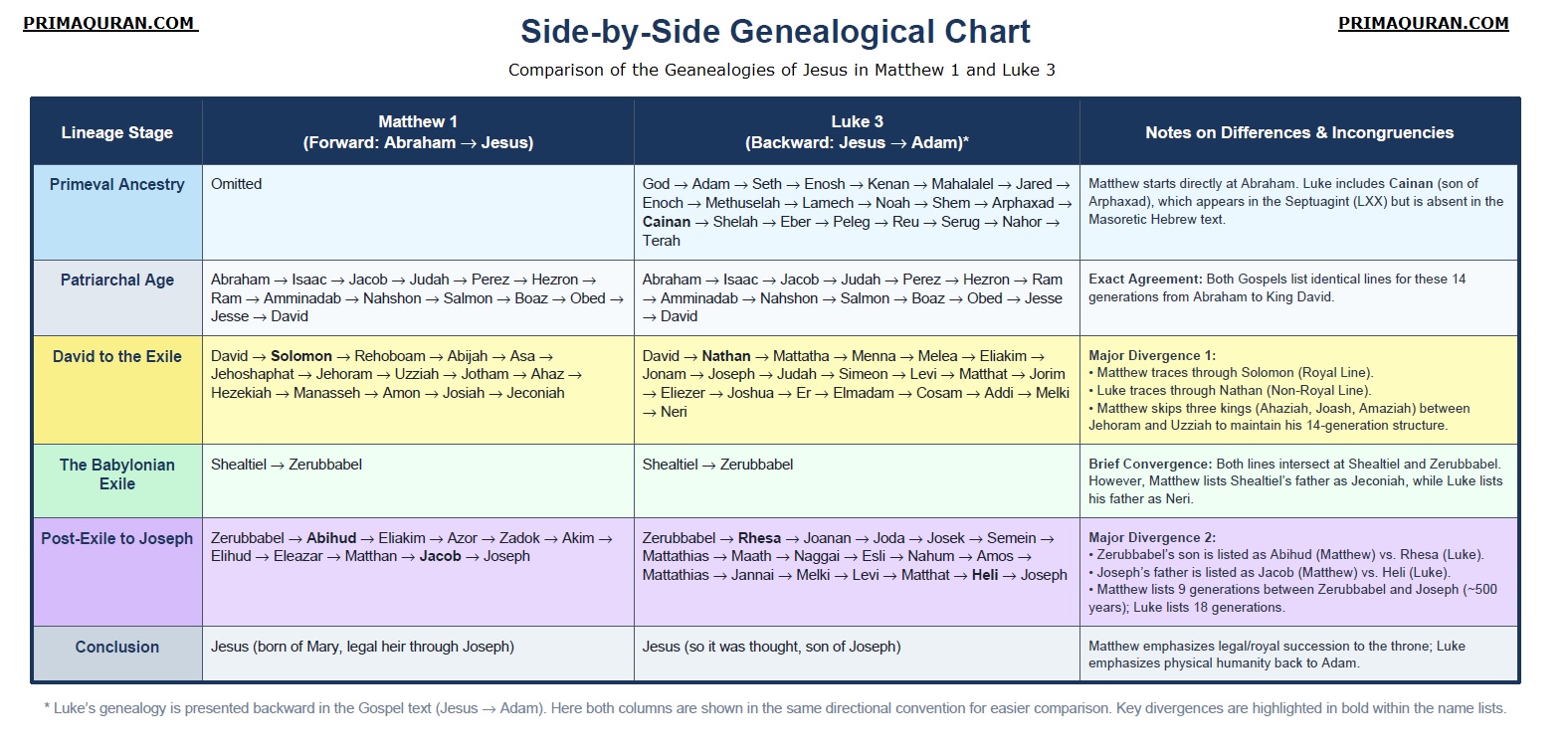
[Click on the image above. Then right click that image and select open image in new tab. Ctrl and mouse wheel or Ctrl and +,- to zoom in/out.] Voila!

Christians try and deal with this conflict by saying that one is a genealogy through Joseph and the other is a genealogy via Mary. However, neither of the text say that it represents a genealogy through Mary.

Even then you cannot get a consistent answer from Christians. Some will claim that Matthew is giving Mary’s lineage. Some will claim that Luke is giving Mary’s lineage.

Those who try and advocate a lineage via Mary do so by claiming that Matthew ends with Mary and not Joseph.

So let us look at what the text says:

and Jacob the father of Joseph, the husband of Mary, and Mary was the mother of Jesus who is called the Messiah. (Matthew 1:16)

What does this text say about Mary?

  1. She is the mother of Jesus.
  2. She is the wife of Joseph.

It says nothing of her lineage.

Christians are seeing things that simply aren’t there. Who can be a Christian with this level of cope and dishonesty. Matthew 1:16 clearly ends with Joseph.

  1. Who is the husband of Mary. Since Mary is introduced we get info about her.
  2. Mary is Jesus mother.

What we do not get is Mary’s genealogy.

Who is Mary’s Mother in Matthew 1:16?

Who is Mary’s Father in Matthew 1:16?

If we truly love and honout God we need to love and honour truth.

The Grammatical Shift in the Greek Text

There is a vital detail in the original Greek text of Matthew 1:16 that gets lost in English translation, which reinforces our earlier point that Mary is the only physical parent.

Throughout Matthew 1, the English translation uses “was the father of” or “begat.” In the original Greek, this is the active verb egennēsen ἐγέννησεν (masculine: “he fathered”).

But in verse 16, the grammar completely changes:

“…and Jacob fathered Joseph, the husband of Mary, of whom was born Jesus…”

The phrase “of whom” in Greek is hēs, which is strictly feminine singular.

The verb “was born” is (ἐγεννήθη) egennēthē, which is passive.

Grammatically, Matthew is explicitly stating that Jesus was physically born out of Mary alone, deliberately breaking the “he fathered” pattern used for every other man in the list. This confirms exactly what we stated: Jesus’ physical humanity and flesh come solely from Mary, while Joseph’s biological seed is entirely absent.

Luke also does not give us a genealogy via Mary.

“Now Jesus himself was about thirty years old when he began his ministry. He was the son, so it was thought, of Joseph, the son of Heli.” (Luke 3:23)

“So it was thought” or “as was supposed” in some translations. Luke 3:23 is simply acknowledging the public perception of the time. That to the average observer in Nazareth, Jesus was just a normal child born to Joseph and Mary.

Another observation. ‘was about thirty years old’. hōsei (ὡσεὶ)

Meaning: hósei: As if, like, about, approximately

Source: (https://biblehub.com/greek/5616.htm)

So you know this person is not writing under inspiration of any Holy Spirit. The Holy Spirit cannot even supply us with the information when Jesus began preaching. It’s as if the Holy Spirit is guessing. The Holy Spirit is giving us a ‘ball park figure’ a ‘guesstimation’.

Does the Gospel of Luke dismiss Matthew’s Genealogy?

It is important to note that the sequence of the Gospel order was not always uniform in Christian history.

Clement of Alexandria.Matthew and Luke are grouped together as being written before Mark, but Matthew is still traditionally listed first in that pair. The pair of Luke and Matthew.

The Western Order. The sequence is Matthew, John, Luke, Mark. Meaning Matthew remains the very first Gospel, while Luke is third.

So according to the most dominant and surviving Church tradition by all accounts Matthew is before Luke.

Luke exsposes all!

“Many have undertaken to draw up an account of the things that have been fulfilled[a] among us, just as they were handed down to us by those who from the first were eyewitnesses and servants of the word. With this in mind, since I myself have carefully investigated everything from the beginning, I too decided to write an orderly account for you, most excellent Theophilus, so that you may know the certainty of the things you have been taught.” (Luke 1:1–4)

There are four powerful points provided to us by Luke. These four points shatter the popular, clean narrative of flawless textual transmission and reveal the messy reality of early Christian record-keeping.

1. No Claim to Inspiration

The author of Luke never says, “The Holy Spirit moved me to write these words,” nor does he claim to have received this information via a divine vision or revelation. Instead, he treats his work as a human, academic endeavor. He explicitly frames his authority around human methodology: he “carefully investigated everything” like a standard ancient historian or investigative journalist.

2. Not an Eyewitness / Anonymous Sources

The text explicitly states: “just as they were handed down to us by those who from the first were eyewitnesses.”

  • By using the word “us,” the author explicitly excludes himself from being an eyewitness.
  • He admits he is a second- or possibly even a third- transmitter. Relying on a chain of custody (“handed down”).
  • Crucially, when it comes to the complex, divergent genealogy in Luke 3, he never names his source. He doesn’t say he got it from Mary, or from an official temple archive; it is pulled from an entirely anonymous stream of tradition.

3. Rejecting Matthew’s Order

If we grant the traditional Church view that Matthew was written first and was widely circulated, Luke’s opening sentence becomes a direct, polite critique of Matthew.

  • Luke acknowledges that “many have undertaken to draw up an account.” Matthew would be chief among them.
  • Luke then says, “I too decided to write an orderly account.
  • The undeniable logical implication is that Luke found the existing accounts which would presumably include Matthew’s to be disorderly, incomplete, or structurally flawed. If Matthew’s genealogy and narrative were already perfect and “orderly,” Luke’s self-appointed mission to fix the record would be completely redundant.

4. Conflicting Information in the Early Strata

The very fact that Luke felt compelled to launch a major investigation and draft a brand-new timeline proves that the “data” about Jesus in currency between 60–90 AD was already heavily conflicting.

Even in the earliest layers of the Christian movement, there was no single, unified, locked-in story. You had:

  • One community (Matthew’s) circulating a list that went through Solomon, Jeconiah, and Jacob.
  • Another community (Luke’s source) circulating a list that went through Nathan, Neri, and Heli.

The author of Luke stepped into this chaotic environment of competing oral traditions and picked the data he deemed most reliable or “orderly,” and wrote his version. The result is the flat, un-harmonised contradictions we see on the page today.

The blood curse dilemma for Chrisitians.

“and Josiah the father of Jeconiah or spelled as Jehoiachin and his brothers at the time of the exile to Babylon.” (Matthew 1:11)

The inclusion of King Jeconiah (also known as Jehoiachin) in Matthew 1:11 introduces what theologians call the “Blood Curse” dilemma, which stems from a severe prophecy in the Book of Jeremiah.

The Prophetic Dilemma (Jeremiah’s Curse).

During the Babylonian exile, King Jeconiah rebelled against God. In response, God pronounced a permanent curse on his biological bloodline.

““As surely as I live,” declares the Lord, “even if you, Jehoiachin son of Jehoiakim king of Judah, were a signet ring on my right hand, I would still pull you off. I will deliver you into the hands of those who want to kill you, those you fear such as the Nebuchadnezzar king of Babylon and the Babylonians. I will hurl you and the mother who gave you birth into another country, where neither of you was born, and there you both will die. You will never come back to the land you long to return to.” Is this man Jehoiachin a despised, broken pot, an object no one wants? Why will he and his children be hurled out, cast into a land they do not know? O land, land, land, hear the word of the Lord! This is what the Lord says: “Record this man as if childless, a man who will not prosper in his lifetime, for none of his offspring will prosper, none will sit on the throne of David or rule anymore in Judah.” (Jeremiah 22:24-30)

This created a massive legal and prophetic paradox for the Jewish expectation of the Messiah:

  1. The Requirement: The Messiah had to be a descendant of King David and King Solomon to claim the legal rights to the royal throne.
  2. The Problem: Jeconiah was part of that royal line. Because of the curse, any biological child born from Jeconiah’s bloodline was strictly disqualified from ever sitting on the throne of David.

If Jesus was the biological son of Joseph (who carried Jeconiah’s bloodline in Matthew), Jesus would be legally disqualified from being the Messiah King!

If Jesus has absolutely no biological connection to Joseph. So then tracking Joseph’s genealogy whether cursed or not does not give Jesus a drop of Davidic blood.

Neither Matthew or Luke state that they are giving Mary’s genealogy. In fact, they are not even giving us Jesus genealogy. What we are getting are genealogies of Joseph.

The Unresolved Reality

By sticking strictly to the text, we are left with the exact dilemma that was raised earlier:

  • Matthew traces Joseph’s ancestry to David.
  • Luke traces Joseph’s ancestry to David.
  • Jesus has no biological connection to Joseph.
  • The texts do not explicitly provide Mary’s ancestry.

Further contradictions and errors in Matthew Genealogy.

“After the exile to Babylon: Jeconiah was the father of Shealtiel, Shealtiel the father of Zerubbabel,(Matthew 1:12)

“The descendants of Jehoiachin the captive: Shealtiel his son, Malkiram, Pedaiah, Shenazzar, Jekamiah, Hoshama and Nedabiah. The sons of Pedaiah: Zerubbabel and Shimei. The sons of Zerubbabel: Meshullam and Hananiah. Shelomith was their sister.” (1 Chronicles 3:17-19)

To get around this error it is often propsed that a Leveriate marriage was involved. The claim is Shealtiel died childless. This information is completely absent from the text. It is a fabricated premise required to make the Levirate marriage theory function.

Why theis silence destroys any attempt at harmonization.

Once again, stacking this theory against the rest of scripture reveals a new contradiction:

  • If Shealtiel died childless and Pedaiah raised up an heir for him: By Torah law (Deuteronomy 25:6), Pedaiah’s firstborn son would legally belong to Shealtiel to carry on his name.
  • The Chronological Contradiction: If the Levirate law was successfully fulfilled, the official temple archives in 1 Chronicles should have recorded Zerubbabel as the son of Shealtiel. Instead, the Chronicler flatly records Zerubbabel as the son of Pedaiah.

By recording Zerubbabel under Pedaiah’s name, the text indicates that Zerubbabel carried Pedaiah’s legal identity and inheritance, not Shealtiel’s.

The flat textual discrepancy remains.

Rather than the text supporting a Levirate framework, we are left with a direct clash between different books of the Bible:

  • 1 Chronicles 3:19 says Zerubbabel is the son of Pedaiah.
  • (Ezra 3:2), (Nehemiah 12:1), (Haggai 1:1), (Mathew 1:12), (Luke 3:27) all flatly call him the son of Shealtiel.

The narrative of a childless death is a defensive theory constructed after the fact to patch over an explicit contradictions.

The Ultimate Historical Trap for Matthew.

  1. If it was a Levirate marriage: The child legally belongs to the dead brother (Shealtiel). Therefore, the official genealogical records of Israel should have listed Zerubbabel under Shealtiel.
  2. The Chronicler’s Rejection: But the author of 1 Chronicles explicitly rejects that. He prints Zerubbabel as the biological and legal son of Pedaiah.
  3. Matthew’s Error: By writing that Shealtiel fathered Zerubbabel, Matthew is directly contradicting the primary historical source material of the Hebrew Bible.

Why This Destroys Matthew’s Objective.

Matthew’s entire purpose in Chapter 1 is to present a neat, unquestionable, legally airtight royal lineage to prove Jesus is the Messiah to a Jewish audience.

However, by printing a line that flatly contradicts the official priestly and royal archives of 1 Chronicles 3, Matthew’s genealogy fails the very audience he is writing for. Any first-century scribe or scholar reading Matthew 1:12 alongside the scroll of Chronicles would immediately see the discrepancy and flag it as a disqualifying error!

Yes! Even more contradictions and errors in Matthew Genealogy.

 Zerubbabel the father of Abihud, Abihud the father of Eliakim, Eliakim the father of Azor,” (Matthew 1:13)

“The sons of Zerubbabel: Meshullam and Hananiah, and Shelomith was their sister. There were also five others: Hashubah, Ohel, Berekiah, Hasadiah and Jushab-Hesed.” (1 Chronicles 3:19–20)

1 Chronicles explicitly lists seven sons and one daughter for Zerubbabel. Abiud is completely absent from the list.

Furthermore, Luke 3:27 also lists a son for Zerubbabel, but he calls him ‘Rhesa

Neither Matthew’s “Abiud” nor Luke’s “Rhesa” appear anywhere in the official Old Testament list of Zerubbabel’s children.

Matthew’s list here cannot be verified by any Hebrew scripture. Historians note that after the Babylonian exile, official, centralized royal records in Israel largely disintegrated or became heavily fragmented.

Matthew wanting to connect the historic post-exilic hero Zerubbabel to Joseph’s family either used a flawed, unverified local family oral tradition or simply inserted names (like Abiud) to bridge a multi-century historical gap and maintain his rigid structure of exactly 14 generations.

Matthew 1:13 directly invents or inserts a son for Zerubbabel that the chronicler of Israel’s royal line explicitly omitted.

The massive gap of generations between Zerubbabel and Joseph!

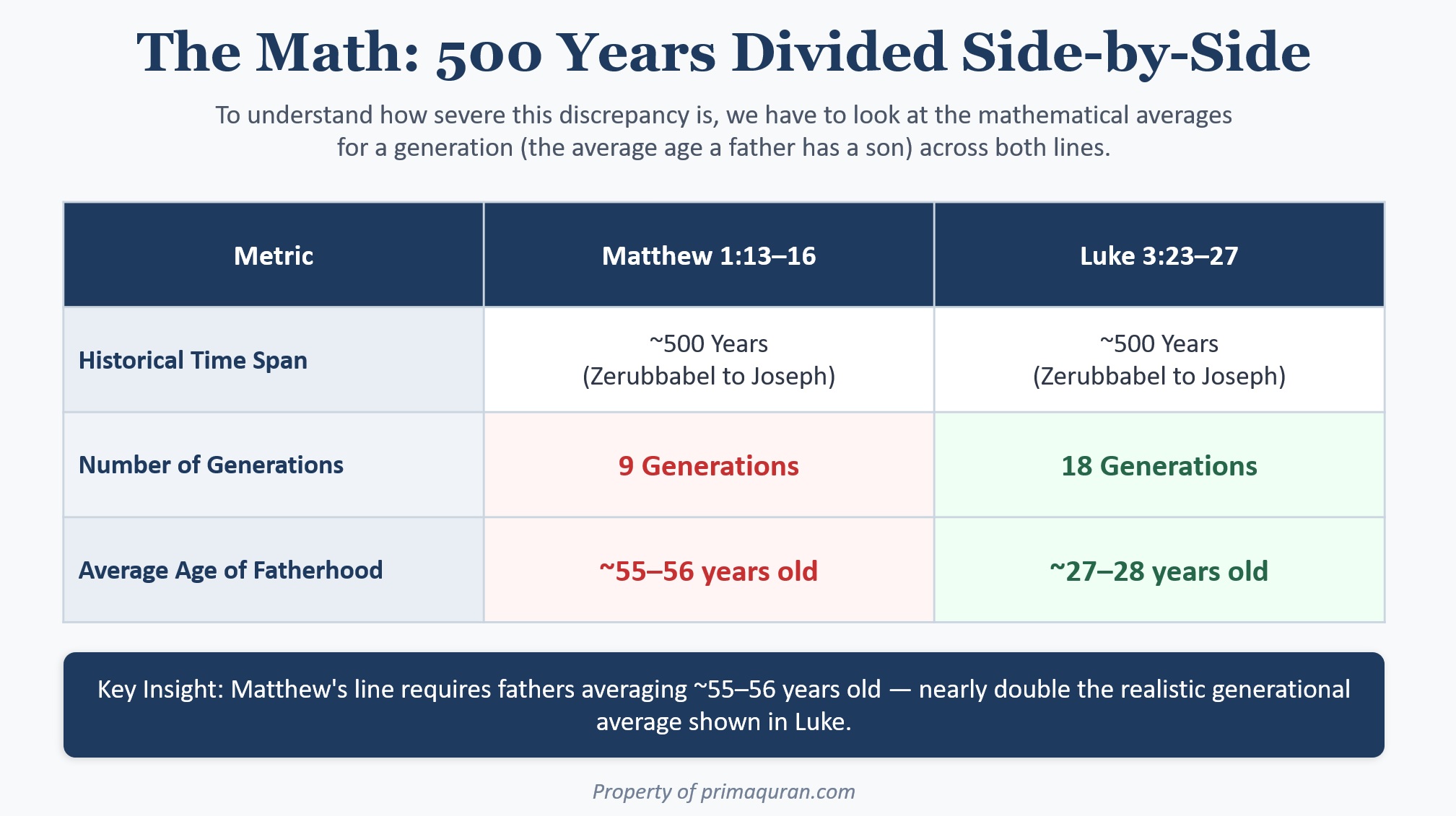
(Where Matthew covers over 500 years of history using only 9 names, while Luke uses 18.)

When we look at the final stretch of history from the Babylonian exile (around 586 BC) to the birth of Jesus, we encounter a massive, chronological black hole in Matthew’s genealogy.

By comparing the number of generations Matthew and Luke use to cover this 500-year historical gap, the numbers reveal a stark biological impossibility in Matthew’s list.
Why Matthew’s Line is Biologically Impossible

In the ancient world, the average age of fatherhood was typically between 20 and 30 years old.

  • Luke’s timeline is completely realistic. An average of 27–28 years per generation fits perfectly with historical realities, standard human biology, and ancient demographics. Over 500 years, you should have around 17 to 20 generations.
  • Matthew’s timeline requires a miracle per generation. For 9 men to stretch across 500 years, every single father in Matthew’s line would have to be roughly 55 to 60 years old when their listed son was born. While biologically possible for an isolated individual, it is mathematically and historically impossible for an entire ancestral line to maintain this average consecutively for half a millennium.

Why Did Matthew Do This?

Matthew explicitly tells us why.

“Thus there were fourteen generations in all from Abraham to David, fourteen from David to the exile to Babylon, and fourteen from the exile to the Messiah.(Matthew 1:17)

Matthew was completely bound to the number 14. For whatever reason. Was it due to numerology, gematria or demonology is anyone’s guess.

What is clear is that Matthew intentionally deleted at least 8 to 10 historical generations from the post-exilic era. He compressed 500 years of history into a completely artificial framework.

By sticking strictly to the text, we see that Luke records a realistic human lineage, while Matthew prints a heavily redacted, structurally forced list.

Because Matthew chopped out massive chunks of history to make his “14 generations” pattern work, his list ceases to be an accurate historical record of Joseph’s actual ancestors. It is a literary device, not a historical document.

This is perhaps why we have Luke who claims:

“With this in mind, since I myself have carefully investigated everything from the beginning, I too decided to write an orderly account for you.”

Further Christian and so called “Hebrew Israelite’ defenses.

In this section we will look at further Christian and/or “Hebrew Isrealite” defenses of these contradictions.

Joseph: The son of Jacob or the son of Heli?

“and Jacob the father of Joseph, the husband of Mary, and Mary was the mother of Jesus who is called the Messiah.” (Matthew 1:16)

“Now Jesus himself was about thirty years old when he began his ministry. He was the son, so it was thought, of Joseph, the son of Heli.(Luke 3:23)

Here the ‘Levirate marriage theory’ is introduced.

“If brothers are living together and one of them dies without a son, his widow must not marry outside the family. Her husband’s brother shall take her and marry her and fulfill the duty of a brother-in-law to her. The first son she bears shall carry on the name of the dead brother so that his name will not be blotted out from Israel.” (Deuteronomy 25:5-6)

Levirate marriage is a traditional practice where a man is required or encouraged to marry his deceased brother’s widow. The main goal is to produce an heir to carry on the dead brother’s name and protect family property.

Since both Gospels explicitly record that Jesus was miraculously conceived through the Holy Spirit, trying to engineer complex biological or legal loopholes for Joseph’s lineage becomes an unnecessary distraction from the text’s primary claim.

When you break down the actual rules of Levirate marriage, the traditional apologetic explanation completely falls apart under its own weight.

The Self-Contradiction of the Theory

The traditional harmonization (popularized by the early church historian Africanus) claims the following scenario:

  1. Heli and Jacob are maternal half-brothers.
  2. Heli dies childless.
  3. Jacob steps in and performs the Levirate marriage with Heli’s widow to raise up an heir for his dead brother.
  4. Jacob biologically fathers Joseph.

By the absolute law of Levirate marriage, the child belongs legally to the dead brother, not the living one.

  • The Law’s Explicit Goal: Deuteronomy states that the firstborn child of a Levirate marriage “shall carry on the name of the dead brother so that his name will not be blotted out from Israel.”
  • The Contradiction: If this was a true Levirate marriage, Heli is the legal father, and Jacob’s name is legally erased from the lineage.
  • The Textual Reality: If Jacob’s name is erased from the legal line, Matthew would never have written “Jacob fathered Joseph.” Matthew’s genealogy would have had to list Heli. Conversely, if Jacob is listed because he is the physical father, it violates the entire point of a Levirate marriage, which was to attribute the child to the dead man.
  • A Levirate marriage only happens after a man is dead.
  • Therefore, Heli is completely out of the picture physically. He did not provide seed, he did not raise the child, and he did not father Joseph.
  • For Luke to flatly write that “Joseph was the son of Heli” while Matthew flatly writes “Jacob fathered Joseph,” they are describing two completely mutually exclusive realities.

To make the Levirate theory work, apologists have to invent a completely fabricated hybrid system where Joseph somehow holds a “dual sonship” that the text of the Gospels never hints at, and that ancient Jewish legal records would not support in the way it is presented.

By applying strict logical consistency to the definitions of the law, the Levirate explanation doesn’t solve the problem. It just creates a new contradiction.

Since the legal and biological loopholes fail to bridge the gap, it leaves us right back at our earlier point: these are two completely separate, conflicting traditions circulating in the early Church strata.


Why the Levirate Explanation Fails Logically

The theory (originally proposed by the 3rd-century historian Julius Africanus) claims that Heli died childless, so his brother Jacob married the widow. Jacob physically fathered Joseph, but legally, Joseph belonged to the deceased Heli.

This fails for three fatal reasons:

1. It Completely Erases Matthew’s Genealogy

According to the Torah (Deuteronomy 25:6), the absolute legal purpose of a Levirate marriage is that the child shall carry on the name of the dead brother so that his name will not be blotted out.”

  • Legally, Jacob’s name is completely out of the picture. Joseph is legally the son of Heli alone.
  • Therefore, Matthew’s legal genealogy tracking the line of kings could not say “Jacob fathered Joseph.” If Matthew was tracking the legal line, he would have been required to write “Heli.”

2. It Makes Matthew Track an Irrelevant Bloodline

If apologists argue that Matthew is tracking the physical bloodline (“according to the flesh”) via Jacob, the genealogy becomes messianically useless. If Joseph is legally Heli’s son, then Jacob’s physical lineage through Solomon and the kings means absolutely nothing to Joseph.

3. It Invents a Speculative “Dual Lineage”

The text of the Gospels gives no hint of this complexity. Matthew says “Jacob fathered Joseph.” Luke says Joseph was “the son of Heli.” To force a Levirate marriage onto the text requires inventing a massive legal loophole that violates how ancient Jewish records actually handled names.


How This Complicates and Ruins Messianic Claims in Judaism

In the Tanakh and rabbinic Judaism, the Levirate explanation does not save the narrative. It completely breaks the requirements for the Messiah.

1. The Legal vs. Physical Contradiction in Jewish Law

To inherit the throne of King David, the Messiah must fulfill two distinct criteria simultaneously under the Tanakh:

  • Tribal/Royal Lineage is Paternal Only: Tribal affiliation (Judah) and royal succession (Davidic) are passed exclusively through the biological father’s seed (Numbers 1:18). Adoption or step-parenting does not transfer tribal identity or royal blood rights in Jewish law.

“and they called the whole community together on the first day of the second month. The people registered their ancestry by their clans and families, and the men twenty years old or more were listed by name, one by one,” (Numbers 1:18)

  • The Biological Dilemma: If Joseph’s physical father is Jacob (Matthew) but his legal father is Heli (Luke), Jesus’ lineage is fractured. If you claim Jesus gets his right through Joseph’s legal line (Heli), Judaism rejects it because Heli’s line goes through Nathan, not Solomon. The Tanakh explicitly states the royal throne belongs exclusively to the physical seed of Solomon (1 Chronicles 22:9-10).

“Behold, a son shall be born to you, who shall be a man of rest; and I will give him rest from all his enemies all around. His name shall be Solomon, for I will give peace and quietness to Israel in his days. He shall build a house for My name, and he shall be My son, and I will be his Father; and I will establish the throne of his kingdom over Israel forever.’ (1 Chronicles 22:9-10)

2. The Levirate Law Disqualifies the Royal Line

If Joseph is the product of a Levirate marriage to raise up seed for Heli, Joseph’s legal identity belongs to Heli’s line (the line of Nathan).

  • Because Nathan was never a king, Heli’s line has no royal claim to the throne.
  • By asserting that Joseph is legally Heli’s son, apologists accidentally strip Joseph (and by extension, Jesus) of the legal right to the throne of Solomon.

3. The Ultimate Jewish Objection: The Virgin Birth

From the perspective of Judaism and the Tanakh, the entire genealogical debate is rendered moot by the claim of the Virgin Birth.

  • If Joseph is not the biological father of Jesus (no sperm/seed involved), then Jesus has 0% tribal connection to Judah and 0% royal connection to David through Joseph, regardless of whether Joseph’s father was Jacob or Heli.

The Jeconiah Blood Curse solution and the Levirate Marriage solutution. When resolutions clash.

When you stack the Jeconiah Blood Curse solution right next to the Levirate Marriage solution, the two arguments completely collide and destroy each other. You cannot hold both views simultaneously without creating a massive logical paradox.

Here is the exact step-by-step breakdown of the trap that traditional harmonizations fall into:

The Contradiction Stack: How They Destroy Each Other

The “Solution” OfferedThe Mechanics of the SolutionThe Hidden Conflict Created
1. The Levirate Solution (To fix the Jacob vs. Heli contradiction)Apologists claim Jacob (Matthew’s line) is the physical/biological father of Joseph, while Heli (Luke’s line) is the legal father.This means Joseph’s true, binding legal identity belongs entirely to Heli (the non-royal line of Nathan).
2. The Adoption Solution (To fix the Jeconiah Blood Curse)Apologists claim Jesus inherits the royal, kingly right to the throne from Joseph via legal adoption.In ancient law, you can only adopt a child into your own legal lineage. You cannot pass down a legal inheritance that you do not legally possess.

The Ultimate Breakdown of Logic

If we accept both traditional claims, the entire messianic argument collapses under its own weight for two reasons:

1. Joseph Has No Royal Legal Line to Pass Down

If Joseph is the legal son of Heli via Levirate law, then Joseph’s legal ancestry is Luke’s genealogy. Luke’s genealogy goes through Nathan, who was never a king. Joseph completely loses his legal connection to Solomon and the royal line of kings in Matthew.

Therefore, when Joseph “legally adopts” Jesus, he can only pass down his own legal lineage. That is the non-royal line of Heli and Nathan. The adoption completely fails to give Jesus a claim to the royal throne.

2. The Physical Line is Cursed and Messianically Useless

If apologists argue that Joseph still carries the royal line of Solomon through his physical father Jacob, that physical line is precisely the one carrying the blood curse of Jeconiah (Jeremiah 22:30) that we mentioned earlier.

But the entire point of the adoption theory was to avoid the physical line because it was cursed! Furthermore, as established by Torah law, a Levirate child has no legal rights to his physical father’s (Jacob’s) royal estate anyway.

The Conclusion: A Complete Logical Checkmate

By trying to patch up two separate problems with two different fabricated legal loopholes, traditional apologetics creates an impossible situation:

  • To fix the name discrepancy, they strip Joseph of his legal royal heritage (making him legally Heli’s son).
  • To fix the blood curse, they rely on Joseph’s legal royal heritage via adoption to make Jesus a king.

This is an absolute, massive contradiction. The moment you use the Levirate theory to explain away the different fathers for Joseph, you automatically disqualify Joseph from being able to pass down the royal throne to Jesus through adoption.

The two texts simply remain what we identified as earlier: two entirely separate, conflicting, and un-harmonized traditions from the early strata of Christianity.

  1. The Flaw in the “Legal Right” Claim: For Joseph to pass down the royal “legal right” to Jesus via adoption, Joseph himself must hold that legal right.
  2. The Levirate Collateral Damage: If Joseph’s legal father is Heli (as the Levirate theory demands to fix the Matthew/Luke contradiction), then Joseph’s legal inheritance is non-royal. He cannot pass a royal legal right to Jesus that he legally surrendered to Heli’s lineage.
  3. The Logical Trap: When presented with the adoption argument as a clean solution to the curse, and then you introduce the Levirate framework to fix the other discrepancies, the foundation of that adoption argument completely dissolves.

The traditional attempts at harmonisation end up chasing their own tails. You cannot use the Levirate law to change Joseph’s legal father to Heli, and then turn around and use Matthew’s line to claim Joseph passes down a legal right from Jacob.

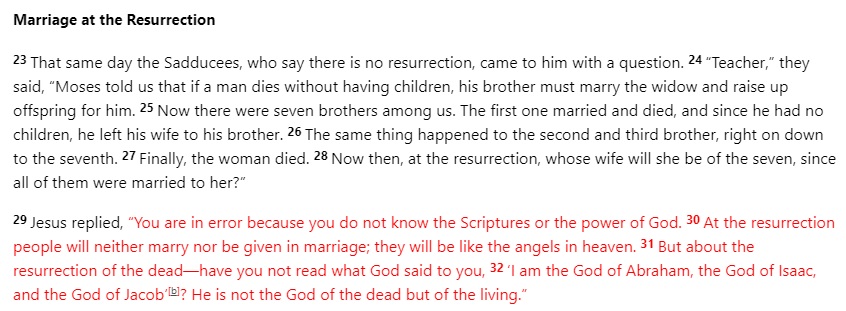
Also, if you want to see how the New Testament portrays Jesus as a super ultra ignorant individual when it comes to levirate marriage and human reproduction you may see our article here:

Apologetic claim: Matthew skips generations while Luke meticuulously lists every person.

When apologists claim that Matthew intentionally “skips” generations while Luke meticulously lists every single person “line-by-line” to capture the pure maternal bloodline, they run straight into a massive wall erected by Luke himself.

Here is exactly how the actual data in Luke exposes this argument as a total fabrication:

1. Luke Explicitly Connects the Line to Joseph, Not Mary

If Luke was writing a strict “line-by-line” biological genealogy of Mary to patch up Matthew’s omissions, he would have stated so. Instead, Luke 1:27 tells us exactly who belongs to the house of David:

“…to a virgin pledged to be married to a man named Joseph, of the house of David. The virgin’s name was Mary.”

Luke explicitly anchors the Davidic lineage to Joseph, not Mary. He repeats this in Luke 2:4: “So Joseph also went up from the town of Nazareth… to Bethlehem the town of David, because he [Joseph] belonged to the house and line of David.”

Luke never says Mary belongs to the line of David. The “all-male line-by-line Mary defense” is entirely invented; Luke flatly states he is tracking Joseph’s ancestry.

2. Luke Fabricates the Ultimate “Skip” (The Post-Exile Void)

The claim that Luke is a reliable, exhaustive “line-by-line” historical record completely falls apart when we look at the historical timeline.

As we established, Luke lists 18 generations between Zerubbabel (500 BC) and Joseph (0 BC). While 18 generations is far more mathematically realistic than Matthew’s 9 generations, it is still an incomplete historical record.

  • In historical reality, 500 years of history at a normal human generational pace requires roughly 20 to 25 generations.
  • To make Luke a flawless “line-by-line” document, apologists have to claim that every single man in Luke’s post-exilic line waited until they were nearly 30 years old to have a child, without a single premature death, war, or disruption over half a millennium.

3. The Textual Reality: Both are Theological, Not Historical

When you look at the raw data, the “Luke is strict, Matthew is skipping” argument is just another artificial patch.

  • Matthew openly admits he is skipping names to force an artificial structural template of 3 sets of 14 generations.
  • Luke rearranges his list to end on a theological climax: tracing Jesus all the way back to Adam.

“Adam, the son of God” (Luke 3:38).

By forcing the text of Luke to stand on its own two feet, we have correctly shown that the “line-by-line Mary” theory completely contradicts what Luke actually wrote in his opening chapters.

How does Numbers 27:8-11 destroy the claims of the adoptionist theory?

“Say to the Israelites, ‘If a man dies and leaves no son, give his inheritance to his daughter. If he has no daughter, give his inheritance to his brothers. If he has no brothers, give his inheritance to his father’s brothers. If his father had no brothers, give his inheritance to the nearest relative in his clan, that he may possess it. This is to have the force of law for the Israelites, as the Lord commanded Moses.’” (Numbers 27:8-11 )

This completely destroys the adoptionist theory because it establishes an exhaustive, legally binding, closed-loop system of inheritance that leaves absolutely no legal mechanism for an adopted child or stepson to inherit a tribal or royal patrimony.

Under the strict letter of Torah law, when a man dies, his inheritance follows a precise, mandatory chain of custody. By applying this exact statute to Joseph and Jesus, the adoptionist framework collapses for three reasons:

The text of Numbers 27 outlines a strict hierarchy of who has legal right to a man’s property, title, and estate:

  1. The Biological Son (assumed in verse 8 as the default primary heir)
  2. The Daughter (if there is no son)
  3. The Deceased Man’s Brothers (if there are no children)
  4. The Paternal Uncles (if there are no brothers)
  5. The Nearest Blood Relative in the Clan

Adoption is completely missing from this statutory list. In the legal framework of the Torah, a man cannot simply invent or appoint an unrelated heir to bypass this divine command.

The law commands: “This is to have the force of law for the Israelites.” If Joseph has no biological sons, his legal estate and royal Davidic titles do not pass to a stepson; they are legally mandated by God to go to Joseph’s brothers or his nearest paternal blood relatives.

To inherit the throne of David, a person must belong to the tribe of Judah and be of the literal, physical line of David and Solomon.

According to Numbers 27, if Joseph dies without physical seed, his branch of the Davidic line effectively closes. The title moves sideways to his biological brothers (such as any physical brothers Joseph might have had from Jacob’s line). Because Jesus has zero biological input from Joseph’s sperm, Jesus is legally outside this chain of custody. Joseph had no legal authority under Torah law to transfer a tribal, patriarchal inheritance to a child who was not his physical seed.

The Ultimate Legal Checkmate

The adoptionist theory tries to argue that “legal fatherhood” is enough to pass down the covenantal promises made to David. However, Numbers 27 proves that biblical legal fatherhood is explicitly tied to biological realities. The law only moves to non-children (brothers and uncles) when biological children do not exist.

If apologists argue that Jesus is Joseph’s legal son through adoption, they are inventing a Hellenistic or Roman legal concept (where adoption granted full estate rights) and forcing it onto Hebrew law. The Torah recognizes no such mechanism for tribal or royal succession.

The Theological Fallout

By applying Numbers 27:8–11 strictly:

  • If Joseph is not the biological father, he cannot pass the rights of Judah and David to Jesus.
  • The inheritance is legally forced by the Torah to go to Joseph’s brothers or closer blood kin.
  • Jesus is left with no legal or scriptural mechanism to claim the royal throne of David through Joseph.

Final Thoughts.

If the goal is to honor God through truth, then the truth is: the New Testament presents a virgin-born Messiah whose Davidic lineage is not documented in the genealogies it provides. That is a real theological and historical problem, and pretending it isn’t there does not serve the text, the tradition, or the seeker of truth.

  • The Gospels present two conflicting genealogies.
  • Both are Joseph’s.
  • Neither is Mary’s.
  • Jesus has no biological connection to Joseph.
  • Therefore, the New Testament does not provide a genealogy of Jesus. It provides genealogies of Joseph, which serve no biological or legal function for a virgin-born Messiah.

Any attempt to make one of these genealogies “Mary’s” or to claim that Joseph’s line “counts” for Jesus through adoption or Levirate marriage is reading into the text, not reading from it.

May Allah guide the sincere Christian into the truth.

May Allah guide those who call themselves, ‘Hebrew Israelites’ into the truth.

May Allah Guide the Ummah.

May Allah Forgive the Ummah.

Leave a comment

Filed under Uncategorized

Nothing Can Change the Words of Allah

“For them are good tidings in the worldly life and in the Hereafter. No change is there in the Words of Allah. That is what is the great attainment. “ (Qur’an 10:64)

“Messengers indeed have been denied before thee, and they were patient under the denial and the persecution till Our succor reached them. And no change is there in the Words of Allah. And there has certainly come to you some information about the messengers.” (Qur’an 6:34)

﷽ 

Does Allah Preserve His Words?

The short answer to this question from a theological perspective is yes. The answer is yes, because all the amr’—meaning commands, edicts, prohibitions, injunctions are from the knowledge of Allah.

Allah does not increase or decrease in knowledge.

The question of Allah preserving his words is usually asked of Muslims by Christian polemicists, and we will address them in this article as well.

You will often find them quoting either of these two verses:

“Your Lord’s word has been fulfilled in truth and justice. No change is there in His Words. He is the All-Hearing, the All-Knowing.” (Qur’an 6:115)

“Recite what has been revealed to you from the Book of your Lord. No change is there in His Words, nor can you find any refuge besides Him.” (Qur’an 18:27)

You will not really find them wanting to quote the following verses:

“For them are good tidings in the worldly life and in the Hereafter. No change is there in the Words of Allah. That is what is the great attainment. “ (Qur’an 10:64)

“Messengers indeed have been denied before thee, and they were patient under the denial and the persecution till Our succor reached them. And no change is there in the Words of Allah. And there has certainly come to you some information about the messengers.” (Qur’an 6:34)

This is because the above verses are clear that what is meant are the decrees of Allah (swt). When he decrees it will be like this or that it will be so.

“And they were patient under the denial and the persecution till Our succor reached them.” (Q 6:34)

“For them are good tidings in the worldly life and in the Hereafter.” (Q 10:64)

Even the above verse indicates this as well:

“Your Lord’s word has been fulfilled in truth and justice.” (Q 6:115)

What is meant by ‘no change is there in his Words’ means basically the decree of Allah. Whatever Allah decrees concerning his Creation. What he promises will occur.

An example being:

“When Allah promised you one of the two groups – that it would be yours – and you wished that the unarmed one would be yours. But Allah intended to establish the truth by His words and to eliminate the disbelievers.” (Qur’an 8:7)

“No calamity befalls on the earth nor from among your selves, without being in a record before We make it (nabr-aha) manifest. This is certainly easy for Allah.S o that you may not grieve for what has escaped you, nor be exultant at what He has given you; and Allah does not love any arrogant boaster (Qur’an 57:22-23)

This word nabr-aha is often difficult to translate into English. You can see a list of disparate translations here:

https://www.islamawakened.com/quran/57/22/

We went with Maududi’s rendering of the text: to make it manifest as it is the most sensible rendering. Others have it as ‘brought into being’ or ‘brought into existence’.

“And certainly We sent messengers (to mankind) before you, and We appointed for them wives and offspring, and it was not (given) to any messenger that he should bring a portent save by Allah’s leave. For everything there is a time prescribed. Allah effaces what He will, and establishes (what He will), and with Him is the source of ordinance (ummu l-kitabi)” (Qur’an 13:38-39)

Look at what Allah (swt) says here. He will efface what he will, and he will establish what he will. This, for Muslims, is the record that the angels give to mankind. That record is fluid because the human being and their relationship with the Creator can be fluid.

We talked more about that when we refuted this foreign concept that has crept in among Muslims about us being weighed on some scale on the day of judgment.

“As for those who repent, believe, and do good deeds, they are the ones whose evil deeds Allah will change into good deeds. For Allah is All-Forgiving, Most Merciful.” (Qur’an 25:70)

That is because they followed what angered Allah and disliked [what earns] His pleasure, so He rendered worthless their deeds.” (Qur’an 47:28)

You can read about this here: https://primaquran.com/2024/08/02/are-muslims-weighed-on-scales-on-the-judgement-day/

However, let us say that this means the revelation of Allah, which would include the Qur’an, the Torah, the Injeel, the Zabur and the Suhuf of Ibrahim.

First, we know that the Qur’an is preserved in the lawhin mahfuz (preserved tablet). We can assume (though not specifically stated) that this is the case for other revealed revelations..

“In fact, this is a glorious Qur’an, in a Preserved Tablet.” (lawhin mahfuzin) (Qur’an 85:21-22)

What about the revelation when it descends from heaven to the Earthly realm?

At this point, one of two things can happen.

1) Allah (swt) can choose himself to preserve this revelation that is on this Earth.

“It is certainly We Who have revealed the Reminder, and it is certainly We Who will (lahafizuna) guard it.(Qur’an 15:9)

2) Allah can entrust the revelation to someone other than himself.

“It was We who revealed the law (to Moses): therein guidance and light. By its standard have been judged the Jews, by the prophets who bowed to Allah’s will, by the rabbis and the learned: for to them was (us’tuh’fizua )entrusted the protection of Allah’s book, and they were witnesses thereto: therefore fear not men, but fear me, and sell not my signs for a miserable price. If any do fail to judge by (the light of) what Allah hath revealed, they are (no better than) Unbelievers.” (Qur’an 5:44)

You can see that the word lahafizuna & the word us’tuh’fizua are etymologically from the same root in Arabic.

The problems for the Christian Polemicist are manifold.

1) How do they even determine what scripture is to begin with?

Now, in regard to the Christian polemic, before we even talk about preserving the words of Allah, they have yet to make clear to the world the process by which they even decide what words are Allah’s words and what words are not.

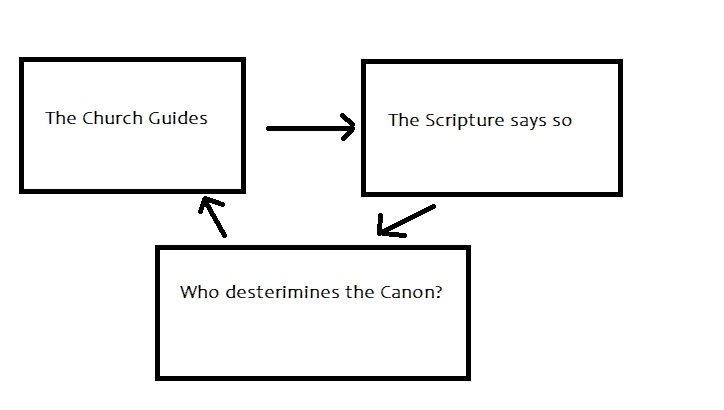
For example, when it comes to the Orthodox (Eastern/Oriental) and the Latin Roman Catholics, we get a very odd circular reasoning. The Protestants do not fair much better.

So this is a conundrum for Christians as a whole.  The Latin Roman Catholics, Orthodox (Oriental/Eastern) point out to the Protestants that it was the Church that decided which books were to be considered canon of the New Testament.  

However, if you were to ask where did the Church (tradition) get its authority from? It had to take its authority from somewhere?

For example, until this very day, Christians dispute the Canon of the Bible.

Not to mention the dispute among them concerning what they call the Old Testament, just to focus on the New Testament, we have the following proposed canons. A New Testament with 22 books (endorsed by the Assyrian Church of the East—Trichur India). They exclude: II Peter, II John, III John, Jude, Revelation of John. A New Testament with 27 books (which we assume most of the readers would be familiar with). A New Testament with 35 books (endorsed by the Ethiopian Orthodox Tawhedo Church). They include Sera’ata Seyon, Te’ezas, Gessewe, Abtelis, Mashafa Kidan, Mashafa Kidan II, Qalmentos, Dideqelya. Church.

For example: In an exchange between Dr. Bart Ehrman and Reformed Baptist Pastor Dr. James White, there were some thought-provoking questions.

Source: (https://www.apologetics315.com/media/white-ehrman-transcript.pdf)

Dr. Ehrman: ” So let me just say—the point is the earlier you go, the more different they are. So you just extrapolate that the earliest were probably the most different. Let me ask about
P72 where you resonate with this particular text, you said, that has 2 Peter and Jude in
it. What other documents are found in P72?”


Dr. White: “There’s some non-canonical documents in P72 My recollection was that 1,2 Peter and Jude were the only canonical documents in it.”


Dr. Ehrman: “Right, so I’m just wondering about you resonating with this document. Do you think this scribe thought that what he was copying was scripture?


Dr. White: “Well, I don’t think that you can simply jump to the conclusion that because
scribes included books in a single codex that meant that they believed that everything in
that codex was necessarily Scripture. There are all sorts of works that were considered
to be very beneficial for the reading of people that were included in codices that were
not necessarily canonical.”


Dr. Ehrman: “Yeah, I just thought that it was odd that that particular manuscript was one that you resonate with because it’s the earliest attestation we have of the Protoevangelion
Jacobi
.”

Prima Qur’an comments: So these are the type of questions that need to be asked. What if the transmitter was under the impression that Protoevangelion Jacobi had the same authoritative weight as the other documents he was transmitting?

You can say what you want about the Church Tradition and the disputes had about the canon (that exist until today), but you cannot presume to speak on behalf of the transmitter themselves.

“But as for you, continue in what you have learned and have become convinced of, because you know those from whom you learned it, and how from childhood you have known the holy Scriptures, which are able to make you wise for salvation through faith in Christ Jesus.” (2 Timothy 3:14-15)

The conundrum, or the pickle here for the Christian, is that the only scriptures that were around when he was a boy were what Christians call ‘the Old Testament’ and even more problematic is the fact that the version he would have had is Septuagint 2.0. (A Greek translation from the Hebrew).

  1. How are Gods words preserved according to Christians?

This is why, in recent years, Christians have developed an apologetic that the Qur’an asserts (one of their many competing New Testament canons) — why the Qur’an would weigh in on competing Christian claims we are never really told.

However, this claim has given much needed oxygen to the Christians involved in debates with Muslims. It deflects from the one thing they do not want to discuss — the Bible itself.

First, it is fascinating that Christians would bring up these verses of the Qur’an to establish (whichever canon they believe) is the preserved word of God.

It is interesting because Christians themselves do admit that we do not have the original writings. The original writings were not preserved. Why is that?

Listen to what Daniel B Wallace has to say on the matter.

We don’t have the original manuscripts of the New Testament. They were they all disappeared within a century. I’m pretty convinced by copying and copying and copying copying frequent handling the early church was far more concerned to get the gospel out than they were to do exact copying of the New Testament. And that actually is a blessing. Because they didn’t have those kind of controls and consequently you get copies that are not through just one stream but tons of people all over the place are making these copies so here’s here’s a man who lives in Corinth he’s gonna be visiting Rome and he says hey I I heard Paul Paul wrote a letter to you guys too. I want to write that out. Do you mind if I copy it when I get there? Sure that’s no problem. This happened I’m sure dozens and dozens of times over. And those manuscripts would have lasted as much as 80-90 years but would fall apart from all these copies being made. So we don’t have the originals they disappeared. And all the copies that we have disagree with each other at some point. Sometimes it’s quite a few disagreements. But we have hundreds of thousands of textual variants among our manuscripts. So, a question to ask here is how badly did the scribes corrupt the New Testament? It’s absolutely proven that they did. No two manuscripts are alike, so unless
one of them is pristine every single scribe made mistakes
. So because the original manuscripts disappeared and because no two copies agree with each other completely we have to do textual criticism we can’t just rely on one it’s imperfect. So scholars have to reconstruct it on that basis. But when you look at the number of textual variants and there are hundreds of thousands of them as Bart Ehrman likes to say there are more textual variants than our words in the original New Testament. That’s actually an understatement. But you have to not just look at the number of variants you have to look at the nature of these variants. And the best estimates are that at least at least 99.8% of them affect nothing. Most are spelling differences, there’s different ways to spell John. There’s different ways to spell Mary. They’re not going to affect anything. But the 1/5th of 1% that do affect things are the one’s that scholars talk about and disagree over on a number of these issues. But the bottom line is it does not matter in some respects which New Testament you use because no essential doctrine is jeopardized by any of these textual variants. Even Bart Erhman who wrote: “Misquoting Jesus” can say the same thing. So that’s true on that end but at the same time we want to know what the original text said in all the details. And so the great majority of scholars have very few disagreements over these passages. For example most scholars would say the long ending of Mark’s Gospel: Mark 16:9-20 is almost surely not authentic. And they still put in their Bibles typically smaller print. Or in brackets or footnote the oldest authorities don’t have this. So there’s a wide consensus on the vast majority of textual variants. And again there’s no essential doctrine that’s jeopardized by any of these textual variants that is extremely comforting. It’s very important to know that.”

Christians, even like Daniel B. Wallace, are deliberately deceitful. We have yet to interact with a Christian that was sincere.

For example: Daniel B. Wallace quotes Erhman as saying:

“But when you look at the number of textual variants and there are hundreds of thousands of them as Bart Ehrman likes to say there are more textual variants than our words
in the original New Testament.”

This is a flat lie!

In the debate with Bart Erhman here: https://www.youtube.com/watch?v=MsVWFS9r9DY
@25:19 “One thing we can say for certain is that there are more differences in our manuscripts than there are words in the New Testament.”

NOTE: Bart does not say the original New Testament.

In fact, during that very debate, Bart Ehrman took Daniel B Wallace to ask for his crazy assertions that biblical scholarship even speaks of getting back to the original. Something, Erhman mentions scholarship has given up on.

There are some other points that Christians play sleight of hand with their audience when it comes to the manuscript tradition.   They don’t like to mention the dates of these manuscripts.  So, when they become manic and start going on about thousands and thousands of manuscripts, we interject. “Slow down, take a deep breath. Let’s pause for a moment. Tell me about these manuscripts and their dates.  For example, a fragment the size of a credit card dated 100 years after Jesus. What does it tell me about the rest of the contents dated 300 or 400 years later? 

About 71% of the Greek New Testament manuscripts date after the 11th century. 84% after the 10th century and around 90% after the 9th century and 94% around the 8th century. So can you imagine that many of the manuscripts date from the Middle Ages, sometimes over 1000 years after what are thought to be the originals?

So Christians console themselves by saying. Alas! Even with us not having the original manuscripts, the manuscripts we do have show marginal differences that affect our core doctrines in insignificant ways. Will see this is not the hot cup of cocoa that Christians think that it is.

As regards what the original manuscripts said. Christians have no way of knowing.  

For example, can Christians demonstrate to us that when a person is making a copy that the copy was read back to check it against the master document? How do we know that the manuscripts or copies before this are not changed?

This is what happens in the memorization of the Qur’an. Keep in mind that Muslims pray five times a day. In all five of those prayers, Surah Al Fatiha is read and transmitted from parents/teacher to children/students. In 3 of those five daily prayers, Surah Al Fatiha and any other portion of the Qur’an is read. In the month of Ramadan, the entire Qur’an is read by the Imam.

In Hadith transmission (though not all-inclusive) I will list three primary methods of transmission/reception.

Method of reception (al-Akhdh wa’l-Tahammul)

a) Direct hearing (al-Sama’) — A person hears directly from the Shaykh/Teacher.

b) Recitation or Rehearsal (Al-Qira’a ‘ala’l-Shaykh) — The person hears directly from the Shaykh/Teacher understands what is transmitted to them and repeats it back to the Shaykh/Teacher.

c) Permission (al-Ijaza) -Simply the Shaykh/Teacher trust the student without testing her/him.

By the way, to the Muslims reading this, be careful about your friends that boast about receiving many ijaza. Unless they reveal to you the specifics about what they learned and the level of mastery, Ijaza’s, in many cases today, amount to a ‘pat on the head’.  Similar to saying: “Good job Tony!” 

In fact, (imo) the most rigorous method of hadith transmission is one in which the student repeats back to the teacher what was said. Which would be transmission by Al-Qira’a ‘ala’l-Shaykh

We could bring a Christian scholar. It could be Oriental Orthodox, Eastern Orthodox, Latin, Roman Catholic, and we could ask them to recite from memory books of the New Testament, and we could check this method against our children.

Can you imagine the modern age when they had (what early Christians did not have) access to. What they imagine is a complete canon, and they still could not compete with our noble sister, Rafia Al Miskry (May Allah cover her with mercy).

Islam can give you demonstrable evidence of a well guarded, well-preserved transmission process. Can Christians do the same?

No major doctrines are affected by the differences in manuscripts? 

What about the lynch pin doctrine of the Trinity?  1 John 5:7  

For those people who think this is old hat and not important. Well, it is a major issue that divides Eastern Orthodox Christians when weighed against the majority of Protestant Christians. 

If a Protestant Christian was weighing the issue of whether to join an Eastern Orthodox Church, they would have to wonder whether the Holy Spirit guided the Eastern Orthodox Church to hang on to 1 John 5:7. Are they truly guided in that decision?

Mark 16:9-20 Are the Churches that Include This Text in the Canon Upon Guidance?

Again, the Eastern Orthodox keep it as part of the canon.

What do the Vatican and the Latin Roman Catholic Church have to say about the text?


[9-20] This passage, termed the Longer Ending to the Marcan gospel by comparison with a much briefer conclusion found in some less important manuscripts, has traditionally been accepted as a canonical part of the gospel and was defined as such by the Council of Trent. Early citations of it by the Fathers indicate that it was composed by the second century, although vocabulary and style indicate that it was written by someone other than Mark. It is a general resume of the material concerning the appearances of the risen Jesus, reflecting, in particular, traditions found in Luke 24 and John 20. The Shorter Ending: Found after Mark 16:8 before the Longer Ending in four seventh-to-ninth-century Greek manuscripts as well as in one Old Latin version, where it appears alone without the Longer Ending. The Freer Logion: Found after v 14 in a fourth-fifth century manuscript preserved in the Freer Gallery of Art, Washington, DC, this ending was known to Jerome in the fourth century. It reads: “And they excused themselves, saying, “This age of lawlessness and unbelief is under Satan, who does not allow the truth and power of God to prevail over the unclean things dominated by the spirits [or, does not allow the unclean things dominated by the spirits to grasp the truth and power of God]. Therefore reveal your righteousness now.’ They spoke to Christ. And Christ responded to them, “The limit of the years of Satan’s power is completed, but other terrible things draw near. And for those who sinned I was handed over to death, that they might return to the truth and no longer sin, in order that they might inherit the spiritual and incorruptible heavenly glory of righteousness. But . . . .’ “

Source: (https://www.vatican.va/archive/ENG0839/__PWI.HTM#$3H5)

Which brings us back to Daniel B. Wallace and his statement above:

For example most scholars would say the long ending of Mark’s Gospel: Mark 16:9-20 is almost surely not authentic. And they still put in their Bibles typically smaller print. Or in brackets or footnote the oldest authorities don’t have this..”

Which Christian is guided by the Holy Spirit in this matter?

In the Red Letter New Testament, where the words are reported to have come from Jesus are in red, we would have: And then he told them, “Go into all the world and preach the Good News to everyone. Anyone who believes and is baptized will be saved. But anyone who refuses to believe will be condemned. These miraculous signs will accompany those who believe: They will cast out demons in my name, and they will speak in new languages. They will be able to handle snakes with safety, and if they drink anything poisonous, it won’t hurt them. They will be able to place their hands on the sick, and they will be healed.” 

That is a huge chunk of words being attributed to Christ Jesus.

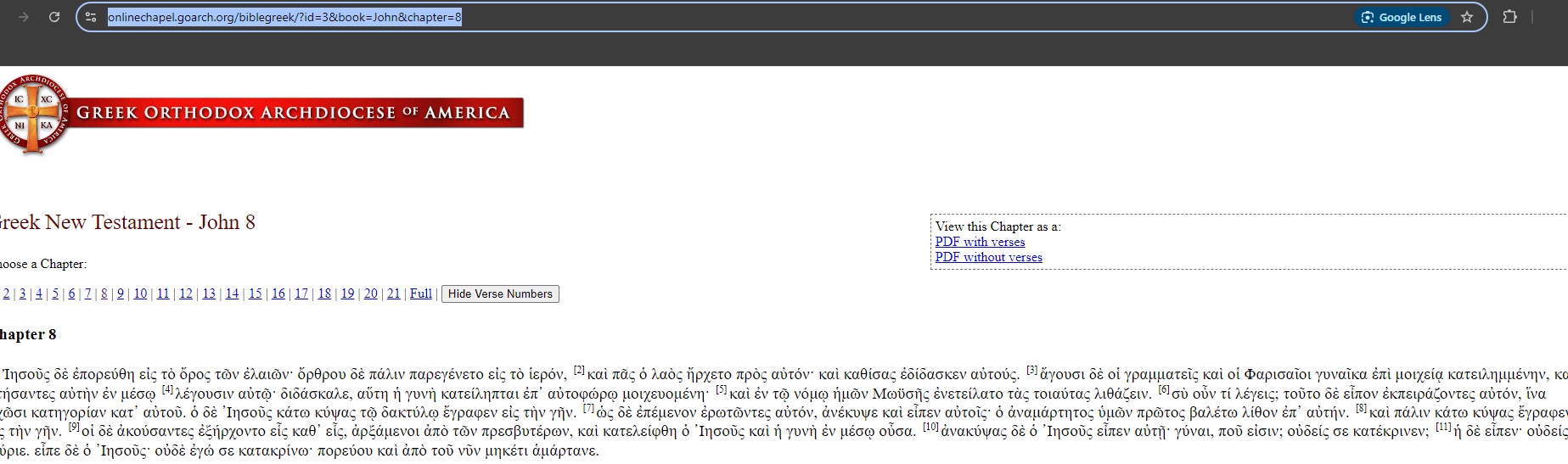
John 7:53-John 8:11 Are the Churches that Include This Text in the Canon Upon Guidance?

The Vatican, the authority for the Latin Roman Catholic Church states:


[7:53-8:11] The story of the woman caught in adultery is a later insertion here, missing from all early Greek manuscripts. A Western text-type insertion, attested mainly in Old Latin translations, it is found in different places in different manuscripts: here, or after
John 7:36 or at the end of this gospel, or after Luke 21:38, or at the end of that gospel. There are many non-Johannine features in the language, and there are also many doubtful readings within the passage. The style and motifs are similar to those of Luke, and it fits better with the general situation at the end of Luke 21:but it was probably inserted here because of the allusion to Jeremiah 17:13 (cf the note on John John 8:6) and the statement, “I do not judge anyone,” in John 8:15. The Catholic Church accepts this passage as canonical scripture.

Source: (https://www.vatican.va/archive/ENG0839/__PXF.HTM)

So, here you have the Latin Roman Catholic Church telling you that this is dubious in nature, and yet if the Church accepts this as canonical, you are bound to accept it as such too!

In a Red Letter New Testament where the words reported to have come from Jesus are in read we would have:

“Let him who is without sin among you be the first to throw a stone at her.” “Woman, where are they? Has no one condemned you?”

“Neither do I condemn you; go, and from now go and sin no more.”

More words attributed to Jesus and put in his mouth of which he may have not said at all.

The Eastern Orthodox are on board with John 8:1-11 as well.

So, depending upon the type of Christian, these issues should be of major concern to them.

  1. If you are a Christian that believes in the inerrancy of scripture, you have conservative Christian scholars asserting that there are errors. Thus, inerrancy is a major doctrine. 

Heaven and earth will pass away, but my words will never pass away.” (Matthew 24:35)

2. If you are a Christian that believes that the Church guides you into the truth and here (at least the Latin Roman Catholic Church) in front of God and everyone is telling you about the dubious nature of these passages, should that not make you want to reflect further?

What is the correct reading of John 1:18 The unique son or unique God?

.”No man has ever seen God; but now his only-begotten Son, who abides in the bosom of the Father, has himself become our interpreter.”

Some of the best manuscripts here read ‘God, the only-begotten’ instead of ‘the only-begotten Son’

Source: (https://www.newadvent.org/bible/joh001.htm)

“No one has ever seen God. The only Son, God,  who is at the Father’s side, has revealed him.”

The only Son, God: while the vast majority of later textual witnesses have another reading, “the Son, the only one” or “the only Son,” the translation above follows the best and earliest manuscripts, monogenes theos, but takes the first term to mean not just “Only One” but to include a filial relationship with the Father, as at Luke 9:38 (“only child”) or Hebrews 11:17 (“only son”) and as translated at John 1:14. The Logos is thus “only Son” and God but not Father/God.

Source: (https://www.vatican.va/archive/ENG0839/__PX9.HTM#$3QA)

Luke  23:34 Did Jesus really say: Jesus said, “Father, forgive them, for they do not know what they are doing.”

“[Then Jesus said, “Father, forgive them, they know not what they do.”]: this portion of Luke 23:34 does not occur in the oldest papyrus manuscript of Luke and in other early Greek manuscripts and ancient versions of wide geographical distribution.”

Source: (https://www.vatican.va/archive/ENG0839/__PX6.HTM#$3PH)

Titus 2:13 Is the Great God, Jesus or are Jesus and the Great God two separate things?

Is it that the “Great God” and “Jesus Christ” are separate beings?

Or

Is that the “Great God” is also “our Saviour Jesus Christ?”

“We were to look forward, blessed in our hope, to the day when there will be a new dawn of glory, the glory of the great God, the glory of our Saviour Jesus Christ; “ (Titus 2:13)

We may, with the Greek Fathers, understand St Paul to have written here ‘the glory of our great God and Saviour Jesus Christ’; or we may, by a slightly less natural interpretation of the Greek, render ‘the glory of the great God, and of our Saviour Jesus Christ’.

Source: (https://www.newadvent.org/bible/tit002.htm)

“as we await the blessed hope, the appearance  of the glory of the great God and of our savior Jesus Christ,” (Titus 2:13)

“The blessed hope, the appearance: literally, “the blessed hope and appearance,” but the use of a single article in Greek strongly suggests an epexegetically, i.e., explanatory sense. Of the great God and of our savior Jesus Christ: another possible translation is “of our great God and savior Jesus Christ.”

Source: (https://www.vatican.va/archive/ENG0839/__P11C.HTM#$4S9)

Which Latin Roman Catholic Source is Inspired By the Holy Spirit to give us the correct reading of Romans 9:5?

“The patriarchs belong to them, and theirs is the human stock from which Christ came; Christ, who rules as God over all things, blessed for ever, Amen.” (Romans 9:5)

‘Christ, who rules as God’; some commentators would translate, ‘Blessed be God who is above all things, for ever’, making this a distinct sentence; but they have not been able to suggest any plausible grounds for the intrusion of this irrelevant apostrophe, and the order of words in the Greek makes it almost impossible.

Source: (https://www.newadvent.org/bible/rom009.htm)

“Theirs the patriarchs, and from them, according to the flesh, is the Messiah. God who is over all be blessed forever. Amen.” (Romans 9:5)

Some editors punctuate this verse differently and prefer the translation, “Of whom is Christ according to the flesh, who is God over all.” However, Paul’s point is that God who is over all aimed to use Israel, which has been entrusted with every privilege, in outreach to the entire world through the Messiah.

Source: (https://www.vatican.va/archive/ENG0839/__PYX.HTM#$47V)

Notice the disharmony between the two Latin Roman Catholic sources?


Does the Gospel of Luke contain a doctrine of vicarious atonement? Luke 22:19-20

Then he took the bread, said the blessing, broke it, and gave it to them, saying, “This is my body, which will be given for you; do this in memory of me.” And likewise the cup after they had eaten, saying, “This cup is the new covenant in my blood, which will be shed for you.” (Luke 22:19-20)

Which will be given . . . do this in memory of me: these words are omitted in some important Western text manuscripts and a few Syriac manuscripts. Other ancient text types, including the oldest papyrus manuscript of Luke dating from the late second or early third century, contain the longer reading presented here. The Lucan account of the words of institution of the Eucharist bears a close resemblance to the words of institution in the Pauline tradition (see 1 Cor 11:23-26). See also the notes on Matthew 26:26-29; 26:27-28; and Mark 14:22-24.

Source: (https://www.vatican.va/archive/ENG0839/__PX5.HTM#$3P1)

CHRISTIAN DECEIT IN REGARD TO THE SEPTUAGINT

The first and original Septuagint was only of the Torah, and it was translated from Hebrew into Greek to facilitate the needs of the Jewish Community.

Those who follow Judaism never translated the TNCH into Greek for their needs. Let us be clear about this. Among those Children of Israel, you have three types in terms of relationship to what the Christians call “The Old Testament.”

  1. You have the Samaritans. They call themselves: Bene Yisrael (“Children of Israel) or Shamerim (“Observant Ones”). They only accept the Torah.
  2. You Karaite Judaism. They follow the whole of the TNCH, but they do not follow the Oral Torah.
  3. You have what may be termed Orthodox Judaism. They follow the TNCH and the Oral Torah.

Let us be clear. None of those groups accept 1 and 2 Maccabees, Judith, Tobit, Sirach, Baruch and Wisdom as authoritative scripture. Not at all!

The other peculiar feature of the Christian Septuagint 2.0 is that it is written in Koine Greek, and other parts use Classical Greek.

The Christian Septuagint 2.0, which includes the whole of the TNCH and includes 1 and 2 Maccabees, Judith, Tobit, Sirach, Baruch and Wisdom, is deemed authoritative by the Latin Roman Catholics, the Oriental Orthodox Church and the Eastern Orthodox Church.

It is this Septuagint 2.0 that is the basis for the Christian New Testament. It is this Septuagint 2.0 that is referenced above: and how, from childhood, you have known the holy Scriptures, which are able to make you wise for salvation through faith in Christ Jesus.” (2 Timothy 3:14-15)

It is this Septuagint 2.0 that Christians believe the Holy Spirit (The Third of Three) inspired the authors of various New Testament texts to quote from. This is folly, as we will see.

The popular Christian version of Isaiah 9:6 is not even in Septuagint 2.0!

“For a child is born to us, a son is given to us. The government will rest on his shoulders. And he will be called: Wonderful Counselor, Mighty God, Everlasting Father, Prince of Peace.” (Isaiah 9:6)

Source: (https://biblehub.com/isaiah/9-6.htm)

This is what you are used to seeing, correct? Wonderful Counselor, Mighty God, Everlasting Father, Prince of Peace.

https://biblehub.com/sep/isaiah/9.htm

“For a child is born to us, and a son is given to us, whose government is upon his shoulder: and his name is called the Messenger of great counsel: for I will bring peace upon the princes, and health to him.”(Isaiah 9:6 -The Septuagint 2.0 The Holy Spirit’s Fav Version)

Where are all these other names?

So who is upon the truth? Are Latin Roman Catholics, Oriental Orthodox and Eastern Orthodox upon guidance for trusting a text that does not make Christological claims about Jesus, such as calling him (Jesus) ‘The Everlasting Father’? Claims that contradict the idea that Jesus is not the Father?

Or are those Protestants who trust in the Masoretic text (although they still give it a Christological bent). Are they upon the truth? 

Only one person in the Jewish scriptures is referred to as “mighty god” and his name is Hizkiyyahu or, Hezekiah (mighty god). Jewish names, like many Muslims’ names, are what one may call a theophoric name.   The 1st century Christians did not use Isaiah 9:6 for Christological purposes. Latter ones did though. Changing the Hebrew perfect tense to future tense. 

The New Testament, frequently, with malevolent intent, deliberately corrupts the Hebrew Bible to advance Christological claims. 

Examples:

“He went to Nazareth, where he had been brought up, and on the Sabbath day he went into the synagogue, as was his custom. He stood up to read, and the scroll of the prophet Isaiah was handed to him. Unrolling it, he found the place where it is written: “The Spirit of the Lord is on me, because he has anointed me to proclaim good news to the poor. He has sent me to proclaim freedom for the prisoners and recovery of sight for the blind, to set the oppressed free, to proclaim the year of the Lord’s favor.” (Luke 4:16-19)

“and the scroll of the prophet Isaiah was handed to him.”

“The Spirit of the Lord is on me, because he has anointed me to proclaim good news to the poor. He has sent me to proclaim freedom for the prisoners and recovery of sight for the blind, to set the oppressed free, to proclaim the year of the Lord’s favor.”

So when we go to this Latin Roman Catholic website here:

https://www.newadvent.org/bible/luk004.htm

The footnote says: [6] Is. 61.1, 2. So, this means this text from Isaiah that Jesus is allegedly reading is Isaiah 61:1-2 right?

So when we check this against the Septuagint 2.0 (The Holy Spirit’s Fav Version)

We find the following:
“The Spirit of the Lord is upon me, because he has anointed me; he has sent me to preach glad tidings to the poor, to heal the broken in heart, to proclaim liberty to the captives, and recovery of sight to the blind; to declare the acceptable year of the Lord, and the day of recompense; to comfort all that mourn (Isaiah 61:1-2 Septuagint 2.0)

Source: (https://biblehub.com/sep/isaiah/61.htm)

But wait a minute! Hold up! It says: ” He stood up to read, and the scroll of the prophet Isaiah was handed to him. Unrolling it, he found the place where it is written…”

Here is the rub: Jesus did not read from Septuagint 2.0. It says he was reading from the scroll! What would the Hebrew Isaiah 61 look like?

The spirit of the Lord God was upon me, since the Lord anointed me to bring tidings to the humble, He sent me to bind up the broken-hearted, to declare freedom for the captives, and for the prisoners to free from captivity. To declare a year of acceptance for the Lord and a day of vengeance for our God, to console all mourners. (Isaiah 61:1-2)

Source: (https://www.chabad.org/library/bible_cdo/aid/15992)

“The spirit of my Sovereign GOD is upon me, Because God has anointed me. I have been sent as a herald of joy to the humble, To bind up the wounded of heart, To proclaim release to the captives, Liberation to the imprisoned; To proclaim a year of GOD’s favor And a day of vindication by our God; To comfort all who mourn.” (Isaiah 61:1-2)

Source: (https://www.sefaria.org/Isaiah.61.2?lang=bi&with=all&lang2=en)

“To give sight to the blind” That is no where there!

So are the Eastern Orthodox, Oriental Orthodox, Latin Roman Catholics and Protestants justified to maliciously tamper with the text like this?  Do they have the right to alter God’s words?

The Malicious tampering of Habakkuk 2:4 by the Christians.

“Behold, it is puffed up-his soul is not upright within him, but the righteous shall live by his faith.” (Habakkuk 2:4)

Another Satanic manipulation by Paul.

“Clearly no one who relies on the law is justified before God, because “the righteous will live by faith.” (Galatians 3:11)

“For in the gospel the righteousness of God is revealed—a righteousness that is by faith from first to last, just as it is written: “The righteous will live by faith.” (Romans 1:17)

Christians are fine with this! Because they are a people who are not sincere and do not mind if God’s scriptures are contorted and manipulated.

An Anonymous New Testament Book Alters the Words of Jeremiah!

The Book of Hebrews—according to church tradition—is ascribed to Paul. However, today, modern Christian scholarship has walked away from this claim.

Nonetheless, why would Christians trust a book by an anonymous author that deliberately and maliciously misquotes the Jewish Scriptures?

“It will not be like the covenant which I made with their fathers, on the day when I took them by the hand, to rescue them from Egypt; that they should break my covenant, and I (says the Lord) should abandon them.” (Hebrews 8:9)

Footnote states: [4] vv. 8 and following: Jer. 31.31.

Source: (https://www.newadvent.org/bible/heb008.htm)

“It will not be like the covenant which I made with their fathers, on the day when I took them by the hand, to rescue them from Egypt; that they should break my covenant, and I, all the while, their master, the Lord says.” (Jeremiah 31:32)

Source: (https://www.newadvent.org/bible/jer031.htm)

Jeremiah 31:31 in the Hebrew TNCH (Jeremiah 31:32 in a Christian Bible)

“Not like the covenant that I formed with their forefathers on the day I took them by the hand to take them out of the land of Egypt, that they broke My covenant, although I was a lord over them, says the Lord.” (Jeremiah 31:31)

Source: (https://www.chabad.org/library/bible_cdo/aid/16028)

“It will not be like the covenant I made with their ancestors, when I took them by the hand to lead them out of the land of Egypt, a covenant that they broke, though I espoused them—declares GOD.” (Jeremiah 31:31)

Source: (https://www.sefaria.org/Jeremiah.31.32?lang=bi)

The deliberate and malicious changes to the text are obvious to all those who do not have a veil over their eyes.

A huge difference between saying God abandoned his people or simply disregarded them and saying that God was like a husband or espoused or a watchful master/lord over them. 

Another example of this anonymous author maliciously and deliberately altering the text of the Hebrew TNCH is the following:

“As Christ comes into the world, he says, No sacrifice, no offering was your demand; you have endowed me, instead, with a body. You have not found any pleasure in burnt-sacrifices, in sacrifices for sin.” (Hebrews 10:5-6)

Source: (https://www.newadvent.org/bible/heb010.htm)

“You have done great things, You, O Lord my God. Your wonders and Your thoughts are for us. There is none to equal You; were I to tell and speak, they would be too many to tell. You desired neither sacrifice nor meal offering; You dug ears for me; a burnt offering or a sin offering You did not request.” (Psalms 40:6-7)

Source: (https://www.chabad.org/library/bible_cdo/aid/16261)

“You, O LORD my God, have done many things; the wonders You have devised for us cannot be set out before You; I would rehearse the tale of them, but they are more than can be told You gave me to understand that You do not desire sacrifice and meal offering; You do not ask for burnt offering and sin offering.” (Psalms 40:6-7)

Source: (https://www.sefaria.org/Psalms.40.6?lang=bi)

A huge difference between saying God prepared a body (meaning Christ) and saying that God opened up my mind to understanding. Yet, this is a shameful and deliberate misquotation and alteration of the text!

Paul once again deliberately and maliciously alters the understanding of the Hebrew TNCH to make it fit into his Christology.

“Christ has redeemed us from the curse of the law, having become a curse for us for it is written, “Cursed is everyone who hangs on a tree”),  that the blessing of Abraham might come upon the Gentiles in Christ Jesus, that we might receive the promise of the Spirit through faith.” (Galatians 3:13-14)

“If any party is guilty of a capital offense and is put to death, and you impale the body on a stake, you must not let the corpse remain on the stake overnight, but must bury it the same day. For an impaled body is an affront to God: you shall not defile the land that your God יהוה is giving you to possess.” (Deuteronomy 21:22-23)

Source:(https://www.sefaria.org/Deuteronomy.21.23?lang=bi&with=all&lang2=en)

“And all the men of his city shall pelt him to death with stones, and he shall die. So shall you clear out the evil from among you, and all Israel will listen and fear.If a man commits a sin for which he is sentenced to death, and he is put to death, you shall [then] hang him on a pole.” (Deuteronomy 21:22-23)

Source: (https://www.chabad.org/library/bible_cdo/aid/9985)

Notice that Paul is using Deuteronomy 21:-22-23 as an ante-mortem suspension. However, it is very clear that Deuteronomy 21:-22-23 is speaking about a post-mortem suspension.

This is why we, in our school, know that the interpretations held by the Qadiani/Sunni/Nizari Ismail concerning Qur’an 4:157 are wrong. As Qur’an 4:157 does not speak about a cross or patibulum at all. If we believed even for a moment that the Sunni/Qadiani/Nizari Ismaili misunderstanding of Qur’an 4:157 was correct, we would have grounds to doubt the Qur’an. May Allah protect us! That is because Jews do not crucify anyone or put anyone on crosses. The Sunni/Qadiani/Nizari Ismaili misunderstanding makes our Creator ignorant of Jewish law. May Allah protect us!

The Torah explicitly mentions post-mortem suspension by impailment (Qur’an 4:157 “They did not kill him nor did they impail him) wa-ma qataluhu wa ma salabuhu. 

If you want to read more on this, we would encourage you to read our article here:


The New Testament belittles the Torah and makes the fallacious claim that Moses received the Torah from the medium of angels rather than directly from God himself!

Where is the proof in the Torah that Moses was given the law by angels or by God while being accompanied by angels? It says God gave the law to Moses. There is no mention of angels being involved at all!

For if the word spoken by angels was steadfast, and every transgression and disobedience received a just recompense of reward.” (Hebrews 2:2)

“This is he (Moses), that was in the church in the wilderness with the angel which spoke to him in the mount Sinai, and with our fathers: who received the lively oracles to give unto us.”(Acts 7:38)

Who have received the law by the disposition of angels, and have not kept it.” (Acts 7:53)

“Wherefore then served the law? It was added because of transgressions, till the seed should come to whom the promise was made; and it was ordained by angels in the hand of a mediator.” (Galatians 3:19)

If you enjoyed this article you may find the following beneficial:

https://primaquran.com/2024/07/15/the-quran-charges-oral-corruption-of-the-previous-revelations/

https://primaquran.com/2024/08/11/why-is-the-injeel-from-greek/

https://primaquran.com/2024/04/15/does-the-quran-teach-that-the-bible-was-corrupted/

https://primaquran.com/2024/04/16/is-the-bible-the-unadulterated-word-of-god/

May Allah Guide them to the truth so that they do not burn in hellfire.


Leave a comment

Filed under Uncategorized

Text clearly show Jesus is not God and the Bible does not understand human reproduction.

“For the truth stands out clearly from falsehood.” (Qur’an 2:256)

﷽ 

Let us see which of you reading this are quick-witted to spot the problem. Given what we know about human reproduction, what is the obvious error in sending brother after brother to impregnate a woman that fails to get pregnant?

Source: (Matthew 22:23-32)

“If brethren dwell together, and one of them die, and have no child, the wife of the dead shall not marry without unto a stranger: her husband’s brother shall go in unto her, and take her to him to wife, and perform the duty of an husband’s brother unto her.” (Deuteronomy 25:5)

“Then Judah said to Onan, “Sleep with your brother’s wife and fulfill your duty to her as a brother-in-law to raise up offspring for your brother.”  But Onan knew that the child would not be his; so whenever he slept with his brother’s wife, he spilled his semen on the ground to keep from providing offspring for his brother.  What he did was wicked in the Lord’s sight; so the Lord put him to death also.” (Genesis 38:8-10)

“That same day the Sadducees, who say there is no resurrection, came to him with a question.  “Teacher,” they said, “Moses told us that if a man dies without having children, his brother must marry the widow and raise up offspring for him.  Now there were seven brothers among us. The first one married and died, and since he had no children, he left his wife to his brother.  The same thing happened to the second and third brother, right on down to the seventh.  Finally, the woman died. Now then, at the resurrection, whose wife will she be of the seven, since all of them were married to her?” (Matthew 22:23-28)

You can replace the seven brothers with ten brothers or even 25 brothers if you like.

At what point does one realize that these men are not firing blanks but that this woman is infertile!

The woman has some type of medical condition that is preventing her from getting pregnant. Now if someone wants to raise an objection, stating that in Genesis 38:8-10 Onan was spilling his semen on the ground (coitus interruptus) and that perhaps all the brothers were doing that, it doesn’t help the case either.

  1. Did not have the foresight to realize that people would do this, evading their responsibility?
  2. If the story of Onan was known, the men would realize that God would strike them dead. Thus, the ever looming wrath of God.  
  3. Surely the women are not so gullible as to not know whether a man is ejaculating in them or not.

This law was before modern medicine in which we know that both a man and a woman may have issues of fertility. Given the low esteem that women are generally afforded in the Bible, it is not at all surprising to see the power of pro-creation as something that man is responsible for.

If Jesus was God, he would be aware that both men and women have a part to play in human reproduction. 

In the majority Christian view, Jesus shares the essence (being) of the Father and the Holy Spirit, which means that He (Jesus) gave those laws to Moses, proving further that he cannot be God and that the sacred text of the Jews and Christians are not free from egregious errors.

Another point to take note of:

The text has Jesus (as) say:

 Jesus replied, “You are in error because you do not know the Scriptures or the power of God.”  “At the resurrection people will neither marry nor be given in marriage; they will be like the angels in heaven.” (Matthew 22:29-30)

It looks like Jesus is in error for not knowing the scriptures!

However, the scriptures say:

“And it came to pass when men began to multiply on the face of the earth, and daughters were born unto them, That the sons of God saw the daughters of men that they were fair; and they took them wives of all which they chose.” (Genesis 6:1-2)

Jesus claims people will not marry nor be given in marriage being like the angels. Yet the angels themselves took human women as wives.

Now, watch out for the curve ball they (some Christians will throw you) because they will say, “Oh, the text says,” Sons of God” not angels.   But angels are the sons of God. 

You can see where they are used interchangeably here:

https://biblehub.com/job/1-6.htm

“One day the angels came to present themselves before the LORD, and Satan also came with them.” (Job 1:6 New International Version)

“Now there was a day when the sons of God came to present themselves before the LORD, and Satan came also among them.” (Job 1:6 King James Version)

Lastly, if they persist that sons of God refer to men, then this shows you it is an appellation referring to mortal human beings without any divine connotation.

The Bible’s treatment of fertility is anthropologically conditioned and not scientifically precise.

From a modern scientific perspective, if multiple brothers fail to impregnate the same woman, it is statistically improbable that all men are infertile (assuming they are fertile with other women). The most logical conclusion is that the woman has a fertility issue. This highlights an ancient misunderstanding of reproduction, where infertility was often attributed solely to the woman. However, the levirate law implicitly places the burden on the man’s lineage to continue, ignoring potential female factors.

May Allah guide the sincere truth seekers.

May Allah guide the Ummah.

May Allah forgive the Ummah.

Leave a comment

Filed under Uncategorized