Tag Archives: ibad

Request from the readers on the term ‘Ahl Sunnah Wal Jammah’

“And strive in His cause as ye ought to strive, (with sincerity and under discipline). He has chosen you, and has imposed no difficulties on you in religion; it is the cult of your father Abraham. It is He Who has named you Muslims, both before and in this (Revelation); that the Messenger may be a witness for you, and ye be witnesses for mankind! So establish regular Prayer, give regular Charity, and hold fast to Allah! He is your Protector – the Best to protect and the Best to help!” (Qur’an 22:78)

﷽ 

Did you know that the vast majority of Muslim layman and even some learned people believe that the Blessed Prophet (saw) said something along the following:

“My Ummah will be split into 73 groups and all of them will be in the hellfire except one, and that is ‘Ahl Sunnah Wal Jammah‘.

  1. This is absolutely not true. In fact, it is imputing a lie to the Blessed Prophet (saw).

There is absolutely no such statement of the Blessed Prophet (saw).

Does anyone know any verse in the Qur’an any sound Hadith that says that we as Muslims are to call ourselves: ourselves ‘Ahl Sunnah Wal Jammah‘?

I have been searching high n low, and coming up empty. I am not infallible or above reproach. So I think its best I consult with others.

Have you the readers found any clear statement from the Qur’an that we are to call ourselves: ‘Ahl Sunnah Wal Jammah‘?

Have you the readers found any clear statement from the Qur’an that the saved people on the day of judgement are: ‘Ahl Sunnah Wal Jammah‘?

Have you the readers found any sound hadith, (whose chain of narration was so spotless it was not disputed by any of the scholars) where the blessed Prophet Muhammed (saw) told us to call ourselves: ‘Ahl Sunnah Wal Jammah‘?

Have you the readers found any sound hadith, (whose chain of narration was so spotless it was not disputed by any of the scholars) where the blessed Prophet Muhammed (saw) said that the saved group are the: ‘Ahl Sunnah Wal Jammah‘?

Here is what I found.

I found that there has been some deception and sleight of hand to fool people into thinking words have meaning that they do not have.

jama’a literally denotes a group, a collective, a congregation.

jama’a does NOT mean largest group, largest collective, largest congregation.

If one searches through the history books, he will find the origin story of the ‘Jama’ah is the year in which Muawiyah seized the power. It was known as the “The Year of al- Jama’ah”.

It was called so, because the Ummah of the Blessed Prophet (saw) had already become divided into two factions after the death of Uthman: The Shia of Ali and the followers of Muawiyah. When Imam Ali was killed and Muawiyah took over the power, the year was called “al- Jama’ah”. Out of the many Jama’ah. The majority was being lead by Muawiyah, who usurped power and any other parties were considered as a dangerous rivals. Therefore the name of “Ahl al-Sunnah and al-Jama’ah” indicates a forged terminology between the Blessed Sunnah of the Prophet (saw) merged with the innovations by Muawiyah, and the agreement upon his leadership.

Source: (History of al-Tabari, English version, v10, p97) https://www.kalamullah.com/Books/The%20History%20Of%20Tabari/Tabari_Volume_10.pdf

Correction: The Muslim community did not come together in recognizing Mu’awiyah. There remained Muslims that up until today do not recognize Mu’awiyah usurping the Imamate of the Muslims.

MORE DECEPTION IN REGARD TO THE TERM JAMA’A

You may have heard a hadith along the lines of: “Allah’s hand is with the Jammah.”

However, as we have already noted jama’a literally denotes a group, a collective, a congregation.

So now watch some manipulation at work.

If we go to the following website islamqa we find the following: (https://islamqa.info/en/answers/147341/can-large-numbers-be-quoted-as-evidence-of-truth-and-the-meaning-of-the-hadith-my-ummah-will-not-agree-on-misguidance)

“Praise be to Allah.

At-Tirmidhi (2167) narrated from Ibn ‘Umar (may Allah be pleased with him) that the Messenger of Allah (blessings and peace of Allah be upon him) said: “Allah will not cause my ummah to agree on falsehood; the hand of Allah is with the jamaa‘ah (the main body of the Muslims).” Classed as hasan by al-Albaani.”

(the main body of the Muslims) is a bracketed insertion. It is not the meaning of the word jama’a.

Manipulation at work once again. Observe:

” ‘Arfajah ibn Shurayh reported: I saw the Prophet, peace and blessings be upon him, delivering a sermon to the people, saying, “Verily, the Hand of Allah is over the united community, for Satan is with one who secedes from the community, running after him.

Source: Sunan al-Nasā’ī 4020

Grade: Sahih (authentic) according to Al-Albani.”

However, the Arabic text says no such thing. Observe how it (along with the fuller text) is translated here:

It was narrated that ‘Arfajah bin Shuraih Al-Ashja’I said:

“I saw the Prophet [SAW] on the Minbar addressing the people. He said: ‘After me there will be many calamities and much evil behavior. Whoever you see splitting away from the Jama’ah or trying to create division among the Ummah of Muhammed [SAW], then kill him, for the Hand of Allah is with the Jama’ah, and the Shaitan is with the one who splits away from the Ummah, running with him.'”

Source: (https://sunnah.com/nasai:4020)

Again, nothing about ‘united community’. Which would be problematic even if that were to be accepted. All the different group of Muslims are united with in themselves. When they become disunited on a matter they split and become another Jama’ah.

This is why the people over at islamqa inserted: the main body of the Muslims

WHAT I AND MY COMPANIONS ARE UPON.

Then we have the following:

Narrated ‘Abdullah bin ‘Amr:

that the Messenger of Allah (saw) said: “What befell the children of Isra’il will befall my Ummah, step by step, such that if there was one who had intercourse with his mother in the open, then there would be someone from my Ummah who would do that. Indeed the children of Isra’il split into seventy-two sects, and my Ummah will split into seventy-three sects. All of them are in the Fire Except one sect.” He said: “And which is it O Messenger of Allah?” He said: “What I am upon and my Companions.”

Source: (https://sunnah.com/tirmidhi:2641)

This hadith has been classified as weak. Not everyone is in agreement upon it’s authenticity.

Notice there is no mention of the theologically and politically loaded terminology jama’a

Certainly this hadith which has been classified as weak has to be tempered in light of the hadith that has been graded sound which states:

Narrated Anas:

The Prophet (saw) said, “Some of my companions will come to me at my Lake Fount, and after I recognize them, they will then be taken away from me, whereupon I will say, ‘My companions!’ Then it will be said, ‘You do not know what they innovated (new things) in the religion after you.

Source: (https://sunnah.com/bukhari:6582)

or the following hadith:

Qais reported:

I said to ‘Ammar: What is your opinion about that which you have done in case (of your siding with Hadrat ‘Ali)? Is it your personal opinion or something you got from Allah’s Messenger (saw)? ‘Ammar said: We have got nothing from Allah’s Messenger (saw) which people at large did not get, but Hudhaifa told me that Allah’s Apostle (saw) had especially told him amongst his Companion, that there would be twelve hypocrites out of whom eight would not get into Paradise, until a camel would be able to pass through the needle hole. The ulcer would be itself sufficient (to kill) eight. So far as four are concerned, I do not remember what Shu’ba said about them

Source: (https://sunnah.com/muslim:2779a)

FOLLOW MY SUNNAH AND THE RIGHTLY GUIDED CALIPHS

Narrated Irbad ibn Sariyah:

AbdurRahman ibn Amr as-Sulami and Hujr ibn Hujr said: We came to Irbad ibn Sariyah who was among those about whom the following verse was revealed: “Nor (is there blame) on those who come to thee to be provided with mounts, and when thou saidst: “I can find no mounts for you.”

We greeted him and said: We have come to see you to give healing and obtain benefit from you.

Al-Irbad said: One day the Messenger of Allah (saw) led us in prayer, then faced us and gave us a lengthy exhortation at which the eyes shed tears and the hearts were afraid.

A man said: Messenger of Allah! It seems as if it were a farewell exhortation, so what injunction do you give us?

He then said: I enjoin you to fear Allah, and to hear and obey even if it be an Abyssinian slave, for those of you who live after me will see great disagreement. You must then follow my sunnah and that of the rightly-guided caliphs. Hold to it and stick fast to it. Avoid novelties, for every novelty is an innovation, and every innovation is an error.

Source: (https://sunnah.com/abudawud/42/12)

Even though this particular hadith is classified as sound I believe that it has been subject to mudraj (interpolated). In particular the phrase: “and that of my rightly -guided caliphs.”

The Arabic term: الْمَهْدِيِّينَ or almahdiiyn also could be translated as ‘The Mahdis’ is certainly problematic.

This hadith does not leave really any good options either for the Umayyad Sunni(s) or the Abbasid Sunni (s).

Why?

  1. There are just too many companions that fought against Imam Ali to have thought him to be (rightly guided) in all his actions.
  2. This means they heard this hadith and ignored it. Not good!
  3. It means that they never heard this hadith because it is mudraj (interpolated) i.e forged.

This extra addition: “and that of my rightly -guided caliphs.” seems cooked up after the fact. Most likely to counter opposition to a particular historical narrative.

If some groups are going to have rightly guided Imams why not rightly guided Caliphs?! Allah (swt) knows best!

THE POSSIBILITY OF NO JAMA’A OR NO IMAM? THEN WHAT?

Narrated Hudhaifa bin Al-Yaman:

The people used to ask Allah’s Messenger (saw) about the good but I used to ask him about the evil lest I should be overtaken by them. So I said, “O Allah’s Messenger (saw)! We were living in ignorance and in an (extremely) worst atmosphere, then Allah brought to us this good (i.e., Islam); will there be any evil after this good?” He said, “Yes.” I said, ‘Will there be any good after that evil?” He replied, “Yes, but it will be tainted (not pure.)” I asked, “What will be its taint?” He replied, “(There will be) some people who will guide others not according to my tradition? You will approve of some of their deeds and disapprove of some others.” I asked, “Will there be any evil after that good?” He replied, “Yes, (there will be) some people calling at the gates of the (Hell) Fire, and whoever will respond to their call, will be thrown by them into the (Hell) Fire.” I said, “O Allah s Apostle! Will you describe them to us?” He said, “They will be from our own people and will speak our language.” I said, “What do you order me to do if such a state should take place in my life?” He said, “Stick to the group of Muslims and their Imam (ruler).” I said, “If there is neither a group of Muslims nor an Imam (ruler)?” He said, “Then turn away from all those sects (al-firqa) even if you were to bite (eat) the roots of a tree till death overtakes you while you are in that state.”

Source: (https://sunnah.com/bukhari:7084)

Here this text addresses the possible scenario of there being no jama’a at all! In particular, no group of Muslims (jamaat al muslimin)

Also, it is hard to imagine that the Blessed Prophet (saw) is advocating for a ‘do it yourself’ Islam in the statement: Then turn away from all those sects (al-firqa)

So let us look at what has been clearly established. We have nothing from the Qur’an or the Sunna of the Blessed Prophet (saw) telling us to follow: Ahl al-Sunnah and al-Jama’ah

CLAIMS THAT THE COMPANIONS USED THE TERM: ‘AHL SUNNAH WAL JAMMAH’ ?

‘Amr ibn Maymun reported: Abdullah ibn Mas’ud, may Allah be pleased with him, said, “Verily, the majority of groups have left the united community. The united community is only the one that conforms to the obedience of Allah, even if you are by yourself.”

Source: Sharḥ Uṣūl I’tiqād Ahl al-Sunnah wal-Jamā’ah 160

From:

Now note somethings from the above site:

The title is: Ibn Mas’ud on Jama’ah: You are Ahl al-Sunnah even if you are alone

But Ibn Mas’ud (ra) did not say: “You Are Ahl al-Sunnah even if you are alone!”

What he is reported to have said is: “The jamaat is only the one that conforms to the obedience of Allah, even if you are by yourself

Remember this translator likes to translate jamaat as ‘united community’ and we already went over this.

The above transmission that is reported to have come from Ibn Mas’ud (ra) is quite eye opening because the truth has nothing to do with a group and especially not an overwhelming majority group. Rather, the truth is that which conforms to the obedience of Allah (swt).

Unfortunately some people will dismiss the above website: https://www.abuaminaelias.com/ because of it’s association with the Salafi sect or Ahl Hadith sect.

Well, if you are an acclaimed Sunni Muslim whom has an aversion for the Salafi you can chew on the following bit of information:

Imam an-Nablusi stated in his book al-Hadiqat an-Nadiyya (vol. 2, pg. 103)

“Jama’ah is rahma, that is, the union of Muslims on truth brings Allahu ta’ala’s Compassion. Tafriqa is adhab, that is, separation from the Community of Muslims brings about punishment from Allahu ta’ala. Hence, it is necessary for every Muslim to unite with those who are on the right path. He must join and believe like them even if they are only a small group. The right path is the path of as-Sahaba al-Kiram. Those who follow this path are called Ahl as-Sunnah Wa’l Jama’ah. It should not confuse us that many heretical groups appeared after the time of as-Sahaba al-Kiram. Al-Imam al-Bayhaqi (d. 458/1066; Rahimahullah) said, ‘When Muslims go astray, you should follow the right path of those who came before them! You should not give up that path even if you are left alone on the path!

Source: (https://masud.co.uk/who-are-the-ahl-as-sunnah-wal-jamaah/)

It is said that Ibn Mas’ud (ra) had a commentary on the following verse of the Qur’an:

“And hold fast, all of you together, to the Rope of Allah, and be not divided among yourselves.” (Qur’an 3:103). Where apparently he explains that the rope mentioned in the verse was the Jama’ah (group).

Insh’Allah when I get the source for this attributed statement I will share it. However, even if it checks out the term again is Jama’ah or simply ‘group’.

The closest you will get to any companion of the Blessed Prophet (saw) coining the phrase: “Ahl al-Sunnah and al-Jama’ah” is that which has been attributed to Abdullah Ibn Abbas (ra).

Commenting on the verse:

“On the Day when some faces will be (lit up with) white, and some faces will be (in the gloom of) black: To those whose faces will be black, (will be said): “Did you reject Faith after accepting it? Taste then the penalty for rejecting Faith.” (Qur’an 3:106)

Ibn Kathir in his commentary on the above verses attributes the following to Ibn Abbas (ra)

“This is when the faces of followers of the Sunnah and the Jama`ah will radiate with whiteness, and the faces of followers of Bid`ah (innovation) and division will be darkened, as has been reported from Ibn `Abbas.”

Source: (https://quranx.com/Tafsirs/3.106)

However, even this statement cannot be authentically attributed to Ibn Abbas (ra).

What I DO find interesting about this particular grouping of words being attributed to Ibn Abbas (ra) is that the Abbasids (from his name sake) are the real intellectual progenitors of what is now commonly known as: Ahl al-Sunnah and al-Jama’ah

Christopher Melchert, Professor of Arabic and Islamic studies at the University of Oxford’s Oriental Institute and fellow in Arabic at Pembroke College, Oxford had the following to say:

“The 9th-century hadith folk’s own preferred term for themselves was “Ahl al-sunna.” It is not convenient for us to call the hadith folk “Sunnis” because that term now calls to mind the great tripartite division of Sunnis, Shi’is, and Kharijis. At least for the 9th century and earlier, a mere tripartite division is simplistic and practically impossible to document. To begin with, 9th-century definitions of Shi’ism were considerably different from those of later times; for example, traditionalist rijal critics regularly distinguished between ‘tashayyu’, special regard for ‘Ali and his house that the hadith folk was willing to overlook, and rafid, the rejection of Abu Bakr and ‘Umar that they thought put one outside the Muslim community. With equal emphasis, the 9th-century hadith folk distinguished themselves from Qadariyya, Murji’a, Mu’tazila, and other theological parties not accounted for by a simple, anachronistic dichotomy between Sunnis and Shi’is. The polarity of Sunni and Shi’i was not strong until the mid-10th century, and full Sunni mutual recognition and self-awareness appeared only in the mid 10th century. Finally, modern scholars should avoid endorsing the hadith folk’s own estimate that they were the overwhelming majority, as calling them “Sunnis” might do.”

” The significance of their calling themselves ‘Ahl al-sunna’ is not that their views were identical to those of the later, great Sunni community, which they were not, but that the later community deliberately identified them as its forebears. We need to understand their piety. Their adversaries preferred not to call them ‘Ahl al-sunna’ and proposed various other terms.’ Al-Jahiz disparaged the nabita, those who sprouted up like weeds to extol the enemies of ‘Ali and to promulgate such crass ideas as assigning God an imaginable body (tajsim, taswfr). Other writers attributed similar errors to the hash- wiyya (vulgar). The hadith folk complained that the Murji’a called them shukkak (doubters) for saying, “I am a believer, God willing,” while the Qadariyya called them mujbira or jabriyya for upholding divine predestination. To use any of these terms for the hadith folk would mean taking sides as much as it would mean calling them ‘Ahl al-sunna’, which is needless for modern scholars.”

“The hadith folk emerged as a distinct group at about the end of the 8th century. They lost importance in the 10th century. Chroniclers usually refer to their 10th-century successors in Baghdad as the Hanabila or simply al-‘amma (the general), periodically rioting against the Shias. Meanwhile, their own name for themselves, ‘Ahl al-sunna’, was claimed by virtually all parties except the Shi’is. Even Mu’tazila called themselves Ahl al-sunna wa-al-jama’a, on the plea that if they were not actually the great majority, they ought to have been. (I have not compared the piety of the hadith folk with that of 9th-century Shi’is, rewarding though such a comparison would be. At least a wing of the Shi’ movement probably had something very close, which ought to show up in Shi’i hadith.)

Source: (The Piety of the Hadith Folk by Christopher Melchert)

Ahl al-Sunnah and al-Jama’ah is the biggest game in town and so they are upon the truth!

I have always found claims that the majority =truth to be quite dubious.

1st and foremost is that the Qur’an never indicates that the majority are upon the truth, quite the opposite.

Then when you actually look at those who claim: Ahl al-Sunnah and al-Jama’ah you begin to realize the difference between those who claim that title, and all the one’s that think the others have misappropriated the title.

As long as one goes to the Masjid and performs their prayers there seems to be a great deal of unity among those who call themselves: Ahl Al-Sunnah And Al-Jama’ah‘. This actually happens any where in Muslim majority countries. It happens in Mecca where the Sunni, Shi’i and Ibadi all pray together, behind one Imam.
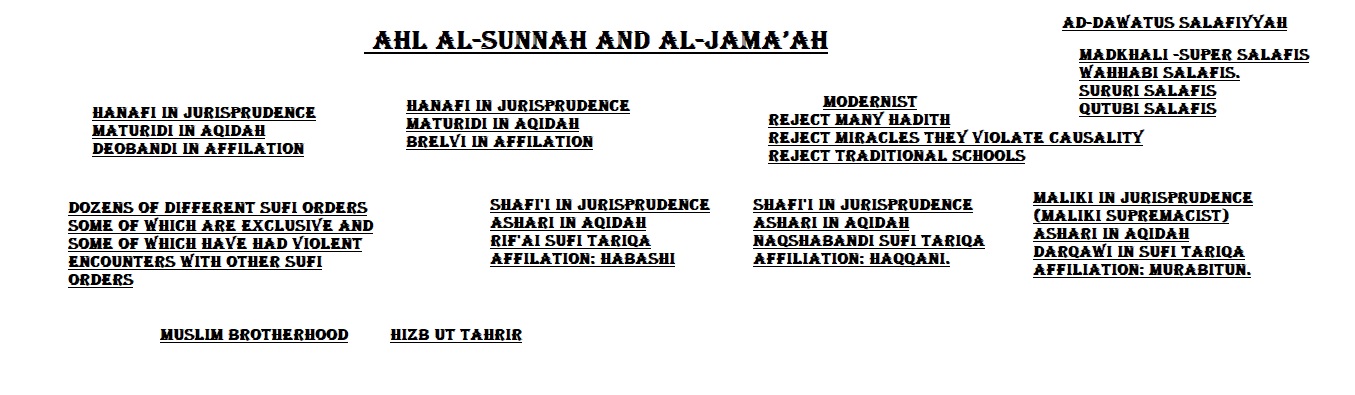
However, the secret to maintaining this outward unity is simply this: Be very very careful what you talk about. Because depending upon the topic, jurisprudence, theology, history, science, politics things could turn quite volatile.

The above image no where does justice to the very real divisions that exist among those who claim the title: Ahl Al-Sunnah And Al-Jama’ah‘.

It seems this ahadith about the ‘jamaat’ or the ‘group’ can easily be interpreted by any group of any given sect of Muslims at any point in history as a reference to themselves.

If Sunni Muslims believe that the majority is correct then the whole lot of them should follow the Hanafi school of jurisprudence. That is because around 60% of Sunni Muslims follow this particular school.

The Abbasids, Mughal and Ottoman empires adopted it and promulgated it. The followers of other schools of Sunni jurisprudence would have to be considered shameful to hold on to to the Hanbali, Maliki and Shafi’i schools of jurisprudence in light of what looks like the apparent favour of Allah (swt) given to the Hanafi school.

Conclusion:

The term or phrase: “Ahl Al-Sunnah Wal-Jama’ah” cannot be authentically attributed to the Blessed Messenger (saw).  This term is not in the Qur’an. This term is not from the Blessed Messenger (saw).

May Allah (swt) Guide the Ummah.

May Allah (swt) Forgive the Ummah.
Leave a comment

Filed under Uncategorized

adalat al-sahaba -a doctrine of Murji’ism?

“And hold firmly to the rope of Allah and do not be divided. Remember Allah’s favour upon you when you were enemies, then He united your hearts, so you—by His grace—became brothers. And you were at the brink of a fiery pit and He saved you from it. This is how Allah makes His revelations clear to you, so that you may be ˹rightly˺ guided.” (Qur’an 3: 103)

﷽ 

The following PDF file upload is an article written by Amr Osman a Professor from Qatar University about the Sunni doctrine of Adalat Al Sahaba.

We cannot hide the fact that over all we are dissapointed with the paper.

We feel one does not get into the meat until page 33 and 34 and even then it is designated to a mere footnote 145.

We feel the author could have done more to give concrete Murji’ sources rather than that which is held in dispute.

He could have elaborated examples of the Murji’ making use of the same hadith that Sunnis in general use for justification of all the companions being just.

The other point we disagree with is the contention that Adalat Al Sahaba is some how a Sunni doctrine. This is something we have come to learn is simply not true. It is simply not true because it is well known that the Umayyads had cursing of Ali at the pulpits. So, if there was such a doctrine it was either blatantly ignored (a highly contentious position) or simply was not developed as of yet (which is what we contend).


It would be correct to say that Adalat Al Sahaba is an Abbasid Sunni doctrine. Yes, this we would agree. But we certainly would not hold this doctrine to be contemporaneous with the Umayyads.

In fact it is a real missed opportunity to show why the growing Sunni Abbasid imperium would develop such a doctrine that would do it’s level best to try and bridge the gap between Umayyad, Alid and other factions of the Muslims. Especially when it came to the contentions civil wars of the early companions.

This would have given a great deal of thrust to the article and indeed show the readers ‘how the sausage is made‘ so to speak.

The other point in the article is the tired oft repeated and lazy claims concerning the so called “Khawarij.”

“Other 4th/10th-century writings reflect more aspects of the emerging doctrine. Defining the proper attitude towards the Companions as a middle way between excessive hate (similar to that of Harigis towards ‘Ali b. Abi Talib and Mu’awiya b. Abi Sufyan who fought each other during the schisms) and excessive love (like that of Si’is towards ‘Ali).”

1) You have to wonder on what basis is the claim being made. Source material for example?

2) The Ibadis are the one’s who went to Umar Abdul Aziz and asked that they stop cursing Ali
at the pulpits. This is hardly the marker of people who hate an individual.

The other eye opening take away from the PDF article below, is that practically every study done by orientalist you will find one of them contradicting the findings of other other.


One of them strongly disagrees with the perspective of the other. This simply shows that they do not have a consistent ontology nor a consistent epistemology either. They often critique traditional views as speculative only for the avid reader to find out that they (orientalist) offer speculation as well. Albeit with the wide eyed claim of not having any presuppositions.

What we can show is that the doctrine of everyone’s ijtihad is correct, even if it leads to the
separation of the Muslim Ummah, and killing; is demonstrably a false doctrine.

“And hold firmly to the rope of Allah and do not be divided. Remember Allah’s favour upon you when you were enemies, then He united your hearts, so you—by His grace—became brothers. And you were at the brink of a fiery pit and He saved you from it. This is how Allah makes His revelations clear to you, so that you may be ˹rightly˺ guided.” (Qur’an 3: 103)

  1. Hold firm to the rope of Allah and do not be divided.
  2. You were enemies and Allah united your hearts.
  3. By the unification of your hearts you became brothers.
  4. By being divided and being enemies you were at the bring of a fiery pit.
  5. By being being united and being brothers you avoid this fiery pit.

This whole idea that everything the companions did is simply a matter of ijtihad even if it leads to killing each other flies in the face of this very verse of the Qur’an!

Meeting on a field and killing each other does not result in being united and not being divided.

Killing each other’s sons and father’s does not unite a person’s heart and make one have the feeling of brotherhood.

In fact, those Sunnis doing Daʿwah in Hyde Park United Kingdom and other venues throughout the world would get destroyed in a discussion on logic.

You see if person A says that an Elephant has a tail and person B says that an Elephant has four legs these are not mutually exclusive points.

It is both possible that a person A and person B are correct.

However, if person B says that an Elephant has four legs and person A says that an
Elephant has two legs we have a problem. One of them is in clear error.

So on this point, those who engage with these people can point out that Sunnis do indeed believe that contradictory information can indeed be acceptable.

Now, it is one thing to believe that contradictory information is acceptable, and quite another thing, altogether to say contradictory information that leads to separation and division and killing is acceptable.

Those that believe that ijtihad that leads to killing and strife among the believers and on top of it gets rewarded even if they are upon error is such a surprising doctrine.

Narrated Ibn `Umar:

I heard the Prophet (saw) saying, “Do not revert to disbelief after me by striking (cutting) the necks of one another.”

Source: (https://sunnah.com/bukhari:7077)

Adalat al-Sahaba: The Construction of a Religious Doctrine by Amr Osman Qatar University.

If you are interested in this article you maybe interested in reading the following:

https://primaquran.com/2022/10/04/ibadi-stance-on-sahaba-according-to-the-quran/

https://primaquran.com/2022/10/04/are-all-the-companions-just/

https://primaquran.com/2024/02/20/the-noble-companion-hurqus-ibn-zuhair-and-the-deception-of-ahl-sunnah-be-just/

https://primaquran.com/2023/02/11/the-genius-of-mufti-abu-layth-can-we-criticize-the-companions/

May Allah (swt) forgive the Ummah!

May Allah (swt) guide the Ummah!

Leave a comment

Filed under Uncategorized

The Ibadi Stance on Ali bin Abi Talib

“Wherever you are ˹O Prophet˺, turn your face towards the Sacred Mosque. And wherever you ˹believers˺ are, face towards it, so that people will have no argument against you, except the wrongdoers among them. Do not fear them; fear Me, so that I may ˹continue to˺ perfect My favour upon you and so you may be ˹rightly˺ guided.” (Qur’an 2:150)

﷽ 

Logic and facts will always rule over feelings and fallacy.

First it should be known that the default position of all the companions of the Blessed Prophet (saw) is Wilayat al dhahir. Which means they are known to follow the Qur’an and the Sunnah, and they are known for their piety. This is the default position for all companions.


Now, if anyone of them did a major sin and did not make tauba to Allah (swt) up until his death, you can put that companion in Bara’ah al Dhahir.

So, in regard to Ali, there are three positions held among the Ibadi.

  1. Wuqoof. Suspend judgement. That is not to put Ali in wilayah or bara’ah. To leave his matter to Allah.
  2. Bara’ah al-Dhahir – The apparent dissociation. This is a matter of jurisprudence. Ali committed kufr ni’ma and there is no indication that he repented of his sins.
  3. Walayah al-Dhahir – The apparent friendship. This is a matter of jurisprudence. Ali was remorseful and repented of his sins.

Bara’ah and Wilayah are a huge part of Islam of which many Muslims are ignorant of. If you want to know how it is understood. We would suggest you read the following:

Wuqoof is to pause if there is khilaf on the person. Wuqoof is to stop at everyone you don’t know. You do not make a judgement on him/her to be in Walayah or Bara’ah. This is a very safe path to take.

Bara’ah al DhahirThe Apparent disassociation. This to perform Bara’ah to whoever you see disobeying the commandments of his Lord. Be it in the Quran or Sunnah- whether you’ve seen him by yourself or by him admitting to committing that sin or by the famous/infamous act that he did. They can return to Walayah if they repent and reform.

Walayah al-Dhahir – The Apparent Friendship. This means to show walayah (loyalty/friendship) to anyone you see following the commandments of Allah—whether from the Qur’an or Sunnah. Even those who have committed sins and repented of the sins.

Shaykh Massoud bin Muhammed Al Miqbali (hafidullah) gives the range of the Ibadi views regarding Ali bin Abi Talib. We did our best to clean up the subtitles below. The Shaykh is giving a reply to one of the Salafi detractors.

The Ibadi stance regarding Ali bin Abi Talib.

“The Ibadis have different positions on Ali bin Abi Talib. And it cannot be said that Ibadis takfir Imam Ali (kufr ni’amah) and it cannot be said that they associate with him (wilayah), and it can not also be said that Ibadis stop on him (Wuqoof). Rather, all three positions exist.”

“So it cannot be said that it is only one of these sayings that the Ibadi adopt.”


“And those that stated he was a kafir by that didn’t mean to remove him out of the fold of Islam. Rather, they looked upon the events and clashes that occurred in Siffin, and they built upon it a judgement. And it’s a Godly judgement. They see that Ali is alike to the people, alike to anyone else. For him, it is that for others, and for him, it is that for others, and he is obligated by what they’re obligated to.”

“So, if it falls on that which obligates deviance, he is considered a deviant, tafseeq he is considered a fasiq, kufr he is takfeered. And this is the madhab of the sahaba which you narrate. The companions who had insulted, killed and cursed him. Was it out whim? Or by a religious obligation?”

“Without a doubt, the madhab of the sahaba (and you claim you follow the salaf, and you say that you’re salafiyyah). This is the madhab of the salaf, where whoever falls on kufr is takfeered, and whoever falls on that which obligates cursing is cursed, and whoever falls on what obligates criticism is criticized. This is the madhab of the salaf, rather it is the madhab of the Qur’an and the honest Prophet (saw). This is the madhab that we adopt.”

“And we do not, after that, believe that if it’s permissible to takfir him, that he’s out of the fold of Islam. No! We say that kufr is split into two. Kufr Shirk and Kufr ni’ama. (That doesn’t take him out of Islam). To make this simple: all mushriks are kafirs, but not all kafirs are mushriks. This is with those that adopted the madhab of takfir, but there are those that didn’t adopt it. And there’s him who stopped.”

“And if you have knowledge just like they have, then it is permissible for you to judge like they have. And if you’re a jahi (not learned), then stopping on him is enough for you, and that is a known way with us.”

“And they say that a monotheist isn’t takfeered except for shirk, and this is a false saying. Here are the texts of the shari’ah and its infallible proof that the takfir doesn’t take its committer out of islam.”

“It is the duty of all men towards Allah to come to the House a pilgrim, if he is able to make his way there. As for the (kafara) ungrateful, Allah is All-sufficient nor needs any being.” (Qur’an 3:97)

“This is a favor from my Lord by which He wants to test whether I am grateful or ungrateful.” (Qur’an 27:40)

Narrated ‘Abdullah:

The Prophet (saw) said, “Abusing a Muslim is Fusuq (an evil doing) and killing him is Kufr (disbelief).” Source: (https://sunnah.com/bukhari:48)

Narrated Ibn `Umar:

I heard the Prophet (saw) saying, “Do not revert to disbelief (kuffaran) after me by striking (cutting) the necks of one another.”

Source: (https://sunnah.com/bukhari:7077)

“Abu Hurairah narrated that the Prophet (saw) said: “Whoever engages in sexual intercourse with a menstruating woman, or a woman in her anus, consults a soothsayer, then he has disbelieved (kafar) in what was revealed to Muhammed.”

Source: (https://sunnah.com/tirmidhi:135)

You may read more about that here:

“All of these texts show clearly that there is from kufr which doesn’t take its committer out of Islam. Rather, it’s a synonym to fusooqi, fujoori, isyaani. So trying to distort the picture of the Ibadi madhab is a miserable and desperate and unsuccessful try. And I said that there are those that said he (Ali) repented, and that narration has been denied by the other group.”

“This narration exists within our books, and if we hated and considered him (Ali) a kafir for personal reasons, we wouldn’t have mentioned this narration, which acquits his position.”

“We have in our athars and books like Bayan al-Shar‘ (بيان الشرع) — written by Muhammed b. Ibrahim al-Kindi, which was written in the 5th century, shows evidence of him (Ali) repenting. And this repenting narration maybe it is something that only the Ibadis have. It doesn’t exist with others. So if they were opposing him (Ali) personally, they wouldn’t have narrated his repentance.”

“But they (The Ibadi scholars) are the just ummah, the righteous ummah, they narrate all that is for them, and they narrate all that is against them. There is no opposition between them and the truth.”

“So we take the truth whenever we see it, even if it’s a hater that brought it, and the false is the rejected by us, even if it was brought by a friend who is taken highly.”

“We accept what Allah accepts from his deen, and reject what He rejects. Our biography is that of Ahmed (saw) companions. We do not accept people of injustice as models. This is the Minhaj that we walked upon. We narrate that which is for us, and narrate that which is against us, and it’s not really our concern about the pleasure of whoever is pleased and the anger of whoever is angry.”

First: From the outset, one must understand that our predecessors were what one may call the Shiat Ali. They were in the battles of the Camel and Siffin and fought hard on behalf of Ali Ibn Abu Talib. Losing life and limbs and relatives. Which is more than what those who claim to profess him can claim.

Second: The disappointment comes with his decision at Siffin, and his injustice in taking the life of the believers at Nahrawan. It becomes abundantly clear that his followers never had even any concept of the terms maʿṣūm (معصوم) and ʿiṣmah (عصمة) being applied to him. If that were the case, they would not have left his camp. Nor were these concepts used by Ibn Abbas (ra) in his debate with the people of the river. (Nahrawan).

Third: The issue surrounding Ali Ibn Abu Talib is similar to that of Uthman ibn Affan, in that
they are political in nature. No one from our school accuses either Ali Ibn Abu Talib or Uthman ibn Affan of being a mushrik. Far from it.

Fourth: Just like a group of companions were the ones to rise up against Uthman ibn Affan, likewise, a group of companions differed with Ali’s decision of arbitration.

All Muslim groups today are formed on the basis of political events in the early period of Islamic history.

There are a few things in the video a person should take away.

The differences in the types of kufr. Kufr ni’ma doesn’t put the person out of the fold of Islam.

The other point is that those who have knowledge of this subject may form a particular opinion on it. Those who do not have knowledge of this subject can and should refrain from having any opinion on it. (wuqoof)

The fact that he (Ali) went against the Qur’an-based ruling at Siffin and killed the Muslims at Nahrawan put him in the state of kufr ni’ma (which doesn’t take the person out of Islam).

However, that person would still need to repent of their kufr before they died. To us, Ali is like others. He can make mistakes.

Indeed, major sins nullify obedient acts, no matter how great. In the case of Ali, he committed major sins. So the point of difference in the school is on rather or not he repented before he met his end.

Those who do not believe he repented before death can say that Ali would be in Bara’ah-al dhahir. The apparent disassociation.

For those that believe Ali repented before he died. Ali would be in Walayah al dhahir. The apparent association.

So, basically to sum up, the Ibadi position. There are three positions regarding Ali Ibn Abi Talib.

Anyone who refuses to mention this (three views) or relates only one view is either willfully ignorant or a deceiver and a liar.

Background into some of the reasons for the opposition of the companions against Ali bin Abi Talib

The main cause of fierce opposition to Ali was the perceived failure or reluctance to punish the culprits, including his stepson, Muhammed bin Abu Bakr, who was involved in the killing of Uthman. Ali married his (Abi Bakar’s) mother, Asma (ra), after the death of Abu Bakr (ra). So there was a marriage relationship between Ali and Muhammed bin Abu Bakr, although, as we have seen, Muhammed bin Abu Bakr did not actually kill Uthman, at best he aided and abetted the assassins. (This for another article).

What might have strengthened people’s suspicion on Ali was that Ali appointed Muhammed bin Abi Bakar as governor of Egypt, which his opponents may have interpreted (right or wrong) as a type of reward for his hand in the matter of killing Uthman.

Furthermore, Ali’s own brother Aqil ibn Abi Talib fought on the side of Muawiya. Aqil ibn Abi Talib is the cousin of the Blessed Prophet (saw) and elder brother of Ali. So, as one can see, these were quite chaotic times.

Prior to this, there was the whole incident of Ali bin Abi Talib burying Fatima (ra) in secret and people were not pleased about it. You may read about this here:

https://sunnah.com/bukhari:4240

Ali bin Abi Talib disappeared from the scene of events throughout the caliphate of the three Shaykhs: Abu Bakr (ra), Umar (ra), and Uthman. For a total of 25 years (a quarter of a century), the man was absent, completely out of sight. No one knew what he was doing. It is said that he did not participate in a single Muslim battle, neither with himself, nor with his children, nor with his money. While the chieftains of the Arabs were crushing the apostates and toppling the thrones of the Caesars, not a single inch did he conquer for Islam!

To many, the greatest of shocks came. When he finally ascended to power after what many saw as the conspiracy to kill Uthman, the momentum of the conquests was paralyzed, the flame of victories of tawhid was extinguished, so that the sword that “slept” on the enemies of the Ummah would awaken suddenly in the breasts of the Muslims!

Furthermore, what set the people against Ali are the various conflicting narratives about how he dealt with Aisha (ra), a member of the purified household according to (Qur’an 33:30-34) as well as “Mother of the Believers” as per (Qur’an 33:6).

They ask how Ali bin Abi Talib would face the Messenger of Allah, (saw) when he fought his wife!! And he sent his helpers against her until they hamstrung her camel and she fell from her litter, and her enemies paraded her around like a captive? This is a sign of humiliation for the man’s family, her violation, her captivity, and the foreigners’ force to subjugate, humiliate, and degrade her!

The test of Aisha (ra) and the test of Ali.

Thus, the case of Ali with us, Ibadi, is similar to the case of Aisha (ra) with many Shi’i. Consider the following:

Aisha (ra) was a test on rather the believers will follow her or the Imam. Ali Ibn Abu Talib himself became a test for the believers at Siffin; to see whether or not people would follow what Allah (swt) ordered in the Qur’an, or Ali’s decision.

Narrated by Abu Maryam `Abdullah bin Ziyad Al-Aasadi:

“When Talha, AzZubair and `Aisha moved to Basra, `Ali sent `Ammar bin Yasir and Hasan bin `Ali who came to us at Kufa and ascended the pulpit. Al-Hasan bin `Ali was at the top of the pulpit and `Ammar was below Al-Hasan. We all gathered before him. I heard `Ammar saying, “`Aisha has moved to Al-Busra. By Allah! She is the wife of your Prophet in this world and in the Hereafter. But Allah has put you to test whether you obey Him (Allah) or her (`Aisha).”

Source: (https://sunnah.com/bukhari:7100)

So even though Aisha (ra) is acknowledged by Ammar bin Yasir to be the ‘wife of the Prophet in this world and in the Hereafter‘, he was not about to leave the dhahir (the apparent) evidence.

Which is that Ali was the rightful 4th Imam of the Muslims. One who is to be obeyed as long as he obeys the Qur’an and Sunnah. 

The idea that a particular blood tie, clan or family affiliation exempted one from the Sharī’ah is absolutely foreign to the Blessed Prophet (saw).

Narrated `Aisha:

Usama approached the Prophet (saw) on behalf of a woman (who had committed theft). The Prophet (saw) said, “The people before you were destroyed because they used to inflict legal punishments on the poor and forgive the rich. By Him in Whose Hand my soul is! If Fatima (the daughter of the Prophet (saw) did that (i.e. stole), I would cut off her hand.”

Source: (https://sunnah.com/bukhari:6787)

Narrated Abu Huraira:

When Allah revealed the verse: “Warn your nearest kinsmen,” Allah’s Messenger (saw) got up and said, “O people of Quraish (or said similar words)! Buy (i.e. save) yourselves (from the Hellfire) as I cannot save you from Allah’s Punishment; O Bani `Abd Manaf! I cannot save you from Allah’s Punishment, O Safiya, the Aunt of Allah’s Messenger (saw)! I cannot save you from Allah’s Punishment; O Fatima bint Muhammed! Ask me anything from my wealth, but I cannot save you from Allah’s Punishment.”

Source: (https://sunnah.com/bukhari:2753)

Likewise, whatever alleged superiority that Ali enjoyed and is claimed to have had does not eclipse one’s obedience to the Qur’an and Sunnah.

As Aisha (ra) was abandoned in favour of the apparent, likewise Ali was abandoned in favour of the apparent. In our madhab, Jabir Bin Zaid (ra) informed us that Ayesha (ra) repented from her sins before she died. The sin being to make war against the legitimate Imam of the Muslims.

This must be the case because Allah (swt) has confirmed this.

Aisha (ra) mother of the believers.

“The Prophet is more worthy of the believers than themselves, and his wives are their mothers (ummahatuhum). And those of relationship are more entitled in the decree of Allah than the] believers and the emigrants, except that you may do to your close associates a kindness. That was in the Book inscribed.” (Qur’an 33:6)

So Aisha (ra) is in Walayah al Haqiqah -The real friendship or friendship that is with Allah (swt). 

The Three views among Ibadis regarding Ali Ibn Abu Talib.

1. Bara’ah al Dhahir- The Apparent disassociation. Disavowed.

This view is that Ali Ibn Abi Talib did not repent of his sins and, therefore, the one who dies without repenting of major sins is doomed. What happens to the one who does not repent from major sins is no secret in Islam.

We must understand that disavowing a person who commits major sins (even if they are a companion) is actually a Sunnah of the Blessed Prophet (saw).

Narrated Salim’s father:

The Prophet (saw) sent Khalid bin Al-Walid to the tribe of Jadhima and Khalid invited them to Islam but they could not express themselves by saying, “Aslamna (i.e. we have embraced Islam),” but they started saying “Saba’na! Saba’na (i.e. we have come out of one religion to another).” Khalid kept on killing (some of) them and taking (some of) them as captives and gave every one of us his Captive. When there came the day then Khalid ordered that each man (i.e. Muslim soldier) should kill his captive, I said, “By Allah, I will not kill my captive, and none of my companions will kill his captive.” When we reached the Prophet, we mentioned to him the whole story. On that, the Prophet (saw) raised both his hands and said twice, “O Allah! I am free from what Khalid has done.” ‏ اللَّهُمَّ إِنِّي أَبْرَأُ إِلَيْكَ مِمَّا صَنَعَ خَالِدٌ

Source: (https://sunnah.com/bukhari:4339)

Loyalty to the Qur’an and Sunnah takes primacy over any other affiliation, or perceived rank or status of an individual.

“You will not find those who believe in Allah and in the Hereafter having (yuwadduna) love/affection with those who oppose Allah and His Messenger, even though they may be their fathers or their sons or their brothers or their clan. They are such that Allah has inscribed faith on their hearts, and has supported them with a spirit from Him. He will admit them to gardens beneath which rivers flow, in which they will live forever. Allah is pleased with them, and they are pleased with Allah. Those are the party of Allah. Be assured that it is (the members of) the party of Allah that are the successful.” (Qur’an 58:22)

Imami Shi’i would take issue with this because of the doctrine of ‘Iṣmah 

Todays Sunnis would take issue with this because of they under went aa Shi’ification under the Abbasid empire and developed the doctrine of Adalat al-Sahaba.

2. Walayah al-Dhahir – The Apparent Friendship.

This view is that Ali Ibn Abi Talib, possibly after seeing that the arbitration with Muaviya did not bring any good for the Muslim ummah, and seeing the world crumble around him and possibly at the prompting of Ibn Abbas (ra), he repented to Allah (swt) and therefore his ending was a good ending.

The evidence that Imam Ali was remorseful and repented is found at the end of this article:

Under the section: Evidence used by the Ibadi school to show that Ali Ibn Abu Talib had repented for his sins.

https://primaquran.com/2024/09/12/the-battle-of-nahrawan-the-ibadi-perspective/

Often these Ibadi’ may say, Karram-Allah-u Wajhah, meaning: “Allah honored his face” as a statement of fact, rather than a du’a.  Meaning that he embraced Islam and was not known to have worshiped idols. Also, the statement: “Allah honored his face” is almost said with a tinge of disappointment, as if to recall what could have been and what sadly was not.

These Ibadi will not do Taraddi. This is a technical term which refers to invoking Allah’s pleasure upon someone by saying Radiy Allahu ‘Anh

May Allāh be pleased with him”. That is because it is not possible to say May Allah be pleased with the deeds of the one who went against the word of Allah and killed the Muslims without right.

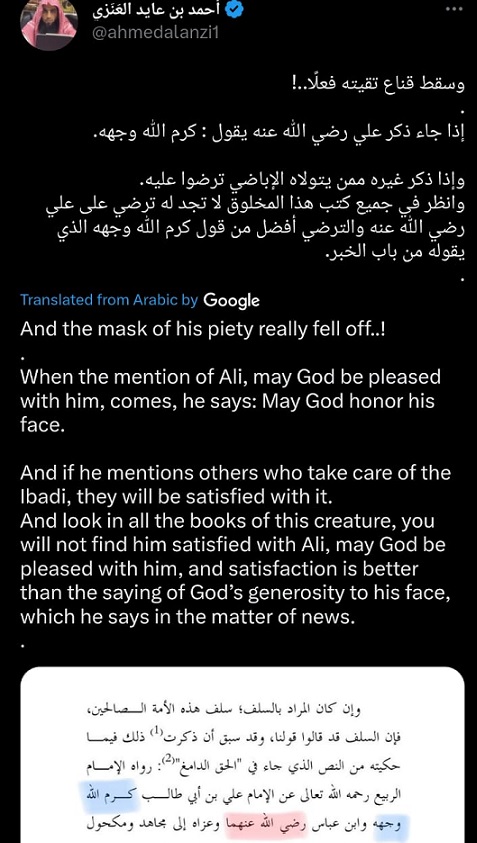
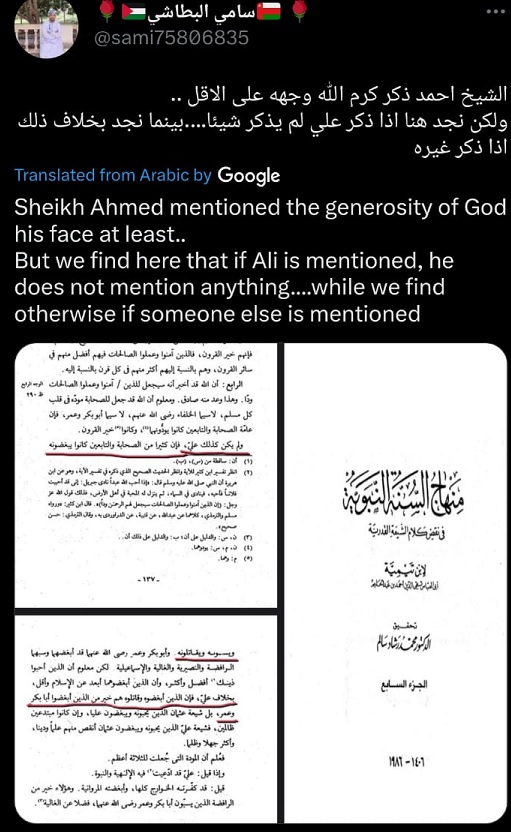
For example: The Mufti of Oman, Shaykh Ahmed Al Khalili (h) is not known to say “May Allah be pleased with him” after mentioning the name of Ali. So some of the detractors point this out. Trying to make a mountain out of a molehill. We share with you because nothing is hidden about our school. Cards are on the table!


So one of them, this @ahmedalanzi1 (who blocked many Ibadi who tried to engage with him) his claim is that saying Radiy Allahu ‘Anh : meaning: May Allah be pleased with him is higher and better than saying: Karram-Allah-u Wajhah: meaning Allah honoured his face.

The following is where our teacher: Shaykh Juma Al Mazruii explained this is not necessarily the case:

So Shaykh Juma Al Mazruii mentioned that this Salafi agitator (which is what he is) wants to have some issue about it than he can take it up with Ibn Kathir. Ibn Kathir was not happy that people say, “Allah honuored his face” after mentioning Ali, but not when mentioning Abu Bakr (ra) or Umar (ra). So he (Ibn Kathir) actually feels that statement is higher than saying, “May Allah be pleased with him.”

Likewise, Shaykh Juma mentions that Ibn Taymiyyah himself felt Ali was inferior to other companions. So this Salafi agitator can go and sort out his own house before he tries to knock on our door or the door of anyone else, for that matter.

To this, our beloved Shaykh Juma Al Mazrui gave a very befitting reply (the audio above).

3. Ambivalence (Wuqoof) towards Ali Ibn Abu Talib. An individual does not have enough data or information to put Ali in Bara’ah or Walayah.

Wuqoof is to pause iif there is khilaf on the person. Wuqoof is to stop at everyone you don’t know. You do not make a judgement on him to be in Walayah or Bara’ah. This is by far the position of the vast majority, as they are layman and do not bother to look into these matters..

Those who are ambivalent as they just do not have enough data to give a conclusive answer. They hold their tongues regarding companions like Ali Ibn Abi Talib. They do not say radhiallahu anhu for those who are possibly under Allah’s wrath. Nor do they say this one met doom when they may have repented for their sins and met a good end under Allah’s spacious grace. This regards students of knowledge and the masses of Muslims in particular who have not investigated these matters. This is a recommended and safe road.

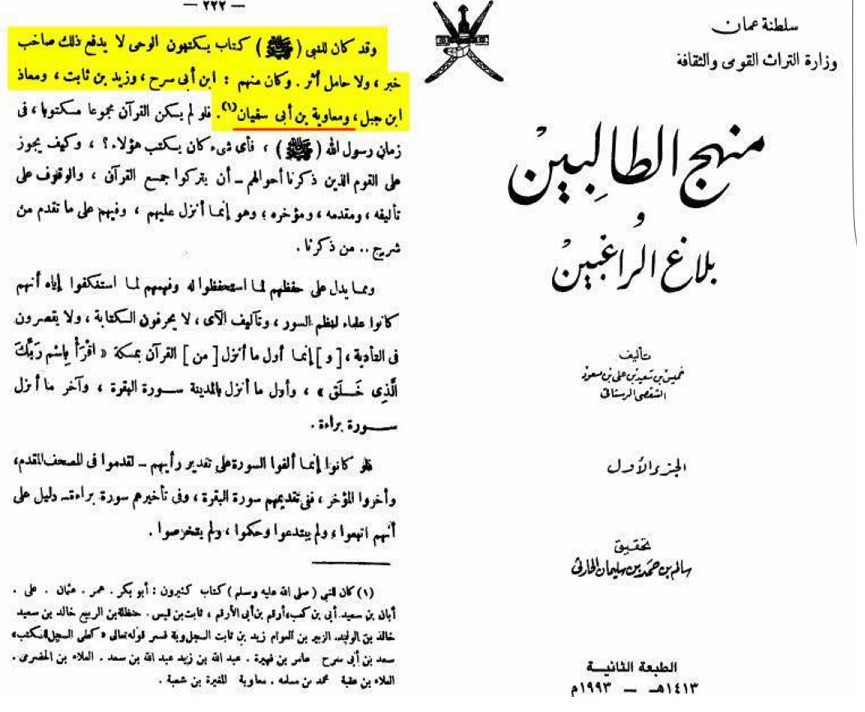
Do not be surprised to find none other than Shaykh Khamis bin Saeed Al-Shaqsi (r) say, “May Allah be pleased with him” after mentioning the name of Muaviya!

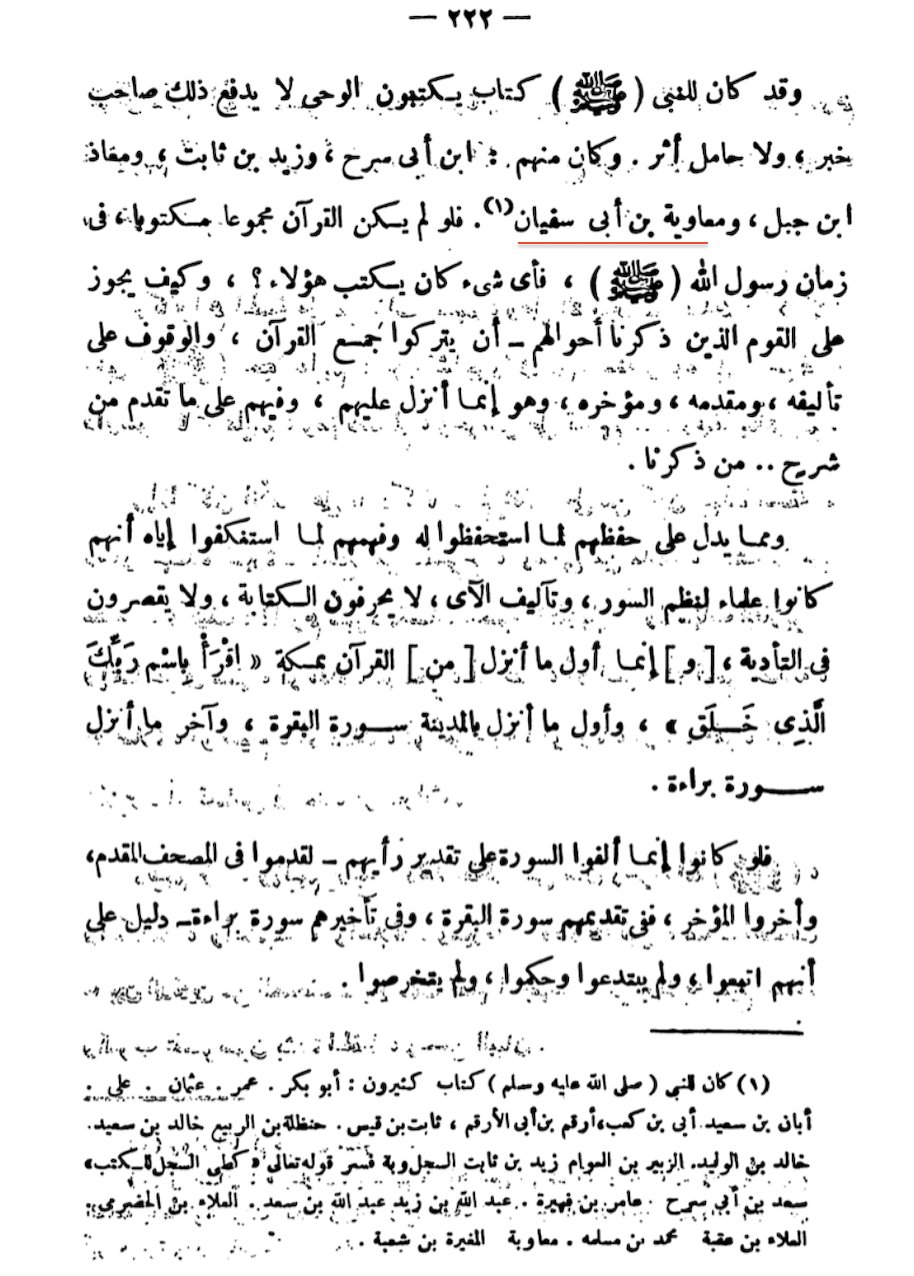
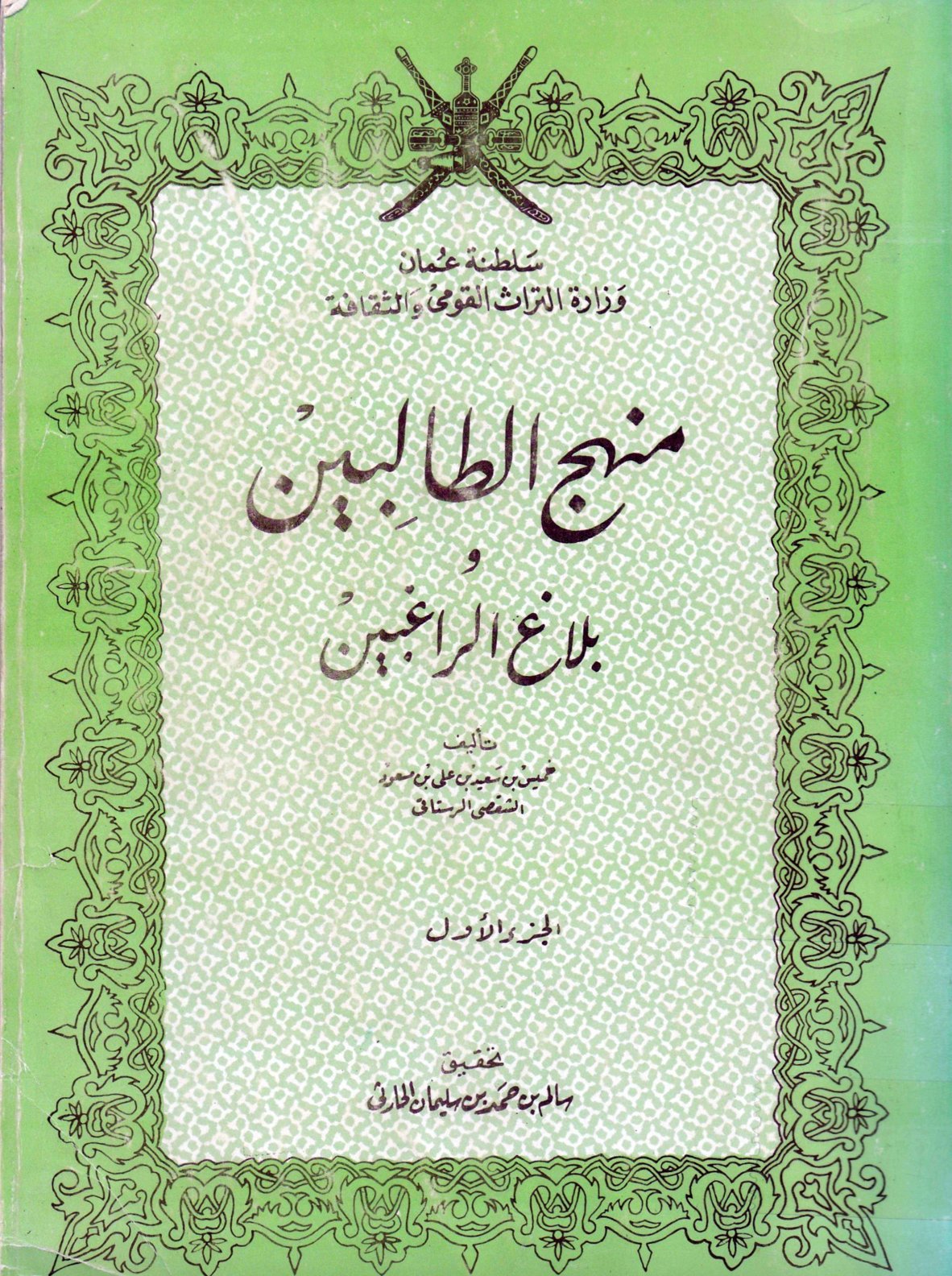
Do not be surprised to find none other than Shaykh Khamis bin Saeed Al-Shaqsi (خميس بن سعيد الشقصي) (r) say, “May Allah be pleased with him” after mentioning the name of Muaviya! He is a highly significant and foundational scholar in the Ibadi school of Islam. He is best known for his monumental encyclopedia, Manhaj al-Talibin wa Balagh al-Raghibin (منهج الطالبين وبلاغ الراغبين).

Sources: (Manhaj Al Talibeen and Balagh Al-Raghibhin)

Do the Ibadi hate Ali because of his actions at Siffin and Nahrawan?

As we have seen, there are three views of the Ibadi. We ask you to imagine that if you were among those companions of the Blessed Prophet (saw) that personally suffered loss at the hands of Ali and his soldiers, you would not have a high or favourable view of him. This is human nature. However, those people would not be Ibadi in a technical sense. As they were the companions and successors who disengaged from Ali. The term ‘Ibadi’ or the school was simply non-existent at that point. This could be a reason why Abd al-Rahman ibn Muljam took revenge. Allah knows best.

You must hate those whom you apply the judgement of Allah (swt) to? No, not necessarily.

Based upon mantiq (logic) and the fact that this particular statement of the narration would clash with the qati’i (decisive) nature of Qur’an, such that a particular understanding of being infallible or not accountable becomes null and void.

Secondly. There is a story which you can read here full of grandiose verbiage that many are familiar with. Ali fights a man and the man spits in Ali’s face. Ali is said to have sheathed his sword. You can read that here: https://www.dar-al-masnavi.org/n-I-3721.html

The point is that just because you oppose someone does not necessarily entail hatred.

An example is this:

Narrated `Aisha:

Usama approached the Prophet (saw) on behalf of a woman (who had committed theft).
The Prophet (saw) said, “The people before you were destroyed because they used to inflict legal punishments on the poor and forgive the rich. By Him in Whose Hand my soul is! If Fatima (the daughter of the Prophet (saw) did that (i.e. stole), I would cut off her hand.”

Source: (https://sunnah.com/bukhari:6787)

So let us imagine a scenario where Fatima (ra) did steal, and she did get caught. Would one necessarily have to have hatred in his/her heart towards Fatima (ra) when executing the punishment?


That means that every judge or Qadi would need to hate the person they pass sentence on?


Would it mean that Ali, as an Amir, any time he inflicted a punishment upon anyone who transgressed, means he would need hatred in his heart as a prerequisite?

However, does one need to necessarily hate an individual that has gone against Allah (swt) and his Messenger (saw)?

Lastly, if someone loves or hates someone or something for the sake of Allah (swt), then there is no harm in this.

Narrated Abu Umamah: The Prophet (saw) said: “If anyone loves for Allah’s sake, hates for Allah’s sake, gives for Allah’s sake and withholds for Allah’s sake, he will have perfect faith.”

Source: (https://sunnah.com/abudawud:4681)

First point. As Shaykh Massoud bin Muhammed Al Miqbali (hafidullah) has mentioned in the video, if the matter of Ali was based upon whims and personal grudges you would not have found in our books that he (Ali) repented..

Second point.

Third point.

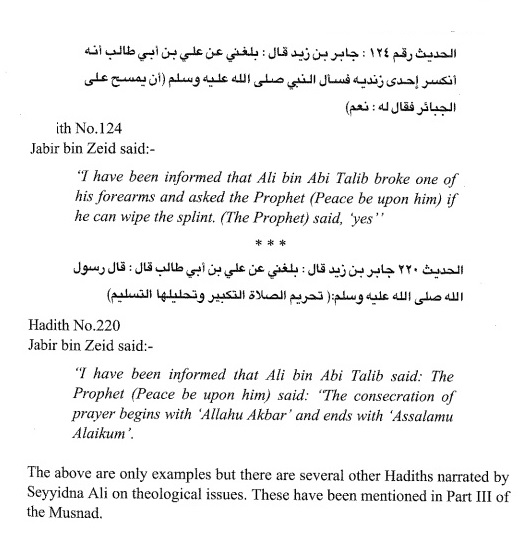
Ali Ibn Abi Talib is quoted as a transmitter of hadith in our Musnad Al-Imam Ar-Rabee’.

Ali Ibn Abi Talib is used as a transmitter of hadith in the Musnad Al- Imam Ar-Rabee’

Parting thoughts.

So let us be practical for a moment. Whatever feelings may have been stirred up by you reading this entry, think of the feelings that may be stirred up among Sunni Muslims when they know of your view concerning some of the companions? Yet, you want to be on cordial terms with them? Then do the same with us.

What amazes and perplexes the thinking individual is that there are among the Shi’i who hold very unfavorable views of Muviyah, Abu Bakr (ra), Umar(ra), Aisha (ra) and other companions, and they expect, no! They almost demand unity with Sunni Muslims.

So, if there are Sunnis who want unity with Shi’i, knowing full well that they (Shi’i) hold unfavourable views of Talha, Zubair, Muaviya and others, then they should have no issues wanting unity with Ibadi, who holds three distinct positions concerning Ali.

So, those who are thinking about following the Ibadi school and have reservations due to certain positions in regard to Ali Ibn Abu Talib. This is not something fundamental to our school. Our school is not about digging up the graves of the people of the past or cursing anyone. We simply give our account of how things were and what that may entail. Practice Wuqoof and focus on your relationship with Allah (swt). Simple.

“We take the truth even from a man of hatred, and we reject falsehood even from a chosen friend. We have no respect for a man, however exalted, if from the truth he has deflected.”-Shaykh Abdullah bin Humeid Al Salmy.

You may also wish to read the following:

There is a very moving poem by the eloquent poet, the Sufi, Abu Muslim al-Bahlani expressing his remorse and admonishment over the actions of Ali at Siffin.

https://primaquran.com/2023/02/11/the-genius-of-mufti-abu-layth-can-we-criticize-the-companions

May Allah guide the Ummah

May Allah Forgive the Ummah.

4 Comments

Filed under Uncategorized