Tag Archives: ibn-taymiyya

Ibn Taymiyya and his sect are ready to slaughter all Muslims in the world.

“And when it is said to them, “Do not cause corruption on the earth,” they say, “We are but reformers.” Of a surety, they are the ones who make mischief, but they realise (it) not.” (Qur’an 2:11-12)

“And whoever kills a believer intentionally, their reward will be Hell—where they will stay indefinitely. Allah will be displeased with them, condemn them, and will prepare for them a tremendous punishment.” (Qur’an 4:93)
﷽ 

Ibn Taymiyya and his sect are ready to slaughter all Muslims in the world.

Ibn Taymiyya and his Salafiyyah sect are the one’s who espouse ideas to cut off the heads of all Muslims who are against them and their ideology.

All you need to do is spend a little time on social media, Twitter, Facebook, Instagram, TikTok and you will not fail to who those who are extremist in their ideology, whom they support in reality.

Read it and weep! If people want to ascribe to the early Khawarij the doctrine of take no prisoners and slaughter them all than what do we have here?!

These so called callers of Salafiyyah tell people: “The Khawarij are the dogs of hellfire!” “They Kill Muslims Who Disagree With Them And They’re Views And Give Bloodshedding Fatwas And They’re Blood Is Halal For Them, They’re Extreme Takfiris!”

But let us look at the following text and be reminded of the saying: If the shoe fits wear it!

Interesting…Interesting…

That sounds awfully familiar (ask them the ruling for one who says the Qur’an is Created)

The following text are from Ibn Taymiyya al Harrani as well as his sect!

“We bear witness-and we are the scholars of Makkah-the Authors of these statements and the conclusions found here. That this religion/sect was established by Shaykh Muhammed B. Abdulwahab and was called too by the Imam of the Muslims. Shaykh Saud B AbdulAziz, To the Oneness of Allah and Negating Polytheism. -That is mentioned in the book is the truth of which there is no doubt or uncertainty of. And of that which occurred prior in Makkah and Madinah. -In Egypt and Syria -and all other countries-up until now is from the forms of polytheism (Shirk). That is mentioned in this book as being disbelief (kufr) that makes the committers of such wealth and blood permissible. And they will be damned to hell forever, residing there and whoever does not enter this religion/sect and acts upon it and supports its people and hates its enemies is a disbeliever (kafir) of Allah and the Last Day. And it is obligatory for the Imam of the Muslims and the Muslims themselves to wage war against them (Jihad) and to Kill them until they repent to Allah from that which they were upon. And he must uphold this religion/sect.”

Source: (Al Duraru Sunniyah Fi Al Jawabat Al Najdiyyah, Vol 1, Pg 314.)

“And the caller too innovation what is deserving of them-is the recompense-by agreement of all Muslims. And that recompense is given by killing them or other than that. As the Salaf killed Jahm B. Safwaan, al-Ja’d b. Dirham (teacher of Jahm bin Safwan) and Gilaan Al Qadari and others..”

He goes on to say if you cannot kill them-that being the first and best option-you should at least warn of them. As he says it is from: “Enjoying Good and Forbidding the Evil”, that “Allah has ordered.”

Source: (Majmoo Al Fatawa: Ibn Taymiyya, Page 242.)

“And whoever amongst them is a caller to misguidance, his deviance cannot be removed except by death! Either he shows open repentance and if he does not he is given judgement for his disbelief (kufr). Like the Imams of the Rafidhis (Shias); they are among those who have misguided people. As the Muslims, Gilan Al Qadari, al-Ja’d b. Dirham (teacher of Jahm bin Safwan) and their likes form the deviant callers. Therefore this dajjal is killed absolutely. -And Allah knows best. And for the killing the caller to innovation then he can be killed as well, to stop his misguidance from affecting the people. Just as one at war is killed. Even if the the situation is not the same as the infidels.”

Source: (Majmoo Al Fatawa: Ibn Taymiyya Page 303 And Page 197)
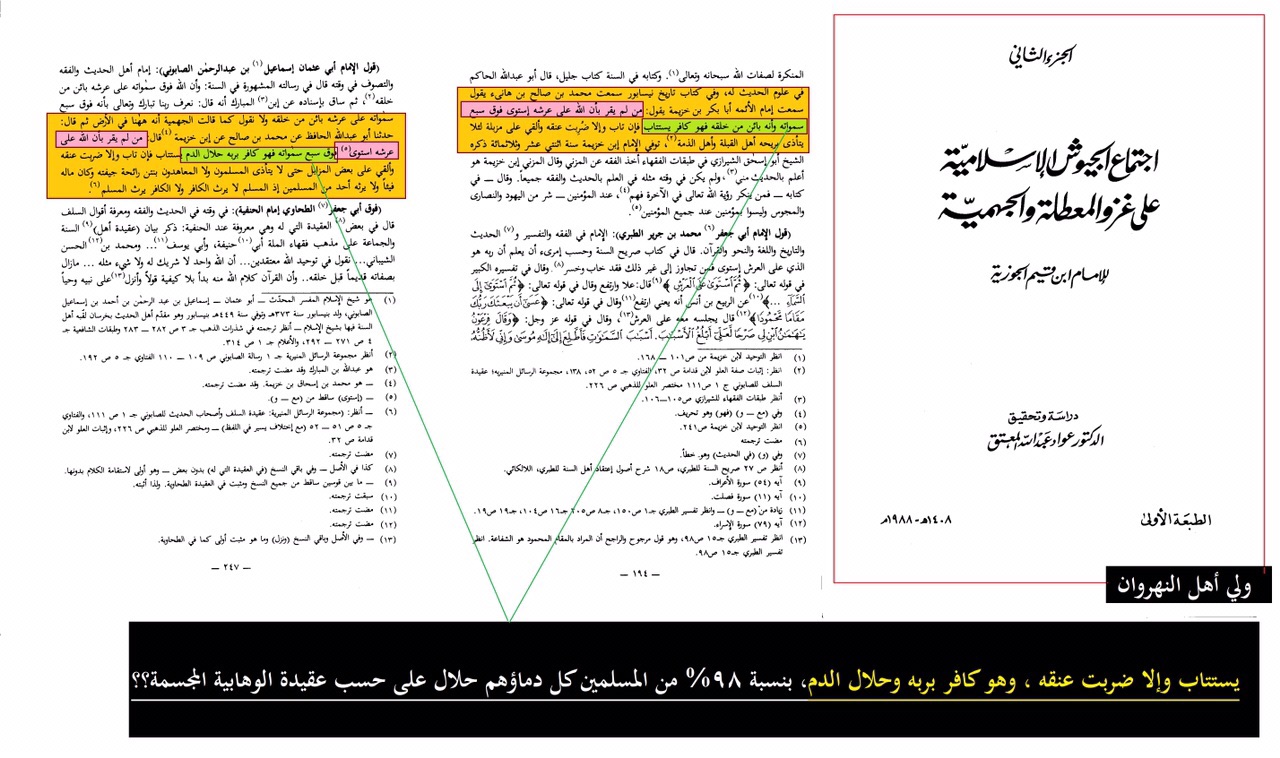
According to the above Fatwa they are ready to kill all Muslims in the world that accept these views!

“And from the book: Taarikh Al Naysapuri – I heard from Muhammed B. Saleh B. Haani, who heard the Imam of the Scholars: Abu Bakr B. Khuzaymah say: “Whoever does not affirm that Allah is over the throne, and has settled on the throne, above the seven heavens and that he is separate from his creation, then he is a kafir-he is obligated to repent or to be struck (killed). Otherwise he will harm the people of the qiblah and the non-Muslims with his presence.”

Source: (Kitab Ijtima Al Juyush Vol 2: Ibn Qayyim.)

“And he was in the 7th Heaven, Because the Prophet (saw) – Saw his Lord. While he was in this world, and did you know that the scholars did no differ that the entirety of the believers will see they’re lord in the hereafter, and not in this world. Whoever denies the seeing of they’re Lord on the day of gathering is not a believer in the eyes of the believers. And He is worse to the scholars than the Jews and Christians and the Magians. As Ibn Mubarak said: “We can bare the sayings of the Christians and Jews but we cannot bare the saying of the Jahmiyyah.” [end of blue section]

Source: (Page 587 Kitab Al Tawheed By Ibn Khuzaymah)
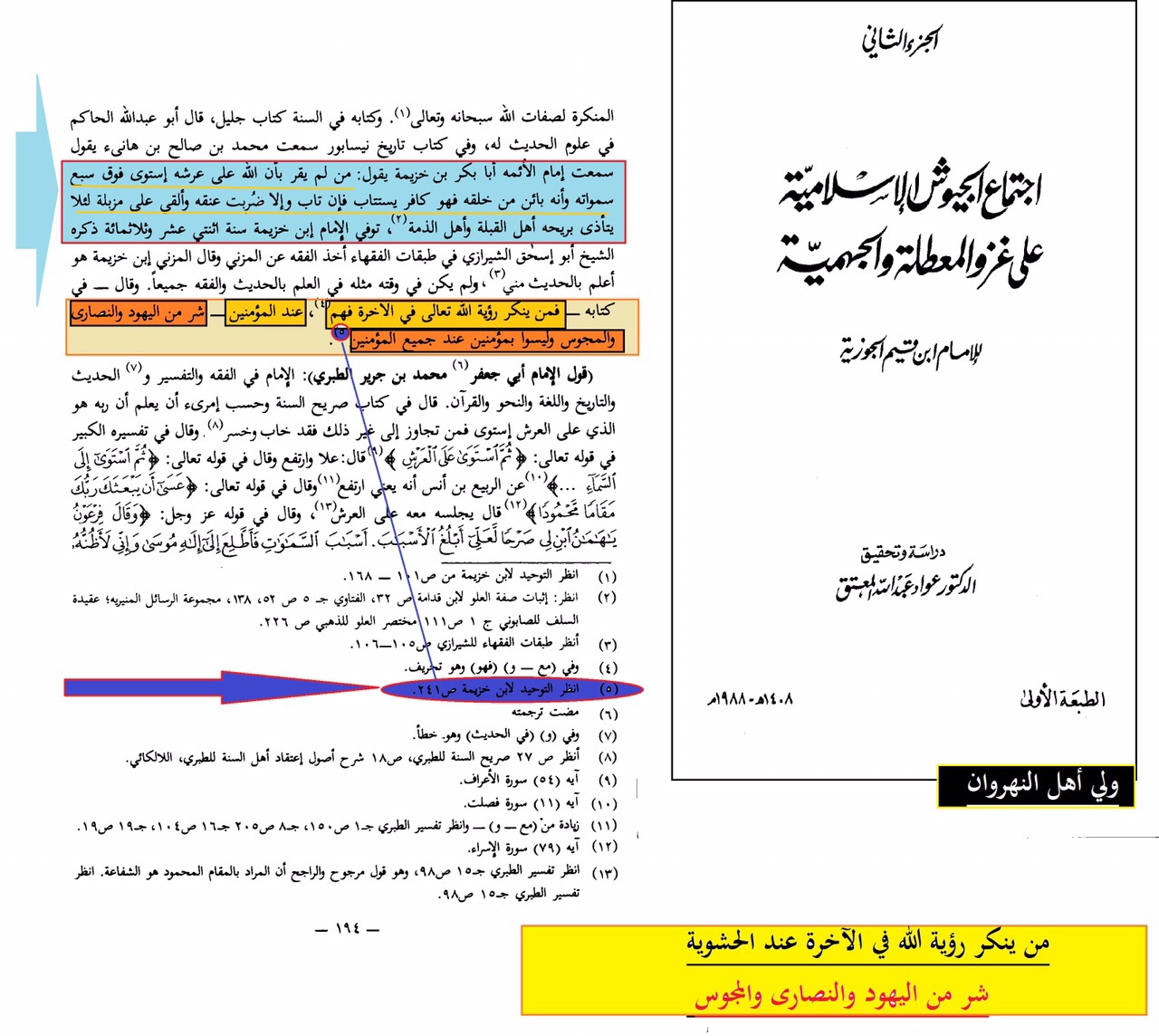
“And from the book: Taarikh Al Naysapuri – I heard from Muhammed B. Saleh B. Haani, who heard the Imam of the Scholars: Abu Bakr B. Khuzaymah say: “Whoever does not affirm that Allah is over the throne, and has settled on the throne, above the seven heavens and that he is separate from his creation, then is a kafir-he is obligated to repent or to be struck (killed). Otherwise he will harm the people of the qiblah and the non-Muslims with his presence.”

The Imam, Ibn Khuzaymah Died In The Year 312 a.h And he says in his book also, “Whoever denies the seeing of Allah in the hereafter, then he is in the sight of the believers, more worse than a Jew or a Christian or a Magian-and they are not believers in the view of the believers.”

Sources: (Kitab ijtima al Juyush Vol 2 Page 194: Ibn Qayyim Kitab Ijtima Al Juyush Vol 2: Ibn Qayyim.)

“This Is The Saved Group, Those who have gathered upon the truth brought by the The Messenger (saw) and that which he was steadfast upon and those who steer upon the path of the Messenger (saw) and his companions. These are the Ahlul Sunnah Wal Jamaah, The people of the noble hadith-the Salafis those that follow the righteous Salaaf-and strive upon their path in upholding the Qur’an and Sunnah and any other sect opposing them-for them is the promise of Hell.”

“Therefore you-oh seeker-are too look at every sect that proclaims they are the saved sect and look into their actions. If their actions actions is in compliance with the Shari’ah then they are the saved sect and if not, then no. And what is the scale that is meant of judging is the Qur’an and Purified Sunnah in (validating) the truth all of it.”

Source: (Fatawaa Noor Alaa Al Darb, Vol 2, Pg 12: Ibn Baz.)

OPEN YOUR EYES DEAR READERS AND SEE FOR YOURSELF! THE SALAFI MANJAH IS UPON THE MANHAJ OF SLAUGHTER AND KILLING.

Ibn Taymiyya al Harrani what is he is talking about!?

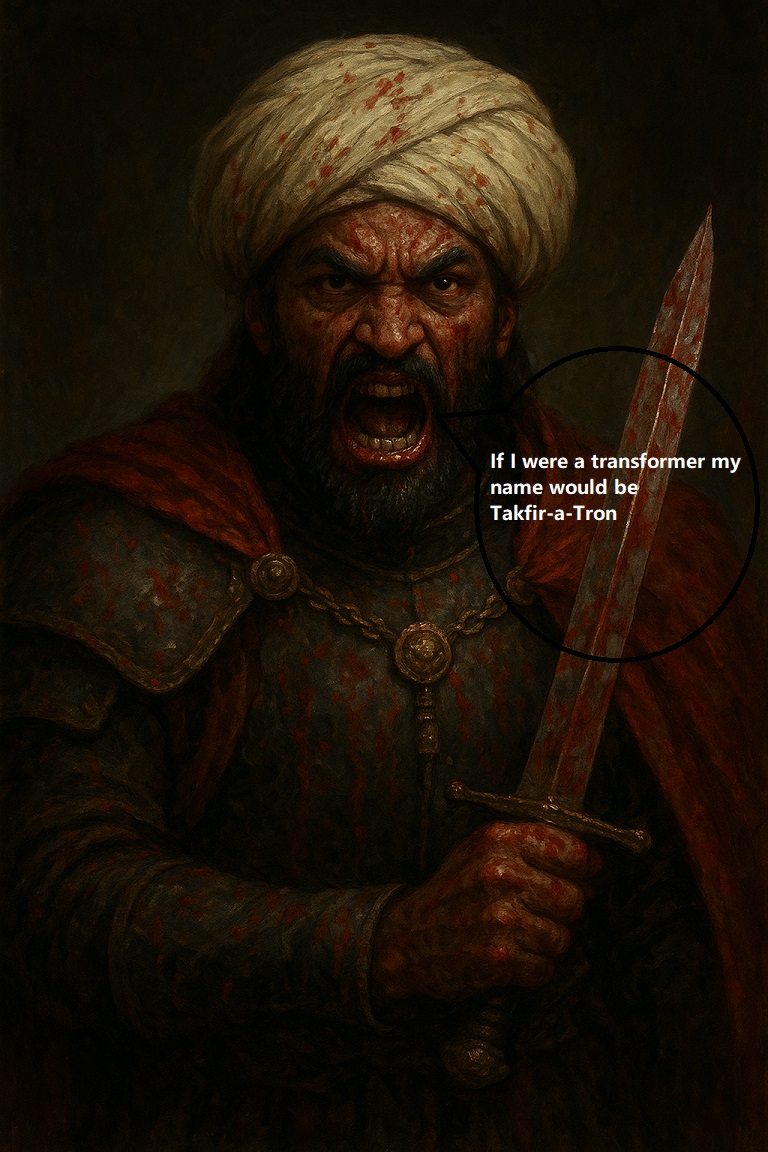
If this guy was a transformer his name would be TAKFIRA-TRON.

This Salafiyyah dawah is effective ONLY in that the people they talk to on the streets they only show the people what they want them to see. Those people (who they invite to Islam) are not researchers and they don’t have access to the Arabic language.

If people really know about them they will know that what they present is not Islam at all.

May Allah guide the Ummah.

May Allah forgive the Ummah.

6 Comments

Filed under Uncategorized

The Bid’ah of Ibn Taymiyya and Two Tawhids

“Today those who disbelieve have lost all hope of damaging your faith. So, do not fear them, and fear Me. Today, I have perfected your religion for you, and have completed My blessing upon you, and chosen Islam as a way of life) for you.” (Qur’an 5:3)

 ﷽ 

Anyone who says, “There is no Allah but Allah and Muhammed is the Messenger of Allah.” enters Islam. That person is a monotheist. Simple. The Blessed Messenger (saw) never taught that tawhid consists of two parts, one part being tawhid al-rubuiyya and the other tawhid al-uluhiyya.

“When the Prophet sent Mu’adh to Yemen, he said to him, “You are going to a nation from the people of the Scripture, so let the first thing to which you will invite them, be the Tauhid of Allah. If they learn that, tell them that Allah has enjoined on them, five prayers to be offered in one day and one night. And if they pray, tell them that Allah has enjoined on them Zakat of their properties and it is to be taken from the rich among them and given to the poor. And if they agree to that, then take from them Zakat but avoid the best property of the people.”

Source: (https://sunnah.com/bukhari:7372)

According to those who are truly ignorant in the religion they believe that the Prophet (saw) should have said to Mu’adh, “call the people to tawhid al-uluhiyya of which they are ignorant, as far as tawhid al-rubiyya they knew it already.”

Allah (swt) in his Book never ordered or even mentioned tawhid al-uluhiyya to anyone! Even in Surah al-Ikhlas which is one equivalent to 1/3 of the entire Qur’an!

If Ibn Taymiyya is to be believed then it means Allah (swt) did not deliver to us the knowledge of tawhid al-uluhiyya since everyone and their father knew about tawhid al-rubiyya.

Authubillah min dhalik! May Allah protect us from that!

Since this doctrine is so central according to certain sects, it means the following verse was not completed:

“Today those who disbelieve have lost all hope of damaging your faith. So, do not fear them, and fear Me. Today, I have perfected your religion for you, and have completed My blessing upon you, and chosen Islam as a way of life) for you.” (Qur’an 5:3)

We had to wait for Ibn Taymiyya who introduced this division in tawhid and this bid’ah in the religion!

So in the view of this sect, the average Muslim (possibly you the reader) your knowledge of tawhid is on the same level of that of idolaters! Authubillah min dhalik!

Imam Ahmad ibn Hanbal never said that tawhid consisted of two parts, one being tawhid al-rubiyya and the other tawhid al-uluhiyya.

Imam Ahmad is nowhere recorded to have said, “Whoever does not know tawhid al-uluhiya, his knowledge of tawhid al-rububiyya is not taken into account because the idolaters also had such knowledge.”


Tawhid Al-Hakamiyyah!! Why Should Ibn Taymiyya Have All The Fun?

So realizing that anyone could make a category of Tawhid some people from that sect thought that would get a little creative! https://www.abukhadeejah.com/categories-of-tawheed-not-adding-hakimiyyah/

The link says,

“They say that there is a Tawheed of Allah’s Lordship, the Tawheed of Allah’s worship, the Tawheed of Allah’s Names and Attributes and the Tawheed Al-Hākimiyyah ―i.e. The Tawheed of Allah’s rule and judgment. This is founded upon the false assumption that the division of Tawheed is a mere matter of terminology, merely tradition and it is not connected to the textual proofs. So, there is no harm, as far as they are concerned, in increasing upon the three categories. They have made the same mistake as many people make, believing that Tawheed is merely an issue of terminology and that the number of categories does not matter. But, in reality, the affair of the division of Tawheed into three categories can only be seen through these categories, and there is no fourth. There is no reduction or increase because anywhere Allah (the Most High) speaks about Himself in the Qur’an, and He explains and clarifies Tawheed, He does so in one of these three categories, and no more.”

“So, it is said to such a person who divides and adds to Tawheed: “This division is not merely invented terminology, rather, this categorisation refers back to the Book and the Sunnah.”

“When the Salaf categorised Tawheed into three categories, they established it from the Book and the Sunnah.”

Well, well, well. we are told that dividing Tawheed into three categories, “is from the Book and the Sunnah” So we have the right to ask where? Where did the Blessed Messenger (saw) teach that tawhid consists of three parts? Or where did He (saw) teach that tawhid consists of two parts, one part being tawhid al-rubuiyya and the other tawhid al-uluhiyya?

Where does the Book of Allah (swt) teach that tawhid is divided into two or three parts? Didn’t the people who advocate Tawhid al Hakimiyyah find that the Blessed Messenger (saw) already divided the tawhid into two or three? Didn’t they find these clear descriptions in the Qur’an? The answer is: They didn’t. Just like Ibn Taymiyya and those who follow him today can’t find the Blessed Messenger (saw) teaching two or three tawhids either! It is Bid’ah! It’s reprehensible innovation in the religion.

However, in the case of Tawhid al-Hakimiyya we can understand why some people who call themselves Salafi distance themselves from it. It has little to do with evidence and truth and more to do with $$$ We get our answer here:

“They are mistaken in adding a fourth category and in saying that there are more than three categories of Tawheed. They have innovated into the Religion with intentions to raise the people against their Rulers with this slogan of Tawheed Al-Hākimiyyah.”

Why are they mistaken in adding a fourth category? On what consistent basis can they not add a fourth category when you people have added three categories? I am only allowed to quote excerpts and not the full article but take a look at the list of scholars that are said to refute Tawheed Al-Hakimiyyah.

You can also read Shaykh Al Abani’s refutation of it here: http://www.themadkhalis.com/md/articles/tjxlr-shaykh-al-albaani-on-tawhid-al-haakimiyyah-a-political-tool-used-to-make-takfir-of-the-rulers.cfm

The truth of the matter is all those who say that tawhid is divided into tawhid al-uluhiyya, tawhid al-rubiyya and tawhid al-hakimiyya are upon bid’ah (innovation). That’s a consistent position.

However, if I was on a government payroll of course I would be told to preach against tawhid al-hakimiyyah.

Which this idea of theirs that one can never go against the government is absolutely refuted in our article here:

May Allah guide the Ummah! May Allah forgive the Ummah!

11 Comments

Filed under Uncategorized

Ibn Taymiyya: The Sufi Shaykh Part 1

“Do not mix truth with falsehood and do not deliberately hide the truth.” (Qur’an 2:42)

﷽ 

What we hear may not necessarily be the truth. Nowadays the anti-Sufi groups, which are at the same time strict followers of Ibn Taimiyya, as well as Sufi groups (namely the Ashari) affiliated with theological schools that Ibn Taymiyya was not affiliated with have both misrepresented and seemingly suppressed the truth about this iconic figure in the history of Islam.

When searching the history of Ibn Taimiyya we find that he himself was not against ‘Sufism’ but he was even adorned with the cloak (khirqa) of shaikhood of the Qadiri Order! Believe it or not, Ibn Taimiyya was himself a Sufi, but he accepted Tasawwuf on the condition that it follows shari’ah, which no Sufi order objects to.
In fact in the Hidayua al-Addhkiya ila Tariq al-awliya by A’ynal Din b. Ali Ma’bari a very beautiful description is given to Shari’a (Laws), Tariqah (path), and Haqiqa (Truth.)

He said, “Shari’a is like a boat, Tariqa is like an ocean and Haqiiqah is like the precious pearl. Whoever aspires after the pearl must (definitely) embark on the boat and then divine into the ocean.” Logically nobody reaches the pearl without having to sail into the boat. In this book will you find many more shocking realities about Ibn Taimiyya that contradict the very foundation of the neo-Salafite movements. It will also shed light upon the reason why many Sufi groups affiliated with theological positions that Imam Ahmad, Shaikh Abdul Qadir Al Jilani, and Ibn Taimiyya were not upon may like to cast aspersions upon the shaykh.

In fact, Ibn Taimiyya says: “The miracles of saints are absolutely true and correct, by acceptance of all Muslim scholars. And the Qur’an has pointed to it in different places and the Hadith of the Prophet (s) have mentioned it, and whoever denies the miraculous power of saints are only people who are innovators and their followers.”

IBN TAYMIYYA AND TASAWWUF.

Orientalist, Modern Islamist, and Sufi orders who follow theological schools that Ibn Taimiyya, Imam Ahmad, and Shaikh Abdul Qadir Al Jilani were not upon having contributed to the misrepresentation of Ibn Taymiyya as an enemy of Sufis. This has been propounded even more strongly lately by the scholars of the “neo-Salafi” school, whose followers claim to strictly adhere to Ibn Taymiyya’s teachings, but who in fact have severely deviated from them in this area of understanding.

However, regardless of the desires of one group or another, the facts provide a clarification of reality: that Ibn Taymiyya accepted Tasawwuf on the condition that it follows shari’ah, and that Ibn Taymiyyah himself was not only a Sufi follower but was adorned with the cloak (khirqa) of the shaikhood of the Qadiri Order.

A closer look at the facts:

Ibn Taymiyya’s supposed anti-Sufism sentiment is a clear cut misrepresentation of the truth. To conclude that Ibn Taymiyya opposed Sufism/Tasawwuf as a whole, simply because he considered particular activities or statements by some individuals and groups as unacceptable in shari’ah, is like concluding that he opposed the Science of Fiqh because he criticized the viewpoints and practices of certain fuqaha (jurists). This would be more than exaggeration, it is completely inaccurate.

Ibn Taymiyya received initiation as a Sufi Sheikh. The fact that Ibn Taymiyya himself was  Sufi has been conveniently ignored by those who chose to misrepresent him, and with good reason: how could someone say that Ibn Taymiyya opposed Sufism/Tasawwuf and that he was a Sufi/mutassawwif/ in one and the same breath? Hence the corollary statement to Ibn Tamiyya’s alleged anti-Tassawuf stance is that “he could certainly not have been a Sufi,” compounding inaccuracy with speculation.

Clear proof that most of the great ‘ulama and the major figures of the Four Schools of Islam were trained in tassawwuf exists in the specialized biographical books known as “Tabaqat.” Tasawwuf was part and parcel of the complete education of a Muslim scholar, from the beginning of the formation of the Islamic curriculum until the gradual weakening and dismantling of the institutions and figures of Islamic higher education in the twentieth century. This resulted in the replacement of the Islamic ‘ijaza’ system (being “licensed” or receiving permission to teach from one’s own teacher), with the modern doctoral system of degrees, inherited from the West.

Far from denigrating or attacking the Sufi component of the Islamic sciences like some of our contemporaries who claim him as their reference, Ibn Taymiyya, in fact, praised it in his time, endorsed it, participated in it, and achieved its highest formal level, which is to receive the khirqah, the equivalent of the ‘ijaza or permission in Sufi terms, from a Sufi shaikh.  The khirqah, representing the cloak of the Prophet (saw), is passed to a student of a Sufi shaikh, only when he is seen to be fit and fully qualified to pass on the teachings he has acquired from his shaikh in turn to students of his own. In this he has simply been one of many among the Hanbali ‘ulama who both educated him or were educated by him, to undergo the expected training and instruction in the various disciplines of Tassawuf appropriate to the scholarly vocation.

Many well-read specialists of Islam are to this day still surprised to hear that Sufis al-Ansari al-Harawi (d.481 H.) and ‘Abdul Qadir al-Jilanai (d. 561 H) were both very strong Hanblis. When one refers to their biographical notices in Ibn Rajab’s  [student of Ibn Qayyim] “Dhail ‘ala Tabaqat al-Hanbabila,”  one finds al-Ansari referred to as “as-Sufi” and Jilani referred to a “az-zahid.” Ibn Rajabs use of these terms in close proximity indicates their inter-changeability.

Ibn Rajab’s two-volume biographical work covers a period of three centuries, from the middle of the 5th century Hijri to the middle of the 8th. Identifiable as Sufis are over one-third of all the Hanbalis scholars treated by Ibn Rajab and other sources from the same time period.

The theory, presented by some Orientalists, that Abdul Faraja Ibn al-Jawzi (d. 597 H) and Iban Taymiyya (d.728 H), were antithetical to Tasawwuf does not stand up to scholarly scrutiny. In fact, neither of these Hanbali doctors of law qualifies as in any way antithetical to Tasawwuf.

Let us examine their record.

Ibn al-Jawzi’s work Talbis Iblis is perhaps the most important single factor in keeping alive the notion of this hostility towards Sufism. In reality, this work was not written against Tasawwuf as such at all, nor against Sufis alone. However, it was an indictment of all unorthodox doctrines and practices (according to Sunnis), regardless of their sources, and opposed any which were innovations in the rule of shari’ah-i.e not found in the Qur’an and Sunnah, wherever found in the Islamic community, especially in Ibn al-Jawzi’s time. It was written against specific innovated practices of many groups, including philosophers (mutakallimoon), theologians, traditionalists (‘ulama-al-hadith), jurists (fuqaha), preachers, philologist, poets, and Sufis. It is in no way an indictment of the subjects they studied and taught, but were an indictment of specific introductions of innovation into respective disciplines and fields.

Ibn al-Jawzi has written other works, which are not only in favor of Tasawwuf, but present its greatest figures in the most complimentary light. Two works considered as pillars in the field of Tasssawuf are Safwat as-Safa and Minhaj al Qasidin wa Mufid as-Sadiqin. In addition, full-length biographies in praise of the early Sufis have been penned by Ibn al Jawzi, including Fada’il Hasan al-Basri (The Gracious Character of Hasan al-Basri), and Manaqib Ibrahim bin Adhan, (The Good qualities of Ibrahim bin Adham), Manaqib Bishr al-Hafi, Manaqib  Ma’ruf al-Karhkhi, “Manaqib Rabi’a al-Adawiyya,. In sections of his book al-Muntazam many biographical notices may be found in praise of the Mutasawwifeen.

IBN TAYMIYYA’S DONNING OF THE QADIRI CLOAK.

As for Ibn Taymiyya, one would search in vain to find his works the least condemnation of Sufism as a discipline. He opposed the seemingly pantheist description of certain Sufis, known as the “ittihadiyya,” but he showed his great admiration for the works of the Sufis Junayd Baghdadi, Sahl at-Tustari, Bayzaid al-Bistami, Abu Talib al-Makki, al-Qusharyri, Adul Qadir al-Jilani, and Abu Hafs as-Suhrawardi.

At present we are in the position to show that this allegedly great opponent of Sufism was himself a Sufi, who belonged to at least one  ‘tariqat’, but especially to that of ‘Abdul Qadir Jilani.

In a manuscript of the Hanbali ‘alim, Shaikh Yusuf bin ‘Abd al-Hadi (d. 909H), entitled Bad’ al-‘ula bi labs al-Khirqa [found in Princeton, Sorbonne, and Damascus, Ibn Taymiyya is found in a Sufi spiritual genealogy with other well-known Hanbali scholars, all except one (Say. Jilani) heretofore unknown as Sufis. The links in this genealogy are, in descending order:

  1. Abdul Qadir Jilani (d. 561 H.)
  2. Abu ‘Umar bin Qudama (d. 607 H.)
  3.  Muwaffaq ad-Din bin Qudama (d. 620 H.)
  4.  Ibn Abi ‘Umar bin Qudama (d. 682 H.)
  5. Ibn Taymiyya (d. 728 H.)
  6.  Ibn Qayyim al-Jawziyya (d. 751 H.)
  7.  Ibn Rajab (d. 795 H.)

(Both Abu ‘Umar b. Qudama and his brother Muwaffaq received the khirqa directly from Abdul Qadir Jilani himself.) Further corroboration of two links separating him from ‘Abdul Qadir Jilani comes from Ibn Taymiyya himself, as quoted in a manuscript of the work al-Mas’ala at-Tabriziyya (manuscripts, Damascus, 1186 H):

“labistu al-khiraqata mubarakata lish-Shaikh ‘Abdul Qadir wa bayni wa baynahu ‘than”  “I wore the blessed Sufi cloak of ‘Abdul Qadir, there being between him and me two.”

Ibn Taymiyya is quoted by Yusuf ibn ‘Abd al-Hadi, affirming his Sufi affiliation in more than one Sufi order:

“Have worn the Sufi cloak [khirqata at-Tasawwuf] of a number of shaikhs belonging to various tariqas [min turuqi jama’atin min ash-shyukhi],  among them the Shaikh ‘Abdul Qadir al-Jiliani, whose tariqa is the greatest of the well-known ones.”

Further on he continues: “The greatest tariqa [ajallu-t-turuqi] is that of my master [sayyidi], ‘Abdul Qadir al-Jilani, May Allah have mercy on him.”

[Found in “Al-Hadi” manuscript in Princeton Library, collection folio 154a, 169b, 171b-172a and Damascus University, copy of original Arabic manuscript, 985H.: also mentioned in “at-Taylani”, manuscript Chester Beatty 3296 (*) in Dublin, folio 67a.]

Additional evidence of Ibn Taymiyya’s connection to the Qadiri silsila (lineage) is found in his lengthy commentary of the seminal Sufi work by his grand shaikh, ‘Abdul Qadir Jilani, entitled “Futuh al-Ghaby.” [This is found in a Princeton manuscript, uncatalogued, also in Leipzig University Library, Arabic manuscript #223, and Istanbul University, Turkish translation, “Futuh ulGayb Hakkinda Yorum”]

The essence of this commentary on “Futuh al-Ghaib” is to show that Sufism, when orthodox, is completely in consonance with the Qur’an and sunnah and that the consensus of the community. A Tasawwuf not based on the revealed law is heretical. In his commentary, Ibn Taymiyya upholds ‘ilham’ or Sufi inspiration, as evidence stronger than weak analogy [qiyas], or a weak tradition [hadith], or istis-hab cited by those who are immersed in fiqh, or divergences of the law [khilaf], or the principles and sources of the law [usul-al-fiqh]. HE places inspiration [ilham] on a level of legally valid evidence on which to base a preference for one action against another when all other sources fail.

The perfection of the soul, says Ibn Taymiyya, does not consist in mere knowledge. On the contrary, along with the knowledge concerning Allah, there must necessarily be love [mahabba] of Allah, worship of Allah, and the turning back to Him in repentance. Real tawhid consists in worshiping no one but Allah, and worship calls for perfect love [kamat al-hubb][, perfect veneration [kamal at-ta’zim], perfect hope, fear, reverence, and respect [kamal ar-raja’ wal-khishya wal-ijlal wal-ikram].

Insh’Allah there will be more to come.

There are a number of reasons why many different groups (especially those who want division and discord) among Muslims would keep this information hidden.

#1) Sunni Muslims who belong to Sufi groups and associated with the Ashari theological school don’t want people to know Ibn Taymiyyah who was Athari in his school was a Sufi.  This gives the impression that Sufism is a monopoly of those who follow the Maturdidi or Ashari theological position.

#2) Those Sunni Muslims who belong to the theological schools of the Maturdidi and Ashari and also follow Sufi tariqat have high esteem for Sheikh Abdul Qadir Al Jilani (who was Athari in creed) don’t want people to connect the dots.  The reason being is it takes the wind out of the sails of those who make takfir upon the Atharis. They dare not do this with Sheikh Abdul Qadir Al Jilani.

#3) Those who say they follow the ‘Salafi Manhaj‘ -they rely heavily upon Ibn Taimiyya and they are harsh in their critique of Sufism and Tassawuf in general. They would not want any of their followers to even get the slightest whiff that Ibn Taimiyya belonged to a Sufi order.

#4) It is a useful tool in the heads of those who have machinations upon Muslim lands and have a vested interest in keeping the divide going among Muslims; especially Sunni Muslims (the largest group).

If you enjoyed this please feel free to read part 2.

May Allah Guide the Ummah.

May Allah Forgive the Ummah.

9 Comments

Filed under Uncategorized

Ibn Taymiyya: The Sufi Shaykh Part 2

Do not mix truth with falsehood and do not deliberately hide the truth.” (Qur’an 2:42) 

﷽ 

Those who have not read part 1 may be interested to read that here:

Before I begin this part 2 I would like to begin with the conclusion from part 1.

There are a number of reasons why many different groups (especially those who want division and discord) among Muslims would keep this information hidden.

#1) Sunni Muslims who belong to Sufi groups and associated with the Ashari theological school don’t want people to know Ibn Taymiyya who was Athari in his school was a Sufi.  This gives the impression that Sufism is a monopoly of those who follow the Maturdidi or Ashari theological positions.

#2) Those Sunni Muslims who belong to the theological schools of the Maturdidi and Ashari and also follow Sufi tariqat have high esteem for Shaykh Abdul Qadir Al Jilani (who was Athari in creed) don’t want people to connect the dots.  The reason being is it takes the wind out of the sails of those who make takfir upon the Atharis. They dare not do this with Sheikh Abdul Qadir Al Jilani!

#3) Those who say they follow the ‘Salafi Manhaj‘ -they rely heavily upon Ibn Taimiyya and they are harsh in their critique of Sufism and Tassawuf in general. They would not want any of their followers to even get the slightest whiff that Ibn Taimiyya belonged to a Sufi order.

#4) It is a useful tool in the heads of those who have machinations upon Muslim lands and have a vested interest in keeping the divide going among Muslims; especially Sunni Muslims (the largest group).

IBN TAYMIYYA’S DISCUSSION OF TASAWWUF IN HIS MAJMU’A FATAWA

What Ibn Taymiyya Says About the Term ‘Tasawwuf’? 

Here we will mention what Imam Ibn Taymiya, mentioned about the definition of Tasawwuf, from Volume 11, “At-Taswassuf” of “Majmu’a Fatawa Ibn Taymiyya al-Kubra, ” Dar Ar-Rahmah, Cairo:

“Alhamdulillah, the pronunciation of the word Tasawwuf has been thoroughly discussed. From those who spoke about Tasawwuf were not just the Imams and Shaikhs, but also included were Ahmad bin Hanbal, Abi Sulayman ad-Daarani, As-Sirr as-Saqati, al-Junayd al-Bahgdadi, Hasan al-Basri, Ma’auruf al-Karkhi, Abdul Qadir Jilani, Bayazid al-Bistami [one of the grand Shaykhs of the Naqshbandi Tariqat] and many others. This is a term that was given to those who were dealing with that kind of science [tazkiyyat an-nafs and Ihsan].”

Imam Ibn Taymiyya says:

“Tassawuf has realities and states of experience which they talk about in their science. Some of it is that the Sufi is that one who purifies himself from anything which distracts him from the remembrance of Allah and who will be so filled up with the knowledge of the heart and knowledge of the mind to the point that the value of gold and stones will be the same to him. And Tasawwuf is safeguarding the precious meanings and leaving behind the call to fame and vanity in order to reach the state of Truthfulness, because the best of humans after the prophets are the Siddiqeen, as Allah mentioned them in the verse:

“(And all who obey Allah and the Apostle) are in the company of those whom is the grace of Allah: of the prophets, the sincere lovers of truth, the martyrs and the righteous; Ah! What a beautiful fellowship.” (an-Nisa’, 69,70)

Ibn Taymiyya continues: “as-Sufi hua fil-haqiqa naw’un min as-siddiqeen. Fahua as-siddiq alladhee iktassa bil-zuhadiwal-‘ibadada.” which translates:

“And the Sufi is, in reality, a kind of Siddiq (Truthful One), that  Siddiq who specialized in zuhd and worship.”

He continues about the Sufis,

“Some people criticized the Sufiyya and Tasawwuf and they said they were innovators, out of the Sunnah, but the truth is they are striving in Allah’s obedience [mujtahidin fi ta’at-illahi], as others of Allah’s People strove in Allah’s obedience. So from them, you will find the Foremost in Nearness in virtue of his striving [as-saabiq ul-muqarrab bi hasab ijtihadhi]. And some of them are from the People of the Right hand [ Ahl al-Yameen mentioned in Qur’an in Surah Waqiah], but slower in their progress. For both kinds, they might make ijtihad and in that case, they might be correct and they might be wrong. And from both types, some of them might make sin and repent. And this is the origin of Tasawwuf. And after that origin, it ha been spread and (tasha’aabat wa tanawa’at) has its mainline and its branches. And it has become three kinds:

1.) Sufiyyat il-Haqa’iq-the True Sufis

2.) Sufiyyat il-Arzaaq -the Professional Sufis (Those who use Sufism for personal gain)

3.) Sufiyyat il-Rasm -The Caricature Sufis. (Sufi by appearance only).”

IMAM IBN TAYMIYYA ABOUT SAINTS AND SAINTHOOD

Imam Ibn Taymiyya mentions in volume 11, page 190 of Majmu’a Fatawi Shaikh ul-Islam Ibn Taymiyya , edition published in Egypt by Dar ar-Rahma:

“A servant of Allah ‘azza wa-Jal’, cannot be considered a saint unless he is a true believer. Allah mentions in the Qur’an:

“Now surely the friends of Allah-they shall have no fear nor shall they grieve. Those who believe and guarded (against evil):” (Yunus, 61,62)

He then quotes from the famous hadith from Bukhari:

“My servant draws not near to Me with anything more loved by Me than the religious duties I have enjoined upon him, and My servant continues to draw near to Me with supererogatory works so that I shall love him. When I love him I am his hearing with which he hears, his seeing with which he sees, his hand with which he strikes and his foot with which he walks. Were he to ask [something] of Me, I would surely give it to him and were he to ask Me for refuge, I would surely grant him it. I do not hesitate about anything as much as I hesitate about [seizing] the soul of My faithful servant: he hates death and I hate hurting him.”

Imam Ibn Taymiyya About Miracles Of Saints

In his book al-Mukhtasar al-Fatawa al-Masriyya, published by al-Madani Publishing House,1980, page 603:

“The miracles of saints are absolutely true and correct, by the acceptance of all Muslim scholars. And the Qur’an has pointed to it in different places, and the Hadith of the Prophet (s) have mentioned it, and whoever denies the miraculous power of saints are only people who are innovators and their followers.”

He continues in Majmu’a Fatawai Ibn Taymiyya:

“What is considered as a miracle for a saint is that sometimes the saint might hear something that others do not hear and they see something that others do not see, while not in a sleeping state, but in a woken state of vision. And he can know something others cannot know, through revelation or inspiration.”

All that Imam Ibn Taymiyya says about the subject of Tasawwuf is found in a large book (volume 11) consisting of 704 pages only about Tasawwuf. And we would like to mention briefly what he said on page 314, about the hadith Qudsi [i.e. related form Allah Himself]:

Verily Allah ta’ala has said: ‘Whosoever shows enmity to a wali (friend) of Mine, then I have declared war against him.”

Source: (https://sunnah.com/nawawi40:38)

Imam Ibn Taymiyya says:

Which means that Allah is expressing: I will seek revenge against anyone who comes against My saints like an aggressive lion.'”

He continues on p. 314 quoting Prophet’s saying about the saints: “You are the martyrs of Allah on Earth.”

Imam Ibn Taymiyya About The Unveiling Of Appearances

He said: “Allah Almighty will unveil to his saint’s states that have never been given before and give them support without measure…If that saint will begin to speak form the things of the unseen, past, or present or future it is considered from “Bab al’ilm al-khaariq” the miraculous unseen knowledge…..Anything that a saint does which is form unveiling to people or to listeners or curing or healing or teaching knowledge, it is accepted….and we have to thank Allah for it.”

Imam Ibn Taymiyya Mentions Some Great Shaikhs of Sufism

And we wish to mention some of the shaikhs, who Imam Ibn Taymiyya accepted from the well-known Sufi shaikhs. This is found in his volume entitled ‘Ilm as-Sulook [The Science of Travelling the Way to Allah], which consist of the whole volume 10 of Majmu’a Fatawa Ibn Taymiyya which is 775 pages in length, all of which is about the knowledge of the ways of true Sufism, the Science of Traveling to Allah, [‘ilm us-sulook].

On page 516, the third paragraph he says:

“The great Sufi shaikhs are the best shaykhs to be known and accepted, such as Bayazid al-Bistami [a grand shaikh of the Golden Chain of the Naqshabandi Tariqat], Shaikh Abdul Qadir Jilani, Junayd bin Muhammad [the most well-known Sufi]. Hasan-al-Basri, al-Fudayl ibn al-Ayyad, Ibrahim bin al-Adham [very famous Sufi, known as Sultan of the Ascetics], Abi Sulayman ad-Daarani,

Ma’ruf’al-Karkhi[a well-known Sufi], Siri-as-Saqati, Shaikh Hammad, Shaikh Abdul Bayyan.”

And Ibn Taymiyya continues:

“Those great Sufi people were the leaders of humanity and they were calling to what is right and forbidding what is wrong.”

In Majmu’a Fatawa Ibn Taymiyya , published by Dar ar-Rahmat, Cairo, Vol, 11, page 497. Book of Tassuwuf), Ibn Taymiyya says:

“You have to know that the rightly -guided shaikhs must be taken as guides and examples in the Din, as they are following in the footsteps of the Prophets and Messengers. And the Way (tariqat) of those shaikhs is to call people to Allah’s Divine Presence and obedience to the Prophet.”

Here we find Ibn Taymiyya calling for people to take a guide and mentioning that each guide has his own method (tariqat) in calling people to the Prophet’s ways.

Ibn Taymiyya says on page 499 of the same volume:

“And the shaikhs whom we need to take as guides are our examples that we have to follow, as when on the Hajj, (the pilgrimage) one needs a guide [daleel] to reach the Ka’aba, these shaikhs our guide [daleel] to Allah and our Prophet (s).”

Ibn Taymiyya quotes from Bayazid al-Bistami, who said, on page 510, Volume 10:

“….the great Sufi shaikh Bayazid al-Bistami and the famous story about him when he saw Allah in a vision (kashf) and said to Him: ‘ O Allah what is the way to You?’ and Allah responded ‘Leave yourself and come to Me.'”

Ibn Taymiyya continues quoting Bayazid al-Bistami, “I shed my self as a snake sheds its skin.”  This quotation is an indication of the need for zuhd (self-denial or abstention from the worldly life), as that was the path followed by Bayazid al-Bistami.

So we see from the above quotes, that Ibn Taymiyya was accepting many shaikhs by quoting them and urging people to follow guides to show the way to obey Allah and to obey the Prophet (s).

Imam Ibn Taymiyya Explains Those Who Are Speaking About Fana’ 

In Book 2, volume 2, pages 396-397 of Majumu’a Fatawi Ibn Taymiyya, published by Dar ar-Rahmat, Cairo, Ibn Taymiyya speaks about the subject of fana’ also known is Sufism as annihilation, He said,

“This state of love is the state of many people that are from the people of Love of Allah ‘azza wa jall, they are the people of the love of Allah and the People of the Will (al-Irada) of Allah (it is typical of many of the people who love Allah and seek Him.) Because that person has vanished in his lover, in Allah ‘azza wa jall-through the intensity of the love, because He vanished in Allah’s love, not his own ego’s love. And he will recall Allah, not recalling himself, he would remember Allah not remembering himself, visualizing Allah [yastashhid], not visualization himself, existing in Allah, not in the existence of himself. When he reaches that stage, he no longer feels his own existence. And that is why he says in this state, ‘Ana al-Haqq” ( I am the Truth), or “Subhanee. (Glory to Me!)” And he will say “maa fil jubba ill-Allah” (there is nothing in this cloak except Allah) because he is drunk in the love of Allah and this is a pleasure and happiness that he cannot control.”

Further on Ibn Taymiyya says:

“This [matter] has in it Haqq and there is in it Batil. But when someone will enter a state with his fervor intense love (‘ishq) to Allah, he will enter a state of absentmindedness, and when he enters the state of absentmindedness, he will find himself as if he is accepting the [concept] ittihad. I do not consider this a sin. Because that person is excused and no one may punish him as he is not aware of what he is doing. Because the pen doe snot condemns the crazy except when he is restored to sanity. And when that person is in that state and he was wrong in what he did, he will be under Allah’s address:

“Rabbana laa tuakhidhna iin-nasseena aw ak-htaana” “O  Our Lord, do not take us to task if we forget or make mistakes.” (Baqara, 286)

“And Allah says in other verse, “wa laa junaaha ‘alwaykum fimma akhtaatum bihi” “there is no blame on you if you unintentionally do a mistake.”

On page 339, in Volume 10, he says:

“There is a story of two men who were so respectful and loved each other very much. One of them fell in the water [of the sea] and immediately the other threw himself behind him. Then the first, one who was sinking asked, “what made you throw yourself here?” He said, “I vanished in you. And when I vanished in you I thought you were me and I was you.”

And further on he continues:

“As long as he is not drunk through something that is prohibited, it is accepted, but if it were prohibited, (the intention was bad) then he is not excused.”

And he continues (vol 2,, page 397):

“And because of that  [situation] many of the saints, like ‘Abdul Qadir Jilani, have an excuse, because they are in a state of love (‘ishq).”

That subject is also mentioned in a whole chapter in detail from page 337 page 343, entitled:   al-Fana’ alladhee yujad fi kalam as-sufiyya yuffassar bi-thalathat umur.

This title means: “the Word of Annihilation found in Sufism explained in Three Ways.” This chapter describes in detail the concept of fana’.

This is the conclusion of the 2 part series. It is now up to you the reader to do your own research and reflection on this matter.

All praise be to Allah! 

May Allah Guide the Ummah.

May Allah Forgive the Ummah.

4 Comments

Filed under Uncategorized

Ibn Taymiyya and clear Tamthil: Likening Allah to the Moon!

“So do not assert similarities to Allah. Indeed, Allah knows and you do not know.” (Qur’an 16:74)

“There is nothing like unto Him.” (Qur’an 42:11)  

﷽ 

In his commentary of the following verse in the Qur’an:

“He is with you wherever you are” Ibn Taymiyya compares Allah (swt) to the moon!

“The phrase “and He is with you” Does not mean that He blends into creation. Nay the moon one of the smallest of Allah’s creations is both placed in the heaven (mawdu’un fi al-samaa’) and present with the traveler and the non-traveler wherever they may be. And the Exalted is above (fawq) the Throne, as a watchful guardian of His creatures and their protector Who is cognizant of them.”

Source: (Ibn Taymiyya, al’-Aqida al-wasitiyya Salafiyya ed. 1346/1927 p. 20)

“They (Ahlus-Sunnah) do not make the resemblance between His Attributes and the attributes of the creation, because, for Him, Glorified is He, there is no comparison, nor equal, nor partner, and there is no analogy for Him with His creation.”

Source: (al-Aqeedah al-Waasitiyyah 1/p.127 with the commentary of ibn al-Uthaymeen)

No one from among the early generations of Muslims compared Allah (swt) to the moon or Allah’s knowledge to the moon’s rays!

Not only this but the moon occupies an orbit as well as it is dependent upon the orbit! The moon’s rays cannot penetrate the ocean depths. Whereas Allah is aware of us even in the ocean depths!   

So all that I have seen from the sect that calls itself ‘Salafiyyah’ is that if you read carefully their responses they do not deny that Ibn Taymiyya made this comparison of Allah (swt) to his creation.  

I could say in this entry blue and blue. Then I will say green.  The fact that I have said blue does not negate the fact that I also said green in this entry.

Followers of Ibn Taymiyya reply: “Oh, he was using it to teach people.” It doesn’t make it correct.

In fact, the smart thing to do at this point for those people who do love Ibn Taymiyya is to simply say he made an error in this regard.

May Allah guide the Ummah.

May Allah forgive the Ummah.

1 Comment

Filed under Uncategorized

Ibn Taymiyya applies Ta’wil of Allah’s attributes.

“Everyone upon the earth will perish but The face of your Lord will remain, possessor of majesty and honor.”(Qur’an 55:27)

﷽ 

“Everything will perish except His face.” (Qur’an 28:88)

Ibn Taymiyya related that Ja’far al-Sadiq’s interpretation of Allah’s “face” as meaning the Religion of Islam, and al-Dahhak’s interpretation of the face in the same verse as meaning: “Allah’s essence, Paradise, the Fire, and the Throne.”

You can imagine the kind of struggle those who say we do not apply ta’wil had when coming to the verses above. If taken at their apparent meaning it indicates that the face is the only attribute of Allah (swt) that would remain while the other attributes would perish.

You cannot have a divine being that is both annihilated and existing forever at the same time.  So what does Ibn Taymiyya do in this situation? What any other rational human being would do. Using the rules of grammar he applied ta’wil!

As for Ibn Taymiyya himself, he interprets ‘his face’ as meaning direction (jiha), so that the meaning would be for him: “Everything will perish save that by which Allah’s direction is sought.” He then adds, “This is what the vast majority of the Salaf have said.”

Source: (Ibn Taymiyya, Majmu’at al-fatawa 2:428)

“This is what the vast majority of the Salaf have said.” -which if we are to believe Ibn Taymiyya it means the vast majority of the salaaf applied ta’wil.

Now only one of two scenarios are possible according to Ibn Taymiyya’s statement.

  1. The vast majority of the salaaf applied ta’wil.
  2. The salaaf didn’t apply ta’wil because they knew the Arabic language better than we do and understood that ‘wajh’ meant essence or direction.

Now proponents of inconsistency will exclaim “This is no ta’wil at all!” “The face is not necessarily an attribute.”

Yet Ibn Taymiyya in Al-Aqidah al-Wasitiyyah has clearly stated that the face is an attribute of Allah (swt).

However, the response is that whatever made the “wajh” not necessarily refer to one of the attributes is precisely the type of ta’wil that Ibn Taymiyya has allowed for others to open the door!

May Allah guide the Ummah!

May Allah forgive the Ummah!

11 Comments

Filed under Uncategorized

Ibn Taymiyya claims the majority of Sahabah (Companions) and Tabi’in (Followers) hated Ali Ibn Abi Talib

“Verily, those who believe and work deeds of righteousness, the Most Beneficent (Allah) will bestow love for them (in the hearts of the believers).” (Qur’an 19:96)

﷽ 

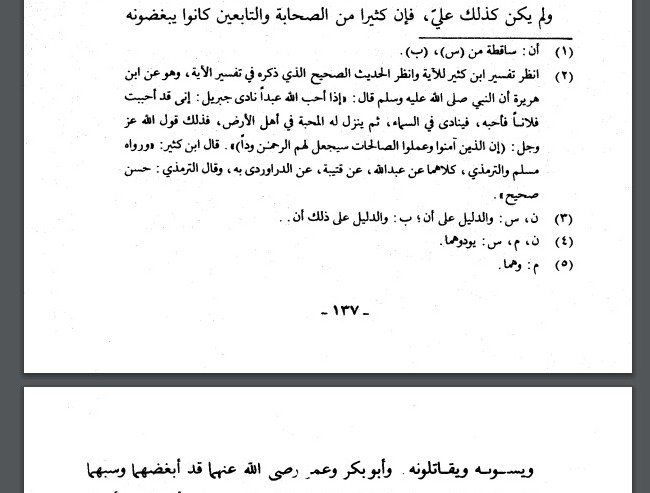
Ibn Taymiyya al Harrani in his asSunnah an-Nabawiyyah when he comments about the above ayat in relation to Ali ibn Abi Talib that:

“Allah (swt) has told that He will place on the believers and those that preform good, love. And this is a true promise from him. Especially for the Caliphs Abu Bakr (ra) and Umar Ibn Al Khattab (ra) for the general amount of companions loved them and they were the best periods of Islam. Ali was not like that, as a large number of companions (sahabah) and followers (tab’ieen) hated him, cursed him and fought him.”

Source: (منهاج السنة النبوية في نقض كلام الشيعة والقدرية Minhaj al-Sunnah al-Nabawiyyah fi Naqd Kalam al-Shi’a wa al-Qadariyyah)

The implication (though not explicitly stated by Ibn Taymiyya) was that Ali was not of those who worked deeds of righteousness.

Ibn Taymiyya continues:

“They love and venerate him, while Abu Bakr and Umar – may God be pleased with them – have been hated and cursed by the Rafidah (Rejectors), the Nusayriyyah, the Ghulat (Extremists), and the Ismailis. However, it is known that those who loved those two (1) are better and more numerous, and that those who hated them are further from Islam and fewer.”

This contradicts the case of Ali, for those who hated and fought him are better than those who hated Abu Bakr and Umar. In fact, the faction of Uthman, who love him and hate Ali, even if they are innovators and wrongdoers, are more knowledgeable and religious than the faction of Ali who love him and hate Uthman, and they are greater in jihad and justice. Thus, it is clear that the affection mandated for the three [first Caliphs] is greater.”

“And if it is said: ‘Claims of divinity and prophethood have been made about Ali (2),’ it is replied: ‘All the Khawarij considered him a disbeliever and the Marwaniyyah hated him. And these are better than the Rafidah who curse Abu Bakr and Umar – may God be pleased with them – let alone the Extremists (3).'”

Source: [Chapter: The Thirteenth Proof “You are only a warner, and for every people there is a guide.”]

You may be interested in reading the following:

May Allah Forgive the Ummah.

May Allah Guide the Ummah.

2 Comments

Filed under Uncategorized