“Had We sent down this Quran upon a mountain, you would have certainly seen it humbled and torn apart in awe of Allah. We set forth such comparisons for people, perhaps they may reflect.” (Qur’an 59:21)
﷽
The first thing you should understand dear reader is that this issue on rather or not the Qur’an is created or uncreated was not discussed by the Blessed Prophet (saw) himself.
This issue was also not addressed by the noble companions of the Blessed Prophet (saw).
This issue came about later. The Umayyads did not restrain the tongue of John of Damascus and it is via his machinations that this debate and intrigue came to the Muslims.
Each side took a position and gave their proofs and justifications.
As regarding making takfir of other Muslims on this issue.
As our teacher, Shaykh Juma Muhammed al-Mazrui, (Hafidhullah) taught us we do not make takfir of other Muslims on this issue.
His Eminence Shaykh Dr Kahlan B. Nabhan al Kharusi, The Assistant Mufti of Oman, (Hafidhullah) has made our position clear:
What is not in dispute between us and the Sunni Muslims.
The things we both affirm about the Qur’an.
1) That Allah (swt) has never been unable to produce speech from all eternity.
2) That the Qur’an does not originate from any other than Allah (swt).
3) It is his Word, His Revelation and that which He sent down.
4) It was revealed in letters and words.
5) It was revealed to the heart of the Blessed Messenger (saw).
6) It is inimitable in its combinations and meanings. No human being can produce the like thereof.
7) It has been narrated from the Blessed Messenger (saw) through firm tawatur
The Truth about the Qur’an: Created or Uncreated? (This article shows some of the proofs and evidences that each side uses to justify their position.)
This discussion relates to some possible theological conundrums and challenges they can face when holdling the view that the Qur’an is eternal and uncreated.
The position of Sunni/Atheist/Materialist. Allah is worthy of worship based upon auditory perception i.e the ability to be heard.
The Created Qur’an: Yasir Qadhi, Salafis and Atheist.
The position of the Sunni/Neo Platonist. The Monad & the Logos
An uncreated ‘Kun’ by which everything else is created. The ‘kun’ acts as the intermediary between Allah, the transcendant and the material world.
However, the Sunni believe that this uncreated ‘kun’ is not identical to the essence of Allah nor other than Allah’s essence. In our view this is a step away from monotheism and a bridge towards Christology and logos theology.
“In the beginning was the Word, and the Word was with God, and the Word was God.” (John 1:1)
“Through him all things were made; without him nothing was made that has been made.” (John 1:3)
Thus for the Ibadi school. The Qur’an is created because Jesus is Not God.
You can see this student of Bin Baz asking Bin Baz that he had the chance to refute Al Khalili(h) and show that he was upon batil (falsehood) so why did he not take it? Bin Baz replied but what if Khalili (h) has strong evidence then what?
The way the following video is framed it paints a picture as if Bin Baz was the wise one in the situation. As if he was saying: “If I debate him he might have a stronger argument and this will cause the misguidance of many people.”
How can the Qur’an be eternal if the first thing created was the Pen, The Throne, Water, Spatiality, the Light of Muhammed. If any of these are in order then one comes before or one comes after.
Noble Shaykh Khalid Al Abdali (h)has an excellent 10-part series in Arabic on the Qur’an being created.
Conclusion:
As a Muslim, regardless of whether it is created or not, your duty is to adhere to every single verse in it and believe in it all. We are to continue to ponder upon the Qur’an. To be transformed by it and healed by it.
The Ummah has bigger challenges. Many Muslims today are being led astray. There are many expressions of Islam today, pseudo-groups who follow as Caliphs and Imams, people who do not even know how to recite the Qur’an. It is not even proven that these people know how to recite the Qur’an properly. Yet, people are being duped into following them.
“Indeed, We have made it an Arabic Qur’an that you might understand.”(Qur’an 43:3)
﷽
For many, the last 10 days of Ramadan will be spent doing extra prayers, late night vigils, reading of the Qur’an, finding charitable causes, time with family and iktikaaf (overnight) stay in the masjid.
Yet, for others, the last 10 days of Ramadan presents a sort of moral dilemma.
So here we are. Attacking Shaykh Mufti Menk for breaking Iftar with a Jewish Rabbi. Let’s attack Dr. Jonathan Brown for writing the book “Islam & Blackness” because human beings shouldn’t be writing books about corals in the coral reef! You aren’t a coral!
And now attacking Shaykh Hamza Yusuf for the same beliefs that the attackers in reality themselves hold! Namely, their baseless assertion that the Qur’an is eternal and uncreated!
“and not subsisting in Allah” Notice how he says that like it’s a good thing!
ٱللَّهُ لَآ إِلَهَ إِلَّا هُوَ ٱلْحَىُّ ٱلْقَيُّومُ (Qur’an 3:2) This one verse in the Qur’an absolutely demolishes the theology of Ibrahim Ibn Mahmud and anyone else who comes along and tries to tell you that Allah (swt) is a compound unity of attributes subsisting and not identical to the essence of Allah (swt).
Al Hayyu and Al Qayyum is what Allah (swt) is. He tells you in clear language in the plain text (dhahir) apparent text that He (ALLAH) Is the Ever Living Self Existing!
You cannot have a self-existing “attribute” called “al qayyum” subsisting! Authubillah min dhalik! (May Allah protect us from that)
We don’t need the real proponents of innovation and speculative theology like Ibrahim Ibn Mahmud, the Athari, to come along later and say other than what the clear text of the Qur’an says.
If the Qur’an is not from the time of the Salaaf Us Salih (then nothing is)!
Why would a well-informed Christian who believes in the Athanasian creed leave their faith for Islam? What are you people really calling to?
This is what these people are calling to. It is this reason why they will not admit what Allah (swt) has clearly stated in the Qur’an:
“Indeed, We have made it an Arabic Qur’an that you might understand.” (Qur’an 43:3)
Give us a single text in the Qur’an where it says it is not made!
Allah (swt) clearly told you that it is!
The reason is that to say that the Qur’an is uncreated is to say that Allah (swt) has an attribute called speech, and his attributes are eternal, and yet they are not identical to his essence, nor other than it. Yet subsisting. So that you end up sounding exactly like this…..
Read it and beware!
Point 5.
“There is little in Berkhof’s explanation of the Trinity that should surprise anyone familiar with the Reformed tradition. He affirms that there is in the Divine Being but one indivisible essence, and that in this Being there are three Divine Persons or individual subsistences (87). On this latter point, Berkhof helpfully reminds us that there are not three individuals in the Godhead, alongside of and separate from each other, but rather “personal self-distinctions within the Divine essence” (87). Perhaps this is why theologians in the Reformed tradition tend to talk of order and operations instead of roles and relationships. The first pair of terms suggests self-distinctions, while the second pair suggests separate individuals.”
Taking a look at the video attack upon Shaykh Hamza Yusuf.
Notice the very first thing this video does. Does it go to the Qur’an? No! Does it appeal to the Sunnah? No!
@0:43 minutes they appeal to an Imam. Can you imagine? These people castigate the Shi’a for appealing to the Imams and they do the exact same thing.
After the appeal to their Imam, then the revelation of Allah (swt) states comes next.
“Rather it is an honoured Qur’an in the preserved tablet.”(Qur’an 85:21-22)
Point 1). The Qur’an is in a preserved tablet. Preserved tablet =NOT ALLAH.
Yes, the very preserved tablet that is the revelation of Allah (swt) states:
“Ha-Mim By the Book that makes things clear,-We have made it a Qur’an in Arabic, that you may be able to understand and learn wisdom. And verily, it is in the Mother of the Book, in Our Presence, high in dignity, full of wisdom. Shall We then take away the Message from you and repel (you), for that you are a people transgressing beyond bounds? (Qur’an 43:1-5)
Point 2). The Qur’an has been made in Arabic. ALLAH =NOT MADE.
Point 3). It is in the presence of Allah. It is distinct from Allah (swt). ALLAH = NOT COMPOUND UNITY
Point 4). The Qur’an is in the mother(origin) of the book. ALLAH=HAS NO MOTHER(ORIGIN)
Point 5) The attributes of Allah (swt) are not contained IN a mother book.
“Allah eliminates what He wills or confirms, and with Him is the Mother of the Book.” (Qur’an 13:39)
This Qur’an is in a preserved (maḥfūẓin) tablet.
Point 6) Allah (swt) nor his attributes are in need of preservation, sustenance, upkeep, maintenance, conservation. ALLAH=ETERNAL.
Point 7) The Qur’an is contained in ‘the mother of the book’ (43:4) which is WITH Allah (13:39)
With shows a clear distinction from Allah (swt).
@1:20 we get another verse from the Qur’an.
“And if any one of the ungrateful disbelievers seeks your protection, then grant him protection so that he may hear the words of Allah . Then deliver him to his place of safety. That is because they are a people who do not know.” (Qur’an 9:6)
Let us first deal with some flawed mantiq (logic).
First, it is sufficient to attribute to Allah (swt) the attribute of power without the attribution of speech. Speech is not the opposite of dumbness, such that dumbness is negated by affirming it. The opposite of speech is silence. It does not mean that a non-speaking person is dumb; rather, he is not non-silent.
There also seems to be some confusion from those who call themselves ‘Salafi’, among others, with regard to Allah’s knowledge of it, whereas there is an attempt to equate the attributes of Speaking and Knowledge as being both eternal. Eternal knowledge of a thing does not mean the thing itself is eternal. Otherwise, all of us would be eternal.
We affirm the attribute of “speech” for Allah (swt) as Imam Diya al-Din ‘Abd al-Aziza Thamini (raheemullah), says in his Mu’alim:
“Know that speech is sometimes referred to Allah in the meaning of negating dumbness of Him, and it then is to be understood as an essential attribute in the way of such attributes. And sometimes it is referred to Him in the sense of its being one of His actions, and it is then to be understood as such. So the meaning of His being Speaking, according to the first interpretation, is that He is not dumb; and according to the second that He is a Creator of Speech.”
The Qur’an has never called the speech of Allah (swt) ‘eternal‘. This is pure kalaam!
“The reason why I don’t follow the Ashari creed is because it goes against the clear text of the Qur’an and human nature. People only follow it because they think it makes them look like intellectuals with all those fancy words.” -Abu Humayd
“Indeed, We have made it an Arabic Qur’an that you might understand.”(Qur’an 43:3)
This text is quite clear.
IMAM AHMED AN INNOVATOR ACCORDING TO IBN TAYMIYYAH?
Think about it, dear respected Muslim sisters and brothers. The fact that our great scholars actually mused over this is really sad.
“Then, among them are those who say that the ink is apparent in the mushaf but not incarnating, and some say that it is incarnating. In the sayings of some of them is what implies that for the form—the form of the letter and figure – but not for its material substance, which is its ink. This opinion is also invalid. Just as the saying, that anything from the voices of human beings is eternal, is an invalid opinion. It is an opinion put forward by a group from among the followers of Malik, Shafi’i, and Ahmad, the majority of whom reject it. The saying of Ahmad and the majority of his followers rejecting his opinion is well-known. There is no doubt that whoever says that the voices of servants are eternal, he is an innovator and inventor. In the same way as whoever says that this Qur’an is not the word of Allah, he is an innovator and an inventor”
Source: (Fatawa Ibn Taymiyyah (Matabi al-Riyad, 1st edition, 12:83-873,83-85)
THE REAL REASON FOR THIS DEBATE/DISCSSION: IS THE QUR’AN ETERNAL or CREATED?
The real reason for this debate is that there are those in the Muslim Ummah that believe Allah (swt) has attributes that are not identical to his essence nor other than it.
TAWHID vs TRINITY.
Tawhid: The belief that Allah is one being that has an undefined/undisclosed number of self-distinctions subsisting with in the divine essence.
Trinity: The Belief that God is one being that has three personal self-distinctions within the Divine essence.
In reality, there is no such debate: Tawhid vs Trinity. The real debate is: In what sense is God a Unity?
In the way that the Athari/Ashari/Maturdi proclaim? Or in the way that Athanasian Christians proclaim?
The real debate between the vast majority of Christians and the vast majority of Muslims (Salafi-Athari/Ashari/Maturdi) should be: In what sense is God a Unity?
May Allah (swt) guide us all to what is beloved to him.
May Allah (swt) guide Shaykh Hamza Yusuf and Ibrahim ibn Mahmud.
If you would like to read more articles concerning Shaykh Hamza Yusuf you maybe interested in:
“Indeed, We have made it an Arabic Qur’an that you might understand.” (Qur’an 43:3)
﷽
We never met this beautiful soul, Joshua. May Allah guide him! He is a very intelligent man. This makes sense. We have a feeling that he is keen on Islam. However, just as he is aware that Judaism has various debates on various issues, he is also smart enough to know that the house of Islam, unfortunately, is not one big happy family.
Probing positions and views before deciding to commit to something IS an intelligent thing to do!
This man, Joshua, had Ali Dawah on the ropes when they were discussing the issue of whether Allah (swt) rested. Because, using a consistent approach, Ali Dawah began to realize he had no scope to argue with the forceful position of this young man. To Ali Dawah’s credit, he didn’t force the issue.
Now to this topic: Discussion with Josh (Jewish) | Is the Quran Being Uncreated Against Tawheed?
Abbas: “I don’t think it was its attribute. We, we’ve, I think we’ve answered the question many times that, with the knowledge of Allah, the Qur’an would have existed eternally. See. The actual physical book the mushaaf that was sent down and this is obviously an English translation, but the actual Arabic text when it was written down it is something that once it gets old it’s even burnt or it’s buried or whatever. To dispose of it in a respectful way.”
Abbas: “Burning it is actually not disrespectful in Islam. It’s a valid way of getting rid of an old manuscript that’s damaged and can’t be read, so you would have to have a new copy or whatever and the old one would be respectfully ah sort of ah, you know, gone away with in that way. But the knowledge of Allah, as a Jew, umm I think that you would accept that whatever knowledge Allah has, for example, the Torah itself. Would you say that the Torah itself is something that came into existence or did God have that in his knowledge but bring it into existence when he chose to?”
Josh: “So I believe that the Torah was in fact created. Only God himself is uncreated. But everything within the so-called “knowledge” of God is created at some point.”
Abbas: “Right, so then are you saying that there was a time when God did not know of the Torah?”
Joshua: “No, there was not a “time” before it, because God is above time. So God created time. Rather or not God created the Torah before he created time is not something I know.“
Abbas: “So, basically what were saying is that was there ever a moment when God did not know of the Torah?”
Joshua.” In a sense, yes. Prior to the creation of the Torah, there could be no knowledge of the Torah.”
Abbas: “So there was a moment when God had no knowledge of the Torah. (Now there is a moment there where the video does a flash sequence. I do not know if that means the video was edited or that is just a video effect.)”
Joshua: “Yes.”
Hamza: “So you don’t believe God has all full knowledge.”
Joshua, “No because, because knowledge we believe is an attribute of God. God’s omniscience is an attribute of him. Therefore, he created his own omniscience.”
Abbas: “Josh, is that a mainstream Jewish belief? In terms of actual rabbinical grounding. That the Torah, at one point God did not actually know what he was going to say. What God was going to give to Moses.”
Hamza (interrupts): “Josh, do you believe that God knows the future?”
Josh: “Yes, because there is no future when it comes to God. Cause for God all time, past, present and future” (could make out due to Hamza speaking over).
Hamza: “So then God knows what the Torah isn’t it always?”
(The team got Josh to admit they had a point that there could be no ‘before’ as he (Joshua) just admitted that past/present/future….)
Imran: (The best listener out of the bunch, in our opinion) He pivots back to the original question: “Your question was really an interesting one because you, you raised this as a question about Tawhid. And you said that this is uh, it requires an explanation having the Qur’an as an uncreated statement that the Qur’an is uncreated, and then you have Allah, who is eternal. Does it affect Tawhid in any way? That was really underlying thing that I think you were trying to get to. So I am going to give you an analogy. Now, obviously, all analogies are imperfect, and we can’t perfect analogies, particularly when it comes to the Creator. But I am gonna try and give an analogy to drawn on and explain. So you’re speaking, right Josh?”
Josh: “Yes.”
Imran: “Can your speech exist without you?” (Can you exist without speaking)
Josh: “I don’t know. Can my speech. Theoretically there could be my speech without me. I suppose. I’m not sure though.”
Imran: “I would say that that’s clearly, that clearly the answer to that question is No. Um, I don’t know how your thinking…if you did not exist, could your speech exist?”
Josh: “Depends. If my speech has to, if there’s prerequisite to the existence of my speech is the existence of myself.”
Imran: “Sorry, sorry to interrupt you. Your thinking. I don’t understand your thinking process. What you’re doing is your taking this speech and your giving it attributes. Now we agreed that speech is an attribute of the Creator. We’ve agreed this. Like just as speech manifests from you. Now the question is do the attributes exist on their own or not?”
Joshua: “With regard to attributes of myself or attributes of God?”
Imran: “So the analogy is to get you to think about the Creator. I am trying to use yourself as an example just to try and give that. So, for example is: Can your speech exist without you?”
Joshua: “So if we (God forbid) leave God out of this picture for this particular analogy. Um, otherwise it’s going to get far too complicated. Then for sure, then you would be right that my speech could not exist without me.”
Imran: “So now I’m going to say now let’s talk about the Creator. Now I’m going to say the attributes of the Creator can’t exist without the Creator.”
Joshua: “Yes, that’s true.”
Imran: “Yup, so now we don’t have a conflation between were not comparing two different things. The Qur’an is the speech of Allah. It’s an attribute you understand? So now the question comes. When we’re talking about (holds up the Qur’an) the text, do we/are we referring to that attribute or not? So there’s two things and now we have to differentiate this. The attribute we’ve agreed is eternal. Why? Because the Creator is eternal, the attribute is eternal. Therefore, the Qur’an is uncreated and eternal. So now that’s a dealt with thing. This is a (holding up the Qur’an) a creation, like somebody has put these pages together, written the pages and the ink down. This (holding up the Qur’an) is not that attribute.”
Joshua: “I understand the difference between the written Qur’an and the spoken Qur’an that..” (unintelligible as Imran talked over him.)
Imran: “So that means coming to the concept of Tawhid. It doesn’t impact that at all. Another example would be: Creation. One of the attributes of God is that he is the Creator. Now, (we agree with this yeah?) “
Joshua: “Yes.”
Imran: “So the creative command is not separate from the creator in any sense, right?”
Joshua: “I would disagree with that because, prior to because prior to having created anything, how can God be considered to be a Creator? In order to be a Creator you need to have a creation.”
Imran: “So o.k that’s interesting, so I think that you sorry Hamza, you wanna…”
Hamza: “You don’t need to create to have the attribute of a creator you just need to create to demonstrate the attribute.“
Joshua: “But that depends on how we understand what the attribute is. Um so, let me just think about how to explain.”
Hamza: (getting visibly impatient) “Oh o.k before Allah, before God created the universe, you believe God created the universe?”
Joshua: “Yes.”
Hamza: “Did he have the attribute of Creator?”
Joshua: “Before he created anything he did not….”
Hamza: “Did he have the attribute of Creator?”
Joshua: “No.”
Hamza: (Surprised) “No!? How did he create than?”
Imran: “O.K. Let’s change the word for a moment, Josh. Let’s make the word ability.”
Joshua: “Ability? o.k. Did God have the ability to create? Yes.”
Imran: “O.K so that’s the attribute.”
Hamza: “That’s the attribute.”
Joshua: “Oh that’s what you mean when you say attributes.”
Hamza: “The Creation is the manifestation of the attribute. Evidence of the attribute if you like.”
Joshua: “It’s the manifestation of ‘Ah’..” (light bulb moment).
Comments:
Over all, that was a very good exchange. In reality, the question Joshua poses is two-fold in nature.
Is the Qur’an created or eternal?
If it is created or eternal, does this pose a problem for the doctrine of Tawhid?
The first argument brought by Abbas is not a good argument.
The eternity of knowledge does not imply the eternity of the known. Otherwise, all things that have come into being would be eternal! Imagine saying, because Allah (swt) has eternal knowledge about Christ Jesus, that Christ Jesus would be eternal! Christians would just love that!
Imran seemed the more learned of the three, at least in terms of Sunni theology. He got straight to the point. However, Imran did a very clever cart before the horse when he asked:
Can your speech exist without you? Actually, we could ask: (Can you exist without speaking?)
The answer to that is yes. You can exist without speaking.
We affirm the attribute of “speech” for Allah (swt) as Imam Diya al-Din ‘Abd al-Aziza Thamini (raheemullah), says in his Mu’alim:
“Know that speech is sometimes referred to Allah in the meaning of negating dumbness of Him, and it then is to be understood as an essential attribute in the way of such attributes. And sometimes it is referred to Him in the sense of its being one of His actions, and it is then to be understood as such. So the meaning of His being Speaking, according to the first interpretation, is that He is not dumb; and according to the second that He is a Creator of Speech.”
Now this is where it gets a bit tricky for Sunni theology.
Imran: “So the creative command is not separate from the creator in any sense, right?”
Response: What do you actually mean by the creator and his attributes? Because the Sunni theological position is that the attributes of Allah (swt) are not equal to Allah (swt) nor other than his essence!
This is a very, very BIG problem for Sunni theology.
Questions for the Athari/Salafi school.
So, if the attributes are not identical to the essence or other than the essence, what are they?
Can you prove your claims that the attributes are not identical to the essence using kitab wa sunnah?
Using the Qur’an and the Sunnah?
Will you need to rely upon kalam?
Actually, a VERY GOOD QUESTION FOR ANY SUNNI MUSLIM IS:
‘What do you mean when you say God is one?’
This may come as a surprise to the readers. They may say the being is one, but can they really, since they also have these attributes that have a quasi/pseudo-being status, in that they are not equal to the being nor other than it?
The second point from Imran
Imran: “So the creative command is not separate from the creator in any sense, right?”
“And the angels called to him as he stood praying in the sanctuary: Allah gives you glad tidings of (a son whose name is) John, (who comes) to confirm A WORD (bikalimatin) from Allah lordly, chaste, a prophet of the righteous. (Qur’an 3:39)
Are we sure that we want to say that Jesus (A WORD) from Allah is not separate from the Creator?
On what consistent basis is Jesus Allah’s word and his spirit and yet be created when the Qur’an is Allah’s word and is eternal and uncreated? On what consistent basis is the claim made?
We are quite certain that Christians are going to be asking themselves why should I leave Christianity, which holds (even in the lesser Arian Christology) that Christ Jesus is a word emanating from the divine nature but sharing the divine nature only to embrace a faith that tells me that Christ Jesus is a word emanating from the divine being but not separate from the divine being?
“His are the creation and the command.” (Qur’an 7:54)
This is answered by the context itself:
Indeed, your Lord is Allah, who created the heavens and earth in six days and then established Himself above the Throne. He covers the night with the day, [another night] chasing it rapidly; and [He created] the sun, the moon, and the stars, subjected by His command. Unquestionably, His is the creation and the command; blessed is Allah, Lord of the worlds. (Qur’an 7:54)
The most that this verse tells us is that, just as Allah (swt) is alone in bringing the universe out of non-being (into being), in the same way, He is alone in the management of it. He has no partner in its creation and in its management. None other than Him has anything of the creation and management. Rather, to HIM alone belong the creation and the command. The meaning here, clearly, is management. And there is nothing in that which even remotely points either to the eternity of the Qur’an or to its contingency.
Examples:
“Maintain with care the [obligatory] prayers and [in particular] the middle prayer and stand before Allah, devoutly obedient.” (Qur’an 2:238)
The middle prayer is not (separated) out of the genus of prayers, the guarding of which has been commanded.
“Whoever is an enemy to Allah and His angels and His messengers and Gabriel and Michael – then indeed, Allah is an enemy to the disbelievers. (Qur’an 2:98)
No one says that Gabriel and Michael are separated out of the genus of angels. The difference between them is relative.
“Indeed, Allah orders justice and good conduct and giving to relatives and forbids immorality and bad conduct and oppression. He admonishes you that perhaps you will be reminded.” (Qur’an 16:90)
No intelligent person will argue about justice being the doing of good, and the doing of good being justice.
The command (amr) of Allah (swt) has been mentioned jointly with what denotes its creation in many places.
“And [remember, O Muhammed], when you said to the one on whom Allah bestowed favor and you bestowed favor, “Keep your wife and fear Allah,” while you concealed within yourself that which Allah is to disclose. And you feared the people, while Allah has more right that you fear Him. So when Zayd had no longer any need for her, We married her to you in order that there not be upon the believers any discomfort concerning the wives of their adopted sons when they no longer have need of them. And ever is the command of Allah accomplished.” (Qur’an 33:37)
“[Remember] when you were on the near side of the valley, and they were on the farther side, and the caravan was lower [in position] than you. If you had made an appointment [to meet], you would have missed the appointment. But [it was] so that Allah might accomplish a matter already destined – that those who perished [through disbelief] would perish upon evidence and those who lived [in faith] would live upon evidence; and indeed, Allah is Hearing and Knowing.” (Qur’an 8:42)
“There is not to be upon the Prophet any discomfort concerning that which Allah has imposed upon him. [This is] the established way of Allah with those [prophets] who have passed on before. And ever is the command of Allah a destiny decreed.” (Qur’an 33:38)
“He arranges [each] matter from the heaven to the earth; then it will ascend to Him in a Day, the extent of which is a thousand years of those which you count.” (Qur’an 32:5)
“Indeed, all things We created with predestination And Our command is but one, like a glance of the eye.” (Qur’an 54:49-50)
“Do the disbelievers await [anything] except that the angels should come to them or there comes the command of your Lord? Thus did those do before them. And Allah wronged them not, but they had been wronging themselves.” (Qur’an 16:33)
All of those examples should be more than sufficient to show our response!
May Allah (swt) open the eyes of the Muslim ummah. May Allah (swt) open the heart of Joshua and bring him to the right way.
If you would like to see more articles on the discussion of the Qur’an, is it created or uncreated? You may wish to see the following:
“Indeed, We have made it an Arabic Qur’an that you might understand.” (Qur’an 43:3)
﷽
Mohamed Hijab, who is a known Muslim speaker based in the United Kingdom, has recently put forward some excellent arguments against the idea of the Qur’an being eternal and uncreated (unbeknownst to him).
Now, to be fair, we want to say from the outset that Mohamed Hijab (as far as we know) believes that the Qur’an is eternal and uncreated.
However, it doesn’t seem that he has pondered the implications of his kalaam argument on the subject of the Qur’an being makhluq (created).
Listen carefully to the exchange between Marwan and Mohamed Hijab
The contingency argument.
@1:28:36 listen to Marwan’s question about pantheism and contingency argument.
@1:30:18 Mohamed Hijab gives his reply listen carefully.
“This is a book, and it’s made out of parts and the parts are the pages of the book right. Correct? So these are the pages of the book. I dunno what book. ‘Jewish historical society of England’ …..This is a book, right, and this is the whole of the book, correct? And it’s made out of parts, correct? Now if I pick a part out. Now if I take all parts out of this book, does it remain as a book? If the parts are taken out, then the whole thing is taken out. If that’s conceivable that parts taken out the whole thing is taken out than there is no way that this thing that I’m talking about is necessary and independent. Because necessary and independent means it’s always there and it can never be any other way. It’s a simple as that. You said, well, if it’s inter-dependent, anything which is inter-dependent by definition is dependent because what does the word inter-dependent mean? Interdependent means things which rely upon each other.So, if in order for this book to exist, there’s an inter-dependence or each page relies upon the existence of other pages in this book in order to exist. Then what we’re saying is this thing is dependent, because everything interdependent is, by definition dependent. What is dependence? Something which relies upon something else for its existence. What is inter-dependence? Something which relies upon something else in order to exist. So, in many ways, what you’re saying is, if we admit that it’s dependent than khalas (finished), it cannot be dependent and necessary at the same time.”
@1:33:16 “How do we describe the kul here? How do we describe the whole of this book? How do we describe the whole of this book? We describe it through its parts, right? Now if I say I just dissembled all its parts, and it’s maybe what 3-400 pages, and I’ve scattered them around. They still exist, but they exist in a different form. Now what I’m saying is the fact that I can re-arrange them like this I can you see this hundred, I dunno, let me see 208 pages of this book, yeah. If I take the 232 pages and make page 1 and page 232 and make it like munaqis (opposite), so instead of 1,2,3,4,5 it’s 232, 231, etc., etc. I’ve re-arranged it. The fact that now I can rearrange this book means there is nothing necessary about the arrangement and the form of this book. There is nothing necessary about it at all.”
@1:34:27 “The book as it is the way in which the book is now from 1 to 232, the way in which the book is like that the form the sura the shaqil the hakel -what ever word you want to use, the form of the book as it is now can be re-arranged. Now let me give you an example because I feel, I feel like the issue here is we don’t know the difference between contingency in this necessity. Necessity: 2 +2=4. 2+2=4. Is there any way 2+2=4 can be arranged any other way. Can it re-arrange in any other way? Can 2+2=anything other than 4? Which means its necessary. So its impossible to re-arrange 2+2 to equal anything other than 4. It’s eternally that way, it’s necessarily that way and it will continue being that way. It cannot be any other way. Now this is not the same with the arrangement of the parts of this book. The arrangement of the parts of this book can be other ways. This book itself can be another way. Instead of this colour; which I will describe as beige I dunno maybe I’m colour blind. It could have been blue. I can actually paint it right now. I can make it blue. I can , you want me to do? It looks like a historic book I dun want to ruin it. But I can change this book. There is nothing necessary about this book. Now you might say well, if we define necessity as something susceptibility, destructibility and generation. Yeah? And then in the closed system of the universe energy cannot be destroyed. Cannot be destroyed and therefore the atoms will take another form. I’m saying. I am not defining. I’m not defining contingency in only that way. I’m defining contingency in three ways. Number 1. Something that can be any other way. Number one yeah? Number 2. Something susceptibility to destruction and generation destruction yeah? And number 3. Something which relies upon something else for its existence. Now even if you argued that well this cannot be really destroyed because it’s atoms will take other form. I’m saying its still not necessary because it can be arranged in another way. The parts of this whole can be arranged in a way which is currently not arranged. It can be a way which is currently not/is. So which means that it, it meets the criterion of contingency; because it can be another way.”
@1:37:24 “You are confusing eternality and necessity. O.K? It’s conceivable that something can be eternal and not necessary. It’s conceivable how so? Because something can be eternal but rely upon something necessary. And that’s why the ‘ulemah of Islam they differentiated between what is referred to as wajibun an nafsi and wajibun al ghayri which is necessary for its own sake and necessary or in and of itself and necessary because of something else. So for example if I were to say. You have a sun. Let’s say the sun is necessary. The sun yani. Shams yeah? And it’s rays are contingent based-dependent upon the sun. The fact that the rays exist and they are contingent on the sun doesn’t’ mean that just because they are both eternal. The fact that the rays exist and are contingent on the sun doesn’t’ mean that the rays are necessary just because their eternal because they are dependent upon something which is necessary in this case, the sun or the eternal. You get it?
@1:38:37 “Yeah that’s his Ibn Cena beliefs. Yeah well Islamic refutation of the universe being eternal is clearly against the Qur’an and the Sunnah. Al Ghazali had this kind of refutation if you wanna.”
Marwan ask about the attributes of Allah (swt).
@1:39:00 “We affirm all the attributes of God through these kind of argumentations. That is why, there is a point where you need like the Rahma of Allah. The fact that he is ghafu and afuw and raheem and all that stuff. That needs to be affirmed through revelation.”
Marwan ask are these attributes necessary or contingent?
@1:39:19 ‘Yeah all attributes of Allah are necessary.” @1:40:25 “We don’t use the word dependent it’s being controlled by the irada (intention) of Allah. By the will of God. So the verb all the attributes of God are controlled by the will of God. If Allah wants to speak yeah? If Allah wants to speak he wills that and he does that.”
Marwan so they are contingent upon his will?
Listen to how uncomfortable is the response of Mohamed Hijab. The sudden shift. Also notice that Mohamed Hijab does not affirm that Allah is speaking, or is speaking eternally. He attributes the speaking to his will! Al hamdulillah! Thank you!
@1:40:44 “We don’t need to use the word contingent. They are controlled by his will.“
I believe at this point Marwan doesn’t really seem to buy it. A quick glance of the ideas upward and simply responds . ‘O.K’
The arguments brought by Mohamed Hijab absolutely decimate the idea that the Qur’an is uncreated.
Its message is dependent upon asbaab an nuzul (occasion of revelation), which conceivably could have been different. According to our brothers from the Sunni denomination, it has text that has been abrogated and that is dependent upon what abrogates and what is abrogated. It is composed of letters and words and sentences that are dependent upon structure to have a coherent meaning. It’s conceivable that the Ahruf /Qir’aat of the Qur’an could be more or less than what they are. It is conceivable that the Qur’an could have been revealed in a language other than Arabic. It is conceivable that the Qur’an itself cannot be necessary, because it is conceivable that Allah (swt) could have had the Torah or any other revelation completely intact and reach us until this very day.
In the words of Fakhr al-Din Al-Razi:
“The impossibility of a word which is composed of letters and sounds being eternal is self-evident to the mind for two reasons:
The first is that a word cannot be a word unless its letters are sequential. The letter uttered before the last that is uttered is originated, and if something’s being originated is affirmed, its eternity is then impossible. So, for the letter following the end of the first, there is no doubt that it originated.
The second is that, if those letters from which the word is composed occurred in one go, the word cannot be. A word composed of three letters can occur in any one of six combinations. If the letters occurred altogether, the words occurring in some of those combinations would not be better than they are occurring in any of the rest. Alternatively, if the letters occurred in succession, then the word is originated.”
Source: (Al-Tafsir al-kabir (Tehran: Dar al-Kutub al-Illmiyyah, 2nd edition, 1:P20.)
Fakhr al-Din took fellow Sunni Muslims of the Hanbali school to task when he says,
“These people are so low as to not deserve mention among the group of the learned. It happened one day that I said to one of them: “If Allah spoke these, then either He spoke them in one go, or in succession. The first is void because the speaking of all these letters in one go will not convey an orderly composition which is a combination in sequence. It necessarily follows that this composition, combined with these successive letters, cannot by themselves be Allah’s speech. The second is void, because if Allah spoke them in succession, then it would be originated.’ When the man heard this statement of mine, he said: ‘It is obligatory for us to affirm and pass on’, i.e., we affirm that the Qur’an is eternal and pass by this statement that we have heard. At that point, I wonder greatly at the safety of this speaker.”
“Indeed, We have made it (ja’alnahu) an Arabic Qur’an that you might understand.” (Qur’an 43:3)
﷽
This video was brought to our attention. Here we have our Muslim sister asking Mohamed Hijab about the age-old question about whether Allah’s words (speech) is created.
So what we are going to do is to let you listen to the exchange. We have also transcribed the exchange between Mohamed Hijab and the questioner (referenced as ‘Muslim sister’.) We will then provide our commentary and thoughts on the exchange.
Muslim sister:
“About like the Qur’an being like there, you know the issue about it being created and not created, about how there was a big debate in the past, so I don’t exactly understand like those two sides, like what do people mean when they say it’s created and what do they mean when they say it’s not created because I don’t think either side actually meant that created in terms of written by people so like how yeah so what do they even mean like how do you make sense of it.”
Mohamed Hijab:
“The Muʿtazilah believed that it was was created, it was makhluq. That Allah created the Qur’an. The words were created. They were not…whereas the Ahl Sunnah position is that the words are not created and that the words are exactly are uh, they are a subset of an attribute of Allah (swt) which is speech. So like I’m speaking to you right now, I have the ability to speak, and my speech is a subset of my ability to speak in my capacity to speak. Likewise, Allah (swt) speech is not created, it’s not manufactured. It’s a subset of one of his attributes. So the Muʿtazilah believed that it was created in the same way as human beings are created, or the universe was created. And Ahl Sunnah believed that’s not the case.”
The sister was asked: “Does that make sense?”
Muslim sister:
“Um, I mean, like it just don’t sound like I guess I cannot fully comprehend in (??) not in terms of how it’s possible but rather like, um, are the words kind of emitted at some point and does that omission all…” (interrupted by Mohamed Hijab)
Mohamed Hijab: “Yeah, omission …all right, look, so does Allah (swt) does he umm create?”
Muslim sister: “Yup”
Mohamed Hijab: “Yup.” So he creates. Allah (swt) does he hear all things?
Muslim sister: “Yeah.”
Mohamed Hijab: “Does he see all things?”
Muslim sister: “Yeah.”
Mohamed Hijab: “Yeah? Right, now all of those things are they created? Like did Allah create-Did Allah create an ability for himself to hear?”
Muslim sister: “Oh I see. So, when you say the words are not created like the Qur’an is not created you mean the ability to speak was not created, yeah?”
Mohamed Hijab:
“That Allah’s ability to speak is not created and that the words themselves are not created. They are uh omitted as you mentioned from Allah (swt) in a way that suits his majesty. Which is nothing like the khalq (the creation). But they are not created it’s like-just like Allah (swt) does not create his ability to hear, and he does not create his ability to see and thus, intrinsically, it’s a part its its its an aspect of what he is, not a part. An aspect of what he is. Then, in that case, the same can be said about kalam about speech. That he is not created.”
Muslim sister:
“But what if, like a single verse or like um like um, you know the message itself it’s dependent is it like of um depending on the rule of Allah? Or is it kind it’s not like part of the essence, right? It’s not like unnessary-it was I don’t know how..”
Mohamed Hijab:
“Yeah, I got you, I got you. So the sifat of Allah (swt) are broken down into two. There’s the attributes which are intrinsic and necessary. Actually all of Allah’s attributes are necessary, yeah? But there’s those which are intrinsic. They’re called Al-Sifāt Dhātiyyah. They’re the intrinsic attributes. So, for example that Allah is pre-eternal that he is post-eternal. That he is All-Powerful, that he has all knowledge all of that is meant Sifat Allah (swt) Dhātiyyah, or the intrinsic attributes of Allah. And then you have the will of Allah (swt) Okay? The Will of Allah. And the Will is Allah’s ability to make decisions okay?”
Muslim sister: “okay”.
Mohamed Hijab:
“And then then you have another set of sifat or attributes of Allah called Sifat Al Ikhtiyariyah or Sifāt Fi’liyyah -which are the verbal attributes -now verbal attributes refer to that which Allah does and that which Allah does it is linked to Allah’s will. So, when Allah decides something -the verbal attributes are then activated. Okay? As a result of whatever he wills. So some of the uh some of the examples of those is like speech. Allah wills to speak. He shall speak. If he wills not to he will not. If Allah wills to create he will create. If he wills not to he will not. So, the sifat, the attributes which are Sifat al filiyyaha they are connected to the will of Allah (swt)
Prima Qur’an commentary:
The first point to keep in mind is that the Qur’an and Sunnah are not quoted to the respected Muslim sister. The issue over whether the Qur’an was created or not created did not come up during the time of the companions. They contended themselves with Allah (swt) is uncreated and everything other than Allah (swt) is created. If only the Muslims were contented with this.
In Mohamed Hijab’s initial response he says:
“So like I’m speaking to you right now I have the ability to speak and my speech is a subset of my ability to speak in my capacity to speak. Likewise Allah (swt) speech is not created it’s not manufactured.”
Allah (swt) says:
There is nothing whatsoever like unto Him, and He is the All-Hearing, the All-Seeing” [Qur’an 42:11].
So, whenever you get involved in tashbih (comparing Allah to his creation) like Mohamed Hijab does, you run into problems. His comparison breaks down because he (Mohamed Hijab) is a created being. His speech is created. He has the ability to speak, but he had not been speaking before he spoke. He produced a speech on the occasion of it. Allah (swt) could destroy Mohamed Hijab and the entirety of his existence, including his speech.
In the second reply to the Muslim sister Mohamed Hijab says:
“But they are not created it’s like-just like Allah (swt) does not create his ability to hear and he does not create his ability to see and thus intrinsically it’s a part its its its an aspect of what he is, not a part.“
People like Mohamed Hijab and the bulk of Sunni Muslims who come across as confused about the issue. Often times they also set up traps that are meant less to have meaningful discussion and more often to win.
Remember Mohamed Hijab said: “Allah wills to speak. He shall speak. If he wills not to he will not.“
He doesn’t create his ability to hear. We would agree.
He doesn’t create his ability to see. We would agree.
He doesn’t create his ability to speak. We would agree.
—————————————————————————————————
He doesn’t create his ability to hear. Agreed.
He doesn’t create his ability to see. Agreed.
He doesn’t create his ability to create. Agreed.
He doesn’t create his ability to speak. Agreed.
Now we ask:
Is that which he sees created? They say, “Yes”.
Is that which he hears created? They say, “Yes”.
Is that which he speaks created? They are silent.
You see they don’t like the way the question is framed. It is meant as a trap. A possible response to this could very well be: Is that which he speaks to created? They would say yes.
But that wasn’t the question. So you can see they evaded the question. Or they will reply to Is that which he speaks created? They can simply reply: “No.”
Or they could pretend to lay a trap for us:
Is his hearing created? We say, “No.”
Is his seeing created? We say, “No.”
Is his speaking created? We say, “Yes!”
So this is the problem with approaching the Creator using tashbih. Rather, it has to be decided by the decisive text of the Qur’an and the Sunnah.
Now the last two paragraphs even had us puzzled because we began to say among ourselves. How is it that Sunni Muslims like Mohamed Hijab differ with us about this? Because he says:
“There’s the attributes which are intrinsic and necessary, actually all of Allah’s attributes are necessary yeah? But there’s those which are intrinsic they’re called Al-Sifāt Dhātiyyah. They’re the intrinsic attributes.“
Actually, we are glad Mohamed Hijab caught himself because we were wondering what attributes of Allah (swt) he thought were redundant or unnecessary because that creates a whole host of problems. Anyway, he says there are attributes which are intrinsic and necessary. We (Ibadi) agree.
Mohamed Hijab says:
“And than then you have another set of sifat or attributes of Allah called Sifat Al Ikhtiyariyah or Sifāt Fi’liyyah -which are the verbal attributes.”
“So some of the uh some of the examples of those is like speech Allah wills to speak he shall speak if he wills not to he will not. If Allah wills to create he will create. If he wills not to he will not.”
Excellent! So, if Allah (swt) wants to speak, he will speak. If he wants to create, he will create. Just as what he creates is not eternal, neither is that which he speaks. He has the ability to do both. This is exactly the position of The Ibadi School. (The People of Truth and Straightness.)
However, you will find that, unfortunately, some of Mohamed Hijab’s cohorts have put the attribute of speech into two categories: both Sifat Dhatiyyah & Sifat Fi’liyyah and that is what our article spoke about as well.
May Allah (swt) bless Mohamed Hijab in his efforts for the daw’ah and attempting his level best to explain an issue to our sister that has unfortunately and unnecessarily split the Ummah.
Rather, it has to be decided by the decisive text of the Qur’an and the Sunnah. In the article provided you will see that the textual evidence of our position is in the Qur’an and the Sunnah, starting off with a sahih (sound) hadith in which a well-known companion mentioned verses of the Qur’an is created. This is followed by the clear verse of the Qur’an and other textual proofs.
Both Sifat Dhatiyyah & Sifat Fi’liyyah and that is what our article spoke about as well. This issue was neither discussed by the Blessed Messenger (saw) discussed this issue nor his noble companions.
Unfortunately, some people form theological concepts and impose this upon the Qur’an and the Sunnah. Whereas our methodology is to be guided by the explicit text when available.
May Allah (swt) guide us to what is beloved to Allah (swt). May Allah (swt) guide the Ummah!
“Have the unbelievers not ever considered that the heavens and the earth were one piece and that We tore them apart from one another. From water, We have MADE/CREATED all living things. Will they then have no faith?” (Qur’an 21:30)
﷽
The Arabic text above says, “waja’alna” (We have created)
When a person makes something, he/she does it out of other materials made by Allah. For example, a carpenter who makes a table does not create it but he/she merely assembles and joins pieces of wood with nails and glue together.
In other words, he/she has made a table out of materials created by Allah. But when Allah (swt) makes something he makes it out of nothing or out of other materials he has created out of nothing.
“And it is He who has created man from water” (Qur’an 25:54)
The Arabic text above says, “khalaqa” (created). Allah (swt) has used in Qur’an 25:54 and Qur’an 21:30 two different Arabic terms, yet both of these words are synonymous in what they convey.
“It is He who created you from one soul and created from it its mate so that he might dwell in security with her.” (Qur’an 7:189)
In the above text, the first term used is “khalaqakum” (created) and the second term “ja’ala” (created). Again, this shows the interchangeable nature of these two terms.
“Oh, mankind! Fear your Lord, who created you from a single person and created, out of him, his wife.” (Qur’an 4:1)
The above Arabic text is “khalaqakum” (created) and wa “khalaqa”(created). Allah (swt) used the same word twice. Allah (swt) did not use the word “ja’ala” (created) as he did in Qur’an 7:189. This once more shows that the two words convey the same meaning.
“Indeed, We have made it an Arabic Qur’an that you might understand.” (Qur’an 43:3)
The Arabic term that is used here is “ja’alnahu” (made/created)
“Truly I am going to create man from clay” (Qur’an 38:71)
The Arabic term here is “khaliqun” (create)
Now let us look at Qur’an 38:72
The underlying words in verse 72 have, however, been given contradictory interpretations.
Professor Abdullah Yusuf Ali has translated them as: “And I breathed unto him of my spirit.”
So when I have fashioned him and breathed into him (his) soul created by Me, then you fall down prostrate to him.”
The implication of the first translation is that Allah (swt) has given part of His spirit, so man is the essence of Allah.
This sounds very much like those who say the Qur’an is the essence of Allah.
In the second translation by Dr. Al Hilali and Dr. Khan, it means that Allah created man’s soul and then breathed it into him. This interpretation agrees with those who say that the Qur’an is created.
This is also the way the Sahih International translates it this way: “So when I have proportioned him and breathed into him of My [created] soul, then fall down to him in prostration.” (Qur’an 38:72)
The three translations (Abdullah Yusuf Ali & Dr. Al Hilali /Dr. Khan and Sahih International are all three contradictory and have both been endorsed by the religious institutions in Saudi Arabia.
Fortunately for us, neither of the translators were Ibadi or the so-called, “Khariji” and thus, no sectarian uproar in the Islamic World!!
Unfortunately, this particular issue is complicated by the fact that there is quite a bit of obfuscation on behalf of our brothers from ‘Ahl Sunnah’ and that is because they do not want to tell us if they regard the attributes of Allah (swt) as being identical with the essence of Allah (swt) or being outside the essence of Allah (swt).
If you would like to learn more about the Qur’an being a creation of Allah (swt), you may wish to read the following:
“He only orders you to evil and immorality and to say about Allah what you do not know. And when it is said to them, “Follow what Allah has revealed,” they say, “Rather, we will follow that which we found our fathers doing.” Even though their fathers understood nothing, nor were they guided?” (Qur’an 2:169-170)
﷽
When it comes to the issue of the Qur’an being created and the topic of the attributes of Allah (swt), we could put this into four views. This brief entry will show where these four denominations have overlapping agreement and/or disagreement.
A. There are four denominations in this subject.
Ibadi.
Muutazila.
Ahl Sunnah.
Jahmia.
Here are the points.
Ibadi & Mutazila say: The attributes of Allah (swt) are nothing other than Allah (swt)
Ahl Sunnah & Jahmia say: The attributes of Allah (swt) are other things with/than Allah (swt).
Ahl Sunnah & Jahmia say: Qur’an is one of the attributes of Allah (swt).
Ibadi & Mutzalia say: Qur’an is not an attribute of Allah (swt).
Jahmia say: Attributes of Allah are created by Allah (swt).
Ahl Sunnah say: All attributes of Allah aren’t created by Allah (swt).
We (The Ibadi) say there is evidence to prove that the Qur’an is created by Allah (swt).
For the Jahmia, the proof that the Qur’an is created by Allah (swt) is that the Qur’an is one of the attributes of Allah (swt). For them, all the attributes of Allah (swt) are created by Allah (swt).
Ibadi, Mutazalia & Ahl Sunnah all say anyone who believes that the attributes of Allah is created are kaafir. (disbelievers of shirk)
We, the Ibadi, say: The Qur’an is a word of Allah and created by Allah, but we don’t say the Qur’an is an attribute of Allah (swt).
“Our belief is upon Haqq and the belief of the Jahmia is upon kufr and batil.” -Shaykh Hamed Hafidh
We want to thank our teacher Shaykh Hamed Hafidh As Sawafi (hafidullah) for this explanation.
“It is He to whom belongs the dominion over the heavens and the earth, and who has not taken a son and has no associate in His dominion, for He has created all things according to precise measures.” (Qur’an 25:2)
﷽
Those people who claim the Qur’an is eternal. They say this precisely because they do not know what the Qur’an is.
We know the number of surahs/chapters is 114. We know each chapter of the Qur’an as well as the number of verses. In each word we know the number of letters. And for each letter we know the harakat.
We know these letters do not operate independently. They combine with other letters that make words and these words combine with other words to make sentences. These sentences combine to make the various chapters of the Qur’an. All of this is clear evidence that the Qur’an is created by Allah (swt).
All scholars, all Muslims believe that all languages are created by Allah (swt).
By this we know that the Arabic language is created by Allah (swt). The Qur’an is informed in the Arabic language. The Arabic language is created by Allah (swt) and by that the Qur’an is created by Allah (swt).
“And of His signs is the creation of the heavens and the earth and the diversity of your languages and your colours. Indeed, in that are signs for those of knowledge.” (Qur’an 30:22)
“And We did not send any messenger except [speaking] in the language of his people to state clearly for them, and Allah sends astray [thereby] whom He wills and guides whom He wills. And He is the Exalted in Might, the Wise.” (Qur’an 14:4)
“Look how We explain signs to them, then see how far they are turned away.” (Qur’an 5:75)
You may be interested in reading the debate among Muslim scholars regarding the foreign words that the Arabic language adopted here:
“Some proponents of this camp quoted the ‘father’ of Arabic grammar,Sībawayh (d. 180/796) himself, who wrote in his al-Kitāb that non-Arabic words could become Arabic if one substituted Arabic letters for the foreign ones, and then appended it to a known morphological form (wazn).”
Source: (Sībawayh, al-Kitāb, v. 4, p. 304.)
Sibawayh’s teacher was the famous Ibadi scholar, Al-Khalili ibn Ahmad al-Farahidi (The one who is credited for teaching your children (no matter what expression of Islam they follow) the harakat of the Qur’an.
A brief entry concerning the famous Ibadi scholar, Al Khalili Ibn Ahmad Al-Farahidi al-Ibadi here:
We do not have any reports from a companion(sahabah) to the contrary. So, our interlocutors will either have to weaken the hadith or employ interpretive principles to dismiss it as sound evidence.
Alas, Saudi, Salafi translations cannot hide the fact that the Qur’an is created.
The making the Qur’an Arabic is natural making, because it is a meaning abiding with the Qur’an, namely its being Arabic. This means that it will either be transforming from one quality to another.
1) It was first not-Arabic then Allah invented in it this quality (of being Arabic).
2) Or (it will be) creating it with this quality from the beginning
As Allah created, the sun joined with the quality of being a lamp; and as Allah created the night with the quality of being a covering, and created the day with the quality of being a space for seeking livelihood. That is definitely the sense that it is used here. In the case of making an Arabic Qur’an. This is also because of the non-existence of anything to indicate that it was not non-Arabic before, and then Allah transformed it into Arabic. As for its being Arabic since forever, relating the verb ‘making’ to it in this way is impermissible in reason and in the dictionary, because ‘making’ is an action and action precedes what is enacted, so ‘making’ definitely precedes the made.
The same will be said about His saying, Glorified is He: ‘But We made it a light, We guide by it whoever We will from among Our servants’ (Qur’an 42:52)
This will appear as self-evident to whoever reflects on the meaning of ‘making’, and thinks about the Eternal Necessary attributes of Allah, Exalted is He, and the impossibility of relating ‘making’ to these attributes. For it is impossible in law that one should say that Allah has made His Knowledge All-Encompassing, or His Power All-Containing, or that Allah has made His Existence Pre-Eternal and Sempiternal, or that He has made His Hearing catch all sounds, or made His Seeing encompass all that is visible-because these phrases imply Allah’s production of these attributes.
Even if the interlocutors want to state that Allah (swt) could have made his revelation in Hebrew or Aramaic or Hindi or Greek, they have no escape from the two categories above.
A) First, there is no textual proof that the Qur’an was non-Arabic before being Arabic. Even if it was the case, that would be a clear admission of defeat. That is because of the admission of contradiction-an eternal abiding quality going through a change. From one state to another.
B) Because there is no proof for A we are left with the clear meaning of the Qur’an. One in which we do not superimpose our theology upon it. The Qur’an has been made in Arabic.
The knock-out blow has already been delivered. However, some are tenacious in clinging to false beliefs. They will often use every day Arabic vernacular that they think are great examples that the layperson will understand. However, those examples actually work against them!
“He made us dance.” ”He made his son the King.”
So, even in both of these examples, we need to ask:
Is being the King an eternal quality abiding in the individual or was this something that came about before it did not exist?
Can it be said that dancing is an eternal action abiding in the individual or is it merely a transitional state from non-dancing to dancing?
Made — is that which is transferred from one state to the other, which cannot be except in that which is created. The second is the reasoning of its being made in the Arabic language with the intention that the one being addressed may understand it.
Like that verse are all the verses which make it clear that it is made. For example, His saying, Exalted is He: “But We have made it a light, We guide by it whomever We will from among our servants.” (Qur’an 42:52).
Imam Muhammad b. Aflah, (Ra) has commented on the evidence of ‘making’ as affirmation of its being created; he says:
“The ummah is in consensus that every doer is before his doing, and the maker is before the making, and the artist is before the art, and that the maker is other than the made. When the difference and precedence between them has been affirmed, then it is true that they are two things, and that the first and precedent is the Eternal Maker, and the second, the made, is the originated, being after it had not been.” Source: (The Overwhelming Truth)
He has argued from ‘making’ when referred to Allah, in many verses which denote it-such as His saying, Exalted is He: “He made the darkness and the light”. (Qur’an 6:1)
His saying: “Me made from it, its pair.” (Qur’an 7:189)
His saying: “He it is that has made for you the night that you may rest therein, and the day to make things visible to you.” (Qur’an 10:67)
His saying: “Or who has made the earth firm to live in; made rivers in its midst; set thereon mountains immovable; and set a separating barrier between the two seas.” (Qur’an 27:61)
His saying: “Of the hills He made some for your shelter.” (Qur’an 16:81)
His saying: “And has made for you ships and cattle on which you ride.” (Qur’an 43:2)
His saying: “And made the sun as a lamp.”(Qur’an 71:16)
His saying: “And We made the night and the day signs.” (Qur’an 17:12). Similar to those (verses is the meaning of ‘making’) in His saying:
“Have WE not made the earth as a place to draw together.” (Qur’an 77:25)
His saying: ‘Have We not made the earth as a wide expanse; and the mountains as pegs; and created you in pairs; and made your sleep for rest; and made the night as a covering; and made the day as a means of subsistence’. (Qur’an 78:6-11) and other verses.
Imam Abu l-Yaqazan Muhammed b.Aflah (May Allah have mercy on him), says:
“The meaning of ‘made’ in these places that we have cited is ‘created’. And so it is for the one who opposes [our argument], but not, he claims, in the context of the Qur’an, because ‘making’ in the Qur’an is other than creation. If that is allowed for him, then it must be allowed [also] for another to oppose that and say some similar thing about [something] other than the Qur’an-that the ‘making’, about which we [Ibadis and Hanbalis] agree, has the meaning ‘creation’, has [for him] another meaning than ‘creation’. But what is the difference between the two ‘makings’? For [if there is a difference] it means that Allah has addressed the Arabs with what they do not understand of their speech, and what they do not know of their language, and with what there in it is allowed for them to be in doubt and uncertainty about. In one place, ‘making’ is in the meaning of ‘creation’, ‘origination’ and ‘management’. And in another place [it has] another meaning that we do not understand, and we do not know. The All-Wise is not described as such!”
When we and they agree that ‘making’ in His saying ”And He made the sun a lamp.” (Qur’an 71:16)
His saying: “Indeed, We have made what is on the earth an adornment for it.” (Qur’an 18:7) His saying: “He made for you from yourselves pairs.” (Qur’an 42:11)
His saying: “And He made darkness and light.” (Qur’an 6:1) -is in the meaning of ‘creation’, then all ‘making’ when it is by Allah is in the meaning of creation. In that will be included the Qur’an and other than the Qur’an. Otherwise, debating will become pointless and any evidence [for the argument] will not be valid.
“If they oppose -relying on the saying of Allah: “It was not Allah who made slit eared she-camels or she-camels let loose in pasture.” (Qur’an 5:103) It will be said-Yes Allah did not create a slit-eared she-camel as a slit-eared she-camel, as you claim, nor a she-camel let loose in pasture as a she-camel let loose in pasture, as you claim. Rather, He negated from Himself what He did not do as the polytheist claimed [that He did]. So he criticized them because of their innovation. Its meaning is that We did not create you as you have described, rather, We created against that which you have described. The negation here is of the particular qualifier, not of the particular creation.”
“Like that is His saying: “Surely I will make you a leader for mankind.” (Qur’an 2:124) i.e. I will create in you the quality that was not in you, and the meaning that was not found in you, and I had not done so in you before that. The meaning of ‘made’ wherever it is found is ‘created’, ‘managed’, and all that is the same meaning, though the words are different.”
Prima-Qur’an comment: Another example is the following:
“Allāh has not made (ja’ala) for a man two hearts in his interior. And He has not made (ja’ala) your wives whom you declare unlawful your mothers. And He has not made (ja’ala) your claimed [i.e., adopted] sons your [true] sons. That is [merely] your saying by your mouths, but Allāh says the truth, and He guides to the [right] way.” (Qur’an 33:4)
One of them actually made the comment to us: “Can we say that Allah didn’t create sons or hearts or wives?” Of course not! Such a bizarre conclusion. Again, the negation is of a particular type or qualifier, not of the creation itself. Another thing we wish they had pondered is that if Allah (swt) had made (ja’ala) for man two hearts, or made (ja’ala) our wives our mothers, or made (ja’ala) our adopted sons our real sons the same word (ja’ala) would still be applicable.
That is Muhammad b. Aflah’s statement about ‘making’. (May Allah’s abundant mercy be upon him).
We add to that, we investigated occurrences of ‘making’ in the Qur’an referred to Allah, and we found it fell in either of two classes.
The ‘making’ is either natural or legal. In both there is creation of what did not exist (before).
In natural making, for example, there are the following:
In His saying: “He made from it its pair.” (Qur’an 7:189)
His saying: “And has made for you ships and cattle on which you ride.” (Qur’an 32:12)
His saying: “He made the sun a lamp.” (Qur’an 71:16) –The meaning of origination and contingency is clear.
The legal ‘making’ is as in His saying in the following:
“Surely I will make you a leader for mankind.” (Qur’an 2:124)
Another example of the same is the negated making in His saying, Exalted is He: “It was not Allah Who made a slit-ear she-camel or a she-camel let loose in pasture.” (Qur’an 5:103) i.e. He did not legalize the slitting of its ear. An(other) example of the legal ‘making’ is His saying, Exalted is He: “And He made the qiblah to which you were used only to test those who followed the Messenger from those who would turn on their heels.” (Qur’an 2:143)
The differences between the two ‘makings’ are as follows:
The first of them is bringing into existence the essence of the made thing or an abiding quality of it which did not exist before. That implies bringing the made from one state to another state, or from one quality to another quality. That (turning from one to another state) is accomplished when ‘making’ is referred to mankind, and it is in the meaning of turning from one state to another, as (when) I made the dough bread, the flour dough. In both cases, there is a turning of the made from one state to another state in which it was not before. The flour being made dough was not dough, and the dough before being made bread was not bread. It is not understood from this other than that the thing made is moving with the making from what it was before (to the changed state).
The second is inventing a law that turns (the object of the action) from one verdict to another one, like the Ka’bah being made the qiblah of the Muslims after Bayt al-Maqdis had been their qiblah.
Dealing with objections: May Allah (swt) guide the sincere.
An objection has been offered to the argument for the creation of the Qur’an from its being made Arabic-that ‘making’ is sometimes other than creation, as in the following examples:
“They make for Allah daughters, Glorified Is He.” (Qur’an 16:57)
“Still, the pagans have made some of His creation out to be a part of Him. Indeed, humankind is clearly ungrateful.” (Qur’an 43:15)
“They made angels who are servants of the Most Gracious females.” (Qur’an 43:19)
His saying: “You make it your provision that you lie.” (Qur’an 56:82).
The answer to this is that the distance between the two ‘makings’ and makers is immense. The making, in the context of what we are here discussing,is an affirmed action referring to Allah, Exalted is He. Whoever rejects it or rejects its effect (namely, the Qur’an), has unbelieved. That which is made—namely, the Qur’an in Arabic, its giving light and its guidance is an established reality. Whoever rejects it, he has certainly unbelieved.
The ‘making’ in what they have objected to is a falsehood referring to the unbelievers. They made—namely, the angels being feminine — is nothing. Whoever affirms that will be regarded as an unbeliever. Who affirms that the made some of his creation to be a part of him is an unbeliever.
There is no problem with the sameness of the letters of the verb (ja’ala)in both references—namely,jim, ‘ayn, lam—because the verb in reference to Allah has one meaning, and in reference to someone else has another meaning regardless of there being no difference in the word. Examples:
“He is who created you and those before you.” (Qur’an 2:21)
“And Allah created you and whatever you do.” (Qur’an 37:96)
“Indeed We have created man from a quintessence of clay.” (Qur’an 23:12)
“We have indeed created man in the best of molds.” (Qur’an 95:4)-and other similar verses where the creation is referred to Allah.
It is in all cases with the meaning of bringing from non-being into being. You will find this same verb, the same word and the same letters, referred to the unbelievers. It has (in those references) a sense that is not proper to the righteous servants of Allah, let alone its being permissible in respect of Allah, the Lord of the Worlds, Exalted is He. That (meaning) is (explicit) in His saying: “And you created falsehood.”(Qur’an 29:17).
So the meaning of the word is the same.
Is there any way to interpret that in one place according to the meaning of the other?
Or is the comparison between the two verbs as impossible as the impossibility of the comparison between the two doers?
“For that is Allah, your Lord, the Truth. And what can be beyond truth except error? How then are you turned away?”(Qur’an 10: 32)
For more information you may wish to read our article here:
“Truly, the likeness of Jesus, in God’s sight, is as Adam’s likeness; He created (khalaqahu) him of dust, then said He unto him, ‘Be,’ and he was.” (Qur’an 3:59)
﷽
The Qur’an is Created because Jesus is Not God.
That is to say, because Jesus (as) is not the uncreated word of Allah, neither is the Qur’an the uncreated word of Allah.
The Qur’an is Uncreated = Jesus is the eternal attribute of Allah.
This would mean, according to Sunni theology (Athari, Ash’ari, Maturidi), that Jesus is not identical to Allah’s essence, but he is not other than Allah’s essence either.
Christian theology states that Jesus (as) existed as the Word of Allah before being placed inside of Mary (as).
فِي البَدْءِ كَانَ الكَلِمَةُ مَوْجُودًا -In the beginning the Word (AlKalimat) Existed.
وَكَانَ الكَلِمَةُ مَعَ اللهِ، -And the Word (AlKalimat) was with Allah.
وَكَانَ الكَلِمَةُ هُوَ اللهَ. –And the Word (AlKalimat) was Allah.
كَانَ الكَلِمَةُ مَعَ اللهِ فِي البَدْءِ – The Word (AlKaimat) was with Allah in the beginning.
بِهِ خُلِقَ كُلُّ شيءٍ، -By Him all things were created.
وَبِدُونِهِ لَمْ يُخلَقْ شَيءٌ مِمَّا خُلِقَ. -And without Him nothing would have been created.
Is Jesus the created word of Allah or the uncreated word of Allah?
“When the angels said, “O Mary, indeed Allah gives you good tidings of a word (bikalimatin)from Him, whose name will be the Messiah, Jesus, the son of Mary – distinguished in this world and the Hereafter and among those brought near [to Allah]. (Qur’an 3:45)
Jesus (as) is a word from Him.
“And [the example of] Mary, the daughter of ‘Imran, who guarded her chastity, so We blew into [her garment] through Our angel, and she believed in the words (bikalimati) of her Lord and His scriptures and was of the devoutly obedient.” (Qur’an 66:12)
Mary (as) is believing in the Lord and his words. Meaning they are not identical.
“O People of the Scripture do not commit excess in your religion or say about Allah except the truth. The Messiah, Jesus, the son of Mary, was but a messenger of Allah and a word (kalimatuhu) from Him which He directed to Mary and a soul from Him. So, believe in Allah and His messengers. And do not say, “Three”; desist – it is better for you. Indeed, Allah is but one God. Exalted is He above having a son. To Him belongs whatever is in the heavens and whatever is on the earth. And sufficient is Allah as Disposer of affairs.” (Qur’an 4:171)
Jesus (as) is a word from Him.
“And if anyone of the polytheists seeks your protection, then grant him protection so that he may hear the (kalam al-lahi) Words of Allah.” (Quran 9:6)
“Those who remained behind will say when you set out toward the war booty to take it, “Let us follow you.” They wish to change the (kalama l-lahi) Words of Allah.” (Quran 48:15)
All these words come from the same Arabic trilateral root.
ك ل م (kaf) (lam) (mim) Jesus is the created word of Allah (swt) just as the Qur’an is the created word of Allah (swt). If someone was to believe that Jesus (as) is the uncreated word of Allah (swt), then that would be Christianity. If someone was to believe that Jesus (as) is the created word of Allah (swt), that would be Islam and the path of safety.
One of our teachers has known of people who have left Islam for Christianity. You also encounter them online and some of them have said a study of the Qur’an helped in making that decision. We would submit that it was not the Qur’an that lead them to this decision but a certain theological perspective about the Qur’an and Jesus being Allah’s creation and command not being able to distinguish between the two.
We have never heard of a Muslim who believes that Allah (swt) alone is the Creator and everything else (including the Qur’an as being created) becomes a Christian.
So what we are looking for is consistency.
On what consistent basis is Jesus ‘the word of Allah’ (kalimatuhu) created but the Qur’an (kalam al-lahi) ‘the words of Allah’ uncreated? Listen to what Mohamed Hijab says above.
“The word is actually defined as Kun.” -Mohamed Hijab
If the word is defined as ‘Kun’, then according to the following Sunni Muslims, then Jesus (as) is the uncreated Word of Allah.
We have actually had one Sunni Muslim brother from India (no doubt equipped with his Shaykhs and Alims) come and assert the following thinking it would be some powerful argument and not realizing they had erred in the following:come
1) The lack of depth in understanding the Qur’an and Arabic.
2) The bizarre theological implications of their view.
So they advanced the following:
“He is the One Who has originated the heavens and the earth, and when He wills to (originate) a thing, He only says to (lahu) it: ‘Be’, and it becomes.” (Qur’an 2:117)
“All it takes, when He wills something ˹to be˺, is simply to say to (lahu) it: “Be!” And it is!” (Qur’an 36:82)
So their argument was that if the ‘kun’ was created, then you would need another ‘kun’ to create that ‘kun’, leading to an infinite number of ‘kun’ regressing back through time.
If this saying (of ‘Be’) had (itself) been created, then it would not be correct to (say that) the creations were created by it, because the creation is not created by a creature.
Going back to the opening verse of this article:
“Truly, the likeness of Jesus, in God’s sight, is as Adam’s likeness; He created (khalaqahu) him of dust, then said He unto him, ‘Be,’ and he was.” (Qur’an 3:59)
A transliteration would be:
inna mathala ʿīsā ʿinda l-lahi kamathali ādama khalaqahu min turābin thumma qāla lahu kun fayakūn
The audio of it is here:
A) It is not really explained by our interlocutors how the word ‘kun’in which the sound‘n’ is eternal when that sound itself is preceded by the sound‘k’, which presumably is eternal.
B) One will not fail to note that in all the verses above (Q 3:59, 2:117, 36:82) that grammatically the structure of the sentence is that Allah (swt) is saying to the ‘lahu’ translated above as ‘he’ or ‘it. “Be!”
Thus, they want us to believe that Allah (swt) is saying to his knowledge of all things (which exist for all eternity) to ‘be’ and it becomes!
The meaning of ‘Be’ in the like of His saying, exalted, is He, “For to anything which We have willed, We but say “Be” then it is.” (Qur’an 16:40)
This relates to the execution of His Will. Exalted is He, in respect of anything of the mumkinat (what is possible) in the context of giving it existence or completing it. It is explained by his Saing, “When We have willed’ i.e. When Our Will has conjoined with it in a way of execution (of the command). Because ‘when’ is for time in the future, and this is emphasized in His saying: “an naqula la-hu.” (that We say to it), (Qur’an 16:40) which is in the imperfect tense which, when it is with ‘an’, means the future.
It is known with certainty that whatever is since forever-like His Knowledge, His Power and His Life-the Will cannot be conjoined with it, because nothing can precede (what is eternal).
And this is emphasized by His saying ‘fa-yakun’ (then it is), the connecting particle ‘fa’ meaning order and sequence. From this you know that His saying, exalted is He, ‘kun fa-yakun’, is, wherever it occurs, nothing but an indirect expression of the speedy response of things to Him, glorified is He, in accordance with the conjunction of His Will with these things. Otherwise, there is no utterance of kaf nun (kun) in the concrete sense (of utterance). If we accept that, then we will say that our discussion is about the Word revealed, such as the Qur’an, not the Word unrevealed.
It is also a metaphor for the expediency of Allah’s creative command.
“Allah created the heavens and the earth, and all that is between them, in six days” (Qur’an 7:54).




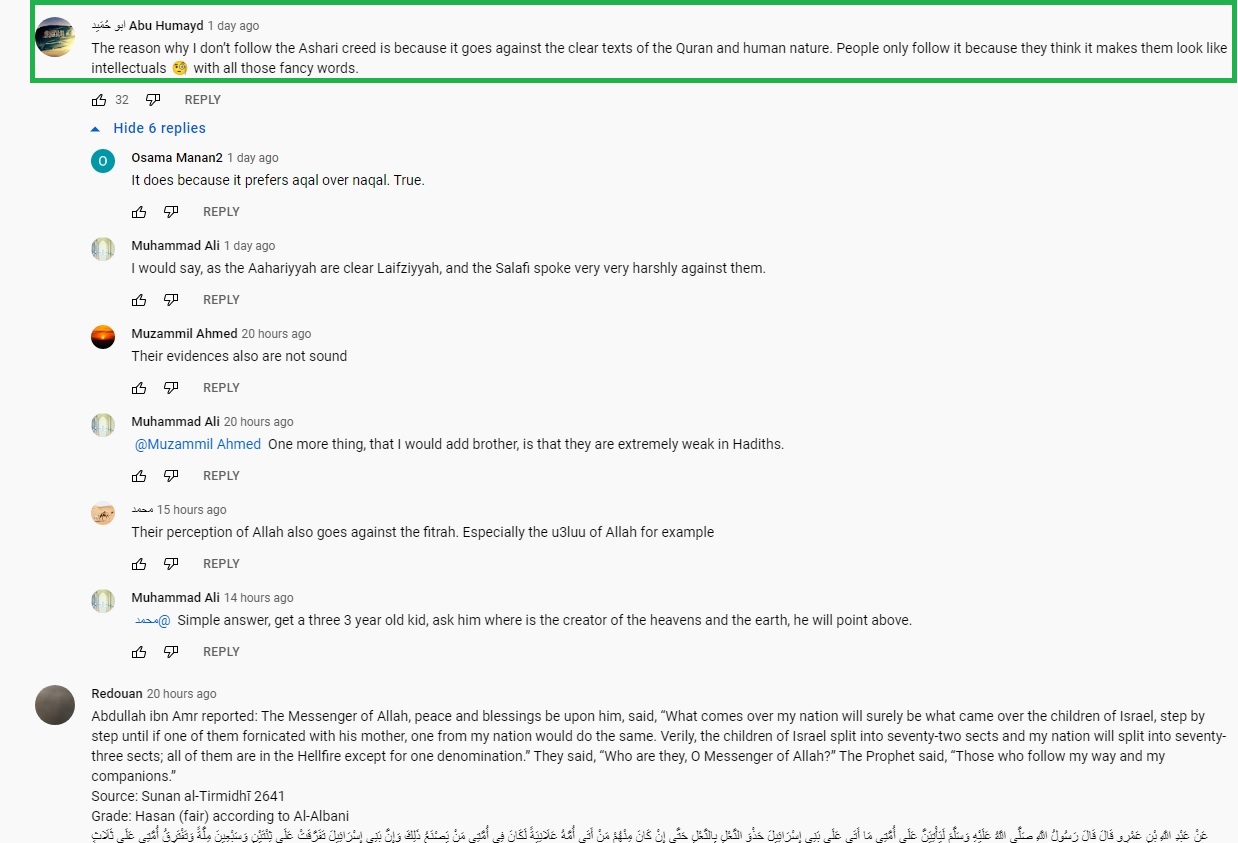
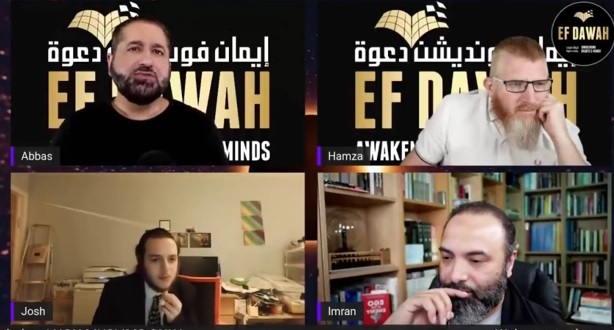



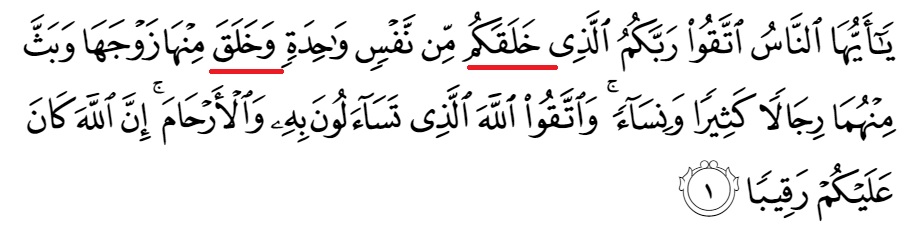






 Prima Quran