Tag Archives: maliki

My own experience with Shi’a.

“Travel through the land and observe how He began creation. Then Allah will produce the final creation. Indeed Allah, over all things, is competent.” (Qur’an 29:20)

﷽ 

Our colleague recounts their encounter with Shi’i 

Now when I say, “My experience with the Shi’i”, I should clarify that by that I mean the 12er Shi’i. The bulk of my experience has been with them.

When I was studying at Zaytuna before it became Zaytuna college, a fellow student and I named Wasif and I went for an afternoon stroll. I recall how he was telling me, “C’mon brother, just one more burger before we walk the straight and narrow.” He had a love for American burgers and was bound and determined to have just one more before going completely halal.

The time for Maghrib came upon us and there was a mosque on the side of a street. We walked in, and it was certainly a 12er Shi’a Mosque. You can see pictures of various Imams on the wall. We did not hesitate to join the congregation for the Maghrib prayer. I only noted to myself afterward that it was interesting that the whole prayer was out loud. Of course, when we went back to Zaytuna, the brothers were sharing their day-to-day things, and the subject came up. One brother approached Wasif and I said, “You prayed behind the Shi’i. Your prayer may not be valid. You better go and talk to Shaykh Mohamed Yaqubi.”

Well, low and behold, we were advised to do our prayer over again. I cannot speak for Wasif, but I didn’t take the advice. I saw no valid reason to. They prayed and I prayed. My prayer is not for them or their school. It is for Allah (swt).

Then there was the time I went for the ATMT (Awareness Through Mosque Tour) training course in Manama, Bahrain. Very beautiful team, great host, and amazing instructors! Unfortunately, during my first Friday prayer there, after everyone does there two nawafil many gather in small groups to simply chit-chat. So, one of the people with us nearby was talking about how “The Shi’i are spreading like cock roaches”. I was really disgusted by the fact that he would like this about other Muslims, and in the mosque no less! So I told him, “We should not talk about other Muslims like this.”

On another occasion, we (the trainees) were going on a guided tour of museums. A Mualif (convert) sister, who came from either the Czech Republic or Hungary was talking to a very stout Arab man. As we were walking they were discussing the current(then) volatile situation in Iraq. I made the comment that, “Sunni and Shi’i Muslims should unite.” To which he quipped: “Who said they are Muslims?” I responded, “What do you mean?” He replied, “The Shi’i who said they are Muslims?” I responded, “Our scholars (Sunni) say they are deviant, but Muslims nonetheless.” At that time I was still following the Maliki School.

The adhaan had sounded. Frustrated with what I had just heard, I stormed off from the group and happened upon a local mosque just a few blocks away. I sat in the front row waiting for the Imam to come forward. The congregants of the Mosque seemed primarily Indo-Pakistani from what I could tell. One brother said the Iqama and an elderly man was pushing me to lead the salaah! I looked around and was wondering if the actual Imam would come forward, and they kept pushing me to lead the prayer. Well, I did just that. Let me tell you it is a huge thing to lead the prayer. It was like a huge weight to lead the congregational prayer. My respect to every Imam of every Masjid on the planet. You can really feel the weight of doing something that one would think is a simple task. After the salaah, I made du’a, did more rakats and left.

Later, that robust Arab brother came up to me during dinner and apologized to me. That took me by surprise because, to be honest, he did not strike me as the type of person who would do that. I later found out from some organizers of ATMT that this brother’s family was killed by a Shi’i death squad in Iraq. May Allah (swt) soften his heart and grant him ease.

Let me tell you, you need to choose your words very carefully when traversing this Earth. Once, in what I thought was a casual conversation, when talking about the region (I being from the States), I called the waters around Bahrain, the “Persian Gulf”. Boy! That’s a blunder! “It is the Arabian Sea!” One man interrupted. I responded with, “Why not call it the sea of Islam, or the Gulf of Allah?”

I remember not far from the hotel we were staying I went out one evening to do dhikr by the “Gulf of Allah” all the while staring off into the direction of Iraq. The cool breeze of the water filled the surrounding air. It was surreal because just a few hundred kilometers was the closest I ever was physically to a war zone. I reflected on the events of the day and made du’a that Allah (swt) would fill the region with peace.

Another encounter was with when I was in Singapore. A brother I met at the Sultan Masjid. Brother Ali Al Ausi, a very kind and jovial brother. I do not want to take from his good deeds by publicly stating the many good things he has done, but Al hamdulillah I saw first hand how he was there to help those in need (fisabilillah). We were roommates for a while, and sometimes I would lead the salaah and other times he would. l was sometimes amused by his method of salah because he would wear jeans that have loops (where the belt goes through) and he would put his thumbs there and hang them during the prayer. Quite cavalier I thought to myself! Haha.

He told about his family leaving Najaf and going to Russia and from there eventually settling in the United Kingdom. His father worked in pizza shops until he became a manager and worked very hard to put his family on a proper footing.

He also told me about his doubts concerning Shi’sm and that he agreed Muslims should be Qur’an centric. He told me about how Shi’i get worked up in the Mosque during sermons on Karbala and that they would want to go out and beat up the first Sunni they saw. By Allah, these are his words, not mine.

Interestingly enough, for those of you who remember the man in Iraq who took off his shoe and threw it at president George Bush Jr, well, that man (the man who threw the shoe) was going to marry his daughter to my friend Ali. They met in Damascus, Syria, and once Ali confided in her that he didn’t believe in some of the stuff about Shi’ism, she stormed off saying, “I would rather marry a Sunni than you!”

He also divulged to me about some rather wealthy Shi’a Arabs that would practice Muta with some of the poorer Arab women in Egypt, and he was rather disgusted by it all. I recall how he remarked, “If everyone is doing Muta, then who will get married?”
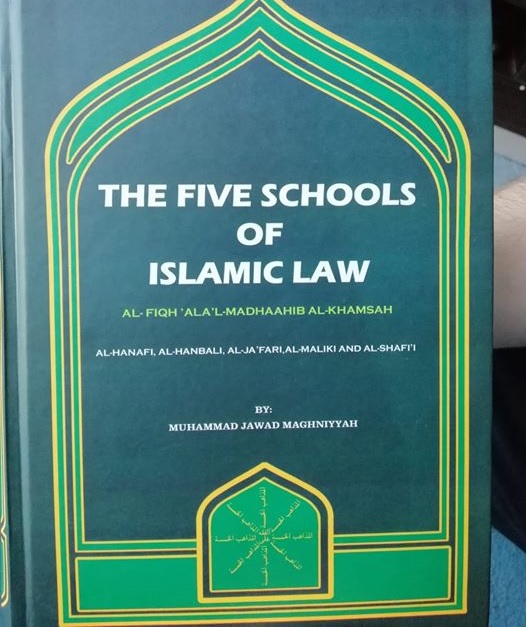
I just wanted to say that this book was given to me by my good friend Dr. Ali Al-Ausi, upon my request. He informed his mother that he had a friend wanting to know more about the 12er jurisprudence. The book is still in my collection. Brother Ali is one of the kindest, honest, generous, and most truthful Muslims I have ever met.

My meeting with the respected, Ali Larijani (The Former Speaker of the Parliament of Iran). This was an occasion at the Sultan Mosque in Singapore when his delegation came to Singapore. I was actually scheduled to give a talk to him and his delegation and there was a change of plans. I prepared before he came by trying to find out about his background. I saw that he studied Philosophy and particularly liked the philosopher Immanuel Kant.

His entourage created quite a shock at the Mosque because the ladies who were with them prayed in the main prayer hall (where the men usually pray). I was amused by it all. Nonetheless, after the prayer, I approached Ali Larijani, who had two bodyguards and one cleric with him. I greeted him, “Assalamu alaikum warahmutallahi wabaraktuh.” He replied the same. I then told him, “I am from America and I wish for peace between us and Iran.” He replied, “That they too wish for peace.” I then asked him what his favourite quote from Kant was. I could tell by his reaction. He was surprised. He responded with Kant quoting the golden rule: “Do not do that to others that you would not like them to do to you.”

Now that is the sum total of my personal experience and interaction with Shi’i or anything in relation to them in my lifetime. If you think, based upon what I shared above, that I hate Shi’i, that is really up to you.

That being said, when it comes to what I encounter online, via various social media platforms and what have you, I have found Shi’a (12er,especially) to be very dishonest, disingenuous and not very forward.

The one thing I do admire about Salafis, Sunnis of all stripes, even those who follow the Hafs Qur’an only religion. Ahmadiyyah etc. is there willingness to be forthright.

Their willingness to say, “I am such and such and this is where I stand.” With the Shi’i, I don’t get this. What I find is they often join groups posing that they are part of this or that and keeping quiet about being Shi’a.

Look! If we were in Syria, Iraq, Lebanon or other places where sectarianism is highly charged and a person’s life is in danger, I would get it. However, this skulking around various platforms pretending to be Hanafi, or Quranist. Anything else is simply just cowardly. It truly is.

All these people saying Ya Ali, Ya Ali Madad. How they would have loved to be at Karbala, or have lifted their sword for Ali. Look, mate, you cannot even be honest enough with yourself to say what you are openly.

And honestly, what I do see on YouTube, of the interactions of 12ers and Zaydi’s with Sunnis, is that the Shi’a end up getting intellectually owned, time and again.
You may also wish to read the following:

May Allah (swt) Forgive the Ummah.

May Allah (swt) Guide the Ummah.

12 Comments

Filed under Uncategorized

Pro Sufi & Anti Sufi Hadith Ascribed to Imam Malik on Tassawuf

“Turn you back in repentance to Him, and fear Him: establish regular prayers, and be not among those who join gods with Allah,- Those who split up their Religion, and become (mere) Sects,- each party rejoicing in that which is with itself!” (Qur’an 30:31-32)

“O mankind! there hath come to you a direction from your Lord and a healing for the (diseases) in your hearts,- and for those who believe, a guidance and a Mercy.” (Qur’an 10:57)

﷽ 

When looking at the issue of forgeries of hadith one does not have to look further than the pro-Sufi and anti-Sufi forces within the ‘Ahl Sunnah‘.

Abd Allah ibn al-Mubarak said, “The isnad is from the religion; were it not for the isnad anyone could say anything they wanted.”

Source: (Reported by Muslim in the introduction to his Sahih, vol. 1, pg. 9, Dar Taibah.)

The isnad -is the chain of narration.

The word hadith in the title of the article is used in the Arabic sense of a report. Thus, for the purposes of this article it is not necessarily a statement attributed to the Blessed Prophet (saw).

Anyone who has been among people who claim to practice ‘Sufism‘ and/ or have inclinations towards a branch of study in Islam called ‘tassawuf‘ has most likely heard innumerable times the following statement attributed to Imam Malik.

“He who practices tassawuf without learning Sacred Law corrupts his faith (tazandaq) , while he who learns Sacred Law without practicing Tasawwuf corrupts himself (tafassaqa).”

Now when I studied at Zaytuna I was told time and again the importance of being connected in an ‘unbroken‘ chain of sacred knowledge that goes all the way back to the Blessed Messenger (saw) himself.

Of course, what I’m about to say may seem cynical to you the reader, but it is the atmosphere that was created around Zaytuna when I was there.

The atmosphere seemed to say to me, “Don’t you dare question anything that is presented to you, because after all who are you to question? You don’t have the requisite tools; and you didn’t study under a Shaykh who toes the line that we tell you to tow. Therefore, all of your sincere lines of inquiry are invalid.”

So let us say that someone has reservations about giving their complete allegiance (the custody of their soul) to a Shaykh. However, this person agrees to or understands the necessity of following someone learned in jurisprudence.

Thus, the concept of the following someone learned in jurisprudence is used as a jump-off point for handing over complete sovereignty of your soul to a Spiritual guide or Shaykh. Many who call themselves ‘Sufi’ today use the following modus operandi:

Start by getting the spiritual aspirant the necessity of following someone learned in jurisprudence. Use the idea of following Imams in jurisprudence to advance their position. Thus, if Imams like Shaf’i and Malik are seen to be in favor of Sufism or ‘Tassawuf‘ then whom are we to question it!

So even until today, you have world-renown people like Shaykh Hamza Yusuf attributing such statements to Imam Malik.

You can see the following video where he attributes the above-mentioned statement to Imam Malik. http://www.youtube.com/watch?v=2_5d9c2UdiU @ 1:14 in the video you can hear Shaykh Hamza attribute this statement to Imam Malik

Interestingly the term Sufi was applied to those given the appellation “Mutazalites” long before it was applied to Junayd.

This is according to the research of Christopher Melchert in his article: “The Piety of the Hadith Folk” which can be found here: http://www.ilmgate.org/wp-content/uploads/2011/02/The-Piety-of-the-Hadith-Folk.pdf

“The term Sufi was applied to Mu’tazili ascetics before it was to Junayd and his circle. Early Mu’tazili ascetics and the later Karramiyya, who more or less absorbed Mu’tazili asceticism, sometimes exalted complete renunciation of normal gain, counting it best to live off alms.”

Origins of the term ‘Ahl al sunnah’

Christopher Melchert also gives some very keen insights into the term ‘Ahl al sunnah’ and the fact that a great many factions were called themselves by this appellation.

He says,

“The 9th-century hadith folk’s own preferred term for themselves was “Ahl al-sunna.” It is not convenient for us to call the hadith folk “Sunnis” because that term now calls to mind the great tripartite division of Sunnis, Shi’is, and Kharijis. At least for the 9th century and earlier, a mere tripartite division is simplistic and practically impossible to document. To begin with, 9th-century definitions of Shi’ism were considerably different from those of later times; for example, traditionalist rijal critics regularly distinguished between ‘tashayyu’, special regard for ‘Ali and his house that the hadith folk was willing to overlook, and rafid, the rejection of Abu Bakr and ‘Umar that they thought put one outside the Muslim community. With equal emphasis, the 9th-century hadith folk distinguished themselves from Qadariyya, Murji’a, Mu’tazila, and other theological parties not accounted for by a simple, anachronistic dichotomy between Sunnis and Shi’is. The polarity of Sunni and Shi’i was not strong until the mid-10th century, and full Sunni mutual recognition and self-awareness appeared only in the mid 10th century. Finally, modern scholars should avoid endorsing the hadith folk’s own estimate that they were the overwhelming majority, as calling them “Sunnis” might do.”

” The significance of their calling themselves ‘Ahl al-sunna’ is not that their views were identical to those of the later, great Sunni community, which they were not, but that the later community deliberately identified them as its forebears. We need to understand their piety. Their adversaries preferred not to call them ‘Ahl al-sunna’ and proposed various other terms.’ Al-Jahiz disparaged the nabita, those who sprouted up like weeds to extol the enemies of ‘Ali and to promulgate such crass ideas as assigning God an imaginable body (tajsim, taswfr). Other writers attributed similar errors to the hash- wiyya (vulgar). The hadith folk complained that the Murji’a called them shukkak (doubters) for saying, “I am a believer, God willing,” while the Qadariyya called them mujbira or jabriyya for upholding divine predestination. To use any of these terms for the hadith folk would mean taking sides as much as it would mean calling them ‘Ahl al-sunna’, which is needless for modern scholars.”

“The hadith folk emerged as a distinct group at about the end of the 8th century. They lost importance in the 10th century. Chroniclers usually refer to their 10th-century successors in Baghdad as the Hanabila or simply al-‘amma (the general), periodically rioting against the Shias. Meanwhile, their own name for themselves, ‘Ahl al-sunna’, was claimed by virtually all parties except the Shi’is. Even Mu’tazila called themselves Ahl al-sunna wa-al-jama’a, on the plea that if they were not actually the great majority, they ought to have been. (I have not compared the piety of the hadith folk with that of 9th-century Shi’is, rewarding though such a comparison would be. At least a wing of the Shi’ movement probably had something very close, which ought to show up in Shi’i hadith.)”

So again we can see there was a lot of conflict and turmoil in the very early history of Islam. Conflict and turmoil that is with us until this very day. So less I digress let me go back to the opening quotation attributed to Imam Malik:

He who practices tassawuf without learning Sacred Law corrupts his faith (tazandaq) , while he who learns Sacred Law without practicing Tasawwuf corrupts himself (tafassaqa).”

Gibril Fouad Haddad who is a follower of the Sufi group ‘The Naqshabandi Haqqani* has provided some very insightful information to this claim above.

* note: This Sufi group is to be distinguished from their rivals the ‘Naqshabandi Mujaddidi‘ as well as other rival Sufi groups.

He has the following to say about the above quotation attributed to Imam Malik :

Cited without the chain of transmission by Al-Qari in Sharh ‘Ayn al-Ilm and Mirqat al-Mafatih, Ahmad Zarruq in the Forth of his Qawa’id al-Tassawuf in his commentary on Ibn Abi Zayd’s Risal a (Beirut: Dar Ihya al-Kutub al Arabiyyah, Ibn Ajiba in Iaqaz, Al Himan fi Sharh al-Hikam and Al-Tata’i in his commentary on Ibn Rushd’s Muaqaddima.”

Source: (The Four Imams and their Schools page 180)

Ponder that for a moment, respected readers. A statement seemingly in support of ‘Tassawuf‘ put into the mouth of Imam Malik and then repeated by men like Al Qari, Ahmad Zarruq, Ibn Abi Zayd, Ibn Ajiba, and At Tata’i. Yet, no chain of narration!

In my previous conversations with Dr. Abdullah bin Hamid Ali and Ustadh AbdasSamad Clarke, both have confirmed to me that it is not authentically ascribed to Malik.

Anti-Sufi reports attributed to Imam Malik

Incident no. 1 )

“Al -Tinnisi said: We were sitting with Malik with his companions around him. A man from the people of Nasibin said, ‘We have some people who go by the name of Sufis. They eat a lot then they start (chanting) poems (qasa’id), after which they stand and start (chanting) dancing.” Malik asked, “Are they boys (sibyan)?” He said no. Malik asked, “Are they insane?” He said, No, they are old men (mashaykh) and other than that, and they are mature and sane (‘uqala.” Malik said, “I never heard that any of the people of Islam do this.” The man said to him, “Indeed, they do! They eat, then they stand up and start dancing intensively (dawa’ib), and some of them slap their heads, and some of their faces.” Malik started laughing then went into his  house. His companions said to the man. “You were, O man, ill luck (mash’um) for our friend [Malik]. We have been sitting with him thirty-odd years and never saws him laugh except today.” “Narrated without a chain by Al-Qadi ‘Iyad in Tartib Al-Madarak.”

Source: (The Four Imams and their Schools by Gibril Fouad Haddad page 180)

Incident no.2 )

“Abd al-Malik ibn Ziyad al-Nasibi said: “We were with Malik when I mentioned to him Sufis in our city. I said to him that they wear fancy Yemenite clothes, and do such and such. He replied, ‘Woe to you! Are they Muslims?’He then laughed until he lay on his back. Some of his companions said to me, ‘What is this?’ We have not seen more trouble (fitna) caused to the Shaykh than you, for we never saw him laugh!” “Narrated by al-Khallal in al-Hathth ‘ala al-Tijara wal-Sina’a wal-Amal (Abu Ghudda) with a weak chain because of ‘Abd al-Malik ibn Ziyad al-Nasibi who is “disclaimed in his narrations and untrustworthy” (munkar al hadith, gahyr thiqa) according to al-Aazdi as per Ibn al-Jawzi in al-Du’afa wal-Matrukin (1:149) while Ibn Hibban in his Thiaqat (8:390) said he reports oddities from Malik.”

Source: (The Four Imams and their Schools by Gibril Fouad Haddad page 181)

So you can imagine the incongruity of all of this. Notice the similarities between the two seemingly Anti-Sufi reports attributed to Imam Malik.

1) His strong reaction: ‘I never heard that any of the people of Islam do this. & Woe to you! Are they Muslims?’

2) His hearty laugh after hearing of their doings. ‘Malik started laughing then went into his house. & He then laughed until he lay on his back’.

3) The shock of the people present at Maliks’ reaction. ‘You were O man, ill-luck (mash’um) for our friend [Malik]. We have been sitting with him thirty-odd years and never saws him laugh except today. & What is this?’ We have not seen more trouble (fitna) caused to the Shaykh than you, for we never saw him laugh’!

Now let us look at how these statements are treated http://www.livingislam.org/fiqhi/sm1-gfh_e.html#4

You can scroll down to the section: “Imam Malik and the Sufis” Gibril Fouad Haddad has the following to say about the two incidents, reported above:

Concerning the first incident, he says, “This is narrated without chain by al-Qadi `Iyad. in Tartib al-Madarik (2:53-54).” That is all he has to say. There is no chain of transmitters. Case closed.

Concerning the second incident, he simply gives the reason one of the transmitters is dismissed. Then he concludes by saying:

“Content-wise, neither of the above reports shows unambiguous condemnation of group dhikr but only that some people who passed for Sufis in the Imam’s time reportedly committed certain childish excesses or irrational breaches of decorum. The reports only show that Imam Malik found the story amusing. The delator seems obsessed with the ‘eating and dancing’ which he mentions twice as if afraid Malik didn’t hear it the first time. There is also on the part of Malik’s circle clear disapproval of the delator who is apparently perceived as an interloper. And Allah knows best.”

Actually what the reports show assuming they are true at all is the following:

The reports show that Imam Malik does not even seem to be even vaguely familiar with such groups. The asking ‘if the people are Muslim‘, and making statements such as ‘the people of Islam are not heard of doing this‘ would be very difficult for Muslims having a pro-Sufi bias to fathom. Especially, in the first report since, we don’t have Imam Malik laughing until after hearing about people slapping their faces.

There are also statements attributed to Imam Shafi’i they seem that they can be either pro ‘Sufism‘ or anti ‘Sufism‘. http://www.livingislam.org/fiqhi/sm1-gfh_e.html#4

You may also be interested in reading the following:

https://primaquran.com/2022/10/04/attacks-upon-sahih-hadith-by-ashari-theologians

May Allah (swt) Guide the Ummah.

May Allah (swt) Forgive the Ummah.

6 Comments

Filed under Uncategorized

Do Salafiyya truly believe that Allah chuckles and laughs at the despair of the Palestinians?

Say, “My Lord has only forbidden immoralities – what is apparent of them and what is concealed – and sin, and oppression without right, and that you associate with Allah that for which He has not sent down authority, and that you say about Allah that which you do not know.” (Qur’an 7:33) 

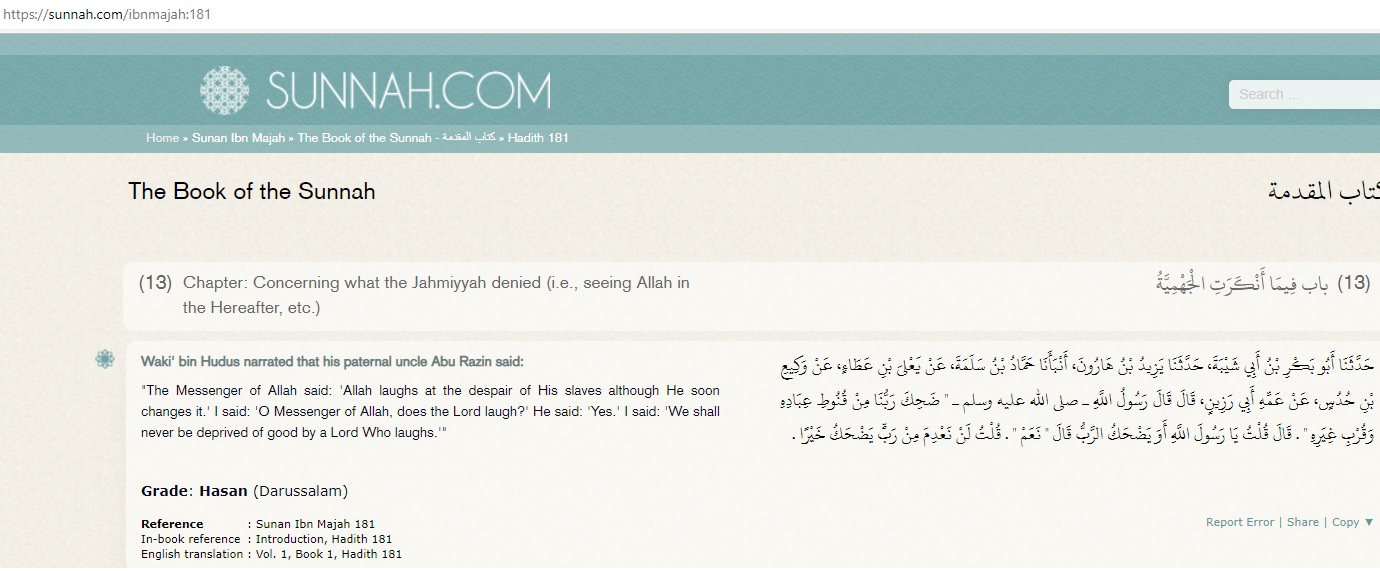
ALLAH LAUGHS AT THE DESPAIR OF HIS SLAVES?

Waki’ bin Hudus narrated that his paternal uncle Abu Razin said:

“The Messenger of Allah said: ‘Allah laughs at the despair of His slaves although He soon changes it.’ I said: ‘O Messenger of Allah, does the Lord laugh?’ He said: ‘Yes.’ I said: ‘We shall never be deprived of good by a Lord Who laughs.'”

Source: (https://sunnah.com/ibnmajah:181)

“The Messenger of Allah said: Allah chuckles at the despair of His slaves although He soon changes it.’
I said: ‘O Messenger of Allah, does the Lord chuckle?’ ‘He said: ‘Yes.’ I said: ‘We shall never be deprived of good by a Lord Who chuckles.”

Now if we take this hadith alone it is challenging to suggest that chuckling/laughing can be interpreted as Mercy. Because, even the companion ask, ‘Does Allah chuckle?’ and it would be difficult to imagine the companion asking, ‘Does the Lord show Mercy’. I mean we recite the Qur’an as bismillah ir rahman ir raheem. Most Merciful and Most Compassionate.

However, this is a lone narrator report. We in Ahl Haqq Wal Istiqamah (The Ibadi School) we do not make lone narrator reports as a basis for our faith. What we do is look at other ahadith where these idioms are used to show if there is other meanings.

If we are to take this lone narrator report at the apparent meaning as the Salafi -Athari suggest than it means that Allah (swt) is laughing, chuckling etc at the despair and pain that humanity undergoes.

It takes a depraved human being and a twisted imagination to suggest that Allah (swt) would have a hearty chuckle at the despair and misery of humanity.

Children being sexually abused by their parents.

People starting to death in this world.

You going to say that Allah (swt) is laughing/chuckling at this?!

Furthermore does this laughing and chuckling produce a sound such that we can say that it is uncreated? Such that one can imagine an eternal chuckling and laughing at the despair, torture and pain of a creation that has yet to be created?

We wonder why people are Atheist?

Either the people who invent such falsehoods have a very low estimation of the Divine, or the Creator they worship is more horribly morbid than the darkest corner of human imagination could fathom.

However, because this hadith is graded as ‘Hasan’ those who take the lone narrator reports will insist,

We believe that Allah chuckles/laughs …with the disclaimer (in a way that befits his majesty!

“It has been narrated on the authority of Abu Huraira that the Messenger of Allah (may peace be upon him) said:  Allah chuckles at the two men both of whom will enter Paradise (though) one of them kills the other. They said: Messenger of Allah, how is it? He said: One of them fights in the way of Allah, the Almighty, and Exalted. and dies a martyr. Then Allah turns in mercy to the murderer who embraces Islam, fights in the way of Allah, the Almighty, and Exalted, and dies a martyr.”  (‘Sahih’ Muslim Kitab Al-Imara hadith number 4658)

Source: (https://sunnah.com/muslim:1890a)

If we understand the mention about Allah (swt) chuckling as his act of Mercy than this is not a problem. It is an idiom or an expression.

However, if as some in the Muslim community do (ever ready to kick every one else out of Islam), insist that we have to take this at the apparent meaning it is very dark.

These kinds of hadiths are reminiscent of the stuff attributed to Allah (swt) in the Bible.

“And the LORD repented of the evil which he thought to do unto his people.” (Exodus 32:14)

“The LORD regretted that he had made human beings on the earth, and his heart was deeply troubled.” (Genesis 6:6)

So we would take the two hadith and combine them and our understanding would be the laughing/chuckling as an idiom or expression of Allah’s mercy that is soon to follow any act of despair, as long as the people put their tawakkul (trust) in Allah (swt).

“Say, “O My servants who have transgressed against themselves, do not despair of the mercy of Allah. Indeed, Allah forgives all sins. Indeed, it is He who is the Forgiving, the Merciful.” (Qur’an 39:53)

May Allah (swt) Forgive the Ummah.

May Allah (swt) Guide the Ummah.
Leave a comment

Filed under Uncategorized