
“My Lord! Increase me in knowledge.” (Qur’an 20:14)

﷽
This entry is to share a brief over view about the territory that was once under the Omani Empire and which countries they would be considered part of today.
Also is an interesting bit of information about the the three longest lasting Muslim empires/dynasties.
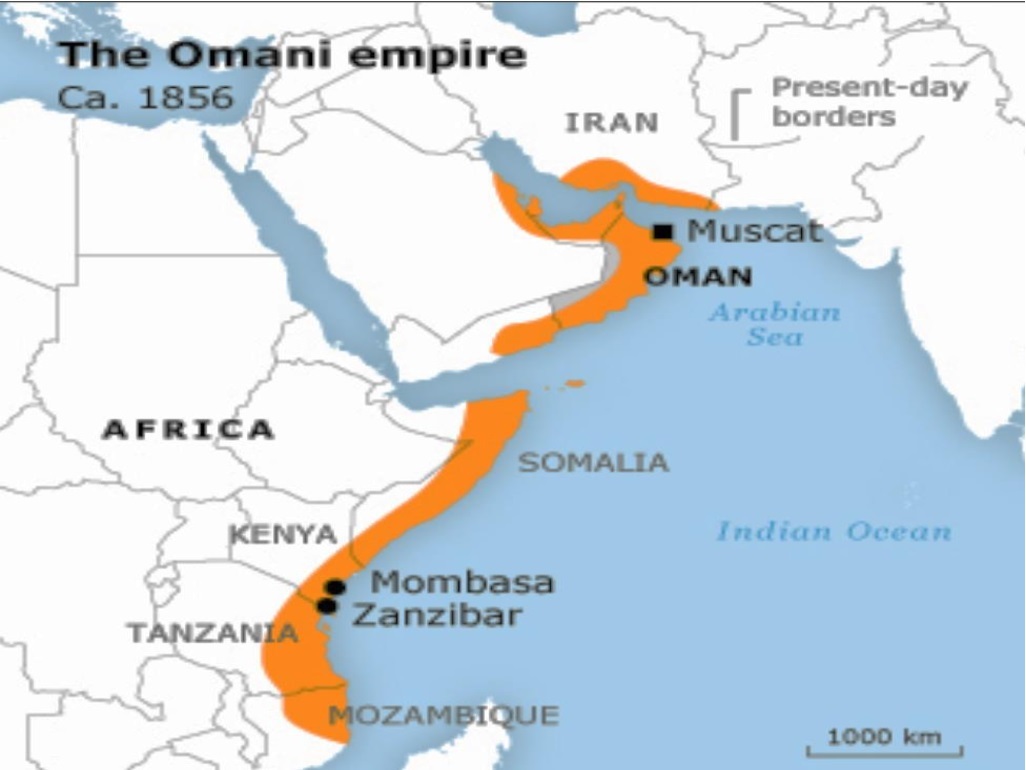
The Omani Empire extended over part of what is today Iran-Bandar Abbas, U.A.E, Pakistan -Balochistan, Yemen, Comoros , Saudi Arabia-pecifically the region of Al-Hasa (or Al-Ahsa Oasis, Somalia, Kenya, Tanzania, Mozambique. Madagascar, Djibouti,
Which are the top 3 longest lasting Muslim empires/dynasties in terms of longevity & stability?
1. 1299-1922 Ottoman/Sunni/Hanafi = 623 years
2. 750-1258 Abbasid/Sunni/Hanafi = 508 years
3. 1154-1624 Nabhani/Ibadi = 470 years
We would like to add here a brief yet very insightful and helpful message. This additional information is accredited to ‘The servant of Allah’ and surely his reward is with his Lord. May Allah (swt) bless him!
A small comment about Omani history
1- The map of the Omani empire that you see here which is supposedly at the time of the Sultan Saeed Bin Sultan…but how accurate is it? Because we know that The Sultan ruled parts of the East African coast as he even lived there. However, did he rule all the colored land? The answer is definitely no. He had different degrees of influence in different areas, but in east Africa, he mostly ruled Zanzibar and its surroundings, like Mumbasa, Dar Al-Salam and Pempa. As for Iran, Oman actually didn’t rule the south coast, rather there was an agreement that Oman basically rented the port of Bandar Abbas, (which is still impressive) However, not as impressive as the map shows it to be.We also don’t think there was Omani sovereignty in Madagascar, Nor in Somalia just influence in trade. Yet, there was some control of trade routes to the African interior.
We should say that after the Imam Ahmed Bin Saeed, Oman was ruled by a monarchy all the way to this present day. Even though yes the rulers where Ibadi, they didn’t rule in the Ibadi way. This is especially true after the British colonized Oman, as they fought against the idea of an Islamic Ibadi state in the interior. Similarly for the Nabhani state, they were just a monarchy. Oman wasn’t even stable or flourishing, it was in chaos and it wasn’t really Islamic at all. They were in constant rivalry with Imams, like Imam Mohammed Bin Isma’il Al-Haderi, which was able to establish an Imamate that ended the first Nabhani era in the year 1500 AD / 906 AH then after his death the second Nabhani era began(1556 AD/964 AH), which then lasted for less than 100 years until the Portuguese invasion.
So what’s our point here?
1- Omani doesn’t equal Ibadi
2- History is not as simple as it looks
3- Ibadis could have done more in the past
4- If we want to be proud, we should look at the Omani Imams like:(Al-Julanda Bin Mas’ood, Al-Salt Bin Malik, Naser Bin Murshid, Mohammed Bin Abdullah Al-Khalil and All the others Imams that carried the Banner of Islam and Ibadism in the proper way).
May Allah Guide the Ummah.
May Allah Forgive the Ummah.


 Prima Quran