
“My Lord! Increase me in knowledge.” (Qur’an 20:114)
﷽
We have absolutely been fascinated by those few individuals who have found there to be controversy surrounding the identity of Dhul-al-Qarnayn. The reason why we are fascinated is that historians and Orientalists are not actually interacting with the Qur’an per se. They are interacting with commentary about the Qur’an.
Historian: We found no evidence that X existed.
Believer: They have yet to find evidence that X existed.
Epistemology matters!
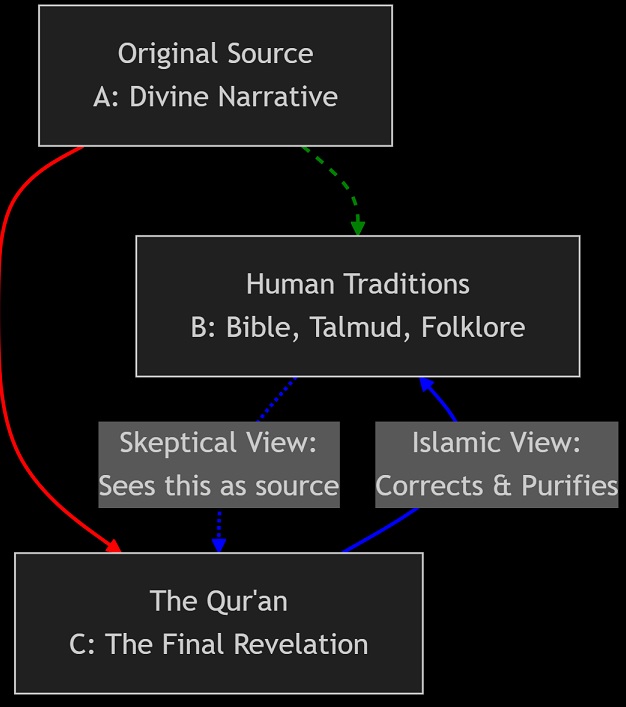
The chart above shows the difference between the different axioms of the believers and the doubters. Agnostics and atheists have a different epistemology than believers.
How The Above Chart Explains the Concept:
- The Source (A): Everything begins with the “Original Source” (A), which is the divine, perfect narrative from God.
- The Two Paths:
- The human traditions (B) are a changed and corrupted version of the original story, having passed through centuries of human transmission (resulting in legends, folklore, and altered scriptures).
- The Qur’an (C) comes directly and perfectly from the same original source (A), acting as a “Final Revelation” that restores the original message.
- The Optical Illusion (The Core of Our Point):
- The Skeptical View (dashed line) looks at the relationship between B and C and mistakenly concludes that C must have copied from B because B appears earlier in history.
- The Islamic View (solid arrows) correctly identifies that both B and C draw from a common, older source (A). Therefore, when B contains elements that align with C, it doesn’t mean C copied B—it means B still contains remnants of the original truth (A) that the Qur’an (C) confirms and corrects.
- The Verbatum Point: The arrow from C to B, labeled “Corrects & Purifies,” visually explains why you will never find verbatim copying. The Qur’an doesn’t replicate the corrupted narratives (B); it speaks with authority from the original source (A) to rectify them.
For the skeptics and doubters, their findings reinforce their epistemology and their axioms. For the Muslims, the findings of the skeptics and doubters provide corroborating evidence of our own epistemology and axioms.
As a Muslim, we know that a tafsir is not divine revelation.Tafsir is scholarly musings about the text.
1st, it should be noted that Dhul Al-Qarnayn, like Khidr, are simply epitaphs, like Al-Amin. These are not real names they are descriptors.
2nd, it should be noted that not much attention is given to the individuals (Khidr & Dhul Al-Qarnayn) beyond their epitaphs. The attention is given to the events that unfold or surround them.
3rd, the Qur’an only mentions Dhul Al-Qarnayn thrice.
So let us get into the narrative of Dhul Al-Qarnayn in the Qur’an.
“And they will ask you about Dhul-Al Qarnayn. Say: I will recount to you a remembrance of him.” (Qur’an 18:83)
“We established him on earth, and We gave him from everything a way.” (Qur’an 18:84)
“And he followed a way.” (Qur’an 18:85)
“Till, when he reached the setting place of the sun, he found it setting in a muddy spring, and found a people thereabout. We said: O Dhul-Al Qarnayn! Either punish or show them kindness.” (Qur’an 18:86)
“He responded, “Whoever does wrong will be punished by us, then will be returned to their Lord, Who will punish them with a horrible torment.” (Qur’an 18:87)
“But as for the one who believes and does righteousness, he will have the best of rewards. We shall require him to do only easy things.” (Qur’an 18:88)
“Then he followed a path.” (Qur’an 18:89)
“Until he came to the rising of the sun. He found it rising on a people for whom We had provided no shade.” (Qur’an 18:90)
“And so it was, Our knowledge encompassed all that happened to him.” (Qur’an 18:91)
“Then he followed a path.” (Qur’an 18:92)
“Until he reached between a barrier, where he found a people who could hardly understand a word he was saying.” (Qur’an 18:93)
“They said, “O Dhul Al-Qarnayn, Gog and Magog are corrupting this land. Can we pay you to erect a barrier between us and them?” (Qur’an 18:94)
“He responded, “What my Lord has provided for me is far better. But assist me with resources, and I will build a barrier between you and them.” (Qur’an 18:95)
“Bring me blocks of iron!” Then, when he had filled up ˹the gap˺ between the barriers he ordered, “Blow!” When the iron became red hot, he said, “Bring me molten copper to pour over it.” (Qur’an 18:96)
“And so the enemies could neither scale nor tunnel through it.” (Qur’an 18:97)
“He said: This is a mercy from my Lord; but when the promise of my Lord comes to pass, He will lay it low, for the promise of my Lord is true.” (Qur’an 18:98)
“On that Day, We will let them surge ˹like waves˺ over one another. Later, the Trumpet will be blown, and We will gather all ˹people˺ together.” (Qur’an 18:99)
The first thing that we found fascinating about this set of texts is the use of twos. Things are in contradistinction to one another. Like two different items, two different scenarios, two things in contrast.
First, being the main focus of the individual in the narrative, is Dhul Al-Qarnayn — the two-horned one, one of two different epochs. The one with two braids. The one with two people.
ثُمَّ أَتْبَعَ سَبَبًا
ثُمَّ أَتْبَعَ سَبَبًا
That exact phrase appears twice.
Setting-place of the sun/he came to the rising of the sun (two different scenarios in relation to the sun)
Either punish or show them kindness (two different ways to deal with a particular people).
A people for whom We had provided no shade contrasted with a people who had no protection against tribes.
The tribes in question are two gog/magog. Two tribes.
He met two different types of people; people who could hardly understand a word, contrasted with people he could communicate with readily.
A barrier between you and them-a barrier is a separation between at least two different things.
The barrier they were not able to do two things: neither scale nor tunnel through it.
The barrier itself is made from two different metals: iron and copper.
If we are looking for clues of a historical vestige (remembrance), we would want to note the following:
- A)What is the meaning of Dhul Al-Qarnayn in the Arabic language?
- B) They will ask you. Who is the ‘they’?
- C)How did they respond to the information?
- D) Tribes are identified as Gog and Magog.
- E) Blocks of iron and molten copper are used to seal an apparent gap/breach in a barrier.
- Ea) It is assumed that there is a garrison that defends the area. The purpose of the wall is to prevent being overrun. *note*
Note: This is an assumption on our behalf.
- Eb) It is assumed that whoever the Gog and Magog are, that they are either
- a) raiders b) expansionists
If we assume they are raiders, this means they have had a foray into these people’s territories before. Though they never established dominion over them.
If we assume that they are expansionists, then the people that Dhul Al-Qarnayn encounter are those who presume expansion is heading in their direction and thus, they want to make preparations.
As regards Qur’an 18:98 we do not see that as connected to Qur’an 18:99 as in events that happen at the same time. For more on this please see:
There is an attack against the Qur’an by its use of metaphor and use of language that describes the perception of this Dhul Al-Qarnayn.
You can read about that here:
https://primaquran.com/2022/10/04/the-quran-and-the-setting-of-the-sun-in-a-murky-spring
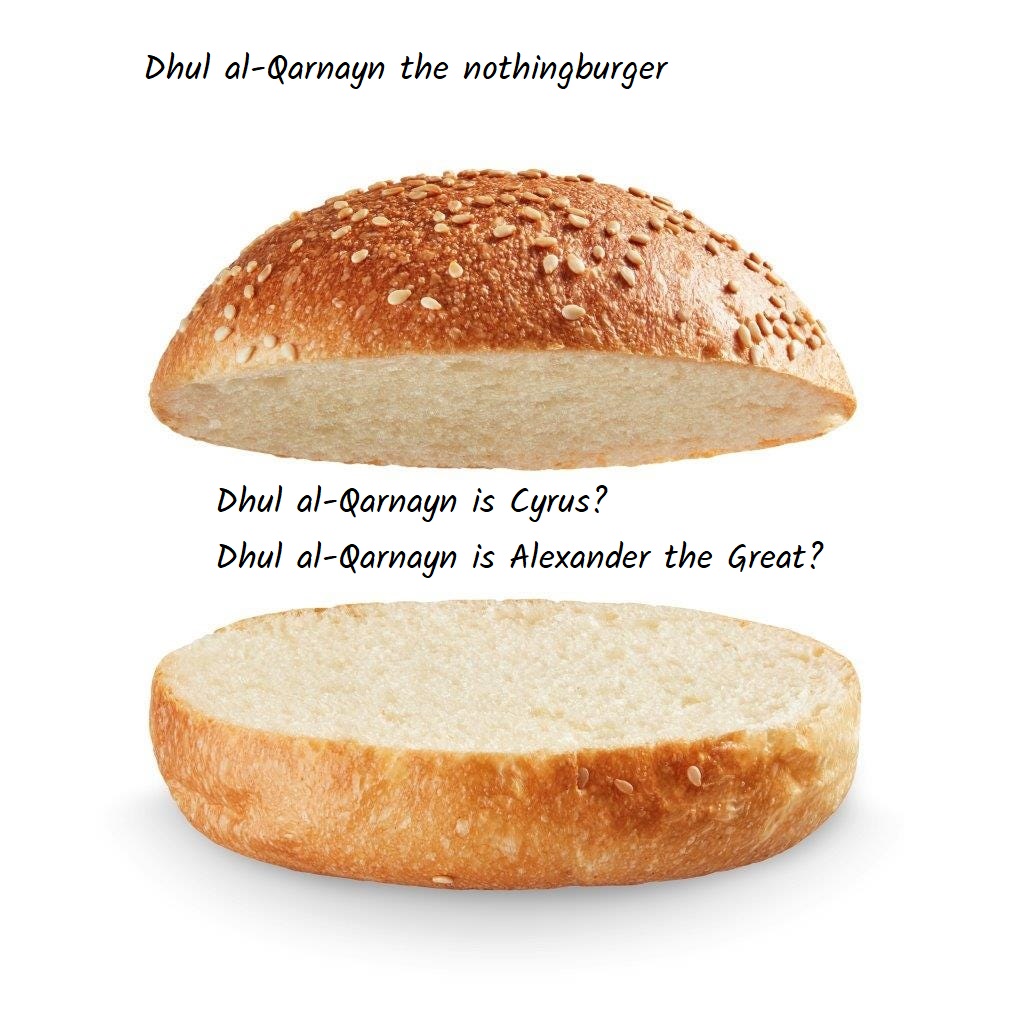
There is nothing that an individual using the historical critical method or an orientalist has brought that even remotely challenges the narrative of the Qur’an. Nihil ad rem. People having doubts because a tafsir was challenged. That is an absolute nothingburger.
Recall:
“And they will ask you about Dhul-Al Qarnayn. Say: I will recount to you a remembrance of him.” (Qur’an 18:83)
There is nothing in that verse that indicates that the answers to the questions that they posed were matters that concern anyone outside those that asked the questions.
May Allah guide the Ummah!
May Allah bless the Ummah!
May Allah forgive the Ummah!




 Prima Quran