Tag Archives: quran-only-religion

Use & Abuse of the word Hikma by the Quran Only religion.

“He gives wisdom to whom He wills, and whoever has been given wisdom has certainly been given much good. And none will remember except those who understand.” (Qur’an 2:269)

﷽ 

“He gives wisdom to whom He wills, and whoever has been given wisdom has certainly been given much good. And none will remember except those who understand.” (Qur’an 2:269)

  • Is there anything internal in the above verse that even remotely suggests that it is a reference to the Qur’an?
  • Are adherents of the ‘Qur’an Only religion’ seriously going to contend that Allah has only given wisdom to Quranist who understand their particular approach to the Qur’an?
  • Are adherents of the ‘Qur’an Only religion’ seriously going to contend that Allah has not given wisdom to people who are not Muslims?

In the above verse it is clear that wisdom is neither a reference to the Qur’an or to the Sunnah. It is a reference to discernment in general.

Hikma — understood as ‘wisdom’ or ‘discernment’, has been used and abused by both the traditionalists and the various sects of the ‘Qur’an Only religion

The traditionalist will try and conflate the term hikma to only mean ‘the sunnah’ of the Blessed Messenger (saw).

They are partially correct, but the term is a bit more nuanced.

They will end up taking this term hikma and then conflating it with sunnah, such that it now is in reference to all the deeds, actions, and sayings of the Blessed Messenger (saw).

That is simply not true. We believe it was Imam Al Shafi’i who was among the first to make this assertion.

While it can be a reference to all the deeds, actions, and sayings of the Blessed Messenger (saw), it does not necessarily need to be.

The ‘Qur’an Only religion‘, in their rush to refute any authority other than their own individual interpretations of the Qur’an, say that hikma is in reference to only the Qur’an.

They are partially correct as well, but it is not the whole picture.

Now certainty it would be correct to say that the Qur’an is hikma. It can be a reference to the Qur’an. However, the inverse is not true.

To say that every instance of the word hikma refers to the Qu’ran is simply not true. This is where we begin to understand the nuanced meaning and application of the term hikma.

“And Allah will teach him the Book and Wisdom (hikma) the Law and the Gospel.” (Qur’an 3:48)

It would certainly be odd if we understood this to be, “And Allah will teach him the Book, and the Qur’an and the Law and the Gospel.”

Does anyone think that Jesus (as) taught the Qur’an?

It would also be odd if we understood this to be, “And Allah will teach him the Book, and the Sunnah of Prophet Muhammed, the Law, and the Gospel.”

However, notice something in the text of Qur’an 3:48.

Followers of the Qur’an Only religion will use as an argument that things mentioned in conjunction with one another do not necessarily mean that they are separate.

For example:

“And We had already given Moses and Aaron the criterion and a light and a reminder for the righteous.” (Qur’an 21:48)

So, here in this context, the Torah is being described as a criterion and a light and a reminder. These are three descriptions of the Torah, not three separate sources of guidance.

Whereas we also have an example of three mentioned together that are not the same. In the following verse is mentioned Allah [swt], the angels and all mankind. These three do not equate to being the same.

“Surely those who disbelieve and die while they are disbelievers, these are those on whom is the curse of Allah and the angels and all mankind.” (Qur’an 2:168)

So in what context is the grammar being used in the verse relating to Jesus?

“And Allah will teach him the Book and Wisdom (hikma) the Law and the Gospel.” (Qur’an 3:48)

Jesus is being taught the Book, the Hikma, the Law, and the Gospel.

The Arabic transliteration is: wayu’allimuhu l-kitaba wal-hik’mata wal-tawrwata wal-injila.

The Law and the Book and the Gospel are not the same things. It stands to reason that, given the grammar of this verse from a perfect All-Knowing being, that the hikma is a reference to something distinct from the Gospel in a way that the Torah is distinct from the Gospel.

“And when Jesus brought clear proofs, he said, “I have come to you with wisdom (hikma) and to make clear to you some of that over which you differ, so fear Allah and obey me.” (Qur’an 43:63)

How odd would that be if we understood it to be,

“And when Jesus brought clear proofs, he said, “I have come to you with the Sunnah of Prophet Muhammed and to make clear to you some of that over which you differ, so fear Allah and obey me.”

It would also certainly be odd if we understood it as:

“And when Jesus brought clear proofs, he said, “I have come to you with the Qur’an and to make clear to you some of that over which you differ, so fear Allah and obey me.”


“And remember the verses of Allah and the wisdom (Prophet’s sayings) which are recited in your houses. Surely, Allah is Courteous, Well-Acquainted.” (Qur’an 33:34)

Some adherents of the Qur’an Only religion have argued that wisdom here must be Qur’an because the prophetic sayings cannot be considered as being ‘recited’. They believe that ‘recited’ is only a reference to the Qur’an.

The Qur’an refutes this point.

“And they followed instead what the devils had recited during the reign of Solomon.” (Qur’an 2:102)

The Arabic yut’lā – can also mean recounted or rehearsed.

We wanted to make this entrance very brief insh’Allah. There is a huge error in the misunderstanding of the Qur’an by adherents of the ‘Qur’an only religion‘.

If they really looked at the Qur’an and reflected upon it they would not have fallen into such an egregious error.

Hikma is discernment. It is the ability to discern. It is penetrating understanding or insight. The Blessed Messenger (saw) was granted hikma.

Thus, when we hear of the term hikma in relationship to the revelation, we can understand it to mean his exposition of the Qur’an. That would be his Sunnah.

Hikma does mean that Allah (swt) granted him penetrating insights into the Qur’an.

This is obvious from the following verse:

“And obey Allah and obey the Messenger. But if you turn away, then Our Messenger is responsible only for conveying the message clearly.(Quran 64:12)

For example:

“They ask you about menstruation. Say, “It is painful, so keep away from women during their menstruation, and do not approach them until they are purified. When they are purified, you may approach them the way God has ordained you.” God loves the repentant and the purified.” (Qur’an 2:222)

So for example are we to live in a seperate house? Are we to be in seperate rooms? Are we not to eat dinner with them?

“This legal scheme has a surprising impact on Jewish women and their periods. Under Jewish religious laws, a woman is considered “impure” during her menstruation days (“niddah”) and must follow a “purifying” ritual prior to entering and consummating a marriage, as well as during married life itself.”

Niddah” requires that a woman experiencing her menstruation remain distant from her husband or husband-to-be. She must maintain physical distance (e.g., sleeping in separate beds during her “impure” days) for seven “clean” days, where she checks with cloth that she has no blood in her cervix. This ritual concludes with a “Mikveh” ceremony, where she purifies herself by dipping into a pool of water. Only when this ritual has concluded is the woman “pure” and allowed to consummate the marriage”

Source: (https://journals.library.columbia.edu/index.php/cjgl/blog/view/347)

It is obvious that the use of hikma would be to know how to employ the Qur’an on issues that are not explicitly mentioned by the Qur’an. The Sunnah provides that clarity.

How to relate the Qur’an to context.

An example:

“And marry not women whom your father married, except what has already passed; indeed it was shameful and most hateful, and an evil way.” (Qur’an 4:22)

This also applies equally to a woman a man’s father has married contractually and to women he has had intercourse with outside of marriage.

Although the Qur’an is not clear on this point. So this is a case of hikma — or discernment. The Sunnah provides clarity on this matter.

Who knows how followers of the Qur’an Only religion deal with this? They are in open rebellion to the idea that anything is an authority outside the Qur’an.

Even though Allah (swt) has said:

“O you who have believed, obey Allah and obey the Messenger and those in authority among you. And if you disagree over anything, refer it to Allah and the Messenger, if you should believe in Allah and the Last Day. That is the best way and the best in result.(Qur’an 4:59)

The life of the Blessed Prophet (saw) is an example of how Muslims should interact with the world around them.

The hikma that has become the mass transmitted sunnah, is his understanding of the Qur’an in all matters.

“He gives wisdom to whom He wills, and whoever has been given wisdom has certainly been given much good. And none will remember except those who understand.” (Qur’an 2:269)

So it is a failure of insight for the adherents of the ‘Qur’an only religion’ to not see that the word hikma was given to the Blessed Messenger (saw) as penetrating insights.

The reason why the various sects of the ‘Qur’an Only religion’ are very uncomfortable with this is due to the fact of their very strained interpretations that the Qur’an ‘explains everything in detail’—which to them leaves no room for expositions, interpretations, or sources of guidance outside of it.

May Allah (swt) guide us to what is beloved to Allah (swt).

May Allah Guide the Ummah.

May Allah Forgive the Ummah.

7 Comments

Filed under Uncategorized

Questions for the Qur’an Only religion That Can’t Be Swept Under A Rug.

Say, “Have you considered: if the Qur’an is from Allah and you disbelieved in it, who would be more astray than one who is in extreme dissension? We will show them Our signs in the horizons and within themselves until it becomes clear to them that it is the truth. But is it not sufficient concerning your Lord that He is, over all things, a Witness? Unquestionably, they are in doubt about the meeting with their Lord. Unquestionably He is, of all things, encompassing.” (Qur’an 41:52-54)

﷽ 

If the Qur’an is all that is needed for any person, why would Allah (swt) say that he would show us signs on the horizons and within ourselves until ‘It‘—becomes clear that ‘It‘—the Qur’an—is the truth?

So the question becomes: how do they know that the Qur’an is complete?

For example, there is absolutely nowhere in the entirety of the Qur’an that says “this Qur’an will consist of so many chapters, verses, and letters.”  Why do they accept the Qur’an in the arrangement it is now in?  What proof does the Qur’an Only religion have to suggest that surah al Fatiha should be placed first and surah an nass last?

Of course, someone could quote the following text: “We have, without doubt, sent down the Message; and We will assuredly guard it against corruption.” (Qur’an 15:9)

Yet, this is absolutely beside the point.  Everyone would agree with this statement. But the point is that “It” is not internally defined.

Ironically, the adherents of the Qur’an only religion cannot even get past the first verse of the Qur’an without coming to a major decision.

Is “Bismillah ir rahman ir raheem” a verse at the beginning of Surah Al Fatiha or not?

There is absolutely no way to substantiate this claim internally.  The irony of ironies here is that rather or not the ‘bismillah’ should be included at the beginning of Surah Al Fatiha is left up to criteria outside the Qur’an to determine!

“Indeed, it is We who have sent down to you, [O Muhammed], the Qur’an, progressively.” (Qur’an 76:23)

Everyone agrees that ‘Basmalla’ is a verse inside the Qur’an.

“It is from Solomon and is (as follows): ‘In the name of Allah, Most Gracious, Most Merciful:” (Qur’an 27:30)

However, why are the followers of the Qur’an Only religion in dispute on rather or not this should occur at the beginning of every chapter or not?

You can go to one Quran Only website and find them not including the bismillah as a verse included before every chapter here: http://www.free-minds.org/quran/PM/2

Whereas other followers of the Qur’an Only religoin openly disputes with those at free-minds.org.    You can see the “submitters’  here:

http://submission.org/QI#2%3A0   Notice the very bizarre 2:0. reference?

“And We have bestowed upon thee the Seven Oft-repeated (verses) and the Grand Qur’an.” (Qur’an 15:87)

This may be the only place where the Qur’an mentions a section of itself outside another section. In other words, if we are to believe this verse as revelation, it clearly states for us to look out for the ‘seven oft repeated’. Yet, interestingly there is ambiguity surrounding this very verse. That is if we abandon the tradition altogether.

There is a very interesting observation.

It is interesting that the Qur’an mentions that these verses are ‘seven oft repeated’.  This can only be confirmed outside the text as we do not find these verses reoccurring in the Qur’an at all.

Who are these people? 

“And when you said to the one on whom Allah bestowed favor, and you bestowed favor, “Keep your wife and fear Allah, ” while you concealed within yourself that which Allah is to disclose. And you fear the people, while Allah has more right that you fear Him. So, when Zayd had no longer any need for her, We married her to you in order that there would not be upon the believers any discomfort concerning the wives of their adopted sons when they no longer have need of them. And ever is the command of Allah accomplished” (Qur’an 33:37)

Who is Zayd?

Why is he mentioned in the Qur’an?

What are these verses all about?

What was it that the Blessed Messenger (saw) concealed that Allah (swt) was about to make known?

How does Allah ‘marry’ someone to the Blessed Messenger (saw) ? 

“May the hands of Abu Lahab be ruined, and ruined is he. His wealth will not avail him or that which he gained. He will burn in a fire of flames and his wife — the carrier of firewood. Around her neck is a rope of fiber.” (Qur’an 1:1-5)

Who is Abu Lahab?

Why is he mentioned in the Qur’an?

What are these verses all about?

Who is his wife?

What did they do to deserve these descriptions of them from the Almighty?

What major doctrines of Islam would we lose if any of those verses were not in the Qur’an?  

Why does Allah (swt) need or even desire to communicate his message through any medium at all?

Be it textual, oral or human.  Why not just reveal the revelation directly to each individual directly?   Surely Allah (swt) is capable of doing all things.

Why does the Qur’an constantly point to outside sources to verify its claims and veracity?

Some points of consideration:

“Those who follow the Messenger, the unlettered prophet, whom they find mentioned in what they have in the Torah and the Gospel, who enjoins upon them what is right and forbids them what is wrong and makes lawful for them the good things and prohibits for them the evil and relieves them of their burden and the shackles which were upon them. So those who have believed in him, honored him, supported him and followed the light which was sent down with him — it is those who will be the successful.” (Qur’an 7:157)

This verse is very explicit in that the veracity of its statement stands on whether the People of the Book (Ahl Kitab) actually find mention of the Blessed Messenger (saw).

The veracity of the entire  Qur’an rests in Muslims being able to prove this claim.  The proof of this claim rests in sources outside the revelation itself.

“Say, “Have you considered that which you invoke besides Allah ? Show me what they have created of the earth; or did they have a partnership in the heavens? Bring me a scripture before this or a trace of knowledge, if you should be truthful.” (Qur’an 46:4)

“This Qur’an narrates to the Children of Israel most of what they are in dispute over.”  (Qur’an 27:76)

In order to verify this claim, one would have to be intimately familiar with outside sources of reference; in particular, they would have to have a great deal of information concerning the disputes of the Children of Israel.

It is clear that the Qur’an is not a self enclosed eco system.

May Allah Guide the Ummah.

May Allah Forgive the Ummah.

10 Comments

Filed under Uncategorized

The Qur’an Only Religion and their confusion on Qur’an 4:157.

“And for their saying, “Indeed, we have killed the Messiah, Jesus, the son of Mary, the Messenger of Allah.” And they did not kill him nor did they impale (ṣalabūhu) him; (وَمَا قَتَلُوهُ وَمَا صَلَبُوهُ وَلَٰكِنْ شُبِّهَ لَهُمْ)but it was made to appear to them so. Those who differ therein are full of doubts. They have no certain knowledge of it, but only follow conjecture. For certainly, they did not kill him.” (Qur’an 4:157)

﷽ 

Once again, this shows why it is problematic to take the Qur’an alone. We can glean the meaning of words via the process of Tafsir al-Quran bi-l-Quran. (Interpreting the Qur’an by the Qur’an).  However, there are times when you need to appeal to external references to get the full grasp of what is being conveyed.

Sam Gerrans, one of the followers of the Qur’an Only religion, has translated the text of Qur’an 4:157 as:

157 And for their saying: “We killed the Messiah,1 Jesus,2 son of Mary,3 the messenger of God,” — and they killed him not nor crucified4 him, but it seemed so5 to them; and those who dispute concerning it are in doubt thereof, no knowledge have they thereof save the pursuit of conjecture — and they killed him not of a certainty.”

Source: (https://reader.quranite.com/verses/chapters?chapter=4&page=4)

Notice that Sam has a note (4) by the word ‘crucified’.

Or put to death by stake. Arabic: ṣalaba. By convention the Traditionalist has understood ṣalaba as to crucify. That understanding is, perhaps, at odds with what Qur’anic usage indicates. In the Qur’an, Firʿawn is called the Lord of Stakes (38:1289:10) — which collocation is typically rendered thus by the Traditionalist himself. This fact certainly suggests that the form of capital punishment meted out by Firʿawn featured a stake. The options available for killing a man on a stake are limited. In close proximity to the verb commonly rendered crucify (ṣalaba) Firʿawn threatens that punishment will be inflicted ‘on the trunks of date-palms’ (20:71) — thus lending credence to the notion that the trunks of date-palms were trimmed and sharpened to facilitate impalement. In addition, Firʿawn threatens to cut off hands and feet from alternate sides before executing the punishment in question (7:12420:7126:49). Attempting to crucify one thus disfigured would be both impractical and run the risk of creating morbid farce — which itself would defeat the point of most of what benefits a tyrant from the public torture of his enemies: the creation of fear. Finally, a date-palm does not possess a crossbar, nor can one readily be made from a second date-palm — a requisite item if we are discussing crucifixion in an intellectually honest manner. However, I render ṣalaba and ṣallaba throughout as to crucify, as per the norm, and confine my dissent to the notes.

Prima Qur’an comments. Sam is correct in that by interpreting the word here in the other places where it is mentioned, you do not get the understanding of a crucifixion. A patibulum with nails placed in the hands and feet.

At least Sam is on board in recognizing that Qur’an 4:157 does not speak of a  crucifixion.

However, in his notes he states: ‘Or put to death by stake.’ This is where reliance upon extra Qur’an information comes into play. Because it is via that extra Qur’anic material that one realizes that Jews do not crucify people at all. It is not part of their repertoire.

In fact, to suggest that Qur’an 4:157 should be rendered as  crucifixion as the Shi’i and Sunnis do would render the Qur’an of human origin. It is not possible that Allah (swt) would be ignorant of Jewish methods of execution.

Another follower of the Qur’an Only religion, Edip Yuksel, in his Reformist Translation would render Qur’an 4:157 as follows:

“We understand that Jesus was not conscious when they crucified his body.” Jesus’person was already terminated, and he was at his Lord.

However, on the Islamawakened website it has Edip saying:

For their saying, “We have killed the Messiah Jesus the son of Mary, the messenger of God!” They did not kill him, nor did they crucify him, but it appeared to them as if they had. Those who dispute this are in doubt of him, they have no knowledge except to follow conjecture; they did not kill him for a certainty.

So it looks as if Edip is prepared to lie about Allah (swt) and equally worse impute to Allah (swt) ignorance of Jewish methods of execution.

We can look at a few more translations by those who follow the Qur’an Only religion.

https://www.islamawakened.com/quran/4/157

Shabbir Ahmed translates the Qur’an 4:157 as:

“And for claiming, “We killed the Messiah Jesus son of Mary, Allah’s Messenger.” They never killed him and never crucified him. But it appeared so to them and the matter remained dubious to them. Those who hold conflicting views on this issue are indeed confused. They have no real knowledge but they are following mere conjecture. Very certainly, they never killed him.”

The Monotheist Group translates Qur’an 4:157 as:

“And their saying: “We have killed the Messiah, Jesus, son of Mary, messenger of God!” And they had not killed him, nor crucified him, but it appeared to them as if they had. And those who dispute are in doubt regarding him, they have no knowledge except to follow conjecture; they did not kill him for a certainty.”

Rashad Khalifa translates Qur’an 4:157 as:

“And for claiming that they killed the Messiah, Jesus, son of Mary, the messenger of GOD. In fact, they never killed him, they never crucified him – they were made to think that they did. All factions who are disputing in this matter are full of doubt concerning this issue. They possess no knowledge; they only conjecture. For certain, they never killed him.”

Another follower of the Qur’an Only religion that goes by the name of Joseph Islam has the following to say in regard to Qur’an 4:157.

https://www.quransmessage.com/articles/jesus%20crucifixion%20FM3.htm

There are many places where Joseph Islam has fumbled.

First, he renders Qur’an 4:157 as:

“That they said (in boast), “Indeed (Arabic: Inna), We killed Jesus Christ, the son of Mary, the Messenger of God”. And they killed him not, nor did they crucify (Arabic: Salabuhu) him, but it appeared so to them (Arabic: Shubbiha), and indeed those who differ in it are surely in doubt (Arabic: Shakkin), with no (certain) knowledge(Arabic: Ilmin), but only follow assumptions (Arabic: Zani), for certainly they did not kill him”

Joseph acknowledges the double denial.

(2)    GOD’S RESPONSE TO THE CLAIM OF THE JEWS BY ANALYSING SOME KEY ARABIC TERMS

God’s initial response is two-fold.

(a) They did not kill him

(b) They did not cause Prophet Jesus (pbuh) to die ‘in a well known manner’ (Arabic: Salabuhu)

Joseph then proceeds to tell us:

The word ‘Salabahu’ is formed from the Arabic root word: Sad-Lam-Ba which means:

To put to death by crucifixion, to extract marrow from bones, to put to death in any well known manner of killing.

Please see related article [1] below.

To be crucified one would need to ‘die‘ on the cross / pole or stake. Death by this manner can range from a few hours to days and can be a result of blood loss, hypovolemic shock, infection related sepsis or by dehydration. However, for crucifixion to be complete, death would be necessary.

Therefore, the primary significance of the word ‘Salabahu’ means to put to death in a well known manner. This may mean by a process of crucifixion, but is not restricted to it.

Prima Qur’an comments: The claim that Sad-Lam Ba which means: ‘To put to death by crucifixion.’ is probably one of the biggest lies that LANE. E.W, Edward Lanes Lexicon has ever fostered. One that Joseph had decided to repeat.

Joseph continues:

007:124

“I will certainly cut off your hands and your feet on opposite sides, then will I will crucify you all together (Arabic: uSALIBANNAkum)”

A popular translation above renders the word ‘Salibanna’ as crucify when all the Arabic implies is a ‘well known manner of death’ at the time of Pharaoh’s reign which may or may not imply crucifixion on a cross.

Prima Qur’an comments:

Again, Joseph is trying to escape reality. Neither does SALIBANNA mean in a ‘well known manner of death’. This is Joseph’s way of saying I do not know, neither does the Qur’an give clarity on the matter.

In fact, by saying ‘well known manner of death’ one would need to be familiar with the types of death that were implemented. This would mean, of course, appealing to information that is external to the Qur’an.

So let us go back and analyze what Joseph had stated:

Joseph acknowledges the double denial. This is something virtually all followers of the Qur’an only religion ignore. The double negation.

(2)    GOD’S RESPONSE TO THE CLAIM OF THE JEWS BY ANALYSING SOME KEY ARABIC TERMS

God’s initial response is two-fold.

(a) They did not kill him

(b) They did not cause Prophet Jesus (pbuh) to die ‘in a well known manner’ (Arabic: Salabuhu)

Prima Qur’an comments: The well known manner of execution by the Jews is stoning. After stoning, the Jews impale an individual. This is a post-mortem suspension punishment. Kindly see the article above with Rabbi Dov Stein.

Once one realizes this, we can dispense with:

  1. Sunni views of some other individual being made to look like Jesus and this person was put on a cross.
  2. Qadiani views of Jesus being on a cross and then taken down alive.
  3. Ismaili views of Jesus dying on a cross (as a body) not as a soul.

Another follower of the Qur’an Only religion has his own twist. Allah kills Jesus, not the Jews, but his corpse is taken up into heaven.  Later he (Jesus) will be resurrected. 

Dear reader, you may not fail to notice the dancing around the verse Qur’an 4:157.

This Shuaib Abdullahi translates Qur’an 4:157 as:

“And their saying, “Indeed, we killed the Messiah, Jesus, the son of Mary, the Messenger of Allah,” when they did not kill him, nor did they crucify him; but it was made to appear so to them. And indeed, those who differ over it are in doubt about it. They have no knowledge of it except the following of assumption. And they did not kill him for certain.”

Source: (https://thegreatkoran.com/chapter/4/)

Conclusion: Out of all of them, Sam Gerrans came the closest. Yet, he admittedly follows the tradition! “However, I render ṣalaba and ṣallaba throughout as to crucify, as per the norm, and confine my dissent to the notes.” Joseph Islam tried to skirt around the fact that, according to the Qur’an alone methodlogy the Qur’an does not give clarity on the matter. Thus, he implores the ‘well known manner of death’. This in and of itself is an appeal to extra Qur’anic data.

For those interested, please see our article here:

May Allah Guide the Ummah.

May Allah Forgive the Ummah.

Leave a comment

Filed under Uncategorized

Salaat in the Qur’an is NOT Ritual Prayer? Examining the claim of some so called Quranist.

“Shall I seek other than Allah as a source of law, when He has revealed to you this book that in places explains itself? Those who received the scripture recognize that it has been revealed by your Lord, truthfully. You shall not harbor any doubt.” (Qur’an 6:114)

﷽ 

We start off with this particular verse because many of the misguided individuals who follow one or more of the competing sects of the Quranist religion will often quote this as saying that the Qur’an has everything you need to understand all aspects of Islam.

However, they like to rely upon a poorly translated version of the Arabic mufassalan as ‘explained in detail’.

Interpretation is important. How we understand various verses in the Qur’an is also very important.

“O you who have believed, be supporters of Allah, as when Jesus, the son of Mary, said to the disciples, “Who are my supporters of Allah?” The disciples said, “We are supporters of Allah.” And a faction of the Children of Israel believed and a faction disbelieved. So We supported those who believed against their enemies, and they became dominant.” (Qur’an 61:14)

“Who is it that would loan Allah a good loan so He may multiply it for him many times over? And it is Allah who withholds and grants abundance, and to Him, you will be returned.” (Qur’an 2:245)

“You alone we worship and you alone we ask for help.(Qur’an 1:5)

You can see that a whole multitude of Quraniyoon from Sam Gerrans/ Hamza Abdul Malik/ Free-Minds/ Monotheist Group struggle with the verses above.

Why is that? It is simple. Because if we were to allow the Qur’an to speak on its apparent meaning, then all Muslims could rightly be accused of shirk. 

This would include those who follow the Quraniyoon religion, like Sam Gerrans, Shabir Ahmed, Rashad Khalifa, Hamza Abdul Malik, Aisha Musa. Everyone in the Free Minds and Monotheist Groups could all rightly be accused of shirk.

Shirk-associating partners/objects/ with Allah.

Every one of us uses and employs the use of the internet, YouTube, social media to help to get across our message. We are not relying solely upon Allah (swt), that is if we are to take this verse on a very literal basis.

Take, for example, https://www.islamawakened.com/quran/1/5/default.htm

Look at how Quranist juggle and struggle with Qur’an 1:5

The Clear Quran, Dr. Mustafa Khattab  You ˹alone˺ we worship and You ˹alone˺ we ask for help.

Though Mustafa Khatta is NOT a follower of the Qur’an Only Religion, it is interesting in a translation self-described as ‘The CLEAR Quran’ that we have ‘alone’ with the apostrophe.

[The Monotheist Group] (2011 Edition) You alone we serve, and You alone we seek for help.

Or in the case of Shabir Ahmed of ‘Our Beacon’, a shameful and total butchering of the translation to avoid the problem altogether. Behold!

Shabbir Ahmed (Realizing these facts), we affirm to obey Your Commands only and ask You to help us as we do that.
Rashad Khalifa You alone we worship; You alone we ask for help.

Sam Gerrans –

Thee alone we serve And from Thee alone we seek help.

So you can see that the ‘Quranist‘ struggle with this all the while accusing those who follow Islam of shirk.

As we digress, why would we assert this?

We assert this because each one of these various competing self-proclaimed Qur’aniyoon groups all have to DEFINE the ARABIC language.

They will assert that this word means this, or it means that. Guess what they rely upon?

They rely upon Arabic lexicons, dictionaries, secondary sources to define what the words mean in the Qur’an itself.

This brings us to their preserved translation of mufassalan — that which explains itself in places.

“Shall I seek other than Allah as a source of law, when He has revealed to you this book fully detailed? Those who received the scripture recognize that it has been revealed by your Lord, truthfully. You shall not harbor any doubt.” (Qur’an 6:114)

If this verse is understood in the way that the self-proclaimed Quraniyoon relies upon, then it is an error.

There is nowhere in the Qur’an in which a list of all the words are given with their various understandings, imports, meanings, and nuances. Only the meanest of people would argue against this most important fact.

So, if we were to look at the following verses above and take them literally, it would mean:

  1. The Qur’an has everything inside of it — which it doesn’t. In fact, the very verse that says it is ‘fully detailed‘ does not ironically tell us what this entails! You can only use deduction to say ‘all matters relating to jurisprudence or law‘.
  2. That Jesus was blaspheming in asserting that Allah (swt) has supporters or helpers or that the Creator of the Universe would need assistance or support.
  3. The blasphemous assertions that Allah (swt) needs loans or is capable of receiving loans.
  4. The idea that every time someone goes to see a doctor, lawyer, specialist of any kind that we are all going against “you alone, we ask for help.”
  5. In this regard, Dr. Shabir Ahmed alone was devious enough to recognize this, and thus, blatantly shredded the Arabic text in his molested translation.

Let us give you a prime example of some attempts by a self-proclaimed adherent of the Qur’an only religion who will tell you that the Salaah is NOT a ritual prayer.

Here is one such video.

We would encourage you to watch the above video in its entirety and then watch the following video:

So, in the first video, Salaah is simply doing good things. Personally, even in the first video, we felt Joseph really struggled to explain the ‘middle salaah’.

“Be ever mindful of prayers, especially the middle prayer; and stand up before Allah in devotion.” (Qur’an 2:238)

It is such a strained reading of the Arabic text. It is another example of a human being making the Qur’an conform to their thought process rather than the other way around.

However, this person cannot escape the following verse in the Qur’an.

“O you who believed! When the call is made for congregational prayer, then proceed to the remembrance of Allah and leave trade; that is better for you if you knew. And when the prayer has ended, disperse within the land and seek Allah’s grace, and remember Allah often that you may succeed.” (Qur’an 62:9-10)

We have done Jospeh a favour by translating the Arabic word Juma — as a congregation.

At 3:48 he says, ‘Is this additional third, Salaah, it is it SEEMS SO.

You have to ask yourself at this point if the Qu’ran produces certainty or if it gives rise to conjecture like this. What is the point?

Does that sound ‘fully detailed’ to you?

@ 3:52 Joseph says, ‘Remember that this that once we understand that the salaah sessions have nothing to do with rituals, then we won’t be so nitpicky about the number of Salaahs , the Qur’an gives us a minimum of two salaahs a day, two salaah sessions…’

@5:26This is my opinion. Once again, this is my opinion.”

Again, this person, just like many other self-proclaimed Quraniyoon, does not have cogent arguments or even a very clear thought process behind the things that they are saying.

So let us get this right. The Salah is not a ritual prayer, but yet Allah demands that we meet to discuss the Qur’an in the morning and the evening?

So Salaah is not a ritual in terms of movements and directions, but it certainly is a ritual in terms of the timings we have to meet?

The other thing is that Joseph is quite literally all over the place in that this verse most assuredly does instruct the timing for congregational prayers.

All Muslim groups, competing groups through mass transmitted practice, have held congregational prayers on Friday. The only dissenting view here is from these people who come online and say ‘this is my opinion‘ and this ‘seems so‘.

From the same people who claim the rest of us deny what is ‘fully detailed‘ and ‘clear‘.

Remember that Joseph says at 4:04  “The Qur’an gives us a minimum of two salaahs a day.” 

Now think about this, people.  If salaah is supposed to be just reflecting on Allah, reading the Qur’an and being a good person, why even emphasize a number?  Why even say 2?   Why even emphasize timing?  This all seems very redundant, especially from a creator who has given all things in detail.

The other thing that we wish Joseph would think about is this. If he says it could be any day, these congregational salaah’s, then why is he so certain that ‘guard the middle salaah’ isn’t just talking about this middle salaah and not extremes in behavior?

Or maybe who knows that he will walk this position back.

Prima Qur’an Conclusion:

Self-proclaimed adherents of the ‘Quran Only Religion’ are certainly not in agreement on the very basic issue of Salaah.

Now seeing that these sects are not in agreement with one another, as some of them indeed agree that Salaah is a type of ritual prayer we focus this article on those who don’t agree with it.

We find that they have nothing cogent nor consistent. Saying, “this is my opinion” or, “it seems so” is not from a book that ‘contains all the details’ but from a mind befuddled and confused.

You may also be interested in reading the following:

May Allah (swt) guide the Ummah.

May Allah Forgive the Ummah.
14 Comments

Filed under Uncategorized

The Qur’an Only Religion is intellectually bankrupt

“O you who have believed, fear Allah, and speak words of appropriate justice.” (Qur’an 33:70)

﷽ 

We find the “Hafs Qur’an Only” Religion to be intellectually bankrupt.  

Beyond the idea of saying that ‘I bear witness that Muhammed is the Messenger of Allah’ upon entering Islam, or saying Salawat upon the Blessed Messenger (saw) to be acts of shirk—or association of partners with Allah (swt), they really have little more to offer in theology.

We find no attempt at all to discuss theological issues about the attributes of Allah in any meaningful way.

No discussion on issues like free will and determinism, no discussion on whether we see Allah in the hereafter, rather souls remain in hell or are released, rather Allah is divinely simplistic in being or unity, rather the Qur’an is created or uncreated, rather than who or what creates actions, nor any meaningful definition of the sifat of Allah (swt). 

Just rail against Hadith. It is all they can bring to the table as to the rest….good luck!

As regards the Quraniyoon. 

We can’t think of a greater diabolical system for the systematic dismantling of Islam.  

We are talking about communal worship and communal bonding and the masjid as a place of khutbah calling for social justice. Erased.

At what point is this platform not a sting or intelligence operation to dismantle islam as a political and ideological source that challenges western hegemony?

Look how fragmented Protestant churches are. 

But imagine now, we don’t even have a church. Just private study circles that splinter into another private study circle. You are left with your translation of the Qur’an and your own individual speculations. 

The claim they make is that the Qur’an is sufficient and clear, yet we keep seeing YouTube videos of them popping up wanting to explain Allah’s kitab and in the process refute other Qur’an only views.

The Arabic language itself becomes the ultimate arbiter of truth and not the Qur’an.

Allah doesn’t need a book, he can give direct gnosis.

What is the degree of fluency that you need before you start telling people what Allah is and is not saying based upon your personal speculation?  

Look at all other faith traditions; Buddhism, Hinduism, Judaism, Christianity, etc….

Why is it they all have structure, ritual and suddenly these people want to come along and dismantle it?

The success of that movement = handing over the so-called third world over to complete dominion of the West.

At the end of the day, this movement turns the Qur’an into a simple self-help book.  You could find it in the same section as a book with the title ‘a road to a better you.’  

In fact, one of them mentioned recently that you don’t even need the Qur’an! The Qur’an is just a shortcut! 

Nor have we seen among those who follow the Hafs Qur’an Only Religion any meaningful attempt to engage in theological issues.

Yet the only thing that the adherents of the “Hafs Qur’an Only Religion” can offer is constant railing against Hadith literature.

We have a feeling that many of these people (at least those we met) are well-educated but don’t really have insight and wisdom. It is possible that many of them were exposed to the very heavy-handed tactics of traditional Muslims.   It would make anyone want to run away from it all.

The fact that many of the adherents of the “Hafs Qur’an Only Religion” rely heavily upon orientalist writings is very telling.

When we announced what our intentions were for this blog, a Quraniyoon follower approached us. She was (is) a level-headed woman.  Her husband is of Pakistani origin.   They raise money for charitable causes… and work with NGOs.

Her husband was quite excited to learn that we put emphasis upon the Qur’an.

Yet, he was unable to answer questions about the textual history of Islam, that the concept of the number (19) MIGHT work for certain qir’aat of the Qur’an, but not for others.

That we can’t even speak about “over it are 19” until we have established that the basmallah is indeed a verse over every surah of the Qur’an.


How do we do that?!!

Submission.org has appealed to extra-Qur’anic material to prove their claims.

We respected their identity, but we parted ways, telling the husband (who got easily irritated) that we did not believe in their ‘Hafs Qur’an only Religion.’

We turned down funding from this couple because we will not promote a cause that we don’t believe in nor do we find to be intellectually viable at all.

We have found that many among the ‘Hafs Qur’an only Religion’, for the most part, are as easily agitated, turned up, and unfocused as are many traditionalist Muslims.

So yes, the ‘Hafs Qur’an Only Religion’ may be a rallying cry for Muslims who have had it up to their neck with ‘traditionalists’.

Yet it is important for those Western Muslims, those in Turkey, Kuwait, Pakistan, India, Malaysia, Egypt, or anywhere else who are enamored with the ‘Hafs Qur’an Only Religion’  to understand just how intellectually bankrupt the position is. It’s just almost like they have these small support groups which become echo chambers for their ideas. All we ever see is railing against the hadith.

A movement that cannot interact with the compilation and transmission of the Qur’an in any meaningful way, nor a movement that interacts with the theological questions that have gripped the Muslim ummah is not a movement or position we would want to invest my trust in.

May Allah Forgive the Ummah.

May Allah Guide the Ummah.


2 Comments

Filed under Uncategorized

The Detailed Qur’an and the Sabeans

“Indeed, those who believed and those who were Jews or Christians or Sabeans – those who believed in Allah and the Last Day and did righteousness – will have their reward with their Lord, and no fear will there be concerning them, nor will they grieve.” (Qur’an 2:62)

“Indeed, those who have believed and those who were Jews and the Sabeans and the Christians and the Magians and those who associated with Allah – Allah will judge between them on the Day of Resurrection. Indeed Allah is, over all things, Witness.” (Qur’an 22:17)

“Indeed, those who have believed and those who were Jews or Sabeans or Christians – those who believed in Allah and the Last Day and did righteousness – no fear will there be concerning them, nor will they grieve.” (Qur’an 5:69)

﷽ 

So in this “highly detailed” book that “leaves nothing out” who and what are the Sabeans? If we asked the followers of the Hafs Qur’an Only Religion what they thought.

If Joseph Islam, Sam Gerrans, Hamza Abdul Malik, Shabir Ahmed, Edip Yuksel, Aisha Musa, Qur’an Centric were to all have a conference together, you ask them: “Who are the Sabeans?” Please give me as many Qur’an references and quotations as humanly possible.

What would you come up with?

Edip Yuksel and his co-translators decided to simply throw in the towel. They decided that the Qur’an itself doesn’t explain what the word means, so they relied upon Hadith literature!  

This is what they give you instead.

“Surely those who acknowledge, and those who are Jewish, and the Nazarenes,and those who follow other religions, anyone of them who acknowledge God and the Last day, and do reform, they will have their reward with their Lord, with no fear over them, nor will they grieve.*” (Qur’an 2:62 A Reformist Translation) 

So they just leave the Sabeans out altogether.

When it comes to 5:69 we are just given a footnote that says, “005:069 See 2:62

“Those who acknowledge, the Jews, the Converts, the Nazarenes, the Zoroastrians, and those who have set up partners; God will separate between them on the day of Resurrection. For God is witness over all things.” (Qur’an 22:17 A Reformist Translation)

So here you can see in (Qur’an 22:17) the Sabians get translated as ‘the Converts’ whereas in (Qur’an 2:62) they just get left out completely.

So Edip Yuksel, Layth Saleh al-Shaiban & Martha Schulte-Nafeh came up with the following:

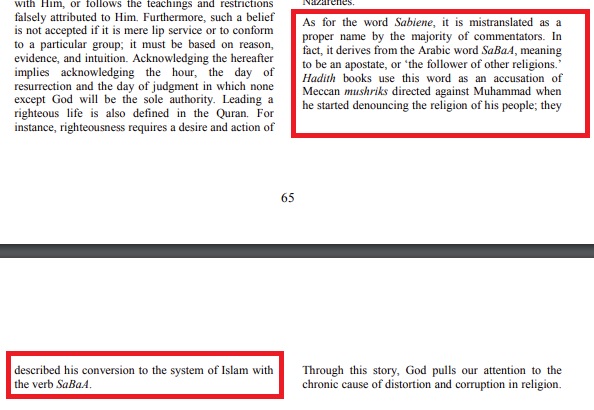
Source: (Reformist Translation of the Qur’an pg. 65)

Apparently, Layth Saleh al-Shaiban, who is the translator, didn’t tell us a source that says: “SaBaA means to be an apostate.” The “detailed Qur’an”  that “doesn’t leave anything out of the book” certainly does it tell us this. One of the three mentioned above wrote:

“As for the word Sabiene, it is a mistranslated as a proper name by the majority of commentators.”  So which classical commentator understands the word in the way that they do?  One of them wrote: “In fact, it derives from the Arabic word SaBaA, meaning to be an apostate, or ‘the follower of other religions’. Hadith books use this word as an accusation of Meccan mushriks directed against Muhammed when he started denouncing the religion of his people, they described his conversion to the system of Islam with the verb ‘SaBaA’.   

In fact, it derives from the Arabic word SaBaA, meaning to be an apostate, OR ‘the follower of other religions’. Where does the “highly detailed” Qur’an that “leaves nothing out of the book” mention this?

Why couldn’t they cross-reference the word with another word in the Qur’an?  

Why are Edip and his co-authors/translators referencing the Hadith books? Why is the Qur’an not sufficient to tell us what the word means? Also,

Edip and his co-authors/translators must think that the book of Allah (swt) has some deficiency when using language. Notice that they say, that SaBaA could mean: apostate/follower of other religion/

“The true religion with Allah is Islam(l-is’lamu). Those who were given the Book were not at variance except after the knowledge came to them, being insolent one to another. And whoso disbelieves in God’s signs. God is swift at the reckoning.” (Qur’an 3:19)

If Allah (swt) was meaning that all of those people who believe in God, the Last Day and Work Righteousness, he could just have said: “l-is’lam.” If what is intended by Edip’s thinking is a submitter to God?  Also, unfortunately, Edip’s understanding of the verse leaves Buddhism out in the freezing cold.   

So does Sabian mean: Apostate/Convert/ Or the very vague: Follower of Other Religions?  Obviously, putting the word Apostate in the verses will be very awkward.  

This is how it would look for the curious:

“Those who acknowledge, the Jews, the Apostates, the Nazarenes, the Zoroastrians, and those who have set up partners; God will separate between them on the day of Resurrection. For God is witness over all things.” (Qur’an 22:17 A Reformist Translation)

“Surely those who acknowledge, and those who are Jewish, and the Nazarenes, and the Apostates, anyone of them who acknowledge God and the Last day, and do reform, they will have their reward with their Lord, with no fear over them, nor will they grieve.” (Qur’an 2:62 A Reformist Translation) 

Simply bizarre. Absolutely no explanation is given for why Allah (swt) would mention converts (presumably to Islam) in these verses when they would already be believers.  

So let us plug in “follower of other religions.” This is how it would look for the curious:

“Those who acknowledge, the Jews, the followers of other religions, the Nazarenes, the Zoroastrians, and those who have set up partners; God will separate between them on the day of Resurrection. For God is witness over all things.” (Qur’an 22:17 A Reformist Translation)

“Surely those who acknowledge, and those who are Jewish, Nazarenes, and those who follow other religions, anyone of them who acknowledge God and the Last day, and do reform, they will have their reward with their Lord, with no fear over them, nor will they grieve.” (Qur’an 2:62 A Reformist Translation) 

The problem with the Reformist Translation, beyond trying to make the Qur’an say what one wants it to say, is that it looks less and less like it came from a Creator and more and more like a confused, jumbled mess.

Little wonder the only praise the book got was from fellow Qur’an Only Religious believers, those who want to liberalize Islam and oh yes, ‘One anonymous Sunni scholar” (of course…wink, wink).

Here is how a Creator who is trying to convey to us that he sent one system for humanity, and that there is no delineation between any of the systems would convey his message:

“Surely those who acknowledge God and the Last Day, and do reform, they will have their reward with their Lord, with no fear over them, nor will they grieve.”  There you go. Very simple.  

Sam Gerrans takes a stab at it. In his “Qur’an a Complete Revelation” we have nothing novel there.

“Who are the Sabeans according to this detailed book?”—Sam Gerrans  

“I don’t know, but I have a pretty good guess,”—Edip Yuksel. 

“Ah sweet bro, let me copy that down!”—Sam Gerrans.

“Those who heed the warning and those who hold to Judaism and the Nazarenes And the Sabaeans Whoso believe in God and the Last day and works righteousness: They have their reward with their lord and they need not fear Nor will they regret.” (Qur’an 2:62 A Complete Revelation Sam Gerrans)

His foot note says:

“’Arabic s-b-‘. This root is also associated in the early Islamic literature with followers of other faiths, or with apostates. I am indebted to Edip Yuksel et al. for this point.”

“Those who heed warning And those who hold to Judaism and the Sabaeans and the Nazarenes Whoso believes in God and the Last Day and works righteousness: They need not fear Nor will they regret.” (Qur’an 5:69 A Complete Revelation Sam Gerrans)

“Those who heed warning and those who hold to Judaism And the Sabaeans And the Nazarenes and the Majus And those who ascribe a partnership God will decide between them on the Day of Resurrection. God is a witness over all things.” (Qur’an 22:17 A Complete Revelation Sam Gerrans)

And he has a footnote that reads in regard to Majus

“Muhammed Asad comments here:

“Al-majus: the followers of Zoroaster or Zarathustra (Zardusht), the Iranian prophet who lived about the middle of the last millennium B.C, and whose teachings are laid down in the Zend-Avesta. They are represented today by Gabrs of Iran and, more prominently, by the Parsis of India and Pakistan. Their religion, though dualistic in philosophy is based in belief in God as the Creator of the universe.”  

So as regards Sabeans, Gerrans has decided to leave the word transliterated into English and has copied and pasted Edip et al. and what they have said.  

Those who follow the Hafs Qur’an Only Religion have absolutely no recourse to this word, Sabean, other than to reference early Islamic literature. The word appears three times in the “highly detailed revelation” that apparently leaves nothing out, is clear, and explains itself. For this, among many, many other reasons, we do not find the Hafs Qur’an Only Religion to be cogent.

May Allah Guide the Ummah.

May Allah Forgive the Ummah.
Leave a comment

Filed under Uncategorized