Tag Archives: crucifixion

A Christian Dilemma & How might Jesus have died?


“And so, for the breaking of their pledge, and their refusal to acknowledge Allah’s signs, and their slaying of prophets against all right, and their boast, “Our hearts are already full of knowledge”- not so, but Allah has sealed their hearts as a result of their denial of the truth, and now they believe in but few things.(Qur’an 4:155)

﷽ 

“And because of their disbelief and of their speaking against Mary a terrible slander.”

“And for their saying: “We have killed the Messiah Jesus the son of Mary, the messenger of Allah!” They did not kill him, nor did they impale him, but it appeared to them so. Those who dispute are in doubt of him, they have no knowledge except to follow conjecture; they certainly did not kill him.”

“Rather, Allah exalted him in his presence. Allah is Almighty, the Wise.” (Qur’an 4:155-158)

It is important to understand that the whole context of these verses is in reference to Jews. The Qur’an asserts they, their and them all in reference to Jews. There is absolutely no reference to Romans.

The Qur’an asserts that the Jews mocked Jesus, ‘We have killed the Messiah, Jesus the son of Mary the messenger of Allah!’

This is similar to the mocking recorded here:


“And they said, Prophecy to us, Messiah. Who hit you?” (Matthew 26:68)

As well as:

“In the same way the chief kohen and the teachers of the law mocked him among themselves. “He saved others,” they said, “But he can’t save himself. Let this Messiah, this King of Israel, come down from the cross, that we may see and believe.” (Mark 15:31-32)

It is important to note that the Qur’an in the above passages does not categorically deny the death of Christ Jesus. The Qur’an refutes that Jews were responsible for it.

They did not kill him” (It means in any way conceivable)

This statement is also asserted here:

“And behold! I did restrain the Children of Israel from (violence to) you when you did show them the clear Signs, and the unbelievers among them said: ‘This is nothing but evident magic.'” (Qur’an 5:110)

Qur’an 4:157 is not a reference to the supposed “Crucifixion” either in support or denial. The Qur’an simply does not mention the event known as the ‘Crucifixion’. The Qur’an is simply ambivalent about it.

Also of importance to note is that the Qur’an 4:157 does not interact with the supposed historical event called the “Crucifixion”. There is no mention of the Romans anywhere in the Qur’an 4:157. It does not even interact with Christian historical beliefs at all!

The only place that Allah (swt) mentions Romans is the following text:

“The Romans have been defeated.” (Qur’an 30:2)

Some people just see Romans where there are no Romans!

Is Qur’an 4:157 an Anti-Semitic Anti-Jewish Text of the Qur’an?

First, the Qur’an cannot be anti-Semitic, because the Arabs themselves are a Semitic people.

Allah informs us in regard to the children of Israel:

“Yet they are not all alike: there are some among the People of the Book who are upright, who recite Allah’s revelations throughout the night, prostrating.” (Qur’an 3:113)

As regards to the clam of Qur’an 4:157 let’s examine the text closely

This is important because most Muslims see Qur’an 4:157 as relating to the so-called “Crucifixion”. They also somehow see Romans in the text! Those Muslims make Jews culpable in the death of Jesus.

Because they somehow, for some ungodly reason, think that the text has to do with Romans crucifying Jesus, they have to make sense of the following:

BUT IT APPEARED TO THEM SO.

It is important that the following views all posit cross, crucifixion and Roman involvement in Qur’an 4:157.

View one: Mistaken identity. Allah made someone look like Jesus, and presumably he was killed. Jews are still culpable. They just got the wrong guy. Jews kill “stealth” Jesus.

Second view: Swoon theory. Jews attempted murder via Roman proxy. Jesus was crucified but, he was not crucified to death.

Third view: The Jews didn’t kill Jesus the Romans did! Jews are culpable though, as they hand Jesus over to Roman authorities. The Jews, via Roman proxy, did indeed kill Jesus’ body but not his soul. People like Todd Lawson hold this view.

Prima-Qur’an comments:


Notice that “but it appeared to them so” is in reference to the double denial. Whereas the three views above connect it only to “they did not (ṣalabūhu) him”.

However, the “but it appeared to them so” is in reference to any and all accusations. It is obvious that all the accusations cannot be synchronous, unless it is to be interpreted as a denial of a death (like stoning) and a post-mortem event (like impaling). Which means that(salabuhu) is not a death act.

Please see our article under the discussion of Qur’an 5:33

The three above views believe somehow there was only one particular event and the people were contemporaneous to said event.

Jews did not kill Jesus at all. They are not culpable, they did not kill the body and they did not use the Romans as proxies. The Qur’an does not affirm any of this.

Anti-Semitic. Anti-Jewish Text of the New Testament?

Note this statement by Paul:

“For you, brothers and sisters, became imitators of God’s churches in Judea, which are in Christ Jesus: You suffered from your own people the same things those churches suffered from the Jews who killed the Lord Jesus and the prophets and also drove us out. They displease God and are hostile to everyone.” Source: (1 Thessalonians 2:14-15)  

This one statement, ‘The Jews who killed the Lord Jesus’, has been the bedrock of Christian hatred of Jews for centuries. They were called ‘Christ Killers’ and guilty of committing deicide. Upon this statement, Jews were put in ghettos.

The Protestant Reformer Martin Luther wrote a book: “The Jews and their Lies.”

Some of Martin Luther’s comments were:

That the Jews were: “venomous beasts, vipers, disgusting scum, canders, devils incarnate.”

He also stated: “Their private houses must be destroyed and devastated, they could be lodged in stables. Let the magistrates burn their synagogues and let whatever escapes be covered with sand and mud. Let them be forced to work, and if this avails nothing, we will be compelled to expel them like dogs in order not to expose ourselves to incurring divine wrath and eternal damnation from the Jews and their lies.”

At one point he wrote: “...we are at fault in not slaying them...”

There can be no doubt that such sentiment was influential among Christians who did what they did to Jews during World War 2.

Prior to that, history tells us that:

“On 31 March 1492,Ferdinand 2 of Aragon and Isabella I of Castile, the rulers of Spain in 1492, declared that all Jews in their territories should either convert to Christianity or leave the country.”

It is very important that we give you just an overview of why the Qur’an clears Jews of this false charge; as well as the theological, social and political impact that such a belief had among Christians towards Jews.

The Qur’an refutes the idea that Jews did either of two things:

They did not kill him, nor did they impale him.”

They did not kill him: (Which is a very general meaning. They did not kill him at all)

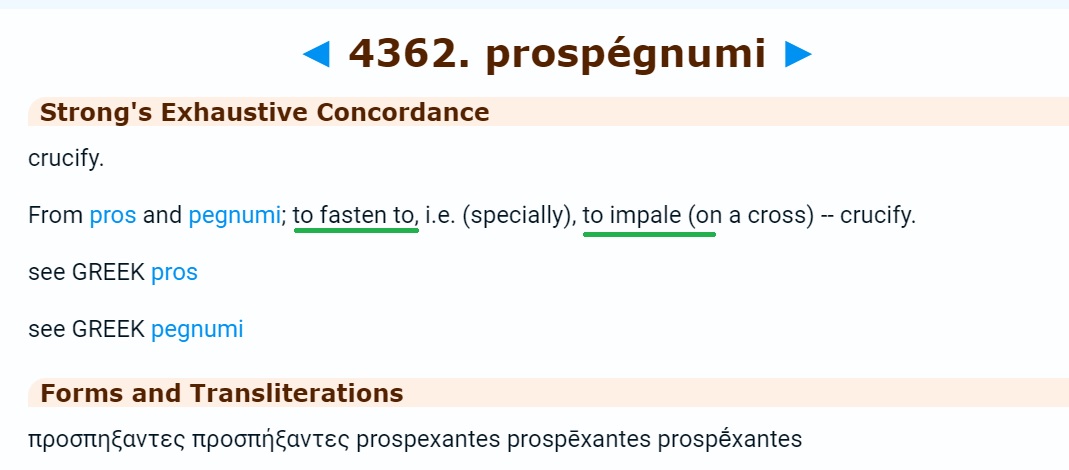
Nor did they impale (ṣalabūhu) him.

The Qur’an is interacting with information in circulation among Jews concerning any notion they had about him killing him or playing a part in him being impaled in reference to the idea circulating from oral traditions that Jesus was stoned to death and his body was impaled.

One such report in circulation could be:

Other writings assert that Jesus was killed AND THAN displayed in a tree.

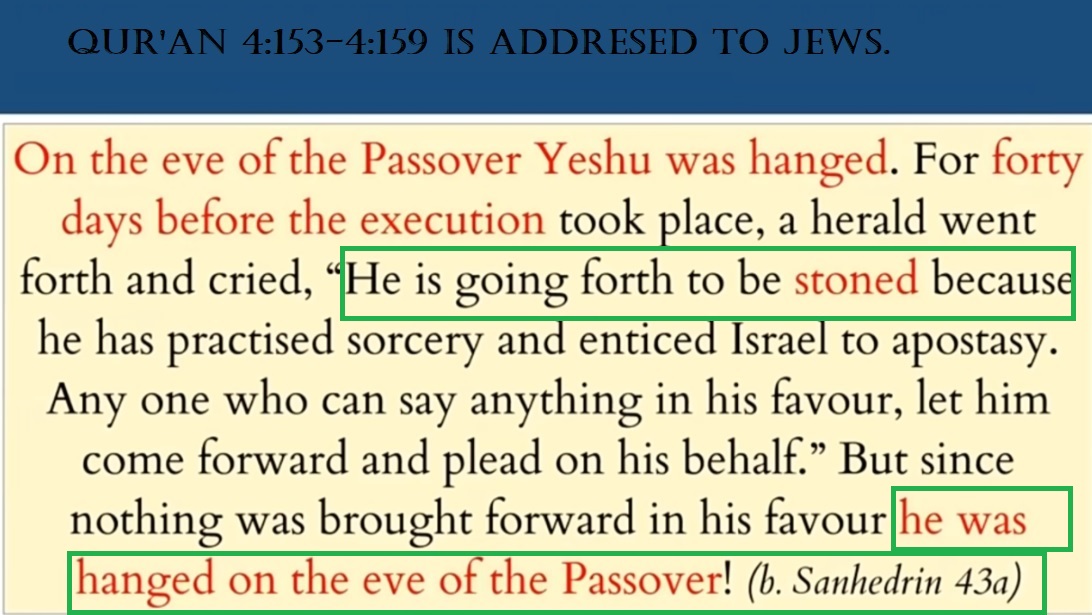
“The mishna teaches that a crier goes out before the condemned man. This indicates that it is only before him, i.e., while he is being led to his execution, that yes, the crier goes out, but from the outset, before the accused is convicted, he does not go out. The Gemara raises a difficulty: But isn’t it taught in a baraita: On Passover Eve they hung the corpse of Jesus the Nazarene after they killed him by way of stoning. And a crier went out before him for forty days, publicly proclaiming: Jesus the Nazarene is going out to be stoned because he practiced sorcery, incited people to idol worship, and led the Jewish people astray. Anyone who knows of a reason to acquit him should come forward and teach it on his behalf. And the court did not find a reason to acquit him, and so they stoned him and hung his corpse on Passover eve.”

Source: [ https://www.sefaria.org/Sanhedrin.43a ]


This is, of course, from the Jewish rabbinical literature. It asserts that Jesus was stoned to death for sorcery, idol worship and leading the Jewish people astray — all charges of which Allah clears Christ Jesus from.

By the way, the above text is taken from the Jewish Sanhedrin. Many times we have noted that Christian apologists will cut the passage up and not mention anything about stoning. Some people can be very slippery.

Remember that according to the Gospel of John, Jews say to Pilate:

“Pilate said, “Take him yourselves and judge him by your own law.” “But we have no right to execute anyone,” they objected.” (John 18:31)

However, this itself is flatly contradicted by the following:

“Then they suborned men, which said, We have heard him speak blasphemous words against Moses, and against God. And they stirred up the people, and the elders, and the scribes, and came upon him, and caught him, and brought him to the council.” (Acts 6:11-12)

” The Jews and religious leaders listened to Stephen. Then they became angry and began to grind their teeth at him. He was filled with the Holy Spirit. As he looked up to heaven, he saw the shining-greatness of God and Jesus standing at the right side of God. He said, “See! I see heaven open and the Son of Man standing at the right side of God!” They cried out with loud voices. They put their hands over their ears and they all pushed on him. Then they took him out of the city and threw stones at him. The men who were throwing the stones laid their coats down in front of a young man named Saul. While they threw stones at Stephen, he prayed, “Lord Jesus, receive my spirit.” After that he fell on his knees and cried out with a loud voice, “Lord, do not hold this sin against them.” When he had said this, he died.” (Acts 7:54-60)

In fact, several times the Gospel accounts tell us that Jews tried to stone Jesus.

“At this, they picked up stones to stone him, but Jesus hid himself, slipping away from the temple grounds.” (John 8:59)

“Again his Jewish opponents picked up stones to stone him..” (John 10:31)

Those Jews certainly don’t sound like people who would say, ” But we have no right to execute anyone, “


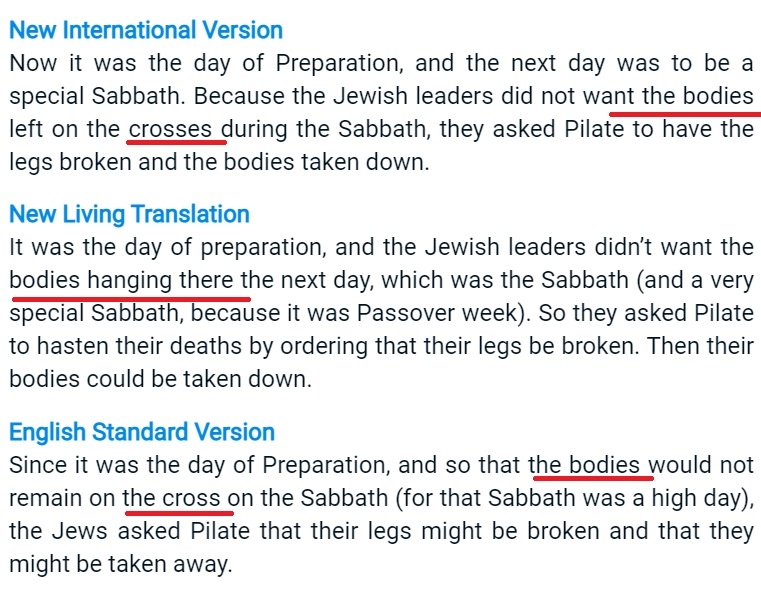
“And we are witnesses of all things which he did both in the land of the Jews, and in Jerusalem; whom they slew and hanged on a tree.” (Acts 10:39)

Jesus was put to death first and than hanged on a tree.

“The God of our fathers raised up Jesus, whom you slew and hanged on a tree.” (Acts 5:30)

Jesus was put to death first and then hanged on a tree.

By the way, some translations see the problem with the above text, and they cover this up by saying: “Hung him on the tree and killed him.” or ‘Killed him by hanging him on the tree.”

Again very slippery.

“Christ has redeemed us from the curse of the law, being made a curse for us: for it is written, cursed is everyone that hangs on a TREE.” (Galatians 3:13)

(This is the text that will eventually come back to haunt the Christians.)

Note: The above-mentioned verse is found here:

“If a man have a stubborn and rebellious son, which will not obey the voice of his father, or the voice of his mother, and that, when they have chastened him, will not listen to them: Then shall his father and his mother lay hold on him, and bring him out to the elders of his city, and to the gate of his place; And they will say to the elders of his city, This our son is stubborn and rebellious, he will not obey our voice; he is a glutton, and a drunkard. And all the men of his city should stone him with stones, that he will die: so that you put evil away from among you; and all Israel will hear, and fear.”


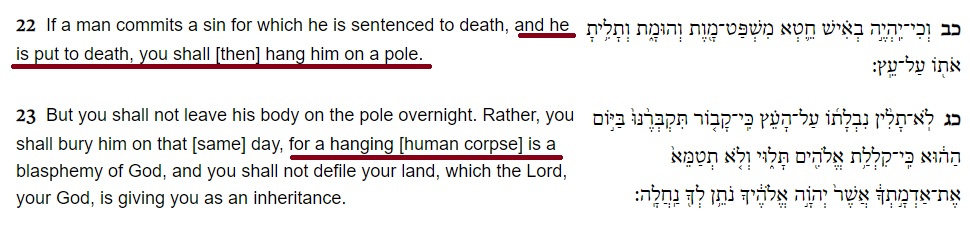
“If a man guilty of a sin worthy of death, and is put to death AND his corpse hung on a tree, it shall not remain on the tree overnight. You shall bury it the same day, otherwise, since God’s curse rest on him who hangs on a tree, you will defile the land which the Lord, your God is giving you as an inheritance.” (Deuteronomy 21:18-23)

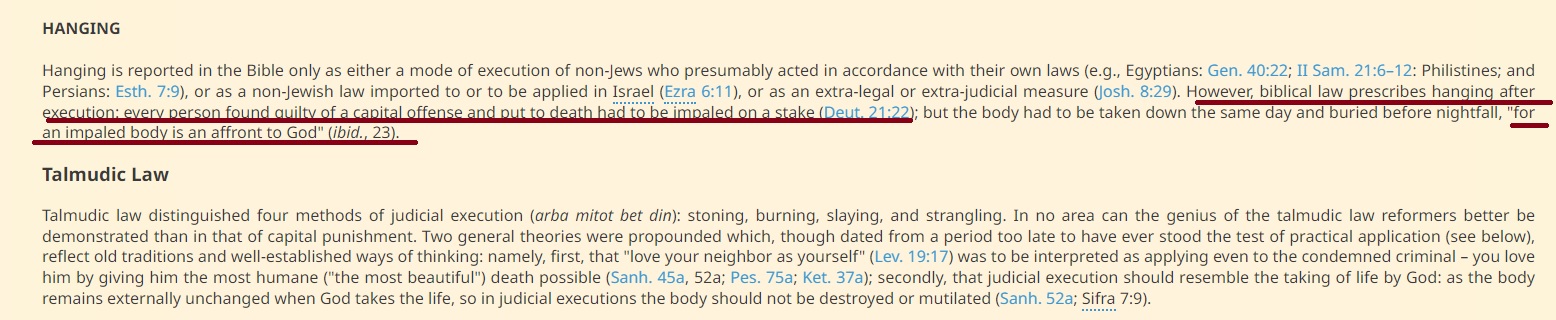
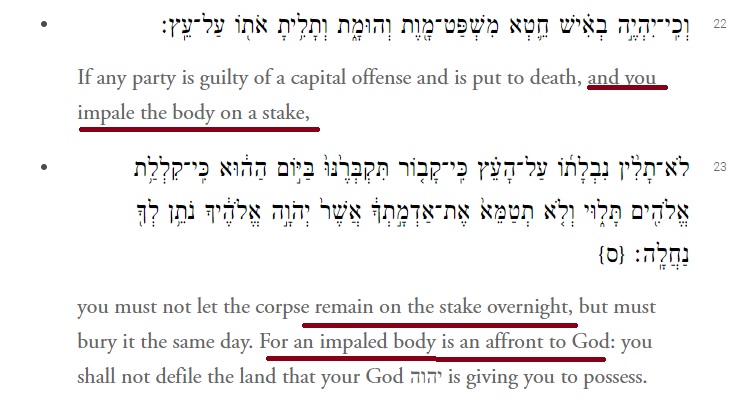
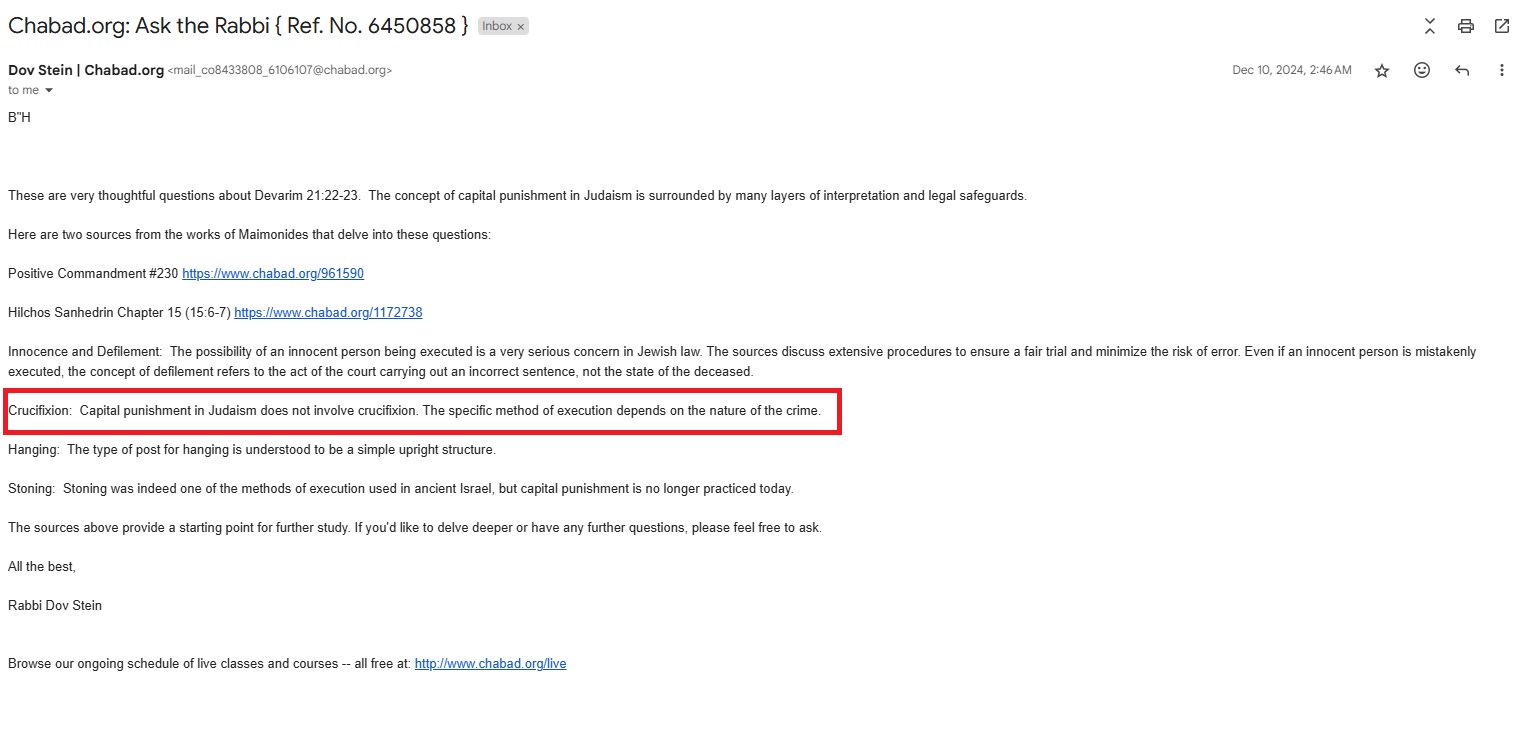
The Hebrew root ת.ל.ה/י can mean hang. But in the context of corpses, it means “impale,” and thus עץ here means not “tree” or “gallows” but “stake.”

You will notice this as well when you look at disparate translations of the text.

Hung on a tree‘ or ‘impaled on a tree.’

In any case, the hanging or impaling was not the means used to execute the criminal; he was first put to death by the ordinary means, stoning, and his corpse was then exposed on high as a salutary warning for others.” Source: (New American Bible pg. 180 commentary on Deuteronomy 21)

So what is the objective of Qur’an 4:157-158 ?

a) It repudiates the claims of those Jews who claimed that they killed him in any way shape or form. In this case, the ‘they didn’t kill him’ would be a reference to stoning.

b) It repudiates the claims of those Jews who claimed the impailed Jesus. The text clearly mentions salabu-impailed. Jesus died by being impailed. The text of Qur’an 4:157 is a reference to what Jews claimed about Jesus.

c) In connection to this, it repudiates the claim that Jesus became a curse or accursed. (Deuteronomy 21:18-23)

All of this can be seen by the following:

Rather, Allah exalted him in his presence. Allah is Almighty, the Wise.” Source: (Qur’an 4:158)

Whereas the New Testament claims:

Christ has redeemed us from the curse of the law, being made a curse for us: for it is written, cursed is everyone that hangs on a TREE.” (Galatians 3:13)

Question? Did Jesus commit a sin worthy of death?

“And if a man have committed a sin worthy of death, and he be put to death, and you hang him on a TREE: his body shall not remain all night upon the TREE, but you shall in any wise bury him that day; that thy land be not defiled, which the Lord thy God gives thee for an inheritance.” (Deuteronomy 21:22-23)

If the answer is yes, then Jesus is not an unblemished sacrifice!
If the answer is no, then Jesus is obviously not accursed as he is not guilty of sin and thus never lifted anyone from any law! Allah obviously knows who is guilty and who is not.

Merely being displayed in the tree does not mean one is accursed. You have to have committed a sin worthy of death.

Paul said above in Galatians 3:13 that Jesus became a curse for us.

“Therefore, I make known to you that no one speaking by the Spirit of God calls Jesus accursed, and no one can say that Jesus is Lord except by the Holy Spirit.” (1 Corinthians 12:3)

If no one speaking ‘by the Spirit of God’ calls Jesus accursed, we wonder what spirit motivated Paul to make such a statement?

Accursed has reference to the state of one’s heart. This is not something to attribute to a messenger of Allah.

“When you do read the Qur’an, seek Allah’s protection from Satan the l-rajimi.” (Qur’an 16:98)

l-rajimi means the rejected, accursed or stoned. This verse is also a rejection of the claims of Christians that Jesus became a curse, or those Jews who claim that Jesus was stoned, or the overall claim by those who never accepted him as being rejected.

Satan is the raijim not Jesus!

All three claims in one are refuted.

This is why Christians believe that Jesus said:

“And about the ninth hour, Jesus cried out with a loud voice, saying, “Eli, Eli, lama sabachthani?” that is, “My God, My God, why have You forsaken Me?” (Matthew 27:46)

The Qur’an also repudiates the claim that Jesus was ever forsaken by Allah. Both before, during, and after the death of Jesus.

BEFORE HIS DEATH

“Behold,” the angels told Mary, “Allah has given you the glad news of the coming birth of a son whom He calls His Word, whose name will be Messiah, Jesus, son of Mary, who will be a man of honor in this life and the life to come, and who will be one of the ones nearest to Allah.” (Qur’an 3:45)

Can it be argued that there ever was a time in which Jesus was not ‘near to Allah‘?

During his death. If we assume the Roman imperium impaled Jesus, the following could have been revealed to him as reassurance and solace:

“Allah said, O Jesus, I shall cause you to die and will exalt you in my presence and shall purify you of the ungrateful disbelieving people, and shall place those who follow you above those who deny the truth, until the Day of Judgement; then to Me shall all return and I will judge between you regarding your disputes.” (Qur’an 3:55)

This is also what is meant by:

“The Day when Allah will say, “O Jesus, Son of Mary, remember My favor upon you and upon your mother when I supported you with the Holy Spirit.” (Qur’an 5:110)


This is why we know that if Jesus actually cried out while being impaled, it is an acknowledgment of him willing to die in holy armed struggle against the Roman imperium.

“And at the ninth hour, Jesus cried out with a loud voice, saying, Eli, Ali, lemana, shabakthani! Which means, My God, my God, for this is my purpose! “

Source: (Mark 15: 34 George M Lamsa translation)

AFTER HIS DEATH

“Rather, Allah exalted him in his presence. Allah is Almighty, the Wise.” (Qur’an 4:158)

” And how I prevented the children of Israel from harming you when you came to them with all evidence of the truth.” (Qur’an 5:116)

“I did not say anything to them except what you commanded me with: That worship Allah, my Lord, and your Lord.” (Qur’an 5:116)

THE CHRISTIAN DILEMA. REVISITING GALATIANS 3:13

Temporal Mismatch (Ante-mortem vs. Post-mortem)

Deuteronomy 21:22-23 explicitly describes a two-step process:

  1. The man is put to death (executed by legal means, typically stoning).
  2. Then his corpse is hung on a tree.

The hanging is not the means of execution. It is an additional act of post-mortem shaming.

In Roman crucifixion (or impalement), the person dies on the tree. The tree/cross is the instrument of death, not a display after death. Paul applies “cursed is everyone who hangs on a tree” to a living person dying on the tree. That is a category error according to the original legal context.

The Curse Attaches to a Convicted Criminal, Not the Method Alone

Deuteronomy 21:22 says the man was put to death for a capital offense — a sin worthy of death. The curse is not magical or mechanical. It is juridical: God’s law says a executed criminal’s displayed corpse brings a defilement if left overnight.

Paul, however, treats the phrase “cursed is everyone who hangs on a tree” as if hanging itself imparts a curse, regardless of the person’s innocence or guilt. He then claims Jesus became that curse for us, even though Jesus was (in Christian belief) innocent.

But the Torah text assumes guilt. An innocent person would never be executed, let alone hung. So Paul inverts the logic: an innocent person takes on a curse meant for the guilty by undergoing a death resembling the post-mortem display.

This is massively devastating to Christianity.

The Qur’anic Critique.

The Qur’an implicitly rejects this entire move in *Q 4:157-158* by:

  • Denying Jewish claims to have killed or impaled Jesus.
  • Affirming God exalted Jesus to Himself — no curse, no humiliation.
  • Rejecting the idea that any prophet of God could be in a state of divine curse or abandonment.

From a Qur’anic perspective, Paul’s error is not exegetical sloppiness but theological overreach — applying a law about executed criminals to an innocent messenger of Allah, and then turning that into a doctrine of vicarious atonement.

The writer of Galatians misapplies Deuteronomy 21:22-23 by:

  1. Ignoring the post-mortem context and treating it as ante-mortem.
  2. Ignoring the requirement of a prior capital crime.
  3. Using the verse to claim Jesus became a “curse” — something the Qur’an explicitly denies.

The Dilemma Restated

Premise 1 (from Torah, Deuteronomy 21:22-23):
The “curse of God” applies only to a person who has committed a sin worthy of death, who is executed, and whose corpse is then displayed on a tree.

Premise 2 (from Christian theology):
Jesus died by hanging on a tree (cross), and Galatians 3:13 says he became a curse for us.

Question: Did Jesus commit a sin worthy of death?


A: Yes, Jesus committed a sin worthy of death.

  • If yes, then:
    • Jesus was a legitimate criminal under Torah law.
    • He was not innocent.
    • He cannot be an “unblemished” or sinless sacrifice (contradicting 1 Peter 1:19, Hebrews 9:14).
    • His death was his own just punishment, not a vicarious atonement for others.
    • Christianity collapses because the entire sacrificial logic requires a sinless victim.

Conclusion: Christianity is false.


B: No, Jesus did not commit any sin worthy of death.

  • If no, then:
    • Deuteronomy 21:22-23 does not apply to him.
    • The “curse” in that verse has no legal or theological standing over an innocent person.
    • Paul’s application of the curse to Jesus in Galatians 3:13 is invalid — he is quoting a verse that has nothing to do with an innocent man.
    • Jesus did not “become a curse” for anyone.
    • He therefore did not redeem anyone from the curse of the law, because there is no mechanism by which an innocent person’s undeserved death transfers to the guilty under Torah.

Conclusion: Paul made an exegetical and theological error. Jesus remains innocent, but Pauline atonement theology is unfounded.


Why This Dilemma Is Fatal to Pauline Christianity?

Christian theology wants both:

  1. Jesus is absolutely sinless (no sin worthy of death).
  2. Jesus became a curse for us (Galatians 3:13 quoting Deuteronomy 21).

But the Torah text does not allow an innocent person to be “cursed” in that juridical sense. The curse is not magical or transferable — it is a legal declaration attached to a guilty, executed criminal’s corpse.

Paul’s move is to sever the curse from guilt and reattach it to the method of death alone. That is not exegesis; it is creative theology. But it violates the plain meaning of the Hebrew text.


The Qur’anic Resolution

The Qur’an simply rejects the premise that Jesus was ever in a state of curse or humiliation before God:

“Rather, Allah exalted him in His presence. Allah is Almighty, the Wise.” (Qur’an 4:158)

And:

“They did not kill him, nor did they impale him, but it appeared to them so.” (Qur’an 4:157)

From the Qur’anic perspective:

  • Jesus committed no sin.
  • He was not accursed.
  • He was not abandoned by God (contra Matthew 27:46).
  • Therefore, Galatians 3:13 is a false attribution to God’s law.
  • Allah knows who is guilty and who is innocent. An innocent man does not become cursed, and no prophet is made a curse for others.

Possible Christian Responses (And Why They Fail)

Christian ResponseWhy It Fails
“Jesus became a curse representatively, not because he was guilty.”Deuteronomy 21 does not recognize representative curse. The curse is on the actual criminal.
“The curse is on the manner of death, not the person’s sin.”The text says “cursed by God is everyone who hangs” — but that “everyone” is already defined as an executed criminal. You cannot separate the curse from guilt.
“Paul is doing midrash, not literal exegesis.”Then it is not a proof text. If you abandon literal meaning, you abandon legal force.
“Jesus bore the curse for us as a substitution.”Substitution requires the substitute to be legally eligible to bear the curse. Torah never allows an innocent substitute to be cursed in place of the guilty.

None of these responses resolve the core logical contradiction we have identified.

THE LESSON FOR MUSLIMS IN THE DEATH OF JESUS AS A MARTYR.

This is based on speculation.

It is likely that Jesus died as a martyr in an armed struggle against the authority of the Roman imperium.

And never think of those who have been killed in the cause of Allah as dead. Rather, they are alive with their Lord, receiving provision, Rejoicing in what Allah has bestowed upon them of His bounty, and they receive good tidings about those after them who have not yet joined them – that there will be no fear concerning them, nor will they grieve.” (Qur’an 3:169-170)

Allow me to share with you a very interesting text from the Qur’an.

The Injil or Gospel is mentioned 12 times in 12 verses of the Qur’an. In one of those verses we have the following:

“Indeed, Allah has purchased from the believers their lives and their properties [in exchange] for that they will have Paradise. They fight in the cause of Allah, so they kill and are killed. [It is] a true promise [binding] upon Him in the Torah and the Gospel and the Qur’an. And who is truer to his covenant than Allah? So rejoice in your transaction which you have contracted. And it is that which is the great attainment.” (Qur’an 9:111)

Prima Qur’an Comment: Out of all the teachings that Allah could inform us about concerning what Jesus taught in the Injil, why did Allah mention the teaching concerning martyrdom? Why would Jesus teach about ‘killing and being killed’ if he was simply a pacifist?

“Do not be afraid of those who kill the body, but cannot kill the soul. Rather, be afraid of the One who can destroy both soul and body in hell.” (Matthew 10:28)

“I tell you, my friends, do not be afraid of those who kill the body and after that can do no more.” (Luke 12:4)

This is exactly what Allah [swt] would have revealed to Jesus if indeed the Romans impaled Christ Jesus.

“Allah said, O Jesus, I shall cause you to die and will exalt you in my presence and shall purify you of the ungrateful disbelieving people, and shall place those who follow you above those who deny the truth, until the Day of Judgement; then to Me shall all return and I will judge between you regarding your disputes.” (Qur’an 3:55)

Jesus received good tidings about those that would come after him and have not joined him yet. While the people were perceiving that Jesus had a horrible ending, the death of Jesus was a tranquil experience, and Jesus was told that he would be cleared of the falsehoods said concerning him.

It is Allah Who takes away the souls at the time of their death, and those that die not during their sleep. He keeps those for which He has ordained death and sends the rest for a term appointed. Verily, in this are signs for a people who think deeply” (Qur’an 39:42)

“And do not say about those who are killed in the way of Allah, “They are dead.” Rather, they are alive, but you perceive [it] not.(Qur’an 2:154)

“Indeed, Allah has purchased from the believers their lives and their properties in exchange for that they will have Paradise. They fight in the cause of Allah, so they kill and are killed. It is a true promise binding upon Him in the Torah and the GOSPEL and the Qur’an. And who is truer to his covenant than Allah? So rejoice in your transaction which you have contracted. And it is that which is the great attainment.” (Qur’an 9:111)

Look at this astonishing verse above. That the idea of fighting in the cause of Allah [swt] killing and being killed is established in the Qur’an, the Torah and the GOSPEL.

Rather than Christ Jesus being seen as some theological projection onto Judaism, a very different picture emerges. We have a Christ Jesus who was a Jewish prophet, a Muslim, a Messenger of Allah [swt], and a figure ultimately wanted dead by the Roman authorities.

Instead, what emerges is a picture of a Messenger of Allah [swt] who was defiant to the very end. He challenged the religious authorities of his time and challenged the government of his time, ultimately leading to his trial and his death. In the face of this death, Jesus became triumphant and became a symbol of martyrdom.


Jesus had spent most of his life calling the children of Israel to Allah and correcting the learned on points where they were in error. Jesus’ teachings on martyrdom were a threat to the Roman government. Jesus and a group of pious Jews who were sick and tired of the Roman Imperium most likely led a violent revolt against the Romans. Jesus and some of his people were charged with sedition and impailed.

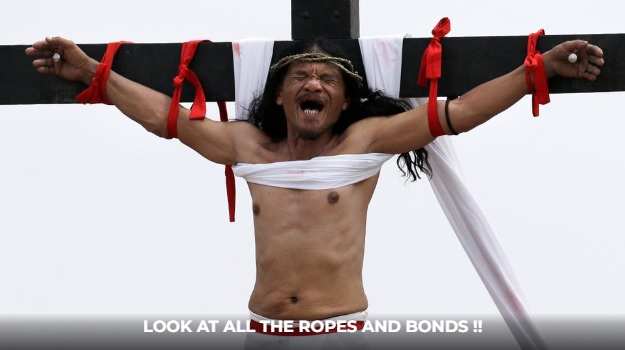
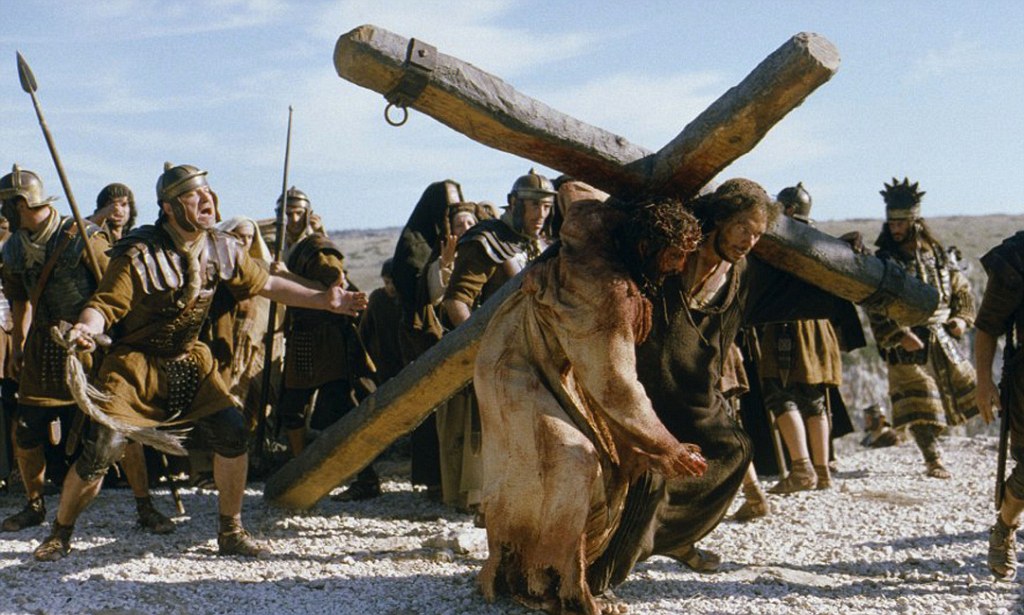
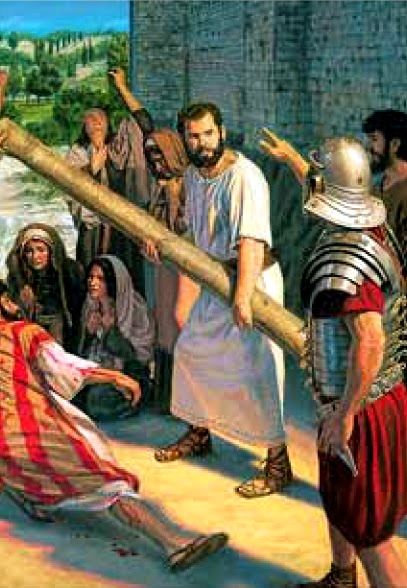
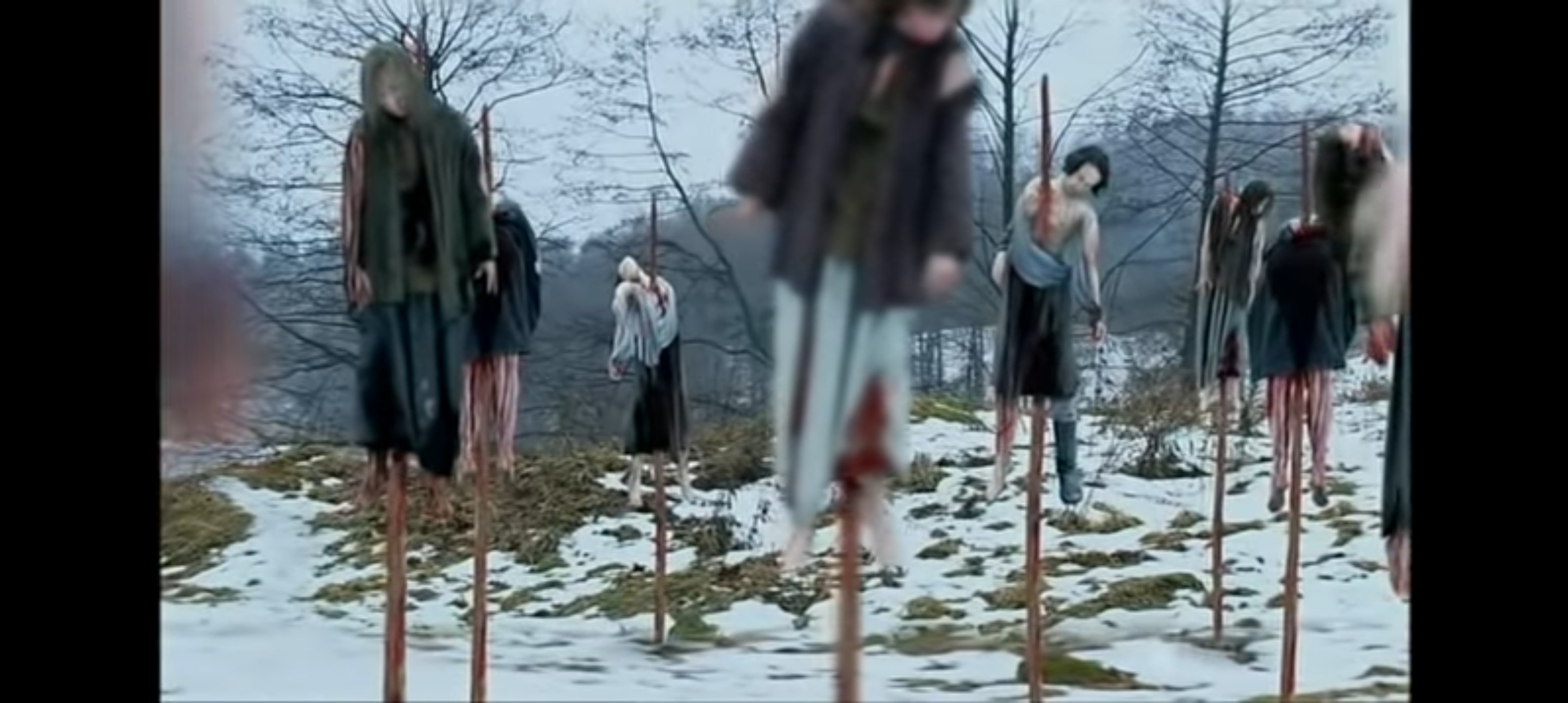
Jesus didn’t die with relative dignity hanging from the cross. He died, suspended on one single stake penetrating his body: he was impaled. There were no nails in his hands or feet. He did not die on a cross-shaped execution tool († or T). Just a sharp stake shoved right into his body upon which he was suspended – that is the most logical and plausible form of execution of Jesus by far…

Furthermore, one of the alleged witnesses, St. Mark, tells us that at the most critical juncture in the life of Jesus — “All his disciples forsook him and fled“- (Mark 14:50).

The Roman spectacle of impalement was meant to be as savage and tortuously cruel as possible because it had to accomplish two things.

  1. To act as a visual deterrent to crime and, in the case of Jesus — uprising against an oppressive regime.
  2. To provide a theater of gore to satisfy the bloodlust of those who came to watch. The spike was the centerpiece of this typically gruesome Roman conception. That is why they didn’t just kill Jesus with a sword and be done with it.


Most likely the Romans introduced the tip of the spike into the victim’s back side and continued hammering it, pushing it far enough to where it passed under the pelvic bone so it would support the body on the impale.

The two thieves, if they were real, (most likely really guilty of sedition), get the same treatment. When the impale device was upright, it kept the victim’s body from being torn loose by his own weight and sliding off. That was its practical use.


But there was also a kind of diabolical sideshow, something to further attract the viewer interest in the impalement process. With the spike thrust under the pelvic bone, but not yet coming out of the body, a man could use the leverage of his arms and his legs to project his body outward, curving it away from the impale and thus preventing the spike from penetrating any further up into the bowels. But as one’s arms gave out, one’s body would slowly sink down on the spike, causing the spike to penetrate further along through one’s maze of intestines.

Eventually, after the leg strength also gave out, all leverage was lost and the body, of its own weight, would slump/slide back against the vertical beam, driving the spike slightly upwards through the body’s maze of vital organs until it pierced the stomach lining from the inside out, spewing blood and guts all over the ground.

Mercifully, death usually followed in a short time thereafter. When it came to devising fiendish methods of torture and death, the Romans were absolutely without equal. They left no sadistic, bloodthirsty detail behind.

It is also reasonable that Jesus hastened his own death by forcing his body down on the spike, an extremely awesome and heroic achievement! It indicates that Jesus had no fear of death. We imagine Jesus looking on at the Romans, with a certain look in his eye as if to say, “Go ahead, make my day!” Whereas the two thieves, if they were real, (most likely rebels) used all their strength to cling to life as long as possible. Hence, the breaking of the legs!

During his death: When the Romans impaled Jesus, it is possible the following was revealed to him as reassurance:

“Allah said, O Jesus, I shall cause you to die and will exalt you in my presence and shall purify you of the ungrateful disbelieving people, and shall place those who follow you above those who deny the truth, until the Day of Judgement; then to Me shall all return and I will judge between you regarding your disputes.” (Qur’an 3:55)

This is also what is meant by:

“The Day when Allah will say, “O Jesus, Son of Mary, remember My favor upon you and upon your mother when I supported you with the Holy Spirit.” (Qur’an 5:110)

WHAT HAPPENS TO THE BODY OF JESUS?

This would be an obvious question from Christian. One that they may find suspect.

The Christian version:

“Jesus, when he began his ministry, was about thirty years of age, being the son (as was supposed) of Joseph, the son of Heli.” (Luke 3:23)

We are told that God incarnate was on the earth for 30-something years, not really doing much of anything. Only 3 years of his life were truly important. He died on the double cross, rose from the dead and ascended bodily up into heaven.

A possible Muslim version

During the impalement, Allah (swt)took the soul of Jesus, leaving behind his body, as he does with everyone else. His body was either given over to his followers or they stole it at night for a more proper burial.

“While the women were on their way, some of the guards went into the city and reported to the chief priests everything that had happened. When the chief priests had met with the elders and devised a plan, they gave the soldiers a large sum of money, telling them, “You are to say, ‘His disciples came during the night and stole him away while we were asleep.’ If this report gets to the governor, we will satisfy him and keep you out of trouble.” So the soldiers took the money and did as they were instructed. And this story has been widely circulated among the Jews to this very day.” (Matthew 28:11-15)

Even though we have not even a shred of evidence outside the New Testament accounts that this was a Jewish polemic directed towards Christianity, we believe it to be plausible. Namely, the disciples took the corpse of Jesus and buried it in a place they found suitable.

The life of Jesus can be likened to a 3-hour Blu-ray in which, in the Christian version, the first 2 hours and 30 minutes are missing (30 years) and in the Islamic version [that we find plausible] the last 15 minutes are missing (last few days).

Whatwe mean by this is that the last 15 minutes are so important to Christian theology that they are obviously not going to be agreeable to what we believe.

Muslims don’t have to lose any sleep over where the bodies of prophets are buried. In the end Allah (swt) knows best.

For reasons why we do not find the supposed crucifixion historical kindly see our article here:

“The Messiah, son of Mary, was no other than a messenger, messengers (the like of whom) had already passed away before him. And his mother was a saintly woman. And they both used to eat (earthly) food. See how We make the revelations clear for them, and see how they are turned away!” (Qur’an 5:75)

“And when they hear what has been revealed to the Messenger, you see their eyes overflowing with tears because of what they have recognized of the truth. They say, “Our Lord, we have believed, so register us among the witnesses.” (Qur’an 5:83)

May Allah (swt) Guide the Ummah.

May Allah (swt) Forgive the Ummah.
11 Comments

Filed under Uncategorized

Jesus was not crucified: the evidence with Dr. Ali Ataie

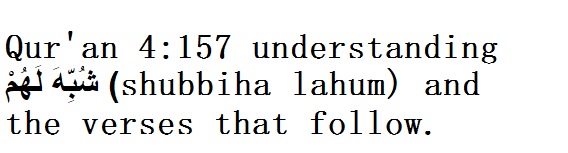
“And for their saying, “Indeed, we have killed the Messiah, Jesus, the son of Mary, the Messenger of Allah.” And they did not kill him nor did they impale (ṣalabūhu) him; (وَمَا قَتَلُوهُ وَمَا صَلَبُوهُ وَلَٰكِنْ شُبِّهَ لَهُمْ)but it was made to appear to them so. Those who differ therein are full of doubts. They have no certain knowledge of it, but only follow conjecture. For certainly, they did not kill him.”  (Qur’an 4:157)

﷽ 

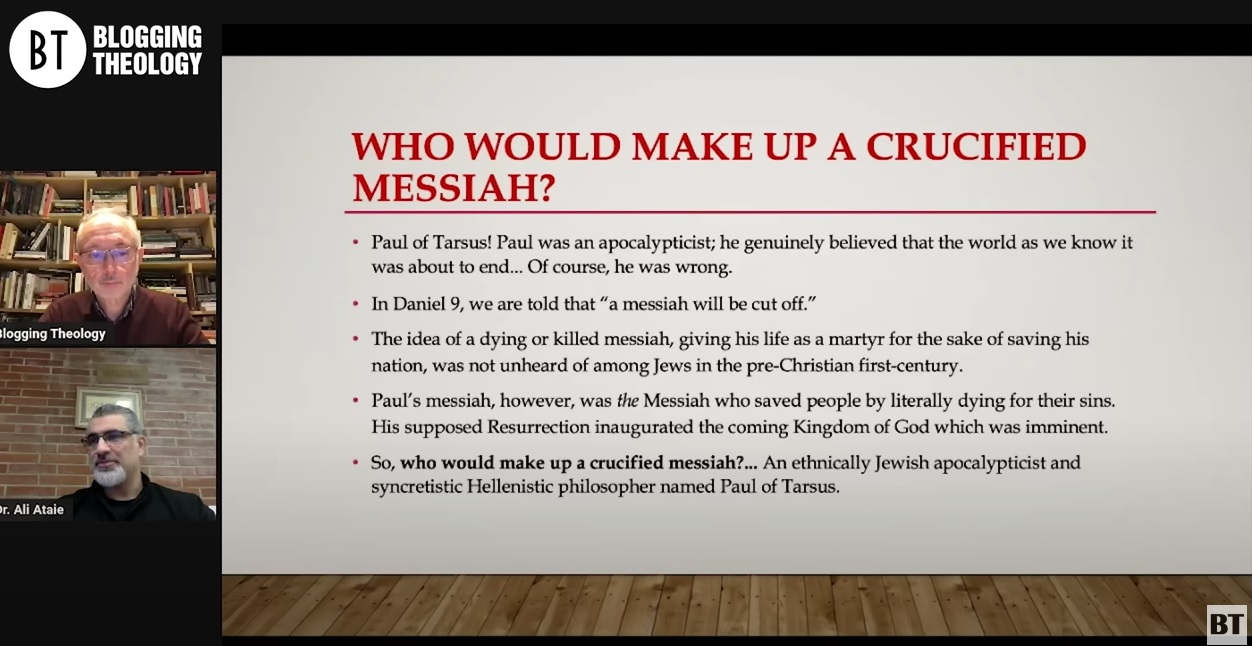
These are some of our thoughts after an attentive listen of all 3 hours 36 minutes and 33 seconds on the Blogging Theology video entitled: ‘Jesus was not crucified: the evidence with Dr. Ali Ataie.’

You may see this here:

Paul Williams and Blogging Theology are still our number one favourite youtube channel.W

e also feel (for our interest) the most relevant in the English language.

Our thoughts are that Dr. Ali Ataie is almost there. The stand out from this, the absolutely commendable point is that Dr. Ataie is challenging what is considered to be a historical ‘fact,’ namely that Jesus of Nazareth was Crucified to death by the Roman Imperium.

That in and of itself is refreshing. We have been saying this for years. After looking at the so called “evidence” both biblical and extra biblical we haven’t found it convincing at all.

As we have pointed out in a previous article here: how does anyone read Qur’an 4:157 and walk away with the understanding that it is talking about Romans, Crucifixion or Cross at all?

It is simply bizarre to us.

Dr. Ataie has a good opening preface that when it comes to issues like resurrection, and other miracles those are simply things that history cannot attest to. There could be a natural and supra natural explanation. Miracles are not considered by modern historians when looking at the past. That being said miracles are not unhistorical it’s just that being in the realm of the supranatural historians do not consider it.

This is a very fair and reasonable point raised by Dr. Ataie.

Again another reason why Muslims should not be too excitable over claims by historians and /or orientalist. At the heart of research are simply different epistemology.


Paul Of Tarsus conversion story for example, is non historical.

“I trust Allah and his Messenger.”-Dr. Ataie

We can only say that: “Ditto.”


@17:55 “If that man said that Jesus wasn’t crucified then I believe him. And I don’t care what Bart Ehrman…..”-Dr. Ataie

Prima Qur’an comments: You see dear reader for some reason Dr.Ataie, Dr. Shabir Ally, Dr. Fatoohi, all think the Qur’an is engaging with something called “crucifixion”

The Qur’an is neither affirming nor denying any crucifixion. The Qur’an is interacting with claims made by Jews about Jesus (as).

As regard to an event that is commonly called ‘The Crucifixion’ the Qur’an is simply indifferent. It simpy neither denies nor affirms it.

Please see:

@19:34 Why in the world did he (Muhammed) deny the crucifixion of Jesus? -Dr. Ataie

Prima Qur’an comments: Again we have read the same Qur’an Dr. Ataie is reading and we simply do not see crucifixion any where in the Qur’an at all.

“The historical case for the crucifixion is not nearly as strong as what we have been lead to believe.” -Dr. Ataie.


@22:36 “It is axiomatic for Westerns that it has happened.”

@24:09 Dr. Ataie goes into the various theories Muslims have in regards to the “crucifixion” of Jesus.

Dr. Ataie is closet to the truth out of them all (Has he been reading Prima-Qur’an?).

@30:17 Dr. Ali Ataie comments that “Crucified victims were left on their crosses long after they expired.”

Dr. Ali Ataie still struggles with Divine Rapture Theory. As he does not find it to be in agreement with the Qur’an and/or historically plausible.


@32:26 Dr. Ali Ataie addresses the issue of Supranatural identity transference.
@32:50 Dr. Ali says that most Muslim exegetes go with this idea that “Jesus was no where near a cross.”

A common trope that we hear from some atheist is that secular historians are objective, unbiased and inductive.

@34:12 objective, unbiased, inductive. -Historians?

Dr. Ataie does an excellent job of going into an analysis of this. How historians have come up with different perspectives and have contradicted each other and how they may not be as objective or unbiased or even as inductive as they may lead themselves to believe.

Dr. Ataie, We owe you lunch! Well said. May Allah (swt) elevate him.

@40:28 Dr. Ataie states: “But I do believe that myth and legend has probably soo permeated the gospel accounts of Jesus passion narratives that it is not at all beyond reason to dismiss them completely as historical fiction!”

Prima-Qur’an comments: Allahu Akbar! There you go Dr. Ataie now that is the ticket!
Than the idea that someone was “crucified” is likely based upon what? Myth and legend.

Dr. Ataie gets into his understanding of: Qur’an 4:157 “It was made to appear to them so.

@53:38 “They did not have information. It did not come from a reliable source.”
@54:11 “Jews and Christians ended up following hearsay reports about some crucifixion event from non eye-witnesses….”

Prima-Qur’an comments: This is exactly what shubbiha lahum means. It is not shubi ha alayhim!

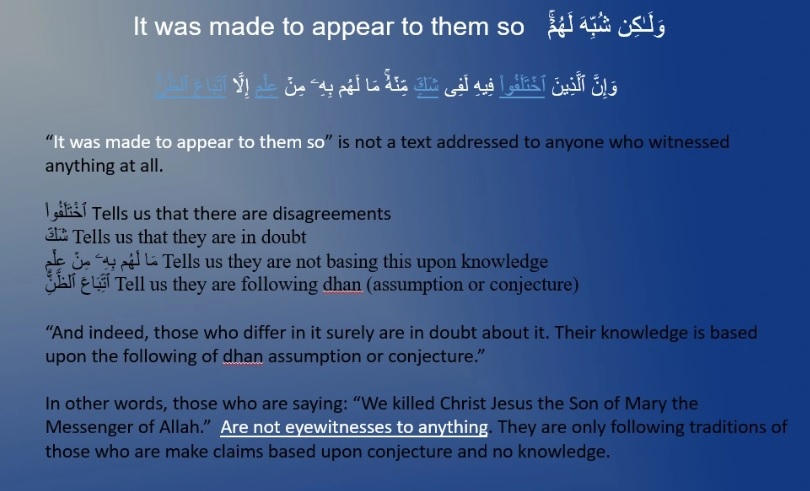
In fact because we love you the readers insh’Allah we will give you a sneak peak at one of the slides that Shaykh Hilal and those of us at Prima Qur’an have been working on.

  1. Disagreements.
  2. They are in doubt.
  3. They have no knowledge about it.
  4. They are following dhan (assumption or conjecture).

These are not things that we would describe eye witnesses to an event with.


@54:25 “When you say it was made to appear to them that it was so who is the implied actor there? Who made it appear to them it was so. Is this referencing God or some other-who is applied in that if you see what I mean?” -Paul Williams.

Prima Qur’an comments: Brother Paul asked a very great question. Very insightful. This is what was answered above. The whole event in which by the way is Allah (swt) addressing Jews and claims made by Jews is that they killed Jesus and impailed him.

This is based upon Jewish claims that were in orally in circulation in the time of the Prophet (saw).

There is absolutely nothing in Qur’an 4:157 about Romans, or about a cross or about a crucifixion which we will come to Insh’Allah

@1:00:53 “Is there any material evidence of any Jew who was ever crucified by the Romans in ancient Palestine? Apparently tens of thousands of Jews were crucified and all archeologist have ever found was a single heel bone of a man with a nail driven through it, they call him Yohanan. I don’t know how they know his name but that’s what they call him.” -Dr. Ataie.

@1:12:24Paul was the first one in recorded history to claim that Jesus was crucified.”- Dr. Ataie.

Prima-Qur’an comments: This is a genius point not because its clever but because it’s true and it is overlooked by way too many.

Paul lays down his theology in 1 Corinthians 15:3-8.

In fact, Allah-willing we will go ahead and lay out the systematic destruction of this group of text

“If the foundation is destroyed what shall the righteous do?” (Psalms 11:3)

Question: Just how important is the theology in 1 Corinthians 15:3-8?

Answer:

“Now if Christ be preached that he rose from the dead, how say some among you that there is no resurrection of the dead? But if there be no resurrection of the dead, then is Christ not risen: And if Christ be not risen, then is our preaching vain, and your faith is also vain. And if Christ be not raised, your faith is vain; you are still in your sins.” (1st Corinthians 15: 12-14, and 17)

Prima Qur’an Comment: Two major points need to be deduced from the above proof text.

1) If Christ Jesus did not raise from the dead, Christianity is a fruitless endeavor in every respect. Muslims do not say that, the Bible says it.

2) If Christ Jesus is not raised from the dead, Christians are still in their sins; and the whole of Christian theology is fruitless. Muslims do not say that, the Bible does.

Note: (Paul does not try and prove his case on an emptied tomb.)

“For I determine not to know anything among you, save Jesus Christ, and him crucified.” (1st Corinthians 2:2)

Note: Paul is not interested in the historical Christ.

In fact Paul never met the historical Jesus in his lifetime! He only claims to have met Jesus in a vision in Acts 9 , 22 and 26 and each and everyone of those text if juxtaposed contradict and conflict with one another.

“If the foundation is destroyed what shall the righteous do?” (Psalms 11:3)

How sound is that first account of the crucifixion that Paul is relating to us and the whole of Christian theology is hinging on?

How sound is it? Is the foundation solid?

Analyzing the foundation of Christian theology.

(1 Corinthians 15:3-8) <<< The Foundation of Christianity is built upon this text.

“For I delivered unto you first of all that which I also received, how Christ died for our sins according to the scriptures.” (1st Corinthians 15:3)

Prima Qur’an Comment:

Paul is referring to the Hebrew Scriptures because there were no New Testament writings at that time. However the fault in this text is that there is no place in the Hebrew scriptures that says a Messiah will die for our sins! Nowhere from Genesis to Malachi! There are allegories about other things.

“And that he was buried, and that he rose again the third day according to the scriptures.” (1st Corinthians 15:4)

Prima Qur’an Comment:

Again, nowhere in the Hebrew scriptures from Genesis to Malachi does it say that a Messiah will rise from the dead on the third day!

“For as yet they knew not the scripture that he must rise again from the dead.” (John 20:9)

Prima Qur’an Comment:

Even Jesus disciples did not know any scriptures about a Messiah rising from the dead.

There is a major contradiction in this narrative as well.

A Contradiction

“And although THEY found no cause of death in him, yet desired THEY Pilate that he should be slain. And when THEY had fulfilled all that was written of him THEY took him down from the tree, and laid him in a sepulcher.” (Acts 13:28-29)

Note: (They the Jews who desired his death put him in the tomb, which is contradicted point blank by the Gospel of Mark.)

“And HE brought fine linen, and took him down, and wrapped him in the linen, and laid him in a sepulcher which was hewn out of a rock, and rolled a stone unto the door of the sepulcher.” (Mark 15:46)

Note: (Joseph himself put Jesus in the tomb not the Jews who desired his death as in Acts.)

Also, if they fulfilled all that was written of him there would be no “rose again the third day according to the scriptures.”

“And that he was seen of Cephas, then of the Twelve.” (Ist Corinthians 15:5)

Prima Qur’an Comment:

There the Greek word for seen is Opthe, and is used for spiritual seeing as in a vision. No where in the Bible does it say Peter had an independent sighting of Jesus n this order that Paul is giving?

Question: What does ‘opthe’ mean?

Answer: spiritual seeing a vision

Also “ appearing to the twelve” is wrong because Judas committed suicide. To say that twelve is just a terminology is not true! Jesus called them the 12 apostles and when Judas died the terminology changes to 11 until the election of Mathias in Acts 6:2!

Catholics, however, got it right. The Douay-Rheims which was diligently compared with the original Greek’ text they say 11! So Somebody’s Greek text is wrong!

Source: (The Douay-Rheims New Testament (published by Tan Books and Publishers, INC. P.O. box424 Rockford, Illinois 61105)

“After that, he was seen of above five hundred brethren at once; of whom the greater part remain unto the present, but some are fallen asleep.” (1st Corinthians 15:6)

This is contradicted by the following text.

“This man God raised on the third day and granted that he be visible, not to all the people, but to us, the witnesses chosen by God in advance, who ate and drank with him after he rose from the dead.” (Acts 10:40-41)

From Emmaus to Jerusalem Paul wedges in 500 people who he says saw Jesus, and then Jesus ascends up into heaven that day.

“And it came to pass, while he blessed them, he was parted from them, and carried up into heaven.” (Luke 24:51)

This is in contrast to the following

“Until the day in which he was taken up, after that he through the Holy Ghost had given commandments unto the apostles whom he had chosen: To whom also he showed himself alive after his passion by many infallible proofs, being seen of them forty days, and speaking of the things pertaining to the kingdom of God” (Acts 1:2-3)

The “Third Coming of Jesus”?

So if Jesus really did go up into heaven after he was raised again and then ‘beamed’ back down to hang around for 40 more days only to ‘beam’ back up this would mean that Christians are awaiting the 3rd coming of Jesus, and that just doesn’t sound too illustrious.

“After that he was seen of James; then of all the apostles.” (1st Corinthians 15:7)

Prima Qur’an Comment:

No where in the Bible does it say James had an independent sighting of Jesus in this order Paul is projecting. The Epistle of James has no account of a risen lord. What an encounter to leave out!

Again when all the apostles are mentioned are there 11 or 12? Which Greek text?

“And, last of all, he was seen of me also, as one born out of due time.” (1st Corinthians 15:8)

Prima Qur’an Comment:

Finally, Paul insert himself in the picture!

Note: Paul has been using that same word seen in Greek (OPTHE) all the way through to apply to all the apostles. Paul did not have a physical encounter with Jesus.

Paul also believes that the disciples did not have a physical encounter with Jesus as he uses the Greek word Opthe-seen all the way through 1 Corinthians 15:3-8.

Paul’s First account is thus discredited and the ‘foundation has been destroyed’.

We can stop right here and disregard everything else since the source of this crucifixion business is found to be incredible. However, we will pursue this in hopes that some people who did not grasp the argumentation above will find other evidence, Insha’Allah, conclusive.

Our apologies dear reader for the detour; we will continue with Dr. Ataie’s presentation.

Dr. Ataie continues also building his case upon what Paul has presented.

Namely that Paul says:

 I want you to know, brothers and sisters, that the gospel I preached is not of human origin.  I did not receive it from any man, nor was I taught it; rather, I received it by revelation from Jesus Christ.” (Galatians 1:11)

The isnaad-the chain of transmission of the Christian account of the crucifixion it begins with Paul.

@1:30:34 Dr. Ataie is quoting a statement of Bart Ehrman which is “Who would make up a crucified Messiah?”

Dr. Ali Ataie makes some good points butwe are not sold on the idea of the Jews expecting a Crucified Messiah. We do believe that the gospels are literary fiction to create a counter-Jesus narrative.

Also, important to note that the Qur’an no where states that no one killed Jesus. There is however, a specific text addressed to a group of Jews who claimed to have either killed or impailed Jesus.

Allow us to share with you a very interesting text from the Qur’an.

The Injil or Gospel is mentioned 12 times in 12 verses of the Qur’an. In one of those verses we have the following:

Indeed, Allah has purchased from the believers their lives and their properties [in exchange] for that they will have  Paradise. They fight in the cause of Allah, so they kill and are killed. [It is] a true promise [binding] upon Him in the Torah and the Gospel and the Qur’an. And who is truer to his covenant than Allah? So rejoice in your transaction which you have contracted. And it is that which is the great attainment. [Qur’an 9:111]

Qur’an Comment: Out of all the teachings that Allah could inform us about concerning what Jesus taught in the Injil, why did Allah mention the teaching concerning martyrdom? Why would Jesus teach about ‘killing and being killed’ if he was simply a pacifist?

To read more the Ibadi view please read:

https://primaquran.com/2022/10/04/what-happened-to-jesus-and-how-did-he-die/

@1:34:38 “The Qur’an says there was ikhtilaaf among the Christians?” -Dr. Ataie

Prima-Qur’an comment: Wait what??!

Can Dr. Ataie show us in the Qur’an 4:157 where there is mention of Christians? There is no mention of Christians. Allah (swt) is clearly addressing claims made by some Jews.

Dr. Ataie please be more careful in your handling of the text!

Dr. Ataie makes an interesting point that Q: The Sayings Gospel has no passion narrative or resurrection narratives.

Dr. Ataie twice during the presentation used language of obfuscation.

@2:04:09 “impailed on the cross” -Dr. Ataie

Prima-Qur’an comment: crucifixion and Impailment are suspension punishments but they are not the same thing. It is possible that Prima Qur’an is gaininig traction and that some people want to use language that obfuscates the issue.

A) Impailment is a punishment where a pike/spike or other sharpened object is shoved through the loins/lubmus region of the body. The spine is used to hoist the individual. Depending upon the technique used it is designed to be a quick death struggle after. After the hapless victim cannot use their feet or hands to keep the impale device from reaching vital organs due to exhaustion. The impale device pierces vital organs and the victim dies an excruciating death.

B) Crucifixion is a punishment where an individual is put on a patibulum which is than affixed to a crux (a pole or beam). There is no nothing driven through the spine and the spinal column is relatively left intact. This suspension punishment focuses on putting nails through the hands and feet and meant to be a prolonged death struggle. Death is usually from asphyxiations. No vital organs are pierced. In fact people could survive being crucified for days. Hence, Christians make a huge ordeal about Jesus being scourged before Crucifixion.

@2:39:11 Dr. Ataie is quoting the Sefer Toledoth Yeshu, the Aramaic version and yet quotes the following to us in English:

“The Rabbi says Jesus was executed for sorcery by stoning and then crucified his body was than removed from the cross and dragged through the streets.” -Dr. Ataie

Prima-Qur’an comment: We are very curious to know the source that Dr. Ataie is quoting from.We are very doubtful that the Aramaic words are cross and crucify just as we know that the Qur’an 4:157 does not say crucify or cross.

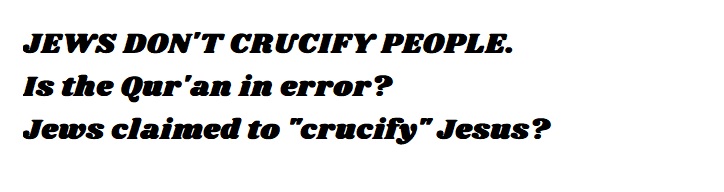
In fact, Jews do not crucify anyone either. But they do impail!

The Sefer Toledoth Yeshu (The Book of the History of Jesus)

You could read other versions that would describe how the Romans convicted him; how he died a charlatan’s death (hanging not even on a tree, but on a cabbage stalk); and suffered a criminal’s burial.

@2:49:21 Dr. Ali Ataie gives his version of events that he thinks happens.

Prima-Qur’an comments: Dr. Alie believes that Jesus Barabbas is crucified instead of Jesus by the Romans. A different take to the substitution theory with the key differences being that no miracles happened and no one was made to look like Jesus. Jesus miraculously ascended into heaven where it is presumed here is there even until this day.

@2:58:44 “wa lakun shuba lahum” Was made to appear to them so by the evangelist it was precisely their passion narratives that made people to think that Jesus was crucified.

“For we did not follow cleverly contrived myths when we made known to you the power and coming of our Lord Jesus Christ; we were eyewitnesses of his majesty.” (2 Peter 1:16)

@3:23:50 “Perhaps what Paul meant is that the Jews killed him by Crucifixion but historically and legally how would the Jews have executed Jesus? If he was found guilty of blasphemy or sorcery which is actually what the Toledoth Yeshu and Qur’an suggest the charges were. “This is evidence sorcery.” If that’s the case they would have stoned him and than crucified his body post mortem.” and thus the Qur’an says wama qataluhu wama salabuhu nor crucify him post mortem.”

Prima-Qur’an comments: Oh Dr. Ataie so close so close. If Dr. Ataie would have simply consulted Jewish legal works he would have found the answer to his question. A very good question btw.

but historically and legally how would the Jews have executed Jesus?”

Once you figure that out Dr. Ataie welcome to the Ibadi position on Qur’an 4:157. Welcome home!

It is not crucifixion it is impalement.

And for their saying, “Indeed, we have killed the Messiah, Jesus, the son of Mary, the Messenger of Allah.” And they did not kill him nor did they impale (ṣalabūhu) him; (وَمَا قَتَلُوهُ وَمَا صَلَبُوهُ وَلَٰكِنْ شُبِّهَ لَهُمْ)but it was made to appear to them so. Those who differ therein are full of doubts. They have no certain knowledge of it, but only follow conjecture. For certainly, they did not kill him.”  (Qur’an 4:157)

  1. Notice that the context Qur’an 4:157 is speaking about Jews. There is no mention of Romans in the text. You may start at Qur’an 4:154 for context.
  2. There is a double denial. They did not kill him nor did they (ṣalabūhu) him.
  3. Why the seemingly redundant text? Is it not sufficient to say “And they did not kill him?” Surely that covers everything?
  4. Why would Allah (swt) deny that Jews “Crucified” Jesus? Especially if Allah (swt) is aware of Jewish laws?
  5. Jews do not crucify anyone nor do they put people on crosses.
  6. Jews do however impale people. So translating (ṣalabūhu) as impale makes complete sense.
  7. The phrase “but it was made to appear to them” does not indicate that this was something Allah (swt) did.

Now what happens is for some reason Muslims look at Qur’an 4:157 and they see Romans! The whole context of the text is that Allah (swt) is talking about Jews.

If Allah (swt) wanted to say Romans he certainly he could have. Yet, Qur’an 4:157 mentions nothing about the Romans.

“The Romans have been defeated.” (Qur’an 30:20)

So where than do Muslims gets Romans or Crucifixion or Cross in Qur’an 4:157 ?? 🤷

Other articles about Dr. Ataie.

May Allah Guide the Christians so that they do not burn in the hellfire.

May Allah (swt) guide us to what is beloved to Allah (swt).

May Allah Forgive the Ummah.

May Allah Guide the Ummah.

3 Comments

Filed under Uncategorized

The Non-Crucifixion Verse by Dr. Louay Fatoohi: A response

“And for their saying, “Indeed, we have killed the Messiah, Jesus, the son of Mary, the Messenger of Allah.” And they did not kill him nor did they impale (ṣalabūhu) him; (وَمَا قَتَلُوهُ وَمَا صَلَبُوهُ وَلَٰكِنْ شُبِّهَ لَهُمْ)but it was made to appear to them so. Those who differ therein are full of doubts. They have no certain knowledge of it, but only follow conjecture. For certainly, they did not kill him.”  (Qur’an 4:157)

﷽ 

In today’s entry on Prima-Qur’an we will be going through this paper by Dr. Louay Fatoohi and sharing some thoughts on what he has written.

Those who are not aware the following is a biography of Dr. Louay Fatoohi.

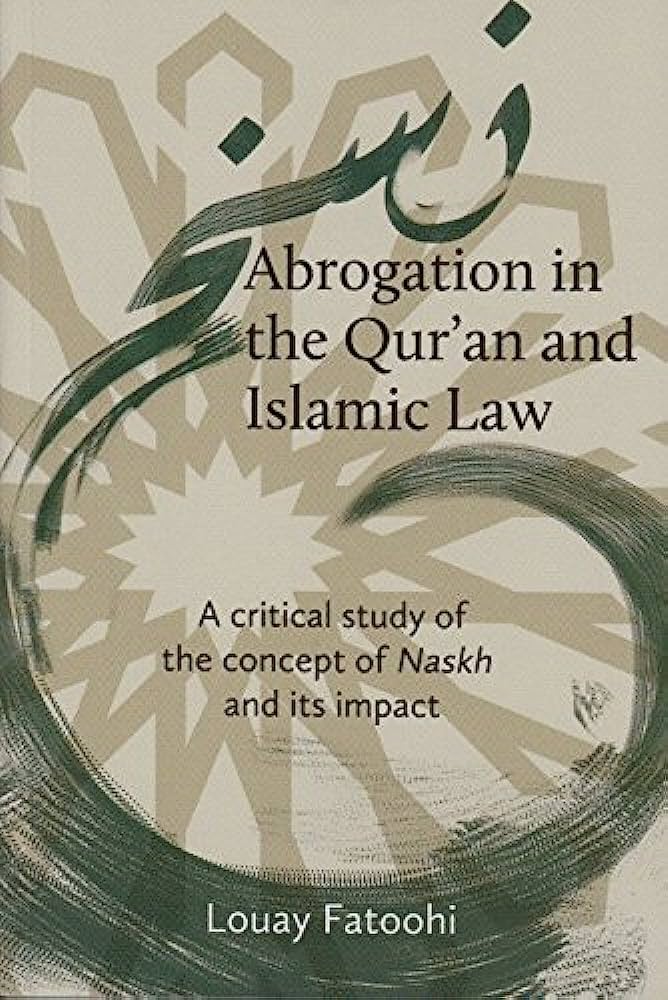
The above is also his website. If you have not read the following book, we would highly recommend it.

We gave our review of the book here: https://www.amazon.com/gp/customer-reviews/R1FCI7QXBCG2SJ/ref=cm_cr_dp_d_rvw_ttl?ie=UTF8&ASIN=9670526027

So now to the topic at hand: The Non-Crucifixion Verse: A Historical, Contextual, and Linguistic Analysis by Louay Fatoohi.

We read from his article:

“In the Qur’an, though, there is little interest in how and when false beliefs appeared, what their historical development was, or whether they were traceable to oral or written tradition. When certain beliefs are rejected in the Qur’an, this comes in the form of asserting that these were not communicated by God through prophets but distortions of the revelations and/or total fabrications by people.” -Louay Fatoohi.

Prima-Qur’an: We would agree that the Qur’an is not “speaking to the wall.” It is certainly addressing claims. In this case, we would both agree with claims made by Jews.

“It sounds unrealistic and farfetched to think that if an average Jew at the time was asked why they thought that the Christian Messiah was false, they would have pointed to one of those few passages in a polemical book that they probably had never read any part of!” -Louay Fatoohi.

Prima-Qur’an: Again we agree. Though it seems rather obvious that the Qur’an 4:157 at least addresses some claims made by some Jews as to a possibility of why they would reject Jesus as the Messiah.

“Also, if 4:157 is to be linked to the known claim that the Jews killed Jesus, then the logical source of choice should be the Gospel narratives, not a passing and vague reference in the Talmud.”-Dr. Louay Fatoohi.

Prima Qur’an: Yeah, so at this point we are glad that Dr. Fatoohi has made his statement conditional. “If 4:157 is to be linked.” Because it begs the question: Why would the Gospel be a logical source of evidence for Jews? Dr. Fatoohi doesn’t quite flesh that out for us.

“Had the Qur’an engaged with the Talmud, it would have probably attacked it and accused the Jews of creating a book that was not revealed by God.” -Louay Fatoohi


Prima Qur’an:
Much like the hadith, it is considered a second source of revelation for Muslims. Perhaps Dr. Fatoohi had not considered that the Talmud acts in much the same way. The Rabbis believe their teachings go back in direct transmission to an oral Torah received by Moses (as).

There is also this verse where Allah (swt) could have plainly stated the word Torah. The Torah is never used in a disparaging way in the Qur’an.

How terrible it is to those who write the Book with their hands and then say, “This is from Allah,” to sell it for a little money. How terrible it is for them for what their hands have written, and how terrible for them what they have earned.” And they say, “The fire will most certainly not touch us for more than a limited number of days.” Say [unto them]: “Have you received a promise from Allah- for Allah never breaks His promise – or do you attribute to Allah something which you cannot know?” (Qur’an 2:79-80)

The mishna states:

Source: (https://www.sefaria.org/Mishnah_Eduyot.2.10?lang=bi)

Prima Qur’an:We want to re-emphasize that we are in complete agreement with Dr. Fatoohi’s statement here:

“In the Qur’an, though, there is little interest in how and when false beliefs appeared, what their historical development was, or whether they were traceable to oral or written tradition. When certain beliefs are rejected in the Qur’an, this comes in the form of asserting that these were not communicated by God through prophets but distortions of the revelations and/or total fabrications by people.” -Louay Fatoohi.

Prima Qur’an: So coming to the verse in question under the section titled: The Non-Crucifixion Verse in Focus, Dr. Louay Fatoohi states:

“In this section, I aim to show that both the language and context of 4:157 repeatedly and unambiguously indicate that this verse can only be a denial of both the killing and the crucifixion of Jesus. This is what underpins the consensus of Muslim exegetes in their understanding of this verse. Conversely, rejecting this ubiquitous interpretation is driven by a priori views and convictions, which I have already quickly reviewed, that are extraneous to the Qur’anic text.” – Louay Fatoohi

Prima-Qur’an:We are going to strongly suggest that this is what Dr. Louay Fatoohi and early Muslim exegetes did. In fact, quoting Dr. Louay Fatoohi:

“In his historical tome Tārīkh al-umam wal-mulūk, al-Ṭabarī quotes Wahb Ibn Munabbih (d. 114/732) on the crucifixion. The latter is known for introducing Jewish and Christian narratives into Islamic tradition.” – Louay Fatoohi

Prima-Qur’an: Dr. Louay Fatoohi then beautifully demonstrates that the Qur’an 4:157 when taken into context is addressed to Jews.

“More specifically, we will focus on the four verses leading to 4:157 and the verse that follows it, as they provide immediate contextual information that is useful for avoiding any misunderstanding of 4:157. We will start with verse 4:153 as it commences a new context in which the Jews, and later Jesus, are the main subject.”-Louay Fatoohi.

Prima-Qur’an: So this is where our frustration with Dr. Fatoohi and the popular view on these verses comes in. Again, no blame on Dr Fatoohi because he seems to be following those early Muslim commentators who tried to fill in the void by relying upon extraneous material.

Point 1. When reading the verses in context. Where is there any mention of Romans?

Allah (swt) is not unfamiliar with the Romans.

“The Romans (l-rūmu) have been defeated.” (Qur’an 30:2)

There is no text in the Qur’an that connects Romans (l-rumu) with an act known as salabu.

Point 2. There is no text in the Qur’an that connects Christians (nasara) with an act known as (ṣalabū)

Point 3. Because Allah (swt) is addressing Jews, salabu cannot be a reference to a cross or a crucifixion! Why? Because Jews simply do not crucify people. Dr. Louay Fatoohi, or anyone under the sun, has given us a shred of evidence that they do!

How could we explain this away if we were a Muslim apologist? Aha! This particular group of Jews were already rebellious, so they crucified him in violation of their laws! Then we thought about it some more and said that doesn’t make any sense.

Think about it. Allah (swt) is addressing claims made by Jews against Jesus (as). Among their boast is a claim tantamount to saying: “We did something to Jesus that is not prescribed by Jewish law!”

It is among the most bizarre claims we have ever come across.

In fact, as Dr. Fatoohi quoted John of Damascus, who rightly critiques this view.

“A much more detailed early Christian account of the Muslim belief about the crucifixion comes from the monk John of Damascus, around a century after Muḥammed’s time. Having accused the Prophet of authoring the Qur’an by plagiarizing the Old and New Testaments with help from an unnamed Arian monk, he goes on to say the following: And he says that the Jews wanted to crucify Him in violation of the Law, and that they seized His shadow and crucified this. But the Christ Himself was not crucified, he says, nor did He die, for God out of His love for Him took Him to Himself into heaven.” -Louay Fatoohi

Dear readers, this error is so serious that this one issue would be enough to make anyone reconsider their Islam! How could Allah (swt) not be aware of Jewish methods of execution?! 

We have two options.

1. Imputing ignorance to Allah (swt) concerning Jewish methods of execution. 

2. Muslim exegets being mistaken by relying upon extraneous material and imposing meaning upon the plain text of the Qur’an.

It is clear that the first option is not an option for the believing Muslim.   Besides, is there any proof that these early Muslim exegetes were well versed in the laws of the Jews?

Ironically, the verse that Dr. Fatoohi calls ‘The Non-Crucifixion Verse’ actually is a crucifixion verse, not just the crucifixion of Jesus.

Point 4. Dr. Fatoohi seems comfortable to translate (ṣalabū) as crucifixion!

Though Dr. Fatoohi has stated:

Finally, I should add a note about the Arabic word root ṣ-l-b, which is ubiquitously translated as “crucify.” This word appears in the Qur’an in a verbal form six times (al-Nisāʾ 4:157; al-Maʾida 5:33; al-Aʿrāf 7:124; Yūsuf 12:41; Ṭāhā 20:71; al-Shuʿarāʾ 26:49). In one instance, Pharaoh makes this threat to the magicians who accepted Moses’ claim to being God’s messenger.” -Louay Fatoohi.

Prima-Qur’an: This is frustrating because usually wefind Dr. Fatoohi to be circumspect but he did the exact same thing that Todd Lawson did. Which is to ignore an analysis of the use of the word with the text of the Qur’an. Dr. Fatoohi also left out that this root word s-l-b is used twice as a noun form. Something Lawson at least did not leave out. Such a crucial word is treated by Professor Todd Lawson and Dr. Fatoohi as nothing more than an afterthought.

““It occurs in the Qur’an eight times (4:157; 12:41; 7:124; 20:71; 26:49; 5:33; 86:7;4:23). Six of these are as a verb with the accepted meaning of ‘to crucify’. The others are as a noun meaning ‘back’ or ‘loins’ (86:7; 4:23). ”

Source: (pg 31 The Crucifixion and the Qur’an: A Study in the History of Muslim Thought)

This use may indicate that ṣ-l-b means some kind of execution by suspension.“-Louay Fatoohi.

Prima-Qur’an: Dr. Fatoohi goes into a discussion about some debate over the form of Jesus’ crucifixion.

“There is some debate about how Jesus was crucified, whether he was nailed to a cross, and what shape it had, or was suspended until he died.”-Louay Fatoohi.

Prima-Qur’an: Actually, this need not be a mystery for us at all. As Dr. Fatoohi has pointed out in the text of Qur’an 4:153-157 the whole focus is on the Jews. So why the curious fixation with the Romans?

Let us see what Jewish sources of punishment there are:

https://www.jewishvirtuallibrary.org/capital-punishment (no mention of crucifixion at all)

Source: https://www.chabad.org/library/bible_cdo/aid/9985

Source: https://www.sefaria.org/Deuteronomy.21.22?lang=bi&aliyot=0

Notice that in the above text the culprit is killed first, and then they are impaled on a stake.

Notice that when Dr. Fatoohi dismisses the swoon theory, he states:

“Any claim that Jesus suffered a non-fatal crucifixion is also dismissed. The verse unambiguously states that Jesus was not killed or even non-fatally crucified.” -Louay Fatoohi

Prima-Qur’an: There is a double denial. They did not kill him nor did they (ṣalabūhu) him. Which means he was not even impaled. (If we are being consistent). They didn’t kill him (which covers every type of death under the sun) nor did they impale him—which would be a post-mortem suspension. Seems quite consistent with what we are seeing from Jewish law.

Or as Dr. Fatoohi states: “not crucified” if we have some strange fixation on the Romans.

So, since Dr. Fatoohi believes the Qur’an is denying that Jesus was even on the cross, then it would be worth asking Dr. Fatoohi. The following: “Do you believe whoever was “crucified” was this crucifixion post-mortem (occurring after death) or an ante mortem (occurring before death)?

After all, Dr. Fatoohi does not seem certain when he says:

“This use may indicate that ṣ-l-b means some kind of execution by suspension.”-Louay Fatoohi.

Prima-Qur’an: This would seem to argue that he is on board with the idea of ante mortem crucifixion. However, I am in agreement with Dr. Fatoohi when he states:

“I would argue that such disregard for the basics of Arabic would make the Qur’an unintelligible.” -Louay Fatoohi.

Prima Qur’an: However, such obfuscation is wholly unnecessary, if we allow the context of the Qur’an to speak, and it is clear that Jews practice post-mortem suspension.

“By the time of the Qur’an, the classical interpretation of the crucifixion of Jesus using a T-shaped cross or a variation of it was already long-established. So, the crucifixion that is rejected in 4:157 seems to be the commonly accepted image of the execution of Jesus.”-Louay Fatoohi


Prima-Qur’an: commonly accepted image according to whom? Since Jews are being addressed, why not reference what (salabu) would look like to them? Again, why the fixation with the Romans and the Christians when there has already been an admission that the immediate text and the context is a response to Jews?

Remember the fixation with Christian beliefs in the Qur’an, according to Dr. Fatoohi, is:

“The human nature of Jesus is repeatedly stressed in the Qur’an and his divinity is rejected in unambiguous terms.”-Louay Fatoohi

Prima-Qur’an: Agreed! Obviously, there is a different agenda when dealing with Christian objections to Islam. If becoming a Muslim meant that a Jew had to accept Jesus as Messiah, then Allah (swt) would have a different agenda when dealing with their objections.

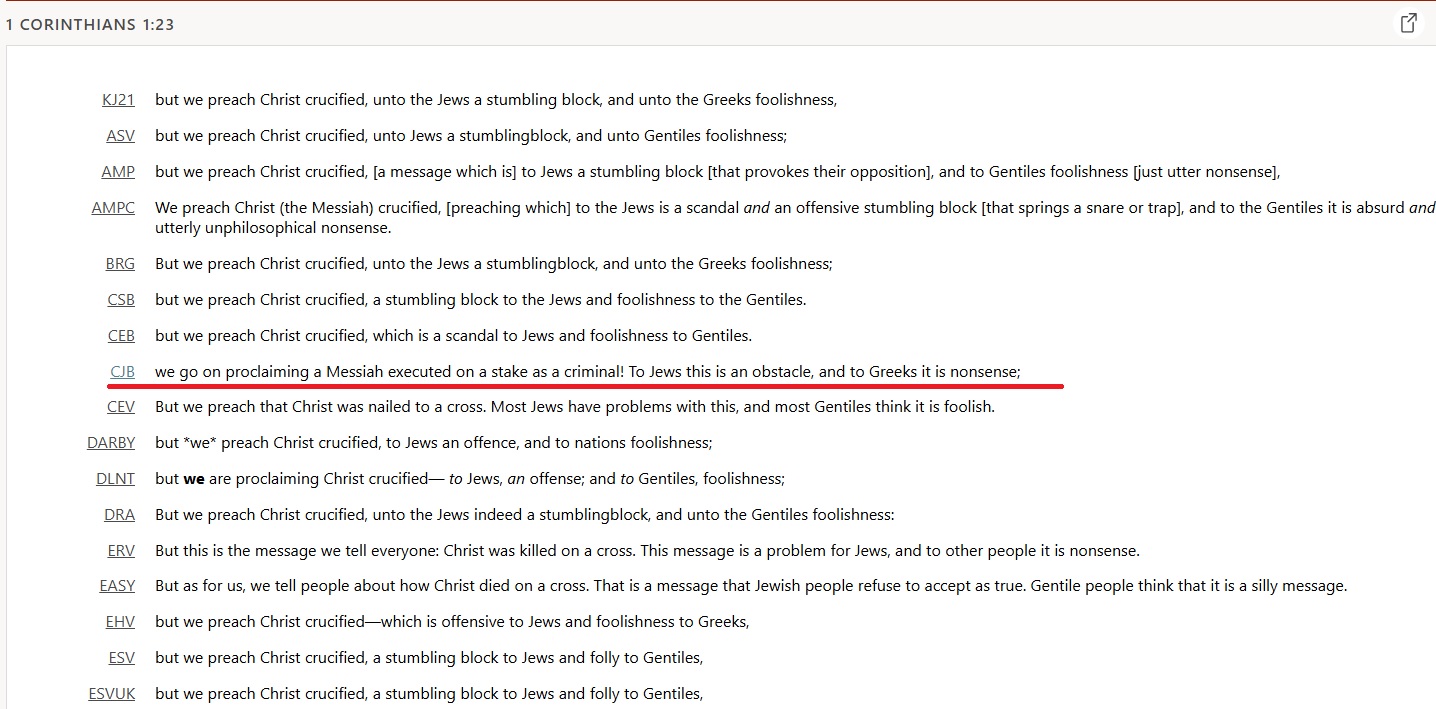
“But we preach Christ crucified, a stumbling block to Jews and folly to Gentiles.” (1 Corinthians 1:23)

These scholars suggest that the majority consensus is based on a misunderstanding of the Qur’an, which Muslims have failed to correct for fourteen centuries.” -Louay Fatoohi


Prima-Qur’an: Well, actually, these 1400 years of scholarship is really based upon copy and paste now, isn’t it? To pretend that every Muslim exegete independently researched every single verse of the Qur’an is just simply presumptuous. What we have is a majoritarian belief based upon individuals incorporating extraneous material from oral traditions without connected chains of narrations going back to the source that contain conflicting accounts.

We are also surprised by Dr. Louay’s appeal to the consensus of scholars when he himself does not believe in the return of Christ Jesus. This is certainly the position of the consensus of scholars. So we can take Dr. Louay’s appeal to consensus as not being serious.

We mean on what consistent basis does Dr. Louay Fatoohi dismiss the second coming of Jesus (as) which is mentioned in quite a number of hadith that do have connected chains and yet expect that we should not dismiss outright beliefs based upon individuals incorporating extraneous material from oral traditions without connected chains of narrations going back to the source that contain conflicting accounts?


None of what has been shared is from the canonical gospels. Would have been great if Dr. Fatoohi would have shared with us an exact quote from the tafsir literature of the tale of substitution. Because it sure the heck would have been very interesting reading a word-for-word detailed account of how the Jews (not the Romans) crucified stealth Jesus. Or about how the Jews killed and then crucified stealth Jesus.

Perhaps in a future article Dr. Fatoohi may give us a detailed quote of these narratives.

However, one central theme stands out. Someone was made to appear to look like Jesus.

This seems to be the understanding of: was made to appear to them so/walākin shubbiha lahum 

Note the following:

“Third, the denial of the crucifixion in 4:157 is followed in 4:158 by a second action that is explicitly attributed to God, which is raising Jesus.”-Louay Fatoohi

Prima-Qur’an: Yet, this was made to appear to them so/walākin shubbiha lahum  is not an action attributed to Allah.

Another example is the following:

“And the answer of Ibrahim’s people was not but that they said, “Kill him or burn him,” but Allah saved him (fa-anjaynāhu) from the fire. Indeed in that are signs for a people who believe.” (Qur’an 29: 24)


Why don’t we see that language, ‘Allah saved him (fa-anjaynāhu) from ‘salabu’ ?

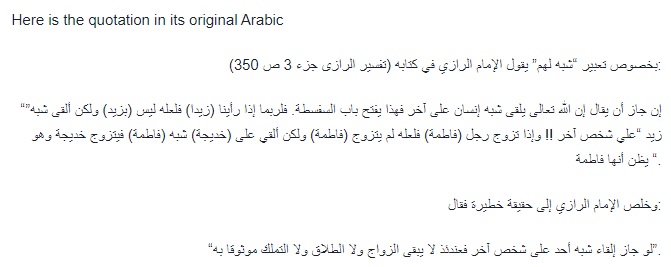
This much is clear when The Ashari in aqidah and Shafi’i in Fiqh, Fakhr al-Din al-Razi, who was not satisfied with the substitution theory, was absolutely merciless in his take-down of this concept when he pins:

“This opens the door of sophistry, So that if we saw Zayd it would be possible that it was not really Zayd but that the likeness of Zayd had been cast upon another. This would imply the nullification of social contracts such as marriage and ownership. Also it would lead to the impugning of the principle of tawatur, bringing into serious doubt all transmitted historical knowledge. This principle should be upheld as long as it is based on perceived phenomena (al-mahsusat). Such confusion about perceived phenomena would threaten the foundations of all religious laws (shar-iya). Neither is it permissible to argue for such transference of identity by appealing to the tradition that allows for miracles during the time of prophecy. Such a provision would bring into question the identity of the prophets themselves, which in turn would call into question the probity of the sources of religious knowledge.”

Source: Fakhr al-Din al-Razi (Mafatih, al-ghayb al-mushtahar bi-al-tafsir al-kabir.)

So it is obvious that ‘made to appear to them’ is not something one can attribute to Allah.

Allah (swt) tells us about his sublime revelation:

“It is a blessed Book which We have revealed for you so that you will reflect upon its verses and so the people of understanding will take heed.” (Qur’an 38:29)

“Surely We know well that they say about you: “It is only a human being who teaches him,” (notwithstanding) that he whom they maliciously hint at is of foreign tongue, while this (Qur’an) is plain Arabic clear.” (Qur’an 16:103)

There really is no need for so much confusion and obfuscation over this verse. We do not need to appeal to extraneous material that is not divine in authority, has no connected chain back to the original sources, is confused in its reports and proclaims some supra natural event that Allah (swt) himself did not claim.

وَإِنَّ ٱلَّذِینَ ٱخۡتَلَفُوا۟ فِیهِ لَفِی شَكࣲّ مِّنۡهُۚ مَا لَهُم بِهِۦ مِنۡ عِلۡمٍ إِلَّا ٱتِّبَاعَ ٱلظَّنِّۚ

“It was made to appear to them so” is not a text addressed to anyone who witnessed anything at all!

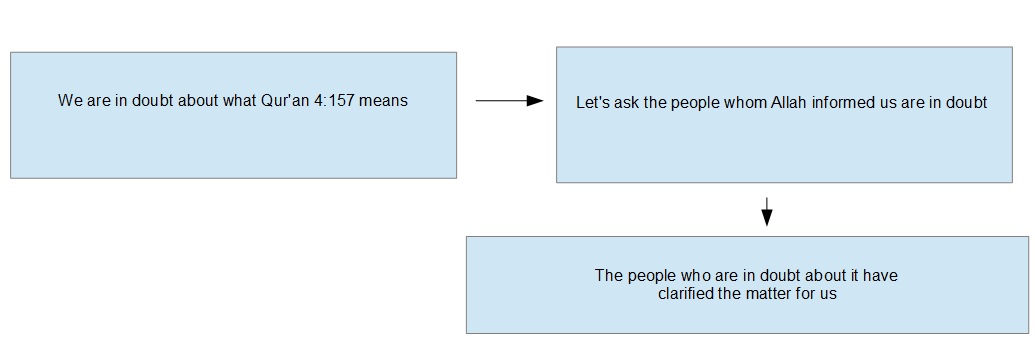
 ٱخْتَلَفُوا۟ Tells us that there are disagreements

شَكّ Tells us that they are in doubt

مَا لَهُم بِهِۦ مِنۡ عِلۡمٍ Tells us they are not basing this upon knowledge

ٱتِّبَاعَ ٱلظَّنِّۚ Tell us they are following dhan (assumption or conjecture)

“And indeed, those who differ in it surely are in doubt about it. Their knowledge is based upon the following of dhan assumption or conjecture.”

In other words, those who are saying: “We killed Christ Jesus the Son of Mary the Messenger of Allah.”  Are not eyewitnesses to anything. They are only following the traditions of those who make claims based upon conjecture and no knowledge.

ٱتِّبَاعَ ٱلظَّنِّۚ it is this same following of dhan (assumption and conjecture) taken from the very same people whom Allah (swt) tells us are in disagreements, are in doubt, not based upon knowledge that we get ultra bizarre translations of the Qur’an an like the following:

And because of their saying (in boast), “We killed Messiah Iesa (Jesus), son of Maryam (Mary), the Messenger of Allah,” – but they killed him not, nor crucified him, but the resemblance of Iesa (Jesus) was put over another man (and they killed that man), and those who differ therein are full of doubts. They have no (certain) knowledge, they follow nothing but conjecture. For surely; they killed him not (i.e. Iesa (Jesus), son of Maryam (Mary) )  (Qur’an 4:157) –Muhsin Khan & Muhammed al-Hilali

Does that make a lick of sense to anyone?

So let’s get this right. Wahb Ibn Munabbih takes his knowledge from people whom Allah (swt) tells us are in disagreements, are in doubt, not basing information upon knowledge, only following conjecture, and they get to inform us about what Allah’s revelation says?

“So if you are in doubt, [O Muhammed], about that which We have revealed to you, then ask those (ahla l-dhik’ri) who have been reading the Scripture before you. The truth has certainly come to you from your Lord, so never be among the doubters.” (Qur’an 10:94)

Notice the phrase: ahla l-dhik’ri and not ahla l-kitābi

The above verse is only applicable in those matters where they themselves do not have doubts about the matter and has to be taken into context with what Allah (swt) has description of those in (Qur’an 4:157)

May Allah (swt) bless Dr. Louay Fatoohi for his sincere and noble efforts. For the most part, he is only defending the indefensible. 1200 plus years of fuzzy logic and copy-and-paste scholarship. Statements by converts to Islam which are based upon conjecture and have no connected chain of transmission going back to the companions of Jesus.

Please do see our article:

May Allah Guide the Christians so that they do not burn in the hellfire.

May Allah (swt)bless the ummah.

May Allah (swt) forgive the ummah.

May Allah (swt) guide the ummah.

4 Comments

Filed under Uncategorized

The Question of the Historical Crucifixion and the Martyrdom of Jesus.

Indeed, Allah has purchased from the believers their lives and their properties [in exchange] for that they will have Paradise. They fight in the cause of Allah, so they kill and are killed. [It is] a true promise [binding] upon Him in the Torah and the Gospel and the Qur’an. And who is truer to his covenant than Allah? So rejoice in your transaction which you have contracted. And it is that which is the great attainment.” (Qur’an 9:111)

Today we examine the evidence for the alleged Crucifixion from the prima facie evidence itself, namely the New Testament. There are many texts in the New Testament that state after the fact, that Jesus died. What we want to do is look at the event itself, the language used as well as the words that are attributed to Jesus in regard to the alleged event.

Every once in awhile a Christian gets the idea that he wants to experience the suffering that Jesus endured on the so called double-cross. So this person will lay down half naked on a beam of wood and gets someone to nail the palms of his hands (or the wrist) and his feet to the beam. When the beam of wood is stood up on its end, the persons’ body weight immediately tears his hands and the feet loose and they slide off the beam in degradation and humiliation.

This happened all to often, and people began to really wonder if the ecclesiastical images of Jesus inspired by painters, having him on the double cross were really true.

Thus, in all effort to make sense of the ecclesiastical images, made popular by paintings, the all too familiar “nailed to the double cross” method, along came the idea that the hands were not only nailed to the cross, but ropes were used to bind the forearms to the horizontal beam. This satisfied the world that such a method would prevent a body from falling off the cross and everyone breathed a sigh of relief.

The below video is a ‘Crucifixion’ that happened on Friday April 29th 2025 in Indonesia, the country with the world’s largest Muslim population.

We are simply fascinated by all the ropes and bonds used to hold the body in place.

WHAT ABOUT THOSE NAILS???

Matthew, Mark, Luke mention nothing at all about nails in the hands and/or feet.

Remember none of the synoptic Gospels (Matthew, Mark, Luke) mention anything at all about nails.

“Behold my hands and my feet, that it is I myself: handle me, and see; for a spirit des not flesh and bones, as you see me have.” (Luke 24:39)

Only in John’s Gospel do we get:

 “Now Thomas (also known as Didymus), one of the Twelve, was not with the disciples when Jesus came. So the other disciples told him, “We have seen the Lord!” But he said to them, “Unless I see the nail marks in his hands and put my finger where the nails were, and put my hand into his side, I will not believe.” (John 20:25)

Nothing about nails in the feet!

We also get this vague passage in Colossians:

“Having canceled the charge of our legal indebtedness, which stood against us and condemned us; he has taken it away, nailing it to the σταυρῷ (staurō) . (Colossians 2:14)

If the etymology of the verse is stressed, this verse is the only direct indication of any nails used to attach Jesus to the stauros.

“They pierce my hands and feet.” (Psalm 21:16)

Nothing about nails in the feet!

WHAT DOES JESUS SAY ABOUT THE FORM OF HIS EXECUTION?

Quite curious when Jesus begins to speak of the passion (according to the evangelist) he does not say much regarding the execution form. He is surprisingly vague.

IN THE GOSPEL OF MARK JESUS DOESN’T MENTION (σταυρόω) stauroó IN CONNECTION TO HIS DEATH AT ALL!

“And he began to teach them, that the Son of man must suffer many things, and be rejected of the elders, and of the chief priests, and scribes, and be killed, and after three days rise again.” (Mark 8:31)

No mention of the ecclesiastical double-cross!

“For he taught his disciples, and said unto them, The Son of man is delivered into the hands of men, and they shall kill him; and after that he is killed, he shall rise the third day”. (Mark 9:31)

No mention of the ecclesiastical double-cross!

And they asked him, saying, Why say the scribes that Elias must first come? And he answered and told them, Elias verily come first, and restore all things; and how it is written of the Son of man, that he must suffer many things, and be held in contempt.” (Mark 9:11-12)

No mention of the ecclesiastical double-cross!

“Saying, Behold, we go up to Jerusalem; and the Son of man shall be delivered unto the chief priests, and unto the scribes; and they shall condemn him to death, and shall deliver him to the Gentiles:  And they shall mock him, and shall scourge him, and shall spit upon him, and shall kill him: and the third day he shall rise again.” (Mark 10:33-34)

No mention of the ecclesiastical double-cross!

IN THE GOSPEL OF LUKE JESUS DOESN’T MENTION (σταυρόω) stauroó IN CONNECTION TO HIS DEATH AT ALL!

“Saying, The Son of man must suffer many things, and be rejected of the elders and chief priests and scribes, and be slain, and be raised the third day.” (Luke 9:22)

No mention of the ecclesiastical double-cross!

” Let these sayings sink down into your ears: for the Son of man shall be delivered into the hands of men. But they understood not this saying, and it was hid from them, that they perceived it not: and they feared to ask him of that saying.” (Luke 9:43-44)

This is certainly the writing of a redactor. It is third person. Here the writer is emphatic that they did not understand this statement. It was hid from them and that they did not perceive the meaning of it. Why not just ask him to explain it? Well apparently, “they feared to ask him about“. It is not explained.

No mention of the ecclesiastical double-cross!

We get much the same in the following passage:

“Then he took unto him the twelve, and said unto them, Behold, we go up to Jerusalem, and all things that are written by the prophets concerning the Son of man shall be accomplished. For he shall be delivered unto the Gentiles, and shall be mocked, and spitefully entreated, and spitted on: And they shall scourge him, and put him to death: and the third day he shall rise again. The disciples did not understand any of this. Its meaning was hidden from them, and they did not know what he was talking about. (Luke 18:31-34)

No mention of the ecclesiastical double-cross!

IN THE GOSPEL OF JOHN JESUS DOESN’T MENTION (σταυρόω) stauroó IN CONNECTION TO HIS DEATH AT ALL!

JESUS COMPARES HIMSELF TO THE SNAKE BEING LIFTED UP (EXALTED)

“And as Moses lifted up (exalted) the serpent in the wilderness, even so must the Son of man be lifted up (exalted).”(John 3:14) This saying may imply some kind of suspension, but nothing more.

The the right is the god Asclepius. The god of medicine, healing, and rejuvenation. Here he is pictured with is serpent entwined staff. On the left is a depiction of the Prophet Moses exalting the snake on a staff. You will find this incident in Numbers 29:6-9

Christians seem to be embarrassed by the idea of Jesus comparing himself to being exalted like the healing snake that Moses put on the pole. However, that healing snake obviously is not the Satan snake of Genesis, as that Satan snake was cursed by God, and the healing snake on Moses pole was directed by God.

Just like Jesus was taken to be worshipped as a false god, so too the snake on the pole was taken to be worshipped. So King Hezekiah did the following:  

“Over time that He removed the high places, smashed the sacred stones and cut down the Asherah poles. He broke into pieces the bronze snake Moses had made, for up to that time the Israelites had been burning incense to it. (It was called Nehushtan.)” (2 Kings 18:4)

THE ONLY GOSPEL WHERE JESUS MENTIONS (σταυρόω) stauroó TWICE IN CONNECTION TO HIS DEATH IS THE GOSPEL OF MATTHEW!

“From that time forth began Jesus to shew unto his disciples, how that he must go unto Jerusalem, and suffer many things of the elders and chief priests and scribes, and be killed, and be raised again the third day.” (Matthew 16:21)

No mention of the ecclesiastical double-cross!

“And while they abode in Galilee, Jesus said unto them, The Son of man shall be betrayed into the hands of men: And they shall kill him, and the third day he shall be raised again. And they were exceeding sorry.” (Matthew 17:22-23)

No mention of the ecclesiastical double-cross!

“Therefore I am sending you prophets and sages and teachers. Some of them you will kill AND ; σταυρώσετε stauosete others you will flog in your synagogues and pursue from town to town.” (Matthew 23:34)

Notice that it says here: “Some of them you will kill AND stauosete.”

ἀποκτενεῖτε (you will kill) καὶ (and) σταυρώσετε (?)

The prophets, sages, and teachers will be killed and some type of suspension/impaling will follow this killing.

Also note that this is an act that the religious Jews carry out. Jesus does not connect σταυρώσετε stauosete to himself here.

What ever σταυρώσετε stauosete means it has to be a punishment that religious Jews would carry out. Otherwise Jesus, would be ignorant of Jewish law!

Jew’s don’t crucify people! They do not suspend people on a double cross! It is not in the TNCH and it is not in the Talmud.

“Behold, we go up to Jerusalem; and the Son of man shall be betrayed unto the chief priests and unto the scribes, and they shall condemn him to death,  And shall deliver him to the Gentiles to mock, and to scourge, and to crucify him staurosai σταυρῶσαι : and the third day he shall rise again.” (Matthew 20:18-19)

Matthew adds here for the first time that the end of Jesus life will be connected with an act referred to with suspension/impaling.

“And it came to pass, when Jesus had finished all these sayings, he said to his disciples, You know that after two days is the feast of the Passover, and the Son of man is betrayed to be staurothenai σταυρωθῆναι .  Then assembled together the chief priests, and the scribes, and the elders of the people, at the palace of the high priest, who was called Caiaphas.  And consulted that they might take Jesus by subtilty, and kill him.” (Matthew 26:1-4)

The second time that the end of Jesus life will be connected with an act referred to with suspension/impaling

THE CONCLUSION:

In the Gospels of Mark, Luke, and John Jesus does not connect his death with (σταυρόω) stauroó at all!

Only in Matthew do we see two passages where Jesus connects his death with (σταυρόω) stauroó.

We also know that what ever (staurothenai σταυρωθῆναι) means in Matthew 26, and (staurosai σταυρῶσαι) in Matthew 20, Jesus connects (stauosete σταυρώσετε) in Matthew 23 with an act that the Jews do!

Juxtapose the text and do the math!

HOW THE WORD (σταυρόω) stauroó IS USED IN CONNECTION WITH JESUS TRIAL

 As soon as the chief priests and their officials saw him, they shouted, “CrΣταύρωσον! CrΣταύρωσον !” (Stauroson) But Pilate answered, “You take him and σταυρώσατε (staurosate) him. As for me, I find no basis for a charge against him.” (John 19:6)

Why would Pilate tell the chief priest and their officials to “crucify” or σταυρώσατε (staurosate) Jesus if:

  1. They had no power to do so.
  2. Pilate was aware of their laws?

Meaning: Jews don’t crucify people! They do not suspend people on a double cross!

Had the Jewish authorities been directly involved, Jesus would have been stoned, or he would have been killed and then impaled.

“Was there ever a prophet your ancestors did not persecute? They even killed those who predicted the coming of the Righteous One. And now you have betrayed and murdered him.” (Acts 7:52)

“While they threw stones at Stephen, he prayed, “Lord Jesus, receive my spirit.”  After that he fell on his knees and cried out with a loud voice, “Lord, do not hold this sin against them.” When he had said this, he died.” (Acts 7:59-60)

“However, biblical law prescribes hanging after execution: every person found guilty of a capital offense and put to death had to be impaled on a stake (Deut. 21:22); but the body had to be taken down the same day and buried before nightfall, “for an impaled body is an affront to God” (ibid., 23).”

Source: https://www.jewishvirtuallibrary.org/capital-punishment

“Then said Pilate unto him, Why do you not speak to me? Do you not know that I have power to (σταυρῶσαί) staurōsai you, and have power to release you?” (John 19:10)

“But they cried out, Away with him, away with him, (σταύρωσον) staurōson him. Pilate said to them, Shall I (σταυρώσω) staurōsō your King? The chief priests answered, We have no king but Caesar. Then delivered he over to them to be (σταυρωθῇ) staurōthē. And they took Jesus, and led him away.” (John 19:15-16)

 “Pilate said unto them, What shall I do then with Jesus which is called Christ? They all said to him, Let him be (Σταυρωθήτω) Staurōthētō. And the governor said, Why, what evil has he done? But they cried out the more, saying, Let him be (Σταυρωθήτω) Staurōthētō.” (Matthew 27:22-23)

“Then released he Barabbas unto them: and when he had scourged Jesus, he delivered him to be (σταυρωθῇ) staurōthē.” (Matthew 27:26)

“And after that they had mocked him, they took the robe off from him, and put his own raiment on him, and led him away to (σταυρῶσαι) staurōsai him.” (Matthew 27:31)

“And they cried out all at once, saying, Away with this man, and release unto us Barabbas: (Who for a certain sedition made in the city, and for murder, was cast into prison.) Pilate therefore, willing to release Jesus, spoke to them again. But they cried, saying, (Σταύρου) Staurou (σταύρου staurou).  And he said unto them the third time, Why, what evil has he done? I have found no cause of death in him: I will therefore chastise him, and let him go.  And they were instant with loud voices, requiring that he might be (σταυρωθῆναι) staurōthēnai. And the voices of them and of the chief priests prevailed.” (Luke 23:18-23)

And Pilate gave sentence that it should be as they required.

“And he released unto them him that for sedition and murder was cast into prison, whom they had desired; but he delivered Jesus to their will.” (Luke 23:24-25)

 “And they cried out again, (Σταύρωσον) Staurōson him. Then Pilate said unto them, Why, what evil has he done? And they cried out the more exceedingly, (σταυρωθῇ) staurōthē him.” (Mark 15:13-14)

“And when they had mocked him, they took off the purple from him, and put his own clothes on him, and led him out to σταυρώσωσιν staurōsōsin him.” (Mark 15:20)

THE CONCLUSION: It is clear from this narrative that the Roman authorities are looked upon as reluctant and even sympathetic to Jesus. Where as the Jews are being looked at as antagonist. If the above accounts are to be harmonized than what ever one understands the terminology for (σταυρόω) stauroó to mean it must be understood in light of Pilate’s statement. “You take him and σταυρώσατε (staurosate) him. (John 19:6)

WHO CARRIED THE (σταυρὸν) stauron AND WHY?

The general public thinks that Jesus carried the cross-shaped execution tool († or T), influenced by ecclesiastical paintings and art-history. The common interpretation that Jesus was carrying the crossbeam (patibulum) is not supported by the Biblical text. The theory may be based on the centuries of ecclesiastical paintings, and/or other art work that would lead to the seemingly logical conclusion that a solid pole together with a solid crossbeam out would be too heavy to be carried. Thus, according to this view Jesus must have been carrying only a part (assumed to the crossbeam) of the execution tool (the assumed cross).

“And they compelled one Simon a Cyrenian, who passed by, coming out of the country, the father of Alexander and Rufus, to bear his (σταυρὸν) stauron.” (Mark 15:20-21)

“As they were going out, they met a man from Cyrene, named Simon, and they forced him to carry the (σταυρὸν) stauron.” (Matthew 27:32)

“As the soldiers led him away, they seized Simon from Cyrene, who was on his way in from the country, and put the (σταυρὸν) stauron on him and made him carry it behind Jesus.” (Luke 23:26)

When it comes to the walk towards Calvary, the gospels do not say that Jesus fell or struggled under the weight of the stauros, contrary to the common assumption. The synoptic gospels say that Simon was forced to carry the staturos, without saying why. The synoptic Gospels of Matthew, Mark and Luke have Simon carrying the stauros. Where as the Gospel of John has Jesus carrying his staturos:

 “And he bearing his (σταυρὸν) stauron went forth into a place called the place of a skull, which is called in the Hebrew Golgotha.” (John 19:17)

Now notice the synoptic Gospel of Matthew, Mark and Luke do not have Jesus bearing his (σταυρὸν) stauron to being with. Where as John says that Jesus bares it himself. Christians imagine scenarios where Jesus carries the (σταυρὸν) stauron and suddenly he cannot.

HOW DID CHRISTIANS TRY TO DEAL WITH THIS DILEMA?

This is an example of how Christian evangelist try and make sense of this:

“Well, John 19:17 does say Jesus bore his own cross to Golgotha. And the synoptics say Simon of Cyrene helped part of the way (Mark 15:21; Matthew 27:32; Luke 23:26).

This is because of Jesus’ weakened state from being flogged. However, John does not say only Jesus carried the cross the whole way, or that Simon of Cyrene did not help him. That is read into the text. John just chose to omit this part of the journey to Golgotha because it was distracting from the themes of his gospel, such as God’s sovereign plan.”

My Response:

Where does (Mark 15:21; Matthew 27:32; Luke 23:26) mention: “helped part of the way“?? That is correct that John does not say that “only Jesus carried the (σταυρὸν) stauron the whole way or that Simon of Cyrene did not help him.” However, the text also does not say that Simon did help him, or that he carried it part way! That is actually ‘reading into the text‘. You have to wonder what prevented Simon from carrying the (σταυρὸν) stauron all the way?

THE CONCLUSION:

The whole account of the gospels so far rest solely on the meaning of the diversely used verb stauros. So far nothing has been said about the notorious crossbeam-neither on Jesus (and/or Simon’s) shoulders nor attached to the pole. In fact, nothing is said about the shape or the nature of the execution tool, other than that it was a staturos. As has been seen, the texts describing Simon of Cyrene carrying Jesus stauros do not even indicate that the carried device was a patibulum and are thus futile to use as evidence that the stauros of Jesus resembles the assumed shape of a cross.

THE ACTUAL EVENT CALLED (σταυρωθῆναι) staurothenai POPULARLY KNOWN ASCRUCIFIXION”

“And they (Σταυρώσαντες) Staurōsantes him, and parted his garments, casting lots: that it might be fulfilled which was spoken by the prophet, They parted my garments among them, and upon my vesture did they cast lots.” (Matthew 27:35)

It is perhaps surprising that the act called “crucifixion” by the masses itself is mentioned only in passing.

On the matters of what sort of “cross” was used to “crucify” Jesus and how he was supposedly fastened, suspended, impaled, hung upon it Matthew is absolutely silent. This becomes all the more interesting when you consider that Matthew is the only book in the entire New Testament where Jesus is actively participating in an act called (staurothenai) σταυρωθῆναι

“Where they (ἐσταύρωσαν) estaurōsan him, and two other with him, on either side one, and Jesus in the middle.  And Pilate wrote a title, and put it on the (σταυροῦ) staurou. And the writing was Jesus Of Nazareth The King Of The Jews. This title then read many of the Jews: for the place where Jesus was (ἐσταυρώθη) estaurōthē was nigh to the city: and it was written in Hebrew, and Greek, and Latin.” (John 19:18-20)

“Then the soldiers, when they had (ἐσταύρωσαν) estaurōsan Jesus, took his garments, and made four parts, to every soldier a part; and also his coat: now the coat was without seam, woven from the top throughout.” (John 19:23)

“Now in the place where he was (ἐσταυρώθη) estaurōthē there was a garden; and in the garden a new sepulchre, wherein was never man yet laid.” (John 19:41)

“And when they had (σταυροῦσιν) staurousin him, they parted his garments, casting lots upon them, what every man should take. And it was the third hour, and they (ἐσταύρωσαν) estaurōsan him.” (Mark 15:24-25)

THE CONCLUSION: There is no mention of nails. There is no mention of ropes. There is not much of a description to label what took place as a “historical account.”

The ecclesiastical tradition that many have taken to be accurate and true cannot be substantiated from the aforementioned text!

DEATH BY ROMAN SPEAR OR (σταυρωθῆναι) staurothenai POPULARLY KNOWN ASCRUCIFIXION”

“But when they came to Jesus and found that he was already dead, they did not break his legs.  Instead, one of the soldiers pierced Jesus’ side with a spear, bringing a sudden flow of blood and water.” (John 19:33-34)

Comments: Now if they saw that Jesus was already dead, they didn’t have any reason to pierce his side! He was dead already! If they were not sure, what would they have done? They would have broken His legs!

This is the version of Matthew most of you read in your bibles

“The rest said, “Now leave him alone. Let’s see if Elijah comes to save him.” (Matthew 27:49)

There is surprising silence about the fact that two of the best manuscripts of the New Testament, the Codices Sinaitcus and Vaticanus, describe Jesus as being killed by a soldier’s spear instead of the suspension per se. Matthew 27:49 according to condex Sinaticus: “The other said, Let [him] be, let us see whether Elijah will come to save him. Another took a spear and pierced his side, and out came water and blood.”

In fact so troubling is this text that Dr. Daniel B Wallace (a prominent defender of the idea that the Bible is inerrant) landed himself in some hot soup!

“Dr. Wallace wrote, “In fact, it has been repeatedly affirmed that no doctrine of Scripture has been affected by these textual differences.” Elsewhere he has adjusted this claim by referring to “cardinal” doctrine and “plausible” variants. I wonder if Dr. Wallace included the doctrine of inerrancy among the doctrines to which he refers. In the same manuscripts that he considers the most reliable (Codex Vaticanus and Codex Sinaiticus), the text of Matthew 27:49 says that Jesus was speared before He died. This textual variant introduces a contradiction with the timing presented in John 19:33-34, where Jesus is speared after His death. I welcome Dr. Wallace to explain how this variant in the “best” manuscripts – a variant which Hort (the most influential compiler of the Revised Text in the 1800’s) regarded as plausibly original – can be embraced without abandoning the doctrine of inerrancy.”

Source: https://purebibleforum.com/index.php?threads/matthew-27-49-doctrinal-question-of-the-blood-of-jesus.946/

You may also see:

http://evangelicaltextualcriticism.blogspot.com/2018/02/matthew-2749-was-jesus-pierced-before.html

THE CONCLUSION:

In the synoptic accounts of the gospels, the spear thrust occurs after Jesus has expired on the supposed “cross”, therefore the Jews who came to see Pilate about the bodies evidently assumed that Jesus and the two thieves would still be alive at that time.

THE WORD (σταυρόω) stauroó IN CONNECTION WITH THE TWO THIEVES.

Most Christians envision in their minds that there were three “crosses” at Calvary. There is nothing in the Gospels that would suggest that the thieves (or revolutionaries) were dealt with in a manner different from Jesus. That is to say there is nothing to suggest three separate “crosses”.

“And with him they (σταυροῦσιν) staurousin two thieves; the one out of his right hand, and the other out of his left. (Mark 15:27)

 “Then were there two thieves (σταυροῦνται) staurountai with him, one out of the right hand, and another out of the left.” (Matthew 27:28)

“And when they were come to the place, which is called Calvary, there they (ἐσταύρωσαν) estaurōsan him, and the malefactors, one out of the right hand, and the other out of the left.” (Luke 23:33)

“Where they (ἐσταύρωσαν) estaurōsan him, and two other with him, on either side one, and Jesus in the middle.” (John 19:18)

Now before you dear reader I would suggest you to look at these disparate Christian translations and watch as some of them try to deceitfully pull the wool over your eyes.

Behold! https://biblehub.com/john/19-31.htm

“Since it was the day of Preparation, and so that the BODIES [PLURAL] would not remain on THE (σταυροῦ) STAUROU [SINGULAR] on the Sabbath (for that Sabbath was a high day), the Jews asked Pilate that their legs might be broken and that THEY [PLURAL] might be taken away. So the soldiers came and broke the legs of the FIRST MAN, and then the legs of the OTHER ONE who had been (συσταυρωθέντος systaurōthentos) together with him. But when they came to Jesus and found that he was already dead, they did not break his legs.” (John 19: 31-33)

You see the Christian translations attempts to cover up the obvious? Doesn’t John say that there were BODIES (PLURAL) on a [SINGULAR]  STAUROU? 

What these verses tell us is that three men were attached/suspended to ONE staurou! 

John 19:32 further substantiates this fact: The Greek word systaurōthentos not only means that the two criminals were simply “with him,” but that both of them were also suspended/impaled “together with him” -“together with him” on the SAME STAUROU!

One more final point as the icing on the cake. Now imagine the popular ecclesiastical images of Jesus with the two thieves, one to his right and one to his left. For example the image posted above. If one robber was crucified on a separate cross on Jesus LEFT side and the other robber was on his RIGHT (THREE crosses, placed side by side by side) with Jesus in the MIDDLE, then this becomes a huge problem with the deaths of the two robbers. This is because the soldiers who killed FIRST the two robbers and LAST they came to Jesus in the MIDDLE to kill him. Jesus being in the MIDDLE would have made him the SECOND to be killed!

HOW DID CHRISTIANS TRY TO DEAL WITH THIS DILEMA?

  1. First was deception through translations which we saw on display above.
  2. Realizing that not everyone has the I.Q of a Turnip they had to come up with some strategies.

Since the New Testament called those “crucified” with the Messiah both robbers (Matthew 27:38) and also malefactors (criminals) (Luke 23:32), One Christian scholar, proposed that there were two malefactors and also two robbers! So we now have a row of five crosses!

The Roman soldiers came to the first one broke his legs, then the second broke his legs and than to Jesus, didn’t break his legs and proceeded on down the row. Even though this interpretation is a valiant effort it still goes against the fact that the two malefactors were two robbers. Also, when we go back and look at the four text in the first section, it is obvious there is only two mentioned; one on each side.

To this Christian scholar’s credit he realized the problem. How could the soldiers first break the legs of the two robbers and then come to Jesus who was in the middle of them?

Actually, the answer is quite simple! They walked AROUND the (σταυροῦ) staurou breaking legs as necessary to hasten death!

THE CONCLUSION:

It is clear from reading these text we do not get the ecclesiastical images of Jesus inspired by painters, having him and two thieves beside him on the double crosses.

HOW THE WORD (σταυρωθῆναι) staurothenai IS USED IN CONNECTION WITH JESUS POST DEATH

He is not here, but is risen: remember how he spoke unto you when he was yet in Galilee, Saying, The Son of man must be delivered into the hands of sinful men, and be (σταυρωθῆναι) staurōthēnai, and the third day rise again. (Luke 24:6-7)

Not spoken by Jesus. Spoken by two super natural beings (angels) about Jesus.

“And how the chief priests and our rulers delivered him to be condemned to death, and have (ἐσταύρωσαν) estaurōsan him.” (Luke 24:20)

Not spoken by Jesus. Spoken about Jesus.

“And the angel answered and said unto the women, Fear not: for I know that you seek Jesus, which was (ἐσταυρωμένον) estaurōmenon.” (Matthew 28:5)

Not spoken by Jesus. Spoken by a super natural being (an angel) about Jesus.

“And he said unto them, Be not affrighted: You seek Jesus of Nazareth, which was (ἐσταυρωμένον) estaurōmenon: he is risen; he is not here: behold the place where they laid him.” (Mark 16:6)

Not spoken by Jesus. Spoken by a super natural being (an angel) about Jesus.

THE CONCLUSION: In his post death appearances. Jesus does not use the word(σταυρωθῆναι) staurothenai in connection to his death at all!

THE USE OF (σταυρόω) stauroó IN OTHER NEW TESTATMENT WRITINGS

Well, we don’t even get passed the first book of Acts without the crafty Christians up to their old tricks.

“He was delivered up by God’s set plan and foreknowledge, and you, by the hands of the lawless, put Him to death by nailing Him to the cross.” (Acts 2:23)

However, is that what it really says?

 “This man was handed over to you by God’s deliberate plan and foreknowledge; and you, with the help of wicked men, put him to death by προσπήξαντες (prospēxantes) (Acts 2:23)

Look at the various translations here:

https://biblehub.com/acts/2-23.htm

“So they cast off the anchors and left them in the sea. At the same time they loosened the ropes that tied the steering-oars; then hoisting (ἐπάραντες) eparantes the foresail to the wind, they made for the beach.” (Acts 27:40)

Actually all the term means is to fasten to, to impale. There is no mention of (σταυρόω) stauroó in Acts 2:23. There is no mention of nails at all!

Hence the added bracketed words (on a cross) in the picture above.

“Therefore let all the house of Israel know assuredly, that God has made the same Jesus, whom you have (ἐσταυρώσατε) estaurōsate, both Lord and Christ.” (Acts 2:36)

“Knowing this, that our old man is (συνεσταυρώθη) synestaurōthē with him, that the body of sin might be destroyed, that henceforth we should not serve sin.” (Romans 6:6)

From sun and stauroo to impale in company with (literally or figuratively) — crucify with.

Source: https://biblehub.com/greek/4957.htm

(συσταυρωθέντος systaurōthentos) together with him”- (John 19:32)

THE USE OF (κρεμάσαντες) kremasantes ON A (ξύλου) xylou IN THE NEW TESTAMENT

“The God of our fathers raised up Jesus, whom you slew (κρεμάσαντες) kremasantes on a (ξύλου) xylou tree.” (Acts 5:30)

“And we are witnesses of all things which he did both in the land of the Jews, and in Jerusalem; whom (κρεμάσαντες) kremasantes on a (ξύλου) xylou tree.” (Acts 10:39)

“And when they had fulfilled all that was written of him, they took him down from the (ξύλου) xylou tree, and laid him in a sepulchre.” (Acts 13:29)

“Who his own self bare our sins in his own body on the (ξύλου xylon) tree, that we, being dead to sins, should live unto righteousness: by whose stripes you were healed.” (1 Peter 2:24)

“But we preach Christ (ἐσταυρωμένον) estaurōmenon, unto the Jews a stumbling block, and unto the Greeks foolishness.” (1 Corinthians 1:23)

Question: Why would a Messiah who was (ἐσταυρωμένον) estaurōmenon be a stumbling block to the Jews?

“Christ has redeemed us from the curse of the law, being made a curse for us: for it is written, “Cursed is every one that (κρεμάμενος) kremamenos on a (xylou) ξύλου tree.” (Galatians 3:13)

“And if a man have committed a sin worthy of death, and he be put to death, and you hang him on a (עֵֽץ) es tree; his body shall not remain all night upon the (הָעֵ֗ץ) ha es tree, but you should surely bury him the same day; for he that is (תָּל֑וּי) ta-lui hanged is accursed by God; that you defile not the land which God gave you gives you for an inheritance.” (Deuteronomy 21:22-23)

Paul’s usage of the text puts the definitive question in focus. The implied definition of the present investigation. Deuteronomy 21:22-23 is OUTSIDE the boundaries of the ecclesiastical “crucifixion.”

To put it in other words, Jesus, was executed by some type suspension or impalement. That is not what Deuteronomy 21:22-23 describes. Paul nevertheless connects the text of Deuteronomy with the death of Jesus.

Thus, Paul connects the death of Jesus, as an ante-mortem suspension, with the text of Deuteronomy 21:22-23, which describes a post-mortem suspension. He connects an event with the boundaries of the definition of the ecclesiastical label “crucifixion” with a text that describes an event that fall out side those boundaries!

Is it then possible to uphold a definition that contradicts the view of Paul?

The present day reader sees a distinct punishment form called the ecclesiastical “crucifixion” which is not compatible with Deuteronomy 21:22-23.

For Paul refers to a diverse suspension punishment in which a person is suspended/impaled as a corpse after an execution (as in Deut 21:22-23).

Paul’s point of view in Galatians 3:13 is that Jesus could have been stoned before being suspended/impaled -post mortem. He would be a curse anyhow.

Remember a few previous points!

“Therefore I am sending you prophets and sages and teachers. Some of them you will kill and ; σταυρώσετε stauosete others you will flog in your synagogues and pursue from town to town.” (Matthew 23:34)

As soon as the chief priests and their officials saw him, they shouted, “CrΣταύρωσον! CrΣταύρωσον !” (Stauroson) But Pilate answered, “You take him and σταυρώσατε (staurosate) him. As for me, I find no basis for a charge against him.” (John 19:6)

“However, biblical law prescribes hanging after execution: every person found guilty of a capital offense and put to death had to be impaled on a stake (Deut. 21:22); but the body had to be taken down the same day and buried before nightfall, “for an impaled body is an affront to God” (ibid., 23).”

Source: https://www.jewishvirtuallibrary.org/capital-punishment

Do you understand what the Jews (who know their text better than any Christian or Muslim) are saying?

SO HOW MIGHT HAVE JESUS ACTUALLY DIED?

Keep in mind this speculation from us based upon reflecting on a plausible scenario.

We drew the conclusion that the Jews did not kill Jesus, the Romans did. The text are written to make the Romans look reluctant to kill Jesus. We believe the Romans wanted Jesus dead. The Jews are portrayed as the ones who killed Jesus. I do not believe that Jesus was some type of pacifists teacher either. Out of all the references to the Injeel in the Qur’an, Allah (swt) informed us that Jesus preached martyrdom!

Indeed, Allah has purchased from the believers their lives and their properties [in exchange] for that they will have Paradise. They fight in the cause of Allah, so they kill and are killed. [It is] a true promise [binding] upon Him in the Torah and the Gospel and the Qur’an. And who is truer to his covenant than Allah? So rejoice in your transaction which you have contracted. And it is that which is the great attainment.” (Qur’an 9:111)

So, allow us to clarify, the concept that Jesus died on, The “cross” or the “double cross” rather, as a cross would actually be one beam and a double cross would be two beams; this it did not happen. The most revered ecclesiastical icon of all of Christianity is a historical fraud.

Jesus didn’t die with relative dignity hanging from the cross. He died, suspended on one single pike penetrating his body: he was impaled. There were no nails in his hands or feet. He did not die on a cross-shaped execution tool († or T). Just a sharp stake shoved right into his body upon which he was suspended – that is the most logical and plausible form of execution of Jesus by far…

Furthermore, one of the alleged witnesses, St. Mark, tells us that at the most critical juncture in the life of Jesus — “All his disciples forsook him and fled“- (Mark 14:50).

The Roman spectacle of impalement was meant to be as savage and tortuously cruel as possible because it had to accomplish two things.

  1. To act as a visual deterrent to crime and in the case of Jesus -uprising against an oppressive regime.
  2. To provide a theatre of gore to satisfy the blood lust of those who came to watch. The spike was the centerpiece of this typically gruesome Roman conception. That is why they didn’t just kill Jesus with a sword and be done with it.

Most likely the Romans introduced the tip of the spike into the victims back side and continued hammering it, pushing it in far enough to where it passed under the pelvic bone so it would support the body on the impale.

Do see our article:

The two thieves if they were real, (most likely really guilty of sedition) get the same treatment. When the impale device was upright it kept the victims body from being torn loose by his own weight and sliding off. That was its practical use.

But there was also a kind of diabolical sideshow, something to further attract the viewer interest in the impalement process. With the spike thrust under the pelvic bone, but not yet coming out of the body a man could use the leverage of his arms and his legs to project his body outward, curving it away from the impale and thus preventing the spike from penetrating any further up into the bowels. But as one’s arms gave out, one’s body would slowly sink down on the spike, causing the spike to penetrate further along through one’s maze of intestines.

Eventually, after the leg strength also gave out, all leverage was lost and the body, of its own weight, would slump/slide back against the vertical beam, driving the spike slightly upwards through the body’s maze of vital organs until it pierced the stomach lining from the inside out, spewing blood and guts all over the ground.

Mercifully, death usually followed in a short time thereafter. When it came to devising fiendish methods of torture and death, the Romans were absolutely without equal. They left no sadistic, bloodthirsty detail behind. The Romans were filthy beast!

It is also reasonable that Jesus hastened his own death by forcing his body down on the spike an extremely awesome and heroic achievement! It indicates that Jesus had no fear of death. We imagine Jesus looking on at the Romans, with a certain look in his eye as if to say, “Go ahead make my day!

Where as the two thieves, if they were real, (most likely rebels) used all their strength to cling to life as long as possible. Hence, the breaking of the legs!

During his death: When the Romans impaled Jesus the following was revealed to him as reassurance:

Allah said, O Jesus, I shall cause you to die and will exalt you in my presence and shall purify you of the ungrateful disbelieving people, and shall place those who follow you above those who deny the truth, until the Day of Judgement; then to Me shall all return and I will judge between you regarding your disputes.” (Qur’an 3:55)

This is also what is meant by:

The Day when Allah will say, “O Jesus, Son of Mary, remember My favor upon you and upon your mother when I supported you with the Holy Spirit.” (Qur’an 5:110)

Thus, to the onlookers what looked like a gruesome death display was for Jesus (as) a rather tranquil experience.

“Allah said, “O fire, be coolness and safety upon Ibrahim.” (Qur’an 21:69)

AND ALLAH (SWT) KNOWS BEST!

“Whoever has ears, let them hear what the Spirit says to the churches. To the one who is victorious, I will give the right to eat from the (ξύλου) xylou tree of life, which is in the paradise of God.” (Revelation 2:7)


 “And do not say of those who are killed in the way of Allah that they are dead; they are alive even though you do not perceive it.” (Qur’an 2:154)

In the end all this is speculation. The Qur’an does not address the event known as the Crucifixion. It neither denies it nor affirms it. The Qur’an addresses Jewish claims and Jewish methods of execution.

Indeed if the Qur’an did try to connect the Jews to any attempt to Crucify Jesus then the Qur’an itself would be a patently false revelation. This would make Allah (swt) unaware of Jewish methods of execution and this is totally unacceptable.

Do see the following articles:

To read more…

May Allah (swt) Guide the Ummah.

May Allah (swt) Forgive the Ummah.

8 Comments

Filed under Uncategorized

The Qur’an Only Religion and their confusion on Qur’an 4:157.

“And for their saying, “Indeed, we have killed the Messiah, Jesus, the son of Mary, the Messenger of Allah.” And they did not kill him nor did they impale (ṣalabūhu) him; (وَمَا قَتَلُوهُ وَمَا صَلَبُوهُ وَلَٰكِنْ شُبِّهَ لَهُمْ)but it was made to appear to them so. Those who differ therein are full of doubts. They have no certain knowledge of it, but only follow conjecture. For certainly, they did not kill him.” (Qur’an 4:157)

﷽ 

Once again, this shows why it is problematic to take the Qur’an alone. We can glean the meaning of words via the process of Tafsir al-Quran bi-l-Quran. (Interpreting the Qur’an by the Qur’an).  However, there are times when you need to appeal to external references to get the full grasp of what is being conveyed.

Sam Gerrans, one of the followers of the Qur’an Only religion, has translated the text of Qur’an 4:157 as:

157 And for their saying: “We killed the Messiah,1 Jesus,2 son of Mary,3 the messenger of God,” — and they killed him not nor crucified4 him, but it seemed so5 to them; and those who dispute concerning it are in doubt thereof, no knowledge have they thereof save the pursuit of conjecture — and they killed him not of a certainty.”

Source: (https://reader.quranite.com/verses/chapters?chapter=4&page=4)

Notice that Sam has a note (4) by the word ‘crucified’.

Or put to death by stake. Arabic: ṣalaba. By convention the Traditionalist has understood ṣalaba as to crucify. That understanding is, perhaps, at odds with what Qur’anic usage indicates. In the Qur’an, Firʿawn is called the Lord of Stakes (38:1289:10) — which collocation is typically rendered thus by the Traditionalist himself. This fact certainly suggests that the form of capital punishment meted out by Firʿawn featured a stake. The options available for killing a man on a stake are limited. In close proximity to the verb commonly rendered crucify (ṣalaba) Firʿawn threatens that punishment will be inflicted ‘on the trunks of date-palms’ (20:71) — thus lending credence to the notion that the trunks of date-palms were trimmed and sharpened to facilitate impalement. In addition, Firʿawn threatens to cut off hands and feet from alternate sides before executing the punishment in question (7:12420:7126:49). Attempting to crucify one thus disfigured would be both impractical and run the risk of creating morbid farce — which itself would defeat the point of most of what benefits a tyrant from the public torture of his enemies: the creation of fear. Finally, a date-palm does not possess a crossbar, nor can one readily be made from a second date-palm — a requisite item if we are discussing crucifixion in an intellectually honest manner. However, I render ṣalaba and ṣallaba throughout as to crucify, as per the norm, and confine my dissent to the notes.

Prima Qur’an comments. Sam is correct in that by interpreting the word here in the other places where it is mentioned, you do not get the understanding of a crucifixion. A patibulum with nails placed in the hands and feet.

At least Sam is on board in recognizing that Qur’an 4:157 does not speak of a  crucifixion.

However, in his notes he states: ‘Or put to death by stake.’ This is where reliance upon extra Qur’an information comes into play. Because it is via that extra Qur’anic material that one realizes that Jews do not crucify people at all. It is not part of their repertoire.

In fact, to suggest that Qur’an 4:157 should be rendered as  crucifixion as the Shi’i and Sunnis do would render the Qur’an of human origin. It is not possible that Allah (swt) would be ignorant of Jewish methods of execution.

Another follower of the Qur’an Only religion, Edip Yuksel, in his Reformist Translation would render Qur’an 4:157 as follows:

“We understand that Jesus was not conscious when they crucified his body.” Jesus’person was already terminated, and he was at his Lord.

However, on the Islamawakened website it has Edip saying:

For their saying, “We have killed the Messiah Jesus the son of Mary, the messenger of God!” They did not kill him, nor did they crucify him, but it appeared to them as if they had. Those who dispute this are in doubt of him, they have no knowledge except to follow conjecture; they did not kill him for a certainty.

So it looks as if Edip is prepared to lie about Allah (swt) and equally worse impute to Allah (swt) ignorance of Jewish methods of execution.

We can look at a few more translations by those who follow the Qur’an Only religion.

https://www.islamawakened.com/quran/4/157

Shabbir Ahmed translates the Qur’an 4:157 as:

“And for claiming, “We killed the Messiah Jesus son of Mary, Allah’s Messenger.” They never killed him and never crucified him. But it appeared so to them and the matter remained dubious to them. Those who hold conflicting views on this issue are indeed confused. They have no real knowledge but they are following mere conjecture. Very certainly, they never killed him.”

The Monotheist Group translates Qur’an 4:157 as:

“And their saying: “We have killed the Messiah, Jesus, son of Mary, messenger of God!” And they had not killed him, nor crucified him, but it appeared to them as if they had. And those who dispute are in doubt regarding him, they have no knowledge except to follow conjecture; they did not kill him for a certainty.”

Rashad Khalifa translates Qur’an 4:157 as:

“And for claiming that they killed the Messiah, Jesus, son of Mary, the messenger of GOD. In fact, they never killed him, they never crucified him – they were made to think that they did. All factions who are disputing in this matter are full of doubt concerning this issue. They possess no knowledge; they only conjecture. For certain, they never killed him.”

Another follower of the Qur’an Only religion that goes by the name of Joseph Islam has the following to say in regard to Qur’an 4:157.

https://www.quransmessage.com/articles/jesus%20crucifixion%20FM3.htm

There are many places where Joseph Islam has fumbled.

First, he renders Qur’an 4:157 as:

“That they said (in boast), “Indeed (Arabic: Inna), We killed Jesus Christ, the son of Mary, the Messenger of God”. And they killed him not, nor did they crucify (Arabic: Salabuhu) him, but it appeared so to them (Arabic: Shubbiha), and indeed those who differ in it are surely in doubt (Arabic: Shakkin), with no (certain) knowledge(Arabic: Ilmin), but only follow assumptions (Arabic: Zani), for certainly they did not kill him”

Joseph acknowledges the double denial.

(2)    GOD’S RESPONSE TO THE CLAIM OF THE JEWS BY ANALYSING SOME KEY ARABIC TERMS

God’s initial response is two-fold.

(a) They did not kill him

(b) They did not cause Prophet Jesus (pbuh) to die ‘in a well known manner’ (Arabic: Salabuhu)

Joseph then proceeds to tell us:

The word ‘Salabahu’ is formed from the Arabic root word: Sad-Lam-Ba which means:

To put to death by crucifixion, to extract marrow from bones, to put to death in any well known manner of killing.

Please see related article [1] below.

To be crucified one would need to ‘die‘ on the cross / pole or stake. Death by this manner can range from a few hours to days and can be a result of blood loss, hypovolemic shock, infection related sepsis or by dehydration. However, for crucifixion to be complete, death would be necessary.

Therefore, the primary significance of the word ‘Salabahu’ means to put to death in a well known manner. This may mean by a process of crucifixion, but is not restricted to it.

Prima Qur’an comments: The claim that Sad-Lam Ba which means: ‘To put to death by crucifixion.’ is probably one of the biggest lies that LANE. E.W, Edward Lanes Lexicon has ever fostered. One that Joseph had decided to repeat.

Joseph continues:

007:124

“I will certainly cut off your hands and your feet on opposite sides, then will I will crucify you all together (Arabic: uSALIBANNAkum)”

A popular translation above renders the word ‘Salibanna’ as crucify when all the Arabic implies is a ‘well known manner of death’ at the time of Pharaoh’s reign which may or may not imply crucifixion on a cross.

Prima Qur’an comments:

Again, Joseph is trying to escape reality. Neither does SALIBANNA mean in a ‘well known manner of death’. This is Joseph’s way of saying I do not know, neither does the Qur’an give clarity on the matter.

In fact, by saying ‘well known manner of death’ one would need to be familiar with the types of death that were implemented. This would mean, of course, appealing to information that is external to the Qur’an.

So let us go back and analyze what Joseph had stated:

Joseph acknowledges the double denial. This is something virtually all followers of the Qur’an only religion ignore. The double negation.

(2)    GOD’S RESPONSE TO THE CLAIM OF THE JEWS BY ANALYSING SOME KEY ARABIC TERMS

God’s initial response is two-fold.

(a) They did not kill him

(b) They did not cause Prophet Jesus (pbuh) to die ‘in a well known manner’ (Arabic: Salabuhu)

Prima Qur’an comments: The well known manner of execution by the Jews is stoning. After stoning, the Jews impale an individual. This is a post-mortem suspension punishment. Kindly see the article above with Rabbi Dov Stein.

Once one realizes this, we can dispense with:

  1. Sunni views of some other individual being made to look like Jesus and this person was put on a cross.
  2. Qadiani views of Jesus being on a cross and then taken down alive.
  3. Ismaili views of Jesus dying on a cross (as a body) not as a soul.

Another follower of the Qur’an Only religion has his own twist. Allah kills Jesus, not the Jews, but his corpse is taken up into heaven.  Later he (Jesus) will be resurrected. 

Dear reader, you may not fail to notice the dancing around the verse Qur’an 4:157.

This Shuaib Abdullahi translates Qur’an 4:157 as:

“And their saying, “Indeed, we killed the Messiah, Jesus, the son of Mary, the Messenger of Allah,” when they did not kill him, nor did they crucify him; but it was made to appear so to them. And indeed, those who differ over it are in doubt about it. They have no knowledge of it except the following of assumption. And they did not kill him for certain.”

Source: (https://thegreatkoran.com/chapter/4/)

Conclusion: Out of all of them, Sam Gerrans came the closest. Yet, he admittedly follows the tradition! “However, I render ṣalaba and ṣallaba throughout as to crucify, as per the norm, and confine my dissent to the notes.” Joseph Islam tried to skirt around the fact that, according to the Qur’an alone methodlogy the Qur’an does not give clarity on the matter. Thus, he implores the ‘well known manner of death’. This in and of itself is an appeal to extra Qur’anic data.

For those interested, please see our article here:

May Allah Guide the Ummah.

May Allah Forgive the Ummah.
Leave a comment

Filed under Uncategorized

Dr. Ali Ataie and his understanding of شُبِّهَ لَهُمْ (shubbiha lahum) Qur’an 4:157

“And for their saying, “Indeed, we have killed the Messiah, Jesus, the son of Mary, the Messenger of Allah.” And they did not kill him nor did they impale (ṣalabūhu) him; (وَمَا قَتَلُوهُ وَمَا صَلَبُوهُ وَلَٰكِنْ شُبِّهَ لَهُمْ)but it was made to appear to them so. Those who differ therein are full of doubts. They have no certain knowledge of it, but only follow conjecture. For certainly, they did not kill him.”  (Qur’an 4:157)

As mentioned before we do a tight textual analsysis of the Qur’an in order to reach the correct understanding. This is done by comparing a word with all other instances of that word in the Qur’an. This is done by also comparing the context of verses with their surrounding verses. This is known as  Tafsir al-Quran bi-l-Quran. (Interpreting the Qur’an by the Qur’an)

In a discussion on Blogging Theology titled: “Jesus was not crucified: the evidence with Dr. Ali Ataie.” Dr. Ali Ataie made some very interesting assertions. Assertions which move him closer to our position.

@40:28 Dr. Ataie states: “But I do believe that myth and legend has probably soo permeated the gospel accounts of Jesus passion narratives that it is not at all beyond reason to dismiss them completely as historical fiction!”

Prima-Qur’an comments: Allahu Akbar! there you go Dr. Ataie now that is the ticket!
Than the idea that someone was “crucified” is likely based upon what? Myth and legend.

Dr. Ataie gets into his understanding of: Qur’an 4:157 “It was made to appear to them so.

@53:38 “They did not have information. It did not come from a reliable source.”
@54:11 “Jews and Christians ended up following hearsay reports about some crucifixion event from non eye-witnesses….”

Prima-Qur’an comments: Dr. Ataie state: ” “Jews and Christians ended up following hearsay reports about some crucifixion event from non eye-witnesses….”

I would replace some words in the above sentence: “Jews and Christians ended up following hearsay reports about some imaplement event from non eye-witnesses….

“Christ has redeemed us from the curse of the law, having become a curse for us (for it is written, “Cursed is everyone who hangs on a tree”), (Galatians 3:13)

  1. Paul is quoting from a text that mentions a post mortem suspension punishment. The individual is killed first and while dead then supsended. Christians understand the Crucifixion as an ante mortem suspension punishment where the person is killed via asphyxiation while alive and being suspended.

This is exactly what shubbiha lahum means. It is not shubi ha alayhim!

In fact because we love you the readers insh’Allah I will give you a sneak peak at one of the slides that Shaykh Hilal and I are working on.

No pay wall and no gate keeping information!

This is the critical linguistic and contextual refinement. This is a far more precise reading of the phrase شُبِّهَ لَهُمْ (shubbiha lahum) and the verses that follow.

From the Ibadi perspective and reading of the verse the point fundamentally shifts the understanding of the verse from a narrative about a visual illusion in real-time to a critique of a historical claim based on unreliable transmission. Let’s integrate this correction.

The Correct Understanding of Point 4:167

The phrase وَ لٰكِنْ شُبِّهَ لَهُمْ (“but it was made to appear so to them”) does not describe a miraculous event witnessed by onlookers in real time. Instead, it critiques the oral tradition and historical narrative that the Jewish community subsequent to the event had come to believe and propagate.

The Qur’an’s own subsequent words completely invalidate the possibility of this being an eye-witness account:

  • إِنَّ الَّذِينَ اخْتَلَفُوا فِيهِ لَفِي شَكٍّ مِنْهُ – “Indeed, those who differ over it are surely in doubt about it.” (4:157)
    • Doubt (شَكٍّ – shakk) is impossible for someone who witnessed an execution firsthand.
  • مَا لَهُمْ بِهِ مِنْ عِلْمٍ – “They have no knowledge of it.” (4:157)
    • Knowledge (عِلْمٍ – ‘ilm) is exactly what an eye-witness would claim to have.
  • إِنْ يَتَّبِعُونَ إِلَّا الظَّنَّ – “They follow not except assumption.” (4:157)
    • Assumption (الظَّنَّ – al-ẓann) is the antithesis of eye-witness testimony.

A Hadith that is classified as الظَّنَّ (al-ẓann), meaning “conjectural” or “of presumptive status,” and comes from a lone narrator (or a single strand of transmission) is known as a Khabar al-Āḥād (خبر الآحاد).

Here’s a detailed breakdown:

Definition: A Khabar al-Āḥād is a report (Hadith) that does not reach the highest level of mass transmission (Mutawātir). It is narrated by one or a few individuals at any stage of its chain of narration (isnad), such that the number of narrators does not generate absolute, certain knowledge (ilm al-yaqīn) in the listener. Instead, it generates presumptive knowledge (ilm al-ẓannī), which is sufficient for action but is theoretically open to doubt.

Therefore, the Qur’an is not describing a supernatural trickery of the senses that happened in the past. It is describing the state of the received narrative in the present tense of its revelation.

The chain of meaning, according to this corrected interpretation, is:

  1. The Claim: A specific Jewish community (contemporary to the Prophet Muhammed or just prior) boasts, “We killed the Messiah, Jesus son of Mary, the messenger of Allah.” This is their historical claim.
  2. The Denial: The Qur’an flatly denies this: “And they did not kill him, nor did they impale him (وَ مَا صَلَبُوهُ).”
  3. The Explanation for the False Claim: How did this false claim arise? The event was “made to appear to them (شُبِّهَ لَهُمْ)” in their oral traditions and historical accounts. The truth was obscured within their own narrative.
  4. The Proof of the Falsehood: The proof that this claim is a baseless tradition and not established fact is that those who argue over it are in doubt, devoid of certain knowledge, and following only assumptions about what truly happened. True eye-witnesses to a capital punishment would not be in a state of doubt and conjecture; they would be certain.

You may also be interested in reading:

May Allah Guide the Ummah.

May Allah Forgive the Ummah.
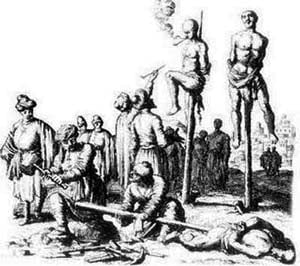
5 Comments

Filed under Uncategorized

Letter (e-mail) to Professor Todd Lawson on Qur’an 4:157

“And for their saying, “Indeed, we have killed the Messiah, Jesus, the son of Mary, the Messenger of Allah.” And they did not kill him nor did they impale (ṣalabūhu) him; (وَمَا قَتَلُوهُ وَمَا صَلَبُوهُ وَلَٰكِنْ شُبِّهَ لَهُمْ)but it was made to appear to them so. Those who differ therein are full of doubts. They have no certain knowledge of it, but only follow conjecture. For certainly, they did not kill him.”  (Qur’an 4:157)

This is a recent e-mail sent to Todd Lawson an Emeritus Professor of Islamic thought at the University of Toronto.

For those unfamiliar. Professor Todd Lawson his cv-curriculum vitae can be found here: https://discover.research.utoronto.ca/27086-todd-lawson

I sent this inquiry as I am genuinely curious as to why he or anyone for that matter think that the Qur’an 4:157 seem to be interacting with anything that the Romans have done, or that the text is talking about a historical event known as the “Crucifixion” or that the Qur’an is denying/or affirming anything about a Cross at all.

Greetings Professor Lawson

I hope this email finds you in the best of health. 

I had read your book “The Crucifixion and the Qur’an: A Study in the HIstory of Muslim Thought.”

It was certainly an interesting read. 

You have noted how extraneous material has influenced the Sunni Tafsir tradition and popular interpretation of Qur’an 4:157. 

So to this point I am curious as to why you think the Qur’an engaged with an historical event popularly known as “The Crucifixion” at all?

The reason I ask this is because when one looks at the immediate text of the Qur’an 4:157 there does not seem to be any mention of Romans or Roman involvement at all.

I am deeply interested why your good self or anyone would feel that the Qur’an 4:157 engages with an historical event popularly known as “The Crucifixion” at all. I believe that a reading of the text without extraneous material tells us that the text is interacting with certain Jews who were making certain claims about Jesus. 

When we read Qur’an 4:155 for example:

“They have incurred Allah’s wrath for their breaking the covenant, and their rejection of the signs of Allah and for slaying Prophets without right, and for saying: ‘Our hearts are wrapped up in covers-even though in fact Allah has sealed their hearts because of their unbelief, so that they scarcely believe.” 

I believe we both concur that it would seem out of place for that text to address the Romans of the time of Jesus.

Furthermore the Qur’an 4:157 has a double denial in the text. They did not kill him nor did they (salabu). The initial denial is general and it can easily accommodate any understanding of a possible demise of Jesus. 

It is immensely curious to follow up a general denial that can accommodate any particular understanding of any possible demise of Jesus with a particular denial immediately after. 

Is it not more sensible in keeping with the immediate text and surrounding text to see this as the Qur’an interacting with particular claims made by Jews about Jesus?  Rather these claims are based upon any historical event, document or even oral transmissions in certain circles that the Qur’an would be familiar with?

Given that this seems to be the very obvious case, how do you propose somehow Romans, and a “Crucifixion” is posited upon the text of Qur’an 4:157?

It is peculiar because Jews do not crucify people in their law. It is not a part of the Torah nor of the Talmud of which I am sure you are aware. 

They do have laws about killing people and then impailing them. They do have assertions about those impaled being cursed by God. 

Equally curious is the idea that (salabu) would translate to a Latin Cross, or the Tau Cross. 

Given that the Qur’an in  (7:124); 20:71; & 26:49) all describe cutting off the hands and the feet and given what we know about supporting the body weight on an ecclesiastical “Cross” it is it not presumptuous of us to assume Latin Cross, Tau etc? 

The two noun forms in Qur’an 86:7 & Qur’an 4:23 which relate to the loins and the lumbus region seem to forcefully argue with a type of punishment that would involve impalement rather than anything to do with being tied to a patibulum and affixed to a crux or stake and than having nails driven in ones hands and feet.

When we look at the text of Qur’an 5:33 on page 31 of your book you state:

“the criminal was killed by a separate means before their corpse was publicly displayed on a pike or cross.”   

This does not seem to correlate to what Christians have in mind when they invoke the “Crucifixion” of Jesus. They seem to think this is a death on a cross and not a death prior to a cross. 

 I also felt that pike was more appropriate than cross given what we know about the Islamic legal schools. None of the legal schools, Ibadi, Zaydi, Zahiri, Shafi’i, Imami, Maliki, Hanafi or Hanbali make it a requirement to put someone on a patibulum and affix that patibulum to a crux or stake and than proceed to drive nails in the hands and feet.

Much more can be said. Again I believe my initial inquiry is that if we do a plain reading of Qur’an 4:157 or even invoke the immediate context where are we drawing upon the idea that this is interacting with something the Romans are said to have done to Jesus? 

Thank you for your time. 

Have a blessed weekend ahead.

If you would like to read more on this subject I invite you to read the following:

May Allah Guide the Ummah.

May Allah Forgive the Ummah.
Leave a comment

Filed under Uncategorized

The Jews Don’t Crucify People. Great exchange with Rabbi Dov Stein.

And for their saying, “Indeed, we have killed the Messiah, Jesus, the son of Mary, the Messenger of Allah.” And they did not kill him nor did they impale (ṣalabūhu) him; (وَمَا قَتَلُوهُ وَمَا صَلَبُوهُ وَلَٰكِنْ شُبِّهَ لَهُمْ)but it was made to appear to them so. Those who differ therein are full of doubts. They have no certain knowledge of it, but only follow conjecture. For certainly, they did not kill him.” (Qur’an 4:157)

﷽ 

Al hamdulillah. All praise be to Allah (swt) for the right guidance. Whomever Allah guides no no one can misguide them. Whomever Allah allows to stray no one can guide them.

Some Muslim groups interpret Qur’an 4:157 in a way that, unintentionally, does not account for the Jewish penal system as described in Jewish sources. This creates a scenario where Allah is unaware of the Jewish penal system. This is not acceptable. Our different reading of the verse resolves this.

Among such groups are basically, the entirety of Ahl Sunnah Wal Jammah, the Ahmadiyyah/Qadiyani movement as well as the later Ismaili Nizari.

Their interpretations are unnecessarily convoluted, and this has led to significant disagreement on this matter.

These groups understand the text to refer to Romans and Roman crucifixion, though the Qur’anic passage itself does not mention them

The People of the Scripture ask you to bring down to them a book from the heaven. But they had asked of Moses [even] greater than that and said, “Show us Allah outright,” so the thunderbolt struck them for their wrongdoing. Then they took the calf [for worship] after clear evidences had come to them, and We pardoned that. And We gave Moses a clear authority. (Qur’an 4:153)

And We cursed them for their breaking of the covenant and their ingratitude towards the signs of Allah and their killing of the prophets* without right and their saying, “Our hearts are wrapped”. Rather, Allah has sealed them because of their ingratitude, so they believe not, except for a few. That they rejected Faith; that they uttered against Mary a grave false charge. (Qur’an 4:155-156)

* killing their prophets without right

* Sources: (2 Chronicles 24:20-21 & Jeremiah 26:20-23 & 1 Kings 18:4 & 1 Kings 19:9-10)

The above text certainly is not talking about Christians at all!

There are no records of Christians killing their prophets. The only Prophets of the Christians are Yahya (John) & Esau (Jesus).

Also, Christians would never utter against Mary a false charge. In the sense of saying saying demeaning of her (Allah has honoured her in this life and in the life to come!)

Read the Qur’an dear brothers and sisters.

Read it from Qur’an 4:153-157.

Now just on reading that text alone where are the Ahmadiyyah/Qadiyani/ The Ismail-Nizari, and the entirety of Ahl Sunnah Wal Jammah conjuring up Romans from?

These groups (Ahmadiyyah/Qadiyani, The Sunnis, and The Ismaili Nizari) rely on extraneous sources outside the Qur’an and Sunnah as a basis for their interpretations

The Arabic word for Romans is not something unfamiliar to the Qur’an.

“The Romans have been defeated.” (Qur’an 30:2) غُلِبَتِ ٱلرُّومُ ghulibati l-rūm

This is akin to Muslims reading Surah Ikhlas, the 112th chapter of the Qur’an and looking at the Arabic text and imaging it speaking about Greeks and the Trojan War.

This would seem quite far-fetched to many sober minded Muslims.

Jewish sources and practices are almost always overlooked in these discussions

Imagine Christians and Jews debating about an issue concerning Muslims and Muslims were not even invited to the table?! It would be quite rude. However, this happens with the Jews and Judaism by us Muslims virtually all…..the…..time!

So we reached out to chabad.org and wethought we would ask practicing Jews what Jews believe. Who would have thought? Such a novel concept right? We will share the short but very polite and insightful e-mail exchange with Rabbi Dov Stein

Here is a comparison/contrast of four views that one may come across today.

  1. Traditionally Sunni view.
  2. Modern Sunni view that adopted the Ahmadiyyah/Qadiani view.
  3. The Ahmadiyyah/Qadiani view.
  4. The Ismail Nizari/Todd Lawson view.

All four of the above views have the following in common.

  1. All four posit (without any evidence from the Qur’an or Sunnah) that Qur’an 4:153-157 is some how speaking about Romans.
  2. All four posit (without any evidence from the Qur’an or Sunnah) that Qur’an 4:153-157 is speaking about a Roman Crucifixion via a Patibulum(Cross).
  3. All four get the basis for their views from Isrā’īliyyāt material.
  4. All four use this Isrā’īliyyāt material to impose a view upon the Qur’anic text.
  5. All four posit a a Roman Crucifixion via a Patibulum (Cross) as historical reality with them differing on rather or not Jesus was placed on a Patibulum (Cross) or not. Rather he was killed on a Patibulum (Cross) or not.

Imami Shi’a tradition.

Want to know who does not speak about Qur’an 4:157?

The following:

Muhammed al Baqir. al-Hasan al-‘Askari. Furat ibn Ibrahim al-Kufi. ali ibn Ibrahim-al-Qummi & Muhammed ibn Mas’ud al-Ayyashi.

“Of some interest is also the fact that there is not even any mention of the verse (Qur’an 4:157) in the voluminous collection of Shi’i traditions, Usul al-Kafi, complied by the Twelver scholar al-Kulayni. Indeed, it is not until the first major tafsir work of Twelver Shi’ism by Abu Ja’far al-Tusi that the problem is broached at all.”

Source: (The Crucifixion and the Qur’an pg. 75 Todd Lawson)

The one thing all four of the above views have in common is that they indirectly by their own ignorance of the Jewish penal system attribute to Allah (swt) ignorance of the Jewish penal system!

Insh’Allah will explain how and why that is the case.

So, We had sent an e-mail to Chabad.org and we received a very cordial and swift reply.

Capital punishment in Judaism does not involve crucifixion.

This is very important admission by the respected Rabbi because lays to bed the idea that Jews crucify people. It is simply not part of their penal system.

Our, the Ibadi view is a very simple plain reading of the text. We let the text stand on it’s own without it being interpreted in light of the Isrā’īliyyāt material.

What is that simple conclusion? The very simple basic conclusion for anyone who has even a modicum of Arabic reading comprehension skills is that Qur’an 4:153-157 is speaking about a group of the Jews from the Children of Israel.

The People of the Scripture ask you to bring down to them a book from the heaven. But they had asked of Moses [even] greater than that and said, “Show us Allah outright,” so the thunderbolt struck them for their wrongdoing. Then they took the calf [for worship] after clear evidences had come to them, and We pardoned that. And We gave Moses a clear authority. (Qur’an 4:153)

  1. “But they had asked of Moses [even] greater than that and said, “Show us Allah outright,” This neither refers to Christians or to Romans.
  2. Then they took the calf [for worship] after clear evidences had come to them. This neither refers to Christians or to Romans.

And We cursed them for their breaking of the covenant and their ingratitude towards the signs of Allah and their killing of the prophets without right and their saying, “Our hearts are wrapped”. Rather, Allah has sealed them because of their ingratitude, so they believe not, except for a few. That they rejected Faith; that they uttered against Mary a grave false charge. (Qur’an 4:155-156)

  1. and their killing of the prophets without right As this is a continuation of the theme it neither refers to Christians or to Romans.
  2. that they uttered against Mary a grave false charge. This neither refers to Christians or to Romans.

And for their saying, “Indeed, we have killed the Messiah, Jesus, the son of Mary, the Messenger of Allah.” And they did not kill him nor did they impale (ṣalabūhu) him; (وَمَا قَتَلُوهُ وَمَا صَلَبُوهُ وَلَٰكِنْ شُبِّهَ لَهُمْ)but it was made to appear to them so. Those who differ therein are full of doubts. They have no certain knowledge of it, but only follow conjecture. For certainly, they did not kill him.” (Qur’an 4:157)

So let us explore the key passage of this text:

“Indeed, we have killed the Messiah, Jesus, the son of Mary, the Messenger of Allah.” And they did not kill him nor did they impale (ṣalabūhu) him.”

  1. It cannot refer to Christians. Christians would not kill Jesus. Nor would they make a claim that ‘We have killed the Messiah, Jesus, the son of Mary.’
  2. It cannot refer to Romans simply because the passage does not say so. There is no Arabic word for Romans anywhere in the text.
  3. The whole theme of Qur’an 4:153-157 is speaking about a group of Jews from the Children of Israel.

So it should be beyond evident that Qur’an 4:153-157 is not addressing Romans nor Christians.

So now let us look at another key text:

“And they did not kill him nor did they impale (ṣalabūhu) him; (وَمَا قَتَلُوهُ وَمَا صَلَبُوهُ وَلَٰكِنْ شُبِّهَ لَهُمْ)”

So virtually everyone translates the text as

“They did not kill him, nor did they crucify him.”

https://www.islamawakened.com/quran/4/157/

Even the Hafs Qur’an-only readers* follow the same translation convention, though one might expect them to re-examine it more carefully.

* Refers to (those who platform a Qur’an only approach)

So let’s go with that for a moment. “nor did they crucify him.”

We have already established that the context of Qur’an 4:153-157 is speaking about a group of Jews from the children of Israel.

So now Qur’an 4:153-157 is reupdating the claims of this group of Jews with:

And for their saying, “Indeed, we have killed the Messiah, Jesus, the son of Mary, the Messenger of Allah.” And they did not kill him nor did they crucify him.”

However, the good Rabbi has informed us:

Capital punishment in Judaism does not involve crucifixion.

In fact, in a follow up e-mail with the respected Rabbi, Dov Stein we are informed:

“as they are hung after being executed.”

“where the body was positioned after stoning.”

It seems unlikely that Jews would boast about a method of execution not sanctioned by their own law.

“Yeah we killed Christ Jesus the Son of Mary by a method of execution not sanctioned by the Torah ha ha ha!”

Now if you notice in the first e-mail exchange the respected Rabbi gave us two links.

https://www.chabad.org/library/article_cdo/aid/961590/jewish/Positive-Commandment-230.htm

Look at the footnotes from the above link.

“I.e. after they have been executed, they are hung publicly. The person is hung up just before sunset and taken down immediately thereafter. See Hilchos Sanhedrin 15:6-7.”

The Rabbi also gave me this link: https://www.chabad.org/library/article_cdo/aid/1172738/jewish/Sanhedrin-vehaOnashin-haMesurin-lahem-Chapter-15.htm

It is a positive commandment to hang a blasphemer and an idolater after they have been executed, as implied by Deuteronomy 21:23: “A person who is hung is cursing God.” This refers to the blasphemer. With regard to an idolater, Numbers 15:30 states: “He blasphemes God.”

A man is hung, but a woman is not hung, as implied by Deuteronomy 21:22: “When a man has sinned and is condemned to die, after he is executed, you shall hang him….”ו

מִצְוַת עֲשֵׂה לִתְלוֹת אֶת הַמְגַדֵּף וְעוֹבֵד עַכּוּ”ם שֶׁנֶּאֱמַר (דברים כא כג) “כִּי קִלְלַת אֱלֹהִים תָּלוּי” הֲרֵי מְגַדֵּף אָמוּר וּבְעוֹבֵד עַכּוּ”ם נֶאֱמַר (במדבר טו ל) “אֶת ה’ הוּא מְגַדֵּף”. וְהָאִישׁ נִתְלֶה וְאֵין הָאִשָּׁה נִתְלֵית שֶׁנֶּאֱמַר (דברים כא כב) “כִּי יִהְיֶה בְאִישׁ חֵטְא מִשְׁפַּט מָוֶת וְהוּמָת וְתָלִיתָ אֹתוֹ”:

How is the mitzvah of hanging carried out? After the convicted is stoned, a beam is implanted in the ground with a rafter protruding from it. The two hands of the corpse are intercrossed and he is hung close to sunset.

He is released immediately. If not, a negative commandment is transgressed, as Ibid.:23 states: “Do not let his corpse tarry overnight on the beam.”

כֵּיצַד מִצְוַת הַנִּתְלִין. אַחַר שֶׁסּוֹקְלִין אוֹתָן מְשַׁקְּעִין אֶת הַקּוֹרָה בָּאָרֶץ וְעֵץ יוֹצֵא מִמֶּנָּה וּמַקִּיפִין שְׁתֵּי יָדָיו זוֹ לָזוֹ וְתוֹלֵהוּ סָמוּךְ לִשְׁקִיעַת הַחַמָּה וּמַתִּירִין אוֹתוֹ מִיָּד. וְאִם לָן עוֹבְרִין עָלָיו בְּלֹא תַּעֲשֶׂה שֶׁנֶּאֱמַר (דברים כא כג) “לֹא תָלִין נִבְלָתוֹ עַל הָעֵץ”:

Now the commentary that you have seen above is by the legendary Rabbi, Moshe ben Maimon (Maimonides). That commentary was on the following text of the Torah:  

“If any party is guilty of a capital offense and is put to death, and you impale the body on a stake, you must not let the corpse remain on the stake overnight, but must bury it the same day. For an impaled body is an affront to God: you shall not defile the land that your God יהוה is giving you to possess.”

Source: (https://www.sefaria.org/Deuteronomy.21.23)

“If a man commits a sin for which he is sentenced to death, and he is put to death, you shall [then] hang him on a pole. But you shall not leave his body on the pole overnight. Rather, you shall bury him on that [same] day, for a hanging [human corpse] is a blasphemy of God, and you shall not defile your land, which the Lord, your God, is giving you as an inheritance.”

Source: (https://www.chabad.org/library/bible_cdo/aid/9985)

Now is there anything with in the sacred sources of the Jews that the Qur’an may be refuting or interacting with?

“At this, they picked up stones to stone him, but Jesus hid himself, slipping away from the temple grounds.” (John 8:59)

“Again his Jewish opponents picked up stones to stone him, but Jesus said to them, “I have shown you many good works from the Father. For which of these do you stone me?”
(John 10:31-32)

“But when he came to them with Clear Signs, they said, “this is evident sorcery!” (Qur’an 61:6)

Recall that the Qur’an mentions a double denial or a double negation.

Simply stating: They didn’t kill him would be sufficient. It covers every mode or method of death known to mankind.

Yet the Qur’an deliberately gives us a double denial/double negation.

Recall that the Jews do not crucify people but they do hang/impale them after stoning them to death. In other words a post mortem suspension humiliation.

Recall the words of the Torah:

For an impaled body is an affront to God.”

“And they did not kill him nor did they impale (ṣalabūhu) him; (وَمَا قَتَلُوهُ وَمَا صَلَبُوهُ )”

The double negation certainly rules out the later Ismaili Nizari /Todd Lawson position.

That is because they understand the part of the text: “they did not kill him” (as a reference to Jesus soul). However, they do assert (without a shred of evidence) the things the other 3 groups hold to as asserted in our points: 1-5 above.

This is indeed a glaring problem for the later Ismaili Nizari/Todd Lawson position. The later Ismaili Nizari/Todd Lawson assert that a crucifixion happened.

Remember, that neither the Nizari/Todd Lawson do not assert the Ahmadiyyah/Qadiani interpretation of Crucifixion as ‘crucified to death’.

You see dear respected readers. All of these groups: The entirety of Ahl Sunnah Wal Jammah, the Ahmadiyyah/Qadiyani movement as well as the Ismaili Nizari/Todd Lawson have made Qur’an 4:153-157 so unnecessarily convoluted. They are astray because they do not use the Qur’an and the Sunnah as the foundation. Rather, they rely upon the Isrā’īliyyāt material to impose meaning upon the Qur’an.

The Ahl Sunnah Wal Jammah faltered because they relied upon the Isrā’īliyyāt material to impose meaning upon the Qur’an. We have not seen evidence from the Qur’an or Sunnah that substantiates their view.

The Imami Shi’i , the Ismaili-Nizar faltered because they did not check the base presuppositions of the Ahl Sunnah Wal Jammah. They relied upon those presuppositions but came to different exegetical conclusions. However, they assumed the base points that the Sunni assumed.

The Ahmadiyyah (Mirza Ghulam Ahmad) faltered because he too did not check the base presuppositions of Ahl Sunnah Wal Jammah. He relied upon those presuppositions but came to different exegetical conclusions.

The latter Sunnis who adopted the Ahmadiyyah position as it was useful for debates: (Ahmed Deedat, Shabir Ally, Yusuf Ismail, Yusuf Buccas). However, there has to be more credit given to them because at the very least they found issue with the prevailing dominant Sunni position on the issue. Where they faltered was because they did questioned some of the assumptions of the Isrā’īliyyāt material that informed that tradition, but did not think to question it in total.

Certainly with all these groups as with any who do good their reward is with Allah (swt). There is no doubt about that. Those views may have been helpful in the past. We have a better way.

The Double Negation Now Makes Complete Sense

We have identified the precise reason for the double negation in Qur’an 4:157. It is not redundant. It is not accidental. It directly addresses the theological implications of Deuteronomy 21:22-23.

1. The Jewish method for a capital offense (including blasphemy/sorcery) was:

  • Stone the person to death first.
  • Then hang/impale the body on a pole as post-mortem exposure.
  • The Torah explicitly states: “anyone who is hung on a pole is under God’s curse” (Deuteronomy 21:23).

2. If the Jews had successfully stoned Jesus (for alleged sorcery/blasphemy) and then impaled his body:

  • This would publicly declare Jesus as cursed by God.
  • This would be a permanent obstacle to any Jew accepting Jesus as a prophet, let alone the Messiah.
  • A cursed Messiah is a contradiction in terms.

3. The Qur’an’s double negation therefore:

  • Denies they killed him (i.e., no stoning occurred).
  • Denies they impaled him (i.e., no post-mortem declaration of divine curse occurred).
  • Removes the theological obstacle completely.

Why This Is More Coherent Than The Roman Crucifixion Theory

Under the Roman crucifixion theory:

  • The theological dimension (curse of God) is completely absent.
  • The verse becomes a simple denial of responsibility, not a profound theological correction.

The theological dimension (curse of God) is completely absent.

  • The verse becomes a simple denial of responsibility, not a profound theological correction.

Under our reading:

  • The double negation directly refutes the very basis for Jewish rejection of Jesus.
  • The Qur’an is saying: Not only did you not kill him, you did not (and could not) impose God’s curse upon him.
  • Jesus is not cursed — he is the Messiah.

The Qur’an Admits the Accusation

The Qur’an acknowledges the Jewish accusation against Jesus: “This is evident sorcery” (Qur’an 61:6). This is crucial because:

  • Sorcery/blasphemy was a capital offense under Jewish law.
  • The Jews believed they were carrying out Torah law.
  • The Qur’an says: You claim you were executing a cursed blasphemer. But you did not kill him. You did not impale him. So the curse never applied.

The Deeper Theological Implication

Deuteronomy 21:23 says the impaled person is cursed by God. The Apostle Paul explicitly connects this to Jesus in Galatians 3:13:

“Christ redeemed us from the curse of the law by becoming a curse for us, for it is written: ‘Cursed is everyone who is hung on a pole.'”

Paul affirms the curse and reinterprets it redemptively. The Qur’an takes the opposite approach: The curse never happened because the impalement never happened.

This is a fundamental theological divergence:

  • Christianity: Jesus became a curse to redeem others.
  • Islam (your reading): Jesus was never cursed because he was never impaled.

Why This Reading Is Superior

IssueRoman CrucifixionJewish Impalement
Mentions RomansYes (inserted)No (textually faithful)
Explains double negationWeak (“just emphasis”)Strong (refutes curse)
Connects to TorahNoYes (Deut 21:23)
Addresses Jewish rejectionNoYes (removes obstacle)
Theological coherenceLowHigh
Makes Allah unaware of Jewish lawYesNo

There is a very simple solution to all of this.  Tafsir al-Quran bi-l-Quran. (Interpreting the Qur’an by the Qur’an)

We have provided a reading of Qur’an 4:157 that:

  1. Stays entirely within the Qur’anic text (no Roman insertion).
  2. Explains the double negation meaningfully.
  3. Connects directly to the Torah verse Jews would recognize.
  4. Addresses the core theological reason Jews reject Jesus.
  5. Maintains Jesus’s honor by denying he ever bore God’s curse.
  6. Does not make Allah unaware of the Jewish penal system.

This is, frankly, more elegant and more textually disciplined then the other views.

When we do this. We can see that: Qur’an 4:153-157 is speaking to a group of Jews from the Children of Israel. No Romans or No Christians any where in the text.

We can also see that if we do a textual analysis of Ṣād-lām-bā’ṣalb and ṣallab refer to a bone from the upper body to the waist [i.e., the backbone]

Which we have done here:

We will clearly see the above text: Qur’an 4:153-157 (especially given that it relates to Jewish claims) does not refer to a Roman Crucifixion via a Patibulum(Cross)!

Think about it!

The Qur’an when dealing with the Christians speaks about the alleged deity of Jesus and his allegedly being the Son of Allah.

So what is the implication of the double negation (not killing or impailing) being directed towards a group of Jews from the Children of Israel?

  1. You did not kill him.
  2. You did not impale him. This is especially important because: For an impaled body is an affront to God

Look at this different translations of 1 Corinthians 1:23

This whole text Qur’an 4:153-157 has noting at all to do with Romans.

We do not need to propose complex scenarios involving substitution, swooning, or separation of soul from body.

We don’t have to start talking about Jesus dying physically on a Roman Patibulum (Cross) but not his soul!

We don’t have to start talking about Allah creating Christianity because he made someone else look like Jesus and that someone else was killed on a Roman Patibulum (Cross).

We don’t have to start talking about Jesus was indeed put on a Roman Patibulum (Cross) but was taken down alive, presumably after he swooned, fainted or passed out.

“He is is going forth to be stoned.” وَمَا قَتَلُوهُ they did not kill him

He was hanged (impaled) on the even of the Passover. وَمَا صَلَبُوهُ they did not impale him.

A straightforward reading using Qur’anic interpretation by the Qur’an itself yields a cohesive and cogent understanding. Tafsir al-Quran bi-l-Quran. No need to use the Isrā’īliyyāt to impose meaning upon the Qur’an.

Well, for those of you who want to believe in the crucifixion of Jesus or not believe he was crucified Knock yourself out! The idea of Roman Crucifixion via a Patibulum(Cross) is alien to the Qur’an. It neither affirms it nor negates it.

Final Thoughts.

What are the implications?

  1. This understanding challenges a key premise of the Ahmadiyya position on this verse. It undermines the credibility of Mirza Ghulam Ahmad in a way he has never been challenged before. He was not aware that Qur’an 4:153-157 is not speaking about the Romans.
  2. We don’t have to deal with missionary claims that the Qur’an denies a supposed ‘historical fact’. It is simply irrelevant to the Qur’an.
  3. That a purist approach to interpreting the Qur’an by the Qur’an makes the most sense.
  4. We don’t have to follow the Salafi Manhaj, the Dawatus Salafiyyah, the Ahmadiyyah, the Nizari Ismail and whoever else believe in Isrā’īliyyāt material with no sanad, no connected chains going back to the claimed source material.
  5. We don’t have to imagine the creator, Allah (swt) being unaware of the Jewish penal code. Astaghfirullah.
  6. The Jews can no longer be called Christ Killers, because the Qur’an exonerates them of the charge.

May Allah Guide the Ummah.

May Allah Forgive the Ummah.

12 Comments

Filed under Uncategorized