Tag Archives: religion

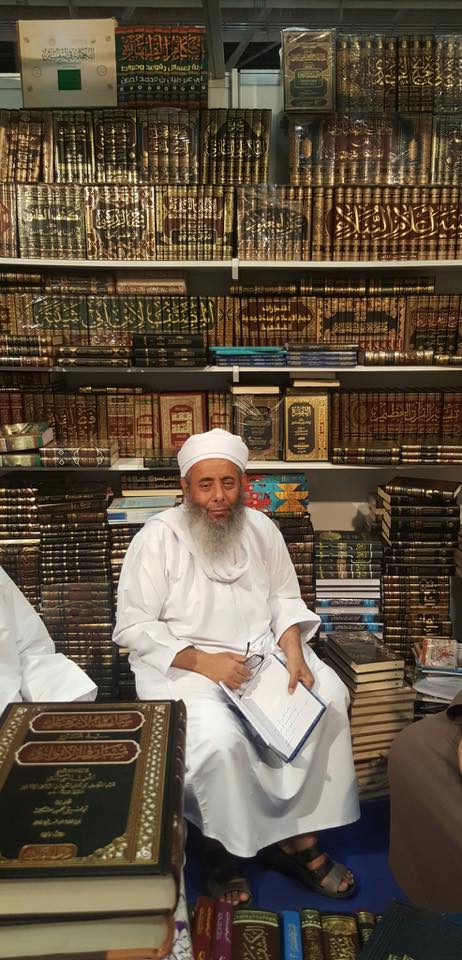
Ibadi hadith master Shaykh Al Qanoubi on Hadith Al Thaqalyan.

“And whoever obeys Allah and the Messenger will be in the company of those blessed by Allah: the prophets, the people of truth, the martyrs, and the righteous—what honourable company!” (Qur’an 4:69)

﷽ 

Shaykh Al Qanoubi (h) is the luminary of the Ibadi school in the sciences of the hadith. The one whom Allah (swt) has illuminated his mind, and given sharp wit. Able to be among the scientists who detect the ʿillah, the hidden defects that often escape the grasp of the most astute.

This entry is in regard to what is known as: Hadith Al Thaqalyan or two matters of weight or two matters of importance.

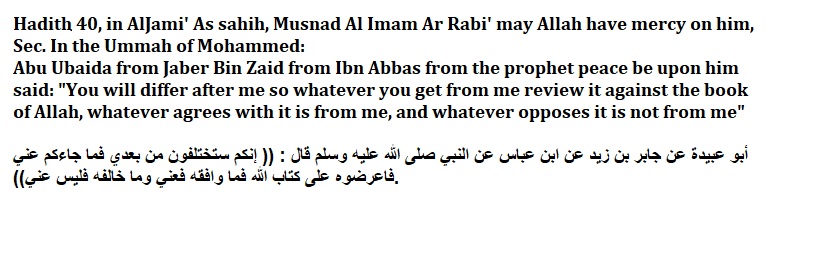
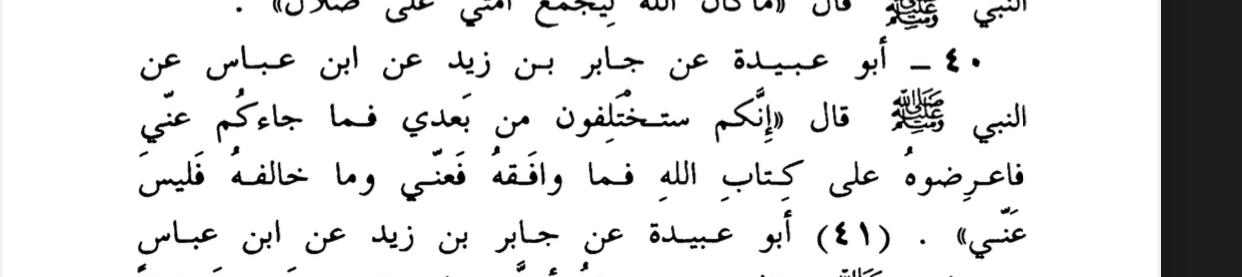
Source: (Hadith 40, in Al Jami’ Al Sahih)

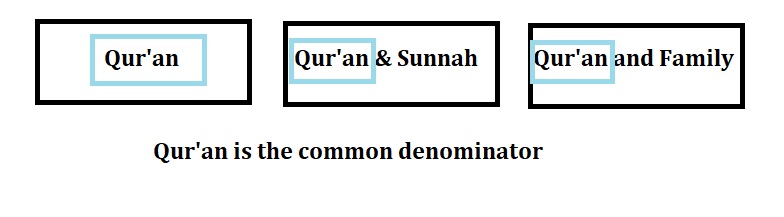
In the short video clip below, Shaykh Dr. Abdullah bin Sa’ed Al Ma’mari (h) mentions that Shaykh Al Qanoubi (h), in his study on the subject, has not found the narrations that include: “and my family” as being authentic from the Blessed Prophet (saw).

As Shaykh Dr Abdullah bin Sa’ed Al Ma’mari (h) says, what is authentic for us in the Ibadi school are the words: “The book of Allah and my Sunnah.”

Obeying Allah and his Messenger is transmitted via tawatur from the Qur’an. It does not need confirmation from the hadith.

What Shaykh Dr Abdullah bin Sa’ed Al Ma’mari (h) has said is true. We don’t find a single mention of obey Allah, Obey the Messenger and Obey the Ahl Bayt.

He who obeys the Messenger has obeyed Allah, but those who turn away-We have not sent you over them as a guardian.” (Qur’an 4:80)

“O you who believe, you shall obey Allah, and obey the messenger. Otherwise, all your works will be in vain.” (Qur’an 47:33)

“And obey Allah and obey the Messenger. But if you turn away, then Our Messenger is responsible only for conveying the message clearly. (Quran 64:12)

“Say, “Obey Allah and obey the Messenger. But if you turn away, then he is only responsible for his duty, and you are responsible for yours. And if you obey him, you will be guided. The Messenger’s duty is only to deliver the message clearly.” (Qur’an 24:54)

Believe in Allah and His Messenger, and the scripture which He has sent to His Messenger and the scripture which He sent to those before (him)” (Qur’an 4:136)

O you who have believed, obey Allah and obey the Messenger and those in authority among you. And if you disagree over anything, refer it to Allah and the Messenger, if you should believe in Allah and the Last Day. That is the best [way] and best in the result. (Qur’an 4:59)

The hadiths that the Sunni and Shi’i primarily dispute about are as follows:

Follow the Qur’an

I have left among you the Book of Allah, and if you hold fast to it, you would never go astray. And you would be asked about me (on the Day of Resurrection), (now tell me) what would you say? They (the audience) said: We will bear witness that you have conveyed (the message), discharged (the ministry of Prophethood) and given wise (sincere) counsel. He (the narrator) said: He (the Holy Prophet) then raised his forefinger towards the sky and pointing it at the people (said):” O Allah, be witness. 0 Allah, be witness,” saying it thrice.”

Source: (https://sunnah.com/muslim:1218a) -connected to ‘Arafa 

Follow the Qur’an and Sunnah.

On the authority of Ikrimah, on the authority of Ibn Abbas, that the Messenger of Allah, (saw) , addressed the people during the Farewell Pilgrimage and said: “O people, I have I have left among you that which if you hold fast to it you will never go astray: the Book of Allah and the Sunnah of His Prophet.”

Source: (https://shamela.ws/book/7861/23097) Sunan Al Kubra Al Bayhaqi. -connected to ‘Arafa 

“On the authority of Ikrimah, on the authority of Ibn Abbas, that the Messenger of Allah, (saw), The Prophet (saw) addressed the people during the Farewell Pilgrimage  and said: “Satan has despaired of being worshipped in your land, but he is content to be obeyed in other than that, of your deeds that you despise. So beware, O people, for I have left among you that which, if you hold fast to it, you will never go astray: The Book of Allah and the Sunnah of His Prophet (saw). Indeed, every Muslim is a brother to Allah.” A Muslim, Muslims are brothers, and it is not permissible for a man to take from his brother’s wealth except what he gives of his own free will. And do not wrong, and do not revert after me to disbelief, striking one another’s necks . ” 

Source: (https://shamela.ws/book/2266/304) Al-Mustadrak ‘ala al-Sahihayn or Mustadrak Al Hakim –connected to ‘Arafa 

Follow the Qur’an and Ahl Bayt.

Narrated by Zaid bin Arqam:

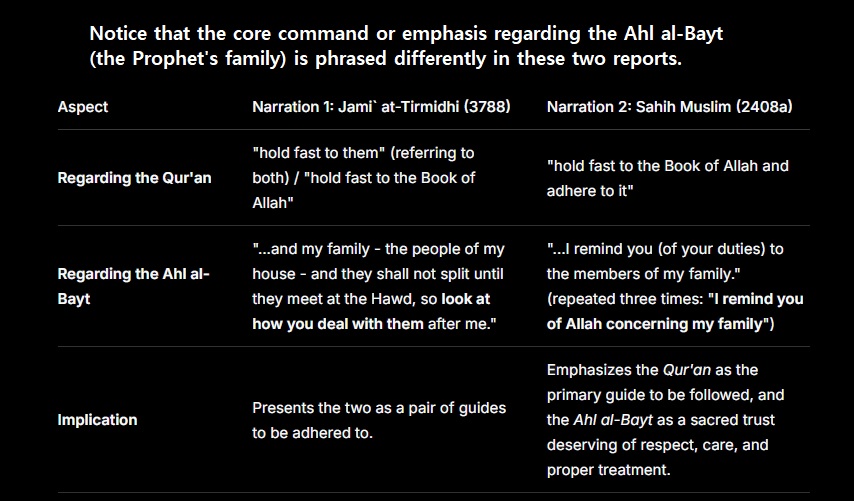
That the Messenger of Allah (saw) said: “Indeed, I am leaving among you, that which if you hold fast to them, you shall not be misguided after me. One of them is greater than the other: The Book of Allah is a rope extended from the sky to the earth, and my family – the people of my house – and they shall not split until they meet at the Hawd, so look at how you deal with them after me.”

Source: (https://sunnah.com/tirmidhi/49/187) –not connected to ‘Arafa 

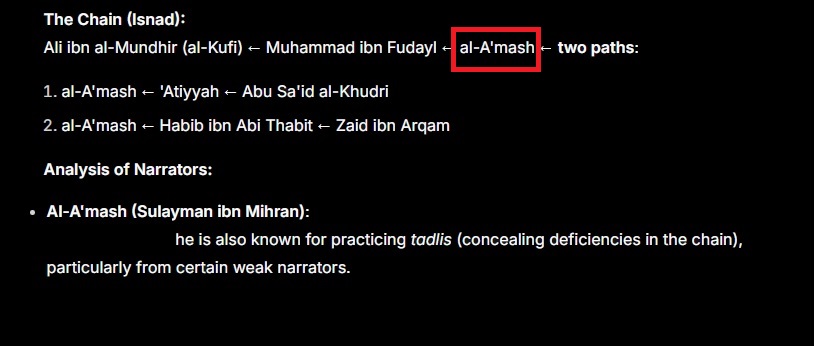
The problem with the above hadith is it contains the vile and evil al-A’mash! No consideration is given to it.

Narrated Jabir bin ‘Abdullah:

“I saw the Messenger of Allah during his Hajj, on the Day of ‘Arafah. He was upon his camel Al-Qaswa, giving a Khutbah, so he said: ‘O people! Indeed, I have left among you, that which if you hold fast to it, you shall not go astray: The Book of Allah and my family, the people of my house.'”

Source: (https://sunnah.com/tirmidhi:3786) -connected to ‘Arafa 

Follow the Qur’an but take care of the Ahl Bayt.

Yazid b. Hayyan reported, I went along with Husain b. Sabra and ‘Umar b. Muslim to Zaid b. Arqam and, as we sat by his side, Husain said to him:

Zaid. you have been able to acquire a great virtue that you saw Allah’s Messenger (saw) listened to his talk, fought by his side in (different) battles, offered prayer behind me. Zaid, you have in fact earned a great virtue. Zaid, narrate to us what you heard from Allah’s Messenger (saw). He said: I have grown old and have almost spent my age and I have forgotten some of the things which I remembered in connection with Allah’s Messenger (saw), so accept whatever I narrate to you, and which I do not narrate do not compel me to do that. He then said: One day Allah’s Messenger (saw) stood up to deliver sermon at a watering place known as Khumm situated between Mecca and Medina. He praised Allah, extolled Him and delivered the sermon and. exhorted (us) and said: Now to our purpose. O people, I am a human being. I am about to receive a messenger (the angel of death) from my Lord and I, in response to Allah’s call, (would bid good-bye to you), but I am leaving among you two weighty things: the one being the Book of Allah in which there is right guidance and light, so hold fast to the Book of Allah and adhere to it. He exhorted (us) (to hold fast) to the Book of Allah and then said: The second are the members of my household I remind you (of your duties) to the members of my family. He (Husain) said to Zaid: Who are the members of his household? Aren’t his wives the members of his family? Thereupon he said: His wives are the members of his family (but here) the members of his family are those for whom acceptance of Zakat is forbidden. And he said: Who are they? Thereupon he said: ‘Ali and the offspring of ‘Ali, ‘Aqil and the offspring of ‘Aqil and the offspring of Ja’far and the offspring of ‘Abbas. Husain said: These are those for whom the acceptance of Zakat is forbidden. Zaid said: Yes.

Source: (https://sunnah.com/muslim:2408a) -not connected to ‘Arafa.

Notice dear reader: “and the offspring of ‘Abbas.” Surely Ibn Abbas (ra) would know best what the Blessed Prophet (saw) said.

Prima Qur’an comments:

As mentioned, the inclusion of the Book of Allah and my family is important for the Shi’i in helping to establish their positions. This is not the case for us (the Ibadi school).

Some Sunni Muslims (in particular those who follow a Sufi Tariqah) reconcile the narrations by stating that they (Sunni Muslims who follow a Sufi Tariqah) follow the Qur’an and Sunnah via the descendants of the Blessed Messenger (saw). Since it is claimed by Sunni Muslims that the bulk of the descendants of Prophet Muhammed (saw) are actually contained within the house of ‘Ahl Sunnah Wal Jammah’, then they are best suited to teach and guide.

So, for example: Shaykh Muhammed Al Yaqoubi, who is a claimed descendant of the Blessed Prophet (saw) via Hasan ibn Ali. People who follow a Sufi order that he is affiliated with would find that he is best suited to guide.

As seen in two of the narrations above, Ibn Abbas (ra) is in the chain of transmission. For us (The Ibadi school) he is part of the household of the Blessed Prophet (saw). Thus, he, being a member of Ahl Bayt, transmitted that we are to follow the Qur’an and Sunnah.

That statement aligns with what we find in the Qur’an.

It could be very well that the Prophet (saw) was meant to convey the following:

Did he convey the message? Did he bring the Qur’an? Of which everyone agrees that he did.

That he would want people to look after and take care of his kinsfolk. This is only natural and something any honourable person would desire. How much more the most honorable among creation?

As we find in the Qur’an:

“That is the good news which Allah gives to His servants who believe and do good. Say, “I do not ask you for a reward for this—only honour for kinship.” Whoever earns a good deed, We will increase it in goodness for them. Surely Allah is All-Forgiving, Most Appreciative” (Qur’an 42:23)

Rest assured that if there are any lectures or writings from Shaykh Al Qanoubi (h) where he fleshes out the more reasons for not accepting the transmissions that include ‘and my family’ insh’Allah will be sure to share them. Allah-Willing.

May Allah Guide the Ummah.

May Allah Forgive the Ummah.
Leave a comment

Filed under Uncategorized

Those Muslims who adopt the Ibadi School Can Practice Kitman to protect their life

“He said, “O my son, do not relate your vision to your brothers or they will contrive against you a plan. Indeed Satan, to man, is a manifest enemy.” (Qur’an 12:5)

﷽ 

This fatwa is in response to those who have adopted the Ibadi school from other schools (be they Hanafi, Shafi’i, Hanbali, Maliki, Imami Shi’i, etc.)

This particular fatwa is limited in scope to serving the purpose of protecting the sanctity of the lives of those brothers and sisters who adopt the school and if they were to outwardly display this via praying the way the Blessed Prophet (saw) prayed, they could get beaten or attacked.

So let me try and answer some objections that have been put forward by laypeople from our school (not from the scholars).

Objection 1) The people will do bid’ah if they do not pray the way the Blessed Prophet (saw) prayed.

Response: The Shaykhs have taken this into consideration when issuing the fatwa.

Objection 2) Why would you go to a Masjid in which people would potentially beat you up?!

Response: Your intelligence and wisdom are sound. However, there is something perhaps you did not consider.

Objector: What is that? 

Response: In our very own school, is it not wajib for the most part for us to perform the fard in the Masjid? 

Objector: Normally yes. 

So, likewise, in other schools and strains of Islam, in particular, the Deobandi and Hanafi schools performing the prayer in the Masjid is fard.  So we informed him. Imagine someone who follows our school, and they go to the Masjid on a regular basis, and suddenly they stopped going.  Will the people not inquire? 

Thus, this is the case with these people. If they stop going, their people, neighbors, and family will inquire, then what is to be done?

Objector. I see your point.

Objection 3) The people may abuse kitman.

Response: This is a possibility and yet is not our concern.  None of us can instill in a person Wara’ nor Taqwa. This is obtained via the efforts of the individual to strive to be close to Allah (swt) and not to take light of the duties and responsibilities as a Muslim who will be accountable to Allah (swt) on the day of reckoning.  

Some brothers may be shocked as they reason how it is that some Muslims would attack other Muslims over juristic differences.  Al hamdulillah! The brothers in Oman live in a place of peace and stability and may it continue to be so.  May Allah (swt) grant the Sultan wisdom. 

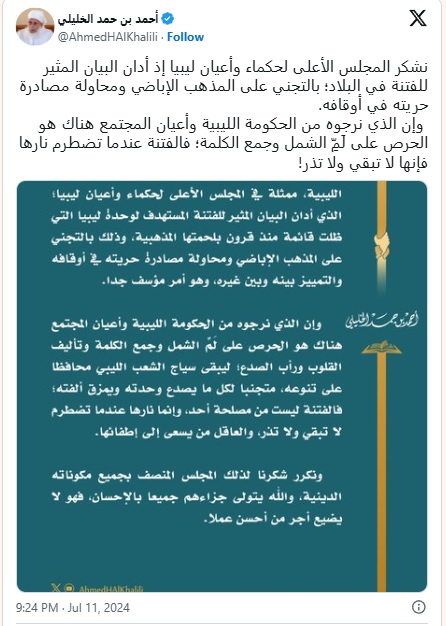
Let us not forget that the Wahhabis and Madhkahlis always stir up sedition against us. Let us not forget our dear brothers in Libya to whom Shaykh Ahmed Al Khalili (h) stated:

“We thank the Supreme Council of Libyan Elders and Notables for condemning the statement that stirred up sedition in the country, by attacking the Ibadi sect and attempting to confiscate its freedom in its endowments. What we hope from the Libyan government and the notables of society there is to be keen on uniting the ranks and unifying the world; for when the fire of sedition flares up, it leaves nothing behind!

For further reading: https://www.middleeastmonitor.com/20240714-omans-grand-mufti-commends-libyan-elders-for-condemning-anti-ibadi-incitement/

We should not forget there is a good number of ignorant people in our Ummah who believe that we are the Khawarij and they have hadith like the following:

(48)

Chapter: Exhortation to kill the Khawarij باب التَّحْرِيضِ عَلَى قَتْلِ الْخَوَارِجِ ‏

‘Ali said:

Whenever I narrate to you anything from the Messenger of Allah (saw) believe it to be absolutely true as falling from the sky is dearer to me than that of attributing anything to him (the Holy Prophet) which he never said. When I talk to you of anything which is between me and you (there might creep some error in it) for battle is an outwitting. I heard the Messenger of Allah (saw) as saying: There would arise at the end of the age a people who would be young in age and immature in thought, but they would talk (in such a manner) as if their words are the best among the creatures. They would recite the Qur’an, but it would not go beyond their throats, and they would pass through the religion as an arrow goes through the prey. So when you meet them, kill them, for in their killing you would get a reward with Allah on the Day of Judgement.

Source: (https://sunnah.com/muslim:1066a)

So it matters little to some of these people what our position is nor do they care. Not everyone is up for a discussion and many don’t have the mental acumen to have one to begin with. To them, the only thing they know is violence and that they will be rewarded by Allah (swt) for it!

This is not the time for us to be naïve. This is the time for us to be sober-minded, practical and pragmatic. Indeed, these are the trademarks of our school! 

The following comes from the noble and learned Shaykh: Abu Al-Arab (Ismail Al-Awfi) — Hafidullah. May Allah (swt) continue to bless him and bless others via his knowledge.


Shaykh Abu Al-Arab (Ismail Al-Awfi)

If they are afraid for themselves, no blame for them for raising their hands and putting their hands on the chest in this situation (only). When you pray alone or by yourself, then you do the prayer of the Blessed Prophet (saw).

Saving yourself is one of the major rules in Islam. Self-preservation is a very basic rule in Islam.

In Islam, we have what is known as : Ad-Darooriyyaat Al-Khams—The Five Necessities that are protected and recognized by the Islamic law (shari’ah).

Protection and sanctity of ones:

  • Life
  • Religion
  • Wealth
  • Lineage
  • Mind (intellect)

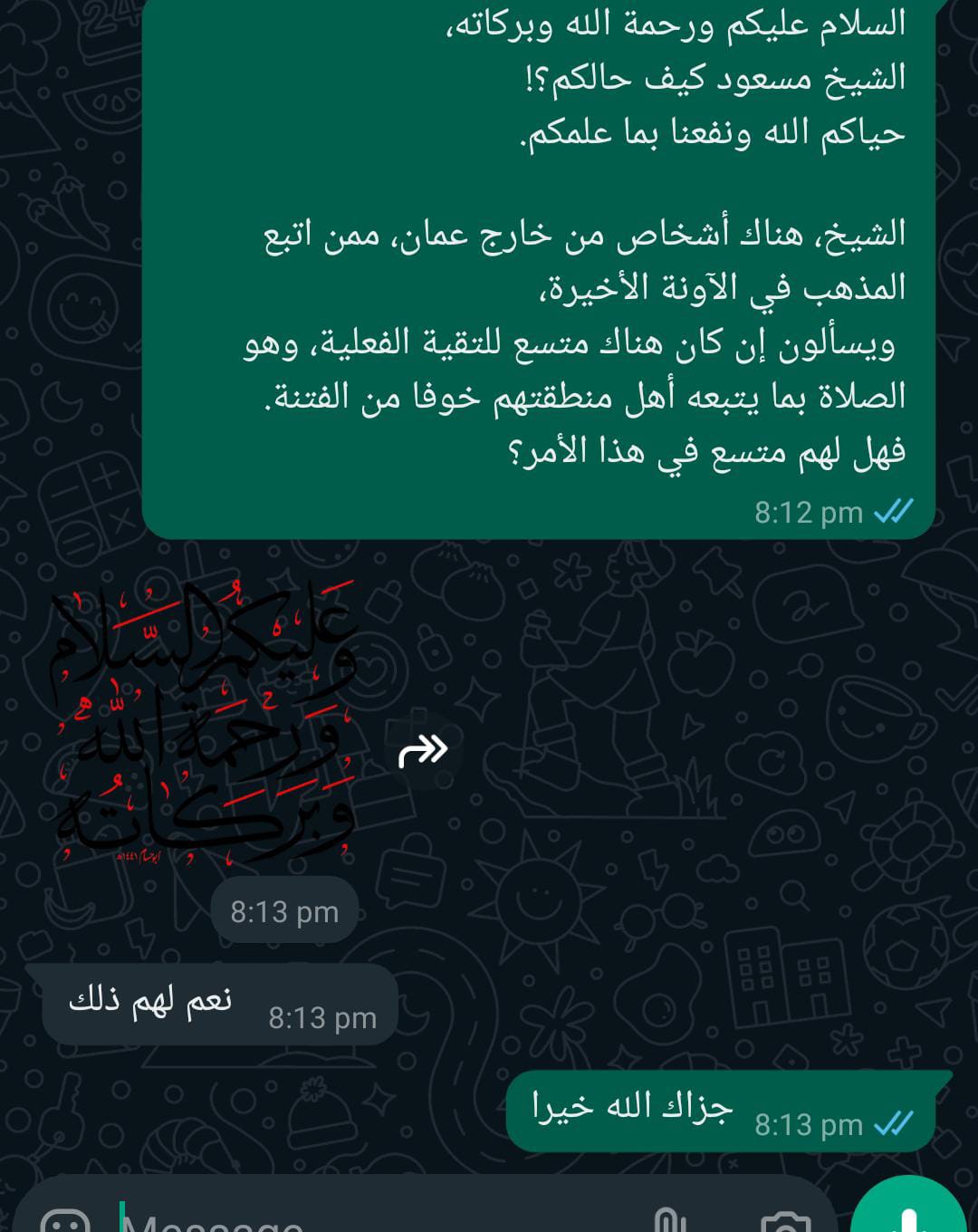
We will also include in this a brief question to Shaykh Massoud bin Mohammed Al Miqbali (h) May Allah (swt) continue to bless him and bless others via his knowledge. As well as his swift and brief reply. We include this because he is known to have more hardline views in our school.

As salam alaikum wr wb Shaykh Massoud, 

Shaykh Massoud, how are you?!

May Allah keep you safe and benefit us with what you have taught us.

Shaykh, there are people from outside Oman who have recently followed the madhab and are asking if there is validation for the actual kitman, which is praying as the people of their region follow for fear of sedition. 

Do they have validity for this matter?

Reply: walakum assalam waarahmatu allahi wabaraktu, Yes they have. 

So dear brothers and sisters, and truth seekers. This fatwa is limited in scope to those of you who may live in places where, if you were to pray the way the Blessed Prophet (saw) prayed, you would get physically attacked or even physically killed.

As mentioned before, many in our Ummah are not educated on some of the differences of views in jurisprudence and other matters. Many of them are not interested in engaging in a discussion with you. We know that the Blessed Prophet (saw) prayed with his arms to the side. In other areas of the world, you can and possibly will be labeled as a Shi’a for praying this way.

As cited above, Muslims of the Ibadi school have been targeted in Libya. Likewise, in Indonesia, the Shi’a have actually had their houses burned down! See below:

https://www.bbc.com/news/av/world-asia-20843259

For us, it is not so much to avoid fitna. For those who want to have a dialogue on the matter, they will find the ibadi school is ever ready!

This fatwa is more for the preservation and sanctity of one’s life.   May Allah (swt) grant us good judgement and safety.

You may be interested in reading the following:

May Allah (swt) Guide The Ummah.

May Allah (swt) Forgive the Ummah.

Leave a comment

Filed under Uncategorized

Shaykh Yasir Qadhi speaks on the Ibadi school: Three Levels of Aqidah (Theology)

“And hold firmly to the rope of Allah all together and do not become divided. And remember the favor of Allah upon you – when you were enemies and He brought your hearts together and you became, by His favor, brothers. And you were on the edge of a pit of the Fire, and He saved you from it. Thus does Allah make clear to you His verses that you may be guided.” (Qur’an 3:103)

﷽ 

Al hamdulillah! Just three years ago (2022) no one was talking about the Ibadi school. Through the efforts of Primaquran we have put the school on the map.

We even sparked an individual to start up his own YouTube channel of which he is a co-host with a former ex 12er lady. They do their own thing. Never underestimate the impact you will have on others.

Recently Shaykh Yasir Qadhi was on a podcast with brothers Dr Salman Butt and Umer Suleman. They have an excellent podcast which is one of my favourites on YouTube as well.

The channel is: https://www.youtube.com/@islam21c

During this podcast Shaykh Yasir Qadhi made some comments about the Ibadi school.

@20:50 he says: “The Ibadis’ of Oman are Mu’tazilah in creed. Their worship of Allah is no less. Frankly it is
better than most Sunni lands. Frankly. If you’ve ever visited Oman. Their akhlaq, their tahhajud, their Qur’an, their strong Emaan. I know the critics are going to go absolutely crazy with this. I’m not saying Mutazalism is correct but I’m saying; the way you guys made it out to be the brother of Shaitan. No it’s not.”-Shaykh Yasir Qadhi

“So let me finish this one point so the accusation that if you say X this will imply Y; that syllogism is a figment of the imagination of the critic. If you deny Allah’s istiwa then it’s going to happen. Well, this then is from you. Not from the people themselves.” -Shaykh Yasir Qadhi

“The people who actually hold it don’t go there. And this is what I’m saying when I say we have the hindsight of history. 13 centuries we look back The Zaydis of Yemen are Mu’tazilah. Their praying tahhajud and doing everything as well. You know what I’m saying?”-Shaykh Yasir Qadhi

“They clearly the itiz’ah they believe, the Ibadi’s believe the Qur’an is makhluq. The Ibadis
believe the Qur’an is makhluq. Their grand mufti is on YouTube literally defending and then saying but Sunnis, he literally said: ‘but Sunnis you guys made this a bigger issue than it needed to be.’ We still recite the Qur’an take the sha, that’ s his view. I am not saying I agree with it right? And look at their laws and look at the people.”-Shaykh Yasir Qadhi.

If anyone has the contact of Shaykh Yasir Qadhi do let him know to that the ministry of awqaf in Oman would (insh’Allah) be interested in inviting him as a guest to Oman. Perhaps he (Shaykh Yasir Qadhi) can give talks there. Shaykh Yasir Qadhi speaks, reads and writes Arabic so there should be no barriers.

We believe Shaykh Salman Al Ouda was a teacher of Shaykh Yasir Qadhi. He came to Oman. Insh’Allah let us invite Shaykh Yasir Qadhi to Oman. He has access to Arabic and thus it will be beneficial insh’Allah. He wants to build bridges across sectarian lines which is a blessing.

Oman has invited many people from across various schools. Shaykh Yasir Qadhi has only to reach out to Nouman Ali Khan about the time he spent at the Qur’an school there.

As Shaykh Yasir Qadhi believes in nuance it is important to note that we are not actually we are not Mu’tazilah.


The Ash’ari agree with us on the doctrine of kasb.

The Ash’ari agree with us morality comes from revelation not human aql.

However, it is possible that Shaykh Yasir Qadhi mentioned Mu’tazilah in the broader definition than in the prevailing sectarian definitions. With Shaykh Yasir Qadhi having what some may consider more liberal leaning inclinations perhaps when he meets with the learned people in Oman he will see that the school is very strong and a very good choice for the Muslim Ummah.

He will see and observe and experience that what he may perceive to be Mu’tazilah leanings there is no doubt that the people cling to the Sunnah!

In fact in our brush ups with certain heretical strains of Salafism they never once (that we can recall)try and fault us about observance of the Sunnah. How can they? They always bring up issues of creed and history.

In regard to the talk that the Mufti of Oman (Shaykh Ahmed Al Khalii-hafidhullah) gave: Shaykh Yasir Qadhi maybe referencing the following:

Shaykh Bin Baz invited Shaykh Ahmed Khalili to his office and Shaykh Khalili accepted the invitation. Shaykh Ahmed Khalili and a small delegation went into what was described as a small room. There was no courtesy and no decorum showed on behalf of Shaykh Bin Baz. As soon Shaykh Bin Baz got everyone in the room he started shouting, “You Ibadi are Kafirs! You don’t believe in seeing Allah in the afterlife”. “You believe in the creation of the Qur’an and you must make tawba!” “You must testify that you are mistaken!”


Shaykh Ahmed Khalili remained very calm. He replied, “These issues are very old issues and many of the ulemah have been talking about it.” “Our expectation was to come and discuss on how to unite the Ummah, and keep the differences aside, and we should agree on certain terms.”

You may read the rest of the incident here:

https://primaquran.com/2024/01/12/prophetic-wisdom-the-winning-group/

May Allah Guide the Ummah

May Allah Forgive the Ummah.

Leave a comment

Filed under Uncategorized

Forgiving Sins: Does This Make Jesus God?

“And let them pardon and overlook. Would you not like that Allah should forgive you? And Allah is Forgiving and Merciful.” (Quran 24:22)

“Who spend In the cause of Allah during ease and hardship and who restrain anger and who pardon the people – and Allah loves the doers of good.” (Qur’an 3:134)

“And We have not created the heavens and earth and that between them except in truth. And indeed, the Hour is coming; so forgive with gracious forgiveness.” (Qur’an 15:85)

“O you who have believed, indeed, among your wives and your children are enemies to you, so beware of them. But if you pardon and overlook and forgive – then indeed, Allah is Forgiving and Merciful.” (Qur’an 64:14)

﷽ 

First let us address a misunderstanding that people have in general with the Muslim view in regard to Allah forgiving sins.

“Those who, upon committing an evil deed or wronging themselves, remember Allah and seek forgiveness for their sins—and who forgives sins except Allah?—and they do not knowingly persist in wrongdoing?” (Qur’an 3:125)

All sins are sins, ultimately sins against Allah. Rather, they are major or minor. One needs to beseech Allah for forgiveness. That being said, there are three types of relational sins.

  1. Sins against yourself. You did injustice to your own self.

And whoever does evil or acts unjustly to his soul, then asks forgiveness of Allah, will find Allah Forgiving, Merciful.” (Qur’an 4:110)

Coupled with this is the psychological torture a sinner puts on themselves thinking that their sins are greater than Allah’s mercy. That Allah (swt) will not forgive them. This is what is meant by forgiving yourself. Allah (swt) says:

“He said, “And who despairs of the mercy of his Lord except for those astray?” (Qur’an 15:56)

“”O my sons! go and enquire about Joseph and his brother, and never give up hope of Allah’s Soothing Mercy: truly no one despairs of Allah’s Soothing Mercy, except those who ungrateful disbelievers.” (Qur’an 12:87)

“Say, “O My servants who have exceeded the limits against their souls! Do not lose hope in Allah’s mercy, for Allah certainly forgives all sins. He is indeed the All-Forgiving, Most Merciful.” (Qur’an 39:53)

2. Sins against another party.

“And We ordained for them therein a life for a life, an eye for an eye, a nose for a nose, an ear for an ear, a tooth for a tooth, and for wounds is legal retribution. But whoever gives up his right as charity, it is an expiation for him. And whoever does not judge by what Allah has revealed – then it is those who are the wrongdoers.” (Qur’an 5:45)

So, depending upon the nature of the offense, one can simply forgive the offending party. However, the offender still needs to seek forgiveness from Allah. Another example could be that someone stole an apple from our orchard and we caught the thief. We can settle it with the thief. That they return the apple, that they agree to pay for it. That they exchange for another item. That they work to pay for it. Yet that offender still needs to ask Allah (swt) for forgiveness. For other offenses, different measures may be taken. This is to ensure a stable, just and cohesive society that is not overwhelmed by crimes and injustice.

3. Sins against Allah.

This is self-explanatory. Yet, in all these above cases. Sinning against myself, another party (person or group), in all cases one still needs to seek forgiveness from Allah (swt).


Jesus forgiving sins makes him God?

It would be appropriate for a Christian to prove to us that Allah (swt) alone pardons, and overlooks sins.

Who is this which speaks blasphemies? Who can forgive sins, but God alone?”


Christians tell us that Jesus must be God because he ‘forgave sins’ and that ‘only God’ can forgive sins.

The text that immediately comes to mind is the following:


“But there were certain of the scribes sitting there, and reasoning in their hearts, “Why does this man speak blasphemies? Who can forgive sins but God only?”(Mark 2:7)


“And the scribes and the Pharisees began to reason, saying, “Who is this which speaks blasphemies? Who can forgive sins, but God alone?” (Luke 5:21)


We find it very peculiar that Christians would take the statement of the people who accused Jesus of wrongdoing and then agree with them!

Basically, the Christian logic is that these people were right. However, Jesus was entitled to do such since he is God.

Prima Qur’an comments:

Now here is some food for thought. Notice that the scribes and the Pharisees began to reason with themselves. Notice that there was absolutely no appeal to proofs and evidence.


Christians argue that the scribes and Pharisees are right based upon their reasoning.

Muslims argue that the scribes and Pharisees are wrong based upon their reason.

So then this would raise an obvious question:
Are there any scriptures that the scribes or Pharisees might appeal to that say that God alone forgives sins or do they simply use their own reason?

We have noted that when Christians try to prove that Jesus is God based upon his ability to forgive sins, they always appeal to Mark 2:7 and Luke 5:21

We have also found it very interesting that they tend to stay away from Matthew chapter 9.

Why don’t they use Matthew chapter 9 verse 8 to prove Jesus forgiving sins makes him divine?

Well, because Matthew chapter 9 verse 8 does not help their case.

In fact, it’s’ a proof text that can be argued effectively against that claim!

“And, behold, they brought to him a man sick of the palsy, lying on a bed: and Jesus seeing their faith said unto the sick of the palsy; “Son, be of good cheer; thy sins be forgiven you.”

And, behold, certain of the scribes said within themselves, “This man blasphemes.”

And Jesus knowing how they were reasoning said, “Why do you think evil in your hearts? What is easier, to say, ‘Your sins are forgiven you;’ or to say, ‘Arise, and walk?’ But that you may know that the Son of Man has power on earth to forgive sins, (then said he to the sick of the palsy,) ‘Arise, take up your bed, and go into your house’.”

And he arose and departed to his house. But when the multitudes saw it, they marveled, and glorified God, which had given such power unto MEN.(Matthew 9:2-8)

*Note* Men plural. Not just a man.

Protestants have suspected that earlier Christians had tampered with the text. So they too have begun to tamper with the text. Notice the various translations of this text into English. Only the New International Version is being blatantly deceptive.

https://biblehub.com/matthew/9-8.htm

But there is something else of importance. You see, all believers do believe that Allah can cause us to be stricken with various ailments and illnesses. This can cause us to be humble, to turn us to the Creator, among other things.

However, apparently there was an understanding among certain of the Jews (if this text were to be believed) that if a person was born with an ailment, handicap or illness that either they or their parents did some sin that warranted this.

“As he went along, he saw a man blind from birth. His disciples asked him, “Rabbi, who sinned, this man or his parents, that he was born blind?” “Neither this man nor his parents sinned,” said Jesus, “but this happened so that the works of God might be displayed in him.” (John 9:1-3)


Now let us go back and compare/contrast these three accounts.

“But there was certain of the scribes sitting there, and reasoning in their hearts, ”Why does this man speak blasphemies? Who can forgive sins but God only?” (Mark 2:6-7)

“And the scribes and the Pharisees began to reason, saying, Who is this which speaks blasphemies? Who can forgive sins, but God alone?” (Luke 5:21)

“When the crowd saw this, they were filled with awe; and they praised God, who had given such authority to men.” (Matthew 9:8)

Prima Qur’an comments:

Mark has it that the Scribes were reasoning that only God can forgive sins.

Luke has it that the Scribes and Pharisees were reasoning that only God can forgive sins.

Matthew does not tell us what the scribes or Pharisees were reasoning at all. Rather, Matthew records the reaction of the crowd who praised God for giving such authority to men (plural).

Is there a contradiction? Not necessarily. Two transmitters record the reaction of Jesus’ opponents. One transmitter records the reaction of the crowd (which could or could not contain Scribes/Pharisees).

For Protestant Christians will ignorantly quote the citations of Mark and Luke as proof of the divinity of Christ Jesus.

Latin Roman Catholics, Oriental Orthodox, and Eastern Orthodox should know better. In this situation, the citation of Matthew 9:8 helps to establish authority for men to forgive sins.

We would like to bring the following text to your attention:

“Whosoever sins you remit, they are remitted unto them; and whosoever sins you retain, they are retained.” (John 20:23)

No one is making an argument that these men are divine because they have the ability to forgive and retain sins. The above text, which supports Sacerdotalism, has to be one of the most disliked texts in the entire New Testament by Protestant Christians.

The Most Famous Prayer in Christianity.

“This, then, is how you should pray: ” ‘Our Father in heaven, hallowed be your name, your kingdom come, let your will be done, on earth as it is in heaven. Give us today our daily bread. And forgive us our debts as we also have forgiven our debtors. And lead us not into temptation, but deliver us from the evil one.” (Matthew 6:9-13)

“He said to them, “When you pray, say: ” ‘Father, hallowed be your name, your kingdom come. Give us each day our daily bread. Forgive us our sins, as we also forgive everyone who sins against us. And lead us not into temptation.’ ” (Luke 11:2-4)

1) Forgive us our debts as we also have forgiven our debtors.

The Greek word there for ‘as‘ is ‘hosper‘ which means: ‘just as‘ and ‘exactly like‘.

2) Forgive us our sins as we forgive those who sinned against us.

Source: https://biblehub.com/greek/5618.htm

Prima Qur’an omments:

Jesus himself taught his followers to ask God to pardon their debts to him exactly like they pardon the debts of others to them. No one is asked to sacrifice their children or animals. Simply to pardon people for their offenses.

So the only way any of us, including Jesus, are ‘divine‘ in that sense would be like the saying,

“To err is human, to forgive, divine.” ― Alexander Pople, An Essay on Criticism

“How God anointed Jesus of Nazareth with the Holy Spirit and power, and how he went around doing good and healing all who were under the power of the devil because God was with him.” (Acts 10:38)

A very powerful example of forgiveness. Forgiveness can be a powerful transformative act for the human soul.

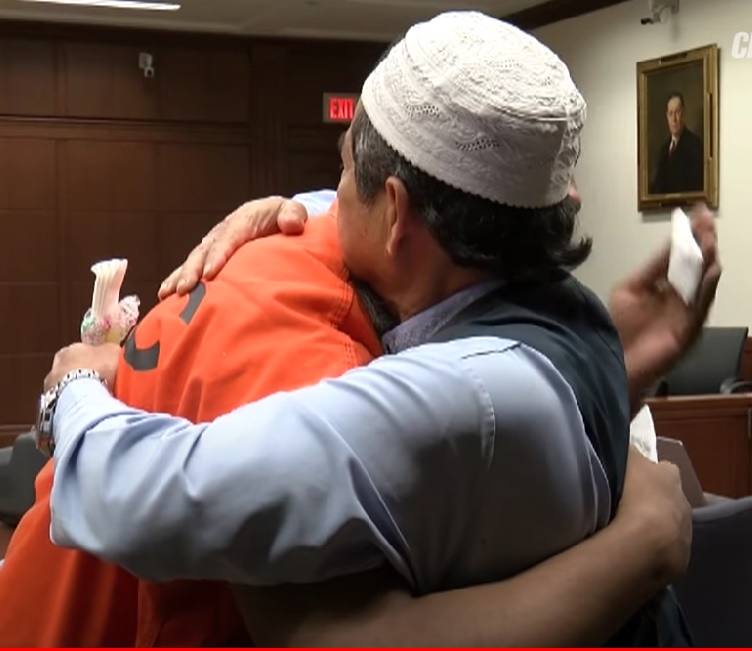
A Muslim man forgives the man who killed his son in a brutal murder. May Allah (swt) grant him paradise and may Allah (swt) open the heart of the other man to the message of Islam.

Muslim woman forgives the man who killed her son in a brutal murder. May Allah (swt) grant her paradise and may Allah (swt) open the heart of the other man to the message of Islam.

It is these conservative Muslim Americans that are transforming their neighborhoods, communities and societies for the better.

“When they hear what has been revealed to the Messenger, you see their eyes overflowing with tears because of what they have recognized of the truth. They say, “Our Lord, we have believed, so register us among the witnesses.”(Qur’an 5:83)

You may Allah be interested in reading:

May Allah guide the sincere among the Christians so that they do not enter the hellfire.

May Allah Guide the Ummah.

May Allah Forgive the Ummah.

Leave a comment

Filed under Uncategorized

A Christian Dilemma: No mention of Islam?

” And give full measure when you measure, and weigh with an even balance. That is the best way and best in result.” (Qur’an 17:35)

﷽ 

We were recently looking back at some statements of Frithjof Schuon, and we came across a very forceful proposition.

“If Muhammed had been a false prophet. there is no reason why Christ should not have spoken of him as he spoke of Antichrist but if Muhammed is a true Prophet the passages referring to the Paraclete must inevitably concern him – not exclusively but eminently – for it is inconceivable that Christ, when speaking of the future, should have passed over in silence a manifestation of such magnitude. The same reasoning excludes a priori the possibility that Christ. when making his predictions, intended to include Muhammed under the general denomination of” false prophets”, for in the history of our era Muhammed is in no sense a typical example among others of the same kind, but on the contrary, a unique and incomparable apparition(1). If he had been one of the false prophets announced by Christ he would have been followed by others and there would exist in our day a multitude of false religions subsequent to Christ and comparable in importance and extension to Islam. The spirituality to be found within Islam from its origins up to our days is an incontestable fact. and “by their fruits ye shall know them.” -Frithjof Schuon

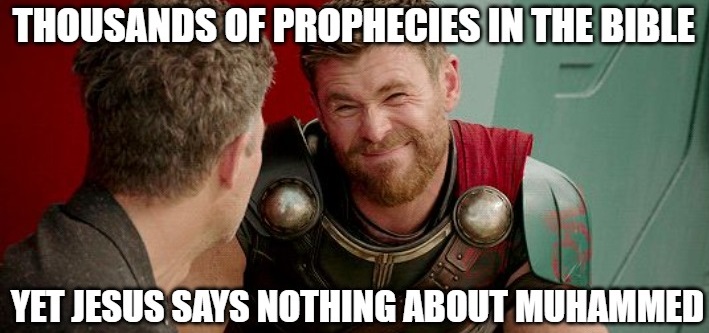
We may not agree with the Paraclete part, but this is powerful. This is truly a Christian Dilemma. How could Jesus (as) NOT mention the coming of Muhammed (saw) even if not in a positive sense? All these prophecies about the future and Islam being THE rival to Christianity and yet absolutely nothing?

What is interesting (maybe a PhD thesis out there waiting for one of you—you’re welcome) — what is interesting is that we would be willing to say that if one searched they would find writings or commentaries in the works of the Oriental Orthodox, Eastern Orthodox, Syriac Church of the East that most likely did interpret certain passages of their canon as regard the coming of the Blessed Prophet (saw) and/or the rise of Islam. Albeit they had to do so very carefully.

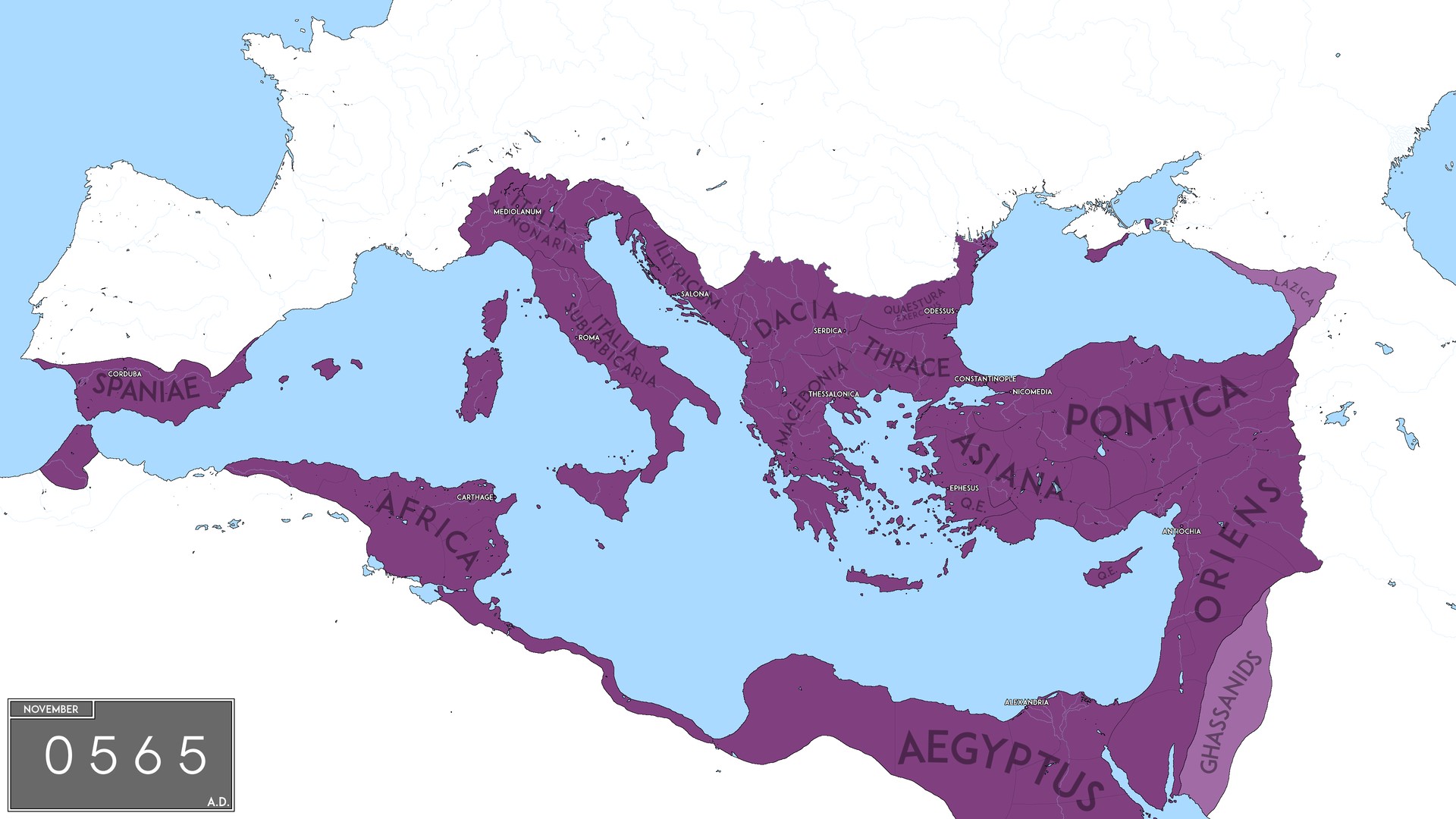
Let us look at the Zenith of the Christian Roman Empire (also known as the Byzantine Empire). Here it is at its Zenith under Justinian I. Btw, the Ghassanids were a vassal Christian state, not Muslims.

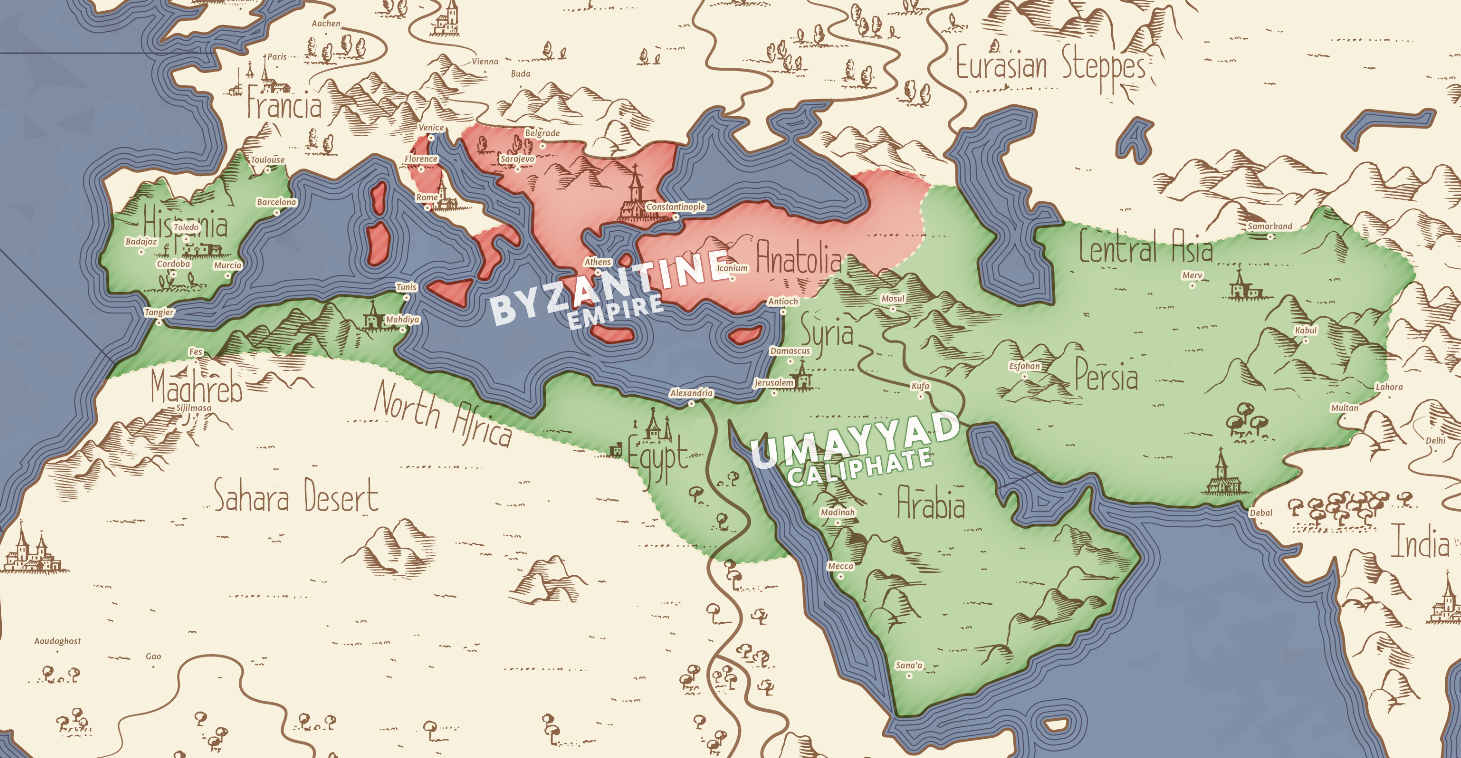
THEN SUDDENLY…. UMAYYAD IMPERIUM AT IT’S PEAK

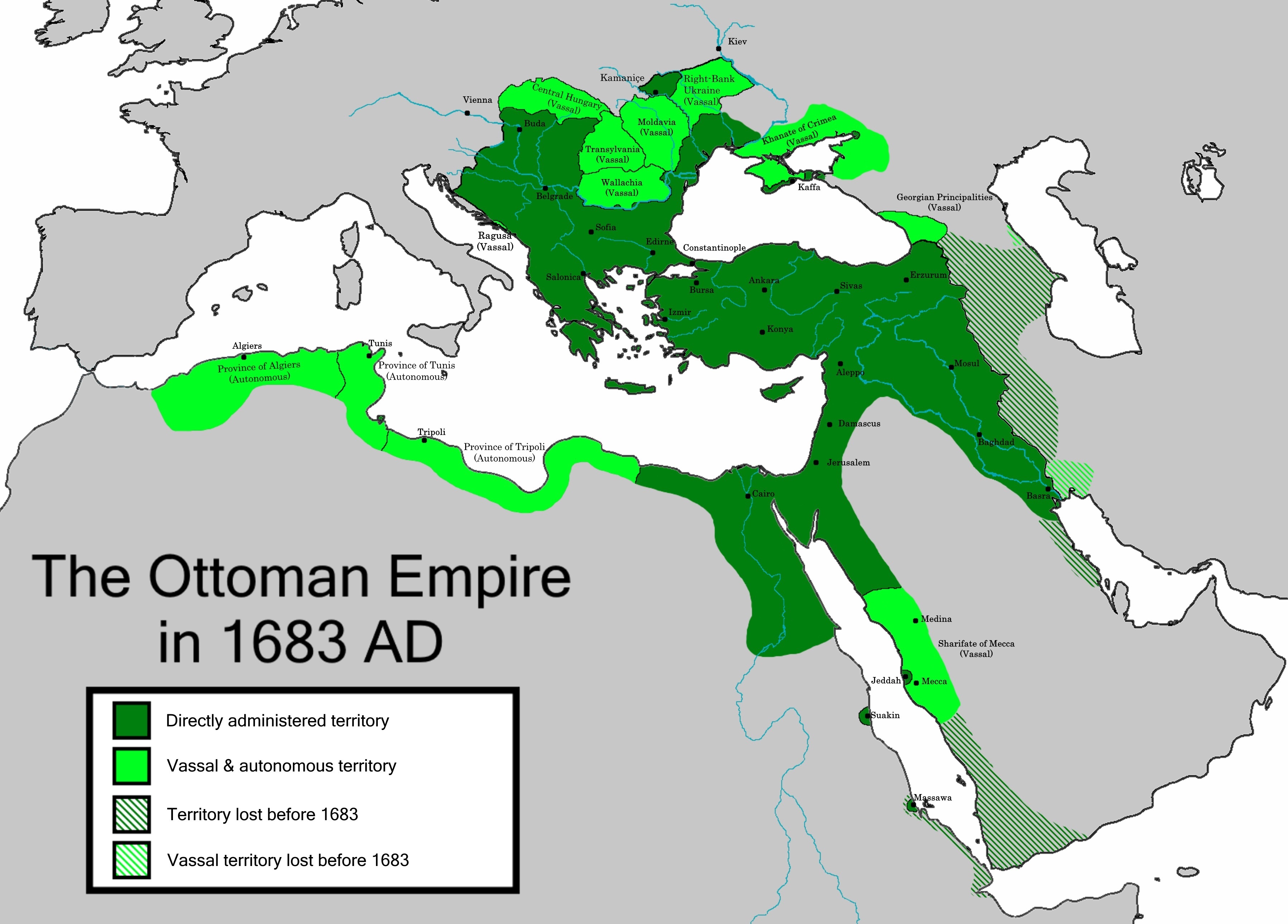
THEN …PEAK OTTOMAN EMPIRE.

This alone is enough to make any sincere person question the validity and veracity of Christianity. It is more than sufficient.

ISLAM WAS LIKE A TSUNAMI OF MONOTHEISM THAT SHOOK THE TRINITARIAN CHRISTIAN WORLD TO IT’S CORE. From the capture of Jerusalem, Antioch, Alexandria and Constantinople.

Islam is set to overtake Christianity (combined denominations) by 2050.

Source: (https://www.pewresearch.org/religion/2015/04/02/religious-projections-2010-2050/)

In fact, go and look at this Christian site: an impressive 351 Old Testament Prophecies supposedly that Jesus (as) fulfilled.

Things as vague and insignificant such as:

Riding a donkey into Jerusalem.
Spending some time in Egypt.
Being betrayed for 30 pieces of silver.
Was spat on.
Was despised.
Was rejected.
Will be a judge.
Given vinegar to drink.
Was thirsty. And in reality, a whole host of other idiosyncrasies that would not matter in the least in regard to Jesus (as) and Prophetic fulfillment.

THE BIG MAMA ULTRA MEGA EVENTS ARE NOT WORTH A PROPHECY!

Things like this:

“At that moment the curtain of the temple was torn in two from top to bottom. The earth shook, the rocks split 52 and the tombs broke open. The bodies of many holy people who had died were raised to life. 53 They came out of the tombs after Jesus’ resurrection and[e] went into the holy city and appeared to many people.” (Matthew 27:51-53)

Apparently, things like the Blessed Prophet Muhammed (saw), who came with a message in which his followers and those after them rose up and supplanted previously held Christian lands and territories and is arguably THE #1 rival on THE planet Earth and—not-even…a…pin…drop.

“For it is inconceivable that Christ, when speaking of the future, should have passed over in silence a manifestation of such magnitude.”- Frithjof Schuon

Well said Mr. Schuon.

This certainly is a Christian Dilemma.

May Allah Guide the Christians before they enter the hellfire.

May Allah (swt) guide the Ummah.

May Allah (swt) forgive the Ummah.

Leave a comment

Filed under Uncategorized

Ali Erbaş Turkish Islamic scholar and President of Directorate of Religious Affairs (Diyanet) in Turkey says Jesus is dead and will not return.

“It is He who has sent His Messenger with guidance and the world view that is based on the truth to manifest it over all other world views, although they who rely upon other than or associate partners with Allah dislike it.” (Qur’an 9:33)

﷽ 

Ali Erbaş Turkish Islamic scholar and President of Directorate of Religious Affairs (Diyanet) in Turkey says Jesus is dead and will not return. He also has stated that there is no Mahdi that will come. This is quite a huge deal because Ali Erbas is in essence the Mufti of Turkey.

These positions (especially concerning the Mahdi) are part of a de-shificiation process we see happening among Sunni Muslims.

It is interesting that more and more learned scholars around the round are coming to the Ibadi school’s position on these points. I wonder how many more actually hold such views but are not so bold as to proclaim them for fear of reprisal?

In the comment section you see threats, emotions and not proofs and evidences.

Here we look at the verse in the Qur’an 43:61 often quoted and used to affirm the second coming Jesus (as).

Here we look at Qur’an 4:159 which is also used to affirm the second coming if Jesus (as)

The following examines the word ‘tawaffa’ Yet, the Qur’an itself offers no cause for confusion. Tawaffā appears in twenty-five passages in the Qur’an, and twice in relation to Christ Jesus (Q 5:117 and Q 3.55).

For twenty-three of those passages the Muslim commentators generally follow the standard definition of this term, that is that Allah (swt) separates the soul from the body or makes someone die.

Think about this Muslim brothers and sisters. For those passages that are not tied into ahadith about Jesus(as) coming back they are translated and understood as per usual.

What about all those hadith that speak about some second coming of Jesus? Aren’t they tawatur?

Al Ma’rij Imam Abu Muhammed Abdulllah Al- Salimi (r) Volume 1. It is actually is a fiqh book. Many times in our school
when our scholars write a book about fiqh they will start with a short section on aqidah.

The coming of Isa Ibn Maryam
1) There is no Prophet after Muhammed (saw).
2) That which is narrated from the people (Ahl Sunnah) about Jesus (as) coming back it is not sound.
3) Even if it was sound, the time of Isa Ibn Maryam has already passed.
4) Same have said that Khidr and Elias (as) they are still alive then their status would be like angels.
Their live would be veiled from the seen world. They would not eating drinking indulging. These things are not correct with our school.
5) If he comes he will come in the Shari’a of the Prophet (saw), which Ahl Sunnah has conceded. They have conceded he cannot come back as a prophet.

Source: (The Ascents of Hope in the Stages of Perfection, in the Introductions by Imam Abu Muhammed Abdullah Al-Salimi -may Allah have mercy on him)

May Allah Forgive the Ummah.

May Allah Guide the Ummah.

7 Comments

Filed under Uncategorized

There is no evidence that the Nizari Isma’ili Imam can properly recite the Qur’an.

“And We have certainly made the Quran easy to remember. So is there anyone who will be mindful?” (Qur’an 54:40)

﷽ 

Our colleague relates the encounter.

Imagine if you will that you have a son or a daughter that informs you that they wish to get married. You sit down with your son or daughter and ask them the following: “What do you wish for a life partner?” “What are some of the traits or qualities you would like to have in a life partner?” Their response is: “I don’t have any standards, I will just take anything!”

That response is the surest way of knowing that they are not ready for marriage at all!

This Muslim Ummah needs to have some standards. We are talking about elementary standards. We are talking about ‘the bare minimum‘.


If one is going to be acclaimed to be the commander of the faithful, the Imam of the Muslims, the Imam is such that if you do not recognize him you die the death of an unbeliever, then at the very least you had best be able to recite the Qur’an. That is not asking for much. It is, however, asking the Ummah to require some very basic standards.

So, no, we are not talking about theology, we are not talking about jurisprudence, we are not talking about philosophy. We are asking a very basic simple question: “Can you Qur’an tho?”

I do not know about other Muslims, but I would like my commander of the faithful and my Imam to be able to recite the Qur’an at ….the….very…..least.

In fact, this may be a very interesting academic article. When did the Imams of the Nizari Isma’ili community begin to distance themselves from the Qur’an? In other words, when did these phenomena of having an insouciant relationship with the Qur’an begin? Which of the Nizari Isma’ili imams set this off?

So recently, when encountering one of many arguments that took place in the wild world of X (Twitter). I saw some mutual fat shaming going on between Imam Hamza wald Maqbul and Professor Khalil Andani.

So, being mildly agitated by this bickering, I put out a challenge to both men.

It was quite a simple and straight-forward point-blank challenge to Professor Andani and Imam Hamza wald Maqbul. I challenged Professor Andani to produce for us the Aga Khan reciting the Qur’an in public. I also challenged Imam Hamza wald Maqbul to produce an example of him reciting the Qur’an in public.

To be quite honest, I do not doubt that Imam Hamza wald Maqbul can properly recite the Qur’an. Professor Andani, over all, is a guy who can comprehend more than basic English. Thus, his response was puzzling.

Produce for us the Aga Khan reciting the Qur’an in public. Professor Andani did the best he could, so he meekly offered: “Karim Aga Khan led the Ismailis in Eid Namaz twice in the 1940s as a child. Obviously he can recite the Quran, which he did during namaz.”

It was after this comment that I now publicly retract every glowing attribute I gave to Professor Andani during his debate with Jake Brantecella. Do I think Professor Andani won that debate? Absolutely. However, after I am quite dismayed at the response given by Professor Andani.

First there is the matter of plain English. “Produce for us the Aga Khan reciting the Qur’an in public.” That is people in the Julian calendar year of 2024.

Second, to make claims that (Professor Andani) himself did not witness is not “obvious” at all. Claims that he led the Eid prayer twice in the 1940s is not proof that he can properly recite the Qur’an. We want proof that Karim, the son of Joan Yarde-Buller, can properly recite the Qur’an.

Then Professor Andani gave another meek reply: “Quran is part of Namaz.” Indeed, it is. Indeed, it is. One could do the dhur prayer or asr prayer. In many schools of jurisprudence, the Qur’an is not recited out loud. Meaning that one would not be able to ascertain that one could properly recite the Qur’an.  I will give the benefit of the doubt and say that it is possible that he may not be aware of this.

However, as the Eid Prayers have parts where the Qur’an is recited out loud, one could assume that a person knows how to properly recite the Qur’an. However, the idea that Karim, the son of Joan Yarde-Buller, did so twice as a child, of which Professor Andani did not witness (as he was not even born then) as being obvious has to be one of the most obtuse statements ever.

Ultimately, it is an admission of being unable to answer the challenge. The man, Karim, the son of Joan Yarde-Buller, became the Imam around/at the age of 20. He is currently 83 years of age. For 60 years on this Earth there is no evidence for us to ascertain whether this man can properly recite the Qur’an. You can turn the internet upside down and inside out, and you will find no evidence of him being able to recite the Qur’an at all.

Professor Andani doesn’t strike me as someone who wouldn’t bring his ‘A’ game. However, he hasn’t been the most forthcoming with Christians when he shows them his chart. You know the one:

The one that leaves out the Virgin birth of Christ Jesus (quite important to every Christian under the sun).

The one that leaves out the second coming of Jesus:

So all you Christians interacting with Professor Andani, open up your eyes and don’t be blind to it!

Thus, the meek response that Professor Khalil Andani is now proof positive for the whole world that it was the best he can do in the way of evidence. Meaning that there was some event that he himself did not witness or partake in which it is said that Karim, the son of Joan Yarde-Buller, twice as a child, led the Eid prayers. No evidence at all that he can properly read the Qur’an.

It is disheartening. If I thought for one moment that Karim, the son of Joan Yarde-Buller, was the commander of the faithful, the Imam of the Muslims how I would love to have his recitation of the Qur’an. How it could console me in dark times! Just to hear the cadence of his voice and the unison of heart and tongue as his holiness brought forth a most sublime and majestic recitation.

Unfortunately, for the Nizari, Isma’ili will never get this experience. Hey! There are always his sons! Perhaps they may take up seriously the learning to read the Qur’an! Or would that be a problem?

Is that the issue? How can someone who is not Allah’s divine representative on Earth possibly teach the divine representative the Qur’an?

*** UPDATE ***

There is an update to this article. Professor Andani thought he would give it one more shot.

First let me start with a major correction to Professor Andani.

Professor Andani states: “Your post is just a slander against me and the Ismaili Imamat.”

First, I do not see how stating the truth about something of which Professor Andani has failed time and again to prove the opposite of is slander.

Second, a major correction. It is more correct and circumspect to say Nizari Ismaili Imamat! It is hubris to think the Nizrari branch represents the entirety of Ismailism. It does not represent the Musta’li Ismai’li branch. A branch which includes the Dawoodi-Taybi as well as the Sulaymani-Tabi.as well as the Sulaymani-Tabi.

In fact, considering the Musta’li Ismai’li consider the Nizari claims null and void, they could very well be delighted to see such challenges. They may even be reading this article with a certain sense of satisfaction. They may be hoping that their Ismai’li brothers, who are following a man who has not been proven to recite the Qur’an with proper recitation, may decide to leave the Nizari and follow them instead!

Ladies and gentlemen. Dear truth seekers. A picture of a boy standing with his hands behind his ears is not proof that he can properly recite the Qur’an.

Imagine if you will there are people who doubted claims that, when I was an eight-year-old little girl I stood in front of the congregation of my church and recited the entire chapter of the book of Acts (King James Version) with perfect memory and no errors.

Then some people doubted this claim. So my mother, driven by emotional attachment to her daughter, rushes to produce a picture of me as an eight-year-old little girl in Church. “Here is your evidence!”

Surely one can see the futility of such.

If you enjoyed the above article you maybe interested in the following:

In this article we did our level best to help the Imami Shi’a solve a dilemma (the Ismaili included) we have not found any contemporary approaches among the Imami Shi’a to approach this dilemma.

https://primaquran.com/2024/01/30/imami-shia-700-years-no-imam-and-no-prophet/

https://primaquran.com/2022/10/17/ismaili-shia-and-circular-reasoning/

May Allah guide the Ummah.

May Allah forgive the Ummah.
Leave a comment

Filed under Uncategorized

Are Muslims weighed on scales on the judgement day?

“Then We will give them a full account with sure knowledge—for We were never absent. “And the weighing that Day will be the truth. So those whose scales are heavy – it is they who will be the successful.” But those whose scale is light, they have doomed themselves for wrongfully denying Our signs.” (Qur’an 7: 7-9)

We set up the scales of justice for the Day of Judgment, so no soul will be wronged in the least. And if a deed is the weight of a mustard seed, We will bring it forth. And sufficient are We as a Reckoner.” (Qur’an 21:47)

﷽ 

The vast majority of Muslims believe that they will be weighed on some scales on the day of judgement in which Allah (swt) will weigh their deeds. They imagine their good deeds being placed on some balance to the right and their bad deeds being placed on some balance on the left.

This has also led to the idea that we merit paradise through our deeds. If we do x amount of this or that than Allah (swt) is bound to grant us paradise.

This belief arises out of the corruption of the belief sent by the earlier messengers to the people of Egypt. After the truth was mixed with falsehood they came to believe that the heart recorded all the good and bad deeds of a person’s life. When the person died their heart was weighted against the feather of the Goddess Ma’at.

Ma’at was the personification of truth and justice. (Themes you will come to see soon enough).

The scales were watched by the results of the weighing were recorded by Anubis, The jackal headed deity of embalming. Known as ‘He who is Upon His Mountain’ meaning
Necropolis (The City of the Dead).

The results were recorded by Thoth -the God associated with writing and judgement of the dead. If the person was said to have led a descent life they would live forever with Osiris.

Do Muslims have any justification for believing in scales that weigh good and bad deeds?

The following verses are usually appealed to.

“Then, when the Trumpet will be blown, there will be no kinship between them on that Day, nor will they ask about one another. As for those whose scale is heavy, it is they who will be successful. But those whose scale is light, they will have doomed themselves, staying in Hell forever.” (Qur’an 23:101-103)

“The Striking Disaster! What is the Striking Disaster? And what will make you realize what the Striking Disaster is? The Day people will be like scattered moths, and the mountains will be like carded wool. So as for those whose scale is heavy, they will be in a life of bliss. And as for those whose scale is light, their home will be the abyss. And what will make you realize what that is? A scorching Fire.” (Qur’an 101:1-11)

“Then We will give them a full account with sure knowledge—for We were never absent. “And the weighing that Day will be the truth. So those whose scales are heavy – it is they who will be the successful.” But those whose scale is light, they have doomed themselves for wrongfully denying Our signs.” (Qur’an 7: 7-9)

We set up the scales of justice for the Day of Judgment, so no soul will be wronged in the least. And if a deed is the weight of a mustard seed, We will bring it forth. And sufficient are We as a Reckoner.” (Qur’an 21:47)

wal-waznu yawma-idhin l-haqu = The weighing that day is the Truth.

wanada’u l-mawazina l-qis’ta = And we set the weighing as justice.

Notice that in the Egyptian theology Ma’at is the personification of Truth and Justice.

So we can see that the Qur’an has used as a metaphor for the Truth and Justice being done that day. The Truth is Justice and Justice is nothing but the Truth.

Allah (swt) is not need of any scale to weigh people’s deeds. He already knows what we have done. He knows even before we have done it!

A BOOK NOT TWO BOOKS

Remember the Qur’an always mentions we are given a book. We are not given two books, so that one may each be weighted.

In fact every minutia of our life is recorded in THE book of eternal life.

“This, Our record, speaks about you in truth. Indeed, We were having transcribed whatever you used to do.” (Qur’an 45:29)

This will be shown to us and as Allah (swt) says:

“And the record will be placed, and you will see the criminals fearful of that within it, and they will say, “Oh, woe to us! What is this book that leaves nothing small or great except that it has enumerated it?” And they will find what they did present. And your Lord does injustice to no one.” (Qur’an 18:49)

Notice the verse says: “Your Lord does injustice to no one.” This is what is given a book. We are not put on some scale physical or metaphysical and weighed. This is incorrect.

These ideas about being weighed in a balance are Egyptian ideas that are important to Christianity and influenced some Muslim understanding of our sacred text.

“Tekel: You have been weighed on the scales and found wanting.” (Daniel 5:7)

It is ultimately Christian belief that one cannot merit salvation and thus Christ Jesus alleged death by being nailed to a patibulum acts as a shield against this judgement or weighing.

As was discussed in a previous article, Christians are absolutely unassured of their salvation.

We know our fate at the moment of death based upon how the angels take our souls.

“The ones whom the angels take in death [while] wronging themselves, and [who] then offer submission, [saying], “We were not doing any evil.” But, yes! Indeed, Allah is Knowing of what you used to do.” (Qur’an 16:28)

“The ones whom the angels take in death, [being] good and pure; [the angels] will say, “Peace be upon you. Enter Paradise for what you used to do.” (Qur’an 16:32)

“And We took the Children of Israel across the sea, and Pharaoh and his soldiers pursued them in tyranny and enmity until, when drowning overtook him, he said, “I believe that there is no deity except that in whom the Children of Israel believe, and I am of the Muslims. Now? And you had disobeyed before and were of the corrupters? So today We will save you that you may be to those who succeed you a sign. And indeed, many among the people, of Our signs, are heedless.” (Qur’an 10:90-92)

“Pharaoh declared, “O chiefs! I know of no other god for you but myself. So bake bricks out of clay for me, O  Hamân, and build a high tower so I may look at the God of Moses, although I am sure he is a liar.” And so he and his soldiers behaved arrogantly in the land with no right, thinking they would never be returned to Us. So We seized him and his soldiers, Casting them into the sea. See then what was the end of the wrongdoers! We made them leaders inviting to the Fire. And on the Day of Judgment they will not be helped. We caused a curse to follow them in this world. And on the Day of Judgment they will be among the outcasts.” (Qur’an 28:38-42)

When the angels seize the souls of those who have wronged themselvesscolding them,What was wrong with you?” they will reply, “We were oppressed in the land.” The angels will respond, “Was Allah’s earth not spacious enough for you to emigrate?” It is they who will have Hell as their home—what an evil destination! (Qur’an 4:97)

Prima Qur’an comments: In fact, if you are reading this above verse and may Allah (swt) protect you and I from being among these people. However, the very fact that there will be people aware of this verse and have this reaction by the angels is sobering indeed!

“Indeed, those who relapse ˹into disbelief˺ after ˹true˺ guidance has become clear to them, ˹it is˺ Satan ˹that˺ has tempted them, luring them with false hopes. That is because they said ˹privately˺ to those who ˹also˺ detest what Allah has revealed, “We will obey you in some matters.” But Allah ˹fully˺ knows what they are hiding. Then how ˹horrible˺ will it be when the angels take their souls, beating their faces and backs! This is because they follow whatever displeases Allah and hate whatever pleases Him, so He has rendered their deeds void. Or do those with sickness in their hearts think that Allah will not ˹be able to˺ expose their malice?” (Qur’an 47:25-29)

Prima Qur’an comments:

It can be readily seen that those whom the angel takes their souls leave this world in one of two conditions. They are either righteous or in a dreadful condition. Their state is not mixed.

There is no such thing as people being raised up in the hereafter with two types of qualities both sinful and righteous; and thus, need to be weighed to see what out weighs what. If the angels take their souls at death saying to them:

Peace be upon you. Enter Paradise for what you used to do.” Where is the sin to put in another scale against this?!

What is the truth and justice is what is recorded in THE BOOK OF LIFE. (The entire 100,000 volume Blue-Ray edition of every iota of your life)

Every circumstance, every context and every intention.

The quality of the person is known before Allah (swt) not the quantity of his/her deeds. Quality is a measure of excellence and quantity is a measure of items.

“And abase me not on the day when they are raised,  “The Day whereon neither wealth nor sons will avail, “But only he (will prosper) that brings to Allah a sound heart.” (Qur’an 26:88-90)

“Narrated An-Nu’man bin Bashir:

I heard Allah’s Messenger (saw) saying, ‘ Beware! There is a piece of flesh in the body if it becomes good (reformed) the whole body becomes good but if it gets spoilt the whole body gets spoilt and that is the heart.”

Source: (https://sunnah.com/bukhari:52)

“That is Paradise, which We give as inheritance to those of Our servants who were fearing of Allah.” (Qur’an 19:63)

“Indeed, Allah only accepts from the righteous [who fear Him]” (Qur’an 5:27)

“Those who believe and do righteous deeds and perform their prayers and give the purifying alms have their reward from their Lord, and they will not fear or grieve.” (Qur’an 2:277)

“As for those who repent, believe, and do good deeds, they are the ones whose evil deeds Allah will change into good deeds. For Allah is All-Forgiving, Most Merciful.” (Qur’an 25:70)

Prima Qur’an comments:

If the person is fasiq, does not repent, is unjust than Allah refuse his all his deeds and that one will be in hell.

“Those who disbelieved, and prevented (others) from Allah’s way, He (Allah) has rendered their deeds vain.” (Qur’an 47:1)

“As for the unbelievers, how miserable will they be? Allah brought their deeds to nothing.
(Qur’an 47:8)

That is because they followed what angered Allah and disliked [what earns] His pleasure, so He rendered worthless their deeds.” (Qur’an 47:28)

Where is the good to put in another scale to benefit them?!

“And those who do not invoke with Allah another deity or kill the soul which Allah has forbidden [to be killed], except by right, and do not commit unlawful sexual intercourse. And whoever should do that will meet a penalty. Multiplied for him is the punishment on the Day of Resurrection, and he will abide therein humiliatedExcept for those who repent, believe and do righteous work. For them Allah will replace their evil deeds with good. And ever is Allah Forgiving and Merciful.” (Qur’an 25:70)

Shirk, adultery, fornication none of them will be in paradise. Except those who repent, amend and do righteous. Allah (swt) will replace their evil deeds with good deeds.

So where is the sin to put in another scale against them?!

The book of life that is given in the right hand or the left hand

As for those given their records in their right hand, they will cry ˹happily˺, “Here ˹everyone˺! Read my record! I surely knew I would face my reckoning.” They will be in a life of bliss, in an elevated Garden, whose fruit will hang within reach. ˹They will be told,˺ “Eat and drink joyfully for what you did in the days gone by.” And as for those given their record in their left hand, they will cry ˹bitterly˺, “I wish I had not been given my record, nor known anything of my reckoning! I wish death was the end! My wealth has not benefited me! My authority has been stripped from me.” ˹It will be said,˺ “Seize and shackle them, then burn them in Hell, then tie them up with chains seventy arms long. For they never had faith in Allah, the Greatest.” (Qur’an 69:19-33)

As for those who are given their record in their right hand, they will have an easy reckoning, and will return to their people joyfully. And as for those who are given their record ˹in their left hand˺ from behind their backs, they will cry for ˹instant˺ destruction, and will burn in the blazing Fire. For they used to be prideful among their people, thinking they would never return ˹to Allah˺.” (Qur’an 7-14)

Prima Qur’an comments:

So it is very clear to these people when they are given their book of life in which hand they are given it what will be their fate. There is no need to put people on scales and weigh them.

Also do take note that you have been lead to believe that the all Muslims take their book by their right hand. The verse does not say that at all!

As for those given their records in their right hand.”

This can only mean the believers who were righteous and died in a good condition. Some will try and counter and say but the verses are references to the kafir: “For they never had faith in Allah, the Greatest.” & “For they used to be prideful among their people, thinking they would never return ˹to Allah˺”

Notice. They did not really believe in Allah. Nor did they really believe in the last day.

“And there are some who say, “We believe in Allah and the Last Day,” yet they are not believers.” (Qur’an 2:8)

We human beings can only judge by the dhahir (the apparent) and Allah (swt) judges by the dhahir and the batin (the apparent and the hidden) and he knows who are the truly righteous.

It is not simply a proclamation with the tongue! Also, note that the Murji’ah (Ahl Sunnah) are divided on rather or not the disobedient sinful believer takes their book with their left hand. Some interpolate statements saying by the left hand in the front (not behind their back).

The Qur’an has left no ambiguity as Shaykh Masoud Al Miqbali (r) says:

May Allah (swt) guide the Ummah!

May Allah (swt) forgive the Ummah


Leave a comment

Filed under Uncategorized

The Salafi (Wahhabi) view that Allah gets bored.

“Allah! There is no god except Him, the Ever-Living, All-Sustaining. Neither drowsiness nor sleep overtakes Him.” (Qur’an 2:55)

﷽ 

This article is written to explode one of the huge myths that is propagated by the Wahhabi sect. This Wahhabi sect also goes by the name of Salafiyah, or the Athari creed.

One of the most absurd theological positions to hold is the idea that Allah (swt) chose to communicate with mankind via a revelation that he himself said would need to be explained and he himself says it contains verses which are apparent in meaning and subject to layers of understanding, containing words that could have multiple meanings that one would walk a way with only one particular meaning on any given verse!

In our school, the Ibadi school we take the Qur’an as the primary source of evidence. We interpret the Qur’an by the Qur’an as the primary tafsir. Anything that conflicts with the Qur’an is heavily scrutinized. If on the apparent it looks as if it conflicts with the Qur’an a forensics analysis is done of the hadith on a few accounts.

  1. The sanad-the chain of narrators.
  2. The matn (the text itself).
  3. The eloquence of the language of the Prophet (saw).

In other words does this match the linguistic style of the Blessed Messenger (saw).

“DO not stir your tongue hastily (to commit the Revelation to memory).  Surely it is for Us to have you commit it to memory and to recite it. And so when We recite it ,follow its recitation attentively; then it will be for Us to explain it.” (Qur’an 75:16-19)

“Allah! There is no god except Him, the Ever-Living, All-Sustaining. Neither drowsiness nor sleep overtakes Him.” (Qur’an 2:55)

The apparent meaning of the above verses is that Allah (swt) does not get tired, bored or fatigued.

However, this does not stop the Wahhabi/Athari from asserting that Allah (swt) gets bored-in a way that befits his majesty! May Allah (swt) protect us from the perverts!

Basing their information on the apparent meaning of the text of the following hadith:

“It was narrated that ‘Aishah said:

“The Messenger of Allah (saw) had a mat which he would spread in the day and make into a small booth at night to pray in it. The people found out about that and they prayed when he prayed, with the mat in between him and them. He said: ‘Do as much of good deeds as you can, for Allah does not get tired (of giving reward) until you get tired. And the most beloved of deeds to Allah are those that are continuous, even if they are few.’ Then he stopped that prayer and did not return to it until Allah took him (in death), and if he started to do something he would persist in it.”

Source: (https://sunnah.com/nasai:762)

You may seem them expound upon this here:

https://www.islamweb.net/en/fatwa/309022/the-ruling-on-attributing-tiredness-and-boredom-to-allaah

“However, the boredom/tiredness/weariness of Allah is not like the boredom/tiredness/weariness of the creatures.

Welcome to Salafiyah disarming Muslims of arguments against the deity of Jesus since….forever.

“Jesus was inside the boat, sleeping with his head on a pillow.” (Mark 4:38)

Salafi: “God doesn’t sleep!”

Christian: “Sure he does in a way that befits his majesty!”

So here the explanation goes some common sense, taw’il (interpretation) and some inconsistency. The link given above we read:

As for the hadeeth that reads, ‘Allaah never gets tired until you get tired,’ some scholars held that this hadeeth serves as proof that the attribute of tiredness (or boredom) is affirmed for Allaah. However, the tiredness (or boredom) of Allaah is not like that of the creature. The tiredness of the creature is an imperfection, while that of Allaah is free of any imperfection. This is similar to all other attributes that we affirm for Allaah as an aspect of perfection although, when attributed to creatures, they are aspects of imperfection. Some scholars held that the statement, ‘Allaah never gets tired until you get tired,’ is meant to indicate that no matter how many good deeds you do, Allaah rewards you for them; so do whatever you wish for Allaah never gets tired of giving you rewards until you get tired of doing good deeds. Thus, what is meant by tiredness here is what such tiredness entails, which is stopping (to give rewards).Other scholars held that the hadeeth does not imply attributing tiredness to Allaah at all because when one says, ‘I shall not get up until you get up,’ this does not necessitate that the latter will get up. Similarly, ‘Allaah never gets tired until you get tired,’ does not necessitate affirming the attribute of tiredness for Allaah.In any case, it is incumbent on the Muslim to believe that Allaah is Exalted above any aspect of imperfection, be it tiredness, boredom, weariness or anything else. If it is established that this hadeeth is evidence to affirm the attribute of tiredness for Allaah, then we must believe that the tiredness of Allaah is nothing like that of the creatures.
” [Majmoo’ Al-Fataawa]

Prima Qur’an response: So we can see the answer is already given.

This absolutely has to be the case since the Qur’an categorically rejects, tiredness, sleepiness, boredom to Allah (swt)!

“Allah! There is no god except Him, the Ever-Living, All-Sustaining. Neither drowsiness nor sleep overtakes Him.” (Qur’an 2:55)

So for those of their scholars who affirm boredom of Allah (swt) maybe they could …I dunno…..perhaps pick up the Qur’an and read it?


Ibn Taymiyya throws the idea of holding to the apparent meaning out the window.

He states in the link above:

““It is known that the principle held by Ahlus-Sunnah Wal-Jamaaʻah (mainstream Muslims) is that we describe Allaah only with what He describes Himself (in the Quran or the authentic Sunnah), without tamtheel (likening Allaah to His creation) or takyeef (trying to describe ‘how’ an attribute is by attempting to determine the manner in which attributes of Allaah take form). If this hadeeth indicates that Allaah is described with tiredness, then it should be noted that the tiredness of Allaah is not like our tiredness; rather, it is tiredness that is free from any aspect of imperfection or deficiency. As for the tiredness of human beings, it involves imperfection because it implies psychological and physical weariness because of a burden beyond one’s ability to endure. As for the tiredness of Allaah, if this hadeeth indicates it, then it is tiredness that befits Him. It is totally devoid of any aspect of imperfection. ” [Majmoo’ Al-Fataawa]”

But the very apparent meaning of one who gets tired or bored itself indicates need! The very apparent meaning of one who gets bored or tired is one who is deficient!

But for the Salafi/Athari the apparent meaning here will not suffice because of it’s obvious implication is that Allah (swt) -authubillah, gets tired and bored.

So the theology of the Salafi/Athari is superimposed upon the text. Than added to it is the Bid’ah addition which the Blessed Prophet (saw) nor any of his companions ever used….ever!

That bid’ah addition is “I a way that befits him” or “In a way that suits his majesty” etc…

Ibn Taymiyya flatly contradicts his own advise in the same discussion with a questioner!

“You know that the Prophet, sallallaahu ʻalayhi wa sallam, addressed his companions with this hadeeth and that they were keener than all of us on knowing the attributes of Allaah; did they ask the Messenger whether Allaah gets tired or not? Or did they rather say, ‘We hear and we believe that Allaah never gets tired (of giving rewards) until we get tired (of doing good deeds)?! The imperfection that tiredness implies is for us human beings, for Allaah is perfect in His Attributes. Hence, we must stop discussing and investigating this matter any further.”

Prima Qur’an: Very good Ibn Taymiyya well done!

Oops!

On second thought let us continue to discuss and investigate it as he does….

“As long as we do good deeds, then Allaah, The Exalted, rewards us, and He never gets tired of giving rewards until we get tired of doing good deeds.’ If you believe that getting tired in this sense is an imperfection in you, then do not attribute an imperfection to Allaah. Verily, it is tiredness befitting of Him. We know that if the attribute of tiredness is affirmed for Allaah, then this entails that it is free of all aspects of imperfection. I warn you, and I warn all listeners of going to extremes and delving deeper into such a serious issue. Instead, you should preoccupy yourselves with carrying out the religious obligations and duties instead of indulging in investigating the matters that you are not obliged to investigate.”

BEWARE THE SALAFI (WAHHABI) SMOKE AND MIRRORS!!!

“Oh the common people just take it at only one meaning, which happens to be what we affirm.”

Notice that the article in the link above continue to say:

At-Tahaawi  may  Allaah  have  mercy  upon  him wrote:

“Someone may ask, ‘How could you accept to attribute this hadeeth to the Messenger of Allaah, sallallaahu ʻalayhi wa sallam, although it indicates describing Allaah with getting tired in a certain case, and this can never be an attribute of Allaah?’ Our answer is: Tiredness can never be an attribute of Allaah as mentioned, and it is not as he understood. Arabic linguists advised that the hadeeth that reads, ‘Allaah never gets tired until you get tired,’ means that tiredness is expected from you but not expected from Allaah. This is similar to what people commonly say when they describe someone as being a good speaker endowed with eloquence and great debate skills, that ‘he does not stop and give up his argument until his opponent does,’ referring to a merit of his in this regard because if they had intended that he does stop, then they would not be affirming a merit for him since he stops when his opponent stops just like his opponent. Rather, what they really mean is that he does not stop after his opponent stops and that he remains as powerful and capable as he was before his opponent stopped. Similar to that – and Allaah knows best – is the hadeeth that reads, ‘Allaah never gets tired until you get tired.’ It means that you may get tired (of performing good deeds), and stop; while Allaah, after you have gotten tired and stopped, is as He was before, never tiring and never stopping.” Source: [Sharh Mushkil Al-Aathaar]

Ah I see! So now we are appealing to Arabic linguist. It’s as if the Arabic language has depth and nuance, idiom and poetic expressions? Who would have thought?

Ibn ʻAbd Al-Barr  may  Allaah  have  mercy  upon  him wrote:

“With regard to the hadeeth that reads, ‘Allaah never gets tired until you get tired,’ the adjective ‘tired’ in this context is used to oppose the weariness on their part. It is well-known that Allaah, The Exalted, does not get tired regardless of whether people got tired or not, and nothing or nobody causes Him to get tired; Exalted is He above such imperfection. The hadeeth used a common style in the Arabic language, called mujaanasah, which means that if they (the Arabs) use a word as an answer and reward for another, it is the same as the original word though different in meaning. Examples on this style are clear in the verses that read (what means):

– {And the retribution for an evil act is an evil one like it…} [Quran 42:40]

– {So, whoever has assaulted you, then assault him in the same way that he has assaulted you.} [Quran 2:194]

In the first example, the second word ‘evil’ is merely for mujaanasah i.e. it does not convey its original meaning; it is only the same as the first. Of course, the reward of evil is not a similar evil, and retribution is not an assault because it is a due right.

The same applies to the following verses:

– {And the disbelievers plotted, but Allaah plotted. And Allaah is the best of plotters.} [Quran 3:54]

– {…they say, “Indeed, we are with you; we were only mockers.” (But) Allaah mocks them and prolongs them in their transgression (while) they wander blindly.} [Quran 2:14-15]

– {…Indeed, they are planning an evil plan, but I am planning an evil plan.} [Quran 86:15-16]

“The Arabic words for plotting, mocking, and evil planning used in the verses as the actions of Allaah are merely used for the sake of mujaanasah. Verily, Allaah, The Exalted, is above mocking, plotting, and planning evil; rather, the terms are used to indicate that Allaah shall punish them for their mockery, plotting, and evil planning. The same applies to the hadeeth that reads, ‘Allaah never gets tired until you get tired;’ the adjective ‘tired’ used for Allaah is merely used for the sake of mujaanasah…” Source: [At-Tamheed]

Imagine that! The Arabic language uses a grammatical device known as mujaanasah!

So be careful of those who pose simplistic scenarios that are dishonest to begin with.

The manner and context of the question is just as important as the question itself.

For example are we to believe that the majority of Muslims believe the literal Arabic of the following verse (easily missed in the English translation) but in the Arabic you have the wall “wanting” to collapse. So are we going to attribute a will to this wall?!

“So they moved on until they came to the people of a town. They asked them for food, but the people refused to give them hospitality. There they found a wall ready to collapse, so the man set it right. Moses protested, “If you wanted, you could have demanded a fee for this.”(Qur’an 18:77)

To read more on this topic I would encourage you to read the following:

May Allah (swt) guide us to what is beloved to him!

May Allah (swt) forgive the Ummah!

1 Comment

Filed under Uncategorized

Is the Qur’an that we are in Possession of Distorted? | Sayyid Ali Abu al-Hasan

” Indeed, it is We who sent down the Qur’an and indeed, We will be its guardian.” (Qur’an 15:9)

﷽ 

First let us post what the original video clip has to say about Sayyid Ali’s presentation:

“In this video, the Sayyid responds to a questioner who asks whether the Qurʾān that is present between us today has been subject to distortion or not. Instead of going through the traditions related to whether this has indeed been the case, the Sayyid outlines some epistemological points to bear in mind when trying to evaluate this claim. He delineates general historical principles and facts that cause us to deem such an occurrence, as historians, to be extremely far-fetched. He then outlines the possible goals of a distorter and contrasts these objectives to what is found within the Qurʾānic text, whence we find that had these been the objectives of the distorters, then we would not possess certain verses and contents of the Qurʾān that we do today.” –Source: https://www.youtube.com/watch?v=l7y9bstcnXM&t=1453s

We would also like to say that this explanation by Sayyid Ali is one of the best, if not the best we have seen. It answers a lot of questions that are put forward in regard to this.

There are those who claim that the Shi’i themselves make this claim. The claim of tahrif of the Qur’an. Sayyid Ali beautifully responds to these claims.

This is a short and succinct lecture, equal to about 29 minutes of your time. It is absolutely worth it.

Those Orientalists and advocates of the historical critical method are most welcome to put this in their pipes and smoke it. The Imam laid out a very cohesive and cogent argument.

We would highly recommend you listen to the whole of the presentation.

@20:04 “Pay attention with me, in the Glorious Qur’an, now if someone wants to distort, what would they want to distort? What are his objectives hind distortion? I mean, what are the possible objectives of distortion? We will mention objectives, and let’s see if they have any basis.”

@20:18 “It may be said, for example, that among the objectives of distortion: Is the removal of certain criticisms directed towards some of the Companions who ruled. I mean, those who had authority. They are all present in the Qur’an. They are found in Surat al-Tahrim, Surat al-Hujurat, which contains: {Do not raise your voices above the voice of the Prophet} [Qur’an 49:2]

@20:40 “And it’s mentioned about whom it was revealed. The issue of fleeing on the day of Uhud, and Hunayn, all these details are mentioned. The details of the events are mentioned. If someone wanted to distort, why would they distort? I mean, if one of the objectives of authorities was distortion, it would have been something related to them.”

@:20:58 “Those who ruled, the criticisms directed at them in the Book of Allah are present.
This is a possible objective [for distortion]. Of coruse, I mention these as supporting points,
not as evidence. The [main] evidence has concluded. The evidence has concluded, now we’re
mentioning supporting [points].

@21:10 “The second objective is, for example, that these individuals want to remove some matters regarding the Prophet (peace be upon him and his family) [being portrayed in a negative light].

@21:19 “They love the Prophet, so they try. The Glorious Qur’an, the criticisms made by the polytheist against the Prophet (peace be upon him and his family) are present in the harshest articulation. In fact, some addresses in the Qur’anic chapters to the Prophet (peace be upon him and his family) that contain-where principally one may perceive some sort of harshness and severity within, for example, {And had We not strengthened you, you would have almost inclined to them a little} [Qur’an 17:74], it’s all there.”

@21:49 “Alright? Of course, we say it’s in the sense of “I mean you, and listen O neighbor.” But the address is there.”

@22:17 “Very well. Among the objectives that are mentioned, is removing the names of
Ahl al-Bayt (upon them be peace), from the Qur’an. I say—I say, firstly, what’s the meaning of this verse?
We’re talking now as Shi’a. {O Messenger, announce that which has been revealed to you from your Lord, and if you do not not, then you have not conveyed His message} [Qur’an 5:67]

@22:38 “How do we interpret this? Isn’t it about Wilaya? Isn’t it about Wilaya in the last days of the Prophet (peace be upon him and his family). And Surat al-Ma’ida is amongst the last [chapters] to be revealed, if not the very last.”

@22:53 “If Wilaya was detailed in previous chapters, then what would be the meaning of: {announce that which has been revealed to you from your Lord} [Qur’an 5:67]? We fundamentally believe that it’s natural for the mention of the Commander of the Faithful (peace be upon him) to not be frequent in the Qur’an.

“This is natural. And this is what we believe. I mean, his mentioned as an Imam.
I speak of his mention as an Imam. Clear? Not as a man of virtues. Otherwise if we’re speaking of virtues, then a “a quarter [of the Qur’an] is about us”. Clear?”

@23:23 “We are not speaking for that perspective. We’re speaking from the perspective of those in power. Alright? Concerning those in power, {Announce that which has been revealed to you from your Lord, and if you do not, then you have not conveyed His message} [Qur’an 5:67] Now, this verse, what’s the reason for its revelation? It’s natural that the mention of Imam ‘Ali (upon him be peace) will not be frequent in the Qur’an. As for mentioning the rest of the Imams (upon them be peace), in the Qur’an.”

@23:50 “Fundamentally, we Shi’a do not believe in the necessity of believing in [all] the Imams (upon them be peace) except after the death of the previous Imam.

However the Imam later admits:

@27:25 “The thing that may be brought up is the issue of Wilaya. So it would be
problematic only on the Shi’a side
. But we explained that the Shi’a, when it comes to revealing all of the Imams’ [names], that is something they have deemed far-fetched.
Fundamentally. It’s not something to be expected, that there would be something in the Qur’an about Imamate. And on the other hand, concerning the Commander of the Faithful (upon him be peace), we believe that the Prophet (peace be upon him and his family) proclaimed this towards the end of his life. {O Messenger, announce that which has been revealed to you from your Lord, and if you do not, then you have not conveyed His message} [Qur’an 5:67]. So in reality, naturally, if the name of the Commander of the Faithful (upon him be peace) was in the Qur’an, it would have been rare and minimal. For example, had it been the case. Up to this extent, I mean, this degree of speculation.”

@28:14 “This does not outright negate the existence of the name of Imam ‘Ali (upon him be peace). This is a speculative argument. However, I just want to say, that upon reflection on the matter, the degree of distortion will not, some people, I mean, naturally, the name of Imam Ali, had it been in the Qur’an, it would be rare, Had it been there, it would be rare. Had it been there. Clear? According to the Shi’i view. Nothing else. I’m saying this according to the Shi’i Twelver view. Alright?”

Prima Qur’an comments: First and foremost again, the overall explanation by the respected Imam was/is brilliant! It is unfortunate that some people will allow themselves to be clouded by sectarianism and not benefit by what he said.

The only part where he dropped the ball was giving his minor points (because, as he mentioned, the main case has already been established), but in regard to the minor points is concerning the mention of the ahl bayt and/or the mention of the name of Imam Ali (at the very least).

By quoting a vague reference:”Announce that which has been revealed to you from your Lord, and if you do not, then you have not conveyed His message} [Qur’an 5:67] This does little to dissuade anyone from the idea that a redactor or editor wanted to remove explicit mention of the Ahl Bayt or Imam Ali as the leader of Imam of the Muslims.

The Imam was also honest and transparent enough to say:

“@22:38 “How do we interpret this? Isn’t it about Wilaya? Isn’t it about Wilaya in the last days of the Prophet (peace be upon him and his family)


“How do we interpret this.”

I mean, naturally, the name of Imam Ali, had it been in the Qur’an, it would be rare, Had it been there, it would be rare. Had it been there.”

He was also very objective and fair-minded when he stated:

“The thing that may be brought up is the issue of Wilaya. So it would be problematic only on the Shi’a side. But we explained that the Shi’a, when it comes to revealing all of the Imams’ [names], that is something they have deemed far-fetched

That is correct. It would only be a problem for the Shi’a side, as they are the ones who have as a theological foundation the concept of being ruled by the family of the Prophet (saw), a concept we absolutely do not find in the Qur’an at all.

So, for the Sunni or the Ibadi, this is not something we would expect to find in the Qur’an.

We have already mentioned this in our article:

Also, when the Ahl Bayt are mentioned in the Qur’an it is specially speaking of the wives of the Blessed Prophet (saw).

Other than that one should watch and take note of this excellent presentation by Sayyid Ali Abu al-Hasan.

May Allah (swt) guide the Ummah.

May Allah (swt) forgive the Ummah.
Leave a comment

Filed under Uncategorized