Tag Archives: wahabbi

The Created Qur’an: Yasir Qadhi, Salafis and Atheist.

Ha-Mim By the Book that makes things clear,-We have made it a Qur’an in Arabic, that you may be able to understand and learn wisdom. And verily, it is in the Mother of the Book, in Our Presence, high in dignity, full of wisdom. Shall We then take away the Message from you and repel (you), for that you are a people transgressing beyond bounds? (Qur’an 43:15)

“Nay! it is a Glorious Qur’an, In a guarded tablet”  (Qur’an 85:21-22)

 ﷽ 

This is an entry that discusses the problematic theological position held by those who call themselves ‘Salafi’ or ‘Athari. That is the belief that the Qur’an is the eternal uncreated word of Allah.

Now this is a belief of those who ascribe to Ahl Sunnah in general. However, there is an aberrant and bizarre perspective held by those who call themselves as ‘Salafi’ or ‘Athari’.

That is what this article will focus on.

I want to say from the outset that the Ibadi school does not make takfir of any Muslim who believes the Qur’an is created. This issue was not addressed by the Blessed Prophet (saw) nor by his companions. Takfir of other Muslims is not something that our school is known for.

This is a matter of dispute between the scholars. Each side will bring thier proofs and justifications for the position that they hold.

It is truly unfortunate that some of the Muslim intelligentsia and academics would feel so threatened by any discussion on this subject that it would incur a death penalty.

For example in one of the great works that are praised by the Sufi Muslims, Qadi Iyad we find

He said about someone who said that the Qur’an is created, “He is an unbeliever, so kill him.” He said in the version of Ibn Nafi’, “He should be flogged and painfully beaten and imprisoned until he repents.” In the version of Bishr ibn Bakr at-Tinnisi we find, “He is killed and his repentance is not accepted.”

Source: (Qadi ‘Iyad Musa al-Yahsubi, Muhammed Messenger of Allah (Ash-Shifa of Qadi ‘Iyad), translated by Aisha Abdarrahman Bewley [Madinah Press, Inverness, Scotland, U.K. 1991; third reprint, paperback], p. 419)

You can also purchase it from amazon. http://www.amazon.com/Ash-Shifa-Qadi-Iyad-Aisha-Bewley

In fact, Muhammed ibn Isma’il Al-Bukhari (of Sahih Bukhari oral collection fame) was persecuted by a group of those from the Hanbali school of jurisprudence for a remark he made.

“Al-Dhuhli was fierce (shadîd) in his adhesion to the Sunna. He confronted Muhammed ibn Isma‘il [al-Bukhari] because the latter had alluded, in his Khalq Af‘al al-‘Ibad, to the fact that the reader’s utterance of the Qur’an was created. Bukhari made it understood without explicitly saying it, but he certainly made it clear. On the other hand, Ahmad ibn Hanbal flatly refused to explore the question, as well as Abu Zur‘a and al-Dhuhli, or indulge in the terminology of dialectic theologians (al-mutakallimûn), and they did well – may Allah reward them excellently. Ibn Isma‘il had to travel from Naysabur undercover, and he was pained by what Muhammed ibn Yahya [al-Dhuhli] had done to him.”

Source: (Al-Dhahabi, Siyar (10:207)

Also:

Al-Hakim [narrated with his chains]: Muhammed ibn Yahya [al-Dhuhli] said: “This Bukhari has openly subscribed to the doctrine of ‘pronunciationists’ (al-lafziyya), and for me those are worse than the Jahmiyya.” . . . Ahmad ibn Salama visited Bukhari and told him: “O Abu ‘Abd Allah, this is a respected man [i.e. al-Dhuhli] in Khurasan, especially in this town [Naysabur], and he has thundered with this speech until none of us can say anything to him about it, so what do you think we should do?” Bukhari grasped his beard then he said: (I confide my cause unto Allah. Lo! Allah is Seer of His slaves.) (40:44) He continued: “O Allah! You know that I did not want for one moment to settle in Naysabur out of arrogance, nor in quest of leadership, but only because my soul would not let me return to my own country [Bukhara] because of my opponents; and now this man intends harm for me out of jealousy, only because of what Allah gave me and for no other reason.” Then he said to me: “O Ahmad, tomorrow I shall leave and you will be rid of his talk which I caused.” . . . Muhammed ibn Ya‘qub the hadith master said: “When al-Bukhari settled in Naysabur Muslim ibn al-Hajjaj took to visiting him frequently. When the affair of the pronunciation of Qur’an took place between al-Bukhari and [al-Dhuhli] and the latter roused people against him and forbade them to visit him, most people stopped visiting him, but not Muslim. Then al-Dhuhli said: ‘Anyone that subscribes to the pronunciation [being created], it is not permitted for them to attend our gathering.’ Whereupon Muslim placed a cloak on top of his turban, stood up in front of everyone, and sent back to al-Dhuhli what he had written from him carried by a camel-driver, for Muslim openly subscribed to the pronunciation and made no attempt to conceal it.” . . . Ahmad ibn Mansur al-Shirazi also narrated it from Muhammed ibn Ya‘qub, adding: “And Ahmad ibn Salama stood up and followed him.” (See Al-Dhahabi, Siyar (10:314-315). Cf. Bayhaqi’s al-Asma’ wa al-Sifat (al-Hashidi ed. 2:20-21 #591).

As Hamza Yusuf correctly remarked. if you follow this line of reasoning you eventually end up with

@ 1:32 Listen carefully people. Shaykh Hamza Yusus if a public orator and a supremely articulate man. Listen very carefully to the doctrine you are being asked to subscribe to.

@ 3:00 “It definitely doesn’t mean though the mushaf you have in your house. Because that would then…I mean some of the Christians argue that well the Qur’an is imbibliation. Like we believe in incarnation of the logos the Muslims believe in imbibliation of the logos. That God became book and so we don’t we don’t see that as valid. That view of it so.” -Hamza Yusuf.

Salafi Da’wah hooks you with the transcendence of Allah (swt). Most people who are introduced to Islam through the street preachers who hold Salafi doctrine are intrigued by concepts such as: Allah being one. What seems to look like a simplistic creed. That Allah has no parents or no children or no partners. Allah is neither black nor white. Allah is not male or female.

However, once you have taken your Shahadah or delcaration of faith how much longer until you are taught ‘Kitab Al Tawhid’ and here come the bizarre concepts. Allah has two right hands, and one of those right hands is a left hand, Allah occupies space, has a shin, a foot, chuckles at people’s despair, comes down the third part of the night, appears to the disbelievers in forms and shapes that they knew and then appears to the disbelievers in forms and shapes they do not know.

Said NO ONE EVER!

Yasir Qadhi, Salafis and Atheist.

Unfortunately Yasir Qadhi has come under fire from people who seemingly do not understand what he has been saying as of late.

Atheist and Agnostics have a different epistemology and world view when evaluating history then do believers. This also should not come as a shock or a surprise to anyone.

Agnostic/Skeptic: “We have not found any evidence of X.”

Believer: “They have yet to find any evidence of X.” The believer takes note that the Agnostic/Skeptic did not claim “We will never find.”

However, in one of his books he has given a very powerful argument to the atheist and agnostics to dismantle Salafi theology.

In reality I should not fault Yasir Qadhi for this as if it was some novel idea that he came up with. Rather, he is parroting the learned polemic that he would have picked up from his teachers.

Yasir Qadhi says:

These Attributes are understood literally (in the case of the Attributes of kalam, that Allah, Speaks, whenever He wishes, with a sound, in different languages, and this Speech is composed of words and letters and is not created), but the actuality and ‘how-ness’ of these Attributes are not delved into, and any negative similarity be-tween these Attributes and the attributes of the creation are negated (in the case of this Attribute, that the speech of the creation is created, but the Speech of Allah is not.)  Understanding these Attributes ‘literally’ does not mean understanding them in the manner that they are found in the creation, or comparing them with the attributes of the creation; rather, it means affirming the linguistic meaning of that Attribute in a manner that befits the Creator, and will never completely be understood by mankind.”    

Source: (An Introduction to the Sciences of the Qur’an pg 52)

 We are told that the ‘how-ness‘ is not delved into and yet this whole paragraph does exactly that!  When you negate comparison you are comparing and contrasting ‘how‘ something is unlike something else.

When speaking of prophet Ibrahim (a.s) and the story of the idols Shaykh Yasir Qadhi says:

“In these verses, Ibrahim showed his people that their idols were not worthy of worship, primarily because they could not speak. After they themselves acknowledged this, Ibrahim rebuked them, and asked them, “Have you no sense?!” meaning, “How can an object that cannot even speak be worthy of worship?”  Notice that Ibrahim was referring to a speech that could be heard, for Ibrahim’s people did not answer Ibrahim with the belief of the Ash’arees, “Our god speaks, but a speech that is not heard-an internal speech of the mind!”  for they understood what Ibrahim meant!! This is why they turned to themselves, and realized the foolishness of their actions, and could only reply with the feeble response that everyone knew that their idols could not speak!”  

Source: (An Introduction to the Sciences of the Qur’an pg 46)

Yasir Qadhi thinks that he has the goods on the Ash’ari Sunnis latter making a quote that in effect turns the Ash’ari Sunnis into idol worshipers.

 Yet, look at the quotation above where he says:

‘literally’ does not mean understanding them in the manner that they are found in the creation.”

Rather than help Islam, Yasir Qadhi and his Salafist-Athari creed and those who think like him have handed over to skeptics of their position a devastating argument.


So like Ibrahim (as) demands above the atheist has the right to demand from him speech from his Creator.

They have the right to demand a speech that could be heard”

A typical discussion between an Atheist-Agnostic/Skeptic and one who follows Salafist theology could go something like this:

Atheist/Agnostic/Skeptic: “Does your god, Allah speak? Let’s hear it then!”

Salafi: “Of course and here is the proof!” (pulls out Qur’an).

Atheist/Agnostic/Skeptic: “Ibrahim didn’t ask the idols for a book; he asked if they can speak!”

Salafi:

Yet Yasir Qadhi is not done with the Ash’ari.

Yasir Qadhi thinks he has the goods on the Ash’ari when he says,

“1) If the kalam of Allah is without sound, then what did Musa hear when Allah spoke to Him? If they respond that Allah created a sound, and caused Musa to hear that created sound, then this means that this created object stated,
“O Musa, verily, I am your Lord…Verily, I am Allah, there is no God save Me, so worship Me… [ Qur’an 20:12-14]


Therefore, if they state this, it implies that this created object claimed to be Allah, and asked Musa to worship it! However, if they stated that it was the actual kalam of Allah, then it must be asked, “How then did Musa hear it if you claim that Allah’s kalam is without sound? ” The scholars of the Ash’arees have not been able to provide a satisfactory response for this.”  

Source: (An introduction to the Sciences of the Qur’an pg 44)

Prima Qur’an Comments:

So Yasir Qadhi thinks that it was the object cried out ‘I am Allah, there is no God save Me, so worship Me’.   Yet, obviously, we know that Moses (as) did not perform any act of worship towards the direction of the voice. Or at least no act of worship is recorded.

Yasir Qadhi and those who agree with his position have to wonder the following:

What did Rasul Allah (saw) think when Angel Gabriel (as)
said. ” Indeed this, your religion, is one religion, and I am your Lord, so worship Me.” (Qur’an 21:92)

Did the Blessed Messenger (saw) fall down and worship Gabriel? Obviously not!

Gabriel(as) was used as a medium in the same way the burning bush was.

As regards if Musa (as) heard audible sounds from the burning bush you ask yourself, did the companions hear audible sounds as the Qur’an was being revealed to the Blessed Messenger (saw)?

“And [We sent] messengers about whom We have related [their stories] to you before and messengers about whom We have not related to you. And Allah spoke to Moses with [direct] speech.”  (Qur’an 4:164)

“When he saw a fire and said to his family, “Stay here; indeed, I have perceived a fire; perhaps I can bring you a torch or find at the fire some guidance.” And when he came to it, he was called, “O Moses, Indeed, I am your Lord, so remove your sandals. Indeed, you are in the sacred valley of Tuwa. And I have chosen you, so listen to what is revealed [to you] Indeed, I am Allah. There is no deity except Me, so worship Me and establish prayer for My remembrance.”  (Quran 20:10-14)

“And when Moses had completed the term and was traveling with his family, he perceived from the direction of the mount a fire. He said to his family, “Stay here; indeed, I have perceived a fire. Perhaps I will bring you from there [some] information or burning wood from the fire that you may warm yourselves.” But when he came to it, he was called from the right side of the valley in a blessed spot – from the tree, “O Moses, indeed I am Allah, Lord of the worlds.” (Qur’an 28:29-30)

“Has there reached you the story of Moses? When his Lord called to him in the sacred valley of Tuwa” (Qur’an 79:15-16)

Likewise, since the Qur’an acts as a guardian of the previous scriptures let us see what is claimed to be the Torah has to say as well.

“There the angel of the LORD appeared to him in flames of fire from within a bush. Moses saw that though the bush was on fire it did not burn up. So Moses thought, “I will go over and see this strange sight–why the bush does not burn up.”When the LORD saw that he had gone over to look, God called to him from within the bush, “Moses! Moses!” And Moses said, “Here I am.””Do not come any closer,” God said. “Take off your sandals, for the place where you are standing is holy ground.” (Exodus 3:2-5)

Allah (swt) created a sound and caused Moses (as) to hear that created sound. In fact, if you go on further the whole context shows how Allah (swt) is the creator of perception.  Moses (as) was made to perceive a burning fire, it did not indicate if anyone saw it or not.  He (as) was made to perceive his hand becoming white. He (as) was made to perceive a voice from a tree. He (as) was made to perceive his staff move like a snake.

“And it is not for any human being that Allah should speak to him except by revelation or from behind a partition or that He sends a messenger to reveal, by His permission, what He wills. Indeed, He is Most High and Wise.” (Qur’an 42:51)

Unless our respected Yasir Qadhi wants to say that the  Qur’an contains a flat contradiction he will need to understand ‘Allah spoke to Moses with direct speech‘ in light of the above verses.

Coming back to Ibrahim:

First of all notice that there are different approaches that the Prophets of Allah take when dealing with different groups.

“Say: “Do you see what it is you invoke besides Allah? Show me what it is they have created on earth, or have they a share in the heavens bring me a book (bikitabin) before this, or any remnant (atharatin) of knowledge (you may have), if you are telling the truth!” (Qur’an 46:4)

Why do people worship at all?

What is the motivation for worship?

A) Either derive from benefit. These deities bring fortune, or blessings.

B) Either to avoid some harm. These deities will bring misfotune, or wrath.

Now comes the question: What is the authority for this worship!

Notice that in the Qur’an 46:4 The Blessed Prophet (saw) is asking if these people have some authority for doing what they do. Do they have a revelation or an athar (report, hadith from a previous athority).

Ibrahim (as) and his approach is very logical and methodical.

  1. There is no prophet or oracle from these people he needs to consult or contend with.
  2. There is no claim of sacred revelation that he needs to consult or contend with.

It is obvious that Ibrahim (as) is trying to trigger these people. He is getting them to reflect on the basis for dong what they do.

They said, “Have you done this to our gods, O Ibrahim?” He said, “Rather, this – the largest of them – did it, so ask them, if they should speak.” (Qur’an 21:62-63)

“Ibrahim asked, “Can they hear you when you call upon them? Or can they benefit or harm you?(Qur’an 26:72-73)

There is nothing in these text that even remotely suggest that it is the personal belief of Ibrahim (as) that in order for Allah to exist and be real, then He must communicate via audible sounds that can be perceived by the ear.

It would be great if we had the response of these idol worshippers.

Wait..we do!

In reply to Qur’an 26:72-73 we have:

“They replied, “No! But we found our forefathers doing the same.”
Ibrahim responded, “Have you considered what you have been worshipping, you
and your ancestors?” (Qur’an 26:74-76)

Now we get to the justification. They are simply following what the people who came before them did. At least here they are forthcoming.

In reply to (Qur’an 26:72-73) we have:

So they came back to their senses, saying, “You yourselves are truly the wrongdoers.
Then they regressed to their mind -set. “You already know that they cannot speak.” He said “Do you then worship besides Allah, what can neither benefit nor harm you? (Qur’an 21:64-66)

What can neither benefit nor harm you. This is proven by the previous episode of the idols being smashed to pieces. If they cannot benefit or protect themselves then what guarantee do you have that they can benefit or protect you.

People should really think carefully before they set up a whole generation of young people to be demolished in an age of Atheist, Agnostics and Skeptics.

“Behold, you received it on your tongues, and said out of your mouths things of which you had no knowledge; and you thought it to be a light matter, while it was most serious in the sight of Allah.” (Qur’an 24:15)

For those interested the book: “An Introduction to the Sciences of the Qur’an” by Yasir Qadhi is still the best book in the English language on the topic. Nothing else comes close.

May Allah Guide the Ummah.

May Allah Forgive the Ummah.

Leave a comment

Filed under Uncategorized

Where is Allah? Allah is in London England!

Say, “My Lord has only forbidden immoralities – what is apparent of them and what is concealed – and sin, and oppression without right, and that you associate with Allah that for which He has not sent down authority, and that you say about Allah that which you do not know.(Qur’an 7:33)

﷽ 

Once I was approached by a Salafi Muslim in a Masjid who asked me,
Brother where is Allah?” I thought this was an extraordinary question to ask but I asked him “What time it was“. He seemed puzzled but told me the current time. I thereby responded, “Allah is in London, England!”

He rapidly started to stroke his beard rapidly repeating “istaghfirullah!'” “‘istaghfirullah!” “Allah forgive you!” “Allah forgive you!”

This seemed like very neurotic behavior so I offered the following mutawatir hadith.

Abu Huraira reported Allah’s Messenger (saw) as saying:

“Allah descends every night to the lowest heaven when one-third of the first part of the night is over and says: I am the Lord; I am the Lord: who is there to supplicate Me so that I answer him? Who is there to beg of Me so that I grant him? Who is there to beg forgiveness from Me so that I forgive him? He continues like this till the day breaks.”

Source: (https://sunnah.com/muslim:758b)

I don’t see what was so wrong with saying that Allah was in London, England considering that it was around 4:45 a.m London time (which would be the last third of the night).

I guess that was not the answer he was expecting. He was visibly upset as he said, “But brother Allah is in the highest heaven.” “What?!” I responded. I thought this was very strange for how could Allah be in London England and in heaven at the same time! Surely this man does not believe that Allah is multi-present? Could it be that he believed that Allah (swt) was in many places simultaneously?

Who said Allah is in heaven?” I asked.

Firaun (Pharoah) said Allah is in heaven.” the brother offered.

Where does he say this?” I demanded!

The brother quoted the following,

“And Fir’aun (Pharaoh) said: “O Hâmân! Build me a tower that I may arrive at the ways, The ways of the heavens, and I may look upon the Ilâh (God) of Mûsa (Moses) but verily, I think him to be a liar.”(Qur’an 40:37)

I was simply shocked by this! “Brother,” I said, “I do not think we need to be taking our Aqidah (belief) from Fir’aun (Pharaoh)! We do not need to build a tower of babel to reach heaven.

This was a real conversation that happened between me and a Malay Salafi brother in a Masjid in Singapore. Needless to say, I feigned ignorance of the subject and admittedly baited the brother because I am all too familiar with these topics.

However, keep in mind he did approach me first.

However, I did advise him that in the future he may wish to use the hadith of the blind woman pointing upwards into heaven or when asked, ‘Who said Allah is in heaven‘ perhaps he could say, ‘Allah himself says this.’ It is also advisable to simply use the verse of the Qur’an “The Beneficent One, Who is established on the Throne.” (Qur’an 20:5)

I am quite sure that our Salafi brothers continue to improve their techniques.

Yet the problem remains. The issue of Allah (swt) presumably being over the throne and descending down into the lowest part of the earth every night of course (in a way that befits his majesty) …..of course.

Now the Ashari and Maturidi among our Sunni brothers are quite sensible on this issue. However, those Sunni Muslims from the Salafi, Hanbali, Athari can get quite agitated over this very sensitive issue.

So sensitive that they tell you to just shut up and accept it! Blind faith!

You can’t make taqlid to a legal school but you damn well better make taqlid to their belief system!

Observe: https://islamqa.info/en/answers/12290/there-is-no-contradiction-between-the-fact-that-allaah-descends-to-the-lowest-heaven-and-his-having-risen-above-the-throne-istiwaa

Don’t worry yours truly has screenshots of the entire Q & A as many people make web sites, articles, and entries that disappear in a flash!

So here we go… I’ll highlight the text of interest.

Question

When asked, “Where is Allah ?”
I reply “Above the seven Heavens and the Arsh” But taking the Hadith regarding that Allah descends to the lowest heaven in the latter part of the night. If someone asks where is Allah (swt) and they state He is the latter 3rd of the night now. What reply should you give?

Another point is that some people say it is the latter part of the night all the time (somewhere on the earth at a particular point in time) From this they conclude that Allah is not above His Arsh.

Answer

Praise be to Allah.

Firstly, we have to know the ‘aqeedah (belief) of Ahl al-Sunnah wa’l-Jamaa’ah concerning the names and attributes of Allah. The belief of Ahl al-Sunnah wa’l-Jamaa’ah is to affirm the names and attributes which Allah has affirmed for Himself, without distorting or denying them, discussing how they are or likening them to anything else. They believe that which Allah has commanded them to believe, for Allah says (interpretation of the meaning):

“There is nothing like Him, and He is the All-Hearer, the All-Seer”

[Qur’an 42:11]

Allah has told us about Himself. He says (interpretation of the meaning):

“Indeed, your Lord is Allah, Who created the heavens and the earth in Six Days, and then He rose over (Istawaa) the Throne (really in a manner that suits His Majesty).

Prima Qur’an comments: “The Throne (really in a manner that suits His Majesty)…” So now they are going to say no one knows how but then use the word ‘really’. Interesting.

[Qur’an 7:54]

“The Most Gracious (Allah) rose over (Istawaa) the (Mighty) Throne (in a manner that suits His Majesty).

[Qur’an 20:5]

and there are other ayats which mention that Allah rose over His Throne.

The rising of Allah over His Throne, which means that He Himself is High and above the Throne, is of a special nature which befits His Majesty and Might. No one knows how it is except Him.

This was proven in the saheeh Sunnah, where it is narrated from the Prophet (peace and blessings of Allaah be upon him) that Allaah descends during the last third of the night. It was narrated from Abu Hurayrah that the Messenger (peace and blessings of Allaah be upon him) said: “Our Lord descends every night to the lowest heaven when the last third of the night remains, and He says, ‘Who will call Me that I might answer him, who will ask of Me that I might give him, who will ask My forgiveness, that I might forgive him?’” (narrated by al-Bukhaari, Kitaab al-Tawheed, 6940; Muslim, Salaat al-Musaafireen, 1262)


According to Ahl al-Sunnah, the meaning of this descent is that Allaah Himself comes down to the lowest heaven in a real sense, as befits His Majesty, and no one knows how that is except Him.

Prima-Qur’ancomments: I thought that the doctrine of Ahl al-Sunnah according to the Hanbali, Salafi, and Athari is that no one knows how? So how are they saying tongue in cheek, “comes down to the lowest heaven in a real sense, as befits His Majesty.”

They continue:

“But does the fact that Allaah comes down means that He vacates the Throne or not? Shaykh Ibn ‘Uthaymeen said concerning a similar question: we say that this question is based on unnecessary and excessive questioning and that the one who asked this is not to be thanked for his question. We ask, are you keener than the Sahaabah to understand the attributes of Allah? If he says yes, we tell him, you are lying. And if he says no, we tell him, then be content with what they were content with. They did not ask the Messenger of Allah (peace and blessings of Allah be upon him), ‘O Messenger of Allah, when He comes down, does He vacate the Throne?’ Why do you need to ask this question? Just say, He comes down. Whether or not the Throne is vacated is not your business. You are commanded to believe the reports, especially concerning the essence of Allah and His attributes, for this matter is above rational thought.”

Prima-Qur’an comments: I have read many of Shaykh ‘Uthaymeen’s legal verdicts and this is as close toShut the hell up as I have ever seen the Shaykh get. The whole of his response is about intimidation and shutting down the inquiry of the questioner.

They continue:

Majmoo’ Fataawa Shaykh Muhammad al-‘Uthaymeen, 1/204-205

Shaykh al-Islam Ibn Taymiyah (may Allaah have mercy on him) said concerning this matter:

“The correct view is that He descends and that He does not vacate the Throne. A person’s soul remains attached to his body night and day until he dies, but when he is asleep it ascends… It was said, night varies, and the last third of the night comes sooner in the east than in the west, so the descent of Allaah to the lowest heaven, of which His Messenger spoke, happens in the east first and then in the west…”

Prima-Qur’an comments: Whoa there Shaykh Ibn Taymiyah! Hold your horses! Are you now likening the descent/ascent of Allah (swt) to a human soul leaving the body? Furthermore are you saying that Allah (swt) has division with him self? A part of him that travels and a part of him that remains? By saying that Allah (swt) does not ‘vacate‘ the throne you are in fact establishing a ‘how’ for Allah swt! Authubillah min dhalik! Or if the Shaykh is suggesting that by his comparison to human beings that Allah (swt) can be in two places at the same time than my initial response to the brother that questioned me is not wrong at all!

They continue:

See Majmoo’ Fataawa Ibn Taymiyah, 5/132

Rising over (istiwaa’) and descending are two of the practical attributes which have to do with the will of Allaah. Ahl al-Sunnah wa’l-Jamaa’ah believe in that, but in this belief they avoid likening Allaah to any of His creation or discussing how He is. It cannot occur to them that Allaah’s descending is like the descending of any of His creatures or that His rising over the Throne is like the rising over of any of His creatures, because they believe that there is nothing like unto Allaah and He is the All-Hearer, All-Seer. They know on rational grounds that there is a great difference between the Creator and His creatures, in their essence, attributes and actions. It cannot occur to them to ask how He descends, or how He rose over His Throne. The point is that they do not ask how His attributes are; they believe that there is a ‘how’, but it is unknown, so we can never imagine how it is.

Prima Qur’an comments: Respected Shaykh Taymiyah you said, ‘we can never imagine how it is’ and yet you also say in the paragraph above, A person’s soul remains attached to his body night and day until he dies, but when he is asleep it ascends.

“We know for certain that what is narrated in the Book of Allaah or the Sunnah of His Prophet (peace and blessings of Allaah be upon him) is true and is not self-contradictory, because Allaah says (interpretation of the meaning):

“Do they not then consider the Qur’aan carefully? Had it been from other than Allaah, they would surely, have found therein many a contradiction”

[Qur’an 4:82]

Prima Qur’an comments: Well, you see 4:82 actually is a reference to the Qur’an. It is not a reference to hadith, sunnah, fiqh, ijtihad of imams, or anything else. How you lump the sunnah in with the Qur’an is anyone’s guess.

He continues:

“Because contradictions in the reports would mean that some of them were showing others to be false, and this is impossible in the case of that which Allaah and His Messenger tell us.

Whoever imagines that there are any contradictions in the Book of Allaah or the Sunnah of His Messenger (peace and blessings of Allaah be upon him), or between the two, it is either because of his lack of knowledge or because he has failed to understand properly or to ponder the matter correctly, so let him seek further knowledge and strive to think harder until the truth becomes clear to him. Then if the matter is still not clear to him, let him leave it to the One Who is All-Knowing and let him put a stop to his illusions and say, as those who are firmly grounded in knowledge say, “We believe in it; the whole of it (clear and unclear Verses) are from our Lord” [Aal ‘Imraan 3:7 – interpretation of the meaning]. Let him know that there is no contradiction in the Qur’aan and Sunnah and no conflict between them. And Allaah knows best.”

Prima Qur’an comments: Well, you see 3:7 actually is a reference to the Qur’an. It is not a reference to hadith, sunnah, fiqh, ijtihad of imams, or anything else. How you lump the sunnah in with the Qur’an is anyone’s guess.

He continues:

“See Fataawa Ibn ‘Uthaymeen, 3/237-238

Imagining that there is a conflict between Allaah’s descending to the lowest heaven and His having risen over the Throne and His being high above the heavens stems from making a comparison between the Creator and the created being. For man cannot imagine the unseen things of His creation, such as the delights of Paradise, so how can he imagine the Creator, may He be glorified and exalted, the Knower of the Unseen. So we believe in what has been narrated of His rising over (the Throne), His descending and His being High and Exalted. We affirm that (and state that it is) in a manner that befits His Majesty and Might.”

Prima-Qur’an comments: So there you have it. ‘Uthaymeen telling a person to shut up. Ibn Taymiyah basically resorted to blatant Tashbih and Tamthil. (Making resemblance and drawling parallels to) the creation.

Being accurate and circumspect in our beliefs. So the next time someone asks you, “Where is Allah?”’ in order to answer the question accurately one would need to ask the person back. “Do you believe Allah is the creator of all things?” “Do you believe Allah is the creator of space and time?

Because apparently Allah (swt) is separate and distinct from his creation. Who said that? This website affirms that Imam Ahmad (r) said that.

“So Yoosuf bin Moosaa al-Qattaan, the Shaykh of Abu Bakr al-Khallaal, said: It was said to Abu Abdullah (Ahmad bin Hanbal): “Allaah is above the seventh heaven, over His Throne, separate and distinct (baa’in) from His creation, and His power and knowledge are in every place?” He said:

Yes, He is over His Throne, and nothing escapes His knowledge.”

http://www.abovethethrone.com/arsh/articles/wafmn-imaam-ahmad-bin-hanbal-d-241h-allaah-is-above-the-seventh-heaven-upon-his-throne.cfm

If the answer is yes, you have to wonder if the throne is a creation or not. If the throne, space, and time are all creations you have to wonder at the question: “Where is Allah?” before the creation of the throne.

We also have this interesting verse. This has to be taken into consideration since some of our brothers from Ahl Sunnah say that Allah (swt) will “come in ranks with the angels.”

“So your Lord comes and also the angels in ranks..” (Qur’an 89:22)

“Lo! those who swear allegiance unto you (Muhammed), swear allegiance only unto Allah. The Hand of Allah is above their hands. So whoever breaks his oath, breaks it only to his soul’s hurt; while whoever keeps his covenant with Allah, on him will He bestow immense reward.” (Qur’an 48:10)

We also have to take into account this hadith:

Narrated Anas:

The Prophet (saw) said, “The people will be thrown into the (Hell) Fire and it will say: “Are there any more (to come)?’ (50.30) till Allah puts His Foot over it and it will say, ‘Qati! Qati! (Enough Enough!)'”

Source: (https://sunnah.com/bukhari:4848)

THE DIFFERENCE BETWEEN WHERE IS ALLAH AND WHEN IS ALLAH?

So what does all this mean? Especially if it is admitted that Allah (swt) is separate and distinct from his creation?

It means that the true answer of an Athari, someone who takes the apparent meaning of a text, that the true answer to the question “Where is Allah?” is to respond by saying:

Allah is as he is before space/time. While also being over the throne, while also coming down in the third part of the night (depending upon the time) and coming with rows of his angels. Allah’s foot is on the hellfire. His hand is over their hands. All of that in a way that befits his majesty.

Because here is the point. I challenge anyone to show me where the Blessed Messenger (saw) or any of the companions disputed any of those points above?

Why is Allah (swt) being over the throne: The Default Answer to the Question-Where is Allah?

Why is ‘Allah being over the throne’ THE DEFAULT POSITION?

Again I challenge anyone to show me where the Blessed Messenger (saw) or the companions made ‘above the throne’ as the default position to the exclusion of the other text/positions? Thus, making everything else like ‘coming down’ or ‘existing as he was before creation’ or ‘coming in rows’ relational to that?

Because keep in mind the person is asking you, “Where is Allah?”  They are not asking you, “When is Allah?” They are not asking you ‘Where is Allah now?” Because ‘now‘ does not apply to Allah (swt).

Who gave them the authority to make ‘the throne’ the default position? So yes, when someone asks, “Where is Allah?” You could reply, “London England” depending upon what time of day/night it is where you are.

Those who say that Allah (swt) is over the throne bi dhati (in essence) have made a reprehensible innovation because we have nothing reliably transmitted to us on this account.

This is the state of these people who want to police the beliefs of the Muslims and do actually approach people in the Masjid and ask random people, “Where is Allah?” With beliefs like this no wonder, they go around asking such a question, because it certainly seems they have lost their Lord. If only Allah (swt) was always in the dhirk of their minds and and in their hearts they would not need to ask this. They are searching for Allah (swt).

May they find him.

For those who are interested to read more:

May Allah Guide the Ummah.

May Allah Forgive the Ummah.
3 Comments

Filed under Uncategorized

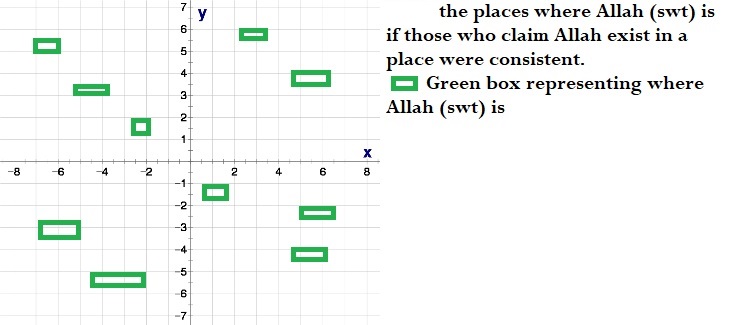
The consistent view would be that Allah is in a set of locations.

“Do they not consider the Qur’an (with care)? Had it been from other Than Allah, they would surely have found therein Much discrepancy.” (Qur’an 4:82)

﷽ 

Now if I was to follow that particular aqidah view I would have to be at least be consistent with myself and consistent with the text of the Qur’an. So again we have nothing stating that x/y is the default place for Allah (swt).

The correct view if we are to take the verses as they and apply a consistent methodology would be to say that Allah (swt) exist in a set [4,0 & 0,4 & 3,4 & 4,3 & 3,5 & 5,3 etc.…]

We describe Him (swt) by what has been authenticated that he described himself with. And we affirm for Him (swt) what the Prophet (saw) has affirmed for Him in his authentic Sunnah. As for those that say that we affirm for Allah what He has affirmed for Himself. They wanted from that to believe in the literal text and pass it as it came. For example, when He (Allah)-Great and Glorious God says:

“The Most Merciful [who is] above the Throne established.” (Qur’an 20:5) For this ayat (verse) when taken literally implies that Allah has a position, and he is above the throne, he says like this. This is the literal meaning.

And when I discussed with one of them regarding this,. I asked him, “Do you always stick to the literal meaning?”

He said, “Yes I do stick to the literal always, I don’t differ nor do I alter.” I said, “Let’s agree to stick to the literal meaning and I will agree on this ruling till a certain time, but I hope that you’ll stick to it and don’t change your words. Now me and you have both agreed on the same madhab and the same opinion.

Which is to say: The affirmation and passing of the ayats (verses) like they came, and taking the literal meanings, and building the belief upon it. (the opinion).

“Good”, he said, “Good”. I said, “Then this ayat (verse), Allah affirms a position for himself which is above the throne {The Most Merciful [who is] above the Throne established.} But in another ayat(verse) Allah says, “Indeed, my Lord is on a path [that is] straight.” (Qur’an 11:56)

Is the straight path the same as the throne or a different thing? Without doubt it’s another place, then this is a 2nd position. And you must affirm the literal meaning.

In a third ayat, Our Lord, Great and Glorious God says: “There are not three in a private conversation but that He is the fourth of them, nor are there five but that He is the sixth of them-and no less than that and no more except that He is with them.” (Qur’an 58:7)

This is a third place, different from the throne and different from the straight path.

And in a fourth ayat (verse), He (Allah) Great and Glorious God says about his Prophet Musa (as) ”No! Indeed, with me is my Lord; He will guide me.” Qur’an 26:62 and Musa (as) was on the beach of the Red Sea when he said this.

And in a fifth ayat, Allah tells us about our Prophet (saw) that he said when he was in Ghar Thawr (a cave that Muhammed-saw hid in)

“Have no fear, for Allah is with us.” (Qur’an 9:40)

And Allah tells us about his Khalil (Friend), Ibrahim (as) that he said: “I will go to my Lord! He will surely guide me!” (Qur’an 37:99)

And he (Allah) Great and Glorious God says in another ayat (verse) “But there he finds Allah, Who settles his account in full.” (Qur’an 24:39)

And he says in another ayat (verse) He says: “There is no creature but that He holds it by its forelock.” (Qur’an 11:56)

And the Prophet (saw) says in his Sunnah “A slave becomes nearest to his Lord when he is in prostration.” Source: (https://sunnah.com/riyadussalihin:1428)

And he says as well mentioning about Allah “Did you not know that my servant so and so was ill and yet you did not visit him? Did you not know that if you had visited him you would have found me with him?” Source: (https://sunnah.com/muslim:2569)

“When any one of you prays, he must not spit in front of him, for Allah is in front of him when he is engaged in prayer.” Source: (https://sunnah.com/bukhari:416)

Which of these literal meanings will you take? Now I am following your madhab.

On the throne? Or on the straight path, or is he the fourth of the three or the sixth of the fifth or in Ghar Thour, or on the beach of the Red Sea or in or where? Or in the prostration position?

He said: “All of these are not taken literally except {The Most Merciful [who is] above the Throne established.}”

I said: “Then you broke your ruling.” “You broke your ruling.”

Anyhow, taking the literal meaning falsifies the fact that the source of the Qur’an is from Allah. It falsifies that, why?

Because Allah says, “Had it been from anyone other than Allah, they would have certainly fund in it many inconsistencies.”(Qur’an 4:82) -and taking the literal meanings leads to that.

Sticking to the literal meaning leads to this inconsistency, because Allah Great and Glorious God affirms a hand for himself, and two hands, and affirms more than that..

{Allah’s hand is over theirs.}-Qur’an 48:10 {Rather, both his hands are extended}-Qur’an 5:64 {Do they not see that We have created for them from what Our hands have made, grazing livestock} –Qur’an 36:71

Which of these literal meanings will you take?

{sailing under Our ‘watchful’ Eyes} –Qur’an 54:14 { so that you would be brought up under My ‘watchful’ Eye.} –Qur’an 20:39 This is singular and that is plural, and lowest plural is 3 some say. 

So, which of these literal meaning will you take? {they would have certainly found in it many inconsistencies.}

Taking the literal meaning is a ruling that is broken and false but actually rotten and sluggish. It’s not looked upon and not depended upon. And it’s throwed to the side of the walls. The same is in the sunnah as well.

Those that take the path of affirming the attributes by affirming and passing them like they came and took the literal meaning have contradicted this ruling of theirs and have heavily crushed it and they have left it crumbled and fragmented and have not left a peaceful (part) of it ever!

And there’s nothing which implies that as much as the act of some when he came to the hadith “Do not curse Time, for it is Allah Who is Time.” Is it not like this?

Source: (https://sunnah.com/muslim:2247a)

He said: “No this hadith is not taken by the literal meaning.” (For it is Allah Who is Time) Else its literal meaning implies the divinity of time! Does it not?

Also, “I become the hearing with which he hears, his seeing with which he sees, his hand with which he strikes, and his leg with which he walks.” -taking the literal meaning leads to the belief of divine indwelling, is that not the case?

Source: (https://sunnah.com/qudsi40:25)

And they fight that very fiercely!!! Taking the literal meaning is a false method.

So when we say that we affirm what Allah has affirmed for himself we take out taking the literal meaning.

And when we say we affirm for Him (Allah) what the Prophet (saw) has affirmed for him in his Sunnah, then we mean the Mutawatir not any other.

What’s authentic about our Prophet (saw) in tawatur with clear mention of the attribute, in approval or rejection.

These people who ascribe to Allah (swt) a place are in error in their aqidah. May Allah (swt) guide them and us! May Allah (swt) forgive the Ummah!

You may be interested in reading the following:

May Allah Guide the Ummah.

May Allah Forgive the Ummah.

Leave a comment

Filed under Uncategorized

Ibn Taymiyya claims the majority of Sahabah (Companions) and Tabi’in (Followers) hated Ali Ibn Abi Talib

“Verily, those who believe and work deeds of righteousness, the Most Beneficent (Allah) will bestow love for them (in the hearts of the believers).” (Qur’an 19:96)

﷽ 

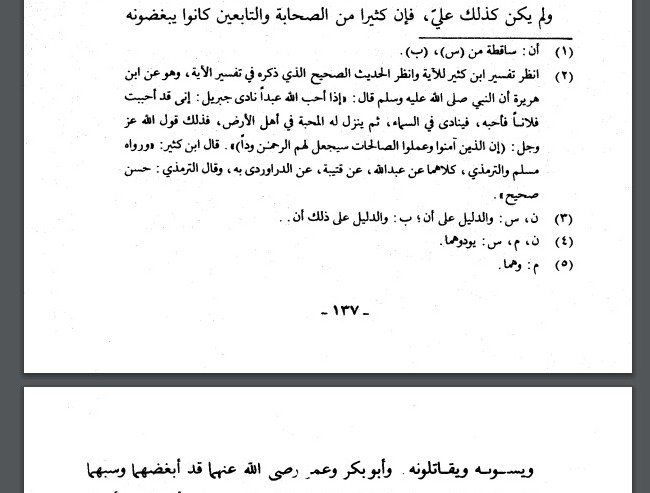
Ibn Taymiyya al Harrani in his asSunnah an-Nabawiyyah when he comments about the above ayat in relation to Ali ibn Abi Talib that:

“Allah (swt) has told that He will place on the believers and those that preform good, love. And this is a true promise from him. Especially for the Caliphs Abu Bakr (ra) and Umar Ibn Al Khattab (ra) for the general amount of companions loved them and they were the best periods of Islam. Ali was not like that, as a large number of companions (sahabah) and followers (tab’ieen) hated him, cursed him and fought him.”

Source: (منهاج السنة النبوية في نقض كلام الشيعة والقدرية Minhaj al-Sunnah al-Nabawiyyah fi Naqd Kalam al-Shi’a wa al-Qadariyyah)

The implication (though not explicitly stated by Ibn Taymiyya) was that Ali was not of those who worked deeds of righteousness.

Ibn Taymiyya continues:

“They love and venerate him, while Abu Bakr and Umar – may God be pleased with them – have been hated and cursed by the Rafidah (Rejectors), the Nusayriyyah, the Ghulat (Extremists), and the Ismailis. However, it is known that those who loved those two (1) are better and more numerous, and that those who hated them are further from Islam and fewer.”

This contradicts the case of Ali, for those who hated and fought him are better than those who hated Abu Bakr and Umar. In fact, the faction of Uthman, who love him and hate Ali, even if they are innovators and wrongdoers, are more knowledgeable and religious than the faction of Ali who love him and hate Uthman, and they are greater in jihad and justice. Thus, it is clear that the affection mandated for the three [first Caliphs] is greater.”

“And if it is said: ‘Claims of divinity and prophethood have been made about Ali (2),’ it is replied: ‘All the Khawarij considered him a disbeliever and the Marwaniyyah hated him. And these are better than the Rafidah who curse Abu Bakr and Umar – may God be pleased with them – let alone the Extremists (3).'”

Source: [Chapter: The Thirteenth Proof “You are only a warner, and for every people there is a guide.”]

You may be interested in reading the following:

May Allah Forgive the Ummah.

May Allah Guide the Ummah.

2 Comments

Filed under Uncategorized