
“Moreover, if two factions among the believers should fight, then make settlement between the two. But if one of them oppresses the other, then fight against the one that oppresses until it returns to the ordinance of Allah. And if it returns, then make settlement between them in justice and act justly. Indeed, Allah loves those who act justly.” (Qur’an 49:9)
“Moreover, it is not for a believing man and it is not for a believing woman when Allah has decided and His Messenger a matter that (there) should be for them (any) choice about their affair. And whoever disobeys Allah and His Messenger certainly, he (has) strayed (into) error clear.” (Qur’an 33:36)
﷽
Our colleague narrates an encounter between a former student of Dr. Syed Ali Hur Kamoonpuri and the claims made by her teacher.
This post is in regard to some messages that a woman named Roxanna sent to me via our conversations/exchanges through WhatsApp. I believe it all started when she shared a post of mine from Prima-Quran. That post was the following:
https://primaquran.com/2022/10/17/ismaili-shia-and-circular-reasoning/
My sincere feedback to Roxanna was that any time when we are in any chat group that has its own agenda or focus, it would not be prudent for us to go into that group with any attempt to derail it.
So for those from the Ibadi school reading this. If there are Facebook groups, WhatsApp, Telegram, or Discord servers created specifically for Sufism, or Shi’i or the Sunni, please do not go into those groups and try and derail the focus of those groups. Let them be.
Thus, as she tells us, this got this Syed Ali Hur Kamoonpuri quite worked up. Which is understandable. Reformist or not, he is still a Shi’i and Ali is central to their identity. Apparently she was threatened with going to hellfire for even entertaining the thought that Ali could be on the wrong side of history when it comes to the decisions at Siffin.
So, apparently, this Syed Ali Hur Kampoonpuri was going to do a YouTube series refuting the Ibadi (nothing better to do). Yet, all the while claiming he wanted an Ibadi to appear as a “guest”. So you have to wonder how sincere that is. In fact, she herself mentioned that she was to play some part in the refutation of the school.
Then, this Syed Ali Hur Kampoonpuri claimed that he “debated Ibadi scholars”. This naturally caused a raised eyebrow from myself So I asked her to ask him who are these “Ibadi scholars” he “debated with.”
The question was deflected, which seemed quite predictable. Wanting to invite a scholar onto your program with the pretense of having a dialogue when you actually want a debate is rather insincere. You don’t have the intention of inviting an “Ibadi guest” on a program while having the intention of doing a refutation series. That doesn’t come across as sincere as all.
So she replies:
“This was the response I got when I asked which Ibadi scholars he had discussions with” — Roxanna
“Walaykum Salaam. They were mostly from Dar es Salaam, Tanzania and Zanzibar when I used to live there. And some who visited India. But I don’t know if they would be pleased at my sharing their names, given how secretive and low-key they prefer to remain.” -Syed Ali Hur Kamoonpuri
“They were mostly from Dar es Salaam (would indicate 1 scholar), Tanzania and Zanzibar (would indicate at least 1 scholar) and “some who visited India” that some would indicate more than one.
So, that is a total of 4 Ibadi scholars, at the very least he has claimed to have debated.
In our eyes, this causes Mr. Syed Ali Hur Kampoonpuri’s credibility to be questioned. It is very challenging to take someone seriously when they make claims like this and when asked to substantiate such claims, they are not forthcoming. It is most unfortunate.
The sister, who was welcomed by the group, acknowledged how kind and welcoming everyone was. It was not long until she asked for others to be invited to the WhatsApp group. Now, keep in mind that the group is created for people convinced of the Ibadi school and asking questions with regard to guidance for their life.
So, she invited about 4 others to the group. It was not long until the questions turned to Siffin and that pretty much dominated the conversation as far as her own interest.
All I know is that I connected her with many people in the Ibadi community. She left the WhatsApp group one day, dropped contact. The last I heard was a person in the group messaged me one day saying: “Your sister dropped her scarf.” Such an odd message to receive with no context. That person then sent me a link of her in some YouTube program she does without the headscarf.
That is really not my business. She is on her own journey, as are we all. May Allah guide her and guide us.
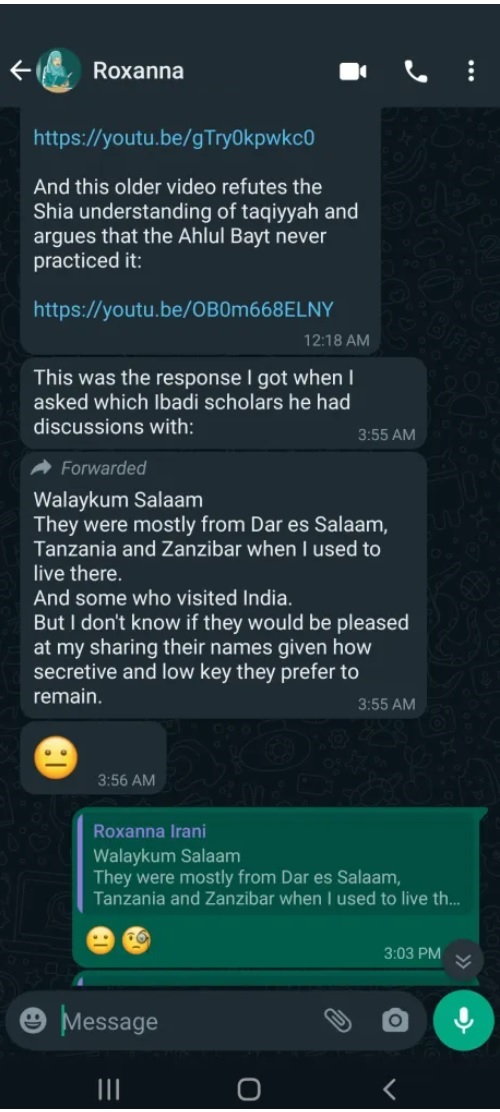
Do note that Roxanna has changed the information from him (Syed Ali), claiming he had ‘debated’ with such people, him (Syed Ali) simply having ‘discussions’ with such people. This also raised an eyebrow.
Yet you can see by her emoji, it is one that conveys mild irritation. We had asked Shaykh Juma Al Mazruii if he had ever heard of this Shaykh, and he said no. Shaykh Hilal al Wardi and Shaykh Hafidh Hamed Al Sawafi had not heard of him either. No one had heard of this guy.
You see, the Ibadi community is quite small. It would not be very hard at all to ascertain the truth of his statements. For example, his statement, “When I used to live there,” We could get from him the years he says he lived there and from there simply ask in our very tight-knit and very small community, have you ever heard of this guy?
This is a huge stumbling block for our side to have anything to do with him. Also, to be transparent it also caused doubt in us towards those who would associate with such a duplicitous individual. I am certain he has not debated Ibadi scholars because the arguments that he brings up are so ignorant, and devoid of any basic knowledge of our fiqh in regard to matters of arbitration.
We let the reader make their own informed decisions.
So, if there is an attempt from his circle or him to engage one of our teachers in the future, he would need to first clear this up.
So who is Syed Ali Hur Kamoonpuri? To be fair, we had not heard of him until she brought up his name. A Google search revealed that his father was one Dr. Syed Mujtaba Hasan Kampoonpuri, who served as the Dean Faculty of 12er Shia Theology at Aligarh Muslim University.
Also, to send some traffic his way, this is his YouTube channel for those interested: https://www.youtube.com/@Al-Islaah
He has some worthwhile content that those who are searching these matters may find useful.
We understand he is trying to reform 12er Shi’ism. In this regard, may Allah (swt) grant him success. Any attempts to build bridges among the Muslim community may Allah (swt) grant him success. However, when it comes to his “knowledge” of the Ibadi school, it is a naked display of ignorance, mischaracterizations and straw man “arguments.”
These are his two voice clips sent to sister Roxanna. You listen and be the judge. We have our own response to these. Apparently sister Roxanna was harangued by them over it. May Allah help us.
This is quite literally a transcription of the above voice notes. One may feel free to give it a listen and follow along. Below is a response to his (Syed Ali) claims.
“Ali had already answered these doubts. He said, “Who told you we made human beings arbitrators? We made the Qur’an the arbitrator. The job of the human beings is simply to deliver the verdict of the Qur’an. You understand? The arbitrator is the Qur’an. And that no one in the Ummah can deny. Even the Qur’an itself says that Allah is supposed to be the hakam right? Allah is supposed to be the arbitrator. But how does Allah be…how does Allah act as the arbitrator? He’s not gonna, he’s not an old man in the sky as the as some of those who believe in Israliyaat (narrations from the children of Israel) would perceive him. Or as the Anthropomorphist would perceive him. That he will that he’s an old man in the sky authbillah (seek refuge with Allah) and that he will descend, you know he will send down on a ladder and he will descend and he will come and issue the verdict. When the Qur’an promotes takheem (arbitration) of Allah. When ever you have a dispute or iktilaaf (difference) the hukm (judgment) will come from Allah. Hukm will not come from Allah in the sense that you look towards the sky and Allah will write the verdict on the sky. He has already, he has already revealed the book. The book contains the judgement. But the book does not have a mouth, with which it can pronounce the judgement. So the mouth Allah has given to the human being. Human agents. O.K? They will bring out the judgement of the Qur’an. And and obviously the judgement of why do you have a qadi in courts then? You know tell tell the government of Oman to fire all the qadis. Who are they? Why are they bringing human agents? You know they should just put a Qur’an on the seat of the qadi; and let the Qur’an give the judgement. So this is Imam Ali’s problem with the Khawarij. He is telling them you are foolish. This is not how it works. You can’t ahh directly ask the Qur’an to issue the judgement. You need to appoint human beings the hakam (judge)O.K.? And those hakam (judges) will extract the verdict from the Qur’an. And than they will say, Why did you appoint Abu Musa Al Ashari say by the way he’s he was not my choice. Why do you allow them to appoint Amr Ibn Al ‘As say Baba this is not my choice. They have their own ah army, they have their own separate government. Uh we cannot impose, we cannot dictate who they will choose. You understand? We cannot impose our choice on them. If we could impose our choice on them at this stage than why are we having the battle between them? The, the reason why we are having the we were having the battle with them is because our authority on them had not yet been established. They have not accepted our authorities. So how can we start appointing people on their side when they don’t even accept they have not even submitted to our authority? But yes they are prepared to submit to the authority of the Qur’an. And they are saying that they are ready and willing to appoint someone from their side who will uh at least as far as they are alleging will sincerely try to extract the verdict, verdict of the Qur’an. So yeah we have to go with that! We can’t determine. We can’t impose our choice Imam Ali was not allowed by the Khawarij in his army to choose his own arbitrator also. He wanted to choose Ibn Abbas or Malik al Ashtar or someone of that sort. But no they imposed Abu Musa Al Ashari because they wanted someone who is anti-war, not pro-war. And let us not forget that it was the Khawarij who applied all the pressure, or the major part of the pressure in getting Imam Ali to uhh to enforcing him to accept takhim (arbitration). And uhh they they at that it seems they were completely you know enamored with this they were they were hypot-they were sorry they were hypnotized by this um by this um by this call to come to the judgement of the Qur’an. They were like how can we fight when people are inviting us towards the Qur’an? Now as far as the verse of surah Al Hujrat (chapter 49) is concerned uhhh Imam Ali did not violate it. Allah says, The obligation to fight the rebellious party only is binding okay soo far as the party is not willing to submit to the Amr (command) of Allah. But as long as as soon as the rebellious party says, even if they don’t accept your authority, and your caliphate, and the ij, bayah (oath) and mashura (collective decision) of the muhajirin (those who migrated) and ansar (those who helped) all of that no problem. As soon as the rebellious party says look we are ready to surrender to the Qur’an. Ah what is the Qur’an. The Qur’an is the amr (command) of Allah is it not? Ahhh so at that point if you want you can invoke this part of the verse and say that look Allah say, until it returns to the Amr (command) of Allah. By raising the Mushahif (Qur’an on parchments) on the spears they are at least zahiran (outwardly apparent) even if if they are batinan (hidden) and munafiq (hypocrites) there you know not serious they are not sincere whatever you say about their batin (what is hidden). But Zahiran (outwardly apparent) so long as the rebellious party is offering to submit to the judgement of the Qur’an. Then you cannot say that Quranically we are still obligated to continue fighting them. No. At that point the Qur’anic obligation is lifted and now it becomes a matter of the what is the requirement of the political and military wisdom. So now poli, the rules of politics and military wisdom dictate that you should try to ascertain are these people really sincere or not. Now, We have already, Imam Ali had already seen these people are not sincere because the beginning of the battle we did call them towards the Qur’an. They didn’t accept it than. Now that they are losing the battle all of a sudden they now want the Qur’an to be the judge? So on that basis politically Imam Ali even after the arbitration continued to maintain he said yes politically what you people forced me to do was not the best. Uhmm it was not the best approach you should have listened to me I was telling you even though the Qur’anic obligation at that point now starts to rest on on a, you see the the critical point the Khawarij did not understand. o.k Which is that Allah’s commands in the Qur’an are absolute, they have to be followed under all circumstances right? But, sometimes they are predicated upon uh worldly, politically and military ijtihad (striving to derive rulings from the sources). So, For example, Allah (swt) says in the Qur’an that we have to fast. O.K we have to fast. And the Sunnah has already made it clear that as soon as you see the moon start fasting shahru Ramadan (month of Ramadan) right? But seeing the moon on shahrul Ramadan this is a human worldly astronomical matter. It is not an absolute uhh divine yani(you know) Allah does not inform us when the moon has been sighted. This is something we human beings have to apply our ijtihad to find out ehh uh has the moon been sighted or not. Here there can be mistakes. So if lets say a human being by mistake has a hallucination or some illusion and he ends up seeing the moon or lets say because of some defect in his eyes he is not able to see the moon and no one is able to see the moon and they don’t fast the next day when in reality the moon had appeared in the ilm (knowledge) of Allah the moon had appeared, Allah doesn’t have a case against such people. You can’t say but I sa my command was to start fasting as soon as you see the moon. The problem is we didn’t see the moon even if it may have been there so yes the requirement of worldly wisdom should have been that we should have put enough arrangements in place to ensure that you know that the moon is sighted. But we failed in that. So similarly Imam Ali is saying that look Allah’s obligation to fight against the forces of Sham (Syria) was only binding so long as they were completely stubborn and they were not re, Muaviya this is how he came to Siffin. He said I don’t have anything for you except the sword. Imam Ali tried to negotiate with him. He wrote letters to him. All of that! Everything failed. That’s why the battle happened as a last resort. When his side attacked the side of Imam Ali and committed aggression against him. So he fought them in defense. So this is what the fight was about. Now when Allah says, You keep on fighting them until they return to the Amr of Allah. Now this until they return to the Amr of Allah this is going to be determined by how do you determine when a party has returned to the Amr of Allah? This will be determined by worldly factors. Which are not God is not going to send you wahy telling o.k now they have returned or ok no no no they have not actually they are not sincere keep fighting. No these are human ijtihadi matters. Now the army of Imam Ali not Imam Ali himself Imam Ali’s ijtihad was correct wal hamdulillah (praise be to Allah)from the beginning he, Ibn Abbas, Malik Al Ashtar they all saw through this and they said yeah but look the correct worldly and military ijtihad requires us to continue this fight. Because we have enough against these people to prove to Allah that they are not sincere. We can see that. But the rest of the army uhhmm and especially these um foolish khawarij were not able to see through that. They were deceived. And in some of the reports indicate that its not just that they were deceived its it’s that the
battle had really broken them. They just wanted an end by any means. Some of them were like that. Their were people in the army of Imam Ali that were completely the battle had been so fierce and it was so much bloodshed they were psychologically effected by it, and they were just looking for any excuse to stop the battle. And these are the first people to have jumped on this thing that no no no let’s stop the fighting. Let’s stop the fight. They were desperate. So this desperation caused them to make this faulty ijtihad and Imam Ali said o.k if they had gone against the Qur’an with this ijtihad Imam Ali would have said you know what let us die. It is better to die than to go against the Qur’an. But because their faulty worldly ijtihad was only a worldly political mistake and military mistake that they were making Imam Ali tried to warn them against it but he did not stick to his gun. He did not impose it on them very ferociously. In the end you see him saying that o.k I can clearly see you people have lost the will to fight and it does not befit me as your leader to force you in a direction that you are not pleased with. You people don’t’ wanna fight o.k What you are proposing because it does not go against the Qur’an and established sunnah accepting arbitration a call to make the Qur’an the judge between two parties is never against the Qur’an and Sunnah. In fact it is 100% in line with the Qur’an and Sunnah. The only issue is that the worldly aspect of it. The worldly aspect is you have to you have to determine rather the other party is really sincere or not. You people are just taking their word for it. Which is not uuh a good thing to do from a worldly political military perspective. But it’s uh ah yani if this is what you have determined. Than yeah it’s fine. Doesn’t go against the Qur’an or Sunnah. Da da they are outwardly calling us towards the Qur’an yeah? So fine uh the Allah (swt) in the Qur’an promotes this idea that the Qur’an and his his
revelations should be made the judge in all disputes. and the appointment of two human beings from both sides this mirror’s uuuhh Qur’anic uh prescription such as in the case of husband and wife Allah says, “send an arbitrator from his people and an arbitrator from her people” and the husband does not get to decide who the wife will choose as her hakam. The woman should have the right to bring her arbitrator, whoever she chooses from her family and whoever her family is agreed upon and happy with and the husband uuhh should have the right to bring whoever he is pleased with from his side. Right?
Th zz You can’t impose you know this foolish argument that Imam, why did Imam Ali let them choose a wicked man like Amr ibn Al As yeah you can’t dictate terms to the the other army. If the Khawarij were really interested in not having Amr Ibn Al As as the hakam they should have continued fighting
as Imam Ali instructed them to do at first. But they disobeyed him. And their disobedience of him there was uhh it was worldly foolishness. Ummm and that is why Imam Ali maintained until the end
he said you people did something foolish and now your trying to pin the blame for your foolishness on me because you’ve now seen with your own eyes the results of your foolishness so in any case Imam Ali appointed these two arbit he he agreed he acquiesced in the appointment of these two arbitrators
he put strict conditions that they will make the Qur’an and the Qur’an alone the hakam and in areas where the Qur’an is silent the Sunnah of the Messenger (saw) and then latter on as you see what happened in takhim u-ma? Imam Ali says, they went astray these two arbitrators. They broke the terms and agreements the the the terms of the agreement. They followed their whim desires and so it was very clearly mentioned in the contract and in the pact that if you know if they go against the requirements of the Qur’an aaa and the Sunnah then their decree is not binding. And therefore when they deposed Imam Ali it was an illegal verdict and when the verdict is illegal you go back to the default which is as mentioned in the contract the original state of war and the original state of war was based on what status quo on the status quo that the Muhajirun and Ansar. The vast majority of them ah have given bayah to Imam Ali he is the rightful legitimate caliph and Muawiyah has to submit to that bayah if he doesn’t he’s a baghy (rebel) and a rebel against the Muslims and the Muslims have the right to impose their authority on him and this is exactly what Imam Ali went back to to doing. Preparing the next campaign against Muaviyah.” — Syed Ali Hur
Prima Qur’an response:
Syed Ali Hur often seems incoherent.
Part of pur frustration with Syed Ali is that there are so many cut-off sentences and his thoughts seem to be jumbled on this. He will begin a sentence and just when you think he is about to make a point or an assertion, he quickly changes course to something else. Then he becomes very polemical and this is a far cry from academic discourse. He seems to like the word ‘foolish’ quite a bit.
Syed Ali Hur does not understand Ibadi jurisprudence.
It is clear to us that Syed Ali Hur neither understands the Ibadi school nor our jurisprudence. This is clear when he makes this gargantuan error concerning our school. To be fair, this tired polemic does not originate with him. It has been said by those before him. It not only insults our school, it insults Ali ibn Abu Talib as well as the reader’s intelligence.
“Whenever you have a dispute or iktilaaf (difference), the hukm (judgment) will come from Allah. Hukm will not come from Allah in the sense that you look towards the sky and Allah will write the verdict on the sky. He has already, he has already revealed the book. The book contains the judgement. But the book does not have a mouth with which it can pronounce the judgement. ” — Syed Ali Hur
” And and obviously the judgement of why do you have a qadi in courts then? You know tell tell the government of Oman to fire all the qadis. Who are they? Why are they bringing human agents? You know they should just put a Qur’an on the seat of the qadi; and let the Qur’an give the judgement. ” — Syed Ali Hur
Listening to Syed Alli make these types of statements was just wild. Are we really to believe that Ali ibn Abu Talib used these types of bizarre arguments?
In fact, it is very reminiscent of the straw man “arguments” and bizarre statements and actions that Sunnis attribute to their imams when attempting to refute the points of others.
Please see:
“You see the the critical point the Khawarij did not understand. o.k Which is that Allah’s commands in the Qur’an are absolute, they have to be followed under all circumstances right? But, sometimes they are predicated upon uh worldly, politically and military ijtihad.” –Syed Ali Hur
Notice the word sometimes. That is exactly the point! Allah (swt) says,
“Moreover, it is not for a believing man, and it is not for a believing woman when Allah has decided and His Messenger a matter that (there) should be for them (any) choice about their affair. And whoever disobeys Allah and His Messenger certainly, he (has) strayed (into) clear error.” (Qur’an 33:36)
When Allah (swt) has decided upon a matter, it is not for human beings to have any choice on something decided upon by Allah (swt). This text is nass—it is clear: a known, clear legal injunction, or a divine decree.
However, in matters of ijtihad, he needs to bring evidence to show the Ibadi school has disagreed with this, which he has not.
Syed Ali Hur contradicts himself.
“This is not how it works. You can’t ahh directly ask the Qur’an to issue the judgement.” Syed Ali Hur
Prima Qur’an response:
Syed Ali Hur contradicted himself. He says: ‘sometimes‘.
However, this new statement that you cannot go directly to the Qur’an is falsehood.
Allah creates circumstances favorable to Muaviya and against Ali?
“They were deceived. And in some of the reports indicate that its not just that they were deceived its it’s that the battle had really broken them. They just wanted an end by any means. Some of them were like that. Their were people in the army of Imam Ali that were completely the battle had been so fierce and it was so much bloodshed they were psychologically effected by it, and they were just looking for any excuse to stop the battle. And these are the first people to have jumped on this thing that no no no let’s stop the fighting. Let’s stop the fight. They were desperate.” -Syed Ali Hur
Prima Qur’an comments: Is it not interesting that, if we are to believe what Syed Ali tells us, that this just so happens to coincide with Muaviyah’s army putting the Mushaf of the Qur’an on spears and swords just when the battle was not going well for Muaviyah’s side?
You can deduce from this the following:
a) Allah (swt) himself wanted both parties to talk by creating this fatigue and exasperation. Thus, Ali’s alleged decision to “keep fighting” was wrong. Muslims do not believe in coincidence.
The people who were for arbitration wanted a good thing and Ali did not want the good thing!
“If they had gone against the Qur’an with this ijtihad Imam Ali would have said you know what let us die. It is better to die than to go against the Qur’an. But because their faulty worldly ijtihad was only a worldly political mistake and military mistake that they were making Imam Ali tried to warn them against it but he did not stick to his gun. He did not impose it on them very ferociously. In the end you see him saying that o.k I can clearly see you people have lost the will to fight and it does not befit me as your leader to force you in a direction that you are not pleased with. You people don’t’ wanna fight o.k What you are proposing because it does not go against the Qur’an and established sunnah accepting arbitration a call to make the Qur’an the judge between two parties is never against the Qur’an and Sunnah. In fact it is 100% in line with the Qur’an and Sunnah. ” -Syed Ali Hur
” As soon as the rebellious party says look we are ready to surrender to the Qur’an. Ah what is the Qur’an. The Qur’an is the amr (command) of Allah is it not? Ahhh so at that point if you want you can invoke this part of the verse and say that look Allah say, until it returns to the Amr (command) of Allah. By raising the Mushahif (Qur’an on parchments) on the spears they are at least zahiran (outwardly apparent) even if if they are batinan (hidden) and munafiq (hypocrites) there you know not serious they are not sincere whatever you say about their batin (what is hidden). But Zahiran (outwardly apparent) so long as the rebellious party is offering to submit to the judgement of the Qur’an. Then you cannot say that Quranically we are still obligated to continue fighting them. No. At that point the Qur’anic obligation is lifted and now it becomes a matter of the what is the requirement of the political and military wisdom.” -Syed Ali Hur
Prima Qur’an comments:
a) So supposedly, these people are “making faulty ijtihad”
b) Then he (Syed Ali) turns around and says, “Accepting arbitration a call to make the Qur’an the judge between two parties is never against the Qur’an and Sunnah. In fact, it is 100% in line with the Qur’an and Sunnah.
c) This is because “ But Zahiran (outwardly apparent) so long as the rebellious party is offering to submit to the judgement of the Qur’an.”
Ali is portrayed as half hearted reed blown by the winds and not the Imam and resolute believer who trust and reliance is solely upon Allah (swt). He shirks from personal responsibility for his actions.
“Now, We have already, Imam Ali had already seen these people are not sincere because the beginning of the battle we did call them towards the Qur’an. They didn’t accept it than. Now that they are losing the battle all of a sudden they now want the Qur’an to be the judge? So on that basis politically Imam Ali even after the arbitration continued to maintain he said yes politically what you people forced me to do was not the best.”-Syed Ali Hur
“If they had gone against the Qur’an with this ijtihad Imam Ali would have said you know what let us die. It is better to die than to go against the Qur’an.”-Syed Ali Hur
“So in any case Imam Ali appointed these two arbit he he agreed he acquiesced in the appointment of these two arbitrators he put strict conditions that they will make the Qur’an and the Qur’an alone the hakam and in areas where the Qur’an is silent the Sunnah of the Messenger.” -Syed Ali Hur
Prima Qur’an comments:
a) So, on the one hand: “You people forced me to do“
b) On the other hand: “You know what let us die. It is better to die than to go against the Qur’an.”
c) And on the other hand: “he agreed he acquiesced in the appointment of these two arbitrators.”
How come Ali wasn’t aware of these verses of the Qur’an?
“How often has a small host overcome a great host by Allah’s leave! For Allah is with those who are patient in adversity.” (Qur’an 2:249)
“When people said to them: ‘Behold, a host has gathered around you and you should fear them’, it only increased their faith and they answered: ‘Allah is Sufficient for us; and what an excellent Guardian He is!”(Qur’an 3:173)
Now again, we are only going by the narrative that Syed Ali Hur has given us. We do not know if these are his surmising’s based upon an oral narrative or actual historical data.
Syed Ali Hur claims without evidence that the so called “Khawarij” selected Abu Musa Al-Ashari? What is the reference for this?
“But no they imposed Abu Musa Al Ashari because they wanted someone who is anti-war, not pro-war. And let us not forget that it was the Khawarij who applied all the pressure, or the major part of the pressure in getting Imam Ali to uhh to enforcing him to accept takhim (arbitration).” -Syed Ali Hur
Prima Qur’an comments:
Is Ali so weak that not only is he supposedly forced into arbitration, and now he cannot even accept his own arbitrator? Which brings us to his example of the separation of man and wife which falls back on him in a bad way.
This also blows open wide any false notion of Ali or his army believing he had any type ofʿIṣmah or that he was Maʿṣūm. The actions of his army be the admission of Syed Ali Hur is proof in the pudding.
Syed Ali Hur’s lack of understanding of the Arabic language and verse 4:35 of the Qur’an.
“The appointment of two human beings from both sides this mirror’s uuuhh Qur’anic uh prescription such as in the case of husband and wife Allah says, “send an arbitrator from his people and an arbitrator from her people” and the husband does not get to decide who the wife will choose as her hakam. The woman should have the right to bring her arbitrator, whoever she chooses from her family and whoever her family is agreed upon and happy with and the husband uuhh should have the right to bring whoever he is pleased with from his side. Right?”-Syed Ali Hur
Prima Qur’an comments:
a) Wrong! This actually shows poor grammar in the understanding of this ayat. The Arabic text is fa-ib’ʿathū (they choose), meaning the family of the respective party choose the arbiter. Not the wife chooses or the husband chooses. Their families choose. So, even if the allegation of the so-called ‘Khawarij’ chose Abu Musa Al Ashari by the understanding of the verse, it would be correct. Which, by the way, Syed Ali Hur did not give evidence that they chose him!
b) For the example of the husband and wife, Allah (swt) says, fa-ib’athu (appoint arbiters).
“If two parties among the believers start to fight against each other, restore peace among them. If one party rebels against the other, fight against the rebellious one until he surrenders to the command of Allah. When he does so, restore peace among them with justice and equality; Allah loves those who maintain justice. ” (Qur’an 49:9)
It is in the imperative form faqatilu! That is the AMR, the command of Allah (swt). There should be no talk of a document. There should be talk of bayah!
Ali was the one in his letters who told Muaviyah that they could investigate the murder of Uthman, yet Muaviyah would need to recognize the legitimate government of the Muslims. Now Ali is laying all this aside for discussion? Give the bayah or perish!
“Th zz You can’t impose you know this foolish argument that Imam, why did Imam Ali let them choose a wicked man like Amr ibn Al As yeah you can’t dictate terms to the the other army. “-Syed Ali Hur
Prima Qur’an comments:
Thankfully, Syed Ali Hur went to verse Qur’an 4:35 of a dispute between a man and a woman. He did not go to the verse of Qur’an 5:95. Because the argument that the sahabah of the Blessed Messenger (saw) who were at Narhawan had against Ibn Abbas was the following:
“O you who believe! Kill not game while in the sacred precincts or in pilgrim garb. If any of you do so intentionally, the compensation is an offering, brought to the Ka’ba, of a domestic animal equivalent to the one he killed, AS ADJUDGED BY TWO JUST MEN AMONG YOU; or by way of atonement, the feeding of the indigent; or its equivalent in fasts: that he may taste of the penalty of his deed. Allah forgives what is past: for repetition, Allah will exact from him the penalty. For Allah is Exalted, and Lord of Retribution.” (Qur’an 5:95)
‘As adjudged by two just men among you’. Keep this in mind as well. This is a key part of the text.
The sahabah of Nahrawaan replied to Ibn Abbas :
“Are you comparing the law relating to the killing of game animals on the sacred land or the law that is intended to resolve the misunderstandings that occur between a man and his wife, with the law that is intended to govern matters of greater magnitude, such as the act of shedding of Muslims’ blood?”
Source: (Al-Tabari, Al-Taarikh Vol. 6, p. 13.)
Also, another point concerning the text that Ibn Abbas brought forth.
Naturally, people would ask, “Are you saying Amru bin Al-As is a man of justice when it was he who spilled our blood yesterday? If you believe that he is just, then we (including you — Ibn Abbas and Ali) are not just because we all fought the war against Mu’awiya and Amru bin Al-As!”
So the unfilled questions were.
- A)Were there two arbitrators or one?
- B) Were they just or unjust?
Now could a person think they are just and sincere in what they are doing?
Syed Ali Hur does not have a cohesive narrative concerning the so called kharijites and rather or not they are pro/anti-arbitration.
So, on the one hand: “You people forced me to do” — Syed Ali Hur
“And let us not forget that it was the Khawarij who applied all the pressure, or the major part of the pressure in getting Imam Ali to uhh to enforcing him to accept takhim (arbitration).”-Syed Ali Hur
However, he (Syed Ali) then turns around and says:
“The, the reason why we are having the we were having the battle with them is because our authority on them had not yet been established. They have not accepted our authorities. So how can we start appointing people on their side when they don’t even accept they have not even submitted to our authority? But yes they are prepared to submit to the authority of the Qur’an. “–Syed Ali Hur
His contradiction is obvious for all to see. If the so-called Kharijites were forcing Ali into arbitration, then why does he have to explain to them that these people do not accept our authority we cannot impose it on them? Seems like you are preaching to the choir. Especially if they were for it!
“Imam Ali maintained until the end. He said you people did something foolish and now your trying to pin the blame for your foolishness on me because you’ve now seen with your own eyes the results of your foolishness.”-Syed Ali Hur
Also, if these people forced Ali into arbitration and they “with their own eyes the results“, then why go their separate ways after? This is not adding up at all.
Especially, in light of the following:
“Now we have already, Imam Ali had already seen these people are not sincere because the beginning of the battle we did call them towards the Qur’an. They didn’t accept it then. Now that they are losing the battle all of a sudden, they now want the Qur’an to be the judge? So, on that basis, politically Imam Ali, even after the arbitration, continued to maintain he said yes, politically, what you people forced me to do was not the best.”—Syed Ali Hur
Why are people who are fighting, spilling blood, fighting for you at the battle of the Camel? Why are they now leaving? They could have said, yes Ali, in hindsight was correct and we were wrong.
It is quite clear that the people who left Ali’s camp wanted to do so because Ali went for arbitration. The companions of the Blessed Messenger (saw) who left Siffin for Narhawan are famous for their cry:
“La Hukma Illa Lillah” (There is no rule but that of Allah)
In the end, with regard to arbitration, what is the result of it? What is the fruit? Did it return to the AMR of Allah (swt) ? No! It did not!
What is that the Shi’i believe was so insufficient about his letters to Muaviyah that he needed to give in to this arbitration? What is it that is not so clear in the Qur’an about what this “amr of Allah” is that we need to make a document, and have court recess and go our own ways?
And the key thing that Shi’i keep running from again and again and again is this one simple, straightforward question. “If the Qur’an is the arbiter, what is the verse or verses that make Ali in the right in his dispute with Muaviyah?”
The command of Allah (swt) is not clear?
Yes indeed it is!
In the example of the husband and wife, Allah (swt) says, fa-ib’athu (appoint arbiters)
“If two parties among the believers start to fight against each other, restore peace among them. If one party rebels against the other, fight against the rebellious one until he surrenders to the command of Allah. When he does so, restore peace among them with justice and equality; Allah loves those who maintain justice. ” (Qur’an 49:9)
It is in the imperative form faqatilu! That is the AMR, the command of Allah (swt)
Unless the Shi’i now want to say that Ali did not know what the amr of Allah (swt) was then let that stand on the record.
Unless the Shi’i want to say that Ali has no Qur’an-based text to support him, then let that also stand on the record.

How does what return to the Amr of Allah (swt)?
Very simple and easy to answer.
Avoid what Allah (swt) asked you to avoid and by doing what Allah (swt) has ordered you to do. Example: You are not making your prayer, then start praying. This is not rocket science.
Whenever the Shi’i are cornered in an argument and have nothing more to offer. They will always return to the incident of Ghadir Khum. It is what they believe is their instant win card!
We have explained the incident of Ghadir Khum here:
Also, do correct your Shi’i friends. There is no such thing as ‘THE’ hadith of Ghadir Khum. However, there is THE incident of Ghadir Khum and various versions of that incident, which means hadiths (plural). Some of these variants have accretions and variations.

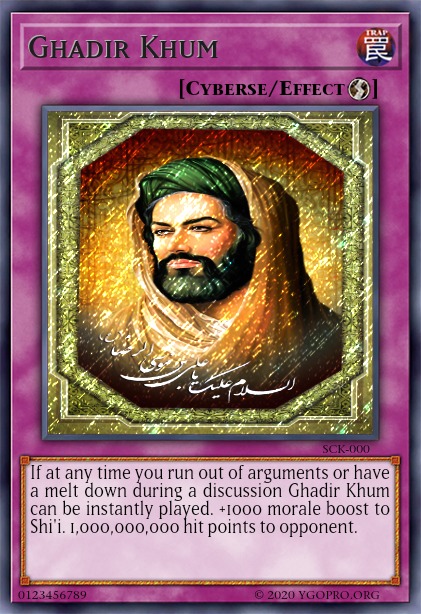
Remember that our position is Prima-Quran.
Some groups try to elevate the hadith over the Qur’an. Whereas for us, we do not elevate the hadith above the Qur’an. Nor can hadith clash with the Qur’an.
The verse in question describes the two opposing groups as believers.
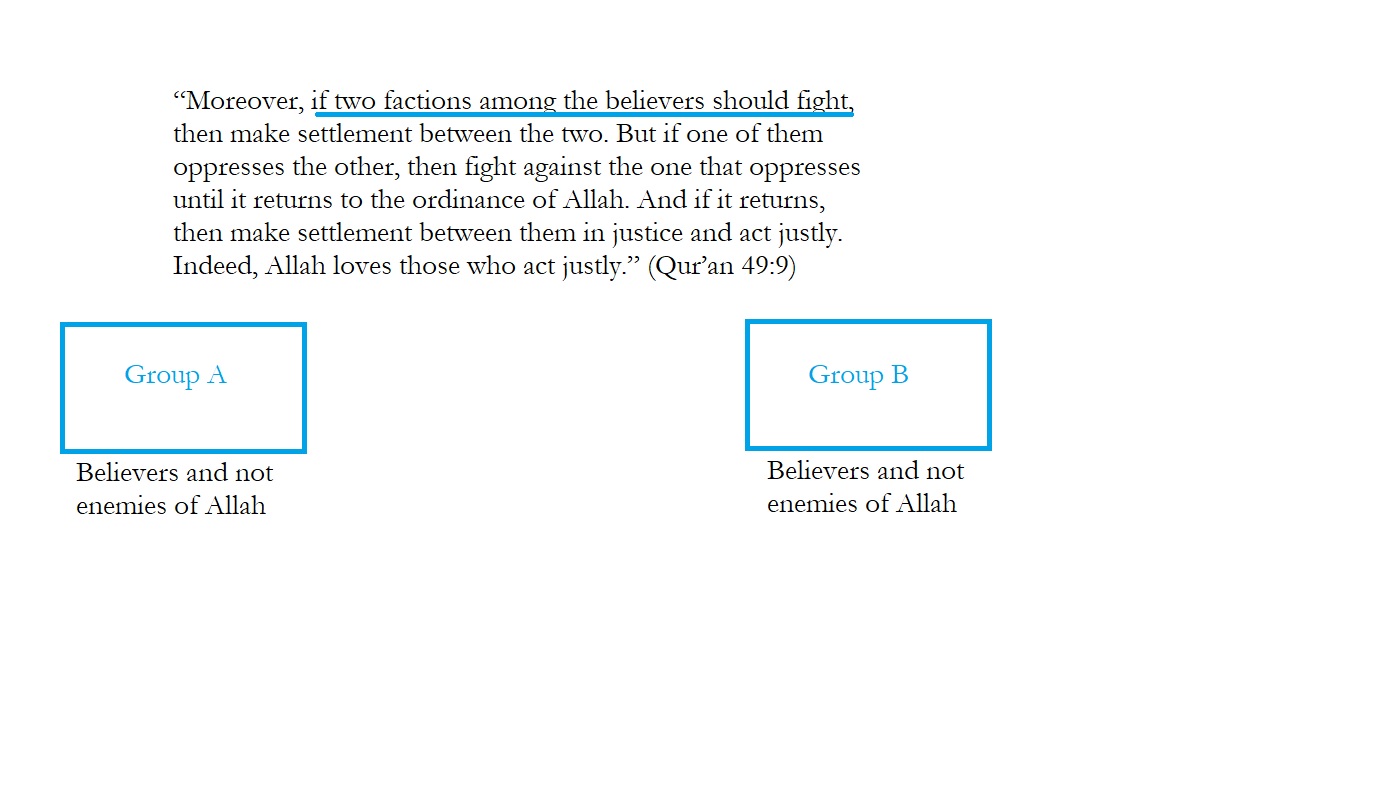
Logic dictates that Ali could be in either group A or group B.
Let us say that Ali is in group B, the group that is being oppressed.
How can it be reasoned that the people in group A are being labeled as enemies of Allah, yet still be called believers by Allah (swt) himself?
“Allah is the Friend (Waliyy)of those who believe He brings them out of darkness into light. And those who disbelieve their friends are the devils who take them out of light into darkness. They are the companions of the Fire; therein they abide.” (Qur’an 2:257)
Surely Allah (swt) the All-Knowing is aware that Ali could be in category A or B.
You must hate those whom you apply the judgement of Allah (swt) to? No, not necessarily.
Based upon mantiq (logic) and the fact that this particular statement of the narration would clash with the qati’i (decisive) nature of Qur’an, such that a particular understanding of being infallible or not accountable becomes null and void.
Secondly. There is a story which you can read here full of grandiose verbiage that many are familiar with. Ali fights a man and the man spits in Ali’s face. Ali is said to have sheathed his sword. You can read that here: https://www.dar-al-masnavi.org/n-I-3721.html
The point is that just because you oppose someone does not necessarily entail hatred.
An example is this:
Narrated `Aisha:
Usama approached the Prophet (saw) on behalf of a woman (who had committed theft).
The Prophet (saw) said, “The people before you were destroyed because they used to inflict the legal punishments on the poor and forgive the rich. By Him in Whose Hand my soul is! If Fatima (the daughter of the Prophet (saw) did that (i.e. stole), I would cut off her hand.”
Source: (https://sunnah.com/bukhari:6787)
So let us imagine a scenario where Fatima did steal, and she did get caught. Would one necessarily have to have hatred in his/her heart towards Fatima when executing the punishment?
That means that every judge or Qadi would need to hate the person they pass sentence on?
Would that mean that Ali, as an Amir, any time he inflicted a punishment upon anyone who transgressed, meant he would need hatred in his heart as a prerequisite?
If this is how people reason, reason is in a state of decline.Allah (swt) says,
“Never will your family bloodlines/ties or your children be of any use to you on the day of Resurrection. He will separate you and judge between you. For Allah is All-Seeing what you do.” (Qur’an 60:3)
Adam made a mistake.
“Thus did Adam disobey his Lord, so he went Astray. Then his Lord chose him, and turned to him with forgiveness, and gave him guidance.” (Quran 20:121-122)
David made a mistake.
“And David perceived that we had tried him by this parable, and he asked pardon of his Lord: and he fell down and bowed himself, and repented.” (Qur’an 38:25).
Saying that Ali is infallible in his decisions puts him above the Prophets. It also makes the following verse not applicable to him.
“Then did they feel secure from the plan of Allah ? But no one feels secure from the plan of Allah except the losing people.” (Qur’an 7:99)
Are we to say that Ali was from the losing people because he felt secure from the plan of Allah (swt)? Certainly not!
Ibadis are not the people known for hating and hatred, contrary to what you have heard.
Read, for example, the poem concerning Ali Ibn Abu Talib by the esteemed scholar, poet, and Sufi, Abu Muslim Al Bahlani (May Allah grant him paradise.)
A group of six great Ibadi scholars, J’afer bin A’Simak, Abu AlHur Ali bin AlHusain Al’Anbri, AlHattat bin Kateb, AlHabab bin Kulaib, Abu Suyan Qanber AlBasri, and Salim bin Thakwan among other unnamed scholars, they went to Umar bin Abdul Aziz and exhorted him to stop this cursing from the pulpits, this includes Ali.
If they hate Ali will they really exhort people to stop cursing him from the pulpits? The pulpit is the place where the tongue should be moist with the remembrance of Allah (swt) and exhortation to those in attendance to obey the commands of Allah (swt) and the Blessed Messenger, the Beloved Prophet Muhammed (saw)
If the Ibadi had personal hatred towards Ali, would we have the opinion in our tradition that he was remorseful and repented to Allah?
“Such is Allah, your true Lord. And, beyond truth, what is there except falsehood? So where else can you turn?” (Qur’an 10:32)
Would hope that one day Mr. Ali Hur finds the courage to repent and make tauba for the lies that he told. It is best to say that he was caught up in the moment, that he made a mistake. That would make him an honourable individual.
Based on the voice notes provided of Mr.Ali Hur and our arguments and quotes and response to the Shi’i reformist Kamoonpuri, the Ibadi side presents the more coherent, scripture-grounded, and logically consistent argument.
1. Fidelity to the Clear Text of the Qur’an (Nass)
The Ibadi argument adheres strictly to the apparent and imperative command in Qur’an 49:9: “…then fight against the one that oppresses until it returns to the ordinance of Allah.”
- The Ibadis argue that the command is clear and absolute. Since Muawiyah was the rebel (baghi), the fighting should have continued until he submitted. The arbitration was a deviation from this clear divine command.
- Kamoonpuri’s argument relies on a complex layer of “worldly ijtihad,” “political wisdom,” and assessing the “sincerity” of the opponent to override the apparent meaning of the verse. He essentially argues that a human judgment about the opponent’s intentions can suspend a direct divine imperative. The Ibadi invocation of Qur’an 33:36 (“it is not for a believing man… when Allah has decided a matter that there should be for them any choice”) is a powerful counter to this.
2. The Practical Failure of the Arbitration
The Ibadi point is devastatingly simple and empirical: What was the result? The arbitration did not return the situation to the amr (command) of Allah. It led to confusion, division, and strengthened Muawiyah’s position. If a course of action was supposedly “100% in line with the Qur’an and Sunnah,” as Kamoonpuri claims, one would expect it to produce a just outcome. It did not. This suggests the premise was flawed.
3. Exposing Internal Contradictions
The Ibadi response effectively highlights the incoherence in Kamoonpuri’s narrative:
- Who were the “Khawarij”? Kamoonpuri says they were the ones who forced Ali into arbitration. But then they are the ones who left Ali because of the arbitration. The Ibadi asks: if they forced him into it, why would they then leave him for it? This exposes a fundamental flaw in the historical narrative being presented.
- Ali’s Agency: Kamoonpuri portrays Ali as both “forced” by his army and as someone who “agreed” and “acquiesced” and set conditions. The Ibadi response questions this portrayal of the Imam as a half-hearted leader blown by the wind, contrasting it with the Quranic ideal of a resolute believer who trusts in Allah.
4. Stronger Use of Quranic Analogy and Companion Reasoning
The Ibadi response brings a powerful historical and Quranic argument by referencing the exchange between Ibn Abbas and the companions at Nahrawan using Qur’an 5:95. The companions rejected the analogy of arbitration in a marital dispute (4:35) or a hunting penalty (5:95) for a matter of massive bloodshed and the leadership of the Ummah. This shows that the earliest Muslims involved in the event understood the flaw in using those verses to justify the Siffin arbitration. Kamoonpuri’s use of the marital arbitration verse (4:35) is shown to be a weak analogy that even the contemporaries of the event dismissed.
5. The Central Unanswered Question
The Ibadi request is the most direct and logical challenge: “If the Qur’an is the arbiter, what is the verse or verses that make Ali in the right in his dispute with Muaviyah?”
This question cuts through all the talk of documents, arbitrators, and political wisdom. It demands a scriptural basis for the arbitration itself. Kamoonpuri’s entire defense is based on the process (they called to the Qur’an) and not the substance (what does the Qur’an actually say about this dispute?). The Ibadis correctly point out that the Qur’an’s command on how to deal with rebels is already clear, so there was nothing to arbitrate.
Conclusion of the Arguments Presented
While Kamoonpuri attempts a sophisticated defense based on the distinction between divine commands and their worldly application, his argument is convoluted, self-contradictory, and detached from the clear imperative of the Qur’anic text.
The Ibadi argument is superior because it is:
- Textually faithful: It holds fast to the clear command of Qur’an 49:9.
- Logically consistent: It points out the flaws and contradictions in the opposing narrative.
- Pragmatic: It judges the action by its fruit, which was division and failure.
- Historically grounded: It uses the reasoning of the companions who were actually there (the Nahrawan group’s argument to Ibn Abbas) to support its position.
The Shi’i reformist argument, as presented here, relies on a narrative that makes Ali appear weak, his opponents hypocritical, and the clear text of the Qur’an subject to the flawed “ijtihad” of a war-weary army. The Ibadi position, by contrast, maintains the sovereignty of the divine command over human political maneuvering.
May Allah Guide the Ummah.
May Allah Forgive the Ummah.


 Prima Quran
Asalaamu Alaikum. Just some thoughts I would like to share: I “feel” like Shi’ism is not a universal sect, and there are many racist hadiths; hadiths that even imply or “state” that certain races of people are inherently kaffirs, simply meeting certain races of people takes one out of the fold of Islam. To me, Shi’ism sounds like an ethno- sect. There are many issues with modern Salafism but, I’d say that for certain communities Salafism “works” and or betters their community (african american Muslim community). Ibadism has stayed the same throughout the years and is practical. I like the non-sectarian approach Ibadism has, and the strong stance against racism/ injustice. I now follow the school of thought as someone who comes from Africa (Tanzania, born Sunni), I will say the disconnect with Ibadism and the rest of the Muslim community is that there aren’t many Ibadi English resources and some brothers and sisters who follow the school tend to be “quiet” ( I now understand why lol) about following the Ibadi school. Anyways, those are just my thoughts. Lastly, I have a few questions, what are the Ibadi opinions on Siffin, the battle of the camel, a more in-depth explanation of the Ibadi Aqeedah, who were the khawarij, and the Ibadi opinion of Aisha?
walakum salaam warahmatullah wabaraktuh,
The 12 Shi’i have a very bizarre narrative on the origins of Black People. You can read about that here: https://primaquran.com/2022/10/05/the-shia-and-the-origin-of-black-people-blatant-racism/
It is reminiscent of the type of teachings that went on in Reformed Christian Theological circles in South Africa. The idea of Noah (a.s) cursing someone and that the amount of melanin a person has in their skin is due to a curse.
I can tell you this, as someone who is “White” or “Caucasian” definitely having more melanin is a huge plus when dealing with the heat of the sun. If I do not have sun block or sun screen I will get scorched and it often leads to massive head aches, and feeling dehydrated.
“. There are many issues with modern Salafism but, I’d say that for certain communities Salafism “works” and or betters their community (african american Muslim community).”
I 100% agree. To their credit Dawatus Salafiyyah try to give dawah to everyone. Often I have found that traditional Sunnism (4 madhabs) does targeted dawah focused on the white upper middle class.
Allah is the lord of us all and therefore Islam is an open invitation for whoever will accept it.
” I now follow the school of thought as someone who comes from Africa (Tanzania, born Sunni), I will say the disconnect with Ibadism and the rest of the Muslim community is that there aren’t many Ibadi English resources and some brothers and sisters who follow the school tend to be “quiet” ( I now understand why lol) about following the Ibadi school.”
Mash’Allah well if you are from Tanzania do you speak Swahilli? If so there is a well spring of information and knowledge in Swahili. Also, the Ibadi school is seeing a revival and resurgence along the whole Eastern Africa.
“I have a few questions, what are the Ibadi opinions on Siffin, the battle of the camel, a more in-depth explanation of the Ibadi Aqeedah, who were the khawarij, and the Ibadi opinion of Aisha?”
Aisha (r.a) is the mother of the believers, and a scholar and teacher of the faithful.
Who are the khawarij you may wish to read the following:
https://primaquran.com/2023/02/09/hadith-khawarij-are-the-dogs-of-hellfire/
This section has three part series on Khawarij Myth of Reality by our own Shaykh Juma Al Mazruii (May Allah continue to bless him)
https://primaquran.com/2022/10/05/ahl-haqq-wal-istiqama-resource-page/
He has aqidah classes in English via Zoom every Sunday. You are welcome to attend them.
Some of the more over arching themes on Ibadi aqidah you may find here:
Would encourage you to attend Shaykh Jumah’s class. It is always better and more reliable to be in touch with the teachers of knowledge (of which I am not)
The battle of Siffin you may read about here:
Likewise you may email me at jasonatreides11@gmail.com
If you are interested to join the WhatsApp group where we have two teachers who answer questions when time permits.
JazakAllah Khairun. I will be checking those sources out.
The problem with Khawarij like you was that you clearly went against the dictum of Quran and Sunnah. Imam Ali AS had complete knowledge of Quran. Rasikhoona fil ilm refers to Ahlul Bayt AS. The circumstances of the time constrained efforts of Imam Ali AS. Have you given up on all sayings of the Prophet SAWW and Allah SWT on Ali AS. It would mean you are evaluating Ali AS by a self made criteria which cannot be Islam. This you have no right to pass judgement from the perspective of Islam.
Regarding racist hadith in Shia Islam these have been countered by the narratives and seerah of Imams of Ahlul Bayt AS. Even couple of Imams were dark skinned.
And regarding poets lambasting Ali AS this is again ridiculous given the fact that companions were innovators and apostates themselves. Many of them. Their siding against Ali AS was simply in keeping with their resume.
Mohsin Haider Ali, this is really not the time for insults like the word ‘khawarij’ which we have refuted time and again.
Also, keep in mind “I” did not do anything. These were the decisions of the Shi’a of Ali who differed with his decision at Siffin some 1400 years ago.
You have come with emotion and rhetoric, might I suggest you take time to make wudhu do some rakats and read the Qur’an or do dhikr of Allah (swt)?
Do not spoil your fasting or Ramadan. Collect yourself and if you something of substance insh’Allah you can bring it. Will engage with it (outside of Ramadan) insh’Allah.
May Allah (swt) accept your good deeds done solely for his sake, and may Allah (swt) guide you to his straight path.