“And there is none of the People of the Book but must believe in him before his death; and on the Day of Judgment he will be a witness against them.” (Qur’an 4:159)
﷽
The misunderstanding of the verse is used as evidence for them to believe in some ‘Second Coming’ of Jesus (as).
You may look at all the various ways the verse has been translated into English here:
In this article we will focus on the justifications and proofs as they are given by the respected Mufti Zameel Ur Rahman. That is because what he statesis the majority view on the matter.
MUFTI ZAMEEL UR RAHMANS UNDERSTANDING OF QUR’AN 4:159
Let us examine what Mufti Zameel Ur Rahman has put forward:
“These verses then state that the Jews will believe in him before he dies. That is, before ‘Īsā (‘alayhissalām) dies (after he defeats the Dajjāl), the Jews that are remaining on the earth will all believe in him as the Messiah/Masīḥ about whom they were foretold. This is the dominant interpretation of the concluding verse that reads: “There will be none from the people of the scripture [i.e. Jews] but will believe in him before his death.” This has been recorded authentically from Abū Hurayrah (raḍiyallāhu ‘anhu) (see below).”
“Al-Ṭabarī transmits through two chains from Sufyān al-Thawrī from Abū Ḥaṣīn from Sa‘īd ibn Jubayr from Ibn ‘Abbās that he said “before his death” means “before the death of ‘Īsā ibn Maryam”. (Tafsīr al-Ṭabarī, Maktabah Hajr, 7:664) This is an authentic chain.”
“He also narrates with an authentic chain to the Tābi‘ī, Abū Mālik Ghazwān al-Ghifārī (ca. 25 – 100 H), that he said of this verse: “That is, upon the descent of ‘Īsā ibn Maryam – none from the people of the scripture will remain but will believe in him.” (ibid. 7:665) He also transmits with an authentic chain to the eminent Tābi‘ī, al-Ḥasan al-Baṣrī (21 – 110 H), that he said: “Before the death of ‘Īsā. By Allāh! He is now alive in the presence of Allāh; but when he comes down, they will all believe in him.” (ibid.)”
“This is also transmitted from the mufassir of the Tābi‘īn, Qatādah ibn Di‘āmah. Al-Ṭabarī also transmits authentically from ‘Abd al-Raḥmān ibn Zayd ibn Aslam (d. 182), a mufassir from the Tab‘ Tābi‘īn, that he said of this verse: “When ‘Īsā ibn Maryam descends and then kills the Dajjāl, no Jew will remain on the earth but will believe in him.” (ibid. 7:666)”
“Ibn Jarīr al-Ṭabarī explains that this is the most correct explanation. (ibid. 7:672) He explains that thus the meaning of the verse is: “[There is none from the people of the book] but will believe in ‘Īsā before the death of ‘Īsā – and that is about a specific [group] of the people of the book; those intended are the people of one particular time from them, not people of all times, who came after ‘Īsā; and that this will occur after his descent.” (ibid. 7:674)”
“Similarly, Ibn Kathīr says after mentioning this interpretation: “This opinion is the truth,” (Tafsīr Ibn Kathīr, Maktabah Awlād al-Shaykh, 4:342), and further states: “There is no doubt that what Ibn Jarīr said [giving preference to this interpretation] is what is correct, as that is what was intended from the context of the verses.” (ibid. 4:344) As Ibn Kathīr mentions, it is clear from the context that this is what is meant. The verses are talking about the Jews’ claim to have executed ‘Īsā (‘alayhissalām). Allāh says they did not kill or execute him but Allāh raised him up to Himself. Furthermore, not one of them will remain but will believe in ‘Īsā before his actual death. Hence, these verses clearly demonstrate that ‘Īsā (‘alayhissalām) was not killed, but was taken up alive into the sky, and further indicate that he will return and the Jews who remain (after he kills the Dajjāl) will believe in him.”
Notice that Mufti says,
“These verses then state that the Jews will believe in him before he dies. That is, before ‘Īsā (‘alayhissalām) dies (after he defeats the Dajjāl).”
However, that is not what the verse says, and he knows this! If he was simply reading the traditions into the commentary, that is one thing, but forcing them into the text is altogether dishonest!
“This is the dominant interpretation.” Well, Mufti, on what basis do you say this is the ‘dominant interpretation’ ? Can you tell us the total amount of tafsir literature you studied on this matter to conclude this? Also, if this is the ‘dominant interpretation’, it is by your own admission not necessarily the only one!
Truth vs. Popularity: The truth is not a matter of democratic opinion but of sound evidence from the Quran itself.
Next, Mufti seems to quote from a disparate number of tafsir commentaries (albeit selectively). So let’s keep count, shall we?
Tafsir #1, Ibn Kathir
Tafsir #2, Ibn Jarir Al-Tabari
Tafsir #3, Qatada ibn Di’amah
Looking at the Tafsir of Qatada Ibn Di’amah.
Qatada Ibn Dia’ama has two traditions — disconnected from unknown sources about (Qur’an 4:157-158)
“And it was related to us that the prophet of God, Jesus son of Mary, said to his disciples: ‘Who of you will have my likeness [shibh/shabah] cast upon him and thereby be killed? One of the disciples said, ‘I, Oh prophet of God!’ ‘Thus that man was killed and God protected [mana’a] His prophet as HE RAISED HIM TO HIMSELF.
Concerning his statement: “AND THEY DID NOT KILL HIM AND THEY DID NOT CRUCIFY HIM, BUT IT APPEARED SO TO THEM. Qatada said: ‘The likeness of Jesus was cast upon one of his disciples, and he was killed. Jesus had appeared before them and said: “Whoever of you will have my likeness cast upon him will have paradise.” And one said: “Upon me!”
Prima Qur’an comments:
Qatada Ibn Dia’ama has two traditions from disconnected unknown sources.
This information is from Israʼiliyyat material.
There is a 700 year gap in the chain of transmission!
Also notice how there is no attempt to identify or name the substitute.
Looking at the Tafsir of Ibn Jarir Al-Tabari
Al-Tabari cites eleven traditions all going back to Wahb ibn Munabbih concerning (Qur’an 4:157-158)
Here is the verdict of Al-Tabari:
“Or the affair was according to what ‘Abd al-Samad related (that is the second tradition) from Wahb ibn Munabbih, that is, that the people who were with ‘Isa in the house scattered from the house before the Jews came upon him. ‘Isa remained, and his LIKENESS was cast upon one of his companions, who still remained with him in the house. And ‘Isa was RAISED UP, and one who was changed in the LIKENESS of ‘Isa was killed. And his companions through that the one CRUCIFIEDwas ‘Isa, because of what they saw happens to the one who was made to look like him. And the truth of the matter was hidden from them, because his being RAISED UP and the changing of the one who was killed into his LIKENESS happened after the SCATTERING of his friends. and [because] they [had] heard ‘Isa that night announce his death, and mourn because he thought that death was approaching him. And they related what happened as true, but the affair with God was really quite different from what they related. And those disciples who related this do not deserve to be called liars.”
Source: (Al-Tabari, vol 9, p 374)
Remember that Al-Tabari is getting his information from Wahb ibn Munabbih, so maybe we spend just a little bit of time on him.
Remember that Mufti Zameel ur Rahman had the following to say about Mufti Abu Layth on the matter:
“Recently, an individual has been promoting the misguided belief that the Prophet ‘Īsā (‘alayhissalām) will not return, claiming that this is an idea that has mistakenly been imported into Islām and the teachings of the Prophet (ṣallallāhu ‘alayhi wasallam) from Christianity.”
Well, let us see if Mufti Zameer ur Rahman would be humble enough to apologize to Mufti Abu Layth concerning Wahb ibn Munabbih:
“It is not known clearly if he converted to Islam from Judaism or that his father is a convert from Judaism. There are various reports.” “He was known for reporting Isra’ilyyat material. -well known.” “He required a reputation from trustworthy to audacious liar.”
Source: (Aḥmad ibn Muḥammad ibn Khallikān (d. 1282 CE) and his work Wafayāt al-aʿyān wa-anbāʾ abnāʾ al-zamān (وفيات الأعيان وأنباء أبناء الزمان,) The Obituaries of Eminent Men and the History of the Contemporaries p. 673)
Ibn Khallikān was a renowned Shafi’i jurist, judge (qāḍī), and historian of the 13th century. He is celebrated for his scholarly rigor and intellectual integrity.
Ibn Ishaq used his work for the beginnings of Christianity but did not take from him as a source for the Prophet (saw) biography!
Ibn Khaldun didn’t have a high opinion, mentioning that he frequently told flat lies.
Source: (“Notices et Extraits des Manuscrits,” xx.part 1, p. 461; De Slane, Ibn Ḥallikan, iii. 673, note 2 | Notices et Extraits des Manuscrits de la Bibliothèque du Roi et autres bibliothèques.
For the English readers: (Notices and Extracts from the Manuscripts of the King’s Library and Other Libraries. The Citation (xx.part 1, p. 461): This refers to Volume 20, Part 1, page 461. The article claims that on this page, there is a discussion about Wahb ibn Munabbih that references Ibn Khaldun’s low opinion of him.
Companions and scholars like Abdullah ibn Mas’ud warned people not to learn Tafsir from the ‘Ahl Kittab’ and his argument was that they may use it to interpolate their own biblical beliefs, teachings and history replacing the Islamic belief and preaching.
Source: (Dr. Muhammed Husayn al-Dhahabi and his monumental work Al-Tafsīr wa al-Mufassirūn (التفسير والمفسرون, Quranic Exegesis and Its Exegetes Volume 1)
Why Dr. Dhahabi’s scholarship is important.
al-Dhahabi provides a powerful, mainstream Sunni scholarly critique of the very sources that underpin the traditional narrative about Jesus’ death. The reference serves several key argumentative purposes:
Historical Validation of the Problem: Al-Dhahabi meticulously documents how these foreign narratives entered Islamic scholarship. This was primarily through early converts from Judaism and Christianity (like Ka’b al-Aḥbār, Wahb ibn Munabbih, and Abdullah ibn Salam) who, while well-intentioned, began to fill in the gaps in Quranic stories with details from their own traditions. This gives historical credence to the warning from the Companion Abdullah ibn Mas’ud that the article also references.
al-Dhahabi, argues that the classical commentaries on verses like 4:157-159 are contaminated with unreliable material. Al-Dhahabi’s work is essentially a scholarly condemnation of the uncritical acceptance of Isrā’īliyyāt.
So let us take a look again at what Al-Tabari believed:
“Or the affair was according to what ‘Abd al-Samad related (that is the second tradition) from Wahb ibn Munabbih, that is, that the people who were with ‘Isa in the house scattered from the house before the Jews came upon him. ‘Isa remained, and his LIKENESS was cast upon one of his companions, who still remained with him in the house. And ‘Isa was RAISED UP, and one who was changed in the LIKENESS of ‘Isa was killed. And his companions through that the one CRUCIFIED was ‘Isa, because of what they saw happens to the one who was made to look like him.And the truth of the matter was hidden from them, because his being RAISED UP and the changing of the one who was killed into his LIKENESS happened after the SCATTERING of his friends. and [because] they [had] heard ‘Isa that night announce his death, and mourn because he thought that death was approaching him. And they related what happened as true, but the affair with God was really quite different from what they related. And those disciples who related this do not deserve to be called liars.”
Source: (Al-Tabari, vol 9, p 374)
Prima Qur’an comments:
So, basically, in this narrative, Allah (swt) didn’t fool the non-believers, but he actually fooled the believing disciples of Jesus into believing that He (Jesus) was killed—when he wasn’t?!? Also, the 12 disciples couldn’t use logic, deduction and simple basic math and say, (Well, you know Jesus is gone and so is ….such and such disciple) Hey, maybe Jesus didn’t die?! Maybe so-and-so took his place! Notice the obfuscation especially with the quote from Qatada Ibn Dia’ama? We don’t get to know who this legendary disciple is? Who is this masked man? Oh well, you can hear them saying, ‘it doesn’t matter his reward is with his Lord’.
Looking at the Tafsir of Ibn Kathir
So what is the view of Ibn Kathir concerning Qur’an 4:157-158?
“They disobeyed Jesus and tried to harm him in every possible way, until God led His prophet away from them-Jesus and Mary traveled extensively to avoid such persecution. Ultimately, the Jews notified the King of Syria that there was a man in the holy house was was charming and subverting the people. The king wrote to his deputy in Jerusalem to be on guard against this. Moreover, the deputy was instructed to crucify the culprit (Jesus) and place thorns on his head to stop him from harming the flock. The deputy obeyed the order and led a group of Jews to where Jesus was staying with his twelve or thirteen followers. When Jesus was aware that they were after him, he asked for a volunteer to take his place. One stepped forward and was taken by the Jews and crucified, while Jesus was himself raised through the roof of the house. The Jews then announced that they had crucified Jesus and boasted about it. In their ignorance and lack of intellect ,a number of Christians accepted this claim. The fact that the other disciples had seen Jesus raised was ignored. Everyone else though that the Jews had crucified Jesus.”
Source: (Ibn Kathir, ‘Umdat al-tafsir, ed Ahmad Muhammed Shakir, 5 vols located in: vol 4 pp.28-34)
Prima Qur’an comments :
So notice how Ibn Kathir’s commentary is totally different from Al-Tabari on very key points. Again, obfuscation is a common theme. We don’t know if Jesus had 12 or 13 disciples. The brave unsung hero disciple who just jumped at the chance to be killed (we have no idea who he is). However, unlike Al-Tabari, who was ready to accept on face value the claim of Jesus’ disciples — although they were apparently fooled by Allah (swt), Ibn Kathir isn’t ready to pen that on the disciples. Instead, he simply offers that the Christians were ignorant and lacked intellect, so they accepted that Jesus died. The fact that ‘other disciples’ saw what went down was just simply ignored.
Summary of the Tafsir Sources:
The three tafsir sources that Mufti Zameer ur Rahman are all ultimately reliant upon anonymous, disconnected chains and sources that are traceable to the very sources (Ahl Kitab) that Ibn Masud warned us about!
How can Mufti Zameer ur Rahman (and anyone else who holds his position) claim with confidence that they know what (Qur’an 4:157-159) is talking about? This so-called ‘unified tradition’ holds disparate and conflicting perspectives that are frankly all over the place.
The testimony of Ibn Masud (ra)
Al-Barqānī informed me, saying: Abū Bakr al-Ismāʿīlī narrated to us, saying: I heard Abū ʿAbd Allāh al-Ḥāfiẓ, and he was asked about tafsīr (Qur’an exegesis): From where should a person begin it? He replied: From the Book of Allah, the Exalted. If that is difficult for him, then he should rely upon the transmitted reports (al-athar). If that is difficult for him, then he should resort to reasoning (al-naẓar). Then he said: It is necessary that above all of this he gives precedence to the Book of Allah. Then he said: I heard Abū al-ʿAbbās Muḥammad ibn Isḥāq al-Thaqafī say: I heard ʿAbdān ibn Aḥmad say: I heard ʿAbd Allāh ibn al-Mubārak say: ʿAbd Allāh ibn Masʿūd used to say: ‘Transmit the Qur’an (faithfully), and do not follow the People of the Book, for indeed they relate to you the most false of narrations, and they burden you with their falsehoods.”
Source: ( Imam Al-Khatib al-Baghdadi Work: Al-Jāmi‘ li-Akhlāq al-Rāwī wa Ādāb al-Sāmi‘ (الجامع لأخلاق الراوي وآداب السامع) – A Compendium of the Ethics of the Narrator and the Etiquette of the Listener. Volume 1, Page 289 )
Chapter: The Qurra from among the Companions of the Prophet (saws)
Narrated Masriq:
`Abdullah bin `Amr mentioned `Abdullah bin Masud and said, “I shall ever love that man, for I heard the Prophet (saw) saying, ‘Take (learn) the Qur’an from four: `Abdullah bin Masud, Salim, Mu`adh and Ubai bin Ka`b.’ “
“Waki’ narrated to us, from Sufyan, from Abu Hasin, from Abu Wa’il, from Abdullah (ibn Mas’ud), who said:
‘When the People of the Book narrate to you, do not believe them nor disbelieve them. Rather, say: “We believe in what has been revealed to us and what has been revealed to you.”‘”
Source: (Al-Musannaf by Ibn Abi Shaybah, Dar al-Taj, Riyadh (1st ed., 1409 AH), Volume 6, Page 101, Hadith Number 29990.)
The testimony of the Blessed Prophet (saw).
Narrated Abu Huraira:
The people of the Book used to read the Torah in Hebrew and then explain it in Arabic to the Muslims. Allah’s Messenger (saw) said (to the Muslims). “Do not believe the people of the Book, nor disbelieve them, but say, ‘We believe in Allah and whatever is revealed to us, and whatever is revealed to you.’ “
Conclusion: In the Ibadi school we will take the firm testimony of the Blessed Prophet (saw). We will take the advice of one of the best people to learn the Qur’an from, Ibn Masud (ra). What we will not do is take the testimony of a person who is narrating Israʼiliyyat with a 700-year gap in the chain of transmission. What we will do is disobey the Blessed Prophet (saw) by taking this material from the people of the book as if they inform us about our religion!
You find that the Sunni and the Shi’i get themselves into a huge exegetical mess over this. They somehow imagine that Qur’an4:157 is speaking about something the Romans are claimed to have done to Jesus!
Ahl al-Haqq wa-l istiqama (The People of Truth and Straightness)The Ibadi school and Quran 4:159
How does the Ibadi school understand Qur’an 4:159?
“And there is none of the People of the Book but must believe in him before his death; and on the Day of Judgment he will be a witness against them.” (Qur’an 4:159)
The death mentioned here could refer either to the death of Jesus (as) or to the death of each and every Jew. The text lends itself to both meanings.
It is important to note that from the (Qur’an 4:153-to 4:159) the entire theme is directed towards Jews.
None among the Jews that Jesus preached to but that it is a prerequisite for them to believe in him before their death.
Jesus is a witness against those who witnessed his preaching and rejected him.
If the people died believing in Jesus, then he would be a witness for them, not against them.
This is confirmed by: “I said not to them except what You commanded me – to worship Allah , my Lord and your Lord. And I was a witness over them as long as I was among them; but when you caused me to die, You were the Observer over them, and You are, over all things, Witness. (Qur’an 5:117)
Who else would he be a witness against?
What is so special about those particular Jews who are alive when Jesus (as) supposedly returns is that they get to witness and see Jesus (as) whereas the Jews who have lived for the last 2000 years simply died upon batil (falsehood)?
If we believe in the interpretation that Mufti Zameer ur Rahman gives (and those like him) they need to answer the following questions:
Why would Jesus be a witness against them if they all died believing in him?
Wouldn’t Jesus be a witness against those who did not believe in him?
If you interpret it, none must believe in him, but before their death, surely thousands of Jews and Christians died without believing Jesus was a prophet.
How can this apply to Christians if they already believe in him?
How do you answer that if it meant to believe in him as a prophet before his alleged return, then he wouldn’t need to be a witness against them anyway.
Prove grammatically that Qur’an 4:159 is a break in theme from 4:153 onwards and refers to some future eschatological event.
Prove grammatically and thematically that the verse in question includes Christians.
Further Proofs:
“And when Allah will say: O Jesus son of Mary! did you say to men, Take me and my mother for two gods besides Allah, he will say: Glory be to You, it did not befit me that I should say what I had no right to (say); if I had said it, You would indeed have known it; You know what is in my mind, and I do not know what is in your mind, surely you are the great Knower of the unseen things. I did not say anything to them except what you commanded me with: That worship Allah, my Lord and your Lord, and I was a witness over them as long as I was among them, but when you caused me to die (Arabic: Tawafaytani), you were the watcher over them, and you are witness of all things.” (Qur’an 5:116-117)
There are several things to take from the above passage:
1) This dialogue takes place on the Day of Judgment, where Prophet Jesus suggests that he has no knowledge of what has happened since his demise on Earth and after his ministry ended. “I was a witness over them as long as I was among them.”
2) From the discussion, it is clear that Prophet Jesus only came to Earth once, acting as a witness over his people. If indeed there was a ‘second coming‘ before the Day of Judgment, he would have full knowledge of what had happened since his first departure. After all, he abolished the Jizya and forced the Christians to convert to Islam. This conversation with Allah (swt) would make little to no sense.
3) Imagine if the ahadiths that are put in the mouth of the Blessed Prophet (saw) were true for a moment. So now Jesus (as) comes back and everyone becomes a Muslim. The Dajjal is defeated. Jesus (as) gets married. Then Allah (swt) causes Jesus (as) to die.
Then we have Jesus (as) saying after he dies to Allah (swt): “I was a witness over them as long as I was among them, but when you caused me to die, you were the watcher over them, and you are witness of all things.”
A rather bizarre understanding, it seems.
Especially if we take the following text into consideration: “And there is none from the People of the Scripture but that he will surely believe in Jesus before his death.” (Qur’an 4:159)
It is clear to all whom Allah has lifted the veils that Qur’an 5:116-117 is talking about Jesus (as) earthly life and ministry.
The very presence of Jesus creates a bizarre redundant time paradox if we are to believe the Sunni position.
Think about it.
Look at the verse again: Imagine that Allah is saying this to Jesus, who came down from the skies, fought the Dajjal, got married and died.
“Allah said, O Jesus, I shall cause you to die and will raise you up to Me and shall purify you of the ungrateful disbelieving people, and shall place those who follow you above those who deny the truth, until the Day of Judgement; then to Me shall all return and I will judge between you regarding your disputes.” (Qur’an 3:55)
If Jesus is alive in the heavens, why is he not aware of this already?
Why is he not aware that Allah has already cleared him of falsehood by the Qur’an?
Even if he wasn’t aware after 2000 plus years, then surely he would have access to the Qur’an when he came back to Earth? Would he not be aware of the text that had already cleared him? Can you imagine Jesus (as) attending the tarweeh prayers in Ramadan and hearing Qur’an 5:116-117 being recited?
Whereas if we understand the text (Qur’an 3:55) as a revelation from Allah [swt] to his Prophet Jesus (as) it at the time of his death, it comes across as very comforting and reassuring. That Allah [swt] is the cause of your death, and you will return to your lord as the statement: “Indeed, to Allah we belong and to Allah we shall return.” That he [Jesus] will be cleared of false accusations. That his followers will be superior over the detractors on the day of judgment.
Sunni Muslims begin to take a new approach to Qur’an 4:159
Jesus bin Maryam will come down to them. Their leader will step backwards so that Jesus can come forward and lead the people in prayer, but Jesus will place his hand between his shoulders and say to him: “Go forward and pray, for the Iqamah was given for you.” Then their leader will lead them in prayer. When he has finished, Jesus (as), will say: “Open the gate.” So they will open it and behind it will be Dajjal with seventy thousand Jews, each of them carrying an adorned sword and wearing a greenish cloak. When Dajjal looks at him, he will start to melt as salt melts in water. He will run away, and Jesus (as), will say: “I have only one blow for you, which you will not be able to escape!” He will catch up with him at the eastern gate of Ludd, and will kill him. Then Allah will defeat the Jews, and there will be nothing left that Allah has created which the Jews will be able to hide behind, except that Allah will cause it to speak – no stone, no tree, no wall, no animal – except for Al-Gharqad (the box-thorn), for it is one of their trees, and will not speak – except that it will say: “O Muslim slave of Allah, here is a Jews, come and kill him!“
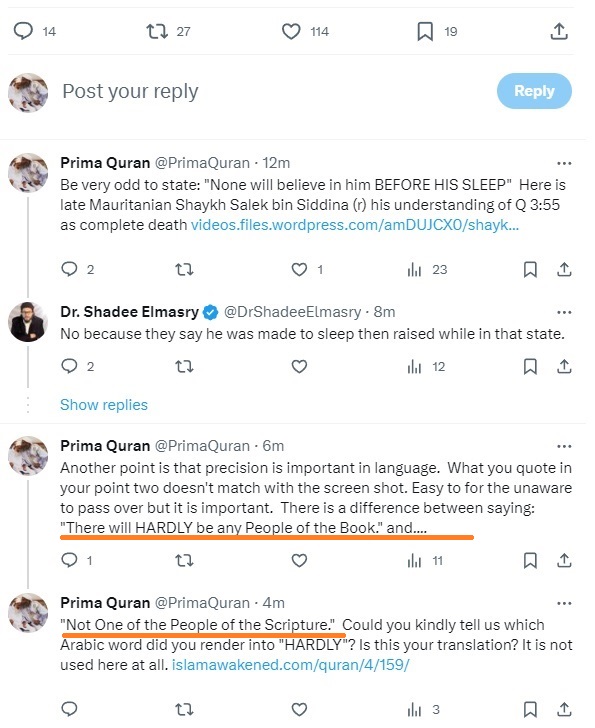
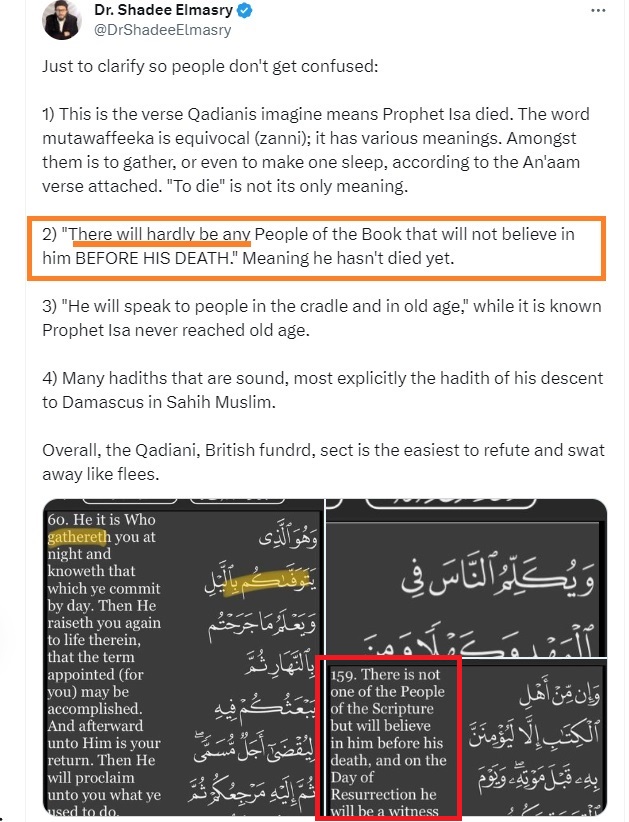
In our discussion with respected Dr. Shaykh Shadee El Masry (and a recent clash he had with the Ahmadi religion) We were curious as to the way Dr. Shadee translated Qur’an 4:159
We never did get an answer to which Arabic word(s) he used to translate the text into ‘Hardly’. Do you, the reader, the truth seeker, see what is happening here? We Love Dr. Shaykh Shadee Elmasry and if you are in his community, Allah-willing, you are in good hands. However, sometimes people will be tenacious in defending the indefensible.
The Jews and Christians will be at each other’s throat until the day of judgement
“Every one of the People of the Book will definitely believe in him before his death.” (Qur’an 4:159) If you were to take the standard Sunni misunderstanding this would flatly contradict the following:
“And the Jews say, “The hand of Allah is chained.” Chained are their hands, and cursed are they for what they say. Rather, both His hands are extended; He spends however He wills. And that which has been revealed to you from your Lord will surely increase many of them in transgression and disbelief. And We have cast among them animosity and hatred until the Day of Resurrection. ” (Qur’an 5:64)
“And from those who say, “We are Christians” We took their covenant; but they forgot a portion of that of which they were reminded. So We caused among them animosity and hatred until the Day of Resurrection. And Allah is going to inform them about what they used to do.” (Qur’an 5:14)
So the above verses do not give one the impression that Jesus (as) is going to come back and sing kumbaya with the Jews and the Christians.
We would not be surprised if some really desperate (clutching at straws) interpretation came that argued. Yes, Jesus (as) will bring the Jews and & Christians together, but they will still have animosity and hatred among them!!
Which begs the question: Why is he coming back?
Those of the Jews and Christians who see the truth and embrace insh’Allah are upon the path of safety. Those of the Jews and Christians who see the truth and reject it will be in hellfire.
“Indeed, that is My Path—perfectly straight. So follow it and do not follow other ways, for they will lead you away from His Way. This is what He has commanded you, so perhaps you will be conscious ˹of Allah˺” Qur’an 6:153)
“O mankind! Surely has come to you a convincing proof from your Lord, and We (have) sent down to you a clear light.” (Qur’an 4:174)
Our final point. We finish where we began.
“This is the dominant interpretation.” Well, Mufti, on what basis do you say this is the ‘dominant interpretation’ ? Can you tell us the total amount of tafsir literature you studied on this matter to conclude this? Also, if this is the ‘dominant interpretation’, it is by your own admission not necessarily the only one!
Truth vs. Popularity: The truth is not a matter of democratic opinion but of sound evidence from the Quran itself.
So dear respected readers which understanding of Qur’an4:159 do you accept as being more cogent?
The Sunni position.
The position of Mufti Zameer ur Rahman, Ahl Sunnah Wal Jammah and the mufassirun — whom rely upon hearsay and disconnected chains coming often from anonymous sources.
A position that allows for whispering, speculation, doubt and uncertainty?
A position that ignores the advice of one of the four we are to learn the Qur’an from—none other than Ibn Masud (ra)?
A position that structures a belief that goes against the Sunnah? “Do not believe the people of the Book, nor disbelieve them.”
The Ibadi position.
A position that takes the sincere council of one of the four we are to learn the Qur’an from—none other than Ibn Masud (ra)?
A position that does not go against the clear Sunnah. A position where we do not disbelieve them but we certainly do not build a belief based upon their reports.
A position that ask if it is reasonable to accept a 700 year gap in the chain of transmission as admissible evidence.
A position that is primarily reliant upon Tafsir al-Quran bi-l-Quran. (Interpreting the Qur’an by the Qur’an).
A position that allows the Qur’an to be interpreted by the use of other passages in the Qur’an, the use of grammar, context and theme?
A position that provides certainty and conviction?
There is an increasingly popular Sunni argument that states that any form of historical consensus that Jesus was indeed Crucified and died is to be expected, as God made it ‘seem’ that Jesus was on the Cross, whereas in reality it was some other unknown person suffering.
Consequently people, from the Romans to the Disciples, believed that Jesus died on the Cross, and reported this. In essence, since God made it ‘seem’ as though Jesus suffered and died upon the Cross, it is only natural that the Gospels and other historical sources should record that this event truly happened.
Consequently, since all historical data is simply the result of this ‘seeming’ Crucifixion, it is of no use against the traditional Sunni Substitution theory. If I may ask, from your perspective as a trained historian of Religion, what is your opinion of this argument?
As none of the members of the Prima Qur’an team have revealed their training, background or credentials the following caught our eye.
“If I may ask, from your perspective as a trained historian of Religion, what is your opinion of this argument?”
To whom or which member of Prima Qur’an is this question directed to?
As regard the rest of your assertions Toby. There is sufficient evidence with in the New Testament text to cast serious doubt upon the received ecclesiastical narrative. More than sufuficient evidence.
Obviously, from what you have posited it seems that you are convinced of this ecclesiastical narrative. We are not.
As regard the Qur’an 4:159. Do you see anything in that partiuclar verse or the surrounding verses that mention anything about something Romans are alleged to have done to Jesus (as)?
That is what this article was about.
As you pointed out Sunni, along with Ahmadiyyah/Qadiani/ and apparently now, Ismailii Nizari/Todd Lawson they look at Qur’an 4:157 and imagine the text some how speaking about something Romans are claimed to have done/not done to Jesus?
Where do you feel they are getting this from?
Toby what do you feel the Qur’an 4:157-159 is speaking of?
Thank you very much for your kind and informative reply:
Regarding the first question, I was referring to the original owner of this blog, who I gather also goes by the nom de plume ‘Jason Atreides’. Over our conversations he has shown himself a rigorous student of religious history.
Regarding the the received ecclesiastical narrative, forgive me, I did not express myself very well. I was not referring to the Gospels or the ecclesiastical narrative as impeccable sources of history (they are nevertheless important). Rather I was referring to the entire cumulative historical consensus that Jesus of Nazareth is dead.
This extends from the work of Jesus scholars such as Dale Allison, Paula Fredriksen and James Tabor, to ancient linguistics experts such as T. C. Schmidt and Bart Ehrman. The Sunni argument however is that this consensus proves nothing, for as Jesus was made to ‘seem’ as though he died, it is to be expected that his disciples/other onlookers/later historians would report this to be the case.
My purpose in asking your opinion is to enquire if, from your unique Islamic perspective, does the Sunni argument work?
Thank you as well for your courteous and polite exchanges.
“Rather I was referring to the entire cumulative historical consensus that Jesus of Nazareth is dead.”
As history is unable to verify miracles one would expect that if a person is deemed to be historical it is quite reasonable to presume them as dead.
“The Sunni argument however is that this consensus proves nothing, for as Jesus was made to ‘seem’ as though he died, it is to be expected that his disciples/other onlookers/later historians would report this to be the case.”
Indeed at first blush it would seem that the Sunni position goes against a claimed consensus.
However, their position technically would not go against any historical consensus at all.
History is not here to prove miracles.
History could cannot prove that Jesus rose from the dead anymore than it can prove or disprove that one was made to look like Jesus.
We are curious your thoughts as to something. May we in turn ask you a question?
This is an answer that I have heard as well, and while it does have its strengths, it has a number of noticeable weaknesses. For instance:
1: For many years advocates of the Substutution theory have been attempting to support their view of Surah 4:157 through appeals to early Christian/Gnostic movements who were believed to have denied the Crucifixion, such as the Valentinians and Basilideans. This is augmented by appeals to texts such as the Second Treatise of the Great Seth and the Gnostic Apocalypse of Peter.
Yet this approach is highly problematic, given that recent fresh research by academics such as David Litwa, Bart Ehrman, Antii Marjannen and Petri Loumanen has convinclingly argued that these groups and texts do in fact state that the fleshly man Jesus was Crucified. However this was interpreted differently than in proto-Orthodox circles, often with the divine Christ leaving the human Jesus.
Yet the approach I outlined in my original comment seems to invalidate any Sunni use of historical texts, since even these sources seem to affirm the death of the man Jesus. Effectively, what then is the point of interacting with recorded religious history if every source that disagrees with the substitution theory will simply be denied in favor of a rather convoluted reading of a single verse of Surah 4? It seems to be an example of an un-falsifiable argument, as any evidence provided will simply be denied as the product of the illusory ‘seeming’ of Jesus death.
2: Whilst it is true that the Resurrection is miraculous in Christian eyes, the Crucifixion is one of the few aspects of Jesus life that at least 99% of the academic community agrees upon, regardless of their own personal beliefs. For instance Bart Ehrman (an agnostic/atheist, James Tabor (a spiritual agnostic), Paula Fredriksen (a liberal Jew) and Dale Allison (a sincere Christian who argues in favor of miracles) all agree that the man Jesus was Crucified, because this is the result of their lifelong studies of his life. Regardless of whether one accepts the miraculous or not, the death of Jesus is deemed a historical fact.
3: From an Islamic perspective, as you know, the substitution theory is neither the only or necessarily the likeliest reading of Surah 4:157. From the Ibadi view of a martyred Jesus to the Ismailii concept of spiritual ascension, to the Ahmadi ‘swoon theory’, there are numerous views of the matter, and each can be argued well. This is furthermore made interesting by the fact that, as you have said, there is no orthodox Hadith reporting the view of the Islamic prophet on this matter. The Sunni Substitution theory, miraculous or not, is but one interpretation amoungst many, and, as you have displayed convincingly in the past, aught not to be seen as the only, infallible interpretation.
Regarding my own view of Surah 4:157, I admit that I am somewhat agnostic on their point, as I think numerous arguments can be made. At the moment I am leaning toward the view of Sean Anthony and Nicolai Sinai, who see Surah 4:157 as a repudiation of Jewish polemic against Jesus, rather than necessarily a denial of his death (Sinai, “The Islamic Jesus” in The New Cambridge Companion to Jesus, 2024, pp. 144-145).
We have noticed that the Sunni interpretation of Qur’an 4:157 seems to be a particular fascination of yours.
1: For many years advocates of the Substutution theory have been attempting to support their view of Surah 4:157 through appeals to early Christian/Gnostic movements who were believed to have denied the Crucifixion, such as the Valentinians and Basilideans. This is augmented by appeals to texts such as the Second Treatise of the Great Seth and the Gnostic Apocalypse of Peter.”
Easily dealt with.
Sunnis can with ease of conscience maintain that position. By quoting the views of such, it shows there were divergences in views.
The task of Christians like yourself, as can be readily seen, is to try and obfuscate by making them seem as if they are appearing to the non-canonical and later sources.
Yet people like Shabir Ally or Ali Ataie would rip through that defense. As you are fond of quoting New Testament scholarship, which is favourable to your position.
Shabir Ally and Ali Ataie would bring down a plethora of quotations from New Testament scholarship that assert that certain passages of the New Testament were interacting with claims that denied that Christ came in the flesh etc.
We know you get the point.
“Yet this approach is highly problematic, given that recent fresh research by academics such as David Litwa, Bart Ehrman, Antii Marjannen and Petri Loumanen has convinclingly argued that these groups and texts do in fact state that the fleshly man Jesus was Crucified. However this was interpreted differently than in proto-Orthodox circles, often with the divine Christ leaving the human Jesus.”
Again, it’s not problematic at all. Not in the least. The Sunni interpretation does not conflict with it. There is not a single Sunni tafsir that we are aware of that holds gnostic points. Claim x died. They claimed an individual was made to look like x. So is it any surprise that anyone would claim that x died?
The objection crumbles.
All this is left is theological objections to Allah doing this in the first place.
2 Thessalonians 2:11 And for this cause God shall send them strong delusion, that they should believe a lie.
For any Muslims reading this exchange there is a doctoral thesis paper just waiting to happen. Early church commentaries on the above text. You could take from all the earliest expressions of Christianity down through the centuries.
Your statements up to 2: are answered from what has previously been stated on the matter.



 Prima Quran
There is an increasingly popular Sunni argument that states that any form of historical consensus that Jesus was indeed Crucified and died is to be expected, as God made it ‘seem’ that Jesus was on the Cross, whereas in reality it was some other unknown person suffering.
Consequently people, from the Romans to the Disciples, believed that Jesus died on the Cross, and reported this. In essence, since God made it ‘seem’ as though Jesus suffered and died upon the Cross, it is only natural that the Gospels and other historical sources should record that this event truly happened.
Consequently, since all historical data is simply the result of this ‘seeming’ Crucifixion, it is of no use against the traditional Sunni Substitution theory. If I may ask, from your perspective as a trained historian of Religion, what is your opinion of this argument?
Greetings Toby,
As none of the members of the Prima Qur’an team have revealed their training, background or credentials the following caught our eye.
“If I may ask, from your perspective as a trained historian of Religion, what is your opinion of this argument?”
To whom or which member of Prima Qur’an is this question directed to?
As regard the rest of your assertions Toby. There is sufficient evidence with in the New Testament text to cast serious doubt upon the received ecclesiastical narrative. More than sufuficient evidence.
Obviously, from what you have posited it seems that you are convinced of this ecclesiastical narrative. We are not.
As regard the Qur’an 4:159. Do you see anything in that partiuclar verse or the surrounding verses that mention anything about something Romans are alleged to have done to Jesus (as)?
That is what this article was about.
As you pointed out Sunni, along with Ahmadiyyah/Qadiani/ and apparently now, Ismailii Nizari/Todd Lawson they look at Qur’an 4:157 and imagine the text some how speaking about something Romans are claimed to have done/not done to Jesus?
Where do you feel they are getting this from?
Toby what do you feel the Qur’an 4:157-159 is speaking of?
Thank you very much for your kind and informative reply:
Regarding the first question, I was referring to the original owner of this blog, who I gather also goes by the nom de plume ‘Jason Atreides’. Over our conversations he has shown himself a rigorous student of religious history.
Regarding the the received ecclesiastical narrative, forgive me, I did not express myself very well. I was not referring to the Gospels or the ecclesiastical narrative as impeccable sources of history (they are nevertheless important). Rather I was referring to the entire cumulative historical consensus that Jesus of Nazareth is dead.
This extends from the work of Jesus scholars such as Dale Allison, Paula Fredriksen and James Tabor, to ancient linguistics experts such as T. C. Schmidt and Bart Ehrman. The Sunni argument however is that this consensus proves nothing, for as Jesus was made to ‘seem’ as though he died, it is to be expected that his disciples/other onlookers/later historians would report this to be the case.
My purpose in asking your opinion is to enquire if, from your unique Islamic perspective, does the Sunni argument work?
Thank you as well for your courteous and polite exchanges.
“Rather I was referring to the entire cumulative historical consensus that Jesus of Nazareth is dead.”
As history is unable to verify miracles one would expect that if a person is deemed to be historical it is quite reasonable to presume them as dead.
“The Sunni argument however is that this consensus proves nothing, for as Jesus was made to ‘seem’ as though he died, it is to be expected that his disciples/other onlookers/later historians would report this to be the case.”
Indeed at first blush it would seem that the Sunni position goes against a claimed consensus.
However, their position technically would not go against any historical consensus at all.
History is not here to prove miracles.
History could cannot prove that Jesus rose from the dead anymore than it can prove or disprove that one was made to look like Jesus.
We are curious your thoughts as to something. May we in turn ask you a question?
What do you feel the Qur’an 4:157 is saying?
Thank you for your reply
This is an answer that I have heard as well, and while it does have its strengths, it has a number of noticeable weaknesses. For instance:
1: For many years advocates of the Substutution theory have been attempting to support their view of Surah 4:157 through appeals to early Christian/Gnostic movements who were believed to have denied the Crucifixion, such as the Valentinians and Basilideans. This is augmented by appeals to texts such as the Second Treatise of the Great Seth and the Gnostic Apocalypse of Peter.
Yet this approach is highly problematic, given that recent fresh research by academics such as David Litwa, Bart Ehrman, Antii Marjannen and Petri Loumanen has convinclingly argued that these groups and texts do in fact state that the fleshly man Jesus was Crucified. However this was interpreted differently than in proto-Orthodox circles, often with the divine Christ leaving the human Jesus.
Yet the approach I outlined in my original comment seems to invalidate any Sunni use of historical texts, since even these sources seem to affirm the death of the man Jesus. Effectively, what then is the point of interacting with recorded religious history if every source that disagrees with the substitution theory will simply be denied in favor of a rather convoluted reading of a single verse of Surah 4? It seems to be an example of an un-falsifiable argument, as any evidence provided will simply be denied as the product of the illusory ‘seeming’ of Jesus death.
2: Whilst it is true that the Resurrection is miraculous in Christian eyes, the Crucifixion is one of the few aspects of Jesus life that at least 99% of the academic community agrees upon, regardless of their own personal beliefs. For instance Bart Ehrman (an agnostic/atheist, James Tabor (a spiritual agnostic), Paula Fredriksen (a liberal Jew) and Dale Allison (a sincere Christian who argues in favor of miracles) all agree that the man Jesus was Crucified, because this is the result of their lifelong studies of his life. Regardless of whether one accepts the miraculous or not, the death of Jesus is deemed a historical fact.
3: From an Islamic perspective, as you know, the substitution theory is neither the only or necessarily the likeliest reading of Surah 4:157. From the Ibadi view of a martyred Jesus to the Ismailii concept of spiritual ascension, to the Ahmadi ‘swoon theory’, there are numerous views of the matter, and each can be argued well. This is furthermore made interesting by the fact that, as you have said, there is no orthodox Hadith reporting the view of the Islamic prophet on this matter. The Sunni Substitution theory, miraculous or not, is but one interpretation amoungst many, and, as you have displayed convincingly in the past, aught not to be seen as the only, infallible interpretation.
Regarding my own view of Surah 4:157, I admit that I am somewhat agnostic on their point, as I think numerous arguments can be made. At the moment I am leaning toward the view of Sean Anthony and Nicolai Sinai, who see Surah 4:157 as a repudiation of Jewish polemic against Jesus, rather than necessarily a denial of his death (Sinai, “The Islamic Jesus” in The New Cambridge Companion to Jesus, 2024, pp. 144-145).
We have noticed that the Sunni interpretation of Qur’an 4:157 seems to be a particular fascination of yours.
1: For many years advocates of the Substutution theory have been attempting to support their view of Surah 4:157 through appeals to early Christian/Gnostic movements who were believed to have denied the Crucifixion, such as the Valentinians and Basilideans. This is augmented by appeals to texts such as the Second Treatise of the Great Seth and the Gnostic Apocalypse of Peter.”
Easily dealt with.
Sunnis can with ease of conscience maintain that position. By quoting the views of such, it shows there were divergences in views.
The task of Christians like yourself, as can be readily seen, is to try and obfuscate by making them seem as if they are appearing to the non-canonical and later sources.
Yet people like Shabir Ally or Ali Ataie would rip through that defense. As you are fond of quoting New Testament scholarship, which is favourable to your position.
Shabir Ally and Ali Ataie would bring down a plethora of quotations from New Testament scholarship that assert that certain passages of the New Testament were interacting with claims that denied that Christ came in the flesh etc.
We know you get the point.
“Yet this approach is highly problematic, given that recent fresh research by academics such as David Litwa, Bart Ehrman, Antii Marjannen and Petri Loumanen has convinclingly argued that these groups and texts do in fact state that the fleshly man Jesus was Crucified. However this was interpreted differently than in proto-Orthodox circles, often with the divine Christ leaving the human Jesus.”
Again, it’s not problematic at all. Not in the least. The Sunni interpretation does not conflict with it. There is not a single Sunni tafsir that we are aware of that holds gnostic points. Claim x died. They claimed an individual was made to look like x. So is it any surprise that anyone would claim that x died?
The objection crumbles.
All this is left is theological objections to Allah doing this in the first place.
2 Thessalonians 2:11 And for this cause God shall send them strong delusion, that they should believe a lie.
For any Muslims reading this exchange there is a doctoral thesis paper just waiting to happen. Early church commentaries on the above text. You could take from all the earliest expressions of Christianity down through the centuries.
Your statements up to 2: are answered from what has previously been stated on the matter.