
“This is a Warner of the series of the Warners of old. The (hour) ever approaches draws nigh” (Qur’an 53:56-57).
﷽
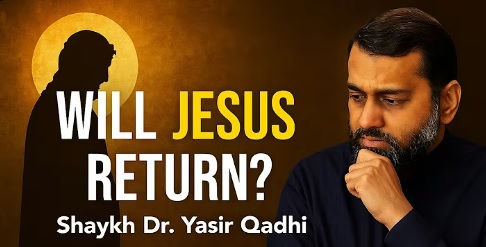
Yasir Qadhi: The Return of Jesus and the Qur’an.
Shaykh Yasir Qadhi takes a look at the four verses that are often advanced to make the claim.
“The issue about coming back at the end of times is one that has caused a little bit of controversy uh in the last few years online and before this point in time has also been a point of contention actually for the last few decades. I thought that in today’s library chat let’s take an academic look. Let’s remove ourselves from the emotional back and forth and let us see uh the reality of this issue and uh allow the evidences to speak for themselves. So today’s talk is going to be about a very interesting topic inshalla and it’s also one that uh on the one hand it is a very introductory level in the sense that everybody will benefit but on the other hand um because of the nature of this talk there will be quite a lot of packed information with names and dates and uh I will be at times speeding up uh I I know people say I talk uh quickly but I think I’m going to have to speed up quite a lot for this particular talk because I have quite a lot of information I want to just um uh put into today’s uh library chat. So it is at the same time an introduction and also it is a very uh comprehensive inshallah uh introductory level talk.”- Shaykh Yasir Qadhi
“Obviously I always make that caveat uh so that people don’t think that this is the end all and be all. Uh today’s talk will be dealing with theology uh with history even with methodology. And before I begin I’d like to point out that there’s there’s two primary ways to look at a controversy or to look at a contentious issue. Uh usually what I do is uh one of the ways to look at it is start from the end and to lay out all of the opinions and then to backtrack and say who says what and why did they say that and that’s a very standard and academic approach. You can flip it around and you have another approach and that is to build and that is to go back to the beginning and say what does the Quran have to say? What does the sunnah have to say? And so today we’re going to be following uh that particular uh procedure and I’m going to be working chronologically forward. And what we’re going to do is divide this entire library chat into a number of different sections. Firstly, does the Quran mention the return of or not? Uh secondly, what does the hadith have to say? And is are they a hadith mutawat or not? And who said they uh thirdly, uh what did the early scholars of Islam have to say about this issue? Uh fourthly uh the is there unanimous consensus on this issue. Uh fifthly what do the other strands of Islam say? Sunni Islam is obviously you know generally clear but what do the other strands of Islam say? And then finally sixth point uh what is the modern controversy and where did this arise and who are the main figures and players with regards to the modern controversy.” – Shaykh Yasir Qadhi
“So uh this is a fairly comprehensive uh lengthy introduction to the entire uh topic and I did spend a good amount of time uh around a day and a half doing uh this research to demonstrate uh a methodology of of how we talk about uh contentious issues. So we begin from the beginning and that is the book uh the book of Allah the Quran. The Quran uh has four verses in it that are used by some uh to posit that the Quran preaches the return “Isa of two of these verses have the exact same phrase in them. And so in reality it boils down to three particular phrases in the Quran because once again there are four verses but two of the verses are pretty much the same for what we want to do. So the two that are the same are (Qur’an 3:46 and Qur’an 5:110)and the both of them have the phrase that is going to speak this is repeated twice in the Quran. He shall speak shall speak to mankind which basically means you know in the cradle he’s going to speak as a baby.” – Shaykh Yasir Qadhi
“Now uh the the word has been defined by many early scholars including that means when the whiteness of the hair begins to appear. So that’s what means and the actual age is something that is disputed. Most say around 40 some say 35 some say even beyond the age of 30. The number is not what is important. means that uh at at an older age and the the notion here is that the Quran says something that should be miraculous that he’s going to speak as a baby and he’s going to speak at an older age. Now it’s not a miracle to speak at an older age but if is not around at an older age then this is a prediction that he’s going to come back and speak when he’s an older man. So both the word and the context of the verse according to a group of scholars is indicating that is going to uh come back and uh this is the interpretation of quite a number of early authorities.” – Shaykh Yasir Qadhi
“Nonetheless, it is not something that is explicit and uh the verse is ambiguous about this point about the return of this particular verse because even if we say that was 33 when his ministry finished Jesus was 33. So 33 would be considered by quite a number of uh linguists. Therefore, we say that this verse has been interpreted by a group of to imply that will come back. Nonetheless, A, it is not universally interpreted that way and B, the language in and of itself does not indicate that Isa is coming back. Okay? But it can be said that the context would indicate this. Okay? that why would it be miraculous unless there is a miracle involved.” – Shaykh Yasir Qadhi
“The third verse that we’re going to discuss is verse (Qur’an 4:159).That Allah subhana wa ta’ala says there’s not a single person of the people of the book except that he will believe in Isa before his death. Now the context of this series of verses is the context of the notion that the Yahood killed Isa. And Allah says very explicitly that they neither killed him nor did they crucify him but rather it was made to appear to them so. And Allah says they did not kill him for sure for certainty. They did not kill him. Rather Allah raised him up to himself. And then Allah subhana wa ta’ala says, “And there is no one from the people of the book except that he shall believe in him.” These are now pronouns. He shall believe in him before he dies. These are all pronouns here. Okay, the majority of early Mufasirun have interpreted this verse to mean that there will not remain a single person of the Ahl Kitab except that they will believe in Jesus before Jesus dies. Okay. So the and according to the majority say that this is Isa Ibn Maryam and therefore before Isa dies the Ahl Kitab will believe in him. Okay the Ahl Kitab will affirm him.” – Shaykh Yasir Qadhi
“However, there is a minority opinion from Qatada and Saeed Ibn Jubary and others that the pronoun biti and mauti are different and the bihi is a reference according to them to the Prophet sallallahu alaihi wasallam and the mauti is a reference to the person of the Ahl Kitab and therefore the verse will translate and there is not a single person of the Ahl Kitab except that he shall believe in the Prophet Muhammed sallallahu alaihi wasallam before he dies. And so they had a bizarre belief. Well, we say it’s bizarre. They don’t they wouldn’t think it is bizarre. They have a bizarre belief that at the time of death of the soul of the when the angel of death comes that before the angel of death takes the soul of the of the Ahl Kitab, the Kitabi must confess their emaan in the Prophet sallallah aii wasallam. This confession is a spiritual one. It doesn’t make them a Muslim. In other words, they’re not going to confess with the tongue that is physical. They’re going to confess with their soul and then they shall be allowed to uh escape their bodies. Now the problem of course is that uh the context of this these series of verses does not mention the Prophet sallallahu alaihi wasallam at all. And also by the way uh the the the the notion that the soul is going to have to uh confess the belief of the Prophet it’s something that’s not found in any other source neither a verse of the Quran nor hadith of the Prophet sallallahu alaihi wasallam. And that is why uh says so says the correct position about this verse is that it goes back to Isa and that none of the people of the book shall remain alive at that time except that they believe in Jesus before Jesus dies. and uh kir says there is no doubt that what says is the better opinion. So this verse therefore seems to be pretty strong. However to be clear it has been interpreted differently as well.” – Shaykh Yasir Qadhi
“There is a third uh problem if you like or problematization and that is done by the famous grammarian Abū Isḥāq Ibrāhīm ibn Muḥammed ibn al-Sarī al-Zajjāj and al-Zajjāj says that how can all of the Ahl Kitab believe in Jesus when most of them would have died before the coming of Jesus. Right? So al-Zajjāj says this verse does not mean what people think it means because he is saying that uh uh the verse says not a single person of the Ahl Kitab shall remain except that they believe in Jesus before Jesus dies. He is saying the bulk of Ahl Kitab have lived and died before the return of Jesus. By the way, al-Zajjāj is affirming the return of Jesus, he’s simply saying that this verse does not apply to that. That’s his interpretation. Others have responded that this verse is going to be restricted by common sense and the restriction by common sense means there is no person of the Ahl kitab that shall be alive when Jesus comes down except that he shall believe in Jesus before Jesus dies. So that restriction that shall be alive when Jesus comes down, it’s not in the Quran but it is assumed. It is something that is understood by the context of the uh verse. And another problematization that occurs is that uh the verse says there is not a single person of the Ahl Kitab except that they shall believe in him before he dies. Even if we say it is Jesus, what do we say to the Yehood that will be fighting on the side of the Dajjal and they’re seeing Jesus? they’re not going to believe in Jesus, right? So, what does this mean? And some have responded to this by the claim that well, iman here does not necessarily mean they shall believe uh in Jesus the belief of the Kalima and the belief of an acceptance of Islam, but rather they shall believe that Jesus was a prophet even if they reject his prophethood. Just like Allah says in the Quran that Allah affirmed the Quraysh have in Allah but they commit. So this is a partial im and so they believe in the concept of God. They believe that there is an Allah out there but they don’t believe that Allahel alone is the and the now the the same can apply over here that when you’re fighting on the side of the those people that are fighting they’re going to recognize that that is Jesus and they’re going to believe that that is the prophet but they know or they for whatever reason they are rejecting likel rejected they’re rejecting the following but they know that he is Jesus so to summarize this verse This verse seems to strongly indicate but to be fair uh a number of dissenting voices have not interpreted this verse to to confirm the return of Jesus Christ.” – Shaykh Yasir Qadhi
“The fourth verse that we will uh discuss is considered to be the most explicit and it is considered to be uh uh the strongest indication that the Quran is affirming the coming of Jesus, the second coming of Jesus and that is Qur’an 43:61. Allah says in the Quran and he is or it because again and it or he is a knowledge of the day of judgment. Now what is the context of these verses? Go back a few verses and Allah subhana wa ta’ala describes the that when uh the son of Mary is given as an example your people they uh break out in applause in applause and they they become happy and they say which one is better our gods or Jesus and Allah says they’re only using him to argue now the the context of revelation that when Allah subhana wa ta’ala revealed uh in the Quran you and those whom you worship uh besides Allah will all end up in Jahannam. One of the members of the Quraysh thought that he had outwit the Quran. And he said, “Okay, if everything that is worshiped besides Allah is going to end up in Jahannam. How about the Christians who worship Jesus and you guys think that Jesus is a prophet? This means that Jesus is going to go to Jahannam as well.” And of course we know from the Quran and from the Sunnah that uh the righteous who were mistakenly worshiped uh will not end up in Jahannam and uh the idols that were constructed as false god will end up in Jahannam. So the verse here says when the son of Mary is given as an example your pe your people meaning the Quraysh they become happy at this and they say which one is better our gods or Jesus and then the verses go on he is but a righteous example and a good a good servant and then Allah says and he shall be a a knowledge of the day of of the hour a knowledge of judgment So do not have any doubt about this.” – Shaykh Yasir Qadhi
“Now this verse has been interpreted by a number of Sahabah most prominently Abbas as being an explicit affirmation of the return of and in fact Ibn Abbas and a number of other uh early Sahabah Ubai and others they actually had a variant recitation of this verse which is actually even more explicit and that recitation rather than it would become means a flag means a sign means an indication and they would recite the verse. Now, of course, the whole concept of recitations and something is a very very deep one and you’re probably aware that it’s probably best I do not go into a lot of detail because people are super sensitive about this topic even though again the evidences are very clear about this. But uh the Sahabah had their multiple recitations and all of them are valid as our Prophet sallallahu alaihi wasallam said is very explicit that do not argue over these uh verses. Our Prophet said do not argue over these recitations and the Quran was revealed in seven and uh Abbas and others would recite this verse in a different recitation and Jesus is a sign for the day of judgment. Now that recitation it is authentic from the Sahabah. However, it has not been preserved in the 10 recitations. It is not preserved in the 10 karat that are commonly recited in our times. It is however well known in the early books of so the way that we recite the verse and is and he comments on this that whoever recites this verse as it means that he is a knowledge of the closeness and proximity of the day of judgment. And whoever recites it with a fat then that means that he is an and he is a sign for the day of judgment. The point being that whether you recite or uh the meaning uh slightly changes but the concept is still the same. Either Jesus is a knowledge of the proximity of the day of judgment or Jesus is a sign of the day of judgment. So this is the majority interpretation of this verse from a whole bunch of early.” – Shaykh Yasir Qadhi
“However, still there is an alternative interpretation and that is the interpretation of Hassan Al Basri said wa-innahu la’il’mun lilssa’ means wa-innahu the ha goes back to the Quran or goes back to the Prophet sallallahu alaihi wasallam that the Quran is uh the knowledge of the day of judgment and it goes back to the revelation of Allah subhanahu wa ta’ala and so he did not understand this verse to be uh now again Hassan Al Basri affirms the coming of Jesus. It’s just a matter of does the Quran talk about it or not. So these are the four verses in order of strength from the weakest in terms of its uh dala in terms of its evidence to the strongest. And to conclude this particular section about the verses of the Quran, the Quran suggests and indicates there is really a very strong suggestion that isa shall return. And this has been the derivation of the vast majority of Sahabah and the early commentators of the Quran that the Quran indicates the coming of. However, to be academic and pedantic, uh this is not the unanimous uh interpretation of the Quran. And again, right now we’re talking about does the Quran talk about to the coming of Jesus or not. As for other sources of the coming of Jesus, that is a separate topic. Does the Quran talk about the coming back of Jesus or not? For every one of these verses, you will find some of the early authorities, a minority opinion, uh interpreting the verse in a different manner. And therefore uh we can say that the Quran strongly suggests the Quran seems to have a very strong indication that Isa is coming. However, it is not definitive and it is not conclusive in and of itself. Just from the language of the Quran and just from the context of the Quran, we give it the presumption but not the certainty. And that’s the first evidence, the Quran.” – Shaykh Yasir Qadhi
wa-innahu la’il’mun lilssa’ wa-innahu the ha
If you would like to see other articles in regard to Shaykh Yasir Qadhi we would invite you to read the following:
If you would like to see other articles that directly relate to the verses Shaykh Yasir mentioned you might be interested in the following:
The following article addresses the use of (Qur’an 3:46 and Qur’an 5:110)
This article addresses the use of Qur’an 4:159
The following article addresses the use of Qur’an 43:61
May Allah Guide the Ummah.
May Allah Forgive the Ummah.


 Prima Quran