Tag Archives: blogging-theology

Yasir Qadhi: The Qur’an has no definitive and conclusive evidence that Jesus will return.

“This is a Warner of the series of the Warners of old. The (hour) ever approaches draws nigh” (Qur’an 53:56-57).
﷽ 

Yasir Qadhi: The Return of Jesus and the Qur’an.

Shaykh Yasir Qadhi takes a look at the four verses that are often advanced to make the claim.

“The issue about coming back at the end of times is one that has caused a little bit of controversy uh in the last few years online and before this point in time has also been a point of contention actually for the last few decades. I thought that in today’s library chat let’s take an academic look. Let’s remove ourselves from the emotional back and forth and let us see uh the reality of this issue and uh allow the evidences to speak for themselves. So today’s talk is going to be about a very interesting topic inshalla and it’s also one that uh on the one hand it is a very introductory level in the sense that everybody will benefit but on the other hand um because of the nature of this talk there will be quite a lot of packed information with names and dates and uh I will be at times speeding up uh I I know people say I talk uh quickly but I think I’m going to have to speed up quite a lot for this particular talk because I have quite a lot of information I want to just um uh put into today’s uh library chat. So it is at the same time an introduction and also it is a very uh comprehensive inshallah uh introductory level talk.”- Shaykh Yasir Qadhi

“Obviously I always make that caveat uh so that people don’t think that this is the end all and be all. Uh today’s talk will be dealing with theology uh with history even with methodology. And before I begin I’d like to point out that there’s there’s two primary ways to look at a controversy or to look at a contentious issue. Uh usually what I do is uh one of the ways to look at it is start from the end and to lay out all of the opinions and then to backtrack and say who says what and why did they say that and that’s a very standard and academic approach. You can flip it around and you have another approach and that is to build and that is to go back to the beginning and say what does the Quran have to say? What does the sunnah have to say? And so today we’re going to be following uh that particular uh procedure and I’m going to be working chronologically forward. And what we’re going to do is divide this entire library chat into a number of different sections. Firstly, does the Quran mention the return of or not? Uh secondly, what does the hadith have to say? And is are they a hadith mutawat or not? And who said they uh thirdly, uh what did the early scholars of Islam have to say about this issue? Uh fourthly uh the is there unanimous consensus on this issue. Uh fifthly what do the other strands of Islam say? Sunni Islam is obviously you know generally clear but what do the other strands of Islam say? And then finally sixth point uh what is the modern controversy and where did this arise and who are the main figures and players with regards to the modern controversy.” – Shaykh Yasir Qadhi

“So uh this is a fairly comprehensive uh lengthy introduction to the entire uh topic and I did spend a good amount of time uh around a day and a half doing uh this research to demonstrate uh a methodology of of how we talk about uh contentious issues. So we begin from the beginning and that is the book uh the book of Allah the Quran. The Quran uh has four verses in it that are used by some uh to posit that the Quran preaches the return “Isa of two of these verses have the exact same phrase in them. And so in reality it boils down to three particular phrases in the Quran because once again there are four verses but two of the verses are pretty much the same for what we want to do. So the two that are the same are (Qur’an 3:46 and Qur’an 5:110)and the both of them have the phrase that is going to speak this is repeated twice in the Quran. He shall speak shall speak to mankind which basically means you know in the cradle he’s going to speak as a baby.” – Shaykh Yasir Qadhi

“Now uh the the word has been defined by many early scholars including that means when the whiteness of the hair begins to appear. So that’s what means and the actual age is something that is disputed. Most say around 40 some say 35 some say even beyond the age of 30. The number is not what is important. means that uh at at an older age and the the notion here is that the Quran says something that should be miraculous that he’s going to speak as a baby and he’s going to speak at an older age. Now it’s not a miracle to speak at an older age but if is not around at an older age then this is a prediction that he’s going to come back and speak when he’s an older man. So both the word and the context of the verse according to a group of scholars is indicating that is going to uh come back and uh this is the interpretation of quite a number of early authorities.” – Shaykh Yasir Qadhi

“Nonetheless, it is not something that is explicit and uh the verse is ambiguous about this point about the return of this particular verse because even if we say that was 33 when his ministry finished Jesus was 33. So 33 would be considered by quite a number of uh linguists. Therefore, we say that this verse has been interpreted by a group of to imply that will come back. Nonetheless, A, it is not universally interpreted that way and B, the language in and of itself does not indicate that Isa is coming back. Okay? But it can be said that the context would indicate this. Okay? that why would it be miraculous unless there is a miracle involved.” – Shaykh Yasir Qadhi

“The third verse that we’re going to discuss is verse (Qur’an 4:159).That Allah subhana wa ta’ala says there’s not a single person of the people of the book except that he will believe in Isa before his death. Now the context of this series of verses is the context of the notion that the Yahood killed Isa. And Allah says very explicitly that they neither killed him nor did they crucify him but rather it was made to appear to them so. And Allah says they did not kill him for sure for certainty. They did not kill him. Rather Allah raised him up to himself. And then Allah subhana wa ta’ala says, “And there is no one from the people of the book except that he shall believe in him.” These are now pronouns. He shall believe in him before he dies. These are all pronouns here. Okay, the majority of early Mufasirun have interpreted this verse to mean that there will not remain a single person of the Ahl Kitab except that they will believe in Jesus before Jesus dies. Okay. So the and according to the majority say that this is Isa Ibn Maryam and therefore before Isa dies the Ahl Kitab will believe in him. Okay the Ahl Kitab will affirm him.” – Shaykh Yasir Qadhi

“However, there is a minority opinion from Qatada and Saeed Ibn Jubary and others that the pronoun biti and mauti are different and the bihi is a reference according to them to the Prophet sallallahu alaihi wasallam and the mauti is a reference to the person of the Ahl Kitab and therefore the verse will translate and there is not a single person of the Ahl Kitab except that he shall believe in the Prophet Muhammed sallallahu alaihi wasallam before he dies. And so they had a bizarre belief. Well, we say it’s bizarre. They don’t they wouldn’t think it is bizarre. They have a bizarre belief that at the time of death of the soul of the when the angel of death comes that before the angel of death takes the soul of the of the Ahl Kitab, the Kitabi must confess their emaan in the Prophet sallallah aii wasallam. This confession is a spiritual one. It doesn’t make them a Muslim. In other words, they’re not going to confess with the tongue that is physical. They’re going to confess with their soul and then they shall be allowed to uh escape their bodies. Now the problem of course is that uh the context of this these series of verses does not mention the Prophet sallallahu alaihi wasallam at all. And also by the way uh the the the the notion that the soul is going to have to uh confess the belief of the Prophet it’s something that’s not found in any other source neither a verse of the Quran nor hadith of the Prophet sallallahu alaihi wasallam. And that is why uh says so says the correct position about this verse is that it goes back to Isa and that none of the people of the book shall remain alive at that time except that they believe in Jesus before Jesus dies. and uh kir says there is no doubt that what says is the better opinion. So this verse therefore seems to be pretty strong. However to be clear it has been interpreted differently as well.” – Shaykh Yasir Qadhi

“There is a third uh problem if you like or problematization and that is done by the famous grammarian Abū Isḥāq Ibrāhīm ibn Muḥammed ibn al-Sarī al-Zajjāj and al-Zajjāj says that how can all of the Ahl Kitab believe in Jesus when most of them would have died before the coming of Jesus. Right? So al-Zajjāj says this verse does not mean what people think it means because he is saying that uh uh the verse says not a single person of the Ahl Kitab shall remain except that they believe in Jesus before Jesus dies. He is saying the bulk of Ahl Kitab have lived and died before the return of Jesus. By the way, al-Zajjāj is affirming the return of Jesus, he’s simply saying that this verse does not apply to that. That’s his interpretation. Others have responded that this verse is going to be restricted by common sense and the restriction by common sense means there is no person of the Ahl kitab that shall be alive when Jesus comes down except that he shall believe in Jesus before Jesus dies. So that restriction that shall be alive when Jesus comes down, it’s not in the Quran but it is assumed. It is something that is understood by the context of the uh verse. And another problematization that occurs is that uh the verse says there is not a single person of the Ahl Kitab except that they shall believe in him before he dies. Even if we say it is Jesus, what do we say to the Yehood that will be fighting on the side of the Dajjal and they’re seeing Jesus? they’re not going to believe in Jesus, right? So, what does this mean? And some have responded to this by the claim that well, iman here does not necessarily mean they shall believe uh in Jesus the belief of the Kalima and the belief of an acceptance of Islam, but rather they shall believe that Jesus was a prophet even if they reject his prophethood. Just like Allah says in the Quran that Allah affirmed the Quraysh have in Allah but they commit. So this is a partial im and so they believe in the concept of God. They believe that there is an Allah out there but they don’t believe that Allahel alone is the and the now the the same can apply over here that when you’re fighting on the side of the those people that are fighting they’re going to recognize that that is Jesus and they’re going to believe that that is the prophet but they know or they for whatever reason they are rejecting likel rejected they’re rejecting the following but they know that he is Jesus so to summarize this verse This verse seems to strongly indicate but to be fair uh a number of dissenting voices have not interpreted this verse to to confirm the return of Jesus Christ.” – Shaykh Yasir Qadhi

“The fourth verse that we will uh discuss is considered to be the most explicit and it is considered to be uh uh the strongest indication that the Quran is affirming the coming of Jesus, the second coming of Jesus and that is Qur’an 43:61. Allah says in the Quran and he is or it because again and it or he is a knowledge of the day of judgment. Now what is the context of these verses? Go back a few verses and Allah subhana wa ta’ala describes the that when uh the son of Mary is given as an example your people they uh break out in applause in applause and they they become happy and they say which one is better our gods or Jesus and Allah says they’re only using him to argue now the the context of revelation that when Allah subhana wa ta’ala revealed uh in the Quran you and those whom you worship uh besides Allah will all end up in Jahannam. One of the members of the Quraysh thought that he had outwit the Quran. And he said, “Okay, if everything that is worshiped besides Allah is going to end up in Jahannam. How about the Christians who worship Jesus and you guys think that Jesus is a prophet? This means that Jesus is going to go to Jahannam as well.” And of course we know from the Quran and from the Sunnah that uh the righteous who were mistakenly worshiped uh will not end up in Jahannam and uh the idols that were constructed as false god will end up in Jahannam. So the verse here says when the son of Mary is given as an example your pe your people meaning the Quraysh they become happy at this and they say which one is better our gods or Jesus and then the verses go on he is but a righteous example and a good a good servant and then Allah says and he shall be a a knowledge of the day of of the hour a knowledge of judgment So do not have any doubt about this.” – Shaykh Yasir Qadhi

“Now this verse has been interpreted by a number of Sahabah most prominently Abbas as being an explicit affirmation of the return of and in fact Ibn Abbas and a number of other uh early Sahabah Ubai and others they actually had a variant recitation of this verse which is actually even more explicit and that recitation rather than it would become means a flag means a sign means an indication and they would recite the verse. Now, of course, the whole concept of recitations and something is a very very deep one and you’re probably aware that it’s probably best I do not go into a lot of detail because people are super sensitive about this topic even though again the evidences are very clear about this. But uh the Sahabah had their multiple recitations and all of them are valid as our Prophet sallallahu alaihi wasallam said is very explicit that do not argue over these uh verses. Our Prophet said do not argue over these recitations and the Quran was revealed in seven and uh Abbas and others would recite this verse in a different recitation and Jesus is a sign for the day of judgment. Now that recitation it is authentic from the Sahabah. However, it has not been preserved in the 10 recitations. It is not preserved in the 10 karat that are commonly recited in our times. It is however well known in the early books of so the way that we recite the verse and is and he comments on this that whoever recites this verse as it means that he is a knowledge of the closeness and proximity of the day of judgment. And whoever recites it with a fat then that means that he is an and he is a sign for the day of judgment. The point being that whether you recite or uh the meaning uh slightly changes but the concept is still the same. Either Jesus is a knowledge of the proximity of the day of judgment or Jesus is a sign of the day of judgment. So this is the majority interpretation of this verse from a whole bunch of early.” – Shaykh Yasir Qadhi

“However, still there is an alternative interpretation and that is the interpretation of Hassan Al Basri said wa-innahu la’il’mun lilssa’ means wa-innahu the ha goes back to the Quran or goes back to the Prophet sallallahu alaihi wasallam that the Quran is uh the knowledge of the day of judgment and it goes back to the revelation of Allah subhanahu wa ta’ala and so he did not understand this verse to be uh now again Hassan Al Basri affirms the coming of Jesus. It’s just a matter of does the Quran talk about it or not. So these are the four verses in order of strength from the weakest in terms of its uh dala in terms of its evidence to the strongest. And to conclude this particular section about the verses of the Quran, the Quran suggests and indicates there is really a very strong suggestion that isa shall return. And this has been the derivation of the vast majority of Sahabah and the early commentators of the Quran that the Quran indicates the coming of. However, to be academic and pedantic, uh this is not the unanimous uh interpretation of the Quran. And again, right now we’re talking about does the Quran talk about to the coming of Jesus or not. As for other sources of the coming of Jesus, that is a separate topic. Does the Quran talk about the coming back of Jesus or not? For every one of these verses, you will find some of the early authorities, a minority opinion, uh interpreting the verse in a different manner. And therefore uh we can say that the Quran strongly suggests the Quran seems to have a very strong indication that Isa is coming. However, it is not definitive and it is not conclusive in and of itself. Just from the language of the Quran and just from the context of the Quran, we give it the presumption but not the certainty. And that’s the first evidence, the Quran.” – Shaykh Yasir Qadhi

wa-innahu la’il’mun lilssa’ wa-innahu the ha

If you would like to see other articles in regard to Shaykh Yasir Qadhi we would invite you to read the following:

If you would like to see other articles that directly relate to the verses Shaykh Yasir mentioned you might be interested in the following:

The following article addresses the use of (Qur’an 3:46 and Qur’an 5:110)

This article addresses the use of Qur’an 4:159

The following article addresses the use of Qur’an 43:61

May Allah Guide the Ummah.

May Allah Forgive the Ummah.
Leave a comment

Filed under Uncategorized

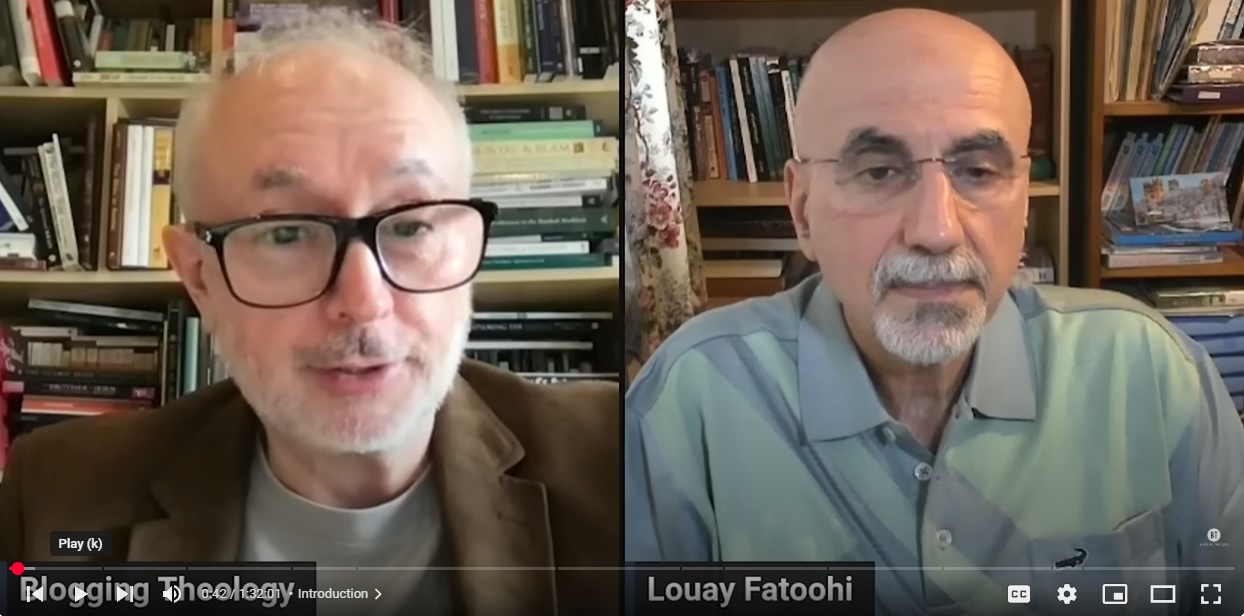
Qadiri Sufi Dr. Louay Fatoohi: Jesus has died and will not return.

“Allah said, O Jesus, I shall cause you to die and will raise you up to Me and shall purify you of the ungrateful disbelieving people, and shall place those who follow you above those who deny the truth, until the Day of Judgement; then to Me shall all return and I will judge between you regarding your disputes.” (Qur’an 3:55)

﷽ 

Before we begin for those who do not know that Dr. Louay Fatoohi is a caliph (or representative) of Shaykh Muhammed al Muhammed alal-Kasnazan al-Husayni-https://www.amazon.in/Shaikh-Muhammad-al-Muhammad-al-Kasnazan-al-Husayni/dp/1906342253

He has been a guest at the behest of Paul Williams of Blogging Theology numerous times to discuss topics of interest in regard to Islam and Christianity.

That aside, what has intrigued us about Dr. Louay Fatoohi is that he believes that Jesus (as) has died and that he will not return. This brings him in line with the Ibadi school of Islam, as virtually no other school of Muslims shares this view.

Here is the PDF: The end of Jesus’ Life on Earth in the Qur’an. The title is interesting because it is a bit of bait. Because English can convey a meaning that seems in line with the majority position of Ahl Sunnah. As the majority of Sunni Muslims believe that Jesus (as) Earthly life came to an end (just not that his life itself) came to an end.

The readers are encouraged to show their gratitude for his academic work by subscribing to Dr. Louay’s YouTube channel, visiting his website and purchasing his many, many insightful books!

Now we are going to be very forward in saying we don’t think this particular article is one of Dr. Louay Fatoohi’s best. There is a great deal to be desired.

In some ways, if you are a traditional Sunni who holds the majority traditional views of Jesus (as) being taken up into heaven and returning again towards the end of time, you will enjoy this read….up to a point.

We say, “Up to a point,” because you are in the Jaguar with Dr. Fatoohi doing 160km on the freeway when suddenly he hits the breaks, giving you the biggest whiplash you ever had.


You read this article, and you see the footnotes, you see the scholarly quotations, you see the references from the Qur’an and the arguments that he builds. Then suddenly we get the following bold assertion from the good Doctor:

“In this paper, I have argued in favour of a combination of the majority opinion that Jesus was raised alive in heaven and the minority view that he died naturally. That Jesus died after, not before, he was raised means he died in the abode in heaven to which he was taken.”

and the minority view that he died naturally.” No, no you didn’t, Dr. Fatoohi. Because you did not quote anyone who says: means he died in the abode in heaven to which he was taken.

No one who argues that Jesus (as) died naturally states he was whisked up to heaven alive in a body and then died in heaven. That is a far cry from any natural death. That is a bit of sleight of hand there. We must call it out for what it is.

Not only that, but indeed you did not give us a single quote from the Qur’an or the Sunnah to substantiate that Jesus died in heaven! Heaven being a place of death is news for us. We have to be quite honest in saying this.

Then there is this bit here:

“This phenomenological perspective seems to lend support to the minority view of al-Suddī (d. 127), which is favoured by al-Ṭabarī, 80 that the dialogue in 5:117 between God and Jesus happened after he was raised to heaven, rather than it will happen on the Day of Judgement.”

That makes little sense as Allah (swt) is already aware of this. It makes the knowledge of Allah (swt) redundant, and we seek refuge in Allah from this.

Yet, to make this happen on the day of judgement where it can be witnessed is more sensible. It is not for Allah (swt) to know redundant information but for those who party to the questioning.

Then we need to come back to the following verse of the Qur’an:

“Peace be upon me the day I was born, the day I die, and the day I will be raised back to life!” (Qur’an 19:33)

What is the point of being raised back to life if you have already been made to die (in heaven) and are presumably there now?

Unless the claim is that Jesus is dead in heaven and will be brought back to life (at a point in the future), what is the purpose of this?

Again, heaven being an abode of death, rather than life, is truly news to us as Muslims. It must also be news to Christians and Jews as well.

There are just too many loose ends that Dr. Fatoohi has in the article.

Dr. Fatoohi offers really no engagement at all with the hadith tradition. That now becomes someone else’s task.

“The support for the traditional view comes mainly from aḥadīth. Such narratives are found in all major ḥadīth sources, including al-Bukhārī and Muslim. This has led to the treatment of Jesus’ return as a fundamental Muslim belief and even conflating it with Islam’s articles of faith,82 accusing those who deny it of kufr. 83 The conclusion of this article implies that those aḥadīth are inauthentic. Indeed, scholars who argue that Jesus died naturally on earth claim the aḥadīth on Jesus’ return are aḥād, rather than mutawātir, so their credal status is at best doubtful.84 Consequently, Jesus’ return is not a tenet of Islam. Books of creeds also distinguish it and other beliefs from the six articles of faith.”

The conclusion of this article implies that those aḥadīth are inauthentic.”


A conclusion that we must admit, with all candor, is based upon the filmiest ground possible i.e. he (Jesus) died in heaven!

scholars who argue that Jesus died naturally on earth claim the aḥadīth on Jesus’ return are aḥād, rather than mutawātir.”

Those scholars which have laid charge to the ahadith, none of which have argued that Jesus (as) was brought alive bodily to heaven and then died in heaven.

This became all the more curious in light of Dr. Fatoohi’s recent article:

In that article he states:

“Among the Prophet’s (PBUH) sayings regarding Imām ʿAlī is his address to the Muslims at Ghadir Khumm, when he asked, “Do you not know that I have more authority over every believer than they have over themselves?” They replied, “Yes, we bear witness that you have more authority over every believer than they have over themselves.” He then declared, “Then for whomever I am a guardian, this is his guardian,” and he took ʿAlī’s hand.”

“This ḥadīth has been recorded by many scholars, including Aḥmad ibn Ḥanbal,[29] al-Bazzār (d. 292),[30] al-Nasāʾī (d. 303),[31] Abū Yaʿlā (d. 307),[32] and al-Ṭabarānī (d. 360).[33] Ibn Abī ʿĀṣim (d. 287) reported it via eleven companions, and he also documented a ḥadīth in which thirteen unnamed collectively testified to having heard the Prophet (PBUH) utter those specific words regarding ʿAlī.[34] In other words, this ḥadīth is mutawātir.”

So we asked Dr. Fatoohi in his X post the following:

“Another question I have. Would you regard it as Mutawātir Lafẓī or Mutawātir Maʿnawī? Given that we have thirteen unnamed individuals that are claimed to have heard this particular wording?”

Why is this important? It is important because in our article here:

Dr. Fatoohi appeals to the consensus.

These scholars suggest that the majority consensus is based on a misunderstanding of the Qur’an, which Muslims have failed to correct for fourteen centuries.” -Louay Fatoohi.

The consensus is that Jesus (as) is coming back. Dr. Fatoohi goes against this consensus.

But as regards the distinction between Mutawātir Lafẓī or Mutawātir Maʿnawī, this is important for the following reasons.

The Sunni consensus is that the hadith on the return of Jesus are Mutawātir Maʿnawī. There are many hadith from many Companions. Some say Jesus will “descend,” others say he will “come,” others focus on him “praying behind the Mahdi.” The exact words differ, but the core meaning (Jesus will physically return at the end of time) is from the Sunni persepective, mass-transmitted and undeniable.

The Sunni consensus is that over 100 Companions narrated the event of Ghadir Khum. Few report the phrase “Whoever’s master I am, Ali is his master.” Others report different wordings or focus on different parts of the sermon. However, the core meaning (the Prophet stopped the caravan at Ghadir Khum and declared Ali had the right to the spoils) is transmitted by so many chains that it is historically certain. It is not considered Lafẓī because the wordings vary, and major collections like Bukhari and Muslim did not include it in its most famous verbatim form.

Concerning Ghadir Khum Shi’i will often try to catch people unaware of this very important point.

However, back to Dr. Fatoohi’s article and his views.

“Ibn ʿĀshūr also accepts that Jesus is dead but he argues he will still return, as stated in ḥadīth. He mentions the possibility that Jesus will have a special early resurrection, rather than the later universal resurrection of all other people and will descend to earth”

Source: (Ibn ʿĀshūr, Al-Taḥrīr wal-tanwīr, vol. 3, 258-259)

He is a well-known Sunni Muslim of the Maliki school of jurisprudence and Ash’ari school of theology.

“Being faithful to aḥadīth about Jesus’ return to earth is also given as a reason for the Muslim misunderstanding of wfy contrary to its more frequently used meaning.”

“I have critiqued these claims in detail elsewhere.”

“It concludes that Jesus was raised to heaven where he continued to live, which is the majority view, but he later died naturally there and will not return to earth, in agreement with the minority view.”

Again we are not sure which scholars hold the view that Jesus (as) ascended to heaven alive and died in heaven. That cannot be described as a natural death at all.

Dr. Fatoohi suggests: “When analysing Qur’ānic terminology, the hermeneutical principle that the Qur’ān interprets itself remains the best option when the Qur’ān provides enough relevant information.”

Prima Qur’an comments: Yet Dr. Fatoohi also states: “Twenty-one occurrences of the verbal root wfy in the Qur’ān are unambiguously associated with death, but the term is also used twice in connection with sleep. This fact suggests the term has a broader meaning than just the end of a person’s life.”

So why Dr. Fatoohi wants to interpret the word in light of it’s less common usage instead of the broader usage merits pensive reflection. He is correct, and it establishes that it has a broader meaning. However, the admission is that the overwhelming majority of the time it is used, it unambiguously means death.

“In the two remaining instances, the Qur’ān uses wfy in the context of describing God’s intervention to protect Jesus from the attempt on his life, so most Muslim scholars have taken this word to mean something other than death in the case of Jesus.”

Prima Qur’an comments: What Dr. Fatoohi does not mention is that this too is influenced by the hadith and the idea that Jesus (as) is coming back. If no such aprior belief was held, then it is more than reasonable for the text to translate as death. Since Dr. Fatoohi is not holding to those traditions, it puzzles one anymore why he takes the position that he does. For the sake of having a novel view? Only Allah (swt) knows what is in one’s heart.

Dr. Fatoohi informs us: “This conclusion is informed by other arguments as well, such as the denial of the crucifixion in 4:157 and the belief in Jesus’ return.”

Dr. Fatoohi states: “The fact that most appearances of wfy are in connection with death or separation of the soul from the body is usually used to conclude there is no justification for claiming the two instances of this verb in Jesus’ story have a different meaning.51 This claim ignores the fact that wfy is also used to mean something other than death.”

Prima Qur’an comments: This is a non-argument. None of the people he quoted are ignoring anything. They are astutely aware of the range of meanings.


Dr. Louay Fatoohi is trying to build an argument off of an objection that no one raised. What he did do correctly was to identify the reasons they felt it was translated as such.

He tries to make it look as if he has an argument based upon the trilateral verb of wfy, stating that almost 2/3 of its appearances in the Qur’an are not related to death. Only to follow that with the very revealing “The only form that is connected with death is the V of the verb, which appears 24 times as tawaffa, including once with reference to Jesus, as mutawaffi, which is the second time it is used in relation to him.”

https://www.islamawakened.com/quran/4/15/translations/

Dr. Fatoohi says: “Allah yatawaffā the anfus (souls) at the time of their mawt and those that do not die during their sleep. Then He keeps those for which He has decreed mawt and releases the others
for a specified term. (39:42) Unlike in death, where wfy donates the permanent taking of the nafs (soul), in the case of sleep, it identifies the temporary taking of the soul. In death, the soul is taken for good, whereas in sleep, the soul is sent back, with wfy used in both cases. This is why Muslim exegetes have
identified and distinguished between these two different types of wafat, one of death and the other of sleep.”

Dr. Fatoohi says: “In summary, tawaffī appears in the Qur’ān in the sense of claiming the soul permanently, which denotes death, or claiming it temporarily, which refers to sleep.”

Prima Qur’an comments: But what is very curious is he does not follow through on the conclusion.

If a person’s soul is claimed during sleep and returned, where does the body go? It does not go anywhere. If a person’s soul is claimed during sleep and is not returned to the body, where does the body go? It does not go anywhere.

Keep this very important point in mind when moving forward.

Qur’an 39:42 -manāmihā we have the word for their sleep.

Note Dr. Fatoohi’s translation of Qur’an 6:61 above.

” He sends over you guardians until when mawt comes to one of you, Our messengers
tawaffathu, and they do not fail [in their duties].”

The question has to be asked. If they (the messengers, presumably angels) take the soul, what happens to the body? Does it go some place?

On what basis does Dr. Fatoohi make the following claim:

“These multiple Qur’ānic assertations are mainly behind the view of most Muslim scholars that wfy does not mean “cause to die” in the case of Jesus, although aḥadīth about his return are also cited.”

Prima Qur’an comments: How does he know that is the reason why most Muslim scholars believe that wfy does not mean to die? Did we get a list or a chart or even a citation? We did not see any.

The sleepers of the cave.

In the Qur’an 18:9-26 we have the revelation concerning the sleepers of the cave. There is nothing there that indicates that the bodies went any place.

Uzair and the doneky.

Or the one who passed by a city which was in ruins. He wondered, “How could Allah bring this back to life after its destruction?” So Allah caused him to die for a hundred years then brought him back to life. Allah asked, “How long have you remained?” He replied, “Perhaps a day or part of a day.” Allah said, “No! You have remained here for a hundred years! Just look at your food and drink—they have not spoiled. look at your donkey! And ˹so˺ We have made you into a sign for humanity. And look at the bones, how We bring them together then clothe them with flesh!”1 When this was made clear to him, he declared, I know that Allah is Most Capable of everything.” (Qur’an 2:259)

This can not be understood as an ascension. The bodies decomposed and were resurrected.

Dr. Louay Fatoohi then turns his attention to the ascension of Christ Jesus.

“First, all seven verses that use rfʿ in the sense of raising a person in status, not spatially, include a word that makes this meaning abundantly clear. Six (2:253, 6:83, 6:165, 12:76, 43:32 and 58:11) of these verses use the plural word darajāt (ranks). The other verse (7:176) uses āyāt (signs) as the way God would have raised someone in status.”

Prima Qur’an comments: So Dr. Fatoohi informs us that Jesus is a special case and that raising is only used of a person in terms of rank, darajāt (degrees) or the other word that is used is āyāt (signs).

However, this assertion falls apart rather quickly upon further investigation.

“and elevated (wa rafaʿnā)your renown for you?” (Qur’an 94:4) There is no mention of either āyāt or darajāt.

Secondly, the most glaring example is the case of Idris (as) Dr. Fatoohi was too dismissive of the case of Idris.

“And mention in the Book, Idris. Indeed, he was a man of truth and a prophet. And We (warafa’nahu) raised him to a high station. ” (Qur’an 19:56-57)

makānan ‘aliyyan (a high station/place). Not even Jesus (as) has been given this honour. It is the only place in the Qura’n where this is mentioned.

Dr.Fatoohi states: “Also, the makān (place) to which Idrīs was taken is described as ʿaliyyā (high). Each of the three other occurrences of the word makān in the same Qur’ānic chapter of the Idrīs verse also
denotes a physical location.”

While that may be true, this is the one place in the Qur’an where makanan ‘aliyyan is used.

Dr. Fatoohi bodly states:

“Expectedly, no attempt has been made by proponents of the metaphorical interpretation to explain what that supposed exaltation of Jesus by God means, as there is no mention of it in the Qur’ān.”

Well, actually there is. In the very first example that he gave to prove his analysis actually goes against him.

Dr. Fatoohi says:

“First, all seven verses that use rfʿ in the sense of raising a person in status, not spatially,
include a word that makes this meaning abundantly clear. Six (2:253….)

So what does 2:253 state?

“Those messengers – some of them We caused to exceed others. Among them were those to whom Allah spoke, and He raised some of them in degree. And We gave Jesus, the Son of Mary, clear proofs, and We supported him with the Pure Spirit. If Allah had willed, those [generations] succeeding them would not have fought each other after the clear proofs had come to them. But they differed, and some of them believed and some of them disbelieved. And if Allah had willed, they would not have fought each other, but Allah does what He intends.” (Qur’an 2:253)

So in the very text that Dr. Fatoohi uses to prove that rf’ does not mean spatially but in status none other than Jesus (as) is the first prophet mentioned by name that follows the text!

Recall Dr. Fatoohi’s own words: “When analysing Qur’ānic terminology, the hermeneutical principle that the Qur’ān interprets itself remains the best option when the Qur’ān provides enough relevant information.”

Thus,

Qur’an 4:159 makes perfect sense of raising Jesus (as) in honour, given that an impailed person is, in the eyes of Rabbinical law, cursed.

Also, Allah has already declared that Jesus (as) would be an ayat unto men.

“He said, “Thus [it will be]; your Lord says, ‘It is easy for Me, and We will make him a sign āyāt to the people and a mercy from Us. And it is a matter [already] decreed.’ “

Dr. Fatoohi’s conclusion was thus:

“The traditional, majority view is that Jesus was raised to heaven alive, continues to live there
and will descend to earth close to the end-time. A minority view that developed in the last one
and a half centuries argues that Jesus died naturally on earth, so he was not raised alive to
heaven and will not come back. In this paper, I have argued in favour of a combination of the
majority opinion that Jesus was raised alive to heaven and the minority view that he died
naturally
.”

Now we admire Dr. Fatoohi. We take him to be a serious researcher. However, we were not amused with the line:

“I have argued in favour of a combination of the majority opinion that Jesus was raised alive to heaven and the minority view that he died naturally.”

First. There is no natural scenario where a person is put to sleep, raised bodily to heaven and then dies. Not one! That is supranatural and not natural.
Second. There is no minority view that states that Jesus (as) was put to sleep ,raised bodily to heaven and then died.

Dr. Fatoohi states:

“The traditional, majority view is that Jesus was raised to heaven alive, continues to live there
and will descend to earth close to the end-time.”

Prima Qur’an what is the traditional view?

  1. Jesus was raised alive in heaven.
  2. Continues to live there.
  3. Will descend at the end of times.

Dr. Fatoohi believes in which of these three? He believes in point 1.

What else can Dr. Fatoohi tell us about points 1–3 above? 

“The support for the traditional view comes mainly from aḥadīth.”

Conclusion and Summary.

Fatoohi does not cite any scholar—classical or modern—who explicitly argues that Jesus died in heaven after being raised alive. The minority view he references (e.g., Sayyid Ahmad Khan, Muhammed Abduh, Rashid Rida) holds that Jesus died a natural death on earth, not in heaven. By combining the majority’s “raised alive to heaven” with the minority’s “died naturally,” Dr. Fatoohi creates a hybrid position that lacks clear precedent. This does not make it wrong, but it does mean he is not simply synthesizing existing views—he is proposing something new. His failure to acknowledge this novelty weakens his claim.

Heaven is not described in the Qur’an or Sunnah as a place where death occurs. If Jesus died in heaven, that would imply death exists in the afterlife realm, which contradicts the understanding of Jannah as dār al-ḥayawān (abode of life). Dr.Fatoohi does not address this tension. His reliance on Qur’an 39:42 (sleep vs. death) does not resolve it, because that verse concerns earth, not heaven.

The Hermeneutical Principle – Qur’ān Interprets Itself. Dr. Fatoohi appeals to the principle that the Qur’ān interprets itself. We counter that he then prioritizes the less common meaning of tawaffā (sleep/temporary taking) over the overwhelmingly common meaning (death).

Dr. Fatoohi admits that 20 of 23 occurrences of tawaffā in form V refer to death. Only two refer to sleep, and one refers to Jesus. To then argue that Jesus’ case follows the rare meaning requires external justification (e.g., the denial of crucifixion, the belief in his return). But Dr. Fatoohi claims to be setting aside ḥadīth. Without ḥadīth, why prefer the rare meaning? His argument becomes circular: he assumes Jesus was raised alive (from 4:158) and then reads tawaffā accordingly. That is not the Qur’ān interpreting itself; it is interpretation driven by a prior conclusion.

The Case of Idrīs and Qur’an 94:4. We point out that Dr. Fatoohi’s claim about raf‘ always requiring darajāt or āyāt for non-spatial raising is false, citing Qur’an 94:4 (“We raised your renown”) and the case of Idrīs.

Qur’an 94:4 uses rafa‘nā without any qualifier, and it clearly means elevation in status, not physical ascent. Dr. Fatoohi overstates his case when he says “no attempt has been made by proponents of is claimed to be the ‘metaphorical‘ interpretation” – we have now made that attempt, citing Qur’an 2:253 and Qur’an 94:4.

Qur’an 19:33 – “The day I will be raised back to life” We ask: If Jesus died in heaven, what is the point of a future resurrection? This is a serious problem for Dr. Fatoohi’s view. Qur’an 19:33 lists three events: birth, death, and resurrection. If Jesus already died and is in heaven, then his “death” refers to that heavenly death. But then “raised back to life” would refer to a second resurrection after that death. That would mean Jesus dies twice (once on earth? no – he didn’t die on earth in Dr. Fatoohi’s view; once in heaven) and is resurrected twice. The Qur’ān nowhere suggests such a sequence. The natural reading of Qur’an 19:33 is that death occurs on earth, followed by resurrection on Judgement Day. Dr.Fatoohi does not address this.

Nonetheless we are happy that another independent researcher, and a representative of the ʿAliyya Qādiriyya Kasnazāniyya tariqa no less, has confirmed that Jesus (as) is dead and he will not return to Earth.

May Allah Guide the Ummah.

May Allah Forgive the Ummah.

Leave a comment

Filed under Uncategorized

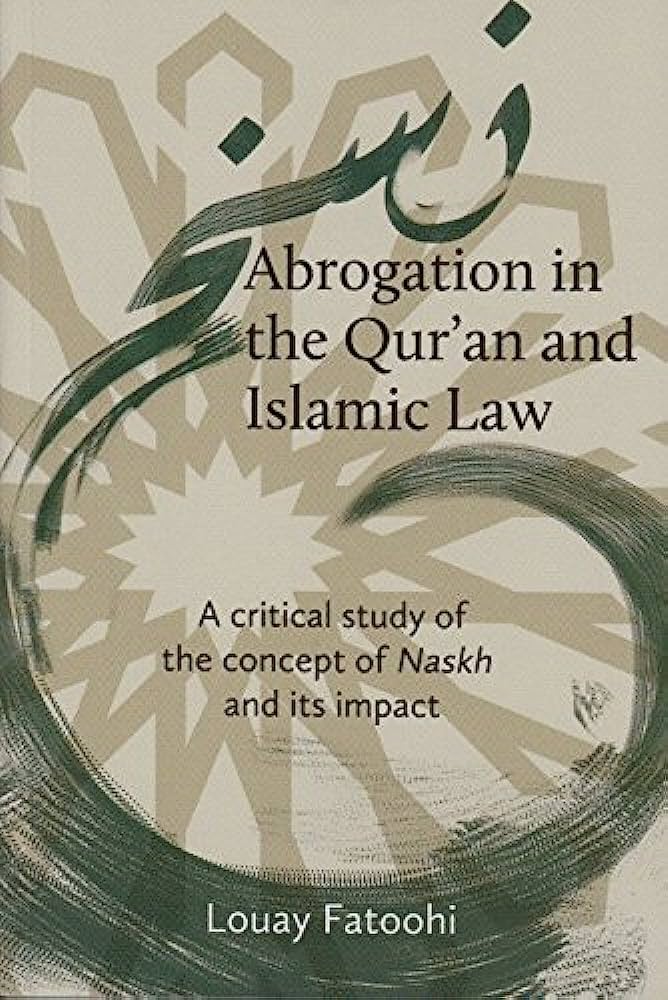
The Non-Crucifixion Verse by Dr. Louay Fatoohi: A response

“And for their saying, “Indeed, we have killed the Messiah, Jesus, the son of Mary, the Messenger of Allah.” And they did not kill him nor did they impale (ṣalabūhu) him; (وَمَا قَتَلُوهُ وَمَا صَلَبُوهُ وَلَٰكِنْ شُبِّهَ لَهُمْ)but it was made to appear to them so. Those who differ therein are full of doubts. They have no certain knowledge of it, but only follow conjecture. For certainly, they did not kill him.”  (Qur’an 4:157)

﷽ 

In today’s entry on Prima-Qur’an we will be going through this paper by Dr. Louay Fatoohi and sharing some thoughts on what he has written.

Those who are not aware the following is a biography of Dr. Louay Fatoohi.

The above is also his website. If you have not read the following book, we would highly recommend it.

We gave our review of the book here: https://www.amazon.com/gp/customer-reviews/R1FCI7QXBCG2SJ/ref=cm_cr_dp_d_rvw_ttl?ie=UTF8&ASIN=9670526027

So now to the topic at hand: The Non-Crucifixion Verse: A Historical, Contextual, and Linguistic Analysis by Louay Fatoohi.

We read from his article:

“In the Qur’an, though, there is little interest in how and when false beliefs appeared, what their historical development was, or whether they were traceable to oral or written tradition. When certain beliefs are rejected in the Qur’an, this comes in the form of asserting that these were not communicated by God through prophets but distortions of the revelations and/or total fabrications by people.” -Louay Fatoohi.

Prima-Qur’an: We would agree that the Qur’an is not “speaking to the wall.” It is certainly addressing claims. In this case, we would both agree with claims made by Jews.

“It sounds unrealistic and farfetched to think that if an average Jew at the time was asked why they thought that the Christian Messiah was false, they would have pointed to one of those few passages in a polemical book that they probably had never read any part of!” -Louay Fatoohi.

Prima-Qur’an: Again we agree. Though it seems rather obvious that the Qur’an 4:157 at least addresses some claims made by some Jews as to a possibility of why they would reject Jesus as the Messiah.

“Also, if 4:157 is to be linked to the known claim that the Jews killed Jesus, then the logical source of choice should be the Gospel narratives, not a passing and vague reference in the Talmud.”-Dr. Louay Fatoohi.

Prima Qur’an: Yeah, so at this point we are glad that Dr. Fatoohi has made his statement conditional. “If 4:157 is to be linked.” Because it begs the question: Why would the Gospel be a logical source of evidence for Jews? Dr. Fatoohi doesn’t quite flesh that out for us.

“Had the Qur’an engaged with the Talmud, it would have probably attacked it and accused the Jews of creating a book that was not revealed by God.” -Louay Fatoohi


Prima Qur’an:
Much like the hadith, it is considered a second source of revelation for Muslims. Perhaps Dr. Fatoohi had not considered that the Talmud acts in much the same way. The Rabbis believe their teachings go back in direct transmission to an oral Torah received by Moses (as).

There is also this verse where Allah (swt) could have plainly stated the word Torah. The Torah is never used in a disparaging way in the Qur’an.

How terrible it is to those who write the Book with their hands and then say, “This is from Allah,” to sell it for a little money. How terrible it is for them for what their hands have written, and how terrible for them what they have earned.” And they say, “The fire will most certainly not touch us for more than a limited number of days.” Say [unto them]: “Have you received a promise from Allah- for Allah never breaks His promise – or do you attribute to Allah something which you cannot know?” (Qur’an 2:79-80)

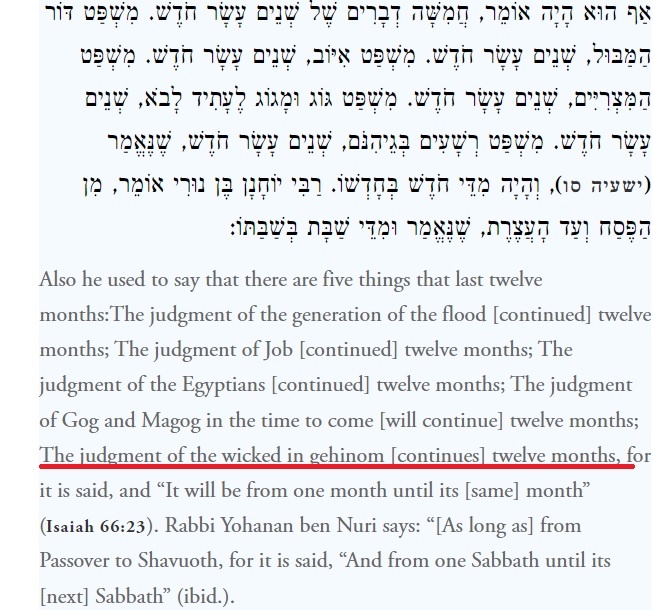
The mishna states:

Source: (https://www.sefaria.org/Mishnah_Eduyot.2.10?lang=bi)

Prima Qur’an:We want to re-emphasize that we are in complete agreement with Dr. Fatoohi’s statement here:

“In the Qur’an, though, there is little interest in how and when false beliefs appeared, what their historical development was, or whether they were traceable to oral or written tradition. When certain beliefs are rejected in the Qur’an, this comes in the form of asserting that these were not communicated by God through prophets but distortions of the revelations and/or total fabrications by people.” -Louay Fatoohi.

Prima Qur’an: So coming to the verse in question under the section titled: The Non-Crucifixion Verse in Focus, Dr. Louay Fatoohi states:

“In this section, I aim to show that both the language and context of 4:157 repeatedly and unambiguously indicate that this verse can only be a denial of both the killing and the crucifixion of Jesus. This is what underpins the consensus of Muslim exegetes in their understanding of this verse. Conversely, rejecting this ubiquitous interpretation is driven by a priori views and convictions, which I have already quickly reviewed, that are extraneous to the Qur’anic text.” – Louay Fatoohi

Prima-Qur’an:We are going to strongly suggest that this is what Dr. Louay Fatoohi and early Muslim exegetes did. In fact, quoting Dr. Louay Fatoohi:

“In his historical tome Tārīkh al-umam wal-mulūk, al-Ṭabarī quotes Wahb Ibn Munabbih (d. 114/732) on the crucifixion. The latter is known for introducing Jewish and Christian narratives into Islamic tradition.” – Louay Fatoohi

Prima-Qur’an: Dr. Louay Fatoohi then beautifully demonstrates that the Qur’an 4:157 when taken into context is addressed to Jews.

“More specifically, we will focus on the four verses leading to 4:157 and the verse that follows it, as they provide immediate contextual information that is useful for avoiding any misunderstanding of 4:157. We will start with verse 4:153 as it commences a new context in which the Jews, and later Jesus, are the main subject.”-Louay Fatoohi.

Prima-Qur’an: So this is where our frustration with Dr. Fatoohi and the popular view on these verses comes in. Again, no blame on Dr Fatoohi because he seems to be following those early Muslim commentators who tried to fill in the void by relying upon extraneous material.

Point 1. When reading the verses in context. Where is there any mention of Romans?

Allah (swt) is not unfamiliar with the Romans.

“The Romans (l-rūmu) have been defeated.” (Qur’an 30:2)

There is no text in the Qur’an that connects Romans (l-rumu) with an act known as salabu.

Point 2. There is no text in the Qur’an that connects Christians (nasara) with an act known as (ṣalabū)

Point 3. Because Allah (swt) is addressing Jews, salabu cannot be a reference to a cross or a crucifixion! Why? Because Jews simply do not crucify people. Dr. Louay Fatoohi, or anyone under the sun, has given us a shred of evidence that they do!

How could we explain this away if we were a Muslim apologist? Aha! This particular group of Jews were already rebellious, so they crucified him in violation of their laws! Then we thought about it some more and said that doesn’t make any sense.

Think about it. Allah (swt) is addressing claims made by Jews against Jesus (as). Among their boast is a claim tantamount to saying: “We did something to Jesus that is not prescribed by Jewish law!”

It is among the most bizarre claims we have ever come across.

In fact, as Dr. Fatoohi quoted John of Damascus, who rightly critiques this view.

“A much more detailed early Christian account of the Muslim belief about the crucifixion comes from the monk John of Damascus, around a century after Muḥammed’s time. Having accused the Prophet of authoring the Qur’an by plagiarizing the Old and New Testaments with help from an unnamed Arian monk, he goes on to say the following: And he says that the Jews wanted to crucify Him in violation of the Law, and that they seized His shadow and crucified this. But the Christ Himself was not crucified, he says, nor did He die, for God out of His love for Him took Him to Himself into heaven.” -Louay Fatoohi

Dear readers, this error is so serious that this one issue would be enough to make anyone reconsider their Islam! How could Allah (swt) not be aware of Jewish methods of execution?! 

We have two options.

1. Imputing ignorance to Allah (swt) concerning Jewish methods of execution. 

2. Muslim exegets being mistaken by relying upon extraneous material and imposing meaning upon the plain text of the Qur’an.

It is clear that the first option is not an option for the believing Muslim.   Besides, is there any proof that these early Muslim exegetes were well versed in the laws of the Jews?

Ironically, the verse that Dr. Fatoohi calls ‘The Non-Crucifixion Verse’ actually is a crucifixion verse, not just the crucifixion of Jesus.

Point 4. Dr. Fatoohi seems comfortable to translate (ṣalabū) as crucifixion!

Though Dr. Fatoohi has stated:

Finally, I should add a note about the Arabic word root ṣ-l-b, which is ubiquitously translated as “crucify.” This word appears in the Qur’an in a verbal form six times (al-Nisāʾ 4:157; al-Maʾida 5:33; al-Aʿrāf 7:124; Yūsuf 12:41; Ṭāhā 20:71; al-Shuʿarāʾ 26:49). In one instance, Pharaoh makes this threat to the magicians who accepted Moses’ claim to being God’s messenger.” -Louay Fatoohi.

Prima-Qur’an: This is frustrating because usually wefind Dr. Fatoohi to be circumspect but he did the exact same thing that Todd Lawson did. Which is to ignore an analysis of the use of the word with the text of the Qur’an. Dr. Fatoohi also left out that this root word s-l-b is used twice as a noun form. Something Lawson at least did not leave out. Such a crucial word is treated by Professor Todd Lawson and Dr. Fatoohi as nothing more than an afterthought.

““It occurs in the Qur’an eight times (4:157; 12:41; 7:124; 20:71; 26:49; 5:33; 86:7;4:23). Six of these are as a verb with the accepted meaning of ‘to crucify’. The others are as a noun meaning ‘back’ or ‘loins’ (86:7; 4:23). ”

Source: (pg 31 The Crucifixion and the Qur’an: A Study in the History of Muslim Thought)

This use may indicate that ṣ-l-b means some kind of execution by suspension.“-Louay Fatoohi.

Prima-Qur’an: Dr. Fatoohi goes into a discussion about some debate over the form of Jesus’ crucifixion.

“There is some debate about how Jesus was crucified, whether he was nailed to a cross, and what shape it had, or was suspended until he died.”-Louay Fatoohi.

Prima-Qur’an: Actually, this need not be a mystery for us at all. As Dr. Fatoohi has pointed out in the text of Qur’an 4:153-157 the whole focus is on the Jews. So why the curious fixation with the Romans?

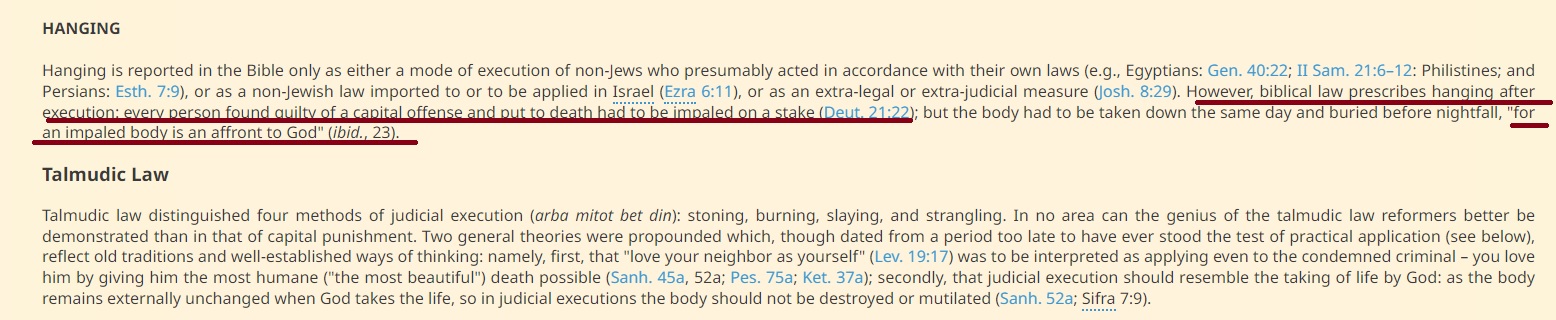
Let us see what Jewish sources of punishment there are:

https://www.jewishvirtuallibrary.org/capital-punishment (no mention of crucifixion at all)

Source: https://www.chabad.org/library/bible_cdo/aid/9985

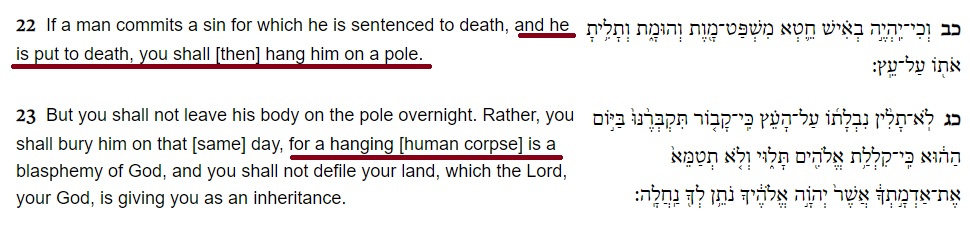
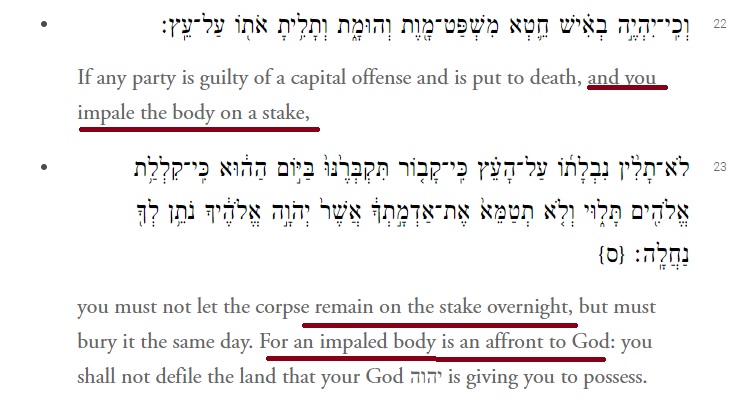
Source: https://www.sefaria.org/Deuteronomy.21.22?lang=bi&aliyot=0

Notice that in the above text the culprit is killed first, and then they are impaled on a stake.

Notice that when Dr. Fatoohi dismisses the swoon theory, he states:

“Any claim that Jesus suffered a non-fatal crucifixion is also dismissed. The verse unambiguously states that Jesus was not killed or even non-fatally crucified.” -Louay Fatoohi

Prima-Qur’an: There is a double denial. They did not kill him nor did they (ṣalabūhu) him. Which means he was not even impaled. (If we are being consistent). They didn’t kill him (which covers every type of death under the sun) nor did they impale him—which would be a post-mortem suspension. Seems quite consistent with what we are seeing from Jewish law.

Or as Dr. Fatoohi states: “not crucified” if we have some strange fixation on the Romans.

So, since Dr. Fatoohi believes the Qur’an is denying that Jesus was even on the cross, then it would be worth asking Dr. Fatoohi. The following: “Do you believe whoever was “crucified” was this crucifixion post-mortem (occurring after death) or an ante mortem (occurring before death)?

After all, Dr. Fatoohi does not seem certain when he says:

“This use may indicate that ṣ-l-b means some kind of execution by suspension.”-Louay Fatoohi.

Prima-Qur’an: This would seem to argue that he is on board with the idea of ante mortem crucifixion. However, I am in agreement with Dr. Fatoohi when he states:

“I would argue that such disregard for the basics of Arabic would make the Qur’an unintelligible.” -Louay Fatoohi.

Prima Qur’an: However, such obfuscation is wholly unnecessary, if we allow the context of the Qur’an to speak, and it is clear that Jews practice post-mortem suspension.

“By the time of the Qur’an, the classical interpretation of the crucifixion of Jesus using a T-shaped cross or a variation of it was already long-established. So, the crucifixion that is rejected in 4:157 seems to be the commonly accepted image of the execution of Jesus.”-Louay Fatoohi


Prima-Qur’an: commonly accepted image according to whom? Since Jews are being addressed, why not reference what (salabu) would look like to them? Again, why the fixation with the Romans and the Christians when there has already been an admission that the immediate text and the context is a response to Jews?

Remember the fixation with Christian beliefs in the Qur’an, according to Dr. Fatoohi, is:

“The human nature of Jesus is repeatedly stressed in the Qur’an and his divinity is rejected in unambiguous terms.”-Louay Fatoohi

Prima-Qur’an: Agreed! Obviously, there is a different agenda when dealing with Christian objections to Islam. If becoming a Muslim meant that a Jew had to accept Jesus as Messiah, then Allah (swt) would have a different agenda when dealing with their objections.

“But we preach Christ crucified, a stumbling block to Jews and folly to Gentiles.” (1 Corinthians 1:23)

These scholars suggest that the majority consensus is based on a misunderstanding of the Qur’an, which Muslims have failed to correct for fourteen centuries.” -Louay Fatoohi


Prima-Qur’an: Well, actually, these 1400 years of scholarship is really based upon copy and paste now, isn’t it? To pretend that every Muslim exegete independently researched every single verse of the Qur’an is just simply presumptuous. What we have is a majoritarian belief based upon individuals incorporating extraneous material from oral traditions without connected chains of narrations going back to the source that contain conflicting accounts.

We are also surprised by Dr. Louay’s appeal to the consensus of scholars when he himself does not believe in the return of Christ Jesus. This is certainly the position of the consensus of scholars. So we can take Dr. Louay’s appeal to consensus as not being serious.

We mean on what consistent basis does Dr. Louay Fatoohi dismiss the second coming of Jesus (as) which is mentioned in quite a number of hadith that do have connected chains and yet expect that we should not dismiss outright beliefs based upon individuals incorporating extraneous material from oral traditions without connected chains of narrations going back to the source that contain conflicting accounts?


None of what has been shared is from the canonical gospels. Would have been great if Dr. Fatoohi would have shared with us an exact quote from the tafsir literature of the tale of substitution. Because it sure the heck would have been very interesting reading a word-for-word detailed account of how the Jews (not the Romans) crucified stealth Jesus. Or about how the Jews killed and then crucified stealth Jesus.

Perhaps in a future article Dr. Fatoohi may give us a detailed quote of these narratives.

However, one central theme stands out. Someone was made to appear to look like Jesus.

This seems to be the understanding of: was made to appear to them so/walākin shubbiha lahum 

Note the following:

“Third, the denial of the crucifixion in 4:157 is followed in 4:158 by a second action that is explicitly attributed to God, which is raising Jesus.”-Louay Fatoohi

Prima-Qur’an: Yet, this was made to appear to them so/walākin shubbiha lahum  is not an action attributed to Allah.

Another example is the following:

“And the answer of Ibrahim’s people was not but that they said, “Kill him or burn him,” but Allah saved him (fa-anjaynāhu) from the fire. Indeed in that are signs for a people who believe.” (Qur’an 29: 24)


Why don’t we see that language, ‘Allah saved him (fa-anjaynāhu) from ‘salabu’ ?

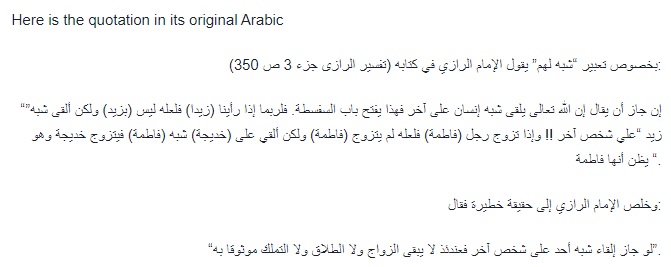
This much is clear when The Ashari in aqidah and Shafi’i in Fiqh, Fakhr al-Din al-Razi, who was not satisfied with the substitution theory, was absolutely merciless in his take-down of this concept when he pins:

“This opens the door of sophistry, So that if we saw Zayd it would be possible that it was not really Zayd but that the likeness of Zayd had been cast upon another. This would imply the nullification of social contracts such as marriage and ownership. Also it would lead to the impugning of the principle of tawatur, bringing into serious doubt all transmitted historical knowledge. This principle should be upheld as long as it is based on perceived phenomena (al-mahsusat). Such confusion about perceived phenomena would threaten the foundations of all religious laws (shar-iya). Neither is it permissible to argue for such transference of identity by appealing to the tradition that allows for miracles during the time of prophecy. Such a provision would bring into question the identity of the prophets themselves, which in turn would call into question the probity of the sources of religious knowledge.”

Source: Fakhr al-Din al-Razi (Mafatih, al-ghayb al-mushtahar bi-al-tafsir al-kabir.)

So it is obvious that ‘made to appear to them’ is not something one can attribute to Allah.

Allah (swt) tells us about his sublime revelation:

“It is a blessed Book which We have revealed for you so that you will reflect upon its verses and so the people of understanding will take heed.” (Qur’an 38:29)

“Surely We know well that they say about you: “It is only a human being who teaches him,” (notwithstanding) that he whom they maliciously hint at is of foreign tongue, while this (Qur’an) is plain Arabic clear.” (Qur’an 16:103)

There really is no need for so much confusion and obfuscation over this verse. We do not need to appeal to extraneous material that is not divine in authority, has no connected chain back to the original sources, is confused in its reports and proclaims some supra natural event that Allah (swt) himself did not claim.

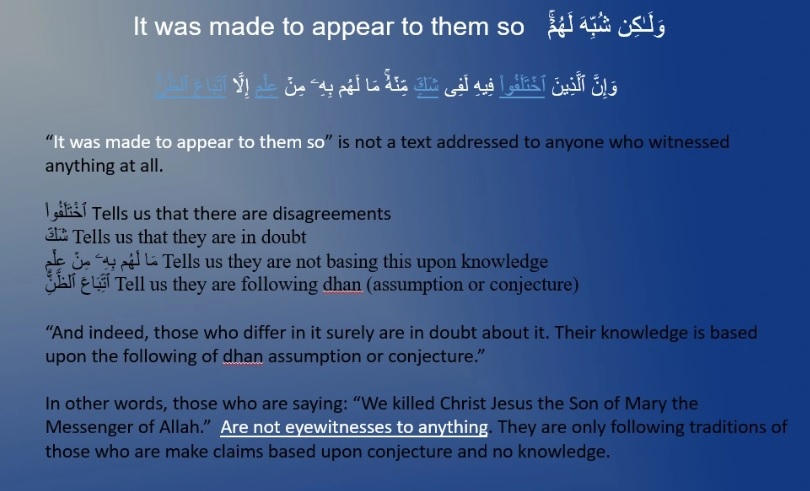
وَإِنَّ ٱلَّذِینَ ٱخۡتَلَفُوا۟ فِیهِ لَفِی شَكࣲّ مِّنۡهُۚ مَا لَهُم بِهِۦ مِنۡ عِلۡمٍ إِلَّا ٱتِّبَاعَ ٱلظَّنِّۚ

“It was made to appear to them so” is not a text addressed to anyone who witnessed anything at all!

 ٱخْتَلَفُوا۟ Tells us that there are disagreements

شَكّ Tells us that they are in doubt

مَا لَهُم بِهِۦ مِنۡ عِلۡمٍ Tells us they are not basing this upon knowledge

ٱتِّبَاعَ ٱلظَّنِّۚ Tell us they are following dhan (assumption or conjecture)

“And indeed, those who differ in it surely are in doubt about it. Their knowledge is based upon the following of dhan assumption or conjecture.”

In other words, those who are saying: “We killed Christ Jesus the Son of Mary the Messenger of Allah.”  Are not eyewitnesses to anything. They are only following the traditions of those who make claims based upon conjecture and no knowledge.

ٱتِّبَاعَ ٱلظَّنِّۚ it is this same following of dhan (assumption and conjecture) taken from the very same people whom Allah (swt) tells us are in disagreements, are in doubt, not based upon knowledge that we get ultra bizarre translations of the Qur’an an like the following:

And because of their saying (in boast), “We killed Messiah Iesa (Jesus), son of Maryam (Mary), the Messenger of Allah,” – but they killed him not, nor crucified him, but the resemblance of Iesa (Jesus) was put over another man (and they killed that man), and those who differ therein are full of doubts. They have no (certain) knowledge, they follow nothing but conjecture. For surely; they killed him not (i.e. Iesa (Jesus), son of Maryam (Mary) )  (Qur’an 4:157) –Muhsin Khan & Muhammed al-Hilali

Does that make a lick of sense to anyone?

So let’s get this right. Wahb Ibn Munabbih takes his knowledge from people whom Allah (swt) tells us are in disagreements, are in doubt, not basing information upon knowledge, only following conjecture, and they get to inform us about what Allah’s revelation says?

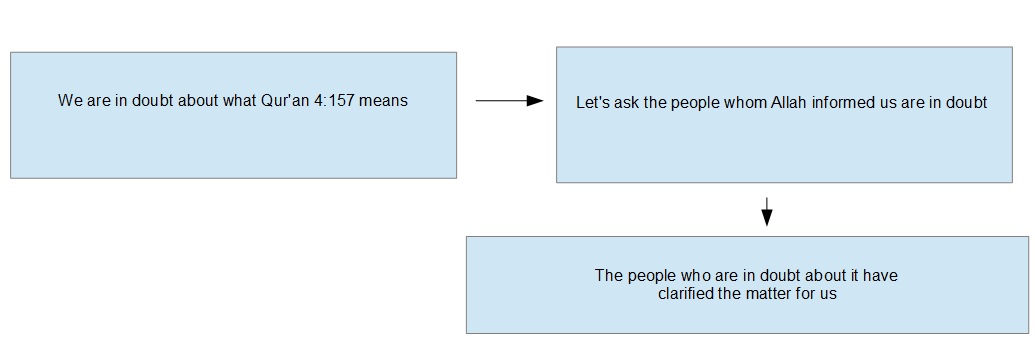
“So if you are in doubt, [O Muhammed], about that which We have revealed to you, then ask those (ahla l-dhik’ri) who have been reading the Scripture before you. The truth has certainly come to you from your Lord, so never be among the doubters.” (Qur’an 10:94)

Notice the phrase: ahla l-dhik’ri and not ahla l-kitābi

The above verse is only applicable in those matters where they themselves do not have doubts about the matter and has to be taken into context with what Allah (swt) has description of those in (Qur’an 4:157)

May Allah (swt) bless Dr. Louay Fatoohi for his sincere and noble efforts. For the most part, he is only defending the indefensible. 1200 plus years of fuzzy logic and copy-and-paste scholarship. Statements by converts to Islam which are based upon conjecture and have no connected chain of transmission going back to the companions of Jesus.

Please do see our article:

May Allah Guide the Christians so that they do not burn in the hellfire.

May Allah (swt)bless the ummah.

May Allah (swt) forgive the ummah.

May Allah (swt) guide the ummah.

4 Comments

Filed under Uncategorized

Dr. Ali Ataie and his understanding of شُبِّهَ لَهُمْ (shubbiha lahum) Qur’an 4:157

“And for their saying, “Indeed, we have killed the Messiah, Jesus, the son of Mary, the Messenger of Allah.” And they did not kill him nor did they impale (ṣalabūhu) him; (وَمَا قَتَلُوهُ وَمَا صَلَبُوهُ وَلَٰكِنْ شُبِّهَ لَهُمْ)but it was made to appear to them so. Those who differ therein are full of doubts. They have no certain knowledge of it, but only follow conjecture. For certainly, they did not kill him.”  (Qur’an 4:157)

As mentioned before we do a tight textual analsysis of the Qur’an in order to reach the correct understanding. This is done by comparing a word with all other instances of that word in the Qur’an. This is done by also comparing the context of verses with their surrounding verses. This is known as  Tafsir al-Quran bi-l-Quran. (Interpreting the Qur’an by the Qur’an)

In a discussion on Blogging Theology titled: “Jesus was not crucified: the evidence with Dr. Ali Ataie.” Dr. Ali Ataie made some very interesting assertions. Assertions which move him closer to our position.

@40:28 Dr. Ataie states: “But I do believe that myth and legend has probably soo permeated the gospel accounts of Jesus passion narratives that it is not at all beyond reason to dismiss them completely as historical fiction!”

Prima-Qur’an comments: Allahu Akbar! there you go Dr. Ataie now that is the ticket!
Than the idea that someone was “crucified” is likely based upon what? Myth and legend.

Dr. Ataie gets into his understanding of: Qur’an 4:157 “It was made to appear to them so.

@53:38 “They did not have information. It did not come from a reliable source.”
@54:11 “Jews and Christians ended up following hearsay reports about some crucifixion event from non eye-witnesses….”

Prima-Qur’an comments: Dr. Ataie state: ” “Jews and Christians ended up following hearsay reports about some crucifixion event from non eye-witnesses….”

I would replace some words in the above sentence: “Jews and Christians ended up following hearsay reports about some imaplement event from non eye-witnesses….

“Christ has redeemed us from the curse of the law, having become a curse for us (for it is written, “Cursed is everyone who hangs on a tree”), (Galatians 3:13)

  1. Paul is quoting from a text that mentions a post mortem suspension punishment. The individual is killed first and while dead then supsended. Christians understand the Crucifixion as an ante mortem suspension punishment where the person is killed via asphyxiation while alive and being suspended.

This is exactly what shubbiha lahum means. It is not shubi ha alayhim!

In fact because we love you the readers insh’Allah I will give you a sneak peak at one of the slides that Shaykh Hilal and I are working on.

No pay wall and no gate keeping information!

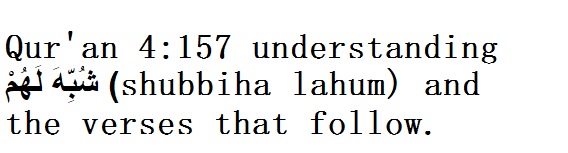
This is the critical linguistic and contextual refinement. This is a far more precise reading of the phrase شُبِّهَ لَهُمْ (shubbiha lahum) and the verses that follow.

From the Ibadi perspective and reading of the verse the point fundamentally shifts the understanding of the verse from a narrative about a visual illusion in real-time to a critique of a historical claim based on unreliable transmission. Let’s integrate this correction.

The Correct Understanding of Point 4:167

The phrase وَ لٰكِنْ شُبِّهَ لَهُمْ (“but it was made to appear so to them”) does not describe a miraculous event witnessed by onlookers in real time. Instead, it critiques the oral tradition and historical narrative that the Jewish community subsequent to the event had come to believe and propagate.

The Qur’an’s own subsequent words completely invalidate the possibility of this being an eye-witness account:

  • إِنَّ الَّذِينَ اخْتَلَفُوا فِيهِ لَفِي شَكٍّ مِنْهُ – “Indeed, those who differ over it are surely in doubt about it.” (4:157)
    • Doubt (شَكٍّ – shakk) is impossible for someone who witnessed an execution firsthand.
  • مَا لَهُمْ بِهِ مِنْ عِلْمٍ – “They have no knowledge of it.” (4:157)
    • Knowledge (عِلْمٍ – ‘ilm) is exactly what an eye-witness would claim to have.
  • إِنْ يَتَّبِعُونَ إِلَّا الظَّنَّ – “They follow not except assumption.” (4:157)
    • Assumption (الظَّنَّ – al-ẓann) is the antithesis of eye-witness testimony.

A Hadith that is classified as الظَّنَّ (al-ẓann), meaning “conjectural” or “of presumptive status,” and comes from a lone narrator (or a single strand of transmission) is known as a Khabar al-Āḥād (خبر الآحاد).

Here’s a detailed breakdown:

Definition: A Khabar al-Āḥād is a report (Hadith) that does not reach the highest level of mass transmission (Mutawātir). It is narrated by one or a few individuals at any stage of its chain of narration (isnad), such that the number of narrators does not generate absolute, certain knowledge (ilm al-yaqīn) in the listener. Instead, it generates presumptive knowledge (ilm al-ẓannī), which is sufficient for action but is theoretically open to doubt.

Therefore, the Qur’an is not describing a supernatural trickery of the senses that happened in the past. It is describing the state of the received narrative in the present tense of its revelation.

The chain of meaning, according to this corrected interpretation, is:

  1. The Claim: A specific Jewish community (contemporary to the Prophet Muhammed or just prior) boasts, “We killed the Messiah, Jesus son of Mary, the messenger of Allah.” This is their historical claim.
  2. The Denial: The Qur’an flatly denies this: “And they did not kill him, nor did they impale him (وَ مَا صَلَبُوهُ).”
  3. The Explanation for the False Claim: How did this false claim arise? The event was “made to appear to them (شُبِّهَ لَهُمْ)” in their oral traditions and historical accounts. The truth was obscured within their own narrative.
  4. The Proof of the Falsehood: The proof that this claim is a baseless tradition and not established fact is that those who argue over it are in doubt, devoid of certain knowledge, and following only assumptions about what truly happened. True eye-witnesses to a capital punishment would not be in a state of doubt and conjecture; they would be certain.

You may also be interested in reading:

May Allah Guide the Ummah.

May Allah Forgive the Ummah.
5 Comments

Filed under Uncategorized