
“And when Ibrahim was tried by his Lord with certain words, which he fulfilled.” (Qur’an 2:124)
“Then when he reached with him the (age of) working he said, “Oh my son! Indeed, I have seen in the dream that I am sacrificing you, so look what you see.” He said, “Oh my father! Do what you are commanded. You will find me, if wills Allah, of the patient ones.” (Qur’an 37:102)
“Then when they submitted and Ibrahim laid him on the side of his forehead
for sacrifice. We called out to him: “Oh Ibrahim! You have already fulfilled the vision.” Indeed this is how We reward the good-doers. For this was obviously a clear trial.” (Qur’an 37:103-106)
“And we ransomed him with a tremendous sacrifice. And we left for him the hereafter. Peace be on Ibrahim. Thus we reward the good doers. Indeed he was of Our believing slaves. And we gave him glad tidings of Isaac, a Prophet among the righteous.” (Qur’an 37:107-112)
﷽
There was some really interesting, and engaging back and forth between Mustafa Akyol & Dr. Abdullah bin Hamid Ali on these text. Mustafa Akyol appealed to the mystic Ibn al-Arabi in the exchange.
Abdullah bin Hamid Ali: He is the Founding Director of the Lamppost Education Initiative. He serves as an associate professor of Islamic law and Prophetic Tradition at Zaytuna College in Berkeley, California (2007-present). He holds a Ph.D. in Cultural and Historical Studies in Religion (2016) and an M.A. in Ethics and Social Theory (2012) from the Graduate Theological Union. He obtained his B.A. (ijaza ‘ulya) in Islamic Law (Shariah) from the prestigious Al-Qarawiyin University of Fes, Morocco in 2001. He is an Ashari in theology and a Maliki in matters of jurisprudence.
Mustafa Akyol: Mustafa Akyol: He is a journalist and columnist. Notable for his post-modernist and liberal reform views. Since 2018, Akyol has been a senior fellow at the Cato Institute, a libertarian think tank founded and financially supported by the Koch brothers, right wing politicians.
This blog entry is in regard to an exchange that happened between Abdullah bin Hamid Ali and Mustafa Aykol. We provide our comments when necessary.
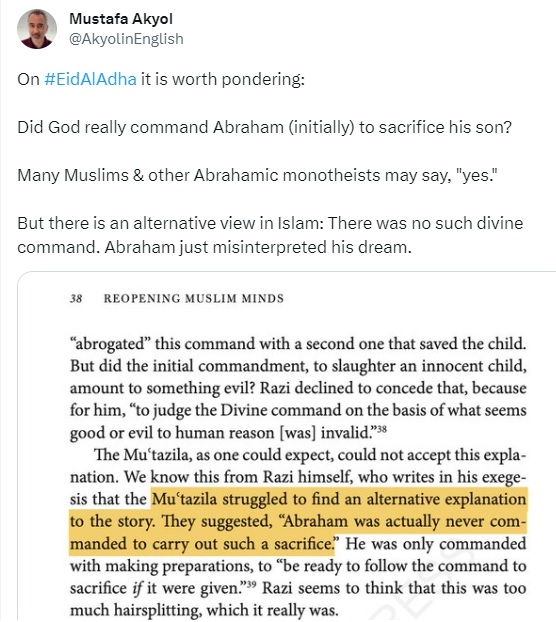
Now Mustafa Akyol had made the following post:
“It is worth pondering: Did God really command Abraham (initially) to sacrifice his son? Many Muslims & other Abrahamic monotheists may say, “yes.” But there is an alternative view in Islam: There was no such divine command. Abraham just misinterpreted his dream.”-Mustafa Akyol
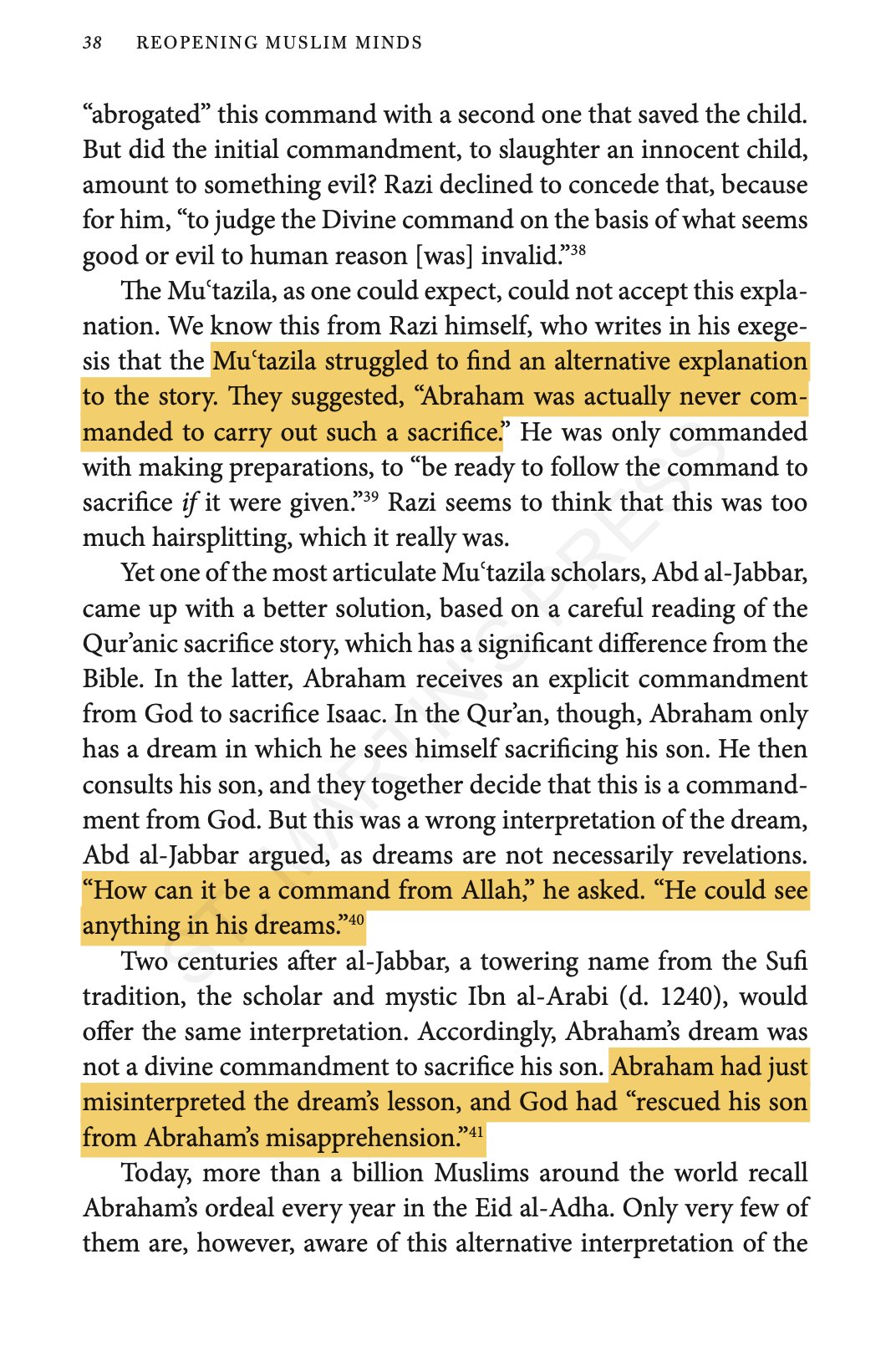
(The page is from my book, “Reopening Muslim Minds.”)
“Why is this important? Because the dominant view supports divine command theory: Whatever God commands, that is ethically right. The other view envisions a principled God: He will only command what is objectively ethical.” -Mustafa Akyol
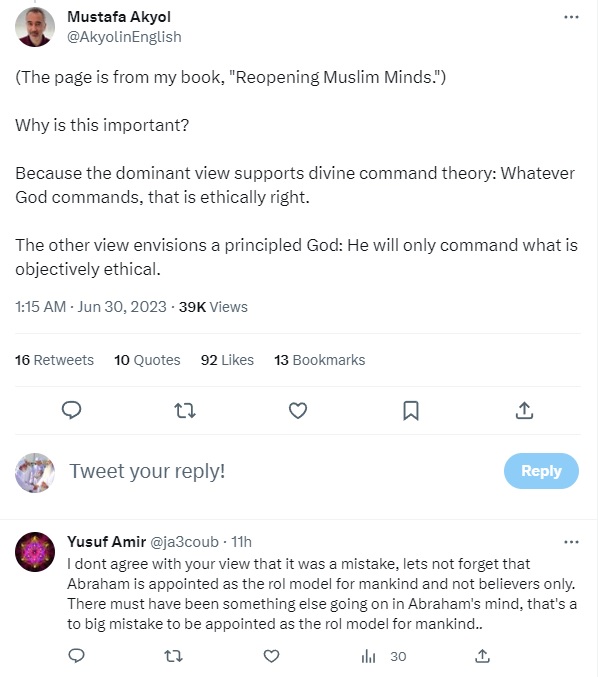
Prima-Qur’an comments: The obvious problem with Mustafa’s assertion is who or what decides what a principled God would entail? Who also decides what is objectively ethical?
Abdullah bin Hamid Ali responds.
This post was responded to by Dr. Abdullah Bin Hamid Ali with:
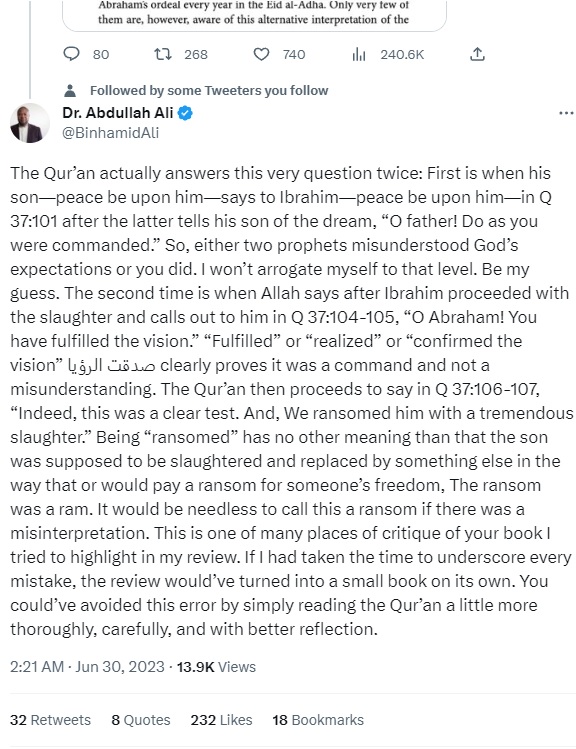
To which Mustafa Aykol responded with:
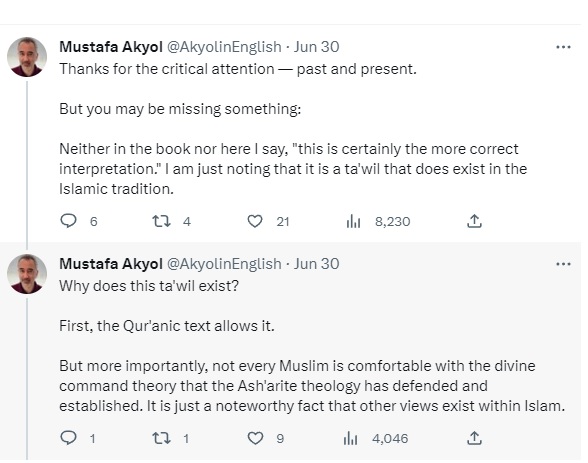
To which Dr. Abdullah bin Hamid Ali responds with:
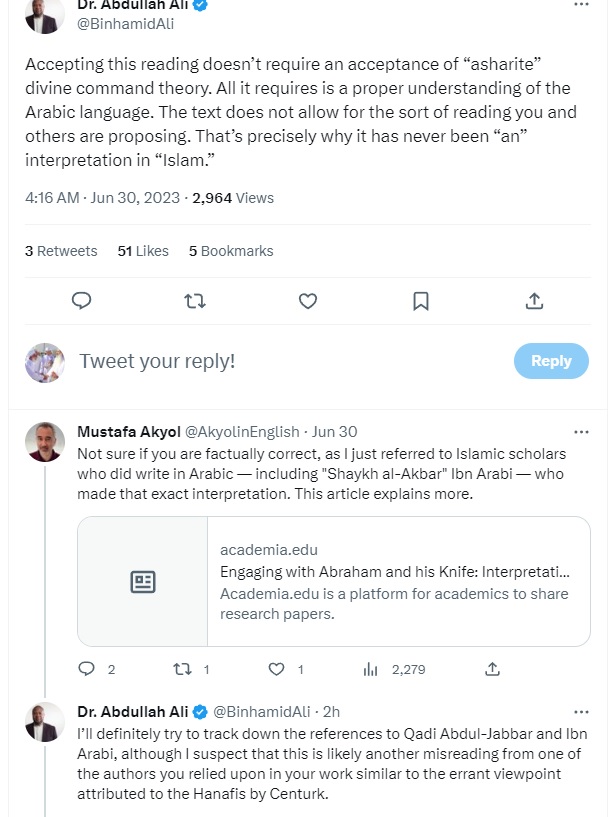
Prima-Qur’an comments: At this point in the exchange, Dr. Abdullah Bin Hamid Ali noted that Mustafa Akyol had transmitted errors made by others in the past. In particular to viewpoints attributed to the Hanafi school that they did not hold.
Rejoinder from Mustafa
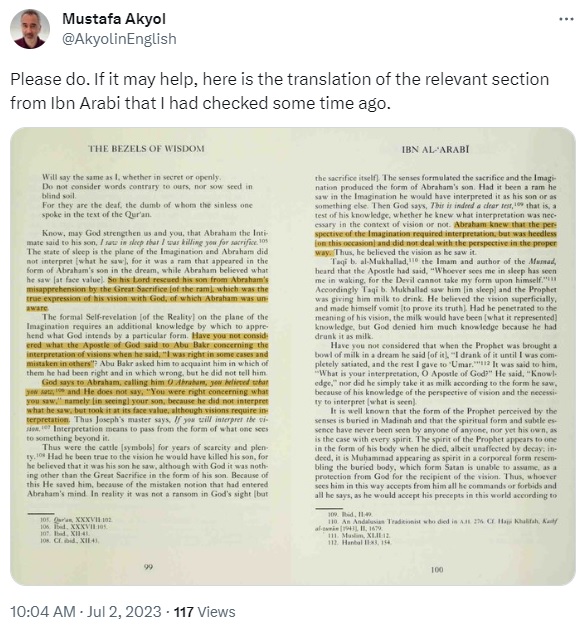
Prima-Qur’an comments: There are a number of problems with the mystic Ibn Al Arabi’s view. He seems that Allah (swt) had veiled him from the truth of the matter.
From the text posted above:
“The state of sleep is the plane of the Imagination and Abraham did not interpret [what he saw], for it was a ram that appeared in the form of Abraham’s son in the dream, while Abraham believed what he saw [at face value] So his Lord rescued his son from Abraham’s misapprehension by the Great Sacrifice [of the ram], which was the true expression of his vision with God, of which Abraham was unaware.”
“Have you not considered what the Apostle of God said to Abu Bakr concerning the interpretation of visions when he said, “I was right in some cases and mistaken in others?” Abu Bakr asked him to acquaint him in which of them he had been right and in which
wrong, but he did not tell him.”
“Thus were the cattle [symbols for years of scarcity and plenty. Had he been true to the vision he would have killed his son, for he believed that it was his son he saw, although with God it was nothing other than the Great Sacrifice in the form of his son.”
“Thus Joseph’s master says, If you will interpret the vision. Interpretation means to pass from the form of what one sees to something beyond it. Thus were the cattle [symbols] for years of scarcity and plenty. Had he (Ibrahim) been true to the vision he would have killed his son, for he believed that it was his son he saw, although with God it was nothing other than the Great Sacrifice in the form of his son.”
Prima-Qur’an comments: Ibn Al Arabi as someone making egregious blunders one after the other.
- Ibn Al Arabi the one who did not have the dream knows better than Ibrahim himself what the dream entailed?
- Ibn Al Arabi doesn’t help his case by stating that Yusuf (as) can interpret his dream correctly but Ibrahim (as) cannot! That is indeed very weak.
- Why relate the supposed conversation between Abu Bakr (ra) and the Blessed Messenger (saw) if we are to be let down with…” but he did not tell him”
- So now Ibn Al Arabi does what the Prophet (saw) himself did not do?
- “he (Ibrahim) been true to the vision he would have killed his son,” Did Ibn Al Arabi not read the Qur’an when Allah (swt) states: We called out to him: “Oh Ibrahim! You have already fulfilled the vision.” What does Ibn Al Arabi think would have happened had that voice not called out?
Rejoinder Dr. Abdullah Bin Hamid Ali
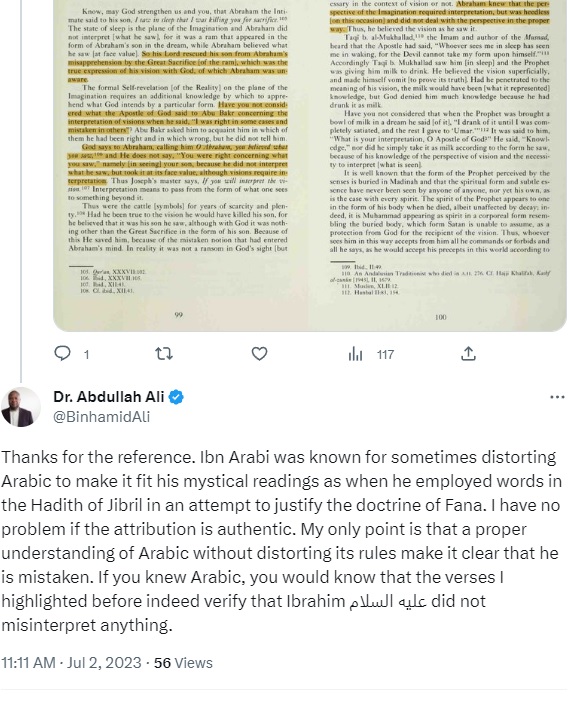
Prima-Qur’an comments: Apparently this is what Dr. Shehzad Saleem conveys what Javed Ahmed Ghamidi says as well. You can see that here: https://www.youtube.com/watch?v=KPR-hzoROaw
So Javed Ahmed Ghamidi & Mustafa Akyol are of the same view here.
Prima-Qur’an comments: To be quite honest, Dr. Abdullah Bin Hamid Ali has already shown us the clear response in his initial reply.
Questions:
What were those words that Ibrahim was tried with?
“And when Ibrahim was tried by his Lord with certain words, which he fulfilled.” (Qur’an 2:124)
“Then when they submitted and Ibrahim laid him on the side of his forehead
for sacrifice. We called out to him: “Oh Ibrahim! You have already fulfilled the vision.” Indeed this is how We reward the good-doers. For this was obviously a clear trial.” (Qur’an 37:103-106)
“Then when they submitted” Can it be said that Ibrahim and his son submitted to Satan?
Can it be said that they both submitted to something false (faulty interpretation of a dream)?
“We reward the good-doers” Can it be said that Satan rewards the doers of good?
For this was obviously a clear trial. What is there a clear trial in sacrificing a sheep or lamb? That is something people were accustomed to.
Prima Qur’an summary: What did we learn from this exchange?
This text is a reference to Ibrahim (as) being tried by Allah (swt) by certain words which he fulfilled.
The son (undisclosed) at this point. Was patient with what his father saw in his dream. His father Ibrahim (as) saw that he was to sacrifice his son.
When they had submitted (the son by submitting to the father’s authority and by this the vision given by Allah) and the father by submitting to the vision from Allah (swt). The submission itself was the fulfillment of the vision. Not the sacrificing of anything. The vision was already fulfilled.
“The answer of the Believers, when summoned to Allah and His Messenger, in order that He may judge between them, is no other than this: they say, “We hear and we obey“: it is such as these that will attain felicity.” (Qur’an 24:51)
Lastly, we see that immediately after this were the glad tidings of the second son of Ibrahim (as). That is the Prophet Isaac (as). Think about it. The willingness to sacrifice a son and not only is he sparred, but an announcement of a second son!
You were willing to sacrifice your son to Allah (swt) due to this tremendous test via submission you were awarded two sons! Subhan’Allah!
May Allah Guide the Ummah.
May Allah Forgive the Ummah.


Assalamu alaikum, please do not take the questions personally. I just need a bit of clarification here.
Please let me know if I’m missing anything here!
walakum salam warahmutallah wabaraktuh.
“please do not take the questions personally. I just need a bit of clarification here.”
No offense taken as this is your right upon us and our right upon you to clarify.
For us the walyiyaaju billah is to imagine that Ibn Al Arabi/Mustafa Akyol/Javed Ahmed Ghamidi would have more spiritual insight than ANY Prophet of Allah (swt) as they are not Prophets nor did any of them receive revelation.
When people put aside their presuppositions to force a conclusion that aligns with thier presuppostion they get the answer. Insh’Allah.
What people confuse in the story of Ibrahim (as) is the difference between the command of Allah and the intention of Allah.
What was the command. 1) Sacrifice the son. 2) What was the intention of Allah?
“Then when they submitted and Ibrahim laid him on the side of his forehead
for sacrifice. We called out to him: “Oh Ibrahim! You have already fulfilled the vision.” Indeed this is how We reward the good-doers. For this was obviously a clear trial.” (Qur’an 37:103-106)
Once Ibrahim (as) and Ismail (as) submitted the intention behind the command was fulfilled so there was ‘no fake command’ take heed that often dark spiritual forces whisper into our hearts and inspire us to say such things.
May Allah protect us from Shaitan. May Allah guide us to a way that is straight.
May Allah bless you!
I’m actually not supporting or accepting their views. Just trying to understand what is happening here.
This is actually a good point. We can add the example of fasting, where the command is to refrain from certain acts, but the intention is to practice Taqwa. This is internally consistent.
But how would we prove something is bad if there is no outside evidence to prove it, other than using the Quran or Sunnah? Here, I’m talking about the Divine command theory. For example, how would we prove that using idols to worship Allah is bad without referring back to the Quran and Sunnah? You can say that we first have to prove that the Quran and Sunnah are actually Allah’s revelation, and then from there we decide Good and Bad. But in the Quran, Allah says about the Prophet (Sallallahu alaihi wa sallam) that he permits tayibaat and forbids what is impure. Which hints that things are already Good or Bad, prophet is just finding them and declaring their ruling!
This also applies to scholars, I think; for example, the question of smoking. Smoking is inherently bad for human health, which is why some scholars will say it is prohibited because of Quranic principle. So, here we just discovered the inherent harm of smoking, which was not known, let’s say, 20 years ago! We can say smoking was always bad/haram for us; we just didn’t know about it earlier and hence were forgiven due to ignorance. But now, since we know it is harmful, we are no longer allowed to smoke. It is not that Allah’s command changed regarding smoking; we just discovered it now!
Additionally, if we say that things are neither bad nor good and only become good or bad because of Allah’s command, then it would mean that Alcohol and Pork do not have anything bad in them; they are only bad because Allah prohibited them to us, but in the Quran we find that Alcohol already has harm in it.
Can we not say that Allah already created these things which have qualities that are bad for us? And also, certain actions are also Bad for us, for example, fornication and also inherently bad concepts, for example, being ungrateful? I would not say that these pre-existed before Allah or are co-eternal with Allah. But maybe these are also creations or effects of Allah’s own attributes? For example, Allah is just; hence, justice is always good, and the opposite of justice is always bad?
Sorry for writing such a long response and drifting away from the topic of the article.
May Allah help you and me in doing good deeds!
“May Allah bless you!” You and us both.
“May Allah help you and me in doing good deeds!” Amin.
Before we comment on your second comment are we clear about the intitial inquiry?
Yes, I think that is clear! I had some questions, but I think I can solve those myself!
As for the second comment, I think it would be best if you could write an article about the Divine command theory. What is the position of Ibadi scholars regarding it? If they support it, then what is their answer to questions similar to mine? I forgot the exact post title, but as far as I remember from that post, Prima Quran supports the Divine command theory. Correct me if I’m wrong!
Jajakallah
“Yes, I think that is clear! I had some questions, but I think I can solve those myself!”
Al hamdulillah.
“This also applies to scholars, I think; for example, the question of smoking. Smoking is inherently bad for human health, which is why some scholars will say it is prohibited because of Quranic principle. So, here we just discovered the inherent harm of smoking, which was not known, let’s say, 20 years ago!”
Our school was the first among the Islamic schools to recognize the evil in smoking and to clearly see it is indeed harmful. Anyone who has been around cigarette smoke knows about the smoker’s cough, and knows how one pack becomes two packs becomes three. Interestingly enough, many Muslims who fell into the so called ‘rationalist’ camp picked up the smoking habit!
So as with the your initial question it seems that people get confused between two things.
So what are the two categories?
1. Knowing that Allah is. This is a judgment about what exists and what deserves worship by nature.
2. Knowing what Allah orders. (prayer times, fingernail-trimming, inheritance fractions, the permissibility of pork under necessity) is a judgment about positive law, and reason has no access to it at all.
The Ibadi of Basra were all too familiar with Muʿtazila circles and perhaps influenced them as well as the later Ashʿarī.
So when we speak of reason it is worth asking questions such as:
Define reason:
Who or what defines reason?
Does reason have parameters?
Who or what defines those parameters?
There is a difference between: reason as a faculty that recognizes and reason as a faculty that legislates.
Reason is a condition of accountability, not a legislating source. Legislation comes only through revelation.
“Whoever chooses to be guided, it is only for their own good.
“And whoever chooses to stray, it is only to their own loss. No soul burdened with sin will bear the burden of another. And We would never punish until We have sent a messenger (Qur’an 17:15)
“When your Lord brought forth from the loins of the children of Adam their descendants and had them testify regarding themselves. “Am I not your Lord?” They replied, “Yes, You are! We testify.” “Now you have no right to say on Judgment Day, ‘We were not aware of this.’” (Qur’an 7:172)
Reason can recognize that Allah exists (fitra), recognize consistency and inconsistency in arguments, and recognize that it is dependent—but it cannot generate the normative force of obligation. Obligation requires a commander.
Reason can see that it is not the arbiter; only a command can bind.
A standard that stands over Allah and makes the human reason that grasps it the real sovereign is problematic. Allah becomes answerable to a tribunal whose judge is man.
One has to be extremely cautious that rationalist metaethics does not enthrone man as arbiter over Allah. That would constitue “a god of our own making.”
The Mu’tazili claim is also not verifiable. What do we mean?
The Mu’tazila cannot point out to us a society that produces a moral insight arising in isolation from any religious tradition.
Where is this society? Mynamar? Peru?
Allah (swt) says:
“For every community We appointed a code of life to follow. So do not let them dispute with you in this matter. And invite to your Lord, for you are truly on the Right Guidance.” (Qur’an 22:67)
We have two articles on this:
The Ibadi vs the Mutazila: Where does knowledge of morality come from.
This deals with:
Knowing what Allah orders
Reason as a faculty that legislates
Reason in and of itself not being a legislating source.
This deals with:
Knowing that Allah is.
Reason as a faculty that recognizes
Reason as a condition of accountability.
“Surely this Quran guides to what is most upright” (Qur’an 17:9)
Salaam alaikum,
I agree that reason can not legislate. My concern was more about the mind’s ability to recognise what is bad and what is good. For example, genocide! We as muslims would call it bad and a great sin, but some people think that it is good and that God commanded it! Some may even argue that the Quran commands ki**ng all mushriks.
So my question would be: can we, without going back to the Quran, say that genocide is bad? So, for example, in India, people had a practice where they would burn the wife alive with her dead husband. How would an Indian know or understand whether this is good or bad? If you say that the mind can recognise good and bad, then you will have to agree that there are some things that are always good or bad; otherwise, the word ‘recognising‘ is meaningless.
Are you saying that there are no inherently good or bad actions, and that something only becomes good or bad depending upon God’s command?
Also, Allah said that he doesn’t do injustice towards His Ibaad. Is it because his will or is it becuase his attribute of being just? Is it that justice is not his attribute at all? Maybe justice is a human concept? If Allah willed, he could have burned us all for no sin, and that would be equal to burning stone!
Please read these questions in a sincere, curious tone from a brother who is seriously trying to understand. I’m not here to argue or offend you guys.
May Allah help me and you to understand his book better!
walakum salaam.
Please do go back and re-read what our response to you.
We will reproduce the response for the benefit of yourself and others who read. Insh’Allah
Once this is grasped the other questions are answered.
So as with the your initial question it seems that people get confused between two things.
So what are the two categories?
1. Knowing that Allah is. This is a judgment about what exists and what deserves worship by nature.
2. Knowing what Allah orders. (prayer times, fingernail-trimming, inheritance fractions, the permissibility of pork under necessity) is a judgment about positive law, and reason has no access to it at all.
The Ibadi of Basra were all too familiar with Muʿtazila circles and perhaps influenced them as well as the later Ashʿarī.
So when we speak of reason it is worth asking questions such as:
Define reason:
Who or what defines reason?
Does reason have parameters?
Who or what defines those parameters?
There is a difference between: reason as a faculty that recognizes and reason as a faculty that legislates.
Reason is a condition of accountability, not a legislating source. Legislation comes only through revelation.
“Whoever chooses to be guided, it is only for their own good.
“And whoever chooses to stray, it is only to their own loss. No soul burdened with sin will bear the burden of another. And We would never punish until We have sent a messenger (Qur’an 17:15)
“When your Lord brought forth from the loins of the children of Adam their descendants and had them testify regarding themselves. “Am I not your Lord?” They replied, “Yes, You are! We testify.” “Now you have no right to say on Judgment Day, ‘We were not aware of this.’” (Qur’an 7:172)
Reason can recognize that Allah exists (fitra), recognize consistency and inconsistency in arguments, and recognize that it is dependent—but it cannot generate the normative force of obligation. Obligation requires a commander.
Reason can see that it is not the arbiter; only a command can bind.
A standard that stands over Allah and makes the human reason that grasps it the real sovereign is problematic. Allah becomes answerable to a tribunal whose judge is man.
One has to be extremely cautious that rationalist metaethics does not enthrone man as arbiter over Allah. That would constitue “a god of our own making.”
The Mu’tazili claim is also not verifiable. What do we mean?
The Mu’tazila cannot point out to us a society that produces a moral insight arising in isolation from any religious tradition.
Where is this society? Mynamar? Peru?
Allah (swt) says:
“For every community We appointed a code of life to follow. So do not let them dispute with you in this matter. And invite to your Lord, for you are truly on the Right Guidance.” (Qur’an 22:67)
We have two articles on this:
The Ibadi vs the Mutazila: Where does knowledge of morality come from.
This deals with:
Knowing what Allah orders
Reason as a faculty that legislates
Reason in and of itself not being a legislating source.
This deals with:
Knowing that Allah is.
Reason as a faculty that recognizes
Reason as a condition of accountability.
“Surely this Quran guides to what is most upright” (Qur’an 17:9)