
“Say: What! shall I seek a Lord other than Allah? And He is the Lord of all things; and no soul earns (evil) but against itself, and no bearer of burden shall bear the burden of another; then to your Lord is your return, so He will inform you of that in which you differed.” (Qur’an 6:164)
“No soul burdened with sin will bear the burden of another. And if a sin-burdened soul cries for help with its burden, none of it will be carried—even by a close relative.” (Qur’an 35:18)
“And most certainly they shall carry their own burdens, and other burdens with their own burdens, and most certainly they shall be questioned on the resurrection day as to what they forged.” (Qur’an 29:13)
“That no bearer of burdens shall bear the burden of another, and that man shall have nothing but what he strives for.” (Qur’an 53:38-39)

﷽
Before we dive into this it is helpful for us to bring some additional verses of the Qur’an as well as a sacred transmission reported from the Blessed Prophet (saw).
“And fear the Day when you shall be brought back to Allah. Then shall every soul be paid what it earned, and none shall be dealt with unjustly.” (Qur’an 2:281)
“Verily We! We shall raise the dead. And We write down that which they send before and their footsteps. And everything We have counted up in a Book luminous.” (Qur’an 36:12)
Two additional translations of Qur’an 36:12
“Truly, We give life to the dead and We write down what they put forward and their effects. We counted everything in a clear record.” (Qur’an 36:12)
“Surely We will give new life to the dead, and We are recording whatever (deeds) they send before them and whatever effects they leave behind. Every thing is fully computed by Us in a manifest book of record.” (Qur’an 36:12)
It was narrated from Mundhir bin Jarir that his father said:
“The Messenger of Allah (saw) said: ‘Whoever introduces a good practice that is followed, he will receive its reward and a reward equivalent to that of those who follow it, without that detracting from their reward in the slightest.. And whoever introduces a bad practice that is followed, he will receive its sin and a burden of sin equivalent to that of those who follow it, without that detracting from their burden in the slightest.'”
Source: (https://sunnah.com/ibnmajah:203)
1) Fear the day that you will be returned to Allah.
This is the first information we should know. On this Earth, we are living and breathing, and one day we will die. When we die our body dies. However, the soul remains and that soul will return to Allah (swt). Whether you like it or not. Whether you believe it or not.
2) Then every soul will be compensated for what it has earned. Good earnings or bad earnings.
3) They will not be treated unjustly. This should make us happy as well as absolutely terrify us simultaneously.
Why is that? It makes us happy because now we know that Allah (swt) does not want only to punish us. Allah (swt) is not looking for an excuse just to throw us in hellfire. So this is very comforting to the believers.
Now it is also terrifying to know He is treating us justly because if Allah (swt) accounts for every single thing that we do—all mistakes, infractions, shortfalls—it is frightening., it is frightening.
4) Surely we give life to the dead. On the day of resurrection all the dead will be brought back to life. We will be reunited with our bodies, flesh and all. We will be waiting for the decree of Allah.
5) We write down what they have sent before and their footprints.
When you die your record goes before Allah and your footprints…
What is meant by the footprints (or traces) as other translations put it?
Imagine if you will someone walking in the desert and they are just passing by and the people coming after him they do not see the man but they see the footprints on the sand. They can see that someone has passed by here. They will acknowledge that someone has passed by.
This has to do with our deeds!
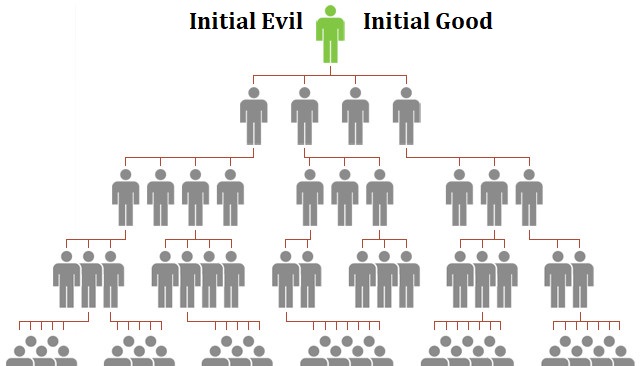
Example: Someone is selling drugs to young kids and this drug dealer dies. So in his record it is recorded that this person was drug dealer and sold drugs (end of story).
However, there is something added to the book which is the footprints (traces).
Now those small boys whom the drug dealer sold the drugs to they became addicted they became criminals they grew up to become drug dealers themselves.
So guess what? Who takes that burden who takes that responsibility? The initial drug dealer.
Of course those people are responsible for their own actions that they have acquired, yet, we cannot forget the initial drug dealer is responsible for this cascading chain of events and so the initial drug dealer shares in the evil that his actions wrought!
So this should make every one of us extremely cautious about what we do, what we say, and our influence upon others. So don’t think when you die you will only be rewarded for what you did. You will be rewarded for all the good that you initiated and others followed and were encouraged by. Likewise you will be punished for all the evil, wrongdoing, misguidance, lies, cheating etc. that others emulated, followed and in turn encouraged others to emulate.
If you make a video and post it on YouTube showing people how to break into a house, how to crack an encryption, and then, look, it goes viral.
Look at that word, viral! It now spreads and multiplies how evil is the return.
It was narrated from Mundhir bin Jarir that his father said:
“The Messenger of Allah (saw) said: ‘Whoever introduces a good practice that is followed, he will receive its reward and a reward equivalent to that of those who follow it, without that detracting from their reward in the slightest.And whoever introduces a bad practice that is followed, he will receive its sin and a burden of sin equivalent to that of those who follow it, without that detracting from their burden in the slightest.'”
Source: (https://sunnah.com/ibnmajah:203)
Jarir b. Abdullah reported that some desert Arabs clad in woollen clothes came to Allah’s Messenger (saw). He saw them in sad plight as they had been hard pressed by need. He (the Holy Prophet) exhorted people to give charity, but they showed some reluctance until (signs) of anger could be seen on his face. Then a person from the Ansar came with a purse containing silver. Then came another person and then other persons followed them in succession until signs of happiness could be seen on his (sacred) face. Thereupon Allah’s Messenger (saw) said:
He who introduced some good practice in Islam which was followed after him (by people) he would be assured of reward like one who followed it, without their rewards being diminished in any respect. And he who introduced some evil practice in Islam which had been followed subsequently (by others), he would be required to bear the burden like that of one who followed this (evil practice) without their’s being diminished in any respect.
Source: (https://sunnah.com/muslim:1017e)
“And most certainly they shall carry their own burdens, and other burdens with their own burdens, and most certainly they shall be questioned on the resurrection day as to what they forged.” (Qur’an 29:13)
“Truly, We give life to the dead and We write down what they put forward and their effects. We counted everything in a clear record.” (Qur’an 36:12)
So in simple terms none of us will get rewarded for the good that others do or punished for the evil that others do. However, we can have shared reward and shared punishment based upon the influence of good or evil that we have upon others.
May Allah (swt) rectify our condition and cause us to be examples of good for others to emulate!
The fact that Allah (swt) does not cause us to bare the burdens of the sins of others is an established fact that even the Jews and Christians can find remnants of in their teachings:
“And when there came to them a Messenger from Allah, confirming what was with them, a faction of those who were given the Scripture threw the Scripture of Allah behind their backs, as though they didn’t know.” (Qur’an 2:101)
“And the little ones that you said would be taken captive, your children who do not yet know good from bad—they will enter the land. I will give it to them and they will take possession of it.” (Deuteronomy 1:39)
“And he said: “Truly I tell you, unless you change and become like little children, you will never enter the kingdom of heaven.” (Matthew 18:3)
All little children are those to whom the kingdom of heaven belongs. Therefore, all little children are persons without sin.
“The one who sins is the one who will die. The child will not share the guilt of the parent, nor will the parent share the guilt of the child. The righteousness of the righteous will be credited to them, and the wickedness of the wicked will be charged against them.” (Ezekiel 18:20)
“The fathers shall not be put to death for the children, neither shall the children be put to death for the fathers: every man shall be put to death for his own sin.” (Deuteronomy 24:16)
“Yet he did not put the children of the assassins to death, in accordance with what is written in the Book of the Law of Moses where the Lord commanded: “Parents are not to be put to death for their children, nor children put to death for their parents; each will die for their own sin.” (2 Kings 14:6)
“Neither this man nor his parents sinned,” said Jesus, “but this happened so that the works of God might be displayed in him.” (John 9:3)
The above texts record that the child will not bear the sin of their father. Therefore, all men are not born totally depraved.
At the very least this position as outlined in Islam, Judaism, and some interpretations of Christianity such as: Eastern Orthodox, and those Christian Churches and Churches of Christ often called: “Campbellites” have this as a common perspective.
In short:
No one is punished for another’s sin.
Everyone is rewarded or punished for their own deeds.
And additionally, one is held accountable for the chain of influence they initiate—good or evil.
May Allah make us among those who leave behind good footprints (athar hasan) and protect us from being a means of misguidance. Amin.
You may wish to read the following:
May Allah (swt) guide the Ummah.
May Allah (swt) forgive the Ummah.


On the subject of the interaction of Divinity and humanity, may I ask if Islam possesses a tradition of ‘Theosis’, in which human beings many by union with the supreme God become ‘gods’ through participation?
Thank you for your question. In the Ibadi we build our theology upon that which is certain. The clear cut certain verses of the Qur’an or the mutawatir hadith.
So for example even in your questioin you put two words in quotations. ‘Theosis’ and ‘gods’.
Your first quotation mark seems to be used in a linguistic or academic sense.
Whereas your second quotation mark seems to be what is called a scare quote. Which sugget doubt.
There would be no need to have the quotation marks if people did indeed become ‘gods’.
With due respect sometimes we wonder your intentions given that you have commented on our article concerning henotheism. It is very clear that Islam does not teach that Allah is a god among gods.
What we do not believe is that people who are not prophets can obtain a status that a Prophet has not even obtained.
So for example. In the Eastern Orthodox view of ‘Theosis’ they have a major problem.
They claim that saints reach a state that the Father never allowed for the first man, Adam.
In fact, The Bible has the following:
According to the Bible it was not due to sin but due to God’s fear.
Contary to what some may think in the Bible God does not remove Adam and Eve from the garden for their sin. He removes them from the garden for fear that they will become immortal!
“Then the Lord God said: See! The man has become LIKE ONE OF US, knowing good and evil! Now, what if he also reaches out his hand to take fruit from the tree of life, and eats of it and lives forever? The Lord God therefore banished him from the garden of Eden, to till the ground from which he had been taken. He expelled the man, stationing the cherubim and the fiery revolving sword east of the garden of Eden, to guard the way to the tree of life.” (Genesis 3:22-24)
So from Orthodox perspective, Genesis 3 is not God opposing theosis itself, but opposing autonomous acquisition of immortality after disobedience.
If Adam and Eve could remain in the garden without eating from the tree of life, then merely forbidding the tree should have been enough. But the narrative says God expels them entirely and stations cherubim to guard the way to the tree.
“For God knows that when you eat from it your eyes will be opened, and you will be like God, knowing good and evil.” (Genesis 3:5)
Satan is the one who said this. Not a Prophet. How can Satan be a giver of Christian truths when according to Christians Jesus said the following about him.
“You belong to your father, the devil, and you want to carry out your father’s desires. He was a murderer from the beginning, not holding to the truth, for there is no truth in him. When he lies, he speaks his native language, for he is a liar and the father of lies.” (John 8:44)
Christian Evangelist Benny Hinn would teach this ‘little god’ theology in his Word of Faith movement.
(“You are gods, you are all sons of the Most High”) Psalm 82:6 This passage is a reference
to the idea that people did believe the angels are sons of God. This is clear in the fact
that there is no single text anywhere in the New Testament that explicitly states that Jesus is the only son of God.
Allah (swt) says:
“Not brought from like-kind and does not bring forth like-kind.” (Qur’an 112:3)
So there is no monogenēs when it comes to the one true God.
“My prayer is not for them alone. I pray also for those who will believe in me through their message, 21 that all of them may be one, Father, just as you are in me and I am in you. May they also be in us so that the world may believe that you have sent me. 22 I have given them the glory that you gave me, that they may be one as we are one— 23 I in them and you in me—so that they may be brought to complete unity. Then the world will know that you sent me and have loved them even as you have loved me. (John 17:20-23)
This is for those who believe in these text. Rather someone partially shares in God’s glory would mean that Jesus partially shared in God’s glory. If somenoe fully shares in God’s glory then again this makes sense in a henotheist frame work.
It conflicts with monotheism. Completey alien to Islam. Shirk.
There is no sharing or partaking ontologicaly with Allah (swt).