
“And when Jesus, son of Mary, said: O’ children of Israel, surely I am the messenger of Allah to you, verifying that which is before me of the Torah and giving the good news of a Messenger who will come after me, his name being AHMAD. But when he came to them with clear arguments, they said: This is clear enchantment.”(Qur’an 61:6)
﷽
This text of the Qur’an has either been a means where Christians have tripped themselves up; or it has been a huge eye opener, one that has led many of them to embracing Islam.
So when dealing with Christians concerning this text you will find those who fall into one of two categories.
A) Those who are insincere and think this text of the Qur’an is some how a problem for Muslims.
B) Those whom are sincerely inquiring into the matter and willing to ponder over the justifications that are given.
The first very obvious point is that this text of the Qur’an no where said that Ahmad is written in any competing number of Christian New Testament canons. The text states: “And when Jesus, son of Mary, said:
Often those Christians antagonistic to Islam read the above text of the Qur’an and think that a Muslim should reply: “Oh yes that is in Matthew chapter so and so verse so and so.”
There is nothing in Qur’an 61:6 that would indicate that the name ‘Ahmad’ would be captured in any of the competing Christian New Testament canons
This would be similar to the text of the New Testament:
“And he went and lived in a city called Nazareth, that what was spoken by the prophets might be fulfilled: “He shall be called a Nazarene.” (Matthew 2:23)
The reason why Christians have not been able to find that particular prophecy is because the above text said it was: ‘spoken’ by the prophets not necessarily that it was written by the prophets.
Archbishop of Constantinople John Chrysostom offers a possible perspective.
This Archbishop of the Latin Roman Catholics/Eastern Orthodox Christians offers an interesting perspective.
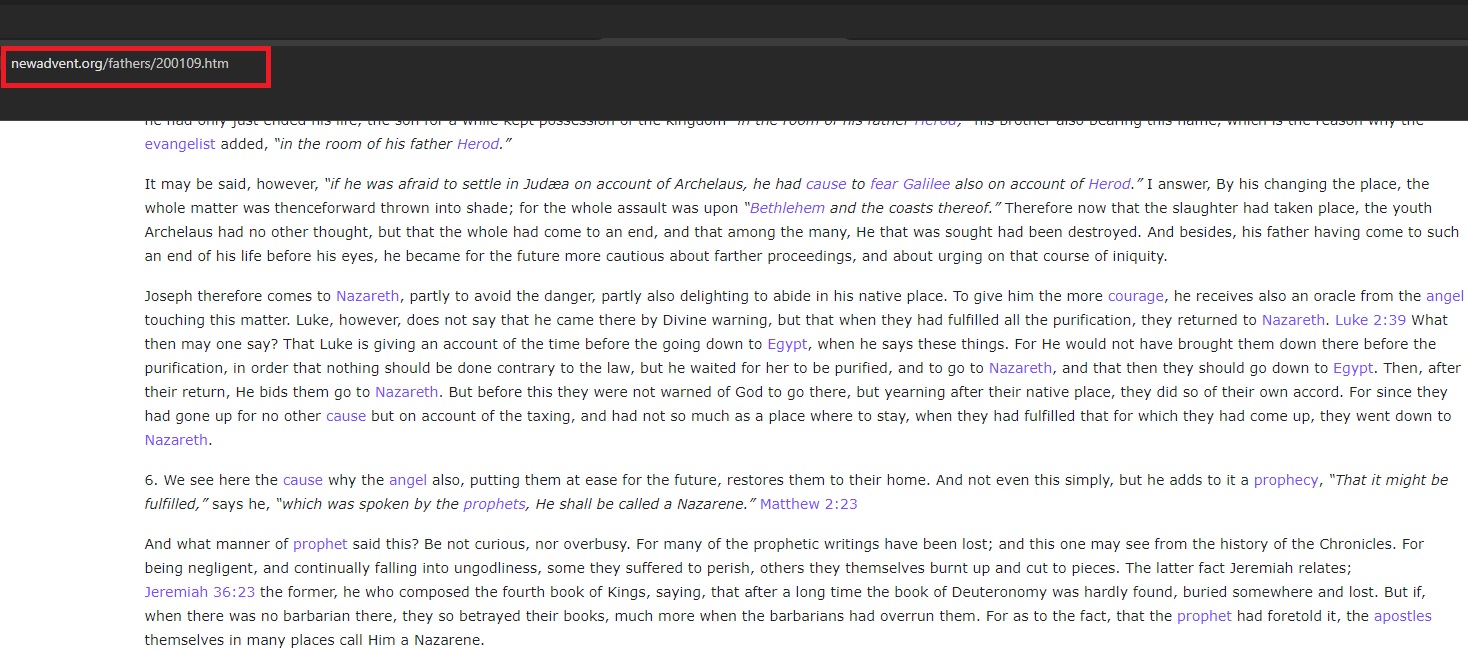
“We see here the cause why the angel also, putting them at ease for the future, restores them to their home. And not even this simply, but he adds to it a prophecy, That it might be fulfilled,
says he, which was spoken by the prophets, He shall be called a Nazarene.
Matthew 2:23.”
“And what manner of prophet said this? Be not curious, nor overbusy. For many of the prophetic writings have been lost; and this one may see from the history of the Chronicles. For being negligent, and continually falling into ungodliness, some they suffered to perish, others they themselves burnt up and cut to pieces. The latter fact Jeremiah relates; Jeremiah 36:23 the former, he who composed the fourth book of Kings, saying, that after a long time the book of Deuteronomy was hardly found, buried somewhere and lost. But if, when there was no barbarian there, they so betrayed their books, much more when the barbarians had overrun them. For as to the fact, that the prophet had foretold it, the apostles themselves in many places call Him a Nazarene.” -Archbishop of Constantinople John Chrysostom
Source: (https://www.newadvent.org/fathers/200109.htm)
Thus, if what Archbishop of Constantinople John Chrysostom says of ‘The Nazarene’ is true than it is likewise that this could be the case for ‘Ahmad’. Namely:
“For many of the prophetic writings have been lost; and this one may see from the history of the Chronicles. For being negligent, and continually falling into ungodliness, some they suffered to perish, others they themselves burnt up and cut to pieces.”
This argument merely demonstrates that the absence of “Ahmad” from any competing New Testament canon does not disprove the Qur’anic claim.
Did Jesus ever write anything?
They were using this question as a trap, in order to have a basis for accusing him. But Jesus bent down and started to write on the ground with his finger. When they kept on questioning him, he straightened up and said to them, “Let any one of you who is without sin be the first to throw a stone at her.” Again he stooped down and wrote on the ground. (John 8:6-8)
The assumption is that Jesus (as) wrote what he spoke: “Let any one of you who is without sin be the first to throw a stone at her.” Yet, we have no idea what he wrote the second time.
Not only this but may Allah (swt) reward brother Ammar in the comments section. He had reminded us that even the text that alleges Jesus (as) wrote something in the sands is considered a forgery.
This is taken from a Christian website:
https://www.gotquestions.org/John-7-53-8-11.html
The story is a clear forgery. Wasn’t found in the 4th century manuscripts.
The New Testament also mentions that Jesus said things that were not recorded.
“After the festival was over, while his parents were returning home, the boy Jesus stayed behind in Jerusalem, but they were unaware of it. Thinking he was in their company, they traveled on for a day. Then they began looking for him among their relatives and friends. When they did not find him, they went back to Jerusalem to look for him. After three days they found him in the temple courts, sitting among the teachers, listening to them and asking them questions. ” (Luke 2:43-46)
Luke does not record any questions that Jesus asked! So this is clear evidence that there are indeed things that Jesus said that are not captured nor recorded by the New Testament.
Since Jesus (as) didn’t really write anything it makes sense we wouldn’t find anything written concerning “Ahmad”. And even if he did write something, we have no evidence it was preserved.
However, note the above text does state that Jesus (as) said:
“Oh children of Israel, surely I am the messenger of Allah to you, verifying that which is before me of the Torah and giving the good news of a Messenger who will come after me, his name being Ahmad.” (Qur’an 61:6)
This is more than sufficient for those who believe. Allah (swt) said that Jesus (as) said it and that is enough for the Muslims.
We are not required to go beyond this. ⬆️⬆️⬆️
Though, for those Christians who are sincere we will endeavor to give them some things to reflect over.
What you are about to read is simply food for thought for those inquiring into the matter.
The New Testament teaches that Jesus never claimed to be the last Prophet.
Jesus (as) never claimed to be the last prophet. That admission in and of itself already is an argument in favour of our proposition. It does not necessarily prove it. However it is a point in favour of our proposition.
Think about this.
When other Christian denominations get into debates and discussions with Mormons (The Church of Jesus Christ of the Latter Day Saints) they never shut down the Mormons with saying: “Well, Joseph Smith can’t be a Prophet because Jesus said there would be no more.” If that were so the matter would be an open and shut case.
This is a significant point in favour of the Islamic position.
If Jesus never claimed to be the last prophet, then:
There is no theological barrier to another prophet coming after him. Nothing in Jesus’s teaching rules this out.
First, Jesus himself didn’t shut down the possiblity of true prophets or even other messiahs coming!
“For false messiahs and false prophets will appear and perform great signs and wonders to deceive, if possible, even the elect.” (Matthew 24:24)
Jesus could have closed the door by stating, “There will be no Messiah after me”. He didn’t. He could have said, “There will be no prophet after me.” He didn’t.
The New Testament gives many examples of prophets who came after Jesus.
“Now there were in the church at Antioch prophets and teachers, Barnabas, Simeon who was called Niger, Lucius of Cyrene, Manaen a lifelong friend of Herod the tetrarch, and Saul.” (Acts 13:1)
“And Judas and Silas, who were themselves prophets, encouraged and strengthened the brothers with many words.” (Acts 15:32)
“And as we tarried there many days, there came down from Judaea a certain prophet, named Agabus.” (Acts 21:10)
What has passed is more than sufficient to answer the objections of those who attack the Qur’an 61:6. We can see that the Qur’an says that it was something that Jesus (as) spoke and it doesn’t say it was written. We can also see that the New Testament does not have a definite statement about Jesus (as) being the last prophet.
However, for those Christians who like to reflect we will present more information to reflect upon.
Discussing the Identiy and the Prophecy of the Comforter/Advocate.
Why does the identify of the Comforter need clarification?

[Click on the image above. Then right click that image and select open image in new tab. Ctrl and mouse wheel or Ctrl and +,- to zoom in/out.] Voila!
Now notice something about this text in John 14:26. Notice that the identity of The Comforter seems to be a matter of ambiguity. This ambiguity is followed up by the clarification: ‘Which is the Holy Spirit‘
Now to be clear, of the Greek manuscripts that we currently know about, John 14:26 is read as: “The Comforter, Which is the Holy Spirit.” We are saying this in the interest of transparency and not to over state the case.
However, the very presence of this clarification suggests that the identity of the Paraclete was not self-evident to the original readers. If the meaning were obvious, no clarification would be needed.
What we are going to present is justification to show that this is a scribal insertion.
As you can read the text on the left is quite intelligible without the addition ‘Which is the Holy Spirit‘.
Some Early Church Fathers saw the possibility of the Paraclete being a reference to a human being.
The Montanists professed to be prophets and to speak under divine inspiration. Their founder, Montanus, claimed to be the Paraclete, the “Comforter,” or Helper, of John, chapter 14. Tertullian became a Montanist before he died.”
Source: (Edgar J Goodspeed How Came The Bible pg. 67.)
Eusebius explicitly states that some “boasted that Montanus was the Paraclete”
Prima Qur’an Comment: Tertullian and Monatanus were early church fathers who played a crucial role in the development of the New Testament text Christians have today. So if such learned men saw the possibility of the Paraclete referring to a human being then who are we to say?
The Christians will claim thath Montanist did not claim that Montanus himself was the Paraclete. Instead,
they believed the Holy Spirit spoke through Montanus and his prophetesses.
As one can see from the comments section of this post our engagement with a Christian below reveals there are debates on rather Montanist theology was monolithic.
Sources note distinctions between Monarchian and non-Monarchian Montanist.

“The enemy of God’s Church, who is emphatically a hater of good and a lover of evil, and leaves untried no manner of craft against men, was again active in causing strange heresies spring up against the Church. For some persons, like venomous reptiles, crawled over Asia and Phrygia, boasting that Montanus was the Paraclete, and that the women that followed him, Priscilla and Maximilla, were prophetesses of Montanus.”
Source: Eusebius, Ecclesiastical History volume 5 chapter 14
Source: (https://www.newadvent.org/fathers/250105.htm)
“Christian tradition has identified this figure (Paraclete) as the Holy Spirit, but scholars like Spitta, Delafosse, Sasse, Bultmann, and Betz have doubted whether this identification is true to the original picture and have suggested that the Paraclete was once an independent salvific figure, later confused with the Holy Spirit.”
Source: (The Anchor Bible, 1970, Volume 29A, p.1135)
“The Paraclete is a parallel figure to Jesus himself; and this conclusion is confirmed in the fact that the title is suitable for both. It is clear from 14:16 that the source thought there were sending of two Paracletes, Jesus and his successor, the one following the other”
Source: (The Gospel of John a Commentary, Rudolf Bultmann, p. 567)
The word Paraclete is used in the New Testament to refer to a human being
“My little children, these things write I unto you, that you sin not and if any man sin, we have an advocate (Parakleton) Παράκλητον with the Father, Jesus Christ the righteous) (1st John 2:1)
Note: The first time the word Paraclete is used is in reference to a man, Jesus.
Jesus (as) mentions that the Paraklete will be like him -and not unlike him.
“If you love me, keep my commandments, and I will pray for the Father, and he shall give you another Comforter (allon Parakleton) ἄλλον Παράκλητον, that HE may abide with you forever.” (John 14:15-16)
‘Another‘- the Greek word Allon means another of the same kind.
The ‘allon Parakleton‘ means in addition to himself another messenger, not heteros, another of a different kind!
If Jesus (as) meant a comforter of a different kind he would have used the Greek word heteron meaning-another of a different kind. The Greek word heteron is where we get the word heterosexual.
An example of the Greek word heteros being used.
“I marvel that you are so soon removed from him that called you into the grace of Christ another (heteron) ἕτερον gospel.” (Galatians 1:6-9)
(Here the Greek word another (heteron) is another of a different kind.)
A derivative of the word Paraclete is also used to reference a human being.
“Joseph, a Levite from Cyprus, whom the apostles called Barnabas (which is translated as “son of encouragement (parakleseos)” (Acts 4:36)

This is such a very curious text that is full of obfuscation. So we have an individual named Joseph, which is being called ‘Barnabas’ by the apostles. Which in turn is being translated as: The son of encouragement [Parakleseos].
Does the Holy Spirit hear and speak?
“I have many things to say unto you, but you cannot bear them now. Howbeit when HE, the Spirit (Pneuma)Πνεῦμα of truth comes HE will guide you into all truth: (HOW?) For HE shall not speak of HIMSELF; But whatsoever HE shall hear (akousei) ἀκούσει that shall HE speak (lalesei) λαλήσει and HE will show you things to come.” (John 16:12-13)
HEAR– The Greek verb (akousei) means to perceive audible sounds.
SPEAK-The Greek verb ; (lalesei) means to speak, to emit sounds.
So this HE has to be able to hear audibly and tell verbally.
The two Greek words Akousei and Lalesei refer to a concrete being with speech organs.
Recall the following text:
” But the Spirit itself (auto) αὐτὸ itself makes intercession for us with groanings which cannot be uttered.” (Romans 8:26)
Ask a Christiain does the Holy Spirit speak? Ask him (The Holy Spirit) to speak then!
Does (John 16:12-13) apply to the Holy Spirit? No!
A) Shall not speak of Himself.
B) Whatso ever He shall here is what he will speak.
This cannot be a reference to the Holy Spirit as Christians understand it.
The Qur’an is the created speech of Allah and and the Blessed Prophet (saw) is the mouthpiece of this created speech.
“By the star when it goes down your companion is neither astray nor being misled, nor does he say of his own desire. It is no less than an inspiration sent down to him: He was taught by one mighty in power.” (Qur’an 53:1-5)
Another point is if we reflect upon the above text it presents problems for Christian theology.
“For HE shall not speak of HIMSELF; But whatsoever HE shall hear (akousei) ἀκούσει that shall HE speak (lalesei) λαλήσει and HE will show you things to come.”
How would the speech of the Spirit be different than the speech of the Father in essence?
Why would the Holy Spirit need to be told what to say when his knowledge is the same as the knowledge of the father in essence?
Remember, Christians cannot use the fully deity/full man argument like they can for Jesus. The Holy Spirit does not have two natures as the Dyophysitist (majority of Christianity) claim about Jesus.
So the text of (John 16:12-13) does not necessarily need to be about a man. However, it is equally not possible for it to be about the Holy Spirit-at least not as Christians today understand it.
Say, “Whoever is an enemy of Gabriel should know that he revealed this to your heart by Allah’s Will, confirming what came before it—a guide and good news for the believers.” (Qur’an 2:97)
Angel Gabriel hears from Allah and speaks to the prophets. This is exactly what angels do. They receive and deliver messages. Gabriel is a created being who hears the command of Allah.
The Christian doctrine of the Trinity has historically struggled with the subordination question. The text of John 16:13 seems to imply a subordinate figure. A figure who hears and speaks, who receives rather than originates. This fits Gabriel perfectly.
Jesus (as) constantly refers to the Paraclete as ‘He’ and not ‘It’.
When one goes back and looks at all the text Jesus consistently used the masculine pronoun ‘He’, however, Spirit in Greek is used in the neuter gender which could be he, she or simply it.
lLet us look at various translations of John 1:32.
Notice that the King James version translates the neutral gender as ‘it’ where as in the New King James version they switch it to ‘He’. The other versions also make it masculine gender as ‘He’, or ‘himself’. The New International Version is the best translation remaining non committal in the gender specification.

“Likewise the Spirit also keeps our infirmities: For we know not what we should pray for as we ought: But the Spirit itself (auto) αὐτὸ itself makes intercession for us with groanings which cannot be uttered.” (Romans 8:26)
The above passages show the Holy Spirit as neuter gender which means passages can translate the Holy Spirit as She, He, It. Whereas it is clear that the Paraklete is only referenced as ‘He’.
Recall the point about Jesus calling the Paraklete as (allon Parakleton) ἄλλον Παράκλητον
Another of the same kind, the same genus. The Holy Spirit can be her, him, or it. Jesus is not reference as ‘her’ or it’.
Another reason why (The Comforter, Which is the Holy Spirit) is a scribal insertion.
The New Testament claims Jesus must go away in order for the Holy Spirit to come.
Jesus (as) is reported to make the following claim:
“Nevertheless I tell you the truth; it is expedient for you that I go away: for if I go not away, The Comforter (Parakletos)Παράκλητος will not come to you; but if I depart, I will send HIM unto you.” (John 16:7)
Yet, the same New Testament clearly shows The Holy Spirit concurrent with Jesus.
So Jesus has to depart in order for this Paraklete to come. Based upon this admission the Paraklete cannot be not the Holy Spirit!
The reason why the Paraklete cannot be the Holy Spirit is because Jesus (as) was around when the Holy Spirit was around.
We have ample proof text that make this abundantly clear.
“And the Holy Spirit descended in a bodily shape like a dove upon him.” (Luke 3:23)
(Jesus didn’t have to go anywhere!)
“And Jesus being full of the Holy Spirit returned from Jordan, and was led by the Spirit into the wilderness.” (Luke 4:1)
(Again Jesus and Holy Spirit are present together.)
“Jesus said to them again, “Peace be with you. As the Father sent me, So I send you.” And when he had said this, he breathed on them and said to them, Receive the Holy Spirit.” (John 20:21-22)
(Jesus didn’t go anywhere!)
“ For he will be great in the sight of the Lord. He is never to take wine or other fermented drink, and he will be filled with the Holy Spirit even before he is born.” (Luke 1:15)
John was filled with the Holy Spirit before he was even born, which is unlike Jesus who had to receive the Holy Spirit after baptism. The point being John (being filled with the Holy Spirit) was around Jesus.
(Jesus didn’t go anywhere!)
So all these text prove that this Paraklete cannot by the Holy Spirit as Jesus (as) has been around when the Paraklete has been around.
However, Jesus (as) mentions that he needs to go in order to come. This is also an indirect proof that Jesus (as) is dead and not like some have imagined that he is alive in the heavens.
Conclusion.
Jesus departing. These texts are explicit and have proven to be a problem for Christians. The only thing
the Christian can do is to say that the Muslims do not understand these texts. Then the Christian only offers an interpretation of what is obviously clear text.
If the Paraclete is the Holy Spirit, then Jesus was wrong to say the Paraclete would only come after his departure. Either the text is inconsistent, or the identification is incorrect.
John 16:12-13 Does this refer to a Prophet to come or the Spirit of Truth?
“I have many things to say unto you, but you cannot bear them now. Howbeit when HE, the Spirit (Pneuma)Πνεῦμα of truth comes HE will guide you into all truth: (HOW?) For HE shall not speak of HIMSELF; But whatsoever HE shall hear (from God) that shall HE speak: and HE will show you things to come.” (John 16:12-13)
So a Christian may object that this can be a reference to a Prophet because the word spirit is clearly used. However, that is because the word ‘spirit’ is being used as a metonymy for a Prophet. It has been used in the following verse in such a way:
“Beloved believe not every SPIRIT (pneumati) πνεύματι , but try the SPIRITS (pneumata) πνεύματα whether they are of God: Because many false PROPHETS are gone out into the world. Hereby know you the SPIRIT of God: Every SPIRIT that confessed that Jesus Christ has come in the flesh is of God:” (1 John 4:1-6)
So you can see that Spirits/Prophets are used interchangeably. So that objection is answered.
However, Muslims can be charitable and agree that this does indeed refer to the Holy Spirit.
Al-Rūḥ Al-Amīn (Trustworthy Spirit)mentioned in the Qur’an.
“‘Which the trustworthy spirit brought down into your heart so that you may be one of the warners.” (Qur’an 26:193-194)
“Say, “The holy spirit has brought it down from your Lord with the truth to reassure the believers, and as a guide and good news for those who submit.” (Qur’an 16:102)
Jesus claims that neither he nor the Bible guide you into all truth.
“I have many things to say unto you, but you cannot bear them now. Howbeit when HE, the Spirit (Pneuma)Πνεῦμα of truth comes HE will guide you into all truth: (HOW?) For HE shall not speak of HIMSELF; But whatsoever HE shall hear (from God) that shall HE speak: and HE will show you things to come.” (John 16:12-13)
This means The Bible alone does not contain all truth. It is only a partial revelation at bests and is awaiting the Spirit of Truth and his guidance.
By admission Jesus is not guiding you into all truth. There is one who comes after him that does this.
This creates a problem for the Protestant: If the Spirit guides into all truth, then the Scripture can’t be the only infallible authority.
This creates a problem for Catholics/Orthodox: If the Church (tradition) is the vehicle of the Spirit’s guidance, then the Church’s authority is self-referential and circular.
This is circular because:
- The Church’s authority depends on the Bible
- The Bible’s authority depends on the Church
- Neither can independently validate the other
One thing that the Holy Spirit has never guided the Church on.
Here is a major point that the according to the Oriental Orthodox, the Eastern Orthodox, The Roman Catholics, the Anglicans, the Presbyterians, the Baptist that the Holy Spirit has never guided any of them on.
You see the above Christian groups will tell you that God is one being in three persons. That these three persons are the Father, the Son and the Holy Spirit. They will tell you that the name of the son is Jesus. They will tell you that the name of the Father is Yahweh. But they will never tell you what the name of the Holy Spirit is. Why is that?
Why can they give us the name of the Father and the name of the Son but not the name of the Holy Spirit?
We can put Christian claims to the test in real time.
“Ask, and it shall be given you; seek, and you shall find; knock, and it shall be opened unto you: For every one that ask receives; and he that seeks shall find; and to him that knocks it shall be opened.” (Matthew 7:7-8)
So we can ask any Christian on Earth from any denomination to ask the Holy Spirit to reveal his name to them. There is not justifiable reason why he shouldn’t.
Christian objections to some Muslim claims.
Now given that some Muslims use (John 16:12-13) as a reference to the coming of the Blessed Prophet Muhammed (saw) we will look and see what is a sound Christiain objection and what is not a sound objection.
1st Christian objection.
“The Spirit of truth. The world cannot accept him, because it neither sees him nor knows him. But you know him, for he lives with you and will be in you.” (John 14:17)
It cannot be said that Prophet Muhammed (saw) will live inside anyone. This is unless we use some strained metaphor about his teachings living inside of us. However, it is best not to be like the Christians who use truly strained readings of their text. So this is a sound Christiain objection.
However, the above text is contradicted by the following:
“Nevertheless I tell you the truth; it is expedient for you that I go away: for if I go not away, The Comforter (Parakletos)Παράκλητος will not come to you; but if I depart, I will send HIM unto you.” (John 16:7)
The Holy Spirit can’t both live with the disciples and be present in their midst and Jesus also needs to depart from the disciples in order to send the Holy Spirit. This is not adding up.
The New Testament does not record Jesus baptizing any of his disciples.
““I baptize you with water for repentance. But after me comes one who is more powerful than I, whose sandals I am not worthy to carry. He will baptize you with the Holy Spirit and fire.” (Matthew 3:11)
Again, Jesus can’t be baptizing anyone with the Holy Spirit especially if it is expedient that he (Jesus) goes away.
The text of the Bible contradict the position of the Orthodox Church.
“In the Mystery of Chrismation (Gr. chrismatis, “anointing”), the newly baptized Orthodox Christian receives the Holy Spirit through anointing with oil by the bishop or priest. From the earliest times, the Church practiced Holy Chrismation immediately following Baptism. This same practice held, whether the newly baptized was an adult or an infant. Western churches (like Roman Catholics and Anglicans), in contrast, usually reserve Baptism and Chrismation for those who reach “the age of reason”.
Source: https://www.saintjohnchurch.org/receiving-the-holy-spirit/
“Now Jesus learned that the Pharisees had heard that he was gaining and baptizing more disciples than John although in fact it was not Jesus who baptized, but his disciples. (John 4:1-2)
So were these disciples unbaptized and performing baptism?
If they were baptized why didn’t they receive the Holy Spirit then and there?
Not only this but why isn’t anyone asking the obvious. Where in the hell did the idea of baptism even come from? None of the Old Testament prophets were ever baptized for the forgiveness of sins. The practice is completely alien to the Tanach. Christianity is not in continuity with the Old Testament teachings at all.
2nd Christian objection.
“But the Comforter, which is the Holy Spirit, whom the Father will send in my name, will teach you everything and remind you of all (πάντα καὶ ὑπομνήσει ὑμᾶς πάντα) that I have told you.” (John 14:26)
First notice the need for clarity. The Comforter, the Holy Spirit. So would we know that the Comforter is the Holy Spirit without the text giving this clarifying remark?
That being said Muhammed (saw) did not come in the name of Jesus. Why would he? So that part is problematic.
What is not problematic is that this Comforter will remind them of what Jesus told them.
This means that there would be some lapse in regard to what Jesus taught. Ironically that would include this very passages (John 14:26) as well as (John 14:16-17) & (John 16:7) & (John 15:26) in which Jesus is supposed to clarify the role of the Comforter as well as it’s identify.
πάντα καὶ ὑπομνήσει ὑμᾶς πάντα
The Greek word hypomnēskō unequivocally means “to remind.” It presupposes a lapse in memory.
Source: (https://biblehub.com/greek/upomne_sei_5279.htm)
A reminder is only necessary if something has been forgotten. If the disciples perfectly remembered everything Jesus taught, the Comforter’s role of “reminding” them would be redundant. Therefore, the text logically implies that:
- Some of Jesus’s teachings were lost or forgotten. (Including the identify and role of the Paraclete)
- The Comforter would come to restore or bring back what was lost.
If the Comforter needed to “remind” the disciples, then some teachings were at risk of being lost. This undermines the idea of a perfectly preserved tradition.
The Gospel of John itself (John 21:25) states: “There are also many other things which Jesus did, which if they were written one by one, I suppose that even the world itself could not contain the books that would be written.”
This is a clear admission that the Gospel accounts are selective, not comprehensive.
If the Gospel writers themselves admit that they did not record everything Jesus did or said, then the Comforter’s role of “reminding” becomes even more significant: the Comforter will restore what was not recorded, ensuring the essential teachings were not lost.
The text of John 14:26 is an admission that:
- Jesus taught more than what is recorded.
- The disciples were at risk of forgetting what he taught.
- The Comforter would bring back what was lost.
This is exactly what Allah (swt) says:
“And from those who say, “We are Christians” We took their covenant; but they forgot a portion of that which they were reminded. So we caused amonghtem animosity and hatred until the Day of Resurrection. And Allah is going to inform them about what they used to do.” (Qur’an 5:14)
3rd. Christian objection.
“Nevertheless, I tell you the truth: it is to your advantage that I go away, for if I do not go away, the Comforter will not come to you. But if I go, I will send him to you.” (John 16:7)
“But when the Comforter is come, whom I will send unto you from the Father, even the Spirit of truth, which proceedeth from the Father, he shall testify of me: (John 15:26)
The Christian objection is sound. Why would Jesus be the one to send the Blessed Prophet Muhammed (saw). However, as we saw from (John 14:26) it is the father who will send not Jesus. So which is it?
4th Chrisitan objection.
“And I will ask the Father, and he will give you another advocate to help you and be with you forever.” (John 14:16)
The problem comes from the word ‘forever’. The Christian will object and ask if the advocate is a reference to the Blessed Prophet Muhammed (saw) how is he with the believers forever?
This is answered by a number of ways.
“To the roots of the mountains I went down, to the land whose bars closed upon me forever. Yet you brought up my life from the pit, O Lord my God.” (Jonah 2:6)
Jonah was not literally in the land of the dead forever; “forever” means for an extended, indefinite period.
“I am with you always, even unto the end of the world.” (Matthew 28:20)
Jesus is not physically present but Christians could say they feel his presence or that his teachings live on with them. The same can be said of the Blessed Prophet Muhammed (saw).
It seems rather strange that the other Gospel writers have no mention about this coming Paraklete. Lastly, their remains some curiosity in the retention of the word Paraclete in the Hebrew and Aramaic translations.
The Qur’an 61:6 and the use of a type of literary device to that would be akin to an enthymeme.
“And when Jesus, son of Mary, said: O’ children of Israel, surely I am the messenger of Allah to you, verifying that which is before me of the Torah and giving the good news of a Messenger who will come after me, his name being AHMAD.” (Qur’an 61:6)
Do you ever wonder why the verse does not say: ”Giving the good news of a Messenger who will come after me, his name being MUHAMMED?”
Muhammed comes from the triconsonantal Semitic root H-M-D.

The spelling of the word is different but the meaning is the same.
- Jesus (as) did not speak Arabic and so what ever he did say would be in Hebrew or Aramaic and not Greek nor Arabic.
- What ever prophecy Jesus (as) made would either be ‘Ahmad’ or the equivalent of it’s meaning.
- Allah (swt) by using the word ‘Ahmad’ instead of the word ‘Muhammed’ has given us a type of enthymeme by which those interested can investigate the matter. That is to say it is possible that the scribes
“But on account of their breaking their covenant We cursed them and made their hearts hard; they altered the words from their places (yuharifuna l-kaima ‘an mawadi’ihi) and they neglected a portion of what they were reminded of; and you shall always discover treachery in them excepting a few of them; so pardon them and turn away; surely Allah loves those who do good (to others).” (Qur’an 5:13)
What may have been the word in Hebrew or Aramaic?

In the above text we can see the word transliterated as: Mahamaddim. They have translated the word as description ‘lovely.
In the Orthodox Jewish Bible they have put the transliterated word as: Machamaddim and have translated it as: (altogether desirable)
Source for the the text below: (https://www.biblestudytools.com/ojb/shir-hashirim/5.html)


Again a different translation this time we get: “wholly desirable” and we can see that the is a masculine noun pronounced as Machmad. The word origin for this is chamad.
By the way do yourself a favour and copy those Hebrew words and put them in Safari/Google translate and listen to how they sound.
Notice that the word in Hebrew is to be desired, delighted in, to covet, to be pleased with, and than look at the Arabic equivalent that they give! With its meaning to praise to eulogize.
Look at the Arabic word that they give.


This in and of itself is not a proof, but it is an intriguing piece of evidence that may point to a preserved remnant of the original prophecy.
May Allah (swt) open the eyes and hearts of those who are sincere.
For further reading on topics in relation to Christianity you may want to read the following:
May Allah Guide the Ummah.
May Allah Forgive the Ummah.


