“And give full measure when you measure out, and weigh with a true balance; this is fair and better in the end.” (Qur’an 17:35)
﷽
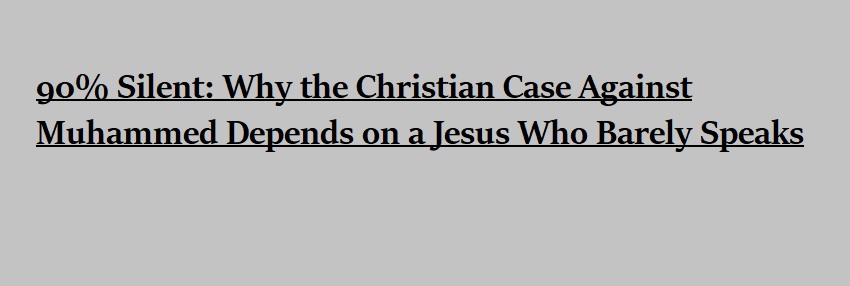
The Asymmetry No One Talks About
When Christian apologists attack the Blessed Prophet Muhammed (saw), they have an enormous body of material to work with. They cite the sīrah (biography), the ḥadīth (sayings and actions), and the maghāzī (campaign literature). From his first revelation at age 40 to his death at approximately 63, that is roughly 23 years of public prophetic activity. Even if one includes his life before prophethood, from age 25 (his first marriage to Khadījah-ra) to 40, that adds another 15 years of documented context. In total, critics have 35+ years of recorded material to analyze, critique, and polemicize.
But what about Jesus?
Most Christians have never stopped to ask a simple question: How many actual words attributed to Jesus are even in the New Testament? And more importantly: How much of Jesus’s life is actually recorded?
This article is not an argument for Islam. It is an argument for intellectual honesty. The comparison Christian apologists make between Jesus(as) and Muhammed (saw) is not balanced — not because Islam/Christianity is true/false, but because the evidentiary basis for each figure is radically different.
The Raw Data – How Many Words of Jesus Actually Exist?
According to a detailed analysis from synopticgospel.com, the total number of words attributed to Jesus Christ in the four canonical Gospels (Matthew, Mark, Luke, John) is 31,426.
But that number includes duplicate material. The same speeches and parables appear in multiple Gospels. Once you exclude the duplication of Jesus’s speeches across the Synoptic Gospels (Matthew, Mark, Luke), the total unique words drop significantly.
If you enter 31,426 words into a standard “Convert Words to Minutes” speech calculator, you find that it would take approximately 242 minutes — or about 4 hours — to read all of Jesus’s words aloud.
That is the sum total. Four hours of reading. That is everything Jesus is recorded as saying in the four Gospels.
Beyond the Gospels – Jesus’s Words in the Rest of the New Testament
Most Christians assume the Gospels are where Jesus speaks. That is correct. But what about the rest of the 27-book New Testament canon (the one accepted by Latin Roman Catholics, Eastern Orthodox, and most Protestants)?
Here is the complete inventory of words attributed to Jesus outside the four Gospels.
Acts of the Apostles
Acts 1:4-8 – The risen Jesus commands the apostles to wait for the Holy Spirit.
Acts 9:4-16 – Jesus appears to Saul (Paul) on the road to Damascus: “Saul, Saul, why do you persecute me?” and subsequent instructions to Ananias.
Acts 11:16 – Peter recalls Jesus’s words: “John baptized with water, but you will be baptized with the Holy Spirit.”
Acts 18:9-10 – Jesus speaks to Paul in a vision at Corinth: “Do not be afraid; keep on speaking… I am with you.”
Acts 20:35 – Paul recalls a saying of Jesus not found in the Gospels: “It is more blessed to give than to receive.”
Acts 22:7-10 – Paul’s retelling of the Damascus road experience.
Acts 22:18-21 – Jesus tells Paul to leave Jerusalem: “Go; I will send you far away to the Gentiles.”
Acts 23:11 – Jesus stands by Paul: “Take courage! As you have testified about me in Jerusalem, so you must also testify in Rome.”
Acts 26:14-18 – Paul’s third retelling, with additional detail: “It is hard for you to kick against the goads.”
1 Corinthians
1 Corinthians 11:24-25 – The institution of the Eucharist: “This is my body… This cup is the new covenant in my blood.”
2 Corinthians
2 Corinthians 12:9 – A saying of Jesus to Paul: “My grace is sufficient for you, for my power is made perfect in weakness.”
Revelation
Revelation 1–3 – The risen Christ speaks to the seven churches: “I am the Alpha and the Omega… Write to the angel of the church in Ephesus…” (approximately 20-30 verses of direct speech).
The Rest – Complete Silence
The following New Testament books contain zero direct words attributed to Jesus:
Romans
Galatians
Colossians
Ephesians
Philippians
1 Thessalonians
2 Thessalonians
1 Timothy
2 Timothy
Titus
Philemon
Hebrews
James
1 Peter
2 Peter
1 John
2 John
3 John
Jude
That is 19 books out of 27 with absolutely no direct quotation of Jesus.
The 27-Book Canon – A Closer Look
It is worth remembering that the 27-book New Testament was not the only canon in early Christianity. There were rival Christian communities with 22-book New Testaments and others with 35-book New Testaments. The canon we have today is the result of debates, disputes, and eventual ecclesiastical decisions.
But even granting the 27-book canon as authoritative, the fact remains:
Only 8 books contain any direct words of Jesus: Matthew, Mark, Luke, John, Acts, 1 Corinthians, 2 Corinthians, and Revelation.
19 books (70% of the New Testament by book count) have no words of Jesus in them at all.
Most Christians never stop to think about this. They assume the New Testament is full of Jesus speaking. In reality, the vast majority of the New Testament is written about Jesus — not by him, and not quoting him.
The 90% Problem – Jesus Lived 33 Years. We Have 3.
According to Luke 3:23, Jesus began his public ministry when he was “about thirty years old.” Traditional dating places his birth at approximately 4 BC and his crucifixion around AD 30 or 33. That gives him a lifespan of roughly 33 years.
His public ministry — the period from which we have any recorded words at all — lasted approximately 3 years.
3 years out of 33 = approximately 9% of his life.
That means 91% of Jesus’s life is completely silent in the New Testament.
From birth to age 12: one brief episode in the temple (Luke 2:41-52).
From age 12 to age 30: absolute silence. Nothing. No words. No actions. No teachings.
From age 30 to 33: roughly 4 hours of unique sayings (after excluding Synoptic duplicates).
Think about that. God incarnate, according to Christian theology, walked the earth for 33 years. The Christian record gives us only a handful of episodes from a 3-year window. The rest is silence.
Christian theology has an answer for this: the “hidden years” demonstrate Jesus’s full humanity, his ordinary life, his obedience. But that answer does not solve the historical or polemical problem. It simply explains why the silence is theologically acceptable.
For the purpose of comparing Jesus (as) to Muhammed (saw), the silence is not a theological virtue. It is an evidentiary void.
Age and Life Experience: The Unasked Question
There is another layer to this asymmetry that is almost never discussed: age. Jesus (as) died at approximately 33 years old. Muhammed (saw) died at approximately 63 years old. That is a 30-year difference. A full generation.
Now ask yourself: If Jesus had lived to 63 — if his public ministry had continued for another three decades beyond the brief three years recorded in the Gospels — how much more material would the New Testament contain? How many more sermons? How many more parables? How many more interactions with political authorities, with families, with enemies, with disciples who failed him? How many more decisions under pressure, more moments of moral complexity, more spoken words?
We cannot know, of course. The New Testament does not tell us. But that is precisely the point.
The Christian apologist who contrasts 23 years of prophetic activity (or 35+ years of documented adult life) with Jesus’s 3 years of public ministry is not comparing like with like. They are comparing a life cut short in its early thirties — a life whose longest documented period is measured in hours of speech — with a life that spanned more than six decades and produced enough literature to fill multiple volumes of hadith, sīrah, and tafsīr.
It is entirely possible that a 63-year-old Jesus would have said and done things that a 33-year-old Jesus did not. Perhaps he would have married. Perhaps he would have wielded political power. Perhaps he would have led what looked like military campaigns. Perhaps he would have said more things that later generations found morally uncomfortable. More so even than what we find today. We will never know. Because the claim is he died young. And the Gospels, as they exist, give us almost nothing from the first 30 years of his life and only a sliver from his final three.
To pretend that the silence of the New Testament is a moral or theological victory for Christianity — is to mistake absence of evidence for evidence of moral superiority. That is not scholarship. That is polemics dressed up as piety.
4 Hours vs. 35 Years – The Evidentiary Chasm
Now let us put the two figures side by side.
The data
Jesus (canonical NT)
Muhammed (sīrah, ḥadīth, maghāzī)
Public prophetic ministry
~3 years
~23 years (610-632 CE)
Total documented life
~9% (3 of 33 years)
~100% of prophetic period
Unique spoken words
~4 hours of reading aloud possibly 2 hours without repetitions from the synoptics.
Hundreds of thousands of ḥadīth (of various grades of authenticity)
Narrow: rural Galilee, Jerusalem, Roman occupation
Broad: Medinan state, marraiges, diplomacy, law, economics, community governance
When Christian apologists attack the Blessed Prophet Muhammed (saw), they have an enormous dataset. They can point to specific battles, specific marriages, specific political decisions, specific legal rulings, and specific moments of apparent moral failure — all dated, documented, and debated within Islamic tradition itself.
When Muslims (or anyone) try to respond symmetrically, they cannot. Not because Jesus was morally superior/inferior, but because the New Testament gives us almost nothing to work with outside a handful of sayings and a short public ministry.
The Christian Apologist’s Blind Spot
Here is the uncomfortable question this raises:
If your case against Muhammed (saw) depends on comparing his documented actions to Jesus’s silence, are you truly making a fair argument?
The Christian apologist will often say: “Jesus never married multiple women. Jesus never led raids. Jesus never owned slaves. Jesus never wielded political power.”
All of that is true — if we limit ourselves to the 3 years and 4 hours of material we have.
But the apologist rarely adds the necessary caveat: “And we have almost no information about what Jesus did or said for the other 30 years of his life.”
The comparison is not between two equally documented figures. It is between:
A man with 35+ years of dense, varied, politically and militarily detailed documentation (Muhammed), and
A man whose recorded words can be read aloud in an afternoon, and whose entire public ministry fits into a 3-year window (Jesus).
That is not a level playing field. It is not a fair comparison. And the Christian apologist who pretends it is has either not thought about the asymmetry or is deliberately ignoring it.
Conclusion – Not a Win, Just an Asymmetry
This article is not arguing that Christianity is false. It is not arguing that Islam is true. It is not even arguing that the Blessed Prophet Muhammwd was a better or worse prophet than Jesus.
It is arguing something much simpler — and much more uncomfortable for the Christian polemicist:
You cannot build a fair case against Muhammed (saw) by relying on a Jesus who barely speaks.
The New Testament is 90% silent about Jesus’s life. He spoke for approximately 4 hours of unique material over a 3-year public ministry. The rest of his 33 years are a blank slate.
The Islamic sources for the life of the Blessed Prophet Muhammed (saw) are vastly more detailed, more diverse, and more extensive. That gives the Christian apologist more material. It gives them more material because there is simply more material.
If the Gospels had recorded Jesus from age 12 to 30 — his words, his actions, his relationships, his work, his political views, his family life — the Christian polemic against the Blessed Prophet Muhammed (saw) might look very different. Or it might collapse entirely. We will never know.
Because the New Testament is silent.
And that silence is not the Christian apologist’s ace in the hole. It is the very thing that makes the comparison impossible from the start.
A Note to Christian Readers
If you are a Christian reading this and feeling defensive, ask yourself honestly:
Would you want your case for Jesus to rest on a comparison with the Prophet Muhammed (saw) that requires ignoring 30 years of Jesus’s life and the thinness of the Gospel record?
Or would you rather admit: “We don’t have much from Jesus outside a short ministry. That doesn’t prove Christianity false. But it does mean comparing him to Muhammed (saw) on deeds and sayings is apples to oranges.”
That is all this article asks. Honesty about the data. Just a recognition that the scales are not balanced — and they never were.
May Allah Guide the Jews and the Chrisitians to the truth!
“O People of the Book! Now Our Messenger has come to you, revealing much of what you have hidden of the book and disregarding much. There certainly has come to you from Allah a light and a clear Book. through which Allah guides those who seek His pleasure to the ways of peace, brings them out of darkness and into light by His Will, and guides them to the Straight Path. (Qur’an 5:15-16)
﷽
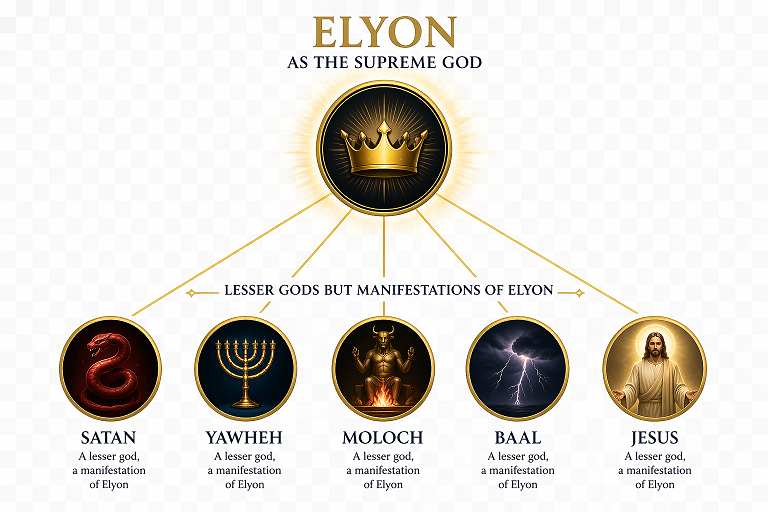
Henotheism is the worship of a single, supreme deity while acknowledging or accepting the existence of other, lesser gods.
Monotheism is the belief in the existence of only one god, or the oneness of God, distinguishing it from polytheism (many gods) and atheism.
The cypher of The Tetragrammaton revealed.
Tetra =4.
Gramma= letter.
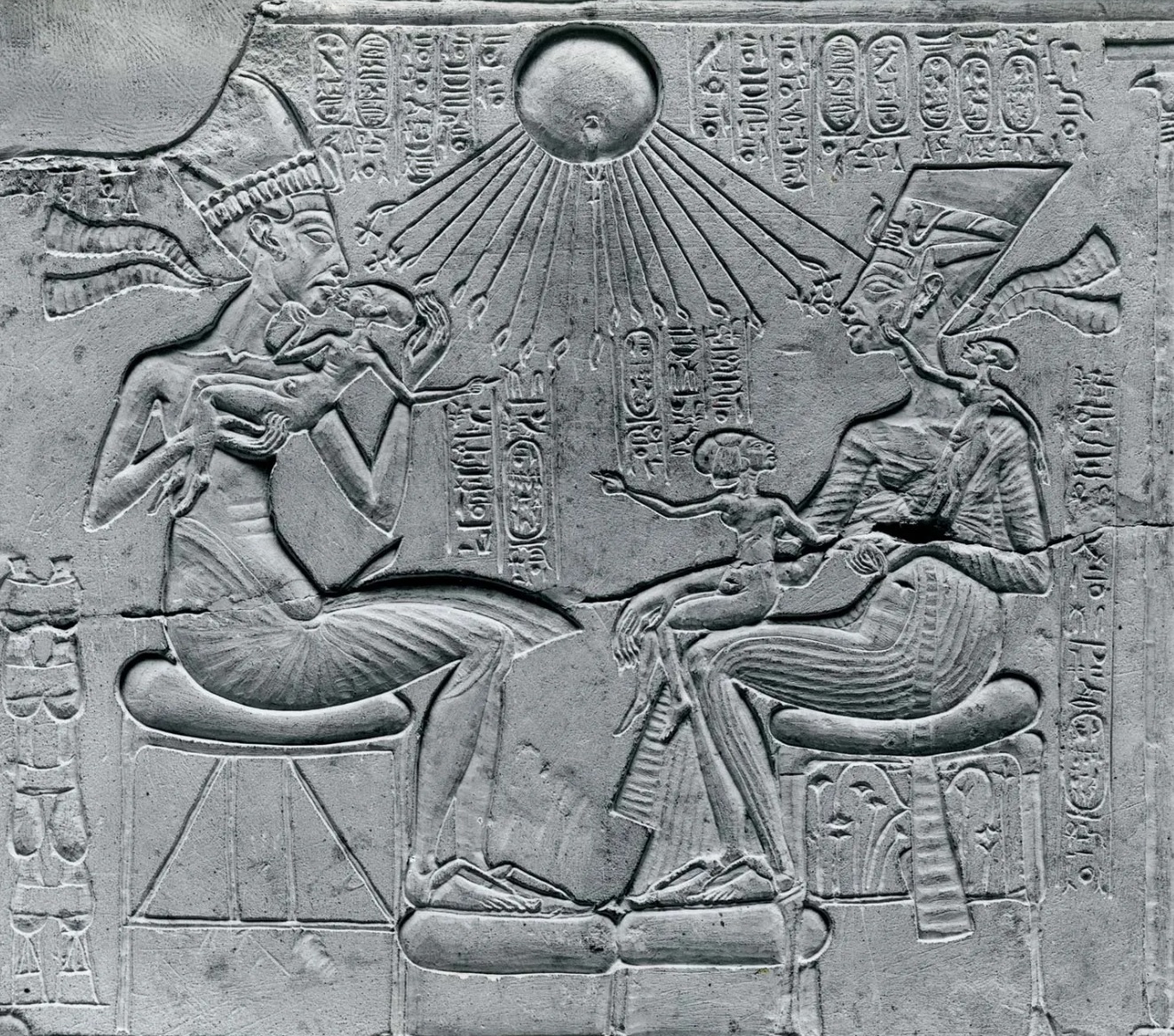
Aton (Aten).
The Bible claims that their god used to be called ‘Baal’.
“And in that day, declares the LORD, you will call me ‘My Husband,’ and no longer will you call me ‘My Baal.’ (Hosea 2:16)
Ba’al (בעל) is the most commonly used in modern Hebrew for husband.
“Eluzai, Jerimoth, Bealiah, Shemariah and Shephatiah the Haruphite…” (1 Chronicles 12:5)
Bealiah which means Jehovah is Baal.
However, because the name Baal had become so associated with the Canaanite deity, there becomes a prohibition that commands Israel to stop using that title for Him altogether . This also proves that Israelites were using the same name for their God prior to this prohibition.
Barnes’ notes on the Bible has the following:
“God says, “so wholly do I hate the name of idols, that on account of the likeness of the word Baal, “my Lord,” I will not be so called even in a right meaning, lest, while she utter the one, she should think on the other, and calling Me her Husband, think on the idol.”
Think of it like this. Maybe there was a woman married to a man named Thomas. This woman received a divorce from Thomas. Now this woman is married to you and your name happens to also be Thomas. So, during intimacy, it is possible that you would not want her to call out your name as it could be awkward.
In the Qur’an Allah (swt) has never once been identified with Baal.
In fact, the two are contrasted and never conflated.
“When he said to his people, “Will you not fear Allah ?”Will you call upon Baal and forsake the Best of Creators.” (Qur’an 37:124-125)
The Bible portrays Jesus as a rebelious son who went away from Elyon (God) and sacrificed to Baals and burned incense to images.
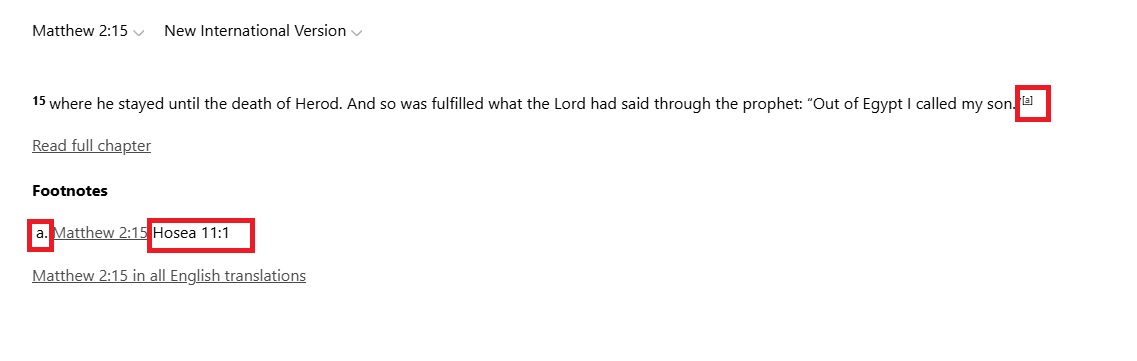
Hosea 11:1-2 in context says:
“When Israel was a child, I loved him, and out of Egypt I called my son. But the more they were called, the more they went away from me.They sacrificed to the Baals and they burned incense to images.” (Hosea 11:1-2)
The Qur’an presents clear monotheism.
“Allah! There is no god except Him, the Ever-Living, All-Sustaining.” (Qur’an 2:255)
Say, He Allah is Absolute. That which is independent of all but which all things are dependent upon. He does not bring for like kind nor was he from like kind And there is no equivalent to His being Absolute. (Qur’an 112:1-4)
This powerful surah is absolutely uncompromising.
We need to explain the reasons why we translate the text as we do.
Say, He Allah is Absolute.
We make a crucial distinction that most English translations obscure. Wāḥid appears throughout the Qur’an (e.g., 2:163, 5:73, 14:48) and means “one” in a numerical, countable sense. Aḥad, by contrast, appears in this surah and carries a different weight.
Wāḥid = one as opposed to two or more (quantitative oneness)
Aḥad = absolute, unique, singular without composition or peer (qualitative oneness)
Our translation of Aḥad as “Absolute” is therefore more precisethan “One,” which conflates Aḥad with Wāḥid. The standard “One and Only” tries to bridge this but still leans on number. “Absolute” correctly captures the mode of oneness rather than the count.
On Al-Ṣamad. That which is independent of all but which all things are dependent upon.
Standard translations (“Eternal,” “Absolute,” “Self-Sufficient,” “The Uncaused Cause”) each capture one facet. Our full clause—“That which is independent of all but which all things are dependent upon”—is arguably the most complete English rendering possible. It combines:
Negative theology (not dependent on anything)
Positive theology (all depend on Him)
Causal primacy (uncaused cause)
Implication: This is not a liability but an advantage. It sacrifices brevity (the Arabic Ṣamad is one word) but gains clarity. For a translation intended for study rather than liturgical memorization, this is defensible.
Why we do not render the text as “begets not nor is begotten”. He does not bring for like kind nor was he from like kind.
If Allah came from something else (was begotten): He would share a genus with that something else (both would be “things that originated from a prior cause”).
If something like Him came from Allah (begets): That something would share a genus with Allah (both would be “beings that produce likenesses”).
Either scenario destroys absoluteness. A truly absolute being has no genus. Genus implies shared properties, limitations, and comparability. An absolute being is sui generis in the literal sense: of its own kind.
Therefore, “does not bring for like kind nor was he from like kind” is theologically superior to “begets not nor is begotten” because:
It explicitly targets category membership, not biological process.
It avoids the English word “beget,” which confuses modern readers.
It closes the door on Neoplatonic emanation (where lower realities come from higher ones “like kind” in a chain of being) as well as Christian Trinitarian generation.
Implication: Our translation is a more universal negation of ontological continuity between Allah and creation than the conventional one. It addresses Christianity, Neoplatonism, certain Hindu cosmologies (e.g., prakriti giving birth to purusha-like realities), and any emanationist or filial model.
And there is no equivalent to His being Absolute.
Absoluteness is a maximal property. If two things were both absolute, each would limit the other’s absoluteness (each would fail to be absolute relative to the other). Absoluteness entails uniqueness necessarily, not accidentally.
Our final line—“no equivalent to his being absolute”—thus correctly implies that the property itself cannot be instantiated in any other subject. The property is self-uniquifying.
It is clear that Islam is monotheistic.
This is unlike the bible where someone could become like the God (Elyon) or like the deities in his assembly.
“And the Lord God said, “The man has now become like one of us, knowing good and evil. He must not be allowed to reach out his hand and take also from the tree of life and eat, and live forever.” So the Lord God banished him from the Garden of Eden to work the ground from which he had been taken.(Genesis 3:22-23)
“And the ETERNAL God said, “Now that humankind has become likeany of us, knowing good and bad, what if one should stretch out a hand and take also from the tree of life and eat, and live forever!” (Genesis 3:22) –Source: (https://www.sefaria.org/Genesis.3.22)
It is interesting that the Jews at Sefaria have translated the text as the Eternal God was worried that Adam may eat from a tree that would give him the property of living forever. This would make him like ‘any of us’.
Paul being the henotheist that he is says:
“For though there be that are called gods, whether in heaven or on earth; as there are gods many, and lords many; yet to us there is one God, the Father, of whom are all things, and we unto him; and one Lord, Jesus Christ, through whom are all things, and we through him.” (1 Corinthians 8:5-6)
“And even if our gospel is veiled, it is veiled in them that perish: in whom the god of this world has blinded the minds of the unbelieving, that the light of the gospel of the glory of Christ, who is the image of God, should not dawn upon them.” (2 Corinthians 4:3-4)
Paul concedes that there’s a “god of this world” separate from his god. He acknowledges that there are many gods. He just simply says that for him and his sect, they only worship one god, whom they call, ‘The Father’.
The TNCH or what the Christians call the Old Testament is replete with henotheistic passages. The Children of Israel went through different phases worshipping different gods at different times and even had a massive civil war over the matter.
You will notice when studying that the names of several deities names pop up time and again. These names are often conflated with the various other deities that the Children of Israel worshipped.
Perhaps the most damning evidence is as follows:
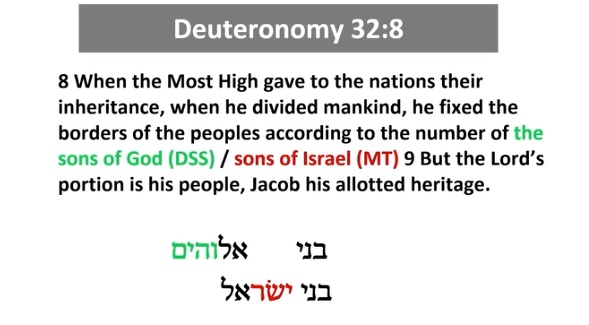
“When the Most High gave the nations thier inheritance, when he divided all mankind, he set up boundaries for the peoples according to the number of the sons of Israel. For the Lord’s portion is his people, Jacob his alloted inheritance.” (Deuteronomy 32:8-9)
“Masoretic Text; Dead Sea Scrolls (see also Septuagint)sons of God.”
How does the New Revised Standard Version render the reading?
“When the Most High gave the nations thier inheritance, when he divided all mankind, he set up boundaries for the peoples according to the number of the gods; For the Lord’s portion is his people, Jacob his alloted inheritance.” (Deuteronomy 32:8-9)
How did the transition from “bene Elohim” (sons of God) to “bene Yisrael” (sons of Israel) occur in Deuteronomy 32:8? The timing remains unknown. Whether this change took place during the intertestamental period or at the time of the text’s standardization around 100 AD — we simply do not know when it happened. But this much is certain: a scribe altered the text. Someone deliberately replaced “sons of God” with “sons of Israel.” The exact date of this change is unknown, but the fact that it occurred is beyond dispute. We know this because the Masoretic Text contains the altered reading, while the Dead Sea Scrolls preserve the original. And the Dead Sea Scrolls predate the Masoretic text by a full millennium. Israel is not even in existence when the nations are divided!
A scribe removed the three letters you see in green and added the two letters you see in red.
What does this mean?
Elyon was to be the god of Jacob and his people. The sons of Elyon. Or the other gods were to be for the other nations. In other words the main God (Elyon) divided Earth up among regional deities.
We see this in the following text:
“Will you not possess whatever Chemosh your god gives you to possess? So whatever the Lord our God takes possession of before us, we will possess.” (Judges 11:24)
It mentions that Chemosh is the god of the Ammonites, just as Israel has their own god.
“You shall have no other gods before/beside me.” (Exodus 20:3)
“You shall not bow down to them or worship them; for I, the Lord your God, am a jealous God, punishing the children for the sin of the parents to the third and fourth generation of those who hate me,” (Exodus 20:5)
“Do not worship any other god, for the Lord, whose name is Jealous, is a jealous God.” (Exodus 34:14)
“You shall have no other gods before/beside me.” (Deuteronomy 5:7)
These text are not a denial of other gods or deities. In fact, the above text describe this god as a jealous god.
This understanding of jealousy is a complex, often unpleasant emotion stemming from fear, insecurity, or a perceived threat to a valued relationship or status. It arises when someone feels threatened by a rival.
The way the Bible portrays this jealousy its as if the god of the children of Israel is in a genus. Even though this god acknowledges that he is superior there is a sort of pathological jealousy at play here.
“God(Elyon) stands in the congregation of the mighty; he judges among the gods.” (Pslam 82:1)
This verse indicates a superior deity presiding over lesser beings. A god among gods.
The Qur’an never describes Allah as a god among gods. Rather it negates any other deity except him.
Insh’Allah we will come back to (Pslam 82:1)
There is an interesting connection between Moloch and the god that the Children of Israel worshipped.
“Then Melchizedek king of Salem brought out bread and wine. He was priest of God Most High, and he blessed Abram, saying, “Blessed be Abram by God Most High, Creator of heaven and earth. And praise be to God Most High, who delivered your enemies into your hand.Then Abram gave him a tenth of everything.” (Genesis 14:18-20)
Prima Qur’an Comments:
Melchizedek is said to be a priest of God Most High, (Elyon). In other words the chief god.
Melchizedek needs to clarify who the (Elyon) Most High is. He is the Creator of heaven and earth.
“The LORD has sworn and will not change his mind: ‘You are a priest forever, in the order of Melchizedek'” (Psalm 110:4)
Prima Qur’an Comments:
Notice that this does not identify or equate the priest as Melchizedek but that he would be priest in his order.
“Without father or mother, without genealogy, without beginning of days or end of life, resembling the Son of God, he remains a priest forever.” (Hebrews 7:3)
Whoever wrote the book of Hebrews must have had some access to extra Biblical data about Melchizedek that we do not know about.
What is interesting is the word translated as Melchizedek: Righteous King can easily be translated as Righteous Moloch.
We also have the following interesting text.
“Adonizedek, the king of Jerusalem, heard that Joshua had captured and totally destroyed Ai and had killed its king, just as he had done to Jericho and its king. He also heard that the people of Gibeon had made peace with the Israelites and were living among them. The people of Jerusalem were greatly alarmed at this because Gibeon was as large as any of the cities that had a king; it was larger than Ai, and its men were good fighters. So Adonizedek sent the following message to King Hoham of Hebron, King Piram of Jarmuth, King Japhia of Lachish, and to King Debir of Eglon. (Joshua 10:1-3)
Adonizedek is an interesting name. It means Adon is Zedek. Adon (Aton/Aten) is Righteous.
However, it can also mean that Adon is Zedek. My Lord is Zedek.
(Moloch) is a god satiated by human suffering. In particular the sacrifice of innocent children.
He is a god of holocaust. However, anyone who is a Christian will understand a deity who is satiated through the suffering of children, in particular one of his own.
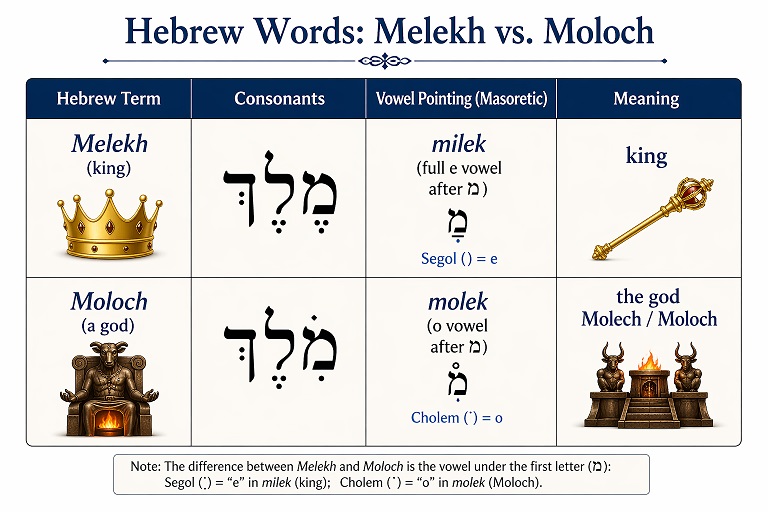
“A divinity worshipped by the idolatrousIsraelites. The Hebrew pointing Molech does not represent the original pronunciation of the name, any more than the Greek vocalization Moloch found in the LXX and in the Acts (vii, 43). The primitive title of this god was very probably Melech, “king”, the consonants of which came to be combined through derision with the vowels of the word Bosheth, “shame”. As the word Moloch (A.V. Molech) means king, it is difficult in several places of the Old Testament to determine whether it should be considered as the proper name of a deity or as a simple appellative. The passages of the original text in which the name stands probably for that of a god are Lev., xviii, 21; xx, 2-5; III (A. V. I) Kings, xi, 7; IV (II) Kings, xxiii, 10; Isaiah 30:33; 57:9; Jeremiah 32:35. The chief feature of Moloch’s worship among the Jews seems to have been the sacrifice of children, and the usual expression for describing that sacrifice was “to pass through the fire”, a rite carried out after the victims had been put to death. The special centre of such atrocities was just outside of Jerusalem, at a place called Tophet (probably “place of abomination”), in the valley of Geennom. According to III (I) Kings, xi, 7, Solomon erected “a temple” for Moloch “on the hill over against Jerusalem”, and on this account he is at times considered as the monarch who introduced the impious cult into Israel. After the disruption, traces of Moloch worship appear in both Juda and Israel. The custom of causing one’s children to pass through the fire seems to have been general in the Northern Kingdom [IV (II) Kings, xvii, 17; Ezech. xxiii, 37], and it gradually grew in the Southern, encouraged by the royal example of Achaz (2 Kings 16:3) and Manasses [IV (II) Kings, xvi, 6] till it became prevalent in the time of the prophet Jeremias (Jerem. xxxii, 35), when King Josias suppressed the worship of Moloch and defiled Tophet [IV (II) Kings, xxiii, 13 (10)]. It is not improbable that this worship was revived under Joakim and continued until the Babylonian Captivity.”
“Aaron answered them, “Take off the gold earrings that your wives, your sons and your daughters are wearing, and bring them to me.” So all the people took off their earrings and brought them to Aaron. He took what they handed him and made it into an idol cast in the shape of a calf, fashioning it with a tool. Then they said, “These are your gods,[b] Israel, who brought you up out of Egypt.” When Aaron saw this, he built an altar in front of the calf and announced, “Tomorrow there will be a festival to the Lord.” So the next day the people rose early and sacrificed burnt offerings and presented fellowship offerings. Afterward they sat down to eat and drink and got up to indulge in revelry. Then the Lord said to Moses, “Go down, because your people, whom you brought up out of Egypt, have become corrupt. They have been quick to turn away from what I commanded them and have made themselves an idol cast in the shape of a calf. They have bowed down to it and sacrificed to it and have said, ‘These are your gods, Israel, who brought you up out of Egypt.’” (Exodus 32:2-8)
Prima Qur’an comments:
Prophet Aaron is claimed to have made an idol in the shape of a calf.
The people also said: These are your gods (plural) that brought you (Israel) out of Egypt.
The god that is speaking to moses reaffirms the above two points. Especially: “These are your gods,Israel, who brought you up out of Egypt.”
Notice the translation is not sure if the word should be gods or god. However, it is clarified in what was said to Moses by the god that spoke to him. The people were claiming gods (plural) brought them out of Egypt.
Is it not very odd that it is claimed a prophet and servant of the One True God who witnessed miracles would so quickly go and do something like this in the absence of his brother (Moses)?
No one seems to the object to the idea that gods (not god) brought them out of Egypt.
During the civil war of Israel the following happened.
“After seeking advice, the king made two golden calves. He said to the people, “It is too much for you to go up to Jerusalem. Here are your gods, Israel, who brought you up out of Egypt.” One he set up in Bethel, and the other in Dan. And this thing became a sin; the people came to worship the one at Bethel and went as far as Dan to worship the other.” (1 Kings 12:28-30)
Jewish Rabbis have debates about what type of worship of Molech is acceptable and what is not.
The Mishnah (Sanhedrin 64a):
“HE WHO GIVES OF HIS SEED TO MOLECH INCURS NO PUNISHMENT UNLESS HE DELIVERS IT TO MOLECH AND CAUSES IT TO PASS THROUGH THE FIRE. IF HE GAVE IT TO MOLECH BUT DID NOT CAUSE IT TO PASS THROUGH THE FIRE, OR THE REVERSE, HE INCURS NO PENALTY, UNLESS HE DOES BOTH.”
Observation: The rabbis are parsing the precise act that constitutes a capital offense. Both elements are required: (1) delivering to Molech’s priests, and (2) causing the child to pass through fire.
The Gemara Discussion:
“R. Abin said: Our Mishnah is in accordance with the view that Molech worship is not idolatry. For it has been taught, whether to Molech or to any other idol he is liable. R. Eleazar son of R. Simeon said: If to Molech, he is liable; if to another idol, he is not.”
This is striking. Some rabbis consider Molech worship not to be idolatry — or at least different in kind from other idol worship. Why?
“R. Hanina b. Antigonus said: Why did the Torah employ the word Molech? To teach that the same law applies to whatever they proclaimed as their king, even a pebble or a splinter.”
Molech is not necessarily a specific deity — it is any deity to whom one transfers sovereignty (“king”) over oneself. The rabbis are working hard to define the boundary.
The Critical Question the Rabbis Are Avoiding
If a Jew offered his child as a burnt offering to Yahweh, would that be permitted?
The rabbis do not address this directly. But their silence is telling.
Jephthah in Rabbinic Literature:
The Talmud (Ta’anit 4a) and later rabbinic commentary do address Jephthah — and they are highly critical of him. The general rabbinic view is that Jephthah should have sought to annul his vow through a sage, and that his failure to do so resulted in tragedy. Some rabbis even say he was punished for his foolishness (losing parts of his body, dying unnaturally).
However — and this is crucial — the rabbis never say that what Jephthah did was inherently impossible or categorically forbidden. They criticize his failure to seek annulment, not the act of human sacrifice itself. They also note that his daughter (like Isaac) was willing.
The Nakdimon Connection
One of the most revealing texts appears in the Babylonian Talmud (Nedarim 37a) and is cited in the Soncino commentary on Sanhedrin 64a. Rabbi Dr. Freedman, the translator, notes:
“The offering of children to Molech was not regarded as ordinary idolatry, but as a distinct offence. One reason is that it involved the destruction of one’s seed — an act of cruelty which even pagans normally did not practice. Another is that it was sometimes done in the name of the Lord, as in the case of Jephthah.”
Read that again: “It was sometimes done in the name of the Lord, as in the case of Jephthah.”
The rabbis knew that child sacrifice had been performed in Israel in the name of Yahweh. They were not condemning the practice universally — they were trying to regulate it, to distinguish between “legitimate” (Yahwistic) and “illegitimate” (pagan) contexts.
The god of Israel (Yahweh) is apparently satiated by human suffering. In particular the sacrifice of innocent children.
In (2 Samuel 21), David is king over Judah. A famine oppresses the land; King David learns that LORD God is punishing Israel for King Saul’s sin (Saul attacked the Gibeonites in violation of Joshua’s treaty (Joshua 9:15). Therefore, in order to relieve the famine, David must appease the Gibeonites. On negotiation, the Gibeonites demand to be given seven descendants of Saul to be hanged “unto the LORD.” David picks two of Saul’s sons and five of Saul’s grandsons. Coincidentally, the five grandsons are the children of Michal, the woman David had wanted to marry (see 1 Samuel 18:25). David gives these Israelites to the Gibeonites so the Gibeonites can hang them.
“Then there was a famine in the days of David three years, year after year; and David inquired of the LORD. And the LORD answered, It is for Saul, and for his bloody house, because he slew the Gibeonites. And the king called the Gibeonites, and said unto them; (now the Gibeonites were not of the children of Israel, but of the remnant of the Amorites; and the children of Israel had sworn unto them: and Saul sought to slay them in his zeal to the children of Israel and Judah.) Wherefore David said unto the Gibeonites, What shall I do for you? and wherewith shall I make the atonement, that ye may bless the inheritance of the LORD? And the Gibeonites said unto him, We will have no silver nor gold of Saul, nor of his house; neither for us shalt thou kill any man in Israel. And he said, What ye shall say, that will I do for you. And they answered the king, The man that consumed us, and that devised against us that we should be destroyed from remaining in any of the coasts of Israel, Let seven men of his sons be delivered unto us, and we will hang them up unto the LORD in Gibeah of Saul, whom the LORD did choose. And the king said, I will give them. But the king spared Mephibosheth, the son of Jonathan the son of Saul, because of the LORD’s oath that was between them, between David and Jonathan the son of Saul. But the king took the two sons of Rizpah the daughter of Aiah, whom she bare unto Saul, Armoni and Mephibosheth; and the five sons of Michal the daughter of Saul, whom she brought up for Adriel the son of Barzillai the Meholathite: And he delivered them into the hands of the Gibeonites, and they hanged them in the hill before the LORD: and they fell all seven together, and were put to death in the days of harvest, in the first days, in the beginning of barley harvest.” Source: (2 Samuel 21:1-11)
Prima Qur’an Comments: The God (Elyon) did not explicitly request the hangings. But The God (Elyon) imposed an insufferable famine on the Israelites, The God (Elyon) named the Gibeonites as the people to be appeased, and the Gibeonites named the penalty. When it was done, The God (Elyon) apparently found the human sacrifice to be satisfactory: the chapter continues with accounts of battles, and the famine is not mentioned further. This sequence — an angry god causes a natural disaster, innocent life is slain to appease the god’s anger, and the hardship ceases — this is the same sequence of events found in the human sacrifice rites of other primitive religions.
The God (Elyon) of the Bible did not stop Jephthah from burning his small daughter if the God (Elyon)gave him victory over his enemies.
“Then the Spirit of the Lord came on Jephthah. He crossed Gilead and Manasseh, passed through Mizpah of Gilead, and from there he advanced against the Ammonites. And Jephthah made a vow to the Lord: “If you give the Ammonites into my hands, whatever comes out of the door of my house to meet me when I return in triumph from the Ammonites will be the Lord’s, and I will sacrifice it as a burnt offering.” Then Jephthah went over to fight the Ammonites, and the Lord gave them into his hands. He devastated twenty towns from Aroer to the vicinity of Minnith, as far as Abel Keramim. Thus Israel subdued Ammon. When Jephthah returned to his home in Mizpah, who should come out to meet him but his daughter, dancing to the sound of timbrels! She was an only child. Except for her he had neither son nor daughter. When he saw her, he tore his clothes and cried, “Oh no, my daughter! You have brought me down and I am devastated. I have made a vow to the Lord that I cannot break.” “My father,” she replied, “you have given your word to the Lord. Do to me just as you promised, now that the Lord has avenged you of your enemies, the Ammonites. But grant me this one request,” she said. “Give me two months to roam the hills and weep with my friends, because I will never marry.” “You may go,” He said. And he let her go for two months. She and her friends went into the hills and wept because she would never marry. After the two months, she returned to her father, and he did to her as he had vowed. And she was a virgin. (Judges 11:29-39)
Prima Qur’an Comments: Now there is major major copium from Christians and Jews regarding this.
Copium # 1. They try and put a spin that the sacrifice is to dedicate his daughter to the Lord as a virgin (meaning temple service) and Jephthah bemoaned that due this he would never have any descendants. Response: and I will sacrifice it as a burnt offering & After the two months, she returned to her father, and he did to her as he had vowed The emphasis on her being a virgin is so she would be an unblemished sacrificed.
Copium #2. The God (Elyon) commands against sacrificing Children in the Bible.
Response. No, no he doesn’t!
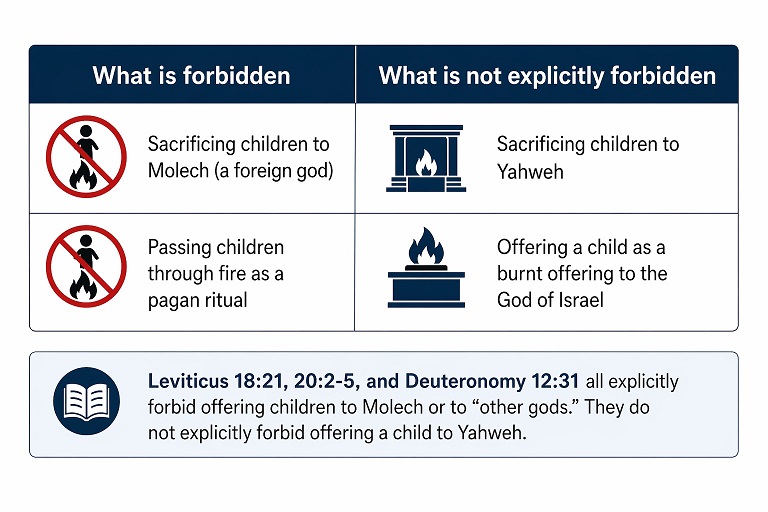
“You shall not give any of your offspring to offer them to Molech, nor shall you profane the name of your God; I am the Lord.” (Leviticus 18:21)
“I will also set My face against that man and will cut him off from among his people, because he has given some of his offspring to Molech, so as to defile My sanctuary and to profane My holy name.” (Leviticus 20:3)
“You shall not behave thus toward the Lord your God, for every abominable act which the Lord hates they have done for their gods; for they even burn their sons and daughters in the fire to their gods.” (Deuteronomy 12:31)
As well as the related practice of passing the children through the fire and not consuming them by the fire:
“There shall not be found among you anyone who makes his son or his daughter pass through the fire, one who uses divination, one who practices witchcraft, or one who interprets omens, or a sorcerer.” (Deuteronomy 18:10)
“You shall also say to the sons of Israel: ‘Any man from the sons of Israel or from the aliens sojourning in Israel who gives any of his offspring to Molech, shall surely be put to death; the people of the land shall stone him with stones.” (Leviticus 20:2)
Offering your children up as a burnt offering is not against the Torah teachings of the Jews. Nor was it something unacceptable to God. The offence in question was offering them up to Molech and NOT THE GOD (ELYON) OF ISRAEL!
“For I the Lord your God am a jealous God.” (Daniel 5:9)
This god that they worshipped is not against sacrifice or burnt offerings as we have already shown above. Their god
There is no issue with offering up children as a holocaust (burnt offering) to their god. The issue is doing it to false gods.
“They built high places for Baal in the Valley of Ben Hinnom to sacrifice their sons and daughters to Molek, though I never commanded—nor did it enter my mind—that they should do such a detestable thing and so make Judah sin.” (Jeremiah 32:35)
Because the Elyon, The High God of the Bible is jealous.
Did we forget?
“After these things God tested Abraham and said to him, “Abraham!” And he said, “Here I am.” He said, “Take your son, your only son Isaac, whom you love, and go to the land of Moriah, and offer him there as a burnt offering on one of the mountains of which I shall tell you.” (Genesis 22:1-2)
The Angel of the Lord as Satan and one of the gods among gods in the Bible.
In the Hebrew Bible, ha-satan (הַשָּׂטָן) is not a proper name but a title: “the Adversary” or “the Accuser” . This figure appears in the divine council — the assembly of elohim (divine beings) over which Elyon presides as supreme. Ha-Satan is not a rival god or a fallen angel — he is a subordinate being within Elyon’s administration. As one scholar puts it: “The Satan is a member of the divine council, serving as a sort of prosecutor or royal spy” (Peggy L. Day, An Adversary in Heaven).
“I was further shown Joshua, the high priest, standing before the angel of GOD, and the Accuser (Satan) standing at his right to accuse him. But [the angel of] GOD said to the Accuser (Satan), “GOD rebukes you, O Accuser; GOD who has chosen Jerusalem rebukes you! For this is a brand plucked from the fire.”
Here you have Ha-Satan standing at the right hand of the Angel of the LORD to accuse Joshua the high priest. Elyon (the Most High God) rebukes Ha-Satan.
“One day the divine beings presented themselves before GOD. The Adversary came along with them to present himself before GOD. GOD said to the Adversary, “Where have you been?” The Adversary answered GOD, “I have been roaming all over the earth.” GOD said to the Adversary, “Have you noticed My servant Job? There is no one like him on earth, a blameless and upright man who fears God and shuns evil. He still keeps his integrity; so you have incited Me against him to destroy him for no good reason. The Adversary answered GOD, “Skin for skin—all that the man has he will give up for his life. But lay a hand on his bones and his flesh, and he will surely blaspheme You to Your face.” So GOD said to the Adversary, “See, he is in your power; only spare his life.”The Adversary departed from GOD’s presence and inflicted a severe inflammation on Job from the sole of his foot to the crown of his head.”
Here you have Ha-Satan appearing among the bene ha-elohim (sons of God) and acting as a prosecuting attorney, testing Job’s righteousness with Elyon’s permission. He is not an enemy of Elyon but a member of His court.
The Angel of the LORD as a Satan in Numbers 22
This is a fascinating and often overlooked passage.
The Narrative: Balaam is hired by Balak of Moab to curse Israel. He consults God (Elyon) who tells him not to go. Balak sends more prestigious messengers; Balaam asks again; God (Elyon)permits him to go but with conditions. On the way:
“But God’s anger was kindled because he went, and the Angel of the LORD stationed himself in the road as an adversary (satan) against him.” (Numbers 22:22)
Analysis:
The Hebrew word used for “adversary” is precisely לְשָׂטָן (l’satan) — “as a satan.”
The Angel of the LORD — generally understood as a manifestation of God (Elyon) Himself (since the Angel speaks as God and is worshipped as God elsewhere) — functions as an obstructor or adversary to Balaam.
This same Angel later permits Balaam to continue (Numbers 22:35).
What this means: God (Elyon)through His Angel) acts as both a guide and an adversary. The same being who permits Balaam to go also stands in his way as a satan. This shows that the role of “adversary” is not a separate being but a function that even God(Elyon) can perform.
As one commentary notes: “The Angel of the LORD acts as Balaam’s ‘adversary’ (satan)… This is the only place in the Old Testament where the Angel of the LORD is explicitly called a satan” (Gordon Wenham, Numbers).
“O Lord, you have deceived me, and I was deceived; you are stronger than I, and you have prevailed.” (Jeremiah 20:7)
Henotheism is the worship of one primary deity while accepting the existence of other gods within a pantheon. It is sort of a pantheon. As a middle ground between polytheism and monotheism, it allows followers to focus devotion on a single “king god”—such as Zeus, Odin, or in some forms of Hinduism—while recognizing other divine beings.
This is why we can have text like the following:
Again the anger of the Lord was aroused against Israel, and He moved David against them to say, “Go, number Israel and Judah.” (2 Samuel 24:1)
“Now Satan stood up against Israel, and moved David to number Israel.” (1 Chronicles 21:1)
This would seem to be a contradiction but when we realize that they are basically one and the same it makes sense from a henotheistic worldview.
The biblical divine council — with its bene ha-elohim, ha-satan as prosecutor, and the Angel of the LORD as a distinct yet divine figure — is not compatible with Islamic tawhid (radical monotheism). Whether the figure in question is called Baal, Molech, Yahweh, or Ha-Satan, the Qur’an would reject any theology that places other divine beings beside Allah.
Qur’an Surah 112 has been shown to absolutely demolish this framework.
Yahweh seems to be a sort of tribal war deity or war angel as presented in the TNCH. The part of the Bible the Christians call: ‘The Old Testament.’
The term Tzva’ot refers to armies or hosts. (Hebrew: Yahweh Tzva’ot) is a divine title in the Bible appearing over 200 times, primarily in the Old Testament, designating Yahweh as the god over all heavenly and earthly armies.
“Yahweh of Armies is with us. The God of Jacob is our refuge. “ (Pslam 46:7)
“Each year Elkanah would travel to Shiloh to worship and sacrifice to the LORD of Heaven’s Armies at the Tabernacle. The priests of the LORD at that time were the two sons of Eli—Hophni and Phinehas.” (1 Samuel 1:3)
“The Lord is a man of war: the Lord is his name.” (Exodus 15:3)
You even have henotheistic views put in the mouth of the One True God’s Prophets!
“Now this is eternal life: that they know you, the only true God (τὸν μόνον ἀληθινὸν Θεόν), and Jesus Christ, whom you have sent.” (John 17:3)
Here he could have simply said “only God.” By adding “true” (ἀληθινός), he leaves open the possibility that other beings exist who could be called “gods” (elohim) — but they are not the true God.
The Jehovah’s Witness have translated John 1:1 as:
“In the beginning was the Word, and the Word was with God, and the Word was a god.” (John 1:1)
“Who among the gods is like you, Lord?” (Exodus 15:11)
“For the Lord is the great God, the great King above all gods.” (Pslam 95:3)
“All who worship images are put to shame, those who boast in idols—Worship him, all you gods!” (Psalm 97:7)
“For the Lord your God is God of gods and Lord of lords, the great God, mighty and awesome, who shows no partiality and accepts no bribes.” (Deuteronomy 10:17)
This is far from monotheism. This is far from what is presented in the Qur’an.
Is it little wonder we those socities that succumb to these beliefs ridden with demonic forces? Even the innocent among them they have no idea what they are even worshipping! May Allah Guide these people to the truth before the burn in hellfire.
“I said not to them except what You commanded me – to worship Allah , my Lord and your Lord. And I was a witness over them as long as I was among them; but when You caused me to die., You were the Observer over them, and You are, over all things, Witness.” (Qur’an 5:117)
“When Allah said, “O Jesus, indeedI will cause you to die and raise you to Myself and purify you from those who disbelieve and make those who follow you [in submission to Allah alone] superior to those who disbelieve until the Day of Resurrection. Then to Me is your return, and I will judge between you concerning that in which you used to differ.” (Qur’an 3:55)
﷽
The verb tawaffā (verbal noun: tawaffī) seems to cause a great deal of needless distress among Muslim exegetes. Why is this so?
We are going to present our case that if it was not for these oral traditions, Muslim exegetes would not argue the way they do at all.
So keep in mind that the interpretation of the verses that clearly say that Jesus died is influenced by ‘the tradition’.
Yet, the Qur’an itself offers no cause for confusion. Tawaffā appears in twenty-five verses in the Qur’an, and twice in relation to Christ Jesus (Qur’an 5:117 and Qur’an 3.55).
For twenty-three of those verses, the Muslim commentators generally follow the standard definition of this term, that is that Allah (swt) separates the soul from the body or makes someone die.
Think about this. For those verses in the Qur’an that are not tied into ahadith about Jesus(as) coming back, they are translated and understood as per usual.
Interestingly enough, we have the following du’a:
“And you do not resent us except because we believed in the signs of our Lord when they came to us. Our Lord, pour upon us patience and let us die as Muslims [in submission to You].” (Qur’an 7:126)
How often do we say this du’a after congregational prayers?
So let us use the ol Google machine — aka—the much feared and dreaded ‘Shaykh Google’ and put two and two together, shall we?
So what we are going to do as an experiment so that you, the reader, can follow along as we are going to call upon the good people at https://www.islamawakened.com-Whoever they are, may Allah (swt) bless them.
They put all the translations out for everyone to see.
So what we are going to do is show you all the disparate translations into the English language. We will then put those that don’t immediately convey the idea of death—at least to us.
Tawaffā appears in twenty-five verses: Let us examine them all.
We will go in order of the chapter and verse they appear in.
Example: 1 (Qur’an 2:234)
“And those who are taken in death among you and leave wives behind – they, [the wives, shall] wait four months and ten [days]. And when they have fulfilled their term, then there is no blame upon you for what they do with themselves in an acceptable manner. And Allah is [fully] acquainted with what you do.” (Qur’an 2:234)
Ya Allah people 51 disparate translations from people coming from different approaches to Islam have translated the passage as DEATH.
The two odd ones out: Ahmed Hulusi, a translation still in progress… and Muhammed Mahmoud Ghali and even then it finally puts “And the ones of you who are taken up, (i.e., those who die).”
You want to talk about consensus? The consensus here is that yutawaffawna means death, to die.
Example: 2(Qur’an 2:24)
“And those who are taken in death among you and leave wives behind – for their wives is a bequest: maintenance for one year without turning [them] out. But if they leave [of their own accord], then there is no blame upon you for what they do with themselves in an acceptable way. And Allah is Exalted in Might and Wise.” (Qur’an 2:24)
Once again, look at the 52 disparate translations and the verdict is that yutawaffawna means death, to die.
Example: 3 (Qur’an 3:193)
“Our Lord, indeed we have heard a caller calling to faith, [saying], ‘Believe in your Lord,’ and we have believed. Our Lord, so forgive us our sins and remove from us our misdeeds and cause us to die with the righteous.” (Qur’an 3:193)
“Gather us to Thee with the pious” — Dr. Laleh Bakhtiar
“And take us with the obedient ones”—The Monotheist Group 2011 edition.
“Take us back to You”—Aisha Bewley
“And take us to You with the ever benign (ones)”—Muhmmed Mahmoud Ghali
“Include us among the righteous people”-Bijan Moeinian
“And take us to Thee with the pious.” -Arthur John Arberry
“And claim us back with the righteous” — N J Dawood (2014)
“You never fail to fulfill your oath” — Ahmed Halusi
44 Translators are in consensus that the term watawaffanā -is to cause to die.
In fact, we would say that N J Dawood, Arberry, Bewley, Bakhtiar or the Monotheist Group, none of them believe that watawaffana here means to be bodily raised up to heaven.
Example: 4 (Qur’an 4:15)
“Those who commit unlawful sexual intercourse of your women – bring against them four [witnesses] from among you. And if they testify, confine the guilty women to houses until death takes them or Allah ordains for them [another] way.” (Qur’an 4:15)
“The angels will ask those whom they claim back while steeped in sin”- N J Dawood 2014
“And those the angels take, while still they are wronging themselves”-Arthur John Arberry
“And the angels who take those who wronged themselves will say”-Hasan Al-Fatih Qaribullah
“When the angles take the should of those who [had compromised and in consequence] were unjust to their own souls”-,Bijan Moeinian
“Surely the ones whom the Angels take up, (while) they are unjust to themselves”-Muhammed Mahmoud Ghali
“Indeed, those whom the angels take away while they are wronging themselves” -Ali Quli Qara’i
“The angels ask those they take while they are wronging themselves” -Aisha Bewley,-
“Those whom the Angels take, while they had wronged their souls.”-The Monotheist Group (2011 Edition)
“While the angels are gathering the souls of those who wronged themselves.”-Safi Kaskas
“Those whom the angels will gather up”- T. B Irving
“Truly, those whom the angels gathered to themselves.”-Dr. Laleh Bakhtiar
The overwhelming consensus of 42 translations is that tawaffāhumu is to die by taking the souls.
Example: 6 (Qur’an 5:117) –text that is about Jesus.
“I said not to them except what You commanded me – to worship Allah , my Lord and your Lord. And I was a witness over them as long as I was among them; but when You caused me to die., You were the Observer over them, and You are, over all things, Witness.” (Qur’an 5:117)
We know the drill on this crucial passage. So let us see the disparate translations here:
“Thou hast caused me to die”-Muhammad Asad
“But when Thou didst cause me to die”-Shakir
“You did cause me to die”-Wahiduddin Khan
“You did cause me to die”- Safi Kaskas
“Ever since You took my soul”-Abdel Haleem
“And after my life had been done”- Ahmed Ali
“After You caused me to die”-Shabbir Ahmed
“but when you gave me Wafat”-Dr. Kamal Omar (NON COMMITTAL)
“You terminated my life”-Monotheist group-2013
“but when You caused me to die” -Muhammed Shafi
“Thou didst cause me to die”-Maulana Muhammad Ali
“so when You made me die”- Muhammad Ahmed-Samira
“Thou didst cause me to die”-Sher Ali
“When You terminated my life on earth”-Rashad Khalifa
“You caused me to die”- Amatul Rahman Omar
“Thou didst cause me to die” -George Sale
39 Translations overwhelming support the view that tawaffaytanī -is to be raised up, gathered up, recalled. We assume the majority believe bodily and alive.
So in the curious case of Jesus (as) the majority view is not to understand tawaffaytanī as death. That was predictable; as it will be when we get to (Qur’an 3:55).
WHAT ABOUT THE TWO VERSES THAT ARE THAN USED TO SUGGEST THAT JESUS HAS BEEN PUT TO SLEEP FOR THESE LAST 2000 YEARS? (Qur’an 6:60) & (Qur’an 39:42)
That is to say they want to argue that Jesus (as) has been put to sleep and will one day wake up at some unspecified time. Presumably as per various hadith traditions etc.
Example: 7(Qur’an 6:60)
“And it is He who takes your souls by night and knows what you have committed by day. Then He revives you therein that a specified term may be fulfilled. Then to Him will be your return; then He will inform you about what you used to do.” (Qur’an 6:60)
“Allah takes the souls at the time of their death, and those that do not die [He takes] during their (manāmihā)sleep. Then He keeps those for which He has decreed death and releases the others for a specified term. Indeed in that are signs for a people who give thought.” (Qur’an 39:42)
This is why we have the well known du’a for going to sleep and rising from sleep:
Narrated Hudhaifa:
Whenever the Prophet (saw) intended to go to bed, he would recite: “Bismika Allahumma amutu wa ahya (With Your name, O Allah, I die and I live).” And when he woke up from his sleep, he would say: “Al-hamdu lil-lahil-ladhi ahyana ba’da ma amatana; wa ilaihi an-nushur (All the Praises are for Allah Who has made us alive after He made us die (sleep) and unto Him is the Resurrection). “
Question: Has anyone observed a person sleeping that their body suddenly disappeared or went some where else?
I think we all know the answer is No.
“And He has made me blessed wherever I am and has enjoined up me prayer and zakah as long as I remain alive.” (Qur’an 19:31)
What kind of embellished claims are you going to make about Jesus (as) giving zakat in the heavens while asleep?!!
Here is the interesting point about these verses. If as some of the exegetes want to understand it as ‘you put me to sleep‘ and ‘than raised me up‘ than what about those who say, “No he raises him up first and than will put him to sleep in the future!”
DO TELL US WHICH VERSION IS CORRECT?
They would be taking into account:
“but Allah raised him to Himself. Allah is All-Mighty, All-Wise.” (Qur’an 4:158)
Does that really make any sense? They can’t both be correct.
Also know that Qur’an 5:117 or Qur’an 3:55 can’t be understood as falling asleep. It is actually negated by Qur’an 6:60 and Qur’an 39:42
Why? Allah (swt) either:
Takes souls at the time of their death. If the souls are taken the person(body) dies.
Other souls are taken during sleep-during an unspecified period of time-if they are not returned than they die in their sleep leaving behind a body.
Other souls are taken during sleep-during an unspecified period of time –If they are returned to their body the person lives the course of their natural life until they die in the future.
In all three examples thebody is left behind. There are no examples where tawaffā means to taking the soul and the body.
So since our interlocutors in this discussion will absolutely rule out points 1 & 2 with regards to Christ Jesus (as) let us look at point 3.
Let us put up the two verses in consideration and juxtapose them. We will put up two translations that are very user friendly to the ‘he didn’t die and was bodily raised up‘ crowd.
“Behold! Allah said: “O Jesus! I will take thee AND raise thee to Myself and clear thee (of the falsehoods) of those who blaspheme; I will make those who follow thee superior to those who reject faith, to the Day of Resurrection: Then shall ye all return unto me, and I will judge between you of the matters wherein you dispute.” (Qur’an 3:55 Yusuf Ali translation)
“Never said I to them aught except what You did command me to say, ‘worship Allah, my Lord and your Lord’; and I was a witness over them while I dwelt among them; when You did take me up You were the Watcher over them, and You are a witness to all things.” (Qur’an 5:117 Yusuf Ali translation)
Now if we only had Qur’an 5:117 and we were feeling really charitable (despite the fact the word is translated as death every where else)- we could say, “O.K. maybe you have a point“.
However, Qur’an 5:117 has to also be in harmony with Qur’an 3:55 doesn’t it?
This is where our interlocutors are in a most difficult situation. Why are they in a most difficult situation? Qur’an 3:55 says, “mutawaffīka WA rāfiʿuka.”
Thus, their arguments make the Qur’an a redundant revelation.
It would be akin to saying: “I am going to take your soul from your body (just like when we sleep) and than I am going to raise up (presumably) your physical body. It would have been sufficient to just say that Allah (swt) ‘took him up’.
However, we have this slight problem. We have this very troublesome conjunction called ‘WA‘ -AND.
Why does Allah (swt) want you to know that he did something to Jesus (as) before “taking him up”? Couldn’t Allah (swt) just say that he “took him up”?
Why would Allah (swt) say, “I made Jesus fall asleep and than I took him up.” What point is being made there?
“Gabriel replied, ‘Muhammed.’ It was asked, ‘Has he been called?’ Gabriel answered in the affirmative. Then it was said, ‘He is welcomed. What an excellent visit his is!’ The gate was opened. When I went over the second heaven, there I saw Yahya (i.e. John) and `Isa (i.e. Jesus) who were cousins of each other. Gabriel said (to me), ‘These are John and Jesus; pay them your greetings.’ So I greeted them and both of them returned my greetings to me and said, ‘You are welcomed, O pious brother and pious Prophet.’ ”
What should we expect concerning the state of those Prophets (May Allah’s peace and blessings be upon them all)?
“The Messiah, son of Mary, is no more than a messenger, certainly the messengers before him have passed away. And his mother was a saintly woman. And they both used to eat (earthly) food. See how We make the revelations clear for them, and see how they are turned away!” (Qur’an 5:75)
So in light of Qur’an 6:60 and Q ur’an 39:42
Are there any indications in Qur’an 5:117 or Qur’an 3:55 that Allah (swt) took a soul out of Jesus -during a sleep phase -only to put it back in, and afterwards raise a body up?
“And has blessed me wherever I might be and has enjoined upon me Prayer and Zakah (purifying alms) as long as I live.” (Qur’an 19: 31)
Is Jesus(as) asleep (hence why he’s not doing zakat-for as long he lives?) being ‘disembodied‘ -meaning his soul is some where and his body is some where else? Yet , he has time for a quick meet and greet with the Blessed Prophet (saw) according to the above hadith?
In fact one of the Mauritanian Shaykhs -Shaykh Salek bin Siddina āl-Māliki whom was called upon to correct Mufti Abu Layth doesn’t buy into the argument of redundancy either.
This Shaykh knows full well what the text says and so he uses a different strategy -to save the hadith traditions-of course!
(We have also downloaded this video-you know-in case it mysteriously vanishes)
Here are some notes we took of the video in the post linked to above.
We thought it was interesting. The translator said: @ 0:55 “Isa alayi salam has died a complete death.”
Prima Qur’an comments: “What other kind of death is there?”
@ 3:30 minutes, the translator addresses what the Shaykh says: “Mutawafikka is a word that can be translated to ‘I will cause you to die.’ It is mentioned in a way that it does not indicate any particular order.”
“Allah says I will cause you to die, and I will raise you to me, it doesn’t it is used…”
@5:11 minutes, the translator addresses what the Shaykh says:
“So this ‘And’ is the type of WA that is being used. Those are both things that are being done, not necessarily in a particular order.” “In the statement that Zayd and Umar came, it doesn’t mean that Zayd came first. Not in any way does it indicate an order of those things.”
Prima Qur’an comments:
Firstly. May Allah (swt) have patience with the translator. The shaykh often would not allow the translator to finish. If the idea is to convey in Arabic let it be conveyed in Arabic, but if there is an agreement that this knowledge is to be transmitted by translation into English, than give the translator time.
Second the respected shaykh knows full well the obvious that ‘mutawafikka‘ means ‘I will cause you to die‘.
Third he definitely is not on board with the interpretation: “No he raises him up first and than will put him to sleep in the future!“
Fourth the shaykh being influenced by the traditions has to make the Qur’an confirm to his presuppositions. As we stated before if it were not for the traditions (which the shaykh brought up quite often) you would wonder if he would have felt the need to use this literary device. In English we call this hysteron proteron.
For example you could say I put on my shoes and socks. No one understands that you put the shoes on and then the socks.
So what is important that we take away from this is that.
The Shaykh understands the word in Qur’an 3:55 means death
A cursory reading of the text would be ‘I will cause you to to die and than elevate you.’
The obvious understanding of the text is made to conform to a literary device. This is obviously based upon the presupposition the shaykh holds to the ahadith.
Another point about Qur’an 5:117
Narrated Ibn `Abbas:
Allah’s Messenger (saw) delivered a sermon and said, “O people! You will be gathered before Allah barefooted, naked and not circumcised.” Then (quoting Qur’an) he said:– “As We began the first creation, We shall repeat it. A promise We have undertaken: Truly we shall do it..” The Prophet (saw) then said, “The first of the human beings to be dressed on the Day of Resurrection, will be Abraham. Lo! Some men from my followers will be brought and then (the angels) will drive them to the left side (Hell-Fire). I will say. ‘O my Lord! (They are) my companions!’ Then a reply will come (from Almighty), ‘You do not know what they did after you.’I will say as the pious slave (the Prophet (as) Jesus) said: And I was a witness over them while I dwelt amongst them. When You took me up. You were the Watcher over them and You are a Witness to all things.’ (Qur’an 5:117) Then it will be said, “These people have continued to be apostates since you left them.”
Now what is the condition of the Blessed Prophet (saw) at this point when he used that phrase “When you took me up?” It is clear that Allah (swt) took his soul and his body is in Madinah. In other words the Prophet Muhammed (saw) died.
Was he taken body and soul into the heavens?
Example: 8 (Qur’an 6:61)
“And He is the subjugator over His servants, and He sends over you guardian-angels until,when death comes to one of you, Our messengers take him, and they do not fail [in their duties].” (Qur’an 6:61)
The unanimous decision of 54 translations is that tawaffathu is death.
Example: 9 (Qur’an 7:37)
“And who is more unjust than one who invents about Allah a lie or denies His verses? Those will attain their portion of the decree until when Our messengers come to them to take them in death, they will say, “Where are those you used to invoke besides Allah ?” They will say, “They have departed from us,” and will bear witness against themselves that they were disbelievers.” (Qur’an 7:37)
“When Our messengers come to gather them”- M.M Pickthall
“Our Messengers drew near to gather them to themselves” -Dr. Laleh Bakhtiar
“Our messengers come to carry them off”-T.B Irving
“So that when Our messengers come to take them”-The Monotheist Group (2011) -changed position in 2013.
“When Our angels arrive to take them back”-Abdel Haleem
“When Our messengers come to take them away”- “Ali Quli Qara’i
“When Our Messengers come to them to take them up”-Muhammed Mahmoud Ghali
“Our Messengers come to take them away.”- Hasan Al-Fatih Qaribullah
“Our messengers come to them, to take them away”- Arthur John Arberry
“Until when Our messengers come to them to take them away”- Sayyed Abbas Sadr-Ameli
44 disparate translations are unanimous in their decision that yatawaffawnahum means to take the souls and or to die.
Worth mentioning is that ‘The Monotheist Group‘ translation changed in 2013.
Example: 10 (Qur’an 7:126)
“And you do not resent us except because we believed in the signs of our Lord when they came to us. Our Lord, pour upon us patience and let us die as Muslims [in submission to You].” (Qur’an 7:126)
“Lift us (from the world)”-Dr. Mohammed Tahir Qadri.
“And gather us unto Thee”- Arthur John Arberry.
“And take us to Thyself resigned”-Edward Henry Palmer
47 disparate translations believe that watawaffana is to die.
Even those that don’t translate it as such take for example Dr. Mohmmed Tahir Qadri, do you really think his belief when making this du’a is that Muslims will be taken bodily into the sky? Does anyone really think Aisha Bewley believes this?
Example: 11 (Qur’an 8:50)
“And if you could but see when the angels take the souls of those who disbelieved… They are striking their faces and their backs and [saying], “Taste the punishment of the Burning Fire.” (Qur’an 8:50)
“Are called to themselves by the angels”-Dr. Laleh Bakhtiar
“See as the Angels take those who have rejected”-The Monotheist Group 2011 -changed in 2013 edition
“When the angels take away the faithless”-Ali Quli Qara’i
“As they take up the ones who disbelieved”, -Muhmmed Mahmoud Ghali
“As the angels take away those who disbelieve”-Talal A. Itani (new translation)
When the angels take the unbelievers”-Arthur John Arberry
47 disparate translations are in agreement that yatawaffameans to separate the soul from the body, to cause to die.
Example: 12 (Qur’an 10:46)
“And whether We show you some of what We promise them, [O Muhammed], or We take you in death, to Us is their return; then, [either way], Allah is a witness concerning what they are doing.” (Qur’an 10:46)
“Or whether We will take you to Ourself”-Hamid S. Aziz
“We definitely take you up to Us” -Muhammed Mahmoud Ghali
“Or We take you back to Us”-Muhammed Taqi Usmani
“Or take you”-Talal A. Itani
“Or We call you unto Us”-Maududi
“We call you towards Us”- Faridul Haque
“Or We call you to Us”- Hasan Al-Fatih Qaribullah
“Or We call you unto Us”- Ahmed Raza Khan (Barelvi)
“We call thee unto Us”-Arthur John Arberry
“Or we will take thee to ourself”-Edward Henry Palmer
“Or whether we first take thee to Ourself”-John Medows Rodwell
“Or claim you back to Us”-N J Dawood (2014)
37 disparate translations are of the view that natawaffayannaka means to cause to die, to separate the soul from the body.
Now there are a few points that need to be mentioned here. Understand that many people who don’t believe that the Prophet (saw) is dead. They believe that the Prophet (saw) was poisoned by a Jewish woman and that made him (saw) a martyr. Therefore, he is alive ‘though we do not perceive it’. However, if you ask them if they believe a body is in the Prophets Mosque in Medina, they will answer ‘of course’.
In fact, every one of those translators who translate as they do asks them point-blank, “Do you believe there is a body in the Mosque in Medina with the Green Dome?”
Remember the point we mentioned earlier about these people making the Qur’an redundant?
Let’s take the translation of Muhammed Mahmoud Ghali
Let us look at he translates the above text:
“And whether We definitely show you something (i.e., some form of punishment) of what We promise them, or We definitely take you up to Us, then to Us will be their return; thereafter Allah is Ever-Witnessing over whatever they perform.” (Qur’an 10:46)
“We definitely take you up to Us” -Muhammed Mahmoud Ghali
Now let us look at he translates Qur’an 3:55
“As Allah said, “O Isa, (Jesus) surely, I am taking you up to Me, and I am raising you up to Me, and I am purifying you of the ones who have disbelieved. And I am making the ones who have closely followed you above the ones who have disbelieved until the Day of the Resurrection. Thereafter to Me will be your return; so I will judge between you as to whatever you used to differ in.” (Qur’an 3:55)
“I am taking you up to Me, and I am raising you up to Me.” – Muhammed Mahmoud Ghali.
Notice the redundancy in the language used? He could have just translated as “I am taking you up to Me” OR “I am raising you up to Me” -because in his mind they both mean the same thing.
This is the exact kind of problems that they run into when they approach the Qur’an with a mind of making it to conform to the oral traditions.
Example: 13(Qur’an 10:104)
“Say, [O Muhammed], “O people, if you are in doubt as to my religion – then I do not worship those which you worship besides Allah ; but I worship Allah , who causes your death. And I have been commanded to be of the believers.” (Qur’an 10:104)
“Who will eventually retrieve you back to Him”- Safi Kaskas
“Who takes me”-The Monotheist Group 2011 edition -changed in the 2013 edition.
“Who will take you back to Him”-Aisha Bewley
“Who takes you to Himself”-Hamid S. Aziz
“Who takes you up to Him”-Muhammed Mahmoud Ghali
“I only serve Allah Who will cause (all of) you to”-Maududi
“Who will gather you to Him”-Arthur John Arberry
“Who takes you to Himself”_Edward Henry Palmer
“Who will claim you back”-N J Dawood (2014)
43 disparate translations understand yatawaffākum to mean to terminate the life of, to take the souls, to cause to die.
Example: 14(Qur’an 12:101)
“My Lord, You have given me [something] of sovereignty and taught me of the interpretation of dreams. Creator of the heavens and earth, You are my protector in this world and in the Hereafter. Cause me to die a Muslim and join me with the righteous.” (Qur’an 12:101)
“Call me to Thyself as one who submits.”-Dr. Laleh Bakthiar
“Gather me in as a Muslim.”-T.B Irving
“Take me as one who has surrendered.”-The Monotheist Group 2011 Edition -changed in the 2013 edition
“O receive me to Thee in true submission.”-Arthur John Arberry
“Take me to Thyself resigned,” -Edward Henry Palmer
49 different disparate translations understand tawaffani as to die , to separate the soul from the body.
Example: 15(Qur’an 13:40)
“And whether We show you part of what We promise them or take you in death, upon you is only the [duty of] notification, and upon Us is the account.” (Qur’an 13:40)
“Or We call you to Us before”- Ahmed Raza Khan (Barelvi)
“Or We lift you.”-Dr. Mohammad Tahir-ul-Qadri
“We call thee to Us”-Arthur John Arberry
“Or we will take thee to Ourself”-Edward Henry Palmer
“Or whether we take thee hence”-John Medows Rodwell
“Or claim you back to Us”-N J Dawood (2014)
37 Disparate translations understandnatawaffayannaka to mean to die , to separate the soul from the body.
Example: 16(Qur’an 16:28)
“The ones whom the angels take in death [while] wronging themselves, and [who] then offer submission, [saying], “We were not doing any evil.” But, yes! Indeed, Allah is Knowing of what you used to do.” (Qur’an 16:28)
“Those whom the angels call to themselves”-Dr. Laleh Bakhtiar
“Whom the angels will carry away”-T.B. Irving
“Those whom the Angels take while they had wronged their souls”-The Monotheist Group 2011 Edition -changed in the 2013 edition.
“Those whom the angels take away while they are wronging themselves”- Ali Quli Qara’i
“Those whom the angels take away while they are wronging their own souls.”-Hamid S. Aziz
“Whom the Angels take up while they are unjust to themselves.”-Muhammed Mahmoud Ghali
“The unjust, who will be seized by the angels, will submit themselves”-Muhammed Sarwar
“Whom the angels take while they were still harming themselves.”-Hasan Al-Fatih Qaribullah
“Whom the angels take while still they are wronging themselves”-Arthur John Arberry
“Those whom the angels took away were wronging themselves;”-Edward Henry Palmer
“Those whom the angels will claim back”- N J Dawood (2014)
43 different and disparate translations have tatawaffāhumu understood to be taken in death.
Example: 17(Qur’an 16:32)
“The ones whom the angels take in death,[being] good and pure; [the angels] will say, “Peace be upon you. Enter Paradise for what you used to do.” (Qur’an 16:32)
“Those whom the angels call to themselves”-Dr. Laleh Bakhtiar
“Whom the angels carry off”-T.B. Irving
“Those whom the Angels take”-The Monotheist Group 2011 Edition-changed in 2013 edition
“Those the angels take in a virtuous state.”-Aisha Bewley
“Those whom the angels take away while they are pure”.-Ali Quli Qara’i
“To those whom the angels take away in a goodly state”-Hamid S. Aziz
“Whom the Angels take up while they are goodly”-Muhammed Mahmoud Ghali
“They will be received by the angels of mercy”-Muhammed Sarwar
“Those who are in a wholesome state when the angels take them”-Talal A. Itani
“Whom the angels take while they are goodly”- Hasan Al-Fatih Qaribullah
“Whom the angels take while they are goodly”-Arthur John Arberry
“To those whom the angels take off in a goodly state:-Edward Henry Palmer
“Whom the angels will claim”-N J Dawood (2014)
41 different and disparate translations understandtatawaffāhumu as to take in death, to take the soul.
Example: 18(Qur’an 16:70)
“And Allah created you; then He will take you in death. And among you is he who is reversed to the most decrepit [old] age so that he will not know, after [having had] knowledge, a thing. Indeed, Allah is Knowing and Competent.” (Qur’an 16:70)
“He will take you”-The Monotheist Group 2011 Edition -2013 edition they changed their position.
“Will take you back again”-Aisha Bewley
“Then He takes you away”-Ali Quli Qara’i
“Then He will take you to Himself”-Hamid S. Aziz
“Thereafter He takes you (to Him)”-Muhammed Mahmoud Ghali
“Then He takes you back”-Muhammed Taqi Usmani
“Then He takes you away”-Talal A. Itani
“Then He will gather you to Him”-Arthur John Arberry
“Then He will take you to Himself”-Edward Henry Palmer
“By and bye will he take you to himself”-John Medows Rodwell
“And He will then reclaim you”-N J Dawood (2014)
41 disparate translations understand yatawaffākum- as to cause to die, to separate the soul from the body.
Example 19: (Qur’an 22:5)
“O People, if you should be in doubt about the Resurrection, then [consider that] indeed, We created you from dust, then from a sperm-drop, then from a clinging clot, and then from a lump of flesh, formed and unformed – that We may show you. And We settle in the wombs whom We will for a specified term, then We bring you out as a child, and then [We develop you] that you may reach your [time of] maturity. And among you is he who is taken in [early] death, and among you is he who is returned to the most decrepit [old] age so that he knows, after [once having] knowledge, nothing. And you see the earth barren, but when We send down upon it rain, it quivers and swells and grows [something] of every beautiful kind.” (Qur’an 22:5)
Prima Qur’an Comments: One thing is certain you cannot escape death. Look at all thes above translators of Qur’an 22:5 who were very reluctant to use the word death or dying. They resisted and resisted and finally they yield.
“And among you there is he whom death will call to itself”-Dr. Laleh Bakhtiar
“[Then] there are some of you who are taken away”-Ali Quli Qara’i –this guy still resist 😉
“And among you there is he who is taken up, (i.e., dies)“-Muhammed Mahmoud Ghali. So now Muhammed Mahmoud Ghali sheds light on what he means by ‘is taken up‘ i.e -death.
“Then We (rear you) that you may attain your (age of) full strength. And among you then is he who is allowed to complete (the normal life-span)”- Dr. Kamal Omar -odd translation
“And some of you die“-Arthur John Arberry
“And of you are some who die“-Edward Henry Palmer
“Some among you die young”-N J Dawood (2014)
Example 20: (Qur’an 32:11)THE MOST POWERFUL VERSE FOR LOOKING AT ALL THESE ODD TRANSLATIONS
Say, “The angel of death will take your soul who has been entrusted with you. Then to your Lord you will be returned.” (Qur’an 32:11)
“Will take you”-The Monotheist Group 2011-the 2013 edition modified their translation
“Will take you up”-Muhammed Mahmoud Ghali
“Will collect you”-Shabbir Ahmed
“Will take you”-Umm Muhmmad Sahih Internationl
“Will reclaim you”-Talal A. Itani
Will gather you”- Hasan Al-Fatih Qaribullah
“Shall gather you”-Arthur John Arberry
“Shall take you away”-Edward Henry Palmer
“Will claim you back.”-N J Dawood (2014)
“Will gather you”-Sayyid Qutb
The reason why this is the most powerful verse yet discussed is because it deals with the angel of death. What does the angel of death do? It is very obvious. The fact that translators who we have seen use that same ambiguity here makes it now both known and clear what they mean.
So for example when we see them use ambiguous terms like:
“gather you”
“call you to itself”
“retrieve you”
“take you up”
“collect you”
“claim you”
“reclaim you”
“summoned”
We now know with certainty that all of these authors meant ‘to die’, ‘to separate the soul from the body’ ‘to take the soul’. What else does the Angel of Death do? Notice you kept seeing practically the same group of people that will over and over use ambiguous terms. Instead of making their case plain in the most obvious situation—”the angel of death” — they still choose to use ambiguous language — which sheds light on their ambiguity in all other places! This actually means that the verb tawaffā (verbal noun: tawaffī) is being translated nearly 100% of the time as to die, to cause to die, to separate the soul from the body!
Thank you! Al hamdulillah!
Example: 21 (Qur’an 39:42)
“Allah takes the souls at the time of their death, and those that do not die [He takes] during their sleep. Then He keeps those for which He has decreed death and releases the others for a specified term. Indeed in that are signs for a people who give thought.” (Qur’an 39:42)
This is another very powerful verse. Not a single translator can play with the text here. It is as Allah (swt) says,
“We have brought them a Scripture – We have explained it on the basis of knowledge – as guidance and mercy for those who believe.” (Qur’an 7:52)
The beautiful thing about this verse is that death is clearly contrasted with sleep (as explained in a similar verse above).
Here there is 100% unanimous approval from the translators that yatawaffā is death, final death, physical death, taking the soul from the body.
Translators (any of us) can try and play fast & loose with the words of Allah (swt) but sooner or latter we will get caught out.
Example :22 (Qur’an 39:42)
“It is He who created you from dust, then from a sperm-drop, then from a clinging clot; then He brings you out as a child; then [He develops you] that you reach your [time of] maturity, then [further] that you become elders. And among you is he who is taken in death before [that], so that you reach a specified term; and perhaps you will use reason.” (Qur’an 39:42)
“And some are summoned before completing the whole cycle”-Bijan Moeinian
“Are taken away before”-Edward Henry Palmer
Once again, there is unanimous understanding that ‘yatawaffa’ means to die, to be taken in death, to take the soul, to separate the soul from the body.
Remember as well that these ambiguous terms: ‘summoned’, ‘taken away’, ‘recalled’, ‘gone with the wind’, ‘spirited away’ etc. None of that is ambiguous to us now. It all means having died.
Example: 23(Qur’an 40:77)
“So be patient, [O Muhammed]; indeed, the promise of Allah is truth. And whether We show you some of what We have promised them orWe take you in death, it is to Us they will be returned.” (Qur’an 40:77)
“We definitely take you up (to Us)”-Muhammed Mahmoud Ghali
“We recall you”-Farook Malik
“Or take you to Us”-Talal A. Itani
“Or We recall you (from this world)”-Maududi
“Call you to Us”- Hasan Al-Fatih Qaribullah
“Or make you depart from the visible life”-Dr. Mohammed Tahir-ul-Qadri (from the visible life-what’s he mean here make you become invisible?) (walk around cloaked from vision)
“We call thee unto Us”-Arthur John Arberry
“Take thee to ourself”-Edward Henry Palmer
“Or claim you back”-N J Dawood 2014
The unanimous decision is that natawaffayannaka means to cause to die, to take the life of, to separate the soul from the body. The only exception seems to be Dr. Mohammad Tahir Ul Qadri who seems to be offering everyone the power of invisibility; however we are sure that you dear reader will see this is not the case.
Exampe: 24 (Qur’an 47:27)
“Then how [will it be] when the angels take them in death, striking their faces and their backs?” (Qur’an 47:27)
“Angels will call them to themselves”-Dr. Laleh Bakhtiar
“Gather them up”-T. B. Irving
“Then the angels take them away”-Ali Quli Qara’i
“Angels take them up”-Muhammed Mahmoud Ghali
“The angels take them”-Arthur John Arberry
Again the unanimous consensus is that tawaffathumu means to die, to cause to die, to take the soul at death, to separate the soul from the body.
Example: 25(Qur’an 3:55)text that is about Jesus.
“When Allah said, “O Jesus, indeedI will cause you to die and raise you to Myself and purify you from those who disbelieve and make those who follow you [in submission to Allah alone] superior to those who disbelieve until the Day of Resurrection. Then to Me is your return, and I will judge between you concerning that in which you used to differ.” (Qur’an 3:55)
We all know the drill of how the masses understand these ayats and how both the bulk of majority scholarship want the masses to understand them.
Tawaffā appears in twenty-five passages in the Qur’an, and twice in relation to Christ Jesus (Qur’an 5:117 & Qur’an 3.55).
Conclusion and Summary
The Qur’anic usage of tawaffā is remarkably consistent
The linguistic facts:
Tawaffā / tawaffī appears ~25 times in the Qur’an.
In every uncontroversial context, it means:
Allah takes the soul
i.e. death (final death or death-like separation, as in sleep, where the body remains)
Even in verses where translators use softer English (“take”, “gather”, “recall”, “claim”), the underlying meaning is still death, as we convincingly demonstrated by:
Context (Angel of Death, punishment, resurrection)
Cross-comparison with Qur’an 39:42 and 6:60
The translators’ own theology (none believe people are bodily lifted into heaven at death)
In other words:
Lexically, contextually, and theologically, tawaffā in the Qur’an means “to take the soul,” resulting in death.
No neutral reader disputes this.
The problem only appears with Jesus (Q 3:55 and Q 5:117)
We correctly identified the anomaly:
23 verses → tawaffā = death
2 verses about Jesus → suddenly reinterpreted
This inconsistency is not driven by Arabic, grammar, or Qur’anic context.
It is driven by extra-Qur’anic commitments.
The real pressure comes from hadith-based eschatology
Classical Sunni theology developed a very detailed end-times narrative in which:
Jesus is alive
He was raised bodily
He will return physically before the Hour
Once that framework is assumed, the Qur’an must be made to fit it.
So when exegetes reach:
Qur’an 3:55 (mutawaffīka wa rāfiʿuka)
Qur’an 5:117 (falammā tawaffaytanī)
They face a dilemma:
Either:
Read tawaffā consistently → Jesus died
Or preserve the tradition → reinterpret the word
They overwhelmingly choose option 2.
How exegetes resolve the tension (as we have documented)
To preserve the tradition, they resort to:
a) Redefinition
Claiming tawaffā here means:
“taking without death”
“taking the soul temporarily”
“taking body and soul”
➡️ None of these meanings exist elsewhere in the Qur’an
b) Literary devices (e.g., hysteron proteron)
Arguing that:
“wa (and) does not imply order”
So:
“I will cause you to die and raise you” does not mean death precedes raising
This move is theologically motivated, not text-driven.
As we have noted:
A plain reading already makes sense
The literary device is introduced only because death is unacceptable
c) Strategic ambiguity in translation
Using phrases like:
“take you to Myself”
“recall”
“gather”
“claim back”
Yet the same translators use these exact phrases for ordinary death elsewhere, including:
The Angel of Death (Qur’an 32:11)
Disbelievers being punished
The Prophet Muhammed (saw) himself
This exposes the inconsistency.
The Qur’an 39:42 destroys the “sleep” theory
We highlighted the decisive verse:
Allah takes the souls at the time of their death, and those that do not die during their sleep…
This verse establishes three categories only:
Soul taken → death
Soul taken during sleep → body remains
Soul returned → life continues
There is no category where the body is taken.
So:
“Jesus was asleep for 2000 years”
“Jesus’ soul was taken but his body raised”
“Jesus is alive somewhere bodily”
➡️ None of these fit Qur’anic anthropology
Qur’an 3:55 and the problem of redundancy
The observation here is crucial:
mutawaffīka WA rāfiʿuka
If tawaffā already means “raise bodily,” then:
rāfiʿuka becomes redundant
The verse collapses into tautology
But if tawaffā means death, the verse is elegant and non-redundant:
Death (completion of earthly mission)
Elevation in rank/status with Allah
Purification from accusations
Vindication of followers
This reading:
Fits Qur’anic style
Fits Qur’anic anthropology
Fits Qur’an 5:75 (“messengers before him passed away”)
Why the distress persists?
So we return to our original question.
Why does tawaffā cause so much distress?
Because:
Accepting its Qur’anic meaning forces a revision of inherited eschatology
That revision feels, to many, like undermining tradition
So the text is bent to protect the framework rather than the reverse
In short:
The distress is not linguistic. It is theological. And it is inherited, not Qur’anic.
Final takeaway
Our documentation shows that:
The Qur’an is internally consistent
The word tawaffā is not ambiguous in usage
The ambiguity appears only when external narratives are imposed
Once those narratives are removed, the verses about Jesus read plainly
As we concluded:
“If it were not for the traditions, Muslim exegetes would not argue this way at all.”
Jesus (alayi salam) he is dead. He is not coming back!
Open your eyes brothers and sisters, dear truth seekers.
“Proclaim! (or read!) in the name of thy Lord and the One whom Cherishes, Who created” (Qur’an 96:1)
﷽
We have seen this issue raised by Christians repeatedly. We have also remembered Dr. Anis Shorrosh using it in his debate with Dr. Jamal Badawi. Debate: (Qur’an word of God or word of Muhammed?)
It is one of the reasons why we choose the Yusuf Ali translation above.
One could ask: what was God thinking?
You are approaching a man that is obviously illiterate, and you’re asking him to read, again and again….and yet again.
However, the narrative shows that the term ‘Iqra‘ can mean read (as from a book) or recite, or repeat (as in a repetition).
What we find fascinating is that the account of the Blessed Messenger (saw) and his receiving of the revelation are not found in the Qur’an. Rather, it is found in secondary sources. We think this is very profound.
In the Bible, we would read the historical bits, get some revelation as well as the thoughts of the narrators all mixed in together.
The very fact that the Qur’an does not have a detailed narrative of how the Blessed Messenger (saw) received the revelation speaks well for the Prophet (saw), the Qur’an, and the veracity of Islam.
In fact, it is one of the most remarkable things for us. Because we never hear in the Bible what that was like. What is that moment like when you encounter the divine? What is it like to know that you are being appointed as a Prophet of God? What is your mental state? How does that feel?
That has to be indescribable beyond words! Powerful!
In the Bible, we are just given the impression that one day the Holy Spirit moved Matthew to write, so he picked up his pen and off he went. Not really inspiring. Rather lackluster for a divine encounter.
“So if you are in doubt, [O Muhammed], about that which We have revealed to you, then ask those who have been reading the Scripture before you. The truth has certainly come to you from your Lord, so never be among the doubters.” (Qur’an 10:94)
Question: If Muhammed (saw) were in the habit of reading and writing, he wouldn’t need to ask the people of the book anything. He could simply go to their text for verification.
Now, this is, of course, assuming that they had their text with them.
However, the interesting thing about this passage is asking the Blessed Messenger (saw) to verify the truth outside the Qur’an or at the very least corroborate with what the divine directive was, by checking outside references.
No doubt those who follow the ‘Qur’an Only Religion’ would like to dismiss the dominant narrative for two reasons.
Our colleague was in an exchange with Dr. Shabbir Ahmed, @ our Beacon http://www.galaxydastak.com refuting the points he made that the Blessed Messenger (saw) was the one who wrote the Qur’an. Needless to say, he was banned from the forum for ‘not participating in the project’.
He was initially invited there by a friend and former teacher, Hamza Abdulmalik from IPCI. He believes his former teacher was testing the waters before he decided to leave Islam for the “Qur’an Only Religion“.
The two reasons that ‘Qur’an Only Religion’ would want to reject the dominant narrative are these:
The very first word ‘iqra‘ suggests that the Qur’an is composed in a language that has depth, nuances, clarity, and ambiguity. This takes the wind out of one of their sails. Namely, that the Qur’an is clear; which usually means “Agree with our interpretation.”
The very first word ‘iqra’ also suggests that the Qur’an would be transmitted through both written and oral means. The idea that the Qur’an would be transmitted orally is problematic to those who castigate oral transmission in its entirety.
Understand that point 2. above is their sole reason for making the claim that the Blessed Prophet (saw) wrote the Qur’an. It is because they do not like the idea of the Qur’an being preserved through oral transmission.
This might cause other uncomfortable thoughts like: “What else may be preserved through oral transmission?“
The “Qur’an Only Religion” does not like the historical narrative that has been passed down to us about how the Blessed Messenger (saw) received the revelation.
Let us see if their perspective holds true.
“Read in the name of your Lord Who created. He created man from a clot. Read and your Lord is Most Honorable,” (Qur’an 96:1-3)
If the Blessed Messenger (saw) is being asked to ‘read‘ rather than recite/repeat, where is this text at?
In other words, whoever is telling Muhammed (saw) to read, what exactly is he being asked to read? Is it a divine template? Is this an ethereal revelation that is appearing like a holographic image?
Wouldn’t it make sense to say, ‘write‘?
So let us deal with the next point.
“Who taught (to write) with the pen. Taught man what he knew not.” (Qur’an 96:4-5)
So the “Qur’an Only Religion” will say, “How can Muhammed be taught by the PEN if he cannot write?“
However, this assumes two things.
That this verse does not generally address the gift of literacy, which is a blessing from Allah (swt).
That Muhammed (saw) is the one being addressed here. After all, the verse does say, taught man (plural)…
. To suggest that the above verse is imperative. Meaning that Allah (swt) has taught every person to read that would be incorrect. Vast swathes of humanity still cannot read. The proliferation of literacy is a modern phenomenon.
“In honored sheets, exalted and purified, In the hands of scribes noble, virtuous.” (Qur’an 80:13-16)
It would have been a perfect occasion to say, “I will teach you the use of the pen, or I will teach you that which you know not.”
In fact, we never get an example of the Blessed Messenger (saw) reading the Qur’an to anyone. However, we do have examples of him reciting it.
“A messenger from Allah, reciting pure pages.” (Qur’an 98:2)
“Move not thy tongue concerning the (Qur’an) to make haste therewith. It is for Us to collect it and promulgate it; but when We have promulgated it, follow thou its recital’ (Qur’an 75: 16-19).
Why not ‘move not thy eyes‘ concerning the Qur’an?
Why not ‘move not thy pen‘ concerning the Qur’an?
It is interesting to note here that the Blessed Messenger (saw) was told to not be hasty in his recitation; nothing about ‘move not thy pen‘ concerning the Qur’an.
Now we are going to use a translation of the Qur’an that we think is one of the worst possible. Interestingly enough, this translation gets as close as is grammatically possible to supporting the proposition that the Blessed Messenger (saw) wrote the Qur’an.
So we are going to use a translation that actually favours our interlocutors (Qu’ran only Religion) in this regard.
“Neither did you (O Muhammed SAW) read any book before it (this Quran), nor did you write any book (whatsoever) with your right hand. In that case, indeed, the followers of falsehood might have doubted.” (Qur’an 29:48) – Muhsin Khan translation.
We would encourage the readers to see how this verse is translated from disparate translations from translators with disparate theological backgrounds etc…
The reason we chose the ‘Muhsin Khan’ translation above; is because it can give the impression that Muhammed (saw) didn’t read any book before the Qur’an; meaning he can now! Nor has he (saw) written any book (until now!!)…
So let us put our focus on the second part of this verse…
“In that case, indeed, the followers of falsehood might have doubted.”
Let us say that for the sake of argument we take the understanding of those who claim the Blessed Prophet (saw) wrote the Qur’an. Meaning that, suddenly, Muhammed (saw) is now able to read and write.
How does that alleviate the doubt of unbelievers?
It seems the argument being made is that “Haha, you can’t doubt that the Qur’an is a product of Muhammed because he can read and write, and therefore wrote it!
Erm…….. (stares off blankly into space)….. are we missing something here?
What argument is that? Seriously?
We would encourage anyone to carefully read how “Qur’an Only Religion” will posture in regard to the above verse. They half quote it.
Let us look at some of their other claims.
“Moreover, they say, “Legends of the former peoples which he has written, and they are dictated to him morning and afternoon.” (Qur’an 25:5)
We actually found this argument to be very desperate. The fact that (unbelievers) alleged that the Blessed Messenger (saw) wrote down the Qur’an is now proof that he actually did write the Qur’an?
This is a specious argument for anyone who is intellectually honest.
“We know indeed that they say, “It is a man that teaches him.” The tongue of him they wickedly point to is notably foreign, while this is Arabic, pure and clear.” (Qur’an 16:103)
“Moreover, the Unbelievers would almost trip you up with their eyes when they hear the Message; and they say: “Surely he is possessed!” (Qur’an 68:51)
Let’s stop for a moment on this above claim. The claim that ‘he is possessed.’
This is a very fascinating and insightful claim against our Blessed Prophet (saw). The unbelievers ascribed to the Qur’an a supra natural origin. They were just not ready to say that it came from Allah. However, the fact that even they ascribed to it a supra natural origin is quite powerful.
Let us follow the fuzzy logic given to us by these people who claim that the Blessed Messenger (saw) could read and write the Qur’an.
So here it is:
Just because the (unbelievers) charged Muhammed (saw) with writing the Qur’an, does it also follow that a man taught him the Qur’an?
Just because the (unbelievers) charged Muhammed (saw) that he was possessed means that it is true?
So those people who make such claims would do well to remember it was non-Muslims who charged that the Prophet Muhammed (saw) wrote the Qur’an.
The first claim that the Blessed Messenger (saw) wrote the Qur’an came from (unbelievers). That is the company that followers of the ‘Quran Only‘ religion are in; not the company we would like to be in.
Another text they would use.
“And if he had invented false sayings concerning Us We surely should have seized him by his right hand (or with power and might), And then severed his life-artery.” (Qur’an 69:44-46)
There is certainly a lot to be desired in this translation.
Invented is taqawwala -this should have been translated as spoken
So this should read: “And if he had spoken some sayings over Us, We surely should have...”
seized him –la-akhadhna-can be translated as to take or to seize or to call to account.
his right hand-bil-yamini-can be translated as hand or oath.
So this should read: “And if he had spoken some sayings over Us, We surely should have seized him with power and might.”
Alternatively, it could read: “And if he had spoken some sayings over Us, We surely would have called him to account for his oath.”
The first part is how we understand the second part. If someone is speaking and saying it would make sense to say, ‘we seize him by his tongue.’
That is why that argument put forward by the ‘Hafs Qur’an Only Religion’ is easily dismissed. When someone is speaking lies, why is the attention directed towards the hand?
So let us take their understanding and translate it the way they want to: “We surely should have seized him by his right hand.”
Why doesn’t the text before it say:
“So if he had written false sayings concerning Us.”
“Had he uttered any other teachings.”-Rashad Khilafa
“Also, had he attributed anything falsely to Us.”-The Monotheist Group.
In fact, the only person trying to be sly among the Quraniyoon in their translation is Shabir Ahmed
“So if he had ascribed his sayings unto Us.” -Shabir Ahmed
Why handle the Qur’an in such a false manner? Why the deception? What is the agenda here?
Was the Qur’an only revealed to those who were literate? Even today, there are vast areas of the world where people cannot read and write. What of the situation in the past? What was the situation of slaves, farmers, and people from other trades?
How was a textual Qur’an distributed to all of these people? If that is the case, why is there a dearth of written Qur’anic material from the early period?
“However, if they turn away, you are responsible only for conveying the message clearly.” (Qur’an 16:82)
If the Blessed Messenger (saw) was writing the Qur’anand the Qur’an is clear, there would be no need for him to explain anything to anyone. He would simply tell them to refer to the book itself! Better yet to their own written copies, parchments, etc. I think we know better.
We think the idea that the Blessed Messenger (saw) wrote the Qur’an is both intellectually lazy and the result of wanting to skirt around the issue of the preservation through oral transmission of the Qur’an.
We think that issues are nuanced, and sometimes a little more academically challenging than we are ready to admit. Some answers are simply not microwavable.
Something else we want to point out. Was it possible that the Blessed Messenger (saw) learned to recognize and understand some words in the Arabic script over time? Of course!
When our colleague was the Executive Docent Officer at the Singapore Sultan Mosque and leading the ATMT (Awareness Through Mosque Tour) program, they used to have fun showing copies of the Qur’an to curious non-Muslims.
They would open a page of the Qur’an that had many usages of the word ‘Allah‘ in Arabic. They would point out the word. They would then ask them to find that word anywhere on the two pages. They did without fail! They asked them to read that word, and they said, ‘Allah’!
For example, they have highlighted the word ‘Allah’ in the Arabic text below. See if you can find at least 3 other examples of it.
This was a great interactive experience for our colleague and them. Our point here is that it’s possible that the Blessed Messenger (saw) was able to recognize words (after all they are simply symbols) and say or repeat what they mean.
“Neither did you (O Muhammed SAW) read any book before it (this Quran), nor did you write any book (whatsoever) with your right hand. If that was the case, indeed, the followers of falsehood might have doubted.” (Qur’an 29:48)
And they learn from them that by which they cause separation between a man and his wife. But they do not harm anyone through it except by permission of Allah. And the people learn what harms them and does not benefit them. But the Children of Israel certainly knew that whoever purchased the magic would not have in the Hereafter any share. And wretched is that for which they sold themselves if they only knew.” (Quran 2:102-103)
﷽
Is it not curious that, out of all the things that people learned concerning magic that an emphasis is put on causing separation between a man and his wife? That there are extremely dark forces at play working against the foundations of a family should be something that we really think about.
In Islam, marriage completes half of one’s faith. 60% of Shari’ah law is focused on the family.
There is a significant gap between the holistic guidance of the Qur’an and Sunnah and the often-mechanistic application of certain legal rulings, particularly concerning marriage and divorce.
The Reality of Supra-Natural Forces and Their Target.
The Qur’an explicitly confirms the existence of magic and the efforts of Shaitan to sow discord, especially within the most sacred of institutions: the family.
“The Shaitan only desires to cause enmity and hatred to spring in your midst by means of intoxicants and games of chance, and to keep you off from the remembrance of Allah and from prayer.” (Qur’an 5:91)
“If an evil impulse from Shaitan provokes you, seek refuge with Allah; He is All-hearing and all-knowing.” (Qur’an 7:200)
“And march forth in the way of forgiveness from your Lord, and for Paradise as wide as the heavens and the earth, prepared for the pious. Those who spend in prosperity and in adversity, who repress anger, and who pardon the people; verily, Allah loves the good-doers.”(Qur’an 3:133-134)
“So whatever you have been given is but enjoyment for this worldly life, but that which is with Allah is better and more lasting for those who believe and put their trust in their Lord. And those who avoid the greater sins, and illegal sexual intercourse, and when they are angry, they forgive.” (Qur’an 42:36)
It can be seen from the aforementioned verses that enmity, anger, hate are things that Shaitan provokes us with. We also see that tempering our anger and forgiveness are more wholesome.
“Say: ‘I seek refuge with the Lord of Daybreak, from the evil of duality, and from the evil of the darkness as it gathers and from the evil of those who blow on knots (l-‘uqadi) and from the evil of an envier when he envies.'” (Qur’an 113:1-5)
From those who ‘blow on knots‘. The term ‘l-uqadi’ .
This term is used in the following instances of the Qur’an:
“There is no blame upon you for that to which you indirectly allude concerning a proposal to women or for what you conceal within yourselves. Allah knows that you will have them in mind. But do not promise them secretly except for saying a proper saying. And do not determine to undertake a (uq’data l-nikahi)marriage contract until the decreed period reaches its end. And know that Allah knows what is within yourselves, so beware of Him. And know that Allah is Forgiving and Forbearing.” (Qur’an 2:235)
“And in case you divorce them even before you have touched them, and you have already ordained for them a marriage-portion, then give her one half of what you have ordained except in case the women remit, or he in whose hand is the (uq’datu l-nikahi) knot of marriage remits; that you remit is nearer to piety. And do not forget the virtue of grace among yourselves; surely Allah is Ever-Beholding of whatever you do.” (Qur’an 2;237)
When you look at those instances of the word, it becomes apparent that ‘blow on knots‘ means ‘blow on marriages’. “Devise plots against marriages.”
The phrase “those who blow on knots” (an-naffathati fil ‘uqad) has a primary meaning referring to sorceresses who literally tie knots and blow spells upon them. However, the linguistic drawn to the “knot of marriage” (‘uqdat an-nikah) in verses 2:235 and 2:237 is a powerful and valid tafsir (interpretation). It highlights that one of the primary objectives of these dark forces is to unravel the sacred bond (‘aqd) between spouses. This is not a minor issue; it is a direct assault on half of a Muslim’s faith.
Aqad literally means to ‘tie’ or to ‘bind’. In English, we have the interesting idiom of ‘tying the knot‘ as a reference to getting married.
The Arabic word Khul means to ‘untie or to disrobe’.
Whereas the word Talaq means to abandon or rid oneself of something.
“Definition of “divorce” (talaq) Literally, the word “divorce” (talaq) means to abandon a thing or get rid of a thing. When an animal tied with a string is untied it is called talaq. If the tied with a string she-camel is untied, the Arabs mention this state as: “talaqa al-naqata talaqan” 23 (The she-camel has been released).”
Source: (Pg 15. Islamic Law of Marriage and Divorce by Shehza Sham)
So, if the term Talaq means to untie, to abandon or to get rid of something, it makes no sense to say to someone “I abandon you” thrice, because in order to be abandoned the second time or the third time just like saying ‘I untie you thrice’. In order to be ‘untied’ a second or third time, you would need to be tied or in a state of ‘aqad’ for a second or third time.
If we take into account that supra-natural forces are at work in bringing about discord in Muslim marriages, why is it not taken into the calculation by certain Muslim jurists and especially those influenced by ‘tassawuf’ when deciding the fate of Muslim marriages?
Here is something that those of our brothers of the Ahl Sunnah need to take on board. If you believe the following haidth, we have a question for you.
Narrated Aisha:
Magic was worked on Allah’s Messenger (saw) so that he used to think that he had sexual relations with his wives while he actually had not (Sufyan said: That is the hardest kind of magic as it has such an effect)…….the hadith is longer.
If you believe the best of creation, the Blessed Prophet Muhammed (saw), could be affected by magic to the extent that it created a false reality in his personal life, then it is a form of arrogance for any scholar or jurist to dismiss the possibility that ordinary Muslim couples could be acting under similar influences of anger, hatred, miscommunication, and irrational behavior provoked by Shaitan.
Until today, there has been no meaningful engagement in regard to this question.
We also need to keep the following verses in mind:
“O Prophet! When any of you divorce women, divorce them during their period of purity and calculate their ‘idda carefully. And have fear of Allah, your Lord. Do not evict them from their homes, nor should they leave, unless they commit an outright indecency. Those are Allah´s limits, and anyone who oversteps Allah´s limits has wronged himself. You never know, it may well be that after that Allah will cause a new situation to develop.” (Qur’an 65:1)
Even though this is what the Qur’an clearly states, the jurist will allow couples’ marriages to be dissolved without asking questions like:
“Did you intend to divorce your wife while she was in menses?”
If the answer is yes, then you cannot intend to divorce your wife while she is in her menses.
If the answer is “I don’t know”, then again, you cannot intend to divorce your wife on an “I don’t know.”
Yet, we, unfortunately, know of many Muslims who have gone through the divorce process, and they have informed us that the judge, the counselor, didn’t even bother to ask this question. Most unfortunate.
Another aspect of the revelation that unfortunately gets ignored is the following:
“Then, when they have reached their term (3 months), take them back in kindness or part from them in kindness, and call to witness two just men among you, and keep your testimony upright for Allah. Whoso believes in Allah and the Last Day is exhorted to act thus. And whosoever keeps his duty to Allah, Allah will appoint a way out for him…” (Qur’an 65:2)
People do not realize it, but it is very possible for people to part amicably. Sometimes a woman cannot produce children, and she has the option to be a co-wife. Whereas, if a man cannot produce children, he does not have the option to be the co-husband.
People can decide to amicably part if having biological children is an absolute deal-breaker in a relationship. They may find, for various other reasons, that they are not suitable as partners.
Yet, unfortunately, once again, the judges or the counselors do not ask about the emotional state of the man/wife when words are uttered? The answer is no.
“If any men among you divorce their wives by Zihar (calling them mothers), they cannot be their mothers: None can be their mothers except those who gave them birth. And in fact, they use words (both) iniquitous and false: but truly Allah is one that blots out (sins), and forgives (again and again).” (Qur’an)
This verse clearly repudiates those men who would use an idiom or simply a verbal expression to divorce women. This verse is also clear when coupled with other verses about having just two witnesses present, and consultation that it repudiates instant divorce simply through pronunciation.
“They are invited to the book of Allah to settle their dispute”. (Qur’an 3:23)
“And this is a Book which We have revealed as a blessing, so follow it and be righteous, that you may receive mercy”. (Qur’an 6:155).
“Lo! this Qur’an guides to that which is most upright”. (Qur’an 17:9)
The Juristic (Fiqh) Response vs. The Holistic (Tazkiyah) Approach
The Problem: In many contemporary contexts, these two streams have become separated. A judge in a civil or family court, or even an imam acting in an advisory capacity, often wears only the hat of the jurist. They apply the law as a set of rules without the accompanying spiritual and pastoral context that is essential for dealing with something as sensitive as divorce.
The Qur’anic procedure for divorce is not a mere utterance but a process designed for contemplation and reconciliation.
Divorce during Menses (Tuhr): The ruling in (65:1) to divorce women during their period of purity is precisely to prevent a rash decision made in a state of emotional turmoil (which can sometimes coincide with a wife’s menses). A man who says “I divorce you” in a fit of rage during her menses has transgressed Allah’s law. The juristic consensus is that such a divorce is still legally effective but is considered bid’ah (reprehensible innovation) and a sin.
The practical consequence is that the marriage is often considered dissolved, and the crucial pastoral step of questioning the validity of the intention and context is skipped.
The Role of Witnesses and Kindness: Verse (65:2) emphasize kindness, witnesses, and a measured process. This stands in stark contrast to the instantaneous, often unilateral, and highly emotional divorces that occur. The Qur’anic ideal is a mediated separation, not a sudden outburst.
Before any divorce is finalized, a mandatory mediation process should be instituted that involves:
Questioning the emotional state and intention at the time of the utterance.
Investigating possible external factors (family interference, financial stress, etc.).
Recommending ruqyah (Qur’anic healing) if there is a legitimate suspicion of magic or evil eye.
Exhausting all avenues for reconciliation, as the Qur’an commands.
May Allah (swt) sanctify and bless all of your marriages. May Allah (swt) protect you all from the evil eye. May you and your spouse work out your differences. May Allah (swt) make your wife or wives appear as the most loving and beautiful of women. May Allah (swt) make your husband appear to you as the most kind, generous, understanding and handsome of men.
You might be interested in reading the following articles:
“O People of the Scripture, do not commit excess in your religion or say about Allah except the truth. The Messiah, Isa, the son of Mary, was but a messenger of Allah and His word which He directed to Mary and a soul [created at a command] from Him. So, believe in Allah and His messengers. And do not say, “Three”; desist – it is better for you. Indeed, Allah is but one God. Exalted is He above having a son. To Him belongs whatever is in the heavens and whatever is on the earth. And sufficient is Allah as Disposer of affairs.” (Qur’an 4:171)
﷽
The name of God and the name of Jesus are distinctly different.
“The victor I will make into a pillar in the temple of my God, and he will never leave it again. On him, I will inscribe the name of my God, and the name of the city of my God, the new Jerusalem, which comes down out of heaven from my God, as well as my new name.” (Revelation 3:12)
Prima Qur’an Comment:
From the above text it can be seen that ‘the name of my God‘ AND ‘my new name‘ are distinctly different.
This becomes obvious from the fact that Jesus is a common name, like John, James, or Peter. The above text of Revelation3:12 was taken from a ‘Red Lettered‘ New Testament, where the words of Jesus are in red.
JESUS IS NOT THE NAME OF GOD…
Many times, our Christians tell us that Jesus is the name of God. It is a name ‘above every name’. After all, how can a person have a personal relationship with God if you don’t know the name of God? I guess that sounds reasonable.
However, what most Christians are not aware of is the fact that the Hebrew language does not have a ‘J‘. So, if the Jews spoke Hebrew, you know they didn’t pronounce Jesus with a ‘J‘.
The other point that is not realized so readily by our Christian sisters and brothers is that Jesus is really quite an ordinary name. It has no power in and of itself. It was a very common name then and it’s still a common name.
In fact, seeing that Spanish is ranked as the number 3 language in the world, Jesus, pronounced ‘Hey Zeus,‘ is a very common name among men in the Latin American community.
So, this is a rather uneventful name. It would be the equivalent of calling someone Chaz, or Lester or Herbert in English.
Feel free to go to Google Translate and listen to how the name ‘Jesus’ is pronounced.
Go to Google Translate and just listen to the name “Jesus” as it is pronounced in Spanish and Greek.
Even more revealing is the fact that Jesus is a ‘bastardized’ (apologies for the terminology) Latin version of the name Yehoshua in Hebrew, or in other words, Joshua.
The name Yeshua appears 29 times in the Tanach.
Yehoshua (Joshua) of Nun is called Yeshua in Nechemyah (Nehemiah) 8:17. Yeshua is the name of the Cohain HaGadol (the high priest) in the time of Zerubavel in Ezra 3:2. It is the name of a Levite under King Hizkiyah (Hezekiah) in 2 Chronicles 31:15. There is even a city called Yeshua in the negev of Yehudah in Nechemyah11:26.
Yeshua is also a shortened version of the word Yehoshua, much like Bill is for William.
Before anyone gets angry with us using the word ‘bastardized’ in relationship to Jesus (may Allah’s peace and blessings be upon him), one must realize that the word ‘bastardized’ means—to modify, especially by introducing discordant or disparate elements.
After all, you take a very common name, Joshua, which means — ‘God is my salvation’ and turn it into this Latin that sounds a lot like a former Greek god ‘Zeus’.
Remember when the evangelist screams out in the name of ‘Jeeeee zuuus’. Or the Spanish speaker yells out on stage, “In the name of ‘Hey Zeus’.” Jesus /Zeus.
Hey Zeus. Hail Zeus.
HEY ZEUS! HAIL ZEUS!
In the Qur’an the son of Mary is called ‘Isa‘ or ‘Esau‘.
Recall that Hebrew was a dead language for a long time. It was only when Eliezer Ben Yehuda used the Arabic language to help revive Hebrew that it became a vibrant language again.
“One prominent pioneer was Eliezer Ben-Yehuda, the famed Jewish lexicographer widely hailed as the reviver of modern Hebrew, and whose revivalist legacy rested on a genuine recognition of the essential role of Arabic in the rebirth and resurrection of modern Hebrew.“
It is quite possible that some Christians may find it strange to use the name ‘Esau‘ or ‘Isa‘ in place of ‘Jesus‘ as there is a passage in the Bible that says that ‘God hates Esau‘.
“The oracle of the word of the Lord to Israel by Malachi. “I have loved you,” says the Lord. But you say, “How have you loved us?” “Is not Esau Jacob’s brother?” declares the Lord. “Yet I have loved Jacob, but Esau I have hated.” (Malachi 1:1-3)
God hates Jesus but loves Jacob?
Imagine if in place of the word ‘Esau’ you had the word ‘Joshua’. You would have a very interesting passage in the Bible of God saying, “But Jesus, I hate.”
Let’s continue with Eliezer Ben Yehuda.
Since Hebrew, Aramaic, and Arabic are all based upon the same Semitic vowel system, Eliezer used the Arabic language.
A language that was still living and had wide currency to decipher the pronunciation and understanding of the Hebrew language.
“Jesus” was a common name back in the day. In Acts 13:6 there was a magician named Bar Jesus.
“When they had travelled through the whole island as far as Paphos, they met a magician named Bar-Jesus who was a Jewish false prophet.”
In Colossians 4:11 there was a contemporary of Paul called Jesus-Justus
“And Jesus, who is called Justus, who are of the circumcision; these alone are my co-workers for the kingdom of God, and they have been a comfort to me.”
Another interesting example of two people called “Jesus” side by side in the following text:
So, when the crowd had gathered, Pilate asked them, “Which one do you want me to release to you: Jesus Barabbas, or Jesus who is called the Messiah?” (Matthew 27:17).
So, the people had the choice to have Jesus ‘son of the father‘ or Jesus ‘called Messiah‘ killed.
So, the name “Jesus” was a common name, like John, James or Mary.
This doesn’t sound like a ‘Name Above All Names’ to me. It sounds rather common and uneventful.
Do Christians Feel Power in The Name of Joshua?
We are whether we can call upon the name of Joshua and be saved? It is, however, the same as “Jesus”. Why should only the ‘bastardized‘ form of the Latin version of ‘Yehoshua‘ be the only name for salvation?
In other words, is the Christian mission only done in English? No it is not!
So, if there are Jews, wouldn’t they be screaming out ‘Yehoshua‘ in the congregation?
That being the case, why couldn’t they scream out ‘Joshua‘ as it is the Anglicized form?
Joshua Christ?
Imagine using terms like Joshua Christ! Imagine Christian missionaries asking people to accept faith in Joshua? Imagine Benny Hinn jumping up and down and healing people in the name of Joshua! Or imagine John Hagee being slain in the spirit of Joshua Christ!
What about the name Immanuel?
Immanuel is also a common Jewish name which means ‘God is with us‘.
Maher-shalal-hash-baz was called Immanuel in Isaiah 8:8
“It shall pass into Judah and flood it all throughout up to the neck it shall reach; It shall spread its wings the full width of your land, Immanuel!”
So, for Christians to say, “Hey look, there is a prophecy that says he will be called Immanuel, We can tell them that Maher-shalal-hash-baz was also called Immanuel.”
In Matthew 1:23 we read: “Behold, the virgin shall be with a child and shall bear a Son, and they shall call His name Immanuel,” which translated means, “God with us“.”
That this is an example of a failed prophecy plain pure and simple. It’s amazing the lengths that Christian apologists will go through to make this all add up.
In the end, I think that the position of Islam and the Qur’an is very clear. ‘Isa is an Arabized form of the word ‘Esau’. He was born of a virgin named Mariam (Mary).
There is much to be said about the fact that Christians use a name like Jesus (a common name like John, James, or Mary) when describing the ineffable name of the creator.
Maybe there is a way out of this. Maybe, after all, The Creator is not a person, much less person(s).
Since, after all, the words ‘person’ and ‘personality’ come from the Greek word ‘persona’ which means ‘a mask’. Think about it! Tri-Theist Christians believe in a God that is One Being that wears three masks.
In the end, “Jesus” is just a common name, like Chuck, or Daryl or Lester.
We sincerely hope people will read the Qur’an and learn as much as they can about Islam. We hope that Allah Most High opens the breasts and hearts of humanity and that Allah Most Merciful guides us all to what he loves.
“And when they hear what has been revealed to the Messenger, you see their eyes overflowing with tears because of what they have recognized of the truth. They say, “Our Lord, we have believed, so register us among the witnesses.” (Qur’an 5:83)
“Those to whom we gave the Book know it as they know their children, but a group of them knowingly hide the truth”- Qur’an 2:146
﷽
“And when they hear what has been revealed to the Messenger, you see their eyes overflowing with tears because of what they have recognized of the truth. They say, “Our Lord, we have believed, so register us among the witnesses.”(Qur’an 5:83)
Pope John Paul Kissing the Qur’an.
“In the first place amongst these there are the Muslims, who, professing to hold the faith of Abraham, along with us adore the one and merciful God, who on the last day will judge mankind.” -POPE PAUL VI
“You are the best nation that ever existed among humanity. You command people to good and prohibit them from evil, and you believe in Allah. Had the People of the Book accepted the faith (Islam), it would certainly have been better for them. Some of them have faith, but most of them are evil doers.” (Qur’an 3:110)
In the future all such articles concerning Christianity will go under the heading Jews and Christians here:
First and foremost any Muslim engaging with Christians should understand that those whom identify as Christians have a wide range of different beliefs. We have seen too often Muslims engage with Christians and assume their beliefs. This is akin to a Christian thinking that an Ayatollah from Iran or a Shaykh from Saudi Arabia speaks on behalf of all Muslims.
For example even our dear brother Paul Williams (whom we consider to be one of the more read Muslims on Christianity and Christian theology in general, made a post on his X (Twitter) timeline that show cases a massive blunder in regard to what is called: ‘Christianity.’
That being said: Blogging Theology is still the best YouTube channel in English that one will find in my opinion.
For example the Eastern Orthodox Christians do not believe that we bear the sin of Adam rather we bear the consequences of that sin. It is a nuanced position.
Another massive and influential Protestant denomination, the Church of Christ (called Campbellites) by their opponents do not hold that infants are sinless and incapable of making free will decisions to sin.
There are key but major doctrinal differences between Eastern Orthodox and Church of Christ (Campbellites) on this matter as well. With Eastern Orthodox believing original sin corrupts human nature this leads to a deposition towards sin. Whereas the Church of Christ (called Campbellites) They reject original sin altogether, believing that each individual is responsible for their own sins. Adam’s sin affects himself and not future generations.
So brother Paul’s statement paints a very broad brush of Christianity, one which we as Muslims would not want done with us.
Not all Christians believe in a Trinity, and those that do have greatly different takes on it, some viewing others as heretical. They do not all agree on the nature of Christ Jesus, rather or not he has one nature, two natures, they do not even agree on a set number of New Testament books. They have New Testament canons that range from 22 books, 27 books and even 35 books!
“And with those who say, We are Christians (nasara), We made a covenant, but they neglected a portion of what they were reminded of, therefore We excited among them enmity and hatred to the day of resurrection; and Allah will inform them of what they did.” (Qur’an 5:14)
The above verse acknowledges that there are whole factions under the umbrella terminology ‘Nasara’ . That these factions clash with one another. Therefore, it is foolhardy to think that the term ‘Nasara’ is a blanket term to refer to all those who call themselves Christians. It can refer to those who were faithful before the breaking of the covenant as well as those who came after.
Some Christians object to certain verses of the Qur’an saying: This is not what we believe. They seem to have forgotten that one person’s orthodoxy is another person’s heterodoxy. This is what the Qur’an acknowledges. There can only be hatred and enmity between those who have sharp and irreconcilable differences among them.
We hope that the students and researchers of comparative religion find the following articles helpful!
GENESIS CHAPTER 3 SEPARATES ISLAM AND CHRISTIAINITY
Christian Dominionism: The Violent take it by force.
Subordinationism.
Gregory Palamas and his errors on Islam.
May Allah (swt) guide the sincere Christians to Islam. May Allah (swt) guide them so that they may find peace in this life and the life to come. May Allah (swt) guide the sincere Christians to Islam and save them from the punishment of the hellfire.
“(Some) faces, that day, will be radiant. Looking towards their lord.” (Qur’an 75:22-23)
﷽
May Allah (swt) reward brother Assad, the servant of Allah (swt) who did the translation from our noble Shaykh and teacher.
From his book “Bughyat al-Rāqī fī Sharḥ Khulāṣat al-Marāqī” By Shaykh Rashid bin Salim Al-Busafi (h)
The Impossibility of Seeing Allah (SWT): Evidences and Analysis.
1. Qur’anic Evidence: The Permanence of Non-Perception
Surah al-An’am 6:103
{لَّا تُدْرِكُهُ الْأَبْصَارُ وَهُوَ يُدْرِكُ الْأَبْصَارَ وَهُوَ اللَّطِيفُ الْخَبِيرُ} “Vision perceives Him not, but He perceives [all] vision; and He is the Subtle, the Acquainted.”
Linguistic Analysis:
“لَا” (Lā al-Nāfiyah): Implies permanent negation (“visions do not and will never perceive Him”).
“الْأَبْصَارُ” (Al-Abṣār): Plural of baṣar (vision), emphasizing all types of sight fail to perceive Him.
Divine Contrast: Allah’s complete perception of creation vs. creation’s inability to perceive Him underscores His transcendence.
Context: The verse is a declarative praise, not a reproach, confirming Allah’s incomparability.
Surah al-A’raf 7:143: The Case of Prophet Musa (AS)
{قَالَ لَن تَرَانِي} “[Allah] said, ‘You will never see Me.'”
“لَن” (Lan) vs. “لَا” (Lā):
“لَن”: Stronger negation, implying eternal impossibility (not just in this world but also the Hereafter).
Context: A rebuke to the demand for visual perception, linked to the Israelites’ disbelief (Qur’an 2:55).
The Mountain’s Destruction:
Allah’s tajallī (manifestation) to the mountain reduced it to dust, proving physical creation cannot endure His manifestation.
Logical conclusion: If a mountain cannot withstand Allah’s presence, how could human vision perceive Him?
3. Linguistic and Theological Principles
A. Meaning of “Idrāk” (الإدراك):
Literally: “To catch up/comprehend fully” (e.g., “أدركته بيدك” = “You grasped it with your hand”).
In the Qur’an: Used for complete perception, not mere sight (e.g., “إِنَّا لَمُدْرَكُونَ” [7:38] = “We are overtaken”).
B. The Three Parts of Ayah 6:103:
Negation of Perception (لَّا تُدْرِكُهُ الْأَبْصَارُ).
Allah’s Full Perception (وَهُوَ يُدْرِكُ الْأَبْصَارَ).
Divine Attributes (وَهُوَ اللَّطِيفُ الْخَبِيرُ).
“Al-Laṭīf”: The Subtle (beyond physical perception).
“Al-Khabīr”: The All-Aware (knows creation’s limitations).
C. Muqābala (Contrastive Rhetoric):
The juxtaposition of “لَّا تُدْرِكُهُ الْأَبْصَارُ” and “وَهُوَ يُدْرِكُ الْأَبْصَارَ” emphasizes asymmetry: Creation’s incapacity vs. Allah’s omnipotence.
Refutation of “Seeing Allah in the Hereafter”
A. Qur’an 75:22-23: {وُجُوهٌ يَوْمَئِذٍ نَّاضِرَةٌ إِلَىٰ رَبِّهَا نَاظِرَةٌ}
“نَاظِرَةٌ” (Nāẓirah): Does not necessarily mean “seeing”:
Alternate meanings: “Awaiting” (e.g., Qur’an 3:77: “وَلَا يَنظُرُ إِلَيْهِمْ” = “He will not look upon them”).
Context: Contrast between radiant faces (awaiting mercy) and gloomy faces (fearing punishment).
The correct meaning is confirmed through the context it has been mentioned in, so the Al Nathar (النظر) comes with the meaning of waiting even if it was preceded by (Ila) إلى
“Indeed, those who exchange the covenant of Allah and their [own] oaths for a small price will have no share in the Hereafter, and Allah will not speak to them or look at them on the Day of Resurrection, nor will He purify them; and they will have a painful punishment.” (Qur’an 3:77)
So is it said that, those who sell out Allah’s covenant and their own oaths for a small price, is it said that Allah doesn’t see them in the Akhira?!
This Ayah came in the context of describing the day of judgment, and the day of gathering to be exact. And that’s by the proof of its context {{On that Day ˹some˺ faces will be bright,() Awaiting the mercy of their lord ()And ˹other˺ faces will be gloomy,() ا ِض َرةٌ ُو ُجوهٌ َيْو َمِئٍذ } {.in anticipation of something devastating ن )22ٰ )ى َّ لَ ِإ َنا ِظ َرةٌ )23ِ )إ َرِّب َها َت ن ُظ َبا ِس َرةٌ )24ُّ )ن َوُو ُجوهٌ َيْو َمِئٍذ َأ َع َل َأ ُيف َها ْ ِ ٌرة َقِفا َب { so if (Nathira) (ناظرة (was of the meaning of seeing then it won’t be except on that day; because he described that by saying (on that day) (ذٍيومئ (and those who differ with us they have not agreed on it happening on the gathering, add to that, the ayah came with the style of comparison between two types of faces, so these are radiant, happy, waiting for the mercy of its lord, while the others are contorted and gloomy expecting what will break their backs from punishment. So, it’s in pity waiting for it to come. Add to that that the description by faces in this ayah means the known organ which the feelings appear on. What is in the soul. What the soul is feeling will be expressed on the face. As the contentment and happiness can be identified through his face, and fearful and frightened can also be identified by his face, and the face organ is not the organ responsible for seeing.
B. Hadith of the “Two Gardens”:
Claim: The ridā’ al-kibriyā’ (Cover of Majesty) is the only barrier to seeing Allah.
Rebuttal:
The “barrier” is an eternal attribute of Allah’s majesty, not a temporary veil.
Asserting its removal implies Allah changes His essence, which is impossible.
C. Theological Absurdity:
If seeing Allah were possible, it would necessitate:
Spatial limitation (violating His transcendence).
Change in divine attributes (e.g., “pride” being removed).
5. Critique of Pro-Visual Perception Arguments
A. Misinterpretation of “نَاظِرَةٌ”:
Error: Assuming it means “seeing” despite contextual evidence to the contrary.
Qur’anic Precedent: “وَلَا يَنظُرُ إِلَيْهِمْ” (3:77) cannot mean “He does not see them,” as Allah is All-Seeing.
B. Anthropocentric Fallacy:
Claiming “seeing Allah is the ultimate reward” reduces worship to physical gratification, contrary to the Qur’an’s emphasis on spiritual nearness (e.g., “قُرْبًا إِلَى اللَّهِ” [3:45]).
C. Quotes from Classical Scholars:
Ibn al-Qayyim’s Attribution to al-Shafi’i:“If Muhammed ibn Idris [al-Shafi’i] knew he would not see his Lord in the Hereafter, he would not have worshipped Him.”
Rebuttal: This contradicts the Qur’anic principle that worship is due to Allah’s lordship, not contingent on visual perception.
This is not acceptable to us. It is as if one links to Imam al-Shafi’i the belief of the Atheist!
And they hold that seeing Allah is the thing that made Allah the Exalted worthy to be worshiped, and that if he Allah Tabaraka wa Ta’ala was not seen in the Akhira then he was not worthy to be worshiped in this dunya, and to you some of what they said: we find ibn Al Qayyim links to Imam Shafi’e that he said “if Mohammed bin Idrees did not known that he won’t see his lord in the akhira then he wouldn’t have worshiped him” and he said “I oppose ibn Aliyyah in everything even in saying La Illaha Illa Allah, as I say: la Illaha Illa Allah that can be seen in the akhira, and he says: La Illaha Illa Allah that cannot be seen in the Akhira…” and in another narration he said “ If Mohammed ibn Idrees was not certain that he’ll see Allah Azza Wa Jal he wouldn’t have worshiped him”. And this is talk that makes bodies grasp, and minds flabbergasted, as this is the Quran within our hands, we do not find that that the worship of Allah the Exalted was conditioned in any position of it with seeing him swt!! This is the belief of the Atheist!
“The Originator of the heavens and the earth; He made mates for you from among yourselves, and mates of the cattle too, multiplying you thereby; there is nothing like unto Him; and He is the Hearing, the Seeing.” (Qur’an 42:11)
The faculties of seeing (tudriku) cannot grasp Him, and He grasp all–seeing (yudriku), He is the All-Subtle and All-Aware.” (Qur’an 6:103)
“Allah has promised the believing men and believing women Gardens beneath which rivers flow. They shall abide in it. There are delightful dwelling places for them in the Gardens of Eternity. They shall, above all, enjoy the good pleasure of Allah. That is the great achievement.” (Qur’an 9:72)
﷽
My friend had his brother in law send him these clips by a preacher from the Salafi sect claiming people will ‘see the face of Allah’ in the paradise.
The preacher in the above video says:
“O Rabb, show Your Face.” “We want to look at You.” “So Allah (swt) Orders for the Hijab to be removed. And the Hijab of Allah Is Light (Noor).” “And you will see your Lord Like you see the sun at its noon Or the moon at its full. ” “There will be faces looking at their Lord. Looking so much so that Allah” (swt)
“May Allah makes us of those who will lay eyes On the Blessed Face of Allah” (swt)
You ever notice how these people talk about seeing the ‘Face of Allah’ ? Why don’t they ask to see the foot of Allah? Why don’t they ask to see the two right hands of Allah? Why don’t they ask to see the shin of Allah? Why would it be shameful to ask that? Does Allah (swt) have attributes that are shameful? Astaghfiurllah! Of course not!
When I asked this of a brother his response was:
“I guess because the face is considered to be the seat of beauty in human beings.”
Right! However,
“There is nothing like unto Him; and He is the Hearing, the Seeing.” (Qur’an 42:11)
AS FAR AS ALLAH (SWT) REMOVING SOME HIJAB….WELL THINK AGAIN!
Curious to see more?
Like where Imam Shafi’i is reported to have said that if he knew he would not see Allah (swt) he would not worship him, even though Allah (swt) NEVER made that a condition of worshipping him.
Allah (swt) has already told us what the great attainment is! It is not seeing his face!
“Allah has promised the believing men and believing women Gardens beneath which rivers flow. They shall abide in it. There are delightful dwelling places for them in the Gardens of Eternity. They shall, above all, enjoy the good pleasure of Allah. Thatis the great achievement.” (Qur’an 9:72)
You might benefit from reading the following articles: