“The Jews and Christians each claim that none will enter Paradise except those of their own faith. These are their desires. Reply, “Produce your proof if what you say is true.” (Qur’an 2:111)
﷽
This above verse encapsulates the Qur’anic approach to interfaith debate, which is not limited to textual proofs, but reasoned proof. This is sensible considering huge swathes of the population were illiterate. Illiteracy does not mean one could not reason or one could not think.
What is striking and deeply ironic is that the ‘Islamic Dilemma’ is not merely a Protestant argument against Islam. It is a veiled attack on traditional Christianity itself. Roman Catholics, Eastern Orthodox, Oriental Orthodox, and Assyrian Christians who adopt this argument are unwittingly fighting on Protestant ground, using Protestant weapons, against their own ecclesial principles.
The “Islamic Dilemma” is a very specific form of argument. It is a logical, text-based trap: if it is assumed that the Qur’an says the Bible is true, and the Bible contraditcts Islam, then Islam is false. However, If the Bible is unreliable and corrupted, then it is assumed that Islam is still false because of the claim that the Qur’an repeatedly affirms the divine authority, inspiration, and preservation of the very same scriptures.
The trap is clever, but it rests on a fatal assumption: that the Qur’an is referring to the Protestant canon, and that it commands the laity to consult it directly. Neither assumption is true.
For the Protestant this is a debate about the accuracy and authority of written texts.
For a Catholic, Orthodox, or Assyrian Christian, this framing is a false start as well as a betrayal of their own tradition. The ‘dilemma’ demands that the Bible be treated the way Protestants imagine Muslims treat the Qur’an: as a direct, self-interpreting, accessible text for the laity. Yet this is a caricature of both traditions.
Muslims have always had direct access to the Qur’an through recitation and prayer. It is memorized, recited, and heard. Yet like Christians before the Reformation, they have never approached it as a text for private interpretation. The Shi’i have their Imams; the Sunni and Ibadi have their scholars and jurists. The Church, not the text, is the pillar of truth for traditional Christians. And the community of scholars, not the individual, is the pillar of interpretation for Muslims. Both traditions are built on communal, mediated authority. Only Protestantism is built on the chaos of the individual.
The Protestant ‘Islamic Dilemma’ is demonstrablyhistorically fallacious.
It posits that Christians in the 7th century engaged with their scriptures rather than defer to Church authority.
It posits that Muslims in the 7th century accept books that Protestants themselves today do not accept.
It posits that Muslims and Christians engaged in cross referencing Bible canons with the Qur’an.
It posits that people in the 7th century have a high degree of literacy.
It posits that Bible canons were widely availabe to every Christian household.
The Qur’an engages communities and their learned.
“We did not send before you except as men to whom We revealed. Ask the People of the Reminder if you do not know.” (Qur’an 16:43)
(And We sent not (as Our messengers) before thee other than men whom We inspired…) [16:43]. This verse was revealed about the idolaters of Mecca who denied the prophethood of Muhammed, Allah bless him and give him peace. They said: “Allah is too great to have a human being as His messenger; could He not have sent an angel?”
Notice that the people are being told to ask the people. They are not being told to consult the gospel or the torah.
“So “if you are in doubt concerning that which We have revealed unto you, then ask those who are reciting the Book before you. Verily, the truth has come to you from your Lord. So be not of those who doubt (it).” (Qur’an 10:94)
Notice it says ask those who are reciting the book. The one(s) being addressed are not being told to consult the gospel or the torah.
As regard the ‘if’ Arabic grammar has conditionals that are similar to what we find in English.
The zero conditional is used for universal truths or general facts. Example: If water reaches 100°C, it boils.
The second conditional is used for unlikely or hypothetical scenarios. Example: If I won a million dollars, I would travel the world.
So the example used above is the conditional used for universal truths and general facts.
The zero conditional in Arabic (as in English) is not a genuine hypothetical. When the Qur’an says ‘If you are in doubt…’ it is not suggesting that doubt is possible. Rather, it is establishing a universal principle: when in doubt (and the Prophet -peace be upon him, was not), the remedy is to ask the learned. The ‘if’ is rhetorical. To make a point, not to suggest a real possibility.
Examples in the Qur’an:
“Say, “If The Most Merciful had a son, I would certainly have been the first one to worship him.” Exalted is the Lord of the heavens and the earth, Lord of the Throne, above what they describe.”(Qur’an 43:81-82)
The if here is not one of a hypothetical but rather a universal truth. Allah does not have a son.
“Say, “If there had been with Him gods, as they say, then they would have sought to the Owner of the Throne a way.” (Qur’an 17:42)
The if here is not one of a hypothetical but rather a universal truth. There are no other gods.
Also, let us take a look at a key part of the text. “Ask those who are reciting the book.” It doesn’t say ask the Jews or Samaritans. It doesn’t say ask the Oriental Orthodox, the Assyrian Christian, or the Eastern Orthodox. It says, ‘those who are reciting the book‘. So, if Muhammed (saw) asked ‘those who are reciting the book, he would receive some common themes but also a cacophony of discordant voices.
This confirms the following:
“Do not be like those who became divided and differed after the clear proofs had come to them.” (Qur’an 3:105)
“The Jews and Christians each claim that none will enter Paradise except those of their own faith. These are their desires. Reply, “Produce your proof if what you say is true.” (Qur’an 2:1111)
Notice the text says ‘produce your proof’ it does not say ‘let us consult the torah and the gospel’.
Another example.
“Or have they taken gods besides Him? Say, “Produce your proof. This is the message for those with me and the message of those before me.” But most of them do not know the truth, so they are turning away.” (Qur’an 21:24)
In both examples with the idolaters of mecca, the jews and the christians all are being told to ‘produce their proofs’ what are your arguments.
Why do the rabbis (l-rabaniyuna) and religious scholars (ahbaru) not forbid them from saying what is sinful and devouring what is unlawful? How wretched is what they have been practicing.” (Qur’an 5:63)
This is a clear appeal to authority. The rabbis and scholars could only be faulted if it was known that they had authority over thier people. The verse presupposes that the religious leaders have authority and that they are failing in their duty. This is a direct parallel to the traditional Christian model, where bishops and councils, not laypeople, are the authority.
This is not accidental. The Protestant project has always sought to undermine ecclesiastical authority. By recruiting traditional Christians to fight the ‘Islamic Dilemma,’ Protestants are achieving what centuries of polemics could not: getting Catholics and Orthodox to abandon their own ecclesial principles and adopt the Protestant method of direct textual engagement.
It is bad enough that Protestant Evangelicals are ignorant of the context of 7th century Arabia, as well as the reality of the Pagan Arabs, as well as the Jewish and Christian communities.
What is extremely shocking is that representatives of traditional churches are willingy to drink from the same cup of ignorance.
Sola Scriptura (scripture alone) has never been the position of any traditional church.
Jesus claims that neither he nor the Bible guide you into all truth.
“I have many things to say unto you, but you cannot bear them now. Howbeit when HE, the Spirit (Pneuma)Πνεῦμα of truth comes HE will guide you into all truth: (HOW?) For HE shall not speak of HIMSELF; But whatsoever HE shall hear (from God) that shall HE speak: and HE will show you things to come.” (John 16:12-13)
The problem for the Protestant: If the Spirit guides into all truth, then the Scripture can’t be the only infallible authority. This means The Bible alone does not contain all truth. It is only a partial revelation at bests and awaiting the Spirit of Truth and his guidance.
The problem for Catholics/Orthodox: If the Church (tradition) is the vehicle of the Spirit’s guidance, then the Church’s authority is self-referential and circular.
This is circular because:
The Church’s authority depends on the Bible The Bible’s authority depends on the Church Neither can independently validate the other.
So here we are. The real issue is we were promised someone who would SPEAK but in reality all we have are church councils (EO/Catholic) or private interpretations (1001 Protestant denominations). Stalemate.
The problem for the Catholics/Orthodox is that Protestants have unwittingly recruited them into an argument that undermines them and their authority.
The layman did not go directly to the text in the 7th century Arabia.
There are number of reasons historically why this is not the case.
1) Literacy, one cannot assume that the average person could read and write, Arabic, Amharic, Ge’ez, Aramaic, Greek. For example the reference in Qur’an 10:94. This has to obviously be a reference to those who can read. This brings us to the next point.
2) Not only does Qur’an 10:94 have to be a reference to those who can read but those who would have access to a text. So this brings us to the lack of accessibility to the text. Today a Bible can be found in your average hotel. In that time people were not walking around with full canons.
3) It is a Protestant approach to go direct to the scripture and not a Traditional Church perspective. If one was Oriental Orthodox, Eastern Orthodox or Assyrian Church of the East, it was not the habit of laypeople to go directly to the text.
Thus, the Qur’anic command to ‘judge by what Allah has revealed’ cannot mean ‘read the Bible for yourself.’ It would have been historically impossible for the vast majority of Christians to comply. The command must mean something else entirely something consistent with both the traditional model of authority and the lived reality on the ground.
The Protestant use of the Islamic Dilemma is actually a full frontal attack on traditional Christianity (be it Eastern Orthodox, Oriental Orthodox, Roman Catholic, Assyrian Church of the East). Imagine Protestants telling Muslims to go direct to the Torah or the Injeel without the medium of the Holy Spirit or the guidance of the Church!! This is very mischievous and very cunning proposition propagated by the Protestants (esp evangelicals).
There were no Protestant churches nor a Protestant canon in the 7th century.
The following verse is often used by Protestant Christians.
“Do you believe in some of the book and reject the rest? Is there any reward for those who do so among you other than disgrace in this worldly life and being subjected to the harshest punishment on the Day of Judgment? For Allah is never unaware of what you do.” (Qur’an 2:285)
For the sake of argument let us say that Muslims understand this verse in the way that Protestants do.
What objective basis do the Protestants have for determing what is part of the book and what is not?
What objective basis do the Protestants have for determing what is scripture and what is not?
If a Muslim in the 7th or 8th century were to listen to the children of Israel, in particular the tribes of the tribes of Ephraim and Manasseh what would the Samaritans advise in regard to following which scriptures?
The Muslim would find that the Samaritans reject all parts of the Bible except what they consider the Torah. That is to say they only accept Genesis, Exodus, Leviticus, Numbers and Deuteronomy. They reject the rest.
If a Muslim in the 7th or 8th century were to listen to the children of Israel, in particular those who are called Jews, what would be the advise in terms of scripture?
The Muslims would find that the bulk of Jews follow more than the five books that the Samaritans follow. They also follow an oral torah.
If a Muslim in the 7th or 8th century were to embrace Christianity they would join any number of traditional churches that accepted the following books: Tobit, Judith, Wisdom, Sirach, Baruch, 1 & 2 Maccabees.
The Protestant canon of 66 books did not exist in the 7th century. It was a 16th-century invention. The Qur’an could not possibly be endorsing a canon that did not yet exist. This alone destroys the ‘Islamic Dilemma’.
If a Muslim in the 7th or 8th century were to embrace Christianity they would join any number of traditional churches that differ on the canon of the New Testament as well.
“By the beginning of the 5th century, or slightly earlier, the Syrian Church’s version of the Bible, the Peshitta (‘simple’ translation) was formed. For the New Testament it represented an accommodation of the Syrian canon with that of the Greeks. It contains 22 books – all of the present New Testament except:
II Peter, II John, III John, Jude, Revelation of John.”
“For the eastern part of the Syrian Church this constituted the closing of the canon, for after the Council of Ephesus (431 CE) the East Syrians separated themselves as the Nestorians. There are many surviving manuscripts of the Peshitta, the oldest of which bears the date 442. For much more on Peshitta history, see the article at The Encyclopedia of New Testament Textual Criticism. It is noteworthy that exactly these 22 books are cited by John Chrystosom (~347-407) and Theodoret(393-466) from the School of Antioch. For a visual summary of these 22 books see the Cross Reference Table.”
Thus, even if we assume the Qur’an is endorsing the Peshitta canon, it would be endorsing a Bible that lacks five books the Protestant considers canonical. Which canon did the Qur’an endorse? The answer: none. The Qur’an does not endorse any canon. It endorses the original revelation, which is now lost or corrupted.
The Protestants imagine that the Qur’an is somehow endorsing a tangible canon.
What tangible canon would that be? Especially seeing that the Christians themselves were/are in dispute over it?
This is the same question that Christians who follow a traditional Church pose to those who espouse ‘anti-Islamianity’. That is why their whole preaching is against Islam, but they don’t have anywhere for Muslims to go after they apostate from Islam. It’s just anti-Islam teaching, but they (those preachers) do not reveal which church they are affiliated with. That is if they are affiliated with one at all.
This is also known as ‘churchless apologetic’.
This is why the ‘Islamic Dilemma’ is promoted primarily by ‘churchless apologists’. Grifters and independent evangelicals with no affiliation to any traditional Church. They have no stake in defending a particular ecclesiastical tradition. They simply want to tear down Islam, with no thought to where the Muslim convert would go. They are a law unto themselves, accountable to no one but their own whims and private interpretations. And this, ironically, is precisely what the traditional Churches have always warned against i.e The chaos of sola scriptura without the anchor of ecclesiastical authority.
Let us reflect on what Pope Benedict XVI said in his ‘What Is Christianity?’
“All of this means that the Christian faith is not a religion of the Book (see Catechism of the Catholic Church n. 108 and the Post Synodal Apostolic Exhortation Verbum Domini of 2008). Holy Scripture speaks only in the living community of the Church. There is a double exchange here, a relationship of subordination and superordination. On the one hand, the Church clearly submits to the Word of God, always having to let itself be guided and judged by it, on the other hand, however, Scripture, starting from its whole, can only be adequately interpreted in the living Church. This position, adopted by the whole Church until the 16th century, was rejected in the Reformation with the principle of sola scriptura . Christianity now appears as a religion of the Book.
Source: (Benedetto XVI Che Cos’e il Cristianesimo quasi un testamento spirituale).
Here we have the Pope himself affirming that the Catholic Church does not treat the Bible as a self-interpreting text. The Qur’an says the same thing: ‘Ask the People of the Reminder.’ The Protestant ‘Islamic Dilemma’ is not just unhistorical it is anti-Catholic, anti-Orthodox, and anti-Assyrian.
Holy Scripture speaks only in the living community of the Church. -Pope Benedict.
Example.
The doctrine of Invincible Ignorance.
The Roman Catholic Church teaches that not everyone necessarily needs to confess Jesus Christ as their lord and saviour simply becuase not everyone is able to do so.
“Salvation is found in no one else, for there is no other name under heaven given to mankind by which we must be saved.” (Acts 4:12)
“But what does it say? “The word is near you, in your mouth and in your heart” (that is, the word of faith which we preach): That if you confess with your mouth the Lord Jesus and believe in your heart that God has raised Him from the dead, you will be saved.” (Romans 10:8-9)
“Whoever believes in him is not condemned, but whoever does not believe stands condemned already.” (John 3:18)
These text seem very clear that one needs to confess their faith in Jesus to be saved. However, the Roman Catholic Church via it’s doctrine of ‘Invincible Ignorance’ says not so fast.
The concept of invincible ignorance allows for the salvation of young children, the mentally disabled, and others who never heard the gospel.
St Augustine has a whole chapter title called: Chapter 2 [II.]— Faith in Christ Not Necessary to Salvation, If a Man Without It Can Lead a Righteous Life.
He states:
“Therefore the nature of the human race, generated from the flesh of the one transgressor, if it is self-sufficient for fulfilling the law and for perfecting righteousness, ought to be sure of its reward, that is, of everlasting life, even if in any nation or at any former time faith in the blood of Christ was unknown to it. For God is not so unjust as to defraud righteous persons of the reward of righteousness, because there has not been announced to them the mystery of Christ’s divinity and humanity, which was manifested in the flesh. 1 Timonty 3:16 For how could they believe what they had not heard of; or how could they hear without a preacher? Romans 10:14 For faith comes by hearing, and hearing by the word of Christ. But I say (adds he): Have they not heard? Yea, verily; their sound went out into all the earth, and their words unto the ends of the world. Romans 10:17-18. Before, however, all this had been accomplished, before the actual preaching of the gospel reaches the ends of all the earth — because there are some remote nations still (although it is said they are very few)”
The doctrine of invincible ignorance even allows for pagans who persecuted and killed Christians to enter heaven if the Pope prays for their deliverance. There is no need for the person to confess Christ even if they are able.
John of Damascus said that God freed Trajan from Hell after the prayers of Saint Gregory the Great.
“Further, the Damascene in the same sermon relates that Gregory, while praying for Trajan, heard a voice from heaven saying to him: “I have heard thy voice, and I pardon Trajan; : and of this fact the Damascene adds in the same sermon, “the whole East and West are witnesses. ” Yet it is clear that Trajan was in hell, since “he put many martyrs to a cruel death” [De his qui fide dormierunt]. Therefore the suffrages of the Church avail even for those who are in hell.”
The Roman Catholic Church can appeal to scripture but it is not necessay.
“And Jesus said, “Father, forgive them, for they know not what they do.” (Luke 23:34)
“In the past God overlooked such ignorance, but now he commands all people everywhere to repent.” (Acts 17:30)
So Catholics argue that God cannot issue commands that people can’t obey.
If the Catholic Church can interpret away the seemingly clear words of Acts 4:12 and Romans 10:9, then on what basis do Protestants claim that the Bible is self-iexplanatory? The very existence of the doctrine of invincible ignorance proves that the Church and not the text is the final authority.
Catholics like Sam Shamoun and Cameron Bertuzzi stand ready to debate Protestants like Anthony Rogers and Samuel Green on Invincible Ignorance.
The Protestant project has always sought to undermine church authority.
In Mainz, Germany, in the mid-1450s, Johann Gutenberg and his partner Johann Fust published more than 150 large-format copies of the Bible in Latin. This is the book known today as the Gutenberg Bible. That was in the 1450s, and there were 150 copies.
Up until that point, imagine all the Christian souls scattered throughout the Earth; they lived and died without once having or holding an individual Bible in their possession. Hopefully, some Christians will be more appreciative of this fact.
For over a millennium, Christians had no personal Bibles. They relied on the Church. They relied upon its liturgy, its priests, its bishops, its councils. The Protestant idea that the Bible is for the laity is a 16th-century invention. The Qur’an, revealed in the 7th century, could not have been commanding Christians to do what was historically impossible.
Books in those times were luxury items reserved exclusively for the ultra-wealthy, ruling elites, and church communities.
Ordinary Christians experienced the scriptures orally. They would gather together at church services to hear a literate priest or bishop read the letters and gospels aloud.
That Christian laity did not rely upon the Bible to receive their guidance. They relied upon their respective church, whether it was the Latin Roman Catholic, Assyrian Church, Oriental or Eastern Orthodox Church. The Church, and not scripture, was the source of guidance and inspiration for the average Christian.
We can clearly see that the Qur’an has never endorsed the entirety of any Biblical canon or text.
The Protestant ‘Islamic Dilemma’ has two horns both of which rest on an assumption. The assumption is that the Qur’an claims the Bible is true.
Does the Qur’an claim the Bible is true?
The word Bible has its etymological root in the Greek ta biblia, which means “small books”.
Possibly the closest equivalent would be the following:
“The Messenger believes in what has been revealed to him from his Lord, and so do the believers. They believe in Allah, His angels, His Books (kutubihi), and His messengers.” (Qur’an 2:285)
This particular verse does not clarify which books are to be believed. Only that Muslims are to believe in ‘His Books’.
As we have demonstrated that historically speaking, Protestants cannot prove that the Qur’an 2:285 is identical to a 66 book canon.
One thing is certain. The Gospel is not included in the text of Qur’an 2:285. Hoever, Jesus is included in Qur’an 2:285.
The Qur’an never describes the Gospel as a book given to Jesus.
“And He will teach him the Scripture and wisdom, and the Torah and the Gospel.” (Qur’an 3:48)
An interesting note on the above. If the Torah was intact there would be no need for Allah to teach the Torah to Jesus.
“And We sent, following in their footsteps, Jesus , the son of Mary, (ma bayna yadayhi) having authority over the Torah; and We gave him the Gospel, in which was guidance and light and having authority over that which preceded it of the Torah as guidance and instruction for the righteous.” (Qur’an 5:46)
“So let the people of the Gospel judgeby what Allah has revealed in it. And those who do not judge by what Allah has revealed are the rebellious.” (Qur’an 5:47)
If the Gospel was in pristine condition the verse would have simply stated:
“And let the Christians judge by the Gospel.”
Yet, it is drawing attention to the ‘People of the Gospel’ (ahlul l’injili) to judge by what Allah has revealed therein.
The people who have the nomenclature ‘People of the Gospel’ are to judge.
Again keep in mind this is not a call for Christian laity to engage directly with their text.
Recall that we have already established two unassailable points. 1. Literacy was not widespread among all people. 2. Even it were not everyone had access to a text.
“Those who follow the Messenger, the unlettered prophet, whom they find written in the Torah and the Gospel (which are) with them(ʿindahum).” (Qur’an 7:157)
If a person possesses a heavily edited or condensed version of a historical document, it is still legally and conversationally “with them” (ʿindahum).
Example.
“And those who disbelieve say, ‘Why was the Qur’an not revealed to him all at once?” (Qur’an 25:32)
This is a reference to the Qur’an but the entirety of the Qur’an was not revealed at this time. Yet the text is still calling it the Qur’an.
The Qur’an debunks the Protestant claim of preservation.
“There are some among them who distort what is in the Book(bil-kitabi) with their tongues to make you think this is from (l-kitabi) the Book but it is not what the (l-kitabi) Book says. They say, “It is from Allah”—but it is not from Allah. And they attribute lies to Allah knowingly.” (Qur’an 3:78)
The Protestants sweep this accusation aside by affirming that the text doesn’t say anything about textual corruption. It is about people who twist the words and meanings of their sacred text. However, as pointed out in a society where illiteracy was common place, the laity did not go directly to the text and many of them did not have the requisite language skills to acces it. This was already quite poisonous.
However, the next text are not so easily swept aside.
“Have you any hope that they will be true to you when a party of them used to listen(yasma’una) to the word of Allah, then used to (yuharrifunahu)change it, after they had understood(‘aqaluhu) it, knowingly.” (Qur’an 2:75)
This verse is quite explicit in the damnation of these people. That they actually would listen to the words of Allah (auditory hearing), they understood it, confirmed it and knowingly changed it during the oral transmission process!
Received the revelation from Allah.
Understood it.
Knowingly distorted it during the oral transmission process.
One would have to be extremely vile to do such a thing.
‘Then woe to those who write the Book (l-kitaba) with their own hands, and then say: “This is from Allah,” to traffic with it for miserable price!- Woe to them for what their hands do write, and for the gain they make thereby.’ (Qur’an 2:79)
This is what we find “with them” (ʿindahum).
“How can you say, ‘We are wise, and the (תּוֹרַת יְהֹוָהTorat YHWH) law of the LORD is with us’? But behold, the lying pen of the scribes has made it into a lie. (Jeremiah 8:8)
Notice the text of Qur’an 2:79 says they make gain by what they wrote.
The following says that Jews can give interest to non-Jews but not to one another.
“Unto a foreigner you may lend interest; but not unto your brother you shall not lend interest, that Jehovah your God may bless you in all that you put your hand on, in the land wherever you go into possess it. When you shall vow a vow unto Jehovah your God, you shall not be slack to pay it: For Jehovah your God will surely require it of you; and it would be sin in you.” (Deuteronomy 23:20-21)
The Protestant ‘Islamic Dilemma’ uno verse card.
The Qur’an claims that the Gospel, Zabur and Torah are revelation from Allah. If one claims they have the Gospel, Zabur or Torah and those contents do not claim it is from Allah then it should be rejected.
For example, let us imagine that the Gospel is equivalent to any number of competing New Tesatament canons (35 books, 22 books or 27 books) this in and of itself raises questions how one objectively comes to the correct number of books.
However, is there anywhere where the New Testament claims that it is from God?
Many Christians will point to 2 Timothy 3:16.
Let us examine the text.
“Every writing inspired by God is profitable for teaching, for reproof, for correction, and for instruction which is in righteousness.”
Well, this doesn’t say much. Every writing (graphé)inspired by God is profitable. This begs the question. On what objective basis does the Protestant determine which writings are inspired by God?
Predicative: All scripture (as a category) is inspired
ASV / RSV / NEB
“Every writing inspired by God is also profitable…”
Restrictive: Only inspired scripture is profitable
The Grammatical Issue
The Greek construction πᾶσα γραφὴ θεόπνευστος (pasa graphē theopneustos) is ambiguous:
Predicative Reading: “All writing is God-breathed” (the adjective describes the entire category)
Restrictive Reading: “Every writing that is God-breathed” (the adjective limits the category)
The Critical Point:
The absence of the verb “is” (ἐστιν – estin) in the Greek makes the translation a matter of interpretation. There is no explicit “is” in the text. The translator must decide whether to supply it as a predicative or a restrictive statement.
By the way, most of your translations will translate graphé as ‘scripture’ to give you the indication that it is somehow sacred.
Look how the various translations render the Greek into English.
The restrictive reading makes the most sense. That is because there is no Christian on Earth that believes that every writing is God -breathed. That would also make the Qur’an God-breathed and we would not be having this conversation.
The problem for the Protestant. (Every Christian must ask this in reality).
If only some writings are God-breathed, then:
Who determines which writings are inspired?
What is the criterion for inspiration?
How do we know which graphē are God-breathed?
This leads to the question of canon.
The Circular Problem:
Protestant Claim: 2 Timothy 3:16 proves that all Scripture is inspired.
Problem: The verse does not tell us which writings are Scripture.
Result: We must have a canon to know which writings are inspired.
But: The canon is determined different competing apostolic Churches, not by the text itself.
This is circular because:
The Church’s authority depends on the Bible. The Bible’s authority depends on the Church. Neither can independently validate the other.
So here we are. In reality all we have are church councils (EO/Catholic) or private interpretations (1001 Protestant denominations). Stalemate.
The Protestant ‘Islamic Dilemma’ undermines Jesus teachings and becomes a Satanic Dilemma for themselves.
“If Satan drives out Satan, he is divided against himself. “How then will his kingdom stand?” (Matthew 12:26)
The context of Matthew 12:26 is Jesus’ response to the Pharisees, who accused him of driving out demons by the power of Beelzebul (Satan). Jesus used logical reasoning to expose the flaw in their claim, explaining that a divided kingdom or household cannot survive. Therefore, it would make no sense for Satan to cast out his own demons, as that would mean working against himself and destroying his own kingdom
The Protestant claim is that the spiritual force behind the Qur’an is none other than Satan.
If Satan inspired the Qur’an, why would he command people to follow the Torah and Gospel?
The Bible says Satan is the father of lies.
“You belong to your father, the devil, and you want to carry out your father’s desires. He was a murderer from the beginning, not holding to the truth, for there is no truth in him. When he lies, he speaks his native language, for he is a liar and the father of lies.” (John 8:44).
If he is the father of lies, he would not inspire a book that tells people to follow the truth (the Bible).
Therefore, the Qur’an cannot be from Satan. It must be from God.
The Christian cannot escape this without admitting that the Qur’an is either:
A) From God (which they deny), or
B) A bizarre, self-defeating satanic book that commands people to follow the very scripture that would lead them to Jesus and save them from Satan. This ultimately debunks Jesus logic given in Matthew 12:26.
C) The Christian must admit that the Qur’an does not confirm the totality of what Christians call the Gospel and what Jews call the Torah. This would mean the Qur’an’s confirmation is selective, conditional, and discriminatory. But this undermines the entire foundation of the ‘Islamic Dilemma’.
The Christian cannot say the Qur’an is entirely false (because it commands people to follow the Bible) and cannot say it’s entirely true (because that would mean accepting Islam). The only logical exits are:
Admit the Qur’an is from God (conversion).
Admit that Satan sometimes commands people to follow God (which is theologically absurd)
Admit the Muslim position is true (the Qur’an does not confirm the totality of what Christians call the Gospel and what the Jews call the Torah -which undermines both faiths.) < This would be what Satan would do. Satan would obfuscate a matter not lead people to God.
This is why traditional Christian Churches such as the Eastern Orthodox, Oriental Orthodox, Roman Catholic, Assyrian Church of the East did not use these type of arguments against Islam.
They recognized the logical fallacy of such arguments. However, many catechumens of both the Roman Catholic and Eastern Orthodox tradition have fallen for the Protestant approach. They have brought shame and disrepute towards their respective churches.
The ‘Islamic Dilemma’ is a Protestant invention. It is historically ignorant, theologically shallow, and logically self-defeating. It betrays the very traditions it purports to defend. Traditional Christians who embrace it are unwittingly abandoning their own principles and fighting a battle on Protestant ground. The Qur’an invites a different approach: reasoned argument, consultation with the learned, and a return to the original revelation that it confirms and clarifies. The question is not ‘Which text is true?’ but ‘Where is the truth?’ And the Qur’an answers: it is in the Reminder that Allah has sent down. It is clear, preserved, and accessible to all who seek it.
To fully appreciate the Qur’anic message, we must imagine the religious landscape of the 7th century. it was a world of competing factions, warring sects, and conflicting claims to truth.
Consider the scene. The Jews and Samaritans were at odds with one another. The Samaritans accepted only the Pentateuch, rejected the Prophets and Writings, and worshipped on Mount Gerizim. The Jews accepted the entire Tanakh and worshipped in Jerusalem. Both claimed to be the true heirs of Abraham. Both anathematized the other neither accepting Jesus as the Messiah, each claiming to possess the true Torah. The Samaritans had their own version of the Torah, their own Mount Gerizim, their own priesthood. The Jews had their own Torah, their own Temple Mount, their own rabbinic traditions.
Then you had the Christians. But which Christians? The Oriental Orthodox, the Assyrian Christians, the Eastern Orthodox all arguing with one another over the nature of Christ, the number of his natures, the proper way to calculate Easter, the veneration of icons. Each claimed to be the true Church. Each claimed to have the true faith. Each anathematized the others.
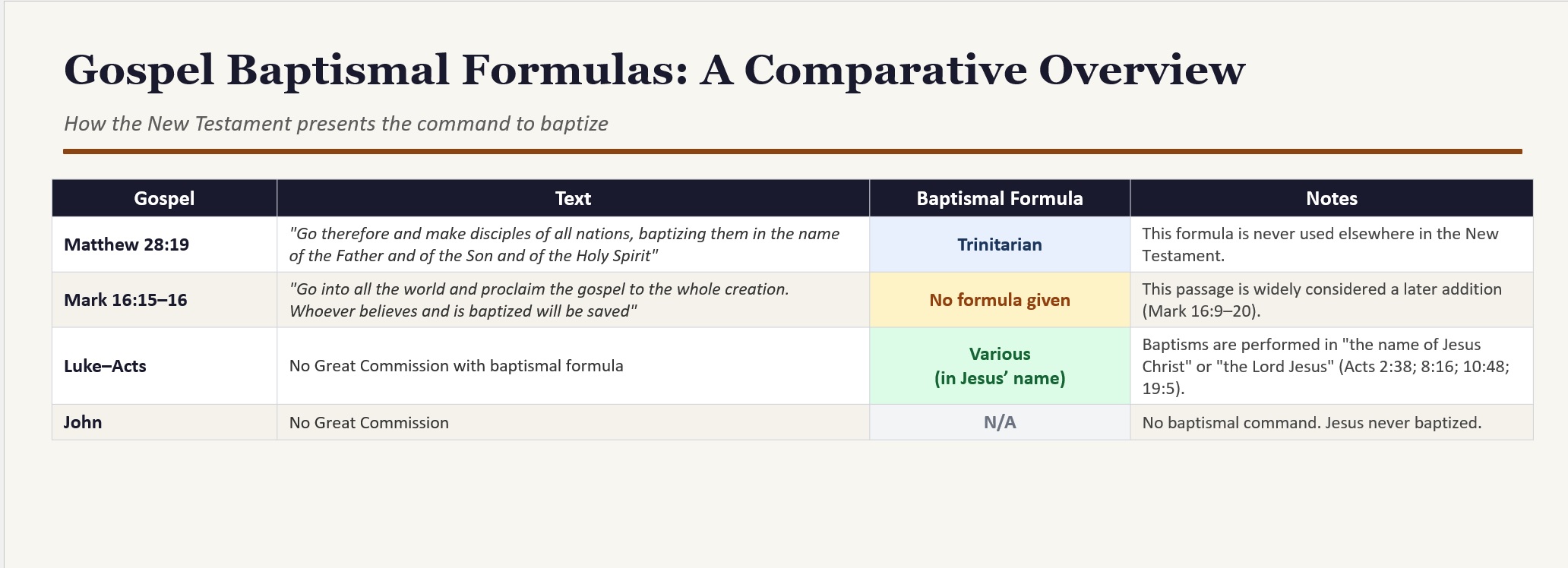
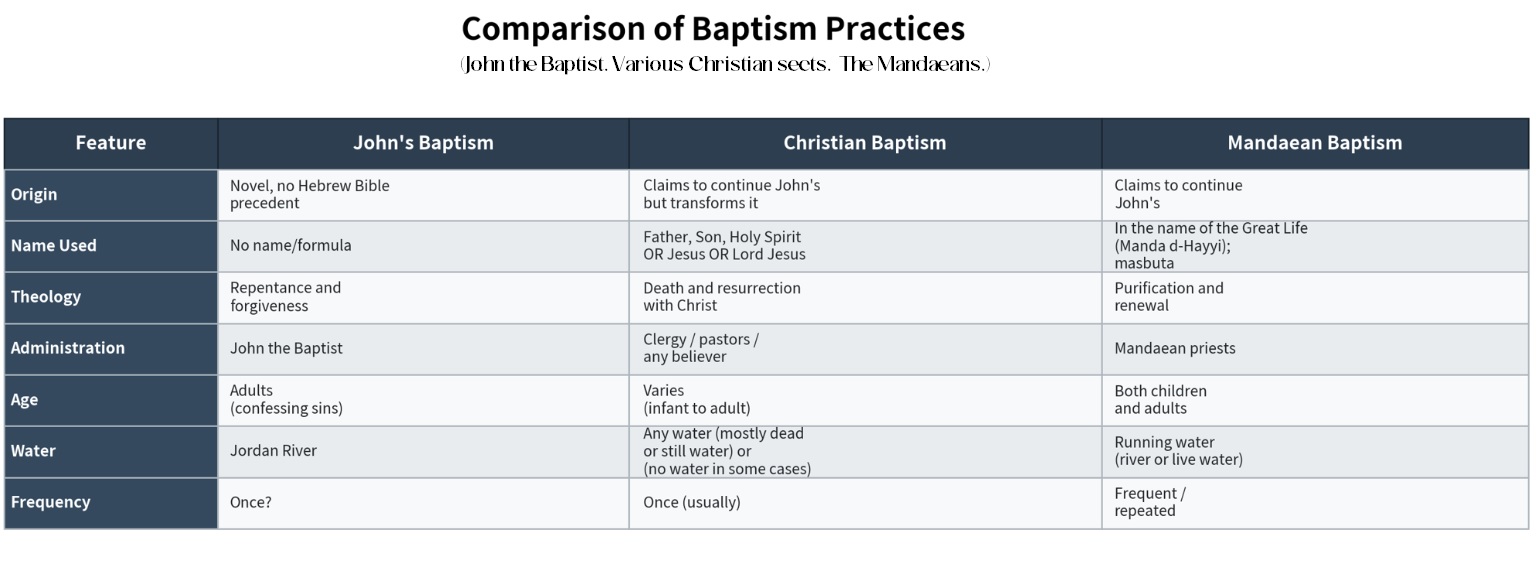
These Christians practiced baptism as a death and resurrection ritual.
Then you had the Sabeans, also known as the Mandeans. They accepted John the Baptist but not Jesus. They practiced ritual baptism, but it carried a different meaning than what the Christians claimed. They had their own scriptures, their own prophets, their own traditions. They were a living witness to the fact that baptism was not the exclusive property of Christianity.
And among all these groups, there was no unified voice. The Pope in Rome claimed authority over the West. The Patriarch of Constantinople claimed authority over the East. The Patriarch of Alexandria claimed authority over Egypt and Ethiopia. The Patriarch of Antioch claimed authority over Syria and beyond. Each claimed to be the successor of Peter, the guardian of the true faith.
There was no single Bible. There were multiple canons: the 27-book canon of the West, the 22-book canon of the Syrian Church, the longer canons of the Ethiopian and Coptic Churches. There were multiple languages: Greek, Syriac, Coptic, Ge’ez, Armenian. There were multiple traditions: the Latin Rite, the Byzantine Rite, the Syriac Rite, the Alexandrian Rite.
Into this chaos came Muhammed, peace be upon him, with a single, powerful, unifying voice. He did not claim to bring a new religion. He came to restore the ancient faith of Abraham. The faith that all the prophets had taught. He did not speak from his own authority. He recited what was revealed to him by Allah, through the Angel Gabriel. He did not claim to be a new pope or patriarch. He claimed to be the final Messenger, confirming what was true in the previous revelations and correcting what had been corrupted.
The message was simple, clear, and cohesive:
There is no god but Allah, and Muhammed (saw) is His Messenger.
Allah is One. Not three, not incarnate.
All the prophets from Adam to Jesus (upon them be peace) taught the same message: submission to the One God.
The Qur’an is the final, preserved, and clarifying revelation.
Judgment is coming. Believe and do good. Or reject it and face the consequences.
For a truth-seeker in the 7th century, the choice was clear. On one side, a cacophony of competing sects, conflicting canons, and anathematizing councils. On the other side, a single, powerful, unifying voice calling all people to submit to the One God. Which message was more cohesive? Which message was more compelling? Which message would you follow?
Allah/God addresses this very scene:
‘So He has made the religion straight and simple. And do not be divided over it.’ (Qur’an 42:13)
‘And hold firmly to the rope of Allah all together and do not become divided.’ (Qur’an 3:103)
‘And those who have been given the Book did not differ except after knowledge had come to them—out of jealousy among themselves.’ (Qur’an 42:14)
The Qur’anic message of unity was not just theological it was a lived reality. It offered clarity in a world of confusion. It offered authority in a world of division. It offered access to revelation in a world where the layperson was excluded from the text. And it offered a single, unified community in a world of warring sects.
“O humanity! What has emboldened you against your Lord, the Most Generous?” (Qur’an 82:6)
May Allah guide the sincere Christians who are longing for the truth. Those who have a hunger in their heart for guidance.
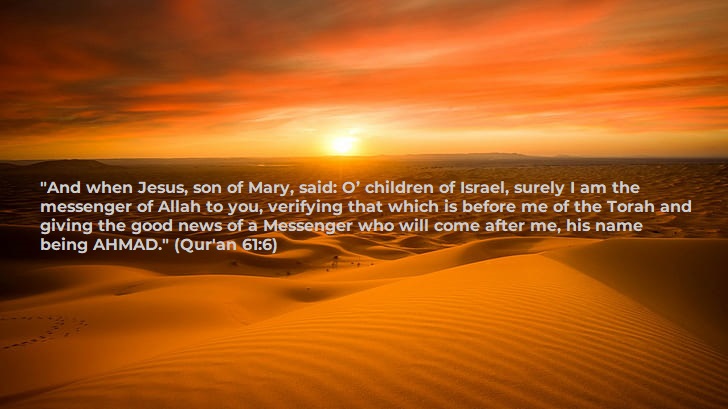
“And when Jesus, son of Mary, said: O’ children of Israel, surely I am the messenger of Allah to you, verifying that which is before me of the Torah and giving the good news of a Messenger who will come after me, his name being AHMAD. But when he came to them with clear arguments, they said: This is clear enchantment.”(Qur’an 61:6)
﷽
This text of the Qur’an has either been a means where Christians have tripped themselves up; or it has been a huge eye opener, one that has led many of them to embracing Islam.
So when dealing with Christians concerning this text you will find those who fall into one of two categories.
A) Those who are insincere and think this text of the Qur’an is some how a problem for Muslims.
B) Those whom are sincerely inquiring into the matter and willing to ponder over the justifications that are given.
The first very obvious point is that this text of the Qur’an no where said that Ahmad is written in any competing number of Christian New Testament canons. The text states: “And when Jesus, son of Mary, said:
Often those Christians antagonistic to Islam read the above text of the Qur’an and think that a Muslim should reply: “Oh yes that is in Matthew chapter so and so verse so and so.”
There is nothing in Qur’an 61:6 that would indicate that the name ‘Ahmad’ would be captured in any of the competing Christian New Testament canons
This would be similar to the text of the New Testament:
“And he went and lived in a city called Nazareth, that what was spoken by the prophets might be fulfilled: “He shall be called a Nazarene.” (Matthew 2:23)
The reason why Christians have not been able to find that particular prophecy is because the above text said it was: ‘spoken’ by the prophets not necessarily that it was written by the prophets.
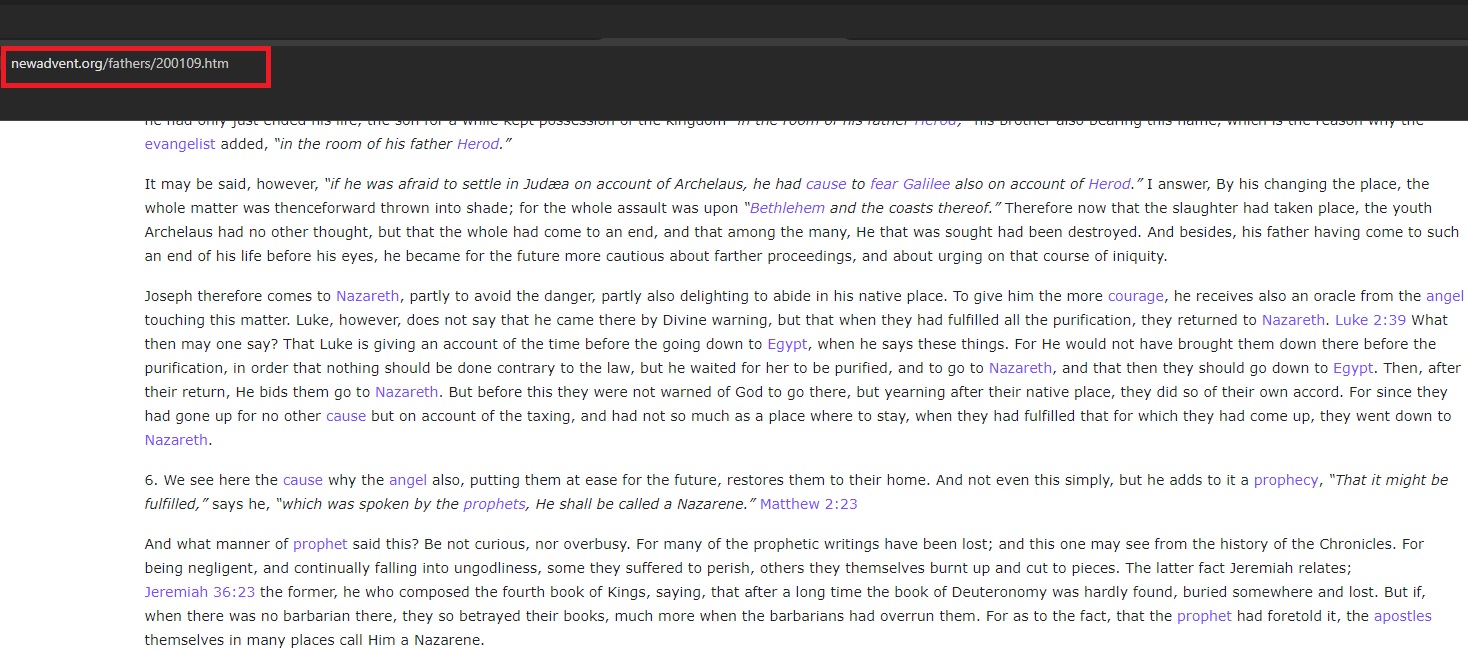
Archbishop of Constantinople John Chrysostom offers a possible perspective.
This Archbishop of the Latin Roman Catholics/Eastern Orthodox Christians offers an interesting perspective.
“We see here the cause why the angel also, putting them at ease for the future, restores them to their home. And not even this simply, but he adds to it a prophecy, That it might be fulfilled, says he, which was spoken by the prophets, He shall be called a Nazarene.Matthew 2:23.”
“And what manner of prophet said this? Be not curious, nor overbusy. For many of the prophetic writings have been lost; and this one may see from the history of the Chronicles. For being negligent, and continually falling into ungodliness, some they suffered to perish, others they themselves burnt up and cut to pieces. The latter fact Jeremiah relates; Jeremiah 36:23 the former, he who composed the fourth book of Kings, saying, that after a long time the book of Deuteronomy was hardly found, buried somewhere and lost. But if, when there was no barbarian there, they so betrayed their books, much more when the barbarians had overrun them. For as to the fact, that the prophet had foretold it, the apostles themselves in many places call Him a Nazarene.” -Archbishop of Constantinople John Chrysostom
Thus, if what Archbishop of Constantinople John Chrysostom says of ‘The Nazarene’ is true than it is likewise that this could be the case for ‘Ahmad’. Namely:
“For many of the prophetic writings have been lost; and this one may see from the history of the Chronicles. For being negligent, and continually falling into ungodliness, some they suffered to perish, others they themselves burnt up and cut to pieces.”
This argument merely demonstrates that the absence of “Ahmad” from the New Testament does not disprove the Qur’anic claim.
Did Jesus ever write anything?
They were using this question as a trap, in order to have a basis for accusing him. But Jesus bent down and started to write on the ground with his finger. When they kept on questioning him, he straightened up and said to them, “Let any one of you who is without sin be the first to throw a stone at her.” Again he stooped down and wrote on the ground. (John 8:6-8)
The assumption is that Jesus (as) wrote what he spoke: “Let any one of you who is without sin be the first to throw a stone at her.” Yet, we have no idea what he wrote the second time.
Not only this but may Allah (swt) reward brother Ammar in the comments section. He had reminded me that even the text that alleges Jesus (as) wrote something in the sands is a forgery.
The story is a clear forgery. Wasn’t found in the 4th century manuscripts.
The New Testament also mentions that Jesus said things that were not recorded.
“After the festival was over, while his parents were returning home, the boy Jesus stayed behind in Jerusalem, but they were unaware of it. Thinking he was in their company, they traveled on for a day. Then they began looking for him among their relatives and friends. When they did not find him, they went back to Jerusalem to look for him. After three days they found him in the temple courts, sitting among the teachers, listening to them and asking them questions. ” (Luke 2:43-46)
Luke does not record any questions that Jesus asked! So this is clear evidence that there are indeed things that Jesus said that are not captured nor recorded by the New Testament.
Since Jesus (as) didn’t really write anything it makes sense we wouldn’t find anything written concerning “Ahmad”. And even if he did write something, we have no evidence it was preserved.
However, note the above text does state that Jesus (as) said:
“Oh children of Israel, surely I am the messenger of Allah to you, verifying that which is before me of the Torah and giving the good news of a Messenger who will come after me, his name being Ahmad.” (Qur’an 61:6)
This is more than sufficient for those who believe. Allah (swt) said that Jesus (as) said it and that is enough for the Muslims.
We are not required to go beyond this. ⬆️⬆️⬆️
Though, for those Christians who are sincere we will endeavor to give them some things to reflect over.
What you are about to read is simply food for thought for those inquiring into the matter.
The New Testament teaches that Jesus never claimed to be the last Prophet.
Jesus (as) never claimed to be the last prophet. That admission in and of itself already is an argument in favour of our proposition. It does not necessarily prove it; however it is a point in favour of our proposition.
Think about this. When other Christian denominations get into debates and discussions with Mormons (The Church of Jesus Christ of the Latter Day Saints) they never shut down the Mormons with saying: “Well, Joseph Smith can’t be a Prophet because Jesus said there would be no more.” If that were so the matter would be an open and shut case.
This is a significant point in favour of the Islamic position.
If Jesus never claimed to be the last prophet, then:
There is no theological barrier to another prophet coming after him. Nothing in Jesus’s teaching rules this out.
First, Jesus himself didn’t shut down the possiblity of true prophets or even other messiahs coming!
“For false messiahs and false prophets will appear and perform great signs and wonders to deceive, if possible, even the elect.” (Matthew 24:24)
Jesus could have closed the door by stating, “there will be no Messiah after me”. He didn’t. He could have said, “There will be no prophet after me.” He didn’t.
The New Testament gives many examples of prophets who came after Jesus.
Now there were in the church at Antioch prophets and teachers, Barnabas, Simeon who was called Niger, Lucius of Cyrene, Manaen a lifelong friend of Herod the tetrarch, and Saul. (Acts 13:1)
And Judas and Silas, who were themselves prophets, encouraged and strengthened the brothers with many words.” (Acts 15:32)
“And as we tarried there many days, there came down from Judaea a certain prophet, named Agabus.” (Acts 21:10)
What has passed is more than sufficient to answer the objections of those who attack the Qur’an 61:6. We can see that the Qur’an says that it was something that Jesus (as) spoke and it doesn’t say it was written. We can also see that the New Testament does not have a definite statement about Jesus (as) being the last prophet.
However, for those Christians who like to reflect we will present more information to reflect upon.
Discussing the Identiy and the Prophecy of the Comforter/Advocate.
Why does the identify of the Comforter need clarification?
Now notice something about this text in John 14:26. Notice that the identity of The Comforter seems to be a matter of ambiguity. This ambiguity is followed up by the clarification: ‘Which is the Holy Spirit’
Now to be clear of the Greek manuscripts that we currently know about John 14:26 is read as: “The Comforter, Which is the Holy Spirit.” We are saying this in the interest of transparency and not to over state the case.
However, the very presence of this clarification suggests that the identity of the Paraclete was not self-evident to the original readers. If the meaning were obvious, no clarification would be needed.
What we are going to present is justification to show that this is a scribal insertion. As you can read the text on the left is quite intelligible without the addition ‘which is the Holy Spirit‘.
Some Early Church Fathers saw the possibility of the Paraclete being a reference to a human being.
The Montanists professed to be prophets and to speak under divine inspiration. Their founder, Montanus, claimed to be the Paraclete, the “Comforter,” or Helper, of John, chapter 14. Tertullian became a Montanist before he died.”
Source: (Edgar J Goodspeed How Came The Bible pg. 67.)
Eusebius explicitly states that some “boasted that Montanus was the Paraclete”
Prima Qur’an Comment: Tertullian and Monatanus were early church fathers who played a crucial role in the development of the New Testament text Christians have today. So if such learned men saw the possibility of the Paraclete referring to a human being then who are we to say?
The Christians will claim thath Montanist did not claim that Montanus himself was the Paraclete. Instead, they believed the Holy Spirit spoke through Montanus and his prophetesses. As one can see from the comments with a Christian below there are debates on ratherMontanist theology was monolithic. Sources note distinctions between Monarchian and non-Monarchian Montanist.
“The enemy of God’s Church, who is emphatically a hater of good and a lover of evil, and leaves untried no manner of craft against men, was again active in causing strange heresies spring up against the Church. For some persons, like venomous reptiles, crawled over Asia and Phrygia, boasting that Montanus was the Paraclete, and that the women that followed him, Priscilla and Maximilla, were prophetesses of Montanus.” Source: Eusebius, Ecclesiastical History volume 5 chapter 14
“Christian tradition has identified this figure (Paraclete) as the Holy Spirit, but scholars like Spitta, Delafosse, Sasse, Bultmann, and Betz have doubted whether this identification is true to the original picture and have suggested that the Paraclete was once an independent salvific figure, later confused with the Holy Spirit.”
Source: (The Anchor Bible, 1970, Volume 29A, p.1135)
“The Paraclete is a parallel figure to Jesus himself; and this conclusion is confirmed in the fact that the title is suitable for both. It is clear from 14:16 that the source thought there were sending of two Paracletes, Jesus and his successor, the one following the other”
Source: (The Gospel of John a Commentary, Rudolf Bultmann, p. 567)
The word Paraclete is used in the New Testament to refer to a human being
“My little children, these things write I unto you, that you sin not and if any man sin, we have an advocate (Parakleton) Παράκλητον with the Father, Jesus Christ the righteous) (1st John 2:1)
Note: The first time the word Paraclete is used is in reference to a man, Jesus.
Jesus (as) mentions that the Paraklete will be like him -and not unlike him.
“If you love me, keep my commandments, and I will pray for the Father, and he shall give you another Comforter (allon Parakleton) ἄλλον Παράκλητον, that HE may abide with you forever.” (John 14:15-16)
‘Another‘- the Greek word Allon means another of the same kind.
The ‘allon Parakleton‘ means in addition to himself another messenger, not heteros, another of a different kind!
If Jesus (as) meant a comforter of a different kind he would have used the Greek word heteron meaning-another of a different kind. The Greek word heteron is where we get the word heterosexual.
An example of the Greek word heteros being used.
“I marvel that you are so soon removed from him that called you into the grace of Christ another (heteron) ἕτερον gospel.” (Galatians 1:6-9)
(Here the Greek word another (heteron) is another of a different kind.)
A derivative of the word Paraclete is also used to reference a human being.
“Joseph, a Levite from Cyprus, whom the apostles called Barnabas (which is translated as “son of encouragement (parakleseos)” (Acts 4:36)
This is such a very curious text that is full of obfuscation. So we have an individual named Joseph, which is being called ‘Barnabas’ by the apostles. Which in turn is being translated as: The son of encouragement [Parakleseos].
Does the Holy Spirit hear and speak?
“I have many things to say unto you, but you cannot bear them now. Howbeit when HE, the Spirit (Pneuma)Πνεῦμα of truth comes HE will guide you into all truth: (HOW?) For HE shall not speak of HIMSELF; But whatsoever HE shall hear (akousei) ἀκούσει that shall HE speak (lalesei) λαλήσει and HE will show you things to come.” (John 16:12-13)
HEAR– The Greek verb (akousei) means to perceive audible sounds.
SPEAK-The Greek verb ; (lalesei) means to speak, to emit sounds.
So this HE has to be able to hear audibly and tell verbally.
The two Greek words Akousei and Lalesei refer to a concrete being with speech organs.
Recall the following text:
” But the Spirit itself (auto) αὐτὸ itself makes intercession for us with groanings which cannot be uttered.” (Romans 8:26)
Ask a Christiain does the Holy Spirit speak? Ask him (The Holy Spirit) to speak then!
Does (John 16:12-13) apply to the Holy Spirit? No!
A) Shall not speak of Himself.
B) Whatso ever He shall here is what he will speak.
This cannot be a reference to the Holy Spirit as Christians understand it.
The Qur’an is the created speech of Allah and and the Blessed Prophet (saw) is the mouthpiece of this created speech.
“By the star when it goes down your companion is neither astray nor being misled, nor does he say of his own desire. It is no less than an inspiration sent down to him: He was taught by one mighty in power.” (Qur’an 53:1-5)
Another point is if we reflect upon the above text it presents problems for Christian theology.
“For HE shall not speak of HIMSELF; But whatsoever HE shall hear (akousei) ἀκούσει that shall HE speak (lalesei) λαλήσει and HE will show you things to come.”
How would the speech of the Spirit be different than the speech of the Father in essence?
Why would the Holy Spirit need to be told what to say when his knowledge is the same as the knowledge of the father in essence?
Remember Christians cannot use the fully deity/full man argument like they can for Jesus. The Holy Spirit does not have two natures as the Dyophysitist (majority of Christianity) claim about Jesus.
So the text of (John 16:12-13) does not necessarily need to be about a man. However, it is equally not possible for it to be about the Holy Spirit-at least not as Christians today understand it.
Say, “Whoever is an enemy of Gabriel should know that he revealed this to your heart by Allah’s Will, confirming what came before it—a guide and good news for the believers.” (Qur’an 2:97)
Angel Gabriel hears from Allah and speaks to the prophets. This is exactly what angels do: they receive and deliver messages. Gabriel is a created being who hears the command of Allah.
The Christian doctrine of the Trinity has historically struggled with the subordination question. The text of John 16:13 seems to imply a subordinate figure. A figure who hears and speaks, who receives rather than originates. This fits Gabriel perfectly.
Jesus (as) constantly refers to the Paraclete as ‘He’ and not ‘It’.
When one goes back and looks at all the text Jesus consistently used the masculine pronoun ‘He’, however, Spirit in Greek is used in the neuter gender which could be he, she or simply it.
lLet us look at various translations of John 1:32.
Notice that the King James version translates the neutral gender as ‘it’ where as in the New King James version they switch it to ‘He’. The other versions also make it masculine gender as ‘He’, or ‘himself’. The New International Version is the best translation remaining non committal in the gender specification.
“Likewise the Spirit also keeps our infirmities: For we know not what we should pray for as we ought: But the Spirit itself (auto) αὐτὸ itself makes intercession for us with groanings which cannot be uttered.” (Romans 8:26)
The above passages show the Holy Spirit as neuter gender which means passages can translate the Holy Spirit as She, He, It. Whereas it is clear that the Paraklete is only referenced as ‘He’.
Recall the point about Jesus calling the Paraklete as (allon Parakleton) ἄλλον Παράκλητον
Another of the same kind, the same genus. The Holy Spirit can be her, him, or it. Jesus is not reference as ‘her’ or it’.
Another reason why (The Comforter, Which is the Holy Spirit) is a scribal insertion.
The New Testament claims Jesus must go away in order for the Holy Spirit to come.
Jesus (as) is reported to make the following claim:
“Nevertheless I tell you the truth; it is expedient for you that I go away: for if I go not away, The Comforter (Parakletos)Παράκλητος will not come to you; but if I depart, I will send HIM unto you.” (John 16:7)
Yet, the same New Testament clearly shows The Holy Spirit concurrent with Jesus.
So Jesus has to depart in order for this Paraklete to come. Based upon this admission the Paraklete cannot be not the Holy Spirit!
The reason why the Paraklete cannot be the Holy Spirit is because Jesus (as) was around when he was around. Ample text make this abundantly clear.
“And the Holy Spirit descended in a bodily shape like a dove upon him.” (Luke 3:23)
(Jesus didn’t have to go anywhere!)
“And Jesus being full of the Holy Spirit returned from Jordan, and was led by the Spirit into the wilderness.” (Luke 4:1)
(Again Jesus and Holy Spirit are present together.)
“Jesus said to them again, “Peace be with you. As the Father sent me, So I send you.” And when he had said this, he breathed on them and said to them, Receive the Holy Spirit.” (John 20:21-22)
(Jesus didn’t go anywhere!)
“For he will be great in the sight of the Lord. He is never to take wine or other fermented drink, and he will be filled with the Holy Spirit even before he is born.” (Luke 1:15)
John was filled with the Holy Spirit before he was even born, which is unlike Jesus who had to receive the Holy Spirit after baptism. The point being John (being filled with the Holy Spirit) was around Jesus.
(Jesus didn’t go anywhere!)
So all these text prove that this Paraklete cannot by the Holy Spirit as Jesus (as) has been around when the Paraklete has been around.
However, Jesus (as) mentions that he needs to go in order to come. This is also an indirect proof that Jesus (as) is dead and not like some have imagined that he is alive in the heavens.
Conclusion.
Jesus departing. These texts are explicit and have proven to be a problem for Christians. The only thing the Christian can do is to say that the Muslims do not understand these texts. Then the Christian only offers an interpretation of what is obviously clear text.
If the Paraclete is the Holy Spirit, then Jesus was wrong to say the Paraclete would only come after his departure. Either the text is inconsistent, or the identification is incorrect.
John 16:12-13 Does this refer to a Prophet to come or the Spirit of Truth?
“I have many things to say unto you, but you cannot bear them now. Howbeit when HE, the Spirit (Pneuma)Πνεῦμα of truth comes HE will guide you into all truth: (HOW?) For HE shall not speak of HIMSELF; But whatsoever HE shall hear (from God) that shall HE speak: and HE will show you things to come.” (John 16:12-13)
So a Christian may object that this can be a reference to a Prophet because the word spirit is clearly used. However, that is because the word ‘spirit’ is being used as a metonymy for a Prophet. It has been used in the following verse in such a way:
“Beloved believe not every SPIRIT (pneumati) πνεύματι , but try the SPIRITS (pneumata) πνεύματα whether they are of God: Because many false PROPHETS are gone out into the world. Hereby know you the SPIRIT of God: Every SPIRIT that confessed that Jesus Christ has come in the flesh is of God:” (1 John 4:1-6)
So you can see that Spirits/Prophets are used interchangeably. So that objection is answered.
However, Muslims can be charitable and agree that this does indeed refer to the Holy Spirit.
Al-Rūḥ Al-Amīn (Trustworthy Spirit)mentioned in the Qur’an.
“‘Which the trustworthy spirit brought down into your heart so that you may be one of the warners.” (Qur’an 26:193-194)
“Say, “The holy spirit has brought it down from your Lord with the truthto reassure the believers, and as a guide and good news for those who submit.” (Qur’an 16:102)
Jesus claims that neither he nor the Bible guide you into all truth.
“I have many things to say unto you, but you cannot bear them now. Howbeit when HE, the Spirit (Pneuma)Πνεῦμα of truth comes HE will guide you into all truth: (HOW?) For HE shall not speak of HIMSELF; But whatsoever HE shall hear (from God) that shall HE speak: and HE will show you things to come.” (John 16:12-13)
This means The Bible alone does not contain all truth. It is only a partial revelation at bests and awaiting the Spirit of Truth and his guidance.
By admission Jesus is not guiding you into all truth. There is one who comes after him that does this.
This creates a problem for the Protestant: If the Spirit guides into all truth, then the Scripture can’t be the only infallible authority.
This creates a problem for Catholics/Orthodox: If the Church (tradition) is the vehicle of the Spirit’s guidance, then the Church’s authority is self-referential and circular.
This is circular because:
The Church’s authority depends on the Bible
The Bible’s authority depends on the Church
Neither can independently validate the other
One thing that the Holy Spirit has never guided the Church on.
Here is a major point that the according to the Oriental Orthodox, the Eastern Orthodox, The Roman Catholics, the Anglicans, the Presbyterians, the Baptist that the Holy Spirit has never guided any of them on.
You see the above Christian groups will tell you that God is one being in three persons. That these three persons are the Father, the Son and the Holy Spirit. They will tell you that the name of the son is Jesus. They will tell you that the name of the Father is Yahweh. But they will never tell you what the name of the Holy Spirit is. Why is that?
Why can they give us the name of the Father and the name of the Son but not the name of the Holy Spirit?
We can put Christian claims to the test in real time.
“Ask, and it shall be given you; seek, and you shall find; knock, and it shall be opened unto you: For every one that ask receives; and he that seeks shall find; and to him that knocks it shall be opened.” (Matthew 7:7-8)
So to any Christian on Earth. from any denomination. ask the Holy Spirit to reveal his name to you then. There is not justifiable reason why he shouldn’t.
Christian objections to some Muslim claims.
Now given that some Muslims use (John 16:12-13) as a reference to the coming of the Blessed Prophet Muhammed (saw) we will look at some of their ojections and see what is a sound Christiain objection and what is not a sound objection.
1st Christian objection.
“The Spirit of truth. The world cannot accept him, because it neither sees him nor knows him. But you know him, for he lives with you and will be in you.” (John 14:17)
It cannot be said that Prophet Muhammed (saw) will live inside anyone. This is unless we use some strained metaphor about his teachings living inside of us. However, it is best not to be like the Christians who use truly strained readings of their text. So this is a sound Christiain objection.
However, the above text is contradicted by the following:
“Nevertheless I tell you the truth; it is expedient for you that I go away: for if I go not away, The Comforter (Parakletos)Παράκλητος will not come to you; but if I depart, I will send HIMunto you.” (John 16:7)
The Holy Spirit can’t both live with the disciples and be present in their midst and Jesus also needs to depart from the disciples in order to send the Holy Spirit. This is not adding up.
The New Testament does not record Jesus baptizing any of his disciples.
““I baptize you with water for repentance. But after me comes one who is more powerful than I, whose sandals I am not worthy to carry. He will baptize you with the Holy Spirit and fire.” (Matthew 3:11)
Again, Jesus can’t be baptizing anyone with the Holy Spirit especially if it is expedient that he (Jesus) goes away.
The text of the Bible contradict the position of the Orthodox Church.
“In the Mystery of Chrismation (Gr. chrismatis,“anointing”), the newly baptized Orthodox Christian receives the Holy Spirit through anointing with oil by the bishop or priest. From the earliest times, the Church practiced Holy Chrismation immediately following Baptism. This same practice held, whether the newly baptized was an adult or an infant. Western churches (like Roman Catholics and Anglicans), in contrast, usually reserve Baptism and Chrismation for those who reach “the age of reason”.
“Now Jesus learned that the Pharisees had heard that he was gaining and baptizing more disciples than John although in fact it was not Jesus who baptized, but his disciples. (John 4:1-2)
So were these disciples unbaptized and performing baptism? If they were baptized why didn’t they receive the Holy Spirit then and there?
Not only this but why isn’t anyone asking the obvious. Where in the hell did the idea of baptism even come from? None of the Old Testament prophets were ever baptized for the forgiveness of sins. The practice is completely alien to the Tanach. Christianity is not in continuity with the Old Testament teachings at all.
2nd. Christian objection.
“But the Comforter, which is the Holy Spirit, whom the Father will send in my name, will teach you everything and remind you of all (πάντα καὶ ὑπομνήσει ὑμᾶς πάντα) that I have told you.” (John 14:26)
First notice the need for clarity. The Comforter, the Holy Spirit. So would we know that the Comforter is the Holy Spirit without the text giving this clarifying remark?
That being said Muhammed (saw) did not come in the name of Jesus. Why would he? So that part is problematic.
What is not problematic is that this Comforter will remind them of what Jesus told them.
This means that there would be some lapse in regard to what Jesus taught. Ironically that would include this very passages in which Jesus is supposed to clarify the role of the Comforter as well as it’s identify.
πάντα καὶ ὑπομνήσει ὑμᾶς πάντα
The Greek word hypomnēskō unequivocally means “to remind.” It presupposes a lapse in memory.
A reminder is only necessary if something has been forgotten. If the disciples perfectly remembered everything Jesus taught, the Comforter’s role of “reminding” them would be redundant. Therefore, the text logically implies that:
Some of Jesus’s teachings were lost or forgotten.
The Comforter would come to restore or bring back what was lost.
If the Comforter needed to “remind” the disciples, then some teachings were at risk of being lost. This undermines the idea of a perfectly preserved tradition.
The Gospel of John itself (John 21:25) states: “There are also many other things which Jesus did, which if they were written one by one, I suppose that even the world itself could not contain the books that would be written.”
This is a clear admission that the Gospel accounts are selective, not comprehensive.
If the Gospel writers themselves admit that they did not record everything Jesus did or said, then the Comforter’s role of “reminding” becomes even more significant: the Comforter will restore what was not recorded, ensuring the essential teachings were not lost.
The text of John 14:26 is an admission that:
Jesus taught more than what is recorded.
The disciples were at risk of forgetting what he taught.
The Comforter would bring back what was lost.
This is exactly what Allah (swt) says:
“And from those who say, “We are Christians” We took their covenant; but they forgot a portion of that which they were reminded. So we caused amonghtem animosity and hatred until the Day of Resurrection. And Allah is going to inform them about what they used to do.” (Qur’an 5:14)
3rd. Christian objection.
“Nevertheless, I tell you the truth: it is to your advantage that I go away, for if I do not go away, the Comforter will not come to you. But if I go, I will send him to you.” (John 16:7)
“But when the Comforter is come, whom I will send unto you from the Father, even the Spirit of truth, which proceedeth from the Father, he shall testify of me: (John 15:26)
The Christian objection is sound. Why would Jesus be the one to send the Blessed Prophet Muhammed (saw). However, as we saw from (John 14:26) it is the father who will send not Jesus. So which is it?
4th Chrisitan objection.
“And I will ask the Father, and he will give you another advocate to help you and be with you forever.” (John 14:16)
The problem comes from the word ‘forever’. The Christian will object and ask if the advocate is a reference to the Blessed Prophet Muhammed (saw) how is he with the believers forever?
This is answered by a number of ways.
“To the roots of the mountains I went down, to the land whose bars closed upon me forever. Yet you brought up my life from the pit, O Lord my God.” (Jonah 2:6)
Jonah was not literally in the land of the dead forever; “forever” means for an extended, indefinite period.
“I am with you always, even unto the end of the world.” (Matthew 28:20)
Jesus is not physically present but Christians could say they feel his presence or that his teachings live on with them. The same can be said of the Blessed Prophet Muhammed (saw).
It seems rather strange that the other Gospel writers have no mention about this coming Paraklete. Lastly, their remains some curiosity in the retention of the word Paraclete in the Hebrew and Aramaic translations.
The Qur’an 61:6 and the use of a type of literary device to that would be akin to an enthymeme.
“And when Jesus, son of Mary, said: O’ children of Israel, surely I am the messenger of Allah to you, verifying that which is before me of the Torah and giving the good news of a Messenger who will come after me, his name being AHMAD.” (Qur’an 61:6)
Do you ever wonder why the verse does not say: ”Giving the good news of a Messenger who will come after me, his name being MUHAMMED?”
Muhammed comes from the triconsonantal Semitic root H-M-D.
The spelling of the word is different but the meaning is the same.
Jesus (as) did not speak Arabic and so what ever he did say would be in Hebrew or Aramaic and not Greek nor Arabic.
What ever prophecy Jesus (as) made would either be ‘Ahmad’ or the equivalent of it’s meaning.
Allah (swt) by using the word ‘Ahmad’ instead of the word ‘Muhammed’ has given us a type of enthymeme by which those interested can investigate the matter. That is to say it is possible that the scribes
“But on account of their breaking their covenant We cursed them and made their hearts hard; they altered the words from their places (yuharifuna l-kaima ‘an mawadi’ihi) and they neglected a portion of what they were reminded of; and you shall always discover treachery in them excepting a few of them; so pardon them and turn away; surely Allah loves those who do good (to others).” (Qur’an 5:13)
What may have been the word in Hebrew or Aramaic?
In the above text we can see the word transliterated as: Mahamaddim. They have translated the word as description ‘lovely.
In the Orthodox Jewish Bible they have put the transliterated word as: Machamaddim and have translated it as: (altogether desirable)
Again a different translation this time we get: “wholly desirable” and we can see that the is a masculine noun pronounced as Machmad. The word origin for this is chamad.
By the way do yourself a favour and copy those Hebrew words and put them in Google translate and listen to how they sound.
Notice that the word in Hebrew is to be desired, delighted in, to covet, to be pleased with, and than look at the Arabic equivalent that they give! With its meaning to praise to eulogize.
Look at the Arabic word that they give.
This in and of itself is not a proof, but it is an intriguing piece of evidence that may point to a preserved remnant of the original prophecy.
May Allah (swt) open the eyes and hearts of those who are sincere.
For further reading on topics in relation to Christianity you may want to read the following:
The Jews and Christians each say, “Follow our faith to be guided.” Say, “No! We follow the faith of Abraham, the upright—who was not a polytheist.” (Qur’an 2:135)
“Therefore be patient; surely the promise of Allah is true and let not those who have no certainty hold you in light estimation. (Qur’an 30:60)
﷽
Perhaps the point at which most Christians feel a sense of superiority over other faith traditions is that many of them have a sense of certainty in regard to their afterlife.
Also, to be fair to them, often it does not come from a sense of superiority but a sense of joy and relief that their sins are covered and paid for and that by accepting what they believe Christ Jesus did for them, they are safe from eternal damnation. Awaiting they are in the glorious kingdom of heaven.
Are you certain about what will happen to you in your afterlife? This is what they very often ask people of other faith traditions. The question is asked if the questioner themselves is certain.
There are several texts that a Christian can point to that give them this assurance. Now this is very important to keep in mind. This is not something intrinsic that a Christian knows; rather, it is the text that confirms their salvation!
So let us take a look at some of these texts.
“I give them eternal life, and they will never perish, and no one will snatch them out of my hand. My Father, who has given them to me, is greater than all, and no one is able to snatch them out of the Father ‘s hand.” (John 10:28-29)
“I write these things to you who believe in the name of the Son of God, that you may know that you have eternal life.” (1 John 5:13)
“For my Father’s will is that everyone who looks to the Son and believes in him shall have eternal life, and I will raise them up at the last day.” (John 6:40)
“For God so loved the world, that he gave his only Son, that whoever believes in him should not perish but have eternal life.” (John 3:16)
“And they said, “Believe in the Lord Jesus, and you will be saved, you and your household.” (Acts 16:31)
Anyone who has a cursory understanding of Christianity and its many competing sects and denominations will be able to spot the flaws with the above text immediately.
That is to say, all Christians believe that Jesus is the son of God. Yet Christians themselves tell us that there are caveats to what seems to be a clear text. “That whoever believes in him.” Whoever is whoever right? Wrong!
The Church of Jesus Christ of the Latter Day Saints, The United Pentecostal Church. The Holy Roman Church. The Greek Orthodox Church, The Jehovah’s Witness, The Southern Baptist. Reformed Baptist, The Trinitarian Pentecostal Church, Anglican/Episcopalian, Methodist, Lutheran, Presbyterian and on and on it goes.
Many of these denominations and sects of Christianity quite often declare the others infidels or outside the body of Christ. Thus, this point alone underscores that the efficacy of “whoever believes in him” in and of itself is insufficient! There must be something more!
Let us also go back and look at this text:
“I give them eternal life, and they will never perish, and no one will snatch them out of my hand. My Father, who has given them to me, is greater than all, and no one is able to snatch them out of the Father’s hand.” (John 10:28-29)
The problem with the above text is that they and them are not defined. Do you not think that every one of those sects and denominations think that they themselves are the ones in the hand of the Father?
Not only that, but each one of those sects above has had apostates and reprobates. Some of them left one denomination for the other. . Some have left said denomination for a faith tradition outside of Christianity altogether. Some have left a belief in God altogether.
So the text quoted by Christians in isolation proves absolutely nothing. If that was the case, Muslims would be saved according to the New Testament.
“Very truly I tell you, whoever hears my word and believes him who sent me has eternal life and will not be judged but has crossed over from death to life.” (John 5:24)
“Now this is eternal life: that they know you, the only true God, and Jesus Christ, whom you have sent.” (John 17:3)
Muslims believe these things. So would that mean we are saved? The Christian would say no as they would go to a) either understanding of these passages in context and/or point to other passages that we do not believe in.
So coming back to the Christians.
“Anyone who runs ahead and does not continue in the teaching of Christ does not have God; whoever continues in the teaching has both the Father and the Son.” (2 John 9)
“Continue in a certain set of teaching” — This means the Christian just cannot have a simple head knowledge about supposed salvation. They must also have correct doctrines.
There are even massive disputes among them about whether one is to be immersed in water for a baptism to be acceptable. Is it enough to sprinkle water to be Christened? At what age should one be baptized? Is infant baptism correct or not? Pedobaptism vs Credobaptism. What is the formula to baptize in? Does one even need to be baptized at all?
“Peter replied, “Repent and be baptized, every one of you, in the name of Jesus Christ, for the forgiveness of your sins. And you will receive the gift of the Holy Spirit.” (Acts 2:38)
“Therefore go and make disciples of all nations, baptizing them in the name of the Father and of the Son and of the Holy Spirit.” (Matthew 28:19)
Some reconcile the above by stating that ‘the name of the Father, Son and Holy Spirit’=Jesus Christ.
“And he said to him, “Truly, I say to you, today you will be with me in paradise.” (Luke 23:43)
These men were not baptized and apparently Jesus assured them of salvation.
What about people who want to convert to Christianity in the desert and there is no water? What about those who believe in water immersion, and they are in a prison where no such service is provided?
Outward signs that would tell us who a true believer of Christ Jesus is?
Are there any outward acts or signs that are not subjective that one could recognize a true believer by?
“And these signs shall follow them that believe. In my name shall they cast out devils; they shall speak with new tongues; They shall take up serpents; and if they drink any deadly thing, it shall not hurt them; they shall lay hands on the sick, and they shall recover.” (Matthew 16:17-18)
The problems with this understanding are manifold.
There is the Pentecostal or Charismatic movement. Among them are Oneness Pentecostals and among them are Trinitarian Pentecostals.
Each side focuses on Tongues as the initial evidence of being saved or “Filled with the Holy Ghost” after baptism.
Oneness Pentecostals reject the trinity view of Godhead and follow closely to what is called by their opponents as Modalism or Sabellianism. That is to say that sometimes God is the Father, sometimes the Son, sometimes the Holy ghost, but never all 3 simultaneously or at the same time.
Oneness Pentecostals believe in baptizing in the name of Jesus ONLY and must be baptized by a Oneness Pentecostal ordained pastor.
Regular Pentecostal people believe in the Trinity : 1 God, 3 persons living together, separately and simultaneously. They baptize” In the name of the Father, the Son, and Holy Ghost.
How is it that both sides speak in tongues if only 1 way is correct? (If the Oneness Formula is the correct one, why do trinitarian Pentecostals also speak in tongues?)
Each side will quote proof text against the other!
Are all apostles? Are all prophets? Are all teachers? Are all workers of miracles? Do all have gifts of healing? Do all speak in tongues? Do all interpret? But earnestly desire the best gifts. And yet I show you a more excellent way. (1 Corinthians 12:29-31)
And no wonder, for Satan himself masquerades as an angel of light. It is not surprising, then, if his servants also masquerade as servants of righteousness. Their end will be what their actions deserve. (1 Corinthians 11:15-16)
In the above text we as Muslims would say that there are those who are apparently righteous (dhahir) and their righteousness is not haqiqah (real or true).
Here are some more texts that Pentecostals and Charismatics and those also known as Holy Rollers would use against each other.
“For false messiahs and false prophets will appear and perform great signs and wonders to deceive, if possible, even the elect.” (Matthew 24:24)
The above text is compounded by the problem that no Christian really knows if any of them are of the elect or not! They only presuppose this by thinking their interpretation of scripture, understanding of scripture or outward manifestation (prophecies, driving out demons and performing miracles) makes them of the elect.
“Not everyone who says to me, ‘Lord, Lord,’ will enter the kingdom of heaven, but only the one who does the will of my Father who is in heaven. Many will say to me on that day, ‘Lord, Lord, did we not prophesy in your name and in your name drive out demons and in your name perform many miracles?’ Then I will tell them plainly, ‘I never knew you. Away from me, you evildoers!’ (Matthew 7:21-23)
The above text has to relate to Christians! Or at the very least, those who in all earnest believe themselves to be Christians. There are no Buddhists, Hindus, Sikhs, Jains, Taoists, Shinto, Jews or Muslims that go around and do such things.
On a personal note, one of our team members has personally known people who were Charismatic Pentecostals that spoke in tongues, and were, for the most part, trying their utmost to be godly people.
Yet, they beat their spouses, remarried after divorce, and the big one—fornication, fornication, fornication! How is one who is filled with the Holy Spirit drawn to sin?
What about the gifts of the Holy Spirit?
“The fruit of the Spirit is love, joy, peace, patience, kindness, goodness, faith, gentleness, and self-control. Against such things there is no law.” (Galatians 5:22-23)
This is also subjective. As you will find Christians and even non-Christians who exhibit all these traits and qualities.
The most hated verses of the entire New Testament to Christians. Separating the wheat from the chafe.
Now, we are going to quote to you some text of the New Testament that deeply troubles Christians. By Christians we mean all of them. Every shade, stripe, sect or denomination.
That is because this text is the real dividing line. This text does not mince words. This text gets as close as one can get to knowing if they have the spirit of God within them.
Now, let us think about this. Let us, for the sake of argument, agree with all the various Christian understandings of who or what the Holy Spirit is.
The Holy Spirit is God himself, as the third person of the Trinity.
The Holy Spirit is God’s active force (Jehovah’s Witness)
The Holy Spirit is God (as Jesus), as Oneness Pentecostals believe.
Let’s just take all that on board.
“For there are certain men crept in unawares, who were before of old ordained to this condemnation, ungodly men, turning the grace of our God into lasciviousness, and denying the only Lord God, and our Lord Jesus Christ.” (1 Jude 1: 4-5)
Now ponder that. A Christian can now walk in righteousness and live a holy life (not by their own account so that they may boast). The reason that they can walk in righteousness and live a holy life is so that they are born of God! They have the Holy Spirit (God himself, Jesus himself, or God’s active force) indwelling in them!
Example:
“No one can serve two masters. Either you will hate the one and love the other, or you will be devoted to the one and despise the other. You cannot serve both God and money.” (Matthew 6:24)
That is the benchmark! Now let us come to that nightmare text we were talking about.
“Dear children, do not let anyone lead you astray. The one who does what is right is righteous, just as he is righteous. The one who does what is sinful is of the devil, because the devil has been sinning from the beginning. The reason the Son of God appeared was to destroy the devil’s work. No one who is born of God will continue to sin, because God’s seed remains in them; they cannot go on sinning, because they have been born of God. This is how we know who the children of God are and who the children of the devil are: Anyone who does not do what is right is not God’s child, nor is anyone who does not love their brother and sister. (1 John 3:7-10)
POWERFUL!!!
As Muslims reading this we only have to say Allahu Akbar! Because there are among Muslims those who think that they can continue to engage in sins and even major sins and die without repenting to Allah, and they will be among the people of paradise!
So read those words, dear Christian! When you molest your child, defraud your frock, embellish funds from the Church, look upon a woman (or man) with lust, marry again after being divorced, are a racist, cheat people, lie, are gluttonous, are greedy, lazy, envious, prideful, hypocrite, vain, unforgiving, seeking obscenities, slander, involved in sedition, bribery, embezzle funds, evade taxes, palm reading, psychic networks, astrologers, and those who believe in astrology, watcher of pornography, adulterer, fornicator, gambler, neglect prayer, or are bitter you are involved in sin and the Holy Spirit does not dwell with in you PERIOD!
“But as He who called you is holy, you also be holy in all your conduct, because it is written, “Be holy, for I am holy.” (1 Peter 1:15-16)
All those above sins mentioned if any Christian commits a single one of them, they cannot be considered holy.
In fact, Paul wrote to Christian Churches with the following strong warning.
“The acts of the flesh are obvious: sexual immorality, impurity and debauchery; idolatry and witchcraft; hatred, discord, jealousy, fits of rage, selfish ambition, dissensions, factions and envy; drunkenness, orgies, and the like. I warn you, as I did before, that those who live like this will not inherit the kingdom of God.” (Galatians 5:19-21)
The above letter is written to a Church filled with Christians!
“If we deliberately keep on sinning after we have received the knowledge of the truth, no sacrifice for sins is left, but only a fearful expectation of judgment and of raging fire that will consume the enemies of God.” (Hebrews 10:26-27)
Oh, Christians! Know that your theology is built upon a mountain of sand!
You are only righteous in accordance with your ego! Fear God! Fear the fire Christians! Flee to God! Turn in repentance! Accept the truth!
Not to be haughty (May Allah protect us), but this also applies to us as Muslims.
“So that you neither grieve over what you have missed nor boast over what He has granted you. For Allah does not like whoever is arrogant, boastful.”(Qur’an 57:23)
We have said it before, and we will say it again. Genesis chapter 3 is the only thing that stands between Christianity and Islam.
Let us examine the concept of salvation and the assurances of it in light of a debate between two Protestant Christians and in light of a debate between a Christian and a Muslim.
The Predestination Debate: James White vs Michael Brown
@ 10:40 “When some determinately refuses him, then God will righteously judge that person and even give them over to unbelief and delusion. And even in that sense, harden them in their sin by giving them over to it.”—Michael Brown
Prima Qur’an comments:
If you look at what Michael is saying. it can be supported by (1 John 3:7-10)
That is, those people who claim they have the Holy Spirit and commit any type of sin at all. Those people can be described by Michael Brown as those who are given over to unbelief and delusion.
“And for this cause, God shall send them a strong delusion, that they should believe a lie.” (2 Thessalonians 2:11)
The Christian believes in a type of God that will send delusion upon people to cause them to believe in lies.
One has to wonder, given that most Christian denominations and sects do believe that Jesus is the son of God, and their redeemer and means to salvation, what did those other Christian sects and denominations (deemed to be heretical and hell-bound) do or not do to put in a state of delusion to the point of believing in lies?
@55:20 “The universe that Dr. White holds to and please correct me if I’m wrong on understanding what you believe or overstating it or misstating it. Instead of God grieving over the rape and torture, slow torture death of a little child whose than buried alive and no one ever going to know about it until the judgement seat of Christ. Instead of God grieving over it and saying I never intended for that. That is absolutely contrary to my will, Dr. White said God ordained it. When he created the universe, he ordained in his decree that someone would do that, and he takes glory in that one way or another.” -Michael Brown
@1:02:15 “Ah my brother, you’re so close to the kingdom.” -James White
James White is making this statement towards Michael Brown. Then James was interrupted by God, who decreed that there be some sound distortion the moment after he said it.
James unveils the dark truth of Calvinist interpretations of the Bible. In fact, this view was refuted by the Ibadi long ago. Calvinism in Christianity is Jabriyya among Muslims.
It is a view that turns the Creator into an unjust, capacious deity that does a sort of Eeny, meeny, miny, moe with his creations.
@1:05:07 “When he said in his opening statement if he calls us to repent, he enables us to repent. He calls everyone to repent. Acts chapter 17. God commands man everywhere to repent. The times of this ignorance God overlooked, but now He commands all men everywhere to repent.” (Acts 17:30)Does that mean he enables? What does enablement mean? What’s the nature of this enabling? Is it a partial regeneration? Romans chapter 8 says those according to the Spirit cannot do what is pleasing before God. “Because the carnal mind is enmity against God: for it is not subject to the law of God, neither indeed can be. So then they that are in the flesh cannot please God. But you are not in the flesh, but in the Spirit. If so, be that the Spirit of God dwell in you. Now if any man have not the Spirit of Christ, he is none of his.” (Romans 8:7-9) Is repentance pleasing towards God? You better believe it is. So you cannot be according to the flesh and do what is pleasing to God. Regeneration has to come first. So is everyone regenerated? Of course not! So if he commands man everywhere to repent. Then he must regenerate everyone to fulfill the statement. ‘If he calls us to repent, he enables us to repent.’ That’s some kind of general prevenient grace, I guess, but that concept simply isn’t Biblical, and it simply does not work.” -James White
Prima Qur’an comments.
What does it say about the justice of God: “but now He commands all men everywhere to repent,” but then He does not enable all men to do so?
“So is everyone regenerated? Of course not! So if he commands man everywhere to repent. Then he must regenerate everyone to fulfill the statement.”
The bizarre ‘logic’, if we want to call it, is as follows.
God has predetermined before the foundation of the world that he will send his Holy Spirit to regenerate human beings so that they may recognize that Christ is the Lord.
“Therefore I make known to you that no one speaking by the Spirit of God calls Jesus accursed, and no one can say that Jesus is Lord except by the Holy Spirit.” (1 Corinthians 12:3)
2. Only those who are regenerated by the Holy Spirit can call Jesus Lord.
3. Because God calls all men to repent but does not enable them to do means that God does indeed want some people to burn in eternal hellfire without even giving them the equal “opportunity” he gives others. We use “opportunity” because none of the Calvinists can tell us on what basis God chooses one over the other. The reason why we used the word “opportunity” in brackets is because a well-known theologian and scholar of their tradition himself quoted a senior teacher as calling this act: “holy rape of the soul!”
In this view of God, it truly is unconditional love because there are no conditions placed upon man and nothing reciprocal either. Rape is a form of unconditional love because it is not based upon mutual consent.
So there are two very massive differences when it comes to the concept of divine love and divine justice in this understanding of Christianity and the true understanding of Islam.
Allah does not force us to love him. Allah has enabled humanity to love him.
We human beings have the ability (given to us by God, each one of us with the mental capacity and faculty) to love God. We can reach out to God. In fact, we bet there is someone reading this article right now because you have something beautiful inside of you. That is right! We said it, something beautiful and amazing and something that needs to be harnessed, trained, and nurtured so it becomes even more beautiful. Right now, out of the thousands of websites you could be looking at, the million and one things you could be doing, you are here.
Why? Because you have a longing for God!
In Islam, you have the ability to reach out to God, and God will reach out to you.
Narrated Abu Huraira:
The Prophet (saw) said, “Allah says: ‘I am just as My slave thinks I am, (i.e. I am able to do for him what he thinks I can do for him) and I am with him if He remembers Me. If he remembers Me in himself, I too, remember him in Myself; and if he remembers Me in a group of people, I remember him in a group that is better than they; and if he comes one span nearer to Me, I go one cubit nearer to him; and if he comes one cubit nearer to Me, I go a distance of two outstretched arms nearer to him; and if he comes to Me walking, I go to him running.’ “
In Christianity, you are on the road to hell unless the capricious deity of Calvin randomly chooses to love you, and then he will make you love him!
Huge difference!
“Say (O Muhammed): “If you do love Allah, follow me: Allah will love you and forgive you your sins: For Allah is Oft-Forgiving Most Merciful.” (Qur’an 3:31)
In Islam, humanity has love instilled in them! In Islam, Love is a dynamic relationship between Allah and humanity. We have love instilled in us, we are not born without love. We human beings develop very deep bonds with our siblings and our children and parents.
“But ask forgiveness of your Lord, and turn unto Him (in repentance): For my Lord is indeed full of mercy and loving-tender kindness.” (Qur’an 11:90)
When confronted with the cruel Calvinist deity, we are dealing with a sadomasochistic entity that is capricious and whimsical when dealing with his creation.
The only critique (and a shallow one at that) the Calvinist can hurl at Islam is the following:
“Allah has enabled humanity to have a synergist relationship with him. In such a system, Muslims can boast of their good deeds!
That is right! Allah has created human beings with the innate power and ability to resist evil and to submit to Allah.
It is true that there are Muslims who boast of their good deeds, their achievements, their awards, their spouses, their children, but this is also true of Christians as well.
The question is, does Allah encourage us to be boastful?
“And the servants of the Merciful are those who walk on the earth in humility….” (Qur’an 25:63)
“Allah does not love the arrogant and the boastful.” (Qur’an 4:36)
For Allah does not like whoever is arrogant, boastful.” (Qur’an 57:23)
2. The second major point of difference between Islam and Christianity.
Do Christians even believe in a God who is fair and just?
“This is what your hands sent ahead, and God is never unjust to the servants.” (Qur’an 22:10)
“Whoever does good, it is for his own soul, and whoever does evil, it is against it; and your Lord is not in the least unjust to the servants.” (Qur’an 41:46)
However, in Christianity we are all God’s enemies! Every human baby born is an enemy of God! What a twisted doctrine! It is only when God forces you (reprograms you from an enemy to a friend) that you become this automaton that loves him.
If any Christian (Assembly of God, Church of Christ, Methodist) comes up to a Calvinist Christian basking and glowing and talking about how they love Jesus Christ and are filled with the love of Jesus, the Calvinist will give them a very cold look and a very stern stare. “Who are these pathetic human beings who think that they are capable of love?”
The Calvinist shivers and withers at the thought of it!
“For if, when we were God’s enemies, we were reconciled to him through the death of his Son, how much more, having been reconciled, shall we be saved through his life!” (Romans 5:10)
Basically, you’re an enemy of God, and you’re on a collision course with death (if you think we are overexaggerating this example, all you have to do is click on the following link:
“Now, Mark Driscoll had a good point on this argument. He likened irresistible grace to a time his daughter was running towards the road about to get hit by a truck. He snatched her out of the way. He did not respect her will. That’s a better analogy.”
Basically, right now you have free will. Your will in this worldview is to always choose evil and rebellion. That’s right! No matter how many times you donate to charity, or you have given your blood or kidney to save someone. No matter how many times you are disgusted with the violence and agony and suffering of the world, you are just rotten to the very core! You’re fundamentally evil in nature! If you don’t like it that’s just tough! The reason you don’t like it is because of your rebellion against a sovereign God!
So what does this sovereign, cruel, capricious deity of Calvinism do? He “does not respect your will,” as the Christian above so eloquently puts it.
God forces you to love him, he changes you, generates you, smashes your will, spiritually rapes you, reconciles you.
However, in Christianity (Calvin’s version), God is very unjust and unfair. God does not give everyone an equal chance. Oh, no!
The favorite proof text of the Calvinist?
So here is the crux upon which their devious and vile doctrine rests, Romans 9:10-21 You would do well to know this text when dealing with Calvinists!
“Not only that, but Rebekah’s children had one and the same father, our father Isaac. Yet, before the twins were born or had done anything good or bad—in order that God’s purpose in election might stand: not by works but by him who calls—she was told, “The older will serve the younger.” Just as it is written: “Jacob I loved, but Esau I hated.” What then shall we say? Is God unjust? Not at all! For he says to Moses, “I will have mercy on whom I have mercy, and I will have compassion on whom I have compassion.” It does not, therefore, depend on man’s desire or effort, but on God’s mercy. For the Scripture says to Pharaoh: “I raised you up for this very purpose, that I might display my power in you and that my name might be proclaimed in all the earth.” Therefore God has mercy on whom he wants to have mercy, and he hardens whom he wants to harden. One of you will say to me: “Then why does God still blame us? For who resists his will?” But who are you, O man, to talk back to God? “Shall what is formed say to him who formed it, ‘Why did you make me like this?’ ”Does not the potter have the right to make out of the same lump of clay some pottery for noble purposes and some for common use?”(Romans 9:10-21)
Notice something about the above text highlighted in red. God had a purpose for the children before they had done anything good or bad, the text says.
Notice that the author of the text also recognizes that there are arguments against the position. Why does God blame us for people who resist his will?
Basically, it comes down to a problem of JUSTICE!!! Where is God’s justice when God, in his “positive will”, actively regenerates some and in his “negative will” he passes over the non-elect?
Christians go on and on about where the justice of God lives in Islam! That’s rich! That is very rich coming from people who believe in doctrines like this!
Where is the justice of God in not giving everyone the same chance and ability to be saved?
Only a person who has a very dark heart, or holds the divine in low esteem could even fathom that such a doctrine is even remotely a modicum of God’s justice!
So what do the Calvinists do?
What do the Reformed Baptists do when they are confronted by this monstrosity of a doctrine?
Write books, of course! Coin phrases and theological terminology. That they feel will help “explain” (read: dress up) the utter ugliness and darkness that this doctrine really is.
In fact, if truth be told in this system, Jesus’ blood is absolutely meaningless. It is a veiled gnostic attack upon the very heart of Christian teachings of atonement.
It is not the blood of Jesus who saves, it is the Holy Spirit that regenerates. The blood of Jesus was not for anyone except for God. It was his own stage show, his own circus act for himself! To satisfy his own wrath, he was already determined to save!
Talk about beyond weird and sadomasochistic does not even come close to the type of perversity that this doctrine is.
Subhan’Allah! Praise be to Allah who has given humanity Islam! Praise be to Allah, who, by the tongues of Christ Jesus the son of Mary, Moses, Aaron, David, Abraham and Muhammed have come to teach us that this is not the way!
“R.C. Sproul, in his book Chosen by God pg. 142-43 gives tells us what Equal Ultimacy is and how it does not fit into the Reformed view of Double Predestination:”
“There are different views of double predestination. One of these is so frightening that many shun the term altogether, lest their view of the doctrine be confused with the scary one. This is called the equal ultimacy view. Equal ultimacy is based on a concept of symmetry. It seeks a complete balance between election and reprobation. The key idea is this: Just as God intervenes in the lives of the elect to create faith in their hearts, so God equally intervenes in the lives of the reprobate to create or work unbelief in their hearts. The idea of God’s actively working unbelief in the hearts of the reprobate is drawn from biblical statements about God hardening people’s hearts. Equal ultimacy is not the Reformed or Calvinist view of predestination. Some have called it ‘hyper-Calvinism.’ I prefer to call it ‘sub-Calvinism’ or, better yet, ‘anti-Calvinism.’ Though Calvinism certainly has a view of double predestination, the double predestination it embraces is not one of equal ultimacy. To understand the Reformed view of the matter, we must pay close attention to the crucial distinction between positive and negative decrees of God. Positive has to do with God’s active intervention in the hearts of the elect. Negative has to do with God’s passing over the non-elect. The Reformed view teaches that God positively or actively intervenes in the lives of the elect to insure their salvation. The rest of mankind God leaves to themselves. He does not create unbelief in their hearts. That unbelief is already there. He does not coerce them to sin. They sin by their own choices. In the Calvinist view, the decree of election is positive; the decree of reprobation is negative. Hyper-Calvinism’s view of double predestination may be called positive-positive predestination. Orthodox Calvinism’s view may be called positive-negative predestination.
Prima Qur’an comments:
Now R.C Sproul is supposed to be a person who understands theology.
So God has decreed that he will act to save some. God has also decreed that he will not act to save the rest. Notice that R.C Sproul says, “The idea of God’s actively working unbelief in the hearts of the reprobate is drawn from biblical statements about God hardening people’s hearts.”
Well, would you imagine that! The whole idea of God actively working unbelief in the hearts of the reprobate is drawn from biblical statements! Who would have guessed! However, what R.C Sproul also conveniently leaves out is the fact that Calvinists believe that God creates all souls! If all souls, by their very nature, sin, then God creates souls that sin. The amount of sin that they do and all that will germinate from it is from God! In fact, rather than saying that God is actively working to create unbelief in people’s hearts, the truth of the matter is that, in Christian theology, God has created human beings who, from the outset, from the very beginning of their creation are unbelievers!
It is only by his capricious, tyrannical whim that he smashes their will and makes them friends rather than keeping them as enemies whom he created to be enemies.
Some Calvinist Christians will read this and scoff and say! Rubbish! Nonsense! Blasphemy!
And we simply raise an eyebrow at them, put our hands over our mouths, give a slight cough and say….”Ever heard of the doctrine of original sin?”
Anyone?
So what kind of nature is man born with? What kind of nature did we inherit from Adam? What kind of flesh, by default mode is supposedly a loving God going to send a soul into?
A soul that, by default mode is on a trajectory to hell!
Remember the above text in Romans 9 says, Does not the potter have the right to make out of the same lump of clay some pottery for noble purposes and some for common use?
There you have it!
Or let us use the more flowery language of the New Living Translation.
So we know that it is his will that one will be made for decoration and one for garbage!
Notice that R.C Sproul says the following:
“Though Calvinism certainly has a view of double predestination….”
So what part of pre-destination needs to be explained here? If it is double predestination and God has a positive decree and a negative decree, then there you have it!
There is no justice in such a doctrine! None! It makes God out to be a tyrannical overlord who only makes people love him. Love does not come from human beings. The human being does not respond to God. The human being is made into an automaton.
Those who are unfortunate enough to become automatons are destined to an eternal life in hellfire for ever-lasting Glory to God the Father! Amen!
All this from a creator who willfully places human souls into a machine that is on a trajectory for hell!
In Calvinism, God is not just. God is the Most Unjust. God’s justice is arbitrary. Contrary to those theologians today who know you will be troubled by this idea, why don’t they do what the Apostle Paul did?
It is not sufficient for R.C Sproul, John Piper and others to allow God’s Holy Spirit to speak when he supposedly inspired Paul to respond by saying, “But who are you, O man, to talk back to God? “Shall what is formed say to him who formed it, ‘Why did you make me like this?’”
Instead, they prefer to write whole books that try and explain away what obviously was not very clear to the masses!
“For God so loved the world…” Wrong! As one Christian speaker who is on the opposite side of this doctrine noted:
“Modern Calvinist circles seem to be filled with guys who insist that Christ’s death had no benefit whatsoever for anyone other than the elect and God’s only desire with regard to the reprobate is to damn them period. Too many Calvinists embrace the doctrine of limited atonement. They finally see the truth of it, but then they think, “Oh, that’s that.” Christ died for the elect and, in no sense are there any universal benefits in the atonement, so the atonement is limited to the elect in every sense, and it has no relevance whatsoever to the non-elect.” -Leighton Flowers
This is the real dilemma for Christians. A capricious deity that randomly chooses without reason or rhyme (only known to himself) who will be the object of his salvation and who will be the object of his wrath).
Or the admission by the Christian that humanity in some capacity can call out to God. That God gives people choice. A type of synergism. That there are people who are awed by Creation and thus the Creator and seek the face of God.
Either way, Islam comes in as a crushing wave that overwhelms them both!
When we peel back the thin veneer of assurance, what we find are spacious doctrines and a people who often lead vacuous lives.
Let us continue on with the debate: The Predestination Debate – James White vs Michael Brown
@1:14:45 Listen to the cross-examination between James White and Michael Brown.
@1:14:49 “Alright and because we are respectful gentleman I will not give a 4 minute, 59 second question. Nor will he give a 4 minute, 59 second answer. So let’s just start out a practical level in terms of election, predestination, Um. I’m 100% sure that I am a child of God, my sins are forgiven. If I was to die right now I’d be in his presence. I assume you feel the same. Therefore, since you know that you are an elected predestined. Can you say that you know that it is absolutely(im) possible for you to ever fall away?” -Michael Brown.
“Well, you’re confusing I think creaturely categories of knowledge and divine categories of knowledge. I would take infallibility and infallible knowledge as a divine category. So, in the sense that the Holy Spirit testifies to me of my sonship as certain as a person can be at that point, given our uh human limitation Yes. But I differentiate between any kind of making my certainty the same kind of level of certainty that we have in scripture.” -James White
Michael Brown: So than I have as a non Calvinist the greater assurance than you do.” James White: “I don’t believe so.” Michael Brown: “Ah, But it says we can know. John says I write these things so that you can know. So you know you have eternal life?”
James White: “Well again.” Michael Brown: “But you could be deceived possibly.”
“Remember what 1 John chapter 5 says Well I (catches himself) The fact is Mike you and I are both old enough now to know many people who used to stand with us in the church, and who made those statements to us…. “-James White
Michael Brown: “And they fell away.“
James White: “And we believed them.”
James White: “And they fell away.”
Michael Brown: “Yes”
James White: “And so the question…(cut off)
Michael Brown: “My theology allows for that.”
James White: “So does mine. They went out from us so that it might be shown they were not truly of us.”-
Michael Brown: “Some that’s the case.”
James White: “Exactly.”
“Those are the ones that are being described. “And That’s why there’s warning after warning. Don’t harden your heart.”-Michael Brown. “Exactly.”-James White. “And we are partakers if we continue to the end.”-Michael Brown
“So we agree on perseverance.” -Michael Brown
“Exactly.”-James White.
“So your saying your sure but not God 100% sure?“-Michael Brown.
“I’m not divine! So I have to recognizes that that that as far as the Holy Spirit testifies to my heart yes! And that in 1 John 5 by the way says that you may know. What. I’ve wrote these things to you. What were those things? That you love the brethren, that you walk in light etc. etc.” -James White
“Right right So we have the fruit of it. So we have the fruit of it. Therefore the warnings the warnings are real to you?” -Michael Brown.
“Yes they are.”-James White.
“Ok, fine fine that’s important alright.”-Michael Brown
Prima Qur’an comments.
First, we found interesting Michael Brown’s not so subtle dig at James White’s debate tactics.
Brown stated:
“Alright and because we are respectful gentleman I will not give a 4 minute, 59 second question. Nor will he give a 4 minute, 59 second answer“-Michel Brown.
What Brown is speaking about is, during what is called ‘cross -fire’, James can often milk the clock of his opponent by giving a lengthy response that takes time away from the questioner to press him.
“I would take infallibility and infallible knowledge as a divine category. So in the sense that the Holy Spirit testifies to me of my sonship as certain as a person can be at that point given our uh human limitation Yes. But I differentiate between any kind of making my certainty the same kind of level of certainty that we have in scripture.”-James White.
Prima Qur’an comments:
Doesn’t a Christian deserve 100% certainty over ‘as certain as a person can be’ ? Does that very response completely blow the lid off the idea of assurance of salvation? You have to wonder why wouldn’t God give that infallible knowledge to a Christian?
Recall what we stated at the entry of this blog post.
There are several textd that a Christian can point to that give them this assurance. Now this is very important to keep in mind. This is not something intrinsic that a Christian knows; rather, it is the text that confirms their salvation!
“The fact is Mike you and I are both old enough now to know many people who used to stand with us in the church, and who made those statements to us.” -James White
Prima Qur’an comments: What James says is quite true. There are indeed those who call themselves Christians. Perhaps even those who are calling Muslims to Christianity right now who actually may not even be real Christians (according to James & Michael). They could be out there in Hyde Park, online and in other places saying and confessing the exact same things that James White and Michael Brown say and confess. Then behold! One day, those same people have left a particular Christian denomination for one deemed to be heretical. Or that person left Christianity for a non-Christian tradition. Or that Christian renounced faith altogether!
“So your saying your sure but not God 100% sure?“-Michael Brown.
“I’m not divine! So I have to recognizes that that that as far as the Holy Spirit testifies to my heart yes! And that in 1 John 5 by the way says that you may know. What. I’ve wrote these things to you. What were those things? That you love the brethren, that you walk in light etc. etc.” -James White
“Right right So we have the fruit of it. So we have the fruit of it. Therefore the warnings the warnings are real to you?:-Michael Brown.
Prima Qur’an comments:
So Brown presses James about whether he can be 100% certain that he is saved, or elected and will never fall away from faith. It is odd that Christians who claim to be regenerated from the Holy Spirit (presumably God the third person) cannot give a more convincing response.
James again quotes scripture (which hundreds of other denominations that he feels are heretical also quote).
James then appeals to ‘fruits of the spirit’ which, as mentioned above, are also found in hundreds of other denominations that both James and Michael would feel are heretical. Those same fruits are also found in non-Christian people.
So there is really nothing apparent that would set James and his sect apart from any other type of Christian denomination that would rely upon the same evidence.
@1:19:25 There is an exchange between James and Michael about whether a Christian should praise God over a child of theirs that would be damned to hell. Michael got the better of this exchange, of which James tacitly agreed. That is because, as Michael noted, if everything is predestined by God, and God is good, then nothing he does is other than good and is praiseworthy. Including allowing a believing Christian’s son or daughter to burn in hell for all eternity.
Prima Qur’an comments:
This may be seen as underhanded by Michael Brown, especially if he is aware of the friction between James White (pictured right) and his estranged sister Patricia Bonds. Patricia had converted to the Roman Catholic Church. She also writes about the claim that her father molested her. Source: (https://catholicconvert.com/patty-bonds-her-father-her-mother-and-her-brother-james-white/)
So what Michael is pressing James on here is that if God decrees all things and predetermines them, and God is good, and we must rejoice in all things God does…. then well…..you, the reader, follow the logic.
@1:50:51 There was a very good question from the audience.
“If the atonement is particular rather than conditional, is it the case that the elect have their penalty paid for them before they were born? If so, in virtue of what are they ever under the wrath?“
“Whoever believes in the Son has eternal life, but whoever rejects the Son will not see life, for God’s wrath remains on them.” (John 3:36)
You can listen to James response.
@1:51:07 “Yeah, that’s a very good question. But uh, its uh Biblically answered uhh we experience what God has provided for us in eternity in time. We are time-bound creatures. And so, yes uh in our union with Christ we die with him. That’s the great confession of all every believer. I’ve been crucified with Christ nevertheless I live. Well, when was I crucified with Christ? At the time of my conversion? Or was I not united with him in his death? Uh, the idea that we somehow unite ourselves to him. I think is doesn’t’ make much sense. But we experience all this in time. So, while God has decreed, according to Ephesians chapter 1, that salvation that is ours there is a point in time, early in life for those who are really blessed, maybe later in life uh for others for God’s purposes that they may go through those things so that they can be ministers unto others. But at God’s intent, intended time the Spirit of God brings spiritual life we are uh given the gifts of faith and repentance and we than experience that which God intended from eternity past and procured for us Not just in the sacrifice of Christ but even in all his redemptive works that he did with the people of Israel before that, which brings about the sacrifice of Christ. So, uh it is it’s a category error to say that If we are all united with Christ in his death, therefore that means that we’ve never been children of wrath, or that we umm until or generation or somehow uhh free from uhh the penalty of sin or any of those types of things. That is ignoring the fact that God can be eternal and we are in time and therefore he decrees when in time we are going to experience that which he has decreed for us.” -James White.
Prima Qur’an comments:
We have watched enough of James White to know that when he isn’t certain how to respond, he in respond with one of two ways or a combo. 1) Fill the response with incoherent ramblings. 2) State the person is making a ‘category error’ or a combination of both.
We found his response wanting. If God had already pre-ordained before the beginning of time whom he would regenerate, in what real sense would such individuals ever be under the wrath of God?
We believe the questioner also wanted to take aim at the “ordo salutis” position of what is known as primitive Baptist or “hard-shell” Baptist. Namely, the idea that one could be in Christ as an unrepentant individual. In other words, an unbeliever united with Christ. That regeneration preceded repentance.
NNow there are textsthat could assist the idea of one being regenerated by the Holy Spirit and not having faith. But then to call this person an unbeliever (as they have not professed anything) would be a stretch.
“For he will be great in the sight of the Lord; and he will drink no wine or liquor, and he will be filled with the Holy Spirit while yet in his mother’s womb.” (Luke 1:15)
In what real sense can the wrath of God be upon John? The following text cannot be true in any real sense unless the Christian states that this is the case in general.
“For all have sinned, and come short of the glory of God.” (Romans 3:23)
“No one who is born of God will continue to sin, because God’s seed remains in them; they cannot go on sinning, because they have been born of God. (1 John 3:9)
John was born of God, so in what sense is a sinner and/or in what sense is the wrath of God upon him?
“Before I formed you in the womb I knew you, before you were born I sanctified you; I appointed you as a prophet to the nations. Alas, Sovereign Lord,” I said, “I do not know how to speak; I am too young.” But the Lord said to me, “Do not say, ‘I am too young.’ You must go to everyone I send you to and say whatever I command you. Do not be afraid of them, for I am with you and will rescue you,” declares the Lord. Then the Lord reached out his hand and touched my mouth and said to me, “I have put my words in your mouth.” (Jeremiah 1:5-9)
God says he sanctified Jeremiah even in his mothers womb. Is someone going to come along and say that Jeremiah is the object of God’s wrath? Or that Jeremiah sinned?
As regards using the idea that either Jeremiah or John the Baptist were regenerated without the ability to declare faith from the point of view of a Muslim is an argument from silence.
Thus, Jeremiah, John the Baptist could have all had prescience at birth.
Evanescent Grace -Christian James White debates Muslim Abdullah Kunde.
Title of the debate: The Assurance of Salvation In Islam And Christianity
When we knew that Abdullah Kunde was going to debate James White and knowing that Pastor White is a Calvinist we pointed out to Abdullah the position of Evanescent Grace.
What was shocking to usis that James White was ignorant of the terminology. We do not know if the showcasing of his ignorance also contributes to the fact that his website does not link to the debate. Or it maybe that those who hosted the debate did not feel James did so well.
Allah knows best.
WHAT IS EVANESCENT GRACE?
Evanescent-something that gradually vanishes.
1. I am aware it seems unaccountable to some how faith is attributed to the reprobate, seeing that it is declared by Paul to be one of the fruits of election; and yet the difficulty is easily solved: for though none are enlightened into faith, and truly feel the efficacy of the Gospel, with the exception of those who are fore-ordained to salvation, yet experience shows that the reprobate are sometimes affected in a way so similar to the elect, that even in their own judgment there is no difference between them. Hence it is not strange, that by the Apostle a taste of heavenly gifts, and by Christ himself a temporary faith, is ascribed to them. Not that they truly perceive the power of spiritual grace and the sure light of faith; but the Lord, the better to convict them, and leave them without excuse, instills into their minds such a sense of his goodness as can be felt without the Spirit of adoption. Should it be objected, that believers have no stronger testimony to assure them of their adoption, I answer, that though there is a great resemblance and affinity between the elect of God and those who are impressed for a time with a fading faith, yet the elect alone have that full assurance which is extolled by Paul, and by which they are enabled to cry, Abba, Father. Therefore, as God regenerates the elect only for ever by incorruptible seed, as the seed of life once sown in their hearts never perishes, so he effectually seals in them the grace of his adoption, that it may be sure and steadfast. But in this there is nothing to prevent an inferior operation of the Spirit from taking its course in the reprobate. Meanwhile, believers are taught to examine themselves carefully and humbly, lest carnal security creep in and take the place of assurance of faith. We may add, that the reprobate never have any other than a confused sense of grace, laying hold of the shadow rather than the substance, because the Spirit properly seals the forgiveness of sins in the elect only, applying it by special faith to their use. Still it is correctly said, that the reprobate believe God to be propitious to them, inasmuch as they accept the gift of reconciliation, though confusedly and without due discernment; not that they are partakers of the same faith or regeneration with the children of God; but because, under a covering of hypocrisy, they seem to have a principle of faith in common with them. Nor do I even deny that God illumines their minds to this extent, that they recognize his grace; but that conviction he distinguishes from the peculiar testimony which he gives to his elect in this respect, that the reprobate never attain to the full result or to fruition. When he shows himself propitious to them, it is not as if he had truly rescued them from death, and taken them under his protection. He only gives them a manifestation of his present mercy. In the elect alone he implants the living root of faith, so that they persevere even to the end. Thus we dispose of the objection, that if God truly displays his grace, it must endure for ever. There is nothing inconsistent in this with the fact of his enlightening some with a present sense of grace, which afterwards proves evanescent.
This is extremely unnerving and terrifying. How do Christians ‘know’ for sure that they are saved and are not just under some false sense of security that God has put into them as mentioned by John Calvin? Why would God do that any way?
Would people who have sincerely repented, turned to God and searched for truth and endured hardships their whole life be given a false sense of security by God?
In fact, Abdullah Kunde brought up this excellent point about Simon the Magi you can see in the video below (quality not so great).
“Now for some time a man named Simon had practiced sorcery in the city and amazed all the people of Samaria. He boasted that he was someone great, and all the people, both high and low, gave him their attention and exclaimed, “This man is rightly called the Great Power of God.” They followed him because he had amazed them for a long time with his sorcery. But when they believed Philip as he proclaimed the good news of the kingdom of God and the name of Jesus Christ, they were baptized, both men and women. Simon himself believed and was baptized. And he followed Philip everywhere, astonished by the great signs and miracles he saw. When the apostles in Jerusalem heard that Samaria had accepted the word of God, they sent Peter and John to Samaria. When they arrived, they prayed for the new believers there that they might receive the Holy Spirit, because the Holy Spirit had not yet come on any of them; they had simply been baptized in the name of the Lord Jesus.Then Peter and John placed their hands on them, and they received the Holy Spirit. When Simon saw that the Spirit was given at the laying on of the apostles’ hands, he offered them money and said, “Give me also this ability so that everyone on whom I lay my hands may receive the Holy Spirit.” Peter answered: “May your money perish with you, because you thought you could buy the gift of God with money! You have no part or share in this ministry, because your heart is not right before God. Repent of this wickedness and pray to the Lord in the hope that he may forgive you for having such a thought in your heart. For I see that you are full of bitterness and captive to sin.”Then Simon answered, “Pray to the Lord for me so that nothing you have said may happen to me.” After they had further proclaimed the word of the Lord and testified about Jesus, Peter and John returned to Jerusalem, preaching the gospel in many Samaritan villages. (Acts 8:9-25)
Now this above text is all kinds of interesting. We know that Simon was one of the elect of God because no one can believe unless, they are regenerated by the Holy Spirit. This is not a case of simple head knowledge or knowledge of the apparent. We know this because the one instructing Luke to write Acts is none other than the Holy Spirit, according to Christians! Surely the Holy Spirit would know if Simon believed or was not correct? So Simon was one of the elect. He believed and was baptized.
However, this text is full of problems such as:
“because the Holy Spirit had not yet come on any of them; they had simply been baptized in the name of the Lord Jesus” Yet, the previous text says: “But when they believed Philip” & “they were baptized, both men and women.”
Peter, who is one of the elect, according to Christians says to his fellow elected Christian: “Repent of this wickedness and pray to the Lord in the hope that he may forgive you .”
The very fact that the Elect Peter, who is disturbing the Holy Spirit like there is no tomorrow, says to the fellow Elect Simon, “That he may forgive you” is proof clear as day that the possibility was there for Simon to lose his election.
The Elect Peter also says to the Elect Simon: “For I see that you are full of bitterness and captive to sin.”
That was the end that we heard of Simon.
They couldn’t have believed unless the Holy Spirit had already came to them.
@2:27 Abdullah Kunde brought up evanescent grace.
@1:23 Abdullah points out that James has yet to interact with his question on evanescent faith.
@5:45 Again brother Abdullah Kunde presses James to answer his questions on evanescent faith.
@6:06 Brother Abdullah Kunde ask: “Does faith come before or after salvation”?
“Are mentally retarded individuals are they granted salvation because are they granted the ability to come to faith; or are they granted salvation at the very beginning and then faith after that?”
“What about children?” “Children that do not reach the age of reason if they die are they granted salvation?”
These are very excellent questions given by brother Abdullah Kunde.
@7:52 Again Abdullah ask about Evanescent faith to James White.
@10:07 “ok thank you very much, uh the reason I didn’t respond to uh what Abdullah said is I’m not sure what evanescent faith is. He just defined it as pretend faith. Uh I I’m sorry it’s not terminology I’ve ever heard of before. Uh there are certainly are people who have false Faith. There are people who have faith in a false Jesus, a false gospel.”-James White
@13:42 Abdullah Kunde is enlightening James White about the position of evanescent faith by quoting Calvin’s Institutes.
Prima Qur’an comments:
“I’m not sure what evanescent faith is. He just defined it as pretend faith. Uh I I’m sorry it’s not terminology I’ve ever heard of before. “-James White
We are very, very surprised that James White expressed ignorance over the terminology of what Brother Abdullah Kunde gave.
“@1:47 “Ah well very briefly I said I didn’t address uh mentally retarded individuals, children these are huge subjects. The scripture does not address these issues. It simply tells us that God will be just. and that the judge of all the Earth will do right.”-James White.
Yet Islam does address these points. Islam has very clear nass (text) that answer these questions.
“Allah does not burden a soul beyond that it can bear.” (Qur’an 2:286)
The above text is actually in regard to the sacred law.
It was narrated from ‘Ali bin Abu Talib that:
the Messenger of Allah (saw) said: “The Pen is lifted from the minor, the insane person and the sleeper.”
So, when we dream, we may do certain acts in our dreams that would be impermissible in sacred law. We are not held accountable for it. Islam addresses this. Does Christianity?
The case of children.
Minor children, until they become mukhalif (responsible) exhibited signs such as distinction between right and wrong, abstract thinking etc. Until then, they have not been held accountable. Even if they are raised by non-Muslims. They die, they enter into the Mercy of Allah. Islam addresses this. Christianity is not cohesive on the issue.
This also circles around further disputes about what one must do/believe in order to obtain salvation. For example, the differences between credobaptism and pedobaptism. Credobaptis (those who say a person must confess a faith in Christ) vs Pedobaptist (not necessary to confess a faith in Christ). The Credobaptists have not demonstrated that the Bible teaches that professing believers, and no one else, are to be baptized. Personally, in this debate, the Pedobaptist (Orthodox, Catholic, Presbyterian, Anglican and others that practice baby baptism are more consistent with the doctrine of original sin. Babies die—they fell in Adam. Whereas the only consistent Protestants that can reject Pedobaptism are the Churches of Christ (not Mormons) — these Churches of Christ are also called ‘Campbelites’.
Here is the syllogism:Campbellites agree with Augustine that baptism literally washes away sin;Campbellites disagree with Augustine that baptism is for infants;Therefore, Campbellites conclude that infants are not affected by original sin, but are rather born innocent.
Thus, on who is baptized, they are the most biblically consistent Protestants.
The case of those not in full use of mental faculties (the insane, the mentally challenged).
Islam addresses this. Does Christianity?
The concept of eternal security, preservation or perseverance of saints has been unsettling for many Christians. This is because many of them witnessed people who believed as they believed, said as they said, witnessed as they witnessed, and bore fruit as they bore fruit and yet these very people left Christianity.
Calvin does distinguish between the graces experienced by the saved versus the evanescent grace experienced by the confused damned. The saved get the real thing, while the damned lay hold “of the shadow rather than the substance.” In other words, if the saved are drinking Coke, the damned are drinking Diet Coke. But since neither the saved nor the damned have ever had the other kind, and all the external characteristics are the same, there’s no way of knowing which you’re drinking.
One extremely distraught Christian wrote: “So here is where I’m hung up. There have been Christians who surpass myself by any measure or rubric that I could use for comparison. And yet some of these have since fallen away. Any comfort I have in regard to not falling away, these former(?) Christians would also have had. But since they have fallen away, the comfort they felt should not have been comforting. The assurance that they felt should not have been assuring.”
“I was wondering how the doctrine of assurance is assuring to Calvinists, knowing that others have seemingly fallen away. I’m not sure how else to word it.”
“My sheep listen to my voice; I know them, and they follow me. I give them eternal life, and they shall never perish; no one will snatch them out of my hand. My Father, who has given them to me, is greater than all; no one can snatch them out of my Father’s hand.” (John 10:27-29)
Thus, the Christian tells us that the Shephard choose the sheep. The sheep do not choose the Shephard. Though this is not a good analogy because of the following text:
“He answered, “I was sent only to the lost sheep of the house of Israel.” (Matthew 15:24)
Did the shepherd do a poor job as to lose the sheep or did the sheep simply not obey?
The problem, and in actuality, the very real and very sad irony of someone quoting the above text as some proof for a doctrine of the assurance of salvation, is as follows.
Of course, the Shephard knows the sheep, and the sheep recognizes the Shephard. However, the sheep cannot even affirm if they are the Shephard’s sheep to begin with. Therefore, they cannot know if the Shephard will keep them. It does not get more uncertain than this.
JESUS WAS ONLY SENT TO THE LOST SHEEP OF THE HOUSE OF ISRAEL.
Jesus when speaking about his people , those saved, those
“Know that the Lord, he is God! It is he who made us, and we are his ;we are his people, and the sheep of his pasture.” (Psalm 100:3)
“He answered, “I was sent only to the lost sheep of the house of Israel.” (Matthew 15:24)
“Jesus said to him, “Today salvation has come to this house, because this man, too, is a son of Abraham. For the Son of Man came to seek and to save the lost.” (Luke 19:9-10)
“You worship what you do not know; we know what we worship, for salvation is of the Jews.” (John 4:22)
“My sheep listen to my voice; I know them, and they follow me. I give them eternal life, and they shall never perish; no one will snatch them out of my hand. My Father, who has given them to me, is greater than all; no one can snatch them out of my Father’s hand.” (John 10:27-29)
“While I was with them, I protected them and kept them safe by that name you gave me. None has been lost except the one doomed to destruction so that Scripture would be fulfilled.” (John 17:12)
“Then Jesus replied, “Have I not chosen you, the Twelve? Yet one of you is a devil!” (John 6:70)
Prima-Qur’an comments:
Everyone is in agreement that the terminology ‘them’, ‘they’ and ‘those’ are not a reference to the whole of humanity but to a specific group of people. They are numbered. What is the evidence to suggest that John 10: 27-29 is not simply a reference to the 12 disciples themselves?
Where is the evidence that when Jesus used the terminology ‘them’, ‘they’ are a reference to a Motley Crue of Christians from every tribe and people?
“They went out from us, but they did not really belong to us. For if they had belonged to us, they would have remained with us; but their going showed that none of them belonged to us.” (1 John 2:19)
So often some Christians say about those who left Christianity, well, “they were never really Christian to begin with.” But the problem with that type of thinking is that no one can truly know if they are that type of Christian (i.e. true) until they die!
What has terrified the Christian is that they said the whole reason for a redeemer is that God demands 100% perfection. So let’s get this right. God calls all men to repent. However, this God has given the ability to some to repent and not others. But even those he has regenerated and given the ability to repent have to now also be 100% perfect.
“Dear children, do not let anyone lead you astray. The one who does what is right is righteous, just as he is righteous. The one who does what is sinful is of the devil, because the devil has been sinning from the beginning. The reason the Son of God appeared was to destroy the devil’s work. No one who is born of God will continue to sin, because God’s seed remains in them; they cannot go on sinning, because they have been born of God. This is how we know who the children of God are and who the children of the devil are: Anyone who does not do what is right is not God’s child, nor is anyone who does not love their brother and sister. (1 John 3:7-10)
You will never commit a single sin. The moment you do. Voilà! You can know that you are not one of the saints.
One of the preachers of this above doctrine is a man named R. C Sproul. Here he is showing utter disdain for another Christian for stating that as a Christian she does not drink. This Holy Spirit that dwells inside him was about to tempt him to drink some Double Scotch on the Rocks. “That’ll show her.” I guess he was thinking as such.
This preacher, R.C Sproul has a son, R.C Sproul Jr. who is known in his community as a big-time alcoholic. His infamous quote, “We are Presbyterians, so we smoke and drink!” as if this is something to brag about, seems to have invoked the wrath of God upon him.
You can read all about this here. The fruits of regeneration and being in the body of Christ:
“Hi Dee and Deb, just a couple of things you might want to correct in this part of your post:”
>> Heart breaking tragedy is not an excuse for substance abuse. Sproul Jr. needs serous help. I learned an important lesson while working in an alcoholic hospital when I was young. Tragedy does not cause alcoholism. Alcoholism is an excuse to drink and every alcoholic in the world usually tries to find an excuse to drink.<<
“Serous help? Haha. Sounds like needs a blood transfusion! …. which is not that far off base: he needs to be born again as this persistent pattern of behaviour shows he is NOT regenerate and is NOT in Christ at all. I wonder whether RC Sproul Senior has accepted that fact yet? I doubt it.”
“And I’m sure you didn’t mean ‘Alcoholism is an excuse to drink’ — I’m pretty sure you meant something like “Alcoholics use tragedy as an excuse to drink…. “
“R C Sproul Junior needs to be put out of the church and that needs to be very publicly done because he has been so significant at Ligonier. 1 Corinthians 5:11-13.”
“But now I am writing to you that you must not associate with anyone who claims to be a brother or sister but is sexually immoral or greedy, an idolater or slanderer, a drunkard or swindler. Do not even eat with such people. What business is it of mine to judge those outside the church? Are you not to judge those inside? God will judge those outside. “Expel the wicked person from among you.” (1 Corinthians 5:11-13)
YOU CAN NEVER LOSE YOUR SALVATION IN CHRIST EVEN IF YOU BECAME AN ATHEIST!?
So, on the other side of this discussion came the logical conclusion that ‘If you played no part in your salvation, then you play no part in your damnation’. ‘If Christ keeps you he will never lose you, no matter what you do!‘
You didn’t save yourself, you won’t lose yourself!
Thus, a Christian could commit adultery, lie, cheat, have homosexual relationships, lie about Islam if it gets them the upper hand in a debate. Because simply put: “Once you are Saved you are Always Saved! A Christian simply put cannot lose their salvation!
“These Christians among them people like Charles Stanely, have positions among them like the following: True Christians will not necessarily persevere in the faith. In fact, a true Christian may receive Jesus as Savior, later become intellectually unconvinced of the gospel, denounce Christ and become an atheist; however, because of that one human decision made at one point in time, he is still considered to be saved. For instance, Joseph Dillow, in The Reign of the Sevant Kings, says, “It is possible for a truly born-again person to fall away from the faith and cease believing.” (p.199). True Christians may fall away completely from the faith and still be saved. God in no way grants them perseverance, or sustains them in their faith.”
There are two books among Baptist Christians that have ignited another battleground, another massive theological divide among Christians.
Version 1.0.0
The two books in question are:
Absolutely Free: A Biblical Reply to Lordship Salvation. -Zane C. Hodges.
Eternal Security-by Charles Stanley.
Here are some blog links with reviews of these books:
People, Charles Stanly & Zane C. Hodges were heavy hitters among Baptist Christians.
Charles Stanly He also served two one-year terms as president of the Southern Baptist Convention from 1984 to 1986. Zane C Hodges received a master of theology degree from Dallas Theological Seminary in 1958. He then taught New Testament Greek and Exegesis (1959–1986) at Dallas Seminary and was chairman of the New Testament Department for some time.
Can you imagine these people and the views they held and this was all seeded in the 80s? Now it is 2025. Is it any wonder that the former United States is in such a condition?
One of many reasons why we do not even take seriously those Christians engaged in calling Muslims to their religion is just how cheaply they treat the suffering and blood of Christ Jesus. The key figures among them associated with people who any discerning Christian should be able to see are in spiritual bondage. If we can see this as a Muslim, why can’t they see that?
This is in accordance with their own standards!
Totally ignored is the following text:
“But now I am writing to you that you must not associate with anyone who claims to be a brother or sister but is sexually immoral or greedy, an idolater or slanderer, a drunkard or swindler. Do not even eat with such people. What business is it of mine to judge those outside the church? Are you not to judge those inside? God will judge those outside. “Expel the wicked person from among you.” (1 Corinthians 5:11-13)
“But I discipline my body and keep it under control, lest after preaching to others I myself should be disqualified.” (1 Corinthians 9:27)
There is something very spiritually eye-opening about Christians teaming up with atheists to take down Muslims. It’s as if the salvation of the atheists can take a back seat to tearing down Islam.
It is as if there is something that agitates their inner being about seeing women dressing modestly, people praying together, worshiping the one God.
We often wonder what led Christians who debated Muslims to say and do some of the dark things. Among them:
Minister Phil Arms — who used to write books attacking Islam, became addicted to drugs.
Reverend Jimmy Swaggart. The man attacked Islam and Islam’s position on polygamy. Cheated on his wife with prostitutes, potentially introducing an infectious disease to his wife. His ministry never really recovered.
Ted Haggard, former megachurch pastor and head of the 30 million-strong National Association of Evangelicals, struggled with gay sex and methamphetamine. Recently, another Christian minister has come out with claims that Ted also did inappropriate things to him. Ted appeared in Pat Robertson’s the 700 club attacking Islam.
“Dr” Robert Morey, Christian evangelist from the Reformed tradition. Would write booklets against Islam, was famous for his ‘moon god theory’. Lied to the world about his mill degrees, was thrown out by his own denomination for ‘gross habitual financial impropriety’.
Anis Shorrosh, an evangelist, Baptist pastor, debated and wrote against Islam & Muslims. Claimed the Qur’an had grammatical errors and mistakes. Was badly exposed in a debate with an Arab Muslim in which Shorrosh was shown to be not able to read simple passages from the Qur’an. Arrested for burning tax records and in the process almost setting his building on fire. After that, the disgraced pastor left the scene.
Ergun Caner, former dean of the Liberty Baptist Theological Seminary, lied about being an ex-former devout Muslim. Lied about debating Muslim personalities like Dr. Shabir Ally, was removed from his position on the Liberty University Board. His 15-year-old son, involved in a Twitter war with another pastor, committed suicide.
Time and time again, Christians who attacked Islam & Muslims were handed over to sin and rebellion. Many of them defrauding and fleecing their flock of money. They did more damage to Christianity than Islam, that is for sure.
However, the more we learn about their own understandings of God, the less we become surprised about the things they would get up to.
Even united, they would not fight against you except within fortified strongholds or from behind walls. Their malice for each other is intense: you think they are united, yet their hearts are divided. That is because they are a people with no understanding. (Qur’an 59:14)
“Whoever calls on the name of the Lord shall be saved” (Romans 10:13)
So it is simply not true that whoever calls upon the name of the Lord will be saved.
This text has to be interpreted in light of the fact that Christians do leave Christianity. That Christians have other sects that ‘call upon the name of the Lord’ and those sects are deemed as deviant, lost and damned.
OSAS (Once Saved Always Saved)
This is another doctrine that many Christians believe in, in which there are countless texts in the New Testament itself that refute this. However, Christians who push back against this teaching have many proof texts.
They say the following:
Grace does permit immoral living. Does grace permit immorality?
OSAS, or Once Saved Always Saved, they claim, is an emotional doctrine not based on revelation. You have no real basis to call people to true repentance and holiness in life.
We show our love of God by obeying his commands. It is not possible to claim to love God and ignore his commands and prohibitions.
“It teaches us to say “No” to ungodliness and worldly passions, and to live self-controlled, upright and godly lives in this present age..” (Titus 2:12)
“But as He who called you is holy, you also be holy in all your conduct, because it is written, “Be holy, for I am holy.” (1 Peter 1:15-16)
Did Jesus teach Christians a redundant prayer?
“And forgive us our trespasses, as we forgive them that trespass against us. And lead us not into temptation, but deliver us from evil. For yours is the kingdom and the power and the glory forever. Amen. For if you forgive others their trespasses, your heavenly Father will also forgive you.” (Matthew 6:12-14)
“Father, forgive us our trespasses” would seem like a redundant prayer in light of the fact that the claim is that the elect do not trespass.
“But the one who endures to the end will be saved.” (Matthew 24:13)
What does ‘the end’ mean? It means death. A Christian must endure to the end. They are not saved now. They are only saved at the end (that is if they are true believers even to begin with).
“If we endure, we will also reign with him; if we deny him, he also will deny us.” (2 Timothy 2:12)
“He cuts off every branch in me that bears no fruit, while every branch that does bear fruit he prunes so that it will be even more fruitful. You are already clean because of the word I have spoken to you. Remain in me, as I also remain in you. No branch can bear fruit by itself; it must remain in the vine. Neither can you bear fruit unless you remain in me.“I am the vine; you are the branches. If you remain in me and I in you, you will bear much fruit; apart from me you can do nothing. If you do not remain in me, you are like a branch that is thrown away and withers; such branches are picked up, thrown into the fire and burned.” (John 15:2-6)
“Consider therefore the kindness and sternness of God: sternness to those who fell, but kindness to you, provided that you continue in his kindness. Otherwise, you also will be cut off.” (Romans 11:22)
“You will be hated by everyone because of me, but the one who stands firm to the end will be saved.”(Matthew 10:22)
“Those on the rocky ground are the ones who receive the word with joy when they hear it, but they have no root. They believe for a while, but in the time of testing they fall away.” (Romans 8:13)
“Or do you not know that wrongdoers will not inherit the kingdom of God? Do not be deceived: Neither the sexually immoral nor idolaters nor adulterers nor men who have sex with mennor thieves nor the greedy nor drunkards nor slanderers nor swindlers will inherit the kingdom of God.” (1 Corinthians 6:9-10)
“But the cowardly, the unbelieving, the vile, the murderers, the sexually immoral, those who practice magic arts, the idolaters and all liars—they will be consigned to the fiery lake of burning sulfur. This is the second death.” (Revelation 21:18)
“If we deliberately keep on sinning after we have received the knowledge of the truth, no sacrifice for sins is left, but only a fearful expectation of judgment and of raging fire that will consume the enemies of God.” (Hebrews 10:26-27)
“And if any man shall take away from the words of the book of this prophecy, God shall take away his part out of the book of life, and out of the holy city, and from the things which are written in this book.” (Revelation 22:19)
Now you cannot have your part removed from the book of life or the tree of life unless it was there to begin with.
“As for you, see that what you have heard from the beginning remains in you. If it does, you also will remain in the Son and in the Father. And this is what he promised us—eternal life.” (1 John 2:24-25)
If is a conditional. You will also remain. Which means they are already in the Son and in the Father.
“Jerusalem, Jerusalem, you who kill the prophets and stone those sent to you, how often I have longed to gather your children together, as a hen gathers her chicks under her wings, and you were not willing.” (Matthew 23:37)
“Therefore, my dear friends, as you have always obeyed—not only in my presence, but now much more in my absence—continue to work out your salvation with fear and trembling.” (Philippians 2:12)
Here the New Testament talks about Jesus returning and killing children and rewarding everyone according to their work.
“And I will kill her children with death; and all the churches shall know that I am he which searches the reins and hearts: and I will give unto every one of you according to your works.” (Revelation 2:23)
“For the Son of man shall come in the glory of his Father with his angels; and then he shall reward every man according to his works.” (Matthew 16:27)
Christian widows that have abandoned their former faith in Christ and some have strayed after Satan!
The one who does not provide for his relatives, has denied the faith and is worse than an unbeliever!
“Honor widows who are truly widows. But if a widow has children or grandchildren, let them first learn to show godliness to their own household and to make some return to their parents, for this is pleasing in the sight of God. She who is truly a widow, left all alone, has set her hope on God and continues in supplications and prayers night and day, but she who is self-indulgent is dead even while she lives. Command these things as well, so that they may be without reproach. But if anyone does not provide for his relatives, and especially for members of his household, he has denied the faith and is worse than an unbeliever. Let a widow be enrolled if she is not less than sixty years of age, having been the wife of one husband,and having a reputation for good works: if she has brought up children, has shown hospitality, has washed the feet of the saints, has cared for the afflicted, and has devoted herself to every good work. But refuse to enroll younger widows, for when their passions draw them away from Christ, they desire to marry and so incur condemnation for having abandoned their former faith. Besides that, they learn to be idlers, going about from house to house, and not only idlers, but also gossips and busybodies, saying what they should not. So I would have younger widows marry, bear children, manage their households, and give the adversary no occasion for slander. For some have already strayed after Satan. (I Timothy 5:3-15)
Conclusion
It cannot be said that Christians have assurance of salvation. Many Christians question many things about the fundamentals of their faith. There are just too many unanswered questions about the nature of God, the role of evil, death and sin.
When very learned Christians like the following have deep foundational questions, how much more the layperson?
“How God freely hardens and yet preserves human accountability we are not explicitly told. It is the same mystery as how the first sin entered the universe. How does a sinful disposition arise in a good heart? The Bible does not tell us.” -John Piper
“But Adam and Eve were not created fallen. They had no sin nature. They were good creatures with a free will. Yet they chose to sin. Why? I don’t know. Nor have I found anyone yet who does know.” RC Sproul
Source: Chosen By God, p.31
These are restless minds and restless hearts.
This has led us to believe that the bulk of Christians have not read the Qur’an. They do not read it and ponder it carefully.
We do believe that many Christians have a hunger in their heart and a yearning in their soul for the truth.
Do compare/contrast the Qur’an and it’s account of Genesis chapter 3 with that of the Qur’an.