Tag Archives: ibadi-fiqh

Is seeking ease in the religion a sign of weak faith? The Ibadi Respond

“We have not sent down to you the Qur’an that you be distressed.” (Qur’an 20:2)

﷽ 

Allah does not require any soul more than what it can bear. All good will be for its own benefit, and all evil will be to its own loss. “Our Lord! Do not punish us if we forget or make a mistake. Our Lord! Do not place a burden on us, like the one you placed on those before us. Our Lord! Do not burden us with what we cannot bear. Pardon us, forgive us, and have mercy on us. You are our Guardian. So grant us victory over the disbelieving people.(Qur’an 2:286).

The above verse is an often misunderstood verse. It is misunderstood to mean a personal life crisis. Notice the phrase: “Do not place a burden on us, like the one you placed on those before us our Lord!

This is a reference to the Children of Israel.

“The example of those who were entrusted with the Torah and then did not take it on is like that of a donkey who carries volumes [of books]. Wretched is the example of the people who deny the signs of Allah . And Allah does not guide the wrongdoing people.” (Qur’an 62:5)

By not observing what Allah (swt) had ordered them and forbade them and by not applying laws to context, they made the law a burden for themselves. The donkey carries books, yet it has no grasp of their contents, and it does not benefit from them. In fact, the donkey is looking forward to having that weight removed from it. 

The Shariah law is meant to be the path to victory. Notice the verse above also states:

So grant us victory over the disbelieving people.”

In Arabic, Shariah (شريعة) literally means “a path to water.”

Allah does not require any soul more than what it can bear.

This is in regard to the Shariah. There is no aspect of the sacred law that is difficult for anyone to carry out. If there becomes a difficulty or a challenge, an ease or a dispensation is introduced.

So, surely with hardship comes ease. Surely with hardship comes ease.
(Qu’ran 94:5-6)

Certainly it is enough for the Creator to say something once. Yet, here there is a repetition.

This is not a redundancy. This is an example of (tikrār) for the purpose of confirmation, consolation, and emphasis. The repetition drives home the message of hope and divine assurance, making it absolutely unequivocal.

The above verse is understood by us that periods of hardship are followed by periods of ease. It is also understood in jurisprudence that difficulties create dispensations.

There are many examples in the Qur’an where a challenge or hardship may come and Allah (swt) grants an ease.

Eating something generally forbidden is an act of worship when faced with starvation.

“Ad-dararatu tubīhu al-mahzūrāt” (Necessity permits the prohibited).

“Indeed, He has only forbidden to you dead animals, blood, the flesh of swine, and that which has been dedicated to other than Allah. But whoever is forced [by necessity], neither desiring [it] nor transgressing [its limit], there is no sin upon him. Indeed, Allah is Forgiving and Merciful.” (Qur’an 2:173)

Key Points:

It provides an important exception: in a situation of genuine necessity where no other food is available to preserve life, a person may consume it without sin.

It lists four primary prohibitions: carrion (dead meat), blood, pork, and meat sacrificed to idols.

“And there is no blame upon you for that in which you have erred but what your heart intended. And ever is Allah Forgiving and Merciful.” (Qur’an 33:5)

Exemptions due to honest mistakes and not intentional acts.

The following verse deals with the accidental misuse of names in adoption

  • The key distinction is made between an honest mistake (akhta’tum) and an intentional act (ta’ammadat qulubukum).
  • This principle is generalized in Islamic law. For example, if someone unknowingly eats pork because they were deceived or, it was mislabeled, they are not considered to have sinned.

There was a video circulating online that showed a father playing a cruel prank on him (who embraced Islam). Only telling him after the meal that he had eaten pork. The young man committed no sin. Only the father will answer for his evil. Anyone who thinks that by deceiving a Muslim in such a way has only deceived themselves.

Exemption Under Duress (Ikrah)

The following verse was revealed about a companion, Ammar ibn Yasir, who was tortured into uttering a word of disbelief while his heart was firm in faith.

“Whoever disbelieves in Allah after his belief… except for one who is forced while his heart is secure in faith. But those who [willingly] open their breasts to disbelief, upon them is wrath from Allah, and for them is a great punishment.” (Qur’an 16:106)

Exemption from using water for prayers.

“O believers! Do not approach prayer while intoxicated until you are aware of what you say, nor in a state of impurity—unless you merely pass through —until you have bathed. But if you are ill, on a journey, or have relieved yourselves, or been intimate with your wives and cannot find water, then purify yourselves with clean earth, wiping your faces and hands. And Allah is Ever-Pardoning, All-Forgiving.” (Qur’an 4:43)

The first point to notice here is that Earth is something purifying for Muslims. We do not view the world as something that in and of itself is filthy.

Some other schools of jurisprudence have attacked Ibadis by saying that we don’t perform wudhu or ghusl with water when there is the presence of wells. That is not true. The situation is evaluated.

Some schools may take a literalist approach. They take the part that says, “Until you have bathed” and “cannot find water” as the priority. So, if there was a man in a caravan who was intimate with his spouse and needed to perform major ritual purity and there is the availability of a well. That school may deem it necessary for that man to wash himself with the available water. Our school would evaluate the distance or journey to the next well or wadi. How many people are in the caravan? If it is deemed that water is more necessary for drinking and preservation of life, then it is used for this purpose and not ritual washing. 

Should the whole tribe or group die of dehydration, so one man can wash his private parts? 

A recent fiqh ruling. 

A man asked about a condition where a person takes medications in the afternoon. This medication is necessary for him to take. However, the medication makes him excessively drowsy.  This individual will usually sleep through the asr and the maghrib prayers. So what are they to do?

A man asked about a condition where a person takes medications in the afternoon. This medication is necessary for him to take. However, the medication makes him excessively drowsy. This individual will usually sleep through the asr and the maghrib prayers. So what are they to do? 

Notice the above verse says:

O believers! Do not approach prayer while intoxicated until you are aware of what you say.”

“Allah intends for you ease and does not intend for you hardship.” (Qur’an 2:185)

Shaykh Rashid Al Miskiri (h) had replied to the man with the following:

“Ibn ‘Abbas reported:

The Messenger of Allah (saw) observed the noon and afternoon prayers together in Medina without being in a state of fear or in a state of journey. (Abu Zubair said: I asked Sa’id [one of the narrators] why he did that. He said: I asked Ibn ‘Abbas as you have asked me, and he replied that he [the Holy Prophet] wanted that no one among his Ummah should be put to [unnecessary] hardship.)

Source: (https://sunnah.com/muslim:705b)

Thus, the man is advised to do 4 rakats of dhuhr immediately followed by 4 rakats of asr. When he wakes up, he has to perform 3 rakats of maghrib followed by 4 rakats of isha.

Delaying your prayer if you need to relieve yourself by going to the toilet.

Section on Disliked Acts in Prayer

“It is clear to you, O alert reader, that disliked acts of prayer are matters alien to its essence, and they are inconsistent with its Sunnah acts and its desirable etiquettes. They might distract one’s attention from his prayer. Thus, they should be abandoned to attain the reward despite the fact that there is no sin with the one who does any of them. Therefore, hold fast to the Sunnah and avoid heresy. The following are a number of reprehensible acts in prayer: 1 — Praying when one is resisting urine or stool. This is a disliked act because it disturbs one during prayer. Indeed, it makes one miss the greatest pillar of prayer, which is Khushū‘1. The proof was correctly ascribed to the Prophet (PBUH) when he forbade prayer while resisting the two akhbathayn, body wastes (urine and stool).2”

Source: ( pg 283 Shaykh Al-Muatasim Al-Mawali (Religious Studies Supervisor at Sultan Qaboos University). This book, Al-Muatamad (The Reliable Jurisprudence on Prayer) 

2 3- Khushū‘ in prayer is to have reverence, consciousness and attentiveness. – ar-Rabī‘. Ḥadīth number 301. – ar-Rabī‘. Ḥadīth number 253.

So does this mean that bodily waste is more important than prayer or our Creator?  Of course not. It is simply reasonable that one will not be able to give the Creator the proper focus and respect while they need to answer the call of nature.

Exemption from fasting in Ramadan and/or paying back the missed fast.

“˹Fast a˺ prescribed number of days. But whoever of you is ill or on a journey, then ˹let them fast˺ an equal number of days ˹after Ramaḍân˺.” (Qur’an 2:184)

“So whoever is present this month, let them fast. But whoever is ill or on a journey, then ˹let them fast˺ an equal number of days ˹after Ramaḍân˺. Allah intends ease for you, not hardship, so that you may complete the prescribed period and proclaim the greatness of Allah for guiding you, and perhaps you will be grateful.” (Qur’an 2:185)

There are among us in the Muslim community those whose hearts have become hardened and are often bereft of mercy, empathy, compassion.   They recite Ar Rahman and Ar Raheem before the recitation of the Qur’an again and again and yet never seem to grasp concepts like mercy and compassion.

In fact, the most often repeated verses of the Qur’an are “Then which of the favors of your Lord would you deny?” are repeated 31 times after every description of Allah’s blessings and power. Where are these verses repeated? They are found in Surah Ar-Rahman (Chapter 55), a chapter titled: The Most Merciful. 

So, in reality, those who seek hardship and difficulty with religion, it is they who are having a spiritual crisis. They possibly wake up in the middle of the night in cold sweats wondering if someone somewhere is taking a dispensation that will create ease in their life.

We have seen such people and been among them. They never want to shepherd their own souls. They are too busy wanting to shepherd the souls of others and even then it is not with sincerity they only wish in the darkness of their hearts to see others fall short, to fail.

We know of Muslims afraid to eat soup in front of others in Ramadan when they are sick. 

Muslim women who have menses in Ramadan are often afraid to eat in front of other people simply because of this attitude that some people have, as if Allah (swt) and his angels are not sufficient as witnesses.  Authubillah min dhalik!

You will hear that taking an easy fatwa—legal verdicts or taking the easiest opinion is a sign of weak faith or a giving into your nafs (self/ego).

Even though, as we have seen above that time and time again that Allah (swt) has permitted ease in our faith and that he doesn’t want to impose difficulty upon us.

What these people (those who accuse others of having weak faith or taking the easy way out) is that they themselves may be having a disease of the heart.

Even in the Qur’an, where a man insults his wife by calling her ‘like the back of my mother’, such a heinous thing even then Allah (swt) gives dispensation after dispensation.

“Those who pronounce thihar (saying you are to me like the back of my mother) among you to separate from their wives-they are not their mothers. Their mothers are none but those who gave birth to them. And indeed, they are saying a dishonorable statement and a flat lie. But indeed, Allah is Pardoning and Forgiving. 1) And he who does not find a slave to set free-then 2) a fast of two months consecutively before they touch one another; and he who is unable -then 3)  the feeding of sixty poor persons. That is for you to believe in Allah and His Messenger, and those are the limits set by Allah. And for the disbelievers is a painful punishment (Qur’an 58:2-4)

Cannot set a slave free? Then fast for two consecutive months.

Cannot fast for two consecutive months than feed 60 poor people.

Those are the limits set by Allah.

The Sunnah of Allah is to want ease for his servants.

As we have seen at the beginning of this blog post that Allah (swt) desires ease.  This is the Sunnah of Allah (swt).

“This is the way of Allah (Sunnat Allah) with those who passed away before, and you will not find any alteration in the way of Allah (Sunnat Allah).” (Qur’an 33:62)

“Allah does not intend to make difficulty for you.” (Qur’an 5:6)

“He has chosen you and has not placed upon you in the religion any difficulty” (Qur’an 22:78)

“And Allah wants to lighten for you your difficulties” (Qur’an 4:28)

“Recite then only that which is easy for you.” (Qur’an 73:20)

“It is part of the mercy of Allah that you deal gently with them. If you were severe or hardhearted, they would have broken away from you.” (Qur’an 3:159)

So which of the favours of your Lord would you deny?

Ibadi fiqh of prayer when traveling.

You may be surprised to know that in our school the combining of the prayers is for the duration that a person is traveling from what is considered their permanent home. This even means for business or going to school overseas. So this could be for weeks, months or even years. There are some exceptions to this.

*Traveling prayer*
When traveling, prayers are a little bit different. Here are some rulings regarding prayer when traveling:
– The traveling distance: 12 Km
– There is no time limit for these rulings as long as you are not at home.
– When traveling, you pray the 4 Rak’a prayers (Duhr, Asr and Isha’) in 2 Rak’as, and this is *mandatory*.
– When traveling you can join Dhuhr and Asr (2+2) and Maghrib with Isha (3+2), and when joining them you don’t need to pray the Sunan Rawatib.
– Joining the (congregational) prayer is not mandatory, but they are recommended when actively traveling, and discouraged when staying at some place.

-When you find a congregation, you always follow the Imam. If he prays 4, you pray 4
When choosing an Imam, the priority is for the resident over the traveler, because otherwise he will only pray 2 in Jama’a
— If a traveler prays behind a resident, he prays 4
If a resident prays behind a traveler, he prays until the Imam finishes, but then he shouldn’t do Tasleem with the Imam but continue the 3rd and 4th Rak’a and only then he does the Tasleem
The 2 prayers can be joined normally, so after finishing Dhuhr, for example, a new Iqama is said and the Asr prayer starts.
There are two options when joining, you can join them at the time of the first prayer (Duhr/Maghrib) or join them at the time of the second prayer (Asr/Isha’) and in both cases the prayer is the same, it’s only about the time.

When you decide to pray Jam’ Ta’khir (the time of the second prayer), you cannot return home before praying the first prayer. For example: we are traveling, and it’s the time of Maghrib, and we decide that we will join them later with Isha’ at the time of Isha’. If the Maghrib time is out, and we return home without praying it, then we commit a sin by not praying a prayer at its time.
Another important issue is that we pray based on our current location and not based on where we used to be at the time of Athan, so if the time of Duhr started when you were home, but you traveled at the time of Duhr, you should pray it as a traveler, and the opposite is true, but as we said you should be careful about returning home after the time runs out.
Regarding the ruling about joining the prayers, first, it’s always allowed when traveling. There are distinctions when actively traveling (on the road/ moving) and staying (in a city/visiting someone).

We would like to give some practical examples:

1. Joining Duhr with Asr in a congregation: we are traveling. It’s time for Dhuhr. We decide to pray Jam’ Taqdeem with Asr (at the time of the first prayer), we enter a mosque, we find a normal congregation, what should we do? We should pray with the normal Jama’a 4 Rak’as, when we finish, one of us stands up and recites the Iqama, then another person leads 2 Rak’as of Asr. 

2. Actively traveling: We were traveling from Muscat to Nizwa to visit the fort, before slightly before Maghrib time, when we reached Samail, it was time for Maghrib. We remembered that later we would be busy in Nizwa, so it’s better for us to pray Maghrib and Isha’ now (Jam’ Taqdeem), because we don’t know when we will pray later if we decide to pray Jam’ Ta’kheer, so we finally decide to join Maghrib and Isha’ at the time of Maghrib.

3. Staying when traveling: I am from Muscat and my family is in Nizwa, so I decided to visit them on the weekend, so during the weekend I am not home, but I am not actively traveling, so I have to pray Qasr, but it’s better not to join but to pray each prayer in its time.

This can be extended for longer time frames. For example: ‘Amr went to Russia to study for 4 years. He should pray Qasr as long as he doesn’t consider his place his stable home.

=============================

Some say that Qur’an 4:101 only allows (not orders) halving the rakat when you fear for your safety during traveling. They also add that the verse says nothing about the length of the trip. So the main excuse for halving the rakat is the absence of safety.

“When you travel through the land, it is permissible for you to shorten the prayer—˹especially˺ if you fear an attack by disbelievers. Indeed, the disbelievers are your sworn enemies.” (Qur’an 4:101)

===========================

We don’t see the argument against Safar prayer. While it’s true, in the verse it says you can pray Qasr if you fear the disbeliever, but it doesn’t say don’t pray Qasr in Safar. For us, this sounds like a logical error.

If one is looking for evidence, then there are many Hadiths. Among them is when the Blessed Proohet (saw) went to “Thil Hulaifa”, which is 2 Farsakh away from Medina ≈ 12 km, he prayed Salat Safar, and told the companions I came here to teach you Salat Safar, and all the other details on this topic is taken from different texts.

=============================

Here is some of our evidence on this topic:

1- The Blessed Prophet (saw), performed Qasr in all his travels, and there is no piece of evidence that he prayed a full prayer when traveling, not even once.

The Hadith: “He used to shorten and complete his prayers, and fast and eat in his travels” is a very weak Hadith, and can’t be used as an argument, as said by Shaykh Saeed Al Qannoobi — May Allah bless us with his knowledge.-

2. The Hadith of Aisha May (ra) (The prayer was obligated two Rak’as two Rak’as in residency and travel, then the prayer was fixed in travel and increased in residency)

‘A’isha, the wife of the Messenger of Allah (saw), reported:

The prayer was prescribed as two rak’ahs, two rak’ahs both in journey and at the place of residence. The prayer while travelling remained as it was (originally prescribed), but an addition was made in the prayer (observed) at the place of residence.

Source: (https://sunnah.com/muslim:685a)

*note* Most Muslims are unaware that the shortened rak’ahs were initially the default.

3. “Ibn ‘Abbas reported that the Messenger of Allah (saw) said: ‘Upon the resident are seventeen rak’ahs, and upon the traveler are eleven rak’ahs.‘”

Source: (Musnad al-Bazzar. by Hafiz Abu Bakr Ahmed al-Bazzar )

Even though this specific hadith is weak, the numbers it mentions (17 for resident, 11 for traveler) are factually correct and are established through the consistent, practical Sunnah (Fi’l) of theBlessed Prophet (saw) and the consensus of the Muslims.

We know the number of rak’ahs not from a single statement, but from the Blessed Prophet’s continuous, witnessed actions:

For the Resident:

  • Fajr: 2 Rak’ahs
  • Dhuhr: 4 Rak’ahs
  • Asr: 4 Rak’ahs
  • Maghrib: 3 Rak’ahs
  • Isha: 4 Rak’ahs
  • Total: 17 Rak’ahs for the obligatory prayers.

For the Traveler:
The traveler shortens the four-rak’ah prayers (Dhuhr, Asr, Isha) to two rak’ahs each.

  • Fajr: 2 Rak’ahs (cannot be shortened)
  • Dhuhr: 2 Rak’ahs (shortened from 4)
  • Asr: 2 Rak’ahs (shortened from 4)
  • Maghrib: 3 Rak’ahs (cannot be shortened)
  • Isha: 2 Rak’ahs (shortened from 4)
  • Total: 11 Rak’ahs for the obligatory prayers.

Both of these two Hadiths are narrated by Imam Rabi’ May Allah have mercy on him.

Allah does not require any soul more than what it can bear

The Shariah law is neither a curse nor a burden.

However, ignorance of Shariah law is both a curse and a burden.

Dear seeker of truth do not make your ignorance a curse nor a burden. Seek knowledge.

Jabir said:

We set out on a journey. One of our people was hurt by a stone, that injured his head. He then had a sexual dream. He asked his fellow travelers: Do you find a concession for me to perform tayammum? They said: We do not find any concession for you while you can use water. He took a bath and died. When we came to the Prophet (saw), the incident was reported to him. He said: They killed him, may Allah kill them! Could they not ask when they did not know? The cure for ignorance is inquiry. It was enough for him to perform tayammum and to pour some drops of water or bind a bandage over the wound (the narrator Musa was doubtful); then he should have wiped over it and washed the rest of his body.

Source: (https://sunnah.com/abudawud:336)

May Allah Guide the Ummah.

May Allah Forgive the Ummah.

Leave a comment

Filed under Uncategorized

The four conditions of the Muslim community according to the Ibadi school.

“It is He who has sent His Messenger with guidance and the religion of truth to manifest it over all religion, although they who associate others with Allah dislike it.” (Qur’an 9:33)

﷽ 

This entry is based upon the work Studies in Ibadism by Dr. Amr K. al-Nami (May Allah continue to benefit us by him) which you may read here: https://primaquran.com/wp-content/uploads/2022/01/studies_in_ibadhism.pdf

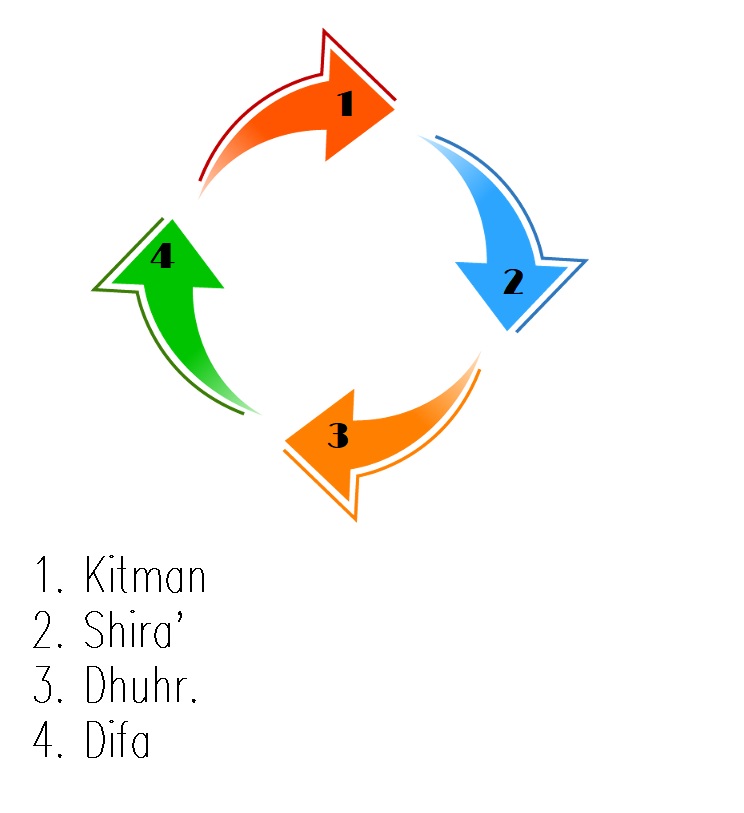
The four conditions (Masalik al-din) according to Ahl al-Haqq wa-l istiqama (The People of Truth and Straightness) are as follows:

  1. Kitman: The State of Secrecy.
  2. Shira’: The state of trading one’s life for the cause of Allah.
  3. Dhuhur: The state of being Manifest.
  4. Difa’: State of Defense.

The arrival of the Umayyad Imperium completed the cycle of four stages that the Muslim community underwent. From the Blessed Prophet (saw) teaching Islam in secret (Kitman), to the command in Qur’an 15:94 to teach Islam openly and to fight in the cause of Allah (Shira’), to when Madinah was under the rule of Islam and the rule was total (Dhuhur), until the fighting among the companions and the appointment of the 5th Imam, Imam Ar Rasibi (May Allah be pleased with him) (Difa’).

This is the Prophecy of the Blessed Prophet (saw)

It was narrated that Anas bin Malik said:

“It was said: ‘O Messenger of Allah, when should we stop enjoining what is good and forbidding what is evil?’ He said: ‘When there appears among you that which appeared among those who came before you.’ We said: ‘O Messenger of Allah, what appeared among those that came before us?’ He said: ‘Kingship given to your youth, immorality even among the old, and knowledge among the base and vile.’”

Source: (https://sunnah.com/ibnmajah:4015)

IMPORTANT! The rulings of the sharīʿah tighten or loosen depending upon the condition of the Muslims and the context that they find themselves in.

You could ask an audience a trick question: Can Muslims eat pork yes or no? The deception is in the false dichotomy. The correct answer is: It depends on context.

KITMAN: The State of Secrecy

Kitman means hiding one’s beliefs. In reality, the word kitman comes from the verb katama, which means to hide, to conceal. In this state the believers keep their beliefs in secret to avoid suppression by their enemies who will not allow the Ibadis to profess their beliefs if they discovered them. In this sense, hiding one’s beliefs is the best way to preserve them. So ‘secrecy’ becomes an obligation in such a case. Ibadis started their movement in secrecy to avoid suppression by the Umayyad rulers. Both Ibadi leaders Jabir b. Zaid (ra) and his successor Abu Ubaidah Muslim b. Abi Karimah (ra) acted in the stage of secrecy (kitman). All their activities were carried out in secret. During this time, secrecy was recommended almost in everything.

“He said, “O my son, do not relate your vision to your brothers or they will contrive against you a plan. Indeed Satan, to man, is a manifest enemy.” (Qur’an 12:5)

Kitman is of much greater importance when we realize that it is a type of trust. When one discloses some of his secrets to you and asks you to keep them secret from others, then it is your duty to keep them secret as required by that person. Even between the two spouses, they have to practice kitman, i.e. they are in no way allowed to talk to others about the details or generalities of their conjugal life or intimate relations. Kitman may extend to cover the secrets of the whole state at the time of war and peace where a person who is loyal to his people cannot divulge to anyone or tell the enemy about his country’s affairs.

Also, we know that not everyone needs to know about all of our day to day affairs. There are some real busy bodies in this world.

Mu’adh ibn Jabal reported: The Messenger of Allah, peace and blessings be upon him, said, “Seek help in the fulfillment of your needs by being discrete, for everyone who is given a blessing will be envied.”

Source: (al-Mu’jam al-Kabīr 16644) not found at sunnah.com / found here: https://www.abuaminaelias.com/dailyhadithonline/2019/08/21/kull-dhi-nimah-mahsud/

Ibadi scholars claim that the stage of secrecy (kitman) in their doctrine is derived from the life of the Blessed Prophet (saw) ; but they differ in fixing the exact period of secrecy in the life of the Prophet. According to Shaikh Muhammad Yusuf Atfaiyish (r), it is the period between the beginning of the revelation up to the time when the number of the Muslims reached forty by Umar b. al-Khattab (ra) declaring his acceptance of Islam. Abu Sulaiman Dawud b. Ibrahim al-Talati (r) regards all the period before the Prophet’s immigration to Madina as a stage of secrecy, while Abu Ammar Abd al-Kafi (r) says, “The Prophet stayed in Mecca for some time after the revelation, in secrecy.” It seems that he meant the period of three years of the prophethood before the revelation of this verse: “Proclaim what you have been ordered and turn aside from the polytheists.” (Qur’an 15:94) However, this was the basis on which Ibadi scholars furnished the proof for the obligation of secrecy (kitman) as a religious duty ordered in the Qur’an.

Special rules that apply when in kitman and/or living under the rule of tyrants and/or any situation where one fears for their life.

The most important aspect is the suspension of the hadd punishment during kitman.

During kitman Ibadis have to live under the rule of tyrants. Special rules were laid down for Ibais regarding their relationship with ‘tyrants’ in the time of kitman. The main principle is that the Ibadis must not be of any help to tyrants in their rule, so they must not hold any posts for them. The exception to this rule is that those members of the Ibadi community who are known for their opposition to the ‘tyrants’ and were capable of commanding them to good and forbidding them from evil, such members can hold posts in the rule of ‘tyrants’; they can lead their troops in jihad, be in charge of the spoils (ghanaim), Qadiship, or futya (delivering legal opinions on religious questions). Ibadis, in this attitude, follow the example of Ibn Abbas, Jabir b. Zaid, al-Hasan al-Basri and Shuraih al-Qadi. All these great scholars were known for their opposition to the rule of ‘tyrants’ and held posts under them. The condition for such an attitude is to run the posts according to the shari’ah and not fear anybody in practising justice.

The teachings of Islam still continue as per the following verses:

It was narrated that Abu Hurairah said:

“The Messenger of Allah (saw) said: ‘Whoever is asked about knowledge that he has and he conceals it, will be bridled on the Day of Resurrection with reins of fire.'”

Source: (https://sunnah.com/ibnmajah:266)

“Verily those who conceal that which We have revealed of clear signs and guidance, after We have made it clear for people in the Book – on them shall be Allah’s curse, and the curse of those who curse. Except those who repent, make amends, and make manifest [the truth]; to them I relent, for I am Oft-returning, Most Merciful.” (Qur’an 2:159-160)

There are certain occasions on which the ‘tyrants’ force Ibadis to act or speak contrary to their beliefs. In such circumstances, Ibadi school allows its followers to use a special dispensation (rukhsah) under the principle of religious dissimulation (taqiyah) to avoid the punishment of death. They can, for example, say that there is more than one God, or claim walayah for the enemies of Allah, and baraah from the true believers, or give false testimony, or tell lies, all these with the tongue only without believing it. They also can eat during the day in Ramadhan, or eat carrion, blood, or pork, all this to avoid the punishment of death.

Some of the proofs for the above views are as follows:

“Whoever disbelieves in Allah after their belief—not those who are forced while their hearts are firm in faith, but those who embrace disbelief wholeheartedly—they will be condemned by Allah and suffer a tremendous punishment.” (Qur’an 16: 106)

“He has only forbidden to you dead animals, blood, the flesh of swine, and that which has been dedicated to other than Allah . But whoever is forced [by necessity], neither desiring [it] nor transgressing [its limit], there is no sin upon him. Indeed, Allah is Forgiving and Merciful.” (Qur’an 2:173)

“The believers must not take the disbelievers as friends instead of the believers. And whoever does that has no relation with Allah whatsoever, unless you (do so) as a protective measure (in order to) save yourself from them. Allah warns you of Himself, for unto Allah is the return.” (Qur’an 3:28)

Exceptions to Kitman: When you must risk your life being forfeit.

As the whole point of Kitman is the preservation of human life you may not do the following:

There are certain actions that must not be done even if that should cause the one using kitman the loss of their lives. Such as slaying the innocent. If you are asked to kill someone unjustly you must drop your cloak of kitman as the point of kitman was preservation of your life. In this case you trade your life for the innocent. May Allah (swt) reward the one who does it. Other instances where the cloak of kitman must be dropped: One cannot seize people’s property or lay waste to it. One must not give up their weapons to their enemies. One must not drink wine, commit adultery or eat and drink unclean (najas) things like urine or excrement.

One may not fail to note that khamr (alcohol) is given stricter treatment than that of pork. Both are haram, yes, but the former opens up more doors to greater sins while the later just stops there. The drinking of khamr (alcohol) also affects judgement, which in turn can affect the point of kitman.

“Whoever disbelieves in Allah after their belief—not those who are forced while their hearts are firm in faith, but those who embrace disbelief wholeheartedly—they will be condemned by Allah and suffer a tremendous punishment.” (Qur’an 16: 106)

If we revisit the above verse for a moment there is an interesting asbab-an-nuzul or occasion for this revelation being revealed.

In the Asbab Al-Nuzul by Al-Wahidi we find:

Said Ibn ‘Abbas: “This verse was revealed about ‘Ammar ibn Yasir. The idolaters had taken him away along with his father Yasir, his mother Sumayyah, Suhayb [al-Rumi], Bilal [ibn Rabah], Khabbab [ibn al-Aratt] and Salim [the client of Hudhayfah] and tortured them. As for Sumayyah, she was tied up between two camels and stabbed with a spear in her female organ. She was told: ‘You embraced Islam for the men’, and was then killed. Her husband Yasir was also killed. They were the first two persons who were killed in Islam. As for ‘Ammar, he was coerced to let them hear what they wanted to hear. The Messenger of Allah (saw), was told that ‘Ammar has renounced faith, but he said: ‘Never, ‘Ammar is filled with faith from his head to his toes; faith is admixed with his flesh and blood!’ ‘Ammar then went to see the Messenger of Allah (saw), crying. The Messenger of Allah (saw) wiped his tears with his own hand and said: ‘if they return to you, let them hear again what you told them’. Then, Allah, exalted is He, revealed this verse”. Mujahid said: “This verse was revealed about some Meccans who accepted faith. The Muslims of Medina wrote to them urging them to migrate and told them that they did not consider them part of them unless they migrated. And so they left Mecca intending to migrate to Medina. The Quraysh caught up with them on the way and coerced them to renounce their faith. It is about them that this verse was revealed

Source: (https://quranx.com/tafsirs/16.106)

Besides, Ibadis, although living under the rule of ‘tyrants’, must have their own organisation to look after their affairs, and to plan for the safety of their community and to preserve the teachings of their schools; in other words, to prevent the Ibadis from melting into the large body of their opponents, and to ultimately prepare for ‘manifestation

Saving yourself is from one of the major rules in Islam. Self preservation is a very basic rule in Islam.

In Islam we have what is known as : Ad-Darooriyyaat Al-Khams-The Five Basic Necessities that are protected and recognized by the Islamic law (shari’ah).

Protection and sanctity of ones:
Life
Religion
Wealth
Lineage
Mind (intellect)

A modern example of this in action is where those who have have adopted the Ibadi school from other schools (be they Hanafi, Shafi’i, Hanbali, Maliki, Imam Shi’i, etc.) fear that if they pray the way the Blessed Prophet (saw) prayed they maybe violently attacked. So they are allowed to join the congregation and pray according tot he ijtihad of the prevailing school.

See here for example:

Another example: A woman in some remote part of the former United States or Canada embraces Islam. If her family knows she could be expelled from her home. She could be violently attacked even by members of her own family. If she outwardly adorns the khimar she could become violently attacked. So, in a place where the people wear winter attire (examples: Toboggan, Tuque, Toque, Touque, and neck scarfs) that woman can adorn winter wear and dress as modestly as she can. She can and must blend in to protect the sanctity of her life. However, the moment she moves to an area where the believers are both strong and able to defend her she must adorn the appropriate attire or be in a state of rebellion to Allah (swt) and his commands.

SHIRA’: The Sacrifice of one’s life for the cause of Allah

The Arabic word shira’ means buying and selling. This term is used in Ibadi writings for the action of sacrificing one’s life in the cause of Allah to attain Paradise.

Shira’ as an individual obligation; it is understood as a voluntary duty only.

Shurat (pl.) are: Those who have sold their souls for the cause of Allah .

The term al-shira’ is derived from the following verses of the Qur’an:

“Allah has bought from the believers their selves and their possessions against the gift of Paradise; they fight in the way of Allah; they kill, and are killed; that is a promise binding upon Allah in the Torah, and the Gospel, and the Qur’an; and who fulfil his covenant truer than Allah? So rejoice in the bargain you have made Him.”(Qur’an 9:111)

*Note* the above verse of the Qur’an teaches us clearly that Jesus (as) taught martyrdom against oppressors.

“So let them fight in the way of Allah who sell the present life for the world to come, and whosoever fights in the way of Allah and is slain, or conquers, We shall bring him a mighty wage.” (Qur’an 4:74)

“But other men there are that sell themselves desiring Allah’s pleasure.” (Qur’an 2:207)

The first to practice shira’ was none other than the Blessed Prophet (saw) and his noble companions who fought in the cause of Allah (swt) against those who wanted to physically stop the teaching and call to Islam.

Latter, after the arrival of the Umayyad Imperium it was practised by Abu Bilal Mirdas b. Hudair (ra). The idea of shira’ or Khuruj (coming out) occurred to him when he saw the harm caused by The Umayyad Imperium under Ubaidullah b. Ziyad against his fellow-Muslims. His comment on the situation was, “Surely, being content with tyranny is an offence, and drawing the sword and frightening the people is grave, but we come out and fight no one but those who do us wrong.”

They, i.e. the Shurat, agree that they sell themselves desiring Allah’s pleasure, and show no claim for ruling, but to end tyranny and revive righteousness. They must not revolt with less than forty men; they can complete the number with a woman. If their intention was not to return before ending falsity, batil), they, therefore, must not return to their homes unless they ended falsehood or died. If they went out with the intention to return if they wanted, they can return at any time. Their homes are their swords, so if they return to their original homes for any purpose, they must pray short prayers qasr and pray complete prayers during their revolt even though they were far away from their original homes

The following are the main principles of Shira’:

  1. Shira’ is a voluntary duty for Ibadis in general, and an obligation for those who imposed it on themselves.
  2. The minimum number of forty persons must carry it out.
  3. .They must elect their leader among themselves. Imam of Shira‘. The authority of their leader is binding on his followers only.
  4. Religious dissimulation, Taqiyah, does not behoove the Shurat, they have to fight till they bring tyranny to an end or are killed. Some scholars say that they can return if only three of them were left
  5. They have no home except the places where they gather to fight their enemies; if they return to their original homes to get supplies, or information, or for any other purpose, they must consider themselves travelers and pray short prayers (qasr) while in their original homes.
  6. They must not fight anyone except those who fight them, must not follow the defeated or kill the injured, must not kill old men, women, or children, and must not take any spoils or property unless they have a right to it

Regarding the stage of Shira’, it has already been mentioned that it is a voluntary duty for more than forty persons, and that they must pray full prayer during their revolt though they are far from their original homes. In case the Shurat wanted to take over during the Imamate of defence, they have all the right to do so, for the Imam of the Shurat, for his intention of sacrificing his life for the cause of the Ibadi community, is more entitled to the right of leadership than the Imam of defence.

Some scholars suggest that the state of Shira’ was practised first during the Meccan period of the Prophet’s life. They point out that the Prophet declared Islam openly when the number of his followers reached forty, this was about the time that Umar ibn al-Khattab (ra) had embraced Islam. It was thus, directed by the Qur’an to leave the house of al-Arqam b. Abi al-Arqam which was “the centre of his preaching activities.” When he had passed the stage of secrecy, Allah revealed to him, “O Prophet, Allah suffices you, and the believers who follow you.” (Qur’an 8:64)

DHUHUR: The State of Manifestation

The Blessed Prophet (saw) died leaving the Muslims in the stage of manifestation (Dhuhur). It is when Islam is established and it is dominant. It is not in a state of fracture or subjugation by enemies.

It is obligatory for Muslims to maintain this state in order to execute the commands of Allah (swt). Hadd punishments, the Friday prayers, the collection of zakat and protection tax (jizyah), fighting such enemies as Polytheists and rebels (al-bughat) the proper division of spoils and zakat, none of these obligations can be carried out without the authority of the Imam.

Note about Zakat. Yes Zakat is being paid by the Muslims today. However, it is being done by will alone. In reality the Zakat is a forced taxed collection by the Amir (Imam) to make sure that those who can do contribute to the betterment of the society. Abu Bakr (ra) fought people who refused to pay Zakat.

Ibadi scholars cite the Caliphates of Abu Bakr and Umar (May Allah be pleased with them both) as examples of the stage of manifestation in early Islam. Whenever Muslims attain satisfactory conditions of proper, wealth, and knowledge of religion, so that they can execute the commands of Allah, and when they number about half of the enemy around them, they must move from the condition of kitman via shira’ to the condition of Dhuhur by electing their own Imam from among their outstanding men.

The Imazighen or Free-Men of North Africa were the last to try to establish the Imam Adh- Dhuhur or the Manifest Imam.  Manifestation (Dhuhur)

After the collapse of the Rustamid Imamate in Tahert in 909 A.D. Ibadis of North Africa tried to revive their Imamate under the leadership of Abu Khazr Yaghla b. Zaltaf, but they lost the battle of Baghy which they fought against the Fatimids on the year 358 A.H. After this the Ibadis entered the stage of secrecy up to our times. No attempt was made afterwards by the Ibadis of North Africa to establish the Imam Adh Dhuhur.

So a question arises: Are the Ibadis today without an Imam?

The answer to that is no. The Ibadis today are not without an Imam. The Imam today is the Imam Kitman. That is to say, the Imam in a state of secrecy. This Imam is known to his inner circle and it kept as such until the condition changes.

DIFA’: The state of Defence

Defence becomes the obligatory duty in the absence of manifestation (Dhuhur).

When under attack, or suspecting a sudden attack, the Muslims must elect a leader to lead them in fighting their enemy. Such a leader is called Imam al difa’, Imam of defence. He must be a learned man of high military capability. He has the same full authority as the Imam of Dhuhur until the end of the war. At the end of the war his Imamate dissolves automatically, so the Muslims would have no difficulty in removing him from his office. The Muslims must then elect their new Imam as required by the resultant state, either of ‘manifestation’ or ‘secrecy’. The first Imam of defence given in Ibadi sources is Abdullah b. Wahb al-Rasibi (ra) who was elected before the battle of al-Nahrawan. The other Imams of defence of North Africa included Abu Hatim al-Malzuzi (r) who tried to revive the Imamate of ‘manifestation’ which was established by Abu al-Khattab Abd al-Ala b. al-Samh al-Ma’afiri (r) and Abu Khazr Yaghla b. Zaltaf (r) who tried to revive the Rustamid Imamate and fought the Fatimids for this purpose.

For those who wish to learn more about Abdullah b. Wahb al-Rasibi our sister bintibadh has an excellent write up here: https://bintibadh.blogspot.com/2015/09/the-fifth-caliph-abdullah-ibn-wahb-al.html

Concerning the stage of difa’, it is already mentioned that the Imamate of defence (Imamat al-difa’) dissolves automatically after the end of the war, but some scholars hold that the Imamate of defence can remain after the end of the war as well. In the case of Imam Ali Ibn Abu Talib if he would have repented for the arbitration the Muslims would have rejoined him and the Imam of defense (Abdullah b. Wahb al-Rasibi –might have pledged allegiance to him (Ali) and rejoined him again, and Imam Ali would have been the Imam Adh-Dhuhur. However, this is only a possibility as Ali also removed himself from the authority; so the people were free to choose their Imam. People think that the Ibadi position is that if a leader makes one mistake than we do khurooj against him or make tafkir. This is not correct. It depends on the type and nature of the mistake. IF he has committed a sin for which there is a required punishment such as adultery, or the act of the people of Lut, or theft, or drinking alcohol, unlawful killing and the arguments and proofs are established against him are proven by the Shari’ah judiciary, then there must be another Imam to carry out the Sharia punishment against him. He must retire or be isolated by the people of the contract and someone else is to be chosen. If he refuses, he will be judged as a transgressor and a revolt against him will be legislated.

May Allah (swt) guide the Ummah!

May Allah (swt) forgive the Ummah!

May Allah (swt) grant us the strength to return to the commands of Allah (swt).

1 Comment

Filed under Uncategorized