“The Messenger of Allah is certainly a good example for those of you who have hope in Allah and in the Day of Judgment and who remember Allah very often.” (Qur’an 33:21)
“And perform the prayer, and pay the alms, and bow with those that bow.” (Qur’an 2:43)


﷽
The picture on your left is the Sunnah of the Blessed Messenger (saw) to make du’a or supplication with the hands open. We do not tie the hands or fold our hands in prayer. That is the method of other traditions.
Opening of the hands is the way of the supplicant getting ready to receive some mercy or guidance from above. Leaving the hands at the side leaves the heart open and uncovered. It signifies stillness, tranquility and humbleness before a Sovereign and Mighty God.
Most of the world’s Muslims have it right when it comes to making du’a (supplication).
We open our hands, and we do not tie or fold our hands when making du’a (supplication).
We do not fold or tie hands in prayer.
This is the correct way. This is the Sunnah of the Blessed Messenger (saw). No tying or folding of the hands. You should be tranquil in your prayer
FROM SUNNAH TO INNOVATION: AN EVOLUTION OF CHANGE IN THE SUNNI SCHOOLS.
How does one come to such radically different approaches to one of the most witnessed and beloved acts of the Blessed Messenger (saw)? Insh’Allah, we have another article at the end of this that you may wish to read and ponder over.
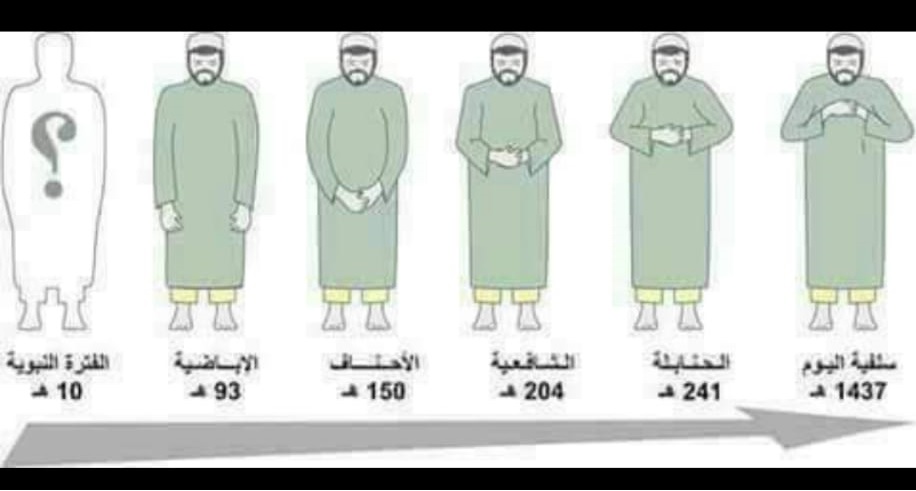
As you can see in the begging in the fitra period, and early period the Sunnah of the Blessed Messenger (saw) was to not tie the hands or fold the hands in prayer…AT ALL!
Listen to this interesting clip from brother Hamed Rashid Malik
NONE OF THE FOUR SURVIVING SUNNI SCHOOLS OF JURISPRUDENCE SAY ITS OBLIGATRY TO PRAY WITH THE HANDS FOLDED.
Now, they may say it is preferred to tie or fold the hands. However, none of them say it’s prohibited or bid’ah or anything even close to that to keep the hands open in prayer.
School of Ahmed Ibn Hanbal
Imam Ala’ al-Din al-Mardawi, the Munaqqih & Musahhih of the Madhhab who authored an explanation on the Muqni’ in a 12-volume work he named “al-Insaf”. It is reported that Imam Ahmad would open his hands and leave them to his sides always.
In the Ṭabaqāt al-Ḥanābilah
Abdullah asked his father, Ahmad bin Hanbal, about the hadith of Abi Ma’sher. “It’s not allowed to do takfeer in salat,” so Ahmad said, “It means putting his right on his chest.”
Ibn ul-Qayyim, in his Badaaī’ al-Fawaaid, cites al-Muzani, the student of Imam Ahmad, as follows:
ونقل المزني عنه…ويكره أن يجعلهما على الصدر، وذلك لما روي عن النبي -صلى اللَّه عليه وسلم- أنه نهى عن التكفير، وهو وضع اليد على الصدر
بدائع الفوائد
Imam Ahmad said:
“It is reprehensible for him to place both of them (hands) upon the chest. And that is because of what is related from the Prophet (saw) that he prohibited al-Takfeer – and that is, placing the hand upon the chest.”
School of Imam Shafi’i
In the book of “Al Um” by Shafi’i you’ll not find mention of tying or folding the hands in the prayer, he didn’t ever mention it.
Also, the book of Nawawi “Al Minhaj” didn’t mention Qabd (tying or folding the hands in the prayer)
And all who have explained it from Shafi’ees didn’t mention it as obligatory in the prayer.
We also know that Imam Shafi’i was a student of Imam Malik, and we will come to that insh’Allah.
School of Imam Abu Hanifa.
Imam Abu Hanifa, we have nothing written from him on this subject. We just do not.
School of Imam Malik
Narrated by Ibn al-Qasim in al-Mudawanna (1:74) and in al-Tamheed (20:75) al-Layth as-Sa’d is reported to have said:
Not tying or folding the hands in prayer is preferred, unless he is standing for an extended period and becomes tired, then there is no problem (la ba’as) with putting the right hand over the left.
LOOKING AT THE NARRATIONS USED BY THOSE WHO ADVANCE TYING/FOLDING THE HANDS
And the only narration that they really have is:
Yahya related to me from Malik from Abu Hazim ibn Dinar that Sahl ibn Sad said, “People used to be ordered to place their right hands on their left forearms in the prayer.”
Abu Hazim added, “I know for sure that Sahl traces that back to the Prophet, may Allah bless him and grant him peace.”
This exact hadith came by way of Imam Malik and Imam Malik himself doesn’t do it!
And when a narrator narrates something about the Blessed Messenger (saw) and doesn’t follow it he’s either:
- A fasiq
- He knows that it isn’t Authentic about the Blessed Messenger (saw)
- He may have forgotten
And since Malik is a respectable scholar, then the first option is removed. The last option is also removed because Imam Malik mentioned the hadith in his Muwatta. Which means only option 2 is left, because he saw another thing than what was reported.
Just two other points about the hadith that’s used.
Also, he didn’t say, “We were Ordered,” but said, “People were ordered.”
And only Abu Hazm the Tabi’e has claimed that it’s from the Prophet (saw).
THE PEOPLE WERE ORDERED? INNOVATION BY BANI UMMAYAD
وحدثني عبد الرحمن بن إبراهيم عن عبدالله بن يحيى المعافري عن حيوة عن بكر بن عمرو أنه لم ير أبا أمامة -يعني ابن سهل- واضعا إحدى يديه على الأخرى قط ولا أحدا من أهل المدينة حتى قدم الشام فرأى الأوزاعي وناسا يضعونه
Look what Imam Abu Zur’ah the Shaykh of Imam Al Bukhari had to say:
Abd al-Rahman ibn Ibrahim told me on the authority of Abdullah ibn Yahya al-Ma`fari on the authority of Haywa on the authority of Bakr ibn Amr that he had never seen Abu Umamah – meaning Ibn Sahl – ever put one of his hands on the other, and no one from the people of Medina did that either, until he came to Syria, so he saw al-Awza`i and people putting him on.
Better archive/save the following before it suddenly disappears from the internet.
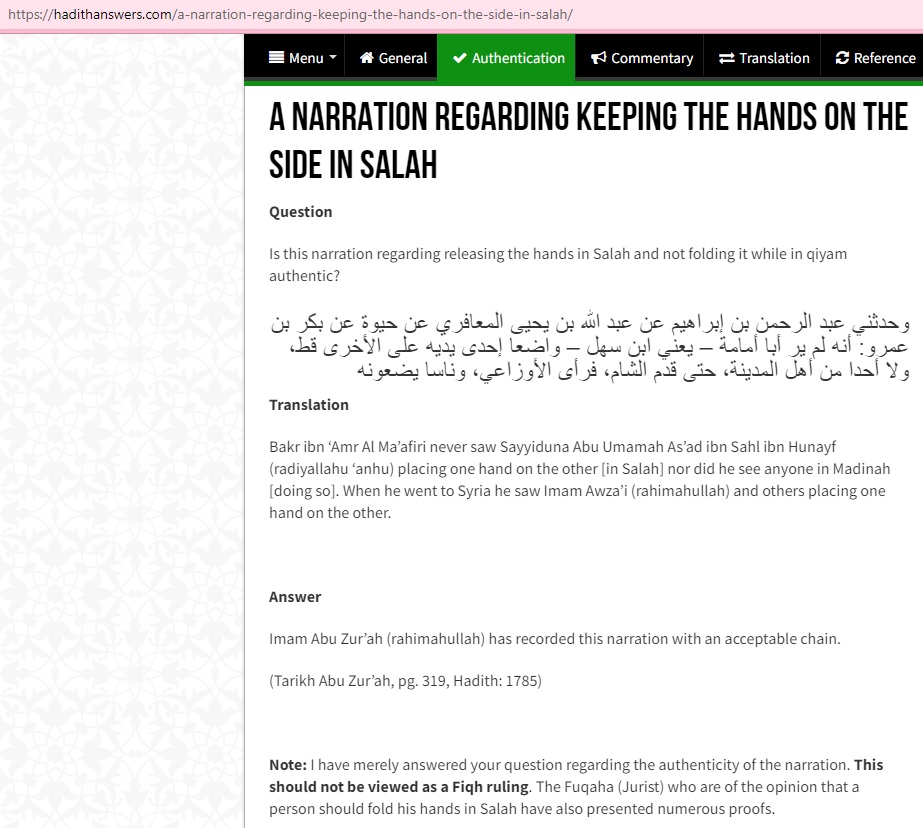
Abu Umama bin Sahl is one of the Sahaba. His full name is Asad bin Sahal bin Hunaif Al Ansari and The Blessed Messenger (saw) used to call him Abu Umama.


So the pedigree, the start of this practice of tying and folding the hands in prayer, started in Sham, where the Umayyads country was.
All the scholars of the great Scholars of Tabi’een that opposed the Umayyads, it’s authentic about them that they didn’t tie or fold the hands in Salat!
May Allah (swt) open your eyes WIDE dear Muslim ummah! May Allah (swt) put in your hearts a love for the Sunnah of the Blessed Messenger (saw).
If you are interested or keen to pray the way the Blessed Prophet (saw) prayed, we would encourage you to read the following. May Allah (swt) bless those responsible for its compilation.
HOW TO DO THE PRAYER ACCORDING TO THE BLESSED SUNNAH?
If you would like to read more:
https://primaquran.com/2023/04/01/the-value-of-the-prayer-in-islam/
https://primaquran.com/2022/06/08/clarity-from-obfuscation-where-to-place-the-hands-in-the-prayer/
https://primaquran.com/2020/09/05/textual-manipulation-of-hadith-to-advocate-prayer-positions/
May Allah Guide the Ummah.
May Allah Forgive the Ummah.


