Tag Archives: ibadi-muslims

Genesis chapter 3 separates Islam and Christianity.

“Then learned Adam from his Lord words of inspiration, and his Lord turned towards him; for He is Oft-Returning, Most Merciful” (Qur’an 2:35-37)

“Say, “Is it other than Allah I should desire as a lord while He is the Lord of all things? And every soul earns not [blame] except against itself, and no bearer of burdens will bear the burden of another. Then to your Lord is your return, and He will inform you concerning that over which you used to differ.” (Qur’an 6:164)

 ﷽ 

“Then learned Adam from his Lord words of inspiration, and his Lord turned towards him; for He is Oft-Returning, Most Merciful” (Qur’an 2:35-37)

The above touching heartfelt verse teaches us original forgiveness.. We know that he was forgiven because it was Allah that taught Adam the very words by which to seek reconciliation with The Divine!

Allah! Ar Rahman Ar Raheem! Allah!!!! Most Merciful!!!! The Ever Compassionate!!!!

After he learned to turn towards Allah (swt), he was forgiven. That is it. Full stop!

There is no sin through which death entered the world, causing amoebas and single-celled organisms and everything else to die because of this person’s actions!

Now, dear respected reader, what you read is two different accounts of what happened with Adam and Eve.

You are not reading a Muslim response to Genesis chapter 3. We want to make that very clear.

What you are reading is what God has revealed in the Qur’an.

The choice you need to make is to discern which of these two accounts is true. The account as given by God in the Qur’an or the account as given in Genesis chapter 3.

It is important for you as a Christian, dear reader, to understand that the concepts of Original Sin, Inherited Sin, Total Depravity, Limbo, God Incarnate, the idea of God sending a ‘Son’, the Crucifixion, the Resurrection, Vicarious Atonement, Justification by Faith, Paul’s letters and the entirety of the New Testament all have their basis in Genesis chapter 3.

There is no need for Muslims to engage in any of these other beliefs, because if what God revealed in the Qur’an about Adam and Eve is correct, then all of these Christian beliefs that have their basis in Genesis chapter 3 are in and of themselves irrelevant.

Genesis chapter three is all that stands between Islam and Christianity.

One chapter in the entire Bible is all that separates Islam and Christianity.

If it was not for that chapter in the Bible there would be no Christianity.

That particular chapter gives us the following:

Original Sin

Inherited Sin

Total Depravity

Limbo

The concept of God Incarnate

The need for God to send His Son

The Crucifixion

The Resurrection

Vicarious Atonement

Justification By Faith

Paul’s Letters

The New Testament as a whole.

Adam and the events that unfolded in the Garden of Eden is such a central theme in Christology and if we were to juxtapose the events as related by Genesis chapter 3 with what is revealed in the Qur’an, we will be able to get a deeper appreciation of what is central that divides the two faith traditions.

We will also find out that which brings much needed clarity.

Let us begin with the question:

Who truly committed The First Sin? How does sin enter into the universe?

What does sin mean?

Christians define sin as transgression, lawlessness, and missing the mark.

The first issue to clear up is that Christians are absolutely forced to agree with Muslims on this.

The first sin, missing the mark or transgression against Allah, was done by a non-human entity!

In Christian theology, it is an X-Angel named Lucifer.

In Islamic theology, it is a Jinn named Iblis.

Either way, it was not Adam or Eve (May Allah’s peace be upon them both) that erred first.

“So behold, We said to the angels: “Bow down to Adam: “And they bowed down: not so Iblis: he refused and was arrogant: he was of those who reject Faith. We said: “O Adam! Dwell you and your wife in the Garden, and eat of the bountiful things in that respect as you will, but approach not this tree, or you will run into harm and transgression.”(Qur’an 2:30-37)

Sin enters into the universe via beings created with sovereign choice.

The sovereign choice to obey or to submit to the will of God.

So the position of Islamic theology is clear. Howeve, have you ever read any text anywhere in the Bible that makes the claim that Satan was an X-Angel named Lucifer and that he rebelled against Allah?

There is no such text anywhere in the Bible at all! It is a fable that came into Christian circles from apocryphal sources. The best attempt at trying to glean such a view comes from the following:

“How have you fallen from heaven, the morning star? You have been cut down to earth, You who cast lots on nations.” (Isaiah Chapter 14:12)

Source: (https://www.chabad.org/library/bible_cdo/aid/15945)

What did Protestant reformer John Calvin have to say about this text?

“How art thou fallen from heaven! Isaiah proceeds with the discourse which he had formerly begun as personating the dead, and concludes that the tyrant differs in no respect from other men, though his object was to lead men to believe that he was some god. He employs an elegant metaphor, by comparing him to Lucifer, and calls him the Son of the Dawn; 220 and that on account of his splendor and brightness with which he shone above others. The exposition of this passage, which some have given, as if it referred to Satan, has arisen from ignorance; for the context plainly shows that these statements must be understood in reference to the king of the Babylonians. But when passages of Scripture are taken up at random, and no attention is paid to the context, we need not wonder that mistakes of this kind frequently arise. Yet it was an instance of very gross ignorance, to imagine that Lucifer was the king of devils, and that the Prophet gave him this name. But as these inventions have no probability whatever, let us pass by them as useless fables.”

Source: (https://ccel.org/ccel/calvin/calcom13/calcom13.xxi.i.html)

As Calvin rightly states, it is a metaphor. Otherwise, we have the very awkward situation of calling Jesus ‘Lucifer’ as Lucifer simply means “Morning Star” or a reference to Venus — a star that outshines the others.

Jesus is called “Lucifer” or Morning Star in the following verse in the Bible.

“I, Jesus, have sent my angel to testify to you about these things for the churches. I am the root and the descendant of David, the bright morning star.” (Revelations 22:16)

There are two other texts that Christians often appeal to as well:

“And he said to them, “I saw Satan fall like lightning from heaven.” (Luke 10:18)

This text says nothing about Satan being an X-Angel or that his name was Lucifer etc.

“So war broke out in heaven and Michael and his angels fought against the Dragon and his angels, and the Dragon and his angels prevailed not.” (Revelation 12:7)

This is possibly the closest text as it does mention angels waring with each other in heaven. Yet this text does not mention angels becoming X-Angels, but rather angels at war with each other.

At the very least, the Christian book of Revelation and the Qur’an both point to the fact that a non-human(s) was(were) the first to transgress or sin against Allah; however, there are major points of difference in the two theologies.

In Christian theology, an X-Angel rebelled against Allah. However, in Islamic theology it was a Jinn. In Islamic theology, angels do not go against the divine plan. There is a race of beings known as the Jinn that can go against the divine plan.

So the first question here would be: Why is there not a doctrine of salvation for fallen angels? In Islam, we know that the Qur’an was sent to save humanity and the Jinn.

“So when we (Jinn) heard the guidance, we believed in it. And whoever believes in his Lord will not fear deprivation or burden.” (Qur’an 72:13)

“And We have sent you not but as a mercy for the ‘Alamin.” (Qur’an 21:107)

‘Alamin (mankind, jinn, and all that exists beyond)

“You say you have faith, for you believe that there is one God. Good for you! Even the demons believe this, and they tremble in terror.” (James 2:9)

So, in Islam, any being that sins against Allah (swt) can repent and reconcile with Allah (swt).

“By which Allah guides those who pursue His pleasure to the ways of peace and brings them out of darknesses into the light, by His permission, and guides them to a straight path.” (Qur’an 5:16)

The second question would be: Who wants to go to a heaven where wars break out? I mean people constantly deride the Qur’an for its metaphorical usages of women and wine in paradise; yet the Christian heaven is one of intrigue, assassination attempts, and wars!!!

In Islamic theology, the fall of Iblis (not the fall of humanity) fits logically into the greater picture of Allah’s wisdom.

However, we want to know in Christian theology what is to prevent the next disgruntled angel from trying to create wars and strife in heaven?

Finally, the Qur’an gives us a teaching of original forgiveness!! Allahu Kareem (Allah is Most Generous)

Though Adam did transgress, he was not the first transgressor.

The story of Adam, Eve and the Garden as compared/contrasted by Genesis chapter 3 and the Qur’an.

The whole Genesis account gives us a picture of a capricious divine being that lacks attributes of mercy, wisdom, justice or foreknowledge.

Again, dear truth seeker, contrast again the accounts in Genesis and the Qur’an.

“The Lord saw how great the wickedness of the human race had become on the earth, and that every inclination of the thoughts of the human heart was only evil all the time. The Lord regretted that he had made human beings on the earth, and his heart was deeply troubled. So the Lord said, “I will wipe from the face of the earth the human race I have created—and with them the animals, the birds and the creatures that move along the ground—for I regret that I have made them.” (Genesis 6:5-7)

Now, this does not sound like a divine plan at all. This sounds like a plan going terribly wrong.

How can a person find hope in the Christian tradition when Allah himself is in despair?

To attribute despair and regret to Allah is an affront to divine sovereignty and to the understanding that Allah is All-Knowing, All-Aware.

Contrast dear reader the absolute lack of sovereignty, will, and divine foreknowledge as given in the above passage with what Allah has revealed to us in the Qur’an.

“Behold, your Lord said to the angels: “I will create a vicegerent on earth.” They said: “Will you place therein one who will make mischief therein and shed blood?- while we do celebrate Thy praises and glorify your sanctity?” He said: “I know what you know not.” (Qur’an 2:30)

“So set your purpose for the way of life aligned with humanity’s upright nature – the nature (framed) by Allah, in which He has created humanity. There is no altering of the work wrought by Allah. That is the correct way of life, but most men do not know.” (Qur’an 30:30)

The angels look at the crude form of humanity and immediately see the capacity for violence. Also, notice that the angels are basically saying that they praise and worship Allah (swt) as is so what possible purpose does humanity serve?

The response of Allah (swt) is “I know what you know not.” That was a sufficient response to the angels. In other words, there is a plan for humanity.

You should know, dear reader, that in the order of Creation in Islam there are four types of creation with regard to will (choice).

Two in the unseen world.

  1. Angels which oscillate at frequencies of pure light. They do not go against their nature. Thus, there is no concept of fallen angels in Islam.
  2. Jinn are beings which are made from a fire that does not emit smoke. These beings can go against their nature and go against the divine plan.

Two in the natural seen world.

  1. Animals, plants and other living creations that do not go against their nature.
  2. Humanity can go against nature and go against the divine plan.

The first point of agreement between Christianity and Islam concerning Adam and Eve is that they were both blameless and sinless. They also had to have in some sense had the faculties of reasoning and understanding in order to understand commands and prohibitions.

The whole of Christianity is based upon Genesis chapter 3.

That one chapter presents to humanity a bizarre picture of The Divine Being and human destiny. It is the very foundation upon which Christian theology is built.

Whereas the Islamic Theological position is simply surrendering to the will of Allah. Adam and Eve slipped, they were reprimanded and ultimately forgiven.

Whereas in Christology, Adam and Eve were placed in the company of their mortal enemy with absolutely no heads up and no warning!

Can you imagine what kind of loving father puts their children in a garden with a shape-shifting entity intent on hurting the children and when the shape-shifting entity ends up duping the children, not only are the children punished but the whole of humanity is culpable for their slip?

Contrast this with what Allah revealed in the Qur’an.

“Did I not forbid you from the tree and tell you that Satan is to you a clear enemy?” (Qur’an 7:22-23)


So We cautioned, “O Adam! This is surely an enemy to you and to your wife. So do not let him drive you both out of Paradise, for you would then suffer hardship.” (Qur’an 20:177)

“We cautioned, “O Adam! Live with your wife in Paradise and eat as freely as you please, but do not approach this tree, or else you will be wrongdoers.” (Qur’an 2:35)

Adam and Eve were good creatures with a free will. Yet they chose to sin. Why?

  1. Adam and Eve had sovereign free will.
  2. Adam and Eve were not alone. They had an agent provocateur.

We can see that Allah clearly gave warning to Adam and Eve about their enemy and disobeying Allah. In fact, due to this warning about an adversary in Islam, Adam and Eve are more culpable than they are in the Christian tradition! 

Whereas in Genesis 3 there is no indication of any agent provocateur at all! It’s as if Adam and Eve were walking into an ambush!

“God saw all that he had made, and it was very good. And there was evening, and there was morning—the sixth day.” (Genesis 1:31)

“Now the serpent was more crafty than any other beast of the field that the LORD God had made.”(Genesis 3:1)

All that God creates is very good. God created snakes (serpentes) that were very good and very crafty at the same time?

Not only this, but to show you this vengeful portrayal of the Divine has whole entire species (serpentes) or snakes condemned simply because a shape-shifting entity imitated one of their kind!

“So the Lord God said to the serpent, “Because you have done this, “Cursed are you above all livestock and all wild animals! You will crawl on your belly and you will eat dust all the days of your life.” (Genesis 3:14)

So even more bizarre is the fact that Satan doesn’t get punished at all in Genesis chapter 3. It is the entire species of snakes (serpentes) that get punished instead!

“Allah said, “Descend, both of you, from here together ˹with Satan˺ as enemies to each other. Then, when guidance comes to you from Me, whoever follows My guidance will neither go astray ˹in this life˺ nor suffer ˹in the next˺(Qur’an 20:123)

What was the snake’s method of locomotion before it was to “crawl on it’s belly?”

Why wouldn’t Allah know that Satan was either a shapeshifter who appeared as a snake (serpentes) or that Satan made it appear that a snake (serpentes) was speaking to them?

It doesn’t justify a punishment upon a whole suborder of animals, namely snakes (serpentes).

So none of this is good! None of this is an accurate portrayal of A Wise and Judicious Creator working in this world. None of this is an accurate portrayal of the attributes of mercy, wisdom, justice, foreknowledge, or will at all!

The whole Genesis account gives us a picture of a capricious divine being that lacks attributes of mercy, wisdom, justice or foreknowledge.

Again, dear truth seeker, contrast again the accounts in Genesis and the Qur’an.

“The Lord saw how great the wickedness of the human race had become on the earth, and that every inclination of the thoughts of the human heart was only evil all the time. The Lord regretted that he had made human beings on the earth, and his heart was deeply troubled. So the Lord said, “I will wipe from the face of the earth the human race I have created—and with them the animals, the birds and the creatures that move along the ground—for I regret that I have made them.” (Genesis 6:5-7)

Now, this does not sound like a divine plan at all. This sounds like a plan going terribly wrong.

How can a person find hope in the Christian tradition when Allah himself is in despair?

In the Christian tradition, the agent provocateur is not immediately punished. Rather, wrathful punishment is given to an entire suborder of animals, namely snakes (serpentes). 

To a Muslim reading and reflecting on this, it all seems very bizarre and even a case of misplaced judgement. 

As Allah says in the Qur’an:

“My mercy has encompassed everything.” (Qur’an 7: 156).

Allah (swt) never states that his wrath encompasses everything but his mercy does.

You cannot imagine anything not benefiting from His mercy; otherwise, nothing could have come to existence, and even if so, nothing could have survived.

Even the fact that Satan is able to continue his life is due to Allah’s mercy. When Satan insisted on his wrong behaviour and was cursed, he requested Allah to be given time until the day of Resurrection:

“My Lord. Respite me until the day they will be resurrected.” (Qur’an 15:36)

Allah replied:

“You are indeed among the reprieved until the day of the known time.” (Qur’an 15:37-38)

The very role of Satan/Iblis as laid out in the Qur’an.

He said: “Since you have let me wander off, I’ll waylay them along Your Straight Road; then I´ll come at them from in front of them and from behind them, on their right and on their left. You will not find that most of them are grateful.” (Qur’an 7:16-17)

The whole point of Iblis, the arch enemy of mankind is to show that most of us (humanity) will be kaffir (ungrateful) to Allah (swt).

“And incite whoever you can of them with your voice, mobilize against them all your cavalry and infantry, manipulate them in their wealth and children, and make them promises.” But Satan promises them nothing but delusion.” “You will truly have no authority over My servants.” And sufficient is your Lord as a Guardian.” (Qur’an 17:64-65)

“Allah said, “This is the Way, binding on Me: you will certainly have no authority over My servants, except the deviant who follow you,” (Qur’an 15:41-42)

What is it that Allah makes obligatory on himself? To give certain of his creations choice.

“Allah responded, “Be gone! Whoever of them follows you, Hell will surely be the reward for all of you—an ample reward.” (Qur’an 17:63)

Genesis chapter 3. The Origin of Wrath or the Origin of Forgiveness? Is the woman to blame or are Adam and Eve both culpable?

Apparently, according to the Book of Genesis, after Adam and Eve ate from the tree of good and evil and had a conversation with Allah, they were quite cavalier about the whole ordeal.

Whereas Allah tells us in the Qur’an that the progenitors of the human race were more sensible, whereas they said:

They said, “Our Lord, we have wronged ourselves, and if You do not forgive us and have mercy on us, we will surely be among the losers.” (Qur’an 7:23)

“Then Adam learned from his Lord words of inspiration, and his Lord turned towards him; for He is Oft-Returning, Most Merciful” (Qur’an 2:35-37)

This is the teaching of original forgiveness, and we know that he was forgiven because it was Allah that taught Adam the words by which to seek reconciliation with the divine.

Also, of note that in Islamic theology both Adam and his wife were deceived and both asked for forgiveness, and they were both forgiven. Whereas in Christian theology the woman is the one who was deceived.

“And he succeeded in deceiving them. As soon as the two had tasted [the fruit] of the tree, their nakedness became obvious to them, and they started covering themselves with leaves from the Garden. Their Lord called to them, “Did I not forbid that tree to you and tell you, ‘Satan is your clear enemy?” (Qur’an 7:22)

“And Adam was not the one deceived; it was the woman who was deceived and became a sinner.” (1 Timothy 2:14)

When the woman saw that the fruit of the tree was good for food and pleasing to the eye, and also desirable for gaining wisdom, she took some and ate it. She also gave some to her husband, who was with her, and he ate it. Then the eyes of both of them were opened, and they realized they were naked; so they sewed fig leaves together and made coverings for themselves. (Genesis 3:6-7)

Now pay attention to the above text. The woman was apparently duped by the Snake (Serpentes). However, when she took the fruit and ate it didn’t she realize immediately that she was naked so that she could warn her husband?

Apparently not. The text allows for interpretative story telling. Such that Eve got the fruit (she hadn’t eaten it yet) and then brought some to Adam. They began to eat together and had the joint discovery together. Yet, this is where the text is extremely hurtful to women in a way that the Qur’an never is.

The question now arises.

Did Eve just give Adam the fruit without telling him what it was? Or did Eve tell Adam where that fruit was from, and he ate it anyway?

The text simply does not say.

Imagine a man who steals a fruit from a garden, and he gives it to another man to eat that fruit. In Christian theology, both the man who stole the fruit and the one who ate it are guilty. However, in Islamic theology, as long as the man who eats the stolen fruit is unaware that the fruit is stolen, he is not guilty of eating stolen fruit.

So, in Christian theology, Adam is punished for a sin he very well could have been unaware of! Islamic theology does not allow this type of ambiguity. Especially, in regard to the severity of the consequences of such an action in Christian theology.

The nature of death and dying in Christianity and Islam. Are human beings culpable for the sin and errors of others?

And no burdened soul can bear another’s burden. And if one weighed down by a burden calls another to carry his load, naught of it will be carried, even though he be near of kin. You warn only those who fear their Lord in secret and keep up prayer. And whoever purifies himself purifies himself only for his own good. And to Allah is the eventual coming.” (Qur’an 35:18)

Contrast this with:

“For since death came through a human being, the resurrection of the dead came also through a human being: For just as in Adam all die, so too in Christ shall all be brought to life.” (1 Corinthians 15:21-22).

“Therefore, just as sin entered the world through one man, and death through sin, and in this way death came to all people because all sinned. To be sure, sin was in the world before the law was given, but sin is not charged against anyone’s account where there is no law. Nevertheless, death reigned from the time of Adam to the time of Moses, even over those who did not sin by breaking a command, as did Adam, who is a pattern of the one to come.” (Romans 5:12-14).

Death and the nature of death.

“He is the One Who created you from clay, then appointed a term ˹for your death˺ and another known only to Him ˹for your resurrection˺—yet you continue to doubt!”
(Qur’an 6:2)

“We settle whatever We will in the womb for an appointed term, then bring you forth as infants, so that you may reach your prime. Some of you die earlier, while others are left to reach the most feeble stage of life so that they may know nothing after having known much.” (Qur’an 22:5)

“He brings you out as an infant, then causes you to grow into full maturity, and then causes you to grow further so that you may reach old age, while some of you He recalls earlier. All this is in order that you may reach an appointed term and that you may understand.” (Qur’an 40:67)

“His is the dominion of the heavens and the earth. He gives life and causes death, and He is over all things competent.”(Qur’an 57:2)

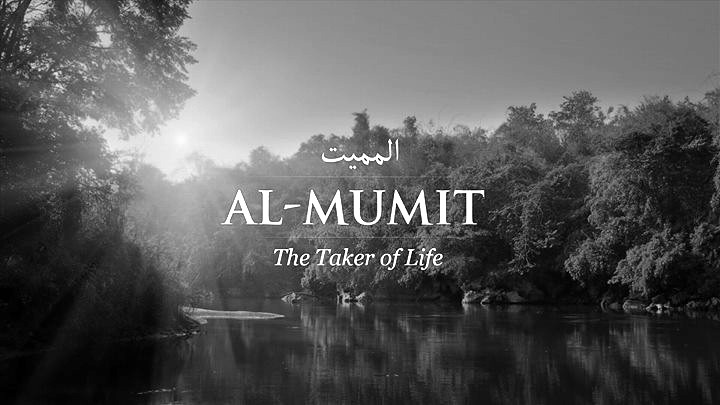
Allah is the giver of death, the taker of life. One of the names of Allah is the Taker of Life.

Because Allah is also the giver of life.

“Say, “Call upon Allah or call upon the Most Merciful. Whichever name you call -To Him belongs the best names.”(Qur’an 17:110)
“For the wages of sin is death: but the gift of God is eternal life in Christ Jesus our Lord.” (Romans 6:23)

Prima Qur’an Comment: “The wages of sin is death.” So because of what Adam and Eve did not only does this sin get transferred to every newborn child, but amoebas, single-celled organisms, insects, fish, and every type of living thing dies because of this.

This peculiar doctrine leads one to reflect on some of the following points:

  • What kind of world would there be if nothing died?
  • Surely if Allah created predatory animals there would be animals that would be the prey?
  • If Allah ordered Adam and Eve to eat all the fruit, surely the fruit would ‘die’ once it was removed from said tree or plant?
  • What would be the population of the planet if nothing died?

Al hamdulilah! We as Muslims do not have such a bizarre and unnatural doctrine. Death is a natural part of life. In fact, we as Muslims believe that Allah (swt) is Al Hayyu (The Ever Living).

What would be the point of calling Allah ‘The-Ever-Living’ if all living things were to be ‘Ever-living’ as well?

The very fact that Allah, God, is ‘The Ever Living’ in and of itself shows you that the nature of everything else is opposite to that. This includes Adam.

Death is a contrast to life so that we understand the sacredness of life, the sanctity of life, and to appreciate the limited time we have been given to live on such a beautiful planet that offers many delights.

There is an entire Goth subculture in the West. They see death as something beautiful.

There is beauty in things not lasting and a peace in knowing that everything is in transition. It causes one to embrace the moment and to cherish the now. Perhaps more than the busy denizens of the city, the goth appreciates the currency of time, and they understand that, perhaps more than most, one must spend it wisely. 

One of the contributors to Primaquran, ‘Abd al-Mumit’ chose this name because of this very fact.

There is no eternal permanence except Allah. 

If Christians claim that Adam’s death was a ‘spiritual death‘, you have to reflect on the following:

  • Why is there absolute silence on Adam’s reconciliation to Allah in the Book of Genesis?
  • In light of Adam’s knowledge of the tree of ‘good and evil‘, why does the Bible portray Adam and Eve as so cavalier regarding their spiritual estrangement from Allah?

Adam is such a central figure, especially in Christology, and we hear nothing more than that he had some children and then died.

The deity of divine forgiveness and restoration for all or the deity of divine wrath, making pain and suffering the path of redemption for the few.

The God that desires that we are sincere, that we repent with a contrite heart and gives opportunity after opportunity for man to reform.

Do see our article here:

“It is not their flesh, nor their blood, reaches Allah, but it is your piety that reaches him. Thus has He made them subservient to you, that you may magnify Allah for guiding you. And give good news to those who do good.” (Qur’an 22:37)

This statement from the Qur’an is very important.  Accordingly, the first idea of blood sacrifice goes back to the story of Cain and Abel.

The Biblical Version:

“Adam made love to his wife Eve, and she became pregnant and gave birth to Cain. She said, “With the help of the Lord I have brought forth a man.” Later she gave birth to his brother Abel. Now Abel kept flocks, and Cain worked the soil. In the course of time, Cain brought some of the fruits of the soil as an offering to the Lord. And Abel also brought an offering—fat portions from some of the firstborn of his flock. The Lord looked with favour on Abel and his offering, but on Cain and his offering, he did not look with favour. So Cain was very angry, and his face was downcast. Then the Lord said to Cain, “Why are you angry? Why is your face downcast? If you do what is right, will you not be accepted? But if you do not do what is right, sin is crouching at your door; it desires to have you, but you must rule over it.” (Genesis 4:1-7)

The Version in the Qur’an:

“Recite to them the truth of the story of the two sons of Adam. Behold! They each presented a sacrifice (to Allah): It was accepted from one, but not from the other.  He said: I will most certainly slay you.”Surely,” said the former, “Allah does accept of the sacrifice of those who are righteous.” (Qur’an 5:27)

Prima Qur’an comments:

Notice that in both accounts we are not told of the treachery that one of the brothers did. In fact, up until the point of murder, whatever he did that estranged him from his Lord was kept as a personal matter between him and God.

The Christians get the idea [with absolutely no proof] that Allah favoured Abel’s sacrifice because he brought Allah some fat — a sacrifice from one of his flock. Whereas, according to the Christians, Allah didn’t like the vegetables that Abel brought.

Now think about this for a moment. Doesn’t this make God sound capricious? Of course, it does!  

However, you can read in both accounts in the Qur’an and in the Bible that the reason that one sacrifice was accepted was due to the fact that one was righteous. It was the state of his heart and not what was presented!

So who will it be?

Contrasting a divine being that delights in the blood atonement and suffering from an animal, the outward material things of this world, with that of a divine being that looks at the contents of the human heart.

“The Day when neither wealth nor children shall profit, only the one will be saved who comes before God with a sound heart.” (Qur’an 26:88-89).
“And when they hear what has been revealed to the Messenger, you see their eyes overflowing with tears because of what they have recognized of the truth. They say, “Our Lord, we have believed, so register us among the witnesses.” (Qur’an 5:83)

May Allah Guide them to the truth so that they do not burn in hellfire.

10 Comments

Filed under Uncategorized

The Qur’an is created: Collection of Articles.

“Had We sent down this Quran upon a mountain, you would have certainly seen it humbled and torn apart in awe of Allah. We set forth such comparisons for people, perhaps they may reflect.” (Qur’an 59:21)

﷽ 

The first thing you should understand dear reader is that this issue on rather or not the Qur’an is created or uncreated was not discussed by the Blessed Prophet (saw) himself.

This issue was also not addressed by the noble companions of the Blessed Prophet (saw).

This issue came about later. The Umayyads did not restrain the tongue of John of Damascus and it is via his machinations that this debate and intrigue came to the Muslims.

Each side took a position and gave their proofs and justifications.

As regarding making takfir of other Muslims on this issue.

As our teacher, Shaykh Juma Muhammed al-Mazrui, (Hafidhullah) taught us we do not make takfir of other Muslims on this issue.

His Eminence Shaykh Dr Kahlan B. Nabhan al Kharusi, The Assistant Mufti of Oman, (Hafidhullah) has made our position clear:

What is not in dispute between us and the Sunni Muslims.

The things we both affirm about the Qur’an.

  • 1) That Allah (swt) has never been unable to produce speech from all eternity.
  • 2) That the Qur’an does not originate from any other than Allah (swt).
  • 3) It is his Word, His Revelation and that which He sent down.
  • 4) It was revealed in letters and words.
  • 5) It was revealed to the heart of the Blessed Messenger (saw).
  • 6) It is inimitable in its combinations and meanings. No human being can produce the like thereof.
  • 7) It has been narrated from the Blessed Messenger (saw) through firm tawatur

The Truth about the Qur’an: Created or Uncreated? (This article shows some of the proofs and evidences that each side uses to justify their position.)

The theological problems one side has.

This discussion relates to some possible theological conundrums and challenges they can face when holdling the view that the Qur’an is eternal and uncreated.

The position of Sunni/Atheist/Materialist. Allah is worthy of worship based upon auditory perception i.e the ability to be heard.

The Created Qur’an: Yasir Qadhi, Salafis and Atheist.

The position of the Sunni/Neo Platonist. The Monad & the Logos

An uncreated ‘Kun’ by which everything else is created. The ‘kun’ acts as the intermediary between Allah, the transcendant and the material world.

However, the Sunni believe that this uncreated ‘kun’ is not identical to the essence of Allah nor other than Allah’s essence. In our view this is a step away from monotheism and a bridge towards Christology and logos theology.

“In the beginning was the Word, and the Word was with God, and the Word was God.” (John 1:1)

“Through him all things were made; without him nothing was made that has been made.” (John 1:3)

Thus for the Ibadi school. The Qur’an is created because Jesus is Not God.

Discussion on (ja’ala) making of the Qur’an in Arabic.

A summary of views on the issue from: Ibadi, Muutazila, Ahl Sunnah & Jahmia.

Every word in the Qur’an is proof that is created by Allah

Saudi translations cannot hide the fact that the Qur’an is created.

Speech of Allah? Is the Qur’an Created? Ash’ari and Salafi perspectives.

Let’s attack Hamza Yusuf….in Ramadan? (The Qur’an is Created)

Sunni Muslims try to convince a Hasidic Jew that the Qur’an is eternal and uncreated. You judge how that went.

Allah’s Word Created or Uncreated? -Mohamed Hijab.

Mohamed Hijab’s excellent argument against the Qur’an being uncreated.

Salafis/Atharis/Wahabbis fled from the Ibadi

The ones in the ummah who make the biggest noise about this issue had chances to have two of their top people debate the issue with us and they fled!

Shaykh Abd al-Aziz ibn Baz refused to debate with Shaykh Ahmed bin Hamad al-Khalili (h)

You can see this student of Bin Baz asking Bin Baz that he had the chance to refute Al Khalili(h) and show that he was upon batil (falsehood) so why did he not take it? Bin Baz replied but what if Khalili (h) has strong evidence then what?

The way the following video is framed it paints a picture as if Bin Baz was the wise one in the situation. As if he was saying: “If I debate him he might have a stronger argument and this will cause the misguidance of many people.”

See for yourself: https://www.youtube.com/shorts/GQa47p88nP0

Saudi Dr. Saad Al-Humid Professor of Hadith Science in Medina flees from debate with Shaykh Saeed Al Qanoubi on the Creation of the Qur’an.

Noble Shaykh Khalid Al Abdali (h)has an excellent 10-part series in Arabic on the Qur’an being created.

Conclusion:

As a Muslim, regardless of whether it is created or not, your duty is to adhere to every single verse in it and believe in it all. We are to continue to ponder upon the Qur’an. To be transformed by it and healed by it.

The Ummah has bigger challenges. Many Muslims today are being led astray. There are many expressions of Islam today, pseudo-groups who follow as Caliphs and Imams, people who do not even know how to recite the Qur’an. It is not even proven that these people know how to recite the Qur’an properly. Yet, people are being duped into following them.

May Allah Guide the Ummah.

May Allah Forgive the Ummah.

Leave a comment

Filed under Uncategorized

Allah’s Word Created Or Uncreated? -Mohamed Hijab.

“Indeed, We have made it (ja’alnahu) an Arabic Qur’an that you might understand.” (Qur’an 43:3)

﷽ 

This video was brought to our attention. Here we have our Muslim sister asking Mohamed Hijab about the age-old question about whether Allah’s words (speech) is created.

So what we are going to do is to let you listen to the exchange. We have also transcribed the exchange between Mohamed Hijab and the questioner (referenced as ‘Muslim sister’.) We will then provide our commentary and thoughts on the exchange.

Muslim sister:

“About like the Qur’an being like there, you know the issue about it being created and not created, about how there was a big debate in the past, so I don’t exactly understand like those two sides, like what do people mean when they say it’s created and what do they mean when they say it’s not created because I don’t think either side actually meant that created in terms of written by people so like how yeah so what do they even mean like how do you make sense of it.”

Mohamed Hijab:

“The Muʿtazilah believed that it was was created, it was makhluq. That Allah created the Qur’an. The words were created. They were not…whereas the Ahl Sunnah position is that the words are not created and that the words are exactly are uh, they are a subset of an attribute of Allah (swt) which is speech. So like I’m speaking to you right now, I have the ability to speak, and my speech is a subset of my ability to speak in my capacity to speak. Likewise, Allah (swt) speech is not created, it’s not manufactured. It’s a subset of one of his attributes. So the Muʿtazilah believed that it was created in the same way as human beings are created, or the universe was created. And Ahl Sunnah believed that’s not the case.”

The sister was asked: “Does that make sense?”

Muslim sister:

“Um, I mean, like it just don’t sound like I guess I cannot fully comprehend in (??) not in terms of how it’s possible but rather like, um, are the words kind of emitted at some point and does that omission all…” (interrupted by Mohamed Hijab)

Mohamed Hijab: “Yeah, omission …all right, look, so does Allah (swt) does he umm create?”

Muslim sister: “Yup”

Mohamed Hijab: “Yup.” So he creates. Allah (swt) does he hear all things?

Muslim sister: “Yeah.”

Mohamed Hijab: “Does he see all things?”

Muslim sister: “Yeah.”

Mohamed Hijab: “Yeah? Right, now all of those things are they created? Like did Allah create-Did Allah create an ability for himself to hear?”

Muslim sister: “Oh I see. So, when you say the words are not created like the Qur’an is not created you mean the ability to speak was not created, yeah?”

Mohamed Hijab:

“That Allah’s ability to speak is not created and that the words themselves are not created. They are uh omitted as you mentioned from Allah (swt) in a way that suits his majesty. Which is nothing like the khalq (the creation). But they are not created it’s like-just like Allah (swt) does not create his ability to hear, and he does not create his ability to see and thus, intrinsically, it’s a part its its its an aspect of what he is, not a part. An aspect of what he is. Then, in that case, the same can be said about kalam about speech. That he is not created.”

Muslim sister:

“But what if, like a single verse or like um like um, you know the message itself it’s dependent is it like of um depending on the rule of Allah? Or is it kind it’s not like part of the essence, right? It’s not like unnessary-it was I don’t know how..”

Mohamed Hijab:

“Yeah, I got you, I got you. So the sifat of Allah (swt) are broken down into two. There’s the attributes which are intrinsic and necessary. Actually all of Allah’s attributes are necessary, yeah? But there’s those which are intrinsic. They’re called Al-Sifāt Dhātiyyah. They’re the intrinsic attributes. So, for example that Allah is pre-eternal that he is post-eternal. That he is All-Powerful, that he has all knowledge all of that is meant Sifat Allah (swt) Dhātiyyah, or the intrinsic attributes of Allah. And then you have the will of Allah (swt) Okay? The Will of Allah. And the Will is Allah’s ability to make decisions okay?”

Muslim sister: “okay”.

Mohamed Hijab:

And then then you have another set of sifat or attributes of Allah called Sifat Al Ikhtiyariyah or Sifāt Fi’liyyah -which are the verbal attributes -now verbal attributes refer to that which Allah does and that which Allah does it is linked to Allah’s will. So, when Allah decides something -the verbal attributes are then activated. Okay? As a result of whatever he wills. So some of the uh some of the examples of those is like speech. Allah wills to speak. He shall speak. If he wills not to he will not. If Allah wills to create he will create. If he wills not to he will not. So, the sifat, the attributes which are Sifat al filiyyaha they are connected to the will of Allah (swt)

Prima Qur’an commentary: 

The first point to keep in mind is that the Qur’an and Sunnah are not quoted to the respected Muslim sister. The issue over whether the Qur’an was created or not created did not come up during the time of the companions.  They contended themselves with Allah (swt) is uncreated and everything other than Allah (swt) is created. If only the Muslims were contented with this.

In Mohamed Hijab’s initial response he says:

So like I’m speaking to you right now I have the ability to speak and my speech is a subset of my ability to speak in my capacity to speak. Likewise Allah (swt) speech is not created it’s not manufactured.”

Allah (swt) says:

There is nothing whatsoever like unto Him, and He is the All-Hearing, the All-Seeing” [Qur’an 42:11].

So, whenever you get involved in tashbih (comparing Allah to his creation) like Mohamed Hijab does, you run into problems. His comparison breaks down because he (Mohamed Hijab) is a created being. His speech is created. He has the ability to speak, but he had not been speaking before he spoke. He produced a speech on the occasion of it. Allah (swt) could destroy Mohamed Hijab and the entirety of his existence, including his speech.

In the second reply to the Muslim sister Mohamed Hijab says:

But they are not created it’s like-just like Allah (swt) does not create his ability to hear and he does not create his ability to see and thus intrinsically it’s a part its its its an aspect of what he is, not a part.

People like Mohamed Hijab and the bulk of Sunni Muslims who come across as confused about the issue.  Often times they also set up traps that are meant less to have meaningful discussion and more often to win.

Remember Mohamed Hijab said: Allah wills to speak. He shall speak. If he wills not to he will not.

He doesn’t create his ability to hear. We would agree.

He doesn’t create his ability to see. We would agree.

He doesn’t create his ability to speak. We would agree.

—————————————————————————————————

He doesn’t create his ability to hear. Agreed.

He doesn’t create his ability to see. Agreed.

He doesn’t create his ability to create. Agreed.

He doesn’t create his ability to speak. Agreed.

Now we ask:

Is that which he sees created? They say, “Yes”.

Is that which he hears created? They say, “Yes”.

Is that which he speaks created? They are silent.

You see they don’t like the way the question is framed. It is meant as a trap. A possible response to this could very well be: Is that which he speaks to created? They would say yes.

But that wasn’t the question. So you can see they evaded the question. Or they will reply to Is that which he speaks created? They can simply reply: “No.”

Or they could pretend to lay a trap for us:

Is his hearing created? We say, “No.”

Is his seeing created? We say, “No.”

Is his speaking created? We say, “Yes!”

So this is the problem with approaching the Creator using tashbih. Rather, it has to be decided by the decisive text of the Qur’an and the Sunnah. 

Now the last two paragraphs even had us puzzled because we began to say among ourselves.  How is it that Sunni Muslims like Mohamed Hijab differ with us about this? Because he says:

There’s the attributes which are intrinsic and necessary, actually all of Allah’s attributes are necessary yeah? But there’s those which are intrinsic they’re called Al-Sifāt Dhātiyyah. They’re the intrinsic attributes.

Actually, we are glad Mohamed Hijab caught himself because we were wondering what attributes of Allah (swt) he thought were redundant or unnecessary because that creates a whole host of problems. Anyway, he says there are attributes which are intrinsic and necessary.  We (Ibadi) agree.

Mohamed Hijab says:

And than then you have another set of sifat or attributes of Allah called Sifat Al Ikhtiyariyah or Sifāt Fi’liyyah -which are the verbal attributes.”

So some of the uh some of the examples of those is like speech Allah wills to speak he shall speak if he wills not to he will not. If Allah wills to create he will create. If he wills not to he will not.

Excellent! So, if Allah (swt) wants to speak, he will speak. If he wants to create, he will create. Just as what he creates is not eternal, neither is that which he speaks. He has the ability to do both. This is exactly the position of The Ibadi School. (The People of Truth and Straightness.)

However, you will find that, unfortunately, some of Mohamed Hijab’s cohorts have put the attribute of speech into two categories: both Sifat Dhatiyyah & Sifat Fi’liyyah and that is what our article spoke about as well.

May Allah (swt) bless Mohamed Hijab in his efforts for the daw’ah and attempting his level best to explain an issue to our sister that has unfortunately and unnecessarily split the Ummah.

Rather, it has to be decided by the decisive text of the Qur’an and the Sunnah. In the article provided you will see that the textual evidence of our position is in the Qur’an and the Sunnah, starting off with a sahih (sound) hadith in which a well-known companion mentioned verses of the Qur’an is created. This is followed by the clear verse of the Qur’an and other textual proofs.

Both Sifat Dhatiyyah & Sifat Fi’liyyah and that is what our article spoke about as well. This issue was neither discussed by the Blessed Messenger (saw) discussed this issue nor his noble companions.

Unfortunately, some people form theological concepts and impose this upon the Qur’an and the Sunnah. Whereas our methodology is to be guided by the explicit text when available.

May Allah (swt) guide us to what is beloved to Allah (swt). May Allah (swt) guide the Ummah!

May Allah (swt) forgive the Ummah!

You maybe interested in reading:

If you would like to see other articles featuring Mohamed Hijab you maybe interested in the following:

https://primaquran.com/2022/10/05/mohamed-hijab-and-divine-simplicity/

May Allah Guide the Ummah.

May Allah Forgive the Ummah.

2 Comments

Filed under Uncategorized

Saudi translations cannot hide the fact that the Qur’an is created.

“Have the unbelievers not ever considered that the heavens and the earth were one piece and that We tore them apart from one another. From water, We have MADE/CREATED all living things. Will they then have no faith?” (Qur’an 21:30)

﷽ 

The Arabic text above says, “waja’alna” (We have created)

When a person makes something, he/she does it out of other materials made by Allah. For example, a carpenter who makes a table does not create it but he/she merely assembles and joins pieces of wood with nails and glue together.

In other words, he/she has made a table out of materials created by Allah. But when Allah (swt) makes something he makes it out of nothing or out of other materials he has created out of nothing.

“And it is He who has created man from water” (Qur’an 25:54)

The Arabic text above says, “khalaqa” (created). Allah (swt) has used in Qur’an 25:54 and Qur’an 21:30 two different Arabic terms, yet both of these words are synonymous in what they convey.

“It is He who created you from one soul and created from it its mate so that he might dwell in security with her.” (Qur’an 7:189)

In the above text, the first term used is “khalaqakum” (created) and the second term “ja’ala” (created). Again, this shows the interchangeable nature of these two terms.

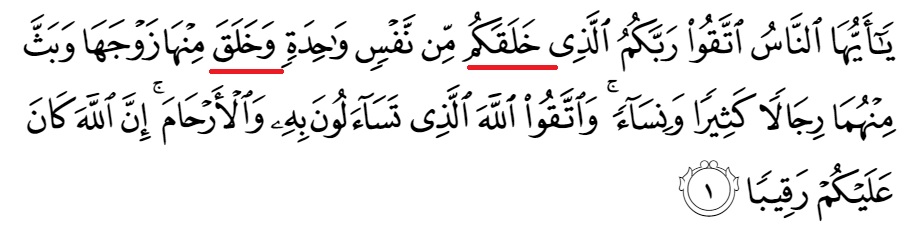
“Oh, mankind! Fear your Lord, who created you from a single person and created, out of him, his wife.” (Qur’an 4:1)

The above Arabic text is “khalaqakum” (created) and wa “khalaqa”(created). Allah (swt) used the same word twice. Allah (swt) did not use the word “ja’ala” (created) as he did in Qur’an 7:189. This once more shows that the two words convey the same meaning.

“Indeed, We have made it an Arabic Qur’an that you might understand.” (Qur’an 43:3)


The Arabic term that is used here is “ja’alnahu” (made/created)

“Truly I am going to create man from clay” (Qur’an 38:71) 

The Arabic term here is “khaliqun” (create) 

Now let us look at Qur’an 38:72

The underlying words in verse 72 have, however, been given contradictory interpretations. 

Professor Abdullah Yusuf Ali has translated them as: “And I breathed unto him of my spirit.”

Yusuf Ali (Saudi Rev. 1985) “When I have fashioned him (in due proportion) and breathed into him of My spirit, fall ye down in obeisance unto him.”
Yusuf Ali (Orig. 1938) “When I have fashioned him (in due proportion) and breathed into him of My spirit, fall ye down in obeisance unto him.” 

While Dr. Al Hilali and Dr. Khan has explained them this way: “And I breathed unto him his soul created by me.”

Muhsin Khan & Muhammad al-Hilali So when I have fashioned him and breathed into him (his) soul created by Me, then you fall down prostrate to him.”

The implication of the first translation is that Allah (swt) has given part of His spirit, so man is the essence of Allah.

This sounds very much like those who say the Qur’an is the essence of Allah.

In the second translation by Dr. Al Hilali and Dr. Khan, it means that Allah created man’s soul and then breathed it into him. This interpretation agrees with those who say that the Qur’an is created.

This is also the way the Sahih International translates it this way: “So when I have proportioned him and breathed into him of My [created] soul, then fall down to him in prostration.” (Qur’an 38:72)

The three translations (Abdullah Yusuf Ali & Dr. Al Hilali /Dr. Khan and Sahih International are all three contradictory and have both been endorsed by the religious institutions in Saudi Arabia.

Fortunately for us, neither of the translators were Ibadi or the so-called, “Khariji” and thus, no sectarian uproar in the Islamic World!!

Unfortunately, this particular issue is complicated by the fact that there is quite a bit of obfuscation on behalf of our brothers from ‘Ahl Sunnah’ and that is because they do not want to tell us if they regard the attributes of Allah (swt) as being identical with the essence of Allah (swt) or being outside the essence of Allah (swt).

If you would like to learn more about the Qur’an being a creation of Allah (swt), you may wish to read the following:

https://primaquran.com/2022/10/04/lets-attack-hamza-yusuf-in-ramadan-the-quran-is-created/

https://primaquran.com/2022/10/05/ef-dawah-discussion-with-josh-jewish-is-the-quran-being-uncreated-against-tawheed/

https://primaquran.com/2024/01/18/allahs-word-created-or-uncreated-mohammed-hijab/

May Allah Guide the Ummah.

May Allah Forgive the Ummah.

2 Comments

Filed under Uncategorized

The Ibadi, Muutazila, Ahl Sunnah & Jahmia: Qur’an and attributes.

“He only orders you to evil and immorality and to say about Allah what you do not know. And when it is said to them, “Follow what Allah has revealed,” they say, “Rather, we will follow that which we found our fathers doing.” Even though their fathers understood nothing, nor were they guided?” (Qur’an 2:169-170)

﷽ 

When it comes to the issue of the Qur’an being created and the topic of the attributes of Allah (swt), we could put this into four views. This brief entry will show where these four denominations have overlapping agreement and/or disagreement.

A. There are four denominations in this subject.

  1. Ibadi.
  2. Muutazila.
  3. Ahl Sunnah.
  4. Jahmia.

Here are the points.

  • Ibadi & Mutazila say: The attributes of Allah (swt) are nothing other than Allah (swt)
  • Ahl Sunnah & Jahmia say: The attributes of Allah (swt) are other things with/than Allah (swt).
  • Ahl Sunnah & Jahmia say: Qur’an is one of the attributes of Allah (swt).
  • Ibadi & Mutzalia say: Qur’an is not an attribute of Allah (swt).
  • Jahmia say: Attributes of Allah are created by Allah (swt).
  • Ahl Sunnah say: All attributes of Allah aren’t created by Allah (swt).

We (The Ibadi) say there is evidence to prove that the Qur’an is created by Allah (swt).

For the Jahmia, the proof that the Qur’an is created by Allah (swt) is that the Qur’an is one of the attributes of Allah (swt). For them, all the attributes of Allah (swt) are created by Allah (swt).

Ibadi, Mutazalia & Ahl Sunnah all say anyone who believes that the attributes of Allah is created are kaafir. (disbelievers of shirk)

We, the Ibadi, say: The Qur’an is a word of Allah and created by Allah, but we don’t say the Qur’an is an attribute of Allah (swt).

“Our belief is upon Haqq and the belief of the Jahmia is upon kufr and batil.” -Shaykh Hamed Hafidh

We want to thank our teacher Shaykh Hamed Hafidh As Sawafi (hafidullah) for this explanation.

For further reading on this subject:

https://primaquran.com/2022/10/04/lets-attack-hamza-yusuf-in-ramadan-the-quran-is-created/

May Allah Guide the Ummah.

May Allah Forgive the Ummah.

4 Comments

Filed under Uncategorized

Every word in the Qur’an is proof that it is created by Allah.

“It is He to whom belongs the dominion over the heavens and the earth, and who has not taken a son and has no associate in His dominion, for He has created all things according to precise measures.” (Qur’an 25:2)

﷽ 

Those people who claim the Qur’an is eternal. They say this precisely because they do not know what the Qur’an is.

We know the number of surahs/chapters is 114. We know each chapter of the Qur’an as well as the number of verses. In each word we know the number of letters. And for each letter we know the harakat.

We know these letters do not operate independently. They combine with other letters that make words and these words combine with other words to make sentences. These sentences combine to make the various chapters of the Qur’an. All of this is clear evidence that the Qur’an is created by Allah (swt).

All scholars, all Muslims believe that all languages are created by Allah (swt).

By this we know that the Arabic language is created by Allah (swt). The Qur’an is informed in the Arabic language. The Arabic language is created by Allah (swt) and by that the Qur’an is created by Allah (swt).

“And of His signs is the creation of the heavens and the earth and the diversity of your languages and your colours. Indeed, in that are signs for those of knowledge.” (Qur’an 30:22)

“And We did not send any messenger except [speaking] in the language of his people to state clearly for them, and Allah sends astray [thereby] whom He wills and guides whom He wills. And He is the Exalted in Might, the Wise.” (Qur’an 14:4)

“Look how We explain signs to them, then see how far they are turned away.” (Qur’an 5:75)

You may be interested in reading the debate among Muslim scholars regarding the foreign words that the Arabic language adopted here:

https://muslimmatters.org/2008/05/21/the-arabic-quran-and-foreign-words/

“Some proponents of this camp quoted the ‘father’ of Arabic grammar,Sībawayh (d. 180/796) himself, who wrote in his al-Kitāb that non-Arabic words could become Arabic if one substituted Arabic letters for the foreign ones, and then appended it to a known morphological form (wazn).”

Source: (Sībawayh, al-Kitāb, v. 4, p. 304.)

Sibawayh’s teacher was the famous Ibadi scholar, Al-Khalili ibn Ahmad al-Farahidi (The one who is credited for teaching your children (no matter what expression of Islam they follow) the harakat of the Qur’an.

A brief entry concerning the famous Ibadi scholar, Al Khalili Ibn Ahmad Al-Farahidi al-Ibadi here:

https://primaquran.com/2023/03/24/harakat-of-the-quran-al-khalili-ibn-ahmad-al-farahidi-al-ibadi/

If you want to learn more on the subject of the Qur’an being created, you may wish to read the following articles:

https://primaquran.com/2022/10/04/lets-attack-hamza-yusuf-in-ramadan-the-quran-is-created/

May Allah Guide the Ummah.

May Allah Forgive the Ummah.

Leave a comment

Filed under Uncategorized

Discussion on (ja’ala) making of the Qur’an in Arabic.

“Indeed, We have made it (ja’alnahu) an Arabic Qur’an that you might understand.” (Qur’an 43:3)

﷽ 

Al hamdulillah! Praise be to Allah (swt) that the evidence that the Qur’an is created is crystal clear.

Just as the following hadith is crystal clear.

Narrated ‘Abdullah bin Mas’ud:

“Allah has not created (khalaq) in the heavens nor in the earth what is more magnificent than Ayat Al-Kursi.”

حَدِيثِ عَبْدِ اللَّهِ بْنِ مَسْعُودٍ قَالَ مَا خَلَقَ اللَّهُ مِنْ سَمَاءٍ وَلاَ أَرْضٍ أَعْظَمَ مِنْ آيَةِ الْكُرْسِيِّ

Source: https://sunnah.com/tirmidhi:2884

We do not have any reports from a companion(sahabah) to the contrary.  So, our interlocutors will either have to weaken the hadith or employ interpretive principles to dismiss it as sound evidence.

Alas, Saudi, Salafi translations cannot hide the fact that the Qur’an is created.

https://primaquran.com/2022/10/04/saudi-translations-cannot-hide-the-fact-that-the-quran-is-created/

The making the Qur’an Arabic is natural making, because it is a meaning abiding with the Qur’an, namely its being Arabic. This means that it will either be transforming from one quality to another.

1) It was first not-Arabic then Allah invented in it this quality (of being Arabic).

2) Or (it will be) creating it with this quality from the beginning

As Allah created, the sun joined with the quality of being a lamp; and as Allah created the night with the quality of being a covering, and created the day with the quality of being a space for seeking livelihood. That is definitely the sense that it is used here. In the case of making an Arabic Qur’an. This is also because of the non-existence of anything to indicate that it was not non-Arabic before, and then Allah transformed it into Arabic. As for its being Arabic since forever, relating the verb ‘making’ to it in this way is impermissible in reason and in the dictionary, because ‘making’ is an action and action precedes what is enacted, so ‘making’ definitely precedes the made.

The same will be said about His saying, Glorified is He: ‘But We made it a light, We guide by it whoever We will from among Our servants’ (Qur’an 42:52)

This will appear as self-evident to whoever reflects on the meaning of ‘making’, and thinks about the Eternal Necessary attributes of Allah, Exalted is He, and the impossibility of relating ‘making’ to these attributes. For it is impossible in law that one should say that Allah has made His Knowledge All-Encompassing, or His Power All-Containing, or that Allah has made His Existence Pre-Eternal and Sempiternal, or that He has made His Hearing catch all sounds, or made His Seeing encompass all that is visible-because these phrases imply Allah’s production of these attributes.

Even if the interlocutors want to state that Allah (swt) could have made his revelation in Hebrew or Aramaic or Hindi or Greek, they have no escape from the two categories above.

A) First, there is no textual proof that the Qur’an was non-Arabic before being Arabic. Even if it was the case, that would be a clear admission of defeat. That is because of the admission of contradiction-an eternal abiding quality going through a change. From one state to another.

B) Because there is no proof for A we are left with the clear meaning of the Qur’an. One in which we do not superimpose our theology upon it. The Qur’an has been made in Arabic.

The knock-out blow has already been delivered. However, some are tenacious in clinging to false beliefs. They will often use every day Arabic vernacular that they think are great examples that the layperson will understand. However, those examples actually work against them!

“He made us dance.” ”He made his son the King.”

So, even in both of these examples, we need to ask:

Is being the King an eternal quality abiding in the individual or was this something that came about before it did not exist?

Can it be said that dancing is an eternal action abiding in the individual or is it merely a transitional state from non-dancing to dancing?

Made — is that which is transferred from one state to the other, which cannot be except in that which is created. The second is the reasoning of its being made in the Arabic language with the intention that the one being addressed may understand it.

Like that verse are all the verses which make it clear that it is made. For example, His saying, Exalted is He: “But We have made it a light, We guide by it whomever We will from among our servants.” (Qur’an 42:52).

Imam Muhammad b. Aflah, (Ra) has commented on the evidence of ‘making’ as affirmation of its being created; he says:

“The ummah is in consensus that every doer is before his doing, and the maker is before the making, and the artist is before the art, and that the maker is other than the made. When the difference and precedence between them has been affirmed, then it is true that they are two things, and that the first and precedent is the Eternal Maker, and the second, the made, is the originated, being after it had not been.” Source: (The Overwhelming Truth)

He has argued from ‘making’ when referred to Allah, in many verses which denote it-such as His saying, Exalted is He: “He made the darkness and the light”. (Qur’an 6:1)

His saying: “Me made from it, its pair.” (Qur’an 7:189)

His saying: “He it is that has made for you the night that you may rest therein, and the day to make things visible to you.” (Qur’an 10:67)

His saying: “Or who has made the earth firm to live in; made rivers in its midst; set thereon mountains immovable; and set a separating barrier between the two seas.” (Qur’an 27:61)

His saying: “Of the hills He made some for your shelter.” (Qur’an 16:81)

His saying: “And has made for you ships and cattle on which you ride.” (Qur’an 43:2)

His saying: “And made the sun as a lamp.”(Qur’an 71:16)

His saying: “And We made the night and the day signs.” (Qur’an 17:12).
Similar to those (verses is the meaning of ‘making’) in His saying:

“Have WE not made the earth as a place to draw together.” (Qur’an 77:25)

His saying: ‘Have We not made the earth as a wide expanse; and the mountains as pegs; and created you in pairs; and made your sleep for rest; and made the night as a covering; and made the day as a means of subsistence’. (Qur’an 78:6-11) and other verses.

Imam Abu l-Yaqazan Muhammed b.Aflah (May Allah have mercy on him), says:


“The meaning of ‘made’ in these places that we have cited is ‘created’. And so it is for the one who opposes [our argument], but not, he claims, in the context of the Qur’an, because ‘making’ in the Qur’an is other than creation. If that is allowed for him, then it must be allowed [also] for another to oppose that and say some similar thing about [something] other than the Qur’an-that the ‘making’, about which we [Ibadis and Hanbalis] agree, has the meaning ‘creation’, has [for him] another meaning than ‘creation’. But what is the difference between the two ‘makings’? For [if there is a difference] it means that Allah has addressed the Arabs with what they do not understand of their speech, and what they do not know of their language, and with what there in it is allowed for them to be in doubt and uncertainty about. In one place, ‘making’ is in the meaning of ‘creation’, ‘origination’ and ‘management’. And in another place [it has] another meaning that we do not understand, and we do not know. The All-Wise is not described as such!”

When we and they agree that ‘making’ in His saying ”And He made the sun a lamp.” (Qur’an 71:16)

His saying: “Indeed, We have made what is on the earth an adornment for it.” (Qur’an 18:7) His saying: “He made for you from yourselves pairs.” (Qur’an 42:11)

His saying: “And He made darkness and light.” (Qur’an 6:1) -is in the meaning of ‘creation’, then all ‘making’ when it is by Allah is in the meaning of creation. In that will be included the Qur’an and other than the Qur’an. Otherwise, debating will become pointless and any evidence [for the argument] will not be valid.

“If they oppose -relying on the saying of Allah: “It was not Allah who made slit eared she-camels or she-camels let loose in pasture.” (Qur’an 5:103) It will be said-Yes Allah did not create a slit-eared she-camel as a slit-eared she-camel, as you claim, nor a she-camel let loose in pasture as a she-camel let loose in pasture, as you claim. Rather, He negated from Himself what He did not do as the polytheist claimed [that He did]. So he criticized them because of their innovation. Its meaning is that We did not create you as you have described, rather, We created against that which you have described. The negation here is of the particular qualifier, not of the particular creation.”

“Like that is His saying: “Surely I will make you a leader for mankind.” (Qur’an 2:124) i.e. I will create in you the quality that was not in you, and the meaning that was not found in you, and I had not done so in you before that. The meaning of ‘made’ wherever it is found is ‘created’, ‘managed’, and all that is the same meaning, though the words are different.”

Prima-Qur’an comment: Another example is the following:

“Allāh has not made (ja’ala) for a man two hearts in his interior. And He has not made (ja’ala) your wives whom you declare unlawful your mothers. And He has not made (ja’ala) your claimed [i.e., adopted] sons your [true] sons. That is [merely] your saying by your mouths, but Allāh says the truth, and He guides to the [right] way.” (Qur’an 33:4)

One of them actually made the comment to us: “Can we say that Allah didn’t create sons or hearts or wives?” Of course not! Such a bizarre conclusion.  Again, the negation is of a particular type or qualifier, not of the creation itself.  Another thing we wish they had pondered is that if Allah (swt) had made (ja’ala) for man two hearts, or made (ja’ala) our wives our mothers, or made (ja’ala) our adopted sons our real sons the same word (ja’ala) would still be applicable.

That is Muhammad b. Aflah’s statement about ‘making’. (May Allah’s abundant mercy be upon him).

We add to that, we investigated occurrences of ‘making’ in the Qur’an referred to Allah, and we found it fell in either of two classes.

The ‘making’ is either natural or legal. In both there is creation of what did not exist (before). 

In natural making, for example, there are the following:

In His saying: “He made from it its pair.” (Qur’an 7:189)

His saying: “And has made for you ships and cattle on which you ride.” (Qur’an 32:12)

His saying: “He made the sun a lamp.” (Qur’an 71:16)The meaning of origination and contingency is clear.


The legal ‘making’ is as in His saying in the following:

“Surely I will make you a leader for mankind.” (Qur’an 2:124)

Another example of the same is the negated making in His saying, Exalted is He: “It was not Allah Who made a slit-ear she-camel or a she-camel let loose in pasture.” (Qur’an 5:103) i.e. He did not legalize the slitting of its ear. An(other) example of the legal ‘making’ is His saying, Exalted is He: “And He made the qiblah to which you were used only to test those who followed the Messenger from those who would turn on their heels.” (Qur’an 2:143)

The differences between the two ‘makings’ are as follows:

The first of them is bringing into existence the essence of the made thing or an abiding quality of it which did not exist before. That implies bringing the made from one state to another state, or from one quality to another quality. That (turning from one to another state) is accomplished when ‘making’ is referred to mankind, and it is in the meaning of turning from one state to another, as (when) I made the dough bread, the flour dough. In both cases, there is a turning of the made from one state to another state in which it was not before. The flour being made dough was not dough, and the dough before being made bread was not bread. It is not understood from this other than that the thing made is moving with the making from what it was before (to the changed state).

The second is inventing a law that turns (the object of the action) from one verdict to another one, like the Ka’bah being made the qiblah of the Muslims after Bayt al-Maqdis had been their qiblah.

Dealing with objections: May Allah (swt) guide the sincere.


An objection has been offered to the argument for the creation of the Qur’an from its being made Arabic-that ‘making’ is sometimes other than creation, as in the following examples:

“They make for Allah daughters, Glorified Is He.” (Qur’an 16:57)

“Still, the pagans have made some of His creation out to be a part of Him. Indeed, humankind is clearly ungrateful.” (Qur’an 43:15)

“They made angels who are servants of the Most Gracious females.” (Qur’an 43:19)

His saying: “You make it your provision that you lie.” (Qur’an 56:82).

The answer to this is that the distance between the two ‘makings’ and makers is immense. The making, in the context of what we are here discussing, is an affirmed action referring to Allah, Exalted is He. Whoever rejects it or rejects its effect (namely, the Qur’an), has unbelieved. That which is made—namely, the Qur’an in Arabic, its giving light and its guidance is an established reality. Whoever rejects it, he has certainly unbelieved.

The ‘making’ in what they have objected to is a falsehood referring to the unbelievers. They made—namely, the angels being feminine — is nothing. Whoever affirms that will be regarded as an unbeliever. Who affirms that the made some of his creation to be a part of him is an unbeliever.

There is no problem with the sameness of the letters of the verb (ja’ala) in both references—namely, jim, ‘ayn, lam—because the verb in reference to Allah has one meaning, and in reference to someone else has another meaning regardless of there being no difference in the word. Examples:

“He is who created you and those before you.” (Qur’an 2:21)

“And Allah created you and whatever you do.” (Qur’an 37:96)

“Indeed We have created man from a quintessence of clay.” (Qur’an 23:12)

“We have indeed created man in the best of molds.” (Qur’an 95:4)-and other similar verses where the creation is referred to Allah.

It is in all cases with the meaning of bringing from non-being into being. You will find this same verb, the same word and the same letters, referred to the unbelievers. It has (in those references) a sense that is not proper to the righteous servants of Allah, let alone its being permissible in respect of Allah, the Lord of the Worlds, Exalted is He. That (meaning) is (explicit) in His saying: “And you created falsehood.”(Qur’an 29:17).

So the meaning of the word is the same.

Is there any way to interpret that in one place according to the meaning of the other?

Or is the comparison between the two verbs as impossible as the impossibility of the comparison between the two doers?


“For that is Allah, your Lord, the Truth. And what can be beyond truth except error? How then are you turned away?”(Qur’an 10: 32)

For more information you may wish to read our article here:

May Allah Guide the Ummah.

May Allah Forgive the Ummah.

Leave a comment

Filed under Uncategorized

Shaykh Uthman Ibn Farooq: “If you pray with your hands down, your salah is still acceptable.”

“So woe to those who pray yet are unmindful of their prayers.” (Qur’an 107: 104-105)

﷽ 

Malik ibn Al-Huwayrith reported:

We came to the Prophet (saw) while we were young men, and we stayed with him twenty nights. Then the Prophet considered that we were anxious to see our families, so he asked us who we had left behind to take care of them, and we told him. The Prophet was kindhearted and merciful, and he said, “Return to your families, teach them, and enjoin good upon them.” Pray as you have seen me praying. When the time of prayer arrives, then one of you should announce the call to prayer and the eldest of you should lead the prayer.

Source: (https://sunnah.com/bukhari:6008)

This is a commentary on the following video:

Shaykh Uthman REFUTES Shia lies on Folding Hands in Prayer [MUST WATCH]

It is refreshing to see that those who claim to be following the early generations are starting to relax their position on this matter. Al hamdulillah.

For example, Salafi preacher, Assim Al Hakeem mentions that one can pray with their arms to the side with no problem.

If you pray with your hands down, your salah is still acceptable -Shaykh Uthman Ibn Farooq.

Shaykh Uthman says @0:46If you feel that you want to pray with your hands to your side ,and you feel that’s the correct opinion based on the evidence that you have seen, it’s up to you. No problem. That’s between you and Allah. I believe with the evidences from the Qur’an itself and from the authentic hadith of the Prophet (saw) and the sahabam, ahl bayt and others that the sunnah is to fold the hands.”

Shaykh Uthman says @1:09 “But I’m not pushing that opinion. I don’t believe in dividing the ummah based on this. I believe even if you pray with your hands down, your salah is still acceptable.”

Shaykh Uthman says @3:24 “Now when, whether you fold your hands or don’t fold your hands, personally I’m not going to argue with you on this issue. If you feel this is the way of the Prophet (saw), then that’s between you and Allah.”

Shaykh Uthman Ibn Farooq: Misquotes the Shi’a man.

@7:14 “This man is saying there’s not a single narration that shows among the Ahl Sunnah to fold the hands. That’s hwat he’s saying. Listen to him again.”

Actually, that is not what the man said.

The Shi’a man: “Within Ahl Sunnah there is no single proven tradition from the holy prophet (peace be upon him and his family in regard to folding of the hands in prayer.”

Proven (adjective) = established beyond doubt.

Something to be mindful of. The idea that something is more established than it truly is.  In fact, throughout the video, Shaykh Uthman makes this claim about the Sh’ia man several times. 

If one person narrates something to 50 students and those 50 students copy this narration into their books and a person quotes those 50 students, the one listening may get the false impression that the evidence is overwhelming.  They may reason to themselves. “Look how many people narrate this.” However, in reality they all quote the one channel. 

This is not necessarily dishonest, however, it can give the false impression that something is stronger than what it actually is. 

@12:06 “But he mentioned that Ibn Mundhir has mentioned from Ibn Zubayr, from Hassan Al Basri from Nakha’i, about leaving the hands on the side. That not folding the right on the left and this was reported by an-Nawawi, upon the authority of Layth ibn Sa’ad.” (Shaykh Uthman stops reading..)

@12:26 “Now, the honesty that we believe in we quote this. We’re not going to hide anything from you.” (NOTICE THE VIDEO EDIT).

Notice, dear reader, and in this case, dear viewer, that at the point where Shaykh Uthman says, ‘We’re not going to hide anything from you.” The video skips. Which shows that part
was cut. Does this mean that nothing was hidden or revealed? Allah knows best. However, it is worth taking note of.

@12:31 “Now what does he say? He says Ibn Al Qassim has mentioned this from Imam Malik one of the great a’immah of Medina that is also reported from him Ibn Al Qassim, but he says he was opposed (@12:47 the video is cut) by Ibn Al Hikim who said that Imam Malik believed in folding the hands as well.

Prima Qur’an: Why can’t Shaykh Uthman simply quote the narration that Imam Malik regarded praying with the hands at side? The way the video is sliced and spliced is done in such a way that it skips over it.

Where did these knowledgeable salaaf get their view from about placing the hands at the side in prayer?

Abdullah ibn al-Zubayr
Al Hassan al-Basri
Ibrahim al-Nakha’i
Imam Malik

Shaykh Uthman says: @13:49 “20 authentic narrations leading back to 18 different sahaba from the Prophet (saw).”

You have to wonder if that is what Shaykh Uthman believes himself? Are all those narrations authentic? Because it is important to note what Shaykh Uthman is doing is talking about narrations concerning folding the hands in prayer.

Shayky Uthman Ibn Farooq is caught lying.

Shaykh Uthman, while reading from a text, says: @15:04 “We were ordered in the time of the Prophet (saw), as Abu Hazim has clarified, to fold the hands, right on left in the prayer.”

Which Arabic in the text below is he rendering as: ‘In the time of the Prophet’ ?

Often Shaykh Uthman makes mistakes in his Arabic.

@16:03 “Ali radianhu” ???

Insh’Allah we will come back to this hadith. This hadith they feel is their ultimate trump card. Suffice it to say that the text does not say: “were ordered in the time of the Prophet.”

They wish it said that!

We remind Shaykh Uthman the seriousness about lying on the Blessed Prophet (saw).

Narrated `Ali:

The Prophet (saw) said, “Do not tell a lie against me for whoever tells a lie against me (intentionally) then he will surely enter the Hell-fire.”

Source: (https://sunnah.com/bukhari:106)

The word intentionally is not in the Arabic text.

Does the Qur’an mention anywhere about the placement of the hands?

“Therefore pray to your Lord and make a sacrifice.” (Qur’an 108:2)

https://www.islamawakened.com/quran/108/2/

Does this really need any comment? Does one really see anything in this text about the placement of hands in the prayer?

Shaykhk Uthman says: @17:12 “Imam Malik himself and I’m going to put a link to the Muwatta Imam Malik in the description. He has an entire chapter in his Muwatta about folding the hands in prayer; from the people of Medina. Not a single hadith in the Muwatta, not a single chapter that says, ‘dangle the hands in prayer’. And Imam Malik style of writing if he saw the people of Madina doing something opposite to that which was narrated, then in the Muwatta he would write, ‘This is what is narrated, but the people of Madina
did opposite. But he did not say that about folding the hands.”

There are a few points to take note of.

  1. The Muwatta is not the only work attributed to Imam Malik. The following are also attributed to him.
  • al-Mudawwanah al-Kubrā
  • Risālat Mālik ilā al-Layth ibn Saʿd
  • al-ʿUtibiyyah

2. @12:31 Shaykh Uthman didn’t actually give us the quote that is from Malik on his stance.

3. As we mentioned in our other article. Just because someone narrated something doesn’t mean they acted upon what was narrated. Narrating a hadith shows awareness of its existence.

Abu Dawud transmitted the following hadith:

  • Hands below the navel
  • On the chest
  • And even hands to the sides

You can read more about that here:

4. Fiqh is stronger than hadith. Hadith is a narration and fiqh is understanding of the narration.

We mentioned that we would come back to this: “were ordered in the time of the Prophet.”

Narrated Sahl bin Sa`d:

The people were ordered to place the right hand on the left forearm in the prayer. Abu Hazim said, “I knew that the order was from the Prophet (saw) .”

Source: (https://sunnah.com/bukhari:740)

So for them this hadith serves as a neutralizer to any idea of the Blessed Prophet (saw) praying with arms to the side.

Go look at how the render the English over here: (https://sunnah.com/bukhari:740)

What a juciy dishonest lie! In plain sight!

The whole of the Arabic text actually says:

Abdullah ibn Maslamah narrated to us, from Malik, from Abu Hazim, from Sahl ibn Sa’d, who said: “People were commanded that a man should place his right hand on his left forearm during prayer.” Abu Hazim said: “I know of it only as being attributed to the Prophet (peace be upon him).” Isma’il (a narrator in the chain) said: “It is attributed” — and he did not say “he attributes it.”

Effectively, the hadith they think is a trump card actually is an athar.  It doesn’t describe something that the Blessed Prophet (saw) did. It describes actions that people did that were attributed to the Prophet (saw). 

A note about Sahl ibn Sa’d he lived to see the Umayyad imperium.

Al-Bukhari’s hadith comes through two chains: one from ‘Abdullah ibn Maslama and the other from Isma‘il ibn Abi Uways, both narrating from Imam Malik ibn Anas, from Abu Hazim, from Sahl ibn Sa‘d, who said: “The people used to be commanded…”

• In the narration of ‘Abdullah ibn Maslama, Abu Hazim said: “I do not know it except that he attributes it (yanmī dhālika) to the Blessed Prophet (saw).”

• In the narration of Isma‘il ibn Abi Uways, it says: “I do not know it except that it is attributed (yunmā dhālika) to him.”

Based on this, the hadith is defective (ma‘lūl), weak, and cannot be used as evidence, because it is merely Abu Hazim’s supposition, and it is also inconsistent (muḍṭarib).

20 different chains from 18 different sahabah?

A Sunni, Maliki scholar Shaykh Abdullah bin Hamid Ali translated a work that showed the problems in these chains.

So when the Shi’a man says: “Within Ahl Sunnah there is no single proven tradition from the holy prophet (peace be upon him and his family in regard to folding of the hands in prayer.”

Proven (adjective) = established beyond doubt.

This is correct.

As the article by Shaykh Abdullah states:

“True or not, there exists sufficient doubt about every single report that exists to this effect that weakens the “popular” claim and understanding that it is well established that the Prophet prayed while placing one hand over the other.”

You may also be interested in reading the following:

Final thoughts.

Shaykh Uthman Ibn Farooq, his first point, lands hard.  That was quite embarrassing for the Shi’a to quote that as a reference.  Also, something Shi’a has to contend with is the idea of women praying with their hands folded.  

However, Shaykh Uthman Ibn Farooq himself blatantly lied and misled his audience concerning what the Arabic text said. 

Allah Guide the Ummah.

May Allah Forgive the Ummah.

Leave a comment

Filed under Uncategorized

The Punishment for Adultery in the Qur’an & Sunnah according to the Ibadi School.

“But why do they come to you for judgment when they have the Torah containing Allah’s judgment, then they turn away after all? They are not believers.” (Qur’an 5:43)

“Indeed, We revealed the Torah, containing guidance and light, by which the prophets, who submitted themselves to Allah, made judgments for Jews. So too did the rabbis and scholars judge according to Allah’s Book, with which they were entrusted and of which they were made keepers. So do not fear the people; fear Me! Nor trade my revelations for a fleeting gain. And those who do not judge by what Allah has revealed are the disbelievers.” (Qur’an 5:44)

﷽ 

There is a very, very easy way to avoid the legal punishments for adultery in Islam. In fact, a person could live in a political entity in which punishments for committing adultery are enacted and never even have to worry about them at all.

It is very similar to living in a nation in which there are strict punishments for killing someone. The very easy way to avoid the repercussions and legal punishments is simply not to do the acts.

Can you imagine our opponents? “No, a man should have the right to cheat on his wife!” “No, a woman should have the right to cheat on her husband!”

Rather than discuss the sternness of the punishment, the discussion should really centre around questions of intelligence and decision-making.

  1. Is cheating on your husband or wife a good decision or a bad decision?
  2. Is cheating on your husband or wife an intelligent decision in a society where you could be stoned to death for such actions?
  3. Is cheating on your husband or wife an intelligent decision when one has recourse to more wives (in the case of a man) or recourse to divorce (man and woman)?

Notwithstanding the Islamic legal punishment for adultery we read numerous reports across numerous countries, and cultures about the rash acts that husbands and or wives commit when they find that their partner has cheated on them.

Any search engine can pull up the latest murders, murder-cum-suicides and rage-fueled actions taken by those who felt betrayed by the man or woman most dear to them. Someone they never felt would betray them in such a manner.

So, before we even get to the punishment for adultery, an ideal Islamic society would have several measures and safeguards in check before an individual were to make unintelligent decisions.

One would be taught: Ad-Darooriyyat Al-Khams—The Five Basic Necessities that are protected and recognized by Islamic law-shari’ah. 

This would fall under the category of: preservation of lineage.

  1. Growing up in a strong family household with emphasis upon respect for oneself. Emphasis upon reverence to Allah (swt).
  2. A strong emphasis upon proper interaction between the genders.
  3. A strong emphasis upon the respect that is due to marriage and a strong desire not to cause discord between a wife and husband.
  4. Understanding that sexuality is something sacred and intimacy can create strong bonds between two people.
  5. Marriage is the completion of half of one’s Islam.
  6. Marriage is the backbone upon which healthy communities and healthy socities are brought about.
  7. That your spouse will be your partner through joy and hardships.
  8. That such a relationship should be built upon trust and not lust.
  9. The understanding that if one commits a major sin and does not repent from that sin and dies while in that state that one will be in an eternal agony far worse than any prescriptive punishment meted out by human beings on Earth.
  10. The understanding that if one’s marriage is not working out that one has the recourse to divorce. Divorce can be a solution to a marriage which lacks love, intimacy, passion, friendship, companionship, mercy, trust, cooperation and depth.
  11. That divorce is not a source of shame nor does one need to be stigmatized because of it.

Before we continue, let it be known to the reader that, under previous administration of this site, our brother was of the incorrect view that rajm (stoning) for adultery was not part of the Islamic penal code. He has publicly recanted and publicly repented from that position. May Allah (swt) forgive him and guide any who has been misled about this.

He held the position not because he had liberal or modernist leanings or tendencies. He held that position that rajm (stoning) for adultery was not part of the Islamic penal code because he believed that it was the strongest position based on the evidence from the Qur’an and Sunnah.

Thus the importance of taking knowledge from the learned.

He did not hold the position due to liberal or modernist leanings for three reasons.

  1. He believes in the eternality of the hellfire for all who enter it. This is not a liberal or modernist position.
  2. He believes in a penal punishment that we imagine could be more painful and excruciating than rajm (stoning) and that is to be ‘lifted up’ or impailed according to the Qur’an 5:33. He has informed us this was always his view.
  3. He believed that, due to what he saw as the ambiguity of ‘rajm’ as a punishment, that he was following Qur’an 5:32 “Whoever saves a life it’s as if he saved the whole of mankind.”

Insh’Allah we link to his original article so people can see the evolution in his thought process.

That entry is here:

https://primaquran.com/2020/09/05/refuting-the-argument-of-stoning-to-death-for-adultery-taking-the-quran-as-the-primary-guidance/

So consider this article a self-refutation. A more learned primaquran refuting a less learned primaquran.

It is also our sincere hope that, at any point, we are mistaken in a position, or misrepresent the views of others that Allah (swt) guides us to the right action and the correct course.

Let us start with this insightful hadith concerning the Mother of the believers.

Narrated Yusuf bin Mahk:

While I was with Aisha, the mother of the Believers, a person from Iraq came and asked, “What type of shroud is the best?” `Aisha said, “May Allah be merciful to you! What does it matter?” He said, “O mother of the Believers! Show me (the copy of) your Qur’an,” She said, “Why?” He said, “In order to compile and arrange the Qur’an according to it, for people recite it with its Suras not in proper order.” `Aisha said, “What does it matter which part of it you read first? (Be informed) that the first thing that was revealed thereof was a Sura from Al-Mufassal, and in it was mentioned Paradise and the Fire. When the people embraced Islam, the Verses regarding legal and illegal things were revealed. If the first thing to be revealed was: ‘Do not drink alcoholic drinks.’ people would have said, ‘We will never leave alcoholic drinks,’ and if there had been revealed, ‘Do not commit illegal sexual intercourse, ‘they would have said, ‘We will never give up illegal sexual intercourse.’ While I was a young girl of playing age, the following Verse was revealed in Mecca to Muhammad: ‘Nay! But the Hour is their appointed time (for their full recompense), and the Hour will be more grievous and more bitter.’ (54.46) Sura Al-Baqara (The Cow) and Surat An-Nisa (The Women) were revealed while I was with him.” Then `Aisha took out the copy of the Qur’an for the man and dictated to him the Verses of the Suras (in their proper order) 

Source: (https://sunnah.com/bukhari:4993)

This insightful hadith teaches us that the priority of teaching Muslims was not given to the penal aspect of Islamic law. Rather, when one looks at which verses are said to have first to the Blessed Prophet (saw), priority is given to establishing faith in Allah, believing in the life to come. The promise of heaven and the promise of hellfire.

The punishment for sexual impropriety in the early days of Islam was a temporary light punishment because people were from the days of ignorance and were new to following a moral code that called them to a higher standard of behavior. This is indicated by the hadith where Aisha (ra) spoke about the matter. 

The way of Allah (swt) with the early Muslim community in legislation was to guide the nation gradually, by which is more successful in treatment, wiser in application, and easier for the souls to accept with satisfaction and reassurance, as we saw in the prohibition of alcohol and usury, and other Shariah rulings.

Faahish in Islam is an immoral act, either done by mouth, meaning to say something immoral, or it is done by action of the body to do something immoral. It means something that exceeds the limit. Something excessive.

The punishment for an unspecified type of Faahishah: (Anything short of fornication or adultery)

The punishment in the early days of Islam was as given by Allah (swt) in the following:

“As for those of your women who are accused of committing a (fāḥishata) immoral deed, call four witnesses from among you, and if they testify to their guilt, keep the women at home until death comes to them or until Allah shows them another way. Punish both of the guilty parties, but if they both repent and mend their ways, leave them alone. Allah is always ready to accept repentance. He’s the Mercy Giver.” (Qur’an 4:15)

So, the punishment for an unspecified type of immorality (fahishata) for a woman was confinement in the house and not allowing her to go out. The punishment for an unspecified type of immorality (fahishata) for the man was reproach and scolding with harsh words. In the early days of Islam, Muslims did not have jails or prison complexes. The home was an efficient holding facility.

However, from the above text (Qur’an 4:15) this is where the practice and basis of establishing such acts via four witnesses comes from.

The punishment for a specific type of Faahishah: Fornication.

The following verse of the Qur’an came by way of takhsees(specification) for a particular type of sexual impropriety, namely fornication.

“(As for) the fornicatress and the fornicator, flog each of them, (giving them) a hundred stripes, and let not pity for them detain you in the matter of obedience to Allah, if you believe in Allah and the last day, and let a party of believers witness their chastisement. The fornicator shall not marry any but a fornicatress or idolatress, and (as for) the fornicatress, none shall marry her but a fornicator or an idolater; and it is forbidden to the believers.” (Qur’an 24:2-3)

It is very clear that the above verses are not talking about married couples. This can be seen from the text: “The fornicator shall not marry any but a fornicatress or idolatress.” Meaning the default is they are unmarried.

We do want to comment that we personally feel that all translations and translators of the Qur’an have failed to convey what Qur’an 24:3 means and we have yet to see a translation that translates the meaning accurately. We put this right up there with Qur’an 4:157 as the worst translated text that translations and translators have failed to convey.

One may see for themselves the disparate translations of Qur’an 24:3 here:

https://www.islamawakened.com/quran/24/3/

The major reason why we loath all translations of Qur’an 24:3 is that when you look at it:

“The fornicator shall not marry any but a fornicatress or idolatress.” It gives the impression that a Muslim male or female or committed fornication has two options for his/her future.

a) marry a believer who has done a similar offense.

b) marry a mushrik who has done a similar offense.

We would translate it as: “The fornicator marries none but the fornicator and the idolater marries none but the idolatress.” The reason that the mushirk is put in this context is to show the level of disdain that Allah (swt) has for people who commit fornication.

The punishment for a specific type of Faahishah: Adultery.

Islamic law differentiates between the hadd for a non-married person by flogging for 100 hundred lashes and intensifying the punishment for the married person by making it stoning to death. This is because the crime of adultery after marriage is more severe and graver in Islam’s view.

The rest of the explanation deals with the rationale behind these punishments, their legitimacy, and how they are derived from Islamic law. 

As regards flogging (lashing), it has been firmly established by the explicit Quranic text:

“(As for) the fornicatress and the fornicator, flog each of them, (giving) a hundred stripes.”

That verse refers to the punishment for someone who is (non-muhsan) not married.

As regards rajm (stoning), it has been established by the implicit Quranic text as well as the explicit Sunnah of the Blessed Prophet (saw)

The implicit textual evidence of the Qur’an is as follows:

“But why do they come to you for judgment when they have the Torah containing Allah’s judgment, then they turn away after all? They are not believers.” (Qur’an 5:43)

  1. The only reason why this group of Jews would go to the Blessed Prophet (saw) is because they were hoping for a lighter judgement than what was already established among them.
  2. They were familiar with the penal code on general Faahishah and specific Faahishah: fornication they were hoping that the Blessed Prophet (saw) had something light for them in regard to those who committed adultery.

https://quranx.com/tafsirs/5.43

All the commentators in regard to the asbab an nuzul of this verse point to a group of Jews who went to see if they would get a judgement other than what was in the Torah.

We also have numerous hadith to this effect.

“When they have the Torah containing Allah’s judgment.”

“We have revealed to you this Book with the truth, as a confirmation of previous Scriptures and a supreme authority on them. So judge between them by what Allah has revealed, and do not follow their desires over the truth that has come to you. ” (Qur’an 5:48)

Those who maintain that the punishment for adultery is the same as those who are unmarried—namely, 100 lashes would have to come to terms with the following powerful contention:

There is no manuscript evidence from any Torah from the time of the Blessed Prophet (saw), or before him that the punishment for adultery was anything other than rajm (stoning).

The other powerful point that the detractors would have to deal with is the fact that the statement in the Qur’an: “But why do they come to you for judgment?” has been related on account of nothing other than the Jews coming to the Blessed Prophet (saw) over an incident of adultery.

Abū ‘Ubayda narrated from Jābir that ‘Ibn ‘Umar said: “The Jews went to the Prophet (saw), to tell him that a man and a woman of their community had committed adultery. The Prophet,(saw), said: “What does the torah say about stoning?” They said: “They must be branded and inflicted with the punishment of the whip.” ‘Abd Allah ‘Ibn Salām said to them: “You lie, it says that they should be stoned. Bring the torah and let’s check.” We brought the torah. One of the Jews got his hands on the stoning passage and read what preceded that passage and what followed it. ‘Abd Allah ‘Ibn Salām said to him: “Take away your hand.” Once the hand was raised, we found the passage relating to stoning. At this time, the Jews said: “It is true, O Muḥammed, there is a passage on stoning.” The two culprits were then stoned by order of the Prophet, (saw). ‘Ibn ‘Umar said: “I then saw the man leaning over the woman to protect her from the stones being thrown at them.”

Source: (Hadith 614 Al-Jami’i Al-Sahih Musnad Al- Imam Al-Rabii)

It was narrated that Bara’ bin Azib said:

“The Messenger of Allah (saw) passed by a Jew with a blackened face who had been flogged. He called them and said: ‘Is this the punishment for the adulterer that you find in your Book?’ They said: ‘Yes.’ Then he called one of their scholars and said: ‘I adjure you by Allah (SWT) Who sent down the Tawrah (Torah) to Musa! ‘Is this the punishment for the adulterer that you find in your Book?’ He said: ‘No; if you had not adjured me by Allah (SWT), I would not have told you. The punishment for the adulterer that we find in our Book is stoning, but many of our nobles were being stoned (because of the prevalence of adultery among them), so if we caught one of our nobles (committing adultery), we would let him go; but if we caught one of the weak among us, we would carry out the punishment on him. We said: “Come, let us agree upon something that we may impose on both noble and weak alike.” So we agreed to blacken the face and whip them, instead of stoning.’ The Prophet (saw) ‘O Allah (SWT), I am the first of those who revive your command which they had killed off,’ and he issued orders that (the man) be stoned.”

Source: (https://sunnah.com/ibnmajah:2558)

Notice what the man said about passing over the punishment among the nobles and imposing it upon the weak.

Recall the following hadith:

Narrated `Aisha:

Usama approached the Prophet (saw) on behalf of a woman (who had committed theft). The Prophet (saw) said, “The people before you were destroyed because they used to inflict legal punishments on the poor and forgive the rich. By Him in Whose Hand my soul is! If Fatima (the daughter of the Prophet (saw) did that (i.e. stole), I would cut off her hand.”

Source: (https://sunnah.com/bukhari:6787)

Now this becomes very interesting when we later turn our attention to Qur’an 4:25 where in Islam, the weak and the poor are given lesser punishments than the rich and the powerful.

The mission of the blessed Prophet (saw) is to clarify, as Allah says:

 “So that you may explain to the people what was revealed to them.” (Qur’an 16:44).  

The explanation and clarification provided by the Blessed Prophet (saw) suffice to detail and elucidate the general meaning of the Quran!

As for stoning, it has been established by the actions, sayings of the Blessed Prophet (saw), as well as by the consensus of the Companions and their followers.

Authentic narrations that leave no room for doubt have confirmed this, and it has been transmitted through reliable sources that the Blessed Prophet (saw) implemented the punishment of stoning on some Companions, such as Ma’iz and the woman from the tribe of Ghamid. The Caliphs/Imams after him continued to enforce this punishment during their rule, repeatedly announcing that stoning is the prescribed punishment for adultery after marriage.

Islamic scholars in every era and region have unanimously agreed that this ruling is a well-established, followed Sunnah and a definitive divine law, supported by abundant evidence that leaves no room for doubt or skepticism. This ruling has remained in place until our time, with no one dissenting except for what has been claimed concerning certain groups from among the Kharijites, who claimed that stoning is not prescribed. The fallacy of their argument will be clarified below:

The truth is that this is found in the books of their opponents, and there are no known books of theirs now. So we cannot be certain whether they made this statement or not.

In this link, you will find a book by the respected scholar, Shaykh (Abu Is’haq) Ibrahim Attfayish (hafidhullah),who explained that the Kharijites do not deny stoning, but they have an interpretation which you will find in the book. Here is the link:  

“This matter, according to me, is not as many think it is; some non-Ibadi Muslims’ claim that Khawarij reject stoning is an insinuation. This claim backfires on them because they narrated a verse that states “if an old man and old woman commit adultery, stone them as a punishment from Allah and Allah is Almighty All-Wise” was recited in the Holy Quran in Al-Ahzab but was eaten by a goat. Based on this false narration, an imperfection has occurred in the Qur’an. This terrible error will always accompany them despite their claims that its recitation is being abrogated while its ruling remains in effect! However, our Ibadi scholars say that stoning is not prescribed in the Holy Qur’an but in the hadith. Imam Al-Hafidh Al-Hujjah Ar-Rabi bin Habeeb narrated in his Sahih that Imam Jabir bin Zaid said, “Istinja, circumcision, witr and stoning are obligatory Sunnah.” -Shaykh Attfayish (h).

You can read about that here:

The opponents of stoning or rajm have four basic arguments.

Argument 1: They said stoning or rajm is the severest of punishments; if it were legitimate, it would have been mentioned in the Quran. Since it is not mentioned, this indicates that it is not legitimate.

Argument 2: The punishment for a female slave is half that of a free woman as we find here:

“They should receive half the punishment of free [unmarried] women.” (Qur’an 4:25) Since stoning cannot be halved, it cannot be the prescribed punishment for a free woman.

Argument 3: The ruling in the verse is general for all adulterers, and specifying the (married adulterer) is contrary to the Quran.

Response to these arguments:

Response to argument 1: As mentioned, the absence of stoning in the Qur’an is only by way of explicit evidence and not by implicit evidence as has already shown. Plus the historical, archeological and manuscript evidence of what the prescribed punishment in the Torah was/is.

The absence of stoning in the Quran does not indicate its illegitimacy. Many legal rulings are not mentioned in the Quran but are explained by the Sunnah. Allah has commanded us to follow the Blessed Prophet (saw) and adhere to his orders:

“And whatever the Messenger has given you — take; and what he has forbidden you — refrain from.” (Qur’an 59:7)

The Blessed Prophet (saw) conveys on behalf of Allah Almighty, and everything he brought is by divine revelation:

“Nor does he speak from [his own] inclination. It is but a revelation revealed.” (Qur’an 53:3-4)

How can stoning be considered illegitimate when the Blessed Prophet (saw) implemented it, and his Companions did so as well, as he clarified this through his words and actions?

Furthermore, the Quran explains the mission of the Blessed Prophet (saw) in the verse:

“And We revealed to you the message that you may make clear to the people what was sent down to them and that they might give thought.” (Qur’an 16:44)

You may wish to read more on this here:

https://primaquran.com/2024/05/07/how-we-know-the-sunnah-of-the-prophet-is-divine-guidance/

Response to argument 2:

The punishment for a specific type of Faahishah: Adultery of Malakat Aymanukum

“So marry them, with their people’s leave, and give them their wages honourably as women in wedlock, not as in licentious or taking lovers. But when they are in wedlock, if they commit indecency (bifahishatin), they shall be liable to half the chastisement of freewomen. That provision is for those of you who fear fornication; yet it is better for you to be patient. God is All-forgiving, All-compassionate.”(Qur’an 4:25)

This indicates that the intended punishment here is flogging, not stoning, as indicated by the halving of the punishment. Allah knows that stoning cannot be halved, as it is impossible for people to half-kill a person. Therefore, reason and sound understanding suggest that the punishment mentioned here is flogging, not stoning.

A married female slave is flogged fifty lashes, while a free, unmarried woman is flogged one hundred lashes. The reason for this leniency towards the female slave compared to the free woman is that the crime committed by the free woman is more heinous and detestable, as she is less likely to be tempted and is further removed from the cause of immorality, whereas the female slave is weaker in resisting it. Therefore, Allah, in His mercy, reduced her punishment.

Regarding the evidence that stoning cannot be halved, you will find more on this in the book “Tafsir Ayat Al-Ahkam” (2/19) by Shaykh Muhammed bin Ali Al-Sabuni.

Notice that in Islam the punishment for the weak and the poor, in this example, is less than for the powerful and wealthy.   Recall the hadith narrated by Aisha (ra):

“The people before you were destroyed because they used to inflict legal punishments on the poor and forgive the rich.”

Also, recall the exchange the Jews had with the Blessed Prophet (saw):

“The punishment for the adulterer that we find in our Book is stoning, but many of our nobles were being stoned (because of the prevalence of adultery among them), so if we caught one of our nobles (committing adultery), we would let him go; but if we caught one of the weak among us, we would carry out the punishment on him.”

That is why, in our school, the punishments for adultery and pre-marital sex are meted out like so:

  1. Free Woman/Man that are married =Rajm.
  2. Free Woman/Man that are unmarried =100 lashes.
  3. Slave Woman/Man that are married =50 lashes.
  4. Slave Woman/Man that is unmarried = Taazir.

A tazir punishment is when there is nothing explicit from the Qur’an or Sunnah. It is discretionary. It could be corporeal in nature, it could be harsh words of admonishment.

Recall the meaning of Faahish.

Faahish in Islam is an immoral act, either done by mouth, meaning to say something immoral, or it is done by action of the body to do something immoral. It means something that exceeds the limit. Something excessive.

Thus, they differ in degree and severity.

Response to argument 3:

The claim that the ruling is general and specifying it is contrary to the Quran is complete ignorance. Don’t we see that many rulings came in general terms and were specified by the Sunnah?

For example, the verse:

“As for the thief, the male and the female, amputate their hands.” (Qur’an 5:38)

This statement is general and includes all thieves, even if the theft is of something insignificant (trivial). According to their claim, we would have to cut off the hand of someone who steals a penny or a needle, even though the Sunnah specified and limited this ruling to a quarter dinar or its equivalent value of ten dirhams.

Similarly, the verse:

“And your mothers who nursed you, and your sisters through nursing.” (Qur’an 4:23)

This only mentions the prohibition of the mother and sister through nursing, while the Prophet (peace be upon him) explained that nursing forbids all the relationships that blood does. Hence, according to their argument, the prohibition of (a daughter through nursing) would contradict the Qur’an. The Qur’an prohibits marrying two sisters simultaneously, so anyone who says it is forbidden to marry a woman and her maternal or paternal aunt should be judged as contradicting the Qur’an

Unfortunately, some of the jurists and some of the schools have obfuscated this matter for the people so that they remain in a state of confusion about these matters.

All four types of punishments in regard to the different types of Faahish remain valid should the need arise. None of them are abrogated!

The punishment for an unspecified type of Faahishah: Confinement in homes. (Qur’an 4:15)

The punishment for a specific type of Faahishah: Fornication. 100 lashes. (Qur’an 24:2-3)

The punishment for a specific type of Faahishah: Adultery. Stoning for free married persons. (Qur’an 5:43)

The punishment for a specific type of Faahishah: Adultery of Malakat Aymanukum 50 lashes for the malakat aymanukum and discretionary “punishment” for the Malakat Aymankum who is unmarried. (Qur’an 4:25)

When we look at the four above. We can see that none of these can be enacted where Islam is in a state of Kitman. Where Islam is in a state of Zuhur (Manifestation), may Allah (swt) grant guidance and justice to the people of those lands.

MISUNDESTANDINGS REGARDING UMAR IBN AL KHATTAB (RA) AND FLAT LIES ATTRIBUTED TO HIM IN REGARD TO RAJM (STONING)

The following is correctly attributed to Umar bin Al Khattab (ra)

Umar bin Al-Khattab said:

“Verily Allah sent Muhammed (saw) with the truth, and he revealed the Book to him. Among what was revealed to him was the Ayah of stoning (Qur’an 5:43). So the Messenger of Allah (saw) stoned, and we stoned after him. I fear that time will pass over the people such that someone will say ‘We do not see stoning in the Book of Allah.‘ They will be misguided by leaving an obligation which Allah revealed. Indeed, stoning is the retribution for the adulterer if he was married and the evidence has been established, or due to pregnancy, or confession.”

Source: (https://sunnah.com/tirmidhi:1432)

What Umar Ibn Al Khattab (ra) means is similar to the following hadith:

It was narrated that ‘Abdulleh said:

“The Messenger of Allah cursed the woman who does tattoos and the one who has them done, and those who pluck their eyebrows and file their teeth for the purpose of beautification, and those who change the creation of Allah.” News of that reached a woman of Banu Asad who was called Umm Ya’qub. She went to him and said: “I have heard that you said such and such.” He said: ‘Why should I not curse those whom the Messenger of Allah cursed ? And it is in the Book of Allah.She said: “I read what is between its two covers ‘and I have not found that.” He said: “If you read it properly you would have found it. Have you not read the words: ‘And whatsoever the Messenger (Muhammed) gives you, take it; and whatsoever he forbids you, abstain (from it).’?” She said: “Of course.” He said: ‘The Messenger of Allah forbade that.” She said: ‘I think that your wife does it.’ He said: “Go and look.” So she went and looked, and she did not see what she wantedShe said: “I have not seen anything!’ ‘Abdullah said: “If she was as you say, I would not have kept her with me. “

Source: (https://sunnah.com/ibnmajah:1989)

This is what Umar Ibn Al Khattab (ra) was referencing when he said that it (stoning) was mentioned in the Qur’an in the way the companion mentioned (plucking the eyebrows) was mentioned in the Qur’an.

The following is incorrectly attributed to Umar bin Al Khattab (ra)

‘Umar bin Al-Khattab (ra) said:

“The Messenger of Allah (saw) stoned, Abu Bakr stoned, and I stoned. If I didn’t dislike that I add to the Book of Allah. I would have written it in the Mushaf, for I fear that there will come a people and they will not find it in the Book of Allah, so they will disbelieve in it.”

Source: (https://sunnah.com/tirmidhi:1431)

Now this is either incorrectly attributed to Umar Ibn Al Khattab (ra) or it is very possible that when we read this we are missing the point!

It cannot be that Umar Ibn Al Khattab (ra) meant to write down something as if it was the Qur’an! This is clear from the following verse:

“So woe to those who distort the Scripture with their own hands then say, “This is from Allah”—seeking a fleeting gain! So woe to them for what their hands have written, and woe to them for what they have earned.” (Qur’an 2:79)

Thus, the statement:

If I didn’t dislike that I add to the Book of Allah. I would have written it in the Mushaf.”

It is a reference to Umar Ibn Al Khattab (ra) writing his own personal commentary or notes to (Qur’an 5:43) or that Umar Ibn Al Khattab (ra) was speaking in hyperbole. That is possible as well, because we all know he ended up not writing it down.

a note about the four witnesses need four stoning.

  1. They all four must have witnessed the actual act of penetration. Simply catching a man and woman naked would not suffice.
  2. The four witnesses must be mentally sound. They cannot be small children, for example; or those who have not reached the age of puberty.
  3. There are discussions about people who wear too much kohl, if it causes blurry vision.

Lastly: the very easy way to avoid the repercussions and legal punishments is simply not to do the acts! Don’t cheat on your wife! Don’t cheat on your husband! If the marriage is so lacking in passion and intimacy that you feel the urge to cheat, then seek a dissolution of the marriage. Otherwise, you are playing with fire, both literally and metaphorically speaking.

Allah (swt) knows best.

You maybe interested in reading the following:

https://primaquran.com/2022/10/04/why-abrogation-in-the-quran-is-a-false-doctrine/

May Allah (swt) guide the Ummah.

May Allah (swt) forgive the Ummah.

Leave a comment

Filed under Uncategorized

The narrator Ikrima: You cannot have your cake and eat it too.

“And give full measure when you measure, and weigh with an even balance. That is the best [way] and best in result.” (Qur’an 17:35)

﷽ 

Narrated `Ikrima:

that Ibn `Abbas told him and `Ali bin `Abdullah to go to Abu Sa`id and listen to some of his narrations; So they both went (and saw) Abu Sa`id and his brother irrigating a garden belonging to them. When he saw them, he came up to them and sat down with his legs drawn up and wrapped in his garment and said, “(During the construction of the mosque of the Prophet) we carried the adobe of the mosque, one brick at a time while `Ammar used to carry two at a time. The Prophet (saw) passed by `Ammar and removed the dust off his head and said, “May Allah be merciful to `Ammar. He will be killed by a rebellious aggressive group. `Ammar will invite them to (obey) Allah and they will invite him to the (Hell) fire.”

Source: (https://sunnah.com/bukhari:2812)

One could simply ditch the narration from Ikrima (ra) above. And use the following. Although the following allows for more interpretative scope than does the narration given via Ikrima (ra).

Abu Sa`id Khudri reported:

One who is better than I informed me, that Allah’s Messenger (saw) said to `Ammar as he was digging the ditch (on the occasion of the Battle of the Ditch), wiping over his head: “O son of Summayya, you will be involved in trouble and a group of the rebels would kill you.”

Source: (https://sunnah.com/muslim:2915a)

So why are a group of companions castigated when it becomes even apparent to them that Muaviya and his part were the unjust group? They warned Ali, this was a ruse, and they remembered well what the Blessed Messenger (saw) said: and a group of the rebels would kill you

By the way, Ammar (ra) was killed BEFORE arbitration.

Narrated `Ikrima:

“Some Zanadiqa (atheists) were brought to `Ali and he burnt them. The news of this event reached Ibn `Abbas who said, “If I had been in his place, I would not have burnt them, as Allah’s Apostle forbade it, saying, ‘Do not punish anybody with Allah’s punishment (fire).’ I would have killed them according to the statement of Allah’s Apostle, ‘Whoever changed his Islamic religion, then kill him.’”

Source:  (https://sunnah.com/bukhari:6922)

Some Muslims really do imagine that they can have their cake and eat it too when it comes to Ikrima (ra).

On the one hand, they want to use Ikrima (ra) as a narrator when it comes to clearly showing that the kharijites truly were, none other than Muawiyah and his band.

In the following post you can see how Ibn Taymiyyah tripped over himself with regard to one of the narrations of Ikrima regarding Ammar ibn Yasir (ra).

Imam Ahmad Ibn Hanbal says that Ikrima was of the view of the Ibadi.

Yet, then they want to cast aspersions upon the narrator, Ikirma (ra), because he has none other than Ibn Abbas (ra), who narrates that he himself differed with the ijtihad of Ali, concerning the burning of apostates.

Failing to pin blame on Ikrima (ra) some have now satisfied themselves with casting aspersions on Ibn Abbas (ra). See here:

With Ikrima (ra) you cannot have your cake and eat it too.

You will need to be consistent in your methodology.

May Allah (swt) open the eyes and the hearts.

May Allah Guide the Ummah.

May Allah Forgive the Ummah.

Leave a comment

Filed under Uncategorized