
“It is He who has sent His Messenger with guidance and the world view that is based on the truth to manifest it over all other world views, although the mushrik make dislike it.” (Qur’an 9:33)
﷽
Bio: Early Life and Education
Shaykh ʿAbdallāh b. Zayd Āl Maḥmūd was born in Najd and studied under prominent scholars of the Saudi reformist-Salafi tradition. He was influenced by the intellectual legacy associated with the Hanbali revival of central Arabia, which traced its theological orientation back to Ibn Taymiyyah and Muhammed ibn Abd al-Wahhab.
He studied Qur’an, hadith, fiqh (primarily Hanbali), and Arabic sciences in Najd before being invited to Qatar.
Move to Qatar and Judicial Career
In the 1930s, he moved to Qatar at the invitation of the ruling family, the Āl Thānī. He eventually became:
- Chief Judge of Qatar
- A key religious authority shaping Qatar’s legal and educational institutions
- An advisor to the rulers during the formative pre-oil and early oil period
He played a central role in institutionalizing Sharīʿah courts and religious education in Qatar before the development of a modern state judiciary.
Intellectual Orientation
Shaykh Āl Maḥmūd was known for:
- Strong adherence to Atharī creed
- Emphasis on scriptural literalism in theology
- Conservative positions on social and moral issues
- Opposition to theological speculation (kalām)
He wrote against practices he regarded as bidʿah (religious innovations) and was critical of certain Sufi and Ashʿarī trends.
The ‘Abdulla bin Zaid Al Mahmoud Islamic Cultural Center’ in Qatar is named after him.
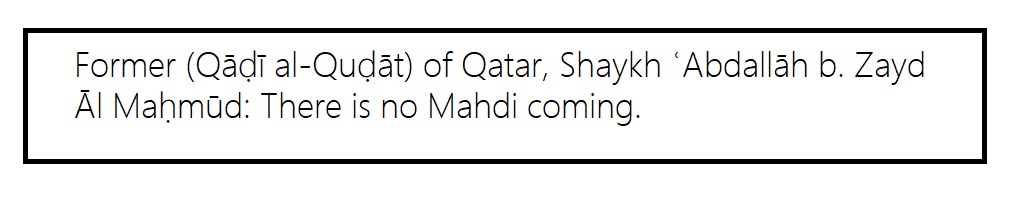
He wrote a book: “لا مهدي يُنتظر بعد الرسول محمد ﷺ خير البشر “No Mahdi is awaited after the Prophet Muhammed ﷺ, the best of mankind.”
His book is a masterpiece, and it gives no scope for his opponents to maneuver. The fairness and justice with which he writes about the subject is refreshing. This book alone would make one interested to read his other writings.
This Shaykh, who says he is Hasani in lineage, has urged Muslim scholars that if anyone comes claiming to be Mahdi, that the claimant should be killed. He argues as such based upon every other claim that has brought nothing but division and strife to the Muslim Ummah.
From his book:
The Epistle Sermon
Praise be to Allah, and there is no power or strength except with Allah.
Now then : This message, entitled “There is no Mahdi awaited after the Messenger Muhammed ﷺ, the best of mankind,” I chose this name for it so that it would be a good belief, which the tongues of every Muslim man and woman would pronounce, because I believe it to be an established fact.
I began by calling on scholars and students to unite in their sound belief that there is no Mahdi to be awaited after the Prophet, the best of mankind. This is because, although I believe that I have achieved fairness and justice in the message, and have not deviated in it to what is negated by Islamic law or rejected by reason, I am but a human being, prone to error and forgetfulness. In the message, I presented the Muslim’s belief regarding the Mahdi, including:
All people, scholars and commoners, in every time and place, fight against anyone who claims to be the Imam Mahdi, because they believe that he is a lying imposter who wants to corrupt the religion, divide the Muslim community, and fill what he has seized with injustice and immorality, as happened to many of those who claimed to be the Mahdi. They will continue to fight against anyone who claims to be the Mahdi until the Hour comes. So where is the Mahdi in this situation?
The idea of the Mahdi is not originally from the beliefs of the early Sunnis. It was not mentioned among the Companions in the first century, nor among the Successors. The origin of those who adopted this idea and belief is the Shiites, whose beliefs include belief in the awaited absent Imam, who will fill the earth with justice as it was filled with injustice. He is the twelfth Imam: Muhammed ibn al-Hasan al-Askari. This idea and belief was transmitted, through sitting, socializing, and mixing with the Sunnis, and it entered into their belief, even though it is not originally from their belief.
Then it was generally transferred to the Islamic community when it was proclaimed to the people by Abdullah bin Saba, who is known for his explicit atheism and hostility towards Islam and Muslims. He and his followers began to work on formulating hadiths and placing them on the tongue of the Messenger of Allah with organized chains of transmission from the people of the graves, and they began to spread them in the community of people, so that they would not lose the hope that they hoped for, in their claim, to return the rule to the people of the house, to remove from them the injustice and persecution that was happening to them at the hands of their opponents, the Umayyads. It is a political terrorist call.
When the Umayyads heard these hadiths directed at them from Iraq, which made them tremble and threatened to overthrow them, they became aware of this, so they placed Al-Sufyani in the position of the Mahdi, and their supporters did their work in fabricating hadiths about the Messenger of Allah concerning Al-Sufyani. Among these is what Al-Hakim narrated in his Sahih on the authority of Abu Hurayrah, who said: The Messenger of Allah , may Allah bless him and grant him peace, said: “A man called Al-Sufyani will emerge from Damascus, and most of those who follow him will be from Kalb. He will kill until he rips open the bellies of women and kills children.” He mentioned the rest of the hadith, then Al-Hakim said: This is a sound hadith according to the conditions of the two Shaykhs, but they did not include it. Then he presented a second hadith about Al-Sufyani with the wording and meaning of the first hadith.
Al-Hakim’s correction of the hadiths of Al-Sufyani is like his and Al-Tirmidhi’s correction of the hadiths of Al-Mahdi alike. In reality, they are all incorrect and not widely transmitted. If it is said: How did you know that these many hadiths with chains of transmission and a chain of narrators from a number of companions are fabricated, when they are in the Sunan of Abu Dawud, Al-Tirmidhi, Ibn Majah, Musnad of Imam Ahmad, Al-Hakim , and other books?
The answer is : These numerous hadiths, which amount to fifty hadiths about the Mahdi according to the Sunnis, some of which they claim are authentic, some of which are good, and some of which are weak. They amount to one thousand two hundred hadiths according to the Shiites. The Mahdi is one and not two, and the ideas of the Shiites and the ideas of the Sunnis have conflicted about him.
These hadiths are what captivated the hearts of most Sunni scholars, as has been said, and the majority holds sway, although quantity is of no consequence compared to quality. Most people are imitators, following one another, and few are the true scholars. The true scholars, both past and present, have subjected these hadiths to rigorous verification, scrutiny, and criticism, and have identified flaws in them that necessitate their rejection and non-acceptance, for several reasons:
Among them : The Prophet ﷺ was sent with a complete religion and a comprehensive law, based on bringing about benefits and increasing them, and repelling harms and reducing them. It is known that believing in the Mahdi and saying that his emergence is valid entails great harms and corruptions, and stirring up strife and shedding the blood of innocent people, the magnitude of which is witnessed by studied history and tangible reality, all of which the Prophet ﷺ is innocent of bringing about, since the religion is complete without it.
Among these claims is that the Mahdi, whose coming they assert is true, is named Muhammed ibn Abdullah and is described as having a broad forehead and a prominent nose. This description, along with these characteristics, is common among groups claiming descent from Hasan and Husayn, and therefore does not provide certainty in his identity. If someone possessing these attributes were to claim to be the Mahdi, the danger would arise of inciting discord between believers and disbelievers, and between those who love him and those who oppose him. Such a belief would become a source of misery for people throughout their lives, due to the constant confusion surrounding him. This contradicts the religion that Allah made a mercy for all of creation, as He, the Exalted, said: { And We have not sent you, [O Muhammed], except as a mercy to the worlds . } [Al-Anbiya: 107] Among them: It is impossible for the Prophet ﷺ to obligate his nation to believe in a man from the children of Adam, unknown in the unseen world, who is neither a close angel nor a sent prophet, nor does he bring a new religion from his Lord that must be believed in and acted upon, and then leave his nation to fight over believing in him and disbelieving in him, for this is contrary to his Sunnah and the wisdom of his message, ﴿ He is grieved by what you suffer ; [ He is] concerned over you and to the believers is kind and merciful. 128﴾ [At-Tawbah: 128].
Among them : We are not the first to reject these hadiths, as some scholars before us have rejected them. Shaykh al-Islam Ibn Taymiyyah, may Allah have mercy on him, said in al-Minhaj [147] after mentioning the hadiths about the Mahdi:
These hadiths about the Mahdi have been erred by groups of scholars. Some groups have denied them, which indicates that they have been a point of contention among scholars since ancient times, as is the case with the disagreement among scholars in this era.
Among them : that these hadiths were not taken by Al-Bukhari and Muslim, and they did not include them in their books, despite their popularity in their time, and that is only because they were not proven to them, as well as the fact that there is no mention of the Mahdi in the Qur’an, which reduces the celebration of him.
Among them : the contradiction and conflict of these hadiths on their subject, for there is a Mahdi whose name is the name of the Messenger, and his father’s name is the name of his father, and a Mahdi whose name is Abu Abdullah, and a Mahdi who resembles the Messenger in appearance, but does not resemble him in character, and a Mahdi whom Allah will reform in one night, and a man who will flee from Medina to Mecca, and pledge allegiance to him between the Corner and the Station, and a man whose name is Al-Harith bin Harran, who will pave the way or enable the family of Muhammed, and a man who will emerge from beyond the river, and a man who will pledge allegiance to him after a tribulation occurs at the death of a caliph, and a man whose maternal uncles are Kalb, and the black banners will come to him from the direction of Iraq, and the righteous of Syria, and a Mahdi behind whom Jesus, son of Mary, will pray, and a Mahdi who will be told in the presence of the Prophet of Allah, Jesus: “Pray, O Prince,” and he will say: “Every person is the prince of himself,” as an honor from Allah to this nation.
This and more than this has made the investigating scholars certain that it was fabricated and attributed to the Messenger of Allah, may Allah bless him and grant him peace, and that it did not originate from the source of his prophethood, and is not from his words, so it is not permissible to look at it, let alone believe it.
These hadiths, narrated by Abu Dawud, al-Tirmidhi, and Ibn Majah, led some Sunni scholars, due to their sheer number, to accept them as established principles and respected doctrines, obeying them without reflection or contemplation. This included figures like Shaykh Siddiq, al-Shawkani, al-Safarini, Shaykh Mar’i, al-‘Abbadi, and other later scholars. However, had these scholars examined the hadiths about the Mahdi narrated by Abu Dawud, Ibn Majah, and al-Tirmidhi more thoroughly and compared them, they would have recognized the inherent contradictions and discrepancies. They would have found evidence compelling them to reconsider their acceptance of these hadiths, realizing that most of them describe events that occurred with specific individuals, with no mention of the Mahdi.
Every hadith that mentions the Mahdi is weak, such as the hadith attributed to Ali, may Allah be pleased with him, in which he said: “Even if only one day remained of this world, Allah would send a man from among us who would fill it with justice as it was filled with injustice .” Similarly, there is a hadith attributed to Ali, may Allah be pleased with him, in which he said: “The Mahdi is from us, the People of the House .” Likewise, there is a hadith attributed to Ali, may Allah be pleased with him, in which he looked at his son Al-Hasan and said: “This son of mine is a leader, as the Messenger of Allah named him, and from his loins will come a man who will be named after your Prophet, resembling him in character but not in physical appearance.” Similarly, there is the hadith attributed to Umm Salamah, in which he said: “The Mahdi is from my family, and from the descendants of Fatimah.” All of these were narrated by Abu Dawud in his Sunan and others.
Most modern scholars have refrained from including many hadiths about the Ahl al-Bayt in their books, due to the extremists’ tendency to introduce a great deal of falsehood into their virtues. Al-Bukhari, Muslim, Al-Nasa’i, Al-Daraqutni, and Al-Darimi also avoided them, and did not mention them in their reliable books. This was only because they knew of their weakness, knowing that Al-Darimi was the teacher of Abu Dawud and Al-Tirmidhi, and he kept his Musnad free from hadiths about the Mahdi, so there is no mention of them in it.
Furthermore, it is the custom of modern scholars and early jurists to transmit hadiths and sayings from one another, even with their flaws, following the example of their predecessors. It is reported that Imam Ahmad used to borrow the compilation from Ibn Sa’d’s Tabaqat , copy it, and then return it to him. This is mentioned in the biography of Ibn Sa’d. Al-Shafi’i used to say to Imam Ahmad, “If you have a confirmed hadith, send it to me so that I may include it in my book.” Similarly, scholars of every era transmit from one another. Therefore, given this practice, it is no wonder that hadiths about the Mahdi spread throughout the books of Abu Dawud’s contemporaries, such as al-Tirmidhi and Ibn Majah. This is because a hadith spread from one book to a hundred, and errors were transmitted from one scholar to a hundred, since people tend to follow others, and few are truly diligent scholars. A follower is not considered a scholar.
In the treatise, I dedicated a chapter entitled ” The Reliable Investigation into the Hadiths of the Awaited Mahdi,” in which I explained all the hadiths narrated by Abu Dawud, al-Tirmidhi, Ibn Majah, Imam Ahmad, and al-Hakim, providing a comprehensive explanation. The treatise should be consulted. I clarified that the hadiths concerning the Mahdi are neither authentic, nor explicit, nor transmitted through multiple independent chains of narration (mutawatir) in meaning. We have already cited the words of Shaykh Ibn Taymiyyah (may Allah have mercy on him) regarding them, and that a group of scholars completely rejected them. Similarly, the scholar Ibn al-Qayyim (may Allah have mercy on him) stated in his book, ” Al-Manar al-Munif fi al-Sahih wa al-Da’if” (The Shining Beacon on Authentic and Weak Hadiths ): “People differed regarding the Mahdi, holding four opinions.”
One of them is : that he is the Messiah, son of Mary, and he is the Mahdi in reality.
The second : He is Al-Mahdi bin Al-Mansur, who was appointed by the Abbasids, and his time has ended.
Third : He is a man from the family of the Prophet (peace and blessings be upon him), from the descendants of Al-Hasan ibn Ali, who will appear at the end of time. Most of the hadiths support this.
Fourth : The Imamiyyah say that he is Muhammed ibn al-Hasan al-Askari.
These statements, despite their differences, indicate that the issue is a matter of dispute and disagreement, both in ancient and modern times, and is not a matter of agreement.
And it follows from his statement that what they claim about the emergence of the unknown Mahdi in the unseen world has no reality, but the fanatics for his emergence, since the time has been long for them, and fourteen centuries have passed – and I do not feel that more time will come than has passed without them seeing him until the Hour comes – for this reason they have begun to extend the time in order to prove the correctness of their statement about the fall, so they began to spread among the people that he will not emerge except in the time of Jesus, son of Mary, knowing that the hadiths that are in their hands, which they claim are authentic and continuous and which were narrated by Imam Ahmad, Abu Dawud, Al-Tirmidhi and Ibn Majah, were mentioned in general terms and were not restricted to the time of Jesus, peace be upon him, except for the hadith of Jesus praying behind the Mahdi, which Al-Dhahabi and Ali Al-Qari said: It is fabricated, that is, it is a lie, so it is not used as evidence.
The words of later scholars are numerous, and the most accurate one I have seen who hit the mark on the issue of the Mahdi is Abu al-A’la al-Mawdudi, as he said in a treatise called Al-Bayanat about the Mahdi:
The hadiths on this matter fall into two categories: those that explicitly mention the Mahdi, and those that speak only of a caliph to be born at the end of time who will elevate the word of Islam. Neither of these categories possesses the strength of a chain of transmission that would stand up to Imam al-Bukhari’s rigorous standards for hadith criticism. He did not include any of these hadiths in his Sahih , and Imam Muslim included only one in his Sahih, but even that one does not explicitly mention the Mahdi.
He said : It is impossible, through an unlikely interpretation, to say that in Islam there is a religious position known as Mahdism that every Muslim must believe in, and that not believing in it entails a range of doctrinal and social consequences in this world and the hereafter.
He said : It is appropriate to mention in this regard that there is no belief in the Mahdi among the beliefs of Islam, and no book of the Sunnis on beliefs mentions it. End quote.
The conclusion we believe, and profess to Allah, is that there is no Mahdi awaited after the Prophet Muhammed, the best of mankind, and that he does not condemn those who deny him, since his denial does not diminish faith. Rather, condemnation is directed at those who argue about his existence and the validity of his emergence. And Allah knows best.
* * *
[147] See Minhaj al-Sunnah al-Nabawiyyah: 4/211.
Calling upon scholars and wise people to unite on sound belief
All praise is due to Allah, Lord of the Worlds, and may Allah’s peace and blessings be upon our Prophet Muhammed, the Seal of the Prophets, and upon his family and all his companions. Now then: O esteemed scholars, and O wise people who listen to the word and follow the best of it.
Let us sit down and examine the hadiths about the Mahdi that have been the subject of much debate and gossip, so that we may look at their validity and authenticity, what must be believed in them, and what Muslims must believe and reject.
Research yields benefit, and encountering the experiences of men enriches their minds, and knowledge has many facets, some of which call for others.
When we say that we are Salafi Muslims and that our creed is the creed of Ahlus Sunnah wal Jama’ah, this belief obligates us to unite on the word of truth and speak the truth, so that we agree and do not separate. Allah Almighty says: { And hold fast to the rope of Allah, all of you } [Al Imran: 103]. It is known with certainty that Allah Almighty created people with varying levels of knowledge and understanding, just as they vary in intellect and physical strength, { And they will continue to differ, except those on whom your Lord has bestowed His mercy } [Hud: 118-119].
This includes the hadiths about the Mahdi and what is said about their authenticity and validity, and what must be believed about them. By investigating them and studying their narrations, it becomes clear with certainty that they contain contradictions, discrepancies, inconsistencies, and problems, and that it is impossible to reconcile the narrations. This confirms their lack of authenticity and leads the later and some earlier scholars to judge them as fabricated and falsely attributed to the Messenger of Allah, may Allah bless him and grant him peace, and not as his words. They exonerate the Messenger of Allah and his Sunnah from bringing such things, since the doubt in them is certain, and the falsehood in them is clear and evident. Far be it from the Messenger of Allah to impose on his nation belief in a man from the children of Adam unknown in the unseen world, whose time and place are unknown, and who is neither a close angel nor a sent prophet, and who will not bring a new religion from his Lord that necessitates belief in him, and then leave his nation to fight over his realization and belief, and then one of them comes forward and places himself in the position of this unknown Mahdi, and this results in tribulation on earth and great corruption. All the hadiths that they cite to prove his emergence are contradictory and conflicting. They are different and inconsistent. What they claim to be true is not true in indicating what they mentioned, and what they claim to be explicit and mentioning the Mahdi is not true. In short, none of them are true, explicit, or widely transmitted.
But it may be presented to prove what we said by the statement of some of them that Shaykh Al-Islam Ibn Taymiyyah, may Allah have mercy on him, said that the emergence of the Mahdi is valid, and he is the verified scholar who is known for the correctness of the narration and the clarity of the knowledge.
I say : Yes, and I have seen a statement by Ibn Taymiyyah in which he affirms that seven hadiths about the Mahdi were narrated by Abu Dawud. In my early years, I held the same belief as Ibn Taymiyyah, influenced by his words, until I reached the age of forty. After expanding my knowledge of various sciences and arts, and understanding the hadiths about the Mahdi, their defects, contradictions, and discrepancies, my misguided belief was dispelled, praise be to Allah. I came to know with complete certainty that there is no Mahdi after the Messenger of Allah and after the Book of Allah. Ibn Taymiyyah, may Allah have mercy on him, is our beloved, but he is neither our Lord nor our Prophet.
It has been said : How much error and shortcoming might be attributed to even the most learned scholar [148], for he, like all human scholars, cannot encompass all knowledge. He may remember some things and forget others, since perfection belongs to Allah alone, whose decree cannot be overturned nor His words questioned. They have likened the slip of a scholar to the sinking of a ship, with which many perish. How many scholars and laypeople were misled by this statement of Ibn Taymiyyah when they believed in the truth of the Mahdi’s advent! Indeed, every scholar and layperson I encountered would cite the words of Ibn Taymiyyah, may Allah have mercy on him, as proof.
Perhaps this statement came from him at the beginning of his life before he expanded his knowledge of sciences and arts, and he was striving and rewarded for his striving, since if a learned scholar says a weak and undesirable statement, then the one who imitates his statement and defends his opinion is not in the same position as him in obtaining the reward and removing the burden of sin, rather his obligation is to strive and consider, so how many scholars used to say statements at the beginning of their lives, then it became clear to him that they were weak, so he said the opposite.
This Imam Al-Shafi’i had statements that he made in Iraq, and they are called his old statements. Then he had new statements that he made in Egypt, and the work was based on his newer, later statements. The same is true of Imam Ahmad, for he has several narrations on a single issue, because in their custom, ijtihad is renewed.
This Al-Daraqutni responded to Al-Bukhari in eighty-odd places in his Sahih, and there is no fault in Al-Bukhari or Al-Daraqutni. It is enough for you to know that the schools of thought are divided into four, and each one sees evidence that his companion does not have, and they are pleased with each other.
In Al-Bukhari : When Moses met Al-Khidr at the confluence of the two seas, he was horrified by what he saw of his actions: his killing of the boy, his building of the wall that was about to collapse, and his damaging of the ship of the poor people who worked on it to earn a living at sea. Moses became distressed by his actions and his patience ran out, so he wanted to leave him. Al-Khidr said to him: O Moses, I have knowledge from Allah’s knowledge that He taught me that you do not know, and you have knowledge that I do not know. He also said to him: O Moses, my knowledge and your knowledge are no less than the knowledge of Allah, like the peck of this bird in the sea [149] .
Thus, the scholars differ in what they know, and the differences in what they understand, as it has been said:
The scholars differ in their understanding
of knowledge more than the bodies differ,
O assembly of scholars, learners, and all people:
Our teaching and belief must be based on the fact that there is no Mahdi after the Messenger of Allah(peace and blessings be upon him), just as there is no prophet after him.
May Allahreward Muhammed with all good on our behalf,
for he was a Mahdi and a guide.
We also believe that the Messenger of Allah(peace and blessings be upon him) did not leave behind any knowledge or religion that could be attained or delivered by a Mahdi after him, because Allah Almighty has perfected the religion for us and completed His favor upon the Muslims by sending this noble Prophet : { He is grieved by your suffering; he is concerned over you and to the believers is kind and merciful. } [At-Tawbah: 128]
And Allah revealed in His clear Book : “ This day I have perfected for you your religion and completed My favor upon you and have approved for you Islam .” [Al-Ma’idah: 3] So after perfection there is only deficiency, and after Islam there is only disbelief.
We are already well provided for by the Book of our Lord and the Sunnah of our Prophet, and we have no need for a religion brought to us by the awaited Mahdi.
For the Mahdi is neither a close king nor a sent prophet, and our religion, which was brought by the Book of our Lord and the Sunnah of our Prophet, is not incomplete so that the Mahdi completes it. “ And the word of your Lord has been fulfilled in truth and in justice. None can change His words, and He is the All-Hearing, the All-Knowing. ” (Al-An’am: 115)
The Messenger of Allah, may Allah bless him and grant him peace, said in the position of Arafat when he delivered that long sermon to them, in which he said: “Perhaps you will not meet me after this year of mine” [150] , “and I have left among you that which, if you hold fast to it, you will never go astray: the Book of Allah” [151] , and in another narration: “and my Sunnah” [152]. He did not say: “and I have left after me the Mahdi,” since it has not been proven that the Messenger of Allah, may Allah bless him and grant him peace, mentioned the Mahdi by name in a clear and authentic hadith.
There is knowledge that is best kept secret, and revealing it to some people may be harmful. The Prophet (peace and blessings be upon him) would sometimes share certain knowledge with specific individuals, instructing them to keep it secret lest it lead people astray. For example, he told Mu’adh, “Whoever dies without associating anything with Allah will enter Paradise .” Mu’adh asked, “Even if he committed adultery and theft?” The Prophet replied, “Even if he committed adultery and theft .” Mu’adh then asked, “Should I not give this good news to the people?” The Prophet replied, “Do not give them this good news, lest they become complacent.” (Agreed upon). The Messenger of Allah (peace and blessings be upon him) instructed Mu’adh to keep this good news secret, fearing that people might become lax in committing sins and wrongdoings, relying on what they had heard, and thus be led astray. Mu’adh did not tell anyone this hadith until his death.
Similarly, he informed Hudhayfah of the names of thirty hypocrites and ordered him to keep them secret. So the Companions would only pray for those whom Hudhayfah had prayed for, and they called him the keeper of the hidden secret.
Al-Bukhari included it in his Sahih, saying: (Chapter on those who were given knowledge to some people and not others, for fear that they would not understand). He quoted Ali as saying: Speak to people according to their understanding. Do you want Allah and His Messenger to be lied about ? They said: You will not speak to people with a hadith that their minds cannot comprehend, except that it will be a trial for them.
When the matter is of this nature, the legitimate policy requires the scholar to remind them of what benefits them and increases their faith and piety, and to avoid reminding them of what tempts them and shakes their faith, and causes anxiety and unrest in their society, because averting harm takes precedence over bringing benefits, and it has been said: Beware of what is first rejected by the hearts, even if you have an excuse for it.
This includes reminding people that the Mahdi is real, that he will inevitably come out to the people and that he will fill the earth with justice. This does not increase faith, nor good deeds, and it causes people to be confused between believers and disbelievers.
Knowing that the hadiths about the Mahdi are not authentic, nor explicit, nor continuous, but rather they are all flawed and weak, and flawing takes precedence over authentication, and most of the later scholars from the elite of the cities have preferred that they are all lies against the Messenger of Allah, so they are a hadith of a political terrorist myth that was formulated and fabricated on the tongue of the Messenger of Allah, may Allah bless him and grant him peace, and it was fabricated by the extremist heretics when the rule was taken away from the family of the Prophet, so they began to frighten the Umayyads with it and promise them that the Mahdi would come out, and his coming was imminent, so he would take the rule from the Umayyads and then return it to the family of the Messenger of Allah, as they are more deserving of it and his family.
Abdullah ibn Saba’ played a key role in fabricating hadiths and manipulating people’s minds. He claimed that the Mahdi was Muhammed ibn al-Hanafiyya ibn Ali ibn Abi Talib, that he was sent after Ali’s death and resided on Mount Radwa in the Hijaz, between Mecca and Medina, and that he possessed a spring of honey and a spring of water. He would lead the armies to fight the Umayyads. They were called the Saba’iyya, and Kathir ‘Azza, a Saba’i himself, wrote about him: “
A descendant who will not taste death until
he leads the army, preceded by the banner.
He disappears, unseen among them for a time,
on Radwa, where he has honey and water.
” In any case, whenever belief is corrupt, actions are corrupt, and the outcome is corrupt.
The Rightly Guided Caliphs, the Companions, and the Followers lived, and after them lived the scholars and righteous predecessors who were in the three preferred centuries, and after them lived all the scholars and rulers, including: Imad al-Din Zengi, Nur al-Din Mahmud the Martyr, and Salah al-Din al-Ayyubi, and all the people after them, and at their forefront lived Shaykh al-Islam Ibn Taymiyyah and the scholar Ibn al-Qayyim. Their faith and piety were not diminished by the absence of the Mahdi among them, because they knew and believed that the religion was complete without him, so they had no need for him, whether he appeared or not.
We are now in the year that completes the fourteenth century, and I feel that more time will come than has passed until the Hour comes without the Mahdi appearing, and Allah knows best.
* * *
[148] Al-Nahrir: The skilled and adept one.[149] Narrated by Imam Ahmad on the authority of Ibn Abbas.[150] Narrated by Abu Ya’la from the hadith of Jā’ir.[151] Narrated by Muslim from the hadith of Jabir.[152] Narrated by Al-Bayhaqi from the hadith of Zayd ibn Arqam.
The Muslim belief regarding the Mahdi
The belief of the general public and some scholars has become attached to the beliefs and minds of the masses, and to the existence of a Mahdi in the unseen world, whose place and time they do not know.
Some believe in him, affirm his advent, and condemn those who deny him. Others deny the existence of the Mahdi altogether, questioning the authenticity of the hadiths concerning him and claiming they are fabricated and falsely attributed to the Prophet.
The debate and argument between the two sides has continued, and for this reason, there are still those who claim to be the Mahdi in every era and in some countries, and as a result of this claim, strife arises and blood is shed.
The truth we believe in, and which we call people to know and act upon, is that there is no Mahdi after the Messenger of Allah, just as there is no prophet after him.
May Allah reward Muhammed with all good on our behalf,
for he was a Mahdi
and a guide. The Mahdi, if we accept the hadiths concerning him, is neither an infallible angel nor a divinely sent prophet. He is merely an ordinary man, like any other person, except that he is just and will fill the earth with justice as it was filled with injustice. All the hadiths concerning him are weak, and it is more likely that they were fabricated and falsely attributed to the Messenger of Allah, peace and blessings be upon him, and that he did not narrate them.
The Muslim’s position in relation to the Mahdi and the Mahdi’s position in relation to him
First : It is not necessary to firmly believe in his departure due to the strength of the disagreement in the hadiths. Therefore, one should not criticize those who deny it, but rather criticize those who say that his departure is valid.
Secondly : Belief in the Mahdi is not part of the creed of Islam and Muslims, unlike belief in the existence of Allah, belief in angels, belief in resurrection after death, and belief in Paradise and Hell. These are matters of the Hereafter that must be believed in and whose occurrence is clearly evident in the Hereafter. They are established by the Quran and authentic Sunnah. Belief in the Mahdi is not among them. As-Safarini erred when he included belief in him in his creed, saying: “
Among them is the final, eloquent Imam,
Muhammed al-Mahdi, and the Messiah.” He was mistaken in making the Mahdi the final one. If we interpret him as making him the final of the twelve Imams, the successors through whom the affairs of religion are set right, then this is the same creed of the Shi’a, who made the eleventh Imam al-Hasan al-‘Askari. After his death, the Imamate passed to his son, Muhammed ibn al-Hasan al-‘Askari, who entered the cellar of Samarra. The claim of the Mahdi originated with the Shi’a, who believed in it and affirmed it, and frequently mentioned this awaited Mahdi. Some Sunnis adopted this belief and then followed its path and teachings until this idea became widespread among later generations, to the point that it became a method and a creed. Whenever it is changed, it is said: The Sunnah has changed! And this is the case with innovation. Because of their proximity to the Shiites and their mixing with them, they adopted it from them. Otherwise, it is not from the creed of the Sunnis. This is why Shaykh al-Islam Ibn Taymiyyah did not mention it in his creeds, neither in al-Wasitiyyah nor in al-Asfahaniyyah nor al-Sab’iniyyah nor al-Tis’iniyyah nor al-‘Arshiyyah. It was also not mentioned in the creed of al-Tahawiyyah nor in its explanation, nor in the creed of Ibn Qudamah, nor in the creed of Ibn Zaydun al-Maliki.
Their failure to mention it indicates that it is not one of the beliefs of Islam and Muslims. The Mahdi, at the beginning of his call, is one and not two. No one said that there are two Mahdis. Rather, there is one Mahdi, who is contested by the ideas of the Shiites and the ideas of some Sunnis. Every blame or condemnation directed at the Shiites for their belief in their Imam Muhammed bin Al-Hassan, who is in a cellar, applies by way of correspondence and agreement to the Sunnis who believe in the unknown Mahdi in the unseen world. They are the same in the corruption of belief in him.
The verse by Al-Safarini is incorrect and untrue in both cases, and Al-Safarini, may Allah have mercy on him, is the strongest one who established the foundations of the Mahdi belief in the hearts of Muslims.
Third : The Mahdi is not mentioned in the Qur’an, nor in Sahih al-Bukhari and Muslim. They have kept their books free from mentioning him and from talking about him, despite the widespread news about him in their time. We see this only because of the weakness of his hadiths in their view.
Fourth : The Messenger of Allah, may Allah bless him and grant him peace, was sent with concise and comprehensive speech. He would summarize many wise sayings in a few words. Aisha said: “ The Messenger of Allah spoke words that, if someone were to count them, he could easily do so.” [153] The hadiths about the Mahdi are like the tales of One Thousand and One Nights. Al-Shawkani counted them in more than fifty hadiths, all of which are contradictory and inconsistent, with some contradicting others. Some indicate that the Mahdi is Ali ibn Abi Talib, some indicate that he is Al-Hasan or his sons after him, some indicate that he is Muhammed ibn al-Hanafiyyah, and that he is alive on Mount Radwa between Mecca and Medina, and that he has two springs of honey and water. Some indicate that he is a man named Al-Harith, and that people are commanded to hasten to him to pledge allegiance to him, even if they have to crawl on their knees or on snow. There are other hadiths like these, which every rational person knows the Messenger of Allah is above.
Fifth : It was not from the guidance of the Messenger of Allah, nor from his law, to refer his nation to believe in a man in the unseen world who is from the people of this world, and from the children of Adam, and to inform about him that he does such and such, which causes disagreement and turmoil among the nation.
Sixth : Since the Mahdi has the characteristics they claim, and his name is like the name of the Prophet Muhammed bin Abdullah, and he has a broad forehead, a prominent nose, and is from the Quraysh tribe, this characteristic is found in abundance in many noble people.
Since I am one of these noble people, from the descendants of Al-Hasan bin Ali, if a man from the noble people named Muhammed bin Abdullah, who has a prominent forehead and a prominent nose, were to come out and claim to be the Mahdi, I would be the first to fight him because I believe that he is a liar who wants to corrupt the religion and divide the Muslims, and the Prophet, may Allah bless him and grant him peace, said: “Whoever comes to you while you are united and wants to divide your community, then kill him.” [ 154]
Seventh : Among the characteristics of the Mahdi, whose coming they claim, is that his stay in this world is seven or nine years, according to another hadith. Will he be supported by miracles and wonders, or by dreams and visions? Will angels descend with him to fight alongside him, or will jinn be subservient to him as they were subservient to Solomon? Is he more honorable to Allah than Muhammed, the Messenger of Allah, who remained for twenty-three years, all of which he struggled, argued, and endured hardship and distress, following the universal laws of the paths leading to his success, with the Qur’an supporting him and the angels assisting him, and his head was wounded, his incisor tooth was broken, and they lowered him into a pit, thinking him dead, during the Battle of Uhud.
Despite all this, he was only able to spread justice in the Arabian Peninsula, which is a small point in relation to the vastness of the world.
Is the awaited Mahdi more beloved to Allah than Muhammed, the Messenger of Allah?!
Eighth : All Muslims in the east and west of the earth, their scholars and their common people, agree on fighting whoever claims to be the Mahdi, as they have done in every time and place, despite the large number of people who claim to be the Mahdi, because they believe that it is a false claim that has no basis in truth.
They will continue to fight those who claim to be the Mahdi until the Hour comes. So where is the Mahdi in this situation? The Mahdi has become like someone who exists only in minds, not in reality.
Ninth : The scholars agreed that all the Companions were just, so nothing of deliberate lying was attributed to them. However, in the first and then the second century, people were involved in tribulations such as the tribulation of the Camel and Siffin, then the tribulation of Nahrawan in Ali’s fight against the Kharijites, then the tribulation of Ibn al-Zubayr with Abd al-Malik Ibn Marwan and al-Hajjaj, then the tribulation of the killing of Musab Ibn al-Zubayr with Abd al-Malik Ibn Marwan in Iraq, then the tribulation of al-Mukhtar Ibn Abi Ubayd and his killing of Ubayd Allah Ibn Ziyad.
As a result of these conflicts, passions spread among the people to the point that they were exchanging insults and curses on the pulpits. The companions of Ali, may Allah be pleased with him, and his supporters were cursing Muawiyah and the Umayyads, and the Umayyads and their supporters were responding in kind until the beginning of the reign of the Rightly Guided Caliph Umar ibn Abd al-Aziz, who abolished this cursing and replaced it with: “ Our Lord, forgive us and our brothers who preceded us in faith and do not place in our hearts any resentment toward those who have believed. Our Lord, indeed You are Kind and Merciful. ” (Al-Hashr: 10)
Tenth: The religion is complete with the presence of the Messenger of Allah and the revelation of the Book of Allah. The Messenger of Allah did not leave anything of it behind, neither in heaven nor on earth. Allah Almighty says: “ This day I have perfected for you your religion and completed My favor upon you and have approved for you Islam as religion .” [Al-Ma’idah: 3].
The Prophet, may Allah bless him and grant him peace, said: “I have left among you that which, if you hold fast to it, you will never go astray: the Book of Allah and my Sunnah . ” [155]
Therefore, we are now free and have no need for a religion and justice brought by the Mahdi, for there is no Mahdi after the Messenger of Allah, peace and blessings be upon him, just as there is no prophet after him.
Eleventh : Scholars such as Abu Dawud in his Sunan , Ibn Kathir in his Nihayah , al-Safarini in his Lawami’ al-Anwar, and others, included hadiths about the Mahdi among the signs of the Hour, along with hadiths about the Antichrist, the Beast, Gog and Magog, and hadiths about tribulations. These hadiths were not subjected to authentication or scrutiny by hadith critics, who knew they were based on leniency and contained falsehoods, additions, insertions, and distortions. They were not relevant to their time, nor did they pertain to their rulings or matters of what was permissible and forbidden.
In the ninth century, when the claimants to the Mahdi increased, and strife arose because of him, as Al-Mas’udi mentioned in his history , some of the scholars were compelled to critique the hadiths about the Mahdi in order to distinguish the strong from the weak, and the authentic from the unsound, because events in life are the mother of inventions. Ibn Khaldun, in his introduction , undertook the task of scrutinizing them, sifting through them and then dispersing them hadith by hadith, and explaining all their defects, and that among their narrators were liars, and among them were those accused of Shi’ism and extremism, and among them were those who attributed the hadith to the Messenger without the Messenger having spoken it, and among them were those who could not be used as evidence.
In summary, he judged the hadiths about the Mahdi to be weak.
However, we have seen some scholars in our time object to Ibn Khaldun’s corrections, saying: He is a historian, not a hadith scholar. This objection is unfounded, for Ibn Khaldun is a distinguished scholar, and no one speaks ill of him. His being a historian does not preclude him from being an expert on ten or more hadiths, as such verification is easy for someone like him when the necessary tools and books on the characteristics of narrators are available. Studying individuals, their integrity, and criticizing them are matters of history, just as they are matters of hadith science. Ibn Khaldun had debates and discussions in response to Ibn Hajar, the author of Fath al-Bari.
We have seen that Ibn Khaldun’s statement was supported by some of the earlier scholars, who were advanced in knowledge and learning, and who adhered to the Book and the Sunnah. Among them was the scholar Ibn al-Qayyim, who mentioned in his book Al-Manar al-Munif the hadiths about the Mahdi and their weakness, as we will quote his words in full in the reliable investigation into the hadiths about the awaited Mahdi from this book of ours, so refer to it.
Among them is Imam Al-Shatibi in his book Al-I’tisam [156] , who made the Mahdis and the Imamis among the people of innovation. By the Mahdis he means those who believe in the coming of the Mahdi. Here is his wording to establish the proof and excuse, and to remove the doubt and blame. He said after a previous statement of his about those who follow the people of desires and innovations: Likewise, whoever follows the Moroccan Mahdi to whom many of the innovations of the Maghreb are attributed is in sin and name with those he follows if he stands up as a supporter of them and an argument for them.
He said: “And indeed, due to turning away from evidence and relying on men, some people have gone astray from the path of the Companions and the Followers, and have followed their desires without knowledge, and have thus gone astray from the right path.”
He said: The doctrine of the Mahdist sect, which made the actions of their Mahdi an argument, whether they agreed with the ruling of the Sharia or contradicted it, rather they made most of that a part of their faith, whoever contradicted it they declared an infidel and made his ruling the ruling of the original infidel [157] .
Thus, the argument of those who claimed that no scholar preceded Imam Ibn Khaldun in weakening the hadiths of the Mahdi is cut off. There was almost a consensus among the later scholars of the various regions in weakening the hadiths of the Mahdi, and that they were fabricated and attributed to the Messenger of Allah, may Allah bless him and grant him peace, as evidenced by the contradiction, inconsistency, discrepancies and problems, which makes the matter clear to the eye, and is not hidden except by those with weak understanding. And Allah guides to the truth and to a straight path.
Twelfth : The Prophet, may Allah bless him and grant him peace, came to bring about benefits and increase them, and to ward off evils and harms and reduce them, and believing in the Mahdi and calling to believe in him entails various kinds of great harms and evils, and continuous trials, the latter of which is worse than the former, which is something that the Messenger is above bringing about, as it is from the trials of life from which the Messenger of Allah, may A,llah bless him and grant him peace, used to seek refuge after the prayers, and people have been constantly afraid and apprehensive of being tested by the trial of the one who claims to be the Mahdi and his followers and his helpers from among the reckless youth who are the rabble and the naive rabble who follow every caller and incline with every shouter, and the rabble are the helper of the oppressor and the hand of the tyrant in every time and place, so believing in him entails a trial on earth and great corruption, and what occurs in people’s hearts from believing in him is greater and more reprehensible, for the trial is worse than killing, so he is not blamed or sinful for denying him, since the basis is his invalidity.
Allah Almighty, in His Book and through the words of His Prophet, does not require belief in an unknown man in the unseen world, who is from the children of Adam, who is neither a close angel nor a sent prophet, nor does he bring a new religion from his Lord that must be believed in, and then leave people to fight over belief and disbelief in him. This is contrary to His law, which Allah made a mercy for His servants. { He is grieved by what you suffer; [He is] concerned over you and to the believers is kind and merciful. } [At-Tawbah: 128].
The existence of this is more harmful to people than its absence, even though it is impossible for it to be as they described it.
But believing in its falsehood and not believing in it gives hearts comfort, joy, security, tranquility, and safety from turmoil and temptation. { And whoever Allah wills to put to trial – you will not be able to do anything for him against Allah. Those are the ones whose hearts Allah did not intend to purify. For them in this world is disgrace, and for them in the Hereafter is a great punishment . } [Al-Ma’idah: 41]
The idea of the Mahdi has political, social, and religious reasons, all of which stemmed from the beliefs of the Shiites, who were the first to invent it, after the caliphate left the House of the Prophet.
The Shiites exploited the naive ideas of the public and their enthusiasm for religion and the Islamic call, so they approached them from this good and pure side, and they fabricated hadiths that they narrated on the authority of the Messenger of Allah, may Allah bless him and grant him peace, in that regard, and they strengthened their chains of transmission, and they spread them through different methods, so the good public believed them because of their simplicity, and the Shiite men remained silent because it was in their interest.
This was a heinous conspiracy that corrupted people’s minds, and filled them with hadiths that were narrated and stories that were told, some of which were attributed to the Prophet ﷺ, some to the Imams of the Ahl al-Bayt, and some to Ka’b al-Ahbar.
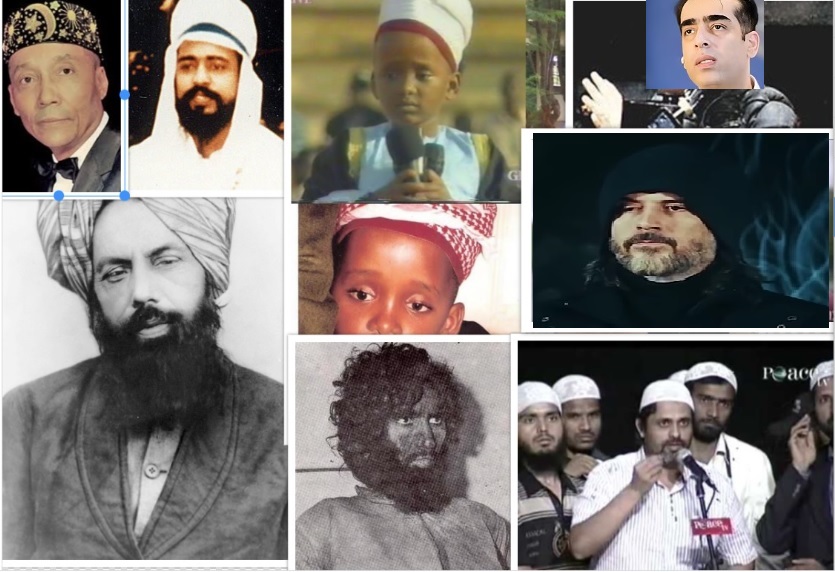
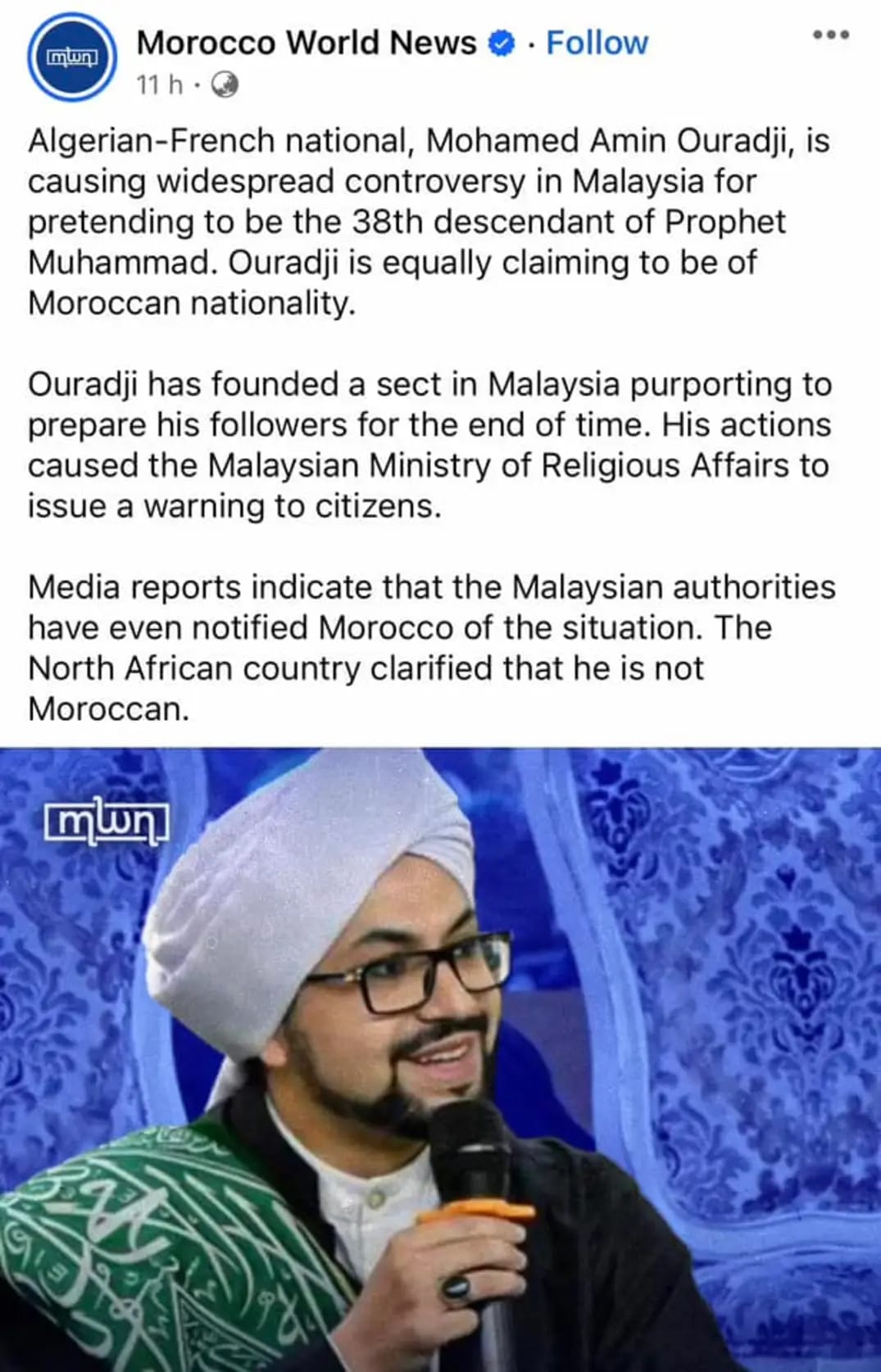
All of this had a bad effect on misleading people’s minds and subjecting them to illusions. It also had an effect on the successive revolutions and movements in the history of Muslims. In every era, a preacher or preachers emerges claiming to be the awaited Mahdi, and a group of people gathers around him, causing a lot of strife. All of this is due to a mythical theory, which is the theory of the Mahdi, a theory that does not agree with Allah’s law in His creation and does not agree with sound and healthy reason.
* * *
[153] Agreed upon.[154] Narrated by Muslim from the hadith of Arfajah ibn Darih.[155] Narrated by Muslim from the hadith of Jabir.[156] See page 129 and beyond.[157] See the book Al-I’tisam: 301 and onwards
The rest of his book is a systematic dismantling of the hadith quoted by the lesser authorities.
If anyone is interested in reading his book you may find it here: https://ibn-mahmoud.com/books/1773
May Allah Guide the Ummah.
May Allah Forgive the Ummah.










 Prima Quran