“Those who believe and whose hearts find comfort in the remembrance of Allah. Surely in the remembrance of Allah do hearts find comfort.” (Qur’an 13:28)
﷽
Ramadan Day 23:There is nothing better than the remembrance of Allah.
23rd day of Ramadan ——————————– *Heart Illness: The Ego* Arrogance is from the characteristics that kills the heart, Allah had vilified it in many verses such as: “I will turn away from My signs those who act unjustly with arrogance in the land.” (Qur’an 7:46).
The Blessed Prophet (saw) said:
“A person doesn’t enter the paradise if he has arrogance the weight of an atom.”
The types of arrogance: 1- Arrogance against Allah: And it is by rejecting to believe in him and to obey him, just like the Pharaoh who claimed to be a god, and Iblis who rejected the command of Allah to prostrate to Adam
2- Arrogance against prophets: By rejecting to believe in them and follow them, just like the people of Quraish who said that “Muhammed is an orphan, how can Allah send him to us?”
3- Arrogance against people: This can be caused by many things: Your knowledge/academic level. The amount of worship you engage in. Your lineage. Your beauty. Your wealth Your social status
Each one of these has a solution, but a good comprehensive solution to All these things is as
Ahnaf ibn Qays would often sit with Mus’ab ibn Zubayr. On one occasion, when he arrived, Mus’ab had extended his legs and didn’t make room. Ahnaf took his seat, feeling somewhat cramped. In response, he remarked, “It’s truly remarkable how a person can be proud and arrogant, considering that he has passed through the urinal passage twice.” [i.e., At the time of conception and birth]
Source: (At-Tawāḍuʿ wal-Khumūl (Humility and Modesty) – p. 201)
*The Sorting of People in the Religion* People are sorted to three: 1. A believer: we spoke about the attributes of a believer before.
2. A hypocrite: Is someone who shows outside the opposite of what is in his inside, and it’s of two types:
Doctrinal hypocrisy: It’s when someone shows belief in Islam and hides his Shirk as a way to protect them from being treated as such, and this type was described a lot in the Qur’an like: “When the hypocrites come to you ˹O Prophet˺, they say, “We bear witness that you are certainly the Messenger of Allah”—and surely Allah knows that you are His Messenger—but Allah bears witness that the hypocrites are truly liars.” (Qur’an 63:1)
Practical hypocrisy: It’s better than the previous type but it’s still a grave matter, and it’s when someone claims to be a Muslim but does not commit to the obligations of Islam by doing commands nor leaving prohibitions, and there are many evidences for this type. The Blessed Prophet (saw) said:
“Four things whoever has them is a pure hypocrite, and whoever has one of them he has an attribute of hypocrisy until he leaves it, if he was trusted he betrays, if he spoke he lies, if he made a covenant he breaks it, and if he quarrels he deviates from the truth.”
3. A Mushrik: Someone who rejects Islam outwardly and inwardly, this includes idol worshippers, atheists or the people of the book, and from the rulings of Mushriks: no inheritance between them, they are not buried in the Muslim cemeteries, we don’t pray for their dead, they aren’t greeted with the greeting of Islam. If they die between Muslims and there is no one from their faith the Muslims should bury them somewhere else without praying for them nor washing them, but their body should be covered to save the human sanctity.
We will discuss this later in the topic of the six doctrines/faiths -Allah Willing.
*Disliked Things in Prayer* Here are some disliked things that should be avoided when praying: Praying while holding back urine and faeces, in one opinion it doesn’t break the prayer until you raise a leg. Praying while fighting back sleepiness. Praying when the food is present. Praying in front of a distraction like a mirror or a picture. Adhering to a specific position in the mosque. Slightly looking around without a reason, some say the prayer doesn’t break until he looks at the sky or looks behind, and if the person looks around too much then his prayer is corrupted. Smiling slightly by accident. Performing Sahu prostration without having to. Yawning.
“so vie with one another in good works. Wheresoever you may be, Allah will bring you all together. Lo! Allah is Able to do all things.” (Qur’an 2: 148)
﷽
Ramadan Day 22:See you at the finish line. Allah-willing.
Heart Illness: Envy
Envy is the most dangerous characteristic, which leads to heart illness, and it’s to wish that some blessing is striped from others and given to you.
Allah says: “and from the evil of an envier when they envy.” (Qur’an 113:5), in another verse: “Or do they envy the people for Allah’s bounties? Indeed, We have given the descendants of Abraham the Book and wisdom, along with great authority.” (Qur’an 4:54)
Envy coupled with pride of one’s origin is the first sin ever committed, when Iblis envied Adam -(as)- and objected to perform Sujud for him, and it’s also the first sin on earth, when Qabil envied Habil so he killed him.
And an important note: There is a difference between Hasad (envy) and “ghibtah غبطة” Hasad is a bad attribute as we said, but ghibtah is to hope to get the blessing of others while not wishing for that blessing to be taken from them, the Blessed Prophet (saw) said: “No envy except in two: a man who was given knowledge by Allah and he teaches it in the morning and night, and a man who is given wealth by Allah and he spends it on those who deserve it.”
*The stages of the religion* The ways that Muslims take based on the surrounding conditions are called Masalik (ways/paths/stages) so that they do what they can to raise the flag of truth, and to establish the system of the religion.
Imam of concealment (Kitman): It’s the opposite of the manifest Imamate in meaning and in rulings, and it’s taken when the Muslims are weak and dispersed, and they can’t take any other path, and this was the way of the Blessed Prophet (saw) when he was in Mecca, and this was the way of Imam Jaber Bin Zaid when he realized that the Muslims cannot organize an Islamic system. He was followed by the great scholar, the pious, the leader, Imam Abu Ubaida Muslim Bin Abi Karima who was in concealment in Basra, but four of his students were able to establish manifest Imamates later on, and they are mentioned above, just like how the concealment of the Blessed Prophet (saw) produced a strong Islamic nation.
Then comes the Shira’ way: Shira’ linguistically means to sell, and it comes from many verses in the Qur’an like: “Allah has indeed purchased from the believers their lives and wealth in exchange for Paradise. They fight in the cause of Allah and kill or are killed. This is a true promise binding on Him in the Torah, the Gospel, and the Quran. And whose promise is truer than Allah’s? So rejoice in the exchange you have made with Him. That is ˹truly˺ the ultimate triumph.” (Qur’an 9:111). The Shira’ stage is taken when Muslims are oppressed and unable to raise the flag of truth, when there is an unjust ruler over them, an example of this is in the time of the Ummayads when Ziad Bin Abih was locating the people of truth to kill them and punish them, and the situation was unbearable, forty from the Shurah pledged allegiance to Imam Abu Bilaal Mirdas Bin Hudair Al Tamimi to repel by not fighting anyone except those who fight them, and these forty were able to defeat 1000 in the battle of ‘Asik. Shira’ can only be done with a minimum of forty people, and non of them can go back except if he dies, and in an opinion if there are only three left alive.
The final way is Manifestation (Dhuhur): it’s built on strength and unity of the Ummah, where the people can sail the ship of the Ummah, and this was the way of the Abu Bakr and Umar may Allah be pleased with them, and because this is the purest way, Ahl Alhaqq Wal Istiqamah never hesitated to establish it, some examples would be: in Hadhramout Imam Talib Al Haqq Al Kindi, in Oman Imam Al Julanda Bin Mas’ood Al Ma’wali and the righteous Imams after him, and in the west Imam Abu Al Khattab Al Ma’afiri and in the Rustumi state Imam Abdulrahman Bin Rustum may Allah be pleased with them all.
Difa’ (defence): It’s to make a temporary Imam in the situation of defense, when the state is invaded by an enemy.
To explain how the above takes place on a practical and pragmatic level in western nations like the former United States and the United Kingdom.
A) What the establishment thinks are progressive, liberal and reformist Muslims. These are perhaps the most important component of the plan. Their task is to ingratiate themselves to the left leaning thinkers and academia.
Related to them are fake apostates to Christianity or Agnosticism. This allows the Muslims to understand the networking and strategies of various Christian organizations.
Also related to them are people who have language speaking skills in Arabic, Farsi, Urdu etc. They are often tapped by intelligence apparatus in the above communities to act as informants. Some times these intelligence communities catch on that these people are double agents. Likewise and more often than not information via various channels is passed down to the relevant people.
The task of what the naïve think are ‘progressive’ , ‘liberal’ or ‘reformist’ Muslims are to form an echo chamber for anxious liberals or left leaning academic types. To give them the illusion that Islam can be molded and shaped according to the desires of these interest groups.
Among them are two sub groups:
Those who placate anxious left leaning and liberal leaning politicians all the while Islam grows in the country.
Those who may even call for the banning and vetting of Muslims from certain nations. While to the untrained eye this looks promising; it puts Western nations in a moral dilemma of hypocrisy. a) It makes the Western nations look as if they are compromising on plurality, and multiculturalism. b) It gives a strong hand to those Imams who teach the masses that the two world views are incompatible hence their restrictions.
B) What the establishment thinks are the moderate Muslims. The task of these Muslims is to be fluid between the political left and the political right. It also allows Western nations to save face by saying: “See we allow practicing Muslims in our societies and we welcome it!”
These Muslims are more often than not the activist types. Building Masjids, and Madrasah and grass roots organizations. One of the objectives of these ‘moderate’ Muslims is to create the illusion of conflict with the ‘progressive’ , ‘reformist’ or ‘liberal’ Muslims. So elaborate and orchestrated is this performance that by the time the policy makers know is happening it is already too late. So elaborate and orchestrated is this performance that the common Muslim actually perceives their is some kind of ideological battle between the two.
It is one of the reasons I am so confident to write this information. We are already beyond the threshold. We as Muslims just need to continue to have strong families, resilient communities, and keep winning hearts and minds. May Allah guide them to the truth!
Islam is salvation for the whole of mankind.
The west will try. They will do their best. Atheist will become cultural Christians as the realization sets in that perhaps pervasive hedonism wasn’t a great idea.
The moral relativism of the left is no match for Islam. The political right as they abandon Christianity will lean more into nativism, white nationalism.
All of this helps the Muslim communities and objectives.
In the end when the violence comes and it is coming (Allah knows best) -it will be from the political right. The violence will not be from the Muslims.
We just have to be patient. Act in accordance with the principles of justice and remember that none of those people truly are our enemies. They are people upon misguidance.
For those who want to read more about the four conditions of Islam.
*The Disliked in Wudu’* You should know dear believer that there are some actions that are disliked in Wudu’: 1. to perform it while standing 2. to talk in something other than mentioning Allah 3. to waste water 4. to increased the times of washing more than three times, and one in wiping 5. to perform it in a filthy place (to avoid the filth) 6. nudity in isolation, and it’s haram if people can see 7. to leave a Sunna of Wudu’
“It is He who has sent His Messenger with guidance and the religion of truth to manifest it over all religion, although they who associate others with Allah dislike it.” (Qur’an 9:33)
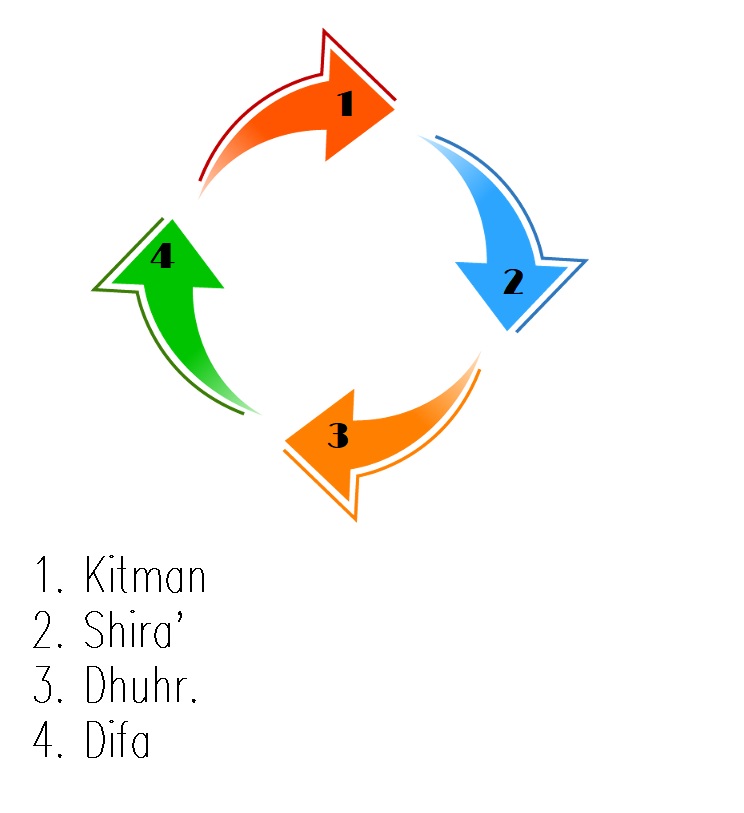
The four conditions (Masalik al-din) according to Ahl al-Haqq wa-l istiqama (The People of Truth and Straightness) are as follows:
Kitman: The State of Secrecy.
Shira’: The state of trading one’s life for the cause of Allah.
Dhuhur: The state of being Manifest.
Difa’: State of Defense.
The arrival of the Umayyad Imperium completed the cycle of four stages that the Muslim community underwent. From the Blessed Prophet (saw) teaching Islam in secret (Kitman), to the command in Qur’an 15:94 to teach Islam openly and to fight in the cause of Allah (Shira’), to when Madinah was under the rule of Islam and the rule was total (Dhuhur), until the fighting among the companions and the appointment of the 5th Imam, Imam Ar Rasibi (May Allah be pleased with him) (Difa’).
This is the Prophecy of the Blessed Prophet (saw)
It was narrated that Anas bin Malik said:
“It was said: ‘O Messenger of Allah, when should we stop enjoining what is good and forbidding what is evil?’ He said: ‘When there appears among you that which appeared among those who came before you.’ We said: ‘O Messenger of Allah, what appeared among those that came before us?’ He said: ‘Kingship given to your youth, immorality even among the old, and knowledge among the base and vile.’”
IMPORTANT! The rulings of the sharīʿah tighten or loosen depending upon the condition of the Muslims and the context that they find themselves in.
You could ask an audience a trick question: Can Muslims eat pork yes or no? The deception is in the false dichotomy. The correct answer is: It depends on context.
KITMAN: The State of Secrecy
Kitman means hiding one’s beliefs. In reality, the word kitman comes from the verb katama, which means to hide, to conceal. In this state the believers keep their beliefs in secret to avoid suppression by their enemies who will not allow the Ibadis to profess their beliefs if they discovered them. In this sense, hiding one’s beliefs is the best way to preserve them. So ‘secrecy’ becomes an obligation in such a case. Ibadis started their movement in secrecy to avoid suppression by the Umayyad rulers. Both Ibadi leaders Jabir b. Zaid (ra) and his successor Abu Ubaidah Muslim b. Abi Karimah (ra) acted in the stage of secrecy (kitman). All their activities were carried out in secret. During this time, secrecy was recommended almost in everything.
“He said, “O my son, do not relate your vision to your brothers or they will contrive against you a plan. Indeed Satan, to man, is a manifest enemy.” (Qur’an 12:5)
Kitman is of much greater importance when we realize that it is a type of trust. When one discloses some of his secrets to you and asks you to keep them secret from others, then it is your duty to keep them secret as required by that person. Even between the two spouses, they have to practice kitman, i.e. they are in no way allowed to talk to others about the details or generalities of their conjugal life or intimate relations. Kitman may extend to cover the secrets of the whole state at the time of war and peace where a person who is loyal to his people cannot divulge to anyone or tell the enemy about his country’s affairs.
Also, we know that not everyone needs to know about all of our day to day affairs. There are some real busy bodies in this world.
Mu’adh ibn Jabal reported: The Messenger of Allah, peace and blessings be upon him, said, “Seek help in the fulfillment of your needs by being discrete, for everyone who is given a blessing will be envied.”
Ibadi scholars claim that the stage of secrecy (kitman) in their doctrine is derived from the life of the Blessed Prophet (saw) ; but they differ in fixing the exact period of secrecy in the life of the Prophet. According to Shaikh Muhammad Yusuf Atfaiyish (r), it is the period between the beginning of the revelation up to the time when the number of the Muslims reached forty by Umar b. al-Khattab (ra) declaring his acceptance of Islam. Abu Sulaiman Dawud b. Ibrahim al-Talati (r) regards all the period before the Prophet’s immigration to Madina as a stage of secrecy, while Abu Ammar Abd al-Kafi (r) says, “The Prophet stayed in Mecca for some time after the revelation, in secrecy.” It seems that he meant the period of three years of the prophethood before the revelation of this verse: “Proclaim what you have been ordered and turn aside from the polytheists.” (Qur’an 15:94) However, this was the basis on which Ibadi scholars furnished the proof for the obligation of secrecy (kitman) as a religious duty ordered in the Qur’an.
Special rules that apply when in kitman and/or living under the rule of tyrants and/or any situation where one fears for their life.
The most important aspect is the suspension of the hadd punishment during kitman.
During kitman Ibadis have to live under the rule of tyrants. Special rules were laid down for Ibais regarding their relationship with ‘tyrants’ in the time of kitman. The main principle is that the Ibadis must not be of any help to tyrants in their rule, so they must not hold any posts for them. The exception to this rule is that those members of the Ibadi community who are known for their opposition to the ‘tyrants’ and were capable of commanding them to good and forbidding them from evil, such members can hold posts in the rule of ‘tyrants’; they can lead their troops in jihad, be in charge of the spoils (ghanaim), Qadiship, or futya (delivering legal opinions on religious questions). Ibadis, in this attitude, follow the example of Ibn Abbas, Jabir b. Zaid, al-Hasan al-Basri and Shuraih al-Qadi. All these great scholars were known for their opposition to the rule of ‘tyrants’ and held posts under them. The condition for such an attitude is to run the posts according to the shari’ah and not fear anybody in practising justice.
The teachings of Islam still continue as per the following verses:
It was narrated that Abu Hurairah said:
“The Messenger of Allah (saw) said: ‘Whoever is asked about knowledge that he has and he conceals it, will be bridled on the Day of Resurrection with reins of fire.'”
“Verily those who conceal that which We have revealed of clear signs and guidance, after We have made it clear for people in the Book – on them shall be Allah’s curse, and the curse of those who curse. Except those who repent, make amends, and make manifest [the truth]; to them I relent, for I am Oft-returning, Most Merciful.” (Qur’an 2:159-160)
There are certain occasions on which the ‘tyrants’ force Ibadis to act or speak contrary to their beliefs. In such circumstances, Ibadi school allows its followers to use a special dispensation (rukhsah) under the principle of religious dissimulation (taqiyah) to avoid the punishment of death. They can, for example, say that there is more than one God, or claim walayah for the enemies of Allah, and baraah from the true believers, or give false testimony, or tell lies, all these with the tongue only without believing it. They also can eat during the day in Ramadhan, or eat carrion, blood, or pork, all this to avoid the punishment of death.
Some of the proofs for the above views are as follows:
“Whoever disbelieves in Allah after their belief—not those who are forced while their hearts are firm in faith, but those who embrace disbelief wholeheartedly—they will be condemned by Allah and suffer a tremendous punishment.” (Qur’an 16: 106)
“He has only forbidden to you dead animals, blood, the flesh of swine, and that which has been dedicated to other than Allah . But whoever is forced [by necessity], neither desiring [it] nor transgressing [its limit], there is no sin upon him. Indeed, Allah is Forgiving and Merciful.” (Qur’an 2:173)
“The believers must not take the disbelievers as friends instead of the believers. And whoever does that has no relation with Allah whatsoever, unless you (do so) as a protective measure (in order to) save yourself from them. Allah warns you of Himself, for unto Allah is the return.” (Qur’an 3:28)
Exceptions to Kitman: When you must risk your life being forfeit.
As the whole point of Kitman is the preservation of human life you may not do the following:
There are certain actions that must not be done even if that should cause the one using kitman the loss of their lives. Such as slaying the innocent. If you are asked to kill someone unjustly you must drop your cloak of kitman as the point of kitman was preservation of your life. In this case you trade your life for the innocent. May Allah (swt) reward the one who does it. Other instances where the cloak of kitman must be dropped: One cannot seize people’s property or lay waste to it. One must not give up their weapons to their enemies. One must not drink wine, commit adultery or eat and drink unclean (najas) things like urine or excrement.
One may not fail to note that khamr (alcohol) is given stricter treatment than that of pork. Both are haram, yes, but the former opens up more doors to greater sins while the later just stops there. The drinking of khamr (alcohol) also affects judgement, which in turn can affect the point of kitman.
“Whoever disbelieves in Allah after their belief—not those who are forced while their hearts are firm in faith, but those who embrace disbelief wholeheartedly—they will be condemned by Allah and suffer a tremendous punishment.” (Qur’an 16: 106)
If we revisit the above verse for a moment there is an interesting asbab-an-nuzul or occasion for this revelation being revealed.
In the Asbab Al-Nuzul by Al-Wahidi we find:
Said Ibn ‘Abbas: “This verse was revealed about ‘Ammar ibn Yasir. The idolaters had taken him away along with his father Yasir, his mother Sumayyah, Suhayb [al-Rumi], Bilal [ibn Rabah], Khabbab [ibn al-Aratt] and Salim [the client of Hudhayfah] and tortured them. As for Sumayyah, she was tied up between two camels and stabbed with a spear in her female organ. She was told: ‘You embraced Islam for the men’, and was then killed. Her husband Yasir was also killed. They were the first two persons who were killed in Islam. As for ‘Ammar, he was coerced to let them hear what they wanted to hear. The Messenger of Allah (saw), was told that ‘Ammar has renounced faith, but he said: ‘Never, ‘Ammar is filled with faith from his head to his toes; faith is admixed with his flesh and blood!’ ‘Ammar then went to see the Messenger of Allah (saw), crying. The Messenger of Allah (saw) wiped his tears with his own hand and said: ‘if they return to you, let them hear again what you told them’. Then, Allah, exalted is He, revealed this verse”. Mujahid said: “This verse was revealed about some Meccans who accepted faith. The Muslims of Medina wrote to them urging them to migrate and told them that they did not consider them part of them unless they migrated. And so they left Mecca intending to migrate to Medina. The Quraysh caught up with them on the way and coerced them to renounce their faith. It is about them that this verse was revealed
Besides, Ibadis, although living under the rule of ‘tyrants’, must have their own organisation to look after their affairs, and to plan for the safety of their community and to preserve the teachings of their schools; in other words, to prevent the Ibadis from melting into the large body of their opponents, and to ultimately prepare for ‘manifestation’
Saving yourself is from one of the major rules in Islam. Self preservation is a very basic rule in Islam.
In Islam we have what is known as : Ad-Darooriyyaat Al-Khams-The Five Basic Necessities that are protected and recognized by the Islamic law (shari’ah).
Protection and sanctity of ones: Life Religion Wealth Lineage Mind (intellect)
A modern example of this in action is where those who have have adopted the Ibadi school from other schools (be they Hanafi, Shafi’i, Hanbali, Maliki, Imam Shi’i, etc.) fear that if they pray the way the Blessed Prophet (saw) prayed they maybe violently attacked. So they are allowed to join the congregation and pray according tot he ijtihad of the prevailing school.
Another example: A woman in some remote part of the former United States or Canada embraces Islam. If her family knows she could be expelled from her home. She could be violently attacked even by members of her own family. If she outwardly adorns the khimar she could become violently attacked. So, in a place where the people wear winter attire (examples: Toboggan, Tuque, Toque, Touque, and neck scarfs) that woman can adorn winter wear and dress as modestly as she can. She can and must blend in to protect the sanctity of her life. However, the moment she moves to an area where the believers are both strong and able to defend her she must adorn the appropriate attire or be in a state of rebellion to Allah (swt) and his commands.
SHIRA’: The Sacrifice of one’s life for the cause of Allah
The Arabic word shira’ means buying and selling. This term is used in Ibadi writings for the action of sacrificing one’s life in the cause of Allah to attain Paradise.
Shira’ as an individual obligation; it is understood as a voluntary duty only.
Shurat (pl.) are: Those who have sold their souls for the cause of Allah .
The term al-shira’ is derived from the following verses of the Qur’an:
“Allah has bought from the believers their selves and their possessions against the gift of Paradise; they fight in the way of Allah; they kill, and are killed; that is a promise binding upon Allah in the Torah, and the Gospel, and the Qur’an; and who fulfil his covenant truer than Allah? So rejoice in the bargain you have made Him.”(Qur’an 9:111)
*Note* the above verse of the Qur’an teaches us clearly that Jesus (as) taught martyrdom against oppressors.
“So let them fight in the way of Allah who sell the present life for the world to come, and whosoever fights in the way of Allah and is slain, or conquers, We shall bring him a mighty wage.” (Qur’an 4:74)
“But other men there are that sell themselves desiring Allah’s pleasure.” (Qur’an 2:207)
The first to practice shira’ was none other than the Blessed Prophet (saw) and his noble companions who fought in the cause of Allah (swt) against those who wanted to physically stop the teaching and call to Islam.
Latter, after the arrival of the Umayyad Imperium it was practised by Abu Bilal Mirdas b. Hudair (ra). The idea of shira’ or Khuruj (coming out) occurred to him when he saw the harm caused by The Umayyad Imperium under Ubaidullah b. Ziyad against his fellow-Muslims. His comment on the situation was, “Surely, being content with tyranny is an offence, and drawing the sword and frightening the people is grave, but we come out and fight no one but those who do us wrong.”
They, i.e. the Shurat, agree that they sell themselves desiring Allah’s pleasure, and show no claim for ruling, but to end tyranny and revive righteousness. They must not revolt with less than forty men; they can complete the number with a woman. If their intention was not to return before ending falsity, batil), they, therefore, must not return to their homes unless they ended falsehood or died. If they went out with the intention to return if they wanted, they can return at any time. Their homes are their swords, so if they return to their original homes for any purpose, they must pray short prayers qasr and pray complete prayers during their revolt even though they were far away from their original homes
The following are the main principles of Shira’:
Shira’ is a voluntary duty for Ibadis in general, and an obligation for those who imposed it on themselves.
The minimum number of forty persons must carry it out.
.They must elect their leader among themselves. Imam of Shira‘. The authority of their leader is binding on his followers only.
Religious dissimulation, Taqiyah, does not behoove the Shurat, they have to fight till they bring tyranny to an end or are killed. Some scholars say that they can return if only three of them were left
They have no home except the places where they gather to fight their enemies; if they return to their original homes to get supplies, or information, or for any other purpose, they must consider themselves travelers and pray short prayers (qasr) while in their original homes.
They must not fight anyone except those who fight them, must not follow the defeated or kill the injured, must not kill old men, women, or children, and must not take any spoils or property unless they have a right to it
Regarding the stage of Shira’, it has already been mentioned that it is a voluntary duty for more than forty persons, and that they must pray full prayer during their revolt though they are far from their original homes. In case the Shurat wanted to take over during the Imamate of defence, they have all the right to do so, for the Imam of the Shurat, for his intention of sacrificing his life for the cause of the Ibadi community, is more entitled to the right of leadership than the Imam of defence.
Some scholars suggest that the state of Shira’ was practised first during the Meccan period of the Prophet’s life. They point out that the Prophet declared Islam openly when the number of his followers reached forty, this was about the time that Umar ibn al-Khattab (ra) had embraced Islam. It was thus, directed by the Qur’an to leave the house of al-Arqam b. Abi al-Arqam which was “the centre of his preaching activities.” When he had passed the stage of secrecy, Allah revealed to him, “O Prophet, Allah suffices you, and the believers who follow you.” (Qur’an 8:64)
DHUHUR:The State of Manifestation
The Blessed Prophet (saw) died leaving the Muslims in the stage of manifestation (Dhuhur). It is when Islam is established and it is dominant. It is not in a state of fracture or subjugation by enemies.
It is obligatory for Muslims to maintain this state in order to execute the commands of Allah (swt). Hadd punishments, the Friday prayers, the collection of zakat and protection tax (jizyah), fighting such enemies as Polytheists and rebels (al-bughat) the proper division of spoils and zakat, none of these obligations can be carried out without the authority of the Imam.
Note about Zakat. Yes Zakat is being paid by the Muslims today. However, it is being done by will alone. In reality the Zakat is a forced taxed collection by the Amir (Imam) to make sure that those who can do contribute to the betterment of the society. Abu Bakr (ra) fought people who refused to pay Zakat.
Ibadi scholars cite the Caliphates of Abu Bakr and Umar (May Allah be pleased with them both) as examples of the stage of manifestation in early Islam. Whenever Muslims attain satisfactory conditions of proper, wealth, and knowledge of religion, so that they can execute the commands of Allah, and when they number about half of the enemy around them, they must move from the condition of kitman via shira’ to the condition of Dhuhur by electing their own Imam from among their outstanding men.
The Imazighen or Free-Men of North Africa were the last to try to establish the Imam Adh- Dhuhur or the Manifest Imam. Manifestation (Dhuhur)
After the collapse of the Rustamid Imamate in Tahert in 909 A.D. Ibadis of North Africa tried to revive their Imamate under the leadership of Abu Khazr Yaghla b. Zaltaf, but they lost the battle of Baghy which they fought against the Fatimids on the year 358 A.H. After this the Ibadis entered the stage of secrecy up to our times. No attempt was made afterwards by the Ibadis of North Africa to establish the Imam Adh Dhuhur.
So a question arises: Are the Ibadis today without an Imam?
The answer to that is no. The Ibadis today are not without an Imam. The Imam today is the Imam Kitman. That is to say, the Imam in a state of secrecy. This Imam is known to his inner circle and it kept as such until the condition changes.
DIFA’:The state of Defence
Defence becomes the obligatory duty in the absence of manifestation (Dhuhur).
When under attack, or suspecting a sudden attack, the Muslims must elect a leader to lead them in fighting their enemy. Such a leader is calledImam al difa’, Imam of defence. He must be a learned man of high military capability. He has the same full authority as the Imam of Dhuhur until the end of the war. At the end of the war his Imamate dissolves automatically, so the Muslims would have no difficulty in removing him from his office. The Muslims must then elect their new Imam as required by the resultant state, either of ‘manifestation’ or ‘secrecy’. The first Imam of defence given in Ibadi sources is Abdullah b. Wahb al-Rasibi (ra) who was elected before the battle of al-Nahrawan. The other Imams of defence of North Africa included Abu Hatim al-Malzuzi (r) who tried to revive the Imamate of ‘manifestation’ which was established by Abu al-Khattab Abd al-Ala b. al-Samh al-Ma’afiri (r) and Abu Khazr Yaghla b. Zaltaf (r) who tried to revive the Rustamid Imamate and fought the Fatimids for this purpose.
Concerning the stage of difa’, it is already mentioned that the Imamate of defence (Imamat al-difa’) dissolves automatically after the end of the war, but some scholars hold that the Imamate of defence can remain after the end of the war as well. In the case of Imam Ali Ibn Abu Talib if he would have repented for the arbitration the Muslims would have rejoined him and the Imam of defense (Abdullah b. Wahb al-Rasibi –might have pledged allegianceto him (Ali) and rejoined him again, and Imam Ali would have been the Imam Adh-Dhuhur. However, this is only apossibilityas Ali also removed himself from the authority; so the people were free to choose their Imam. People think that the Ibadi position is that if a leader makes one mistake than we do khurooj against him or make tafkir. This is not correct. It depends on the type and nature of the mistake. IF he has committed a sin for which there is a required punishment such as adultery, or the act of the people of Lut, or theft, or drinking alcohol, unlawful killing and the arguments and proofs are established against him are proven by the Shari’ah judiciary, then there must be another Imam to carry out the Sharia punishment against him. He must retire or be isolated by the people of the contract and someone else is to be chosen. If he refuses, he will be judged as a transgressor and a revolt against him will be legislated.
May Allah (swt) guide the Ummah!
May Allah (swt) forgive the Ummah!
May Allah (swt) grant us the strength to return to the commands of Allah (swt).
“This is a favor from my Lord by which He wants to test whether I am grateful or ungrateful.” (Qur’an 27:40)
A person has only two choices: either to be grateful or to be ungrateful. Now the question is If he is ungrateful, do we say that he has committed shirk (associating partners with Allah)?
So when one reads the books of the Ibadi scholars and luminaries of the past and they come across the statement that such and such was declared to be a kafir one needs to read this with the correct lenses.
First point. For the vast majority of Muslims they follow schools that have defined kafir meaning to expel them from the millat of Islam. In other words to expel them from Islam altogether. This is simply not the case with the Ibadi. We use the word kufr as Allah (swt) used it in the Qur’an to describe those who are ungrateful.
Excommunicating other Muslims is not something the Ibadi school is known for. Many may get this impression when our scholars have addressed someone as being a kafir. That is because they come from a framework in which kafir is understood to mean execommunicated or outside the fold of Islam. This is absolutely not true for the Ibadi school. That is because the word kafir literally means ingratitude or to be ungrateful.
Second point. Not every act of kufr is shirk. However, every act of shirk is kufr.
Third point. Kufr does not necessitate a permanent condition. If someone became a kafir by something they did deserving of Bara’ah (shunning/ostracization) that same person can repent, reform and be deserving of Wilayah (friendship/protection/solidarity).
Fourth point. There are different types of Kufr according to Sunni, Imami and Zaydi perspectives.
Kufr al-Amal
Kufr al-Inkar
Kufr al-Juhud
Kufr al-Nifaq
Kufr bi’l-l’rad / Kufr al-Irad
Kufr al-Ni’mah
Kufr al-‘Inad
Kufr al-Takdhib
WHAT IS A MUSLIM AND HOW IS THE WORD MUSLIM DEFINED?
Muslim =one who submits to Allah. Now ask yourself. Does this mean submit to Allah 50% of the time? Does it mean to submit to Allah 99% of the time?
“Yes, whoever submits his whole self in Islam to Allah while being a doer of good will have his reward with his Lord, and no fear will there be concerning them, nor will they grieve (Qur’an 2:112)
“So who is better in religion than one who submits himself to Allah while being a doer of good and follows the religion of Abraham, inclining toward truth? And Allah took Abraham as an intimate friend.” (Qur’an 4:125)
“So whoever submits his whole self to Allah while he is a doer of good, then he has grasped the most trustworthy handhold. And to Allah will be the outcome of all matters. (Qur’an 31:22)
WHAT IS IBADAH (DEVOTION)?
In Arabic ‘Abd carries the meaning of both slave and devotee.
“And I did not create the jinn and mankind except to worship (liya ‘buduni) Me.” (Qur’an 51:56)
“Lo! My slaves (‘ibadi) – over them you have no authority. And sufficient is your Lord as Disposer of affairs.” (Qur’an 17:65)
“And if you are in doubt about what We have sent down upon Our Slave (‘abdina) [Muhammed], then produce a Surah the like thereof and call upon your witnesses other than Allah , if you should be truthful.” (Qur’an 2:23)
Ustadh Nouman Ali Khan has made it a point to drive home the concept of what a slave in Islam actually means. A slave to Allah (swt) is something that we all hope to strive for. May we die as obedient slaves to Allah (swt).
WHAT IS KUFR AND HOW IS THE WORD DEFINED?
“And if We give man a taste of mercy from Us and then We withdraw it from him, indeed, he is despairing and ungrateful (kafarun)(Qur’an 11:9)
“Indeed, the wasteful are brothers of the devils, and ever has Satan been to his Lord ungrateful (kafuran)“ (Qur’an 17:27)
It is important to understand here that Satan knows the truth. He knows the unseen. Being chief of the Jinn he knows allot. He even made du’a to Allah (swt) not to punish him immediately!
“He said, “My Lord, then reprieve me until the Day they are resurrected.” (Qur’an 15:36)
Satan also made the following pledge.
“Then I will surely come upon them from before them and from behind them and from their right and from their left, and then You will not find most of them (shakirina) grateful.” (Qur’an 7:17)
“Indeed, Allah defends those who have believed. Indeed, Allah does not like everyone treacherous and ungrateful (kafurin)” (Qur’an 22:38)
“Indeed, We guided him to the way, be he grateful (shakiran) or be he ungrateful (kafuran).” (Qur’an 76:3)
“And We had certainly given Luqman wisdom [and said], “Be grateful (ush’kur) to Allah.” And whoever is grateful (yashkur) is grateful (yashkuru) for [the benefit of] himself. And whoever is ungrateful (kafara) [His favor] – then indeed, Allah is Free of need and Praiseworthy.” (Qur’an 31:12)
“Certainly they are ungrateful (KAFARA)who say: Surely, Allah– He is the Messiah, son of Mary. Say: Who then could control anything as against Allah when He wished to destroy the Messiah son of Mary and his mother and all those on the earth? And Allah’s is the kingdom of the heavens and the earth and what is between them; He creates what He pleases; and Allah has power over all things,” (Qur’an 5:17)
“O my sons! Go you and enquire about Yusuf (Joseph) and his brother, and never give up hope of Allah’s Mercy. Certainly no one despairs of Allah’s Mercy, except the people who are ungrateful (l-kakiruna) .”
“And [remember] when your Lord proclaimed, ‘If you are grateful (shakartum), I will surely increase you [in favor]; but if you are ungrateful (kafartum), indeed, My punishment is severe. (Qur’an 14:7)
“And of no effect is the repentance of those who continue to do evil deeds until death faces one of them and he says: “Now I repent;” nor of those who die while they are ungrateful (kuffarun). For them, We have prepared a painful torment.” (Qur’an 4:18)
“It is the duty of all men towards Allah to come to the House a pilgrim, if he is able to make his way there. As for the (kafara) ungrateful, Allah is All-sufficient nor needs any being.” (Qur’an 3:97)
We can see from the above text that kufr is of two types.
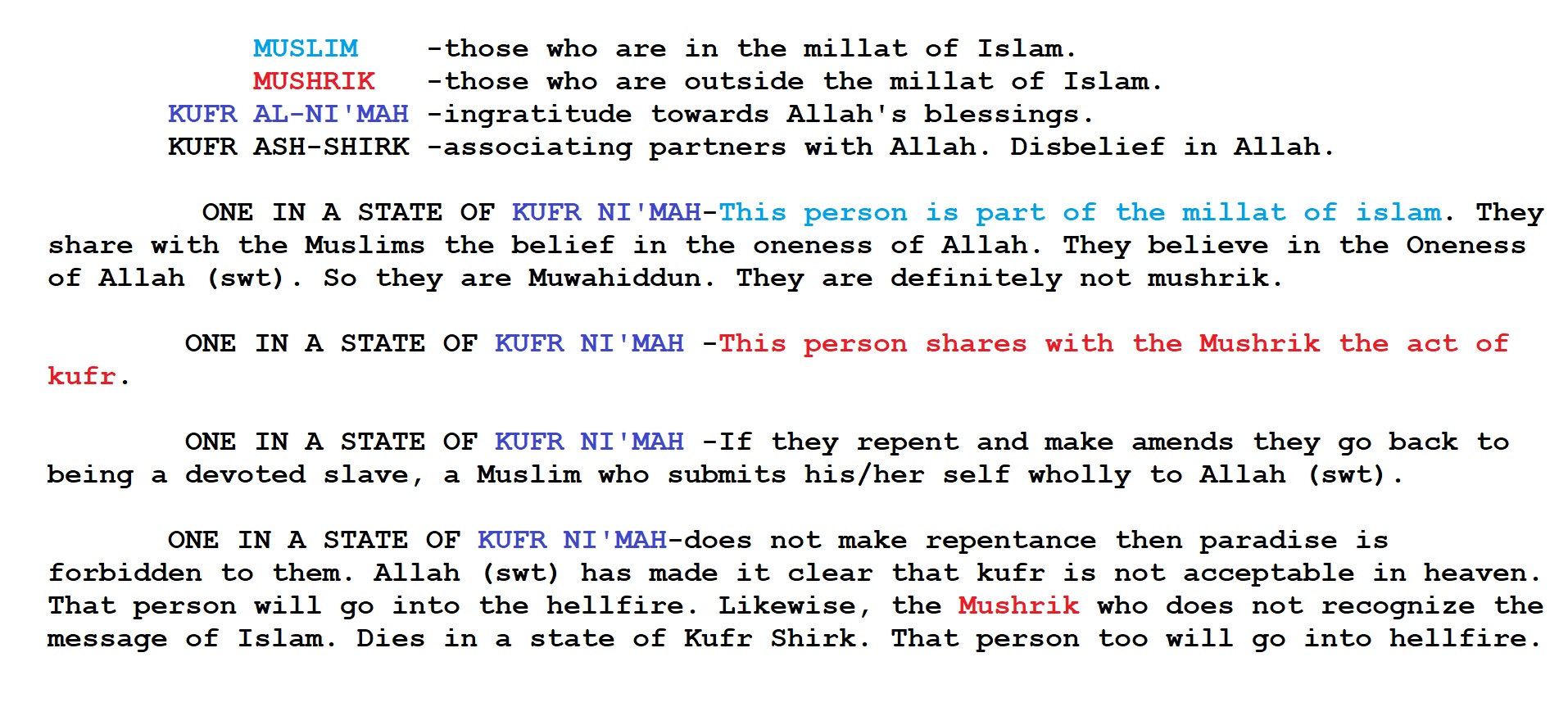
Kufr Ni’mah
Ni’mah means: favour, ease, blessings, grace.
Kufr Ni’mah is not the ingratitude of disbelief, but the ingratitude of not recognizing Allah’s blessings, grace, and favour, by going against his commands, prohibitions, guidance.
Kufr Shirk.
Shirk/Mushrik means: To give worship to something other than Allah, along with Allah.
Kufr Shirk is the ingratitude of not recognizing and acknowledging who Allah (swt) is. As well as not directing one’s devotion to Allah (swt) and Allah (swt) alone.
So for us kufr is ingratitude. Rather than disbelief.
“Say: O ungrateful (l-kafiruna) ones! I will not be a devoted slave (a’budu) to what you are a devoted slave (ta’buduna) to. Neither are you devoted slave (‘abiduna) to Him whom I am devoted slave (a’budu) to. Nor will I be devoted slave (‘abidun) to that which you base your (‘abadttum) devoted slavery. Nor are you going to be devoted slave (‘abiduna) to Him who I am devoted slave (a’budu) to. To you is your way of life (worldview),and to me, my way of life (worldview). (Qur’an 109:1-6)
WHAT IS EMAAN? (BELIEF)
“Indeed, those who believed (amanu) and those who were Jews or Christians or Sabeans [before Prophet Muhammed] – those [among them] who believed (amanu) in Allah and the Last Day and did righteousness – will have their reward with their Lord, and no fear will there be concerning them, nor will they grieve.” (Qur’an 2:62)
“And when it is said to them: Believe (aminu) as the people believe (amana) they say: Shall we believe (anu’minu) as the fools believe (amana)? Now surely they are the fools, but they do not know.” (Qur’an 2:13)
“These are the verses of Allah which We recite to you in truth. Then in what statement after Allah and His verses will they (yu’minuna) believe“? (Qur’an 45:6)
It is narrated on the authority of Abu Huraira that the Messenger of Allah (saw) said:
“Faith has over seventy branches or over sixty branches, the most excellent of which is the declaration that there is no god but Allah, and the humblest of which is the, removal of what is injurious from the path: and modesty is a branch of faith.”
So even an agnostic or an atheist who removes an obstacle on a path they have some faith.
Remember, Iblis himself was a devoted Muslim until…
“So when We said to the angels: Prostrate to Adam they did prostrate, but Iblis (did it not). He refused and he was proud, and he was one of the ungrateful (l-kafirina).” (Qur’an 2:33)
At this moment, this one act of defiance, made Iblis go from being a devoted slave (‘abdina) to being in a state of Kufr Ni’mah.
Heaven is not a place for the ungrateful!
“Get down from here! Here is no place for your arrogance, Get out! You are the lowest of creatures!” (Qur’an 7:13)
“Like the Shaitan when he says to man: be (uk’fur) ungrateful, but when man is (kafara) ungrateful, he says: I am surely clear of you; surely I fear Allah, the Lord of the worlds.” (Qur’an 59:16)
Iblis is not said to be a disbeliever in Allah (swt) nor in his last day. Yet, this one sin (kufr niama), this one act of transgression was enough to bar him from paradise and to have him to burn in hellfire forever. There is absolutely no indication anywhere that Iblis will repent.
“He said, “My Lord, then reprieve me until the Day they are resurrected.” (Qur’an 15:36)
Allah! There is no god but He. The Most Merciful, The Most Gracious! Can you imagine! Iblis wants respite, not to make repentance, not to turn from his waves, not to show himself a devoted slave of Allah (swt) but a persistent and continuous rebel until the very end!
Look at how Merciful Allah (swt) is to humanity! We have been given chance after chance to make tawbah, to repent, to amend, to reform, to turn towards Allah (swt) as devoted slaves.
The Hadith Evidences.
Brothers and sisters there is no verse in the Qur’an anywhere that believers will enter the hellfire. This is a trap and false belief that clashes with stronger evidence.
Hadith such as the following:
Narrated ‘Ubada:
The Prophet (saw) said, “If anyone testifies that None has the right to be worshipped but Allah Alone Who has no partners, and that Muhammed is His Slave and His Apostle, and that Jesus is Allah’s Slave and His Apostle and His Word which He bestowed on Mary and a Spirit created by Him, and that Paradise is true, and Hell is true, Allah will admit him into Paradise with the deeds which he had done even if those deeds were few.” (Junada, the sub-narrator said, ” ‘Ubada added, ‘Such a person can enter Paradise through any of its eight gates he likes.”)
‘Itban bin Malik (May Allah be pleased with him) said in his long Hadith cited in the Chapter entitled ‘Hope’ reported:
When the Prophet (saw) stood up to offer As-Salat (the prayer) he asked, “Where is Malik bin Ad-Dukhshum?” A man replied: “He is a hypocrite. He does not love Allah and His Messenger.” The Prophet (saw) said, “Do not say that. Do you not know that he said: La ilaha illallah (there is no true god except Allah),’ seeking His Pleasure. Allah has made the fire of Hell unlawful for him who affirms that none has the right to be worshipped but Allah.”
Prima Qur’an Comment: It is becoming readily apparent that those hadith need to be taken contextually. First of all the hadith about Allah (swt) making hellfire unlawful for those who say “la ilaha illallah seeking His Pleasure” cannot simply mean just saying the testimony of faith. This is obvious as it is attached to “seeking his Pleasure.”
This goes directly against the following verse:
“Do people think once they say, “We believe,” that they will be left without being put to the test?” (Qur’an 29:2)
“So of no effect is the repentance of those who continue to do evil deeds until death faces one of them and he says: “Now I repent;” norof those who die while they are ungrateful. For them We have prepared a painful torment”. (Qur’an 4:18)
This idea that Muslims can just do what ever they wish and say the testimony of faith and they will be absolutely fine has no basis in the Qur’an. It is a dangerous belief. Not only this but how many times have we seen kufr ni’mah become kufr shirk? Virtually every apostate I have ever encountered was involved in some major sin and then they slipped away into darkness. When in reality the problem was sin to begin with.
When the believer commits sin, a black spot appears on his heart. If he repents and gives up that sin and seeks forgiveness, his heart will be polished. But if (the sin) increases, (the black spot) increases. That is the Ran that Allah mentions in His Book: “Nay! But on their hearts is the Ran (covering of sins and evil deeds) which they used to earn.” (Qur’an 83:14)
It is well known that the companions certainly did fight among each other and killed each other. So the question is; Was their kufr an act of Kufr Ash-Shirk or Kufr An Ni’mah?
It is narrated on the authority of ‘Abdullah b. Mas’ud that the Messenger of Allah (saw) observed:
Abusing a Muslim is an outrage and fighting against him is (kufr)unbelief. Zubaid said: I asked Abu Wa’il: Did you hear it from Abdullah narrating if from the Messenger of Allah (may peace and blessings be upon him)? He replied: Yes. But there is mention of the talk between Zubaid and Abu Wa’il in the hadith narrated by Shu’ba.
It is well known that the companions certainly did fight among each other and killed each other. So the question is; Was their kufr an act of Kufr Ash-Shirk or Kufr An Ni’mah?
“Abu Hurairah narrated that : the Prophet (saw) said: “Whoever engages in sexual intercourse with a menstruating woman, or a woman in her anus, consults a soothsayer, then he has disbelieved (kafar) in what was revealed to Muhammed.”
The one who did intercourse with a menstruating woman, or in her anus are those acts of kufr ash-shirk or kufr an-ni’mah ?
By the way, There is commentary in Arabic on the above hadith. That if intercourse with a woman was considered disbelieve than expiation would not have been ordered for it. However, this is not true. Expiation depends on the type and manner of sin. So there is something strange in the commentary.
It is narrated on the authority of Jarir that he heard (the Holy Prophet) saying, The slave who fled from his master committed an act of infidelity as long as he would not return to him.
Another hadith evidence that supports our position. I will show you where those who call themselves ‘Salafi’ try to fool those who are not familiar with the Arabic. Then I will show you were the majority Sunni position comes clean and basically their view is in alignment with us.
Narrated Abu Dhar:
The Prophet (saw) said,
“A man who knowingly claims to be the father of someone other than himself has committed an act of disbelief. And whoever claims to be the father of a people when he is not one of them, let him take his place in hellfire.”
However, notice how the above link renders the Arabic text as:
Narrated Abu Dhar:
The Prophet (saw) said, “If somebody claims to be the son of any other than his real father knowingly, he but disbelieves in Allah, and if somebody claims to belong to some folk to whom he does not belong, let such a person take his place in the (Hell) Fire.”
Notice that ‘he but disbelieves in Allah’ to the English reader gives the indication that this person is on the same level of an Atheist.
We all know those who disbelieve in Allah are bound for hell. So knew information is being presented. So we know that ‘he but disbelieves in Allah’ is not a rendering of the Arabic text. The new information being presented is: “if somebody claims to be the son of any other than his real father knowingly..”
Now notice the interesting observation the followers of majority Sunni Islam make here:
However, the scholars explain that the term kufr in this hadith has two interpretations.
“The first interpretation applies to someone who considers such an act permissible. The second interpretation is that it refers to ingratitude for blessings and kindness, as well as violating the rights of Allah (Most High) and the rights of his father. However, the intended meaning is not disbelief that takes one out of the fold of Islam. This is similar to when the Prophet (Allah bless him and give him peace) mentioned “disbelief” concerning women and then explained it as their ingratitude for kindness and their ingratitude toward their husbands.” [Nawawi, Sharh Sahih Muslim]
Now notice something dear readers. Context is important. The above hadith that promise someone paradise is dependent upon all the other text (Qur’an and Sunnah) that put terms and conditions.
The same is true for the above hadith about affirming that the one who makes such a statement would take his place in hellfire. This too is dependent upon all other text (Qur’an and Sunnah) that mention the acceptance of those who sincerely repent.
‘Abdullah bin ‘Umar bin Al-Khattab (May Allah be pleased with them) reported that:
The Prophet (saw) said, “Allah accepts a slave’s repentance as long as the latter is not on his death bed (that is, before the soul of the dying person reaches the throat)”.
And of no effect is the repentance of those who continue to do evil deeds until death faces one of them and he says: “Now I repent;” nor of those who die while they are ungrateful disbelievers. For them We have prepared a painful torment. (Qur’an 4:18)
Narrated Ibn `Abbas:
The Prophet (saw) said, “When (a person) an adulterer commits illegal sexual intercourse, then he is not a believer at the time he is doing it; and when somebody steals, then he is not a believer at the time he is stealing .”
The Prophet (saw) said, “An adulterer, at the time he is committing illegal sexual intercourse is not a believer; and a person, at the time of drinking an alcoholic drink is not a believer; and a thief, at the time of stealing, is not a believer.” Ibn Shihab said: `Abdul Malik bin Abi Bakr bin `Abdur-Rahman bin Al- Harith bin Hisham told me that Abu Bakr used to narrate that narration to him on the authority of Abu Huraira. He used to add that Abu Bakr used to mention, besides the above cases, “And he who robs (takes illegally something by force) while the people are looking at him, is not a believer at the time he is robbing (taking).
All the above acts: Fornication, Adultery, Stealing, Drinking, none of these acts are committing shirk. Yet, the people who do such are not to be described as believers at the time of doing such actions.
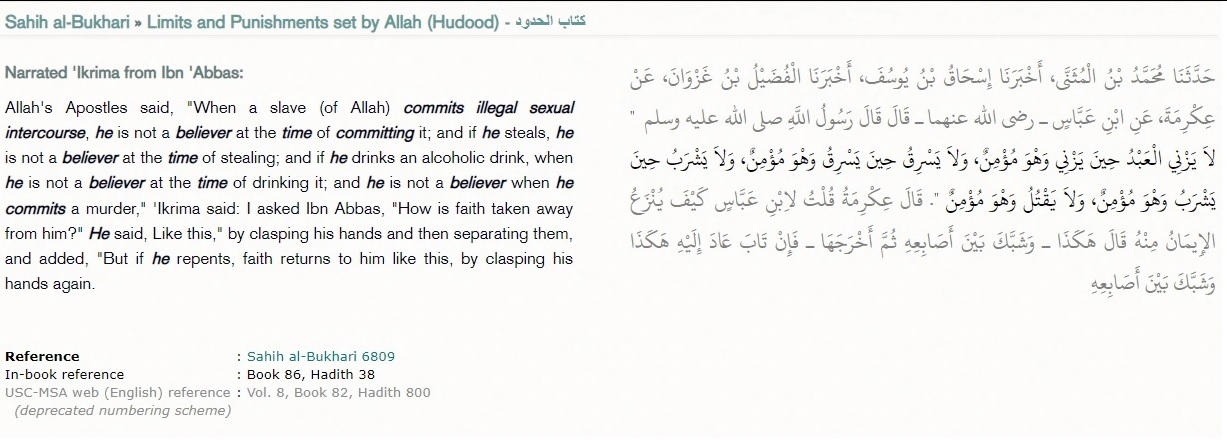
Narrated ‘Ikrima from Ibn ‘Abbas:
Allah’s Messenger (saw) said, “When a slave (of Allah) commits illegal sexual intercourse, he is not a believer at the time of committing it; and if he steals, he is not a believer at the time of stealing; and if he drinks an alcoholic drink, when he is not a believer at the time of drinking it; and he is not a believer when he commits a murder,” ‘Ikrima said: I asked Ibn Abbas, “How is faith taken away from him?” He said, Like this,” by clasping his hands and then separating them, and added, “But if he repents, faith returns to him like this, by clasping his hands again.
Taking the life without right is not committing shirk. Yet, the people who do such are not to be described as believers at the time of doing such actions.
Not every act of Kufr is Shirk.
However, every act of Shirk is Kufr.
May Allah (swt) continue to bless us and guide us and keep us on the straight path. May Allah (swt) cause us all to die as devoted slaves, as Muslims.
Please also see the following:
” And when your Lord made it known: If you are (shakartum)grateful, I would certainly give to you more, and if you are (kafartum) ungrateful, My chastisement is truly severe.” (Qur’an 14:7)
“This is a favor from my Lord by which He wants to test whether I am grateful (a-ashkuru) or ungrateful (akfuru).” (Qur’an 27:40)
“Truly, those who were ungrateful (kafaru), and they died and they were ones who are ungrateful (kuffarun), those, on them is a curse of Allah, and the angels and humanity, one and all.” (Qur’an 2:161)
” And whoever does not judge by what Allah has revealed – then it is those who are the disbelievers (l-kāfirūna).” (Qur’an 5:44)
While the immediate context is a reference to the Jews it would be a strange thing to say that Jews who do not judge by what Allah has revealed are kafir while Muslims get a free pass.
“Surely We have made/created it an Arabic Quran that you may understand.” (Qur’an 43:3)
“Have the unbelievers not ever considered that the heavens and the earth were one piece and that We tore them apart from one another. From water, We have made/created all living things. Will they then have no faith?.” (Qur’an 21:30)
“And it is He who has made/created man from water” (Qur’an 25:54)
“It is He who made/created you from one soul and made/created from it its mate that he might dwell in security with her.” (Qur’an 7:189)
“Oh, mankind! fear your Lord who made/created you from a single person and created, out of him, his wife.” (Qur’an 4:1)
﷽
Ramadan Day 12: Including Your Children in Ramadan.
*Heart health: Accompanying The Blessed Prophet (saw) in his deeds and sayings*
“Indeed, in the Messenger of Allah you have an excellent example for whoever has hope in Allah and the Last Day, and remembers Allah often.” (Qur’an 33:21)
Whoever wants purification of the heart and soul, let him take the Blessed Prophet Muhammed (saw)as an example: How he was in is worship: prays the night until his feet swells. How he was in asceticism: three days go by and his stomach never filled even with bread. How he was in humbleness: used to sit like any other person, on the ground, eats with the servant, and finishes when the everyone finishes. How he was in his generosity: more generous than wind.
So every Muslim should follow him in all his daily affairs.
*Paradise and Hell*
There is not in the Qur’an a single verse that says that believers will enter the hellfire. Not one.
There is not in the Qur’an a single verse that says those who enter paradise will exist it.
There is not in the Qur’an a single verse that says those who enter hellfire will exist it.
“Whoever obeys Allah and His Messenger will be admitted into Gardens under which rivers flow, to stay there forever. That is the ultimate triumph!, But whoever disobeys Allah and His Messenger and exceeds their limits will be cast into Hell, to stay there forever. And they will suffer a humiliating punishment.” (Qur’an 4:13-14)
So whoever obeys Allah and dies upon straightness will enter the paradise forever, and whoever disobeys him and dies without repentance will enter hell forever.
Allah says:
“Those who do good will have the finest reward and ˹even˺ more. Neither gloom nor disgrace will cover their faces. It is they who will be the residents of Paradise. They will be there forever. As for those who commit evil, the reward of an evil deed is its equivalent. Humiliation will cover them—with no one to protect them from Allah—as if their faces were covered with patches of the night’s deep darkness. It is they who will be the residents of the Fire. They will be there forever.” (Qur’an 10:26-27)
He also says:
“Indeed, the virtuous will be in bliss, and the wicked will be in Hell, burning in it on Judgment Day، and they will have no escape from it.” (Qur’an 82:13-16)
As well as many other clear verses. May Allah make us with the virtuous, the repentant, the recalcitrant and save as from hellfire.
*Waking up just before sunrise* As we know the time of Fajr ends after the sun’s first ray appears, after that there is a period where it’s prohibited to pray until the sun is fully risen.
What If someday someone wakes up 5 minutes before sunrise for example? If this person was able to perform Wudu’ and pray at least one Rak’a then this is the best scenario, although he has to finish the first Rak’a for this to count, but in this case he will pray the Fardh (obligatory) 2 Rak’as first so that he prays Fajr on time, and after sunrise he can perform the 2 Rak’as of Sunnah Qadha (make up what he missed), and if he doesn’t find the time, then he should make up both Sunnah and Fardh after sunrise as usual.
If this person saw that he has time to pray Sunnah and Fardh, then he should pray as usual Sunnah + Fardh.
We hope this is clear and Allah knows best
Oh Allah (swt) continue to bless the men and women who stand, attentive listening to the revelation you have sent to mankind!
“A Book We have sent down to you so that you may bring forth mankind from the darkness into the light.” (Qur’an 14:1)
﷽
Ramadan Day 11: Parents are Responsible for Teaching Their Children.
A gentle reminder to those of you going shopping in Ramadan or night bazaars for food.
If you have children that you bring with you we want you to give your children some notes (some money)
When you see people who are in need and they are obviously destitute encourage your children to give them the money.
This insh’Allah can teach the children several important points.
1) Not to be selfish. 2) To think of others. 3) To earn the reward of giving in Ramadan. 4) That they are part of a human family in which the poor and the destitute have rights over those whom Allah’ has favoured with more wealth or abundance.
*Heart health contentment and love with Allah* Factors that contribute to the servant’s love to his lord: Knowing Allah: and this can be achieved by contemplating his creation. Benevolence: humans by nature love those who are good to them, so knowing the blessings of Allah upon us, will increase our love for him.
True love of Allah will appear after: Cutting attachment to the world and the love of other than Allah Avoiding sins Constantly and zealous remembrance of Allah Finding joy and pleasure being in seclusion to pray to Allah and recite his book Enjoying worship and not making it a burden Sitting with people who love Allah and picking the fruits of their speech.
*Sirat and reckoning* (The so called bridge over hellfire) Sirat (path) is not a bridge on top of hell as many claimed, Allah informs us to pray:
“Guide us to the straight path.” (Qur’an 1:6)
This path is the religion of Allah, and whatever is mentioned in some narrations that Sirat is a thin bridge and people contrast in crossing it is all a metaphor about the religion
See the Hadith (Ibn Mas’ud reported God’s messenger as saying, “God has propounded as a parable a straight path on the sides of which are walls with open doors over which curtains are hanging down. At the top of the path there is one who calls, ‘Go straight on the path and do not follow an irregular course.’ Above that one is another who calls out as often as anyone tries to open any of those doors, ‘Woe to you! do not open it, for if you open it you will go through it.’” He then interpreted it telling that the path is Islam, the open doors are the things God has forbidden, the curtains hanging down are the limits God has set, the crier at the top of the path is the Qur’an, and the one above him is God’s monitor in every believer’s heart.)
Ibn Katheer mentioned some chains of narrations and said: the chain is good and authentic, also with Tirmithi, Ahmed, Al Hakem, Nisa’i, Ibn Jareer, Ibn Al Munthir, Abi Shaykh, Ibn Mardaweih, and Baihaqi in “Shu’ab Al Iman”
We mentioned the authenticity just because Albani says there is no basis to the Hadith which is wrong, and the information is from commentary to (The poem ‘Ghayat Al Murad’ by Imam Noor Ad-Deen Assalemi May Allah have mercy on him by Shaykh Ahmed Al Khalili (h)
We also believe that reckoning is not counting like the counting of humans, but counting is Showing the deeds good and evil to people in the day of judgment.
*Wet dreams when fasting* Firstly we should make it clear that consciously masturbating breaks the fast and obligates a heavy atonement which is to fast two months.
But in the case if someone woke up to wet dreams, then they would have to hasten to perform Ghusl and nothing is on him. Meaning the person does not make up any days of fasting. The pen is lifted from one while in the state of dreaming.
“My Lord! Increase me in knowledge.” (Qur’an 20:114)
﷽
If you do not know the Ibadi, know that they are the ones who preserved the methodology of the Rightly Guided Caliphate—the Imamate. Their imams safeguarded the pure religion, from the day it was said that for Allah’s faith, there are many.
If you do not know the Ibadi, know that they are the only Islamic school of thought that managed to encompass various Islamic sects and schools under one umbrella in an astonishingly peaceful and harmonious coexistence.
If you do not know the Ibadi, know that their great Imam, Jabir ibn Zayd, was praised by Ibn Abbas, who said: “It is astonishing that the people of Iraq seek knowledge from us when they have Jabir ibn Zayd among them. If they turned to him, he would suffice them in knowledge.”
If you do not know the Ibadi, know that among them was the eloquent orator Abu Hamza al-Shari, Mukhtar ibn Awf, who delivered a sermon from the pulpit of the Prophet (saw) that resonated through time. Malik ibn Anas said it enlightened the doubtful.
If you do not know the Ibadi, know that they defended Ali ibn Abi Talib (may Allah honor his face) when they approached Caliph Umar ibn Abdul Aziz (may Allah have mercy on him) to change the practice of cursing Ali, established by the Umayyads. He complied with their request.
If you do not know the Ibadi, know that among them was Al-Khalil ibn Ahmad al-Farahidi, the pioneer of prosody and the teacher of Sibawayh.
That system—you use to teach their children, which enables tajwīd, which facilitates tarāwīḥ prayers, and which is the very means of correctly reciting the Qur’an—was systematized by an Ibadi scholar.
If you do not know the Ibadi, they protected the Arabian Peninsula, fought against the Portuguese invasion, drove them out of the region, and cleared the seas of them—a history written in gold.
If you do not know the Ibadi, their naval fleets were so formidable that European fleets feared them and considered them a serious force. Their fleet was the second most powerful in the world at the time.
If you do not know the Ibadi, they spread Islam throughout East Africa, reaching deep into its jungles, transforming Zanzibar into the jewel of Africa, and establishing an Omani-Zanzibari kingdom.
If you do not know the Ibadi, among them was the great merchant Abdullah ibn al-Qasim, whom the Emperor of China honored with the title *”General of Noble Ethics.”*
If you do not know the Ibadi, among them was the Libyan Mujahid Sheikh Suleiman Pasha al-Barouni, whom Sultan Abdul Hamid II of the Ottoman Empire entrusted with fighting the Italian invasion in Libya.
If you do not know the Ibadi, they were the ones who liberated the island of Socotra from the Christian Abyssinians when Imam Al-Salt ibn Malik dispatched a naval fleet to rescue them after a plea from Az-Zahra, in the third century Hijri.
If you do not know the Ibadi, they built mosques and gifted them to their Sunni brethren in Algeciras when they ruled it—a pinnacle of tolerance and noble character.
If you do not know the Ibadi, among them were the Rustamid Imams who ruled North Africa for a century and a half. The Maliki historian Ibn al-Saghir described them as *”people of justice, asceticism, and equality.”*
If you do not know the Ibadi, they were the first in the Islamic world to compile books. The *Diwan* of Imam Jabir ibn Zayd was written in the first Hijri century but was lost during the Mongol invasions.
If you do not know the Ibadi, among them was the pioneer of Algerian journalism, Abu al-Yaqzan, who presented Khedive Ismail with the *Mizab* newspaper during his visit to Algeria, impressing him with his bravery.
If you do not know the Ibadi, among them was Imam Muhammed ibn Abdullah Al-Khalili (may Allah have mercy on him), for whom the late Saudi Prince Faisal ibn Abdulaziz ordered the absentee funeral prayer at the Grand Mosque in Mecca.
If you do not know the Ibadi, they fought against the extremist Kharijite sect known as the Sufriyya in Oman during the reign of Imam Al-Julandah ibn Masoud in the early second Hijri century, and in Kairouan during the time of Imam Abu al-Khattab al-Ma’afari (may Allah have mercy on them).
If you do not know the Ibadi, among them was the Algerian scholar and freedom fighter Sheikh Ibrahim Bioudh, who resisted French colonialism, endured torture, and was imprisoned.
If you do not know the Ibadi, among them was Imam Qutb al-A’immah Muhammad Atfiyyash, whom the great Egyptian reformer Muhammad Abduh once said: *”We in Egypt seek his counsel.”*
If you do not know the Ibadi, their city is Nizwa, the *”Egg of Islam,”* where, at one point in history, three hundred scholars gathered, issuing legal rulings. It was the capital of the valiant Imams of Oman.
If you do not know the Ibadi, among them was the scholar-poet Abu Muslim, who wrote a poem urging Riyad Pasha of Egypt to strengthen the resolve of the people of the Nile against colonial rule.
If you do not know the Ibadi, among their books are:
– *Qamus al-Shari’a* (92 volumes)
– *Bayan al-Shari’a* (73 volumes)
– *Al-Diya’* (40 volumes)
– *Al-Musannaf* (42 volumes)
– *Sharh al-Nayl* (18 volumes), and many others.
If you do not know the Ibadi, the Damascus scholar Izz al-Din al-Tanoukhi said: *”Whoever accuses the Ibadi of misguidance is among those who have divided their religion and become sects and is of the ignorant and misguided.”*
If you do not know the Ibadi, they were acknowledged by Abdul Hafiz Abdul Rabuh, who wrote the insightful book *The Ibadi: A Doctrine and a Way of Life*, where he stated: *”They are the true and valid currency for exchange.”*
If you do not know the Ibadi, the renowned Islamic thinker Salim Al-Awwa, after thorough research, concluded: *”The Ibadi are not a sect of the Kharijites, as is commonly claimed.”*
If you do not know the Ibadi, they have never fabricated a single hadith about the Prophet (saw) as they consider lying a major sin that dooms a person unless they repent.
If you do not know the Ibadi, the historian Ahmad Amin described them as a people *”who neither indulge in wine nor lewdness, for you will not find any reference to such things in their literature—a pinnacle of chastity and purity.”*
“Do they not reflect upon the Quran, or are there locks on their hearts.” (Qu’ran 47:24)
﷽
Ramadan Day 10: Tips for Parents on Getting Children to Fast.
Dear brothers and sisters this is the 10th day of Ramadan. This means 1/3 of Ramadan will be behind us. Let us all make haste in doing what we can to make the most out of this Ramadan.
Know this dear brothers and sisters. If Allah (swt) is inspiring you to ask for something this means he wants to give you something!
Repeat this du’a again and again in this month! Allahumma inaka afuwon kareemun tuhibu alafwa faafu anaa (Oh Allah you are The Forgiver, the Generous and you Love Forgiving So Forgive Us.)
Dear brothers and sisters this is the month where we ask Allah (swt) to save us from the hellfire and all that is needed, let me repeat this ALL THAT IS NEEDED is for you to make this du’a this request ONCE and for Allah (swt) to ACCEPT IT and insh’Allah you have obtained the goal! Subhan’Allah!
*Heart Health Trusting Allah* “So in Allah let the believers put their trust.” (Qur’an 9:51)
Trusting Allah should be in the core of a believers daily affairs. However, we should know the difference between Tawakkul توكل and Tawakul تواكل.
Tawakkul is trust in Allah, and it should be done always, for example: when someone is sick, he should do All he can to get back his health, by taking medicine, visiting doctor or avoiding pathogens, but on top of this, one must have his full trust on Allah
Tawakul is reliance on Allah without taking reason, and this is a wrong behaviour, for example: when someone is sick and says I won’t go to the doctor, I trust on Allah, this kind of thinking will literally kill him.
However, Tawakkul is a powerful idea, knowing that everything you do is nothing without Allah’s help and will
*The Weights* “The weighing on that Day is truth. As for those whose scale will be heavy ˹with good deeds˺, ˹only˺ they will be successful.” (Qur’an 7:8)
In the day of judgment people’s deeds will be weighted, and Muslims have differed on this interpretation:
There will be a physical scale on which people’s deeds will be weighted, this is the opinion of Ash’aries and who agrees with them
Scale is just a metaphor meaning that deeds will be sorted to good and bad, as Allah doesn’t require a physical scale to know the deeds, and from the Qur’an we see that Allah describes the weights with Truth and Justice, both of them are not used to describe physical objects, and this is the opinion of our scholars and of Mu’tazilah
*Local customs are an authority and judge* The fifth of the five comprehensive rules, its explanation is that established norms by members of society is a valid reference in people’s transactions, as long as they don’t contradict the legal rulings
For example: conducting a transaction without any party verbally offering their services in the way of “give and take”.
Proof: “And due to the wives is similar to what is expected of them, according to what is reasonable.” (Qur’an 2:228)
If you wish to support Prima Qur’an.
Prima Qur’an humbly ask of the readers for any support. Many hours are often invested in research of articles and compilation of material. Academics usually devote themselves fully for research. This web site is for truth seekers helping truth seekers.
May Allah (swt) reward you all for your du’a, support and sincere efforts!
“O you who have believed, decreed upon you is fasting as it was decreed upon those before you that you may become righteous.” (Qur’an 2:183)
﷽
Ramadan Day 9: Guidance on teaching children how to fast.
*Heart health Praying to Allah* “When My servants ask you ˹O Prophet˺ about Me: I am truly near. I respond to one’s prayer when they call upon Me. So let them respond ˹with obedience˺ to Me and believe in Me, perhaps they will be guided ˹to the Right Way˺” (Qur’an 2:186)
Praying is to supplicate and take refuge to Allah, and praying has some manners, such as: To mention the names of Allah in the prayer Praying for The Blessed Prophet peace be upon him Avoiding prohibited food and drink To insist on the prayer and repeat it To not despair if it seems the prayer is not answered To pray with sincerity and a present heart To pray for every demand, big or small for Allah owns the treasures of the seen and unseen. To avoid sins and bad deeds To lower the voice when praying To respect the time of Du’as answer, which is encouraged for us to pray in: After obligated prayer At the depth of night The day of Arafah Friday Between call to prayer and starting When breaking the fast When it rains After reciting the entire Qur’an When prostrating (in Nafilah not obligation)
As is said: The most powerless person is the one who doesn’t make Du’a. For what weapon will you have against your lower self and the vile forces of chaos?
*Death, resurrection and reckoning* The arguments of proof came speaking of death, resurrection and reckoning.
Death is the truth that nobody disagrees upon, and it’s the separation of the soul from the body, to port from this life to the hereafter, from mortality to eternity, and from work to reward.
After death comes resurrection which is for the soul to return back to the body.
after that comes reckoning, where every human being is accountable for all his action, small or big. “You will then be presented ˹before Him for judgment˺, and none of your secrets will stay hidden.” (Qur’an 69:18)
We ask Allah safety when there is no way out except for his mercy.
*difficulty brings ease* The fourth of the five comprehensive rules of Shari’a, its explanation is when there is difficulty in some ruling, there would be clearance by law, there are many examples that illustrate this rule:
Breaking the fast in Ramadan in the state of illness or traveling Tayammum when there is no water for Wudu’ Eating prohibited food in the state of necessity Shortening prayer when traveling
Proofs: “Allah intends ease for you, not hardship.” (Qur’an 2:185) “For ˹it is˺ He ˹Who˺ has chosen you, and laid upon you no hardship in the religion.” (Qur’an 22:78) “And it is Allah’s Will to lighten your burdens, for humankind was created weak.” (Qur’an 4:28)
“We send down the Quran as a healing and mercy for the believers, but it only increases the wrongdoers in loss.” (Qur’an 17:82)
﷽
Ramadan Day 8: The Social Benefit where people are more charitable in assisting those in need.
*Heart health Remembering Allah* “O believers! Always remember Allah often.” (Qur’an 33:41)
It’s the worship that’s not bound by time or conditions, and from the forms of remembrance: Reciting the Qur’an Prayers Seeking knowledge Mentioning Allah (mentioning Allah in the morning أذكار الصباح, mentioning Allah at the evening أذكار المساء, mentioning Allah after every prayer, mentioning Allah before sleeping…etc)
Allah’s remembrance has many benefits, some of them are: Alienating the devil and the forces of darkness. Removes worries and sadness Strengthening the heart Planting the love of Allah in the heart Erases sins A reason for the descendance of mercy Keeps the tongue busy from backbiting and gossip Take the heart away from toughness and hypocrisy.
*Muhammed is the messenger of Allah* “Muhammed is not the father of any of your men, but is the Messenger of Allah and the seal of the prophets. And Allah has ˹perfect˺ knowledge of all things.” (Qur’an 33:40)
We should believe that Muhammed (saw) is the final Messenger of Allah (swt). And that he is the best of all prophets. We can believe all the prophets as a whole, but we should still believe in Muhammed (saw)by name, as this is a fundamental in the religion of Islam.
May Allahs peace and blessings be upon him.
*The Harm is Removed* The third of the five comprehensive rules. Its explanation is that every harm or damage is eliminated or prevented in Islam.
Islam came to protect the five necessities: (Ad-Darooriyyaat Al-Khams)
Which are religion, life, mind, wealth and lineage, for example:
Jihad. This protects religion. Prohibition of unlawful killing and suicide. This protects life. Prohibition of alcohol. This protects the mind. Prohibition of stealing. This protects wealth. Prohibition of fornicating. This protects lineage.
and so are the other things that cause harm.
Proof: The hadith: (There is no harm or return of harm), and many verses from the Qur’an like:
“No mother should be harmed through her child.” (Qur’an 2:233)
Sources: ( Musnad Al Rabi’i 692- ‘Abū Ubayda narrated from Jābir ‘Ibn Zayd that the Prophet, ﷺ, said: “Let him who believes in Allah and the last day, speak only good or keep quiet and do no harm to his neighbor”)
It was narrated from ‘Ubadah bin Samit that the Messenger of Allah (saw) ruled:
“There should be neither harming nor reciprocating harm.”
Source: (https://sunnah.com/ibnmajah:2340) -chain of transmission is weak but the matn is sound based upon the general principles of Islam.