
“And if two parties from the believers should fight, then you [O men] should reconcile between them. Then if one of them transgresses against the other, then fight against the one that transgresses until it returns to the command of Allah. And if it returns, then reconcile between them in justice and act justly. Indeed, Allah loves those who act justly.” (Qur’an 49:9)
“And whoever kills a believer intentionally, their reward will be Hell. Therein they will stay indefinitely. Allah will be displeased with them, condemn them, and will prepare for them a tremendous punishment.” (Qur’an 4:93)
﷽
Introduction
Qur’an 49:9 stands as one of the most consequential verses in Islamic jurisprudence, politics, and theology concerning intra-community conflict.
The Ibadi tradition offers a uniquely rigorous and internally consistent reading of Qur’an 49:9, the verse commanding reconciliation. This article demonstrates how the Ibadi tafsir resolves tensions between the verse’s apparent designation of combatants as “believers” and its command to fight the transgressing party. The Ibadi position hinges on the distinction between kufr al-milla (disbelief of the religion) and kufr al-ni’ma (ingratitude of blessing), maintaining that the transgressor remains within the milla of Islam but enters a state of ingratitude subject to divine punishment. This framework is supported by the unique linguistic status of Qur’an 49:9, the Prophetic prohibition warning, and the strict rules of engagement established by the earliest Muslim community.
“And if two parties from the believers should fight, then make peace between them. But if one of them transgresses against the other, then fight against the one that transgresses until it returns to the command of Allah. Then if it returns, make peace between them with justice and be equitable. Indeed, Allah loves those who act equitably.” (Qur’an 49:9)
“min al-mu’minīn”–(مِنَ الْمُؤْمِنِينَ) The literal translation of “min al-mu’minīn” is “From the believers” or “Among the believers.”
This is very important to see how this verse of the Qur’an has been translated into English.
Look at the disparate translations of this verse into English here: https://tinyurl.com/5cv8der8
Look at some of the translations:
“Hence, if two groups of believers fall to fighting, make peace between them; but then, if one of the two [groups] goes on acting wrongfully towards the other, fight against the one that acts wrongfully until it reverts to God’s commandment; and if they revert, make peace between them with justice, and deal equitably [with them]: for verily, God loves those who act equitably.”-Muhammed Asad
“And if two parties of believers fall to fighting, then make peace between them. And if one party of them doeth wrong to the other, fight ye that which doeth wrong till it return unto the ordinance of Allah; then, if it return, make peace between them justly, and act equitably. Lo! Allah loveth the equitable.” -Marmaduke Pickthall.
This verse has generated extensive commentary across all Islamic schools of thought. However, the Ibadi tradition offers a uniquely rigorous and internally consistent reading that deserves careful attention. Drawing on the Ibadi tafsir Al-Abriz, the Taysir al-Tafsir of Atfayyish, the tafsir of al-Hawwari, the Prophetic tradition, and the broader Qur’anic framework, this article will demonstrate how the Ibadi position resolves apparent tensions in the text while maintaining a coherent theology of faith, sin, and community.
Asbāb al-Nuzūl: Reason or occasion for the revelation.
Ibn Abbas (or his report transmitted in Tanwīr al-Miqbās) (7th century / died 68 AH / 687 CE)
“(And if two parties of believers fall to fighting) this was revealed about the hypocrite ‘Abdullah Ibn Ubayy Ibn Salul and his host and ‘Abdullah Ibn Rawahah, a true believer, and his companions; these two parties fell to fighting after an exchange of words, and so Allah forbade them from fighting each other and commanded them to make up, saying, (And if two parties of believers fall to fighting then make peace between them) by referring to the Book of Allah. (And if one party of them) the party of ‘Abdullah Ibn Ubayy Ibn Salul (doeth wrong to) persists and transgresses against (the other) the party of ‘Abdullah Ibn Rawahah al-Ansari, and refuses to make peace by referring the matter to the Qur’an, (fight you that which does wrong till it return unto the ordinance of Allah) until it accepts to make peace by referring to the ordinances of the Qur’an; (then, if it return) if it accepts to make peace by referring the matter to the Book of Allah, (make peace between them justly, and act equitably) towards both parties. (Lo! Allah loveth the equitable) Allah loves those who judge justly by the Book of Allah, and act upon it.”
Source: (Abbas – Tanwîr al-Miqbâs min Tafsîr Ibn ‘Abbâs https://quranx.com/Tafsirs/49.9)
Tafsir al-Wahidi (by Abu al-Hasan al-Wahidi) 11th century / died 468 AH / 1075 CE) 400 years after Ibn Abbas.
“(And if two parties of believers fall to fighting, then make peace between them…) [49:9]. Muhammed ibn Ahmad ibn Ja‘far al-Nahwi informed us> Muhammed ibn Ahmad ibn Sinan al-Muqri’> Ahmad ibn ‘Ali al-Mawsili> Ishaq ibn Abi Isra’il> Mu‘tamir ibn Sulayman> his father> Anas who related: “I said: ‘O Prophet of Allah, why do you not visit ‘Abd Allah ibn Ubayy?’ The Prophet, Allah bless him and give him peace, decided to go and visit him. He mounted an ass and the Muslims walked with him. It happened that the ground was full of manure. So when the Prophet, Allah bless him and give him peace, reached ‘Abd Allah ibn Ubayy, the latter said: ‘Keep away from me, the staunch of your ass is offending me’. A man from the Helpers said to him: ‘By Allah, the ass of the Messenger of Allah, Allah bless him and give him peace, smells better than you’. One of the men of ‘Abd Allah ibn Ubayy got angry; then the men of both parties became angry because of what was said. They exchanged blows and hurled leafless palm leaves and sandals at each others. We heard that it is about them that (And if two parties of believers fall to fighting…) was revealed”. This was narrated by Bukhari from Musaddid and by Muslim from Muhammed ibn ‘Abd al-A‘la; both Musaddid and Muhammed ibn ‘Abd al-A‘la related it from al-Mu‘tamir.”
Source: (Wahidi – Asbab Al-Nuzul by Al-Wahidi https://quranx.com/Tafsirs/49.9)
Tafsir Ibn Kathir (by Imad al-Din Ibn Kathir) (14th century / died 774 AH / 1373 CE) 300 years after al-Wahidi and 650 years after Ibn Abbas.
“(And if two parties among the believers fall to fighting, then make peace between them both.) Therefore, Allah calls both opposing groups among Muslims, believers, although they are fighting each other. Al-Bukhari and other scholars relied on this Hadith as evidence that committing a sin does not nullify faith, no matter how major the sin is. This creed contradicts the creed of the Khawarij sect and those who accepted their idea, such as the Mu`tazilah sect.“
” Said bin Jubayr said that the tribes of Aws and Khazraj once got into a scuffle using date tree branches and slippers. Allah revealed this honourable Ayah comanding them to make peace between them. As-Suddi said, A man from Al-Ansar, whose name was Imran, had a wife called Umm Zayd. She wanted to visit her family, but her husband prevented her from visiting them by locking her in an upper room. So, none of her family could visit or see her. She sent someone to her family. They came, took her down from the room and wanted to take her away. Her husband was absent at the time, so his family called on their people. Their cousins came to help prevent the wife from going with her family. A push and shove situation occurred that led to them fighting using slippers. This Ayah was then revealed in their case, and the Messenger of Allah sent someone to bring peace between them, and they both agreed to resort to the decision of Allah the Exalted.'”
Source: (Kathir – Ibn Al Kathir https://quranx.com/Tafsirs/49.9)
Prima Qur’an comments. Ibn Kathir immediately evokes the so called ‘Khawarij’ and Mu’tazilah’ in which he puports to represent their position.
He then pivots to the Aws and Khazraj getting into a scuffle. He also narrates a conflict between among the Ansar themselves.
The prominent Maliki jurist Qadi Abu Bakr ibn al-Arabi (d. 1148 CE) from his landmark legal exegesis, Ahkam al-Qur’an remarked the following:
“The first: It was narrated by Saʿīd ibn Jubayr from Ibn ʿAbbās that it concerned Aws and Khazraj. A man from them insulted another, so each group supported its clansman until fighting erupted between them. Then the Messenger of Allah (saw) came and reconciled them, and Allah revealed the verse commanding justice and fairness.”
“The second: It was narrated that the verse was revealed concerning a dispute between two groups of the Anṣār. They took the case to the Prophet (saw), who judged between them. But one side refused the judgment and became angry, which led to fighting. Then Allah revealed the verse: “And if two groups of the believers fight each other, then reconcile between them.”
“The third: Al-Suddī narrated that a man from the Anṣār was married to a woman, and they had a disagreement. The woman wanted to go to her family, but her husband refused. She gathered her people, and he gathered his people, and they fought one another. Then the Prophet (saw) reconciled them, and the verse was revealed concerning them.”
“The fourth: It was said that the verse was revealed about ʿAbdullāh ibn Ubayy ibn Salūl (the hypocrite leader) who quarreled with a Muslim. Each of them brought his group to support him until fighting almost broke out. Then the Prophet (saw) reconciled them, and the verse was revealed.”
الْمَسْأَلَةُ الثَّانِيَةُ: أَصَحُّ الرِّوَايَاتِ: الْأَخِيرَةُ، وَالْآيَةُ تَقْتَضِي جَمِيعَ مَا رُوِيَ لِعُمُومِهَا وَمَا لَمْ يُرْوَ، فَلَا يَصِحُّ تَخْصِيصُهَا بِبَعْضِ الْأَحْوَالِ دُونَ بَعْضٍ.
“Al-ʿArabī said: The most authentic of the narrations is the last one. “The correct opinion is that the verse is general, and it is not restricted to a particular cause of revelation. The Qur’anic verse remains general in meaning, even if it was revealed about a specific event. What is narrated about Aws, Khazraj, Ibn Ubayy, or the story of the husband and wife all of it fits the meaning, but the ruling of the verse applies universally to every case.”
Source: (https://shamela.ws/book/1464/2036)
Prima Qur’an comments:
Examing the four cases.
The fourth case involves the hypocrite ʿAbdullāh ibn Ubayy ibn Salūl.
The second case involves one who refuses the very judgement of the Prophet (saw). Which makes you wonder how will you reconcile between those who won’t even accept the authority of the Prophet (saw). It is likely that ibn al-Arabi so the futility of that case from a matn perspective.
Ibn al-Arabi likely saw that the first case and the third case cancel each other out.
Why? Because if the verse was revealed for the first case it would be redundant to be revealed concerning the third case and if it was revealed concerning the third case it would be redunant concerning the first case.
The Ibadi scholars weigh in.
The eminent scholar Al-Qutb al-A’imma (r) said:
(“And if two groups from the believers fight”) – They are called believers based on their apparent state known to us before the fighting. Or it means: ‘And if two groups from the believers’ – like calling a prepubescent child a ‘disobedient sinner’ (‘āṣin) based on his state before reaching puberty, even though their fathers have died.”
The eminent scholar Shaykh Al-Khalīlī (h) said:
“As for His saying, the Exalted, (“And if two groups from the believers fight”), it is possible to understand it based on considering the faith (īmān) of the two groups before the fighting. Just as one says: ‘The disbeliever believed,’ ‘The people repented,’ ‘The misguided one was guided,’ ‘The Muslim apostatized,’ and ‘The pious person sinned’ – this is said with regard to what they were upon, even though after his belief he is no longer a disbeliever. Similarly, after his repentance he is no longer a sinner, after his guidance he is no longer misguided, and whoever apostatizes from his Islam is no longer a Muslim. Likewise, the trader, after he has sinned, is not pious.”
“Similarly, the faith of the two groups: it is correct to consider it with regard to what they were upon before the fighting. However, the faith that prevents its ascription [being removed] from a person and a sinner is the faith upon which success and salvation in the Hereafter are contingent. This is just as Islam is used in contrast to disbelief (kufr), for conventionally, every monotheist is called a Muslim, even if he falls short in fulfilling the obligations of Islam, even though…”
Question: Does this observation by the respected scholars find evidence in the Qur’an?
Answer: Yes! by using Tafsīr al-Qur’ān bi’l-Qur’ān which is the method of explaining or interpreting the meanings of one verse of the Quran by using another verse from within the Quran itself.
(49:9) fa-in baghat iḥdāhumā ‘alā al-ukhrā — “if one of them oppresses the other”
Is there any verse outside of Qur’an 49:9 that suggest that this is the conduct of the righteous and those who fear Allah? Is there anywhere in the Qur’an where Allah uses this descriptor to describe the righteous and those who fear Allah?
The root b-gh-y is not used for ordinary sinning. It is used for transgression, oppression, rebellion — a specific and severe category. This specific category is never applied to believers or to the righteous anywhere in the Qur’an.
Form I verb baghā (بَغَىٰ) — 25 times
Every single Qur’anic usage of Form I in the active sense is negative. It means to transgress, oppress, rebel, or wrong someone.
Examples:
- (2:213) baghyan baynahum — “out of jealousy among themselves”
- (3:19) baghyan baynahum — “out of envy among themselves”
- (7:33) wal-baghya bighayri al-haqq — “and oppression without right” (forbidden)
- (10:23) yabghūna fi’l-ard bighayri al-haqq — “they rebel in the earth without right”
- (28:76) fa-baghā ‘alayhim — “but he oppressed them” (Qarun)
- (38:22) baghā ba’ḍunā ‘alā ba’ḍ — “one of us has wronged the other”
- (42:27) la-baghaw fi’l-ard — “they would surely rebel in the earth”
- (49:9) fa-in baghat iḥdāhumā ‘alā al-ukhrā — “if one of them oppresses the other”
- (55:20) lā yabghiyāni — “they do not transgress” (the two seas)
Conclusion: Form I verb baghā is never used in the Qur’an to describe the righteous positively. It is always transgression, oppression, or rebellion. The only “neutral” usage is in the sense of “seeking” in a few places, but even then the context is not describing the righteous as such. Example: (3:83) afaghayra dīn Allāh yabghūna — “Do they seek other than the religion of Allah?” — which is a rebuke.
Noun baghy (بَغْي) — 11 times
Every single usage is negative. It means transgression, oppression, envy, or rebellion.
- (2:90) baghyan — “grudging”
- (2:213) baghyan baynahum — “out of jealousy among themselves”
- (3:19) baghyan baynahum — “out of envy among themselves”
- (6:146) bibaghyihim — “for their rebellion”
- (7:33) wal-baghya — “and oppression” (forbidden)
- (10:23) baghyukum — “your rebellion”
- (10:90) baghyan wa ‘adwan — “in tyranny and enmity” (Pharaoh)
- (16:90) wal-baghyi — “and oppression” (forbidden)
- (42:14) baghyan baynahum — “out of rivalry”
- (42:39) al-baghyu — “tyranny”
- (45:17) baghyan baynahum — “out of envy”
Conclusion: The noun baghy is never used positively. It is always a blameworthy quality.
Noun baghiyy (بَغِيّ) — 2 times
Both usages refer to an unchaste woman — a negative term:
- (19:20) wa mā kuntu baghiyyan — “I have not been unchaste” (Maryam’s defense)
- (19:28) wa mā kānat ummuki baghiyyan — “nor was your mother unchaste”
Conclusion: Always negative.
Verbal noun bighā’ (بِغَاء) — 1 time
- (24:33) wa lā tukrihū fatayātikum ‘alā al-bighā’ — “do not compel your slave girls to prostitution”
Conclusion: Always negative.
Active participle bāgh (بَاغ) — 3 times
All three occur in the same phrase:
- (2:173) ghayra bāghin wa lā ‘ādin — “neither desiring [it] nor transgressing”
- (6:145) same
- (16:115) same
Conclusion: The participle bāgh here means “one who desires” or “one who transgresses” — in the context of eating forbidden food under necessity. It is not describing the righteous; it is describing the limits of a concession for the one in need. The righteous person is the one who does not desire the forbidden thing.
Source: https://tinyurl.com/ysxxw89n
Perhaps the most striking feature of the Sunni understanding of Qur’an 49:9 is that this is the only verse in the entire Qur’an where they can claim the apparent believers are described as bāghī (transgressors)!
The Sunni reading must work harder to explain why the Qur’an uses a term for believers in 49:9 that it never uses for believers anywhere else.
If the question is which reading is on firmer textual footing, the Ibadi reading has the stronger case. This is not because it is the majority position, but because it is the reading that accounts for the most textual data with the no unresolved tensions.
Where as we have seen using Tafsīr al-Qur’ān bi’l-Qur’ān the Sunni understanding doesn’t hold under scrutiny.
This misunderstanding not only clashes with the Qur’an but clashes with sound tranmission from the Blessed Prophet (saw).
As we have seen it clashes with the Qur’an. Such a descrption is never applied to believers or to the righteous anywhere in the Qur’an.
It also clashes with the following:
“And whoever kills a believer intentionally, their reward will be Hell. Therein they will stay indefinitely. Allah will be displeased with them, condemn them, and will prepare for them a tremendous punishment.” (Qur’an 4:93)
The (eternal punishment for intentional killing of a believer) creates a tension that the Sunni framework struggles to resolve without collapsing into Murji’ism.
This verse presents a serious problem for the Sunni reading:
If the bāghī remains a believer, and they intentionally kill another believer, then Qur’an 4:93 applies to them: eternal Hell.
But Sunni theology generally holds that a Muslim who commits a major sin does not face eternal Hell they face punishment, then eventually enter Paradise.
So either Qur’an 4:93 applies to the bāghī (and they face eternal punishment), or Qur’an 4:93 does not apply to the bāghī (which shouldn’t require an strenuous explanation).
Narrated Ibn `Umar:
I heard the Prophet (saw) saying, “Do not revert to disbelief (kuffaran) after me by striking (cutting) the necks of one another.”
Source: (https://sunnah.com/bukhari:7077)
The Ibadi reading is that this confirms that intra-Muslim fighting is a form of kufr. In particular kufr al-ni’ma, the kufr that does not expel one from the milla.
The Ibadi reading has the advantage of taking the word kufr seriously while still maintaining that the fighters remain within the community. The Sunni reading must explain why the Prophet (saw) used the word kufr if he did not mean kufr in some sense. Look at the verse:
“Then if one of them transgresses against the other, then fight against the one that transgresses until it returns to the command of Allah.”
- The verse does not describe the two parties who did ijtihād and erred. Or had a “difference of opinion” — it uses the language of transgression.
- It cannot be imagined that Allah (swt) is asking believers to fight against those who are in conformity with Allah and his Messenger.
- This is proven by the fact that one faction has to return to the command of Allah. If they were upon the command of Allah they would not be fought.
The Verse of the Qur’an Does Not Call Both Parties Believers While They Fight.
Let us look at the actual Arabic:
وَإِن طَائِفَتَانِ مِنَ الْمُؤْمِنِينَ اقْتَتَلُوا
Wa-in ṭā’ifatāni min al-mu’minīna iqtatalū
The structure is:
طَائِفَتَانِ (ṭā’ifatāni) — two factions
مِنَ الْمُؤْمِنِينَ (min al-mu’minīna) — from among the believers
اقْتَتَلُوا (iqtatalū) — they fought
The description “from among the believers” qualifies the subject before the action. The verse does not say “two factions of believers fought.” It says “if two factions from among the believers fight.”
Grammatically and logically, the min al-mu’minīn is identifying who these factions are drawn from — the believing community. It is describing their origin, their prior status, their membership in the community.
It is not saying they are believers in the state of fighting.
So when the Qur’an says “two factions from among the believers fought,” it is saying:
They were believers before the fighting.
The one who commits (baghy) transgression is to be fought.
The description “believer” applies to what they were, not to what they are doing.
The verse continues:
فَإِن بَغَتْ إِحْدَاهُمَا عَلَى الْأُخْرَىٰ فَقَاتِلُوا الَّتِي تَبْغِي
Fa-in baghat iḥdāhumā ‘alā al-ukhrā fa-qātilū allatī tabghī
“But if one of them transgresses against the other, then fight against the one that transgresses.”
So the Qur’an:
Identifies them as from among the believers (prior state).
Describes one of them as transgressing (baghat).
Commands fighting the transgressing one — not both.
If both parties remained believers in the state of fighting, the verse would not single out one as the transgressor. The verse makes a moral distinction: one party is in the wrong. The other is the wronged party. The wronged party is not fought. The transgressing party is fought until it returns to Allah’s command.
This is why the Sunni framing of “two groups of believers who had a misunderstanding” is problematic. The verse does not describe a mutual misunderstanding. It describes one party transgressing against the other.
What they were: believers.
What one of them did: transgressed.
What the community must do: fight the transgressor until it returns.
The one who fights unjustly is the bāghī. The one who is fought against is the wronged believer.
So the question becomes: what is the status of the believer who transgresses?
This is where the Ibadi framework comes in:
They remain within the milla(the religion). They are not kuffār in the sense of kufr al-milla.
But they have entered kufr al-ni’ma. That is the ingratitude of blessing by transgressing against their fellow believers.
They are subject to fighting until they return, and to divine punishment if they do not.
This is a coherent, textually grounded framework. And it does not require reading the verse as describing a “big misunderstanding” between two parties who remain believers while fighting.
The Argument from A Fortiori Reasoning (Qiyās al-Awlawī)
“O you who have believed, let not a people ridicule other people; perhaps they may be better than them; nor let women ridicule other women; perhaps they may be better than them. And do not insult one another and do not call each other by offensive nicknames. Wretched (bi’sa) is the name of disobedience (l-fusūqu) after [one’s] faith. And whoever does not repent – then it is those who are the (l-ẓālimūna) wrongdoers.” (Qu’ran 49:11)
If ridicule — a word, a gesture, a nickname — is enough to earn the label fāsiq and ẓālim, then what about killing?
The Qur’anic reasoning is:
- Premise 1: Ridicule and insult are prohibited, and those who persist in them are called fāsiq and ẓālim (Qur’an 49:11).
- Premise 2: Killing a believer intentionally is a far graver offense . It is the destruction of a life, the breaking of the community, the ultimate transgression against a fellow Muslim.
- Conclusion: Therefore, the one who kills a believer is at least a fāsiq and a ẓālim and in fact, far worse.
Notice the sequence. The verse does not say:
- “Ridiculing is a minor sin.”
- “Insulting is a peccadillo.”
- “Nicknames are a trivial matter.”
It says:
- The one who does these things has been labeled with disobedience (fusūq).
- The one who does not repent is among the wrongdoers (ẓālimūn).
These are Qur’anic categories of serious moral failure. They are not casual descriptors. They are the same categories used elsewhere in the Qur’an for grave offenses.
Now place this next to Qur’an 4:93:
“And whoever kills a believer intentionally, their reward will be Hell. Therein they will stay indefinitely. Allah will be displeased with them, condemn them, and will prepare for them a tremendous punishment.” (Qur’an 4:93)
The contrast is stark:
| Offense | Qur’anic Response |
|---|---|
| Ridicule, insult, nicknames | Fusūq, ẓulm, bi’sa |
| Intentional killing of a believer | Eternal Hell, divine wrath, divine curse, tremendous punishment |
If ridicule earns fusūq and ẓulm, then intentional killing which earns eternal Hell and divine curse cannot possibly leave the perpetrator in the same moral category as before.
Dear readers! What planet or universe does this make sense? Taking the life of a believer is a lesser offense than ridicule?!
This is precisely the point. The Sunni framework that says:
- Ridicule → fāsiq, ẓālim
- Intentional killing of other Muslims → are the actions of a Mu’min?
This creates a moral inversion. The lesser offense (ridicule) earns the label fāsiq and ẓālim. The greater offense (killing) supposedly leaves one a Mu’min in good standing. It is a matter of ijtihad?!
This is incoherent. And it is precisely why the Ibadi framework of kufr al-ni’ma is more consistent:
- Ridicule → kufr al-ni’ma (ingratitude)
- Intentional killing → kufr al-ni’ma (ingratitude), and far more severe
Both are within the milla outwardly, but both have entered kufr al-ni’ma. The difference is in the degree of the offense and the severity of the punishment.
The Qur’an does not say that the one who ridicules is a Mu’min in good standing. It says he is a fāsiq and a ẓālim unless he repents. How much more, then, the one who kills?
The Two Types of Kufr: Kufr al-Milla and Kufr al-Ni’ma
The Ibadi position hinges on a critical distinction between two categories of kufr (disbelief/ingratitude):
1. Kufr al-Milla (Disbelief of the Religion): This is outright rejection of Islam, placing one outside the community of believers entirely. This is the kufr of the polytheists and those who deny God’s existence or reject the Prophethood of Muhammed(saw).
2. Kufr al-Ni’ma (Disbelief/Ingratitude of Blessing): This applies to a Muslim who commits a major sin (kabīra) but still affirms the oneness of Allah (tawḥīd) and belongs to the milla of Islam. Such a person is a kāfir in the sense of being ungrateful for Allah’s blessings, but not a kāfir in the sense of being outside the faith.
This distinction is rooted in the Qur’an itself. In Surah Ibrahim (14:7), Allah declares:
“And [remember] when your Lord proclaimed, ‘If you are grateful (shakartum), I will surely increase you [in favor]; but if you are ungrateful (kafartum), indeed, My punishment is severe.'” (Qur’an 14:7)
The verse establishes a direct correlation between gratitude (shukr) and increase in favor, and between ingratitude (kufr) and severe punishment. The one who fights and kills fellow believers is acting in kufr al-ni’ma. They are ungrateful for the blessings of faith, brotherhood, and life itself.
Crucially, the Qur’an does not promise paradise to the ungrateful (kafartum) as a standalone category. Paradise is promised to the believers, the righteous, the Allah-conscious, the patient, and the repentant. In no place is it ever promised to the ungrateful (kafir) as a category. Therefore, the bāghī cannot claim the promise of paradise while persisting in their transgression.
The Qur’an explicitly warns:
“And whoever kills a believer intentionally, their reward will be Hell. Therein they will stay indefinitely. Allah will be displeased with them, condemn them, and will prepare for them a tremendous punishment.” (Qur’an 4:93)
This verse presents a serious theological problem: How can a believer who commits such a sin face eternal punishment? The Ibadi answer is that the intentional killer has entered a state of kufr al-ni’ma—a state of ingratitude so profound that they are subject to the severe punishment promised in Qur’an 14:7.
Qur’an 2:112 and The Two Conditions
“Yes [on the contrary], whoever submits his face (wholeself/being) in Islam to Allah while being a doer of good will have his reward with his Lord. And no fear will there be concerning them, nor will they grieve.”
The verse establishes two conditions:
- أَسْلَمَ وَجْهَهُ لِلَّهِ (aslama wajhahu li’llāh) — submission of the face to Allah. This is the inward orientation: sincerity, devotion, turning toward Allah.
- وَهُوَ مُحْسِنٌ (wa-huwa muḥsin) — being a doer of good. This is the outward manifestation: actions of obedience, iḥsān in practice.
The reward is contingent on both. Neither alone is sufficient. This is a key Qur’anic principle: faith and works are inseparable in the Qur’anic vision of salvation.
How This Fits the Ibadi Understanding
The Ibadi framework of kufr al-ni’ma (ingratitude of blessing) and kufr al-milla (disbelief of religion) maps directly onto this verse:
The person who claims belief but has no outward actions of obedience has entered kufr al-ni’ma. They have not left the milla — they are still outwardly Muslim, still part of the community — but they are not fulfilling the condition of iḥsān that Qur’an 2:112 requires for reward and security.
This is precisely why the Ibadi tradition takes outward conformity seriously. It is not enough to say “I believe”. The Qur’an demands that belief be accompanied by iḥsān (doing good).
By not, at the very least, calling out the lack of outward conformity, it becomes very easy for hypocrites to move about undetected, although the inward hypocrisy can only be dealt with by Allah.
The Ibadi framework does not pretend to judge the inward. It judges the outward, because that is what the community has access to, and it leaves the inward to Allah. But precisely because it takes the outward seriously, it does not allow outward conformity to be ignored.
Every Mumin is a Muslim but not every Muslim is a Mumin.
“The bedouins say, ‘We have believed.’ Say, ‘You have not believed; but say [instead], “We have submitted,” for faith has not yet entered your hearts.'” (Qur’an 49:14)
This verse is directly adjacent to Qur’an 49:9–12. It is part of the same surah, the same discourse, and the same thematic unit. And it establishes the exact distinction this article is builds on:
| Term | Meaning | What it describes |
|---|---|---|
| Islam (أَسْلَمْنَا) | Submission, outward entry into the community | The dhāhir — what is visible, legal, social |
| Īmān (آمَنَّا) | Faith, inward conviction | The inward (bāṭin) —what is in the heart or the ḥaqīqa (reality) — is only accessible to Allah |
The bedouins claimed īmān (inward faith). Allah corrected them: You have not believed; say instead that you have submitted. The outward profession of Islam is real, but the inward faith has not yet entered their hearts.
The bedouins in 49:14 are Muslims (aslamnā). That is they have entered the milla. But they are not yet believers (mā āmannā). Meaning īmān has not entered their hearts. Their status is:
- Outwardly: Muslim part of the community, subject to its laws and protections.
- Inwardly: Not yet a mu’min faith has not entered the heart.
- Their reality: Their reality is known to Allah alone.
The Prophetic Warning
The Ibadi reading of Qur’an 49:9 is strongly supported by the Prophetic tradition.
“Do not revert after me as disbelievers, striking the necks of one another.”
The Arabic word used is kuffāran (كُفَّارًا). While some translations render this as “disbelievers,” the Ibadi understanding as reflected in our translation as “ungrateful ones” actually captures the essence of the warning. The Blessed Prophet (saw) was not saying that those who fight each other become actual disbelievers outside the fold of Islam. Rather, he was warning that fighting fellow Muslims is an act of extreme ingratitude (kufr al-ni’ma) that mimics the behavior of disbelievers.
Narrated Ibn `Abbas:
The Prophet (saw) said, “When (a person) an adulterer commits illegal sexual intercourse, then he is not a believer at the time he is doing it; and when somebody steals, then he is not a believer at the time he is stealing .”
Source: https://sunnah.com/bukhari:6782
Narrated Abu Huraira:
The Prophet (saw) said, “An adulterer, at the time he is committing illegal sexual intercourse is not a believer; and a person, at the time of drinking an alcoholic drink is not a believer; and a thief, at the time of stealing, is not a believer.” Ibn Shihab said: `Abdul Malik bin Abi Bakr bin `Abdur-Rahman bin Al- Harith bin Hisham told me that Abu Bakr used to narrate that narration to him on the authority of Abu Huraira. He used to add that Abu Bakr used to mention, besides the above cases, “And he who robs (takes illegally something by force) while the people are looking at him, is not a believer at the time he is robbing (taking).
Source: https://sunnah.com/bukhari:5578
So when a person who is part of the milla of Islam is not described a believer at the moment they commit illegal sexual intercourse, steals, drinks, or robs then what is his status when he oppresses a fellow Muslim? Especially when this oppression leads to intentional killing?
The Ibadi commentary in Al-Abriz reinforces this point:
It is not valid to apply the name of ‘Believer’ to the one who commits major sins, as is apparent from the noble verse, because He described them with faith at the time of the fighting, before it.” (Al-Abriz, p. 315)
The Divine Method in Extinguishing the Fitnah of Fighting Between the Believers
“And if two factions among the believers should fight, then make settlement between the two. But if one of them oppresses the other, then fight against the one that oppresses until it returns to the ordinance of Allah. And if it returns, then make settlement between them in justice and act justly. Indeed, Allah loves those who act justly. The believers are but brothers, so make settlement between your brothers. And fear Allah that you may receive mercy.” (Qur’an 49:9-10) -pg 314 Al-Ibriz fi Tafsir al-Qur’an al-‘Aziz
“And the point of connection between this passage and the previous passage is what was mentioned regarding the possibility of the people being afflicted with ignorance. This leads to the fire of discord and the disintegration of the bonds of brotherhood. And the Muslims, in the throes of confusion and regret, hasten with the necessary remedy to heal the wounds of division and conflict, and to extinguish the flames of hatred and aversion. And if “And if two factions among the believers should fight, then make settlement between the two” — O leaders of the Muslim community — the sparks of conflict between two factions of the believers appear, leading to outbreaks of wars and bloody clashes, then hasten to mend the breach and gather the word.” -pg 314 Al-Ibriz fi Tafsir al-Qur’an al-‘Aziz
” [This is] in light of what has been permitted to you of experience in the field of reform. The root [of the word] in the verb “should fight” (iqtatalū) is used in the sense of intending the occurrence. This is like His saying, the Most High: “O you who have believed, when you rise to [perform] prayer…” (5:6). [This is] because the command to reform is obligatory, and the nearest [course of action] when signs of enmity and verbal confrontations appear is that, because the matter is greater, blood has flowed and properties have been destroyed. And with this, there is a transition to the branch: “But if one of them oppresses the other.” And the meaning and the face [of it]: Al-Ta’ifah (the faction): the group distinguished from others by language, or history, or social specificity. And it is not valid to apply the name of “believer” to the one who commits major sins, as is apparent from the noble verse, because He described them with iman (faith) before their fighting, as became clear to you previously from His saying: “And if two factions among the believers should fight…” (49:9). If one of them does not submit to the other, [and] does not yield to the path of reconciliation, harmony, and agreement, it leads to arrogance and audacity in aggression against the other with force and weapons. [This is indicated by] His saying: “then fight against the one that oppresses until it returns to the ordinance of Allah” (49:9). So the leadership of the Muslim community aids the oppressed faction against the oppressive, transgressing faction until it submits to the command of Allah, and His command is what calls to it of responding to the call of reconciliation and justice, and refraining from injustice. “And if it returns, then make settlement between them in justice” (49:9).” -pg 314-315 Al-Ibriz fi Tafsir al-Qur’an al-‘Aziz
“If the transgressing faction desists from its aggression and stops its crimes, then make peace — O leadership of the Muslim community — between the two factions with the balance of justice, to reach a solution that satisfies the guardians of both parties. And it may be among the crucial matters that contribute to extinguishing the flames of discord: the absence of demanding compensation from the two parties for blood and wealth, and emphasis upon the removal of justice, for the position is one of caution regarding bias and harm, especially if the damages of the two factions are vastly different, and their losses are greatly disparate. “And act justly. Indeed, Allah loves those who act justly” (49:9) — meaning: return. And His saying “and act justly” is an emphasis upon the guardians of the matter to reaffirm the aforementioned testament of justice, because reform in matters of blood and destruction requires much study, focus, and deliberation, so that every possessor of a right is given their right. And the command to establish justice in the verse is general, encompassing all aspects of life and its multiple issues, whether at the level of individuals or groups. And the divine love for His servant who is just is not a sentimental emotion or a tender longing; rather, His love is His aid, support, and divine confirmation. Then the sentence “The believers are but brothers” (49:10) is in the position of explaining the previous [command] to make peace in His saying: “And if two factions among the believers should fight… then make settlement between them in justice” (49:9).” -pg 315 Al-Ibriz fi Tafsir al-Qur’an al-‘Aziz
“The meaning: those gathered under the shade of faith are nothing but brothers, and He expressed the relationship of brotherhood without [mentioning] other human relationships like friendship, fatherhood, and sonship, because it is the most truthful and strongest, and in it The majority remain firm, and it is appropriate to draw attention in this noble verse to the fact that iman (faith) is a description of all Muslims from the various Islamic schools of thought, as long as one of them does not deny something known of the religion by necessity (which is categorical).” -pg 315-316 Al-Ibriz fi Tafsir al-Qur’an al-‘Aziz
“Therefore, the people of a school of thought do not have the right to exclude another school of thought from that Qur’anic description (iman) due to a doctrinal branch in which it differs, or due to a baseless historical accusation, so that it becomes easy for them to impose war upon them. For they have been addressed by the explicit text of the Noble Qur’an: “The believers are but brothers” (49:10). They said: “Those are not believers.” But the truth is that they negated iman from them due to their school of thought, not according to the Qur’anic standard of the advisor: “So make settlement between your brothers” (49:10). The transition to reconciliation is based on the bond of faith, to emphasize what the word “only” (innamā) indicated, and to increase the affirmation of the two reconciliations mentioned previously: “So make settlement between them” (49:9) and “then make settlement between them in justice” (49:9). And the observation here is that He did not say: “So make settlement between the two factions,” but rather He shifted to the new description, which is established by His saying: “The believers are but brothers” (49:10). “And fear Allah that you may receive mercy” (49:10) is a follow-up to the divine obligation (the command and the prohibition) with the command of piety, to indicate the necessity of observing the required caution and not taking the matter lightly. And the meaning: And fear the punishment of your Lord by making immediate reconciliation between the believing brothers who have been separated, and [fear] the one who strives for reconciliation [regarding] the consequences of mercy in this world and the Hereafter.” -pg 316 Al-Ibriz fi Tafsir al-Qur’an al-‘Aziz
The Necessary Etiquettes for Preserving Islamic Brotherhood
“O you who have believed, let not a people ridicule [another] people; perhaps they may be better than them; nor let women ridicule [other] women; perhaps they may be better than them. And do not insult one another and do not call each other by [offensive] nicknames. Wretched is the name of disobedience after [one’s] faith. And whoever does not repent — then it is those who are the wrongdoers. O you who have believed, avoid much [negative] assumption. Indeed, some assumption is sin. And do not spy or backbite each other. Would one of you like to eat the flesh of his brother when dead? You would detest it. And fear Allah; indeed, Allah is Accepting of repentance and Merciful.” (Qur’an 49:11-12)” -pg 316 Al-Ibriz fi Tafsir al-Qur’an al-‘Aziz
“After affirming the meaning of the bond of faith in this passage, it calls for what strengthens it, establishes it, and raises it to a new level, by encouraging individuals to good companionship. This is done by adopting a set of ethics and etiquettes that a person may be ignorant of or belittle, but which are among the foundations of building a Muslim society. Indeed, laxity in them undermines the unity of the Islamic brotherhood and threatens its pillars with collapse. The opening of the call with “O you who believe” (49:11) -pg 316 Al-Ibriz fi Tafsir al-Qur’an al-‘Aziz
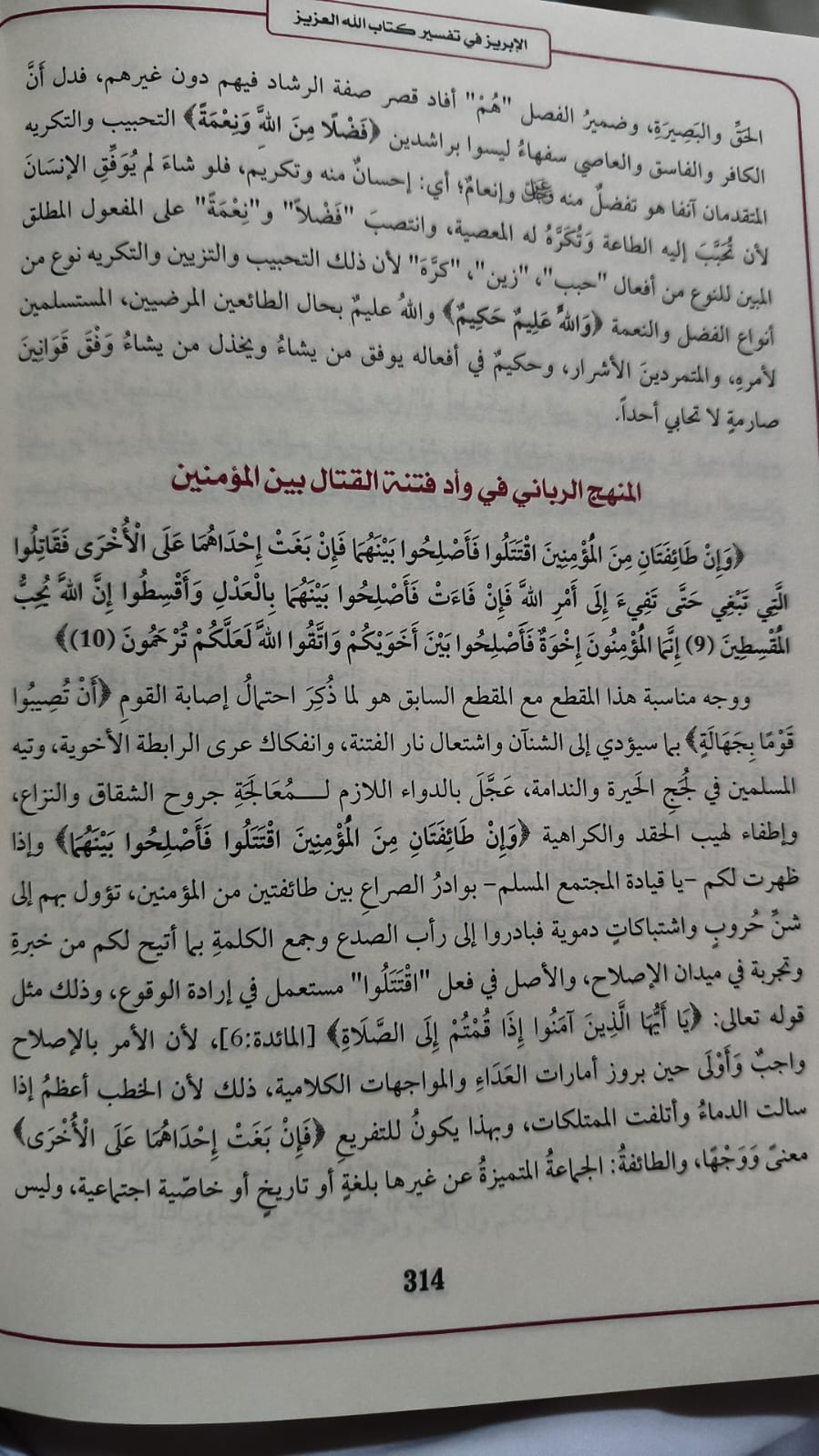
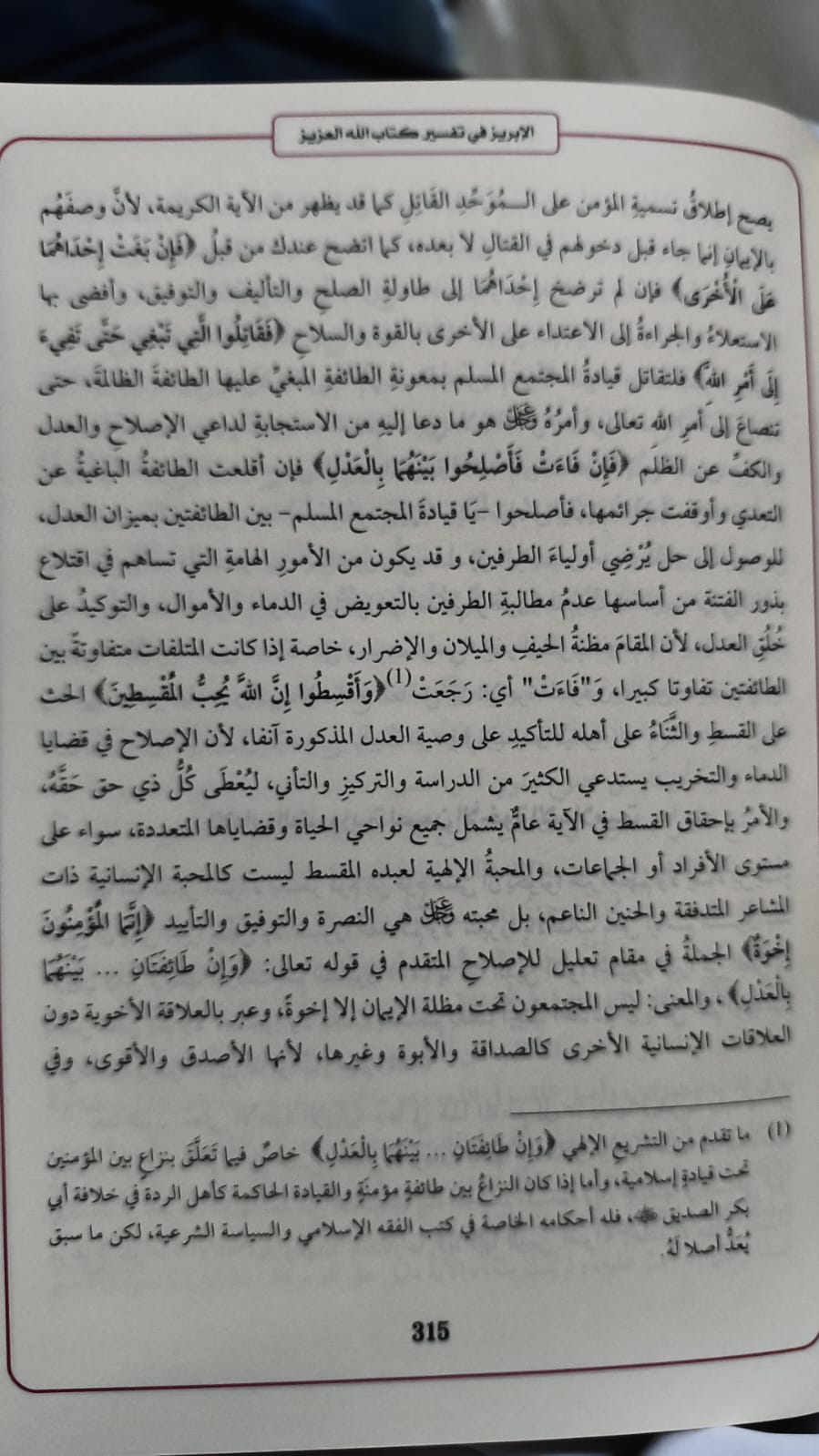
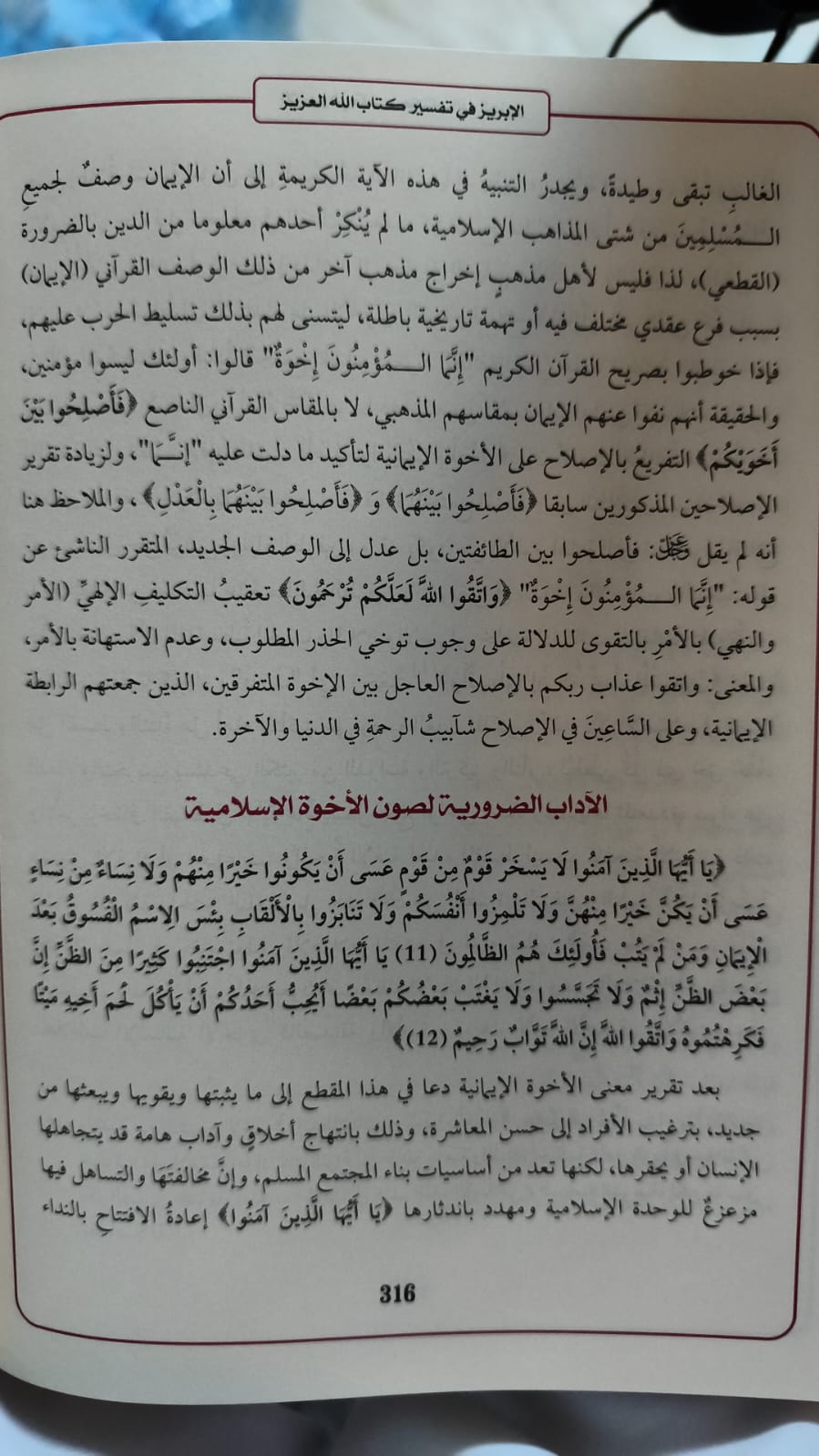
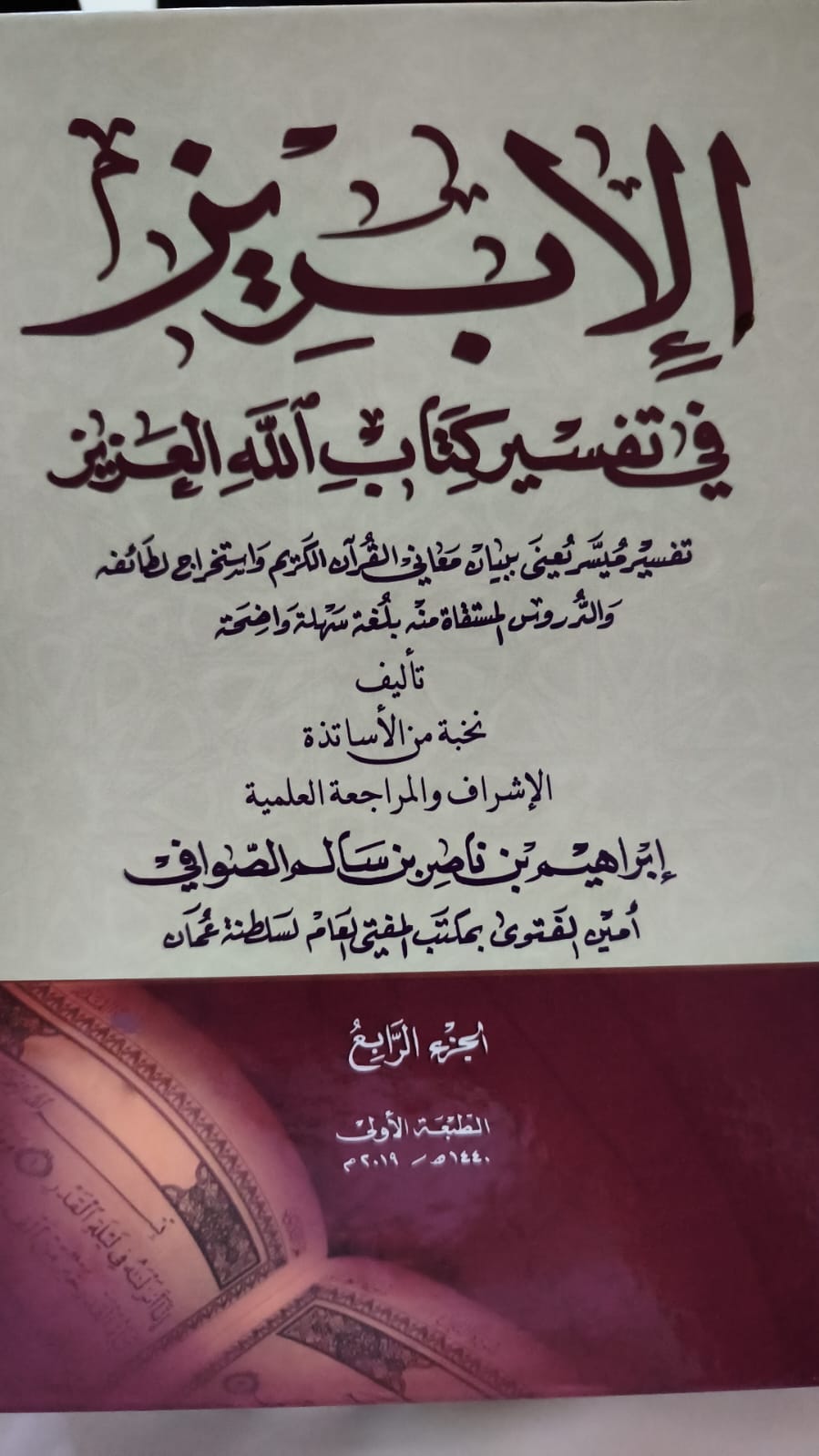
Source: (pgs. 314-316 Al-Ibriz fi Tafsir al-Qur’an al-‘Aziz – Pure Gold in the Interpretation of the Noble Qur’an – First Edition 2019 CE 1440 AH -The fourth Volume/Part 4 )
This is an Ibadi tafsir published under the supervision of the Office of Fatwa in the Sultanate of Oman. It is a contemporary, simplified commentary on the Qur’an produced by a committee of scholars.
Authored by a select group of professors/scholars. This was done under the supervison and scholarly review of Ibrahim Muhammed Fadil bin Salman al-Sawafi.
Rules of Engagement
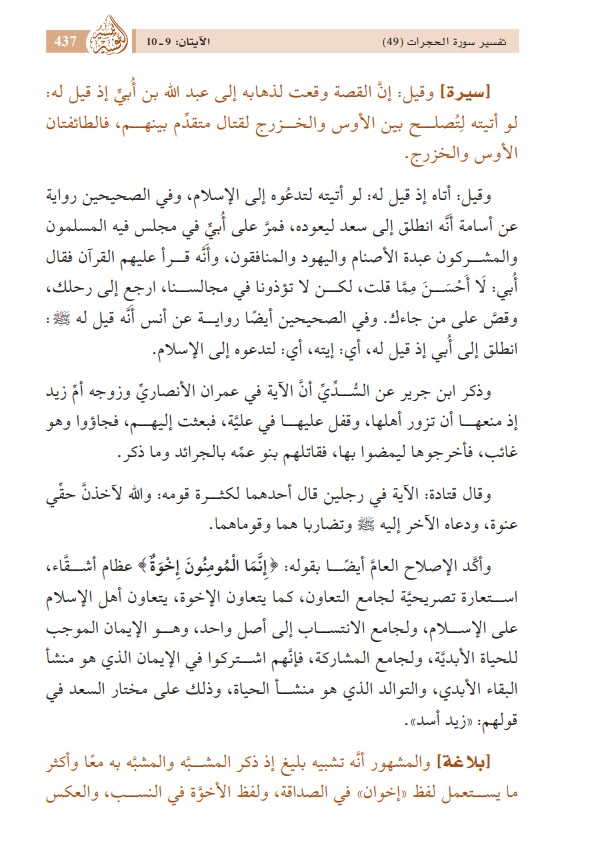
The passage from Atfayyish’s Taysir al-Tafsir provides the historical context for the revelation of Qur’an 49:9. It recounts a specific incident involving ‘Abdullah ibn Ubayy ibn Salul, the leader of the hypocrites (munafiqun) in Medina:
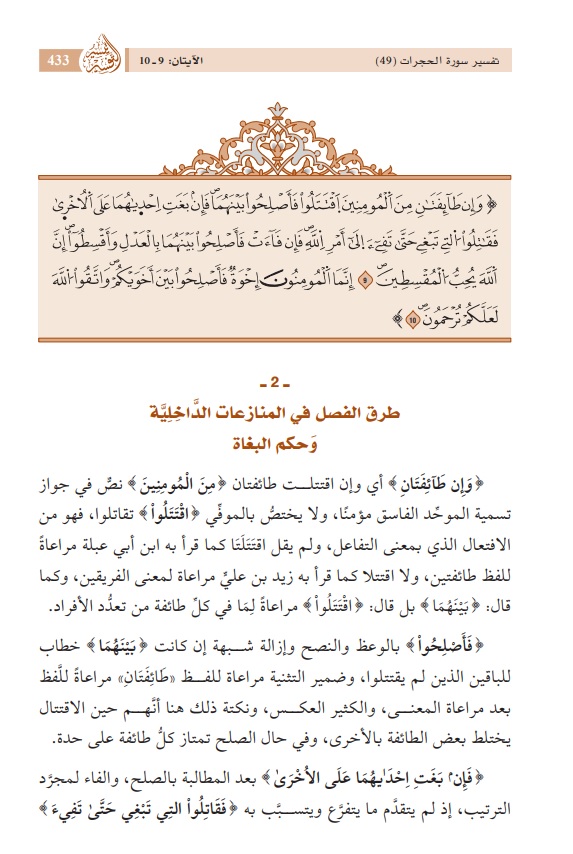
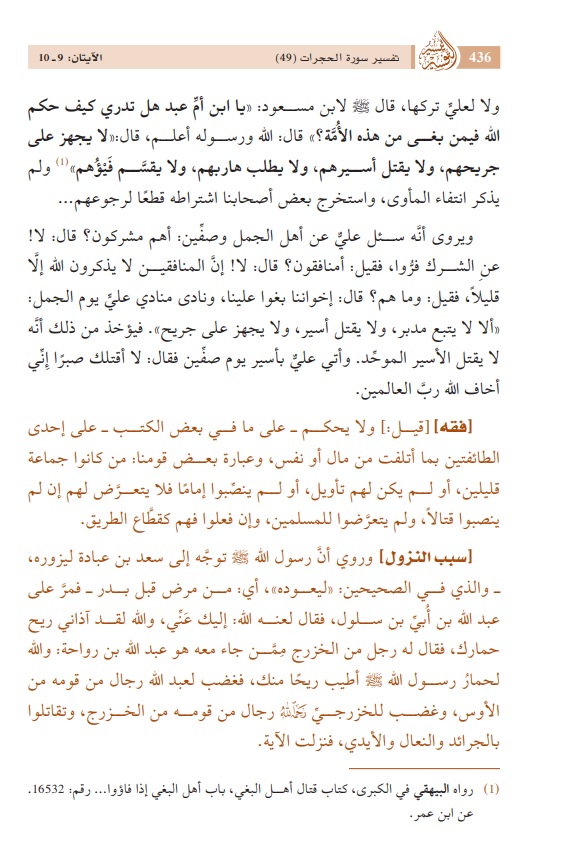
“It is mentioned in the story of Badr: Usama ibn Zayd was riding behind him [the Prophet], and on the donkey was Qutba ibn Abi Salul before he embraced Islam. Al-Khazraj passed by a gathering of the Jews, and they had idols and a Muslim with them. When the gathering was covered by the braying of the donkey, ‘Abdullah ibn Ubayy said: ‘Do not frighten us with your donkey.’ The Messenger of Allah (saw) stopped, descended, recited the Qur’an, and called them to Allah. ‘Abdullah said: ‘O man, there is nothing better than what you say, if it were true. So do not harm us in our gatherings.’ So the Messenger of Allah (saw) returned to his mount. Then ‘Abdullah ibn Rawaha said: ‘O Messenger of Allah, he is harming us in our gathering, so we are the polytheists…’ And the Jews and the Muslims almost fought. The Prophet (saw) continued to reconcile them until they were quiet, then he rode his mount. Then the verse was revealed.” Source: (Taysir al-Tafsir, Atfayyish, p. 436)
This historical context confirms that the verse 49:9 was revealed to address civil strife (fitnah) within the Muslim community. The Prophet’s own action—reconciling rather than fighting—demonstrates the priority of peace.
The passage also cites a narration from Al-Hasan:
“One of them was a hypocrite (munafiq) supported by his people, and the other was a believer (mu’min) supported by the Muslims, so they fought. Then it was revealed.”
Source: (Taysir al-Tafsir, Atfayyish, p. 436)
The Rules of Engagement (Fiqh al-Baghy)
The early Muslim community established strict rules of engagement for fighting the transgressing believers. Ibn Mas’ud ruled:
“The wounded among them is not to be finished off, the captive among them is not to be killed, the fugitive among them is not to be pursued, and no spoils are to be divided regarding them.”
Source: (Taysir al-Tafsir, Atfayyish, p. 436)
These rules prove beyond a doubt that the bāghī remains a Muslim. You do not take spoils from Muslims, nor do you execute Muslim captives. The goal is to restore order, not to exterminate the transgressors.
And a caller announced on the Day of the Camel:
“Do not pursue a fugitive, do not finish off a wounded person, and do not kill a captive.”
Source: (Taysir al-Tafsir, Atfayyish, p. 436)
When a captive was brought to Ali on the Day of Siffin, he said:
“I will not kill you, for I fear Allah, the Lord of the Worlds.” Source: (Taysir al-Tafsir, Atfayyish, p. 436)
This demonstrates the extreme caution the early Muslims exercised in shedding the blood of fellow believers.
The Sequence of Commands: Reconciliation, Fighting, and Justice
The Taysir al-Tafsir of Atfayyish provides a detailed legal analysis of the sequence of commands in Qur’an 49:9:
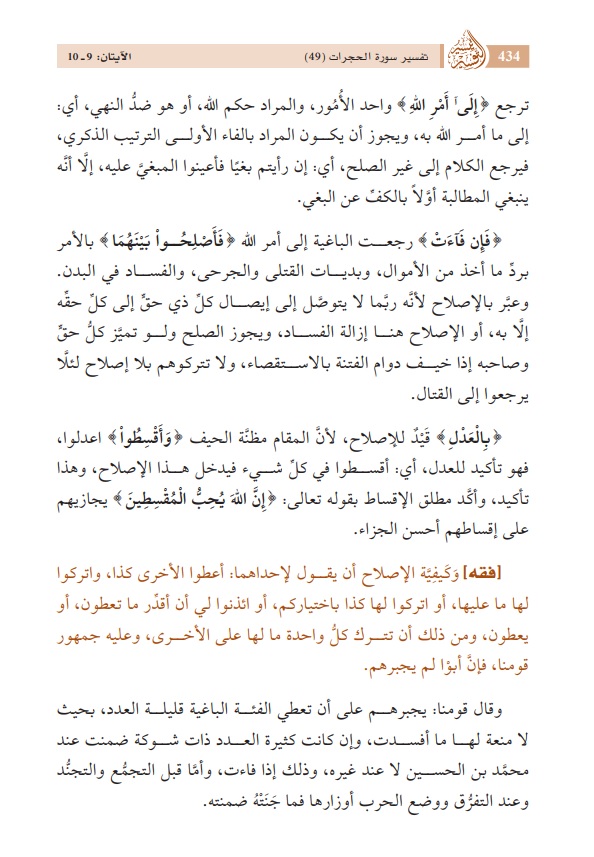
{“But if one of them transgresses against the other”} — after the request for reconciliation, and the refusal is merely [an act of] defiance. It has not yet been dealt with, so it necessitates {“then fight against the one that transgresses until it returns to the command of Allah”}.
Source: (Taysir al-Tafsir, Atfayyish, p. 433)
Atfayyish highlights a critical detail in the verse’s structure. The command to “make peace” (fa-aṣliḥū) appears twice:
- First: “If two parties fight, make peace between them.” (General reconciliation)
- Second: “Then if it returns, make peace between them with justice.” (Post-fighting reconciliation)
He explains that the first reconciliation is directed at both parties. But if one party transgresses (baghat), the second command to reconcile is directed specifically at the transgressor—they are the ones who must be brought back to obedience first, before peace can be established.
The Al-Abriz commentary adds:
“If one of them transgresses against the other, then fight against the one that transgresses until it returns to the command of Allah.” The purpose of fighting is not to exterminate the transgressors but to bring them back to obedience. The commentary notes that the verb qātilū (fight) is used in the sense of willing the occurrence, similar to the command to establish prayer. The goal is correction, not destruction. (Al-Abriz, p. 315)
The Taysir al-Tafsir also confirms the linguistic point we discussed earlier:
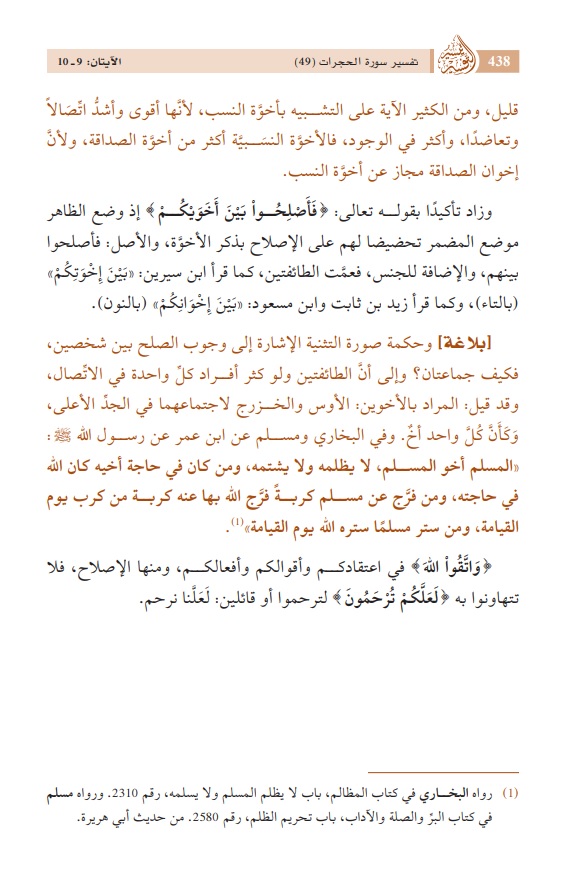
{“Until it returns” (tafi’a)} — it is said that the meaning is: until it returns to the command of Allah, which is His ruling. [The word] tafi’a (returns) is used exclusively for returning to obedience after disobedience.
Source: (Taysir al-Tafsir, Atfayyish, p. 434)
This is a crucial theological point. The bāghī is not being called to “convert” to Islam (as a disbeliever would be). They are being called to return to obedience (ṭā’ah) after a state of disobedience (ma’ṣiyah). This confirms that they are already Muslims; they have simply fallen into kufr al-ni’ma.
“Until it returns” (tafi’a)}
Justice and Equity: The Goal of Reconciliation
The Taysir al-Tafsir emphasizes that reconciliation must be done “with justice” (bil-ʿadl). Why? Because the position is one of “suspicion of bias” (maẓinnat al-ḥayf). After blood has been shed, there is a natural tendency for one party to seek revenge or for the mediator to favor one side. The Qur’an commands absolute equity to prevent further injustice:
{“Then make peace between them with justice”} — the command [here] includes the prevention of wealth, and the blood-money for the killed and the wounded, and the corruption in the body. And the expression “with reconciliation” is because it may not lead to the restoration of every right to its owner, even if the reconciliation is [meant to be] clear. It is permissible for reconciliation to remove the corruption, even if it does not perfectly distinguish every right to its owner, if there is a fear of the continuation of the dissension.
Source: (Taysir al-Tafsir, Atfayyish, p. 434)
Atfayyish outlines the practical steps of reconciliation:
- Prevention of wealth (badal min al-amwāl): The transgressor must compensate for destroyed property.
- Blood-money (diyāt): Compensation for the killed and wounded.
- Corruption in the body (al-fasād fī al-badan): Physical injuries must be accounted for.
This confirms that the bāghī is legally liable for their actions — proof that they are still a Muslim. You do not pay blood-money to a disbeliever’s family in the same way; you take their wealth as spoils.
The Al-Abriz commentary adds:
“This is a confirmation of the aforementioned instruction of justice, because reform in matters of blood and destruction requires much study, focus, and deliberation, so that every person with a right is given his right.” Sources: (Al-Abriz, p. 315) & (Taysir al-Tafsir, Atfayyish, p. 438)
The verse concludes with the statement that “Allah loves those who act equitably” (al-muqsiṭīn). This divine love is not a sentimental emotion but a promise of victory, success, and support for those who establish justice.
Source: (Taysir al-Tafsir, Atfayyish, p. 434)
The Brotherhood of Faith
Qur’an 49:10 immediately follows the verse on fighting:
“The believers are but brothers, so make peace between your brothers and fear Allah that you may receive mercy.” (Qur’an 49:10)
“Those gathered under the shade of faith are nothing but brothers, and the brotherhood relationship is without [the need for] other human relationships like friendship, fatherhood, and others, because it is the most truthful, strongest, and most powerful.” (Al-Abriz, p. 316)
This brotherhood is the basis for the command to reconcile. If the fighters were outside the milla of Islam, there would be no brotherhood to preserve. But because they are outwardly Muslims— guilty of kufr al-ni’ma — the doors to repentance and reconciliation must remain open so as to restore peace and unity.
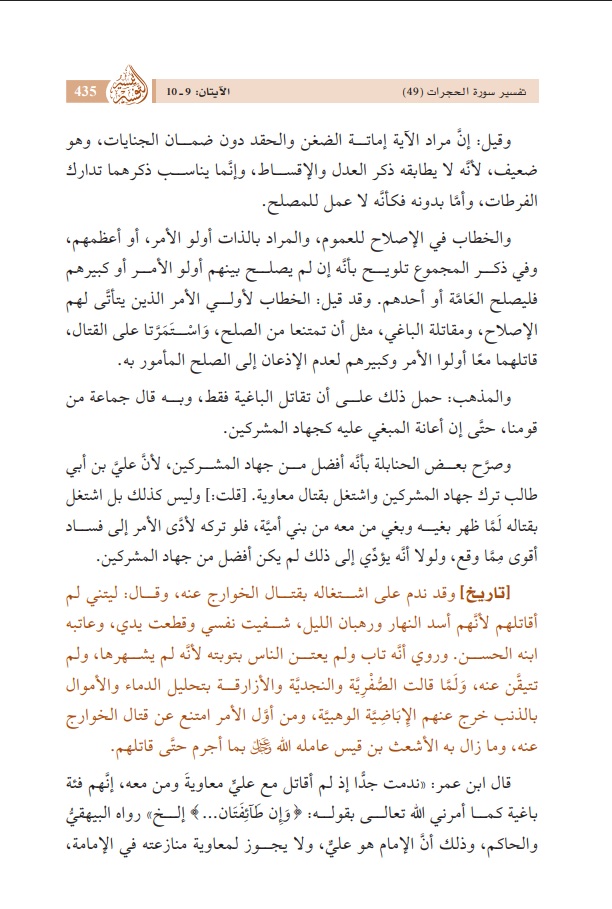
The Taysir al-Tafsir notes that the sentence “The believers are but brothers” is in the position of explaining the previous instruction for reconciliation:
“And the meaning: Those gathered under the shade of faith are nothing but brothers, and the brotherhood relationship is without [the need for] other human relationships like friendship, fatherhood, and others, because it is the most truthful, strongest, and most powerful.”
Source: (Taysir al-Tafsir, Atfayyish, p. 438)
Source material: (Taysir al-Tafsir li’l-Qur’an al-Karim, Qutb al-A’imma Muhammed ibn Yusuf Atfayyish)
The Strength of the Ibadi Position
The Ibadi tafsir of Qur’an 49:9 offers a theologically rigorous and textually grounded reading that resolves several apparent tensions:
| Principle | Ibadi Position | Evidence |
|---|---|---|
| Status of the Bāghī | Believer in milla, kāfir in ni’ma (ungrateful). | Qur’an 49:9 (nowhere in the Qur’an is bāghī for believers); Qur’an 14:7 (kafartum = severe punishment); Hadith Bukhari 7077 (“Do not revert as kuffāran“). |
| Goal of Fighting | To restore obedience and justice, not to exterminate. | Qur’an 49:9 (“until it returns to the command of Allah”); Taysir al-Tafsir (tafi’a = return to obedience after disobedience). |
| Rules of Engagement | No killing captives, no spoils, no pursuit of fugitives. | Ibn Mas’ud’s ruling in Taysir al-Tafsir, p. 436; the caller on the Day of the Camel; Ali’s statement “I will not kill you, for I fear Allah.” |
| Responsibility | The community leaders (ahl al-amr) must reconcile. | Qur’an 49:9 (“make peace between them”); Al-Abriz (leaders of the Muslim community). |
| Purpose | Eliminate rancor and hatred, establish justice. | Taysir al-Tafsir (purpose of the verse is the elimination of rancor and hatred); Qur’an 49:10 (brotherhood). |
| Nature of the Duty | Supporting the oppressed against the transgressor is a jihad. | Taysir al-Tafsir (a group of our people said: assistance of the oppressed is a jihad). |
Conclusion
The Ibadi tafsir of Qur’an 49:9 offers a balanced theology that upholds the sanctity of faith while recognizing the gravity of sin.
The Ibadi position, is not one of extremism or excessive leniency. It is a rigorous, textually grounded, and spiritually profound reading of the Qur’anic text. It demonstrates that the Muslim community is called to be a community of justice, reconciliation, and mercy even in the midst of its most painful internal conflicts. It provides a framework for addressing intra-community conflict that neither demonizes the transgressor nor ignores their wrongdoing. It serves as a powerful reminder that faith and sin are not mutually exclusive—but the consequences of sin are severe, and the path to reconciliation requires justice, equity, and a steadfast commitment to the bonds of brotherhood.
- The root b-gh-y is never used for believers elsewhere in the Qur’an.
- The min al-mu’minīn describes prior state, not the state of fighting.
- The hadith uses kufr language for intra-Muslim fighting.
- Qur’an 4:93 creates a tension that the Ibadi framework resolves.
You may also enjoy the following:
May Allah Forgive the Ummah.
May Allah Guide the Ummah.


