
“Indeed, We have made it (ja’alnahu) an Arabic Qur’an that you might understand.” (Qur’an 43:3)
﷽
The truth of the matter is that the entire Muslim Ummah are in agreement that some aspect of the Qur’an is created. What they differ and disagree about are the specifics.
This debate has been framed incorrectly. It has been framed as a debate between those who believe the Qur’an is created and those who believe the Qur’an is uncreated.
The reality: The debate is about to what degree and which aspects of the Qur’an are created.
1. For example the Mushaf. The pages that the ink is printed upon. All Muslims call this the Qur’an. There is etiquette in regard to it. We do not bring it to dirty places. The proper disposal is to burn it’s pages. Yet, this is called ‘Qur’an’. Everyone who can be called Muslim agrees to this. That is that the Mushaf of the Qur’an is created. If there is a person who disagrees with this and or is hesitant to affirm this then know that they are upon something very strange.
2. The ink which the words are written. The words and letters on the pages that were placed there by ink or the printing press. Everyone who can be called Muslim agrees to this. That is that the ink and the words on the pages are created.If there is a person who disagrees with this or is hesitant to affirm this then know they upon something very strange.
3. The recitation of the words of the Qur’an. This is is what we will be discussing today.
“Muhammed bin Yahya al-Nisaburi wrote to the people of Rayy, informing them of al-Bukhari’s position. The accusation was that al-Bukhari held “lafzi bil-Quran makhluq”. That his pronunciation/recitation of the Quran is created.”
“My father and Abu Zur’ah heard from him, then they both abandoned his hadith when Muhammad bin Yahya al-Nisaburi wrote to them that he [al-Bukhari] had made it apparent to them that his pronunciation of the Qur’an is created.”
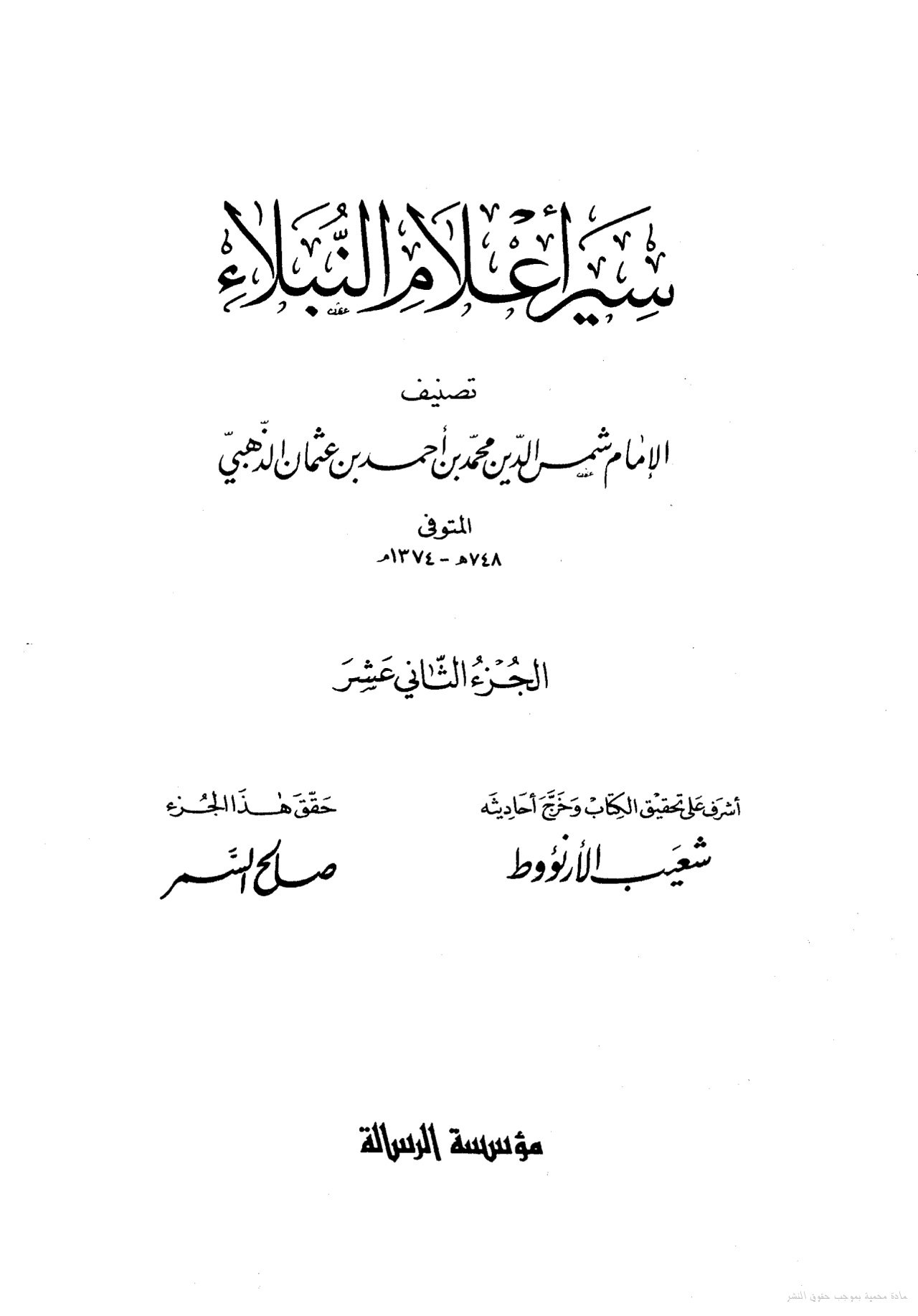
Source: (page 462 from Volume 12 of Siyar A’lam al-Nubala’ (Biographies of the Noble Scholars) by Imam al-Dhahabi, edited by Shu’ayb al-Arna’ut.)
“[Al-Ma’idah: 64]. And his emigration (hijrah)(1) was from Mecca. He came to Iraq at the end of the night… [Quranic verse]: “If Allah helps you, none can overcome you; and if He forsakes you, who is there after Him that can help you?” [Al Imran: 160].”
“And Ahmad bin Mansur al-Shirazi said: I heard al-Qasim bin al-Qasim say: I heard Ibrahim, the scribe of Ahmad bin Sayyar, say: When al-Bukhari arrived in Marw, Ahmad bin Sayyar met him. So he said to him: “O Abu Abdullah, we do not oppose you in what you say, but the common people cannot bear this from you.” He [al-Bukhari] said: “I only ask about something I know to be true, fearing the Fire, lest I say other than it.” So Ahmad bin Sayyar turned away from him.”
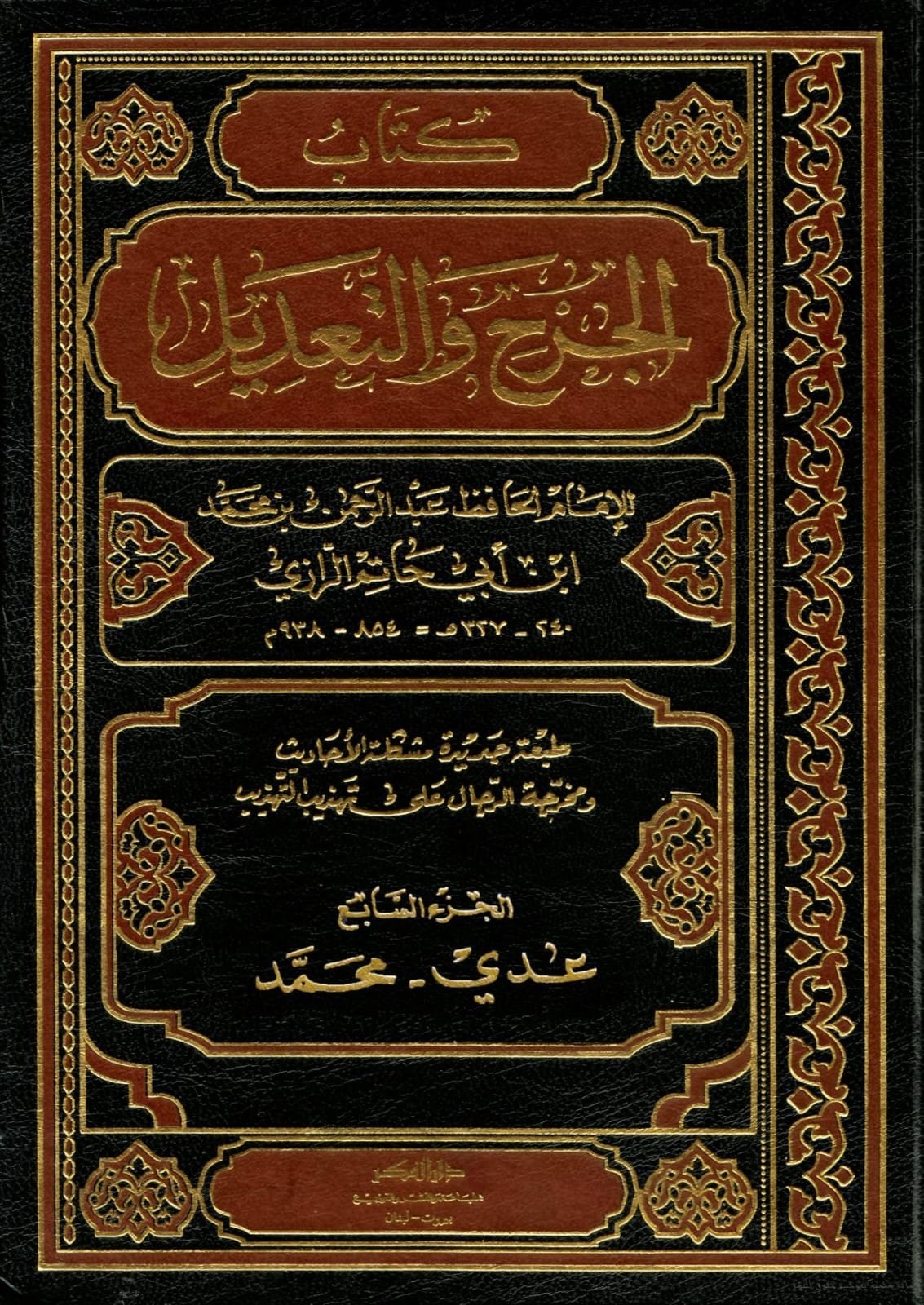
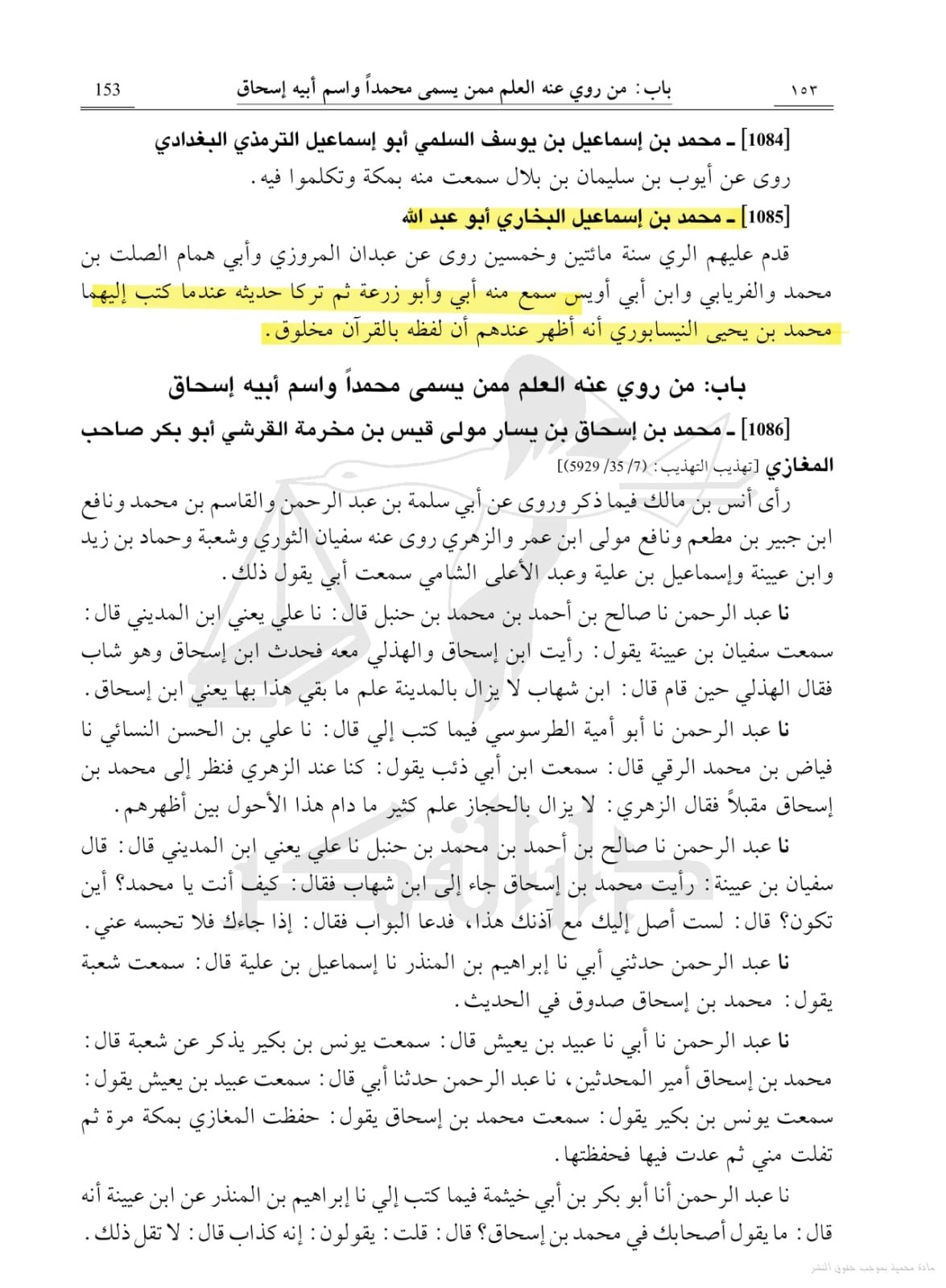
“And Abd al-Rahman bin Abi Hatim said in Al-Jarh wa al-Ta’dil (2): Muhammad bin Isma’il al-Rayy came in the year 210 AH, and my father and Abu Zur’ah heard from him. And they abandoned his hadith when Muhammad bin Yahya al-Nisaburi wrote to them that he [al-Bukhari] had made it apparent to them that his pronunciation of the Quran is created.“
Then Shu’ayb al-Arna’ut comments on this.
By the way for those not familiar when you see the name Shu’ayb al-Arna’ut it is a reference to Abū Usāmah Shuʿayb ibn Muḥarram ibn ʿAlī al-Albānī al-Arnāʾūṭ.
Most people in Salafi/Athari circles simply refer to him as: al-Albānī.
So al-Albānī (Shu’ayb al-Arna’ut) comments:
“This is strange from Abu Zur’ah and Abu Hatim, for they both had already heard from him [al-Bukhari] and narrated from him, and they did not abandon him except based on the statement of their teacher al-Bukhari regarding the issue of lafz [pronunciation]. And it is not permissible for them to act upon this, due to what it entails of sin, caprice, and envy. And Imam al-Dhahabi said in Mizan al-I’tidal 1/111 in the biography of Abu Nu’aym, the author of Al-Hilyah: “The words of some of them regarding others are not to be relied upon, especially if it becomes clear to him that it is due to partisanship for a madhhab or envy. And no one is safe from that except one whom Allah protects. And I do not know of an era from the eras that is safe from that except the era of the Prophets and the Rightly Guided Caliphs. And if you wish, I could list that in volumes.” And al-Subki said in Tabaqat al-Shafi’iyyah 2/230: “The position of al-Dhuhali [Muhammed bin Yahya] regarding al-Bukhari came from envy of him.” And al-Subki said in Qa’idah al-Jarh wa al-Ta’dil 12: “And from what should be examined is the state of beliefs and their differences in relation to the critic and the criticized. For perhaps the critic is wronged in creed, so his criticism of him is [invalid].”-Shaykh al-Albānī
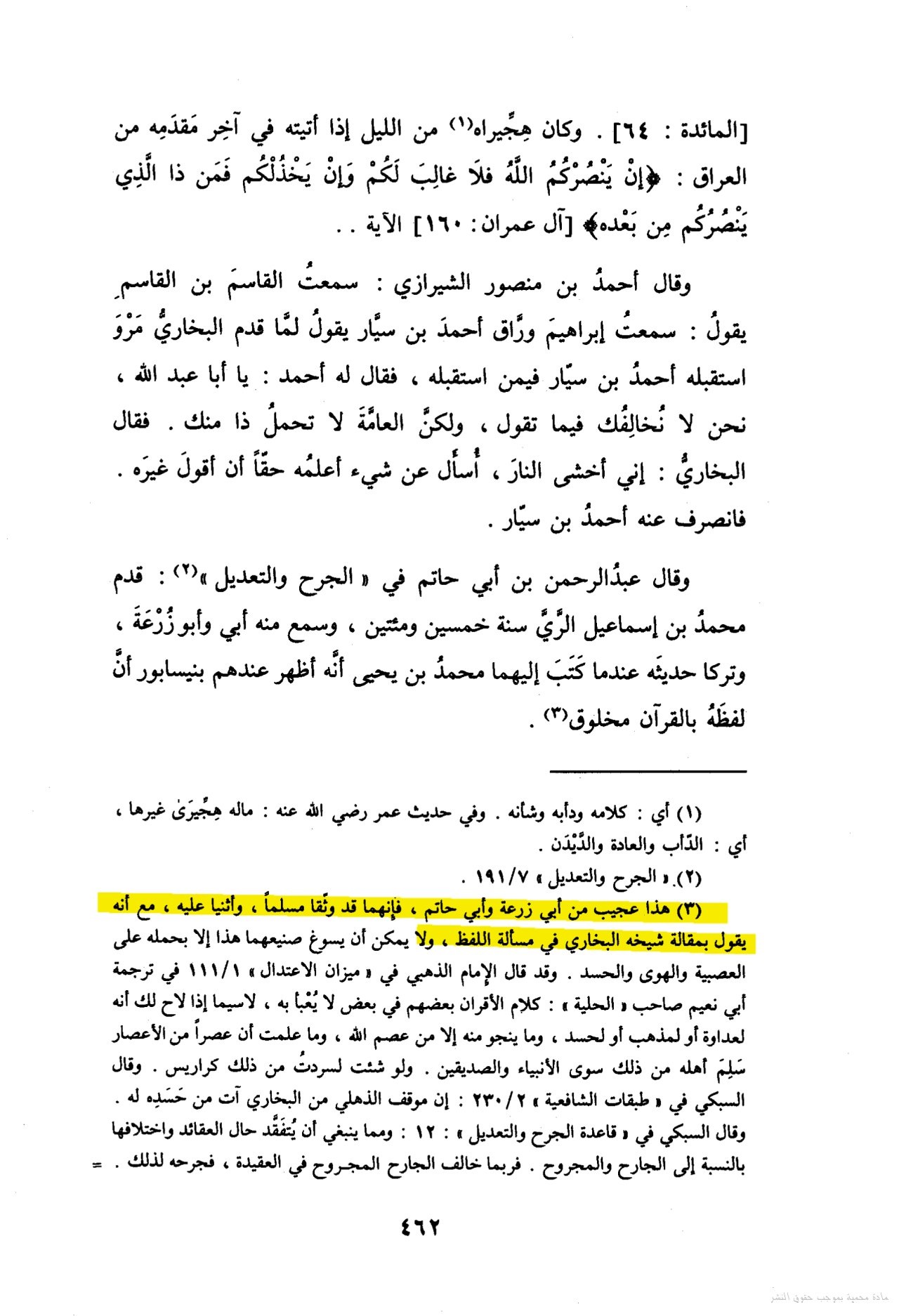
Source: (page 462 from Volume 12 of Siyar A’lam al-Nubala’ (Biographies of the Noble Scholars) by Imam al-Dhahabi, edited by Shu’ayb al-Arna’ut.)
Examining Shaykh al-Albānī charge of envy for abandoning Bukhari for his position on the createdness of the Qur’an.
Shaykh Shaykh al-Albānī’s argument in the highlighted footnote is essentially this: Abu Zur’ah’s criticism cannot be sincere because he also narrated from Muslim, who shared al-Bukhari’s theological position.
If Abu Zur’ah was willing to accept hadith from Muslim, he should have accepted them from al-Bukhari on the same grounds. Unless his abandonment of al-Bukhari was motivated by petty jealousy, or partisanship.
We have to be fair here in saying that Shaykh al-Albānī’s claim has a very strong basis.
This reasoning has some historical traction, but it is not the whole picture:
Muslim’s Position: It is well-established that Imam Muslim did agree with al-Bukhari on the lafz issue. Al-Bayhaqi explicitly stated that Muslim “was on the madhhab of al-Bukhari in the distinction” between recitation and the recited. Muslim also famously stood by al-Bukhari during the boycott, taking his written works back from al-Dhuhali and withdrawing from his circle.
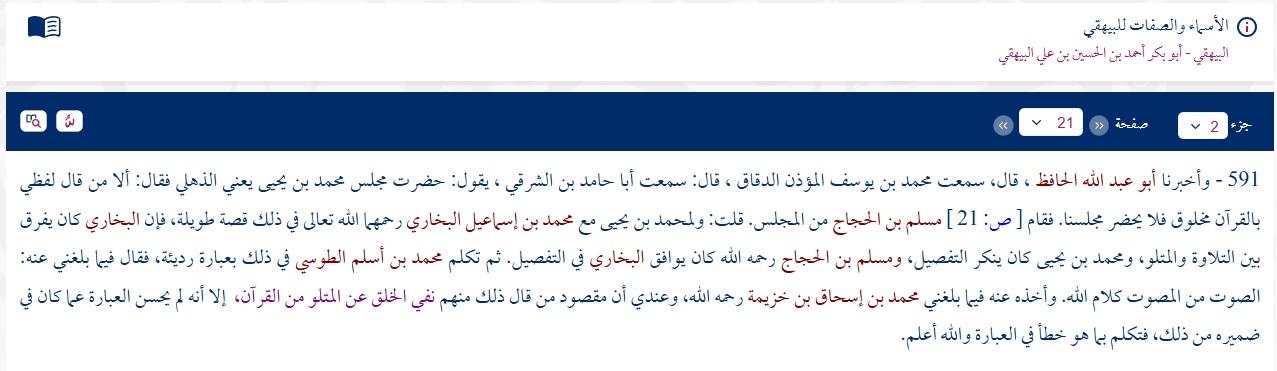
Source: (https://tinyurl.com/3mk8nusf)
Source: (Siyar A’lam al-Nubala’ 12/460, Huda al-Sari in the introduction to Fath al-Bari 2/264)
Imam Muslim was the only one who did not abandon Imam al-Bukhari, since they were upon the same creed. Their creed opposed that of the Hanbali who opposed them.
“And Makki bin Abdan said: Dawud bin Ali al-Asbahani came to Nisapur during the days of Ishaq bin Rahwayh. They held a session of debate for him, and he attended the circle of Yahya bin al-Dhuhali, and Muslim bin al-Hajjaj. A theological issue was discussed in which Yahya spoke, and he silenced him, saying: “Be quiet, O boy!” So Muslim did not support him. He returned to his father and complained to him. His father said: “Who was he?” He said: “Muslim.” He said: “You have returned from every single one of my hadiths!” [Meaning: you have ruined your standing with him]. When this reached Muslim, he gathered what he had written from him in a notebook, sent it to him, and said: “I will never narrate anything from you ever again.”
“Abu Abdullah al-Hakim said: I have noted this story from Tahir bin Ahmad, from Makki, and Muslim may have differed after this incident with Muhammed bin Yahya, but he only cut him off because of the issue of al-Bukhari. And al-Hafiz Abu Abdullah bin al-Akhram knew that, so he informed about the alienation [that occurred] later.”
“And I heard him [al-Hakim] saying: Muslim bin al-Hajjaj used to openly declare the statement regarding al-lafz [the pronunciation of the Quran], and he did not conceal it. When al-Bukhari settled in Nisapur, he openly declared more of the disagreement with him. When the issue of al-lafz occurred between al-Bukhari and al-Dhuhali, and the people of Nisapur were prevented from differing with him [al-Dhuhali], and he called to that, the majority of people cut off from Muslim, other than a few. It reached Muhammed bin Yahya, and he said one day: “Whoever says al-lafz is not created, it is not permissible for him to attend my circle.” So Muslim took his garment, placed it on his shoulder, stood up before the people, and sent to him what he had written from him, saying: “We only used to narrate from you because of al-lafz.” And Muslim used to openly declare the statement regarding al-lafz and not conceal it.“
“Abu Hamid bin al-Sharqi said: I attended the circle of Muhammed bin Yahya, and he said: “Whoever says: ‘My pronunciation of the Quran is created,’ let him not attend my circle.” So Muslim stood up from the circle.”
“Abu Bakr al-Khatib said: Muslim used to fight on behalf of al-Bukhari, until the relationship between him and Muhammed bin Yahya became estranged, due to his [al-Bukhari’s] reason.”
“I [al-Dhahabi] said: Then, [if] he was a Muslim due to his createdness [meaning: his stance on the creation of actions] he also turned away from al-Bukhari, and did not mention him as a narrator of hadith, nor did he name him in his Sahih. Rather, he began the book with the wording of those who stipulated al-lafz for whomever he narrated from, in a manner that claims consensus in the contemporary era is sufficient [to establish it], and he did not pause on that knowledge of the two of them, and he criticized whoever stipulated that. But rather, Abu Abdullah al-Bukhari said that, and his teacher Ali bin al-Madini, and it is the most correct and most sound [position]. And this is not the place to elaborate on this issue.”
“The Hafiz Abu al-Qasim bin Asakir said in Al-Atraf: It is after he mentioned [the Sahih of al-Bukhari]: Then he followed the path of Muslim bin al-Hajjaj, and he took the extraction of his book, its composition, and its arrangement into two parts. He intended to mention in the first part the hadiths of the reliable people of precision, and in the second part the hadiths of the people of covering and truthfulness, those who did not reach the rank of the firmly established. The death prevented him from completing this aspiration, and between him and this aspiration was the completion of his book. However, his book became famous and spread despite his need for it [to be completed].”
“And al-Hakim said: Muslim wanted to extract the Sahih into three categories, and upon three generations of narrators. He mentioned this at the beginning of his introduction, but he was not able to finish except the first category, and he died.”
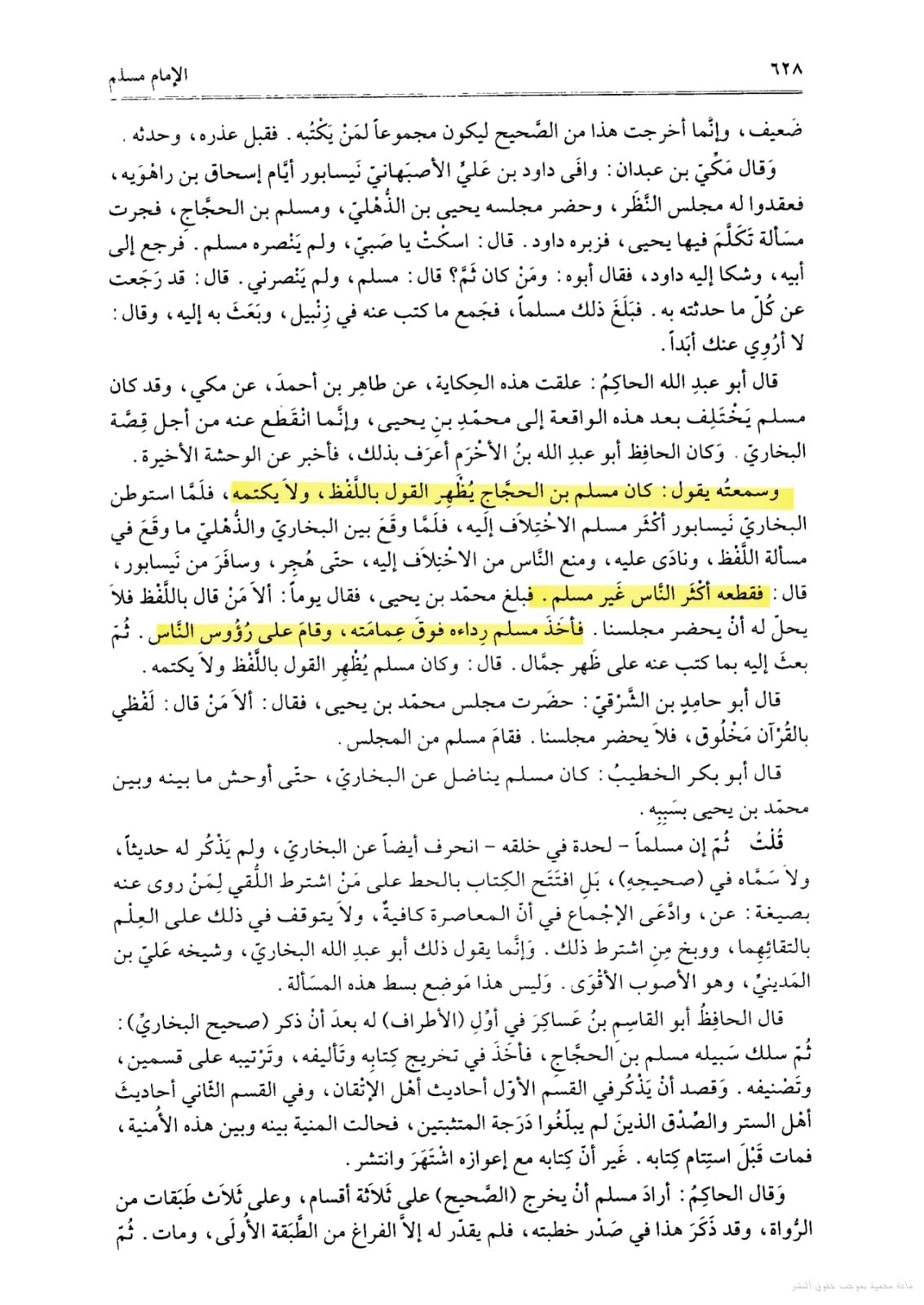
Source: (page 628 from Volume 12 of Siyar A’lam al-Nubala’, in the biography of Imam Muslim)
The second point.
Abu Zur’ah’s Relationship with Muslim: Abu Zur’ah was not hostile to Muslim. In fact, Muslim submitted his Sahih to Abu Zur’ah for review, and Abu Zur’ah’s approval was seen as a mark of its authenticity. if Abu Zur’ah accepted Muslim’s Sahih despite his lafz views, why did he abandon al-Bukhari?
Insh’Allah we will update this page and provide an easily accessible online source when it becomes available.
If you would like to learn more about this specific subject please read the following:
May Allah Guide the Ummah.
May Allah Forgive the Ummah.


