“And (He desires) that you should complete the number and that you should exalt the greatness of Allah for His having guided you and that you may give thanks” (Qur’an 2:185)
﷽
Eid Mubarak! May this blessed occasion fill your heart with joy, your home with warmth, and your life with countless blessings. May Allah grant you peace, love, and unity in the company of family and friends. Please forgive our many short comings and faults. While we celebrate let us not forget those who can’t due to war and oppression. Let us not forget the converts, often alone and isolated.
May this be a very blessed and joyous Eid for all of you!
“O Adam, dwell, you and your wife, in Paradise and eat there from abundance from wherever you will. But do not approach this tree, lest you be among the wrongdoers.” (Qur’an 2:35)
“But Satan caused them to slip out of it and removed them from that in which they had been. And We said, “Go down, as enemies to one another, and you will have upon the earth a place of settlement and provision for a time.” (Qur’an 2:36)
“So he brought about their fall through deception. And when they tasted of the tree, their nakedness was exposed to them, prompting them to cover themselves with leaves from Paradise. Then their Lord called out to them, “Did I not forbid you from that tree and tell you that Satan is your sworn enemy?” (Qur’an 7:22)
(And Adam and his wife ate of it, and their private parts became apparent to them, and they began to fasten over themselves from the leaves of Paradise. And Adam disobeyed (waʿaṣā ) his Lord and erred.) (Qur’an 20:121)
“They replied, “Our Lord! We have wronged ourselves. If You do not forgive us and have mercy on us, we will certainly be losers.” (Qur’an 7:23)
“Allah said, “Descend as enemies to each other. You will find in the earth a residence and provision for your appointed stay.”(Qur’an 7:24)
﷽
A bone chilling reminder. Dear brothers and sisters and truth seekers. This is the month of mercy and forgiveness. Seek it!
Shaykh Dawud Bu-Sinani reminds us:
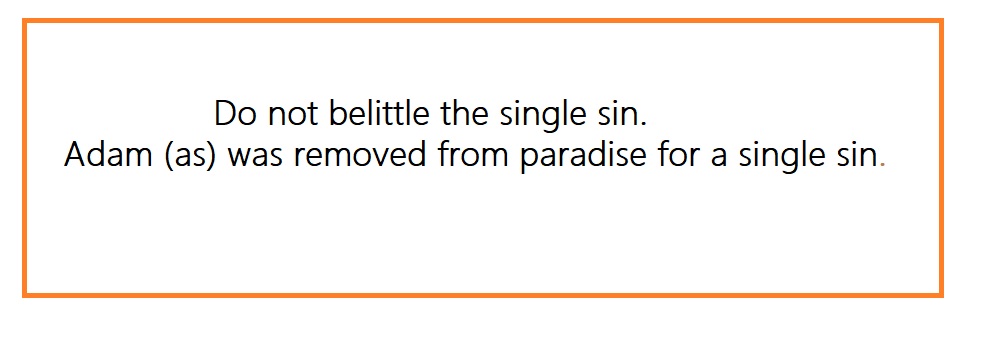
“Allah The Exalted, removed our Father Adam alayi salam, from heaven. For what reason did Allah (swt) remove him? For the reason of committing a single sin only! For the people of now (in these times) belittle committing a single sin and consider it severe only when they gather many (sins).”
“As if a problem only arises and is connected only to when the sins become many. No!”
“A sin in the sight of Allah is considered severe. Even if it were just one!”
“And if it were not like that, then why did Allah The Exalted remove our Father Adam alayhi salam, from a huge blessing in the form of heaven for the sake of committing one sin only, only! “
“Do not disobey your lord, even if it is just by one sin (one time) only! For it is not the number of sins committed that is considered; rather, it is He who you have sinned against that is considered. And that is ALLAH the MAGNIFICIENT!”
“So if you commit a sin under the pretext that it is just one (one time) and one only and that you won’t commit more. And as a result of continuing such, you eventually lose huge favour (from Allah) such as: health, offspring, spouse, work, shelter or any other favour!”
“Then do not blame anyone other than yourself! For you are not greater than our Father Adam alayi salam.”
According to the proofs and evidence advanced by the Sunnī schools of theology (Ashʿarī, Atharī, Māturīdī) if a Muslim dies without repenting from their major sins, they will spend an undisclosed period in hellfire. (Billions of years perhaps).
According to the proofs and evidence advanced by the Shiʿi and Ibāḍī schools of theology, if a Muslim dies without repenting from their major sins they will be in hellfire without reprieve.
No matter our theological position on what happens to the unrepentant sinners in the hereafter (billions of years in hellfire or indefinitely), the Shaykh has made a forceful point.
Even in the various Ṣūfī tariqa. How often during the day is it permissible to be in a state of ghaflah (heedlessnes)? In taṣawwuf, when is it permissible to not be in a state of dhirk (remembrance) of Allah? When is it permissible to forget Allah?
When we sin are we in a state of dhirk or ghaflah?
We need to get right with Allah. We need to purfiy ourselves and our intentions.
“And keep in mind that Allah’s Messenger is in your midst. If he were to yield to you in many matters, you would surely suffer. But Allah has endeared faith to you, making it appealing in your hearts. And He has made disbelief, rebelliousness, and disobedience detestable to you. Those are the ones rightly guided.” (Qur’an 49:7)
“But as for he who feared the exalted station of his Lord and prevented his soul (l-nafsa) from base impulses, Then indeed, Paradise will be the final refuge.” (Qur’an 79:40-41)
﷽
Before we begin this article, we want to say that we have never been truly satisfied with any English translation of the Arabic word (l-nafsa)
“But as for he who feared the exalted station of his Lord and prevented his soul (l-nafsa) from base impulses, Then indeed, Paradise will be the final refuge.” (Qur’an 79:40-41)
(l-nafsa) as far as we can glean, is a reference to what psychologists refer to as the ‘Id. This is why the verse then follows with ‘base impulses’. (Thoughwe are certainly open to being corrected on this).
It is these basic impulses within ourselves that we as humans must master. It is these very base impulses by which we are easily manipulated and controlled by many around us. From the sex industry, food industry, and most things that seek to bring pleasure to sensory perception. Sight, Sound, Taste, & Touch.
From the Frank Herbert Sci-Fi Novel Dune: Below is the script from the book.
Lady Jessica: “Paul… please, Paul… listen to the Reverend Mother and do what she tells you.”
The Reverend Mother speaks to Paul using The Voice, a Bene Gesserit training which permits an adept to control others merely by selected tone shadings of the voice. It sounds as if two people are talking — one normal and the other guttural and slightly electronic. The effect is strange, yet subtle.
Reverend Mother (using The Voice): “Now You! Come here!”
Paul finds he cannot help but obey her, yet he fights her controlling him.
Paul’s (inner voice) “She’s using The Voice.” (out loud) “No!
The Reverend Mother holds up a green metal cube. Reverend Mother: “See this… Put your right hand in the box.”
Paul stares at the hole in the box. Paul: “What’s in the box?”
Reverend Mother “Pain!”
Just then, she raises one hand to his neck. Paul sees a glint of metal. He tries to back away.
Reverend Mother (Using The Voice): “STOP! Put your hand in the box!”
Paul’s hand goes in. Fear passes over his face. (Paul’s inner voice) “The Voice again.”
Reverend Mother “I hold at your neck the gom jabbar. Don’t pull away, or you’ll feel that poison. A Duke’s son must know about many poisons —this one kills only animals.”
Paul “Are you suggesting a Duke’s son is an animal?”
Paul: “Are you suggesting a Duke’s son is an animal?”
Reverend Mother: “Let us say I suggest you may be human. Your awareness may be powerful enough to control your instincts. Your instincts will be to remove your hand from the box. If you do so, you will die. You will feel an itching — there… see? Now the itching becomes burning… heat, upon heat, upon heat.”
Paul (whispering): “It burns!”
Reverend Mother “SILENCE… SILENCE!”
Paul (inner voice)(struggling to compose himself)
“I must not fear. Fear is the mind-killer. Fear is the little death that brings total obliteration. I will face my fear… I will permit it to pass over me and through me.”
The Reverend Mother moves her face up to his. Her ancient face, with its metal teeth gleaming inches away, breathes hotly. She is smiling.
Reverend Mother: “You feel the flesh crisping?”
Paul’s inner mind sees his hand on fire with all sorts of sores. The skin is bubbling.
Reverend Mother “Flesh dropping off.”
He pictures this. The destruction of his hand is complete — now only blood spurts out and burns. Paul’s face registers extreme pain.
(Paul couldn’t help the explosion) “THE PAIN!!!
Reverend Mother: “NO!! ENOUGH!! Qul wahad! No woman child ever withstood that much. I must have wanted you to fail. Take your hand out of the box and look at it, young human…. Do it!”
Paul pulls his hand out of the box. No sign of anything wrong. He turns his hand, flexes hisf ingers. He looks to the Reverend Mother.
Reverend Mother.(explaining) “Pain caused by nerve induction… A human can resist any pain. Our test is crisis and observation.”
We want to draw attention to certain points in the dialogue.
“I hold at your neck the gom jabbar. Don’t pull away, or you’ll feel that poison. A Duke’s son must know about many poisons —this one kills only animals.”
This was a very powerful point that the Reverend Mother made. The point is that animals act upon instinct and, in this case, the instinct can get one killed. In this case, the instinct of fight or flight.
Paul, obviously in a situation of pain, was not in a position to ponder the truth behind what the reverend mother was saying. His immediate focus was on his discomfort, and so he offers a retort:
Paul: “Are you suggesting a Duke’s son is an animal?”
This is where the Reverend Mother makes her reply:
“Let us say I suggest you may be human. Your awareness may be powerful enough to control your instincts. Your instincts will be to remove your hand from the box. If you do so, you will die.”
Now, in the book series, it is very clear that Paul is not your average everyday person. He has had all sorts of disciplinary training. Mental training, physical training and spiritual training, all of which help to shape and mold him. Had Paul been an average person, it is highly likely that they would have died almost immediately.
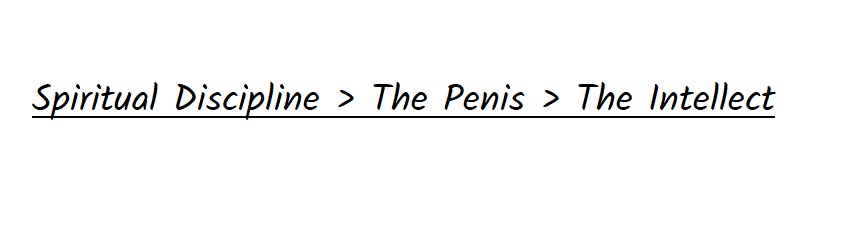
How many times has the Aql been overcome by the Penis? How many times has reason been overpowered by base impulses? The intellect and human reasoning are outmatched by the ‘Id again and again and again. How many strong men, capable men, men in powerful positions? How often have they been overcome by the penis?
Only a well-disciplined soul is an ally and an aid to the human faults of reasoning.
You can replace the word ‘Penis’ above for practically any other impulse. Driving down the freeway, someone cuts you off. Suddenly you are a ball of uncontrollable rage!
“How dare they!” “I will be late for work!” You speed up the car, cut them off at the next turn giving your favourite hand gesture and they reciprocate. Both individuals get out of the car and the fist start flying. You make your way back to your car, grab the gun and empty the clip! Murder one.
How is that? How did the faculty of reason and of intellect become so easily discarded like an utterly useless item?
Surely 10 to 15 years in prison will make one very, very late for work.
Did that thought not once cross the mind?
“And I do not seek to free myself (nafsi) from blame, for indeed the self (l-nafsa) is ever inclined to evil, except those shown mercy by my Lord. Surely my Lord is All-Forgiving, Most Merciful.” (Qur’an 12:53)
“And I do call to witness the self-reproaching (bil nafsi) self.” (Qur’an 75:2)
The intellect -reason on its own is misguided without divine guidance.
The intellect is overcome by the ‘id without the assistance of a disciplined soul.
An example of #1 would be:
An example can be that we have found four people: one needs a liver, one a lung, one a kidney and one a heart. Reason could lead us to believe that killing one person in order to save four has its own justification. This is because our thinking is linear. We do not see, for example, that the person we killed was responsible in the future for discovering a cure that saved millions upon millions of lives. Thus, the reason that was imposed: kill one and save four backfired. Four were saved and millions were lost.
“Believers! Fasting is enjoined upon you, as it was enjoined upon those before you, that you become (tattaquna) righteous.“ (Qur’an 2:183)
Fasting is a divinely prescribed prescription for a method of spiritual discipline. It has become one of many tools that Islam gives to aid and arm the intellect against base impulses.
In Islamic fasting, we’re fasting from sunrise to sunset, abstaining from food and drink. Sometimes it is quite easy for people, especially those who fast regularly outside of Ramadan and/or started this discipline quite young. Interestingly, the busier you make yourself in Ramadan, the easier it is too.
Those who struggle are usually people who are idle. Not working, schooling or engaging in anything meritorious. They are simply left with their hunger. There are times some may feel their parched throat, and the urge to drink. “Ya Allah, I am sorry I cannot go on, and I will pay back this fast.” This is where the real war happens. The jihad an nafs. — The struggle with the’ Id.
You either overcome it or it will overcome you. You either make it a slave of Allah or it will make you a slave to it. You either bring it in conformity with the amr of Allah or you become a slave to your base impulses.
Islam has never called for partial surrender to Allah (swt) but complete surrender to Allah (swt) and this happens when the ego submits, the super-ego submits and the ‘id submits.
Fasting is a purification and a chance to discipline the soul, a chance to assist and arm the intellect, which often loses its battle over and over against the penis, against the quick temper, against the base impulses.
You would technically go your whole life (complete the term of your existence) without any sexual interaction of any kind with any human being. Though, for many, that might be a sad, lonely and boring life. You could technically even be a productive and functioning human being in society as such. Though Islam does not recommend this.
You would technically go your whole life (complete the term of your existence) without any emotional outlet of any kind. You could technically even be a productive and functioning human being in society as such. But you are not a robot and Islam does not recommend this either.
Though you cannot continue to sustain yourself, you cannot continue to be a productive and functioning human being in society going forever without food or water.
Thus, if you can overcome that impulse that is intrinsic to your survival (fight/flight), if you can overcome that impulse to eat and drink, which is absolutely necessary for your survival, you can gain mastery over your other impulses, sexual and emotional, which are ancillary to your survival but not necessary. You can master yourself.
And if you are in control …..well then…
“To the righteous it will be said, “O reassured self (l-nafsu), return to your Lord, well-pleased and pleasing to Him.” (Qur’an 89:27-28)
May Allah Guide the Ummah. May Allah Forgive the Ummah.
“Behold, We revealed this (Qur’an) on the Night of Power.” (Qur’an 97:1)
﷽
May Allah bless us and grant us forgiveness, mercy, guidance, closeness to Allah (swt) and overflowing love for his Messenger (saw). We, at Prima-Qur’an are thankful you all are here.
Welcome to all the newcomers!!
May Allah continue to bless and guide you and us. Remember all the oppressed wherever they are in this world. Please keep us in your du’a this month. Please forgive our shortcomings. From our ‘s to your heart ‘s
Our du’a for you this Ramadan is that Allah (swt) grants you many openings and many beautiful resolutions to any and all challenges you may be facing.
We can only du’a that Allah is pleased with us all, considers us among the obedient slaves; that we are all spoken well of by Allah swt’s Angels and we all are protected and comforted by them; that our loved one be blessed ameen
{space for Nurul, Haider, ‘Abdullah to share their thoughts}
*The Grace of Ramadan*
Ramadan as Allah said is the month of the Qur’an, and Allah exalted commanded the believer to fast during this month, but contrary to what most people believe, fasting is not about abstaining from eating and drinking only, but fasting is abstaining from everything that Allah forbids, The Blessed Prophet (saw) said: “Backbiting breaks the fast and Wudu'”, and said: “No fasting except by abstaining from the prohibitions of Allah” and based on this we conclude that the importance of Ramadan is not just in abstaining from food and drink, but Ramadan is an entire school in patience and purification, the prophet peace be upon him said signifying the grace of Ramadan: “Who ever fasts Ramadan with faith and hope of retribution, his former sins will be forgiven, and if you knew the virtues of Ramadan you will wish it lasted a year”.
———————
*Ignorance of the religion*
Ignorance is not an excuse in the religion after obligation
Obligation in this context is directing the commands and prohibitions to the creature by his creator, and it has three conditions:
1- Intellect
2- Puberty
3- Establishing the argument
The argument is the proof, if someone meets the conditions then he is not excused for his ignorance, in addition to these conditions, there is “the absence of deterrent”, meaning: to be able to do what Allah commanded you to do, as Allah says: “Allah does not require of any soul more than what it can afford”.
Another aspect of this topic is the importance of seeking knowledge in Islam, Allah says: ” Say, ˹O Prophet,˺ “Are those who know equal to those who do not know?” None will be mindful ˹of this˺ except people of reason.” and the prophet peace be upon him said: “whoever Allah wants his goodness will give him knowledge in the religion” and said: “whoever purses a path seeking knowledge, Allah will make his path to paradise easier”.
———————
*Breaking the fast intentionally and unintentionally*
1- If someone unintentionally breaks his fast by forgetting and eating for example, he should continue his fasting and he doesn’t have to redo that day later
2- If someone intentionally breaks his fast by eating, drinking, having intimacy…etc, he has to redo that day after Ramadan and has to perform Kafarah Mughalladah, which is to free a slave or fast two months, and if he can’t then to feed 60 poor people.
“He is the One Who made the sun a radiant source and the moon a reflected light, with precisely ordained phases, so that you may know the number of years and calculation ˹of time˺. Allah did not create all this except for a purpose. He makes the signs clear for people of knowledge.” (Qur’an 10:5)
“Indeed, in the alternation of the night and the day and [in] what Allāh has created in the heavens and the earth are signs for a people who fear Allāh.” (Qur’an 10:6)
(Ramaḍan is the month (shahru) in which the Quran was revealed as a guide for humanity with clear proofs of guidance and the decisive authority.” (Qur’an 2:185)
Say, “Have you considered: if Allah should make for you the night continuous until the Day of Resurrection, what deity other than Allah could bring you light? Then will you not hear? Say, “Have you considered: if Allah should make for you the day continuousuntil the Day of Resurrection, what deity other than Allah could bring you a night in which you may rest? Then will you not see?” (Qur’an 28:71-72)
﷽
Subhan’Allah!
“And He is the One Who spread out the earth and placed firm mountains and rivers upon it, and created fruits of every kind in pairs. He covers the day with night. Surely these are signs for those who reflect.” (Qur’an 13:3)
“Indeed, in the creation of the heavens and the earth and the alternation of day and night, there are signs for people of reason.” (Qur’an 3: 190)
“Will they then not reflect on the Qur’an, or are there locks on the hearts?” (Qur’an 47:24)
If you are a teacher, you can easily give your student the answer to a question. However, it is much more fulfilling, not necessarily for the teacher but for the student to give the student the tools needed to find the answer.
We often expect that we can open the Qur’an, this chapter of that verse and find the answer. However, Allah (swt) has asked us to ponder upon the Qur’an. Simultaneously, Allah (swt) has asked us to ponder upon natural phenomena.
When is the last time any of us have reflected upon time? When is the last time anyone of us has reflected upon the calendar? The nature of the calendar. Who invented the calendar? What purpose does the calendar serve? Why is there a solar calendar and a lunar calendar? What is the difference between the two?
Please take some time to research this.
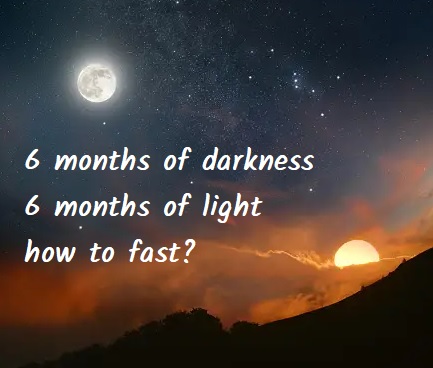
Now, we want to propose a thought experiment. Let us suppose that we are a people who live in the circumpolar arctic. All we know is 6 months of darkness and then 6 months of light.
Between a solar calendar and a lunar calendar, which of the two are we most likely to invent on our own based upon observable phenomena? We will give you a huge clue. The question is a trick question.
If today you were to travel to the circumpolar arctic and ask the people what day it is today. They would say that today is 4/4/2024 on the Julian calendar (a solar calendar).
If we ran into any Muslims they would say 24 of Ramadan 1445 (a lunar calendar).
Yet if we pressed them on this: Where did you get this information from? The most obvious answer would be the calendar. Yes, but where did they get this information from?
In other words, the concept of time that we find in the circumpolar arctic is not intrinsic to the people of that region. We have searched and not found any archeological evidence of the people of that region developing a calendar or a system independent of the solar or lunar calendars that are used by people the world over. You could say in a sense (forgive the pun) they are frozen in time. Though we know that this is not the case.
The point is that their concept of a month is not intrinsic to that region. Their reality is taken from the people nearest to them. Those who they had contact with. Those who migrated to those regions with this concept of time.
“And eat and drink until the white thread becomes distinct to you from the black thread at dawn. Then complete the fast until the night. And do not have relations with them as long as you are staying for worship in the masjid.These are the limits [set by] Allah, so do not exceed them. Thus does Allāh make clear His verses to the people that they may become righteous.” (Qur’an 2:187)
There are a few interesting highlights from this verse.
A) Eat and drink until the white thread/black thread becomes clear at fajr (dawn).
B) Then complete the fast at night (al-layli) (not maghrib) — this is because maghrib* in Arabic is a euphemism for “sunset” and or “west”. It, too, can be used to describe heavy, thick darkness (Qur’an 35:27) (al-layli encompasses maghrib), which is because layl begins at sunset.
*To clarify you fast until maghrib because it is the night. As has been mentioned, al-layli encompasses maghrib. In English, people say nightfall, which is another word for sunset.
“Do you not see that Allah sends down rain from the sky, and We produce thereby fruits of varying colors? And in the mountains are tracts, white and red of varying shades and [some] (wagharabibu) extremely black.” (Qur’an 35:27)
C) Those are Allah’s limits: keep well within them.
D) Allah makes clear his ayat (verses/signs) to people.
(Ramaḍân is the month (shahru) in which the Quran was revealed as a guide for humanity with clear proofs of guidance and the decisive authority.” (Qur’an 2:185)
So, what is a shahr? A month is 29/30 days according to lunar calculations.
“He is the One Who made the sun a radiant source and the moon a reflected light, with precisely ordained phases, so that you may know the number of years and calculation ˹of time˺. Allah did not create all this except for a purpose. He makes the signs clear for people of knowledge.” (Qur’an 10:5)
This verse also proves to us that time is not absolute. However, to have a functioning society, Allah (swt) has given us time relative to celestial bodies.
“And We have made the night and day two signs, and We erased the sign of the night and made the sign of the day visible so that you may seek bounty from your Lord and may know the number of years and the account [of time]. And everything We have set out in detail.” (Qur’an 17:12)
Months are used to calculate many aspects of Islamic law.
“Indeed, the number of months with Allah is twelve months in the register of Allah(kitabi-l-lahi), the day He created the heavens and the earth; of these, four are sacred. That is the correct religion, so do not wrong yourselves during them. And fight against the disbelievers collectively as they fight against you collectively. And know that Allah is with the righteous.” (Qur’an 9:36)
What is very interesting is that we have a template given to us by Allah (swt). This template is used for many aspects of Islamic law.
“And those who are taken in death among you and leave wives behind – for their wives is a bequest: maintenance for one year without turning them out. But if they leave , then there is no blame upon you for what they do with themselves in an acceptable way. And Allah is Exalted in Might and Wise.” (Qur’an 2:240)
” And those who are taken in death among you and leave wives behind – they, [the wives, shall] wait four months and ten days. And when they have fulfilled their term, then there is no blame upon you for what they do with themselves in an acceptable manner. And Allah is Acquainted with what you do.” (Qur’an 2:234)
“It is not lawful for a believer to kill another except by mistake. And whoever kills a believer unintentionally must free a believing slave and pay blood-money to the victim’s family—unless they waive it charitably. But if the victim is a believer from a hostile people, then a believing slave must be freed. And if the victim is from a people bound with you in a treaty, then blood-money must be paid to the family along with freeing a believing slave. Those who are unable, let them fast two consecutive months—as a means of repentance to Allah. And Allah is All-Knowing, All-Wise” (Qur’an 4:92)
This same template can be used anywhere on Earth as well as anywhere we travel in the stars. For example, let us say, for the sake of discussion, that it is feasible to live on Venus.
A day on Venus lasts for 243 Earth days or 5,832 hours! However, if we traveled to Venus we would travel with the flow of time relative to us. We would take our conceptual model of time with us.
So, for example: let us say that we left Earth on the 4th of April 2024. Let us say it takes 30 ‘earth days’ as that would be the unit of measure. When we arrive, it will be the 4th of May 2024. In all of our logs and journals we will record events relative to Earth UT (Universal time).
Of course, all the variables, via the science of mathematics, can be worked out with regard to method and mode of travel, the speed at which one was traveling and so forth.
The important point is that we have a template!
(Ramaḍân is the month (shahru) in which the Quran was revealed as a guide for humanity with clear proofs of guidance and the decisive authority.” (Qur’an 2:185)
“Believers! Fasting is enjoined upon you, as it was enjoined upon those before you, that you become righteous. Fasting is for a fixed number of days, and if one of you be sick, or if one of you be on a journey, you will fast the same number of other days later on. For those who are capable of fasting there is a redemption: feeding a needy man for each day missed. Whoever voluntarily does more good than is required, will find it better for him; and that you should fast is better for you, if you only know. During the month of Ramadan the Qur’an was sent down as a guidance to the people with Clear Signs of the true guidance and as the Criterion (between right and wrong). So those of you who live to see that month should fast it, and whoever is sick or on a journey should fast the same number of other days instead. Allah wants ease and not hardship for you so that you may complete the number of days required, magnify Allah for what He has guided you to, and give thanks to Him.) (Qur’an 2:183-185)
Fasting is enjoined us.
Those who live to see that month (Ramadan) should fast.
Complete the number of days
If sick or on a journey fast the same number on other days.
Fasting is for a fixed number of days.
“And eat and drink until the white thread becomes distinct to you from the black thread at of dawn. Then complete the fast until the night . And do not have relations with them as long as you are staying for worship in the masjid. These are the limits [set by] Allah, so do not exceed them. Thus does Allāh make clear His verses to the people that they may become righteous.” (Qur’an 2:187)
We can eat and drink until the white thread becomes distinct from the black thread at dawn.
We complete the fast at night, which begins at sunset.
We know those are the limits (template) set by Allah.
Allah makes his signs/verses clear.
We know that the concept of time that we find in the circumpolar arctic is not intrinsic to the people of that region. That they (those 10 million souls) in the circumpolar arctic follow the template of time to those near to them. It makes logical sense that they follow the template of fasting to those nearest to them with a true ‘sunrise’ and true ‘sunset’.
Just as a blind person would be dependent upon the one who can see to navigate for them. Thus, Allah (swt) creates relationships both dependent and inter-dependent.
It is actually a template that could theoretically be brought to other planets and/or star systems.
The other point we found fascinating is this. Everything is relative to our perception of things. As mentioned in another article if the Qur’an wording things differently we would have been accused of being flat earthers.
“Is there any reward for goodness except goodness? (Qur’an 55:60)
﷽
First we would like to share the video by brother Hatim for Ramadan day 29. As people know Muslims use the lunar calendar. Thus, Ramadan is 29 or 30 days.
*Eid prayer and Sunan of Eid* Firstly we send our greetings and congratulations for finishing this dense educational spiritual course which is Ramadan, now that it’s done we as Muslims should be happy in these blessed days of Eid, and a good quote we found: “Eid is exiting Ramadan not existing Islam”
Thus, we should always keep on remembering Allah and following the Sunnah of his Blessed Prophet (saw).
There are Sunnan and etiquettes we should follow for Eid: – To give the obligatory Zakat Al fitr, which we mentioned its rulings prior – Ghusl, brushing, and using perfumes and being in your best form – Eating before going to prayer – Walking to the Eid prayer location while changing the path when going and returning – To perform the prayer outside the city in an outdoor prayer hall – Saying the Takbir when going to pray – Exchanging congratulations for the worship in ramadan and for Eid – Visiting family – Giving charity, bringing joy to kids, and Halal playing and singing
Some rulings related to Eid: – It’s not allowed to fast Eid – You should pray before Eid prayer or after, except if you did the Eid prayer in a mosque so you pray two Rak’as before sitting – Greetings should be after prayer not before – The outdoor prayer hall takes the ruling of a mosque – All people can pray Eid prayer including women and children
How to perform Eid prayer: – The time of the Eid prayer is the time of Duha, so after Sunrise, it should be delayed a bit so that people can give their Zakat Al Fitr
– The Eid prayer is two Rak’as and from the Sunnah is reading Al A’la first then Surat Al Ghashiyah in the second Rak’a
– No Adhan or Iqamah for Eid prayer
– When performing Eid prayer there are more Takbirs than normal prayers, even though scholars differ in their number but they are all correct by Allah’s will, here are some forms: – 13 more Takbirs: 5 after Takbir Al Ihram, 5 after reciting in the second Rak’a and 3 after standing from the second Ruku’ (this is the most common in Oman) – 13 more Takbirs: 6 after Takbir Al Ihram and 7 after reciting in the second Rak’a (Shaykh Ahmed Al Khalili’s choice) – 12 more Takbirs: 7 after Takbir Al Ihram, 5 after standing for the second Rak’a (Shaykh Saeed Al Qannoobi’s choice)
– After the prayer, the Imam should stand and give a Khutbah(speech) that starts with thanking Allah while increasing Takbirs to give them advice for their religion and to remind them about Zakat Al Fitr
And when Allah spoke about Ramadan he said: (so that you may complete the prescribed period and proclaim the greatness of Allah for guiding you, and perhaps you will be grateful)
After finishing Ramadan
On the topic of Tazkiyah: Alhamdulillah we mentioned the topics from the book (towards a longer life of faith) by Shaykh Naser Bin Said Al Azri
On the topic of Aqeeda: We went through more than half the concept in the book (Explanation of Ghayat Al Murad poem) by Shaykh Ahmed Al Khalil
On the topic of Fiqh: we mentioned around 29 different issues and topics related to prayer, fasting, Zakah and different types of worship.
insha’Allah we will continue the Aqeeda section until we finish the book.
May Allah accept this, and grant us sincerety in seeking knowledge.
May Allah Forgive the Ummah. May Allah Guide the Ummah.
“And We have certainly made the Quran easy to remember. So is there anyone who will be mindful?” (Qur’an 54:40)
﷽
Ramadan Day 28: How to form a meaningful relationship with the Qur’an.
*28th of Ramadan* ——————————– *Heart Illness: Obeying satan* Allah says: “Did I not command you, O Children of Adam, not to follow Satan, for he is truly your sworn enemy.” (Qur’an 36:60)
The scholars mention that satan has ways and openings to deceive people like: First the devil tries to drag the person to denying the existence of Allah, by saying: the universe happened by accident, you should take a medium between you and Allah…etc
If the devil couldn’t go through the previous opening he will try to come through innovations, which is by adding things to the religion that are not in the religion.
The third opening is the aspect of major sins, by convincing the Muslim that as long as he believes in Allah it’s fine to commit major sins.
If the person avoids major sins, the devil will try to come through the aspect of minor sins, by telling the person: you are a believer and you avoid major sins, so it’s fine if you do small minor sins like glimpsing at women or insulting others, so when it becomes a habit, it opens the door of major sins, *do not despise minor sins, as mountains are made up of stones*
If the Muslim has strong faith and avoids all sins, the next opening will be through increasing in permissible things, by convincing him for example that his car is old so he should buy a more expensive car…and so on…until this person is used to luxury and forgets to spend his wealth in obedience.
Instead of his thinking to be for the priorities of the Ummah and the might of Islam, you see him thinking about markets, perfumes, clothes and garments, and when these people meet, their speech is basically: “The fabric of your clothes is beautiful, where did you buy it from?” and the talk becomes about cars and clothes, is it Haram? No, but it shouldn’t be at the expense of more important things, until the mind is not busy with important things but busy with recreation, recreation and recreation.
“By men who are not distracted—either by buying or selling—from Allah’s remembrance, or performing prayer, or paying alms-tax. They fear a Day when hearts and eyes will tremble.” (Qur’an 24:37)
Finally if this person is righteous, the last resort for the devil is to try and lower the reward of the Muslim from doing the important to the less important.
*Walayah and Bara’ah of monotheism and worship* We have mentioned some issues related to walayah and bara’ah.
Today will see another classification in walayah and bara’ah based on the reason for walayah:
Walayah for the sake of monotheism: This type is a part of the creed of the Muslim, under this classification is walayat al jumlah and walayat al haqiqah, because these two types are obligated with a certain text so denying this type puts the person out of the circle of Islam because it means denying a certain text Walayah for the sake of obedience: This type is a form of worship which is walayat ad dahir, and it’s to ally with people based on their appearance to you, so it’s a practical demand, but whoever denys this type is on Kufr Ni’ma only unlike the previous type.
*prostration of recitation* Sujud tilawah: is a single prostration performed by a person who recites a verse of prostration in the Qur’an.
Its ruling: obligatory in the opinion of Shaykh Ahmed Al Khalili (h), recommended in the opinion of Shaykh Saeed Al Qannoobi (h), the latter is the opinion of most our scholars.
The verses of prostration: There is a difference of opinion between our scholars on the verses of (Annajm, Al inshiqaq and Al alaq) the opinion of the two shaykhs is that they include prostration, the second prostration in Surat Al hajj isn’t proven so in total there are 14 positions for prostration in:
When performing Sujud tilawah you should be upon Wudu’ and this is the safee opinion.
You should perform sujud tilawah if you recite a prostration verse or listen to it, when repeating the verse to memorize it, it’s enough to prostrate ones, it’s not necessary to perform the prostration when saying the verse with the intention of quoting it, for example in speeches. Allah knows best.
“Indeed, We have made it an Arabic Qur’an that you might understand.”(Qur’an 43:3)
﷽
For many, the last 10 days of Ramadan will be spent doing extra prayers, late night vigils, reading of the Qur’an, finding charitable causes, time with family and iktikaaf (overnight) stay in the masjid.
Yet, for others, the last 10 days of Ramadan presents a sort of moral dilemma.
So here we are. Attacking Shaykh Mufti Menk for breaking Iftar with a Jewish Rabbi. Let’s attack Dr. Jonathan Brown for writing the book “Islam & Blackness” because human beings shouldn’t be writing books about corals in the coral reef! You aren’t a coral!
And now attacking Shaykh Hamza Yusuf for the same beliefs that the attackers in reality themselves hold! Namely, their baseless assertion that the Qur’an is eternal and uncreated!
“and not subsisting in Allah” Notice how he says that like it’s a good thing!
ٱللَّهُ لَآ إِلَهَ إِلَّا هُوَ ٱلْحَىُّ ٱلْقَيُّومُ (Qur’an 3:2) This one verse in the Qur’an absolutely demolishes the theology of Ibrahim Ibn Mahmud and anyone else who comes along and tries to tell you that Allah (swt) is a compound unity of attributes subsisting and not identical to the essence of Allah (swt).
Al Hayyu and Al Qayyum is what Allah (swt) is. He tells you in clear language in the plain text (dhahir) apparent text that He (ALLAH) Is the Ever Living Self Existing!
You cannot have a self-existing “attribute” called “al qayyum” subsisting! Authubillah min dhalik! (May Allah protect us from that)
We don’t need the real proponents of innovation and speculative theology like Ibrahim Ibn Mahmud, the Athari, to come along later and say other than what the clear text of the Qur’an says.
If the Qur’an is not from the time of the Salaaf Us Salih (then nothing is)!
Why would a well-informed Christian who believes in the Athanasian creed leave their faith for Islam? What are you people really calling to?
This is what these people are calling to. It is this reason why they will not admit what Allah (swt) has clearly stated in the Qur’an:
“Indeed, We have made it an Arabic Qur’an that you might understand.” (Qur’an 43:3)
Give us a single text in the Qur’an where it says it is not made!
Allah (swt) clearly told you that it is!
The reason is that to say that the Qur’an is uncreated is to say that Allah (swt) has an attribute called speech, and his attributes are eternal, and yet they are not identical to his essence, nor other than it. Yet subsisting. So that you end up sounding exactly like this…..
Read it and beware!
Point 5.
“There is little in Berkhof’s explanation of the Trinity that should surprise anyone familiar with the Reformed tradition. He affirms that there is in the Divine Being but one indivisible essence, and that in this Being there are three Divine Persons or individual subsistences (87). On this latter point, Berkhof helpfully reminds us that there are not three individuals in the Godhead, alongside of and separate from each other, but rather “personal self-distinctions within the Divine essence” (87). Perhaps this is why theologians in the Reformed tradition tend to talk of order and operations instead of roles and relationships. The first pair of terms suggests self-distinctions, while the second pair suggests separate individuals.”
Taking a look at the video attack upon Shaykh Hamza Yusuf.
Notice the very first thing this video does. Does it go to the Qur’an? No! Does it appeal to the Sunnah? No!
@0:43 minutes they appeal to an Imam. Can you imagine? These people castigate the Shi’a for appealing to the Imams and they do the exact same thing.
After the appeal to their Imam, then the revelation of Allah (swt) states comes next.
“Rather it is an honoured Qur’an in the preserved tablet.”(Qur’an 85:21-22)
Point 1). The Qur’an is in a preserved tablet. Preserved tablet =NOT ALLAH.
Yes, the very preserved tablet that is the revelation of Allah (swt) states:
“Ha-Mim By the Book that makes things clear,-We have made it a Qur’an in Arabic, that you may be able to understand and learn wisdom. And verily, it is in the Mother of the Book, in Our Presence, high in dignity, full of wisdom. Shall We then take away the Message from you and repel (you), for that you are a people transgressing beyond bounds? (Qur’an 43:1-5)
Point 2). The Qur’an has been made in Arabic. ALLAH =NOT MADE.
Point 3). It is in the presence of Allah. It is distinct from Allah (swt). ALLAH = NOT COMPOUND UNITY
Point 4). The Qur’an is in the mother(origin) of the book. ALLAH=HAS NO MOTHER(ORIGIN)
Point 5) The attributes of Allah (swt) are not contained IN a mother book.
“Allah eliminates what He wills or confirms, and with Him is the Mother of the Book.” (Qur’an 13:39)
This Qur’an is in a preserved (maḥfūẓin) tablet.
Point 6) Allah (swt) nor his attributes are in need of preservation, sustenance, upkeep, maintenance, conservation. ALLAH=ETERNAL.
Point 7) The Qur’an is contained in ‘the mother of the book’ (43:4) which is WITH Allah (13:39)
With shows a clear distinction from Allah (swt).
@1:20 we get another verse from the Qur’an.
“And if any one of the ungrateful disbelievers seeks your protection, then grant him protection so that he may hear the words of Allah . Then deliver him to his place of safety. That is because they are a people who do not know.” (Qur’an 9:6)
Let us first deal with some flawed mantiq (logic).
First, it is sufficient to attribute to Allah (swt) the attribute of power without the attribution of speech. Speech is not the opposite of dumbness, such that dumbness is negated by affirming it. The opposite of speech is silence. It does not mean that a non-speaking person is dumb; rather, he is not non-silent.
There also seems to be some confusion from those who call themselves ‘Salafi’, among others, with regard to Allah’s knowledge of it, whereas there is an attempt to equate the attributes of Speaking and Knowledge as being both eternal. Eternal knowledge of a thing does not mean the thing itself is eternal. Otherwise, all of us would be eternal.
We affirm the attribute of “speech” for Allah (swt) as Imam Diya al-Din ‘Abd al-Aziza Thamini (raheemullah), says in his Mu’alim:
“Know that speech is sometimes referred to Allah in the meaning of negating dumbness of Him, and it then is to be understood as an essential attribute in the way of such attributes. And sometimes it is referred to Him in the sense of its being one of His actions, and it is then to be understood as such. So the meaning of His being Speaking, according to the first interpretation, is that He is not dumb; and according to the second that He is a Creator of Speech.”
The Qur’an has never called the speech of Allah (swt) ‘eternal‘. This is pure kalaam!
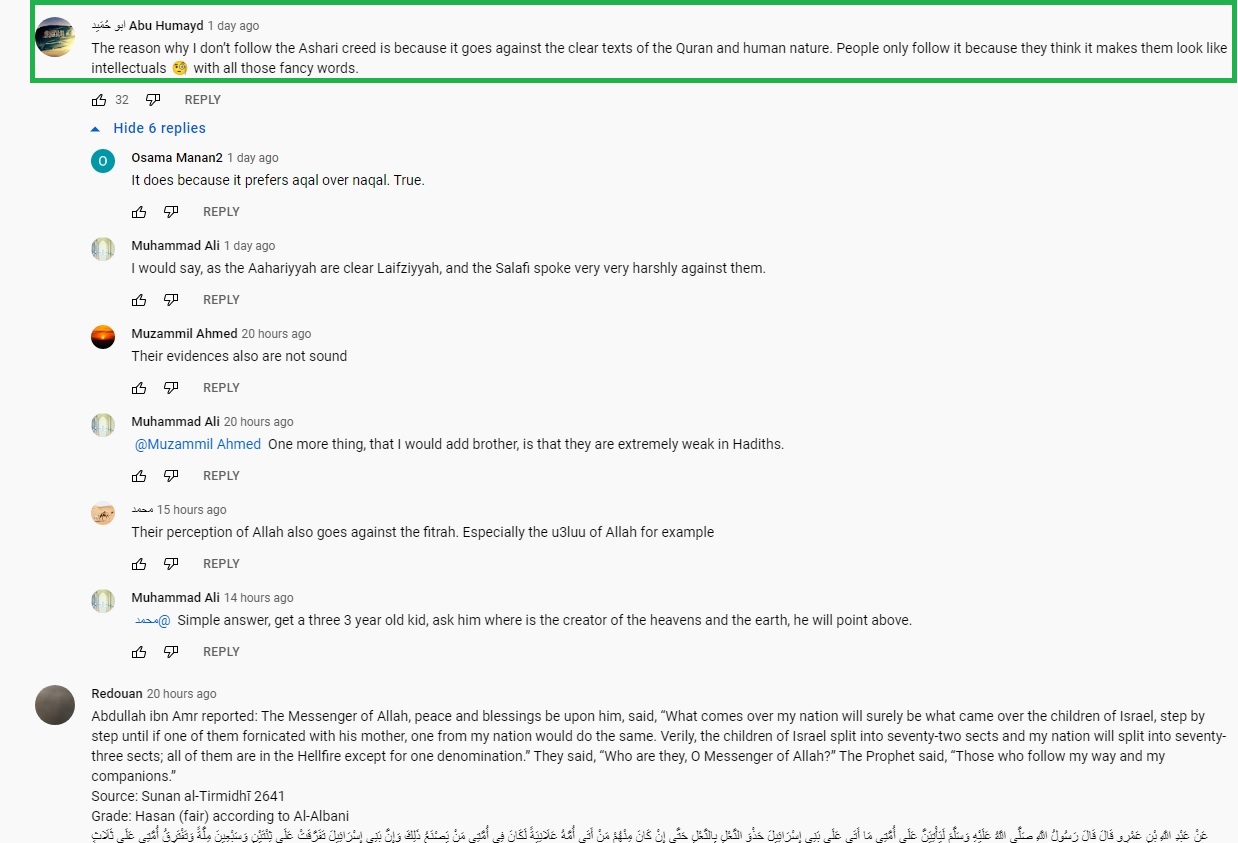
“The reason why I don’t follow the Ashari creed is because it goes against the clear text of the Qur’an and human nature. People only follow it because they think it makes them look like intellectuals with all those fancy words.” -Abu Humayd
“Indeed, We have made it an Arabic Qur’an that you might understand.”(Qur’an 43:3)
This text is quite clear.
IMAM AHMED AN INNOVATOR ACCORDING TO IBN TAYMIYYAH?
Think about it, dear respected Muslim sisters and brothers. The fact that our great scholars actually mused over this is really sad.
“Then, among them are those who say that the ink is apparent in the mushaf but not incarnating, and some say that it is incarnating. In the sayings of some of them is what implies that for the form—the form of the letter and figure – but not for its material substance, which is its ink. This opinion is also invalid. Just as the saying, that anything from the voices of human beings is eternal, is an invalid opinion. It is an opinion put forward by a group from among the followers of Malik, Shafi’i, and Ahmad, the majority of whom reject it. The saying of Ahmad and the majority of his followers rejecting his opinion is well-known. There is no doubt that whoever says that the voices of servants are eternal, he is an innovator and inventor. In the same way as whoever says that this Qur’an is not the word of Allah, he is an innovator and an inventor”
Source: (Fatawa Ibn Taymiyyah (Matabi al-Riyad, 1st edition, 12:83-873,83-85)
THE REAL REASON FOR THIS DEBATE/DISCSSION: IS THE QUR’AN ETERNAL or CREATED?
The real reason for this debate is that there are those in the Muslim Ummah that believe Allah (swt) has attributes that are not identical to his essence nor other than it.
TAWHID vs TRINITY.
Tawhid: The belief that Allah is one being that has an undefined/undisclosed number of self-distinctions subsisting with in the divine essence.
Trinity: The Belief that God is one being that has three personal self-distinctions within the Divine essence.
In reality, there is no such debate: Tawhid vs Trinity. The real debate is: In what sense is God a Unity?
In the way that the Athari/Ashari/Maturdi proclaim? Or in the way that Athanasian Christians proclaim?
The real debate between the vast majority of Christians and the vast majority of Muslims (Salafi-Athari/Ashari/Maturdi) should be: In what sense is God a Unity?
May Allah (swt) guide us all to what is beloved to him.
May Allah (swt) guide Shaykh Hamza Yusuf and Ibrahim ibn Mahmud.
If you would like to read more articles concerning Shaykh Hamza Yusuf you maybe interested in:
“So compete with one another in doing good.” (Qu’ran 2:148)
﷽
Ramadan Day 27: The more people who compete in goodness the more goodness will spread in this world.
*Heart Illness: Eating Haram* From the things that cause heart toughness is eating Haram, that is why Muslims should search for Halal in his food, drink and clothing.
In a narration that Abu Bakr may Allah -be pleased with him- drank some milk brought to him by a slave of his, he asked him: “where did you get this from?” the slave replied: “I did some fortune telling for some people and they gave me it in return”,
So Abu Bakr put his finger in his throat to throw up out of fear that he ate Haram.
A Lesson in Scrupulousness (Wara’): This incident is a prime example of the extreme piety and scrupulousness of the Prophet’s Companions, especially Abu Bakr as-Siddiq. They were not just concerned with avoiding major sins but were also hyper-vigilant about the source of their sustenance (rizq), ensuring it was 100% pure and lawful (halal).
*Walayah and Bara’ah of Rulers and Their followers* It’s obligatory to ally with the Imam of Muslims who is appointed by Ahl al-ḥall wa-l-ʿaqd (Arabic: أهل الحل والعقد) -which is an Islamic concept referring to “the people who loosen and bind, and took the path of the Qur’an and the Sunnah, his walayah in this case is as obligatory as obeying him as long as he doesn’t do something that would prevent obeying him.
It’s also obligatory to ally with all the people under his authority while they obey the Imam if no bad things comes out of them and they don’t violate the laws of Allah.
Question: Some may wonder: why are we giving the subjects of the Imam a special case when it’s the same as any other person? The answer: when the law of Allah is applied by a legal Imam and the rulings are applied for the strong and the weak, the people are supposed to be upon straitness except those who do what obligate dissociation and as much as you should ally with the just Imam you should also dissociate from the unjust ruler and anyone who helps him and aids him in his injustice.
However, you shouldn’t dissociate from all the subjects of the unjust Imam as there could be some believers who are forced to live under the rule of an oppressor.
If you would like to learn more about this we refer you to our article here:
*Zakat Al Fitr* Zakat Al Fitr also known as Zakat Al Abdan is an obligatory type of worship related to the people (and not wealth) the other type of Zakah which is obligated based on the wealth of the individual to purify his wealth, but Zakat Al Fitr isn’t about the wealth but about the soul so it is made to purify the soul.
Who is it obligated for? Answer: It’s obligated for eveey Muslim, man or woman, old or young, free or slave. The person gives it for himself and whoever he provides for, and if someone wants to give the Zakah instead of someone who he doesn’t legally have to provide for then he should tell him first. and knowing the fact that it’s given based on souls and not wealth, this means that even the poor should give Zakat Al Fitr if he can sustain himself for a month.
When is the time of Zakat Al Fitr? Answer: the opinion of Shaykh Ahmed Al Khalili (h) and Shaykh Saeed Al Qannoobi (h) is that the time of Zakat Al Fitr starts from the sunset of the last day of Ramadan until the Eid prayer.
There are three permitted times for Zakat Al Fitr: – after the sunrise of Eid until the Eid prayer, and this is the best time – after sunset of the last day of Ramadan – three or four days before Eid, as was done by some companions, and this can be due to the nature of place and time, as long as the person who is given the Zakah remains worthy of it (alive, Muslim, poor…etc)
What should be given? Answer: the Hadith mentioned some types of food like dates, barley, raisin…etc, in the prominent opinion: the food given in Zakat Al Fitr shouldn’t necessarily be from the types mentioned in the Hadith but should be based on what the local people use as food, for example here in Malaysia the common food is rice.
How much should be given? Answer: one unit of Sa’ صاع and it’s a measurement of volume approximately equivalent to four hand fulls of an average man.
because Sa’ is a measurement of volume instead of mass we should be careful as this means that each food type can differ in mass.
1 Sa’ ≈ 2.43 Liters 1 Sa’ of rice ≈ 2.048 kg of rice
I hope this overview is clear and Allah knows best
“Every soul will taste death. And you will only receive your full reward on the Day of Judgment. Whoever is spared from the Fire and is admitted into Paradise will triumph, whereas the life of this world is no more than the delusion of enjoyment.” (Qur’an 3:185)
﷽
Ramadan Day 26:Purifyyour intentions and work hard.
*26th of Ramadan* ——————————– *Heart Illness: Loving the Dunya* From the things that destroy the heart is the love of this life and its desires. Loving this life is the start of every sin, the permitted things in this life are reckoning, it’s prohibitions are punishments, its start is crying, its middle is pain and its ending is mortality.
Allah says:
“The enjoyment of desires—women, children, treasures of gold and silver, fine horses, cattle, and fertile land—has been made appealing to people. These are the pleasures of this worldly life, but with Allah is the finest destination.” (Qur’an 3:14)
and
“And give them a parable of this worldly life. like the plants of the earth, thriving when sustained by the rain We send down from the sky. Then they turn into chaff scattered by the wind. And Allah is fully capable of all things.” (Qur’an 18:45)
The companions, may Allah be pleased with them, were filled with a love for the Blessed Prophet (saw) that was deeper than the love for their own families. They wished for every comfort and ease for him, and it pained them to see him in any state of hardship.
On one occasion, they entered upon the Messenger of Allah (saw) and saw that he had been sleeping on a simple, coarse mat made of palm fibers. The harsh weave of the mat had left its clear imprint on his blessed side, marking his skin with its pattern.
Their hearts swelled with compassion and concern. One of them exclaimed, “O Messenger of Allah! Why didn’t you call us so that we could have spread a softer, more comfortable bedding for you?”
They longed to provide him with every comfort, to spare him from the slightest discomfort. But the Blessed Prophet (saw), whose mission was to teach humanity the meaning of life, turned to them with a gaze filled with profound wisdom. He was not concerned with the fleeting comforts of a world he understood to be a mere passage.
He (saw) said:
“What have I to do with this world? My example and the example of this worldly life is but that of a rider who journeyed on a scorching summer’s day. He stopped to rest in the shade of a tree for a short while. Then, he rose and continued on his journey, leaving it behind.”
—
Explanation and Meaning:
With this magnificent parable, the Blessed Prophet (saw) distilled the entire Islamic outlook on life:
The Rider: This is the believer, the soul on its journey through existence. Our ultimate destination is not this world, but the Hereafter (al-Ākhirah)—the meeting with our Lord.
The Scorching Summer Day: This represents the toil, trials, heat, and hardships of worldly life. It is a temporary state of difficulty through which one must pass.
The Shade of the Tree: This is the metaphor for the worldly life (ad-Dunyā) itself. It is a temporary respite, a momentary relief from the journey’s heat. It is a blessing from Allah, to be used gratefully but not to be mistaken for a permanent home.
The Short Nap: This signifies the brevity of human life. No matter how long one lives—60, 70, or 100 years—in the grand scale of eternity, it is nothing more than a brief pause, a short nap.
Leaving it Behind: This is the crucial point. The rider does not pack up the tree and take it with him. He does not become attached to the shade. He enjoys its respite, thanks Allah for it, and then moves on toward his real goal without a backward glance. Similarly, a believer uses the comforts and blessings of this world as a means to aid their worship and journey to Allah, never becoming enslaved by them or heartbroken at their loss.
*Walayah and Bara’ah of Dhahir* Last time we mentioned Walayah and Bara’ah of Haqiqah and Jumlah, today we will take a look at the third type which is walayah and bara’ah of Dahir, the word dhahir refers to the appearance, so you judge the people based on their appearance.
Walayat ad-dhahir is based on what is apparent from a person, and his straightness in his sayings and actions, like so, Bara’ah is based on the apparent of the people if they fall in a violation of truth by saying or doing while insisting on it.
There are three ways for walayah: 1. Preview: it is when the person sees the other in what shows his straightness without deviation from the truth by saying or doing, while hastening towards repenting after making a mistake.
2. Reputation: when a person is known for his righteousness and the toungs repeat this around.
3. Testimony: it’s to get this from two witnesses, and there is an opinion regarding if one person can be sufficient.
These ways are the same for bara’ah but it has one more way which is self-endorsement of committing a major sin either by saying, doing or believing.
and if there is some whom is unknown to you, or you can’t fit him in the previous conditions then he should be in Wuquf (to stop) until he can be put in walayah or bara’ah.
If you want to read more on this most important concept in Islam.
*The relationship between the prayer of the Imam and the Followers* The most prominent opinion in this issue is that the the prayer of the followers are linked to the prayer of the Imam, so if the prayer of the Imam is corrupted then the prayer of the followers is corrupted, based on the following pieces of evidence:
The imam carries some actions in the prayer, which the follower should have done if he prayed alone
The follower cannot precede the imam in anything in the prayer or else his prayer will break
If the follower was a traveler he should pray 4 Rak’as behind a resident imam, even though it’s obligatory for him to pray 2
The saying of the Blessed Prophet (saw):
“The imam was made to be followed, so if he prays standing pray standing, and if he prays sitting pray sitting.”


 Please forgive our many short comings and faults. While we celebrate let us not forget those who can’t due to war and oppression. Let us not forget the converts, often alone and isolated.






 Prima Quran