“O Adam, dwell, you and your wife, in Paradise and eat there from abundance from wherever you will. But do not approach this tree, lest you be among the (l-ẓālimīna)wrongdoers.” (Qur’an 2:35)
“But Satan caused them to slip out of it and removed them from that in which they had been. And We said, “Go down, as enemies to one another, and you will have upon the earth a place of settlement and provision for a time.” (Qur’an 2:36)
“So he brought about their fall through deception. And when they tasted of the tree, their nakedness was exposed to them, prompting them to cover themselves with leaves from Paradise. Then their Lord called out to them, “Did I not forbid you from that tree and tell you that Satan is your sworn enemy?” (Qur’an 7:22)
“And Adam and his wife ate of it, and their private parts became apparent to them, and they began to fasten over themselves from the leaves of Paradise. And Adam disobeyed (waʿaṣā ) his Lord and erred.” (Qur’an 20:121)
“They replied, “Our Lord! We have wronged ourselves. If You do not forgive us and have mercy on us, we will certainly be losers.” (Qur’an 7:23)
“Allah said, “Descend as enemies to each other. You will find in the earth a residence and provision for your appointed stay.”(Qur’an 7:24)
﷽
A bone chilling reminder. Dear brothers and sisters and truth seekers. This is the month of mercy and forgiveness. Seek it!
Shaykh Dawud Bu-Sinani reminds us:
“Allah The Exalted, removed our Father Adam alayi salam, from heaven. For what reason did Allah (swt) remove him? For the reason of committing a single sin only! For the people of now (in these times) belittle committing a single sin and consider it severe only when they gather many (sins).”
“As if a problem only arises and is connected only to when the sins become many. No!”
“A sin in the sight of Allah is considered severe. Even if it were just one!”
“And if it were not like that, then why did Allah The Exalted remove our Father Adam alayhi salam, from a huge blessing in the form of heaven for the sake of committing one sin only, only! “
“Do not disobey your lord, even if it is just by one sin (one time) only! For it is not the number of sins committed that is considered; rather, it is He who you have sinned against that is considered. And that is ALLAH the MAGNIFICIENT!”
“So if you commit a sin under the pretext that it is just one (one time) and one only and that you won’t commit more. And as a result of continuing such, you eventually lose huge favour (from Allah) such as: health, offspring, spouse, work, shelter or any other favour!”
“Then do not blame anyone other than yourself! For you are not greater than our Father Adam alayi salam.”
Prima Qur’an comments:
“And We had already taken a promise from Adam before, but he forgot (fanasiya); and We found not in him determination.” (Qur’an 20:115)
Allah (swt) removed Adam (as) from paradise for what we may consider a simple act of fanasiya (negligence). Look at this Arabic word (fanasiya) and look how it used here:
“And from those who say, “We are Christians” We took their covenant; but they forgot (fanasū) a portion of that of which they were reminded. So We caused among them animosity and hatred until the Day of Resurrection. And Allah is going to inform them about what they used to do.” (Qur’an 5:14)
The Christians were cursed and given the curse of animosity and hatred among each other until the day of resurrection. This means Allah (swt) must have found in them determination. Where as witih Adam (as) he did not.
What about the Muslim who goes beyond what we may consider simple matters of negligence? One who sins and persist in the sinning. One who does not even seek forgiveness from Allah (swt)? What is that person’s condition?
Is there any Muslim today who considers themselves better or the equal of Adam (as)?
Allah (swt) inspired Adam (as) with words of forgiveness and the Allah (swt) forgave Adam. Yet, the effects of the sin took place. That is the explusion from the paradise.
According to the proofs and evidence advanced by the Sunnī schools of theology (Ashʿarī, Atharī, Māturīdī) if a Muslim dies without repenting from their major sins, they will spend an undisclosed period in hellfire. (Billions of years perhaps).
According to the proofs and evidence advanced by the Shiʿi and Ibāḍī schools of theology, if a Muslim dies without repenting from their major sins they will be in hellfire without reprieve.
No matter our theological position on what happens to the unrepentant sinners in the hereafter (billions of years in hellfire or indefinitely), the Shaykh has made a forceful point.
Even in the various Ṣūfī tariqa. How often during the day is it permissible to be in a state of ghaflah (heedlessnes)? In taṣawwuf, when is it permissible to not be in a state of dhirk (remembrance) of Allah? When is it permissible to forget Allah?
When we sin are we in a state of dhirk or ghaflah?
We need to get right with Allah. We need to purfiy ourselves and our intentions.
“And keep in mind that Allah’s Messenger is in your midst. If he were to yield to you in many matters, you would surely suffer. But Allah has endeared faith to you, making it appealing in your hearts. And He has made disbelief, rebelliousness, and disobedience detestable to you. Those are the ones rightly guided.” (Qur’an 49:7)
“And who is more unjust than he who forges a lie against Allah” (Qur’an 6:93)
﷽
“The hadith reported by Al-Bukhari that Adam’s height was sixty yards, has been criticized by Ibn Hajar on the basis of the measurement of the homes and dwellings of some of the ancient nations, which do not show that their inhabitants were enormously tall.”
Source: (A Textbook of Hadith Studies, Authenticity, Compilation, Classification, and Criticism of Hadith pg. 204)
“The hadith, reported by al-Bukhari, that Adam’s height was sixty yards, has been criticized by Ibn Hajar on the basis of the measurement of the homesteads of some of the ancient nations which do not show that their inhabitants were of an enormous height.” (SB, Kitab al-Anbiya, bab khalq Adam; Fb (Egypt, 1320 A.H), vi,230)
Source: (Hadith Literature Its Origin, Development, Special Features, and Criticism pg 202.)
The following hadiths in Bukhari are thought to be taken into account here:
“Narrated Abu Huraira: The Prophet said, “Allah created Adam, making him 60 cubits tall. When He created him, He said to him, “Go and greet that group of angels, and listen to their reply, for it will be your greeting (salutation) and the greeting (salutations of your offspring.” So, Adam said (to the angels), As-Salamu Alaikum (i.e. Peace be upon you). The angels said, “As-salamu Alaika wa Rahmatu-l-lahi” (i.e. Peace and Allah’s Mercy be upon you). Thus the angels added to Adam’s salutation the expression, ‘Wa Rahmatu-l-lahi,’ Any person who will enter Paradise will resemble Adam (in appearance and figure). People have been decreasing in stature since Adam’s creation. “
“Narrated Abu Huraira: Allah’s Apostle said, “The first group of people who will enter Paradise, will be glittering like the full moon and those who will follow them, will glitter like the most brilliant star in the sky. They will not urinate, relieve nature, spit, or have any nasal secretions. Their combs will be of gold, and their sweat will smell like musk. The aloes-wood will be used in their centers. Their wives will be houris. All of them will look alike and will resemble their father Adam (in statute), sixty cubits tall.“
Someone has claimed that Ibn Hajar (rh) rejected the hadith that stated that Adam (as) was 60 cubits tall in his book Fath ul Bari and that the reasoning was archaeological evidence which didn’t conform to the hadith?
Shaykh Haddad’s response:
“Ibn Hajar did not reject the hadith but said that there was an apparent contradiction between its wording of sixty cubits and the archaeological findings of the people of Thamud whose distance from the time of Adam (as), he said, “is less than the time elapsed between them and the beginning of this Umma.” This is phrased as just a thought that causes the explanation of the hadith to be problematic, not a rejection of the basis of the hadith. Further, one might see a problem in the objection itself.”
In sum, (1) the assumption that Ibn Hajar “rejected” the hadith of the sixty cubits is inaccurate even if thus forwarded by M. Zubair Siddiqi in his ‘Hadith Literature’ and (2) the problem raised by Ibn Hajar is open to question.
Question 2) Surely the archaeological information would be subservient to the knowledge of hadith?
Shaykh Haddad’s response
“The knowledge imparted by hadith is assumptive (zanni) and becomes categorically binding only with the mutawatir.”
“Further, is there true conflicting information here, i.e. correctly interpreted and dated findings?”
What Shaykh Gibril mentions here is that Ibn Hajar questions the ‘matn’-text of the hadith because it contradicts known archaeological evidence.
He also makes an interesting plea that the hadith is (zanni) which he translates as ‘assumptive’. The word (zanni) can also be translated as ‘speculative’. This means it has the probability of being true and the probability of not being true.
However, the point here is that if these hadith are sound and then many people would take that to mean that the Messenger of Allah (saw) definitely said it.
The creation of Adam (as) was miraculous creation.
Indeed all of creation is a miracle.
A possible challenge some would have with accepting Adam (as) being 90 feet tall is that the hadith seems to be silent on the height of Eve (as). In Arabic the companion of Adam (as) is known as Hawwāʾ(as).
One would also have to point to a time in the archaeological/historic records in which the offspring of Adam (as) and Eve (as), including subsequent generations, ceased being so tall.
Lastly, many of these hadith have as their source Abu Huraira -a problematic transmitter when it comes to Israʼiliyyat hadith. As they would mix up his reports from the Blessed Messenger (saw) with those of his reports from the Israʼiliyyat.
عن بسر بن سعيد ، قال : اتقوا الله ، وتحفظوا من الحديث ; فوالله لقد رأيتنا نجالس أبا هريرة ; فيحدث عن رسول الله – صلى الله عليه وسلم- ويحدثنا عن كعب ثم يقوم ، فأسمع بعض من كان معنا يجعل حديث رسول الله عن كعب ، ويجعل حديث كعب عن رسول الله ،
صلى الله عليه وسلم .
“On the authority of Busr ibn Sa’id , said: Fear God, and be careful with hadith; for by God, I saw us sitting with Abu Hurayrah ; and he would narrate on the authority of the Messenger of God (peace and blessings be upon him) and he would narrate to us on the authority of Ka’b , then he would get up, and I would hear some of those who were with us attributing the hadith of the Messenger of God to Ka’b , and attributing the hadith of Ka’b to the Messenger of God (peace and blessings be upon him).”
In other words people were mixing up what was being narrated from Ka’b (ra) and what was being narrated from the Blessed Messenger (saw)!
This is from Imam al-Dhahabi in his ‘Siyar A’lam al-Nubala’ under the section talking about Abu Huraira.
This is one of many reasons why we in the Ibadi school are very careful when it comes to narrations from Abu Huraira concerning the Israʼiliyyat. However we take from him in matters of jurisprudence.
Lastly, even though there are among our Muslim brothers who will cling fast to these hadith we would like to make the following plea to them.
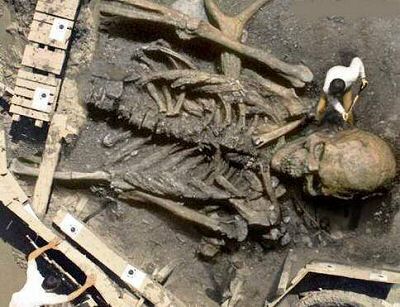
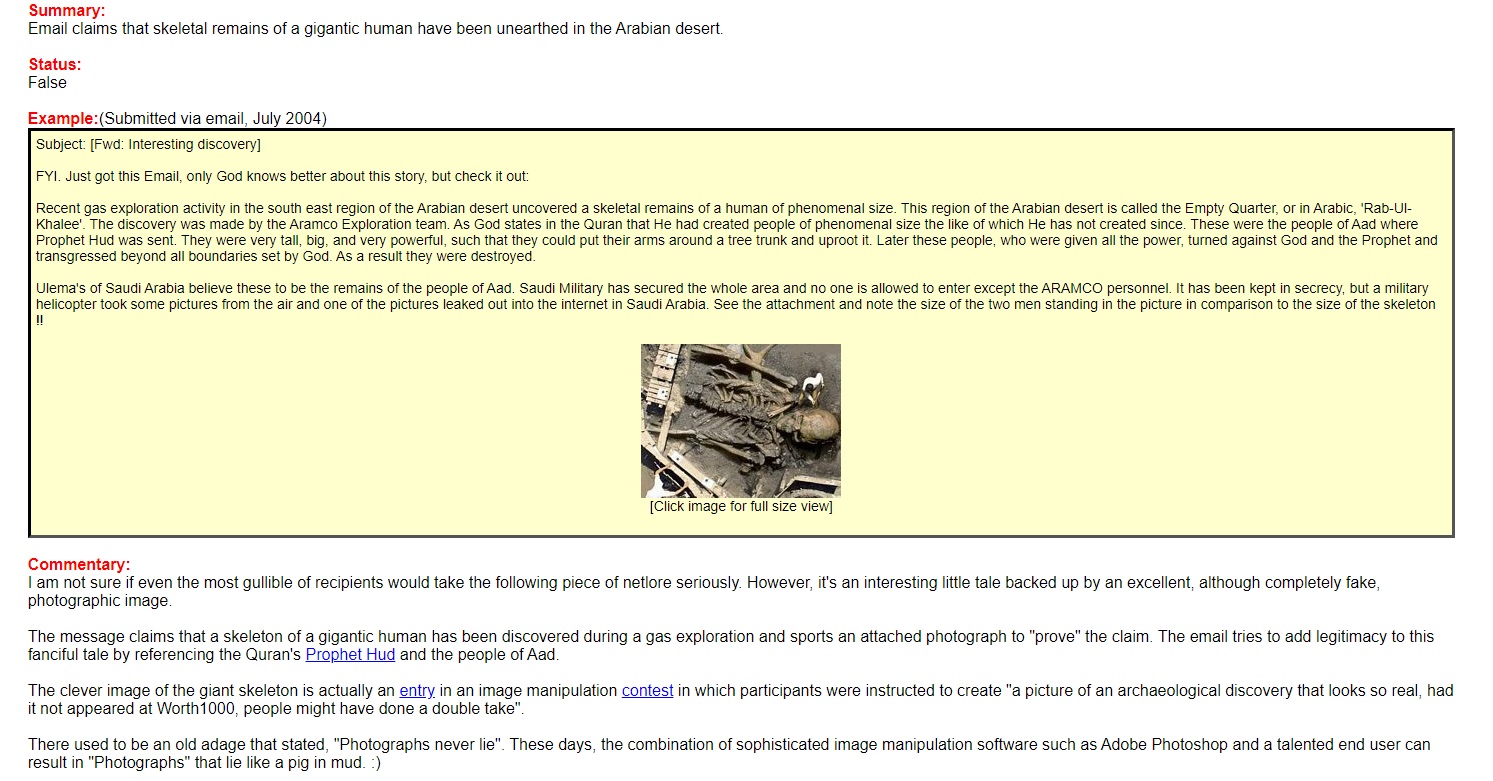
Please stop circulating e-mails and pictures like the following:
We remember receiving such an e-mail of the ‘giant human’ found in the deserts of Saudi Arabia. Even then we kept wondering why the government would want to keep such a tight lid on something that would support a cherished hadith.
It is things like this that canbe a source of embarrassment, and truly tarnishes the image of Islam in the eyes of others. In the end, Ibn Hajar Al Asqlani did not reject this hadith. Ibn Hajar Al Asqlani also did not reject Bukhari. However, it is very obvious that he did not think that Bukhari was not above being critiqued.
“And who is more unjust than he who forges a lie against Allah” (Qur’an 6:93)
And “O Adam, dwell, you and your wife, in Paradise and eat from wherever you will but do not approach this tree, lest you be among the wrongdoers.” (Qur’an 7:19)
﷽
We need to first understand why these questions come about and the possible intentions behind them. Especially in light of very clear verses of the Qur’an.
“(This is) a blessed Book which We have revealed to you, (O Muhammed), that they might reflect upon its verses and that those of understanding would be reminded.” (Qur’an 38:29)
The first thing to say is that all who sincerely ponder upon the Qur’an will be rewarded. It is a very great act of worship.
The second is to say that all of us approach the Qur’an with our presuppositons. A presupposition is an implicit, underlying assumption about the world that a speaker takes for granted as true for an utterance to make sense in context.
So, if someone approaches the Qur’an with the idea in mind that miracles do not take place or the current Ijmāʿin science is the end, all be all, they will interpret the Qur’an in accord with this presupposition.
Others may feel the need to interpret the Qur’an in such a way in light of what they see as verses that could not be reconciled otherwise.
The Qur’an is clear that both Adam and his wife were in paradise (Jannah). Yet, this word literally means ‘garden’.
“O Adam, dwell, you and your wife, in Paradise and eat there in abundance from wherever you will. But do not approach this tree, lest you be among the wrongdoers.” (Qur’an 2:35)
“So he brought about their fall through deception. And when they tasted of the tree, their nakedness was exposed to them, prompting them to cover themselves with leaves from Paradise. Then their Lord called out to them, “Did I not forbid you from that tree and tell you that Satan is your sworn enemy?” (Qur’an 7:22)
“O children of Adam! Do not let Satan deceive you as he tempted your parents out of Paradise and caused their cover to be removed in order to expose their nakedness. Surely he and his soldiers watch you from where you cannot see them. We have made the devils allies of those who disbelieve.” (Qur’an 7:27)
And “O Adam, dwell, you and your wife, in Paradise and eat from wherever you will; but do not approach this tree, lest you be among the wrongdoers.” (Qur’an 7:19)
The first objection to Adam-alayi salam being created in the heavenly paradise rather than a garden on Earth.
The Satan’s Access Argument Examined.
So, whether this means the Paradise that the righteous go to when they die, or it means some place on the Earth that Adam (alayi salam) was expelled from, raises questions.
The first question it raises is as follows:
“Allah said, “Then get down from Paradise! It is not for you to be arrogant here. So get out! You are truly one of the disgraced.” (Qur’an 7:13) clearly states that Iblis was already in the same “Jannah” as Adam before his expulsion.
This verse makes it clear that Iblis was removed from Paradise. Yet, we have the following verse:
“But Satan caused them to slip out of it and removed them from that in which they had been. And We said, “Go down, as enemies to one another, and you will have upon the earth a place of settlement and provision for a time.” (Qur’an 2:36)
&
“O children of Adam! Do not let Satan deceive you as he tempted your parents out of Paradise and caused their cover to be removed in order to expose their nakedness. Surely he and his soldiers watch you from where you cannot see them. We have made the devils allies of those who disbelieve.” (Qur’an 7:27)
So how does Iblis have access to paradise? (Either the place the righteous go to when they die or the place on Earth that Adam -alayi salam was expelled from)
One approach that is used is to suggest that the satan that tempted Adam -alayi salam was not necessarily Iblis, but rather another Jinn that decided to go down the path of rebellion and perversion.
“And thus did We make for every prophet an enemy, the Shaitans from among men and jinn, some of them suggesting to others varnished falsehood to deceive (them), and had your Lord pleased they would not have done it, therefore leave them and that which they forge And that the hearts of those who do not believe in the hereafter may incline to it and that they may be well pleased with it and that they may earn what they are going to earn (of evil).” (Qur’an 112:113)
“He said: Get out of this (state), despised, driven away; whoever of them will follow you, I will certainly fill hell with you all.” (Qur’an 7:18)
“But Satan caused them to slip out of it and removed them from that in which they had been. And We said, “Go down, as enemies to one another, and you will have upon the earth a place of settlement and provision for a time.” (Qur’an 2:36)
“We said, “Descend all of you! Then when guidance comes to you from Me, whoever follows it, there will be no fear for them, nor will they grieve.” (Qur’an 2:38)
So, as Iblis was an inhabitant of heaven before he became a shaitan, it is reasoned that the jinn that tempted Adam -alayi salam was an inhabitant of heaven before he became a shaitan.
Some will argue that this cannot be the case as Iblis is the shaitan identified in the following verse:
“O children of Adam! Do not let Satan deceive you as he tempted your parents out of Paradise and caused their cover to be removed in order to expose their nakedness. Surely he and his soldiers watch you from where you cannot see them. We have made the devils allies of those who disbelieve.” (Qur’an 7:27)
This may not mean Iblis directly but by way of proxy. “He and his soldiers.”
The two “Descents” Hubut (هبوط) approach.
Another way Muslim commentators have tried to approach this is to suggest we distinguish between two different “descents” or “expulsions”:
First Descent (Iblis): Iblis is expelled from the presence of divine mercy and from the company of the angels. However, he is not immediately removed from the physical location of the Garden. He lingers, seeking revenge.
Second Descent (Adam): After successfully tempting Adam, both Adam and Iblis are then commanded to descend to earth.
This view holds that Iblis’s expulsion in Qur’an 7:13 is primarily a spiritual and relational expulsion (loss of status), while his physical departure from the Garden happens simultaneously with Adam in Qur’an 2:36 and Qur’an 7:24.
The Two Descents approach creates a theologically unacceptable inconsistency:
Iblis: Commits direct, arrogant rebellion against Allah’s explicit command. Refuses to prostrate. Challenges Allah openly. His punishment? He is “expelled” but allowed to loiter around in the Garden long enough to tempt Adam -alayhi salam.
Adam: Makes a mistake. He forgets. He is weak. He is then deceived by the very being Allah allegedly allowed to remain. His punishment? Immediate removal. No lingering.
This portrayal makes Allah appear inconsistent. May Allah forgive us. The rebel gets deferment; the one who stumbles gets the hammer. This is not the Allah of the Quran, who is Al-‘Adl (The Just) and Al-Rahman (The Most Merciful).
Our objection is not just logical; it is theological dynamite. It exposes that the “two descents” harmonization, far from solving the problem, actually creates a worse one: a morally problematic portrait of divine justice.
كيف قام الشيطان بأغواء آدم عليه السلام؟أين كانت جنة آدم عليه السلام؟وهل يمكن أن يدخلها ابليس؟
This is the way that Shaykh Ahmed Al Khalili (H) has answered the above question:
The second objection to Adam-alayi salam being created in the heavenly paradise rather than a garden on Earth.
If Adam-alayhi salam is a special creation of paradise, then how did mud make its way into heaven?
˹Remember, O Prophet˺ , when your Lord said to the angels, “I am going to create a human being from sounding clay moulded from black mud.” (Qur’an 15:28)
This is a rather odd objection.
Why couldn’t Allah have created the dust and clay for Adam within Paradise itself? For a being who creates the entire universe from nothing (“Be, and it is”), Allah could have willed into existence a handful of dust within the celestial garden just as easily as He could have on earth.
The Qur’an has already established the following:
“O Adam, dwell, you and your wife, in Paradise and eat there in abundance from wherever you will. But do not approach this tree, lest you be among the wrongdoers.” (Qur’an 2:35)
“So he brought about their fall through deception. And when they tasted of the tree, their nakedness was exposed to them, prompting them to cover themselves with leaves from Paradise. Then their Lord called out to them, “Did I not forbid you from that tree and tell you that Satan is your sworn enemy?” (Qur’an 7:22)
“The description of Paradise promised to the righteous is that in it are rivers of fresh water, rivers of milk that never changes in taste, rivers of wine delicious to drink, and rivers of pure honey. There they will ˹also˺ have all kinds of fruit, and forgiveness from their Lord. ˹Can they be˺ like those who will stay in the Fire forever, left to drink boiling water that will tear apart their insides?.” (Qur’an 47:15)
Can you imagine!? Rivers of milk. Rivers of wine! Rivers of pure honey! Willy Wonka and the Chocolate Factory eat your heart out!
“And We will provide them with whatever fruit or meat they desire.” (Qur’an 52:22)
“˹They will also be served˺ any fruit they choose and meat from any bird they desire.” (Qur’an 56:20-21)
Allah (swt) has described the jannah as the place where Adam-alayi salam was eating. Does this then follow that he needed to relieve himself? Allah (swt) has described the jannah as a place that has trees, and it has leaves that Adam -alayhi salam used to cover his nakedness.
Therefore, the presence of these materials does not, in itself, prove the location was earthly. The miracle of creation is not bound by our physical laws of geology.
Just as one can have a garden on earth they can have a garden in heaven. Just as we can have trees and rivers on earth we can them in heaven.
The third objection to Adam-alayi salam being created in the heavenly paradise rather than a garden on Earth.
“And when your Lord said to the angels, I am going to place in the earth a khalif, they said: Will You place in it such as shall make mischief in it and shed blood, and we celebrate Your praise and extol Your holiness? He said: Surely I know what you do not know.” (Qur’an 2:30)
It is argued that this verse somehow contradicts Allah’s initial purpose of sending a khalif to the Earth. The argument is that if Allah (swt) decided in the beginning to send Adam-alayhi salam to the Earth, then why does Allah (swt) need an excuse to send him down to earth as a punishment?
In other words, if Adam -alayi salam had not slipped, he would not have been sent to the Earth.
The first point is that nowhere does the Qur’an say that the khilafa is for one who does not sin. Nowhere does it state that to be an Imam for others you need to be free from sin.
The second point is that Allah (swt) knows all things including what would happen between Adam-alayhi salam and his nemesis. Also, Allah (swt) knew what the selection of adam-alayi salam would be. To argue against this is to argue against the Qur’an itself. To argue against what Allah (swt) said about himself here:
“He is the First and the Last, the Most High and Most Near, and He has knowledge of all things.” (Qur’an 57:3)
“How could He not know His Own creation? For He is the Most Subtle, All-Aware.” (Qur’an 67:14)
Questions that must be asked of those who believe the garden was a place on Earth.
Where is the location of this place?
Can humans re-enter this location? If not, why not?
Why does Allah (swt) need to inform Adam-alayi salam of the following:
But Satan caused them to slip out of it and removed them from that in which they had been. And We said, “Go down, as enemies to one another, and you will have upon the earth a place of settlement and provision for a time.” (Qur’an 2:36)
He said, ‘Descend, being enemies to one another. And on the earth, for you is a place of settlement and enjoyment for a time.’ He said, ‘Therein you will live, and therein you will die, and from it you will be brought forth.'” (Quran 7:24-25)
If the earth was their default location, why do they need to be informed of it?
If you enjoyed this article you may find our other entries interesting.
“And when your Lord said to the angels, I am going to place in the earth a khalif, they said: Will You place in it such as shall make mischief in it and shed blood, and we celebrate Your praise and extol Your holiness? He said: Surely I know what you do not know.” (Qur’an 2:30)
﷽
This proclamation of Allah (swt) and the subsequent response of the angels is very interesting.
The first point to establish is that the proclamation of Allah (swt) needs to be clear and without ambiguity.
The second point is that the angels understood from the word that Allah (swt) used two possiblities.
Yuf’sidu. That it entails the possiblity that the khalif can do mischief.
wayasfikul-dimāa. That it entails the possibility that the khalif can be the cause of bloodshed and violence.
This both astonishing and astounding in that this is the initial reaction of these noble beings.
In Islamic teachings the angels are pure and love purity. They do not dwell among or around the places that are impure.
Out of all the possible responses of the angels the initial response to this word chosen by Allah (swt) is recoil.
The response of Allah (swt) was not to correct them, or even to suggest that they are wrong. Allah (swt) simply responds with: “I know what you do not know.”
If a person were to offer a child a banana one would not really think much of it. We don’t think that the banana would harm the child. It surely does not have the properties of being sharp or dangerous. It certainly is not going to cut them.
However, if a person were to offer a knife to a child, one may wonder the intention behind it. A knife is a tool. It can be used as an instrument to cut items that may otherwise be cumbersome to deal with as a whole. However, a knife can also be used to injure either oneself or others.
Yet, also notice that the angels said: “and we celebrate Your praise and extol Your holiness?”
In other words, they did not deny the possibility of this word khalif in addition to creating mischief and shedding blood, that it too could celebrate and praise Allah. However, from the perspective of the angels, the creation of this khalif seems redundant.
The word khalif did not entail (at least to those angelic recipients of the word) one who would be flawless, infallible, rightly guided, necessarily just.
Just as it did not entail as such to those angelic recipients of the word, it does not entail as such to the Ibadi school.
We want just leaders. We want to be ruled by the just and the righteous.
The word khalif to those angelic recipients of the word understood that with it could come the possibility of violent upheaval.
All citizens of just governance always pray and hope for a peaceful transition of power. However, often, the transition of power does not come about by peaceful means.




 Prima Quran