“The faculties of seeing (tudriku) cannot grasp Him, and He grasp all–seeing (yudriku), He is the All-Subtle and All-Aware.” (Qur’an 6:103)
﷽
A question that every Christian should ask every Muslim who calls themselves the following: Salafi, Athari, Ahl Hadith, Hanbali.
1 What form/shape of Allah (swt) is it that these people knew?
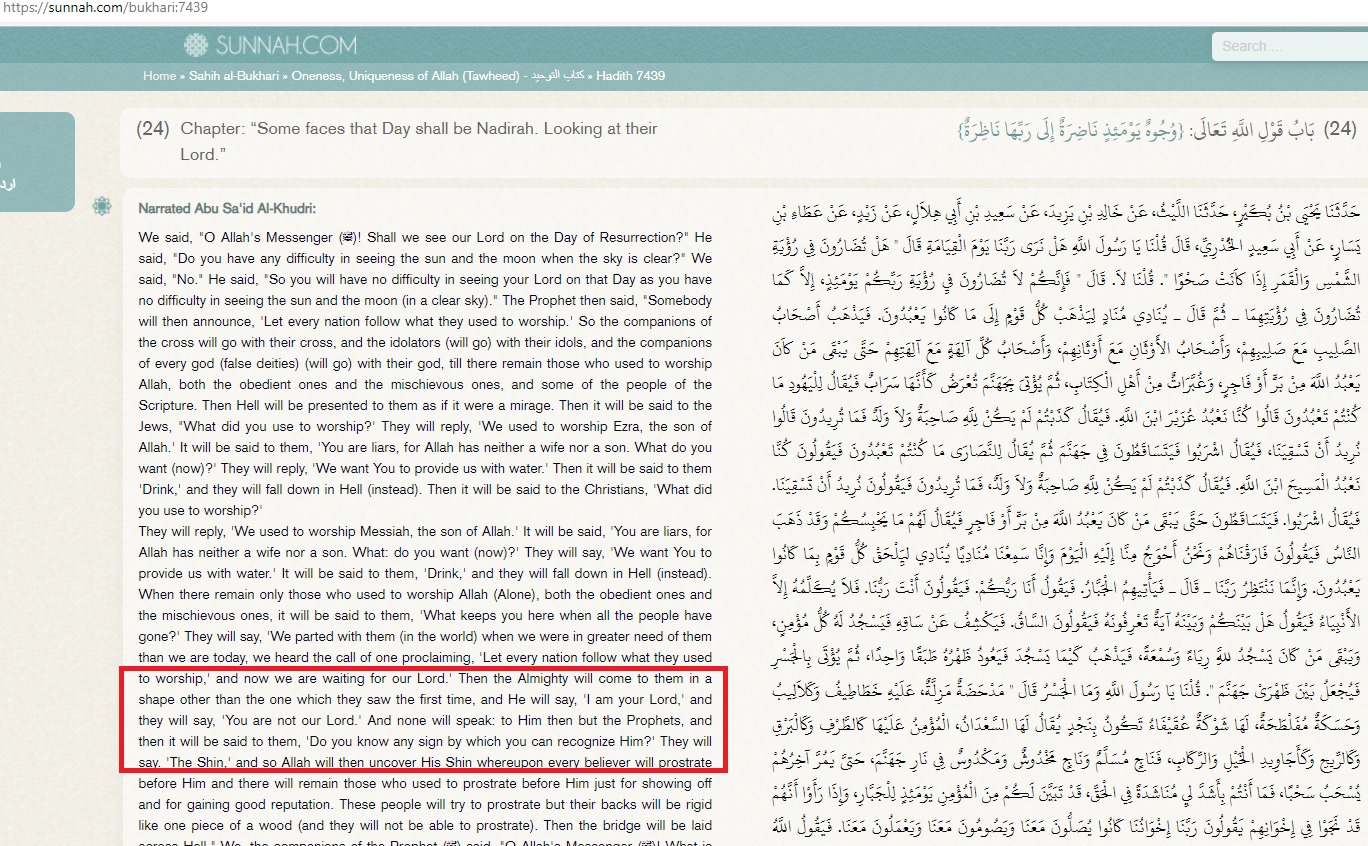
“Then the Almighty will come to them in a shape other than the one which they saw the first time, and He will say, ‘I am your Lord,’ and they will say, ‘You are not our Lord.’ And none will speak: to Him then but the Prophets, and then it will be said to them, ‘Do you know any sign by which you can recognize Him?’ They will say. ‘The Shin,’ and so Allah will then uncover His Shin whereupon every believer will prostrate before Him.”
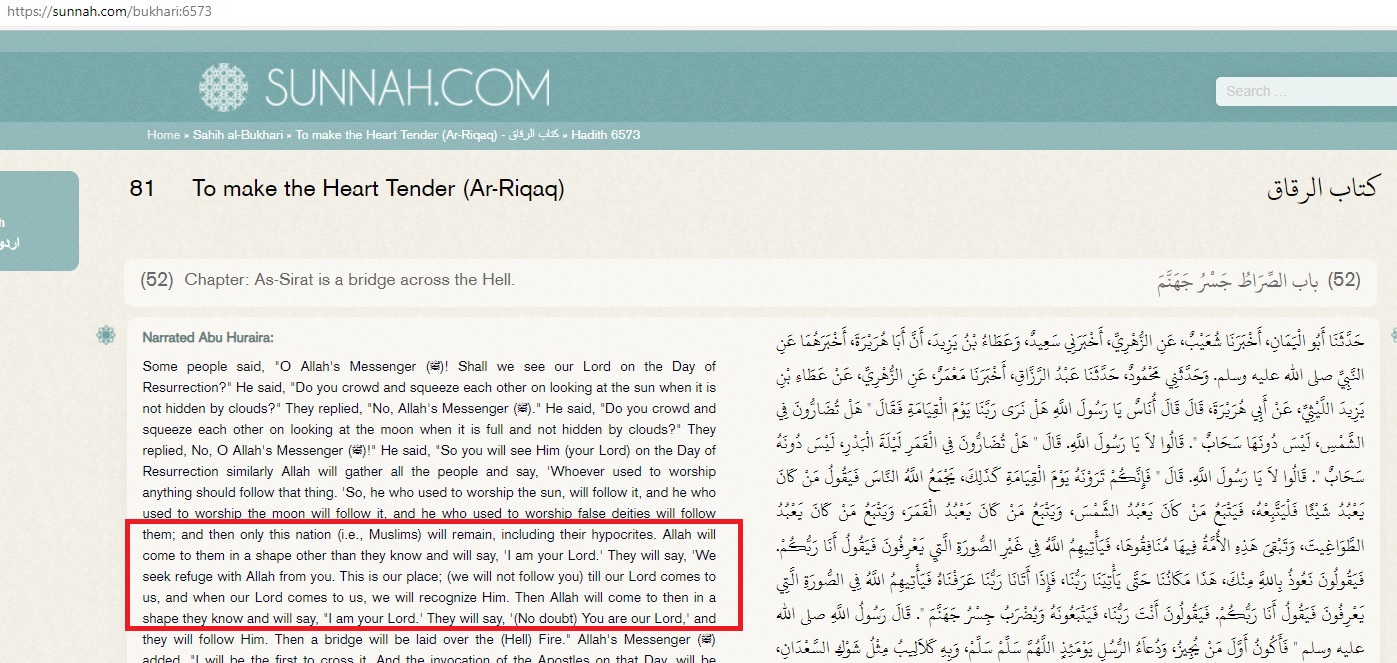
“Allah will come to them in a shape other than they know and will say, ‘I am your Lord.’ They will say, ‘We seek refuge with Allah from you. This is our place; (we will not follow you) till our Lord comes to us, and when our Lord comes to us, we will recognize Him. Then Allah will come to then in a shape they know and will say, “I am your Lord.’ They will say, ‘(No doubt) You are our Lord,’ and they will follow Him.”
“People asked the Prophet (saw): O’ Messenger of Allah will we see our Lord in the Day of Resurrection? Then the Messenger of Allah replied: Is there any dispute among you whether a full moon is visible? They answered: No. then The Prophet (saw) continued asking them: “ Is there any dispute among you whether the sun is visible in a cloudless sky? They replied in the negative. Then The Prophet stated (saw): “Then you will see your Lord JUST LIKE this”. Allah will get the people together in the Day of Resurrection then He says: those who were worshiping any deity shall follow it. Then the ones who were worshiping the sun will follow the sun and the ones who were worshiping the moon will follow the moon and those who were worshiping Rebels will follow Rebels …Then Allah will come to them in a FORM other than WHAT THEY KNEW and say: “I am your Lord”, they reply: “We seek refuge in Allah from you. This is our place until our Lord Comes to us, and when our Lord comes to us, we will recognize Him. THEN ALLAH WILL COME TO THEM IN A SHAPE THEY KNOW and will say, I am your Lord’ They will say, ‘(No doubt) You are our Lord,’ and they will follow Him.”
There are many problems with the apparent reading of this text and the approach that the Athari/Salafi take.
A) It follows from it that His Essence (dhat) Exalted is He, changes from one form to the other. Such change is characteristic of contingent existents [huduth]. It, necessarily implies contingency of Him.
B) It also follows from it that Allah, Exalted is He, is seen by this ummah (including believers and hypocrites)in this world with clear sight so that His form will remain printed in the minds of those who see. Then, when He comes to them in another form, they will refuse to accept that form as their Lord, and they will seek refuge in Allah from it.
Otherwise, how would they recognize His form, seeing that they did not recognize Him when He came in a form other than that, and they recognized Him when He turned back to it? And all of this is at the first of the Stations of the Day of Resurrection!
There have been debates with our scholars the Ahl Al Haqq Wal Istiqamah-The People of Truth and Straightness (The Muslims) and certain among them on these matters.
When they were pinned down with this argument, they answered that this knowledge of His form is not a result of any earlier seeing. It is a result of their knowledge from the description of Him in His Book and in the Prophet’s Sunnah!
They were urged strongly: Whoever has read the Book of Allah and has studied the Sunnah of His Messenger must know that real form in which He will see his Lord, Exalted is He, so that, when he sees Him in another form, he does not recognize Him. Then please bring us the description of this form and definition of it from your knowledge through your reading of the Qur’an and your study of the hadiths of the Messenger (saw). Then they were taken aback and their argument became void, and all the praise belongs to Allah.
And among what falsifies their interpretation that they turned to fleeing from the compelling argument is its opposition to the clear text of the hadith of Abu Sa’id in the Sahihayn.
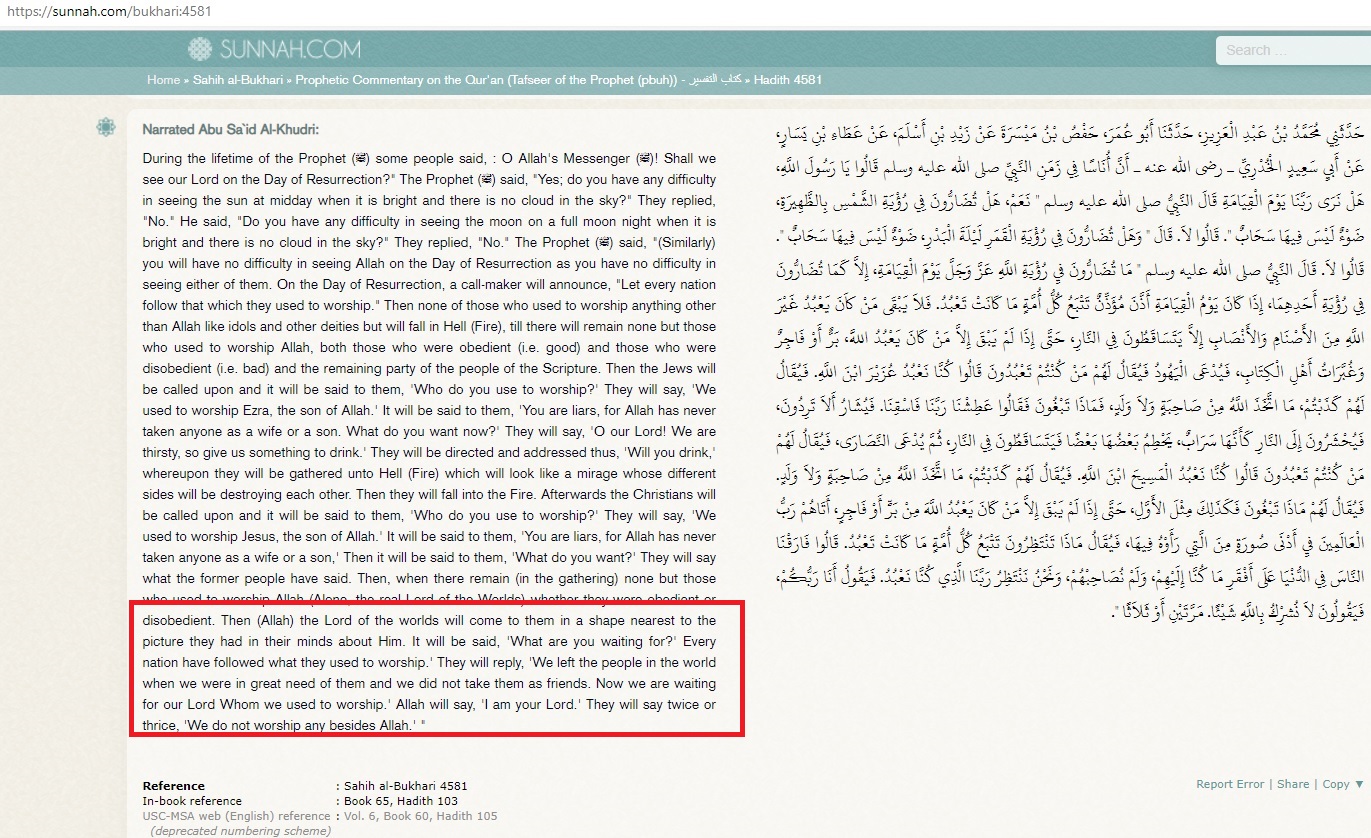
It is in the Sahih of al-Bukhari with the words: ‘Then the Omnipotent will come to them in a form than what they had seen Him in at first.’
The wording of Muslim is: ‘Until when no one is left except those who worshipped Allah, pious and non-pious, then the Lord of the Universe, Exalted is He, will come to them in a form closer to the one they have seen Him in.’
Both wordings are clear that their knowledge of His form will be a result of a previous seeing. There is no way for those who take the hadith literally but to say that He is seen in this world.
Yet most of them have rejected that (the seeing of Him in this world).
Whoever said it restricted the seeing of Him to some special individuals, and did not hold the opinion that it included the pious and the non-pious of this ummah, nor the opinion of the seeing of Him in barzakh (the isthmus between the two worlds).
That is something no one has claimed before, let alone had any evidence for it.
If you found this article helpful you may enjoy the following:
“The faculties of seeing (tudriku) cannot grasp Him, and He grasp all–seeing (yudriku), He is the All-Subtle and All-Aware.” (Qur’an 6:103)
﷽
Dear Muslim Ummah.
This is a collection of articles on the issue of Seeing Allah (swt) in the hereafter. May Allah (swt) guide you to the path and way of the Muslims. May Allah (swt) guide you to the doctrine of transcendence. The way of the Qur’an and the Sunnah. Because this is the safest and secure road.
Among those who profess to be Sunni Muslims, you see such a division among them on this matter. One will claim that their lord has a shape and a form. The other side, realizing the problematic nature of such a position, will claim a sort of ‘beatific vision’. All sides come with their proofs and evidence.
Among them are those who say both believers and disbelievers will see Allah and others say seeing Allah is a reward exclusive to the believers.
For example: what form or shape did the disbelievers see Allah in?
On Seeing Allah: The following article breaks down a video from a brother upon the Ashʿarī theology giving our critical analysis from the Ibadi perspective.
The following section deals with a fringe group who call themselves ‘Salafi;: They claim that they are upon the belief of the early generation of Muslims. In reality they are those who have very eccentric and bizarre views.
According to Sahih Bukhari what Form/Shape of Allah did the disbelievers see? What Every Christian Should Ask Every Muslim. Christians believe that God took upon himself a form or a shape. The Salafi sect also believes that Allah took upon a form or a shape.
“Those who do good will have the finest reward and more. Neither gloom nor disgrace will cover their faces. It is they who will be the residents of Paradise. They will be there forever.” (Qur’an 10:26)
﷽
Those who believe that we will see Allah (swt) in the afterlife believe that the above verse is a proof of it.
“Those who do good will have the finest reward and (waziyādatun) more. Neither gloom nor disgrace will cover their faces. It is they who will be the residents of Paradise. They will be there forever.” (Qur’an 10:26)
We can see this زَادَ – yazīdu which basically means to ‘increase in something’. It is used throughout the Qur’an.
“That Allah may reward them the best of what they did and increase them (wayazīdahum) from His bounty. And Allah gives provision to whom He wills without account.” (Qur’an 24:38)
“And as for those who believed and did righteous deeds, He will give them in full their rewards and grant them extra (wayazīduhum) from His bounty.” (Qur’an 4:173)
“That He may give them in full their rewards and increase for them (wayazīdahum) of His bounty. Indeed, He is Forgiving and Appreciative.” (Qur’an 35:30)
” And He answers those who have believed and done righteous deeds and increases them (wayazīduhum)from His bounty.” (Qur’an 42:26)
“And those who are guided – He increases them (zādahum) in guidance and gives them their righteousness.” (Qur’an 47:17)
Their understanding is simply based on an exotic interpretation and not one based upon the meaning in the Arabic language.
We can see that every time they are increased from the genus or genre of what they are already being given. They are guided and guidance is increased. The finest reward and more of it. For example, in Arabic grammar it is fine to say I will give you 10,000 Euros and I will give you an additional 500 Euros, like this. Some people may scratch their heads wondering why there is a picture of an ice cream cone getting an additional scoop. The picture is to indicate what I mean in this point 2.
The following verse makes it abundantly clear that we will not see him:
“The faculties of seeing (tudriku) cannot grasp Him, and He grasp all–seeing (yudriku), He is the All-Subtle and All-Aware.” (Qur’an 6:103)
This indicates the description of the divine changes. What was once not true of Allah (swt) is now true of Allah (swt).
” Neither drowsiness nor sleep overtakes Him. To Him belongs whatever is in the heavens and whatever is on the earth.” (Qur’an 2:255)
So now it is possible that what is not currently true of Allah (swt) not being drowsy nor overtaken by sleep becomes possible.
If one can be gone then another attribute can be gone as well.
4. Not in the scope of this article but often those who believe that we will see Allah (swt) in the next life bring a number of hadith. This is an evidence for them. For us, as well as the majority of the Muslim Ummah, lone narrator reports (ahad) are not an evidence for us.
Zanni Hadith (الحديث الظني) refers to a narration that provides probable knowledge (ظن – Zann) rather than absolute certainty (يقين – Yaqeen)
Linguistically: Derived from “ظن” (Zann), meaning “assumption,” “probability,” or “conjecture.”
Technically: A Hadith that does not reach the level of definitive proof (Qat’i) but is still considered reliable enough for practical rulings.
For the Ibadi we do not build our belief upon the ahad. This is so even if we find the hadith to be sahih. That is because creedal matters are not based upon what is probable but what is certain.
Shaykh Massoud bin Mohammed Al Miqbali (h) explains this to us concerning a debate he had with one of the Salafi in Egypt. (A debate that they pulled offline).
The Shaykh also went on to explain that even in the case of an ayat of the Qur’an that is certain we may not build creedal matters upon it. That is because it could be from the mutashabih; and Allah (swt) has warned us:
“While other verses may have several possibilities. Those whose hearts are perverse, follow the unclear statements in pursuit of their own mischievous goals by interpreting them in a way that will suit their own purpose.” (Qur’an 3:7)
Thus the Qur’an itself can be certain and yet present verses that are multifaceted. How much more for the hadith?
Not to mention if they bring hadith we too can bring hadith.
Hadith like the following:
Narrated Abu Sa`id Al-Khudri:
The Prophet (saw) said, “Allah will say to the people of Paradise, “O the people of Paradise!” They will say, ‘Labbaik, O our Lord, and Sa`daik, and all the good is in Your Hands!’ Allah will say, “Are you satisfied?’ They will say, ‘Why shouldn’t we be satisfied, O our Lord as You have given us what You have not given to any of Your created beings?’ He will say, ‘Shall I not give you something better than that?’ They will say, ‘O our Lord! What else could be better than that?‘ He will say, ‘I bestow My Pleasure on you and will never be angry with you after that.’
Allah’s Messenger (saw) said, “Allah will say to the people of Paradise, ‘O the people of Paradise!’ They will say, ‘Labbaik, O our Lord, and Sa`daik!’ Allah will say, ‘Are you pleased?” They will say, ‘Why should we not be pleased since You have given us what You have not given to anyone of Your creation?’ Allah will say, ‘I will give you something better than that.’ They will reply, ‘O our Lord! And what is better than that?’ Allah will say, ‘I will bestow My pleasure and contentment upon you so that I will never be angry with you after for-ever.’ “
“Those who do good will have the finest reward and (waziyādatun) more. Neither gloom nor disgrace will cover their faces. It is they who will be the residents of Paradise. They will be there forever.” (Qur’an 10:26)
Recall what is stated above in point 2 above. That is to say that the more’ can be from the same genre or genus. This is what we have from Ali Ibn Abi Talib:
17634- حدثنا به يحيى بن طلحة قال ، حدثنا فضيل بن عياض، عن منصور، عن الحكم، عن علي رضي الله عنه: (للذين أحسنوا الحسنى وزيادة) ، قال: ” الزيادة “، غرفة من لؤلؤة واحدةٍ لها أربعة أبواب.
“Narrated to us by Yahya ibn Talha, who said: Narrated to us Fudayl ibn ‘Iyad, from Mansur, from Al-Hakam, from Ali regarding the verse: ‘For those who do good is the best reward and an increase.’ He said: ‘The “increase” is a chamber made of a single pearl with four doors.'”
Sources that cite the above narration include: Tafsir al-Tabari, Tafsir Ibn Abi Hatim, Tafsir al-Baghawi, Tafsir Ibn Kathir.
For those who are interested you may wish to see the following articles:
“When Musa came to the place appointed by Us, and his Lord addressed him, He said: “O my Lord! show (Yourself) to me, that I may look upon you.” Allah said: “You shall never see me; But look upon the mount; if it abides in its place, then you will see me.”
When his Lord manifested His glory on the Mount, He made it as dust. And Moses fell down in a swoon. When he recovered his senses he said: “Glory be to Thee! to Thee I turn in repentance, and I am the first to believe.” (Qur’an 7:143)
﷽
Our brothers have done it again. An excellent overview of the meaning of the request of Musa (as) to see Allah (swt).
As for Musa (as), we get that he knows the attributes of Allah -Transcendent and Exalted He is. That which concerns the positive side and that which concerns the negative side. So he knows of the impossible -to affirm- attributes upon Allah. As we said that this is perceived through the natural instinct and the mind. And Musa (as) without doubt is greater than that; rather he is a prophet whom revelation is passed onto, and he has been chosen by Allah from all creation. So he cannot attribute to Allah that which is not suited. So he is not ignorant-dignified he is- rather he is knowledgeable. He is knowledgeable on the fact that it’s impossible for Allah to be described with being perceived.
As for connecting his request {“My Lord, show me [Yourself] that I may look at You.”} [Qur’an 7:143] and his Belief that this is impossible, then that is understood by saying that he didn’t request the ‘action of seeing’/ru’ya for himself. Rather, he asked (that) for his people. Even if it came in the singular form or first person(perspective). When he said {“My Lord, show me [Yourself] that I may look at You.”}. As for the proof that he asked it for his people then the ayats of the Qur’an are clear! {And [recall] when you said, “O Musa, we will never believe you until we see Allāh outright”;} [Qur’an 2:55].
So, they are the ones who asked Musa (as) for that. And they negate belief upon themselves until that is achieved for them. And Allah the Exalted also said, {For truly, they had asked Moses for something even greater than that, for they said, “Show us Allah openly.”} [Qur’an 4:153] The evidence is also when Musa (as) and those of those who were with him (from bani Israel, when asked for ru’ya) were struck.
He said {Will You annihilate us for what the fools among us have done?} [Qur’an 7:155]. So the sign here is that they are ignorant and they have brought this upon themselves. This all signifies that he asked the ‘action of seeing’ for them, as in him being attentive for them to believe. So he was Merciful to his people, benevolent towards them, even though he knows that this is a grave matter. But he wanted to prove its impossibility not in acceptance to them for what they asked. Rather they were stubborn, so he asked this not in respect to their request to them. All the while knowing it being impossible. Rather to show them by proof that it is not happening. Because they know with their stubbornness that he is better than them; and that he is a messenger of Alllah whom revelation is passed onto.
For if the perception was unachievable for him , then it will be all the more so unachievable for them, thus not happening. And indeed , this is what happened. And reality has been shown with the decimation of the mountain, and with them being struck alongside Mosa (as) by the lightning. And that signified the danger of what was asked.
And that was a punishment for them, but as for Musa (as) it was a type of guidance, because Allah the almighty knows the truth of Musa (as) , but this from Allah was due to Musa (as) being hasty in asking that which he should have sought permission in first. It was more appropriate and fitting for him to first ask permission from Allah the Exalted. Then, his repentance from this indicates that this is grave upon Allah, because when he became unconscious. What did he say, he first said {And when he awoke, he said, “Exalted are You! I have repented to You, and I am the first of the believers.”} [Qur’an 7:143]
“The Originator of the heavens and the earth; He made mates for you from among yourselves, and mates of the cattle too, multiplying you thereby; there is nothing like unto Him; and He is the Hearing, the Seeing.”(Qur’an 42:11)
﷽
This verse is sufficient to refute the rational proofs that the Ashari may try and bring forth to assert that Allah (swt) is perceptible.
This article will give the position of the Ibadi School, The Muslims, also known as: (Ahl al Haqq wal Istiqamah) on seeing Allah (swt) on the day of judgement.
We will critique the position of our brothers from Ahl Sunnah. As Ahl Sunnah is divided on this issue we need to make sure that our arguments are addressed to both sides of the divide among Ahl Sunnah itself.
The school of Ahl Sunnah that asserts that Muslims will see Allah (swt) in an apparent sense. (Athari, Salafiyya)
The school of Ahl Sunnah that asserts that Muslims will see Allah (swt) as being perceptible in the heart or mind.
In our estimation, the Athari, Salafiyya among the Ahl Sunnah are more consistent in their principles on ‘seeing’ Allah (swt) than are the Ashari. We will leave that to you the reader to decide where lay the truth.
Whereas we regard the Ashari/Maturidi to be the most inconsistent in this regard, as there are a few positions of them on this matter. Insh’Allah that will be shown in this article. We will present two examples straight away to prove this point:
“The Day the shin will be uncovered and they are invited to prostration but the disbelievers will not be able.” (Qur’an 68:42)
Ask all the Ashari/Maturidi on the planet, do they take the outward meaning of this verse? Certainly, this would be a strong verse to support their position? That people will see Allah (swt) by seeing the ‘shin’ of Allah (swt).
“People asked the Prophet (saw): O’ Messenger of Allah will we see our Lord in the Day of Resurrection? Then the Messenger of Allah replied: Is there any dispute among you whether a full moon is visible? They answered: No. then The Prophet (saw) continued asking them: “ Is there any dispute among you whether the sun is visible in a cloudless sky? They replied in the negative. Then The Prophet stated (saw): “Then you will see your Lord JUST LIKE this”. Allah will get the people together in the Day of Resurrection then He says: those who were worshiping any deity shall follow it. Then the ones who were worshiping the sun will follow the sun and the ones who were worshiping the moon will follow the moon and those who were worshiping Rebels will follow Rebels …Then Allah will come to them in a FORM other than WHAT THEY KNEW and say: “I am your Lord”, they reply: “We seek refuge in Allah from you. This is our place until our Lord Comes to us, and when our Lord comes to us, we will recognize Him. THEN ALLAH WILL COME TO THEM IN A SHAPE THEY KNOW and will say, I am your Lord’ They will say, ‘(No doubt) You are our Lord,’ and they will follow Him.”
Source:(Al Bukhari hadith no.6573 Book Of Ar-Riqaq)
They (Ashari/Maturidi) leave their students absolutely gob smacked that on the one hand, they battle against fellow Sunni who takes the outward meaning and they(the Ashari/Maturidi) constantly deny corporeality, and space/time for Allah (swt) and yet at the same time assert that we will see (sorry Mohamed Ghilan) I mean look upon Allah (swt) !!
We will show the strength and consistency both textually and intellectually of those of us who say that we will not see Allah (swt) on the day of judgement.
We will also be interacting with material from two videos. In the first video, you will only need to watch the first half-hour. That is the only section relevant to this post. https://youtu.be/5_6zRI0eH44 When we quote from this we will reference this as video A.
I personally was quite shocked and taken aback as I listened to our respected brother Mohamed Ghilan. Yet, as I listened he showed such what has to be described as a simple understanding of basic tenets of creed and certainly did not understand the beliefs of others. May Allah guide him and us.
Mohamed Ghilan echoing Shaykh Hamza Yusuf calls seeing Allah (swt) in the hereafter as “beatific vision” borrowing terminology from Roman Catholics. He states this @ 54:14 seconds (Video B) into the discussion.
Like when he says about Moses and the burning bush… “He really spoke.”
Oh, do tell us what do you mean when you say that, “He (swt) really spoke”??
What follows will be fromvideo A above. The Ustaz ask:
First Question: Is it rationally conceivable that Allah (swt) can be seen?
The Ustaz says that we can conceive of images in our minds. So Allah (swt) is being compared to temporal objects and bodies with accidents!
Now, this is important you will notice some bait and switch tactics going on with Ahl Sunnah. They are all over the place on this point of creed. All of this about “seeing” Allah (swt) and yet the first point is to talk about “seeing” Allah (swt) in the mind! Not with the eyes, not with the faces nor with the hearts.
So the Ustaz ask” “Is it possible in the mind?” He responds: “Yes he can! Why? Because he is existent. He is an existent being!”
My response:
That is a very weak argument. Because what will soon to follow will be likening Allah (swt) to spatial objects with accidents and bodies.
And sure enough @14:51 The Ustaz does exactly that. “Now this pen is made of substance body (plastic) and it’s made up of accidents, colour, shape size, weight, occupying space, etc, moving not moving. These are all accidents. Now can you is it possible in the mind for you to see this body without the accidents. Now you don’t see it. You don’t see it separate from its accidents but that does not mean it’s not possible. There is nothing in your mind to say to you, hear me out. There is nothing in your mind to say that you cannot see substance without the accidentsexcept that you are unable since bodies do not exist except with accidents. But there is nothing inconceivable in your mind. There is nothing that is blocking it in your mind.”
@21:19 the Ustaz continues… “Is it a contradiction in the mind that an accident can be seen. It’s not a contradiction. It actually can be seen because it exists. Anything that exists as an existent being can be seen.”
Notice the student @21:49 (whomever he is) he is brilliant. He tried to save the whole creed and its nonsense by saying what they should be saying, that is: “Because Allah exists it’s possible we can grasp his existence.” Then the teacher responds abruptly “That he is seen yes.” My response: “WOW!”
The student was on to something brilliant but the teacher wanted to quickly make sure that he affirms his (the teacher’s) position in the creed.
So the questions we really should be asking is:
“Is Allah an accident or a substance?”
“Is Allah’s wujud like or unlike his creation?”
The argument that Ustadh is making is that you can’t see accidents but that it is possible. However, he failed to give a single example of someone actually seeing an accident. So you can’t affirm something is possible when you haven’t given a single example of untold thousands of examples of this being a reality. That is even in relation to created things! How much more for that which is not contingent upon or dependent upon anything?
One of the students uses an argument about a man in a dark room. He is there but you cannot see him. So then the Ustaz replies that:
“The reason he can be seen is because he exists is not the means by which he is seen.”
This is fallacious. The reason he can be seen here is that he is a substance, a body. Which still does not make the argument the Ustaz is trying to establish at all. In fact, even in the case of the man in the darkroom, there are many things to be said:
He can’t be seen but he could be perceived. He could be perceptible without even being seen.
Even if you saw him would you say that you comprehend him?
The man has that which you can see his outward and that which you cannot see his inward.
It is part of the fitra that Allah (swt) created us and actually, a proof of his wahdat al wujud is the fact we can’t see him. The Ustaz can’t give a single example because it goes against the fitra. Another example that Allah (swt) has put inside of human beings that is quite powerful is the following:
The concept of nothing. It is part of your fitra, that you cannot picture nothing in your mind. Your mind will either picture an all-black space or an all-white space. That is still something. The irony here is that you can comprehend nothingness but you cannot see nothingness. Certainly, Allah (swt) is more than nothingness! If you cannot see nothingness how much more do you think you can see Allah (swt) who is the wahdat al wujud! You cannot comprehend Allah (swt) let alone see Allah (swt).
“Or were they created by nothing, or were they the creators.”(Qur’an 52:35)
On the possibility of seeing Allah (swt) this claim is demolished by the fact that there are so many invisible existents The soul, the intellect, the sense, perception, sounds, ether, etc.
Their opening the door of comparison of the Creator and the creation will lead to describing Him with many of those that are impossible about Him, Exalted is He. The existence of creatures cannot be perceived except with the existence of space and time. Perishing existents do not have the capacity to see the Eternal.
The peak of perceptibility of Allah (swt) ends with: “There is nothing like Him, and He is All-Hearing, All-Seeing” (Qur’an 42:11)
Muslim narrated from Abu Dhar, he said: “I asked the Prophet Muhammad (Blessings and peace of Allah be upon him), Have you seen your Lord? He replied: ” A light. How can I see Him”.
Source: (Sahih Muslim hadith 341. Kitab Al Iman)
The aforementioned evidence is enough to demolish the rational proofs that the Ashari/Maturidi bring forth in trying to liken Allah (swt) to his creation. May Allah (swt) protect the believers from it!
BE CAREFUL OF THE BAIT AND SWITCH-RUHYA-IDRAAK-NAZAR
I want to caution you the student of knowledge the seeker of truth on something very important. Do yourself a favour and note down every time someone from Ahl Sunnah uses these words ‘Ruhya’ or ‘Idraak’ or ‘Nazar’. I have often found that one speaker will claim Ruhya means this and Idraak means that and then another speaker will actually turn around and say the exact opposite!
Also, take note of the proof text they use. When they use a proof text from the Qur’an which word is being used there and why? Are they using ‘Ruhya’ or are they using ‘Idraak’ or are they using ‘Nazar’?
When they use a proof text from the hadith which word is being used there and why? Are they using ‘Ruhya’ or are they using ‘Idraak’ or are they using ‘Nazar’?
What about Idraak?
Be familiar with these arguments because the advocates of seeing Allah (swt) will rush to this argument first. It is perhaps the strongest they feel that they have. Even in the comment section below you will see one of our brothers from Ahl Sunnah rush to it.
“And what will make you know (idraka) what the Reality is?” (Qur’an 69:3)
The meaning of idraka here means perception when it is connected to the senses.
It has the sense of seeing when connected to the eyes or sight. When Idraak is connected to sight (ba sad ra) it means to see.
In this text yud’rikkumu is to reach or overtake.
“Wherever you may be, death will (yud’rikkumu) reach you, though you should be in raised-up towers. And if a good thing visits them, they say, ‘This is from Allah’; but if an evil thing visits them, they say, ‘This is from you.’ Say: ‘Everything is from Allah.’ How is it with this people? They scarcely understand any tiding.” (Qur’an 4:78)
So will we totally comprehend Allah (swt) or not? To totally comprehend Allah (swt) undermines the Wahdat al Wujud of Allah (swt). Can it be said that the finite will comprehend the infinite?
If we only partially comprehend Allah (swt) this means Allah (swt) would be broken into parts. He would be a part that we can comprehend and a part that we cannot comprehend. If we do not comprehend Allah (swt) at all it strengthens the argument of those of us who say that we will not see Allah (swt) at all. This is because comprehension is of the eyes.
Now, one has to be careful when dealing with various translations of the Qur’an. No doubt the translators have to toe the line of the various theologies they are beholden to.
The faculties ofseeing (tudriku) cannot grasp Him, and He grasp all–seeing (yudriku), He is the All-Subtle and All-Aware.” (Qur’an 6:103)
Now the Ustaz in (video A) gave to his students the impression that Idraak means to ‘behold something in its entirety’. ‘To encompass‘ ‘To see something in its entirety to comprehend it‘.
My response:
There is a difference between reaching (idrak) and encompassing (ihata)
There is no lexical reference work which interprets idrak as ‘encompassing’. That is sufficient proof as to the error of this interpretation by the respected Ustaz and anyone else who follows suit in this.
One’s saying (for example) lahiqtu al-jidara bi yad-i (I reached the wall with my hand) does not mean anything other than touching the wall. It is impossible that the hand should ‘encompass‘ the wall.
if someone says, “ahata bi-hi al-sahmu (the arrow reached him) it is sensible. If someone says “ahata bi-hi al-sahmu (the arrow encompassed him) then no reasonable person will regard his utterance as anything but senseless.
“Allah will say, “Enter among nations which had passed on before you of jinn and mankind into the Fire.” Every time a nation enters, it will curse its sister until, when they have caught up with one another (‘iddarku) therein, the last of them will say about the first of them “Our Lord, these had misled us, so give them a double punishment of the Fire. He will say, “For each is double, but you do not know.” (Qur’an 7:38)
“when they catch up with one another.” It does not mean that each group encompassed the other.
If I cannot make you see this and if the usage of the lexicons cannot make you see it than I pray that Allah (swt) will open your eyes and your heart to what the pure Arab, and mother of the believers had to say about this.
Narrated Masruq:
I said to ‘Aisha, “O Mother! Did Prophet Muhammad see his Lord?” Aisha said, “What you have said makes my hair stand on end! Know that if somebody tells you one of the following three things, HE IS A LIAR: Whoever tells you that Muhammad saw his Lord, IS A LIAR.” Then Aisha recited the Verses:
‘No vision can grasp Him, but His grasp is overall vision. He is the Most Courteous Well-Acquainted with all things.’ (Qur’an 6:103)
‘It is not fitting for a human being that Allah should speak to him except by inspiration or from behind a veil.’ (Qur’an 42:51)
Source: (Al Bukhari Volume 6, Book 60, Number 378)
Notice our mother Aisha (May Allah be pleased with her). Notice the response? “What you have said makes my hair stand on end!”
Now a desperate response to the above text after realizing that the first argument did not work is they may well say:
“The negation is without any condition, and therefore not bound to any meaning of ‘for all time’.”
Response to that claim:
Obviously this is now how our mother Aisha (r.a) understood this verse. She did not reason that perhaps he did see that time whereas other times he did not. No. In fact, that argument also works in our favour as it is not conditioned upon a time (this life or the life to come).
Other textual evidence from the Qur’an.
“When Moses came to the place appointed by Us, and his Lord addressed him, He said: “O my Lord! show (Yourself) to me, that I may look upon you.” Allah said: “You shall never see me; But look upon the mount; if it abides in its place,then you will see me.”
When his Lord manifested His glory on the Mount, He made it as dust. And Moses fell down in a swoon. When he recovered his senses he said: “Glory be to Thee! to Thee I turn in repentance, and I am the first to believe.” (Qur’an 7:143)
This is a powerful text against the claims of the Ashari/Maturidi and all those who say that we can see Allah (swt)!
Moses was dealing with his stubborn and rebellious people and demonstrated them the futility of their request which was:
“The People of the Scripture ask you to bring down to them a book from heaven. But they had asked of Moses [even] greater than that and said, “Show us, Allah, outright,” so the thunderbolt struck them for their wrongdoing. Then they took the calf [for worship] after clear evidences had come to them, and We forgave them for that ˹after their repentance˺ And We gave Moses a clear authority.” (Qur’an 4:153)
“And [recall] when you said, “O Moses, we will never believe you until we see Allah outright”; so the thunderbolt took you while you were looking on.” (Qur’an 2:55)
“And Moses chose from his people seventy men for Our appointment. And when the earthquake seized them, he said, “My Lord, if You had willed, You could have destroyed them before and me [as well]. Would You destroy us for what the foolish among us have done? This is not but Your trial by which You send astray whom You will and guide whom You will. You are our Protector, so forgive us and have mercy upon us; and You are the best of forgivers.” (Qur’an 7:155)
Prima Qur’an Comments: There is so much to be said about the above-mentioned ayats. First of all Allah (swt) said, ‘you will never see me‘. However some of these people have no shame nor fear of their Lord and they will play with the English translations and perform all kinds of maneuvers to make you think that this verse should be understood as, “You will not see me now” meaning the possibility of being seen in the future is there.
In fact, the Ustaz in (video A) unfortunately, he did exactly that.
This is similar to the following verse:
Say: Shall I choose for a protecting friend other than Allah, the Originator of the heavens and the earth,Who feeds and is never fed? Say: I am ordered to be the first to surrender (unto Him). And be not you (O Muhammed) of the idolaters. (Qur’an 6:14)
No one who reads the Arabic text understands this as Allah (swt) is not currently fed but has the possibility of being fed in the future! Authubillah min dhalik.
Not only that but if we do not understand the negative imperative to include all times what does it say about the laws of Islam? Does it ever occur to the mind that there will be a time in the future where shirk would be permissible? Authubillah! There will be a time in the future where adultery and taking the soul without the right will become permissible? Authubillah!
This argument is also negated by the fact that there is division among the Ahl Sunnah as regards Allah (swt) will be seen in this life or not.
Look at the hadith again.
“People asked the Prophet (saw): O’ Messenger of Allah will we see our Lord in the Day of Resurrection? Then the Messenger of Allah replied: Is there any dispute among you whether a full moon is visible? They answered: No. then The Prophet (saw) continued asking them: “ Is there any dispute among you whether the sun is visible in a cloudless sky? They replied in the negative. Then The Prophet stated (saw): “Then you will see your Lord JUST LIKE this”. Allah will get the people together in the Day of Resurrection then He says: those who were worshiping any deity shall follow it. Then the ones who were worshiping the sun will follow the sun and the ones who were worshiping the moon will follow the moon and those who were worshiping Rebels will follow Rebels …Then Allah will COME TO THEM in a FORM other than WHAT THEY KNEW and say: “I am your Lord”, they reply: “We seek refuge in Allah from you. This is our place until our Lord Comes to us, and when our Lord comes to us, we will recognize Him. THEN ALLAH WILL COME TO THEM IN A SHAPE THEY KNOW and will say, I am your Lord’ They will say, ‘(No doubt) You are our Lord,’ and they will follow Him.”
Source:(Al Bukhari hadith no.6573 Book Of Ar-Riqaq)
Can it really be imagined that Allah (swt) who knows all things, and is perfect in the expression of his language would say to Moses (a.s), ‘You shall never see me’ knowing that Moses (a.s) would see him in the afterlife?
Someone should ask the Ustaz (from video A) what form is it that the believers KNOW concerning Allah (swt)?
Not only that but if the negation in this verse is taken to mean for this world, not for the hereafter, then it must be allowed in similar verses, like His saying:
“Slumber does not overtake Him, nor sleep.”(Qur’an 2:255)
“He has neither a companion nor a son”(Qur’an 72:3)
“He is not brought forth from like-kind nor does like kind come forth from him.” (Qur’an 112:3-4)
Whatever is forbidden in this world like slumber, sleep, companion, peers must be permitted in the hear-after. Should we really reason like this?
It is obligatory for every Muslim to believe that this world and the next world have no effect on the essence of Allah!
It is impossible for Allah (swt) that time can affect him or space to accompany him. His essence never changes and his attributes never shift.
What are we to do about the challenge of Allah (swt) in the Qur’an?
“But if you do not – and you will never (walan) be able to – then fear the Fire, whose fuel is men and stones, prepared for the disbelievers.”(Qur’an 2:24)
This negation is eternal and permanent. Is the Ustaz (in video A) or any other going to claim no this statement of Allah (swt) is only for a ‘period of time’. Which means it is possible people will create the like of the Qur’an!
Also, we know that the mountain did not abide. Allah (swt) didn’t set his being perceived on the condition of the mountain but on his knowledge that it is not possible and that was manifest clearly to the people of Moses.
Also, note the concept of blasphemous ideas and concepts being related to mountains being destroyed as with the following blasphemous concept.
“The heavens almost rupture therefrom and the earth splits open and the mountains collapse in devastation That they attribute to the Most Merciful a son.” (Qur’an 19:90-91)
These are the people of disbelief. It is obvious when they say that they will not attain to faith until they see Allah (swt) plainly at which it says in response that the thunderbolt overtook them! Think about it! They are the ones who wanted a golden calf a ‘sura’ a form. These are the same people who want to look upon Allah (swt). They are wanting something perceptible to the eyes.
The people who adhere to the Ashari/Maturidi doctrine need to think clearly on this matter.
Again we have the following text…
And those who do not expect the meeting with Us say, “Why were not angels sent down to us,or [why] do we [not] see our Lord?” They have certainly become arrogant within themselves and [become] insolent with great insolence.” (Qur’an 25:21)
So now let us look at the positive proof that the Ashari/Maturidi will bring forth from the Qur’an to try and establish their proofs. Let us see if it is consistent with
a) The Qur’an itself.
b) with their own theology concerning Allah (swt) not being in space/time
c) reason.
Positive proof for the Ashari/Maturidi position from the Qur’an.
“The heart did not lie [about] whatit saw. So will you dispute with him over whathe saw? And he certainly saw him in another descent. (Qur’an 53:11-13)
“Andwithout doubt, he saw him in the clear horizon.” (Qur’an 81:23)
#1) If we are to believe that this is Allah (swt) then it clashes with the clear text of the Qur’an.
#2) If we are to believe that this is Allah (swt) then it clashes with Ashari/Maturidi Aqidah. For example:
Abu Huraira reported: The Messenger of Allah, peace, and blessings be upon him, said, “Our Lord descends to the lowest heaven in the last third of every night, and he says: Who is calling upon me that I may answer him? Who is asking me that I may give him? Who is seeking my forgiveness that I may forgive him?”
Source:(al-Bukhārī 1094,Muslim 758)
So do the Ashari/Maturidi believe that in the hadith above that Allah (swt) descends?
Do the Ashari/Maturidi believe that distance is a hindrance to Allah (swt)?
Do the Ashari/Maturidi believe that Allah (swt) does the ascending and descending depending on the time of day as (the last third of every night) is depending upon the relative timings of the globe?
So if the Ashari/Maturidi use the above verses to argue that the Blessed Messenger (saw) had seen Allah (swt) then they must believe the part where it says, “certainly saw him in anotherdescent.”
#3) It goes against reason as already mentioned above. Allah (swt) is imperceptible.
#4) Lastly, it contradicts well-established hadith on the matter:
It is narrated that `Aisha, may Allah be pleased with her, said: “I asked the Messenger of Allah about these two verses. He said, “That is Jibreel; I never saw him in the form in which Allah created him except on these two occasions. I saw him descending from the heavens, with his huge size filling the horizon between heaven and the earth.”
Source: (Muslim Book 1 Hadith Number 0337 Book of Faith)
`Aisha may Allah be pleased with her, was asked about the verse (which means): “Then he [Jibreel] approached and descended.”[Quran 53:8] She, may Allah be pleased with her, said, “That is Jibreel. He used to come to him (the Prophet ) in human form, but on this occasion, he came in his real form, and he filled the horizons of the sky.”
Source: (Muslim Book 1 Hadith Number 0340 Book of Faith)
Those counter proofs should be enough to ground to powder any Ashari/Maturidi pretension concerning those verses.
The big verse that the Ashari/Maturidi use to support their position from the Qur’an is the following:
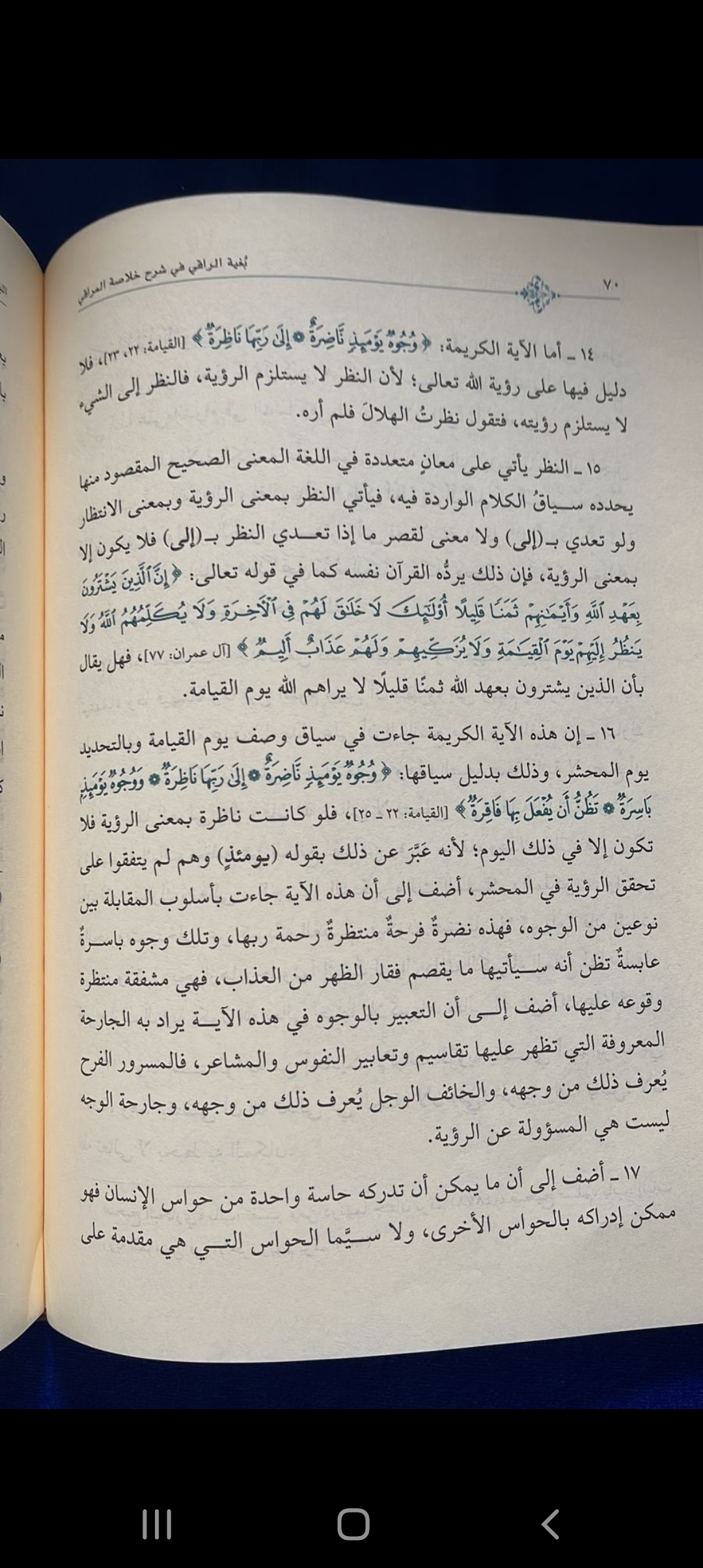
“ Some faces, that Day, will be radiant, Looking toward their Lord. And some faces, that Day, will be contorted, Expecting that there will be done to them something backbreaking.” (Qur’an 75:22-25)
So here the Ashari/Maturidi interpret the word Nazar as looking, seeing. (Insh’Allah we will come back to this, especially in the context of brother Mohamed Ghilan above).
This word (Nazar) is more general than ru’yah.
Will they see with their faces?
Will they see with their eyes?
Will they see with some sixth sense?
This confusion is clear evidence that they do not have any ground for their opinion.
Remember the hadith:
“Soon you will see your Lord openly as you see the moon on the night of the full moon.”
We understand this verse as: “waiting for their Lord”.
We need to again ask if the Ashari/Maturidi position contradicts the following:
a)The Qur’an itself.
b) with their own theology that Allah (swt) is not in space/time.
c) reason.
We would translate or understand the text as: “Faces, that day looking forward to receiving mercy from their Lord.”
The first thing that should be pointed out, is that no one from the Ashari/Maturidi school can find fault with our interpretation of the text. Observe yourself and see the many forms, as a verb, noun, active participle, and passive participle.
Second, the context of the verse itself shows the people of the station waiting to receive their just rewards:
‘Some faces will be radiant, looking forward to receiving mercy from their Lord. Some faces will be contorted, expecting something backbreaking.’
To give you (the truth seeker) a solid proof to show you that Nazir does not have to mean seeing ponder the following text.
“Indeed, those who exchange the covenant of Allah and their [own] oaths for a small price will have no share in the Hereafter, and Allah will not speak to them or look at them on the Day of Resurrection, nor will He purify them; and they will have a painful punishment.”(Qur’an 3:77)
If Nazar in this verse is interpreted as seeing, it will lead to the meaning that Allah will not see these people on the Day of Resurrection. This is not possible, and such a belief is in real error because it is a rejection of faith in Allah (swt)! There is no way but to interpret Nazar here as mercy and favour. Allah (swt) will not show his mercy or favour upon them.
Now going back to what our brother Mohamed Ghilan said in his talk @ 54:32 “But the Sunni position is that we will actually see Allah (swt), but you can but that does not negate that Allah is above everything and he’s above comprehension.”
The other thing that our brother Mohamed Ghilan does is bring in a straw man argument. This is clear evidence that he is not confident of his position.
Thus, he brings up the following verse:
“And if you invite them to guidance, they do not hear; and you see them looking at you while they do not see.” (Qur’an 7:198)
It is clear to me that our brother Mohamed Ghilan by bringing into the discussion a non-argument he is preaching to the choir.
Perhaps our brother Mohamed Ghilan can mention to his students who among the Ahl Al Haqq Wal Istiqimah (The Muslims), the Mu’tazilis, the Jahmis, the Zaydi’s , the Imamis-12er Shia and from among those who scholarsfrom Ahl Sunnah who are independent of taqlid, who among them holds to the position or view that Allah (swt) is comprehensible?
Again a straw man.
As regardsQur’an 75: 22-25 The Ahl Sunnah differ who will see him in the next life.
They are of three views;
1) Only believers will see Him.
2) All people will see him at the Station, believers and unbelievers then the unbelievers will be veiled from him.
3) The third is that hypocrites will see Him but not the unbelievers.
This is enough to prove the weakness of the foundation on which they have established their belief.
By contrast, the truth cannot bear such conflict, because its arguments are clear and its path is straight.
Is this a special treat for the believers only? Is this a special treat just for the believers and people who have remained steadfast?
Apparently not. Ponder the following:
“Soon you will see your Lord.”-Hadith The context of this hadith requires the seeing to take place at the station where all are gathered. It will not be restricted to believers only, Hypocrites, “and this ummah will remain with its hypocrites. Then, Allah, Exalted is He, will come to them in a form other than what they knew, then he will say: “I am your Lord.” Then they will say: “We seek refuge in Allah from you. This is our place until our Lord comes.”
It also follows from it that Allah, will be seen by this ummah believers and hypocrites- This goes against the verse in the Qur’an from
Moses: “NEVER WILL YOU SEE HIM.”
Why the unbelievers and hypocrites from the time of Moses did not get to see Allah (swt) but the unbelievers and hypocrites will be able to see now?
As regards this hadith. Let me put the hadith again for you to read and reflect upon it.
“People asked the Prophet (saw): O’ Messenger of Allah will we see our Lord in the Day of Resurrection? Then the Messenger of Allah replied: Is there any dispute among you whether a full moon is visible? They answered: No. then The Prophet (saw) continued asking them: “ Is there any dispute among you whether the sun is visible in a cloudless sky? They replied in the negative. Then The Prophet stated (saw): “Then you will see your Lord JUST LIKE this”. Allah will get the people together in the Day of Resurrection then He says: those who were worshiping any deity shall follow it. Then the ones who were worshiping sun will follow the sun and the ones who were worshiping moon will follow the moon and those who were worshiping Rebels will follow Rebels …Then Allah will COME TO THEM in a FORM other than WHAT THEY KNEW and say: “I am your Lord”, they reply: “We seek refuge in Allah from you. This is our place until our Lord Comes to us, and when our Lord comes to us, we will recognize Him. THEN ALLAH WILL COME TO THEM IN A SHAPE THEY KNOW and will say, I am your Lord’ They will say, ‘(No doubt) You are our Lord,’ and they will follow Him.”
Source: (Al Bukhari hadith no.6573 Book Of Ar-Riqaq)
Response:
First point. It also follows from it that His Essence (dhat), Exalted is He, changes from one form to the other. Such change is a characteristic of contingent existents (huduth).
Second point.
Shaykh Ahmed Al Khalili (May Allah continue to benefit us through him) asked our brothers from the Ahl Sunnah, the following:
“Whoever has read the Book of Allah and has studied the Sunnah of His Messenger must know that real form in which He will see His Lord, Exalted is He, so that, when he sees Him in another form he does not recognize Him.Then please bring me the description of this form and definition of it from your knowledge through your reading of the Qur’an and your study of the hadiths of the Messenger (saw)? Then they were taken aback and their arguments became void.”
Third point.
Both wordings are clear that their knowledge of His form will be a result of previous seeing. There is no way for those who take the hadith literally but to say that He is seen in this world. Yet most of them have rejected that (the seeing of Him in this world).
Fourth point.
Most believers in the seeing hold that it will happen without kayf (without an understanding how it will happen). The comparison in the hadith with the seeing of the moon ‘like that you will see Him‘ contradicts this view. So too does the mention of the form in the hadith and their not recognizing it when it has changed from what they were familiar with.
Fifth point. How will an angel be commanded to lie? It is a shameful thing.
Abu Musa reported: The Prophet (saw) said, Verily, In Paradise are two gardens with silver vessels and two gardens with golden vessels. Nothing comes between the people and their looking at their Lord but the mantle of Majesty on His Face in the Garden of Eden.”
Source: (Sunan al-Tirmidhi 2527)
In other words, you won’t be seeing Allah (swt) in the afterlife after all!
Remember the Ashari/Maturidi understand face as Allah himself, his essence! That ‘mantle of majesty‘ will prevent you from looking at Allah (swt).
“It is not fitting for a man that Allah should speak to him except by inspiration or from behind a veil.”(Qur’an 42:51)
“The Messenger of Allah stood among us with five words he said Verily Allah exalted is he does not sleep, and that is not appropriate for Him. He lowers the Balance and raises it. To him are carried aloft the actions done in the night before the actions done in the day and the actions of the day before the actions of the night. His veil is “light” (and on one narration “fire”). If He lifts the veil then the light of His Face will burn whatever it reaches of His creation.” The universe itself will be utterly annihilated! Allahu Akbar!
Source: (Sahih Muslim 179a, Book 1 Hadith 352 English reference Book 1 Hadith 343)
“And call not, besides Allah, on another god. There is no god but He. Everything that exists will perish except His Face. To Him belongs the Command, and to Him will you all be brought back.” (Qur’an 28:88)
So regarding this verse that those of our brothers from Ahl Sunnah believe that the Qur’an 75:22 to be strong proof. However, it is weak from all conceivable angles.
It also goes to show to anyone who has eyes and a heart after the truth that the Ahl Sunnah and their consensus down through the ages, has not been guided on this matter. Rather they are in error.
Is it reasonable to assume that the seeing of Allah (swt) is merely hinted at in the Qur’an whereas food and drink, accommodation, gardens, rivers are mentioned time after time with clear phrases with no scope for any other interpretation? Think about it. May Allah (swt) be with you.
So we can see that the Ashari/Maturidi position concerning thee verses in question contradicts other clear text of the Qur’an.
It also contradicts their own theological position.
It also contradicts reason.
The difference between us Ibadi (Ahl Haqq Wal Istiqama) and our brothers from the (Ahl Sunah) when it comes to Qur’an 75:22is that we use an understanding that is consistent with the verb form itself, used throughout the Qur’an: in the way we translate and interpret it, and is consistent with the clear verses of the Qur’an, that clearly negate seeing Allah (swt).
We do that in all verses that indicate corporeality, or time/space for Allah (swt). It is clear that some of our brothers from Ahl Sunnah do so only when it suits them. Allah (swt) knows best.
“Would you question your Messenger as Musa was questioned before? But whoever changes from faith to unbelief has strayed without doubt from the even way.”(Qur’an 2:108)
“(Some) faces, that day, will be radiant. Looking towards their lord.” (Qur’an 75:22-23)
﷽
May Allah (swt) reward brother Assad, the servant of Allah (swt) who did the translation from our noble Shaykh and teacher.
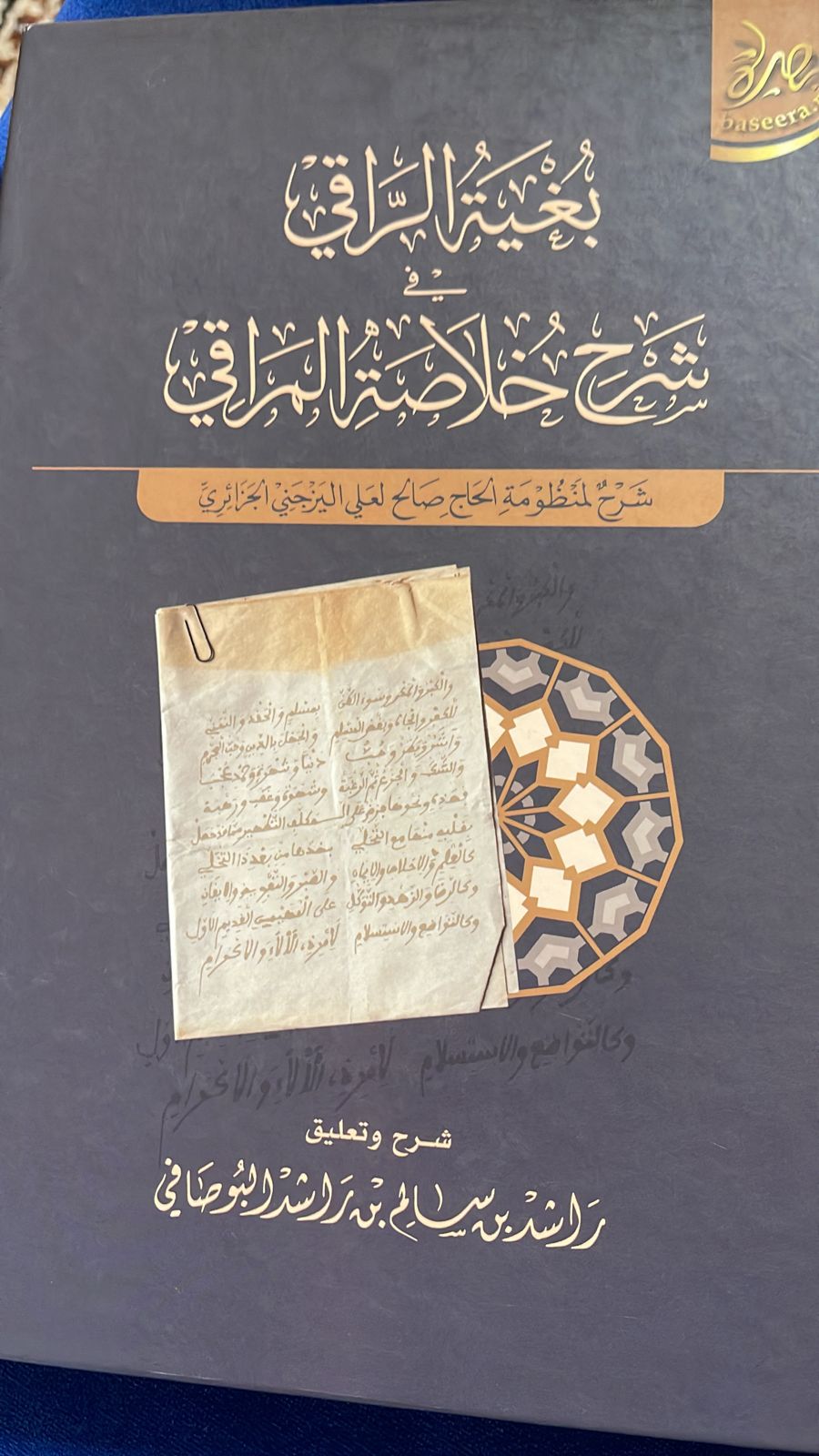
From his book “Bughyat al-Rāqī fī Sharḥ Khulāṣat al-Marāqī” By Shaykh Rashid bin Salim Al-Busafi (h)
The Impossibility of Seeing Allah (SWT): Evidences and Analysis.
1. Qur’anic Evidence: The Permanence of Non-Perception
Surah al-An’am 6:103
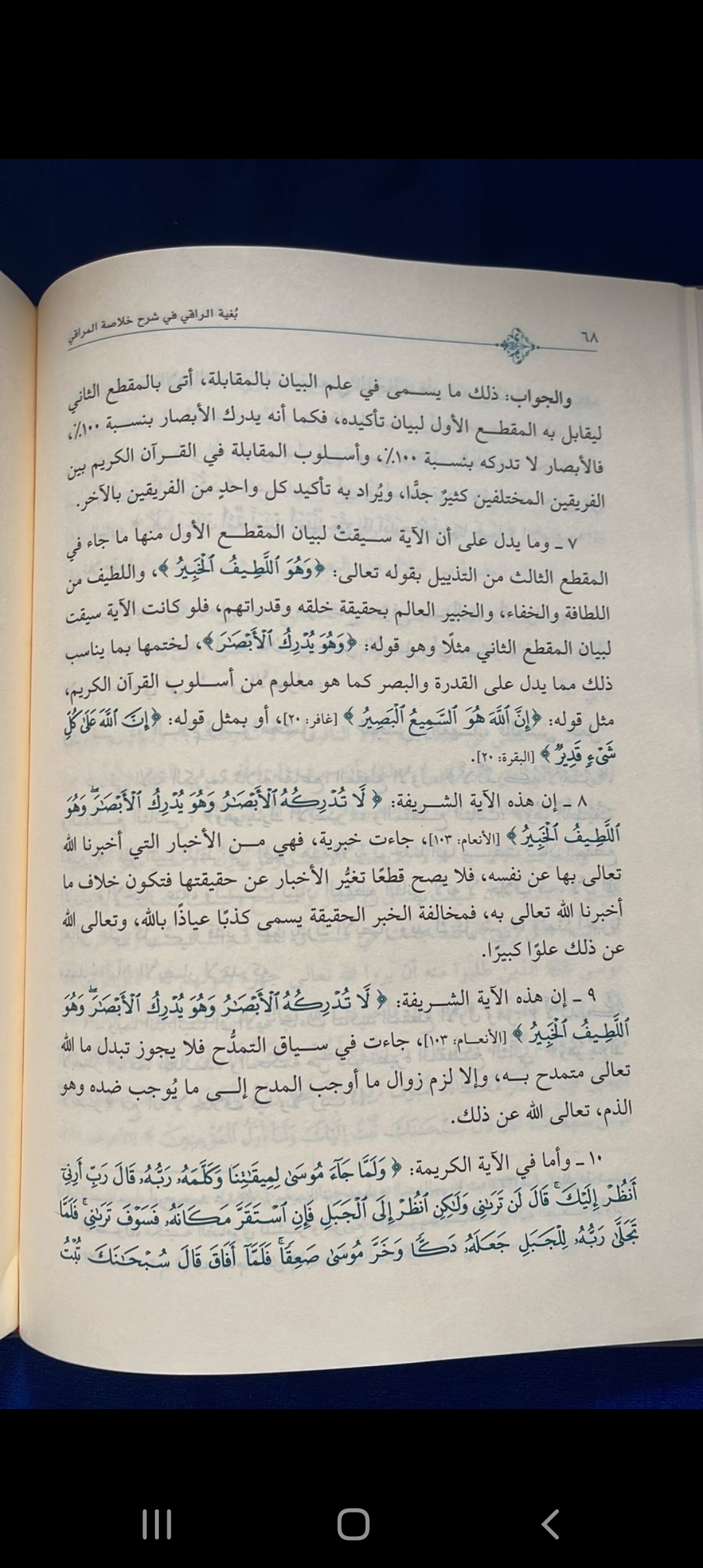
{لَّا تُدْرِكُهُ الْأَبْصَارُ وَهُوَ يُدْرِكُ الْأَبْصَارَ وَهُوَ اللَّطِيفُ الْخَبِيرُ} “Vision perceives Him not, but He perceives [all] vision; and He is the Subtle, the Acquainted.”
Linguistic Analysis:
“لَا” (Lā al-Nāfiyah): Implies permanent negation (“visions do not and will never perceive Him”).
“الْأَبْصَارُ” (Al-Abṣār): Plural of baṣar (vision), emphasizing all types of sight fail to perceive Him.
Divine Contrast: Allah’s complete perception of creation vs. creation’s inability to perceive Him underscores His transcendence.
Context: The verse is a declarative praise, not a reproach, confirming Allah’s incomparability.
Surah al-A’raf 7:143: The Case of Prophet Musa (AS)
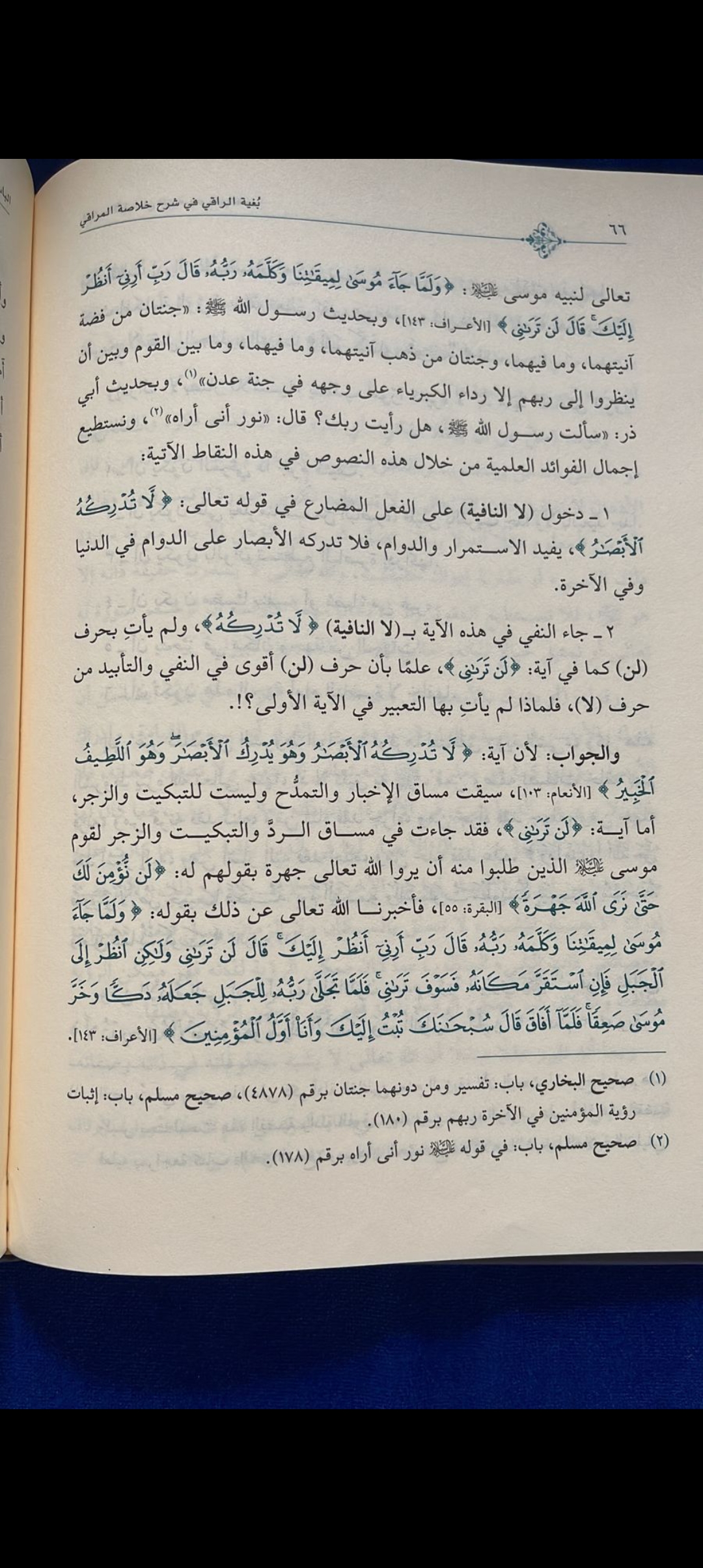
{قَالَ لَن تَرَانِي} “[Allah] said, ‘You will never see Me.'”
“لَن” (Lan) vs. “لَا” (Lā):
“لَن”: Stronger negation, implying eternal impossibility (not just in this world but also the Hereafter).
Context: A rebuke to the demand for visual perception, linked to the Israelites’ disbelief (Qur’an 2:55).
The Mountain’s Destruction:
Allah’s tajallī (manifestation) to the mountain reduced it to dust, proving physical creation cannot endure His manifestation.
Logical conclusion: If a mountain cannot withstand Allah’s presence, how could human vision perceive Him?
3. Linguistic and Theological Principles
A. Meaning of “Idrāk” (الإدراك):
Literally: “To catch up/comprehend fully” (e.g., “أدركته بيدك” = “You grasped it with your hand”).
In the Qur’an: Used for complete perception, not mere sight (e.g., “إِنَّا لَمُدْرَكُونَ” [7:38] = “We are overtaken”).
B. The Three Parts of Ayah 6:103:
Negation of Perception (لَّا تُدْرِكُهُ الْأَبْصَارُ).
Allah’s Full Perception (وَهُوَ يُدْرِكُ الْأَبْصَارَ).
Divine Attributes (وَهُوَ اللَّطِيفُ الْخَبِيرُ).
“Al-Laṭīf”: The Subtle (beyond physical perception).
“Al-Khabīr”: The All-Aware (knows creation’s limitations).
C. Muqābala (Contrastive Rhetoric):
The juxtaposition of “لَّا تُدْرِكُهُ الْأَبْصَارُ” and “وَهُوَ يُدْرِكُ الْأَبْصَارَ” emphasizes asymmetry: Creation’s incapacity vs. Allah’s omnipotence.
Refutation of “Seeing Allah in the Hereafter”
A. Qur’an 75:22-23: {وُجُوهٌ يَوْمَئِذٍ نَّاضِرَةٌ إِلَىٰ رَبِّهَا نَاظِرَةٌ}
“نَاظِرَةٌ” (Nāẓirah): Does not necessarily mean “seeing”:
Alternate meanings: “Awaiting” (e.g., Qur’an 3:77: “وَلَا يَنظُرُ إِلَيْهِمْ” = “He will not look upon them”).
Context: Contrast between radiant faces (awaiting mercy) and gloomy faces (fearing punishment).
The correct meaning is confirmed through the context it has been mentioned in, so the Al Nathar (النظر) comes with the meaning of waiting even if it was preceded by (Ila) إلى
“Indeed, those who exchange the covenant of Allah and their [own] oaths for a small price will have no share in the Hereafter, and Allah will not speak to them or look at them on the Day of Resurrection, nor will He purify them; and they will have a painful punishment.” (Qur’an 3:77)
So is it said that, those who sell out Allah’s covenant and their own oaths for a small price, is it said that Allah doesn’t see them in the Akhira?!
This Ayah came in the context of describing the day of judgment, and the day of gathering to be exact. And that’s by the proof of its context {{On that Day ˹some˺ faces will be bright,() Awaiting the mercy of their lord ()And ˹other˺ faces will be gloomy,() ا ِض َرةٌ ُو ُجوهٌ َيْو َمِئٍذ } {.in anticipation of something devastating ن )22ٰ )ى َّ لَ ِإ َنا ِظ َرةٌ )23ِ )إ َرِّب َها َت ن ُظ َبا ِس َرةٌ )24ُّ )ن َوُو ُجوهٌ َيْو َمِئٍذ َأ َع َل َأ ُيف َها ْ ِ ٌرة َقِفا َب { so if (Nathira) (ناظرة (was of the meaning of seeing then it won’t be except on that day; because he described that by saying (on that day) (ذٍيومئ (and those who differ with us they have not agreed on it happening on the gathering, add to that, the ayah came with the style of comparison between two types of faces, so these are radiant, happy, waiting for the mercy of its lord, while the others are contorted and gloomy expecting what will break their backs from punishment. So, it’s in pity waiting for it to come. Add to that that the description by faces in this ayah means the known organ which the feelings appear on. What is in the soul. What the soul is feeling will be expressed on the face. As the contentment and happiness can be identified through his face, and fearful and frightened can also be identified by his face, and the face organ is not the organ responsible for seeing.
B. Hadith of the “Two Gardens”:
Claim: The ridā’ al-kibriyā’ (Cover of Majesty) is the only barrier to seeing Allah.
Rebuttal:
The “barrier” is an eternal attribute of Allah’s majesty, not a temporary veil.
Asserting its removal implies Allah changes His essence, which is impossible.
C. Theological Absurdity:
If seeing Allah were possible, it would necessitate:
Spatial limitation (violating His transcendence).
Change in divine attributes (e.g., “pride” being removed).
5. Critique of Pro-Visual Perception Arguments
A. Misinterpretation of “نَاظِرَةٌ”:
Error: Assuming it means “seeing” despite contextual evidence to the contrary.
Qur’anic Precedent: “وَلَا يَنظُرُ إِلَيْهِمْ” (3:77) cannot mean “He does not see them,” as Allah is All-Seeing.
B. Anthropocentric Fallacy:
Claiming “seeing Allah is the ultimate reward” reduces worship to physical gratification, contrary to the Qur’an’s emphasis on spiritual nearness (e.g., “قُرْبًا إِلَى اللَّهِ” [3:45]).
C. Quotes from Classical Scholars:
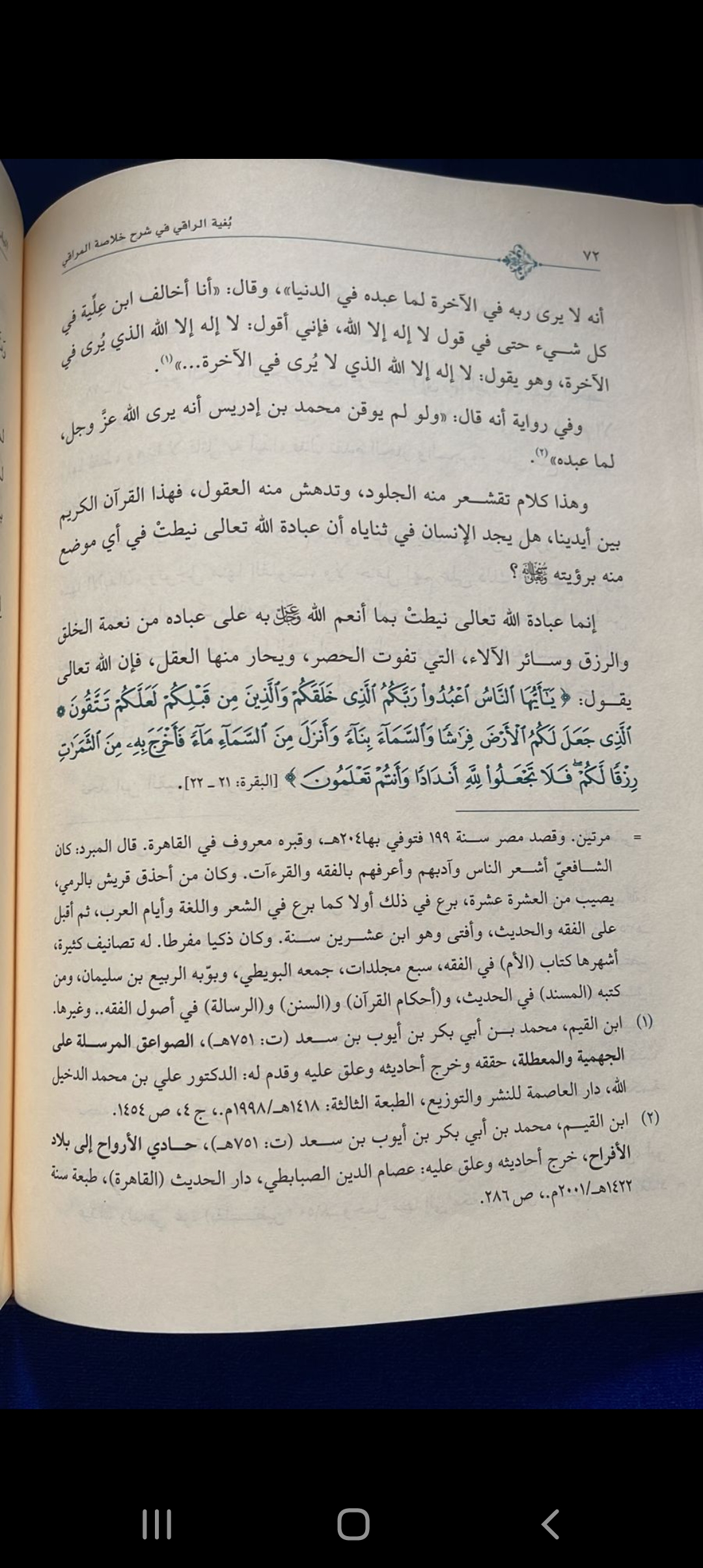
Ibn al-Qayyim’s Attribution to al-Shafi’i:“If Muhammed ibn Idris [al-Shafi’i] knew he would not see his Lord in the Hereafter, he would not have worshipped Him.”
Rebuttal: This contradicts the Qur’anic principle that worship is due to Allah’s lordship, not contingent on visual perception.
This is not acceptable to us. It is as if one links to Imam al-Shafi’i the belief of the Atheist!
And they hold that seeing Allah is the thing that made Allah the Exalted worthy to be worshiped, and that if he Allah Tabaraka wa Ta’ala was not seen in the Akhira then he was not worthy to be worshiped in this dunya, and to you some of what they said: we find ibn Al Qayyim links to Imam Shafi’e that he said “if Mohammed bin Idrees did not known that he won’t see his lord in the akhira then he wouldn’t have worshiped him” and he said “I oppose ibn Aliyyah in everything even in saying La Illaha Illa Allah, as I say: la Illaha Illa Allah that can be seen in the akhira, and he says: La Illaha Illa Allah that cannot be seen in the Akhira…” and in another narration he said “ If Mohammed ibn Idrees was not certain that he’ll see Allah Azza Wa Jal he wouldn’t have worshiped him”. And this is talk that makes bodies grasp, and minds flabbergasted, as this is the Quran within our hands, we do not find that that the worship of Allah the Exalted was conditioned in any position of it with seeing him swt!! This is the belief of the Atheist!
“The Originator of the heavens and the earth; He made mates for you from among yourselves, and mates of the cattle too, multiplying you thereby; there is nothing like unto Him; and He is the Hearing, the Seeing.” (Qur’an 42:11)
The faculties of seeing (tudriku) cannot grasp Him, and He grasp all–seeing (yudriku), He is the All-Subtle and All-Aware.” (Qur’an 6:103)
“Allah has promised the believing men and believing women Gardens beneath which rivers flow. They shall abide in it. There are delightful dwelling places for them in the Gardens of Eternity. They shall, above all, enjoy the good pleasure of Allah. That is the great achievement.” (Qur’an 9:72)
﷽
My friend had his brother in law send him these clips by a preacher from the Salafi sect claiming people will ‘see the face of Allah’ in the paradise.
The preacher in the above video says:
“O Rabb, show Your Face.” “We want to look at You.” “So Allah (swt) Orders for the Hijab to be removed. And the Hijab of Allah Is Light (Noor).” “And you will see your Lord Like you see the sun at its noon Or the moon at its full. ” “There will be faces looking at their Lord. Looking so much so that Allah” (swt)
“May Allah makes us of those who will lay eyes On the Blessed Face of Allah” (swt)
You ever notice how these people talk about seeing the ‘Face of Allah’ ? Why don’t they ask to see the foot of Allah? Why don’t they ask to see the two right hands of Allah? Why don’t they ask to see the shin of Allah? Why would it be shameful to ask that? Does Allah (swt) have attributes that are shameful? Astaghfiurllah! Of course not!
When I asked this of a brother his response was:
“I guess because the face is considered to be the seat of beauty in human beings.”
Right! However,
“There is nothing like unto Him; and He is the Hearing, the Seeing.” (Qur’an 42:11)
AS FAR AS ALLAH (SWT) REMOVING SOME HIJAB….WELL THINK AGAIN!
Curious to see more?
Like where Imam Shafi’i is reported to have said that if he knew he would not see Allah (swt) he would not worship him, even though Allah (swt) NEVER made that a condition of worshipping him.
Allah (swt) has already told us what the great attainment is! It is not seeing his face!
“Allah has promised the believing men and believing women Gardens beneath which rivers flow. They shall abide in it. There are delightful dwelling places for them in the Gardens of Eternity. They shall, above all, enjoy the good pleasure of Allah. Thatis the great achievement.” (Qur’an 9:72)
You might benefit from reading the following articles:
“He is Allah , other than whom there is no deity, the Sovereign, the Pure, the Perfection, the Bestower of Faith, the Overseer, the Exalted in Might, the Compeller, the Superior. Exalted is Allah above whatever they associate with Him.” (Qur’an 59:23)
﷽
The Salafis agreed to debate The Muslims, The People of Truth and Steadfastness, on the issue of ‘Seeing Allah in the hereafter‘. The Salafis are a people not very strong or grounded in theology.
Our noble Shaykh Masoud ibn Muhammed al Maghbali, from the Muslims debated with representatives of the Salafi sect. Professor Hossam Al-Jed from Egypt. Shaykh Masoud went to Egypt to represent the Muslims, while Professor Hossam Al-Jed represented the Salafi sect.
The full debate can be seen here:
Allah’s victory is in the creed of those whom he has purified. The Muslims, The People of the Truth and Steadfastness. The Professor read from his paper, but our noble Shaykh was confident with the arguments Allah (swt) supplied him from sound theology. All praises be to Allah (swt).
Indeed, the arguments for seeing Allah Almighty are weak.
Did Allah (swt) really reveal himself to that mountain? In the anthropomorphic sense that the Salafi claim?
He appeared in His true form?
Then where is he after this Transfiguration? Did he remain there or did he disappear?
Did he vanish?
Allah (swt) is the friend of the Blessed and Noble Messenger, Ibrahim who said in the same Qur’an:
“When the night overshadowed him, he saw a star and said, “This is my Lord!” But when it went down he said, “I do not like things that vanish.” (Qur’an 6:76)
Then they go against the apparent meaning of the verse: “The eyes do not perceive him, and he perceives the sight, and he is The Gentle, The Expert.” (Qur’an 6:103)
So they interpreted the word that the eyes cannot see him in another sense contrary to what came in the linguistic dictionaries, where they interpreted perception by ‘encompassing’ as some type of victory for their scandalous and decrepit doctrine.
After these debates many from among the Arabs left the Salafi sect and entered upon the way of the Muslims, The People of The Truth and Steadfastness. The Salafi’s deleted videos. Their Professor Hossam Al-Jed from Egypt was demoted from Professor to ‘Student of Knowledge’. Well, in this case Shaykh Masoud ibn Muhammed al Maghbali is also a student of knowledge.
We continue to call them and all others to the way of the Muslims, To the doctrine of transcendence. For this is the safest and securest road.
The faculties ofseeing (tudriku) cannot grasp Him, and He grasp all–seeing (yudriku), He is the All-Subtle and All-Aware.” (Qur’an 6:103)
﷽
Salafi Shaykh Muqbil Al Wadi’i Hadith in Sahih Muslim on Seeing Allah is actually weak!
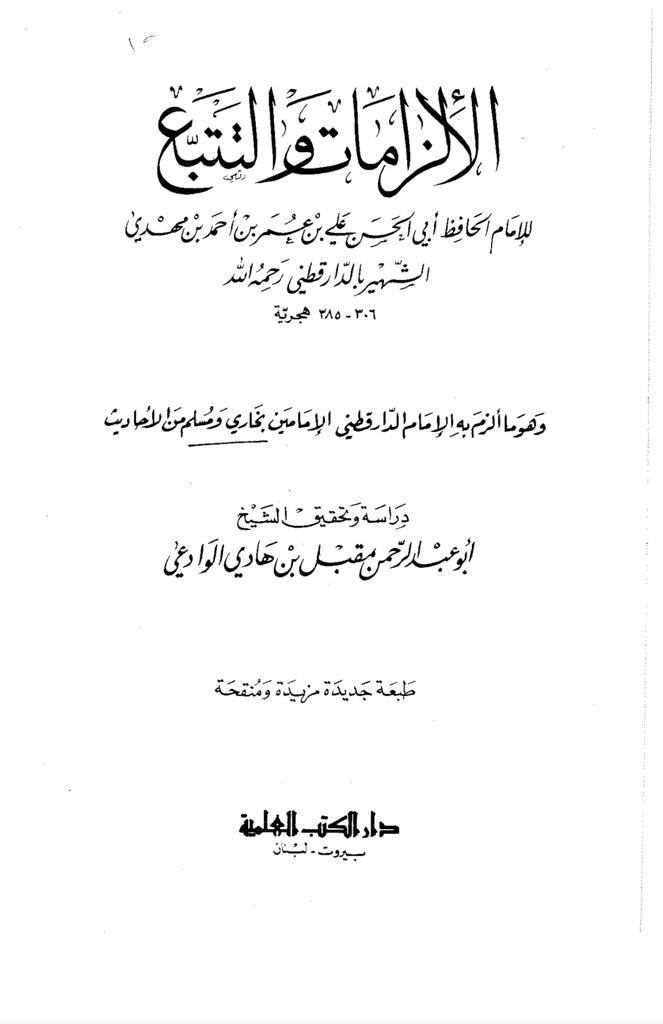
So Imam Al Daraqutni had a commentary about these hadith. In his book he made notes about these ahadith. Than comes along this big hadith scholar from Yemen. This hadith scholar is from the Salafi sect. His name is Muqbil bin Hadi bin Muqbil bin Qa’idah al-Hamdani al-Wadi’i al-Khallali.
So he took the book written by Imam Al Daraqutni and he made his own notes.
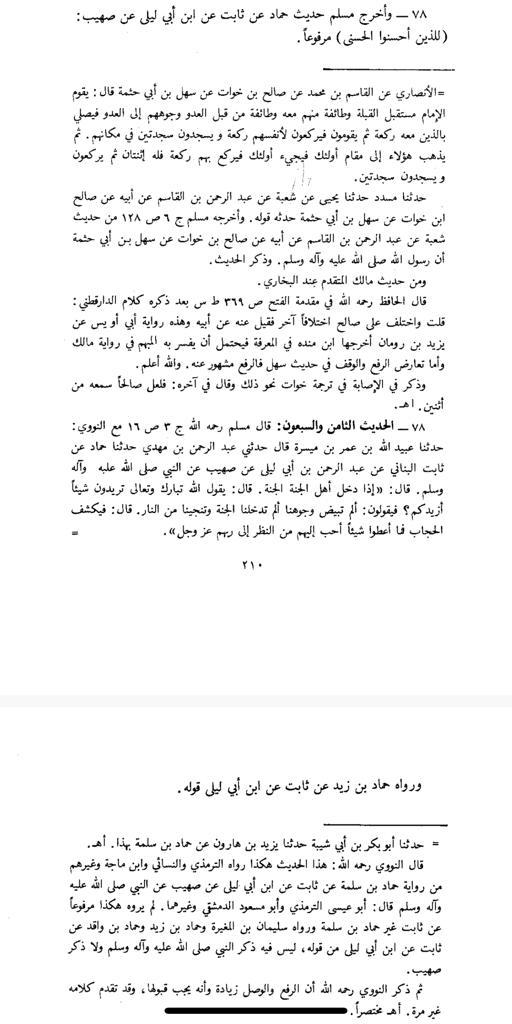
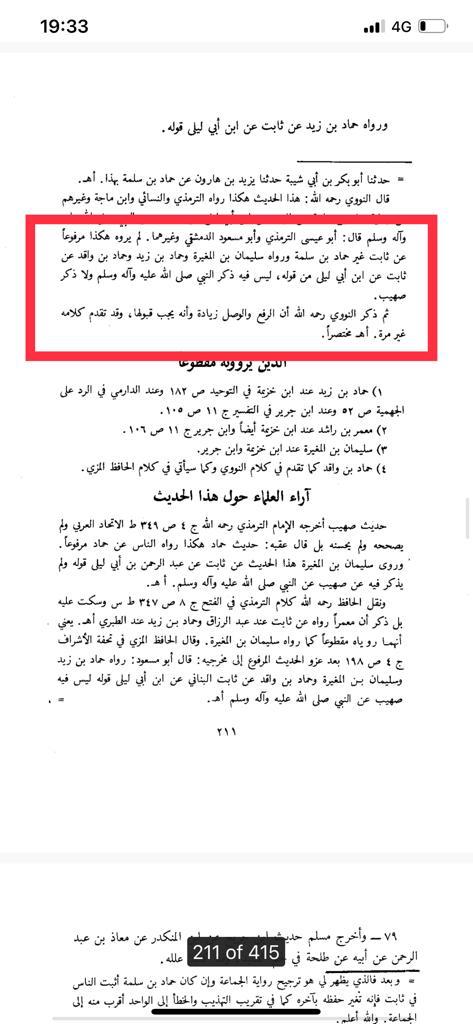
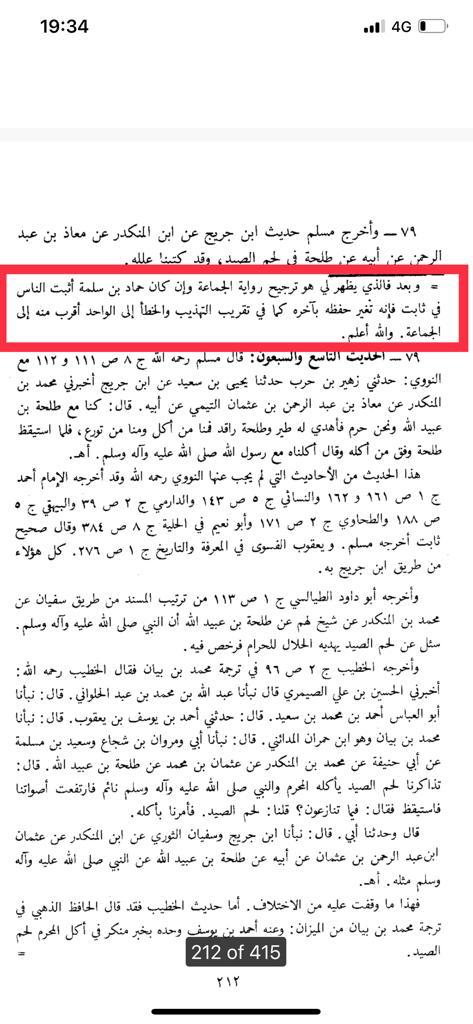
He said about the hadith of Ziyada under Sahih Muslim about the hadith ziyada that the ahl jannah will see Allah (swt) in the Jannah. (Astaghfirullah)
Imam Muqbil al-Wadi’i As Salafi, says this hadith is mistake by Thabit Umani. In the chain, the sanaad.
No one else has ever made this claim other than Muqbil al-Wadi’i Only Thabit al Bunani says this hadith is from Suhayb
The words of the hadith from Shaykh Thabit Bunani only go up to Abdulrahman bin Abi Laylaa only!
It is not from Suhayb nor from the Blessed Messenger (saw).
The words go up to Shaykh Abdulrahman bin Abi Laylaa (only!)
And according to their statement the mistake is coming by Hamaad bin Salamah. For any Hadith that comes through the channel of this man be careful!
There are four students under Thabit al Bunani
Hammad ibn Salamah
Sulaymān ibn al-Mughīrah
Hammad bin Zayd
Hamaad bin Waaqid
So this Imam Muqbli is saying the hadith is in Sahih Muslim is either weak or outright fabricated! On this point he is in agreement with the safe road, The Muslims, the Ibadi school.
May Allah (swt) guide this ummah to what is beloved to Allah (swt). We continue to call the people to the way of the Muslims, To the doctrine of transcendence. The way of the Qur’an and the Sunnah. For this is the safest and securest road.
Say, “My Lord has only forbidden immoralities – what is apparent of them and what is concealed – and sin, and oppression without right, and that you associate with Allah that for which He has not sent down authority, and that you say about Allah that which you do not know.” (Qur’an 7:33)
“And who is more unjust than he who invents a lie about Allah ? Those will be presented before their Lord, and the witnesses will say, “These are the ones who lied against their Lord.” Unquestionably, the curse of Allah is upon the wrongdoers.” (Qur’an 11:18)
﷽
It is wrong to lie about a messenger of Allah (swt) and to deceive the people in the matter of theology.
“Even in the case of Prophet Moses (Peace be upon him) Prophet Musa (alayi salam) begged Allah to see him. Because he could hear him. Now he wanted to see him. He said, and that is recorded in surah Al Araf My Lord allow me to see you. His Lord said, You will never be able to see me….in this life. But when he insisted He said: Look at the mountain if the mountain stands still then perhaps you can see me. And a mountain is definitely much more stronger and powerful than Musa and all the human beings. So Allah The Almighty did as follows: The ayat 143 of surah Al Araf So Allah The Almighty allowed light beam of his light to shine at the mountain, the mountain turned into dust. Full of thunder, it turned into dust, like shredded wool. Then Musa (alayi salam) upon seeing what happened to the mountain he fell unconscious and then when he came back to his consciousness he realized that he was mistaken when he insisted on seeing Allah The Almighty. I repent unto you, I shall not ask for that again.” -Dr. Muhammad Salah
There are quite a few things wrong here with what the Salafi preacher had said.
#1) No where in the Qur’an does Allah (swt) say, “You will never be able to see me in this life” as if to indicate you will see Allah (swt) in the next life. It simply says, ‘You will never be able to se me!’ These people will tell lies about Allah (swt) and go against the clear text of the Qur’an and the Sunnah.
#2) Actually what Musa (alayi salam) said was:
“Highly Exalted are You; I have indeed repented to you, and I am the first of the believers.“
First of the believers in what?
Let us look at how various translations deal with verse in question:
“When Moses came at the appointed time and his Lord spoke to him, he said, “My Lord, show [Yourself] to me, so that I might see You.” Allah said, “You can never see Me. However, behold this mountain. If it remains firm in its place, then you will see Me.” As soon as his Lord revealed His limitless glory to the mountain, He caused it to crumble to dust and Moses fell down unconscious. After he recovered, he said, “May You be exalted in Your glory! I repent! I will be the first of the believers!” (Qur’an 7:143)
Time to manipulate English translations based upon the theological bent one has!
“Never can you see me.”
“You can never see me”
Both of the above translations are correct. It is the one that Dr. Muhammad Salah uses as well. Except, that he added to what Allah (swt) stated with the “in this life.”
“You cannot see me” This translation can be understood as “You cannot see me now” Notice the absence of the word ‘never’.
“But when his Lord manifested Himself to the mountain.” Is the belief that Allah (swt) did reveal himself to the mountain.
Did Allah (swt) really reveal himself to that mountain? In the anthropomorphic sense that the Salafi claim? He appeared in His true form? Then where is he after this Transfiguration? Did he remain there or did he disappear? Did he vanish? Allah (swt) is the friend of the Blessed and Noble Messenger, Ibrahim who said in the same Qur’an:
“When the night overshadowed him, he saw a star and said, “This is my Lord!” But when it went down he said, “I do not like things that vanish.” (Qur’an 6:76)
“When his Lord manifested His glory on the mountain.” This is more sensible especially when consider that even the revelation of Allah (swt), the Qur’an could crush mountains.
“If We had sent down this Qur’an upon a mountain, you would have seen it humbled and coming apart from fear of Allah. And these examples We present to the people that perhaps they will give thought.” (Qur’an 59:21)
What is the view of the Muslims, The Ahl Al Haqq Wal Istiqamah?
Well, dear reader, know that we Muslims put the Qur’an first. We do not attribute words and sayings to Allah (swt) that Allah (swt) did not say. This is a huge sin.
Musa (alayi salam) was aware of the impossibility of seeing Allah, but in asking for it he did not intend obtaining the impossible. He only intended thereby to hold back his people, who were stubborn in seeking it and made their belief in his Message dependent upon it.
“And recall when you said, “O Moses, we will not believe in you unless we see Allah plainly.” Thereupon the thunderbolt struck you while you were beholding.” (Qur’an 2:55)
It is obvious that these demands came before the Musa (alayi salam) approached Allah (swt). Musa (alayi salam) It is not difficult to see that this was a repeated request on their behalf, as the Qur’an mentions this in another place as well.
“The People of the Book demand that you make a book physically come down to them from heaven, but they demanded even more than that of Moses when they said, ‘Show us Allah face to face,’ and were struck by the thunderbolt for their presumption. Even after clear revelations had come down to them, they took the calf as an object of worship, yet We pardoned this, and gave Moses clear authority.” (Qur’an 4:153)
Now is it sensible to think that Musa would ask for the very same thing that they asked for and received the rebuke that they did for doing so? By Allah, to allege such a thing is nothing other than to put Musa (alayi salam) among the despicable ones from among the Children of Israel and to lower him to the level of the ignorant ones.
The proof that Musa (alayi salam) was not asking for himself, is because Allah (swt) could have replied to Musa (alayi salam), “You can never see Me.” This would have been sufficient for a believer.
The proof is that the mountain was destroyed.
Who witnessed the destruction of this mountain? Do you not think people would notice the sudden destruction of a mountain?
If the following happened to Musa (alayi salam) “He caused it to crumble to dust and Moses fell down unconscious.”
What do you think happened to the children of Israel who witnessed this?
“Thereupon the thunderbolt struck you while you were beholding.”
“and were struck by the thunderbolt for their presumption“
Notice after Musa (alayi salam) recovered he says, “”May You be exalted in Your glory! I repent! I will be the first of the believers!“
Why did Musa (alayi salam) say that he will be ‘the first of the believers’ when he is already a believer? Did the incident prove that Allah (swt) can be seen or not seen? Was Allah (swt) seen? No! So Musa (alayi salam) was testifying that he would be foremost among those who deny that Allah (swt) can be seen.
This is the correct belief on the matter:
This is the belief of the Muslims, those who are upon sound theology.














 Prima Quran