Tag Archives: shia

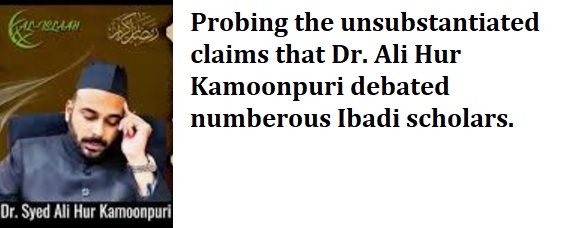
Response to Ali Hur Kamoonpuri attempt to refute Ibadi’s on Siffin.

“Moreover, if two factions among the believers should fight, then make settlement between the two. But if one of them oppresses the other, then fight against the one that oppresses until it returns to the ordinance of Allah. And if it returns, then make settlement between them in justice and act justly. Indeed, Allah loves those who act justly.” (Qur’an 49:9)

“Moreover, it is not for a believing man and it is not for a believing woman when Allah has decided and His Messenger a matter that (there) should be for them (any) choice about their affair. And whoever disobeys Allah and His Messenger certainly, he (has) strayed (into) error clear.” (Qur’an 33:36)
﷽ 

Our colleague narrates an encounter between a former student of Dr. Syed Ali Hur Kamoonpuri and the claims made by her teacher.

This post is in regard to some messages that a woman named Roxanna sent to me via our conversations/exchanges through WhatsApp. I believe it all started when she shared a post of mine from Prima-Quran. That post was the following:

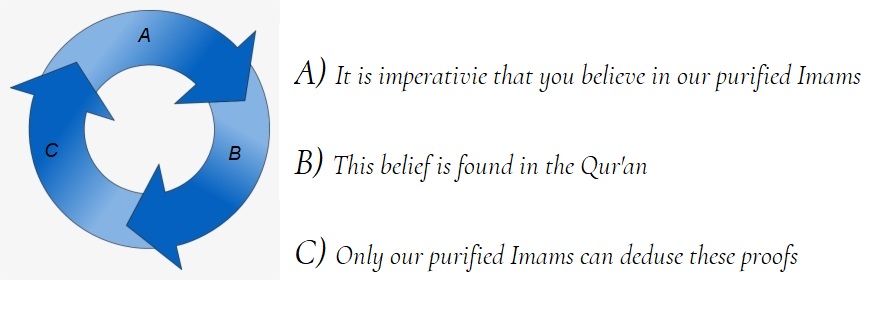
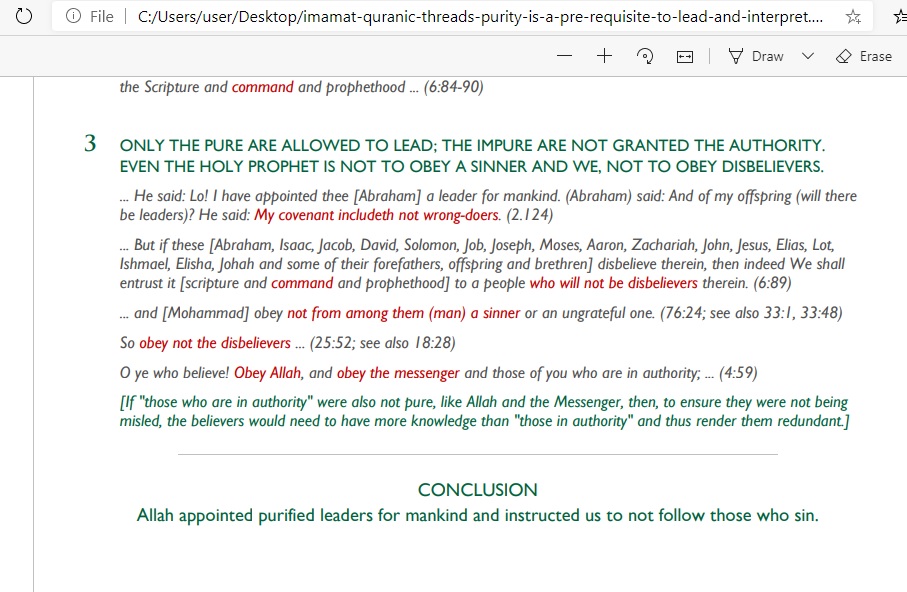
https://primaquran.com/2022/10/17/ismaili-shia-and-circular-reasoning/

My sincere feedback to Roxanna was that any time when we are in any chat group that has its own agenda or focus, it would not be prudent for us to go into that group with any attempt to derail it.

So for those from the Ibadi school reading this. If there are Facebook groups, WhatsApp, Telegram, or Discord servers created specifically for Sufism, or Shi’i or the Sunni, please do not go into those groups and try and derail the focus of those groups. Let them be.

Thus, as she tells us, this got this Syed Ali Hur Kamoonpuri quite worked up. Which is understandable. Reformist or not, he is still a Shi’i and Ali is central to their identity. Apparently she was threatened with going to hellfire for even entertaining the thought that Ali could be on the wrong side of history when it comes to the decisions at Siffin.

So, apparently, this Syed Ali Hur Kampoonpuri was going to do a YouTube series refuting the Ibadi (nothing better to do). Yet, all the while claiming he wanted an Ibadi to appear as a “guest”. So you have to wonder how sincere that is. In fact, she herself mentioned that she was to play some part in the refutation of the school.

Then, this Syed Ali Hur Kampoonpuri claimed that he “debated Ibadi scholars”. This naturally caused a raised eyebrow from myself So I asked her to ask him who are these “Ibadi scholars” he “debated with.”

The question was deflected, which seemed quite predictable. Wanting to invite a scholar onto your program with the pretense of having a dialogue when you actually want a debate is rather insincere. You don’t have the intention of inviting an “Ibadi guest” on a program while having the intention of doing a refutation series. That doesn’t come across as sincere as all.

So she replies:

“This was the response I got when I asked which Ibadi scholars he had discussions with” — Roxanna

“Walaykum Salaam. They were mostly from Dar es Salaam, Tanzania and Zanzibar when I used to live there. And some who visited India. But I don’t know if they would be pleased at my sharing their names, given how secretive and low-key they prefer to remain.” -Syed Ali Hur Kamoonpuri

They were mostly from Dar es Salaam (would indicate 1 scholar), Tanzania and Zanzibar (would indicate at least 1 scholar) and “some who visited India” that some would indicate more than one.

So, that is a total of 4 Ibadi scholars, at the very least he has claimed to have debated.

In our eyes, this causes Mr. Syed Ali Hur Kampoonpuri’s credibility to be questioned. It is very challenging to take someone seriously when they make claims like this and when asked to substantiate such claims, they are not forthcoming. It is most unfortunate.

The sister, who was welcomed by the group, acknowledged how kind and welcoming everyone was. It was not long until she asked for others to be invited to the WhatsApp group. Now, keep in mind that the group is created for people convinced of the Ibadi school and asking questions with regard to guidance for their life.

So, she invited about 4 others to the group. It was not long until the questions turned to Siffin and that pretty much dominated the conversation as far as her own interest.

All I know is that I connected her with many people in the Ibadi community. She left the WhatsApp group one day, dropped contact. The last I heard was a person in the group messaged me one day saying: “Your sister dropped her scarf.” Such an odd message to receive with no context. That person then sent me a link of her in some YouTube program she does without the headscarf.

That is really not my business. She is on her own journey, as are we all. May Allah guide her and guide us.
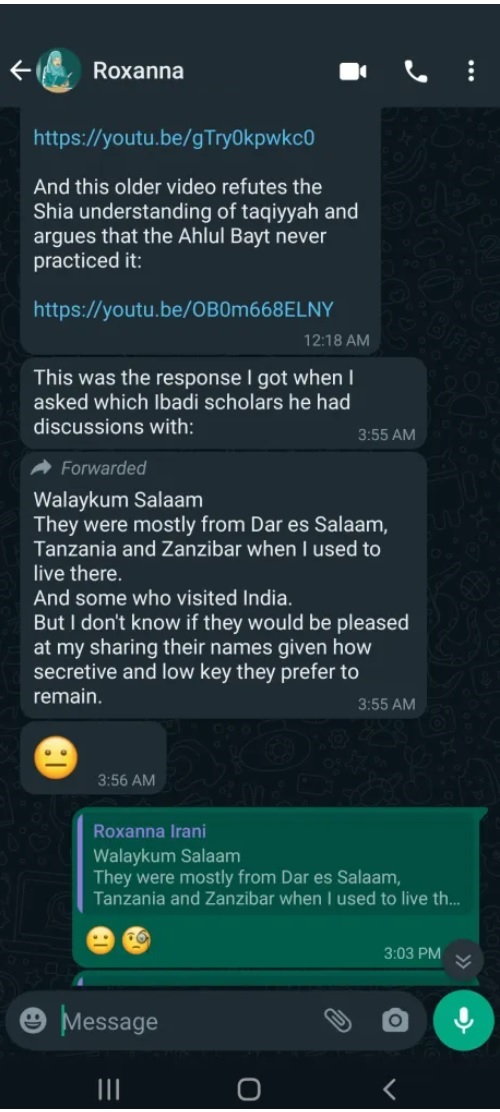
Do note that Roxanna has changed the information from him (Syed Ali), claiming he had ‘debated’ with such people, him (Syed Ali) simply having ‘discussions’ with such people. This also raised an eyebrow. 

Yet you can see by her emoji, it is one that conveys mild irritation. We had asked Shaykh Juma Al Mazruii if he had ever heard of this Shaykh, and he said no. Shaykh Hilal al Wardi and Shaykh Hafidh Hamed Al Sawafi had not heard of him either. No one had heard of this guy.

You see, the Ibadi community is quite small. It would not be very hard at all to ascertain the truth of his statements. For example, his statement, “When I used to live there,” We could get from him the years he says he lived there and from there simply ask in our very tight-knit and very small community, have you ever heard of this guy?

This is a huge stumbling block for our side to have anything to do with him. Also, to be transparent it also caused doubt in us towards those who would associate with such a duplicitous individual. I am certain he has not debated Ibadi scholars because the arguments that he brings up are so ignorant, and devoid of any basic knowledge of our fiqh in regard to matters of arbitration.

We let the reader make their own informed decisions. 


So, if there is an attempt from his circle or him to engage one of our teachers in the future, he would need to first clear this up. 

So who is Syed Ali Hur Kamoonpuri? To be fair, we had not heard of him until she brought up his name. A Google search revealed that his father was one Dr. Syed Mujtaba Hasan Kampoonpuri, who served as the Dean Faculty of 12er Shia Theology at Aligarh Muslim University.

Also, to send some traffic his way, this is his YouTube channel for those interested: https://www.youtube.com/@Al-Islaah

He has some worthwhile content that those who are searching these matters may find useful.

We understand he is trying to reform 12er Shi’ism. In this regard, may Allah (swt) grant him success. Any attempts to build bridges among the Muslim community may Allah (swt) grant him success. However, when it comes to his “knowledge” of the Ibadi school, it is a naked display of ignorance, mischaracterizations and straw man “arguments.”

These are his two voice clips sent to sister Roxanna. You listen and be the judge. We have our own response to these. Apparently sister Roxanna was harangued by them over it. May Allah help us.

This is quite literally a transcription of the above voice notes. One may feel free to give it a listen and follow along. Below is a response to his (Syed Ali) claims. 

“Ali had already answered these doubts. He said, “Who told you we made human beings arbitrators? We made the Qur’an the arbitrator. The job of the human beings is simply to deliver the verdict of the Qur’an. You understand? The arbitrator is the Qur’an. And that no one in the Ummah can deny. Even the Qur’an itself says that Allah is supposed to be the hakam right? Allah is supposed to be the arbitrator. But how does Allah be…how does Allah act as the arbitrator? He’s not gonna, he’s not an old man in the sky as the as some of those who believe in Israliyaat (narrations from the children of Israel) would perceive him. Or as the Anthropomorphist would perceive him. That he will that he’s an old man in the sky authbillah (seek refuge with Allah) and that he will descend, you know he will send down on a ladder and he will descend and he will come and issue the verdict. When the Qur’an promotes takheem (arbitration) of Allah. When ever you have a dispute or iktilaaf (difference) the hukm (judgment) will come from Allah. Hukm will not come from Allah in the sense that you look towards the sky and Allah will write the verdict on the sky. He has already, he has already revealed the book. The book contains the judgement. But the book does not have a mouth, with which it can pronounce the judgement. So the mouth Allah has given to the human being. Human agents. O.K? They will bring out the judgement of the Qur’an. And and obviously the judgement of why do you have a qadi in courts then? You know tell tell the government of Oman to fire all the qadis. Who are they? Why are they bringing human agents? You know they should just put a Qur’an on the seat of the qadi; and let the Qur’an give the judgement. So this is Imam Ali’s problem with the Khawarij. He is telling them you are foolish. This is not how it works. You can’t ahh directly ask the Qur’an to issue the judgement. You need to appoint human beings the hakam (judge)O.K.? And those hakam (judges) will extract the verdict from the Qur’an. And than they will say, Why did you appoint Abu Musa Al Ashari say by the way he’s he was not my choice. Why do you allow them to appoint Amr Ibn Al ‘As say Baba this is not my choice. They have their own ah army, they have their own separate government. Uh we cannot impose, we cannot dictate who they will choose. You understand? We cannot impose our choice on them. If we could impose our choice on them at this stage than why are we having the battle between them? The, the reason why we are having the we were having the battle with them is because our authority on them had not yet been established. They have not accepted our authorities. So how can we start appointing people on their side when they don’t even accept they have not even submitted to our authority? But yes they are prepared to submit to the authority of the Qur’an. And they are saying that they are ready and willing to appoint someone from their side who will uh at least as far as they are alleging will sincerely try to extract the verdict, verdict of the Qur’an. So yeah we have to go with that! We can’t determine. We can’t impose our choice Imam Ali was not allowed by the Khawarij in his army to choose his own arbitrator also. He wanted to choose Ibn Abbas or Malik al Ashtar or someone of that sort. But no they imposed Abu Musa Al Ashari because they wanted someone who is anti-war, not pro-war. And let us not forget that it was the Khawarij who applied all the pressure, or the major part of the pressure in getting Imam Ali to uhh to enforcing him to accept takhim (arbitration). And uhh they they at that it seems they were completely you know enamored with this they were they were hypot-they were sorry they were hypnotized by this um by this um by this call to come to the judgement of the Qur’an. They were like how can we fight when people are inviting us towards the Qur’an? Now as far as the verse of surah Al Hujrat (chapter 49) is concerned uhhh Imam Ali did not violate it. Allah says, The obligation to fight the rebellious party only is binding okay soo far as the party is not willing to submit to the Amr (command) of Allah. But as long as as soon as the rebellious party says, even if they don’t accept your authority, and your caliphate, and the ij, bayah (oath) and mashura (collective decision) of the muhajirin (those who migrated) and ansar (those who helped) all of that no problem. As soon as the rebellious party says look we are ready to surrender to the Qur’an. Ah what is the Qur’an. The Qur’an is the amr (command) of Allah is it not? Ahhh so at that point if you want you can invoke this part of the verse and say that look Allah say, until it returns to the Amr (command) of Allah. By raising the Mushahif (Qur’an on parchments) on the spears they are at least zahiran (outwardly apparent) even if if they are batinan (hidden) and munafiq (hypocrites) there you know not serious they are not sincere whatever you say about their batin (what is hidden). But Zahiran (outwardly apparent) so long as the rebellious party is offering to submit to the judgement of the Qur’an. Then you cannot say that Quranically we are still obligated to continue fighting them. No. At that point the Qur’anic obligation is lifted and now it becomes a matter of the what is the requirement of the political and military wisdom. So now poli, the rules of politics and military wisdom dictate that you should try to ascertain are these people really sincere or not. Now, We have already, Imam Ali had already seen these people are not sincere because the beginning of the battle we did call them towards the Qur’an. They didn’t accept it than. Now that they are losing the battle all of a sudden they now want the Qur’an to be the judge? So on that basis politically Imam Ali even after the arbitration continued to maintain he said yes politically what you people forced me to do was not the best. Uhmm it was not the best approach you should have listened to me I was telling you even though the Qur’anic obligation at that point now starts to rest on on a, you see the the critical point the Khawarij did not understand. o.k Which is that Allah’s commands in the Qur’an are absolute, they have to be followed under all circumstances right? But, sometimes they are predicated upon uh worldly, politically and military ijtihad (striving to derive rulings from the sources). So, For example, Allah (swt) says in the Qur’an that we have to fast. O.K we have to fast. And the Sunnah has already made it clear that as soon as you see the moon start fasting shahru Ramadan (month of Ramadan) right? But seeing the moon on shahrul Ramadan this is a human worldly astronomical matter. It is not an absolute uhh divine yani(you know) Allah does not inform us when the moon has been sighted. This is something we human beings have to apply our ijtihad to find out ehh uh has the moon been sighted or not. Here there can be mistakes. So if lets say a human being by mistake has a hallucination or some illusion and he ends up seeing the moon or lets say because of some defect in his eyes he is not able to see the moon and no one is able to see the moon and they don’t fast the next day when in reality the moon had appeared in the ilm (knowledge) of Allah the moon had appeared, Allah doesn’t have a case against such people. You can’t say but I sa my command was to start fasting as soon as you see the moon. The problem is we didn’t see the moon even if it may have been there so yes the requirement of worldly wisdom should have been that we should have put enough arrangements in place to ensure that you know that the moon is sighted. But we failed in that. So similarly Imam Ali is saying that look Allah’s obligation to fight against the forces of Sham (Syria) was only binding so long as they were completely stubborn and they were not re, Muaviya this is how he came to Siffin. He said I don’t have anything for you except the sword. Imam Ali tried to negotiate with him. He wrote letters to him. All of that! Everything failed. That’s why the battle happened as a last resort. When his side attacked the side of Imam Ali and committed aggression against him. So he fought them in defense. So this is what the fight was about. Now when Allah says, You keep on fighting them until they return to the Amr of Allah. Now this until they return to the Amr of Allah this is going to be determined by how do you determine when a party has returned to the Amr of Allah? This will be determined by worldly factors. Which are not God is not going to send you wahy telling o.k now they have returned or ok no no no they have not actually they are not sincere keep fighting. No these are human ijtihadi matters. Now the army of Imam Ali not Imam Ali himself Imam Ali’s ijtihad was correct wal hamdulillah (praise be to Allah)from the beginning he, Ibn Abbas, Malik Al Ashtar they all saw through this and they said yeah but look the correct worldly and military ijtihad requires us to continue this fight. Because we have enough against these people to prove to Allah that they are not sincere. We can see that. But the rest of the army uhhmm and especially these um foolish khawarij were not able to see through that. They were deceived. And in some of the reports indicate that its not just that they were deceived its it’s that the
battle had really broken them. They just wanted an end by any means. Some of them were like that. Their were people in the army of Imam Ali that were completely the battle had been so fierce and it was so much bloodshed they were psychologically effected by it, and they were just looking for any excuse to stop the battle. And these are the first people to have jumped on this thing that no no no let’s stop the fighting. Let’s stop the fight. They were desperate. So this desperation caused them to make this faulty ijtihad and Imam Ali said o.k if they had gone against the Qur’an with this ijtihad Imam Ali would have said you know what let us die. It is better to die than to go against the Qur’an. But because their faulty worldly ijtihad was only a worldly political mistake and military mistake that they were making Imam Ali tried to warn them against it but he did not stick to his gun. He did not impose it on them very ferociously. In the end you see him saying that o.k I can clearly see you people have lost the will to fight and it does not befit me as your leader to force you in a direction that you are not pleased with. You people don’t’ wanna fight o.k What you are proposing because it does not go against the Qur’an and established sunnah accepting arbitration a call to make the Qur’an the judge between two parties is never against the Qur’an and Sunnah. In fact it is 100% in line with the Qur’an and Sunnah. The only issue is that the worldly aspect of it. The worldly aspect is you have to you have to determine rather the other party is really sincere or not. You people are just taking their word for it. Which is not uuh a good thing to do from a worldly political military perspective. But it’s uh ah yani if this is what you have determined. Than yeah it’s fine. Doesn’t go against the Qur’an or Sunnah. Da da they are outwardly calling us towards the Qur’an yeah? So fine uh the Allah (swt) in the Qur’an promotes this idea that the Qur’an and his his
revelations should be made the judge in all disputes. and the appointment of two human beings from both sides this mirror’s uuuhh Qur’anic uh prescription such as in the case of husband and wife Allah says, “send an arbitrator from his people and an arbitrator from her people” and the husband does not get to decide who the wife will choose as her hakam. The woman should have the right to bring her arbitrator, whoever she chooses from her family and whoever her family is agreed upon and happy with and the husband uuhh should have the right to bring whoever he is pleased with from his side. Right?
Th zz You can’t impose you know this foolish argument that Imam, why did Imam Ali let them choose a wicked man like Amr ibn Al As yeah you can’t dictate terms to the the other army. If the Khawarij were really interested in not having Amr Ibn Al As as the hakam they should have continued fighting
as Imam Ali instructed them to do at first. But they disobeyed him. And their disobedience of him there was uhh it was worldly foolishness. Ummm and that is why Imam Ali maintained until the end
he said you people did something foolish and now your trying to pin the blame for your foolishness on me because you’ve now seen with your own eyes the results of your foolishness so in any case Imam Ali appointed these two arbit he he agreed he acquiesced in the appointment of these two arbitrators
he put strict conditions that they will make the Qur’an and the Qur’an alone the hakam and in areas where the Qur’an is silent the Sunnah of the Messenger (saw) and then latter on as you see what happened in takhim u-ma? Imam Ali says, they went astray these two arbitrators. They broke the terms and agreements the the the terms of the agreement. They followed their whim desires and so it was very clearly mentioned in the contract and in the pact that if you know if they go against the requirements of the Qur’an aaa and the Sunnah then their decree is not binding. And therefore when they deposed Imam Ali it was an illegal verdict and when the verdict is illegal you go back to the default which is as mentioned in the contract the original state of war and the original state of war was based on what status quo on the status quo that the Muhajirun and Ansar. The vast majority of them ah have given bayah to Imam Ali he is the rightful legitimate caliph and Muawiyah has to submit to that bayah if he doesn’t he’s a baghy (rebel) and a rebel against the Muslims and the Muslims have the right to impose their authority on him and this is exactly what Imam Ali went back to to doing. Preparing the next campaign against Muaviyah.” — Syed Ali Hur

Prima Qur’an response:

Syed Ali Hur often seems incoherent.


    Part of pur frustration with Syed Ali is that there are so many cut-off sentences and his thoughts seem to be jumbled on this. He will begin a sentence and just when you think he is about to make a point or an assertion, he quickly changes course to something else. Then he becomes very polemical and this is a far cry from academic discourse. He seems to like the word ‘foolish’ quite a bit.

    Syed Ali Hur does not understand Ibadi jurisprudence.

    It is clear to us that Syed Ali Hur neither understands the Ibadi school nor our jurisprudence. This is clear when he makes this gargantuan error concerning our school. To be fair, this tired polemic does not originate with him. It has been said by those before him. It not only insults our school, it insults Ali ibn Abu Talib as well as the reader’s intelligence.

    “Whenever you have a dispute or iktilaaf (difference), the hukm (judgment) will come from Allah. Hukm will not come from Allah in the sense that you look towards the sky and Allah will write the verdict on the sky. He has already, he has already revealed the book. The book contains the judgement. But the book does not have a mouth with which it can pronounce the judgement. ” — Syed Ali Hur

    ” And and obviously the judgement of why do you have a qadi in courts then? You know tell tell the government of Oman to fire all the qadis. Who are they? Why are they bringing human agents? You know they should just put a Qur’an on the seat of the qadi; and let the Qur’an give the judgement. ” — Syed Ali Hur

    Listening to Syed Alli make these types of statements was just wild. Are we really to believe that Ali ibn Abu Talib used these types of bizarre arguments?  


    In fact, it is very reminiscent of the straw man “arguments” and bizarre statements and actions that Sunnis attribute to their imams when attempting to refute the points of others.

    Please see:

    “You see the the critical point the Khawarij did not understand. o.k Which is that Allah’s commands in the Qur’an are absolute, they have to be followed under all circumstances right? But, sometimes they are predicated upon uh worldly, politically and military ijtihad.” –Syed Ali Hur

    Notice the word sometimes. That is exactly the point! Allah (swt) says,

    “Moreover, it is not for a believing man, and it is not for a believing woman when Allah has decided and His Messenger a matter that (there) should be for them (any) choice about their affair. And whoever disobeys Allah and His Messenger certainly, he (has) strayed (into) clear error.” (Qur’an 33:36)

    When Allah (swt) has decided upon a matter, it is not for human beings to have any choice on something decided upon by Allah (swt). This text is nass—it is clear: a known, clear legal injunction, or a divine decree.

    However, in matters of ijtihad, he needs to bring evidence to show the Ibadi school has disagreed with this, which he has not. 

    Syed Ali Hur contradicts himself.

    “This is not how it works. You can’t ahh directly ask the Qur’an to issue the judgement.” Syed Ali Hur

    Prima Qur’an response:

    Syed Ali Hur contradicted himself. He says: ‘sometimes‘.

    However, this new statement that you cannot go directly to the Qur’an is falsehood.

    Allah creates circumstances favorable to Muaviya and against Ali?

    “They were deceived. And in some of the reports indicate that its not just that they were deceived its it’s that the battle had really broken them. They just wanted an end by any means. Some of them were like that. Their were people in the army of Imam Ali that were completely the battle had been so fierce and it was so much bloodshed they were psychologically effected by it, and they were just looking for any excuse to stop the battle. And these are the first people to have jumped on this thing that no no no let’s stop the fighting. Let’s stop the fight. They were desperate.-Syed Ali Hur

    Prima Qur’an comments: Is it not interesting that, if we are to believe what Syed Ali tells us, that this just so happens to coincide with Muaviyah’s army putting the Mushaf of the Qur’an on spears and swords just when the battle was not going well for Muaviyah’s side?

    You can deduce from this the following:

    a) Allah (swt) himself wanted both parties to talk by creating this fatigue and exasperation. Thus, Ali’s alleged decision to “keep fighting” was wrong. Muslims do not believe in coincidence.

    The people who were for arbitration wanted a good thing and Ali did not want the good thing!

    “If they had gone against the Qur’an with this ijtihad Imam Ali would have said you know what let us die. It is better to die than to go against the Qur’an. But because their faulty worldly ijtihad was only a worldly political mistake and military mistake that they were making Imam Ali tried to warn them against it but he did not stick to his gun. He did not impose it on them very ferociously. In the end you see him saying that o.k I can clearly see you people have lost the will to fight and it does not befit me as your leader to force you in a direction that you are not pleased with. You people don’t’ wanna fight o.k What you are proposing because it does not go against the Qur’an and established sunnah accepting arbitration a call to make the Qur’an the judge between two parties is never against the Qur’an and Sunnah. In fact it is 100% in line with the Qur’an and Sunnah. ” -Syed Ali Hur

    As soon as the rebellious party says look we are ready to surrender to the Qur’an. Ah what is the Qur’an. The Qur’an is the amr (command) of Allah is it not? Ahhh so at that point if you want you can invoke this part of the verse and say that look Allah say, until it returns to the Amr (command) of Allah. By raising the Mushahif (Qur’an on parchments) on the spears they are at least zahiran (outwardly apparent) even if if they are batinan (hidden) and munafiq (hypocrites) there you know not serious they are not sincere whatever you say about their batin (what is hidden). But Zahiran (outwardly apparent) so long as the rebellious party is offering to submit to the judgement of the Qur’an. Then you cannot say that Quranically we are still obligated to continue fighting them. No. At that point the Qur’anic obligation is lifted and now it becomes a matter of the what is the requirement of the political and military wisdom.” -Syed Ali Hur

    Prima Qur’an comments:

    a) So supposedly, these people are “making faulty ijtihad”

    b) Then he (Syed Ali) turns around and says, “Accepting arbitration a call to make the Qur’an the judge between two parties is never against the Qur’an and Sunnah. In fact, it is 100% in line with the Qur’an and Sunnah.

    c) This is because “ But Zahiran (outwardly apparent) so long as the rebellious party is offering to submit to the judgement of the Qur’an.”

    Ali is portrayed as half hearted reed blown by the winds and not the Imam and resolute believer who trust and reliance is solely upon Allah (swt). He shirks from personal responsibility for his actions.

    “Now, We have already, Imam Ali had already seen these people are not sincere because the beginning of the battle we did call them towards the Qur’an. They didn’t accept it than. Now that they are losing the battle all of a sudden they now want the Qur’an to be the judge? So on that basis politically Imam Ali even after the arbitration continued to maintain he said yes politically what you people forced me to do was not the best.”-Syed Ali Hur

    “If they had gone against the Qur’an with this ijtihad Imam Ali would have said you know what let us die. It is better to die than to go against the Qur’an.”-Syed Ali Hur

    “So in any case Imam Ali appointed these two arbit he he agreed he acquiesced in the appointment of these two arbitrators he put strict conditions that they will make the Qur’an and the Qur’an alone the hakam and in areas where the Qur’an is silent the Sunnah of the Messenger.” -Syed Ali Hur

    Prima Qur’an comments:

    a) So, on the one hand: “You people forced me to do

    b) On the other hand: “You know what let us die. It is better to die than to go against the Qur’an.”

    c) And on the other hand: “he agreed he acquiesced in the appointment of these two arbitrators.”

    How come Ali wasn’t aware of these verses of the Qur’an?

    “How often has a small host overcome a great host by Allah’s leave! For Allah is with those who are patient in adversity.” (Qur’an 2:249)

    “When people said to them: ‘Behold, a host has gathered around you and you should fear them’, it only increased their faith and they answered: ‘Allah is Sufficient for us; and what an excellent Guardian He is!”(Qur’an 3:173)

    Now again, we are only going by the narrative that Syed Ali Hur has given us. We do not know if these are his surmising’s based upon an oral narrative or actual historical data.

    Syed Ali Hur claims without evidence that the so called “Khawarij” selected Abu Musa Al-Ashari? What is the reference for this?

    “But no they imposed Abu Musa Al Ashari because they wanted someone who is anti-war, not pro-war. And let us not forget that it was the Khawarij who applied all the pressure, or the major part of the pressure in getting Imam Ali to uhh to enforcing him to accept takhim (arbitration).” -Syed Ali Hur

    Prima Qur’an comments:

    Is Ali so weak that not only is he supposedly forced into arbitration, and now he cannot even accept his own arbitrator? Which brings us to his example of the separation of man and wife which falls back on him in a bad way.

    This also blows open wide any false notion of Ali or his army believing he had any type ofʿIṣmah or that he was Maʿṣūm. The actions of his army be the admission of Syed Ali Hur is proof in the pudding.

    Syed Ali Hur’s lack of understanding of the Arabic language and verse 4:35 of the Qur’an.

    “The appointment of two human beings from both sides this mirror’s uuuhh Qur’anic uh prescription such as in the case of husband and wife Allah says, “send an arbitrator from his people and an arbitrator from her people” and the husband does not get to decide who the wife will choose as her hakam. The woman should have the right to bring her arbitrator, whoever she chooses from her family and whoever her family is agreed upon and happy with and the husband uuhh should have the right to bring whoever he is pleased with from his side. Right?”-Syed Ali Hur

    Prima Qur’an comments:

    a) Wrong! This actually shows poor grammar in the understanding of this ayat. The Arabic text is fa-ib’ʿathū (they choose), meaning the family of the respective party choose the arbiter. Not the wife chooses or the husband chooses. Their families choose. So, even if the allegation of the so-called ‘Khawarij’ chose Abu Musa Al Ashari by the understanding of the verse, it would be correct. Which, by the way, Syed Ali Hur did not give evidence that they chose him!

    b) For the example of the husband and wife, Allah (swt) says, fa-ib’athu (appoint arbiters).

    “If two parties among the believers start to fight against each other, restore peace among them. If one party rebels against the other, fight against the rebellious one until he surrenders to the command of Allah. When he does so, restore peace among them with justice and equality; Allah loves those who maintain justice. ” (Qur’an 49:9)

    It is in the imperative form faqatilu! That is the AMR, the command of Allah (swt). There should be no talk of a document. There should be talk of bayah!

    Ali was the one in his letters who told Muaviyah that they could investigate the murder of Uthman, yet Muaviyah would need to recognize the legitimate government of the Muslims. Now Ali is laying all this aside for discussion?  Give the bayah or perish!


    “Th zz You can’t impose you know this foolish argument that Imam, why did Imam Ali let them choose a wicked man like Amr ibn Al As yeah you can’t dictate terms to the the other army. “-Syed Ali Hur

    Prima Qur’an comments:

    Thankfully, Syed Ali Hur went to verse Qur’an 4:35 of a dispute between a man and a woman. He did not go to the verse of Qur’an 5:95. Because the argument that the sahabah of the Blessed Messenger (saw) who were at Narhawan had against Ibn Abbas was the following:

    “O you who believe! Kill not game while in the sacred precincts or in pilgrim garb. If any of you do so intentionally, the compensation is an offering, brought to the Ka’ba, of a domestic animal equivalent to the one he killed, AS ADJUDGED BY TWO JUST MEN AMONG YOU; or by way of atonement, the feeding of the indigent; or its equivalent in fasts: that he may taste of the penalty of his deed. Allah forgives what is past: for repetition, Allah will exact from him the penalty. For Allah is Exalted, and Lord of Retribution.” (Qur’an 5:95)

    As adjudged by two just men among you’.  Keep this in mind as well. This is a key part of the text.

    The sahabah of Nahrawaan replied to Ibn Abbas :

    “Are you comparing the law relating to the killing of game animals on the sacred land or the law that is intended to resolve the misunderstandings that occur between a man and his wife, with the law that is intended to govern matters of greater magnitude, such as the act of shedding of Muslims’ blood?”

    Source: (Al-Tabari, Al-Taarikh Vol. 6, p. 13.)

    Also, another point concerning the text that Ibn Abbas brought forth.

    Naturally, people would ask, “Are you saying Amru bin Al-As is a man of justice when it was he who spilled our blood yesterday? If you believe that he is just, then we (including you — Ibn Abbas and Ali) are not just because we all fought the war against Mu’awiya and Amru bin Al-As!”

    So the unfilled questions were.

    1. A)Were there two arbitrators or one?
    2. B) Were they just or unjust?

    Now could a person think they are just and sincere in what they are doing?

    Syed Ali Hur does not have a cohesive narrative concerning the so called kharijites and rather or not they are pro/anti-arbitration.

    So, on the one hand: “You people forced me to do” — Syed Ali Hur

    “And let us not forget that it was the Khawarij who applied all the pressure, or the major part of the pressure in getting Imam Ali to uhh to enforcing him to accept takhim (arbitration).”-Syed Ali Hur

    However, he (Syed Ali) then turns around and says:

    “The, the reason why we are having the we were having the battle with them is because our authority on them had not yet been established. They have not accepted our authorities. So how can we start appointing people on their side when they don’t even accept they have not even submitted to our authority? But yes they are prepared to submit to the authority of the Qur’an. “Syed Ali Hur

    His contradiction is obvious for all to see. If the so-called Kharijites were forcing Ali into arbitration, then why does he have to explain to them that these people do not accept our authority we cannot impose it on them? Seems like you are preaching to the choir. Especially if they were for it!

    “Imam Ali maintained until the end. He said you people did something foolish and now your trying to pin the blame for your foolishness on me because you’ve now seen with your own eyes the results of your foolishness.”-Syed Ali Hur

    Also, if these people forced Ali into arbitration and they “with their own eyes the results“, then why go their separate ways after? This is not adding up at all.

    Especially, in light of the following:

    “Now we have already, Imam Ali had already seen these people are not sincere because the beginning of the battle we did call them towards the Qur’an. They didn’t accept it then. Now that they are losing the battle all of a sudden, they now want the Qur’an to be the judge? So, on that basis, politically Imam Ali, even after the arbitration, continued to maintain he said yes, politically, what you people forced me to do was not the best.”—Syed Ali Hur

    Why are people who are fighting, spilling blood, fighting for you at the battle of the Camel? Why are they now leaving? They could have said, yes Ali, in hindsight was correct and we were wrong.

    It is quite clear that the people who left Ali’s camp wanted to do so because Ali went for arbitration. The companions of the Blessed Messenger (saw) who left Siffin for Narhawan are famous for their cry:

    “La Hukma Illa Lillah” (There is no rule but that of Allah)

    In the end, with regard to arbitration, what is the result of it? What is the fruit? Did it return to the AMR of Allah (swt) ? No! It did not!

    What is that the Shi’i believe was so insufficient about his letters to Muaviyah that he needed to give in to this arbitration? What is it that is not so clear in the Qur’an about what this “amr of Allah” is that we need to make a document, and have court recess and go our own ways?

    And the key thing that Shi’i keep running from again and again and again is this one simple, straightforward question. “If the Qur’an is the arbiter, what is the verse or verses that make Ali in the right in his dispute with Muaviyah?”

    The command of Allah (swt) is not clear?

    Yes indeed it is!

    In the example of the husband and wife, Allah (swt) says, fa-ib’athu (appoint arbiters)

    “If two parties among the believers start to fight against each other, restore peace among them. If one party rebels against the other, fight against the rebellious one until he surrenders to the command of Allah. When he does so, restore peace among them with justice and equality; Allah loves those who maintain justice. ” (Qur’an 49:9)

    It is in the imperative form faqatilu! That is the AMR, the command of Allah (swt)

    Unless the Shi’i now want to say that Ali did not know what the amr of Allah (swt) was then let that stand on the record.

    Unless the Shi’i want to say that Ali has no Qur’an-based text to support him, then let that also stand on the record.

    How does what return to the Amr of Allah (swt)?

    Very simple and easy to answer.

    Avoid what Allah (swt) asked you to avoid and by doing what Allah (swt) has ordered you to do. Example: You are not making your prayer, then start praying. This is not rocket science.

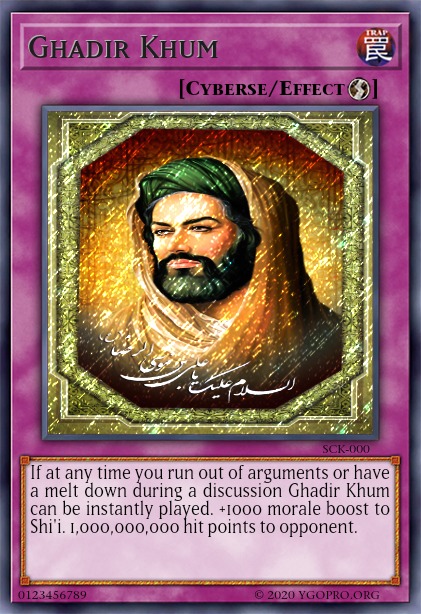
    Whenever the Shi’i are cornered in an argument and have nothing more to offer. They will always return to the incident of Ghadir Khum. It is what they believe is their instant win card!

    We have explained the incident of Ghadir Khum here:

    Also, do correct your Shi’i friends. There is no such thing as ‘THE’ hadith of Ghadir Khum. However, there is THE incident of Ghadir Khum and various versions of that incident, which means hadiths (plural). Some of these variants have accretions and variations.

    Remember that our position is Prima-Quran.

    Some groups try to elevate the hadith over the Qur’an. Whereas for us, we do not elevate the hadith above the Qur’an. Nor can hadith clash with the Qur’an.

    The verse in question describes the two opposing groups as believers.
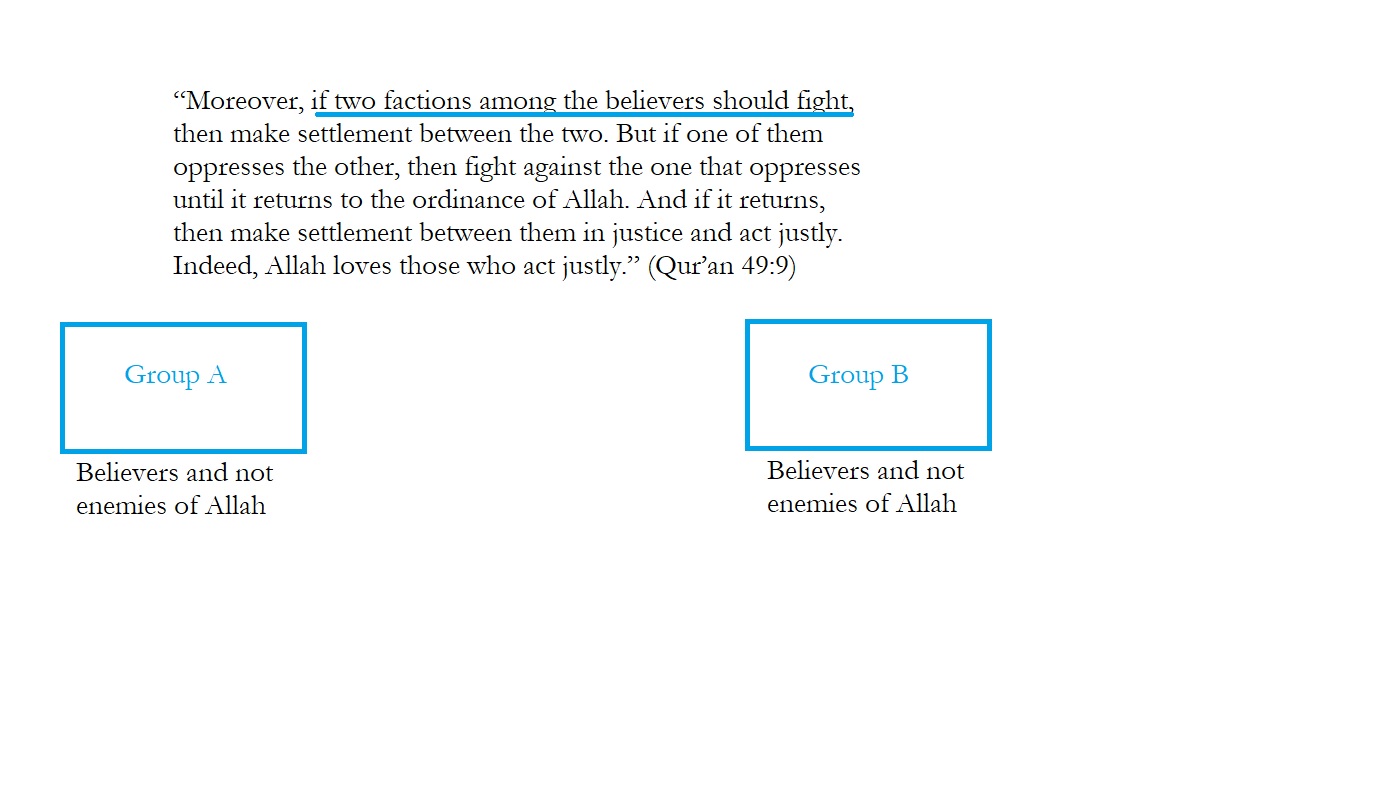
    Logic dictates that Ali could be in either group A or group B.

    Let us say that Ali is in group B, the group that is being oppressed.
    How can it be reasoned that the people in group A are being labeled as enemies of Allah, yet still be called believers by Allah (swt) himself?

    “Allah is the Friend (Waliyy)of those who believe He brings them out of darkness into light. And those who disbelieve their friends are the devils who take them out of light into darkness. They are the companions of the Fire; therein they abide.” (Qur’an 2:257)

    Surely Allah (swt) the All-Knowing is aware that Ali could be in category A or B.

    You must hate those whom you apply the judgement of Allah (swt) to? No, not necessarily.

    Based upon mantiq (logic) and the fact that this particular statement of the narration would clash with the qati’i (decisive) nature of Qur’an, such that a particular understanding of being infallible or not accountable becomes null and void.

    Secondly. There is a story which you can read here full of grandiose verbiage that many are familiar with. Ali fights a man and the man spits in Ali’s face. Ali is said to have sheathed his sword. You can read that here: https://www.dar-al-masnavi.org/n-I-3721.html

    The point is that just because you oppose someone does not necessarily entail hatred.

    An example is this:

    Narrated `Aisha:

    Usama approached the Prophet (saw) on behalf of a woman (who had committed theft).
    The Prophet (saw) said, “The people before you were destroyed because they used to inflict the legal punishments on the poor and forgive the rich. By Him in Whose Hand my soul is! If Fatima (the daughter of the Prophet (saw) did that (i.e. stole), I would cut off her hand.”

    Source: (https://sunnah.com/bukhari:6787)

    So let us imagine a scenario where Fatima did steal, and she did get caught. Would one necessarily have to have hatred in his/her heart towards Fatima when executing the punishment?


    That means that every judge or Qadi would need to hate the person they pass sentence on?


    Would that mean that Ali, as an Amir, any time he inflicted a punishment upon anyone who transgressed, meant he would need hatred in his heart as a prerequisite?

    If this is how people reason, reason is in a state of decline.Allah (swt) says,

    “Never will your family bloodlines/ties or your children be of any use to you on the day of Resurrection. He will separate you and judge between you. For Allah is All-Seeing what you do.” (Qur’an 60:3)

    Adam made a mistake.

    “Thus did Adam disobey his Lord, so he went Astray. Then his Lord chose him, and turned to him with forgiveness, and gave him guidance.” (Quran 20:121-122)

    David made a mistake.

    “And David perceived that we had tried him by this parable, and he asked pardon of his Lord: and he fell down and bowed himself, and repented.” (Qur’an 38:25).

    Saying that Ali is infallible in his decisions puts him above the Prophets. It also makes the following verse not applicable to him.

    “Then did they feel secure from the plan of Allah ? But no one feels secure from the plan of Allah except the losing people.” (Qur’an 7:99)

    Are we to say that Ali was from the losing people because he felt secure from the plan of Allah (swt)? Certainly not!

    Ibadis are not the people known for hating and hatred, contrary to what you have heard.

    Read, for example, the poem concerning Ali Ibn Abu Talib by the esteemed scholar, poet, and Sufi, Abu Muslim Al Bahlani (May Allah grant him paradise.)

    A group of six great Ibadi scholars, J’afer bin A’Simak, Abu AlHur Ali bin AlHusain Al’Anbri, AlHattat bin Kateb, AlHabab bin Kulaib, Abu Suyan Qanber AlBasri, and Salim bin Thakwan among other unnamed scholars, they went to Umar bin Abdul Aziz and exhorted him to stop this cursing from the pulpits, this includes Ali.

    If they hate Ali will they really exhort people to stop cursing him from the pulpits? The pulpit is the place where the tongue should be moist with the remembrance of Allah (swt) and exhortation to those in attendance to obey the commands of Allah (swt) and the Blessed Messenger, the Beloved Prophet Muhammed (saw)

    If the Ibadi had personal hatred towards Ali, would we have the opinion in our tradition that he was remorseful and repented to Allah?

    “Such is Allah, your true Lord. And, beyond truth, what is there except falsehood? So where else can you turn?” (Qur’an 10:32)

    Would hope that one day Mr. Ali Hur finds the courage to repent and make tauba for the lies that he told. It is best to say that he was caught up in the moment, that he made a mistake. That would make him an honourable individual.

    Based on the voice notes provided of Mr.Ali Hur and our arguments and quotes and response to the Shi’i reformist Kamoonpuri, the Ibadi side presents the more coherent, scripture-grounded, and logically consistent argument.

    1. Fidelity to the Clear Text of the Qur’an (Nass)
    The Ibadi argument adheres strictly to the apparent and imperative command in Qur’an 49:9: “…then fight against the one that oppresses until it returns to the ordinance of Allah.”

    • The Ibadis argue that the command is clear and absolute. Since Muawiyah was the rebel (baghi), the fighting should have continued until he submitted. The arbitration was a deviation from this clear divine command.
    • Kamoonpuri’s argument relies on a complex layer of “worldly ijtihad,” “political wisdom,” and assessing the “sincerity” of the opponent to override the apparent meaning of the verse. He essentially argues that a human judgment about the opponent’s intentions can suspend a direct divine imperative. The Ibadi invocation of Qur’an 33:36 (“it is not for a believing man… when Allah has decided a matter that there should be for them any choice”) is a powerful counter to this.

    2. The Practical Failure of the Arbitration
    The Ibadi point is devastatingly simple and empirical: What was the result? The arbitration did not return the situation to the amr (command) of Allah. It led to confusion, division, and strengthened Muawiyah’s position. If a course of action was supposedly “100% in line with the Qur’an and Sunnah,” as Kamoonpuri claims, one would expect it to produce a just outcome. It did not. This suggests the premise was flawed.

    3. Exposing Internal Contradictions
    The Ibadi response effectively highlights the incoherence in Kamoonpuri’s narrative:

    • Who were the “Khawarij”? Kamoonpuri says they were the ones who forced Ali into arbitration. But then they are the ones who left Ali because of the arbitration. The Ibadi asks: if they forced him into it, why would they then leave him for it? This exposes a fundamental flaw in the historical narrative being presented.
    • Ali’s Agency: Kamoonpuri portrays Ali as both “forced” by his army and as someone who “agreed” and “acquiesced” and set conditions. The Ibadi response questions this portrayal of the Imam as a half-hearted leader blown by the wind, contrasting it with the Quranic ideal of a resolute believer who trusts in Allah.

    4. Stronger Use of Quranic Analogy and Companion Reasoning
    The Ibadi response brings a powerful historical and Quranic argument by referencing the exchange between Ibn Abbas and the companions at Nahrawan using Qur’an 5:95. The companions rejected the analogy of arbitration in a marital dispute (4:35) or a hunting penalty (5:95) for a matter of massive bloodshed and the leadership of the Ummah. This shows that the earliest Muslims involved in the event understood the flaw in using those verses to justify the Siffin arbitration. Kamoonpuri’s use of the marital arbitration verse (4:35) is shown to be a weak analogy that even the contemporaries of the event dismissed.

    5. The Central Unanswered Question
    The Ibadi request is the most direct and logical challenge: “If the Qur’an is the arbiter, what is the verse or verses that make Ali in the right in his dispute with Muaviyah?”
    This question cuts through all the talk of documents, arbitrators, and political wisdom. It demands a scriptural basis for the arbitration itself. Kamoonpuri’s entire defense is based on the process (they called to the Qur’an) and not the substance (what does the Qur’an actually say about this dispute?). The Ibadis correctly point out that the Qur’an’s command on how to deal with rebels is already clear, so there was nothing to arbitrate.

    Conclusion of the Arguments Presented

    While Kamoonpuri attempts a sophisticated defense based on the distinction between divine commands and their worldly application, his argument is convoluted, self-contradictory, and detached from the clear imperative of the Qur’anic text.

    The Ibadi argument is superior because it is:

    • Textually faithful: It holds fast to the clear command of Qur’an 49:9.
    • Logically consistent: It points out the flaws and contradictions in the opposing narrative.
    • Pragmatic: It judges the action by its fruit, which was division and failure.
    • Historically grounded: It uses the reasoning of the companions who were actually there (the Nahrawan group’s argument to Ibn Abbas) to support its position.

    The Shi’i reformist argument, as presented here, relies on a narrative that makes Ali appear weak, his opponents hypocritical, and the clear text of the Qur’an subject to the flawed “ijtihad” of a war-weary army. The Ibadi position, by contrast, maintains the sovereignty of the divine command over human political maneuvering.

    May Allah Guide the Ummah.

    May Allah Forgive the Ummah.

    5 Comments

    Filed under Uncategorized

    Examining the hadith: Ali is with the truth and the truth is with Ali.

    “Oh you who believe!  if a deviator brings you a report, scrutinize it carefully in case you attack people in ignorance and so come to greatly regret what you have done.” (Quran 49:6).

    ﷽ 

    This is an examination of the hadith that Shīa uses as a justification for Ali either being infallible or without error in judgement.

    Namely, the hadith that comes to us with conflicting statements: One being that Ali is with the truth and the truth is with Ali. There other is that Ali is with the Qur’an and the Qur’an is with Ali.

    The idea that the Shīa have in quoting this is that Ali could possibly never err. For the Shi’i, either version of this hadith is proof that Ali is infallible in his ijtihad.

    In Islam, as is commonly known, no one is above the law; no one has an absolute authority by being free from the limitations of the law: anyone whose idea goes contrary to what Allah (swt) or what the Blessed Prophet (saw) says, has his idea disregarded and discarded irrespective of the class or caste to which one belongs.

    The hadith contradict the Qur’an.

    If the idea is that these hadith prove that Ali is infallible and beyond reproach that itself is contradicted by Allah (swt) in the Qur’an.

    It would also mean that Ali or anyone who is guaranteed to be infallible or beyond reproach, would mean that he is secure from the Plan of Allah (swt) and that he would be under the power and the threat of the following verse:

    “Were they secure from the Plan of Allah? None deems himself secure from the Plan of Allah except a people that are doomed to perish.” (Qur’an 7:99)

    These hadiths are used in a polemical sense.

    For example, they are intended to be used in the following polemical way:

    Whoever opposed Ali on any matter was simply on the wrong side of history. Not only did they oppose Ali, but they opposed the haqq, the truth. Not only did they oppose Ali and the haqq, but they opposed the Qur’an. So this would include, but not limited to: Muaviyah and those companions (muhakima) who broke camp with Ali over the issue of tahkim-arbitration. It would include Aisha (ra), Talha and Zubayr etc.

    Muslims are not born yesterday. Naturally, the thinking Muslim will ask the following questions.

    Questions like:

    Why not quote the hadith of the 10 promised paradise during all these skirmishes?

    Why not quote ghadir khum hadith?

    Why not quote the hadith of thaqalayn?

    Why not quote all these things to avoid unnecessary bloodshed?

    We will approach these narrations in three ways.

    1. Does it contradict what we know from history or how other companions understood the data? Information that is accessible to you the reader.

    2. We will look at the ‘matn’, which is the text itself. We are looking for anomalous statements or inconsistencies. This information is also accessible to you the reader.

    3. We will be looking at the chain of narrators. This is a specialized field in which the majority of the readers do not have access to. 

    Does it contradict what we know from history or how other companions understood the data?

    One thing which can be taken to absolutely prove the fact that many of these traditions are fabricated is that when Ali himself went to Nahrawan to debate with the people there, after Ibn ‘Abbas (ra) was defeated, Ali did not use any of those traditions as his arguments against them.

    In fact, we challenge anyone to bring forth the claims that he did. And if he didn’t, and assuredly he did not, you have to ask yourself: Why is that?

    Indeed, no man took those traditions as his proofs and arguments during the whole period of the Ali-Mu’awiya crisis: all of them had the Qur’an as the basis for their source of evidence for the ideas they held.

    In other words, no one argued that: “Ali is with the truth and the truth is with ‘Ali: it goes with him wherever he goes.”

    Take for example:

    Where are all these quotes from the Blessed Prophet (saw) about Ali?

    Why are all these hadith that the (Shi’i) feel are effective for the Muslims of the 14th century but not seemingly not helpful at all to Ali and his contemporaries?

    This in and of itself should give the sincere researcher a cause for pause.

    If Ali is with the haqq and the haqq is with Ali, why would a good portion of the companions of the Blessed Prophet (saw) oppose Ali to begin with?!

    We could simply end all this discussion at that. Case closed.

    Then let us approach this from the angle of logic and real life scenarios.

    Al Abbas (ra) said the following about Ali.

    فَقَالَ عَبَّاسٌ: يَا أَمِيرَ الْمُؤْمِنِينَ اقْضِ بَيْنِي وَبَيْنَ هَذَا – الْكَاذِبِ الآثِمِ الْغَادِرِ الْخَائِنِ.

    So Al Abbas said: “O Commander of the Faithful, judge between me and this one – the liar, the sinful, the treacherous, the deceitful.”

    Source: (https://sunnah.com/muslim:1757c)

    The hadith above makes it seem as if Ali is always in the right no matter what. So in the scenario above where Al Abbas (ra) says to Umar (ra) about Ali, “judge between me and this one, liar, sinful, treacherous and deceitful.” How could it ever be fair? How could Umar (ra) judge at all? He could look and say, “Oh it’s Ali and the truth is with him, and he is with the truth out of my sight, Abbas!” In fact, Ali could win any court case by default with such a hadith! 

    This has all the trappings of abuse and manipulation. Especially when these types of weak hadith come to be used later in sufi tariqas and syed culture.  When real abuse and mischief happens, people are shamed and silenced. Made to think evil will befall them if they report such people. A real type of psychological terrorism.

    This is a far cry from the Blessed Prophet (saw) whom even Allah (swt) overturned a decision of his on the account of the woman who pleaded!

    The hadith above makes it seem as if Ali is always in the right no matter what. So in the scenario above where Al Abbas (ra) says to Umar (ra) says about Ali, “judge between me and this one, liar, sinful, treacherous and deceitful.” How could it ever be fair? How could Umar (ra) judge at all? He could look and say, “Oh it’s Ali and the truth is with him and he is with the truth out of my sight Abbas!” In fact, Ali could win any court case by default with such a hadith!

    Another crystal clear example of a person who did not accept that understanding is none other than Ibn Abbas (ra).

    Narrated Ibn `Abbas:

    Once the Prophet (saw) embraced me and said, “O Allah! Bestow on him the knowledge of the Book (Qur’an).”

    Source: (https://sunnah.com/bukhari:75)

    Ikrima (ra) informs us that Ali had errors in his ijtihad that would go against the Qur’an & Sunnah. That he would get corrected by a senior member of the Ahl Bayt.

    Narrated `Ikrima:

    “Some Zanadiqa (atheists) were brought to `Ali, and he burnt them. The news of this event reached Ibn Abbas, who said, “If I had been in his place, I would not have burnt them, as Allah’s Apostle forbade it, saying, ‘Do not punish anybody with Allah’s punishment (fire).’ I would have killed them according to the statement of Allah’s Apostle, ‘Whoever changed his Islamic religion, then kill him.’”

    Source: (https://sunnah.com/bukhari:6922)

    It was narrated by Anas that :

    ‘Ali came to some people of Az-Zutt, who worshiped idols and burned them. Ibn ‘Abbas said: “But the Messenger of Allah [SAW] said: ‘Whoever changes his religion, kill him.‘”

    Source: (https://sunnah.com/nasai:4065)

    Clearly Ibn Abbas (ra) did not see that the haqq nor the Qur’an was with Ali on that matter.

    Narrated from Abū ʿAbdillāh (Imām Jaʿfar al-Ṣādiq), who said: Amīr al-Muʾminīn (ʿAlī), said:
    “If it were possible for me, and if I found someone to help me, I would kill all the adherents of these sects (aṣnāf), and I would burn them with fire
    . And this is [in accordance with] the saying of Allah, Mighty and Exalted:

    ‘Say, I am only a man like you to whom it has been revealed that your God is but one God. So, whoever would hope for the meeting with his Lord – let him do righteous work and not associate anyone in the worship of his Lord’ (Qur’an 18:110).”

    Source: (Bihār al-Anwār al-Jāmiʿah li-Durar Akhbār al-Aʾimmat al-Aṭhār Volume and Page: Vol. 25, p. 265, Hadith #30)

    Prima Qur’an comments: If that is Ali’s understanding of that verse of the Qur’an, it is certainly not from any apparent reading of the text. It is a very strange take. How anyone reads the Qur’an 18:110 and takes away from it that we should burn people is shocking.

    Another point to consider is that even if those traditions are really authentic, they still do not mean that Ali does not make mistakes, especially in matters like these, which depend almost entirely on human intellectual efforts.

    For if “Ali is with the truth and the truth is with ‘Ali: it goes with him wherever he goes,” then the inevitable, logical implication is: “The Prophet is with the truth and the truth is with the Prophet (saw): it goes with him wherever he goes.”

    This is only logical. Yet, Allah (swt) has blamed the Blessed Prophet (saw) him for leaving a better way in some of his military and civil actions.

    For example, the verse states: “May Allah forgive you (O Muhammed). Why did you grant permission to them (to stay behind), until those who told the truth become clear to you, and you had known the liars? (Qur’an 9:43)” , was revealed in order to blame the Blessed Prophet (saw) for his act to allow some people who brought him false excuses so that they might be exempted from taking part in the war of Jihad.

    Typically, the verse: “O Prophet! Why do you prohibit ˹yourself˺ from what Allah has made lawful to you, seeking to please your wives? And Allah is All-Forgiving, Most Merciful.”(Qur’an 66:1) was sent down to blame the Prophet (saw) for outlawing a certain thing which Islam makes lawful to him.

    How can a person of understanding mind, therefore, claim that ‘Ali was infallible simply because the Prophet (saw) is alleged to say: “Ali is with the truth and the truth is with ‘Ali: it goes with him wherever he goes?!”

    “The Prophet (saw) is with the truth and the truth is with the Prophet (saw): it goes with him wherever he goes.”

    The logical question we ought to ask ourselves is: Was the Prophet (saw) not with the truth and the truth not with him? Of course!

    Every Muslim’s answer will be “The Prophet (saw) was with the truth every time.” Thus, if the Prophet (saw) was the most truthful, and so was with the truth ,and the truth was with him, let us ask ourselves again: was he not blamed by Allah for leaving a better way in some of his actions?

    Take for example:

    Musa b. Talha reported:

    “I and Allah’s Messenger (saw) happened to pass by people near the date-palm trees. He (the Holy Prophet) said: What are these people doing? They said: They are grafting, i. e. they combine the male with the female (tree) and thus they yield more fruit. Thereupon Allah’s Messenger (saw) said: I do not find it to be of any use. The people were informed about it and they abandoned this practice. Allah’s Messenger (saw) (was later) on informed (that the yield had dwindled), whereupon he said: If there is any use of it, then they should do it, for it was just a personal opinion of mine, and do not go after my personal opinion; but when I say to you anything on behalf of Allah, then do accept it, for I do not attribute lie to Allah, the Exalted and Glorious.”

    Source: (https://sunnah.com/muslim:2361)

    Look at what is said here:

    Worldly Affairs versus the Sacred Law

    “Imam Nawawi comments: “Scholars mention that his opinion (peace and blessings be upon him) in worldly/livelihood affairs is like the opinion of others, so the like of this [incident] is not impossible, and there is no deficiency entailed in this. The reason is the fact that their [the Companions’] central concern was the afterlife and its affairs.” [Nawawi, Sharh Sahih Muslim]”

    “Mufti Taqi Usmani mentions that the Prophet’s statement, “I don’t think that will provide any benefit,” was only based on his personal opinion and estimation, as before that, he had never himself engaged in farming and agriculture (peace and blessings be upon him). Mufti Taqi also mentions that matters such as this incident can only occur with respect to worldly affairs that are permissible (mubah), yet not with anything entailing a legal ruling of the Sacred Law, like commands, prohibitions, adjudication or legal verdicts. [Usmani, Takmila Fath al-Mulhim]”

    Source: (https://seekersguidance.org/answers/general-counsel/the-prophets-judgement-on-worldly-matters-a-commentary-on-the-hadith-on-pollination-and-affairs-of-this-world/)

    “Allah has indeed heard (and accepted) the statement of the woman who argues with you concerning her husband and carries her complaint (in prayer) to Allah and Allah (always) hears the arguments between both sides among you: for Allah hears and sees (all things). If any men among you divorce their wives by Zihar (calling them mothers), they cannot be their mothers: None can be their mothers except those who gave them birth. And in fact, they use words (both) iniquitous and false: but truly Allah is one that blots out (sins), and forgives (again and again). But those who divorce their wives by Zihar, then wish to go back on the words they uttered,- (It is ordained that such a one) should free a slave before they touch each other: You are admonished to perform: and Allah is well-acquainted with (all) that you do. And if any has not (the wherewithal), he should fast for two months consecutively before they touch each other. But if any is unable to do so, he should feed sixty indigent ones, this, that you may show your faith in Allah and His Messenger. Those are limits (set by) Allah. For those who reject (Him), there is a grievous Penalty.” (Qur’an 58: 1-4)

    As many of you may know regarding what is considered the historical context of these verses, Khawlah bint Tha‘labah (ra) went to the Blessed Messenger (saw) to complain about her husband. Many times it is reported that the Blessed Messenger (saw) gave his verdict on the matter.

    Now, this should give us pause.

    Here we have the case of this woman who, even after hearing the decision of the Blessed Messenger (saw), continued to argue with him!  In other words, the Sunnah of the Prophet (saw) wasn’t good enough for her!  That’s right.  She didn’t simply say, “Yes, Oh Messenger of Allah, thank you!”  No!  This woman went to the highest authority of justice and wisdom that there is. She took her pain directly to Allah (swt)!

    So Allah (swt) took the side of the woman over the side of the Blessed Messenger (saw)!

    Ali is nowhere near the Prophet (saw) when it comes to knowledge. So if the Blessed Prophet (saw) can make errors in worldy ijtihad, then so can Ali.

    It is clear, therefore, that the idea of “Ali being infallible on the grounds that Ali is with the truth”…is the result of the politics of lies aimed at indoctrinating people with the creed of Alism during the time when the waves of the politics of division swept the Islamic nation.

    Another example: it has also been narrated concerning Ammar bin Yasir (ra)

    “Ammar (bin Yasir) is with the truth and the truth is with Ammar (bin Yasir): it goes with him wherever he goes.”

    Source: (Ibn A’atham Al-Futuh Vol. 3, p. 269.)


    Indeed, Ali himself has been quoted as saying: “Ammar (bin Yasir) is with the truth and the truth is with ‘Ammar: it goes with him wherever he goes.”
    Source: (Ibn A’atham Al-Futuh Vol. 3, p. 129, p. 269. Similar to it has been narrated by Al-Hakim – from Hudhaifa – in his Al-Mustadrak Vol. 2, p. 162, hadith no. 2652. )

    Yet no one has ever claimed that ‘Ammar bin Yasir has been infallible, for in case the account is authentic, the meaning intended thereby is that ‘Amaar is truthful: he does not intend to do wrong – no sense of infallibility at all is produced by the account.

    Likewise with Ali. That he intends the truth, not that he is in any sense infallible.

    The hadith in question: Ali is with the Qur’an and the Qur’an is with Ali.

    Al Hakim and al Tabarani narrate — from ‘Ali ibn Hashim ibn al Barid — from his father who said — Abu Sa’id al Taymi narrated to me — from Abu Thabit, the mawla (client) of Abu Dharr

    “I was with Ali on the Day of the Battle of the Camel. When I saw ‘Aisha standing. Some of that (doubt) which entered other people (also) entered me. Allah disclosed that for me (i.e. removed from me the reservations I had to fight) at the time of Salat al Zuhr and so I fought alongside Amir al Muʾminin. When he finished, I proceeded to Madinah. I came to Umm Salamah and said, ‘I have come, by Allah, not asking for food or drink; rather, I am the mawla (client) of Abu Dharr.’ She said, ‘Welcome.’ I told her my story and so she said, ‘Where were you when the hearts flew their course (i.e. when the fighting broke out)?’ I said, ‘I was such that Allah disclosed it for me (i.e. removed the reservations I had) at noon (and then I went to fight alongside Amir al Muʾminin).’ She said, ‘Excellent! I heard the Messenger of Allah(saw) say: ‘‘Ali is with the Qur’an and the Qur’an is with Ali. They will never separate UNTIL they meet me at the Hawd (Cistern).’”

    Sources: (Mustadrak al Hakim 4628 / al Tabarani: al Mujam al Awsat, Volume 5/4880 / & al Mujam al Saghir, volume 2 /720.)

    Interestingly, these statements are not found in either Bukhari or Muslim. Neither in the Muwatta of Imam Malik nor the Musnad Al-Imam Ar-Rabi’ (Al-Jami’ Al-Sahih).

    Chain analysis: a look at the sanad (chain of narrators)

    Al Hakim says, “This hadith has a sahih (authentic) chain of transmission. Abu Sa’id al Taymi is (Abu Sa’id al Taymi) al ‘Aqisaʾ. He is a thiqah (reliable) and maʾmun (trustworthy). Imam al Bukhari and Imam Muslim did not include it in their respective collections.”

    Dinar Abu Sa’id ‘Aqisa al Tamimi (or al Taymi) is not as al Hakim supposed.

    Imam al Nasaʾi says he is not a thiqah (reliable).

    Al Daraqutni says he is matruk al Hadith (suspected of forgery).

    Al Sa’di says he is not a thiqah (reliable).

    Additionally, Abu Thabit could not be traced. The identity of  Abu Thabit is a bit of a mystery, he is not mentioned in the books of Hadith narrators. So, Thabit is Majhul (unknown)

    Therefore, this hadith is etiolated, totally weak.

    Some time on Al Hakim Al Naysaburi

    Al-Hakim, Muhammed ibn Abd Allah ibn Muhammed ibn Hamduyah, Abu Abd Allah al-Dabbi al-Tamhani al-Naysaburi al-Shafi’i, also known as Ibn al-Bayyi.

    Al-Hakim is known among the people of Hadith to be mutasahil (lenient hadith critic).

    Al-Hakim’s Mustadrak was criticized by Hadith scholars due to the number of mistakes and inaccuracies found in it. Al-Sakhawiin alilan wal-Tawbikh and others mention that he declares many forged reports to be rigorously authentic; up to 100, according to some authorities. This is not to mention extremely weak ones. Instead of clinging to his own expressed precondition, he only reports with the chains of the rank of the status of Bukhari and Muslim. For example, he narrates in the Musadrak from Ibn Abbas that Allah revealed to the Blessed Messenger (saw), the following:

    “I have killed seventy thousand [in punishment] for [the murder of] Yahya ibn Zakariyya and I will kill seventy thousand times seventy thousand [in punishment] for [the murder of] your daughter’s son al-Husayn.”

    Al-Hakim said this report has a sound chain, while Al-Dhahabi added: “By the criterion of Muslim” but Ibn Hibban said this hadith is untraceable (la asla lahu), Al-Dhahabi himself rejected its matn as munkar in the Siyar while Ibn Kathir similarly declared it “highly anomalous” (gharib jiddan) in al-Bidaya. [1]

    Sources: Ibn Hibban, al-Majruhin (2:215), al-Khatib, Tarikh Baghdad (1:142), al-Hakim(1990 ed 2:319, 2:648, and 3:195), Fayd al-Qaiîr (1:205), Tadhkirat al-Huffaz (1:77 gharib), Mizan (sv. Qâsim ibn Ibrahim al-Hashimi), and Siyar (Risala ed 4:342-343).

    Some say Al-Dhahabi went to excess in regretting that al-Hakim had compiled the Mustadrak in the first place.

    “It would have been better if al-Hakim had never compiled it!” as mentioned by Dr. Bashshar Awward Maruf in his doctoral thesis.”

    Source: (al-Dhahabi wa Manhajuhu fi Kitabihi Tarikh al-Islam.)

    His classing al-Hakim “among those who are lenient, like al-Tirmidhi” does not apply to al-Hakim in absolute terms but only to his grading of narrations in the Mustadrak, which the Scholars pointed out he compiled in his old age, intending to revise it, a task left unfinished beyond the first volume.


    Sources: Dhikr Man Yutamadu Qawluhu fil-Jarh wal-Tadil (p.172) & (Cf. Al-Sakhawi, Fath al-Mughith (1:36) and Mamduh, Raf` al-Minara (p. 153 n. 1).

    This is proven by the fact that al-Hâkim’s mistakes are fewer in the first volume of the Mustadrak, as shown by al-Dhahab’s own minimal corrections there. “Outside the Mustadrak,” Shaykh Mahmud Mamduh said, “his positions are as strict as those of the meticulous Imams of hadith”

    Source: (al-Sakhawi, Fath al-Mughith (1:36) and Mamduh, Raf` al-Minara p. 153 n.)

    Prima Qur’an comments:

    A look at the matn.

    Abu Thabit had to identify himself to Umm Salamah.

    He twice claims that Allah (swt) had removed his reservations to fight alongside Ali. He actually says this twice. It was at the time of the afternoon prayer. He doesn’t disclose how.

    The hadith contradicts another hadith (below) where he is also the transmitter in which the text (matn) is changed.

    Ali is with the qur’an and the qur’an is with Ali. They will never separate until they meet me at the Hawd (Cistern)

    Ali is with the truth and the truth is with ‘Ali. They will never separate UNTIL they both arrive at the Hawd (Cistern) on the Day of Judgment

    This stand-out line would not be difficult for someone to recall. The fact that the narrator redacts words in the mouth of Umm Salamah and cannot get the facts straight shows that they are confused.

    The Qur’an is all truth but not all truth is the Qur’an.

    In the second version of the hadith of Abu Thabit, there is no mention of his own doubts with regard to standing with Ali or his change of heart at the afternoon prayer.

    Also, in the second version, it is simply that he came upon Umm Salamah. In the second version he does not need to identify himself to her.


    The Hadith of Umm Salamah

    This hadith comes to us via two ways:

    The first is as follows:

    Al Khatib narrates from ‘Abdul Salam ibn Salih — ‘Ali ibn Hashim ibn al Barid — narrated to us — from his father — from Abu Sa’id al Tamimi — from Abu Thabit, the mawla (freed slave) of Abu Dharr who said, “I entered the presence of Umm Salamah and saw her crying. She was mentioning the name of ‘Ali and said, ‘I heard the Messenger of Allah (saw),’” saying Ali is with the truth and the truth is with ‘Ali. They will never separate until they both arrive at the Hawd (Cistern) on the Day of Judgment.

    Source: (Al Khatib: Tarikh Baghdad, 14/321.)

    Chain analysis: a look at the sanad (chain of narrators)

    ‘Abdul Salam Ibn Salih is al Harawi. It has been mentioned previously that he is suspected of lying.

    Al Haythimi said he is weak. Source: (Majma’ al Zawa’id vol. 9 pg. 114)

    Dhahabi said he is censured: Source: (Siyar vol. 11 pg. 447)

    He is accused of being a forger of hadith and one who steals chains to invent things.

    Sources: (Al Kamil fi al Du’afa’ vol. 5 pg. 177) & (Lisan al Mizan vol. 4 pg. 144)

    He is accused of lying and hadith forgery. Source: Mizan al I’tidal vol. 5 pg. 220.

    Abu Sa’id Dinar is not a thiqah (reliable). He is matruk al hadith (suspected of forgery).

    Abu Thabit could not be traced. He is mahjul (unknown)

    Ibn Taymiyyah did not find a chain of transmission for this hadith; consequently, he denied it.

    Source: (Ibn Taymiyyah: Minhaj al Sunnah al Nabawiyyah, 4/238)

     However, there is a chain via Abu Ya’la here:

    The Hadith of Abu Sa’id

    Abu Ya’la narrates — Muhammed ibn ‘Abbad al Makki narrated to us — Abu Sa’id narrated to us — from Sadaqah ibn al Rabi’ — from ‘Umarah ibn Ghaziyyah — from ‘Abdul Rahman ibn Abi Sa’id — from his father that ‘I heard the Messenger of Allah (saw) ,’” saying Ali is with the truth and the truth is with ‘Ali. They will never separate UNTIL they both arrive at the Hawd (Cistern) on the Day of Judgment.

    Source: (Abu Ya’la: Musnad Abi Ya’la, hadith no. 1052.)

    Chain analysis: a look at the sanad (chain of narrators)

    Sadaqah ibn al Rabi’ is regarded as a thiqah (reliable) by Ibn Hibban.

    Source: (Ibn Hibban: Kitab al Thiqat, 8/319)

    Ibn Hibban is known for deeming majhul (unknown) narrators as reliable.

    Ibn Abi Hatim mentions a biography about Sadaqah ibn al Rabi’. However, he did not make mention of any jarh (impugning statement) or ta’dil (statement of approval). Thus, his status is unknown. Neither favourable nor unfavourable.

    Source: (Ibn Abi Hatim: Kitab al Jarh wa al Ta’dil, 4/433.)

    Abu Sa’id is the mawla (freed slave) of Banu Hashim. There is a difference of opinion regarding his status. The better opinion is that he is Hassan al hadith (fair in hadith). However, this type of hadith from him is unacceptable.

    In short, the hadith is da’if (weak); the first chain of transmission is saqit (wholly unreliable) and the second chain of transmission is da’if (weak).

    Lastly, Allah (swt) has made it clear that we are a broken humanity. Yet, he showers abundant grace and mercy upon us all.

    “If Allah were to punish people ˹immediately˺ for their wrongdoing, He would not have left a single living being on earth. But He delays them for an appointed term. And when their time arrives, they cannot delay it for a moment, nor could they advance it.” (Qur’an 16:61)

    In other words if Allah (swt) wanted to exact due measure and justice for the failings of humanity this whole planet would be turned to ash. Everyone. No one is exempted.

    I leave you with this final verse to reflect upon.

    “These are the verses of Allah which We recite to you in truth. Then in what statement after Allah and His verses will they believe?” (Qur’an 45:6)

    You maybe interested in reading the following:

    May Allah (swt) guide the Ummah!

    May Allah forgive the Ummah!

    1 Comment

    Filed under Uncategorized

    Response to Shi’i “You are to me as Aaron is to Moses”

    (After rebuking his people) Moses turned to Aaron and said: “Aaron! What prevented you, when you saw them going astray, from following my way? Have you disobeyed my command? Aaron answered: “Son of my mother! Do not seize me with my beard, nor by (the hair of) my head. I feared that on returning you might say: ‘You sowed discord among the Children of Israel, and did not pay heed to my words.” (Qur’an 20:91-93)

    ﷽ 

    This is in response to other hadith that the Shi’i often use. They try to justify their claims of Ali being the correct or rightful Imam of the Muslims after the Blessed Messenger (saw).

    It is another example (of many) of them making a mountain out of a molehill.

    The following hadith comes to mind:

    Narrated Sa`d:

    Allah’s Messenger (saw) set out for Tabuk, appointing Ali as his deputy (in Medina). Ali said, “Do you want to leave me with the children and women?” The Prophet (saw) said, “Will you not be pleased that you will be to me like Aaron to Moses? But there will be no prophet after me.”

    Source: https://sunnah.com/bukhari:4416

    This hadith is about the honour of present trust and not future succession.

    Alas, we also have the following:

    Narrated ‘Uqbah bin ‘Amir:

    That the Messenger of Allah (saw) said: “If there was to have a Prophet after me, it would have been ‘Umar bin Al-Khattab.”

    Source: https://sunnah.com/tirmidhi:3686

    The hadith about Umar (ra) neutralizes any attempt to single out Ali for a uniquely elevated status.

    This hadith (https://sunnah.com/bukhari:4416) shows clear as daylight that Ali was not pleased being left to take charge of the affairs of the people of Medina. So how much more the whole Ummah?!

    Rather than seeing this as an honor bestowed upon him as one being the most trustworthy to take care of the most vulnerable, Ali saw it as a slight.

    So not being content with trusting his station to his Imam, which is none other than the Blessed Messenger (see), Ali quipped, “Do you want to leave me with the children and women?”

    Was Ali not aware of this verse of the Qur’an?

    Whoever obeys the Messenger has truly obeyed Allah. But whoever turns away, then ˹know that˺ We have not sent you ˹O Prophet˺ as a keeper over them.” (Qur’an 4:80)

    Because the Shi’i cannot prove their case for the concept of the Imamate of Ahl Bayt from the Qur’an, they must quickly pivot the conversation to Hadith, which they feel justifies their position.

    The Blessed Prophet (saw) is said to have replied to the recalcitrant Ali,

    Will you not be pleased that you will be unto me like Aaron to Moses? But there will be no prophet after me.”

    Somehow, the Shi’i seemed to close their eyes over the fact that the Blessed Messenger (saw) was trying to console his otherwise temperamental cousin.

    Perhaps Ali sought glory or standing on the battlefield? Allah (swt) knows best. Yet, the Blessed Messenger (saw) gave Ali a more noble task than what Ali could have longed for.

    The Shi’i run wild.

    So, the Shi’i became laser focused on the part: “You will be unto me like Aaron to Moses? But there will be no prophet after me.”

    They start to surmise that this must be a strong indication that Ali, without a doubt, is the one who will lead the Muslims after the Blessed Messenger (saw) is gone.

    So they start to imagine that the Blessed Messenger (saw) said things that he did not say. For example, the Hadith says, ‘no prophet after me’ but it does not say ‘no messenger after me’.

    So perhaps Ali could be a Messenger after the Prophet Muhammed (saw) ?

    The Shi’i who are known to be lovers of Qiyas (analogy) so well …maybe just this once.. 😉 🤫

    So, with the above hadith in tow, we can quickly turn to the Qur’an and find:

    “We made an appointment of thirty nights with Moses (On Mount Sinai), to which We added ten more; so the term set by the Lord was completed in forty nights. Moses said to Aaron, his brother: “Deputize for me ((ukh’luf’nī) among my people. Dispose rightly, and do not follow the way of the authors of evil.” (Qur’an 7:142)-Ahmed Ali

    “And We treated with Musa thirty nights, and We completed them with ten; so the appointment of his Lord was completed by forty nights. And Musa said unto his brother Harun: act thou (ukh’luf’nī) in my place among my people, and rectify, and follow not the way of the corrupters.” (Qur’an 7:142)=Abdul Majid Daryabadi

    As archaic and jumbled as Abdul Majid Daryabadi’s translation sounds to us, it best represents both the Arabic and the context. Although Ahmed Ali’s translation is good as well.

    As always, because we are not here to tell you how to think or what to think, but for you to research and come to your own conclusions, please proceed to:

    https://www.islamawakened.com/quran/7/142/

    Even some of the more modern translations do a very horrible job of translating the verse:

    For example, Sahih International has:

    “And We made an appointment with Moses for thirty nights and perfected them by [the addition of] ten; so the term of his Lord was completed as forty nights. And Moses said to his brother Aaron, “Take my place among my people, do right [by them], and do not follow the way of the corrupters.” (Qur’an 7:142)


    Take my place.” No. Moses was not going anywhere permanently. Moses went somewhere briefly.

    The following translators translate (ukh’luf’nī) in a Shi’i friendly manner.


    Dr. Laleh Bakhtiar-Iranian Christian translator
    Muhammed Mahmoud Ghali -Al Ahzar
    Ali Quli Qara’i -Shi’i translator
    Ali Bakhtiari Nejad -Shi’ia translator
    The Monotheist Group [2013 Edition]-Quranist

    The following translates the verse that we feel best expresses the meaning of ukh’luf’nī given the context.

    Abdul Majid Daryabadi
    Ahmed Ali
    Hamid S Aziz
    A.L Bilal Muhammed et al
    Mushraff Hussain
    Mohammed Shafi

    So we know that it cannot mean to “take my place” permanently because Moses came back. We also know that it cannot mean taking my place in succession. How do we know this?

    The historical data does not support this.

    “Now Joshua son of Nun was filled with the spirit of wisdom because Moses had laid his hands on him. So the Israelites listened to him and did what the Lord had commanded Moses.” (Deuteronomy 34:9)

    The following, which is quite literally, is titled: Joshua to Succeed Moses.

    Then Moses went out and spoke these words to all of Israel: “I am now a hundred and twenty years old, and I am no longer able to lead you. The Lord has said to me, ‘You shall not cross the Jordan.’ The Lord your God himself will cross over ahead of you. He will destroy these nations before you, and you will take possession of their land. Joshua also will cross over ahead of you, as the Lord said. And the Lord will do to them what he did to Sihon and Og, the kings of the Amorites, whom he destroyed along with their land. The Lord will deliver them to you, and you must do to them all that I have commanded you. Be strong and courageous. Do not be afraid or terrified because of them, for the Lord your God goes with you; he will never leave you nor forsake you.”

     Then Moses summoned Joshua and said to him in the presence of all Israel, “Be strong and courageous, for you must go with this people into the land that the Lord swore to their ancestors to give them, and you must divide it among them as their inheritance.  The Lord himself goes before you and will be with you; he will never leave you nor forsake you. Do not be afraid; do not be discouraged.”

    Source: (https://www.biblegateway.com/passage/?search=Deuteronomy%2031%3A1-8&version=NIV)

    SHI’I HAVE NO TIME FOR CONTEXT ??

    Next time your overly excited Shi’a friend starts to tell you about the above Hadith and quotes the above verse of the (Qur’an 7:142), inform them what it says just 8 verses later.

    “And when Moses returned to his people, angry and grieved, he said, “How wretched is that by which you have replaced me after [my departure]. Were you impatient over the matter of your Lord?” And he threw down the tablets and seized his brother by his head, pulling him toward him. [Aaron] said, “O son of my mother, indeed the people oppressed me and were about to kill me, so let not the enemies rejoice over me and do not place me among the wrongdoing people.” (Qur’an 7:150)

    “And recall when We summoned Moses for a term of forty nights, and then you set up the calf as your god in his absence. You indeed committed a grave wrong.” (Qur’an 2:51)

    Moses scolded, “O Aaron! What prevented you, when you saw them going astray, from following after me? How could you disobey my orders? Aaron pleaded, “O son of my mother! Do not seize me by my beard or my head. I really feared that you would say, ‘You have caused division among the Children of Israel, and did not observe my word.’” (Qur’an 20:92-94)

    So, if the Shi’i want to make Ali analogous to Harun (as) in a very literal way, we have some real problems.

    Let us replace the words Moses (as) with the Prophet Muhammed (saw) and wewill replace Aaron (as) with Ali and let us see how this works.

    “And when Muhammed returned to his people, angry and grieved, he said, “How wretched is that by which you have replaced me after [my departure]. Were you impatient over the matter of your Lord?” And he threw down the tablets and seized Ali by his head, pulling him toward him. [Ali] said, “O son of my mother, indeed the people oppressed me and were about to kill me, so let not the enemies rejoice over me and do not place me among the wrongdoing people.” (Qur’an 7:150)

    Muhammed scolded, “O Ali! What prevented you, when you saw them going astray, from following after me? How could you disobey my orders? Ali pleaded, “O son of my mother! Do not seize me by my beard or my head. I really feared that you would say, ‘You have caused division among the Children of Israel, and did not observe my word.’” (Qur’an 20:92-94)

    Are we to believe that it only takes the Prophet Muhammed (saw) to be gone for 40 days as Ali, fearing for his life, allows the people to fall into blatant shirk?

    Are we to believe there could be a scenario where the Blessed Prophet Muhammed (saw) is so furious with Ali that he snatches him up by his beard?!

    Are we to believe there is a scenario where the Blessed Prophet (saw) scolded Ali for disobeying his orders? Even to the point where Ali feared that the Blessed Prophet (saw) would say that he (Ali) caused division among the Muslims?


    Keep in mind that Moses (as), like the Blessed Prophet Muhammed (saw) would have been given knowledge by Allah (swt) that Aaron (as) was not, in any way shape or form, in dereliction of his duties. Yet Musa (as) snatched Aaron (as) up!

    We do not believe these are things the Shi’i are willing to entertain regarding Ali.

    The Moses Aaron comparison is also devastating to Shi’i claims.

    Why? Because they do not have equal authority.

    “When there comes to them some matter touching (public) safety or fear, they divulge it. If they had only referred it to the Messenger, or to those charged with (ulī l-amri) authority among them, the proper investigators would have tested it for them (direct). Were it not for the Grace and Mercy of Allah unto you, all but a few of you would have fallen into the clutches of Satan.” (Qur’an 4:83)

    Aaron did not have the knowledge of the divine will that Moses had.

    I really feared that you would say, ‘You have caused division among the Children of Israel, and did not observe my word.’

    “And [recall] when Moses said to his people, “O my people, indeed you have wronged yourselves by your taking of the calf [for worship]. So repent to your Creator and kill yourselves [i.e., the guilty among you]. That is best for [all of] you in the sight of your Creator.” Then He accepted your repentance; indeed, He is the Accepting of Repentance, the Merciful.” (Qur’an 2:54)

    This line: “I really feared that you would say, ‘You have caused division among the Children of Israel, and did not observe my word.” This absolutely does not refer to Ali ibn Abi Talib at all! This was a man who, instead of pursuing the killers of Uthman, wasted no time in collecting his army to go fight the people of Sham!


    Translation of the above:

    “This year of his caliphate, the Commander of the Faithful, Ali ibn Abi Talib, assumed leadership and appointed governors over the regions. He appointed Abdullah ibn Abbas over Yemen, Samurah ibn Jundab over Basra, Imarah ibn Shihab over Kufa, Qays ibn Sa’d ibn Ubadah over Egypt, and over Syria, Sahl ibn Hunayf in place of Muawiyah. Sahl marched until he reached Tabuk, when the close associates of Muawiyah met him and said, “We want to say…” It was said, “He knows.” They said, “We want to say…” It was said, “He knows.” They then said, “If Uthman sent you in his capacity [as the rightful caliph, then proceed], but if it was someone else, then go back.” They said, “Have you not heard what happened?” They replied, “Yes.” So he returned to Ali.”

    “As for Qays ibn Sa’d, the people of Egypt differed concerning him. The majority pledged allegiance to him, but a group said, “We will not pledge allegiance until the killers of Uthman are brought to us.” The situation was similar in Basra. As for Imarah ibn Shihab, who was sent as governor to Kufa, Talhah ibn Khuwaylid prevented him from entering out of anger for Uthman. He returned to Ali and informed him. The strife intensified, the matter became grave, and opinions differed. Abu Musa wrote to Ali informing him of the obedience and pledge of allegiance of the people of Kufa, except for a few. Ali sent many letters to Muawiyah, but he did not receive any reply. This continued repeatedly until the third month after the murder of Uthman, in Safar.”

    Then Muawiyah sent a scroll with a man who came to Ali. Ali asked, “What news do you bring?” The man replied, “I come to you from people who desire nothing but revenge, deeply aggrieved. I left seventy thousand elderly men gathered under the shirt of Uthman, which is displayed on the pulpit of Damascus.” Ali said, “O Allah, I declare myself innocent before You of the blood of Uthman.” Then the messenger of Muawiyah left Ali’s presence, and those Kharijites who had killed Uthman intended to kill him, but he barely escaped after much effort.”

    Ali, may Allah be pleased with him, resolved to fight the people of Syria. He wrote to Qays ibn Sa’d in Egypt, urging the people to mobilize for fighting them, and to Abu Musa in Kufa. He also sent word to Uthman ibn Hunayf about this. He addressed the people, inciting them for that purpose. He was determined to prepare and depart from Medina, appointing Qutham ibn Abbas as his deputy over it. He was resolved to fight, with those who obeyed him, against those who disobeyed him, rebelled against his command, and did not pledge allegiance to him along with the people.”

    His son, Al-Hasan ibn Ali, came to him and said, “O my father, abandon this, for it involves the shedding of Muslim blood and the occurrence of division among them.” But he did not accept that from him; rather, he insisted on fighting and organized the army. He gave the standard to Muhammed ibn al-Hanafiyyah, appointed Ibn Abbas to be in charge of important matters, and Umar ibn Abi Salama over the vanguard. It is also said he appointed Umar ibn Sufyan ibn Abd al-Assad over the vanguard. He appointed as the commander of his advance guard Abu Layla ibn Amr ibn al-Jarrah, the nephew of Abu Ubaydah. He appointed Qutham ibn Abbas as his deputy over Medina. Nothing remained except for him to depart from Medina heading towards Syria, until there came to him what diverted him from all of that, which we will mention.”

    Source: Al-Bidāyah wa al-Nihāyah (البداية والنهاية) by Ibn Kathir Volume: around Vol. 7 or 8 (depending on the edition)

    Prima Qur’an comments:

    1. Ali claimed that he is in Bara’ah with those who killed Uthman.
    2. He did not spend his time looking for these killers. Ali did not seem concerned at all about finding the killers of Uthman.
    3. Trying to find the killers of Uthman could have easily disuaded the tension or at the very least exposed Muawiyah as a hypocrite.
    4. Rather, Ali wasted no time in raising an army for the continued fighting, and killing and slaughter among the Muslims.
    5. Al Hasan ibn Ali was much wiser than his father (Ali), who was spoiling for a fight.

    Look at the words of Al Hasan ibn Ali.

    “O my father, abandon this, for it involves the shedding of Muslim blood and the occurrence of division among them.” But he (Ali) did not accept that from him.”

    So try to apply the following statement of Aaron (as) to Ali : “I really feared that you would say, ‘You have caused division among the Children of Israel, and did not observe my word.” This absolutely does not apply to Ali.

    In addition to that, we have the following:

    Narrated by ‘Abdullah bin Abbas

    “Ali bin Abu Talib came out of the house of Allah’s Apostle during his fatal illness. The people asked, “O Abu Hasan (i.e. Ali)! How is the health of Allah’s Apostle this morning?” ‘Ali replied, “He has recovered with the Grace of Allah.” ‘Abbas bin ‘Abdul Muttalib held him by the hand and said to him, “In three days you, by Allah, will be ruled (by somebody else), And by Allah, I feel that Allah’s Apostle will die from this ailment of his, for I know how the faces of the offspring of ‘Abdul Muttalib look at the time of their death. So let us go to Allah’s Apostle and ask him who will take over the Caliphate. If it is given to us we will know as to it, and if it is given to somebody else, we will inform him so that he may tell the new ruler to take care of us.” ‘Ali said, “By Allah, if we asked Allah’s Apostle for it (i.e. the Caliphate) and he denied it us, the people will never give it to us after that. And by Allah, I will not ask Allah’s Apostle for it.”

    Source: https://sunnah.com/bukhari:4447

    1. It is quite clear that Ibn Abbas was not aware of any Shi’i interpretations that Ali should be the one to lead the Muslims after the death of the Blessed Prophet (saw).
    2. Ali himself was not of the understanding that it was something that was his to take simply by being related to the Blessed Prophet (saw).
    3. This is another reason why it is best to make the Qur’an the pillar of our theology and faith, as the hadith themselves have narrations that the Shi’i themselves wince at.

    Then there is this straight from Nahjul balagha itself. Straight from a Shi’i website:

    “By Allah, I had no liking for the caliphate nor any interest in government, but you yourselves invited me to it and prepared me for it. When the caliphate came to me, I kept the Book of Allah in my view and all that Allah had put therein for us, and all that according to which He has commanded us to take decisions; and I followed it, and also acted on whatever the Prophet – may Allah bless him and his descendants – had laid down as his sunnah. In this matter I did not need your advice or the advice of anyone else, nor has there been any order of which I was ignorant so that I ought to have consulted you or my Muslim brethren. If it were so I would not have turned away from you or from others.”

    Source: https://www.al-islam.org/nahjul-balagha-part-1-sermons/sermon-205-both-you-frown-over-small-matter

    This sermon is said to have happened long after the Blessed Prophet Muhammed (saw) died. This sermon itself proves that Ali never considered that he was already the appointed Khilafa of the Muslims.

    He said, “When the Caliphate came to me.” This means he was not the Caliph at the time, he recognized it as such and nor did he want it. Someone who is divinely appointed by Allah (swt) to the Khilafa of the Muslims takes pride in it, claims it and upholds that as a great trust.

    It shows Ali himself viewed the caliphate as something that came to him by people’s invitation after Uthman’s death, not as a pre-appointed right he was claiming.

    Someone who recognizes they are not divinely appointed but that people have chosen who will lead them and then gets pushed into a position of leadership makes the kind of statements that Ali made above.

    May Allah (swt) guide us to what is beloved to Allah (swt).

    May Allah Forgive the Ummah.

    May Allah Guide the Ummah.

    Leave a comment

    Filed under Uncategorized

    Questions every sincere Shi’i must ask concerning Siffin and Nahrawan

    “And cover not Truth with falsehood, nor conceal the Truth when you know what it is.” (Qur’an 2:42)

    ﷽ 

    These are questions that every Shi’i* must ask concerning Siffin and Nahrawan.

    *Shi’a meaning: 12er, Zaydi, Ismail’i, Reformist etc.

    Question 1. Amr bin al-As what is the Shi’i view on him?

    Question 2. Amr bin al-As do the Shi’i view him as being just?

    Question 3. Is there anyone from Muaviya’s army at Siffin that Shi’i consider to be just?

    Question 4. In the Shi’a view, if anyone opposes the Imam in war, is that person considered just?

    Question 5. Is there anyone from Muavyia’s army at Siffin that Shi’i have adoration and respect for?

    Question 6. Do Shi’i believe that Ibn Abbas (ra)was sent to speak to the Muslims of Narhawan?

    Question 6. What is the most accurate portrayal of Ibn Abbas (ra) in his discussion with them (Al Narhawan) from your accounts?

    Question 7. Ibn Abbas (ra) was with Ali in his battle of the Camel, the Battle of Siffin. Why was he not with Ali during his battle at Narhawan?

    LET THE BOOK OF ALLAH JUDGE BETWEEN US?

    Question 8. If you are among those who believe that Ali was correct in arbitration. That he acquiesce to arbitration on the grounds that the decision would be based upon the book of Allah. Then what Qur’an-based verses did Ali believe supported his position?

    What did Muaviyah feel was his evidence from the Qur’an that supported his position? Likewise, what did Ali feel was his evidence from the Qur’an that supported his position?

    Interestingly enough, evidence was given for Muaviyah’s position. The law of Qisas. We can say that it is based upon the following evidence in the Qur’an.

    “Oh You who believe, fair retribution is prescribed for you in cases of murder: the free man for the free man, the slave for the slave, the female for the female. But if the culprit is pardoned by his aggrieved brother, this shall be adhered to fairly, and the culprit shall pay what is due in a good way. This is an alleviation from your Lord and an act of mercy. If anyone then exceeds these limits, grievous suffering awaits him.” (Qur’an 2:178)

    “We ordained for them in the Torah, “A life for a life, an eye for an eye, a nose for a nose, an ear for an ear, a tooth for a tooth—and for wounds equal retaliation.” But whoever waives it charitably, it will be atonement for them. And those who do not judge by what Allah has revealed are ˹truly˺ the wrongdoers.” (Qur’an 5:45)

    “Moreover, if two factions among the believers should fight, then make settlement between the two. But if one of them oppresses the other, then fight against the one that oppresses until it returns to the ordinance of Allah. And if it returns, then make settlement between them in justice and act justly. Indeed, Allah loves those who act justly.” (Qur’an 49:9)

    Once sincere truth seekers look into these questions and reflect upon them, there will be a lot more people identifying with the Ibadi position.

    You may be interested in reading the following:

    Allah (swt) knows best and the help of Allah (swt) is sought!

    May Allah Guide the Ummah.

    May Allah Forgive the Ummah.
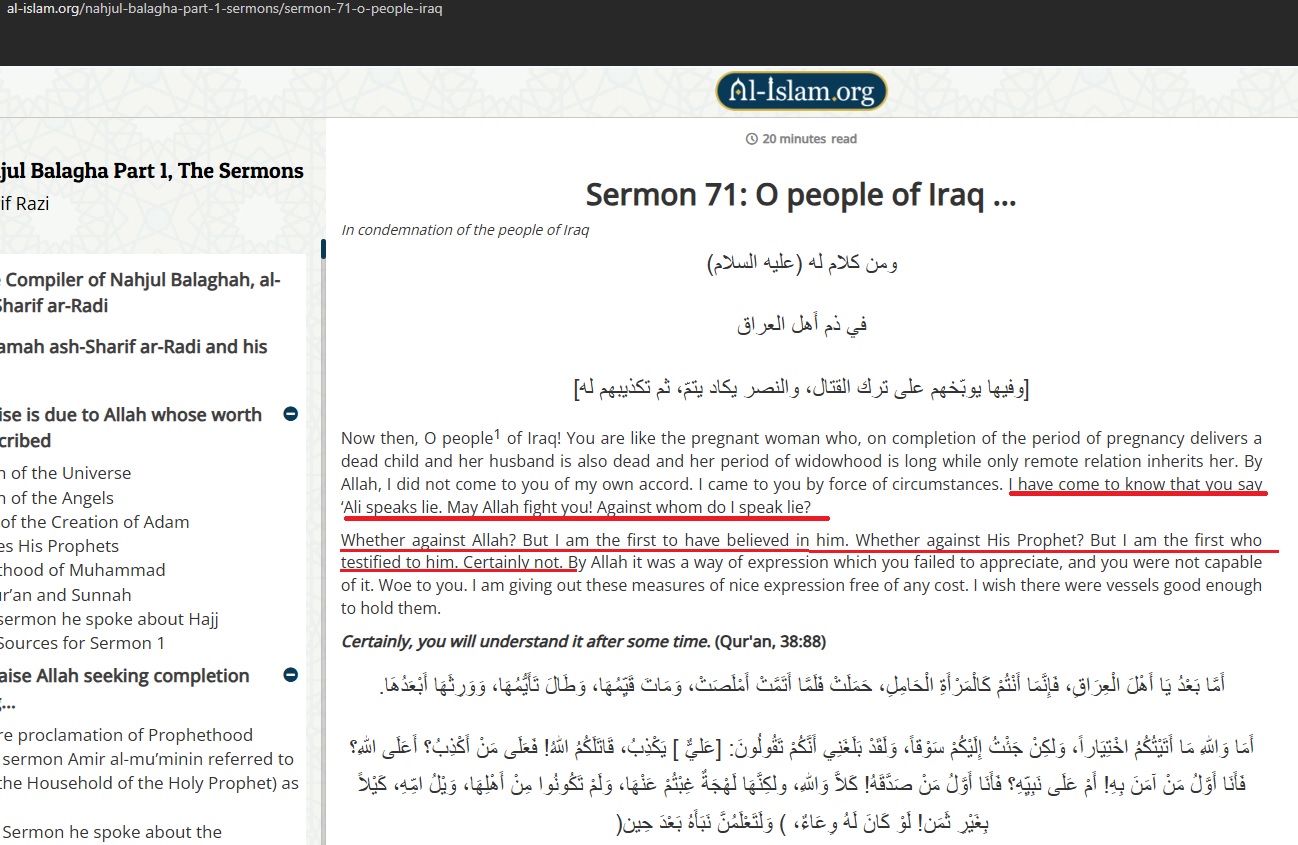
    Leave a comment

    Filed under Uncategorized

    The Hadith of the 12 Caliphs.

    “As for those who divide their religion and break up into (sects), you have no part in them in the least: their affair is with Allah: He will, in the end, tell them the truth of all that they did.” (Qur’an, 6:159)

    ﷽ 

    This idea of the Muslims following 12 Imams is a total concoction.

    First and foremost, it has absolutely no support from the Qur’an.

    We have more than established that here:

    The Sunni Muslims the following hadith that the Shi’i will often use against them.

    Narrated Jabir Ibn Samura:

    I heard the Prophet (saw) saying, “There will be twelve commanders (Amir).” He then said a sentence which I did not hear. My father said the Prophet (saw) added, “All of them will be from Quraish.”

    Source: (https://sunnah.com/bukhari:7222)

    It has been narrated on the authority of Jabir b. Samura, who said:

    I heard the Messenger of Allah (saw) say: Islam will continue to be triumphant until there have been twelve Caliphs. Then the Prophet (saw) said something which I could not understand. I asked my father: What did he say? He said: He has said that all of them (twelve Caliphs) will be from the Quraish.

    Source: (https://sunnah.com/muslim:1821d)

    It is actually quite easy-peasy lemon squeezy from a Sunni Muslim perspective to shut down Shi’i intrigue over these hadiths.

    1. None of these hadith say anything at all about the family of the Blessed Prophet (saw). So the wide-eyed speculation stops there.
    2. None of these hadith say anything at all about them ruling in succession. That is to say, one after the other.
    3. Did Hussein ibn Abi Talib ever rule over the Muslim ummah? We all know the answer to this is a resounding No! He didn’t rule over jack squat!


    The reason we mention Hussein ibn Abi Talib is that the Shi’i who are quite imaginative see the succession of the Blessed Prophet (saw) as:

    Ali ibn Abi Talib
    Hasan ibn Ali
    Husayn ibn Ali (Hussein ibn Abi Talib)
    Ali ibn Husayn

    So, from the perspective of a Sunni Muslim or an Ibadi Muslim, that’s a wrap. That means there is nothing more to discuss. Because the points that the Shi’i want to desperately prove from these hadiths cannot be established at all.

    We will come back with our critique of this hadith. However, let us first look at the history of this number 12 prior to the advent of the Blessed Prophet Muhammed (saw).

    THE NUMBER 12 HAS NO SIGNIFICANCE IN ISLAM.

    The number 12 is not significant or important, in any shape or form, in Islam. It is the atomic number of atoms in Magnesium. 12 is the number of zodiac characters in both the Western and Chinese models. There are 12 months in a year of the Gregorian calendar. The 12th surah in the Qur’an is called ‘Yusuf’ or Joseph.

    The 12th chapter and 12th verse of the Qur’an say the following:

    “Send him with us tomorrow to enjoy himself and play, and we shall take every care of him.” (Qur’an 12:12)

    “Surely, the number of months with Allah is twelve months in Allah’s ordinance since the day when He created the heavens and the earth, of these four being sacred.” (Qur’an 9:36)

    Nothing here is analogous to 12 Imams. The verse says of the 12 months, 4 of them are sacred.

    Are the Shi’i going to tell us that of the 12 Imams only four of them are sacred?

    This holds no significance to 12 tribes, 12 disciples or 12 imams, or 12 rulers at all.

    12 relates to Israel, and the tribes. It has absolutely nothing to do with Islam.

    THE NUMBER 12 AND THE TRIBES OF ISRAEL

    Let us look at Israel (Jacob) and the 12 tribes in the Qur’an and in the Bible.

    “Allah made a covenant of old with the Children of Israel and We raised among them twelve chieftains, and Allah said: Lo! I am with you. If ye establish worship and pay the poor-due, and believe in My messengers and support them, and lend unto Allah a kindly loan, surely I shall remit your sins, and surely I shall bring you into Gardens underneath which rivers flow. Whoso among you disbelieves after this will go astray from a plain road.” (Qur’an 5:12)

    “Moreover, We divided them into twelve tribes And when his people asked Moses for water, We inspired him, “Strike the rock with your staff!” -after which twelve springs gushed forth from it so that all the people knew whence to drink., And We caused the clouds to comfort them with their shade, and We sent down unto them manna and quails, [saying:] “Partake of the good things which We have provided for you as sustenance.” And [by all their sinning] they did no harm unto Us-but [only] against their own selves did they sin.” (Qur’an 7:160)

    “So We dispersed them as separate communities all over the earth; some of them were righteous, and some of them less than that: and the latter We tried with blessings as well as with afflictions so that they might mend their ways.” (Qur’an 7:168)

    “Say (O Muslims): We believe in Allah and that which is revealed unto us and that which was revealed unto Abraham, and Ishmael, and Isaac, and Jacob, and the tribes, and that which Moses and Jesus received, and that which the prophets received from their Lord. We make no distinction between any of them, and unto Him, we have surrendered.” (Qur’an 2:136)

    “Nay! do you say that Abraham and Ismail and Jacob and the tribes were Jews or Christians? Say: Are you better knowing or Allah? And who is more unjust than he who conceals a testimony that he has from Allah? And Allah is not at all heedless of what you do.” (Qur’an 2:140)

    “Truly We gave unto Moses nine tokens, clear proofs (of Allah’s Sovereignty). Do but ask the Children of Israel how he came unto them, then Pharaoh said unto him: Lo! I deem you one bewitched, O Moses.” (Qur’an 7:101)

    Why were 9 tokens given? Why weren’t 12 tokens given? Why weren’t 7 tokens given?

    “Say: We believe in Allah and what has been revealed to us, and what was revealed to Abraham and Ismail and Ishaq and Jacob and the tribes, and what was given to Musa and Isa and to the prophets from their Lord; we do not make any distinction between any of them, and to Him do we submit. ” (Qur’an 3:84)

    “Lo! Thus spoke Joseph unto his father: “O my father! Behold, I saw [in a dream] eleven stars, as well as the sun and the moon: I saw them prostrate themselves before me!” (Qur’an 12:6)


    Here Joseph mentions 11 stars and, altogether, 13 celestial bodies. No mention of anything 12 here.

    There is absolutely nothing in the entirety of the Qur’an that would assign or even remotely hint that the 12 sons of Israel (Jacob) played any role that the 12er Shi’i designates for their 12 Imams. Nothing analogous here at all.

    Now, what does the Bible say about these 12 sons of Jacob/Israel?

    While Israel was living in that region, Reuben went in and slept with his father’s concubine Bilhah, and Israel heard of it. Jacob had twelve sons:

    The sons of Leah:

    Reuben, the firstborn of Jacob,

    Simeon, Levi, Judah, Issachar and Zebulun.

    The sons of Rachel:

    Joseph and Benjamin.

    The sons of Rachel’s servant Bilhah:

    Dan and Naphtali.

    The sons of Leah’s servant Zilpah:

    Gad and Asher.

    These were the sons of Jacob, who were born to him in Paddan Aram.

    Source: (Genesis 35:22-26)

    “All these are the twelve tribes of Israel, and this is what their father said to them when he blessed them, giving each the blessing appropriate to him.” (Genesis 49:28)

    There is absolutely nothing in the entirety of the Bible that would assign or even remotely hint that the 12 sons of Israel (Jacob) played any role that the 12er Shi’i designate for their 12 Imams.

    Were the 12 Imams the names of 12 tribes? Did the descendants of these Imams fight each other in a bitter civil war as was the case with Judah and Benjamin against the other 10 tribes? We all know that the answer to all of this is a resounding No! Nothing analogous here at all.

    The tribes descended from the twelve sons of Jacob. They all existed alive simultaneously as separate people. According to the Imami Shi’i, was there any point in history in which their 12 imams existed simultaneously as separate people? We all know that the answer to all of this is a resounding No! Nothing analogous here at all.

    1. Reuben
    2. Simeon
    3. Levi
    4. Judah
    5. Issachar
    6. Zebulun
    7. Dan
    8. Naphtali
    9. Gad
    10. Asher
    11. Joseph
    12. Benjamin

    NUMBER 12 AND THE DISCIPLES OF JESUS.

    Jesus had 12 disciples because they were to go to each of the 12 tribes of Israel as previously mentioned. That’s it.

    Now let us turn our attention to the disciples of Christ Jesus (as), as they are mentioned in the Qur’an.

    “When Jesus found Unbelief on their part He said: “Who will be My helpers to (the work of) Allah?” Said the disciples: “We are Allah’s helpers: We believe in Allah, and do bear witness that we are Muslims.” (Qur’an 3:50)

    “And behold! I inspired the disciples to have faith in Me and Mine Messenger: they said, ‘We have faith, and do you bear witness that we bow to Allah as Muslims'”. (Quran 5:111)

    “O you who believe! Be Allah’s helpers, even as Jesus son of Mary said unto the disciples: Who are my helpers for Allah? They said: We are Allah’s helpers. And a party of the Children of Israel believed while a party disbelieved. Then We strengthened those who believed against their foe, and they became the uppermost.” (Qur’an 61:14)

    There is absolutely no mention of the number of disciples anywhere in the Qur’an, which is both telling and interesting.

    Now let us turn our attention to the disciples of Jesus (a.s) as they are mentioned in the New Testament.

    “The names of the twelve apostles are these: first, Simon, who is called Peter, and Andrew his brother; James the son of Zebedee, and John his brother; Philip and Bartholomew; Thomas and Matthew the tax collector; James the son of Alphaeus, and Thaddaeus; Simon the Zealot, and Judas Iscariot, who betrayed Jesus.” (Matthew 10: 2-4)

    “Jesus said to them, “Truly I tell you, at the renewal of all things, when the Son of Man sits on his glorious throne, you who have followed me will also sit on twelve thrones, judging the twelve tribes of Israel.” (Matthew 19:28)

    These twelve Jesus sent out with the following instructions: “Do not go among the Gentiles or enter any town of the Samaritans. Go rather to the lost sheep of Israel.” (Matthew 10:6)

    “It had a great, high wall with twelve gates, and with twelve angels at the gates. On the gates were written the names of the twelve tribes of Israel.(Revelation 21:12)

    The Twelve Disciples (Apostles)

    1. Peter the Apostle (Simon Peter)
    2. Andrew the Apostle (Peter’s brother)
    3. James the Great
    4. John the Apostle
    5. Philip the Apostle
    6. Bartholomew the Apostle
    7. Thomas the Apostle
    8. Matthew the Apostle
    9. James son of Alphaeus
    10. Thaddeus
    11. Simon the Zealot
    12. Judas Iscariot

    Replacement after Judas

    After the betrayal and death of Judas Iscariot, the remaining apostles selected:

    • Matthias the Apostle

    We have no record anywhere of the 12 sons of Jacob or the 12 disciples of Jesus giving legal verdicts, and so forth to anyone.

    Not only that but the analogy creates real problems for the 12er Shi’i concept because the 12 sons of Jacob and the 12 disciples of Jesus were concurrent (not in succession).

    Not only that, but one of the 12 disciples of Jesus was a traitor.

    So, if this is analogous to the 12er Shi’i do tell us which of the “12 imams” was a traitor to Rasul Allah (saw)?

    In fact, the 12er Shi’i seem to catch the unsuspecting Sunni Muslims with something that they may be remotely familiar with or something that seems vague.

    “You remember about the 12 tribes of Israel?” “Oh yeah,” says the Sunni layman. “You remember Jesus had 12 disciples?” “Hmm, sounds right”, says the unsure Sunni Muslim who has never bothered to look into these matters.

    So, after they “establish” something murky about the number 12 being significant, then they come and put their spin on the ahadith from Bukhari and Muslim about 12 rulers, and so forth. Even then, as we saw, those hadiths did not even allow the Shi’i to put their spin on the aware Sunni Muslim.

    Now, note that these 12 disciples of Jesus, according to the above text, were with him concurrently, not in succession. None of these disciples ever disappeared, waiting until the present. One of these disciples betrayed Jesus. Which of the “12 Imams” betrayed Rasul Allah (saw)?

    Also, you will note that these 12 disciples were to go unto the 12 tribes of Israel (Jacob). The whole of the New Testament is about Jesus (The Messiah) coming for his people, not the whole wide world. That is why you have the names of the 12 tribes of Israel at the gates of heaven in the vision.

    Are these 12 Shi’i Imams going to have their names on 12 gates for 12 tribes of Arabs (only) numbering 12,000 each?

    The only thing analogous between the 12 Imams and the 12 disciples of Jesus, who were sent to the 12 descendant tribes of Jacob, is in fact the number 12. That is all.

    We have clearly pulled the rug out of the 12er Shi’i idea of there being anything analogous here.


    Unfortunately, our respected Imams of Hadith were not infallible in their collection of Hadith. They allowed a bizarre narration about 12 leaders to slip in their corpus.

    The 12er Shi’i then use that hadith to persuade Sunni Muslims to their perspective.

    Mohammed Hashim Kamali explains the situation best.

    “Hadith critics have expressed reservations. Nevertheless, over the authenticity of various hadiths. Some politically tendentious hadith have come under criticism. One such hadith that al-Bukhari has recorded on the authority of Jabir b Samura is as follows:

    “I heard the Prophet, peace be on him, saying that ‘there will be twelve rulers (amiran), ‘ and then the Prophet uttered words which I did not hear-but my father believed they were ‘…all of them will be from Quraysh’. “

    “The Shi’i scholars have taken this hadith as “decisive evidence”, on the veracity of their belief in the twelve Imams. The Sunnis themselves have advanced different interpretations of this hadith. One interpreter thus understood this to mean that the twelve amirs will be simultaneous, all to whom will be laying claim to leadership, and the context is, therefore, one of tumult (al-fitna). “


    “The various versions of probably this same hadith that Muslim and Abu Dawud have recorded say something different. Briefly, Muslim recorded a hadith to the effect that “this matter (i.e the Caliphate) will not go away until twelve Caliphs have come and gone.” Abu Dawud similarly recorded a hadith to the effect that “this religion shall remain until twelve Caliphs have ruled, all of them with the agreement and support of the umma.”

    “The commentator of al-Bukhari, Ibn Hajar al-‘Asqalani, has quoted these views, and reading all of them together, he thought that the reference in that respect was to the Caliphate. But this only added to complication in view of the common knowledge that the approved Caliphs were only four, not twelve, According to Qadi ‘Iyad Al-Yahsubi the hadith “probably meant just leaders (‘a’immat al’adl) of whom four have lived and the rest may emerge any time before the day of resurrection.” This was “just the right sort of interpretation,” according to Jawad Yasin, for its Shi’i readers with which to vindicate their belief in occultation and the return of their twelfth Imam any time before the day of resurrection.”

    “Ibn al -Jawzi surmised the meaning of the hadith at issue and commented that the Prophet had probably meant twelve rulers, excluding his companions. It was then suggested that the hadith had referred to the Umayyad Caliphs. The problem here was that the Umayyad Caliphs, starting from Mu’awiya (d. 41 H) to Marwan al-Thani (d. 127 H) numbered fourteen, not twelve. Ibn al-Jawzi’s response to this was that Mu’awiya may be excluded since he was a Companion. Then he added that Marwan Ibn al-Hakam (d. 65 H) should also be excluded as he was a usurper and took office after the people had elected ‘Abd Allah b al-Zubayr. This rather imaginative interpretation fitted in with the counting of the Umayyad Caliphs at twelve and the image that was consequently conveyed of them was that they were leaders who ruled with the support of the umma.”

    “This interpretation was based on several questionable assumptions, one of which excluded the first four Caliphs from the counting altogether, then it was assumed that Mu’awiya as not a usurper of political power; that Marwan b. al-Hakam was not to be counted as a Caliph, and that ‘Abd Allah b al-Zubayr had been conclusively elected to be the Caliph.”


    “All of these rather weak interpretations were attempted with the pious yet questionable motive of upholding the reliability of the leading hadith collections and also to lend support perhaps to the Umayyad rule. The episode sustained itself simply because the chain of transmitters of the hadith in question appeared sound. Al-Bukhari and Muslim evidently recorded it because of its isnad without paying much attention to its meaning. And then a series of apologetic commentaries followed suit to justify what they had done.”

    “If the true purpose of all hadith is to clarify and interpret the Qur’an and those aspects of Islam that can properly be said to be a necessary part of its belief structure and its Shari’a, then the hadith we have just reviewed is so peripheral that it hardly merits all the speculative effort that is undertaken to justify it.”

    Source: (A Textbook of Hadith Studies, pages 206-208 by Mohammed Hashim Kamali)

    However, all this fuss is over nothing. As we have shown it is too easy to refute the Shi’i claims in regard to the above hadith.

    Critique of the matn (text) of the hadith.

    Narrated Jabir Ibn Samura:

    “I heard the Prophet saying, “There will be twelve commanders (Amir).” He then said a sentence which I did not hear. My father said the Prophet added, “All of them will be from Quraish.”

    Source😦https://sunnah.com/bukhari:7222)

    It has been narrated on the authority of Jabir b. Samura, who said:

    I heard the Messenger of Allah (saw) say: Islam will continue to be triumphant until there have been twelve Caliphs. Then the Prophet (saw) said something which I could not understand. I asked my father: What did he say? He said: He has said that all of them (twelve Caliphs) will be from the Quraish.

    Source: (https://sunnah.com/muslim:1821d)

    Prima Qur’an Comments:

    Our critique of this hadith will not focus so much on the chain of narration as it will focus on the text itself, but rather using aql and mantiq.

    Is it not odd that Jabir Ibn Samura is to have related something of purportedly such importance to the Messenger of Allah (saw) and yet, did not catch all of it so that his father (or the man standing next to him) had to be the one to inform him of the missing bits?

    Why is Jabir Ibn Samura the only one narrating this? He was possibly only 10 years of age at the time.

    Why is no clarification sought? The companions are known to ask the Blessed Messenger (saw) about the most minute details of his blessed life. Why is there no clarification sought on a matter of purportedly such weight?

    If the Blessed Prophet Muhammed (saw) narrated about the future, why not simply mention Abu Bakr, or Ali as his successor?

    What if the missing bits were as follows:

    “I heard the Prophet saying, “There will be twelve commanders (Amir).” He then said they would all be corrupt and vile. My father, said the Prophet added, “All of them will be from Quraish.”

    It does seem odd that the Blessed Messenger (saw) would foretell about 12 rulers and yet not state plainly that Abu Bakr, or Ali, was to be the successor?

    Look at this map of the umayyad dynasty. That is quite an accomplishment for an empire that did not put the familiy of Ali at the centre of thier doctrine!

    The Shi’i have yet to produce a single hadith where the Blessed Messenger (saw) explicitly stated in no uncertain terms that Ali would be the Amir of the Muslims, after his death. Not one!

    We know you might be thinking about the incident at Ghadir Khum. Don’t worry, we have you covered.

    You may read about that here:

    Lastly, among the Imami Shi’i they still cannot agree upon which list of 12 one is to follow.

    You can read about that here:

    You may also be interested to read the following:

    May Allah (swt) Guide the Ummah.

    May Allah (swt) Forgive the Ummah.

    21 Comments

    Filed under Uncategorized

    Ismaili Shi’a and Circular Reasoning

    O you who have believed, obey Allah and obey the Messenger and those in authority among you. And if you disagree over anything, refer it to Allah and the Messenger, if you should believe in Allah and the Last Day. That is the best [way] and best in the result. (Qur’an 4:59)

    ﷽ 

    Some time back, an Ismaili Shi’i e-mailed us with regard to our entry on the Hadith of Ghadir Khum. Though he has sent us a PDF with many contentions he asked us to address, we feel that we have needed to respond to the heart of the matter.

    The heart of the matter is to understand what the Qur’an says about this issue. He had sent us a link that we are sure he felt would help to establish the case. Unfortunately, if you click on the link, it shows that the page is not there! Thankfully, we have the habit of saving materials.

    So here is the PDF file with the arguments in it. This was written by Mohib Ebrahim.

    Originally to appear here: https://ismailignosis.com/2014/07/08/how-to-validate-the-shia-imamat-from-the-holy-quran/

    If the link fails, we have uploaded the PDF file here:

    imamat-quranic-threads-purity-is-a-pre-requisite-to-lead-and-interpret

    So, for now, let us deal with the heart of the issue. What if we left all the contentious issues aside, and we stuck with the question of what evidence we have in the Qur’an to substantiate this position?

    So in the e-mail, he wrote:

    Likewise, there are numerous verses in the Qur’an that highlight the doctrines of the Imamate, infallibility of the Shi’a Imams (as) and the nobility of the Ahl ul Bayt (peace be upon them). It is not true that such concepts are absent from the Qura’n in a way that we, the Shi’i of Ali (as), are forced to consult supplementary ahadith to support our viewpoints. For more information on the Qura’nic and philosophical/rational proofs of Imamate you can visit: https://ismailignosis.com/2014/07/08/how-to-validate-the-shia-imamat-from-the-holy-quran/


    So let us address what Mohib Ebrahim has written.

    What immediately stood out to us was the very diplomatic way that the reader was being prepped for the clear admission that there is no ‘smoking gun verse’ in the Quran with regard to the Imamate at all.

    Instead, the reader is teased with information like:

    “The dilemma is not improved, but rather compounded, when evidence from the Qur’an is relied upon simply because the Qur’an itself admits, in verse 3:7, to its own partial ambiguity thereby rendering those parts open to individual interpretation “

    “Given the disagreement about a historical event despite overwhelming agreement on its record by both sides, one can only imagine the disagreement over arguments relying on the Qur’an, given its admitted ambiguity”

    Interestingly, the issue is compared to the ‘Gordian Knot‘

    He continues thus,

    “So does this Gordian Knot have a solution or are we of modern and later times hamstrung with the vexing task of trying to tease out the truth from an incomplete historical record 1,400 years after the fact?” “Leaving aside those ambiguous verses that require the Imamat to explain they refer to the Imamat, past attempts to validate the Imamat from the Qur’an were, in general, based on arguing a specific interpretation of what were, hopefully, “smoking gun” verses that one could then point to and proclaim, “Here, clear verses where Allah ordained the Imamat.” However, the fact is that such “smoking gun” verses are few and far between — if they are to be found at all, given the disagreements over interpretation, as explained above. Furthermore, even if they are very clear when read in a certain light, it is precisely because they need to be read in that certain light and then argued in isolation, that they do not, in my opinion, provide substantive, let alone conclusive, evidence.”

    This creates an infinite regress or a closed loop:

    To understand the Quran, you need the Imam.
    To know who the Imam is, you need to understand the Quran.
    To understand the Quran, you need the Imam.

    Now you people are intelligent. This is not a misrepresentation by us. This is a clear-cut admission.

    So, ultimately, this is the intellectual endeavor of Ismail’s. The gentleman in the e-mail asked us to be circumspect with regard to Islamic sects. Let us just say this particular sect of Ismaili Shi’i, as they too have many subdivisions.

    Ultimately, the intellectual endeavors of this particular sect of Ismaili Shi’i want us to believe in circular reasoning, putting the cart before the horse and finding passages simply because we want so desperately to find them.

    In fact, the author, Mohib Ebrahim, states:

    I find it hard to accept that Allah has left the truth of this matter hostage either to the irreconcilable differences of expert Arabic linguists or personal interpretations of the Qur’an’s ambiguous verses.”

    Surely it is self-evident that answers must be found in the “plain verses,” and not the ambiguous ones, for otherwise we would have an unresolvable paradox where the instructions on how we are to acquire the correct meaning of the Qur’an’s ambiguous verses, were themselves cloaked in ambiguity.”

    “Therefore, rather than trying to find and interpret a single “smoking gun” verse, argued and relied on in isolation, to justify Imamat, I use what I call Qur’anic Threads.”

    To preface one’s argument in such a way, it is the end of the discussion, period. In fact, there was no beating around the bush. We have no ‘smoking gun‘ verse. Such ambiguous verses require us to put the cart before the horse, believe in the infallible imam’s ability to interpret before finding such passages. However, we will continue the article with a look into these various ‘threads‘ insh’Allah.

    We don’t know if it would be appropriate to say that Ibrahim, Jacob, Issac were leaders of mankind. As in the whole of humanity. It is more appropriate to say leader for the people, meaning his people.

    Also, to say that Allah (swt) appoints a leader, the question has to be asked. If people appoint a leader and Allah (swt) appoints a leader, are the two things mutually exclusive? After all, that is the reason for this post. That is the reason for this discussion. There is no clear-cut verse in the Qur’an for us to follow infallible Imams. There is no clear-cut verse in the Qur’an that names Ali as a leader for the community. In fact, people point to extraneous sources to indicate that Ali was to be preferred as a leader.

    Look at verse Qur’an 2:124 “His covenant is not with the evildoers.” If a purified lineage also equates to purified offspring, then why did Allah (swt) put the clause ‘My covenant does not include the doers of evil‘?

    Look at the verses: Qur’an 3:33-34 THEY were descendants of one another is true, but not all prophets are descendants of one another.  Unless one means that we all come from Adam (as). In that sense, the whole of humanity is the Ahl Bayt of Adam (as)

    They were all descendants of one another..  We are all from Adam (as). So what is the point?

    From Adam (as) we got two sons, one of whom is the first murderer of another human being. Which brings us back to what Ibrahim (as) prayed for, ‘and of my offspring?’ to which Allah (swt) responds, ‘My covenant does not include the doers of evil.’

    You can imagine Adam (as) making such a du’a for his Ahl Bayt, his offspring, one of which became a murderer.

    Look at verse Qur’an 57:26 among their seed…

    It is interesting that the verse above is half quoted. The full verse says,

    “And We have already sent Noah and Abraham and placed in their descendant’s prophethood and scripture; and among them is he who is guided, but many of them are (fasiqun) defiantly disobedient.” (Qur’an 57:26)

    Among those descendants of Noah and Abraham are those who are guided but most of their descendants are defiantly disobedient. We have a clear example of one of the children of Noah (as) who disobeyed.

    “And Noah called to his Lord and said, “My Lord, indeed MY SON IS OF MY FAMILY (AHLI) and indeed, Your promise is true; and You are the most just of judges! He said, “O NOAH, INDEED HE IS NOT OF YOUR (AHLIKA) FAMILY; indeed, he is one whose work was other than righteous, so ask Me not for that about which you have no knowledge. Indeed, I advise you, lest you be among the ignorant. Noah said, “My Lord, I seek refuge in You from asking that of which I have no knowledge. And unless You forgive me and have mercy upon me, I will be among the losers.” (Qur’an 11:45-47)

    Also, look at verses Qur’an 17:2-3 quoted above. “From the seeds carried along with Noah” came evil beyond evil. In fact, it is interesting that if we continue to read the passage it says:

    “And We conveyed to the seeds of Israel in the Scripture that, “You will surely cause corruption on the earth twice, and you will surely reach [a degree of] great haughtiness.” (Qur’an 17:4)  

    “Those were the ones upon whom Allah bestowed favor from among the prophets of the seeds of Adam and of those We carried [in the ship] with Noah, and of the seeds of Abraham and Israel, and of those whom We guided and chose. When the verses of the Most Merciful were recited to them, they fell in prostration and weeping.” (Qur’an 19:58)

    So why didn’t that guidance and choice descend to their progeny? If Allah (swt) saved Noah (as) and wiped out the evil, it is only reasonable that evil manifested from among the descendants of Noah (as)

    Allah (swt) clearly said that the seeds of Israel would cause corruption and become haughty.

    Just like one of the seeds of Adam was a murderer.

    Just like Allah (swt) put a clause in Ibrahim’s du’a request.

    It’s almost as if these people would own a chain of hotels across Europe one day that sells alcohol. It is as if these people one day would preoccupy themselves with the worldly life and marry supermodels.

    “Also, from their fathers and their seed and their brothers-and, We chose them and We guided them to a straight path.” (Qur’an 6:87)

    “Those are they unto whom We gave the Scripture and command and prophet-hood. But if these disbelieve in that, then indeed We shall entrust it to a people who will not be disbelievers in that.” (Qur’an 6:89)

    Allah (swt) chose and guided them, but if they were to disbelieve therein, they would be replaced by those who would not disbelieve therein. So the possibility of disbelieve is there. This is also confirmed to me by our experience meeting people who are descendants of the Blessed Messenger (saw) who are atheists.

    Look at what he says above about “Obey Allah and Obey the Messenger” (Quran 4:59)

    Mohib Ebrahim continues:

    “For, it is self-evident that if “those who are in authority” were also not pure, like Allah and the Messenger, they will make mistakes and, thus by definition, cannot be rightly guided. Consequently, to avoid being misled by such leaders, others with more knowledge would have to double-check them rendering such leaders redundant and undermining the legitimacy of their claim as rightly guided leadership.”


    Wait a minute. When did tahara (purity) become equated with infallibility? No, that is certainly not the case. We hope no one thought they could sneak that one past us.

    “So they ask you about menstruation. Say, “It is harmful, so keep away from wives during menstruation. And do not approach them until they are pure (tatahharna). And when they have purified themselves, then come to them from where Allah has ordained for you. Indeed, Allah loves those who are constantly repentant and loves those who purify themselves.” (Qur’an 2:222)

    We hope no one is seriously suggesting that we do not approach our wives until they become infallible?  

    “Truly, it is a noble Quran in a protected book. None touch it but the purified.” (Qur’an 56:79)

    Ibn Abbas said concerning the verse, “None touch it except the purified,” that this refers to the Book in the heavens and “the purified” refers to the angels.

    Source: (Tafsīr Ibn Kathīr 56:79 https://quranx.com/Tafsirs/56.79)


    To say that people who are in ritual impurity touch the Qur’an is true. However, to turn around and apply an esoteric meaning to a plain word ‘touch‘ doesn’t help the ‘thread‘ case at all. Nowhere is that word in Arabic used for touch means to interpret.

    Notice he says, “Consequently, to avoid being misled by such leaders, others with more knowledge would have to double-check them, rendering such leaders redundant and undermining the legitimacy of their claim as rightly guided leadership.”

    The Qur’an itself subjects itself to a falsification test by even the most uncouth of people. How is that the Qur’an is subject to a falsification test and these supposed Imams are not?

    In fact, this whole argument used by Shi’i is critiqued here:

    As we noted, one would have to prove the odd assertion that purity equates to infallibility.  If that is the case, then we know that Ali is not pure because he made a colossal error in the battle of Siffin.   

    You can see Ali’s decision critiqued here:

    “Furthermore and notwithstanding the above, the Sunni position — that “those in authority” do not need to be pure and faultless — is just an interpretation since there aren’t, to my knowledge, any verses in the Qur’an stating that Allah left mankind free to choose their own leaders .” -Mohib Ebrahim

    Are there any verses in the Qur’an where Allah (swt) categorically tells mankind that we are not free to choose our leaders?

    So should Western Democracy’s be wary of being too cozy to Aga Khan and the Ismail’i since their doctrine is that democracy is at its core an aberration of what Allah (swt) wants?

    Mohib Ebrahim wants us to believe in even more circular reasoning:

    Since we are unable to judge — perfectly and without error — who are the pure, Thread III will address the apparently impossible command not to follow disbelievers or those who have sinned. Indeed, Allah has said He will judge wherein we differ (42:10,22:67-69,5:48,39:46,6:164, etc.), thus precluding us from even making such assessments.”

    “Since we are unable to judge or assess..perfectly and without error.”

    Ponder that for a moment.

    Question: Are we supposed to believe in perfect error-free Imams?

    Answer: Yes you are.

    Question: Are we able to judge perfectly and without error who these Imams are?

    Answer: No you are not.

    So these infallible Imams are objectively useless.

    Which ahurf or qir’aat are the masses of Muslims to follow?   

    These ‘infallible pure imams‘ could simply throw it up in the air and pick one.

    Who was the divine guide for 700 years between Jesus (as) and Muhammed (saw)?

    It doesn’t matter because these ‘infallible pure imams don’t have an answer, and you are in no position to judge.

    The Qur’an itself subjects itself to a falsification test; these imams do not.

    We will tell you what is really convenient. It’s really convenient that we only have one infallible pure imam at a time. Apparently, in the time of the Blessed Prophet Muhammed (saw), we had him, Ali, and his two sons.

    Wouldn’t it have been quite cool to have put Ali and his two sons in isolated rooms and give them a couple of questions and see if they come up with the same answers?

    Question: What are the people to do when there become violent fractious splits between these infallible Imams?

    Answer: Pick up your sword and hope to Allah that you start stabbing the wrong one. You have no way of objectively knowing which one is the right one!

    Conclusion.

    1. The “No Smoking Gun” Admission: We seized on Ebrahim’s acknowledgment that there is no single, clear, and unambiguous verse in the Quran that establishes the Imamate of infallible leaders or names Ali specifically. We argue that this admission is fundamentally damaging to the Shia case, forcing them into circular reasoning.
    2. The Flawed “Purity = Infallibility” Equation: We refuted the Shii attempt to equate the Quranic term for purity (tahara) with theological infallibility (‘isma). We provided clear counter-examples, such as the verse about menstruation (2:222) and the interpretation of “none touch it but the purified” (56:79) referring to angels, to show the word has a different, context-dependent meaning.
    3. The Problem of Progeny and Sin: We used several Quranic examples (Adam’s son, Noah’s son, the prophesied corruption from the seed of Israel) to demonstrate that being a descendant of a prophet does not guarantee righteousness or leadership. This directly challenges the Shia concept of a lineage-based, infallible Imamate.
    4. The Practical Uselessness of an Unidentifiable Infallible Imam: Which is a brilliant logical critique. If ordinary people are unable to “judge perfectly and without error” who the infallible Imam is, then the Imam’s existence provides no practical guidance. How can people be commanded to follow someone they cannot reliably identify? This stands in stark contrast to the Quran, which issues a clear challenge of falsification and is accessible to all.
    5. The Question of Choice: We challenge the notion that Muslims are not free to choose their leaders, asking for the Quranic verse that prohibits this. This highlights the fundamental political and theological difference: Shiaism posits divine appointment.

    May Allah (swt) Guide the Ummah.

    May Allah (swt) Forgive the Ummah.

    2 Comments

    Filed under Uncategorized

    My own experience with Shi’a.

    “Travel through the land and observe how He began creation. Then Allah will produce the final creation. Indeed Allah, over all things, is competent.” (Qur’an 29:20)

    ﷽ 

    Our colleague recounts their encounter with Shi’i 

    Now when I say, “My experience with the Shi’i”, I should clarify that by that I mean the 12er Shi’i. The bulk of my experience has been with them.

    When I was studying at Zaytuna before it became Zaytuna college, a fellow student and I named Wasif and I went for an afternoon stroll. I recall how he was telling me, “C’mon brother, just one more burger before we walk the straight and narrow.” He had a love for American burgers and was bound and determined to have just one more before going completely halal.

    The time for Maghrib came upon us and there was a mosque on the side of a street. We walked in, and it was certainly a 12er Shi’a Mosque. You can see pictures of various Imams on the wall. We did not hesitate to join the congregation for the Maghrib prayer. I only noted to myself afterward that it was interesting that the whole prayer was out loud. Of course, when we went back to Zaytuna, the brothers were sharing their day-to-day things, and the subject came up. One brother approached Wasif and I said, “You prayed behind the Shi’i. Your prayer may not be valid. You better go and talk to Shaykh Mohamed Yaqubi.”

    Well, low and behold, we were advised to do our prayer over again. I cannot speak for Wasif, but I didn’t take the advice. I saw no valid reason to. They prayed and I prayed. My prayer is not for them or their school. It is for Allah (swt).

    Then there was the time I went for the ATMT (Awareness Through Mosque Tour) training course in Manama, Bahrain. Very beautiful team, great host, and amazing instructors! Unfortunately, during my first Friday prayer there, after everyone does there two nawafil many gather in small groups to simply chit-chat. So, one of the people with us nearby was talking about how “The Shi’i are spreading like cock roaches”. I was really disgusted by the fact that he would like this about other Muslims, and in the mosque no less! So I told him, “We should not talk about other Muslims like this.”

    On another occasion, we (the trainees) were going on a guided tour of museums. A Mualif (convert) sister, who came from either the Czech Republic or Hungary was talking to a very stout Arab man. As we were walking they were discussing the current(then) volatile situation in Iraq. I made the comment that, “Sunni and Shi’i Muslims should unite.” To which he quipped: “Who said they are Muslims?” I responded, “What do you mean?” He replied, “The Shi’i who said they are Muslims?” I responded, “Our scholars (Sunni) say they are deviant, but Muslims nonetheless.” At that time I was still following the Maliki School.

    The adhaan had sounded. Frustrated with what I had just heard, I stormed off from the group and happened upon a local mosque just a few blocks away. I sat in the front row waiting for the Imam to come forward. The congregants of the Mosque seemed primarily Indo-Pakistani from what I could tell. One brother said the Iqama and an elderly man was pushing me to lead the salaah! I looked around and was wondering if the actual Imam would come forward, and they kept pushing me to lead the prayer. Well, I did just that. Let me tell you it is a huge thing to lead the prayer. It was like a huge weight to lead the congregational prayer. My respect to every Imam of every Masjid on the planet. You can really feel the weight of doing something that one would think is a simple task. After the salaah, I made du’a, did more rakats and left.

    Later, that robust Arab brother came up to me during dinner and apologized to me. That took me by surprise because, to be honest, he did not strike me as the type of person who would do that. I later found out from some organizers of ATMT that this brother’s family was killed by a Shi’i death squad in Iraq. May Allah (swt) soften his heart and grant him ease.

    Let me tell you, you need to choose your words very carefully when traversing this Earth. Once, in what I thought was a casual conversation, when talking about the region (I being from the States), I called the waters around Bahrain, the “Persian Gulf”. Boy! That’s a blunder! “It is the Arabian Sea!” One man interrupted. I responded with, “Why not call it the sea of Islam, or the Gulf of Allah?”

    I remember not far from the hotel we were staying I went out one evening to do dhikr by the “Gulf of Allah” all the while staring off into the direction of Iraq. The cool breeze of the water filled the surrounding air. It was surreal because just a few hundred kilometers was the closest I ever was physically to a war zone. I reflected on the events of the day and made du’a that Allah (swt) would fill the region with peace.

    Another encounter was with when I was in Singapore. A brother I met at the Sultan Masjid. Brother Ali Al Ausi, a very kind and jovial brother. I do not want to take from his good deeds by publicly stating the many good things he has done, but Al hamdulillah I saw first hand how he was there to help those in need (fisabilillah). We were roommates for a while, and sometimes I would lead the salaah and other times he would. l was sometimes amused by his method of salah because he would wear jeans that have loops (where the belt goes through) and he would put his thumbs there and hang them during the prayer. Quite cavalier I thought to myself! Haha.

    He told about his family leaving Najaf and going to Russia and from there eventually settling in the United Kingdom. His father worked in pizza shops until he became a manager and worked very hard to put his family on a proper footing.

    He also told me about his doubts concerning Shi’sm and that he agreed Muslims should be Qur’an centric. He told me about how Shi’i get worked up in the Mosque during sermons on Karbala and that they would want to go out and beat up the first Sunni they saw. By Allah, these are his words, not mine.

    Interestingly enough, for those of you who remember the man in Iraq who took off his shoe and threw it at president George Bush Jr, well, that man (the man who threw the shoe) was going to marry his daughter to my friend Ali. They met in Damascus, Syria, and once Ali confided in her that he didn’t believe in some of the stuff about Shi’ism, she stormed off saying, “I would rather marry a Sunni than you!”

    He also divulged to me about some rather wealthy Shi’a Arabs that would practice Muta with some of the poorer Arab women in Egypt, and he was rather disgusted by it all. I recall how he remarked, “If everyone is doing Muta, then who will get married?”

    I just wanted to say that this book was given to me by my good friend Dr. Ali Al-Ausi, upon my request. He informed his mother that he had a friend wanting to know more about the 12er jurisprudence. The book is still in my collection. Brother Ali is one of the kindest, honest, generous, and most truthful Muslims I have ever met.

    My meeting with the respected, Ali Larijani (The Former Speaker of the Parliament of Iran). This was an occasion at the Sultan Mosque in Singapore when his delegation came to Singapore. I was actually scheduled to give a talk to him and his delegation and there was a change of plans. I prepared before he came by trying to find out about his background. I saw that he studied Philosophy and particularly liked the philosopher Immanuel Kant.

    His entourage created quite a shock at the Mosque because the ladies who were with them prayed in the main prayer hall (where the men usually pray). I was amused by it all. Nonetheless, after the prayer, I approached Ali Larijani, who had two bodyguards and one cleric with him. I greeted him, “Assalamu alaikum warahmutallahi wabaraktuh.” He replied the same. I then told him, “I am from America and I wish for peace between us and Iran.” He replied, “That they too wish for peace.” I then asked him what his favourite quote from Kant was. I could tell by his reaction. He was surprised. He responded with Kant quoting the golden rule: “Do not do that to others that you would not like them to do to you.”

    Now that is the sum total of my personal experience and interaction with Shi’i or anything in relation to them in my lifetime. If you think, based upon what I shared above, that I hate Shi’i, that is really up to you.

    That being said, when it comes to what I encounter online, via various social media platforms and what have you, I have found Shi’a (12er,especially) to be very dishonest, disingenuous and not very forward.

    The one thing I do admire about Salafis, Sunnis of all stripes, even those who follow the Hafs Qur’an only religion. Ahmadiyyah etc. is there willingness to be forthright.

    Their willingness to say, “I am such and such and this is where I stand.” With the Shi’i, I don’t get this. What I find is they often join groups posing that they are part of this or that and keeping quiet about being Shi’a.

    Look! If we were in Syria, Iraq, Lebanon or other places where sectarianism is highly charged and a person’s life is in danger, I would get it. However, this skulking around various platforms pretending to be Hanafi, or Quranist. Anything else is simply just cowardly. It truly is.

    All these people saying Ya Ali, Ya Ali Madad. How they would have loved to be at Karbala, or have lifted their sword for Ali. Look, mate, you cannot even be honest enough with yourself to say what you are openly.

    And honestly, what I do see on YouTube, of the interactions of 12ers and Zaydi’s with Sunnis, is that the Shi’a end up getting intellectually owned, time and again.

    You may also wish to read the following:

    May Allah (swt) Forgive the Ummah.

    May Allah (swt) Guide the Ummah.

    12 Comments

    Filed under Uncategorized

    Are we to follow Infallible Imams according to the Qur’an?

    ﷽ 

    O you who have believed, obey Allah and obey the Messenger and those in authority among you. And if you disagree over anything, refer it to Allah and the Messenger, if you should believe in Allah and the Last Day. That is the best [way] and best in the result. (Qur’an 4:59)

    1) In this clear verse, we find that in matters of disagreement between those in authority and those under authority, we need to refer back to Allah and the Messenger.

    Had it been that those in authority were infallible or divinely appointed then, Allah wouldn’t have given any scope to disagree with them.

    The fact that there is disagreement proves that “those in authority, aka the Ulil Amr”, are neither an absolute nor an infallible authority.

    It means that Ali Ibn Abu Talib and Ibn Abbas can disagree with one another. Yet, if they have a disagreement, they would refer the matter back to Allah (swt) and his Blessed Messenger.

    2) If their authority was infallible, Allah(swt) wouldn’t have put authority above them. (.i.e) Allah and His Prophet.

    3) If “those in authority, aka the Ulil Amr” were divinely appointed, then Allah would have asked the believers to refer them along with Allah and the Prophet in matters of disagreement.

    But Allah(swt), giving the possibility of disagreement with those in authority, asked us to refer back to Allah (swt) and the Blessed Messenger; which is clear evidence that “those in authority aka the Ulil Amr” were not divinely appointed.


    The huge advantage that the Sunni have over the Imami Shi’i’ is as follows:

    Since in Sunni Islam they do not believe that their Imams are infallible or above reproach, a mistake in jurisprudence, reasoning, deduction or logic does not entail disaster for Sunni Islam. However, just one mistake in jurisprudence, reasoning, deduction or logic would be absolutely disastrous for the Imami Shi’i’.


    “You see, then the Imamate goes from the Imam to his first cousin, and when the first cousin dies, then the Imamate goes to his first cousin and so on. Because that is the Sunnah of the Prophet (saw).”

    Huh?

    The battle of Siffin and practical implications of the above verse.

    O you who have believed, obey Allah and obey the Messenger and those in authority among you. And if you disagree over anything, refer it to Allah and the Messenger, if you should believe in Allah and the Last Day. That is the best [way] and best in the result. (Qur’an 4:59)

    The battle of Siffin gives us a demonstration of how some of the companions understood the above verse. If we are to believe the historical narrative as told by Shi’i and Sunni sources.

    If we are to believe the Shi’i narrative.

     Ali agreed to arbitration with Muaviya on the basis that they would judge by the Qur’an. If Ali understood that he was of the same authority as the Qur’an and the Messenger (saw) he would not have submitted to arbitration. He would have been on the same page as those in his army who wanted to continue the fight.  However, if he did think he was of the same authority as the Qur’an and the Messenger (saw), then he would be a hypocrite for going against what he himself believed. Or he was not sincere in submitting to the authority of the Qur’an. 

    If we are to believe the Sunni narrative. 

    If those in Muaviya’s camp believed that the Shi’i held any of the views about Ali that Imami Shi’i held, namely that he (Ali) was maʿṣūm (معصوم) and he (Ali) held ʿiṣmah (عصمة) they themselves would have never asked for arbitration as it too would have simply been a ruse. This becomes very clear that these concepts were not among the followers of Ali because Muaviya’s camp would have known this and would have never cooked up the idea of raising the Mushafs as it would have easily backfired

    May Allah (swt) guide us all to what is beloved to Allah (swt).

    May Allah Forgive the Ummah.

    May Allah Guide the Ummah.

    4 Comments

    Filed under Uncategorized

    Sociological Experiment: Ali, Umar and Fatima

    “Indeed, Allah commands you to render trusts to whom they are due and when you judge between people to judge with justice. Excellent is that which Allah instructs you. Indeed, Allah is ever Hearing and Seeing.” (Qur’an 4:58) 

    ﷽ 

    This is a sociological experiment our colleague conducted on their social media regarding the tale of some from among the Shi’i in relation to Umar (ra), Ali and Fatima (ra).

    Narrated `Aisha:

    Once, Fatima came walking and her gait resembled the gait of the Prophet (saw). The Prophet (saw) said, “Welcome, O my daughter!” Then he made her sit on his right or on his left side, and then he told her a secret and she started weeping. I asked her, “Why are you weeping?” He again told her a secret and she started laughing. I said, “I never saw happiness so near to sadness as I saw today.” I asked her what the Prophet (saw) had told her. She said, “I would never disclose the secret of Allah’s Messenger (saw).” When the Prophet (saw) died, I asked her about it. She replied. “The Prophet (saw) said: ‘Every year Gabriel used to revise the Qur’an with me once only, but this year he has done so twice. I think this portends my death, and you will be the first of my family to follow me.’ So I started weeping. Then he said. ‘Don’t you like to be the chief of all the ladies of Paradise or the chief of the believing women? So I laughed for that.” 

    Source: (https://sunnah.com/bukhari:3623)

    If indeed the Shi’i believe that this narration is true and that Fatima (ra) would be the first from among the family of the Beloved Messenger (saw) to die, it cannot also be true that the “unborn” son of Fatima would die as he would technically be the ‘first of my family’ to follow.

    Ali bin Abi Talib said:

    “When al Hassan was born, the Prophet (saw) came and said: Show me, my boy, what have you named him? I said: I called him Harb, he said: Nay,” He is Hassan When al Hussein was born, the Prophet (saw)said: Show me my boy, what have you named him? I said: Harb, he said: Nay, he is Hussein, and when the third was born, the Prophet (saw) came, then said: Show me, my boy, what have you named him? I said: Harb. He said: Nay, he is Muhassin, then he said: I have named them after the names of the children of Haroun(Aaron). They are Shibr, Shubeir, Mushabbar.” 

    Source: (Musnad Ahmad 1/98, Isnad is sound)

    • لمَّا وُلِد الحَسنُ فقال أروني ابنِي ما سمَّيْتُموه قُلْتُ حَرْبًا قال بل هو حَسنٌ قال فلمَّا وُلِد الحُسَينُ سمَّيْتُه حَرْبًا فجاء رسولُ اللهِ صلَّى اللهُ عليه وسلَّم فقال أروني ابنِي ما سمَّيْتُموه قُلْتُ حَرْبًا قال بل هو حُسَينٌ فلمَّا وُلِد الثَّالِثُ سمَّيْتُه حَرْبًا فجاء النَّبيُّ صلَّى اللهُ عليه وسلَّم فقال أروني ابنِي ما سمَّيْتُموه قُلْتُ حَرْبًا قال بل هو مُحَسِّنٌ ثُمَّ قال سمَّيْتُهم بأسماءَ ولدِ هارونَ شَبَرٍ وشُبَيرٍ ومُبشِّرٍ [ وفي روايةٍ ] قال سمَّيْتُهم بأسماءِ ولدِ هارونَ جَبَرٍ وجُبَيرٍ ومُجَبِّرٍ. خلاصة حكم المحدث: رجالهما رجال الصحيح غير هانئ بن هانئ وهو ثقة‏‏
      الراوي: علي بن أبي طالب
      المحدث: الهيثمي
      المصدر: مجمع الزوائد
      الصفحة أو الرقم: 8/55
      التخريج : أخرجه أحمد (769)، وابن حبان (6958)، والطبراني (3/ 96) (2773) جميعا بلفظه.

    موقع الدرر السنية – الموسوعة الحديثية
    https://dorar.net/h/NmytTfjY

    It’s not believable to say that Muhassin was aborted as a fetus and yet the above narration says that he was born.

    Here is a video of Ayatollah Sayyid Fadhlallaha, a Shi’i Imam, who thinks this whole tale about Ali, Umar (ra) and Fatima (ra) is a big fat, juicy fabrication. For those who can’t click on English subtitles in the post, we have put the YouTube link where you can click on English subtitles.

    Surely the Imam has his reward with Allah (swt) for seeking truth on the matter.

    Also, remember the presence of a statement in a book does not necessarily make it authentic. We do not know of anyone who holds this position. The chains of narrators the isnad needs to be scrutinized. Do the reports contradict other pieces of evidence? This is what needs to be understood when engaging in dialogue with anyone from among the Muslims.

    Now let us assume, for the sake of argument, that this incident took place as suggested by the Shi’i. Obviously, learned people like the Ayatollah above don’t buy it for a hot minute.

    SOCIOLOGICAL EXPERIMENT ON FACEBOOK. I CALL THIS: “THE FATIMA EXPERIMENT”

    So, knowing that Muslims have a vested interest in this alleged incident and there are emotional attachments to it, I decided to ask people who were absolutely clueless about this incident.

    I decided that I would ask my non-Muslim friends about their thoughts concerning the characters of the two major individuals in this incident. So this is the data that I gave to them:


    I want my non-Muslim friends to answer this question. Any Muslim who comments, I’ll delete it. This is a sociological experiment.

    What would you say about a man (person A) who punched another man’s wife (person B) in the stomach and caused her to miscarry? Person B (a man) does absolutely nothing in response to person A (a man).

    Later, person B marries one of his daughters to person A.

    Person B names his son after person A. 

    In the Fatima experiment. Person A is Umar Ibn Al Khattab (ra) and Person B is Ali ibn Abu Talib.

    What follows are their responses. Some of them are quite interesting. I have covered up their names to protect/respect their personal privacy.  These are mostly U.S. Americans. They hold nothing back.

    Well, so there you have it. 20 different responses to this scenario. Not favourable views of Umar (ra) and almost unanimously unfavourable views of Ali

    Now we have The Lady of Heaven film that has created quite a controversy.

    May Allah (swt) guide our tongues to speak the truth and our hearts to have the courage to say it. May Allah (swt) guide us from speaking falsely about any person’s incident or matter. Amin!

    You may also wish to read the following:

    May Allah Guide the Ummah.

    May Allah Forgive the Ummah.

    6 Comments

    Filed under Uncategorized

    The Ibadi Stance on Ali bin Abi Talib

    “Wherever you are ˹O Prophet˺, turn your face towards the Sacred Mosque. And wherever you ˹believers˺ are, face towards it, so that people will have no argument against you, except the wrongdoers among them. Do not fear them; fear Me, so that I may ˹continue to˺ perfect My favour upon you and so you may be ˹rightly˺ guided.” (Qur’an 2:150)

    ﷽ 

    Logic and facts will always rule over feelings and fallacy.

    First it should be known that the default position of all the companions of the Blessed Prophet (saw) is Wilayat al dhahir. Which means they are known to follow the Qur’an and the Sunnah, and they are known for their piety. This is the default position for all companions.


    Now, if anyone of them did a major sin and did not make tauba to Allah (swt) up until his death, you can put that companion in Bara’ah al Dhahir.

    So, in regard to Ali, there are three positions held among the Ibadi.

    1. Wuqoof. Suspend judgement. That is not to put Ali in wilayah or bara’ah. To leave his matter to Allah.
    2. Bara’ah al-Dhahir – The apparent dissociation. This is a matter of jurisprudence. Ali committed kufr ni’ma and there is no indication that he repented of his sins.
    3. Walayah al-Dhahir – The apparent friendship. This is a matter of jurisprudence. Ali was remorseful and repented of his sins.

    Bara’ah and Wilayah are a huge part of Islam of which many Muslims are ignorant of. If you want to know how it is understood. We would suggest you read the following:

    Wuqoof is to pause if there is khilaf on the person. Wuqoof is to stop at everyone you don’t know. You do not make a judgement on him/her to be in Walayah or Bara’ah. This is a very safe path to take.

    Bara’ah al DhahirThe Apparent disassociation. This to perform Bara’ah to whoever you see disobeying the commandments of his Lord. Be it in the Quran or Sunnah- whether you’ve seen him by yourself or by him admitting to committing that sin or by the famous/infamous act that he did. They can return to Walayah if they repent and reform.

    Walayah al-Dhahir – The Apparent Friendship. This means to show walayah (loyalty/friendship) to anyone you see following the commandments of Allah—whether from the Qur’an or Sunnah. Even those who have committed sins and repented of the sins.

    Shaykh Massoud bin Muhammed Al Miqbali (hafidullah) gives the range of the Ibadi views regarding Ali bin Abi Talib. We did our best to clean up the subtitles below. The Shaykh is giving a reply to one of the Salafi detractors.

    The Ibadi stance regarding Ali bin Abi Talib.

    “The Ibadis have different positions on Ali bin Abi Talib. And it cannot be said that Ibadis takfir Imam Ali (kufr ni’amah) and it cannot be said that they associate with him (wilayah), and it can not also be said that Ibadis stop on him (Wuqoof). Rather, all three positions exist.”

    “So it cannot be said that it is only one of these sayings that the Ibadi adopt.”


    “And those that stated he was a kafir by that didn’t mean to remove him out of the fold of Islam. Rather, they looked upon the events and clashes that occurred in Siffin, and they built upon it a judgement. And it’s a Godly judgement. They see that Ali is alike to the people, alike to anyone else. For him, it is that for others, and for him, it is that for others, and he is obligated by what they’re obligated to.”

    “So, if it falls on that which obligates deviance, he is considered a deviant, tafseeq he is considered a fasiq, kufr he is takfeered. And this is the madhab of the sahaba which you narrate. The companions who had insulted, killed and cursed him. Was it out whim? Or by a religious obligation?”

    “Without a doubt, the madhab of the sahaba (and you claim you follow the salaf, and you say that you’re salafiyyah). This is the madhab of the salaf, where whoever falls on kufr is takfeered, and whoever falls on that which obligates cursing is cursed, and whoever falls on what obligates criticism is criticized. This is the madhab of the salaf, rather it is the madhab of the Qur’an and the honest Prophet (saw). This is the madhab that we adopt.”

    “And we do not, after that, believe that if it’s permissible to takfir him, that he’s out of the fold of Islam. No! We say that kufr is split into two. Kufr Shirk and Kufr ni’ama. (That doesn’t take him out of Islam). To make this simple: all mushriks are kafirs, but not all kafirs are mushriks. This is with those that adopted the madhab of takfir, but there are those that didn’t adopt it. And there’s him who stopped.”

    “And if you have knowledge just like they have, then it is permissible for you to judge like they have. And if you’re a jahi (not learned), then stopping on him is enough for you, and that is a known way with us.”

    “And they say that a monotheist isn’t takfeered except for shirk, and this is a false saying. Here are the texts of the shari’ah and its infallible proof that the takfir doesn’t take its committer out of islam.”

    “It is the duty of all men towards Allah to come to the House a pilgrim, if he is able to make his way there. As for the (kafara) ungrateful, Allah is All-sufficient nor needs any being.” (Qur’an 3:97)

    “This is a favor from my Lord by which He wants to test whether I am grateful or ungrateful.” (Qur’an 27:40)

    Narrated ‘Abdullah:

    The Prophet (saw) said, “Abusing a Muslim is Fusuq (an evil doing) and killing him is Kufr (disbelief).” Source: (https://sunnah.com/bukhari:48)

    Narrated Ibn `Umar:

    I heard the Prophet (saw) saying, “Do not revert to disbelief (kuffaran) after me by striking (cutting) the necks of one another.”

    Source: (https://sunnah.com/bukhari:7077)

    “Abu Hurairah narrated that the Prophet (saw) said: “Whoever engages in sexual intercourse with a menstruating woman, or a woman in her anus, consults a soothsayer, then he has disbelieved (kafar) in what was revealed to Muhammed.”

    Source: (https://sunnah.com/tirmidhi:135)

    You may read more about that here:

    “All of these texts show clearly that there is from kufr which doesn’t take its committer out of Islam. Rather, it’s a synonym to fusooqi, fujoori, isyaani. So trying to distort the picture of the Ibadi madhab is a miserable and desperate and unsuccessful try. And I said that there are those that said he (Ali) repented, and that narration has been denied by the other group.”

    “This narration exists within our books, and if we hated and considered him (Ali) a kafir for personal reasons, we wouldn’t have mentioned this narration, which acquits his position.”

    “We have in our athars and books like Bayan al-Shar‘ (بيان الشرع) — written by Muhammed b. Ibrahim al-Kindi, which was written in the 5th century, shows evidence of him (Ali) repenting. And this repenting narration maybe it is something that only the Ibadis have. It doesn’t exist with others. So if they were opposing him (Ali) personally, they wouldn’t have narrated his repentance.”

    “But they (The Ibadi scholars) are the just ummah, the righteous ummah, they narrate all that is for them, and they narrate all that is against them. There is no opposition between them and the truth.”

    “So we take the truth whenever we see it, even if it’s a hater that brought it, and the false is the rejected by us, even if it was brought by a friend who is taken highly.”

    “We accept what Allah accepts from his deen, and reject what He rejects. Our biography is that of Ahmed (saw) companions. We do not accept people of injustice as models. This is the Minhaj that we walked upon. We narrate that which is for us, and narrate that which is against us, and it’s not really our concern about the pleasure of whoever is pleased and the anger of whoever is angry.”

    First: From the outset, one must understand that our predecessors were what one may call the Shiat Ali. They were in the battles of the Camel and Siffin and fought hard on behalf of Ali Ibn Abu Talib. Losing life and limbs and relatives. Which is more than what those who claim to profess him can claim.

    Second: The disappointment comes with his decision at Siffin, and his injustice in taking the life of the believers at Nahrawan. It becomes abundantly clear that his followers never had even any concept of the terms maʿṣūm (معصوم) and ʿiṣmah (عصمة) being applied to him. If that were the case, they would not have left his camp. Nor were these concepts used by Ibn Abbas (ra) in his debate with the people of the river. (Nahrawan).

    Third: The issue surrounding Ali Ibn Abu Talib is similar to that of Uthman ibn Affan, in that
    they are political in nature. No one from our school accuses either Ali Ibn Abu Talib or Uthman ibn Affan of being a mushrik. Far from it.

    Fourth: Just like a group of companions were the ones to rise up against Uthman ibn Affan, likewise, a group of companions differed with Ali’s decision of arbitration.

    All Muslim groups today are formed on the basis of political events in the early period of Islamic history.

    There are a few things in the video a person should take away.

    The differences in the types of kufr. Kufr ni’ma doesn’t put the person out of the fold of Islam.

    The other point is that those who have knowledge of this subject may form a particular opinion on it. Those who do not have knowledge of this subject can and should refrain from having any opinion on it. (wuqoof)

    The fact that he (Ali) went against the Qur’an-based ruling at Siffin and killed the Muslims at Nahrawan put him in the state of kufr ni’ma (which doesn’t take the person out of Islam).

    However, that person would still need to repent of their kufr before they died. To us, Ali is like others. He can make mistakes.

    Indeed, major sins nullify obedient acts, no matter how great. In the case of Ali, he committed major sins. So the point of difference in the school is on rather or not he repented before he met his end.

    Those who do not believe he repented before death can say that Ali would be in Bara’ah-al dhahir. The apparent disassociation.

    For those that believe Ali repented before he died. Ali would be in Walayah al dhahir. The apparent association.

    So, basically to sum up, the Ibadi position. There are three positions regarding Ali Ibn Abi Talib.

    Anyone who refuses to mention this (three views) or relates only one view is either willfully ignorant or a deceiver and a liar.

    Background into some of the reasons for the opposition of the companions against Ali bin Abi Talib

    The main cause of fierce opposition to Ali was the perceived failure or reluctance to punish the culprits, including his stepson, Muhammed bin Abu Bakr, who was involved in the killing of Uthman. Ali married his (Abi Bakar’s) mother, Asma (ra), after the death of Abu Bakr (ra). So there was a marriage relationship between Ali and Muhammed bin Abu Bakr, although, as we have seen, Muhammed bin Abu Bakr did not actually kill Uthman, at best he aided and abetted the assassins. (This for another article).

    What might have strengthened people’s suspicion on Ali was that Ali appointed Muhammed bin Abi Bakar as governor of Egypt, which his opponents may have interpreted (right or wrong) as a type of reward for his hand in the matter of killing Uthman.

    Furthermore, Ali’s own brother Aqil ibn Abi Talib fought on the side of Muawiya. Aqil ibn Abi Talib is the cousin of the Blessed Prophet (saw) and elder brother of Ali. So, as one can see, these were quite chaotic times.

    Prior to this, there was the whole incident of Ali bin Abi Talib burying Fatima (ra) in secret and people were not pleased about it. You may read about this here:

    https://sunnah.com/bukhari:4240

    Ali bin Abi Talib disappeared from the scene of events throughout the caliphate of the three Shaykhs: Abu Bakr (ra), Umar (ra), and Uthman. For a total of 25 years (a quarter of a century), the man was absent, completely out of sight. No one knew what he was doing. It is said that he did not participate in a single Muslim battle, neither with himself, nor with his children, nor with his money. While the chieftains of the Arabs were crushing the apostates and toppling the thrones of the Caesars, not a single inch did he conquer for Islam!

    To many, the greatest of shocks came. When he finally ascended to power after what many saw as the conspiracy to kill Uthman, the momentum of the conquests was paralyzed, the flame of victories of tawhid was extinguished, so that the sword that “slept” on the enemies of the Ummah would awaken suddenly in the breasts of the Muslims!

    Furthermore, what set the people against Ali are the various conflicting narratives about how he dealt with Aisha (ra), a member of the purified household according to (Qur’an 33:30-34) as well as “Mother of the Believers” as per (Qur’an 33:6).

    They ask how Ali bin Abi Talib would face the Messenger of Allah, (saw) when he fought his wife!! And he sent his helpers against her until they hamstrung her camel and she fell from her litter, and her enemies paraded her around like a captive? This is a sign of humiliation for the man’s family, her violation, her captivity, and the foreigners’ force to subjugate, humiliate, and degrade her!

    The test of Aisha (ra) and the test of Ali.

    Thus, the case of Ali with us, Ibadi, is similar to the case of Aisha (ra) with many Shi’i. Consider the following:

    Aisha (ra) was a test on rather the believers will follow her or the Imam. Ali Ibn Abu Talib himself became a test for the believers at Siffin; to see whether or not people would follow what Allah (swt) ordered in the Qur’an, or Ali’s decision.

    Narrated by Abu Maryam `Abdullah bin Ziyad Al-Aasadi:

    “When Talha, AzZubair and `Aisha moved to Basra, `Ali sent `Ammar bin Yasir and Hasan bin `Ali who came to us at Kufa and ascended the pulpit. Al-Hasan bin `Ali was at the top of the pulpit and `Ammar was below Al-Hasan. We all gathered before him. I heard `Ammar saying, “`Aisha has moved to Al-Busra. By Allah! She is the wife of your Prophet in this world and in the Hereafter. But Allah has put you to test whether you obey Him (Allah) or her (`Aisha).”

    Source: (https://sunnah.com/bukhari:7100)

    So even though Aisha (ra) is acknowledged by Ammar bin Yasir to be the ‘wife of the Prophet in this world and in the Hereafter‘, he was not about to leave the dhahir (the apparent) evidence.

    Which is that Ali was the rightful 4th Imam of the Muslims. One who is to be obeyed as long as he obeys the Qur’an and Sunnah. 

    The idea that a particular blood tie, clan or family affiliation exempted one from the Sharī’ah is absolutely foreign to the Blessed Prophet (saw).

    Narrated `Aisha:

    Usama approached the Prophet (saw) on behalf of a woman (who had committed theft). The Prophet (saw) said, “The people before you were destroyed because they used to inflict legal punishments on the poor and forgive the rich. By Him in Whose Hand my soul is! If Fatima (the daughter of the Prophet (saw) did that (i.e. stole), I would cut off her hand.”

    Source: (https://sunnah.com/bukhari:6787)

    Narrated Abu Huraira:

    When Allah revealed the verse: “Warn your nearest kinsmen,” Allah’s Messenger (saw) got up and said, “O people of Quraish (or said similar words)! Buy (i.e. save) yourselves (from the Hellfire) as I cannot save you from Allah’s Punishment; O Bani `Abd Manaf! I cannot save you from Allah’s Punishment, O Safiya, the Aunt of Allah’s Messenger (saw)! I cannot save you from Allah’s Punishment; O Fatima bint Muhammed! Ask me anything from my wealth, but I cannot save you from Allah’s Punishment.”

    Source: (https://sunnah.com/bukhari:2753)

    Likewise, whatever alleged superiority that Ali enjoyed and is claimed to have had does not eclipse one’s obedience to the Qur’an and Sunnah.

    As Aisha (ra) was abandoned in favour of the apparent, likewise Ali was abandoned in favour of the apparent. In our madhab, Jabir Bin Zaid (ra) informed us that Ayesha (ra) repented from her sins before she died. The sin being to make war against the legitimate Imam of the Muslims.

    This must be the case because Allah (swt) has confirmed this.

    Aisha (ra) mother of the believers.

    “The Prophet is more worthy of the believers than themselves, and his wives are their mothers (ummahatuhum). And those of relationship are more entitled in the decree of Allah than the] believers and the emigrants, except that you may do to your close associates a kindness. That was in the Book inscribed.” (Qur’an 33:6)

    So Aisha (ra) is in Walayah al Haqiqah -The real friendship or friendship that is with Allah (swt). 

    The Three views among Ibadis regarding Ali Ibn Abu Talib.

    1. Bara’ah al Dhahir- The Apparent disassociation. Disavowed.

    This view is that Ali Ibn Abi Talib did not repent of his sins and, therefore, the one who dies without repenting of major sins is doomed. What happens to the one who does not repent from major sins is no secret in Islam.

    We must understand that disavowing a person who commits major sins (even if they are a companion) is actually a Sunnah of the Blessed Prophet (saw).

    Narrated Salim’s father:

    The Prophet (saw) sent Khalid bin Al-Walid to the tribe of Jadhima and Khalid invited them to Islam but they could not express themselves by saying, “Aslamna (i.e. we have embraced Islam),” but they started saying “Saba’na! Saba’na (i.e. we have come out of one religion to another).” Khalid kept on killing (some of) them and taking (some of) them as captives and gave every one of us his Captive. When there came the day then Khalid ordered that each man (i.e. Muslim soldier) should kill his captive, I said, “By Allah, I will not kill my captive, and none of my companions will kill his captive.” When we reached the Prophet, we mentioned to him the whole story. On that, the Prophet (saw) raised both his hands and said twice, “O Allah! I am free from what Khalid has done.” ‏ اللَّهُمَّ إِنِّي أَبْرَأُ إِلَيْكَ مِمَّا صَنَعَ خَالِدٌ

    Source: (https://sunnah.com/bukhari:4339)

    Loyalty to the Qur’an and Sunnah takes primacy over any other affiliation, or perceived rank or status of an individual.

    “You will not find those who believe in Allah and in the Hereafter having (yuwadduna) love/affection with those who oppose Allah and His Messenger, even though they may be their fathers or their sons or their brothers or their clan. They are such that Allah has inscribed faith on their hearts, and has supported them with a spirit from Him. He will admit them to gardens beneath which rivers flow, in which they will live forever. Allah is pleased with them, and they are pleased with Allah. Those are the party of Allah. Be assured that it is (the members of) the party of Allah that are the successful.” (Qur’an 58:22)

    Imami Shi’i would take issue with this because of the doctrine of ‘Iṣmah 

    Todays Sunnis would take issue with this because of they under went aa Shi’ification under the Abbasid empire and developed the doctrine of Adalat al-Sahaba.

    2. Walayah al-Dhahir – The Apparent Friendship.

    This view is that Ali Ibn Abi Talib, possibly after seeing that the arbitration with Muaviya did not bring any good for the Muslim ummah, and seeing the world crumble around him and possibly at the prompting of Ibn Abbas (ra), he repented to Allah (swt) and therefore his ending was a good ending.

    The evidence that Imam Ali was remorseful and repented is found at the end of this article:

    Under the section: Evidence used by the Ibadi school to show that Ali Ibn Abu Talib had repented for his sins.

    https://primaquran.com/2024/09/12/the-battle-of-nahrawan-the-ibadi-perspective/

    Often these Ibadi’ may say, Karram-Allah-u Wajhah, meaning: “Allah honored his face” as a statement of fact, rather than a du’a.  Meaning that he embraced Islam and was not known to have worshiped idols. Also, the statement: “Allah honored his face” is almost said with a tinge of disappointment, as if to recall what could have been and what sadly was not.

    These Ibadi will not do Taraddi. This is a technical term which refers to invoking Allah’s pleasure upon someone by saying Radiy Allahu ‘Anh

    May Allāh be pleased with him”. That is because it is not possible to say May Allah be pleased with the deeds of the one who went against the word of Allah and killed the Muslims without right.

    For example: The Mufti of Oman, Shaykh Ahmed Al Khalili (h) is not known to say “May Allah be pleased with him” after mentioning the name of Ali. So some of the detractors point this out. Trying to make a mountain out of a molehill. We share with you because nothing is hidden about our school. Cards are on the table!


    So one of them, this @ahmedalanzi1 (who blocked many Ibadi who tried to engage with him) his claim is that saying Radiy Allahu ‘Anh : meaning: May Allah be pleased with him is higher and better than saying: Karram-Allah-u Wajhah: meaning Allah honoured his face.

    The following is where our teacher: Shaykh Juma Al Mazruii explained this is not necessarily the case:

    So Shaykh Juma Al Mazruii mentioned that this Salafi agitator (which is what he is) wants to have some issue about it than he can take it up with Ibn Kathir. Ibn Kathir was not happy that people say, “Allah honuored his face” after mentioning Ali, but not when mentioning Abu Bakr (ra) or Umar (ra). So he (Ibn Kathir) actually feels that statement is higher than saying, “May Allah be pleased with him.”

    Likewise, Shaykh Juma mentions that Ibn Taymiyyah himself felt Ali was inferior to other companions. So this Salafi agitator can go and sort out his own house before he tries to knock on our door or the door of anyone else, for that matter.

    To this, our beloved Shaykh Juma Al Mazrui gave a very befitting reply (the audio above).

    3. Ambivalence (Wuqoof) towards Ali Ibn Abu Talib. An individual does not have enough data or information to put Ali in Bara’ah or Walayah.

    Wuqoof is to pause iif there is khilaf on the person. Wuqoof is to stop at everyone you don’t know. You do not make a judgement on him to be in Walayah or Bara’ah. This is by far the position of the vast majority, as they are layman and do not bother to look into these matters..

    Those who are ambivalent as they just do not have enough data to give a conclusive answer. They hold their tongues regarding companions like Ali Ibn Abi Talib. They do not say radhiallahu anhu for those who are possibly under Allah’s wrath. Nor do they say this one met doom when they may have repented for their sins and met a good end under Allah’s spacious grace. This regards students of knowledge and the masses of Muslims in particular who have not investigated these matters. This is a recommended and safe road.

    Do not be surprised to find none other than Shaykh Khamis bin Saeed Al-Shaqsi (r) say, “May Allah be pleased with him” after mentioning the name of Muaviya!

    Do not be surprised to find none other than Shaykh Khamis bin Saeed Al-Shaqsi (خميس بن سعيد الشقصي) (r) say, “May Allah be pleased with him” after mentioning the name of Muaviya! He is a highly significant and foundational scholar in the Ibadi school of Islam. He is best known for his monumental encyclopedia, Manhaj al-Talibin wa Balagh al-Raghibin (منهج الطالبين وبلاغ الراغبين).

    Sources: (Manhaj Al Talibeen and Balagh Al-Raghibhin)

    Do the Ibadi hate Ali because of his actions at Siffin and Nahrawan?

    As we have seen, there are three views of the Ibadi. We ask you to imagine that if you were among those companions of the Blessed Prophet (saw) that personally suffered loss at the hands of Ali and his soldiers, you would not have a high or favourable view of him. This is human nature. However, those people would not be Ibadi in a technical sense. As they were the companions and successors who disengaged from Ali. The term ‘Ibadi’ or the school was simply non-existent at that point. This could be a reason why Abd al-Rahman ibn Muljam took revenge. Allah knows best.

    You must hate those whom you apply the judgement of Allah (swt) to? No, not necessarily.

    Based upon mantiq (logic) and the fact that this particular statement of the narration would clash with the qati’i (decisive) nature of Qur’an, such that a particular understanding of being infallible or not accountable becomes null and void.

    Secondly. There is a story which you can read here full of grandiose verbiage that many are familiar with. Ali fights a man and the man spits in Ali’s face. Ali is said to have sheathed his sword. You can read that here: https://www.dar-al-masnavi.org/n-I-3721.html

    The point is that just because you oppose someone does not necessarily entail hatred.

    An example is this:

    Narrated `Aisha:

    Usama approached the Prophet (saw) on behalf of a woman (who had committed theft).
    The Prophet (saw) said, “The people before you were destroyed because they used to inflict legal punishments on the poor and forgive the rich. By Him in Whose Hand my soul is! If Fatima (the daughter of the Prophet (saw) did that (i.e. stole), I would cut off her hand.”

    Source: (https://sunnah.com/bukhari:6787)

    So let us imagine a scenario where Fatima (ra) did steal, and she did get caught. Would one necessarily have to have hatred in his/her heart towards Fatima (ra) when executing the punishment?


    That means that every judge or Qadi would need to hate the person they pass sentence on?


    Would it mean that Ali, as an Amir, any time he inflicted a punishment upon anyone who transgressed, means he would need hatred in his heart as a prerequisite?

    However, does one need to necessarily hate an individual that has gone against Allah (swt) and his Messenger (saw)?

    Lastly, if someone loves or hates someone or something for the sake of Allah (swt), then there is no harm in this.

    Narrated Abu Umamah: The Prophet (saw) said: “If anyone loves for Allah’s sake, hates for Allah’s sake, gives for Allah’s sake and withholds for Allah’s sake, he will have perfect faith.”

    Source: (https://sunnah.com/abudawud:4681)

    First point. As Shaykh Massoud bin Muhammed Al Miqbali (hafidullah) has mentioned in the video, if the matter of Ali was based upon whims and personal grudges you would not have found in our books that he (Ali) repented..

    Second point.

    Third point.

    Ali Ibn Abi Talib is quoted as a transmitter of hadith in our Musnad Al-Imam Ar-Rabee’.

    Ali Ibn Abi Talib is used as a transmitter of hadith in the Musnad Al- Imam Ar-Rabee’

    Parting thoughts.

    So let us be practical for a moment. Whatever feelings may have been stirred up by you reading this entry, think of the feelings that may be stirred up among Sunni Muslims when they know of your view concerning some of the companions? Yet, you want to be on cordial terms with them? Then do the same with us.

    What amazes and perplexes the thinking individual is that there are among the Shi’i who hold very unfavorable views of Muviyah, Abu Bakr (ra), Umar(ra), Aisha (ra) and other companions, and they expect, no! They almost demand unity with Sunni Muslims.

    So, if there are Sunnis who want unity with Shi’i, knowing full well that they (Shi’i) hold unfavourable views of Talha, Zubair, Muaviya and others, then they should have no issues wanting unity with Ibadi, who holds three distinct positions concerning Ali.

    So, those who are thinking about following the Ibadi school and have reservations due to certain positions in regard to Ali Ibn Abu Talib. This is not something fundamental to our school. Our school is not about digging up the graves of the people of the past or cursing anyone. We simply give our account of how things were and what that may entail. Practice Wuqoof and focus on your relationship with Allah (swt). Simple.

    “We take the truth even from a man of hatred, and we reject falsehood even from a chosen friend. We have no respect for a man, however exalted, if from the truth he has deflected.”-Shaykh Abdullah bin Humeid Al Salmy.

    You may also wish to read the following:

    There is a very moving poem by the eloquent poet, the Sufi, Abu Muslim al-Bahlani expressing his remorse and admonishment over the actions of Ali at Siffin.

    https://primaquran.com/2023/02/11/the-genius-of-mufti-abu-layth-can-we-criticize-the-companions

    May Allah guide the Ummah

    May Allah Forgive the Ummah.
    4 Comments

    Filed under Uncategorized